(This Bible commentary was written in the 19th century after extensive research by Christians who believed in Christ and keep God’s commandments (Rev.12,17;14,12). Written by U.Smith)
That the book of Daniel was written by the person whose name it bears, there is no reason to doubt. Ezekiel, who was contemporary with Daniel, bears testimony, through the spirit of prophecy, to his piety and uprightness, ranking him in this respect with Noah and Job:
“Or if I send a pestilence into that land, and pour out my fury upon it in blood, to cut off from it man and beast; though Noah, Daniel, and Job were in it, as I live, saith the Lord God, they shall deliver neither son nor daughter; they shall but deliver their own souls by their righteousness.” Eze.14:19,20.
His wisdom, also, even at that early day, had become proverbial, as appears from the same writer. To the prince of Tyrus he was directed by the Lord to say, “Behold, thou art wiser than Daniel; there is no secret that they can hide from thee.” Eze.28:3. But above all, our Lord recognized him as a prophet of God, and bade his disciples understand the predictions given through him for the benefit of his church:
“When ye therefore shall see the abomination of desolation, spoken of by Daniel the prophet, stand in the holy place (whoso readeth, let him understand), then let them which be in Judea flee into the mountains.” Matt.24:15,16.
Though we have a more minute account of his early life than is recorded of that of any other prophet, yet his birth and lineage are left in complete obscurity, except that he was of the royal line, probably of the house of David, which had at this time become very numerous. He first appears as one of the noble captives of Judah, in the first year of Nebuchadnezzar, king of Babylon, at the commencement of the seventy years’ captivity, B.C.606. Jeremiah and Habakkuk were yet uttering their prophecies. Ezekiel commenced soon after, and a little later, Obadiah; but both these finished their work years before the close of the long and brilliant career of Daniel. Three prophets only succeeded him, Haggai and Zechariah, who exercised the prophetic office for a brief period contemporaneously, B.C.520 – 518, and Malachi, the last of the Old Testament prophets, who flourished a little season about B.C.397. During the seventy years’ captivity of the Jews, B.C.606 – 536, predicted by Jeremiah (Jer.25:11), Daniel resided at the court of Babylon, most of the time prime minister of that brilliant monarchy. His life affords a most impressive lesson of the importance and advantage of maintaining from earliest youth strict integrity toward God, and furnishes a notable instance of a man’s maintaining eminent piety, and faithfully discharging all the duties that pertain to the service of God, while at the same time engaging in the most stirring activities, and bearing the weightiest cares and responsibilities that can devolve upon men in this earthly life.
What a rebuke is his course to many at the present day, who, having not a hundredth part of the cares to absorb their time and engross their attention that he had, yet plead as an excuse for their almost utter neglect of Christian duties, that they have no time for them. What will the God of Daniel say to such, when he comes to reward his servants impartially, according to their improvement or neglect of the opportunities offered them? But it is not alone nor chiefly his connection with the Chaldean monarchy, the glory of kingdoms, that perpetuates the memory of Daniel, and covers his name with honor. From the height of its glory he saw that kingdom decline, and pass into other hands. Its period of greatest prosperity was embraced within the limits of the lifetime of one man. So brief was its supremacy, so transient its glory. But Daniel was intrusted with more enduring honors. While beloved and honored by the princes and potentates of Babylon, he enjoyed an infinitely higher exaltation, in being beloved and honored by God and his holy angels, and admitted to a knowledge of the counsels of the Most High.
His prophecy is, in many respects, the most remarkable of any in the sacred record. It is the most comprehensive. It was the first prophecy giving a consecutive history of the world from that time to the end. It located the most of its predictions within well-defined prophetic periods, though reaching many centuries into the future. It gave the first definite chronological prophecy of the coming of the Messiah. It marked the time of this event so definitely that the Jews forbid any attempt to interpret its numbers, since that prophecy shows them to be without excuse in rejecting Christ; and so accurately had its minute and literal predictions been fulfilled down to the time of Porphyry, A.D.250, that he declared (the only loophole he could devise for his hard-pressed skepticism) that the predictions were not written in the age of Babylon, but after the events themselves had transpired. This shift, however, is not now available; for every succeeding century has borne additional evidence to the truthfulness of the prophecy, and we are just now, in our own day, approaching the climax of its fulfilment. The personal history of Daniel reaches to a date a few years subsequent to the subversion of the Babylonian kingdom by the Medes and Persians. He is supposed to have died at Shushan, or Susa, in Persia, about the year B.C.530, aged nearly ninety- four years; his age being the probable reason why he returned not to Judea with other Hebrew captives, under the proclamation of Cyrus (Ezra 1:1), B.C.536, which marked the close of the seventy years’ captivity.
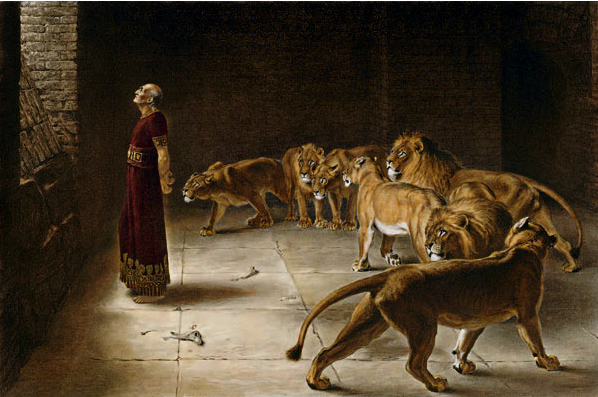
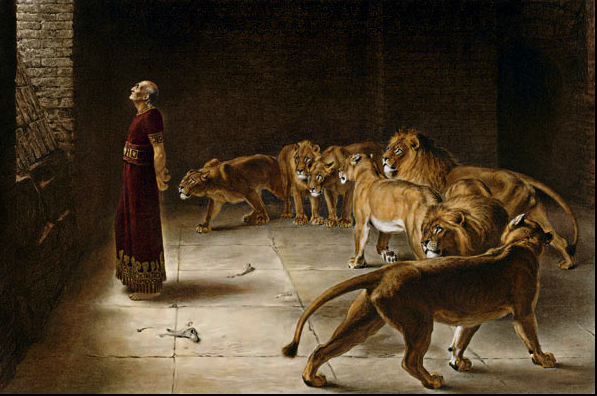
Daniel in the Lions den from chapter 6. Picture: Wikipedia commons
What you don’t know about the development of your end time understanding and how it’s a trap. Your forefathers paved the way for the coming deception that you will face, but you will be given a chance to choose right where they chose wrong.
Most protestants agreed at one point that the institution of the papacy was the Antichrist who would sit in God’s temple showing himself as a God or judge. (2.Thess.2,4). Please see the video below for quotes from historical people to get this confirmed. Their understanding of who Antichrist is was a wake-up call to many Christians and many left the Catholic Church to join the reform movement. They realized they were deceived by a false gospel and a counterfeit Christianity and that the Pope himself was the man of sin.
But one step remained. Protestants still kept the law that the Pope had changed, and they valued this law more than God’s original law. They didn’t obey God before man and tradition. This was the major step that had to be taken in order for God to prepare them for the end time events. Just like John the Baptist had taught Israel this before Christ first coming, God was trying to send the same message to prepare His people for His second coming. Obedience to God’s law was in the Bible always what either made or broke His people (Read all the books in the Bible). It was even the condition for the outpouring of the spirit. (Act, 5:32; Joh 14:15-17) God wanted to take the protestant movement away from the arrogant presumption of the Antichrist power that said they could be in favor with God even when opposing His law, that they could change it as they saw fit, that they were their own lawgivers as they were God’s throne on earth. What the Bible calls the mystery of lawlessness, also translated into Iniquity is from the Greek word ἀνομία (anomia) which literally means ’violation of the law’ or to be without the law. Iniquity and opposing God’s law is the same thing in the Bible. But the remnant protestant movement had long been deceived by the papacy and they were just starting to understand how much. God had great care and patience helping them reform gradually so that it wouldn’t be too hard for them. It was a gradually cleansing process and God is merciful and patient understanding how much emotions and feelings people have tied to traditions. Traditions are what glues families and societies together, and breaking them causes great conflict and distress. And God wanted to do it step by step. But the time had come. The Protestants were losing their glow and becoming worldly. God needed to shake them up and reform them back to His govern and His law. In the mid 19th century another protestant movement awoke thinking Christ second coming was close at hand. Dates were set and although the Bible clearly states dates can’t be set, God had an opportunity to teach people from scripture as many were reaching out to their Bibles and actually studying. They quickly realized that no date could be set yet discovered another unsettling thing. Why were they still keeping doctrines from the Church and regarding them over the Bible? And they started to preach that as long as protestants kept the papal changed version of Gods law they were accepting the authority of the Pope as God’s mediator on earth. Rejecting him as mediator meant rejecting these changes and going back to God’s original law. Either the Papacy held the position as God’s trone on earth or they were deceivers. They remnant group proclaimed that protestants needed to follow Christ, our High Priest, into the Most Holy place and see how the law there still had relevance. They sent people all over the world with the message to Christians to return to God’s original law, they enlightened people on the changes that had been made. The majority of Protestants rejected this message and refused to go back to God’s original law. They saw God in the traditions rather in the Word. Yet their work was not in vain and today 20 million christians around the world have gone back to God’s original law.
All throughout the Bible, being obedient to God gives people a shield from the Devils’ attack. It means God is fighting their battles. Up until then, God had helped the reformation movement but now the movement had rejected God’s authority and chosen to follow the doctrines of men instead. This was a serious decision that left them vulnerable to the enemy. Jesus said He would give the spirit of truth to those who kept His commandments. Those who would refuse would end up believing lies. Actually, those fooled by the Man of Sin sitting in God’s temple showing Himself as god were the ones who were without God’s law. Workers of ANOMIA. This became the faith of the majority of the protestant movement, they would not only reject God’s law as valid, they would even speak against it and work to make others reject it as well. They were now actively encouraging people to be disobedient to God’s law. (Mat 7:21-23 & Mat.5,17-20) Many were teaching their members that they would be lost if they wanted to keep God’s law but saved if they rejected it. They placed the law and Christ as contenders. But in reality, Christ was the law personified. Rejecting the law would eventually mean rejecting Christ. If the two was separated and the law viewed as a deception they would be stuck with a false Christ figure or ending up not knowing Christ for who He is. The apostle John warned against this. (1Jn 5:2-3 & 1Jn 2:1-3)
But now the majority of Protestants were teaching that you could not worship Christ and keep the original law at the same time. This was a new turn in events for evangelicals. Until then they had respected God’s law when they thought it was the original that they were keeping. They had even defended it. But when they learned the law was altered and corrupted by man they started finding an ideology that put God up against His own law. It was clear from this moment that the devil, that old serpent, had in full been given access to the pulpits. The deception had started with the serpent fooling Eve to think she would be blessed by going against God’s command and here the same message was repeated, Salvation and blessings to those keeping traditions and the changed law and Gods curses to those keeping God’s original law. Understand it those who can, but the Protestant world was completely fooled. Even the thought of God’s original laws seemed to scare them. They called it legalistic to keep God’s law but good moral to keep their own version. The image of an upset and crying Jesus, or them crucifying Christ, came before them as their crime if they accepted God’s original law as valid. Every scripture proving this to be an utter lie, as Jesus even asked His followers to be obedient to His commandments, was explained away. But the word was clear: «And hereby we do know that we know him, if we keep his commandments. He that saith, I know him, and keepeth not his commandments, is a liar, and the truth is not in him.» (1Jn 2:3-4) The many scriptures exposing the lie of lawlessness/iniquity was so solid that they were left with only Paul’s writings to defend their view. Paul spoke against the Jewish sacrificial system as a means to atone sin in competition to Christ cross, he never spoke against Gods moral laws and the laws that were to bond Him with His people. For as long as Paul lived the temple service in Jerusalem continued and was a contender to faith in Christ sacrifice. When the temple was destroyed new understandings of Paul’s words seemed valid. Even a warning against misunderstanding Paul is given in the Bible by the apostle Peter. (2.Pet.3,14-18). God saw the future and left a warning. The only author of the Bible whom the Bible itself warns against misunderstanding was made as the sole base of the new understanding that said man had not sinned when they broke God’s law as they were not obligated to keep it. But God doesn’t change. God had been patient. For almost 500 years God had through His servants provided Bibles in peoples own languages. Many had been martyred for spreading them. It was not in vain as the end result was that everyone got the chance to have their own Bible in their own language. God had risen up leaders to reform them step by step and give them the knowledge needed to make the right decision. Now they had been shown their obligation to God’s law and order and willingly chosen opposition. Always when this has happened in the past, God has withdrawn His protection.
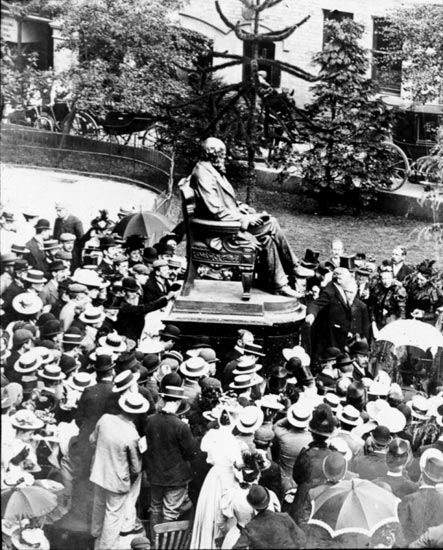
Unveiling of the Darwin Statue outside the former Shrewsbury School building in 1897
Surely enough this is what happened next. After being mostly protected from this Jesuit-created end time understanding it was now about to enter the churches at full speed. The devil had taken control. He had successfully made a large part of the protestant and evangelicals reject God’s authority in favor of man’s idea and traditions. Now he had to preserve them in the deception until it was too late for them to be saved. Triumphally destroying the same people that God so eagerly had tried to save.
At the same time, those preaching they needed to keep God’s law and original Sabbath was proclaiming this message to the world. But they got a new competition set in by the devil. At the same time as they proclaimed: “Fear God, and give glory to him; for the hour of his judgment is come: and worship him that made heaven, and earth, and the sea, and the fountains of waters.” (Rev.14,12) Darwin had started his publications. The first angel of revelation 14 sounded to people to worship God as creator and therefore respect his Sabbath, the fourth commandment. At the same time as they were proclaiming this, the Darwinism and Marxism started their work in convincing people there was either no God or that the creation story in the Bible was wrong and thereby also the premises for keeping Sabbath holy.
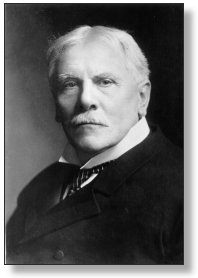
Cyrus I. Scofield
In 1909 started what would forever determine the Protestant view on end time, and to take it away from their original belief. Cyrus I. Scofield enganged in all these views and it was gathered in the Scofield Reference Bible. It was largely through the influence of Scofield’s notes that dispensationalism grew in influence among fundamentalist Christians in the United States. Scofield’s notes on the Book of Revelation are a major source for the various timetables, judgments, and plagues elaborated on by popular religious writers such as Hal Lindsey, Edgar C. Whisenant, and Tim LaHaye. Their writings have lead to popular films such as Left Behind. In this ideology, the Christian churches had a new common enemy. Someone once said: “Nothing unites humans like a common enemy.”
The pope was no longer a threat and slowly the hands between Protestant groups and Papacy could meet. They were now Christian brothers. The ideas that had been made up by Jesuits and planted became accepted as end time facts and many have been taught in this understanding from early on. The papacy had successfully reversed the protestant movement back to themselves enough for them no longer to be threatened by them.
The fight for a Jewish state or to get Jews to go to Palestine continued. If this didn’t happen the theory would eventually be rejected. Did it happen tho, they would all see it as evidence that their interpretation was true and even more would believe it. Maybe even God’s Christian commandment-keeping people would give up and follow.
The Ottoman stronghold had been weakened and Jerusalem was now under the control of the British mandate, a Christian protestant nation.
The Devils’ plan was not over. He knew something the Catholic church and the Protestant movement didn’t. In order to make God’s future message fail, God secret end time proclamation, he had to continue setting up the false end time scenes that he had planted among Protestants and even Catholics. Although he didn’t know Gods future plans fully he had a partial idea of what God would do. But in other parts, the devil was shooting arrows in the dark. The devils best attempt was to make salvation into a matter that had nothing to do with turning from sin and disobedience. To give both Jews and Christians a false sense of security. If it was political or physical genetics before the law in the heart, he could accomplish this.
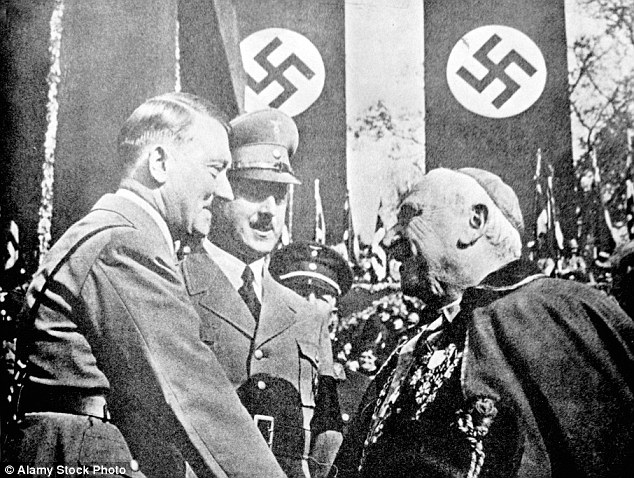
Because the Jews weren’t fighting to get their own state and happy to wait until Messiah came, they had to be pushed in order to do the end time agenda. In order to get the Jews to Palestine the Jews had to be under attack, they were mostly living and thriving in Europe and USA. Slowly the devil stirred up hate and superstition towards the Jews. It was easy as Jews had often been mistreated by Christians in Europe for centuries. It was important to keep Christians and Jews separated in order for Christians not to see that they were following a corrupted Christianity, as Jews upheld a lot of knowledge from the Bible, and to keep Jews from Christians so they didn’t receive Jesus as their Messiah. Because the truth was somewhere in the middle of the two beliefs systems, the devil had to make them opposites to keep them from learning from each other. The devil had long stirred hate between them, when the Jews outnumbered the Christians they persecuted them and later when Christianity became strong in Europe, Jews were persecuted by them. Church councils in the 4th century forbade Christians to take part in Jewish feasts or even forbade Sabbath keeping. Seeing how Christians fought against God’s law Jews were strengthened in the view that Christianity was a deception. Christians viewed the stubbornness of Jews not accepting Jesus as a sign that they were deceived. They had long set the two up against each other. In the early 20th century it was fairly easy to fire people up against the Jews. Sanctions after sanctions were made against them, they were left in despair and their shops and synagogues were vandalized. Adolf Hitler was born Catholic and later had his confirmation in the church. Yet being brought up with a Catholic mentality he also had his own ideas. He also is said to have had great admiration for the Jesuit organization structure and been inspired by it (3 footnote). Hitler did, however, try to obstruct a version of Christianity that was in-between Catholicism and Protestantism. The main belief was that the Old Testament was to be disregarded along with its laws and teachings. Again a mixture Christianity religion rejecting God’s law. His ties to the Church were although several. His background, although rejecting much of Christian belief, bear the similar trades of early Catholicism which also despised Judaism and wanted to break its ties to Christianity. It was this early work of seperating judaic roots from christianity that laid the ground for the Popes Christian religion in Europe. Hitler continued this agenda by showing the same principles while also promoting the ideas of evolution and atheism. The Catholic church has had the custom to do thoroughly historical falsification. That included on making great spiritual leaders seemed Catholics after their death, even though they hadn’t been. But also to break their ties to unpopular leaders once they had become unpopular. But Hitler’s organization and even bad religious ideas had sprung out from Catholicism. According to M. Frederic Hoffet, Hitler, Goebbels, Himmler and most members of the party’s “old guard” were Catholics” (3 footnote). The effects of Hitler in Germany is shown in numbers. Before Hitler Germany was mostly protestant with 67 % Protestants and 33 % Catholics. Only a few years after under the Nazi party the difference was 54% protestants to 40% Catholics. Today in modern Germany 28.6% belong to the Catholic Church and 26.6% to the Evangelical Church. Catholicism has surpassed Protestantism in the land of Martin Luther. The Jews were under attack by the devil and his workers. The devil hated the Jews because they were witnesses of God’s original unchanged law and because they had once been God’s people. And he knew God still loved them and wanted to reach out to them and that they were even closer to the truth then many Christians were. Now he would use them for his agenda. The Jews didn’t have God’s protection because they had refused to receive the prophets God had sent them and also their own King. (Mat.23,37-39) The Jews no longer had atonement. The devil knew his pray was left without “walls” to protect them.
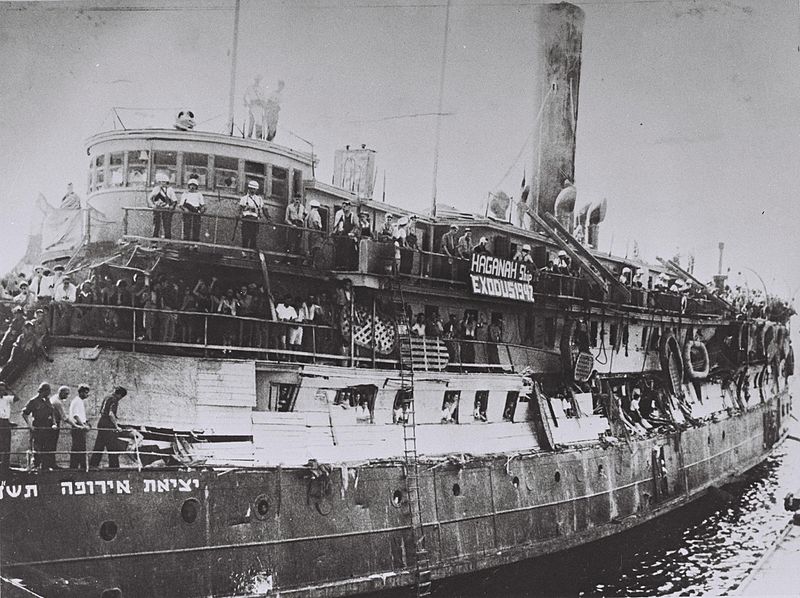
Jews were suffering in Europe and had experienced great trauma. Even before UN gave them land Jews were immigrating to Palestine (Now Israel) This photo shows the boat called SS Exodus carrying over 4000 Jews in 1947.
Through the German Socialist Party and Hitler millions of Jews were treated like animals, starved, tortured, experimented on and lastly killed. When the truth came out the world was abhorred. Even among the worst Jew-haters heads were bowed in shame. It didn’t take long before the United Nations was founded and they decided to give the land back to the Jews. Although the threat against them was removed and the need to move wasn’t really there if they could be restored and honored in their European countries, it was decided they were to be given their own land instead. After the traumatic experience during World War, many Jews were happy to move back trying to make a life for themselves away from the cruel hatred they had suffered. Many were running as fast as they could. After all, what had happened in Europe could happen again? The Jews had their common potential enemy: everyone else. Now they would make their fortress in the land that they once were driven from. However, they weren’t given Jerusalem. What the Jews didn’t know is that they had just gone into another trap.
The Jews were now attacked by the Islamic countries who for long had controlled the temple mount in Jerusalem where the Jewish temple once stood. God had let the Islamic people to protect the mount from a new temple. Although God permitted the Jews to fight off their enemies He did not allow them to take over the temple mount. Although coming on the mount during the war they were quickly told to leave it a Muslim religious site by their own leaders. Many was distressed and didn’t understand the order. But it was given all the same. God let their decision be their rescue. Had they tried to rebuild the temple God would have had to stop them. But now God permitted them to stay in the land in the hope of reaching out to them once more. However if they were to cross the line and try and re-build the temple God would have to intervene, and it wouldn’t be to their favor. They would not get this area for worship before they recognized Jesus as their King as Jesus had prophesied.
For many Christians this was frustrating. They believed Christ could not come unless there was a Jewish temple with an Antichrist in. However, the Devil had not given in. He had two ways he could still deceive the Christian world. He had worked on Catholics and Protestants for a long time to fear the temple furniture and anyone bringing a message from them to be of the Antichrist. They were now ready to reject God’s last message. The devil didn’t need a temple to be built, he could do even worse. He could use what he taught the Protestant world in order to get them to reject the discovery of the Ark of the Covenant and any message coming from it’s hiding place.
Puppets used as a distraction and attention getter to confuse Christians away from the real threat. Their bad moral, devil signs and dressing up as ancient goddesses are made so clear that everyone can see.
To strengthen the mainstream protestant understanding of end time events the devil would continue to create visible common enemies for the Catholics and Protestants. One was the entertainment industry. His puppets would flash symbols and 666 signs and make it so that even a small child would see the occult in these music videos. Many female stars dress up as ancient goddesses while showing illuminati signs. This would help strengthen the belief in the future Antichrist. It would also help continue to draw Catholics together with Protestants in a joint effort to “protect their traditions” and “moral”. The second was to bring Muslims into Europe and US causing another common enemy pushing the Christian world to unite with the real Antichrist, the papal power. It would be the Christians against Islam and not Christians deceiving Christians. Having assumingly enemies on all ends made them unaware of the danger in their midst. But it was the Christian nations that had initially stirred up the hate in Islamic countries, breaking their infrastructure and supporting rebels.
Although many messianic groups would rise and respect God’s law their teachings on the end time events were from the evangelical churches. And messianic communities also helped in sharing these interpretations of the end time.
In 1982 Ron Wyatt found the Ark of The Covenant with Christ blood on it. The discovery was proving Christ was the Messiah, that He died for our transgressions against that very law. Meaning if we are to take part in the atoning blood we need to confess breaking this original law is God’s definition of sin. Which in return means that this is the law that we are measured by. But if we refuse to acknowledge that breaking it is a sin, or we think breaking the papal version is sin instead, we are rejecting the Blood of Atonement. Because Christ blood did not go down over the law the pope changed or the ones the protestant advocate. The blood did not go on the command saying Sunday observance, but the one calling for the Biblical Sabbath observance. God’s definition of Sin is revealed in the law the blood went down upon. This is the transgression Christ saved us from and that we need to repent and convert from. This message, that we need to keep the law that is in the foundation of Gods throne, and seek pardon for our resistance towards His original law, is to go out to the whole world as one last message from God. People will be put on choice. Many Protestants and evangelicals are unaware of the offer to turn back to the law of God that was given to their forefathers and how they rejected this offer. Many are unaware of the origin of their own traditions and practices. How unclean spirits had entered their churches because of their disobedience. But they individually, even though their churches was rejected, have been spared so God could give them the chance to choose right and not do as their spiritual fathers. “Now, lo, if he beget a son, that seeth all his father’s sins which he hath done, and considereth, and doeth not such like, …he shall not die for the iniquity of his father, he shall surely live.» (Eze 18:14 & 17)
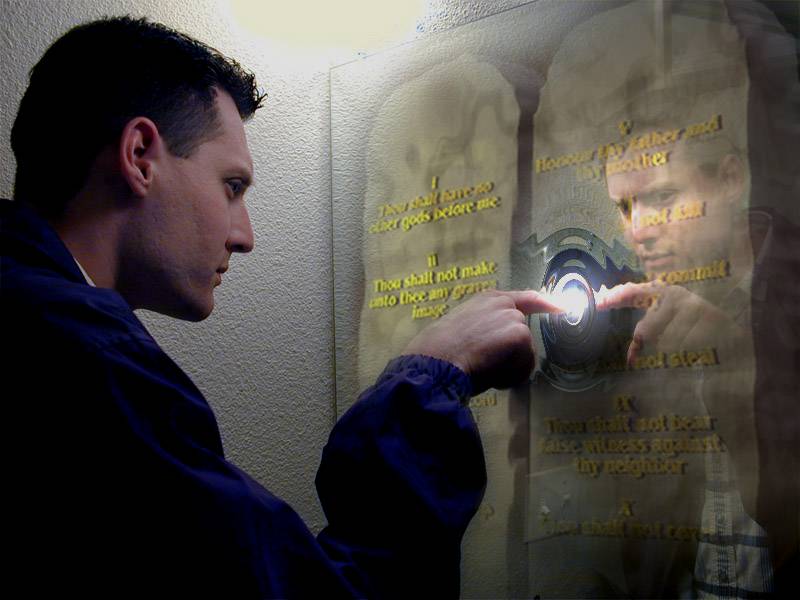
When the ten commandments are shown to the world and they are warned they will be judged by this law if they don’t repent and confess their sins and give them to Jesus, the whole world will for a short time give it attention and evaluate the message. The last plagues coming over the earth is the judgment of the law, that the one on earth is a copy of. (Rev.15,5-8) For a moment it will seem like the whole world will receive this message. Hearts will break over Christ great sacrifice, they briefly comprehend that the original law of God is still valid and what they will be judged by. The majority almost turn from their past understanding.
How does the Devils plot work to ruin this? This is what might happen or can be the consequence of the false end time understanding: What may be the Devils’ final card is played out. Just like he had prepared the Pharisees and Scribes to reject Christ and having them thinking he was of the devil and calling him Beelzebub, and by giving them a false understanding of Gods mission and the events around Christ coming, he now have prepared the Christian world to do the same. Angels and men will work together in bringing the discovery of the Ark of the Covenant out to the world. The devil will send his angels pretending to be people such as Elijah or the disciples to tell the Christian world that this is the deception they had been warned against. (2Co 11:14-15, Rev.19,20) They might say: “This was the temple Antichrist would fool people from, not a newly built one.” “Here is the temple furniture, here is the Ark. Here is also the Antichrist hiding, sending out his messengers.” That papacy has no other choice, their whole organization will fall apart if people accept this as truth and they will be exposed as liars. The same with Protestant leaders. Just like the leaders in the time of Christ saw all Christ did that revealed His divine origin, they hardened their hearts and decided to go against Him anyway calling Him of the Devil. It was the only way for them to save face as Christ had exposed them. History tends to repeat itself. The dragon will unite with the beast (Catholicism) and the false prophet (false Protestantism) to all work against the message from this discovery making it seem like a deception. Everyone’s fear will alarm. For long the devil have fooled this understanding on to them and told them that keeping God’s law was sinful or even a deception. Now they believe they had been almost fooled and the majority again chooses to believe the lie. The law from the old testament is seen as an attack on Christ. The seemingly heavenly sent messages will perhaps even claim that Jesus had given the Pope authority to change his law. That we should have listened to these leaders. People will call the message from the cave on the mount for the works of Beelzebub and of demons. Because they have rejected God’s law they have no measuring rod to know deception from truth. (Pro.2,1-12, Isa.8,20) If they were true to God’s authority and law they would easily know who the serpent in the tree was and what message was from God. But they love not the truth. They want the lie to be the truth and these agencies of the devil are preferred over the ones giving God’s last warning and offer of salvation. Their anger is directed towards the people sharing these things. The devil had even planted people sharing these things that now turn around and warn against it along with the others. If even those who had been in the lead preaching it accepts it was a deception then surely the remaining are just being stubborn. The deception is overwhelming. A small majority refuse to go against God’s law. Even an apperantly ‘angel of light’ cannot take them from obedience to God and the everlasting gospel (2Co.11:14). They take heed to God’s warnings in the Torah and Christ own warnings. That signs and wonders are not to be followed if it goes against God’s law. (2Th.2:9-10) They will stand upright and wait for the Lord rather follow the excitement of the world as the false witnesses work their wonders. They know that the dispute has always been about God’s law. And that Revelation 14 clearly warns that those who take the Mark of the Beast are disobedient to God and those that don’t are they «that keep the commandments of God, and the faith of Jesus.» (Rev.14,12)
Finally, the devil pretends to be Christ. (Mat.24,5) He has prepared his own way. Now that he has convinced that the Antichrist spirit had been at works in the temple “cave” and the message from there that he claims were to fool people into the old covenant, “Christ can come”. And he pretends he is Christ. But in order for him to set up his true kingdom here on earth, he tells people that the resistance must be dealt with. (Rev.13,17) He explains that the changed law was from him and perhaps he will even say that the pope had authority from him to change it and that the little group of protesters are deceiving them and are just being rebellious. Not only those who continue to share it, but that the Antichrist is still present in that cave with the Ark and the other sanctuary items. The door of mercy has quietly been shut as man has chosen the lie over the truth. (Heb.10,26-30, 1.Jhn 5,8-9; 1.Tim.2,6) Once again the serpent in disguise has convinced man that they need not keep God’s law and that they will even have life and prosper when breaking it. They eat the fruit he offers. That good will come out of breaking it. And that bad things now will come over those respecting it. The plagues in the world is said to be the remnants fault. But the plagues fall on them and not on God’s people (Rev.16).
The devil is convincing as Jesus, he reflects goodness and kindness. And the many Christians that believed the lie of lawlessness are greatly angered at not only those who preached obedience to God’s law as it’s written in the Bible, but to the mysticism around the cave in Jerusalem containing the sanctuary items. The more they have turned against God the more they hate the testimony inside this cave. People start to chase down God’s remnant people to defuse them and help the false Christ to establish His kingdom and the war of Armageddon is about to take place. The beasts, the false prophet and the dragon who tricked them, and the kings of the east, all storm against Gods throne in Jerusalem. Thinking if they overthrow it, get rid of the Antichrist they claim is represented there, Christ kingdom can begin. They want to help the false Christ, but in reality, they are attacking God’s throne on earth and His law and everything it stands for. They are battling against God. «And I saw three unclean spirits like frogs come out of the mouth of the dragon, and out of the mouth of the beast, and out of the mouth of the false prophet For they are the spirits of devils, working miracles, which go forth unto the kings of the earth and of the whole world, to gather them to the battle of that great day of God Almighty.» (Rev 16:13-14)
Before this events, God had already sent help to His people. Their angry enemies are slowed down and kept busy by the plagues sent over the earth. Now during the sixth plague, they all come up against Jerusalem. Armageddon is a name from the Hebrew words HAR and MEGGIDO which translates ‘the mountain of gathering’. The Mountain of Gathering was in the past Jerusalem, and it was tied to God’s temple. Now they attack God by attacking the Ark of the Covenant, God’s throne on earth with the blood of Christ on it. They also attack God by persecuting His faithful who keep God’s law and not the man-made one. But they cannot battle God. He intervenes in the events and stops them. The law is shown to the world yet again, the real law, the one written by the hand of God. Everyone now realizes they have been deceived and was fighting against God Himself. That they had stepped on Christ blood. (Heb.10,29-31) When given an opportunity to step on God’s law they took it and did it. They followed the serpents lies and they had even been warned. Graves are opened. Christ is coming back to save His people, gather them and revenge His enemies. (1.Thess.4,13-18; Luke 21,27 & 23,30, Rev.20,10 & Rev 14,14-20) There is no division or separation. Christians going to heaven and Jews reigning on earth. There was only ever one way to be saved for all man, one, and one outcome. For those Jews that didn’t choose the truth, it’s now too late. But Jews are more likely to receive the truth in the discovery that many Christians as they have a better understanding of the purpose of God’s law. Most likely many Jews will be among those standing on God’s side in the end.
The series of events that lead up to this was God working for a long time in reforming and cleansing a people, while those who refused to receive light and be obedient to God was overpowered with the devils lies. (Dan.12,10) Because of this false interpretation, many although attracted to the truth, will out of fear and indoctrination chose the devils side in the last conflict. This is why I am giving out this warning and letting you know where this plot came from and what is about to happen.
There is only one thing that is important in the end time. To have the commandments of God and the faith of Jesus. (Rev.14,12) Those who are not part of this group will be part of the group that is deceived. The truth is very simple, it’s the lie that is complicated. The truth tells you to simply trust God, the Blood, and His law. The lie is a web of lies and interpretations and excuses not to do what God bids.
The devil has used three beasts to work on his end time deception. The beast out of the bottomless pit, the beast out of the sea and the beast out of the earth all played their part. Now you have the opportunity to seek God today, to turn away from iniquity (to be without law, God’s law) and seek pardon for your transgression through the blood of Christ. The moment you do make this decision God will build a wall around you and protect you from being fooled by any of the Devils games and lies that will come in the end time. But the moment you do you will also become the Devils target. “And the dragon was wroth with the woman, and went to make war with the remnant of her seed, which keeps the commandments of God, and have the testimony of Jesus Christ.» (Rev 12:17) You will be the Devils target, but you will also be under God’s protection. “choose you this day whom ye will serve» (Jos.24,15)
_______________________________________
(1) Napoleon on the Jesuit Order of the Catholic Church: “The Jesuits are a MILITARY organization, not a religious order. Their chief is a general of an army, not the mere father abbot of a monastery. And the aim of this organization is power – power in its most despotic exercise – absolute power, universal power, power to control the world by the volition of a single man. Jesuitism is the most absolute of despotisms – and at the same time the greatest and most enormous of abuses.”
(2) Napoleon’s written declaration to be made affect when Napoleon conquered Jerusalem. He failed at his atempt: «The young army with which Providence has sent me hither, let by justice and accompanied by victory, has made Jerusalem my headquarters and will, within a few days, transfer them to Damascus, a proximity which is no longer terrifying to David’s city. Rightful heirs of Palestine! The great nation which does not trade in men and countries as did those which sold your ancestors unto all people (Joel,4,6) herewith calls on you not indeed to conquer your patrimony; nay, only to take over that which has been conquered and, with that nation’s warranty and support, to remain master of it to maintain it against all comers. Arise! Show that the former overwhelming might of your oppressors has but repressed the courage of the descendants of those heroes who alliance of brothers would have done honour even to Sparta and Rome (Maccabees 12, 15) but that the two thousand years of treatment as slaves have not succeeded in stifling it. Hasten!, Now is the moment, which may not return for thousands of years, to claim the restoration of civic rights among the population of the universe which had been shamefully withheld from you for thousands of years, your political existence as a nation among the nations, and the unlimited natural right to worship Jehovah in accordance with your faith, publicly and most probably forever (Joel 4,20).» (Letter to the Jewish Nation from the French Commander-in-Chief Buonaparte (translated from the Original, 1799) General Headquarters, Jerusalem 1st Floreal, April 20th, 1799, in the year of 7 of the French Republic)
(3) “At a time when the heads of the major nations in the world faced the new Germany with cool reserve and considerable suspicion, the Catholic Church, the greatest moral power on earth, through the Concordat expressed its confidence in the new German government.” – Guenter Lewy, The Catholic Church and Nazi Germany.
‘Mein Kampf were already realized; this book, an insolent challenge to the western democracies, was written by the Jesuit Father Staempfle and signed by Hitler. For—as so many ignore the fact—it was the Society of Jesus which perfected the famous Pan-German programme as laid out in this book, and the Fuhrer endorsed it.” The Secret History of the Jesuits Page 138
“I learned much from the Order of the Jesuits”, said Hitler… “Until now, there has never been anything more grandiose, on the earth, than the hierarchical organization of the Catholic Church. I transferred much of this organization into my own party… I am going to let you in on a secret… I am founding an Order… In my “Burgs” of the Order, we will raise up a youth which will make the world tremble… Hitler then stopped, saying that he couldn’t say any more..” Hermann Rauschning, former national-socialist chief of the government of Dantzig: “Hitler m’a dit”, (Ed. Co-operation, Paris 1939, pp.266, 267, 273 ss).
Spanish dictator, Franco, published following Hitler’s death. It said, “Adolf Hitler, son of the Catholic Church, died while defending Christianity.” It goes on to say, “Over his mortal remains stands his victorious moral figure. With the palm of the martyr, God gives Hitler the laurels of Victory.”
Hitler, Goebbels, Himmler and most members of the party’s “old guard” were Catholics”, wrote M. Frederic Hoffet……… On that subject, nothing is more instructive than Joseph Goebbel’s works. He had been brought up in a Jesuit college and was a seminarist before devoting himself to literature and politics… Every page, every line of his writings recall the teaching of his masters; so he stresses obedience… the contempt for truth… “Some lies are as useful as bread!” he proclaimed by virtue of a moral relativism extracted from Ignatius of Loyola’s writings…” Frederic Hoffet: “L’lmperialisme protestant” (Flammarion, Paris 1948, pp.172 ss).
“VERSE 1. In the third year of the reign of Jehoiakim king of Judah came Nebuchadnezzar king of Babylon unto Jerusalem, and besieged it. 2. And the Lord gave Jehoiakim king of Judah into his hand, with part of the vessels of the house of God; which he carried into the land of Shinar to the house of his god; and he brought the vessels into the treasure-house of his god.”
With a directness characteristic of the sacred writers, Daniel enters at once upon his subject. He commences in the simple, historical style, his book, with the exception of a portion of chapter 2, being of a historical nature till we reach the seventh chapter, when the prophetical portion, more properly so called, commences. Like one conscious of uttering only well-known truth, he proceeds at once to state a variety of particulars by which his accuracy could 24 at once be tested. Thus in the two verses quoted, he states five particulars purporting to be historical facts, such as no writer would be likely to introduce into a fictitious narrative: (1) That Jehoiakim was king of Judah; (2) That Nebuchadnezzar was king of Babylon; (3) That the latter came against the former; (4) That this was in the third year of Jehoiakim’s reign; and (5) That Jehoiakim was given into the hand of Nebuchadnezzar, who took a portion of the sacred vessels of the house of God, and carrying them to the land of Shinar, the country of Babylon (Gen.10:10) placed them in the treasure-house of his heathen divinity. Subsequent portions of the narrative abound as fully in historical facts of a like nature.
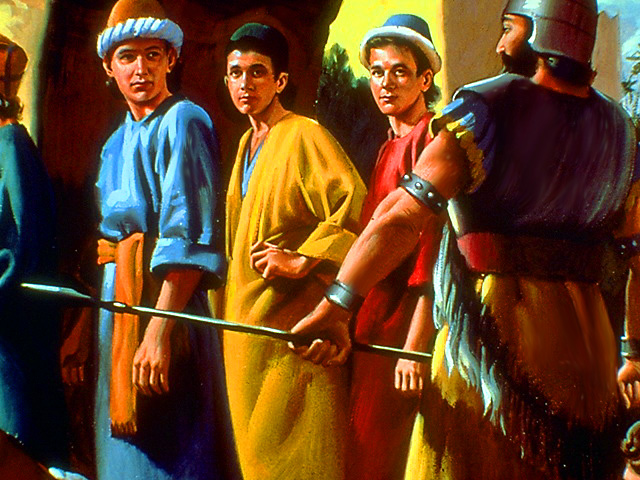
This overthrow of Jerusalem was predicted by Jeremiah, and immediately accomplished, B.C.606. Jer.25:8-11. Jeremiah places this captivity in the fourth year of Jehoiakim, Daniel in the third. This seeming discrepancy is explained by the fact that Nebuchadnezzar set out on his expedition near the close of the third year of Jehoiakim, from which point Daniel reckons. But he did not accomplish the subjugation of Jerusalem till about the ninth month of the year following; and from this year Jeremiah reckons. (Prideaux,Vol.I,pp.99,100.) Jehoiakim, though bound for the purpose of being taken to Babylon, having humbled himself, was permitted to remain as ruler in Jerusalem, tributary to the king of Babylon. This was the first time Jerusalem was taken by Nebuchadnezzar. Twice subsequently, the city, having revolted, was captured by the same king, being more severely dealt with each succeeding time. Of these subsequent overthrows, the first was under Jehoiachin, son of Jehoiakim, B.C.599, when all the sacred vessels were either taken or destroyed, and the best of the inhabitants, with the king, were led into captivity. The second was under Zedekiah, when the city endured the most formidable siege it ever sustained, except that by Titus, in A.D.70. During the two years’ continuance of this siege, the inhabitants of the city suffered all the horrors of extreme famine. At length the garrison and king, attempting to escape from the city, were captured by the Chaldeans. The sons of the king were slain before his face. His eyes were put out, and he was taken to Babylon; and thus was fulfilled the prediction of Ezekiel, who declared that he should be carried to Babylon, and die there, but yet should not see the place. Eze. 12:13. The city and temple were at this time utterly destroyed, and the entire population of the city and country, with the exception of a few husbandmen, were carried captive to Babylon, B.C.588. Such was God’s passing testimony against sin. Not that the Chaldeans were the favorites of Heaven but God made use of them to punish the iniquities of his people. Had the Israelites been faithful to God, and kept his Sabbath, Jerusalem would have stood forever. Jer.17:24-27. But they departed from him, and he abandoned them. They first profaned the sacred vessels by sin, in introducing heathen idols among them; and he then profaned them by judgments, in letting them go as trophies into heathen temples abroad. During these days of trouble and distress upon Jerusalem, Daniel and his companions were nourished and instructed in the palace of the king of Babylon; and though captives in a strange land, they were doubtless in some respects much more favorably situated than they could have been in their native country.
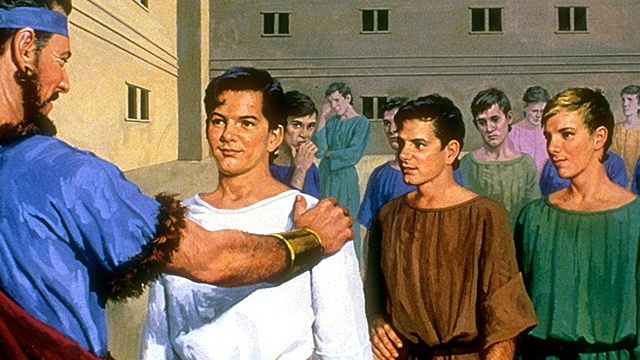
“VERSE 3. And the king spake unto Ashpenaz the master of his eunuchs, that he should bring certain of the children of Israel, and of the king’s seed, and of the princes; 4. Children in whom was no blemish, but well favored, and skilful in all wisdom, and cunning in knowledge, and understanding science, and such as had ability in them to stand in the king’s palace, and whom they might teach the learning and the tongue of the Chaldeans. 5. And the king appointed them a daily provision of the king’s meat, and of the wine which he drank; so nourishing them three years, that at the end thereof they might stand before the king.”
We have in these verses the record of the probable fulfilment of the announcement of coming judgments made to King Hezekiah by the prophet Isaiah, more than a hundred years before. When this king had vaingloriously shown to the messengers of the king of Babylon all the treasures and holy things of his palace and kingdom, he was told that all these good things should be carried as trophies to the city of Babylon, and nothing should be left; and that even his own children, his descendants, should be taken away, and be eunuchs in the palace of the king there. 2Kings 20:14-18. It is probable that Daniel and his companions were treated as indicated in the prophecy; at least we hear nothing of their posterity, which can be more easily accounted for on this hypothesis than on any other, though some think that the term eunuch had come to signify office rather than condition. The word children, as applied to these captives, is not to be confined to the sense to which it is limited at the present time. It included youth also. And we learn from the record that these children were already skilful in all wisdom, cunning in knowledge, and understanding science, and had ability in them to stand in the king’s palace. In other words they had already acquired a good degree of education, and their physical and mental powers were so far developed that a skilful reader of human nature could form quite an accurate estimate of their capabilities. They are supposed to have been about eighteen or twenty years of age. In the treatment which these Hebrew captives received, we see an instance of the wise policy and the liberality of the rising king, Nebuchadnezzar.
1. Instead of choosing, like too many kings of later times, means for the gratification of low and base desires, he chose young men who should be educated in all matters pertaining to the kingdom, that he might have efficient help in administering its affairs. 2. He appointed them daily provision of his own meat and wine. Instead of the coarse fare which some would have thought good enough for captives, he offered them his own royal viands. For the space of three years, they had all the advantages the kingdom could afford. Though captives, they were royal children, and they were treated as such by the humane king of the Chaldeans. The question may be raised, why these persons were selected to take part, after suitable preparation, in the affairs of the kingdom. Were there not enough native Babylonians to fill these positions of trust and honor? It could have been for no other reason than that the Chaldean youth could not compete with those of Israel in the qualifications, both mental and physical, necessary to such a position.
“VERSE 6. Now among these were the children of Judah, Daniel, Hananiah, Mishael, and Azariah: 7. Unto whom the prince of the eunuchs gave names; for he gave unto Daniel the name of Belteshazzar; and to Hananiah, of Shadrach; and to Mishael, of Meshach; and to Azariah, of Abednego.”
This change of names was probably made on account of the signification of the words. Thus, Daniel signified, in the Hebrew, God is my judge; Hananiah, gift of the Lord; Mishael, he that is a strong God; and Azariah, help of the Lord. These names, each having some reference to the true God, and signifying some connection with his worship, were changed to names the definition of which bore a like relation to the heathen divinities and worship of the Chaldeans. Thus Belteshazzar, the name given to Daniel, signified keeper of the hid treasures of Bel; Shadrach, inspiration of the sun (which the Chaldeans worshiped); Meshach, of the goddess Shaca (under which name Venus was worshiped); and Abednego, servant of the shining fire (which they also worshiped).
“VERSE 8. But Daniel purposed in his heart that he would not defile himself with the portion of the king’s meat, nor with the wine which he drank; therefore he requested of the prince of the eunuchs that he might not defile himself. 9. Now God had brought Daniel into favor and tender love with the prince of the eunuchs. 10. And the prince of the eunuchs said unto Daniel, I fear my lord the king, who had appointed your meat and your drink; for why should he see your faces worse liking than the children which are of your sort? then shall ye make me endanger my head to the king. 11. Then said Daniel to Melzar, whom the prince of the eunuchs had set over Daniel, Hananiah, Mishael, and Azariah, 12. Prove thy servants, I beseech thee, ten days; and let them give us pulse to eat, and water to drink. 13. Then let our countenances be looked upon before thee, and the countenance of the children that eat of the portion of the king’s meat; and as thou seest, deal with thy servants. 14. So he consented to them in this matter, and proved them ten days. 15. And at the end of ten days their countenances appeared fairer and fatter in flesh than all the children which did eat of the portion of the king’s meat. 16. Thus Melzar took away the portion of their meat, and the wine that they should drink; and gave them pulse.” 29
Nebuchadnezzar appears upon this record wonderfully free from bigotry. It seems that he took no means to compel his royal captives to change their religion. Provided they had some religion, he seemed to be satisfied, whether it was the religion he professed or not. And although their names had been changed to signify some connection with heathen worship, this may have been more to avoid the use of Jewish names by the Chaldeans than to indicate any change of sentiment or practice on the part of those to whom these names were given. Daniel purposed not to defile himself with the king’s meat nor with his wine. Daniel had other reasons for this course than simply the effect of such a diet upon his physical system, though he would derive great advantage in this respect from the fare he proposed to adopt. But it was frequently the case that the meat used by the kings and princes of heathen nations, who were often the high priests of their religion, was first offered in sacrifice to idols, and the wine they used, poured out as a libation before them; and again, some of the meat of which they made use, was pronounced unclean by the Jewish law; and on either of these grounds Daniel could not, consistently with his religion, partake of these articles; hence he requested, not from any morose or sullen temper, but from conscientious scruples, that he might not be obliged to defile himself; and he respectfully made his request known to the proper officer. The prince of the eunuchs feared to grant Daniel’s request, since the king himself had appointed their meat. This shows the great personal interest the king took in these persons. He did not commit them to the hands of his servants, telling them to care for them in the best manner, without himself entering into details; but he himself appointed their meat and drink. And this was of a kind which it was honestly supposed would be best for them, inasmuch as the prince of the eunuchs thought that a departure from it would render them poorer in flesh and less ruddy of countenance than those who continued it; and thus he would be brought to account for neglect or ill-treatment of them, and so lose his head. Yet it was equally well understood that if they maintained good physical conditions, the 30 king would take no exception to the means used, though it might be contrary to his own express direction. It appears that the king’s sincere object was to secure in them, by whatever means it could be done, the very best mental and physical development that could be attained. How different this from the bigotry and tyranny which usually hold supreme control over the hearts of those who are clothed with absolute power. In the character of Nebuchadnezzar we shall find many things worthy of our highest admiration.
Daniel requested pulse and water for himself and his three companions. Pulse is a vegetable food of the leguminous kind, like peas, beans, etc. Bagster says, “Zeroim denotes all leguminous plants, which are not reaped, but pulled or plucked, which, however wholesome, were not naturally calculated to render them fatter in flesh than the others.” A ten days’ trial of this diet resulting favorably, they were permitted to continue it during the whole course of their training for the duties of the palace. Their increase in flesh and improvement in countenance which took place during these ten days can hardly be attributed to the natural result of the diet; for it would hardly produce such marked effects in so short a time. Is it not much more natural to conclude that this result was produced by a special interposition of the Lord, as a token of his approbation of the course on which they had entered, which course, if persevered in, would in process of time lead to the same result through the natural operation of the laws of their being?
“VERSE 17. As for these four children, God gave them knowledge and skill in all learning and wisdom; and Daniel had understanding in all visions and dreams. 18. Now at the end of the days that the king had said that he should bring them in, then the prince of the eunuchs brought them in before Nebuchadnezzar. 19. And the king communed with them; and among them all was found none like Daniel, Hananiah, Mishael, and Azariah; therefore stood they before the king. 20. And in all matters of wisdom and understanding that the king inquired of them, he found them ten times better than all the magicians and astrologers that were in all his realm. 21. And Daniel continued even unto the first year of king Cyrus.”
To Daniel alone seems to have been committed an understanding in visions and dreams. But the Lord’s dealing with 31 Daniel in this respect does not prove the others any the less accepted in his sight. Preservation in the midst of the fiery furnace was as good evidence of the divine favor as they could have had. Daniel probably had some natural qualifications that peculiarly fitted him for this special work. The same personal interest in these individuals heretofore manifested by the king, he still continued to maintain. At the end of the three years, he called them to a personal interview. He must know for himself how they had fared, and what proficiency they had made. This interview also shows the king to have been a man well versed in all the arts and sciences of the Chaldeans, else he would not have been qualified to examine others therein. As the result, recognizing merit wherever he saw it, without respect to religion or nationality, he acknowledged them to be ten times superior to any in his own land. And it is added that Daniel continued even unto the first year of King Cyrus. This is an instance of the somewhat singular use of the word unto, or until, which occasionally occurs in the sacred writings. It does not mean that he continued no longer than to the first year of Cyrus, for he lived some years after the commencement of his reign; but this is the time to which the writer wished to direct special attention, as it brought deliverance to the captive Jews. A similar use of the word is found in Ps.112:8 and Matt.5:18.
“VERSE 1. And in the second year of the reign of Nebuchadnezzar, Nebuchadnezzar dreamed dreams, wherewith his spirit was troubled, and his sleep brake from him.”
Daniel was carried into captivity in the first year of Nebuchadnezzar. For three years he was placed under instructors, during which time he would not, of course, be reckoned among the wise men of the kingdom, nor take part in public affairs. Yet in the second year of Nebuchadnezzar, the transactions recorded in this chapter took place. How, then, could Daniel be brought in to interpret the king’s dream in his second year? The explanation lies in the fact that Nebuchadnezzar reigned for two years conjointly with his father, Nabopolassar. From this point the Jews reckoned, while the Chaldeans reckoned from the time he commenced 33 to reign alone, on the death of his father. Hence, the year here mentioned was the second year of his reign according to the Chaldean reckoning, but the fourth according to the Jewish. It thus appears that the very next year after Daniel had completed his preparation to participate in the affairs of the Chaldean empire, the providence of God brought him into sudden and wonderful notoriety throughout all the kingdom.
“VERSE 2. Then the king commanded to call the magicians, and the astrologers, and the sorcerers, and the Chaldeans, for to show the king his dream. So they came and stood before the king.”
Magicians were such as practiced magic, using the term in its bad sense; that is, they practiced all the superstitious rites and ceremonies of fortune-tellers, casters of nativities, etc. Astrologers were men who pretended to foretell future events by the study of the stars. The science, or the superstition, of astrology was extensively cultivated by the Eastern nations of antiquity. Sorcerers were such as pretended to hold communication with the dead. In this sense, we believe, it is always used in the Scriptures. Modern Spiritualism is simply ancient heathen sorcery revived. The Chaldeans here mentioned were a sect of philosophers similar to the magicians and astrologers, who made psychic, divinations, etc., their study. All these sects or professions abounded in Babylon. The end aimed at by each was the same; namely, the explaining of mysteries and the foretelling of future events, the principal difference between them being the means by which they sought to accomplish their object. The king’s difficulty lay equally within the province of each to explain; hence he summoned them all. With the king it was an important matter. He was greatly troubled, and therefore concentrated upon the solution of his perplexity the whole wisdom of his realm.
“VERSE 3. And the king said unto them, I have dreamed a dream, and my spirit was troubled to know the dream. 4. Then spake the Chaldeans to the king in Syriac, O king, live forever; tell they servants the dream, and we will show the interpretation.”
Whatever else the ancient magicians and astrologers may have been efficient in, they seem to have been thoroughly 34 schooled in the art of drawing out sufficient information to form a basis for some shrewd calculation, or of framing their answers in so ambiguous a manner that they would be equally applicable, let the event turn either way. In the present case, true to their cunning instincts, they called upon the king to make known to them his dream. If they could get full information respecting this, they could easily agree on some interpretation which would not endanger their reputation. They addressed themselves to the king in Syriac, a dialect of the Chaldean language which was used by the educated and cultured classes. From this point to the end of chapter 7, the record continues in Chaldaic.
“VERSE 5. The king answered and said to the Chaldeans, The thing is gone from me; if ye will not make known unto me the dream, with the interpretation thereof, ye shall be cut in pieces, and your houses shall be made a dunghill. 6. But if ye show the dream, and the interpretation thereof, ye shall receive of me gifts and rewards and great honor; therefore show me the dream, and the interpretation thereof. 7. They answered again and said, Let the king tell his servants the dream, and we will show the interpretation of it. 8. The king answered and said, I know of certainty that ye would gain the time, because ye see the thing is gone from me. 9. But if ye will not make known unto me the dream, there is but one decree for you; for ye have prepared lying and corrupt words to speak before me, till the time be changed; therefore tell me the dream, and I shall know that ye can show me the interpretation thereof. 10. The Chaldeans answered before the king, and said, There is not a man upon the earth that can show the king’s matter; therefore there is no king, lord, nor ruler, that asked such things at any magician, or astrologer, or Chaldean. 11. And it is a rare thing that the king requireth, and there is none other that can show it before the king, except the gods, whose dwelling is not with flesh. 12. For this cause the king was angry and very furious, and commanded to destroy all the wise men of Babylon. 13. And the decree went forth that the wise men should be slain; and they sought Daniel and his fellows to be slain.”
These verses contain the record of the desperate struggle between the wise men, so called, and the king; the former seeking some avenue of escape, seeing they were caught on their own ground, and the latter determined that they should make known his dream, which was no more than their profession would warrant him in demanding. Some have severely censured Nebuchadnezzar in this matter, as acting the part of 35 a heartless, unreasonable tyrant. But what did these magicians profess to be able to do ? – To reveal hidden things; to foretell future events; to make known mysteries entirely beyond human foresight and penetration; and to do this by the aid of supernatural agencies. If, then, their claim was worth anything, could they not make known to the king what he had dreamed ? – They certainly could. And if they were able, knowing the dream, to give a reliable interpretation thereof, would they not also be able to make known the dream itself when it had gone from the king ? – Certainly, if there was any virtue in their pretended intercourse with the other world. There was therefore nothing unjust in Nebuchadnezzar’s demand that they should make known his dream. And when they declared (verse 11) that none but the gods whose dwelling was not with flesh could make known the king’s matter, it was a tacit acknowledgment that they had no communication with these gods, and knew nothing beyond what human wisdom and discernment could reveal. For this cause, the king was angry and very furious. He saw that he and all his people were being made the victims of deception. He accused them (verse 9) of endeavoring to dally along till the “time be changed,” or till the matter had so passed from his mind that his anger at their duplicity should abate, and he would either recall the dream himself, or be unsolicitous whether it were made known and interpreted or not. And while we cannot justify the extreme measures to which he resorted, dooming them to death, and their houses to destruction, we cannot but feel a hearty sympathy with him in his condemnation of a class of miserable impostors. severity of his sentence was probably attributable more to the customs of those times than to any malignity on the part of the king. Yet it was a bold and desperate step. Consider who these were who thus incurred the wrath of the king. They were numerous, opulent, and influential sects. Moreover, they were the learned and cultivated classes of those times; yet the king was not so wedded to his false religion as to spare it even with all this influence in its favor. If the system was one of fraud and imposition, it must fall, however high its votaries might stand in numbers or position, or however many of them might be involved in its ruin. The king would be no party to dishonesty or deception.
“VERSE 14. Then Daniel answered with counsel and wisdom to Arioch the captain of the king’s guard, which was gone forth to slay the wise men of Babylon. 15. He answered and said to Arioch the king’s captain, Why is the decree so hasty from the king? Then, Arioch made the thing known to Daniel. 16. Then Daniel went in, and desired of the king that he would give him time, and that he would show the king the interpretation. 17. Then Daniel went to his house, and made the thing known to Hananiah, Mishael, and Azariah, his companions; 18. That they would desire mercies of the God of heaven concerning this secret; that Daniel and his fellows should not perish with the rest of the wise men of Babylon.”
In this narrative we see the providence of God working in several remarkable particulars. 1. It was providential that the dream of the king should leave such a powerful impression upon his mind as to raise him to the greatest height of anxiety, and yet the thing itself should be held from his recollection. This led to the complete exposure of the false system of the magicians and other pagan teachers; for when put to the test to make known the dream, it was found that they were unable to do what their profession made it incumbent on them to do. 2. It was remarkable that Daniel and his companions, so lately pronounced by the king ten times better than all his magicians and astrologers, should not sooner have been consulted at all, in this matter. But there was a providence in this. Just as the dream was held from the king, so he was unaccountably held from appealing to Daniel for a solution of the mystery. For had he called on Daniel at first, and had he at once made known the matter, the magicians would not have been brought to the test. But God would give the heathen systems of the Chaldeans the first chance. He would let them try, and ignominiously fail, and confess their utter incompetency, even under the penalty of death, that they might be the better prepared to acknowledge his hand when he should finally reach it down in behalf of his captive servants, and for the honor of his own name. 3. It appears that the first intimation Daniel had of the matter was the presence of the executioners, come for his arrest. His own life being thus at stake, he would be led to seek the Lord with all his heart till he should work for their deliverance. Daniel gains his request of the king for time to consider the matter, – a privilege which probably none of the magicians could have secured, as the king had already accused them of preparing lying and corrupt words, and of seeking to gain time for this very purpose. Daniel at once went to his three companions, and engaged them to unite with him in desiring the mercy of the God of heaven concerning this secret. He could have prayed alone, and doubtless would have been heard; but then, as now, in the union of God’s people there is prevailing power; and the promise of the accomplishment of that which is asked, is to the two or three who shall agree concerning it. Matt.18:19,20.
“VERSE 19. Then was the secret revealed unto Daniel in a night vision. Then Daniel blessed the God of heaven. 20. Daniel answered and said, Blessed be the name of God forever and ever; for wisdom and might are his; 21. And he changeth the times and the seasons; he removeth kings, and setteth up kings; he giveth wisdom unto the wise, and knowledge to them that know understanding; 22. He revealeth the deep and secret things; he knoweth what is in the darkness, and the light dwelleth with him. 23. I thank thee, and praise thee, O thou God of my fathers, who hast given me wisdom and might, and hast made known unto me now what we desired of thee; for thou hast now made known unto us the king’s matter.
Whether or not the answer came while Daniel and his companions were yet offering up their petitions, we are not informed. If it did, it shows their importunity in the matter; for it was through a night vision that God revealed himself in their behalf, which would show that they continued the supplications, as might reasonably be inferred, far into the night, and ceased not till the answer was obtained. Or, if their season of prayer had closed, and God at a subsequent time sent the answer, it would show us that, as is sometimes the case, prayers are not unavailing though not immediately answered. Some think the matter was made known to Daniel by his dreaming the same dream that Nebuchadnezzar had dreamed; but 39 Matthew Henry considers it more probable that “when he was awake, and continuing instant in prayer, and watching in the same, the dream itself and the interpretation of it were communicated to him by the ministry of an angel, abundantly to his satisfaction.” The words “night vision” mean anything that is seen, whether through dreams or visions. Daniel immediately offered up praise to God for his gracious dealing with them; and while his prayer is not preserved, his responsive thanksgiving is fully recorded. God is honored by our rendering him praise for the things he has done for us, as well as by our acknowledging through prayer our need of his help. Let Daniel’s course be our example in this respect. Let no mercy from the hand of God fail of its due return of thanksgiving and praise. Were not ten lepers cleansed? “But where,” asks Christ sorrowfully, “are the nine?” Luke 17:17. Daniel had the utmost confidence in what had been shown him. He did not first go to the king, to see if what had been revealed to him was indeed the king’s dream; but he immediately praised God for having answered his prayer. Although the matter was revealed to Daniel, he did not take honor to himself as though it were by his prayers alone that this thing had been obtained, but immediately associated his companions with himself, and acknowledged it to be as much an answer to their prayers as to his own. It was, said he, “what we desired of thee,” and thou hast made it “known unto us.”
“VERSE 24. Therefore Daniel went in unto Arioch, whom the king had ordained to destroy the wise men of Babylon; he went and said thus unto him: Destroy not the wise men of Babylon; bring me in before the king, and I will show unto the king the interpretation.”
Daniel’s first plea is for the wise men of Babylon. Destroy them not, for the king’s secret is revealed. True it was through no merit of theirs or their heathen systems of divination that this revelation was made; they were worthy of just as much condemnation as before. But their own confession of utter impotence in the matter was humiliation enough for them, and Daniel was anxious that they should so far partake of the benefits shown to him as to have their own lives spared. Thus they were saved because there was a man of God among them. And thus it ever is. For the sake of Paul and Silas, all the prisoners with them were loosed. Acts 16:26. For the sake of Paul, the lives of all that sailed with him were saved. Chapter 27:24. Thus the wicked are benefited by the presence of the righteous. Well would it be if they would remember the obligations under which they are thus placed. What saves the world today? For whose sake is it still spared? – For the sake for the few righteous persons who are yet left. Remove these, and how long would the wicked be suffered to run their guilty career? – No longer than the antediluvians were suffered, after Noah had entered the ark, or the Sodomites, after Lot had departed from their polluted and polluting presence. If only ten righteous persons could have been found in Sodom, the multitude of its wicked inhabitants would, for their sakes, have been spared. Yet the wicked will despise, ridicule, and oppress the very ones on whose account it is that they are still permitted the enjoyment of life and all its blessings.
“VERSE 25. Then Arioch brought in Daniel before the king in haste, and said thus unto him, I have found a man of the captives of Judah, that will make known unto the king the interpretation.”
It is ever a characteristic of ministers and courtiers to ingratiate themselves with their sovereign. So here Arioch represented that he had found a man who could make known the desired interpretation; as if with great disinterestedness, in behalf of the king, he had been searching for some one to solve his difficulty, and had at last found him. In order to see through this deception of his chief executioner, the king had but to remember, as he probably did, his interview with Daniel (verse 16), and Daniel’s promise, if time could be granted, to show the interpretation thereof.
“VERSE 26. The king answered and said to Daniel, whose name was Belteshazzar, Art thou able to make known unto me the dream which I have seen, and the interpretation thereof? 27. Daniel answered in the presence of the king, and said, The secret which the king hath demanded cannot the wise men, the astrologers, the magicians, 41 the soothsayers, show unto the king; 28. But there is a God in heaven that revealeth secrets, and maketh known to the king Nebuchadnezzar what shall be in the latter days. Thy dream, and the visions of thy head upon thy bed, are these.”
Art thou able to make known the dream? was the king’s doubtful salutation to Daniel, as he came into his presence. Notwithstanding his previous acquaintance with Daniel, the king seems to have questioned his ability, so young and inexperienced, to make known a matter in which the aged and venerable magicians and soothsayers had utterly failed. Daniel declared plainly that the wise men, the astrologers, the soothsayers, and the magicians could not make known this secret. It was beyond their power. Therefore the king should not be angry with them, nor put confidence in their inefficient superstitions. He then proceeds to make known the true God, who rules in heaven, and is the only revealer of secrets. And he it is, says Daniel, who maketh known to the king Nebuchadnezzar what shall be in the latter days.
“VERSE 29. As for thee, O king, thy thoughts came into thy mind upon thy bed, what should come to pass hereafter; and he that revealeth secrets maketh known to thee what shall come to pass. But as for me, this secret is not revealed to me for any wisdom that I have more than any living, but for their sakes that shall make known the interpretation to the king, and that thou mightest know the thoughts of thy heart.”
Here is brought out another of the commendable traits of Nebuchadnezzar’s character. Unlike some rulers, who fill up the present with folly and debauchery without regard to the future, he thought forward upon the days to come, with an anxious desire to know with what events they should be filled. His object in this was, doubtless, that he might the better know how to make a wise improvement of the present. For this reason God gave him this dream, which we must regard as a token of the divine favor toward the king, as there were many other ways in which the truth involved in this matter could have been brought out, equally to the honor of God’s name, and the good of his people both at the time and through subsequent generations. Yet God would not work for the king independently of his own people; hence, though he gave the dream to the king, he sent the interpretation through one of his own acknowledged servants. Daniel first disclaimed all credit for himself in the transaction, and then to modify somewhat the feelings of pride which it would have been natural for the king to have, in view of being thus noticed by the God of heaven, he informed him indirectly, that, although the dream had been given to him, it was not for his sake altogether that the interpretation was sent, but for their sakes through whom it should best be made known. Ah! God had some servants there, and it was for them that he was working. They are of more value in his sight than the mightiest kings and potentates of earth. Had it not been for them, the king would never have had the interpretation of his dream, probably not even the dream itself. Thus, when traced to their source, all favors, upon whomsoever bestowed, are found to be due to the regard which God has for his own children. How comprehensive was the work of God in this instance. By this one act of revealing the king’s dream to Daniel, he accomplished the following objects: (1) He made known to the king the things he desired; (2) He saved his servants who trusted in him; (3) He brought conspicuously before the Chaldean nation the knowledge of the true God; (4) He poured contempt on the false systems of the soothsayers and magicians; and (5) He honored his own name, and exalted his servants in their eyes.
“VERSE 31. Thou, O king, sawest, and behold a great image. This great image, whose brightness was excellent, stood before thee; and the form thereof was terrible. 32. This image’s head was of fine gold, his breast and his arms of silver, his belly and his thighs of brass, 33. His legs of iron, his feet part of iron and part of clay. 34. Thou sawest till that a stone was cut out without hands, which smote the image upon his feet that were of iron and clay, and brake them to pieces. 35. Then was the iron, the clay, the brass, the silver, and the gold, broken to pieces together, and became like the chaff of the summer threshing- floors; and the wind carried them away, that no place was found for them; and the stone that smote the image became a great mountain, and filled the whole earth.”
Nebuchadnezzar, practicing the Chaldean religion, was an idolater. An image was an object which would at once command his attention and respect. Moreover, earthly kingdoms, which, as we shall hereafter see, were represented by this 43 image, were objects of esteem and value in his eyes. With a mind unenlightened by the light of revelation, he was unprepared to put a true estimate upon earthly wealth and glory, and to look upon earthly governments in their true light. Hence the striking harmony between the estimate which he put upon these things, and the objects by which they were symbolized before him. To him they were presented under the form of a great image, an object in his eyes of worth and admiration. With Daniel the case was far different. He was able to view in its true light all greatness and glory not built on the favor and approbation of God; and therefore to him these same earthly kingdoms were afterward shown (see chapter 7) under the form of cruel and ravenous wild beasts. But how admirably adapted was this representation to convey a great and needful truth to the mind of Nebuchadnezzar. Besides delineating the progress of events through the whole course of time for the benefit of his people, God would show Nebuchadnezzar the utter emptiness and worthlessness of earthly pomp and glory. And how could this be more impressively done than by an image commencing with the most precious of metals, and continually descending to the baser, till we finally have the coarsest and crudest of materials, – iron mingled with the miry clay, – the whole then dashed to pieces, and made like the empty chaff, no good thing in it, but altogether lighter than vanity, and finally blown away where no place could be found for it, after which something durable and of heavenly worth occupies its place? So would God show to the children of men that earthly kingdoms were to pass away, and earthly greatness and glory, like a gaudy bubble, would break and vanish; and the kingdom of God, in the place so long usurped by these, should be set up, to have no end, and all who had an interest therein should rest under the shadow of its peaceful wings forever and ever. But this is anticipating. “VERSE 36. This is the dream; and we will tell the interpretation thereof before the king. 37. Thou, O king, art a king of kings; for the God of heaven hath given thee a kingdom, power, and strength, and glory. 38. And wheresoever the children of men dwell, the 44 beasts of the field and the fowls of the heaven hath he given into thine hand, and hath made thee ruler over them all. Thou art this head of gold.” Now opens one of the sublimest chapters of human history. Eight short verses of the inspired record tell the whole story; yet that story embraces the history of this world’s pomp and power. A few moments will suffice to commit it to memory; yet the period which it covers, commencing more than twenty-five centuries ago, reaches on from that far-distant point past the rise and fall of kingdoms, past the setting up and overthrow of empires, past cycles and ages, past our own day, over into the eternal state. It is so comprehensive that it embraces all this; yet it is so minute that it gives us all the great outlines of earthly kingdoms from that time to this. Human wisdom never devised so brief a record which embraced so much. Human language never set forth in so few words, so great a volume of historical truth. The finger of God is here. Let us heed the lesson well. With what interest, as well as astonishment, must the king have listened, as he was informed by the prophet that he, or rather his kingdom, the king being here put for his kingdom (see the following verse), was the golden head of the magnificent image which he had seen. Ancient kings were grateful for success; and in cases of prosperity, the tutelar deity, to whom they attributed their success, was the adorable object upon which they would lavish their richest treasures and bestow their best devotions. Daniel indirectly informs the king that in this case all these are due to the God of heaven, since he is the one who has given him his kingdom, and made him ruler over all. This would restrain him from the pride of thinking that he had attained his position by his own power and wisdom, and would enlist the gratitude of his heart toward the true God.
The kingdom of Babylon, which finally developed into the golden head of the great historic image, was founded by Nimrod, the great-grandson of Noah, over two thousand years before Christ. Gen.10:8-10: “And Cush begat Nimrod; he began to be a mighty one in the earth. He was a mighty 45 hunter before the Lord; wherefore it is said, Even as Nimrod, the mighty hunter before the Lord. And the beginning of his kingdom was Babel [margin, Babylon], and Erech, and Accad, and Calneh, in the land of Shinar.” It appears that Nimrod also founded the city of Nineveh, which afterward became the capital of Syria. (See marginal reading of Gen.10:11, and Johnson’s Cyclopedia, art. Syria.) The following sketch of the history of Babylon, from Johnson’s Universal Cyclopedia, art. Babylon, is according to the latest authorities on this subject: “About 1270 B.C., the Assyrian kings became masters of Chaldea, or Babylonia, of which Babylon was the capital. This country was afterward ruled by an Assyrian dynasty of kings, who reigned at Babylon, and sometimes waged war against those who reigned in Assyria proper. At other times the kings of Babylon were tributary to those of Assyria. Several centuries elapsed in which the history of Babylon is almost a blank. In the time of Tiglathpileser of Assyria, Nabonassar ascended the throne of Babylon in 747 B.C. He is celebrated for the chronological era which bears his name, and which began in 747 B.C. About 720 Merodach-baladan became king of Babylon, and sent ambassadors to Hezekiah, king of Judah (see 2 Kings 20, and Isa.39). A few years later, Sargon, king of Assyria, defeated and dethroned Merodach-baladan. Sennacherib completed the subjection of Babylon, which he annexed to the Assyrian empire about 690 B.C. The conquest of Nineveh and the subversion of the Assyrian empire, which was effected about 625 B.C., by Cyaxeres the Mede, and his ally Nabopolassar, the rebellious governor of Babylon, enabled the latter to found the Babylonian empire, which was the fourth of Rawlinson’s `Five Great Monarchies,’ and included the valley of the Euphrates, Susiana, Syria, and Palestine. His reign lasted about twenty-one years, and was probably pacific, as the history of it is nearly a blank; but in 605 B.C. his army defeated Necho, king of Egypt, who had invaded Syria. He was succeeded by his more famous son, Nebuchadnezzar (604 B.C.) who was the greatest of the kings of Babylon.” 46 Jerusalem was taken by Nebuchadnezzar in the first year of his reign, and the third year of Jehoiakim, king of Judah (Dan. 1:1), B.C.606. Nebuchadnezzar reigned two years conjointly with his father, Nabopolassar. From this point the Jews computed his reign, but the Chaldeans from the date of his sole reign, 604 B.C., as stated above. Respecting the successors of Nebuchadnezzar, the authority above quoted adds: “He died in 561 B.C., and was succeeded by his son Evil-merodach, who reigned only two years. Nabonadius (or Labynetus), who became king in 555 B.C., formed an alliance with Croesus against Cyrus the Great. He appears to have shared the royal power with his son, Belshazzar, whose mother was a daughter of Nebuchadnezzar. Cyrus besieged Babylon, which he took by stratagem in 538 B.C., and with the death of Belshazzar, whom the Persians killed, the kingdom of Babylon ceased to exist.” When we say that the image of Daniel 2 symbolizes the four great prophetic universal monarchies, and reckon Babylon as the first of these, it is asked how this can be true, when every country in the world was not absolutely under the dominion of any one of them. Thus Babylon never conquered Grecia or Rome; but Rome was founded before Babylon had risen to the zenith of its power. Rome’s position and influence, however, were then altogether prospective; and it is nothing against the prophecy that God begins to prepare his agents long years before they enter upon the prominent part they are to perform in the fulfilment of prophecy. We must place ourselves with the prophet, and view these kingdoms from the same standpoint. We shall then, as is right, consider his statements in the light of the location he occupied, the time in which he wrote, and the circumstances by which he was surrounded. It is a manifest rule of interpretation that we may look for nations to be noticed in prophecy when they become so far connected with the people of God that mention of them becomes necessary to make the records of sacred history complete. When this was the case with Babylon, it was, from the standpoint of the prophet, the great and overtowering 47 object in the political world. In his eye, it necessarily eclipsed all else; and he would naturally speak of it as a kingdom having rule over all the earth. So far as we know, all provinces of countries against which Babylon did move in the height of its power, were subdued by its arms. In this sense, all were in its power; and this fact will explain the somewhat hyperbolical language of verse 38. That there were some portions of territory and considerable numbers of people unknown to history, and outside the pale of civilization as it then existed, which were neither discovered nor subdued, is not a fact of sufficient strength or importance to condemn the expression of the prophet, or to falsify the prophecy. In 606 B.C. Babylon came in contact with the people of God, when Nebuchadnezzar conquered Jerusalem and led Judah into captivity. It comes at this point, consequently, into the field of prophecy, at the end of Jewish theocracy. The character of this empire is indicated by the nature of the material composing that portion of the image by which it was symbolized the head of gold. It was the golden kingdom of a golden age. Babylon, its metropolis, towered to a height never reached by any of its successors. Situated in the garden of the East; laid out in a perfect square sixty miles in circumference, fifteen miles on each side; surrounded by a wall three hundred and fifty feet high and eighty-seven feet thick, with a moat, or ditch around this, of equal cubic capacity with the wall itself; divided into six hundred and seventy-six squares each two and a quarter miles in circumference, by its fifty streets, each one hundred and fifty feet in width, crossing each other at right angles, twenty-five running each way, every one of them straight and level and fifteen miles in length; its two hundred and twenty-five square miles of inclosed surface, divided as just described, laid out in luxuriant pleasure-grounds and gardens, interspersed with magnificent dwellings, this city, with its sixty miles of moat, its sixty miles of outer wall, its thirty miles of river wall through its center, its hundred and fifty gates of solid brass, its hanging gardens, rising terrace above terrace, till they equaled in height the walls themselves, its temple of Belus, three miles in 49 circumference, its two royal palaces, one three and a half, and the other eight miles in circumference, with its subterranean tunnel under the River Euphrates connecting these two palaces, its perfect arrangement for convenience, ornament, and defense, and its unlimited resources, this city, containing in itself many things which were themselves wonders of the world, was itself another and still mightier wonder. Never before saw the earth a city like that; never since has it seen its equal. And there, with the whole earth prostrate at her feet, a queen in peerless grandeur, drawing from the pen of inspiration itself this glowing title, “the glory of kingdoms, the beauty of the Chaldees’ excellency,” sat this city, fit capital of that kingdom which constituted the golden head of this great historic image. Such was Babylon, with Nebuchadnezzar, in the the prime of life, bold, vigorous, and accomplished, seated upon its throne, when Daniel entered its impregnable walls to serve a captive for seventy years in its gorgeous palaces. There the children of the Lord, oppressed more than cheered by the glory and prosperity of the land of their captivity, hung their harps on the willows of the sparkling Euphrates, and wept when they remembered Zion. And there commenced the captive state of the church in a still broader sense; for, ever since that time, the people of God have been in subjection to, and more or less oppressed by, earthly powers. And so they will be, till all earthly powers shall finally yield to Him whose right it is to reign. And lo, that day of deliverance draws on apace. Into another city, not only Daniel, but all the children of God, from the least to greatest, from the lowest to highest, from first to last, are soon to enter; a city not merely sixty miles in circumference, but fifteen hundred miles; a city whose walls are not brick and bitumen, but precious stones and jasper; whose streets are not the stone-paved streets of Babylon, smooth and beautiful as they were, but transparent gold; whose river is not the mournful waters of the Euphrates, but the river of life; whose music is not the sighs and laments of broken-hearted captives, but the thrilling paeans of victory over death and the grave, which ransomed multitudes shall raise; whose light is not the intermittent light of earth, but the unceasing and ineffable glory of God and the Lamb. Into this city they shall enter, not as captives entering a foreign land, but as exiles returning to their father’s house; not as to a place where such chilling words as “bondage,” “servitude,” and “oppression,” shall weigh down their spirits, but to one where the sweet words, “home,” “freedom,” “peace,” “purity,” “unutterable bliss,” and “unending life,” shall thrill their bosoms with delight forever and ever. Yea; our mouths shall be filled with laughter, and our tongue with singing, when the Lord shall turn again the captivity of Zion. Ps.126:1,2; Rev.21:1-27.
“VERSE 39. And after thee shall arise another kingdom inferior to thee, and another third kingdom of brass, which shall bear rule over all the earth.”
Nebuchadnezzar reigned forty-three years, and was succeeded by the following rulers: His son, Evil-merodach, two years; Neriglissar, his son-in-law, four years; Laborosoarchod, Neriglissar’s son, nine months, which, being less than one year, is not counted in the canon of Ptolemy; and lastly, Nabonadius, whose son, Belshazzar, grandson of Nebuchadnezzar, was associated with him on the throne, and with whom that kingdom came to an end. In the first year of Neriglissar, only two years after the death of Nebuchadnezzar, broke out that fatal war between the Babylonians and the Medes, which was to result in the utter subversion of the Babylonian kingdom. Cyaxares, king of the Medes, who is called “Darius” in Dan. 5:31, summoned to his aid his nephew, Cyrus, of the Persian line, in his efforts against the Babylonians. The war was prosecuted with uninterrupted success on the part of the Medes and Persians, until, in the eighteenth year of Nabonadius (the third year of his son Belshazzar), Cyrus laid siege to Babylon, the only city in all the East which held out against him. The Babylonians, gathered within their impregnable walls, with provision on hand for twenty years, and land within the limits of their broad city sufficient to furnish food for the inhabitants and garrison for an indefinite period, scoffed at Cyrus from their lofty walls, and derided his seemingly useless efforts to bring them into subjection. And according to all human calculation, they had good ground for their feelings of security. Never, weighed in the balance of any earthly probability, with the means of warfare then known, could that city be taken. Hence, they breathed as freely and slept as soundly as though no foe were waiting and watching for their destruction around their beleaguered walls. But God had decreed that the proud and wicked city should come down from her throne of glory; and when he speaks, what mortal arm can defeat his word? In their very feeling of security lay the source of their danger. Cyrus resolved to accomplish by stratagem what he could not effect by force; and learning of the approach of an annual festival, in which the whole city would be given up to mirth and revelry, he fixed upon that day as the time to carry his purpose into execution. There was no entrance for him into that city except he could find it where the River Euphrates entered and emerged, passing under its walls. He resolved to make the channel of the river his own highway into the stronghold of his enemy. To do this, the water must be turned aside from its channel through the city. For this purpose, on the evening of the feast-day above referred to, he detailed three bodies of soldiers, the first, to turn the river at a given hour into a large artificial lake a short distance above the city; the second, to take their station at the point where the river entered the city; the third to take a position fifteen miles below, where the river emerged from the city; and these two latter parties were instructed to enter the channel, just as soon as they found the river fordable, and in the darkness of the night explore their way beneath the walls, and press on to the palace of the king, where they were to meet, surprise the palace, slay the guards, and capture or slay the king. When the water was turned into the lake mentioned above, the river soon became fordable, and the soldiers detailed for that purpose followed its channel into the heart of the city of Babylon. But all this would have been in vain, had not the whole city, on that eventful night, given themselves over to the most reckless carelessness and presumption, a state of things upon which Cyrus calculated largely for the carrying out of his purpose. For on each side of the river, through the entire length of the city, were walls of great height, and of equal thickness with the outer walls. In these walls were huge gates of solid brass, which when closed and guarded, debarred all entrance from the river-bed to any and all of the twenty-five streets that crossed the river; and had they been thus closed at this time, the soldiers of Cyrus might have marched into the city along the river-bed, and then marched out again, for all that they would have been able to accomplish toward the subjugation of the place. But in the drunken revelry of that fatal night, these river gates were all left open, and the entrance of the Persian soldiers was not perceived. Many a cheek would have paled with terror, had they noticed the sudden going down of the river, and understood its fearful import. Many a tongue would have spread wild alarm through the city, had they seen the dark forms of their armed foes stealthily treading their way to the citadel of their strength. But no one noticed the sudden subsidence of the waters of the river; no one saw the entrance of the Persian warriors; no one took care that the river gates should be closed and guarded; no one cared for aught but to see how deeply and recklessly he could plunge into the wild debauch. That night’s work cost them their kingdom and their freedom. They went into their brutish revelry subjects of the king of Babylon; they awoke from it slaves to the king of Persia. The soldiers of Cyrus first made known their presence in the city by falling upon the royal guards in the very vestibule of the palace of the king. Belshazzar soon became aware of the cause of the disturbance, and died vainly fighting for his imperiled life. The feast of Belshazzar is described in the fifth chapter of Daniel; and the scene closes with the simple record, “In that night was Belshazzar the king of the Chaldeans slain. And Darius the Median took the kingdom, being about threescore and two years old.” Thus the first division of the great image was completed. Another kingdom had arisen, as the prophet had declared. The first instalment of the prophetic dream was fulfilled. But before we take leave of Babylon, let us glance forward to the end of its thenceforth melancholy history. It would naturally be supposed that the conqueror, becoming possessed of so noble a city, far surpassing anything in the world, would have taken it as the seat of his empire, and maintained it in its primitive splendor. But God had said that that city should become a heap, and the habitation of the beasts of the desert; that their houses should be full of doleful creatures; that the wild beasts of the islands should cry in their desolate dwellings, and dragons in their pleasant places. Isa.13:19-22. It must first be deserted. Cyrus removed the imperial seat to Susa, a celebrated city in the province of Elam, east from Babylon, on the banks of the River Choaspes, a branch of the Tigris. This was probably done, says Prideaux (i.180), in the first year of his sole reign. The pride of the Babylonians being particularly provoked by this act, in the fifth year of Darius Hystaspes, B.C. 517, they rose in rebellion, which brought upon themselves again the whole strength of the Persian empire. The city was once more taken by stratagem. Zopyrus, one of the chief commanders of Darius, having cut off his own nose and ears, and mangled his body all over with stripes, fled in this condition to the besieged, apparently burning with desire to be revenged on Darius for his great cruelty in thus mutilating him. In this way he won the confidence of the Babylonians till they at length made him chief commander of their forces; whereupon he betrayed the city into the hands of his master. And that they might ever after be deterred from rebellion, Darius impaled three thousand of those who had been most active in the revolt, took away the brazen gates of the city, and beat down the walls from two hundred cubits to fifty cubits. This was the commencement of its destruction. By this act, it was left exposed to the ravages of every hostile band. Xerxes, on his return from Greece, plundered the temple of Belus of its immense wealth, and then laid the lofty structure in ruins. Alexander the Great endeavored to rebuild it; but after employing ten thousand men two months to clear away the rubbish, he died from excessive drunkenness and debauchery, and the work was suspended. In the year 294 B.C., Seleucus Nicator built the city of New Babylon in its neighborhood, and took much of the material and many of the inhabitants of the old city, to build up and people the new. Now almost exhausted of inhabitants, neglect and decay were telling fearfully upon the ancient city. The violence of Parthian princes hastened its ruin. About the end of the fourth century, it was used by the Persian kings as an enclosure for wild beasts. At the end of the twelfth century, according to a celebrated traveler, the few remaining ruins of Nebuchadnezzar’s palace were so full of serpents and venomous reptiles that they could not, without great danger, be closely inspected. And to-day scarcely enough even of the ruins is left to mark the spot where once stood the largest, richest, and proudest city the world has ever seen. Thus the ruin of great Babylon shows us how accurately God will fulfill his word, and make the doubts of skepticism appear like wilful blindness. “And after thee shall arise another kingdom inferior to thee.” The use of the word kingdom here, shows that kingdoms, and not particular kings are represented by the different parts of this image; and hence when it was said to Nebuchadnezzar, “Thou art this head of gold,” although the personal pronoun was used, the kingdom, not the person of the king, was meant. The succeeding kingdom, Medo-Persia, is the one which answers to the breast and arms of silver of the great image. It was to be inferior to the preceding kingdom. In what respect inferior? Not in power; for it was its conqueror. Not in extent; for Cyrus subdued all the East from the Aegean Sea to the River Indus, and thus erected the most extensive empire that up to that time had ever existed. But it was inferior in wealth, luxury, and magnificence. Viewed from a Scriptural standpoint, the principal event under the Babylonish empire was the captivity of the children of Israel; so the principal event under the Medo-Persian kingdom was the restoration of Israel to their own land. At the taking of Babylon, B.C.538, Cyrus, as an act of courtesy, assigned the first place in the kingdom to his uncle, Darius. 57 But two years afterward, B.C.536, Darius died; and in the same year also died Cambyses, king of Persia, Cyrus’ father. By these events, Cyrus was left sole monarch of the whole empire. In this year, which closed Israel’s seventy years of captivity, Cyrus issued his famous decree for the return of the Jews and the rebuilding of their temple. This was the first instalment of the great decree for the restoration and building again of Jerusalem (Ezra 6:14), which was completed in the seventh year of the reign of Artaxerxes, B.C.457, and marked, as will hereafter be shown, the commencement of the 2300 days of Daniel 8, the longest and most important prophetic period mentioned in the Bible. (Dan.9:25). After a reign of seven years, Cyrus left the kingdom to his son Cambyses, who reigned seven years and five months, to B.C.522. Eight monarchs, whose reigns varied from seven months to forty- six years each, took the throne in order till the year B.C.336, as follows: Smerdis the Magian, seven months, in the year B.C.522; Darius Hystaspes, from B.C.521 to 486; Xerxes from B.C.485 to 465; Artaxerxes Longimanus, from B.C.464 to 424; Darius Nothus, from B.C.423 to 405; Artaxerxes Mnemon, from B.C.404 to 359; Ochus, from B.C.358 to 338; Arses, from B.C.337 to 336. The year 335 is set down as the first of Darius Codomanus, the last of the line of the old Persian kings. This man, according to Prideaux, was of noble stature, of goodly person, of the greatest personal valor, and of a mild and generous disposition. Had he lived at any other age, a long and splendid career would undoubtedly have been his. But it was his ill-fortune to have to contend with one who was an agent in the fulfilment of prophecy; and no qualifications, natural or acquired, could render him successful in the unequal contest. “Scarcely was he warm upon the throne,” says the last-named historian, “ere he found his formidable enemy, Alexander, at the head of the Greek soldiers, preparing to dismount him from it.” The cause and particulars of the contest between the Greeks and Persians we leave to histories specially devoted to such matters. Suffice it here to say that the deciding point was 58 reached on the field of Arbela, B.C. 331, in which the Grecians, though only twenty in number as compared with the Persians, were entirely victorious; and Alexander thenceforth became absolute lord of the Persian empire to the utmost extent that it was ever possessed by any of its own kings. “And another third kingdom of brass shall bear rule over all the earth,” said the prophet. So few and brief are the inspired words which involved in their fulfilment a change of the world’s rulers. In the ever-changing political kaleidoscope, Grecia now comes into the field of vision, to be, for a time, the all- absorbing object of attention, as the third of what are called the great universal empires of the earth. After the fatal battle which decided the fate of the empire, Darius still endeavored to rally the shattered remnants of his army, and make a stand for his kingdom and his rights. But he could not gather, out of all the host of his recently so numerous and well-appointed army, a force with which he deemed it prudent to hazard another engagement with the victorious Grecians. Alexander pursued him on the wings of the wind. Time after time did Darius barely elude the grasp of his swiftly following foe. At length two traitors, Bessus and Nabarzanes, seized the unfortunate prince, shut him up in a close cart, and fled with him as their prisoner toward Bactria. It was their purpose, if Alexander pursued them, to purchase their own safety by delivering up their king. Hereupon Alexander, learning of Darius’s dangerous position in the hands of the traitors, immediately put himself with the lightest part of his army upon a forced pursuit. After several days’ hard march, he came up with the traitors. They urged Darius to mount on horseback for a more speedy flight. Upon his refusing to do this, they gave him several mortal wounds, and left him dying in his cart, while they mounted their steeds and rode away. When Alexander came up, he beheld only the lifeless form of the Persian king. As he gazed upon the corpse, he might have learned a profitable lesson of the instability of human fortune. Here was a man who but a few months before, possessing many noble and generous qualities, was seated upon the throne of universal empire. Disaster, overthrow, and desertion had come suddenly upon him. His kingdom had been conquered, his treasure seized, and his family reduced to captivity. And now, brutally slain by the hand of traitors, he lay a bloody corpse in a rude cart. The sight of the melancholy spectacle drew tears even from the eyes of Alexander, familiar though he was with all the horrible vicissitudes and bloody scenes of war. Throwing his cloak over the body, he commanded it to be conveyed to the captive ladies of Susa, himself furnishing the necessary means for a royal funeral. For this generous act let us give him credit; for he stands sadly in need of all that is his due. When Darius fell, Alexander saw the field cleared of his last formidable foe. Thenceforward he could spend his time in his own manner, now in the enjoyment of rest and pleasure, and again in the prosecution of some minor conquest. He entered upon a pompous campaign into India, because, according to Grecian fable, Bacchus and Hercules, two sons of Jupiter, whose son he also claimed to be,had done the same. With contemptible arrogance, he claimed for himself divine honors. He gave up conquered cities, freely and unprovoked, to the absolute mercy of his blood-thirsty and licentious soldiery. He himself often murdered his own friends and favorites in his drunken frenzies. He sought out the vilest persons for the gratification of his lust. At the instigation of a dissolute and drunken woman, he, with a company of his courtiers, all in a state of frenzied intoxication, sallied out, torch in hand, and fired the city and palace of Persepolis, one of the then finest palaces in the world. He encouraged such excessive drinking among his followers that on one occasion twenty of them together died as the result of their carousal. At length, having sat through one long drinking spree, he was immediately invited to another, when after drinking to each of the twenty guests present, he twice drank full, says history incredible as it may seem, the Herculean cup containing six of our quarts. he thereupon fell down, seized with a violent fever, of which he died eleven days later, in May or June, B.C. 323, while yet he stood only at the threshold of mature life, in the thirty-second year of his age. The progress of the Grecian empire we need not stop to trace here, since its distinguishing features will claim more particular notice under other prophecies. Daniel thus continues in his interpretation of the great image: –
“VERSE 40. And the fourth kingdom shall be strong as iron; forasmuch as iron breaketh in pieces and subdueth all things; and as iron that breaketh all these things, shall it break in pieces and bruise.”
Thus far in the applications of this prophecy there is a general agreement among expositors. That Babylon, Medo-Persia, and Grecia are represented respectively by the head of gold, the breast and arms of silver, and sides of brass, is acknowledged by all. But with just as little ground for diversity of views, there is strangely a difference of opinion as to what kingdom is symbolized by the fourth division of the great image, – the legs of iron. On this point we have only to inquire, What kingdom did succeed Grecia in the empire of the world? for the legs of iron denote the fourth kingdom in the series. The testimony of history is full and explicit on this point. One kingdom did this, and one only, and that was Rome. It conquered Grecia; it subdued all things; like iron, it broke in pieces and bruised. Gibbon, following the symbolic imagery of Daniel, thus describes this empire: – “The arms of the Republic, sometimes vanquished in battle, always victorious in war, advanced with rapid steps to the Euphrates, the Danube, the Rhine, and the ocean; and the images of gold, or silver, or brass, that might serve to represent the nations or their kings, were successively broken by the iron monarchy of Rome.” At the opening of the Christian era, this empire took in the whole south of Europe, France, England, the greater part of the Netherlands, Switzerland, and the south of Germany, Hungary, Turkey, and Greece, not to speak of its possessions in Asia and Africa. Well, therefore, may Gibbon say of it: – “The empire of the Romans filled the world. And when that empire fell into the hands of a single person, the world became a safe and dreary prison for his enemies. To resist was fatal; and it was impossible to fly.” It will be noticed that at first the kingdom is described unqualifiedly as strong as iron. And this was the period of its strength, during which it has been likened to a mighty Colossus, bestriding the nations, conquering everything, and giving laws to the world. But this was not to continue.
“VERSE 41. And whereas thou sawest the feet and toes, part of potters’ clay, and part of iron, the kingdom shall be divided; but there shall be in it of the strength of the iron, forasmuch as thou sawest the iron mixed with miry clay. 42. And as the toes of the feet were part of iron, and part of clay, so the kingdom shall be partly strong, and partly broken.”
The element of weakness symbolized by the clay, pertained to the feet as well as to the toes. Rome, before its division into ten kingdoms, lost that iron tenacity which it possessed to a superlative degree during the first centuries of its career. Luxury, with its accompanying effeminacy and degeneracy, the destroyer of nations as well as of individuals, began to corrode and weaken its iron sinews, and thus prepared the way for its subsequent disruption into ten kingdoms. The iron legs of the image terminate, to maintain the consistency of the figure, in feet and toes. To the toes, of which there were of course just ten, our attention is called by the explicit mention of them in the prophecy; and the kingdom represented by that portion of the image to which the toes belonged, was finally divided into ten parts. The question there naturally arises, Do the ten toes of the image represent the ten final divisions of the Roman empire? To those who prefer what seems to be a natural and straightforward interpretation of the word of God, it is a matter of no little astonishment that any question here should be raised. To take the ten toes to represent the ten kingdoms into which Rome was divided seems like such an easy, consistent, and matter-of-course procedure, that it requires a labored effort to interpret it otherwise. Yet such an effort is made by some – by Romanists universally, and by such Protestants as still cling to Romish errors. A volume by H. Cowles, D.D., may perhaps best be taken as a representative exposition on this side of the question. The writer gives every evidence of extensive erudition and great ability. It is the more to be regretted, therefore, that these powers are devoted to the propagation of error, and to misleading the anxious inquirer who wishes to know his whereabouts on the great highway of time. We can but briefly notice his positions. They are, (1) That the third kingdom was Grecia during the lifetime of Alexander only; (2) That the fourth kingdom was Alexander’s successors; (3) That the latest point to which the fourth kingdom could extend, is the manifestation of the Messiah: for (4) There the God of heaven set up his kingdom; there the stone smote the image upon its feet, and commenced the process of grinding it up. Nor can we reply at any length to these positions. 1. We might as well confine the Babylonian empire to the single reign of Nebuchadnezzar, or that of Persia to the reign of Cyrus, as to confine the third kingdom, Grecia, to the reign of Alexander. 2. Alexander’s successors did not constitute another kingdom, but a continuation of the same, the Grecian kingdom of the image; for in this line of prophecy the succession of kingdoms is by conquest. When Persia had conquered Babylon, we had the second empire; and when Grecia had conquered Persia, we had the third. But Alexander’s successors (his four leading generals) did not conquer his empire, and erect another in its place; they simply divided among themselves the empire which Alexander had conquered, and left ready to their hand. “Chronologically,” says Professor C., “the fourth empire must immediately succeed Alexander, and lie entirely between him and the birth of Christ.” Chronologically, we reply, it must do no such thing; for the birth of Christ was not the introduction of the fifth kingdom, as will in due time appear. Here he overlooks almost the entire duration of the third diversion of the image, confounding it with the fourth, and giving no room for the divided state of the Grecian empire as symbolized by the four heads of the leopard of chapter 7, and the four horns of the goat of chapter 8. “Territorially,” continues Professor C., “it [the fourth kingdom] should be sought in Western Asia, not in Europe; in general, on the same territory where the first, second, and third kingdoms stood.” Why not Europe? we ask. Each of the first three kingdoms possessed territory which was peculiarly its own. Why not the fourth? Analogy requires that it should. And was not the third kingdom a European kingdom? that is, did it not rise on European territory, and take its name for the land of its birth? Why not, then, go a degree farther west for the place where the fourth great kingdom should be founded? And how did Grecia ever occupy the territory of the first and second kingdoms? – Only by conquest. And Rome did the same. Hence, so far as the territorial requirements of the professor’s theory are concerned, Rome could be the fourth kingdom as truthfully as Grecia could be the third. “Politically,” he adds, “it should be the immediate successor of Alexander’s empire, …changing the dynasty, but not the nations.” Analogy is against him here. Each of the first three kingdoms was distinguished by its own peculiar nationality. The Persian was not the same as the Babylonian, nor the Grecian the same as either of the two that preceded it. Now analogy requires that the fourth kingdom, instead of being composed of a fragment of this Grecian empire, should possess a nationality of its own, distinct from the other three. And this we find in the Roman kingdom, and in it alone. But, 3. The grand fallacy which underlies this whole system of misinterpretation, is the too commonly taught theory that the kingdom of God was set up at the first advent of Christ. It can easily be seen how fatal to this theory is the admission that the fourth empire is Rome. For it was to be after the diversion of that fourth empire, that the God of heaven was to set up his kingdom. But the division of the Roman empire into ten parts was not accomplished previous to A.D. 476; consequently the kingdom of God could not have been set up at the first advent of Christ, nearly five hundred years before that date. Rome must not, therefore, from their standpoint, though it answers admirably to the prophecy in every particular, be allowed to be the kingdom in question. The position that the kingdom of God was set up in the days when Christ was upon earth, must, these interpreters seem to think, be maintained at all hazards. Such is the ground on which some expositors appear, at least, to reason. And it is for the purpose of maintaining this theory that our author dwindles down the third great empire of the world to the insignificant period of about eight years! For this, he endeavors to prove that the fourth universal empire was bearing full sway during a period when the providence of God was simply filling up the outlines of the third! For this, he presumes to fix the points of time between which we must look for the fourth, though the prophecy does not deal in dates at all, and then whatever kingdom he finds within his specified time, that he sets down as the fourth kingdom, and endeavors to bend the prophecy to fit his interpretation, utterly regardless of how much better material he might find outside of his little inclosure, to answer to a fulfilment of the prophetic record. Is such a course logical? Is the time the point to be first established? – No; the kingdoms are the great features of the prophecy, and we are to look for them; and when we find them, we must accept them, whatever may be the chronology or location. Let them govern the time and place, not the time and place govern them. But that view which is the cause of all this misapplication and confusion is sheer assumption. Christ did not smite the image at his first advent. Look at it! When the stone smites the image upon its feet, the image is dashed in pieces. Violence is used. The effect is immediate. The image becomes as chaff. And then what? Is it absorbed by the stone, and gradually incorporated with it? – Nothing of the kind. It is blown off, removed away, as incompatible and unavailable material; and no place is found for it. The territory is entirely cleared; and then the stone becomes a mountain, and fills the whole earth. Now what idea shall we attach to this work of smiting and breaking in pieces? Is it a gentle, peaceful, and quiet work? or is it a manifestation of vengeance and violence? How did the kingdoms of the prophecy succeed the one to the other? – It was through the violence and din of war, the shock of armies and the roar of battle. “Confused noise and garments rolled in blood,” told of the force and violence with which one nation had been brought into subjection by another. Yet all this is not called “smiting” or “breaking in pieces.” When Persia conquered Babylon, and Greece Persia, neither of the conquered empires is said to have been broken in pieces, though crushed beneath the overwhelming power of a hostile nation. But when we reach the introduction of the fifth kingdom, the image is smitten with violence; it is dashed to pieces, and so scattered and obliterated that no place is found for it. And now what shall we understand by this? – We must understand that here a scene transpires in which is manifested so much more violence and force and power than accompany the overthrow of one nation by another through the strife of war, that the latter is not worthy even of mention in connection with it. The subjugation of one nation by another by war, is a scene of peace and quietude in comparison with that which transpires when the image is dashed in pieces by the stone cut out of the mountain without hands. Yet what is the smiting of the image made to mean by the theory under notice? – Oh, the peaceful introduction of the gospel of Christ! the quiet spreading abroad of the light of truth! the gathering out of a few from the nations of the earth, to be made ready through obedience to the truth, for his second coming, and reign! the calm and unpretending formation of a Christian church, – a church that has been domineered over, persecuted, and oppressed by the arrogant and triumphant powers of earth from that day to this! And this is the smiting of the image! this is the breaking of it into pieces, and violently removing the shattered fragments from the face of the earth! Was ever absurdity more absurd? From this digression we return to the inquiry, Do the toes represent the ten divisions of the Roman empire? We answer, Yes; because, – 1. The image of chapter 2 is exactly parallel with the vision of the four beasts of chapter 7. The fourth beast of chapter 7 represents the same as the iron legs of the image. The ten horns of the beast, of course, correspond very naturally to the ten toes of the image; and these horns are plainly declared to be ten kings which should arise; and they are just as much independent kingdoms as are the beasts themselves; for the beasts are spoken of in precisely the same manner; namely, as “four kings which should arise.” Verse 17. They do not denote a line of successive kings, but kings or kingdoms which exist contemporaneously; for three of them were plucked up by the little horn. The ten horns, beyond controversy, represent the ten kingdoms into which Rome was divided. 2. We have seen that in Daniel’s interpretation of the image he uses the words /king// and /kingdom// interchangeably, the former denoting the same as the latter. In verse 44 he says that “in the days of these kings shall the God of heaven set up a kingdom.” This shows that at the time the kingdom of God is set up, there will be a plurality of kings existing contemporaneously. It cannot refer to the four preceding kingdoms; for it would be absurd to use such language in reference to a line of successive kings, since it would be in the days of the last king only, not in the days of any of the preceding, that the kingdom of God would be set up. Here, then, is a division presented; and what have we in the symbol to indicate it? – Nothing but the toes of the image. Unless they do it, we are left utterly in the the dark as to the nature and extent of the division which the prophecy shows did exist. To suppose this would be to cast a serious imputation upon the prophecy itself. We are therefore held to the conclusion that the ten toes of the image denote the ten parts into which the Roman empire was divided. – 1 1 This division was accomplished between the years A.D.351 and A.D.476. The era of this dissolution thus covered a hundred and twenty-five years, from about the middle of the fourth century to the last quarter of the fifth. No historians of whom we are aware, place the beginning of this work of the dismemberment of the Roman empire earlier than A.D.351, and there is general agreement in assigning its close in A.D.476. Concerning the intermediate dates, that is, the precise time from which each of the ten kingdoms that arose on the ruins of the Roman empire is to be dated, there is some difference of views among historians. Nor does this seem strange, when we consider that there was an era of great confusion, that the map of the Roman empire during that time underwent many sudden and violent changes, and that the paths of hostile nations charging upon its territory, crossed and recrossed each other in a labyrinth of confusion. But all historians agree in this, that out of the territory of Western Rome, ten separate kingdoms were ultimately established, and we may safely assign them to the time between the dates above named; namely, A.D.351 and 476. The ten nations which were most instrumental in breaking up the Roman empire, and which at some time in their history held respectively portions of Roman territory as separate and independent kingdoms, may be enumerated (without respect to the time of their establishment) as follows: The Huns, Ostrogoths, Visigoths, Franks, Vandals, Suevi, Burgundians, Heruli, Anglo- Saxons, and Lombards. The connection between these and some of the modern nations of Europe, is still traceable in the names, as England, Burgundy, Lombardy, France, etc. Such authorities as Calmet, Faber, Lloyd, Hales, Scott, Barnes, etc., concur in the foregoing enumeration. (See Barnes’s concluding notes on Daniel 7.) As an objection to the view that the ten toes of the image denote the ten kingdoms, we are sometimes reminded that Rome, before its division into ten kingdoms, was divided into two parts, the Western and Eastern empires, corresponding to the two legs of the image; and as the ten kingdoms all arose out of the western division, if they are denoted by the toes, we would have, it is claimed, ten toes on one foot of the image, and none on the other; which would be unnatural and inconsistent. But this objection devours itself; for certainly if the two legs denote division, the toes must denote division also. It would be inconsistent to say that the legs symbolize division, but the toes do not. But if the toes do indicate division at all, it can be nothing but the division of Rome into ten parts. The fallacy, however, which forms the basis of this objection, is the view that the two legs of the image do signify the separation of the Roman empire into its eastern and western divisions. To this view there are several objections. 1. The two legs of iron symbolize Rome, not merely during its closing years, but from the very beginning of its existence as a nation; and if these legs denote division, the kingdom should have been divided from the very commencement of its history. This claim is sustained by the other symbols. Thus the division (that is, the two elements) of the Persian kingdom, denoted by the two horns of the ram (Dan.8:20), also by the elevation of the bear upon one side (Dan.7:5), and perhaps by the two arms of the image of this chapter, existed from the first. The division of the Grecian kingdom, denoted by the four horns of the goat and the four heads of the leopard, dates back to within eight years of the time when it was introduced into prophecy. So Rome should have been divided from the first, if the legs denote division, instead of remaining a unit for nearly six hundred years, and separating into its eastern and western divisions only a few years prior to its final disruption into ten kingdoms. 2. No such division into two great parts is denoted by the other symbols under which Rome is represented in the book of Daniel; namely, the great and terrible beast of Daniel 7, and the little horn of chapter 8. Hence it is reasonable to conclude that the two legs of the image were not designed to represent such a division. But it may be asked, Why not suppose the two legs to denote division as well as the toes? Would it not be just as inconsistent to say that the toes denote division, and the legs do not, as to say that the legs denote division, and the toes do not? We answer that the prophecy itself must govern our conclusions in this matter; and whereas it says nothing of division in connection with the legs, it does introduce the subject of division as we come down to the feet and toes. It says, “And whereas thou sawest the feet and toes, part of potters’ clay and part of iron, the kingdom shall be divided.” No division could take place, or at least none is said to have taken place, till the weakening element of the clay is introduced; and we do not find this till we come to the feet and toes. But we are not to understand that the clay denotes one division and the iron the other; for after the long-existing unity of the kingdom was broken, no one of the fragments was as strong as the original iron, but all were in a state of weakness denoted by the mixture of iron and clay. The conclusion is inevitable, therefore, that the prophet has here stated the cause for the effect. The introduction of the weakness of the clay element, as we come to the feet, resulted in the division of the kingdom into ten parts, as represented by the ten toes; and this result, or division, is more than intimated in the sudden mention of a plurality of contemporaneous kings. Therefore, while we find no evidence that the legs denote division, but serious objections against such a view, we do find, we think, good reason for supposing that the toes denote division, as here claimed. 3. Each of the four monarchies had its own particular territory, which was the kingdom proper, and where we are to look for the chief events in its history shadowed forth by the symbol. We are not, therefore, to look for the divisions of the Roman empire in the territory formerly occupied by Babylon, or Persia, or Grecia, but in the territory proper of the Roman kingdom, which was what was finally known as the Western empire. Rome conquered the world; but the kingdom of Rome proper lay west of Grecia. That is what was represented by the legs of iron. There, then, we look for the ten kingdoms; and there we find them. We are not obliged to mutilate or deform the symbol to make it a fit and accurate representation of historical events.
“VERSE 43. And whereas thou sawest iron mixed with miry clay, they shall mingle themselves with the seed of men; but they shall not cleave one to another, even as iron is not mixed with clay.”
With Rome fell the last of the universal empires belonging to the world in its present state. Heretofore the elements of society had been such that it was possible for one nation, rising superior to its neighbors in prowess, bravery, and the science of war, to attach them one after another to its chariot wheels till all were consolidated into one vast empire, and one man seated upon the dominant throne could send forth his will as law to all the nations of the earth. When Rome fell, such possibilities forever passed away. Crushed beneath the weight of its own vast proportions, it crumbled to pieces, never to be united again. The iron was mixed with the clay. Its elements lost the power of cohesion, and no man or combination of men can again consolidate them. This point is so well set forth by another that we take pleasure in quoting his words: – “From this, its divided state, the first strength of the empire departed; but not as that of the others had done. No other kingdom was to succeed it, as it had the three which went before it. It was to continue in this tenfold division, until the kingdom of stone smote it upon its feet, broke them in pieces, and scattered them as the wind does the chaff of the summer threshing-floor! Yet, through all this time, a portion of its strength was to remain. And so the prophet says, `And as the toes of the feet were part of iron, and part of clay, so the kingdom shall be partly strong, and partly broken.’ With Rome fell the last of the universal empires belonging to the world in its present state. Heretofore the elements of society had been such that it was possible for one nation, rising superior to its neighbors in prowess, bravery, and the science of war, to attach them one after another to its chariot wheels till all were consolidated into one vast empire, and one man seated upon the dominant throne could send forth his will as law to all the nations of the earth. When Rome fell, such possibilities forever passed away. Crushed beneath the weight of its own vast proportions, it crumbled to pieces, never to be united again. The iron was mixed with the clay. Its elements lost the power of cohesion, and no man or combination of men can again consolidate them. This point is so well set forth by another that we take pleasure in quoting his words: – “From this, its divided state, the first strength of the empire departed; but not as that of the others had done. No other kingdom was to succeed it, as it had the three which went before it. It was to continue in this tenfold division, until the kingdom of stone smote it upon its feet, broke them in pieces, and scattered them as the wind does the chaff of the summer threshing-floor! Yet, through all this time, a portion of its strength was to remain. And so the prophet says, `And as the toes of the feet were part of iron, and part of clay, so the kingdom shall be partly strong, and partly broken.’ “`But then,’ men may say, `another plan remains. If force cannot avail, diplomacy and reasons of state may; we will try them.’ And so the prophecy foreshadows this when it says, `They shall mingle themselves with the seed of men;’ i.e., marriages shall be formed, in hope thus to consolidate their power, and, in the end, to unite these divided kingdoms into one. “And shall this device succeed? – No. The prophet answers: `They shall not cleave one to another, even as iron is not mixed with clay.’ And the history of Europe is but a running commentary on the exact fulfilment of these words. From the time of Canute to the present age, it has been the policy of reigning monarchs, the beaten path which they have trodden in order to reach a mightier scepter and a wider sway. And the most signal instance of it which history has recorded in our own day, is in the case of Napoleon. He ruled in one of the kingdoms…. He sought to gain by alliance what he could not gain by force; i.e., to build up one mighty, consolidated empire. And did he succeed? – Nay. The very power with which he was allied, proved his destruction, in the troops of Blucher, on the field of Waterloo! The iron would not mingle with clay. The ten kingdoms continue still. “And yet, if as the result of these alliances or of other causes, that number is sometimes disturbed, it need not surprise us. It is, indeed, just what the prophecy seems to call for. The iron was `mixed with the clay.’ For a season, in the image, you might not distinguish between them. But they would not remain so. `They shall not cleave one to another.’ The nature of the substances forbids them to do so in the one case; the word of prophecy in the other. Yet there was to be an attempt to mingle – nay, more, there was an approach to mingling in both cases. But it was to be abortive. And how marked the emphasis with which history affirms this declaration of the word of God!” – Wm. Newton, Lectures on the First Two Visions of the Book of Daniel, pp.34-36. Yet with all these facts before them, asserting the irresistible power of God’s providence through the overturnings and changes of centuries, the efforts of warriors, and the diplomacy and intrigues of courts and kings, some modern expositors have manifested such a marvelous misapprehension of this prophecy as to predict a future universal kingdom, and point to a European ruler, even now of waning years and declining prestige, as the “destined monarch of the world.” Vain is the breath they spend in promulgating such a theory, and delusive the hopes or fears they may succeed in raising over such an expectation. – 1 Shortly after this language was penned, Napoleon III, this “destined monarch of the world”! was dethroned, and died in ignominious retirement, and his son and heir has since fallen by the hands of savages in Africa.
“VERSE 44. And in the days of these kings shall the God of heaven set up a kingdom, which shall never be destroyed; and the kingdom shall not be left to other people, but it shall break in pieces and consume all these kingdoms, and it shall stand forever. 45. Forasmuch as thou sawest that the stone was cut out of the mountain without hands, and that it brake in pieces the iron, the brass, the clay, the silver, and the gold; the great God hath made known to the king what shall come to pass hereafter; and the dream is certain, and the interpretation thereof sure.”
We here reach the climax of this stupendous prophecy; and when Time in his onward flight shall bring us to the sublime scene here predicted, we shall have reached the end of human history. The kingdom of God! Grand provision for a new and glorious dispensation, in which his people shall find a happy terminus of this world’s sad, degenerate, and changing career. Transporting change for all the righteous, from gloom to glory, from strife to peace, from a sinful to a holy world, from death to life, from tyranny and oppression to the happy freedom and blessed privileges of a heavenly kingdom! Glorious transition, from weakness to strength, from the changing and decaying to the immutable and eternal! But when is this kingdom to be established? May we hope for an answer to an inquiry of such momentous concern to our race? These are the very questions on which the word of God does not leave us in ignorance; and herein is seen the surpassing value of this heavenly boon. We do not say that the exact time is revealed (we emphasize the fact that it is not) either in this or in any other prophecy; but so near an approximation is given that the generation which is to see the establishment of this kingdom may mark its approach unerringly, and make that preparation which will entitle them to share in all its glories. As already explained, we are brought down by verses 41-43 this side of the division of the Roman empire into ten kingdoms; which division was accomplished, as already noticed, between 351 and 476. The kings, or kingdoms, in the days of which the God of heaven is to set up his kingdom, are evidently those kingdoms which arose out of the Roman empire. Then the kingdom of God here brought to view could not have been set up, as some claim it was, in connection with the first advent of Christ, four hundred and fifty years before. But whether we apply this division to the ten kingdoms or not, it is certain that some kind of division was to take place in the Roman empire before the kingdom of God should be set up; for the prophecy expressly declares, “The kingdom shall be divided.” And this is equally fatal to the popular view; for after the unification of the first elements of the Roman power down to the days of Christ, there was no division of the kingdom; nor during his days, nor for many years after, did any such thing take place. The civil wars were not divisions of the empire; they were only the efforts of individuals worshiping at the shrine of ambition, to obtain supreme control of the empire. The occasional petty revolts of distant provinces, suppressed as with the power, and almost with the speed, of a thunderbolt, did not constitute a division of the kingdom. And these are all that can be pointed to as interfering with the unity of the kingdom, for more than three hundred years this side of the days of Christ. This one consideration is sufficient to disprove forever the view that the kingdom of God, which constitutes the fifth kingdom of this series as brought to view in Daniel 2, was set up at the commencement of the Christian era. But a thought more may be in place.
1. This fifth kingdom, then, could not have been set up at Christ’s first advent, because it is not to exist contemporaneously with earthly governments, but to succeed them. As the second kingdom succeeded the first, the third the second, and the fourth the third, by violence and overthrow, so the fifth succeeds the fourth. It does not exist at the same time with it. The fourth kingdom is first destroyed, the fragments are removed, the territory is cleared, and then the fifth is established as a succeeding kingdom in the order of time. But the church has existed contemporaneously with earthly governments ever since earthly governments were formed. There was a church in Abel’s day, in Enoch’s, in Noah’s, in Abraham’s, and so on to the present. No; the church is not the stone that smote the image upon its feet. It existed too early in point of time, and the work in which it is engaged is not that of smiting and overthrowing earthly governments.
2. The fifth kingdom is introduced by the stone smiting the image. What part of the image does the stone smite? – The feet and toes. But these were not developed until four centuries and a half after the crucifixion of Christ. The image was, at the time of the crucifixion, only developed to the thighs, so to speak; and if the kingdom of God was there set up, if there the stone smote the image, it smote it upon the thighs, not upon the feet, where the prophecy places the smiting.
3. The stone that smites the image is cut out of the mountain without hands. The margin reads, “Which was not in hand.” This shows that the smiting is not done by an agent acting for another, not by the church, for instance, in the hands of Christ; but it is a work which the Lord does by his own divine power, without any human agency.
4. Again, the kingdom of God is placed before the church as a matter of hope. The Lord did not teach his disciples a prayer which in two or three years was to become obsolete. The petition may as appropriately ascend from the lips of the patient, waiting flock in these last days, as from the lips of his first disciples, “Thy kingdom come.”
5. We have plain Scripture declarations to establish the following propositions: (1) The kingdom was still future at the time of our Lord’s last Passover. Matt.26:29. (2) Christ did not set it up before his ascension. Acts 1:6. (3) Flesh and blood cannot inherit it. 1Cor.15:50. (4) It is a matter of promise to the apostles, and to all those that love God. James 2:5. (5) It is promised in the future to the little flock. Luke 12:32. (6) Through much tribulation the saints are to enter therein. Acts 14:22. (7) It is to be set up when Christ shall judge the living and the dead. 2Tim.4:1. (8) This is to be when he shall come in his glory with all his holy angels. Matt.25:31-34. As militating against the foregoing view, it may be asked if the expression, “Kingdom of heaven,” is not, in the New Testament,applied to the church. In some instances it may be; but in others as evidently it cannot be. In the decisive texts referred to above, which show that it was still a matter of promise even after the church was fully established, that mortality cannot inherit it, and that it is to be set up only in connection with the coming of our Lord to judgment, the reference cannot be to any state or organization here upon earth. The object we have before us is to ascertain what constitutes the kingdom of Dan.2:44; and we have seen that the prophecy utterly forbids our applying it there to the church, inasmuch as by the terms of the prophecy itself we are prohibited from looking for that kingdom till over four hundred years after the crucifixion of Christ and the establishment of the gospel church. Therefore if in some expressions in the New Testament the word “kingdom” can be found applying to the work of God’s grace, or the spread of the gospel, it cannot in such instances be the kingdom mentioned in Daniel. That can only be the future literal kingdom of Christ’s glory, so often brought to view in both the Old Testament and the New. It may be objected again, that when the stone smites the image, the iron, the brass, the silver, and the gold are broken to pieces together; hence the stone must have smitten the image when all these parts were in existence. In reply we ask, What is meant by their being broken to pieces together? Does the expression mean that the same persons who constituted the kingdom of gold would be alive when the image was dashed to pieces? – No; else the image covers but the duration of a single generation. Does it mean that that would be a ruling kingdom? – No; for there is a succession of kingdoms down to the fourth. On the supposition, then, that the fifth kingdom was set up at the first advent, in what sense were the brass, silver, and gold in existence then any more than at the present day? Does it refer to the time of the second resurrection, when all these wicked nations will be raised to life? – No; for the destruction of earthly governments in this present state, which is here symbolized by the smiting of the image, certainly takes place at the end of this dispensation; and in the second resurrection national distinctions will be no more known. No objection really exists in the point under consideration; for all the kingdoms symbolized by the image are, in a certain sense, still in existence. Chaldea and Assyria are still the first divisions of the image; Media and Persia, the second; Macedonia, Greece, Thrace, Asia Minor, and Egypt, the third. Political life and dominion, it is true, have passed from one to the other,till, so far as the image is concerned, it is all now concentrated in the divisions of the fourth kingdom; but the other, in location and substance, though without dominion, are still there; and together all will be dashed to pieces when the fifth kingdom is introduced. It may still further be asked, by way of objection, Have not the ten kingdoms, in the days of which the kingdom of God was to be set up, all passed away? and as the kingdom of God is not yet set up, has not the prophecy, according to the view here advocated, proved a failure? We answer: Those kingdoms have not yet passed away. We are yet in the days of those kings. The following illustration from Dr. Nelson’s “Cause and Cure of Infidelity,” pp.374,375, will set this matter in a clear light: – “Suppose some feeble people should be suffering from the almost constant invasions of numerous and ferocious enemies. Suppose some powerful and benevolent prince sends them word that he will, for a number of years, say thirty, maintain, for their safety along the frontier, ten garrisons, each to contain one hundred well-armed men. Suppose the forts are built and remain a few years, when two of them are burned to the ground and rebuilt without delay; has there been any violation of the sovereign’s word? – No; there was no material interruption in the continuance of the walls of strength; and, furthermore, the most important part of the safeguard was still there. Again, suppose the monarch sends and has two posts of strength demolished, but, adjoining the spot where these stood, and immediately, he has other two buildings erected, more capacious and more desirable; does the promise still stand good? We answer in the affirmative, and we believe no one would differ with us. Finally, suppose, in addition to the ten garrisons, it could be shown that for several months during the thirty years, one more had been maintained there; that for one or two years out of the thirty, there had been there eleven instead of ten fortifications; shall we call it a defeat or a failure of the original undertaking? Or shall any seeming interruptions, such as have been stated, destroy the propriety of our calling these the ten garrisons of the frontier? The answer is, No, without dispute. “So it is, and has been, respecting the ten kingdoms of Europe once under Roman scepter. They have been there for twelve hundred and sixty years. If several have had their names changed according to the caprice of him who conquered, this change of name did not destroy existence. If others have had their territorial limits changed, the nation was still there. If others have fallen while successors were forming in their room, the ten horns were still there. If, during a few years out of a thousand, there were more than ten, if some temporary power reared its head, seeming to claim a place with the rest and soon disappeared, it has not caused the beast to have less than ten horns.” Scott remarks: – “It is certain that the Roman empire was divided into ten kingdoms; and though they might be sometimes more sometimes fewer, yet they were still known by the name of the ten kingdoms of the Western empire.”
Thus the subject is cleared of all difficulty. Time has fully developed this great image in all its parts. Most strictly does it represent the important political events it was designed to symbolize. It stands complete upon its feet. Thus it has been standing for over fourteen hundred years. It waits to be smitten upon the feet by the stone cut out of the mountain without hand, that is, the kingdom of Christ. This is to be accomplished when the Lord shall be revealed in flaming fire, taking vengeance on them that know not God, and that obey not the gospel of our Lord Jesus Christ. (See Ps.2:8,9.) In the days of these kings the God of heaven is to set up a kingdom. We have been in the days of these kings for over fourteen centuries, and we are still in their days. So far as this prophecy is concerned, the very next event is the setting up of God’s everlasting kingdom. Other prophecies and innumerable signs show unmistakably its immediate proximity. The coming kingdom! This ought to be the all-absorbing topic with the present generation. Reader, are you ready for the issue? He who enters this kingdom enters it not merely for such a lifetime as men live in this present state, not to see it degenerate, not to see it overthrown by a succeeding and more powerful kingdom; but he enters it to participate in all its privileges and blessings, and to share its glories forever; for this kingdom is not to “be left to other people.” Again we ask you, Are you ready? The terms of heirship are most liberal: “If ye be Christ’s, then are ye Abraham’s seed, and heirs according to the promise.” Are you on terms of friendship with Christ, the coming King? Do you love his character? Are you trying to walk humbly in his footsteps, and obey his teachings? If not, read your fate in the cases of those in the parable, of whom it was said, “But those mine enemies, which would not that I should reign over them, bring hither, and slay them before me.” There is to be no rival kingdom where you can find an asylum if you remain an enemy to this; for this is to occupy all the territory ever possessed by any and all of the kingdoms of this world, past or present. It is to fill the whole earth. Happy they to whom the rightful Sovereign, the all-conquering King, at last can say, “Come, ye blessed of my Father, inherit the kingdom prepared for you from the foundation of the world.”
“VERSE 46. Then the king Nebuchadnezzar fell upon his face, and worshiped Daniel, and commanded that they should offer an oblation and sweet odors unto him. 47. The king answered unto Daniel, and said, Of a truth it is, that your God is a God of gods, and a Lord of kings, and a revealer of secrets, seeing thou couldest reveal this secret. 48. Then the king made Daniel a great man, and gave him many great gifts, and made him ruler over the whole province of Babylon, and chief of the governors over all the wise men of Babylon. 49. Then Daniel requested of the king, and he set Shadrach, Meshach, and Abed-nego over the affairs of the province of Babylon; but Daniel sat in the gate of the the king.”
We have dwelt quite at length on the interpretation of the dream, which Daniel made known to the Chaldean monarch. From this we must now return to the palace of Nebuchadnezzar, and to Daniel, as he stands in the presence of the king, having made known to him the dream and the interpretation thereof, while the courtiers and the baffled soothsayers and astrologers wait around in silent awe and wonder. It might be expected that an ambitious monarch, raised to the highest earthly throne, and in the full flush of uninterrupted success, would scarcely brook to be told that his kingdom, which he no doubt fondly hoped would endure through all time, was to be overthrown by another people. Yet Daniel plainly and boldly made known this fact to the king, and the king, so far from being offended, fell upon his face before the prophet of God, and offered him worship. Daniel doubtless immediately countermanded the orders the king issued to pay him divine honors. That Daniel had some communication with the king which is not here recorded, is evident from verse 47: “The king answered unto Daniel,” etc. And it may be still further inferred that Daniel labored to turn the king’s feelings of reverence from himself to the God of heaven, inasmuch as the king replies, “Of a truth it is that your God is a God of gods and a Lord of kings.” Then the king made Daniel a great man. There are two things which in this life are specially supposed to make a man great, and both these Daniel received from the king: (1) Riches. A man is considered great if he is a man of wealth; and we read that the king gave him many and great gifts. (2) Power. If in conjunction with riches a man has power, certainly in popular estimation he is considered a great man; and power was bestowed upon Daniel in abundant measure. He was made ruler over the whole province of Babylon, and chief of the governors over all the wise men of Babylon. Thus speedily and abundantly did Daniel begin to be rewarded for his fidelity to his own conscience and the requirements of God. So great was Balaam’s desire for the presents of a certain heathen king, that he endeavored to obtain them in spite of the Lord’s expressed will to the contrary, and thus signally failed. Daniel did not act with a view to obtaining these presents; yet by maintaining his integrity with the Lord they were given abundantly into his hands. His advancement, both with respect to wealth and power, was a matter of no small moment with him, as it enabled him to be of service to his fellow-countrymen less favored than himself in their long captivity. Daniel did not become bewildered nor intoxicated by his signal victory and his wonderful advancement. He first remembers the three who were companions with him in anxiety respecting the king’s matter; and as they had helped him with their prayers, he determined that they should share with him in his honors. At his request they were placed over the affairs of Babylon, while Daniel himself sat in the gate of the king. The gate was the place where councils were held, and matters of chief moment were deliberated upon. The record is a simple declaration that Daniel became chief counselor to the king.
“VERSE 1. Nebuchadnezzar the king made an image of gold, whose height was threescore cubits, and the breadth thereof six cubits; he set it up in the plain of Dura, in the province of Babylon.”
There is a conjecture extant that this image had some reference to the dream of the king as described in the previous chapter, it having been erected only twenty-three years subsequently, according to the marginal chronology. In that dream the head was of gold, representing Nebuchadnezzar’s kingdom. That was succeeded by metals of inferior quality, denoting a succession of kingdoms. Nebuchadnezzar was doubtless quite gratified that his kingdom should be represented by the gold; but that it should ever be succeeded by another kingdom was not so pleasing. Hence, instead of having simply the head of his image of gold, he made it all of gold, to denote that the gold of the head should extend through the entire image; or, in other words, that his kingdom should not give way to another kingdom, but be perpetual. It is probable that the height here mentioned, ninety feet at the lowest estimate, was not the height of the image proper, but included the pedestal also. Nor is it probable that any more than the image proper, if even that, was of solid gold. It could have been overlaid with thin plates, nicely joined, at a much less expense, without detracting at all from its external appearance.
“VERSE 2. Then Nebuchadnezzar the king sent to gather together the princes, the governors, and the captains, the judges, the treasurers, the counselors, the sheriffs, and all the rulers of the provinces, to come to the dedication of the image which Nebuchadnezzar the king had set up. 3. Then the princes, the governors, and captains, the judges, the treasurers, the counselors, the sheriffs, and all the rulers of the provinces, were gathered together unto the dedication of the image that Nebuchadnezzar the king had set up; and they stood before the image that Nebuchadnezzar had set up. 4. Then an herald cried aloud, To you it is commanded, O people, nations, and languages, 5. That at what time ye hear the sound of the cornet, flute, harp, sackbut, psaltery, dulcimer, and all kinds of music, ye fall down and worship the golden image that Nebuchadnezzar the king hath set up; 6. And whoso falleth not down and worshipeth shall the same hour be cast into the midst of a burning fiery furnace. 7. Therefore at that time, when all the people heard the sound of the cornet, flute, harp, sackbut, psaltery, and all kinds of music, all the people, the nations, and the languages, fell down and worshiped the golden image that Nebuchadnezzar the king had set up.”
The dedication of this image was made a great occasion. The chief men of all the kingdom were gathered together; so much pains and expense will men undergo in sustaining idolatrous and heathen systems of worship. So it is and ever has been. Alas, that those who have the true religion should be so far outdone in these respects by the upholders of the false and counterfeit! The worship was accompanied with music; and whoso should fail to participate therein was threatened with a fiery furnace. Such are ever the strongest motives to impel men in any direction, – pleasure on the one hand, pain on the other. Verse 6 contains the first mention to be found in the Bible of the division of time into hours. It was probably the invention of the Chaldeans.
“VERSE 8. Wherefore at that time certain Chaldeans came near, and accused the Jews. 9. They spake and said to the king Nebuchadnezzar, O king, live forever. 10. Thou, O king, hast made a decree, that every man that shall hear the sound of the cornet, flute, harp, sackbut, psaltery, and dulcimer, and all kinds of music, shall fall down and worship the golden image; 11. And whoso falleth not down and worshipeth, that he should be cast into the midst of a burning fiery furnace. 12. There are certain Jews whom thou hast set over the affairs of the province of Babylon, Shadrach, Meshach, and Abed-nego; these men, O king, have not regarded thee; they serve not thy gods, nor worship the golden image which thou hast set up.”
These Chaldeans who accused the Jews were probably the sect of philosophers who went by that name, and who were still smarting under the chagrin of their ignominious failure in respect to their interpretation of the king’s dream of chapter 2. They were eager to seize upon any pretext to accuse the Jews before the king and either disgrace or destroy them. They worked upon the king’s prejudice by strong insinuations of their ingratitude: Thou hast set them over the affairs of Babylon, and yet they have disregarded thee. Where Daniel was upon this occasion, is not known. He was probably absent on some business of the empire, the importance of which demanded his presence. But why should Shadrach, Meshach, and Abed-nego, since they knew they could not worship the image, be present on the occasion? Was it not because they were willing to comply with the king’s requirements as far as they could without compromising their religious principles? The king required them to be present. With this requirement they could comply and they did. He required them to worship the image. This their religion forbade, and this they therefore refused to do.
“VERSE 13. Then Nebuchadnezzar in his rage and fury commanded to bring Shadrach, Meshach, and Abed-nego. Then they brought these men before the king. 14. Nebuchadnezzar spake and said unto them, Is it true, O Shadrach, Meshach, and Abed-nego, do not ye serve my gods, nor worship the golden image which I have set up? 15. Now if ye be ready that at what time ye hear the sound of the cornet, flute, harp, sackbut, psaltery, and dulcimer, and all kinds of music, ye fall down and worship the image which I have made, well: but if ye worship not, ye shall be cast the same hour into the midst of a burning fiery furnace; and who is that God that shall deliver you out of my hands? 16. Shadrach, Meshach, and Abed-nego answered and said to the king, O Nebuchadnezzar, we are not careful to answer thee in this matter. 17. If it be so, our God whom we serve is able to deliver us from the burning fiery furnace, and he will deliver us out of thine hand, O king. 18. But if not, be it known unto thee, O king, that we will not serve thy gods, nor worship the golden image which thou hast set up.”
The forbearance of the king is shown in his granting Shadrach, Meshach, and Abed-nego another trial after their first failure to comply with his requirements. Doubtless the matter was thoroughly understood. They could not plead ignorance. They knew just what the king wanted, and their failure to do it was an intentional and deliberate refusal to obey him. With most kings this would have been enough to seal their fate. But no, says Nebuchadnezzar, I will overlook this offense, if upon a second trial they comply with the law. But they informed the king that he need not trouble himself to repeat the farce. “We are not careful,” said they, “to answer thee in this matter.” That is, you need not grant us the favor of another trial; our mind is made up. We can answer just as well now as at any future time; and our answer is, We will not serve thy gods, nor worship the golden image which thou hast set up. Our God can deliver if he will; but if not, it is just the same. We know his will, and to that we shall render unconditional obedience. Their answer was both honest and decisive.
“VERSE 19. Then was Nebuchadnezzar full of fury, and the form of his visage was changed against Shadrach, Meshach, and Abed-nego; therefore he spake, and commanded that they should heat the furnace one seven times more than it was wont to be heated. 20. And he commanded the most mighty men that were in his army to bind Shadrach, Meshach, and Abed-nego, and to cast them into the burning fiery furnace, 21. Then these men were bound in their coats, their hosen, and their hats, and their other garments, and were cast into the midst of the burning fiery furnace. 22. Therefore because the king’s commandment was urgent, and the furnace exceeding hot, the flame of the fire slew those men that took up Shadrach, Meshach, and Abed-nego. 23. And these three men, Shadrach, Meshach, and Abed-nego, fell down bound into the midst of the burning fiery furnace. 24. Then Nebuchadnezzar the king was astonied, and rose up in haste, and spake, and said unto his counselors, Did not we cast three men bound into the midst of the fire? They answered and said unto the king, True, O king. 25. He answered and said, Lo, I see four men loose, walking in the midst of the fire, and they have no hurt; and the form of the fourth is like the Son of God.”
Nebuchadnezzar was not entirely free from the faults and follies into which an absolute monarch so easily runs. Intoxicated with unlimited power, he could not brook disobedience or contradiction. Let his expressed authority be resisted, on however good grounds, and he exhibits the weakness common to our fallen humanity under like circumstances, and flies into a passion. Ruler of the world, he was not equal to that still harder task of ruling his own spirit. And even the form of his visage was changed. Instead of the calm, dignified, self- possessed ruler that he should have appeared, he betrayed himself in look and act as the slave of ungovernable passion. The furnace was heated one seven times hotter than usual; in other words, to its utmost capacity. The king overreached himself in this; for even if the fire had been suffered to have its ordinary effect upon the ones he cast into the furnace, it would only have destroyed them the sooner. Nothing would have been gained by that means on the part of the king. But seeing they were delivered from it, much was gained on the part of the cause of God and his truth; for the more intense the heat, the greater and more impressive the miracle of being delivered from it. Every circumstance was calculated to show the direct power of God. They were bound in all their garments, but came out with not even the smell of fire upon them. The most mighty men in the army were chosen to cast them in. These the fire slew ere they came in contact with it; while on the Hebrews it had no effect, though they were in the very midst of its flames. It was evident that the fire was under the control of some supernatural intelligence; for while it had effect upon the cords with which they were bound, destroying them, so that they were free to walk about in the midst of the fire, it did not even singe their garments. They did not, as soon as free, spring out of the fire, but continued therein; for, first, the king had put them in, and it was his place to call them out; and, secondly, the form of the fourth was with them, and in his presence they could be content and joyful, as well in the furnace of fire as in the delights and luxuries of the palace. Let us in all our trials, afflictions, persecutions, and straitened places, but have the “form of the fourth” with us, and it is enough. The king said, “And the form of the fourth is like the Son of God.” This language is by some supposed to refer to Christ; but it is not likely that the king had any idea of the Saviour. A better rendering, according to good authorities, would be “like a son of the gods;” that is, he had the appearance of a supernatural or divine being. Nebuchadnezzar subsequently called him an angel. What a scathing rebuke upon the king for his folly and madness was the deliverance of these worthies from the fiery furnace! A higher power than any on earth had vindicated those who stood firm against idolatry, and poured contempt on the worship and requirements of the king. None of the gods of the heathen ever had wrought such deliverance as that, nor were they able to do so.
“VERSE 26. Then Nebuchadnezzar came near to the mouth of the burning fiery furnace, and spake, and said, Shadrach, Meshach, and Abed-nego, ye servants of the most high God, come forth, and come hither. Then Shadrach, Meshach, and Abed-nego came forth of the midst of the fire. 27. And the princes, governors, and captains,and the king’s counselors, being gathered together, saw these men, upon whose bodies the fire had no power, nor was an hair of their head singed, neither were their coats changed, nor the smell of fire had passed on them. 28. Then Nebuchadnezzar spake, and said, Blessed be the God of Shadrach, Meshach, and Abed-nego, who hath sent his angel, and delivered his servants that trusted in him, and have changed the king’s word, and yielded their bodies, that they might not serve nor worship any God, except their own God. 29. Therefore I make a decree, That every people, nation, and language, which speak anything amiss against the God of Shadrach, Meshach, and Abed-nego, shall be cut in pieces, and their houses shall be made a dunghill; because there is no other God that can deliver after this sort. 30. Then the king promoted Shadrach, Meshach, and Abed-nego in the province of Babylon.”
When bidden, these three men came forth from the furnace. Then the princes, governors, and king’s counselors, through whose advice, or at least concurrence, they had been cast into the furnace (for the king said unto them, verse 24, “Did not we cast three men bound into the midst of the fire?”), were gathered together to look upon these men, and have optical and tangible proof of their wonderful preservation. The worship of the great image was lost sight of. The whole interest of this vast concourse of people was now concentrated upon these three remarkable men. All men’s thoughts and minds were full of this wonderful occurrence. And how the knowledge of it would be spread abroad throughout the empire, as they should return to their respective provinces! What a notable instance in which God caused the wrath of man to praise him! Then the king blessed the God of Shadrach, Meshach, and Abed- nego, and made a decree that none should speak against him. This the Chaldeans had undoubtedly done. In those days, each nation had its god or gods; for there were “gods many and lords many.” And the victory of one nation over another was supposed to occur because the gods of the conquered nation were not able to deliver them from the conquerors. The Jews had been wholly subjugated by the Babylonians, on which account the latter had no doubt spoken disparagingly or contemptuously of the God of the Jews. This the king now prohibits; for he is plainly given to understand that his success against the Jews was owing to their sins, not to any lack of power on the part of their God. In what a conspicuous and exalted light this placed the God of the Hebrews in comparison with the gods of the nations! It was an acknowledgment that he held men amenable to some high standard of moral character, and that he did not regard with indifference their actions in reference to it; since he would visit with punishment those who transgressed it, and would consequently bestow his blessing on those who complied with it. Had these Jews been time-servers, the name of the true God had not thus been exalted in Babylon. What honor does the Lord put upon them that are steadfast toward him! The king promoted them; that is, he restored to them the offices which they held before the charges of disobedience and treason were brought against them. At the end of verse 30 the Septuagint adds: “And he advanced them to be governors over all the Jews that were in his kingdom.” It is not probable that he insisted on any further worship of his image.
Jewish brochures tell us Jesus can’t have been the Messiah because he was killed. He did not become a great leader like Moses and David and so He cannot have been the promised Deliverer.
What does the Bible teach us?
Many Jews to this day do not accept Jesus because in their understanding Jesus wouldn’t be rejected and killed. They even give out brochures to any uncertain Jew in order to convince them.
They expect the Messiah to be a great man like Moses and David. Both whom the Tanakh or Bible clearly prophesies would be an illustration of the Messiah.
Moses told them: «The LORD thy God will raise up unto thee a Prophet from the midst of thee, of thy brethren, like unto me; unto him, ye shall hearken»(Deu 18:15)
And about the Messiah, it said: «And David my servant shall be king over them, and they all shall have one shepherd: they shall also walk in my judgments, and observe my statutes, and do them.»(Eze 37:24)
But as the greatness of Moses and David is considered, the type they represent show us a bigger picture. For both Moses and David had two sides to their stories.
When Moses first tried to deliver his people from slavery he was met with resistance by his own brethren. “Who made thee a prince and a judge over us?” (Exo.2,14) His actions made known without his peoples support caused him to flee to Median. For 40 years he lived in the Wilderness.
The second time Moses came to deliver them, he came with works and wonders.
When David was anointed King he was first betrayed by his own, persecuted by the leaders God had rejected. David didn’t rise up to kingship instantly. When Saul realized David was the man God had chosen he tried to kill him, leaving David a fugitive and humiliated.
When he finally receives his throne he becomes one of the most powerful kings in Israel’s history and an image of the coming Messiah.
The story of David and Christ has many similarities. They were both anointed by God. They were both received with joy by the people but hated by the leader or leaders. David ended up on the run, however, a crowd of people gathered around him. Those who had been rejected, sinners, and outcasts. The same type of people gathered around Jesus, He set them free from their demons, healed the sick and offered salvation to the outcasts. David was betrayed by his own tribe the ziphites who told Saul about his hiding place. With Jesus, it was his own apostles Judas who showed the authorities Christ location.
Many of the Psalms describing Davids despair in his years of suffering is said to have been direct prophecies of the experience of the Messiah. This becouse Davids experiance and Christ experiance had so many similarities, not them as kings, but them as rejected and persecuted by the people they were sent to lead.
Christ was the Messiah and the King, but like Moses and David, He was first rejected by the people.
They all three had a time where they were rejected and then at a later time a comeback that resulted in them taking their position as leader and King.
The Bible tells us that Jesus will return triumphant as king. But had not Jesus first had his tribulation among His own, would his experience really have been comparable to Moses and David?
What would have happened IF Jerusalem had accepted Jesus as their king?
The time of probation given them through the prophet Daniel was 70 prophetic weeks which is 490 literal years. The end of this time period would either lead to Israel’s restoration or to their rejection. What would have happened to Jerusalem had they received their Messias?
The Bible actually, and Jesus, show us this was the plan A. For Him to be received as King. It’s never Gods plan for anyone to sin, for anyone to reject Him. He plans and pleads for man to receive Him and work with Him. But when that doesn’t happen He has to do plan B.
Christ asked for a young ass to ride on. The event was tied to the Messiah and the entrance of a king. «Tell ye the daughter of Sion, Behold, thy King cometh unto thee, meek, and sitting upon an ass, and a colt the foal of an ass.»(Mat 21:5)
Jesus did this, He rod in procession towards Jerusalem and people were proclaiming him as king. Yet the leaders refused to accept him. As the result Jesus revealed that His plan had to make Jerusalem the light of the world: «Saying, If thou hadst known, even thou, at least in this thy day, the things which belong unto thy peace! but now they are hid from thine eyes. For the days shall come upon thee, that thine enemies shall cast a trench about thee, and compass thee round, and keep thee in on every side»(Luk 19:42-43) These verses clearly show that IF they had received Jesus He would have given them independence again and peace from their enemies. But as always, like it had been in the past, Israel or Judahs independence was tied to them allowing The Lord to be their king.
And Jesus repeats this in the following words: «Behold, your house is left unto you desolate. For I say unto you, Ye shall not see me henceforth, till ye shall say, Blessed, is he that cometh in the name of the Lord.»(Mat 23:38-39)
This tells us there will be NO new Jewish temple in Jerusalem without Jews accepting Christ as their king. For they who think a Jewish temple will be built and an antichrist sitting in it before Christ second coming have been deceived.
Jesus tried to be received as the King and the Messiah in the last week before He was killed.
He rode on the ass like prophesied. A large multitude of people cheered on him, people he had saved healed and shown kindness to.
They :
«Took branches of palm trees, and went forth to meet him, and cried, Hosanna: Blessed is the King of Israel that cometh in the name of the Lord.»(Joh_12:13)
But the leaders of the people told them to shut up, they would not accept Him as their leader. Jesus could not be leader over a people that resisted Him.
Then Jesus does yet another powerful demonstration. He cleanses the temple. Just like Messiah was meant to do,
to come and glorify God’s temple.
He then used the next days to teach the people coming to the temple Gods law and mercy.
Scripture told that the Messiah would: Be a great teacher.
Glorify the temple
Be announced as a King.
Bring Gods law to the heathen
Heal the sick
Yet when Christ did all of this the last week before His death, He was rejected.
After Jesus did all this, and they judged him and delivered him to the Romans. When questioned He confirmed He was the king: «Pilate, therefore, said unto him, Art thou a king then? Jesus
answered, Thou sayest that I am a king. To this end was I born, and for this cause came I into the world, that I should bear witness unto the truth.»(Joh_18:37)
Pilate said to them: «And it was the preparation of the Passover, and about the sixth hour: and he saith unto the Jews, Behold your King!» But they cried out, Away with him, away with him, crucify him. Pilate saith unto them, Shall I crucify your King? The chief priests answered, We have no king but Caesar.»(Joh 19:14-15)
It’s evident that Messiah can’t be made King if His own people are in rebellion. Jesus had stated that receiving Him would have a different outcome for them. God gave them their king they said no and killed him, and now they say Jesus can’t be the King because He died. Try to find the logic.
But it existed even then. While Christ was hanging on the cross they said: «He saved others; himself he cannot save. If he
be
the King of Israel, let him now come down from the cross, and we will believe him.»(Mat_27:42)
The Jews had repeated the crime of their forefathers. But over Christ’s head, as He hung there crucified it said on a large board: «THIS IS JESUS THE KING OF THE JEWS.»(Mat.27:37)
For all to see. Jesus was repeatedly proclaimed the Jewish leader and King. He just wasn’t received.
And hung there above His earthly throne, which contained the law that also had been rejected by man. The discovery of the Ark of the Covenant underneath the crucifixion site proves beyond doubt Christ identity (Se more at arkfiles.net).
Jesus was the Messiah and the King promised. And when He comes a second time He will not come to be humiliated, He will come as a king.
Moses and David were both types of Messiah, they all struggled with a rebellious people that went against them. They all went through a period of desolation and humiliation before taking upon their God-given position.
Those who rebelled against Moses leadership was judged by God. Those who had resisted and rebelled against Davids kingship was judged. Same will those be that rebelled against the true King of Israel, Yeshua.
“VERSE 1. Nebuchadnezzar the king, unto all people, nations, and languages, that dwell in all the earth; Peace be multiplied unto you. 2. I thought it good to show the signs and wonders that the high God hath wrought toward me. 3. How great are his signs! and how mighty are his wonders! his kingdom is an everlasting kingdom, and his dominion is from generation to generation.”
This chapter opens, says Dr. Clarke, with “a regular decree, and one of the most ancient on record.” It was from the pen of Nebuchadnezzar, and was promulgated in the usual form. He wishes to make known, not to a few men only, but to all peoples, nations, and languages, the wonderful dealings of God with him. People are ever ready to tell what God has done for them in the way of benefits and blessings. We ought to be no less ready to tell what God has done for us in the way of humiliation and chastisements; and Nebuchadnezzar set us a good example in this respect, as we shall see from the subsequent portions of this chapter. He frankly confesses the vanity and pride of his heart, and the means that God took to abase him. With a genuine spirit of repentance and humiliation, he thinks it good, of his own free will, to show these things, that the sovereignty of God may be extolled, and his name adored. In reference to the kingdom, he no longer claims immutability for his own, but makes a full surrender to God, acknowledging his kingdom alone to be everlasting, and his dominion from generation to generation.
“VERSE 4. I Nebuchadnezzar was at rest in mine house and flourishing in my palace: 5. I saw a dream which made me afraid, and the thoughts upon my bed and the visions of my head troubled me. 6. Therefore made I a decree to bring in all the wise men of Babylon before me, that they might make known unto me the interpretation of the dream. 7. Then came in the magicians, astrologers, the Chaldeans, and the soothsayers; and I told the dream before them; but they did not make known unto me the interpretation thereof. 8. But at the last Daniel came in before me, whose name was Belteshazzar, according to the name of my god, and in whom is the spirit of the holy gods: and before him I told the dream, saying, 9. O Belteshazzar, master of the magicians, because I know that the spirit of the holy gods is in thee, and no secret troubleth thee, tell me the visions of my dream that I have seen, and the interpretation thereof. 10. Thus were the visions of mine head in my bed: I saw, and behold a tree in the midst of the earth, and the height thereof was great. 11. The tree grew, and was strong, and the height thereof reached unto heaven, and the sight thereof to the end of all the earth; 12. The leaves thereof were fair, and the fruit thereof much, and in it was meat for all: the beasts of the field had shadow under it, and the fowls of the heaven dwelt in the boughs thereof, and all flesh was fed of it. 13. I saw in the visions of my head upon my bed, and, behold, a watcher and an holy one came down from heaven; 14. He cried aloud, and said thus, Hew down the tree, and cut off his branches, shake off his leaves, and scatter his fruit: let the beasts get away from under it, and fowls from his branches: 15. Nevertheless, leave the stump of his roots in the earth, even with a band of iron and brass, in the tender grass of the field; and let it be wet with the dew of heaven, and let his portion be with the beasts in the grass of the earth; 16. Let his heart be changed from the man’s, and let a beast’s heart be given unto him; and let seven times pass over his him. 17. This matter is by the decree of the watchers, and the demand by the word of the holy ones; to the intent that the living may know that the Most High ruleth in the kingdom of men, and giveth it to whomsoever he will, and setteth up over it the basest of men. 18. This dream I king Nebuchadnezzar have seen. Now thou, O Belteshazzar, declare the interpretation thereof, forasmuch as all the wise men of my kingdom are not able to make known unto me the interpretation: but thou art able; for the spirit of the holy gods is in thee.”
In the events here narrated, several striking points may be noticed. 1. Nebuchadnezzar was at rest in his house. He had accomplished successfully all his enterprises. He had subdued Syria, Phoenicia, Judea, Egypt, and Arabia. It was probably these great conquests that puffed him up, and betrayed him into such vanity and self-confidence. And this very time, when he felt most at rest and secure, when it was most unlikely that he would allow a thought to disturb his self-complacent tranquility, – this very time God takes to trouble him with fears and forebodings. 2. The means by which God did this. What could strike with fear the heart of such a monarch as Nebuchadnezzar? He had been a warrior from his youth. With the perils of battle, the terrors of slaughter and carnage, he had often stood face to face, and his countenance had not blanched, nor his nerves trembled. And what should make him afraid now? No foe threatened, no hostile cloud was visible? As the most unlikely time was taken for him to be touched with fear, so the most unlikely means was selected by which to accomplish it – a dream. His own thoughts, and the visions of his own head, were taken to teach him what nothing else could, – a salutary lesson of dependence and humility. He who had terrified others, but whom no others could terrify, was made a terror to himself. 3. A still greater humiliation than that narrated in the second chapter was brought upon the magicians. There, they boasted that if they only had the dream, they could make known the interpretation. Here, Nebuchadnezzar distinctly remembers the dream, but meets the mortification of having his magicians ignominiously fail him again. They could not make known the interpretation, and resort is again had to the prophet of God. 4. The remarkable illustration of the reign of Nebuchadnezzar. This is symbolized by a tree in the midst of the earth. Babylon, where Nebuchadnezzar reigned, was about in the center of the then known world. The tree reached unto heaven, and the leaves thereof were fair. Its external glory and splendor were great; but this was not all of it, as is the case with too many kingdoms. It had internal excellences. Its fruit was much, and it had meat for all. The beasts of the field had shadow under it, the fowls of heaven dwelt in the boughs thereof, and all flesh was fed of it. What could represent more plainly and forcibly the fact that Nebuchadnezzar ruled his kingdom in such a way as to afford the fullest protection, support, and prosperity to all his subjects? 5. The mercy that God mingles with his judgments. When order was given that this tree should be cut down, it was commanded that the stump of the roots should be left in the earth, and protected with a band of iron and brass, that it might not be wholly given to decay, but that the source of future growth and greatness might be left. The day is coming when the wicked shall be cut down, and no such residue of hope be left them. No mercy will be mingled with their punishment. They shall be destroyed both root and branch. 6. An important key to prophetic interpretation. Verse 16. “Let seven times pass over him,” said the decree. This is plain, literal narration; hence the time is here to be understood literally. How long a period is denoted? This may be determined by ascertaining how long Nebuchadnezzar, in fulfilment of this prediction, was driven out to have his dwelling with the beasts of the field; and this, Josephus informs us, was seven years. A “time,” then, denotes one year. When used in symbolic prophecy, it would, of course, denote symbolic or prophetic time. A “time” would then denote a prophetic year, or, each day standing for a year, three hundred and sixty literal years. In Bible chronology thirty days are reckoned to the month, and 360 days to the year. See Gen.7:11;8:3,4; “Sacred Chronology,” by S.Bliss, under “The Day, Week, etc.” 7. The interest that the holy ones, or angels, take in human affairs. They are represented as demanding this dealing with Nebuchadnezzar. They see, as mortals never can see, how unseemly a thing is pride in the human heart. And they approve of, and sympathize with, the decrees and providences of God by which he works for the correction of these evils. Man must know that he is not the architect of his own fortune, but that there is One who ruleth in the kingdom of men, on whom his dependence should be humbly placed. A man may be a successful monarch, but he should not pride himself upon that; for unless the Lord had set him up, he would never have reached this position of honor. 8. Nebuchadnezzar acknowledges the supremacy of the true God over the heathen oracles. He appeals to Daniel to solve the mystery. “Thou art able,” he says; “for the spirit of the holy gods is in thee.” The Septuagint has the singular, the Spirit of the holy God.
“VERSE 19. Then Daniel, whose name was Belteshazzar, was astonied for one hour, and his thoughts troubled him. The king spake, and said, Belteshazzar, let not the dream, or the interpretation thereof, trouble thee. Belteshazzar answered and said, My lord, the dream be to them that hate thee, and the interpretation thereof to thine enemies. 20. The tree that thou sawest, which grew, and was strong, whose height reached unto the heaven, and the sight thereof to all the earth; 21. Whose leaves were fair, and the fruit thereof much and in it was meat for all; under which the beasts of the field dwelt, and upon whose branches the fowls of the heaven had their habitation: 22. It is thou, O king, that art grown and become strong; for thy greatness is grown, and reacheth unto heaven, and thy dominion to the end of the earth. 23. And whereas the king saw a watcher and an holy one coming down from heaven, and saying, Hew the tree down, and destroy it; yet leave the stump of the roots thereof in the earth, even with a band of iron and brass, in the tender grass of the field; and let it be wet with the dew of heaven, and let his portion be with the beasts of the field, till seven times pass over him; 24. This is the interpretation, O king, and this is the decree of the Most High, which is come upon my lord the king; 25. That they shall drive thee from men, and thy dwelling shall be with the beasts of the field, and they shall make thee to eat grass as oxen, and they shall wet thee with the dew of heaven, and seven times shall pass over thee, till thou know that the Most High ruleth in the kingdom of men, and giveth it to whomsoever he will. 26. And whereas they commanded to leave the stump of the tree roots; thy kingdom shall be sure unto thee, after that thou shalt have known that the heavens do rule. 27. Wherefore, O king, let my counsel be acceptable unto thee, and break off thy sins by righteousness, and thine iniquities by showing mercy to the poor; if it may be a lengthening of thy tranquillity.”
The hesitation of Daniel, who sat astonished for one hour, did not arise from any difficulty he had in interpreting the dream, but from its being so delicate a matter to make it known to the king. Daniel had received favor from the king, – nothing but favor, so far as we know, – and it came hard for him to be the bearer of so terrible a threatening judgment against him as was involved in this dream. He was troubled to determine in what way he could best make it known. It seems the king had anticipated something of this kind, and hence assured the prophet by telling him not to let the dream or the interpretation trouble him; as if he had said, Do not hesitate to make it known, whatever bearing it may have upon me. Thus assured, Daniel speaks; and where can we find a parallel to the force and delicacy of his language: “The dream be to them that hate thee, and the interpretation thereof to thine enemies.” A calamity is set forth in this dream, which we would might come upon your enemies rather than upon you. Nebuchadnezzar had given a minute statement of his dream; and as soon as Daniel informed him that the dream applied to himself, it was evident that he had pronounced his own sentence. The interpretation which follows is so plain that it need not detain us. The threatened judgments were conditional. They were to teach the king that the Heavens do rule, the word heavens here being put for God, the ruler of the heavens. Hence Daniel takes occasion to give the king counsel in view of the threatened judgment. But he does not denounce him with harshness and censoriousness. Kindness and persuasion are the weapons he chooses to wield: “Let my counsel be acceptable unto thee.” So the apostle beseeches men to suffer the word of exhortation. Heb.13:22. If the king would break off his sins by righteousness, and his iniquities by showing mercy to the poor, it might result in a lengthening of his tranquillity, or, as the margin reads, “An healing of thine error.” That is, he might even have averted the judgment the Lord designed to bring upon him.
“VERSE 28. All this came upon the king Nebuchadnezzar. 29. At the end of twelve months he walked in the palace of the kingdom o Babylon. 30. The king spake, and said, Is not this great Babylon, that I have built for the house of the kingdom by the might of my power, and for the honor of my majesty? 31. While the word was in the king’s mouth, there fell a voice from heaven saying, O king Nebuchadnezzar, to thee it is spoken: The kingdom is departed from thee. 32. And they shall drive thee from men, and thy dwelling shall be with the beasts of the field; they shall make thee to eat grass as oxen, and seven times shall pass over thee, until thou know that the Most High ruleth in the kingdom of men, and giveth it to whomsoever he will. 33. The same hour was the thing fulfilled upon Nebuchadnezzar; and he was driven from men, and did eat grass as oxen, and his body was wet with the dew of heaven, till his hairs were grown like eagle’s feathers, and his nails like bird claws.”
Nebuchadnezzar failed to profit by the warning he had received; yet God bore with him twelve months before the blow fell. All the time he was cherishing pride in his heart, and at length it reached a climax beyond which God could not suffer it to pass. The king walked in the palace, and as he looked forth upon the wonders of that wonder of the world, great Babylon, the beauty of kingdoms, he forgot the source of all his strength and greatness, and exclaimed, “Is not this the great Babylon, that I have built?” The time had come for his humiliation. A voice from heaven again announces the threatened judgment, and divine Providence proceeds immediately to execute it. His reason departed. No longer the pomp and glory of his great city charmed him, when God with a touch of his finger took away his capability to appreciate and enjoy it. He forsook the dwellings of men, and sought a home and companionship among the beasts of the forest.
“VERSE 34. And at the end of the days I Nebuchadnezzar lifted up mine eyes unto heaven, and mine understanding returned unto me, and I blessed the Most High, and I praised and honored him that liveth forever, whose dominion is an everlasting dominion, and his kingdom is from generation to generation: 35. And all the inhabitants of the earth are reputed as nothing; and he doeth according to his will in the army of heaven, and among the inhabitants of the earth; and none can stay his hand, or say unto him, What doest thou? 36. At the same time my reason returned unto me; and for the glory of my kingdom, mine honor and brightness returned unto me; and my counselors and my lords sought unto me; and I was established in my kingdom, and excellent majesty was added unto me. 37. Now I Nebuchadnezzar praise and extol and honor the King of heaven, all whose works are truth, and his ways judgment; and those that walk in pride he is able to abase.”
At the end of seven years, God removed his afflicting hand, and the reason and understanding of the king returned to him again. His first act then was to bless the Most High. On this Matthew Henry has the following appropriate remark: “Those may justly be reckoned void of understanding that do not bless and praise God; nor do men ever rightly use their reason till they begin to be religious, nor live as men till they live to the glory of God. As reason is the substratum or subject of religion (so that creatures which have no reason are not capable of religion), so religion is the crown and glory of reason; and we have our reason in vain, and shall one day wish we had never had it, if we do not glorify God with it.” His honor and brightness returned to him, his counselors sought unto him, and he was once more established in the kingdom. The promise was (verse 26) that his kingdom should be sure unto him. During his insanity, his son, Evil-merodach, is said to have reigned as regent in his stead. Daniel’s interpretation of the dream was doubtless well understood throughout the palace, and was probably more or less the subject of conversation. Hence the return of Nebuchadnezzar to his kingdom must have been anticipated, and looked for with interest. Why he was permitted to make his home in the open field in so forlorn a condition, instead of being comfortably cared for by the attendants of the palace, we are not informed. It is supposed that he dexterously escaped from the palace, and eluded all search. The affliction had its designed effect. The lesson of humility was learned. He did not forget it with returning prosperity. He was ready to acknowledge that the Most High rules in the kingdom of men, and gives it to whomsoever he will; and he sent forth through all his realm a royal proclamation, containing an acknowledgment of his pride, and a manifesto of praise and adoration to the King of heaven. This is the last Scripture record we have of Nebuchadnezzar. This decree is dated in the authorized version, says Dr. Clarke, 563 B.C., one year before Nebuchadnezzar’s death; though some place the date of this decree seventeen years before his death. Be this as it may, it is probable that he did not again relapse into idolatry, but died in the faith of the God of Israel. Thus closed the life of this remarkable man. With all the temptations incident to his exalted position as king, may we not suppose that God saw in him honesty of heart, integrity, and purity of purpose, which he could use to the glory of his name? Hence his wonderful dealings with him, all of which seem to have been designed to wean him from his false religion, and attach him to the service of the true God. We have, first, his dream of the great image, containing such a valuable lesson for the people of all coming generations. Secondly, his experience with Shadrach, Meshach, and Abed-nego in reference to his golden image, wherein he was again led to an acknowledgment of the supremacy of the true God. And lastly, we have the wonderful incidents recorded in this chapter, showing the still unceasing efforts of the Lord to bring him to a full acknowledgment of himself. And may we not hope that the most illustrious king of the first prophetic kingdom, the head of gold, may at last have part in that kingdom before which all earthly kingdoms shall become as chaff, and the glory of which shall never dim?
“VERSE 1. Belshazzar the king made a great feast to a thousand of his lords, and drank wine before the thousand.”
The chief feature of interest pertaining to this chapter is the fact that it describes the closing scenes of the Babylonish empire, the transition from the gold to the silver of the great image of chapter 2, and from the lion to the bear of Daniel’s vision in chapter 7. This feast is supposed by some to have been a stated annual festival in honor of one of their deities. On this account, Cyrus, who was then besieging Babylon, learned of its approach, and knew when to lay his plans for the overthrow of the city. Our translation reads that Belshazzar, having invited a thousand of his lords, drank before the thousand. Some translate it “drank against the thousand,” showing that whatever other propensities he may have had, he was at least an enormous drinker.
“VERSE 2. Belshazzar, whiles he tasted the wine, commanded to bring the golden and silver vessels which his father Nebuchadnezzar had taken out of the temple which was in Jerusalem; that the king, and his princes, his wives, and his concubines, might drink therein. 3. Then they brought the golden vessels that were taken out of the temple of the house of God which was in Jerusalem; and the king, and his princes, his wives, and his concubines, drank in them. 4. They drank wine, and praised the gods of gold, and of silver, of brass, of iron, of wood, and of stone.”
That this festival had some reference to former victories over the Jews may be inferred from the fact that the king, when he began to be heated with his wine, called for the sacred vessels which had been taken from Jerusalem. It would be most likely that, lost to a sense of all sacred things, he would use them to celebrate the victory by which they were obtained. No other king, probably, had carried his impiety to such a height as this. And while they drank wine from vessels dedicated to the true God, they praised their gods of gold, silver, brass, iron, wood, and stone. Perhaps, as noticed on chapter 3:29, they celebrated the superior power of their gods over the God of the Jews, from whose vessel they now drank to their heathen deities.
“VERSE 5. In the same hour came forth fingers of a man’s hand, and wrote over against the candlestick upon the plaster of the wall of the king’s palace; and the king saw the part of the hand that wrote. 6. Then the king’s countenance was changed, and his thoughts troubled him, so that the joints of his loins were loosed, and his knees smote smote one against the another. 7. The king cried aloud to bring in the astrologers, the Chaldeans, and the soothsayers. And the king spake, and said to the wise men of Babylon, Whosoever shall read this writing, and show me the interpretation thereof, shall be clothed with scarlet, and have a chain of gold about his neck, and shall be the third ruler in the kingdom. 8. Then came in all the king’s wise men: but they could not read the writing, nor make known to the king the interpretation thereof. 9. Then was the king Belshazzar greatly troubled, and his countenance was changed in him, and his lords were astonied.”
No flashes of supernatural light, nor deafening peals of thunder announce the interference of God in their impious revelries. A hand silently appeared, tracing mystic characters upon the wall. It wrote over against the candlestick. In the light of their own lamp they saw it. Terror seized upon the king; for his conscience accused him. Although he could not read the writing, he knew it was no message of peace and blessing that was traced in glittering characters upon his palace wall. And the description the prophet gives of the effect of the king’s fear cannot be excelled in any particular. The king’s countenance changed, his heart failed him, pain seized upon him, and so violent was his trembling that his knees smote one against another. He forgot his boasting and revelry; he forgot his dignity; and he cried aloud for his astrologers and soothsayers to solve the meaning of the mysterious inscription.
“VERSE 10. Now the queen by reason of the words of the king and his lords came into the banquet house: and the queen spake and said, O king, live forever; let not thy thoughts trouble thee, nor let thy countenance be changed. 11. There is a man in thy kingdom, in whom is the spirit of the holy gods; and in the days of thy father light and understanding and wisdom, like the wisdom of the gods, was found in him; whom the king Nebuchadnezzar thy father, the king, I say, thy father, made master of the magicians, astrologers, Chaldeans, and soothsayers; 12. Forasmuch as an excellent spirit, and knowledge, and understanding, interpreting of dreams, and showing of hard sentences, and dissolving of doubts, were found in the same Daniel, whom the king named Belteshazzar: now let Daniel be called, and he will show the interpretation. 13. Then was Daniel brought in before the king. And the king spake and said unto Daniel, Art thou that Daniel, which art of the children of the captivity of Judah, whom the king my father brought out of Jewry? 14. I have even heard of thee, that the spirit of the gods is in thee, and that light and understanding and excellent wisdom is found in thee. 15. And now the wise men, the astrologers, have been brought in before me, that they should read this writing, and make known unto me the interpretation thereof: but they could not show the interpretation of the thing. 16. And I have heard of thee, that thou canst make interpretations, and dissolve doubts: now if thou canst read the writing, and make known to me the interpretation thereof, thou shalt be clothed with scarlet, and have a chain of gold about thy neck, and shalt be the third ruler in the kingdom.”
It appears from the circumstance here narrated, that the fact that Daniel was a prophet of God had by some means been lost sight of at the court and palace. This was doubtless owing to his having been absent at Shushan, in the province of Elam, as narrated in chapter 8:1,2,27, whither he had been sent to attend to the business of the kingdom there. The country being swept by the Persian army would compel his return to Babylon at this time. The queen, who came in and made known to the king that there was such a person to whom appeal could be made for the knowledge in supernatural things, is supposed to have been the queen mother, the daughter of Nebuchadnezzar, in whose memory the wonderful part Daniel had acted in her father’s reign would still be fresh and vivid. Nebuchadnezzar is here called Belshazzar’s father, according to the then common custom of calling any paternal ancestor father and any male descendant son. Nebuchadnezzar was in reality his grandfather. The king inquired of Daniel, when he came in, if he was of the children of the captivity of Judah. Thus it seems to have been ordered, that while they were holding impious revelry in honor of their false gods, a servant of the true God, and one whom they were holding in captivity, was called in to pronounce the merited judgment upon their wicked course.
“VERSE 17. Then Daniel answered and said before the king, Let thy gifts be to thyself, and give thy rewards to another; yet I will read the writing unto the king, and make known to him the interpretation. 18. O thou king, the most high God gave Nebuchadnezzar thy father a kingdom, and majesty, and glory, and honor; 19. And for the majesty that he gave him, all peoples, nations, and languages, trembled and feared before him: whom he would he slew; and whom he would he kept alive; and whom he would he set up; and whom he would he put down. 20. But when his heart was lifted up, and his mind hardened in pride, he was deposed from his kingly throne, and they took his glory from him: 21. And he was driven from the sons of men; and his heart was made like the beasts, and his dwelling was with the wild asses: they fed him with grass like oxen, and his body was wet with the dew of heaven; till he knew that the most high God ruled in the kingdom of men, and that he appointeth over it whomsoever he will. 22. And thou his son, O Belshazzar, hast not humbled thine heart, though thou knewest all this; 23. But hast lifted up thyself against the Lord of heaven; and they have brought the vessels of his house before thee, and thou, and thy lords, thy wives, and thy concubines, have drunk wine in them; and thou hast praised the gods of silver, and gold, of brass, iron, wood, and stone, which see not, nor hear, nor know: and the God in whose hand thy breath is, and whose are all thy ways, hast thou not glorified: 24. Then was the part of the hand sent from him; and this writing was written.”
Daniel first of all disclaims the idea of being influenced by such motives as governed the soothsayers and astrologers. He says, Let thy rewards be to another. He wishes it distinctly understood that he does not enter upon the work of interpreting this matter on account of the offer of gifts and rewards. He then rehearses the experience of the king’s grandfather, Nebuchadnezzar, as set forth in the preceding chapter. He told the king that though he knew all this, yet he had not humbled his heart, but had lifted up himself against the God of heaven, and even carried his impiety so far as to profane his sacred vessels, praising the senseless gods of men’s making, and failing to glorify the God in whose hand his breath was. For this reason, he tells him, it is, that the hands has been sent forth from that God whom he had daringly and insultingly challenged, to trace those characters of fearful, though hidden import. He then proceeds to explain the writing.
“VERSE 25. And this is the writing that was written, MENE, MENE, TEKEL, UPHARSIN. 26. This is the interpretation of the thing: MENE; God hath numbered thy kingdom, and finished it. 27. TEKEL; Thou art weighed in the balances, and art found wanting. 28. PERES; Thy kingdom is divided, and given to the Medes and Persians. 29. Then commanded Belshazzar, and they clothed Daniel with scarlet, and put a chain of gold about his neck, and made a proclamation concerning him, that he should be the third ruler in the kingdom.”
It is not known in what language this inscription was written. If it had been in Chaldaic, the king’s wise men would have been able to read it. Dr. Clarke conjectures that it was written in Samaritan, the true Hebrew, a language with which Daniel was familiar, as it was the character used by the Jews previous to the Babylonish captivity. It seems much more likely that it was a character strange to all the parties, and that it was specially made known to Daniel by the Spirit of the Lord. In this inscription each words stands for a short sentence. Mene, numbered; Tekel, weighed; Upharsin, from the root peres, divided. God, whom thou hast defied, has thy kingdom in his own hands, and has numbered its days and finished its course just at the time thou thoughtest it at the height of its prosperity. Thou, who hast lifted up thy heart in pride, as the great one of the earth, art weighed, and found lighter than vanity. Thy kingdom, which thou didst dream was to stand forever, is divided between the foes already waiting at thy gates. Notwithstanding this terrible denunciation, Belshazzar did not forget his promise, but had Daniel at once invested with the scarlet robe and chain of gold, and proclaimed him third ruler in the kingdom. This Daniel accepted, probably with a view to being better prepared to look after the interests of his people during the transition to the succeeding kingdom.
“VERSE 30. In that night was Belshazzar the king of the Chaldeans slain. 31. And Darius the Median took the kingdom, being about threescore and two years old.”
The scene here so briefly mentioned is described in remarks on chapter 2, verse 39. While Belshazzar was indulging in his presumptuous revelry, while the angel’s hand was tracing the doom of the empire on the walls of the palace, while Daniel was making known the fearful import of the heavenly writing, the Persian soldiery, through the emptied channel of the Euphrates, had made their way into the heart of the city, and were speeding forward with drawn swords to the palace of the king. Scarcely can it be said that they surprised him, for God had just forewarned him of his doom. But they found him and slew him; and with him the empire of Babylon ceased to be.
“VERSE 1. It pleased Darius to set over the kingdom an hundred and twenty princes, which should be over the whole kingdom; 2. And over these three presidents; of whom Daniel was first; that the princes might give accounts unto them, and the king should have no damage. 3. Then this Daniel was preferred above the presidents and princes, because an excellent spirit was found in him; and the king thought to set him over the whole realm. 4. Then the presidents and princes sought to find occasion against Daniel concerning the kingdom; but they could find none occasion nor fault; forasmuch as he was faithful, neither was there any error or fault found in him. 5. Then said these men, We shall not find any occasion against this Daniel, except we find it against him concerning the law of his God.”
Babylon was taken by the Persians, and Darius the Median placed upon the throne, B.C.538. Two years later, B.C.536, Darius dying, Cyrus took the throne. Somewhere, therefore, between these two dates the event here narrated occurred. Daniel was a chief actor in the kingdom of Babylon in the height of its glory; and from that time on to the time when the Medes and Persians took the throne of universal empire, he was at least a resident of that city, and acquainted with all the affairs of the kingdom; yet he gives us no consecutive account of events that occurred during his long connection with these kingdoms. He only touches upon an event here and there such as is calculated to inspire faith and hope and courage in the hearts of the people of God in every age, and lead them to be steadfast in their adherence to the right. The event narrated in this chapter is alluded to by the apostle Paul in Hebrews 11, where he speaks of some who through faith have “stopped the mouths of lions.” Darius set over the kingdom a hundred and twenty princes, there being, as is supposed, at that time a hundred and twenty provinces in the empire, each one having its prince, or governor. By the victories of Cambyses and Darius Hystaspes, it was afterward enlarged to a hundred and twenty-seven provinces. Esther 1:1. Over these one hundred and twenty provinces were set three, and of these Daniel was chief. Preference was given to Daniel because of his excellent spirit. Daniel, who, for being a great man in the empire of Babylon, might have been esteeemed an enemy by Darius, and so have been banished or otherwise put out of the way; or, being a captive from a nation then in ruins, might have been despised and set at naught, was not treated in either of these ways; but to the credit of Darius be it said, Daniel was preferred over all the others, because the discerning king saw in him an excellent spirit. And the king thought to set him over the whole realm. Then was the envy of the other rulers raised against him, and they set about to destroy him. But Daniel’s conduct was perfect so far as related to the kingdom. He was faithful and true. They could find no ground for complaint against him on that score. Then they said they could find no occasion to accuse him, except as concerning the law of his God. So let it be with us. A person can have no better recommendation.
“VERSE 6. Then these presidents and princes assembled together to the king, and said thus unto him, King Darius, live forever. 7. All the presidents of the kingdom, the governors, and the princes, the counselors, and the captains, have consulted together to establish a royal statute, and to make a firm decree, that whosoever shall ask a petition of any God or man for thirty days, save of thee, O king, he shall be cast into the den of lions. 8. Now, O king, establish the decree, and sign the writing, that it be not changed, according to the law of the Medes and Persians, which altereth not. 9. Wherefore king Darius signed the writing and the decree. 10. Now when Daniel knew that the writing was signed, he went into his house; and his windows being open in his chamber toward Jerusalem, he kneeled upon his knees three times a day, and prayed, and gave thanks before his God, as he did aforetime.”
Mark the course these persons took to accomplish their nefarious purposes. They came together to the king, – came tumultuously, says the margin. They came as though some urgent matter had suddenly sprung up, and they had come unanimously to present it before him. They claimed that all were agreed. This was false; for Daniel, the chief of them all, was not, of course, consulted in the matter. The decree they fixed upon was on which would flatter the king’s vanity, and thus the more readily gain his assent. It would be a position before unheard of, for a man to be the only dispenser of favors and granter of petitions for thirty days. Hence the king, not fathoming their evil designs, signed the decree, and it took its place on the statute-books as one of the unalterable laws of the Medes and Persians. Mark the subtlety of these men – the length to which people will go to accomplish the ruin of the good. If they had made the decree read that no petition should be asked of the God of the Hebrews, which was the real design of the matter, the king would at once have divined their object, and the decree would not have been signed. So they gave it a general application, and were willing to ignore and heap insult upon their whole system of religion, and all the multitude of their gods, for the sake of ruining the object of their hatred. Daniel foresaw the conspiracy going on against him, but took no means to thwart it. He simply committed himself to God, and left the issue to his providence. He did not leave the empire on pretended business, or perform his devotions with more than ordinary secrecy; but when he knew the writing was signed, just as aforetime, with his face turned toward his beloved Jerusalem, he kneeled down in his chamber three times a day, and poured out his prayers and supplications to God.
“VERSE 11. Then these men assembled, and found Daniel praying and making supplication before his God. 12. Then they came near, and spake before the king concerning the king’s decree: Hast thou not signed a decree, that every man that shall ask a petition of any God or man within thirty days, save of thee, O king, shall be cast into the den of lions? The king answered and said, The thing is true according to the law of the Medes and Persians, which altereth not. 13. Then they answered and said before the king, That Daniel, which is of the children of the captivity of Judah, regardeth not thee, O king, nor the decree that thou hast signed, but maketh his petition three times a day. 14. Then the king, when he heard these words, was sore displeased with himself, and set his heart on Daniel to deliver him; and he labored till the going down of the sun to deliver him. 15. Then these men assembled unto the king, and said unto the king, Know, O king, that the law of the Medes and Persians is, That no decree or statute which the king establisheth may be changed. 16. Then the king commanded, and they brought Daniel, and cast him into the den of lions. Now the king spake and said unto Daniel, Thy God, whom thou servest continually, he will deliver thee. 17. And a stone was brought, and laid upon the mouth of the den; and the king sealed it with his own signet, and with the signet of his lords, that the purpose might not be changed concerning Daniel.”
It only remained for these men, having set the trap, to watch their victim that they might ensnare him therein. So they again came tumultuously together, this time at the residence of Daniel, as though some important business had called them suddenly together to consult the chief of the presidents; and lo, they found him, just as they intended and hoped, praying to his God. So far all had worked well. They were not long in going to the king with the matter, and, to render it more sure, got an acknowledgment from the king that such a decree was in force. Then they were ready to inform against Daniel; and mark their mean resort to excite the prejudices of the king: “That Daniel, which is of the children of the captivity of Judah.” Yes; that poor captive, who is entirely dependent on you for all that he enjoys, so far from being grateful and appreciating your favors, regards not you, nor pays attention to your decree. Then the king saw the trap that had been prepared for him as well as for Daniel, and he labored till the going down of the sun to deliver him, probably by personal efforts with the conspirators to cause them to relent, or by arguments and endeavors to procure the repeal of the law. But they were inexorable. The law was sustained; and Daniel, the venerable, the grave, the upright and faultless servant of the kingdom, was thrown, as if he had been one of the vilest malefactors, into the den of lions to be devoured by them.
“VERSE 18. Then the king went to his palace, and passed the night fasting; neither were instruments of music brought before him; and his sleep went from him. 19. Then the king arose very early in the morning, and went in haste unto the den of lions. 20. And when he came to the den, he cried with a lamentable voice unto Daniel; and the king spake and said to Daniel, O Daniel, servant of the living God, is thy God, whom thou servest continually, able to deliver thee from the lions? 21. Then said Daniel unto the king, O king, live forever. 22. My God hath sent his angel, and hath shut the lions’ mouths, that they have not hurt me; forasmuch as before him innocency was found in me; and also before thee, O king, have I done no hurt. 23. Then the king was exceedingly glad for him, and commanded that they should take Daniel up out of the den. So Daniel was taken up out of the den, and no manner of hurt was found upon him, because he believed in his God. 24. And the king commanded, and they brought those men which had accused Daniel, and they cast them into the den of lions, them, their children, and their wives; and the lions had the mastery of them, and brake all their bones in pieces or ever they came at the bottom of the den.”
The course of the king after Daniel had been cast into the den of lions attests his genuine interest in his behalf, and the severe condemnation he felt for his own course in the matter. At earliest dawn he repaired to the den where his prime minister had passed the night in the company with hungry and ravenous beasts. Daniel’s response to his first salutation was no word of reproach for the king’s course in yielding to his persecutors, but a term of respect and honor, “O king, live forever.” He afterward, however, reminds the king, in a manner which he must have keenly felt, but to which he could take no exception, that before him he had done no hurt. And on account of his innocency, God, whom he served continually, not at intervals, nor by fits and starts, had sent his angel, and shut the lions’ mouths. Here, then, stood Daniel, preserved by a power higher than any power of earth. His cause was vindicated, his innocency declared. No hurt was found on him, because he believed in his God. Faith did it. A miracle had been wrought. Why, then, were Daniel’s accusers brought and cast in? It is conjectured that they attributed the preservation of Daniel, not to any miracle in his behalf, but to the fact that the lions chanced at that time not to be hungry. Then, said the king, they will no more attack you than him, so we will test the matter by putting you in. The lions were hungry enough when they could get hold of the guilty; and these men were torn to pieces ere they reached the bottom of the den. Thus was Daniel doubly vindicated; and thus strikingly were the words of Solomon fulfilled: “The righteous is delivered out of trouble, and the wicked cometh in his stead.” Prov.11:8.
“VERSE 25. Then king Darius wrote unto all people, nations, and languages, that dwell in all the earth: Peace be multiplied unto you. 26. I make a decree, That in every dominion of my kingdom men tremble and fear before the God of Daniel; for he is the living God, and steadfast forever, and his kingdom that which shall not be destroyed, and his dominion shall be even unto the end. 27. He delivereth and rescueth, and he worketh signs and wonders in heaven and in earth, who hath delivered Daniel from the power of the lions. 28. So this Daniel prospered in the reign of Darius, and in the reign of Cyrus the Persian.”
The result of Daniel’s deliverance was that another proclamation went out through the empire in favor of the true God, the God of Israel. All men were to fear and tremble before him. What Daniel’s enemies designed to prove his ruin, resulted only in his advancement. In this case, and in the case of the three Hebrews in the fiery furnace, the seal of God is set in favor of two great lines of duty: (1) As in the case of the three in the fiery furnace, not to yield to any known sin; and (2) As in the present case, not to omit any known duty. And from these instances, the people of God in all ages are to derive encouragement. The decree of the king sets forth the character of the true God in fine terms. (1) He is the living God; all others are dead. (2) He is steadfast forever; all others change. (3) He has a kingdom; for he made and governs all. (4) His kingdom shall not be destroyed; all others come to an end. (5) His dominion is without end; no human power can prevail against it. (6) He delivereth those who are in bondage. (7) 122 He rescueth his servants from their enemies when they call upon him for help. (8) He worketh wonders in the heavens and signs upon the earth. (9) And to complete all, he hath delivereth Daniel, giving before our own eyes the fullest proof of his power and goodness in rescuing his servant from the power of the lions. How excellent an eulogium is this on the great God and his faithful servant! Thus closes the historical part of the book of Daniel. We now come to the prophetic portion, which, like a shining beacon light, has thrown its rays over all the course of time from that point to the present, and is still lighting up the pathway of the church onward to the eternal kingdom.
“VERSE 1. In the first year of Belshazzar king of Babylon Daniel had a dream and visions of his head upon his bed; then he wrote the dream, and told the sum of the matters.”
This is the same Belshazzar mentioned in chapter 5. Chronologically, therefore, this chapter precedes chapter 5; but chronological order has been disregarded in order that the historical part of the book might stand by itself, and the prophetic part, on which we now enter, might not be interrupted by writings of that nature.
“VERSE 2. Daniel spake and said, I saw in my vision by night, and, behold, the four winds of the heaven strove upon the great sea. 3. And four great beasts came up from the sea, diverse one from another.”
All Scripture language is to be taken literally, unless there exists some good reason for supposing it to be figurative; and all that is figurative is to be interpreted by that which is literal. That the language here used is symbolic, is evident from verse 17, which reads, “These great beasts, which are four, are four kings which shall arise out of the earth.” And to show that kingdoms are intended, and not merely individual kings, the angel continues, “But the saints of the Most High shall take the kingdom.” And further, in the explanation of verse 23, the angel said, “The fourth beast shall be the fourth kingdom upon earth.” These beasts are therefore symbols of four great kingdoms; and the circumstances under which they arose, and the means by which their elevation was accomplished, as represented in the prophecy, are symbolic also. The symbols introduced are, the four winds, the sea, four great beasts, ten horns, and another horn which had eyes and a mouth, and rose up in war against God and his people. We have now to inquire what they denote. Winds, in symbolic language, denote strife, political commotion, and war. Jer.25:31-33: “Thus saith the Lord of hosts, Behold, evil shall go forth from nation to nation and a great whirlwind shall be raised up from the coasts of the earth. And the slain of the Lord shall be at that day from one end of the earth even unto the other end of the earth.” Here the prophet speaks of a controversy which the Lord is to have with all nations, when the wicked shall be given to the sword, and the slain of the Lord shall be from one end of the earth to the other; and the strife and commotion which produces all this destruction is called a great whirlwind. That winds denote strife and war is further evident from a consideration of the vision itself; for as the result of the striving of the winds, kingdoms arise and fall; and these events are accomplished through political strife. The Bible definition of sea, or waters, when used as a symbol, is peoples, and nations, and tongues. In proof of this, see Rev.17:15, where it is expressly so declared. The definition of the symbol of the four beasts is given to Daniel ere the close of the vision. Verse 17: “These great beasts, which are four, are four kings which shall arise out of the earth.” The field of the vision is thus definitely opened before us.
“VERSE 4. The first was like a lion, and had eagle’s wings; I beheld till the wings thereof were plucked, and it was lifted up from the earth, and made stand upon the feet as a man, and a man’s heart was given to it.”
As these beasts denote four kings, or kingdoms, we inquire, What four? Where shall we commence to enumerate? These beasts do not rise all at once, but consecutively, as they are spoken of as first, second, etc.; and the last one is in existence when all earthly scenes are brought to an end by the final Judgment. Now, from the time of Daniel to the end of this world’s history, there were to be but four universal kingdoms, as we learn from Nebuchadnezzar’s dream of the great image in chapter 2. Daniel was still living under the same kingdom which he had declared, in his interpretation of the king’s dream, about sixty-five years before, to be the head of gold. The first beast of this vision must therefore denote the same as the head of gold of the great image, namely, the kingdom of Babylon, and the other beasts the succeeding kingdoms shown by that image. But if this vision covers essentially the same ground as the image of chapter 2, the query may arise why it is given; why was not the vision of chapter 2 sufficient? We answer, The ground is passed over again and again that additional characteristics may be brought out, and additional facts and features may be presented. It is thus that we have “line upon line.” Here earthly governments are viewed as represented in the light of Heaven. Their true character is shown by the symbol of wild and ravenous beasts. At first the lion had eagle’s wings, denoting the rapidity with which Babylon extended its conquests under Nebuchadnezzar. At this point in the vision a change had taken place; it wings had been plucked. It no longer flew like an eagle upon its prey. The boldness and spirit of the lion were gone. A man’s heart, weak, timorous, and faint, had taken its place. Such was emphatically the case with the nation during the closing years of its history, when it had become enfeebled and effeminate through wealth and luxury.
“VERSE 5. And behold another beast, a second, like to a bear, and it raised up itself on one side, and it had three ribs in the mouth of it between the teeth of it; and they said thus unto it, Arise, devour much flesh.”
As in the great image of chapter 2, so in this series of symbols a marked deterioration will be noticed as we descend from one kingdom to another. The silver of the breast and arms was inferior to the gold of the head. The bear was inferior to the lion. Medo-Persia fell short of Babylon in wealth and magnificence, and the brilliancy of its career. And now we come to additional particulars respecting this power. The bear raised itself up on one side. This kingdom was composed of two nationalities, the Medes and Persians. The same fact is represented by the two horns of the ram of chapter 8. Of these horns it is said that the higher came up last; and of the bear that it raised itself up on one side; and this was fulfilled by the Persian division of the kingdom, which came up last, but attained the higher eminence, becoming the controlling influence in the nation. (See on chapter 8:3.) The three ribs perhaps signify the three provinces of Babylon, Lydia, and Egypt, which were especially ground down and oppressed by this power. Their saying unto it, “Arise, devour much flesh,” would naturally refer to the stimulus given to the Medes and the Persians by the overthrow of these provinces, to plan and undertake more extensive conquests. The character of the power is well represented by a bear. The Medes and the Persians were cruel and rapacious, robbers and spoilers of the people. As already noticed in the exposition of chapter 2, this kingdom dated from the overthrow of Babylon by Cyrus, B.C.538, and continued to the battle of Arbela, B.C.331, a period of 207 years.
“VERSE 6. After this I beheld, and lo another, like a leopard, which had upon the back of it four wings of a fowl; the beast had also four heads; and dominion was given to it.”
The third kingdom, Grecia, is represented by this symbol. If wings upon the lion signified rapidity of conquest, they would signify the same here. The leopard itself is a swift-footed beast, but this was not sufficient to represent the career of the nation which it symbolized in this respect; it must have wings in addition. Two wings, the number the lion had, were not sufficient, it must have four; this would denote unparalleled celerity of movement, which we find to be historically true of the Grecian kingdom. The conquests of Grecia under Alexander have no parallel in historic annals for suddenness and rapidity. Rollin, Ancient History, b.15, sec.2, gives the following brief synopsis of Alexander’s marches:- “From Macedonia to the Ganges, which river Alexander nearly approached, is computed at least eleven hundred leagues. Add to this the various turnings in Alexander’s marches; first, from the extremity of Cilicia, where the battle of Issus was fought, to the temple of Jupiter Ammon in Libya; and his returning from thence to Tyre, a journey of three hundred leagues at least, and as much space at least for the windings of his route in different places; we shall find that Alexander, in less then eight years, marched his army upward of seventeen hundred leagues [or more than fifty-one hundred miles], without including his return to Babylon.’ “The beast had also four heads.” The Grecian empire maintained its unity but little longer than the lifetime of Alexander. Within a few years after his brilliant career ended in a fever induced by a drunken debauch, the empire was divided among his four leading generals. Cassander had Macedon and Greece in the west; Lysimachus had Thrace and the parts of Asia on the Hellespont and Bosphorus in the north; Ptolemy received Egypt, Lydia, Arabia, Palestine, and Coele Syria in the south; and Seleucus had Syria and all the rest of Alexander’s dominions in the east. These divisions were denoted by the four heads of the leopard; B.C.308. Thus accurately were the words of the prophet fulfilled. As Alexander left no available successor, why did not the huge empire break up into countless petty fragments? Why into just four parts, and no more? Because the prophecy had said that there should be four. The leopard had four heads, the rough goat four horns, the kingdom was to have four divisions; and thus it was. (See more fully on chapter 8.)
“VERSE 7. After this I saw in the night visions, and behold a fourth beast, dreadful and terrible, and strong exceedingly; and it had great iron teeth; it devoured and brake in pieces, and stamped the residue with the feet of it; and it was diverse from all the beasts that were before it; and it had ten horns.”
Inspiration finds no beast in nature which it can make even the basis of a symbol to represent the power here illustrated. No addition of hoofs, heads, horns, wings, scales, teeth, or nails to any beast found in nature, would answer. This power was diverse from all the others and the symbol wholly nondescript. The foundation for a volume is laid in verse 7, just quoted; but we are compelled to treat it the more briefly here, because anything like a full history is entirely beyond the space that can be allowed in this brief exposition. This beast, of course, corresponds to the fourth division of the great image – the legs of iron. Under chapter 2:40 are given some reasons for supposing this power to be Rome. The same reasons are applicable to the present prophecy. How accurately Rome answered to the iron division of the image! How accurately it answers to the beast before us! In the dread and terror which it inspired, and in its exceeding strength, the world has never seen its equal. It devoured as with iron teeth, and brake in pieces; and it ground the nations into the very dust beneath its brazen feet. It had ten horns, which are explained in verse 24 to be ten kings, or kingdoms, which should arise out of this empire. As already noticed in chapter 2, Rome was divided into ten kingdoms, enumerated as follows: The Huns, the Ostrogoths, the Visigoths, the Franks, the Vandals, the Suevi, the Burgundians, the Heruli, the Anglo-Saxons, and the Lombards. These divisions have ever since been spoken of as the ten kingdoms of the Roman empire. See on chapter 2:41,42; also Appendix III.
“VERSE 8. I considered the horns, and, behold, there came up among them another little horn, before whom there were three of the first horns plucked up by the roots; and, behold, in this horn were eyes like the eyes of man, and a mouth speaking great things.”
Daniel considered the horns. Indications of a strange movement appeared among them. A little horn (at first little, but afterward more stout than its fellows) thrust itself up among them. It was not content quietly to find a place of its own, and fill it; it must thrust aside some of the others, and usurp their places. Three kingdoms were plucked up before it. This little horn, as we shall have occasion to notice more fully hereafter, was the papacy. The three horns plucked up before it were the Heruli, the Ostrogoths, and the Vandals. And the reason why they were plucked up was because they were opposed to the teaching and claims of the papal hierarchy, and hence to the supremacy in the church of the bishop of Rome. And “in this horn were eyes like the eyes of man, and a mouth speaking great things,” the eyes, a fit emblem of the shrewdness, penetration, cunning, and foresight of the papal hierarchy; and the mouth speaking great things, a fit symbol of the arrogant claims of the bishops of Rome.
“VERSE 9. I beheld till the thrones were cast down, and the Ancient of days did sit, whose garment was white as snow, and the hair of his head like the pure wool; his throne was like the fiery flame, and his wheels as burning fire. 10. A fiery stream issued and came forth from before him; thousand thousands ministered unto him, and ten thousand times ten thousand stood before him; the judgment was set, and the books were opened.”
A sublimer description of a sublimer scene is not to be found in the English language. But not only on account of the grand and lofty imagery introduced should it arrest our attention; the nature of the scene itself is such as to demand most serious consideration. The Judgment is brought to view; and whenever the Judgment is mentioned, it ought to take an irresistible hold upon every mind; for all have an interest in its eternal issues. By an unfortunate translation in verse 9, a wrong idea is almost sure to be conveyed. the words cast down are from a word which in the original signifies just the opposite, namely, to set up. The word …. [r‘mah] Gesenius defines as follows: “Chald.1 To cast, to throw, Dan.3:20,21,24; 6:16. 2. To set, to place, e.g., thrones, Dan.7:9. Comp. Rev.4:2, …. and …. No. 2.” The Analytical Hebrew and Chaldee Lexicon, by Davidson, also gives to this word the definition “to set, to place” and refers to Dan.7:9 as an example of its use in this sense. Why this word was used to express the idea here intended may perhaps be learned from the following note found in the Cottage Bible: “Ver.9. The thrones were cast down. Wintle, ‘Were placed.’ So Boothroyd. But both come to the same meaning. The Asiatics have neither chairs nor stools, but, to receive persons of rank, ‘cast down,’ or ‘place,’ cushions round the room for seats, which seems to be here alluded to. See Matt.19:28; Rev.20:4.” Dr. Clarke says that the word “might be translated erected: so the Vulgate, positisunt [were placed], and so all the versions.” The Septuagint has …. (etethesan), which is defined to mean “to set, put, place; to set up; to erect.” The thrones are not the thrones of earthly kingdoms, which are to be thrown down at the last day, but thrones of judgment, which are to be “placed,” or set up, in the court of God on high just before the end. The “Ancient of days,” God the Father, takes the throne of judgment. Mark the description of his person. Those who believe in the impersonality of God are obliged to admit that he is here described as a personal being; but they console themselves by saying that it is the only description of the kind in the Bible. We do not admit this latter assertion; but granting that it were true, is not one description of this kind as fatal to their theory as though it were repeated a score of times? The thousand thousands who minister unto him, and the ten thousand times ten thousand who stand before him, are not sinners arraigned before the judgment-seat, but heavenly beings who wait before him, attendant on his will. An understanding of these verses involves an understanding of the subject of the sanctuary; and to the works on this question we refer the reader. The closing up of the ministration of Christ, our great High Priest, in the heavenly sanctuary, is the work of judgment here introduced. It is an investigative judgment. The books are opened, and the cases of all come up for examination before the great tribunal, that it may be determined beforehand who are to receive eternal life when the Lord shall come to confer it upon his people. John, as recorded in Rev.5, had a view of this same place, and saw the same number of heavenly attendants engaged with Christ in the work of investigative judgment. Looking into the sanctuary (as we learn from Rev.4 that he was doing), in chapter 5:11 he says, “And I beheld, and I heard the voice of many angels round about the throne, and the beasts, and the elders; and the number of them was ten thousand times ten thousand, and thousands of thousands.” It will appear from the testimony of chapter 8:14, that this solemn work is even now transpiring in the sanctuary above.
“VERSE 11. I beheld then because of the voice of the great words which the horn spake; I beheld even till the beast was slain, and his body destroyed, and given to the burning flame. 12. As concerning the rest of the beasts, they had their dominion taken away; yet their lives were prolonged for a season and time.”
There are persons who believe in a thousand years’ triumph of the gospel and reign of righteousness over all the world before the Lord comes; and there are others who believe in probation after the Lord comes, and a mixed millennium, the immortal righteous still proclaiming the gospel to mortal sinners, and turning them into the way of salvation. But both of these systems of error are completely demolished by the verses before us. 1. The fourth terrible beast continues without change of character, and the little horn continues to utter its blasphemies, and hold its millions of votaries in the bonds of a blind superstition, till the beast is given to the burning flame; and this is not its conversion, but its destruction. (See 2Thess.2:8) 2. The life of the fourth beast is not prolonged after its dominion is gone, as were the lives of the preceding beasts. Their dominion was taken away, but their lives were prolonged for a season. The territory and subjects of the Babylonian kingdom still existed, though made subject to the Persians. So of the Persian kingdom in respect to Grecia, and of Grecia in respect to Rome. But what succeeds the fourth kingdom? No government or state in which mortals have any part. Its career ends in the lake of fire, and it has no existence beyond. The lion was merged into the bear; the bear into the leopard; the leopard into the fourth beast; and the fourth beast into what? Not into another beast; but it is cast into the lake of fire, under which destruction it rests till men shall suffer the second death. Then let no one talk of probation or a mixed millennium after the Lord comes. The adverb then, in the sentence, “I beheld then because of the voice of the great words which the horn spake,” etc., seems to refer to some particular time. The work of the investigative judgment is introduced in the previous verses; and this verse would seem to imply that while this work is going forward, and just before this power is destroyed and given to the burning flame, the little horn utters its great words against the Most High. Have we not heard them, and that, too, within a few years? Look at the decrees of the Vatican Council of 1870. What can be more blasphemous than to attribute infallibility to a mortal man? Yet in that year the world beheld the spectacle of an Ecumenical Council assembled for the purpose of deliberately decreeing that the occupant of the papal throne, the man of sin, possesses thisprerogative of God, and can not err. Can anything be more presumptuous and blasphemous? Is not this the voice of the great words which the horn spake? and is not his power ripe for the burning flame, and near its end?
“VERSE 13. I saw in the night visions, and, behold, one like the Son of man came with the clouds of heaven, and came to the Ancient of days, and they brought him near before him. 14. And there was given him dominion, and glory, and a kingdom, that all people, nations and languages should serve him: his dominion is an everlasting dominion, which shall not pass away, and his kingdom that which shall not be destroyed.”
The scene here described is not the second advent of Christ to this earth, unless the Ancient of days is on this earth; for it is a coming to the Ancient of days. There, in the presence of the Ancient of days, a kingdom, dominion, and glory are given him. The Son of man receives his kingdom before his return to this earth. (See Luke 19:10-12 and onward.) This is a scene, therefore, which transpires in the heavenly temple, and is closely connected with that brought to view in verses 9 and 10. He receives the kingdom at the close of his priestly work in the sanctuary. The people, nations, and languages, that shall serve him, are the nations of the saved (Rev. 21:24), not the wicked nations of the earth; for these are dashed in pieces at the second advent. Some out of all the nations, tribes, and kindreds of the earth will find themselves at last in the kingdom of God, to serve him there with joy and gladness forever and ever.
“VERSE 15. Daniel was grieved in my spirit in the midst of my body, and the visions of my head troubled me. 16. I came near unto one of them that stood by, and asked him the truth of all this. So he told me, and made me know the interpretation of the things. 17. These great beasts, which are four, are four kings which shall arise out of the earth. 18. But the saints of the Most High shall take the kingdom, and possess the kingdom forever, and even forever and ever.”
No less anxious should we be than was Daniel to understand the truth of all this. And whenever we inquire with equal sincerity of heart, we shall find the Lord no less ready now than in the days of the prophet to lead to a correct knowledge of these important truths. The beasts, and the kingdoms which they represent, have already been explained. We have followed the prophet down through the course of events, even to the complete destruction of the fourth and last beast, the final subversion of all earthly governments. What next? Verse 18 tells us: “The saints shall take the kingdom.” The saints! those of all others held in low esteem in this world, despised, reproached, persecuted, cast out; those who were considered the least likely of all men ever to realize their hopes; these shall take the kingdom, and possess it forever. The usurpation and misrule of the wicked shall come to an end. The forfeited inheritance shall be redeemed. Peace shall be restored to its distracted borders, and righteousness shall reign over all the fair expanse of the renovated earth.
“VERSE 19. Then I would know the truth of the fourth beast, which was diverse from all the others, exceeding dreadful, whose teeth were of iron, and his nails of brass; which devoured, brake in pieces, and stamped the residue with his feet; 20. And of the ten horns that were in his head, and of the other which came up, and before whom three fell; even of that horn that had eyes, and a mouth that spake very great things, whose look was more stout than his fellows.”
Of the first three beasts of this series, Daniel had so clear an understanding that he had no trouble in reference to them. But he was astonished at this fourth beast, so unnatural and dreadful; for the further we come down the stream of time, the further it is necessary to depart from nature in forming symbols to represent accurately the degenerating governments of this earth. The lion is a production of nature; but it must have the unnatural addition of two wings to represent the kingdom of Babylon. The bear we also find in nature; but as a symbol of Medo-Persia an unnatural ferocity must be denoted by the insertion of three ribs into its mouth. So the leopard is a beast of nature; but fitly to represent Grecia there is a departure from nature in respect to wings, and the number of heads. But nature furnishes no symbol which can fitly illustrate the fourth kingdom. A beast the likeness of which never was seen, is taken; a beast dreadful and terrible, with nails of brass, and teeth of iron, so cruel, rapacious, and fierce that from mere love of oppression it devoured, and brake in pieces, and trampled its victims beneath its feet. Wonderful was all this to the prophet; but something still more wonderful appeared. A little horn came up, and, true to the nature of the beast from which it sprang, thrust aside three of its fellows; and lo! the horn had eyes, not the uncultivated eyes of a brute, but the keen, shrewd, intelligent eyes of a man; and, stranger yet, it had a mouth, and with that mouth it uttered proud sayings, and put forth preposterous and arrogant claims. No wonder the prophet made special inquiry respecting this monster, so unearthly in its instincts, and so fiendish in its works and ways. In the following versessome specifications are given respecting the little horn, which enable the student of prophecy to make an application of this symbol without danger of mistake.
“VERSE 21. I beheld, and the same horn made war with the saints, and prevailed against them; 22. Until the Ancient of days came, and judgment was given to the saints of the Most High; and the time came that the saints possessed the kingdom.”
The wonderful wrath of this little horn against the saints particularly attracted the attention of Daniel. The rise of the ten horns, or the division of Rome into ten kingdoms, between the years A.D.351 and 476, has already been noticed. (See on chapter 2:41.) As these horns denote kingdoms, the little horn must denote a kingdom also, but not of the same nature, because it was diverse from the others. They were political kingdoms. And now we have but to inquire if any kingdom has arisen among the ten kingdoms of the Roman empire since A.D.476, and yet diverse from them all; and if so, what one? The answer is, Yes; the spiritual kingdom of the papacy. This answers to the symbol in every particular, as is easily proved; and nothing else will do it. See the specifications more particularly mentioned in verse 23. Daniel beheld this horn making war upon the saints. Has such a war been waged by the papacy? Fifty million martyrs, with a voice like the sound of many waters answer, Yes. Witness the cruel persecutions of the Waldenses, the Albigenses, and Protestants in general, by the papal power. It is stated on good authority that the persecutions, massacres, and religious wars excited by the church and bishop of Rome, have occasioned the shedding of far more blood of the saints of the Most High than all the enmity, hostility and persecutions of professed heathen peoples from the foundation of the world. In verse 22 three consecutive events seem to be brought to view. Daniel, looking onward from the time when the little horn was in the height of its power to the full end of the long contest between the saints and Satan with all his agents, notes three prominent events that stand as mile-posts along the way. (1) The coming of the Ancient of days; that is, the position which Jehovah takes in the opening of the judgment scene described in verses 9,10. (2) The judgment that is given to the saints; that is, the time when the saints sit with Christ in judgment a thousand years, following the first resurrection (Rev.20:14), apportioning to the wicked the punishment due for their sins. Then the martyrs will sit in judgment upon the great antichristian, persecuting power, which, in the days of their trial, hunted them like the beasts of the desert, and poured out their blood like water. (3) The time that the saints possess the kingdom; that is, the time of their entrance upon the possession of the new earth. Then the last vestige of the curse of sin, and of sinners, root and branch, will have been wiped away, and the territory so long misruled by the wicked powers of earth, the enemies of God’s people, will be taken by the righteous, to be held by them forever and ever. 1Cor.6:2,3; Matt.25:34.
“VERSE 23. Thus he said, The fourth beast shall be the fourth kingdom upon earth, which shall be diverse from all kingdoms, and shall devour the whole earth, and shall tread it down, and break it in pieces. 24. And the ten horns out of this kingdom are ten kings that shall arise; and another shall rise after them; and he shall be diverse from the first, and he shall subdue three kings. 25. And he shall speak great words against the Most High, and shall wear out the saints of the Most High, and think to change times and laws: and they shall be given into his hand until a time and times and the dividing of time. 26. But the judgment shall sit, and they shall take away his dominion, to consume and to destroy it unto the end.”
We have here further particulars respecting the fourth beast and the little horn. Perhaps enough has already been said respecting the fourth beast (Rome) and the ten horns, or ten kingdoms, which arose therefrom. The little horn now more particularly demands attention. As stated on verse 8, we find the fulfilment of the prophecy concerning this horn in the rise and work of the papacy. It is a matter of both interest and importance, therefore, to inquire into the causes which resulted in the development of this antichristian power. The first pastors or bishops of Rome enjoyed a respect proportionate to the rank of the city in which they resided; and for the first few centuries of the Christian era, Rome was the largest, richest, and most powerful city in the world. It was the seat of empire, the capital of the nations. “All the inhabitants of the earth belong to her,” said Julian; and Claudian declared her to be “the fountain of laws.” “If Rome is the queen of cities, why should not her pastor be the king of bishops?” was the reasoning these Roman pastors adopted. “Why should not the Roman Church be the mother of Christendom? Why should not all nations be her children, and her authority their sovereign law? It was easy,” says D’Aubigne, from whom we quote these words (“History of the Reformation,” Vol.I, chap.1), “for the ambitious heart of man to reason thus. Ambitious Rome did so.” The bishops in the different parts of the Roman empire felt a pleasure in yielding to the bishop of Rome some portion of that honor which Rome, as the queen city, received from the nations of the earth. There was originally no dependence implied in the honor thus paid. “But,” continues D’Aubigne, “usurped power increased like an avalanche. Admonitions, at first simply fraternal, soon became absolute commands in the mouth of the pontiff. The Western bishops favored this encroachment of the Roman pastors, either from jealousy of the Eastern bishops, or because they preferred submitting to the supremacy of a pope rather than to the dominion of a temporal power.” Such were the influences clustering around the bishop of Rome, and thus was everything tending toward his speedy elevation to the supreme spiritual throne of Christendom. But the fourth century was destined to witness an obstacle thrown across the path of this ambitious dream. Arius, parish priest of the ancient and influential church of Alexandria, sprung his doctrine upon the world, occasioning so fierce a controversy in the Christian church that a general council was called at Nicaea, by the emperor Constantine, A.D.325, to consider and adjust it. Arius maintained “that the Son was totally and essentially distinct from the Father; that he was the first and noblest of those beings whom the Father had created out of nothing, the instrument by whose subordinate operation the Almighty Father formed the universe, and therefore inferior to the Father both in nature and dignity.” This opinion was condemned by the council, which decreed that Christ was of one and the same substance with the Father. Hereupon Arius was banished to Illyria, and his followers were compelled to give their assent to the creed composed on that occasion. (Mosheim, cent.4, part 2, chap.4: Stanley, History of the Eastern Church, p.239.) The controversy itself, however, was not to be disposed of in this summary manner, but continued for ages to agitate the Christian world, the Arians everywhere becoming the bitter enemies of the pope and of the Roman Catholic Church. From these facts it is evident that the spread of Arianism would check the influence of the Catholics; and the possession of Rome and Italy by a people of the Arian persuasion, would be fatal to the supremacy of a Catholic bishop. But the prophecy had declared that this horn would rise to supreme power, and that in reaching this position it would subdue three kings. Some difference of opinion has existed in regard to the particular powers which were overthrown in the interest of the papacy, in reference to which the following remark by Albert Barnes seems very pertinent: “In the confusion that existed on the breaking up of the Roman empire, and the imperfect accounts of the transactions which occurred in the rise of the papal power, it would not be wonderful if it should be difficult to find events distinctly recorded that would be in all respects an accurate and absolute fulfilment of the vision. Yet it is possible to make out the fulfilment of this with a good degree of certainty in the history of the papacy.” -Notes on Daniel 7. Mr Mede supposes the three kingdoms plucked up to have been the Greeks, the Lombards, the Franks; and Sir Isaac Newton supposes they were the Exarchate of Ravenna, the Lombards, the Senate and Dukedom of Rome. Bishop Newton (Dissertation on the Prophecies, pp.217,218) states some serious objections to both these schemes. The Franks could not have been one of these kingdoms; for they were never plucked up before the papacy. The Lombards could not have been one; for they were never made subject to the popes. Says Barnes, ” I do not find, indeed, that the kingdom of the Lombards was, as is commonly stated, among the number of the temporal sovereignties that became subject to the authority of the popes.” And the Senate and Dukedom of Rome could not have been one; for they, as such, never constituted one of the ten kingdoms, three of which were to be plucked up before the little horn. But we apprehend that the chief difficulty in the application made by these eminent commentators, lay in the fact that they supposed that the prophecy respecting the exaltation of the papacy had not been fulfilled, and could not have been, till the pope became a temporal prince; and hence they sought to find an accomplishment of the prophecy in the events which led to the pope’s temporal sovereignty. Whereas, evidently, the prophecy of verses 24,25 refers, not to his civil power, but to his power to domineer over the minds and consciences of men; and the pope reached this position, as will hereafter appear, in A.D. 538; and the plucking up of the three horns took place before this, and to make way for this very exaltation to spiritual dominion. The insuperable difficulty in the way of all attempts to apply the prophecy to the Lombards and the other powers named above is that they come altogether too late in point of time; for the prophecy deals with the arrogant efforts of the Roman pontiff to gain power, not with his endeavors to oppress and humble the nations after he had secured the supremacy. The position is here confidently taken that the three powers, or horns, plucked up before the papacy, were the Heruli, the Vandals, and the Ostrogoths; and this position rests upon the following statements of historians. Odoacer, the leader of the Heruli, was the first of the barbarians who reigned over the Romans. He took the throne of Italy, according to Gibbon (Decline and Fall of the Roman Empire, Vol.III, pp.510,515), in 476. Of his religious belief Gibbon (p.516) says: “Like the rest of the barbarians, he had been instructed in the Arian heresy; but he revered the monastic and episcopal characters, and the silence of the Catholics attests the toleration which they enjoyed.” Again he says (p.547): “The Ostrogoths, the Burgundians, the Suevi, and the Vandals, who had listened to the eloquence of the Latin clergy, preferred the more intelligible lessons of their domestic teachers; and Arianism was adopted as the national faith of the warlike converts who were seated on the ruins of the Western empire. This irreconcilable difference of religion was a perpetual source of jealousy and hatred; and the reproach of barbarian was embittered by the more odious epithet of heretic. The heroes of the North, who had submitted, with some reluctance, to believe that all their ancestors were in hell, were astonished and exasperated to learn that they themselves had only changed the mode of their eternal condemnation.” The reader is requested to consider carefully a few more historical statements which throw some light on the situation at this time. Stanley (History of the Eastern Church, p. 151) says: “The whole of the vast Gothic population which descended on the Roman empire, so far as it was Christian at all, held to the faith of the Alexandrian heretic. Our first Teutonic version of the Scriptures was by an Arian missionary, Ulfilas. The first conqueror of Rome, Alaric, and the first conqueror of Africa, Genseric, were Arians. Theodoric, the great king of Italy, and hero of the ‘Nibelungen Lied,’ was an Arian. The vacant place in his massive tomb at Ravenna is a witness of the vengeance which the Orthodox took on his memory, when, in their triumph, they tore down the porphyry vase in which his Arian subjects had enshrined his ashes.” Ranke, in his History of the Popes (London, edition of 1871), Vol.I, p.9, says: “But she [the church] fell, as was inevitable, into many embarrassments, and found herself in an entirely altered condition. A pagan people took possession of Britain; Arian kings seized the greater part of the remaining West; while the Lombards, long attached to Arianism, and as neighbors most dangerous and hostile, established a powerful sovereignty before the very gates of Rome. The Roman bishops, meanwhile, beset on all sides, exerted themselves with all the prudence and pertinacity which have remained their peculiar attributes, to regain the mastery, at least in the patriarchal diocese.” Machiavelli, in his History of Florence, p. 14, says: “Nearly all the wars which the northern barbarians carried on in Italy, it may be here remarked, were occasioned by the pontiffs; and the hordes with which the country was inundated, were generally called in by them.” These extracts give us a general view of the state of affairs at this time, and show us that though the hands of the Roman pontiffs might not be visibly manifest in the movements upon the political board, they constituted the power working assiduously behind the scenes to secure their own purposes. The relation which these Arian kings sustained to the pope, from which we can see the necessity of their being overthrown to make way for papal supremacy, is shown in the following testimony from Mosheim, given in his History of the Church, cent.6, part 2, chap.2, sec.2:- “On the other hand, it is certain, from a variety of the most authentic records, that both the emperors and the nations in general were far from being disposed to bear with patience the yoke of servitude which the popes were imposing upon the Christian church. The Gothic princes set bounds to the power of these arrogant prelates in Italy, permitted none to be raised to the pontificate without their approbation, and reserved to themselves the right of judging of the legality of every new election.” An instance in proof of this statement occurs in the history of Odoacer, the first Arian king above mentioned, as related by Bower in his History of the Popes, Vol.I, p.271. When, on the death of Pope Simplicius, A.D.483, the clergy and people had assembled for the election of a new pope, suddenly Basilius, lieutenant of King Odoacer, appeared in the assembly, expressed his surprise that any such work as appointing a successor to the deceased pope should be undertaken without him, in the name of the king declared all that had been done null and void, and ordered the election to be begun anew. Certainly the horn which exercised such a restrictive power over the papal pontiff must be taken away before the pope could reach the predicted supremacy. Meanwhile, Zeno, the emperor of the East, and friend of the pope, was anxious to drive Odoacer out of Italy (Machiavelli, p.6), a movement which he soon had the satisfaction of seeing accomplished without trouble to himself, in the following manner. Theodoric had come to the throne of the Ostrogothic kingdom in Moesia and Pannonia. Being on friendly terms with Zeno, he wrote him, stating that it was impossible for him to restrain his Goths within the impoverished province of Pannonia, and asking his permission to lead them to some more favorable region, which they might conquer and possess. Zeno gave him permission to march against Odoacer, and take possession of Italy. Accordingly, after a three years’ war, the Herulian kingdom in Italy was overthrown, Odoacer was treacherously slain, and Theodoric established his Ostrogoths in the Italian peninsula. As already stated, he was an Arian, and the law of Odoacer subjecting the election of the pope to the approval of the king, was still retained. The following incident will show how completely the papacy was in subjection to his power. The Catholics in the East, having commenced a persecution against the Arians in 523, Theodoric summoned Pope John into his presence, and thus addressed him: “If the emperor [Justin, the predecessor of Justinian] does not think fit to revoke the edict which he has lately issued against those of my persuasion [that is, the Arians], it is my firm resolution to issue the like edict against those of his [that is, the Catholics]; and to see it everywhere executed with the same rigor. Those who do not profess the faith of Nicaea are heretics to him, and those who do are heretics to me. Whatever can excuse or justify his severity to the former, will excuse the justify mine to the latter. But the emperor,” continued the king, “has none about him who dare freely and openly speak what they think, or to whom he would hearken if they did. But the great veneration which he professes for your See, leaves no room to doubt but he would hearken to you. I will therefore have you to repair forthwith to Constantinople, and there to remonstrate, both in my name and your own, against the violent measures in which that court has so rashly engaged. It is in your power to divert the emperor from them; and till you have, nay, till the Catholics [this name Theodoric applies to the Arians] are restored to the free exercise of their religion, and to all the churches from which they have been driven, you must not think of returning to Italy.” – Bower’s History of the Popes, Vol.I, p.325. The pope who was thus peremptorily ordered not to set his foot again upon Italian soil until he had carried out the will of the king, certainly could not hope for much advancement toward any kind of supremacy till that power was taken out of the way. Baronius, according to Bower, will have it that the pope sacrificed himself on this occasion, and advised the emperor not by any means to comply with the demand the king had sent him. But Mr. Bower thinks this inconsistent, since he could not, he says, “sacrifice himself without sacrificing, at the same time, the far greater part of the innocent Catholics in the West, who were either subject to King Theodoric, or to other Arian princes in alliance with him.” It is certain that the pope and the other ambassadors were treated with severity on their return,which Bower explains on this wise: “Others arraign them all of high treason; and truly the chief men of Rome were suspected at this very time of carrying on a treasonable correspondence with the court of Constantinople, and machinating the ruin of the Gothic empire in Italy.” – Id.,p.326. The feelings of the papal party toward Theodoric may be accurately estimated, according to a quotation already given, by the vengeance which they took on his memory, when they tore from his massive tomb in Ravenna the porphyry vase in which his Arian subjects had enshrined his ashes. But these feelings are put into language by Baronius, who inveighs “against Theodoric as a cruel barbarian, as a barbarous tyrant, as an impious Arian.” But “having exaggerated with all his eloquence, and bewailed the deplorable condition of the Roman Church reduced by that heretic to a state of slavery, he comforts himself in the end, and dries up his tears, with the pious thought that the author of such a calamity died soon after, and was eternally damned!” – Bower, Vol.I, p.328; Compare Baronius’ Annals, A.D.526, p.116. While the Catholics were thus feeling the restraining power of an Arian king in Italy, they were suffering a violent persecution from the Arian Vandals in Africa. (Gibbon, chap.,37, sec.2.) Elliott, in his Horae Apocalypticae, Vol.III, p.152, note 3, says: “The Vandal kings were not only Arians, but persecutors of the Catholics: in Sardinia and Corsica, under the Roman Episcopate, we may presume, as well as in Africa.” Such was the position of affairs, when, in 533, Justinian entered upon his Vandal and Gothic wars. Wishing to secure the influence of the pope and the Catholic party, he issued that memorable decree which was to constitute the pope the head of all the churches, and from the carrying out of which, in 538, the period of papal supremacy is to be dated. And whoever will read the history of the African campaign, 533-534, and the Italian campaign, 534-538, will notice that the Catholics everywhere hailed as deliverers the army of Belisarius, the general of Justinian. The testimony of D’Aubigne (Reformation, book 1, chap.1) also throws light upon the undercurrents which gave shape to outward movements in these eventful times. He says: “Princes whom these stormy times often shook upon their thrones, offered their protection if Rome would in its turn support them. They conceded to her the spiritual authority, provided she would make a return in secular power. They were lavish of the souls of men, in the hope that she would aid them against their enemies. The power of the hierarchy, which was ascending, and the imperial power, which was declining, leaned thus one upon the other, and by this alliance accelerated their twofold destiny. Rome could not lose by it. An edict of Theodosius II and of Valerian III proclaimed the Roman bishop ‘rector of the whole church.’ Justinian published a similar decree.” But no decree of this nature could be carried into effect until the Arian horns which stood in its way were overthrown. The Vandals fell before the victorious arms of Belisarius in 534; and the Goths received a crushing blow in connection with their unsuccessful siege of Rome in 538. (Gibbon, chap.41.) Procopius relates that the African war was undertaken by Justinian for the relief of the Christians (Catholics) in that quarter; and that when he expressed his intention in this respect, the prefect of the palace came very near dissuading him from his purpose; but a dream appeared to him in which he was bidden “not to shrink from the execution of his design; for by assisting the Christians he would overthrow the power of the Vandals.” – Evagrius’ Eccl.Hist., book 4, chap.16. Listen again to Mosheim: “It is true that the Greeks who had received the decrees of the Council of Nicaea [that is, the Catholics], persecuted and oppressed the Arians wherever their influence and authority could reach; but the Nicenians, in their turn, were not less rigorously treated by their adversaries [the Arians], particularly in Africa and Italy, where they felt, in a very severe manner, the weight of the Arian power, and the bitterness of hostile resentment. The triumphs of Arianism were, however, transitory, and its prosperous days were entirely eclipsed when the Vandals were driven out of Africa, and the Goths out of Italy, by the arms of Justinian.” – Mosheim’s Church History, cent.6, part 2, chap.5, sec.3. Elliot, in his Horae Apocalypticae, makes two enumerations of the ten kingdoms which rose out of the Roman empire, varying the second list from the first according to the changes which had taken place at the later period to which the second list applies. His first list differs from that mentioned in remarks on chap.2:42, only in that he put the Alemanni in place of the Huns, and the Bavarians in place of the Lombards, a variation which can be easily accounted for. But out of this list he names the three that were plucked up before the papacy in these words: “I might cite three that were eradicated from before the pope out of the list first given; namely, the Heruli under Odoacer, the Vandals, and the Ostrogoths.” – Vol.III, p.152, note 1. Although he prefers the second list, in which he puts the Lombards instead of the Heruli, the foregoing is good testimony that if we make the enumeration of the ten kingdoms while the Heruli were a ruling power, they were one of the horns which were plucked up. From the historical testimony above cited, we think it clearly established that the three horns plucked up were the powers named; viz., the Heruli in A.D.493, the Vandals in 534, and the Ostrogoths in 553. The effective opposition of the Ostrogoths to the decree of Justinian, however, it is to be noted, ceased when they were driven from Rome by Belisarius in 538. 1. “He shall speak great words against the Most High.” Has the papacy done this? Look at such self-approved titles of the pope as “Vicegerent of the Son of God,” and “Lord God, the Pope.” – See gloss on the Extravagantes of Pope John XXII, title 14, ch.4, “Declaramus.” Said Pope Nicholas to Emperor Michael, “The pope can never be bound or loosed by the secular power, since it is plain that he was called God by the pious prince Constantine; . . . and it is manifest that God can not be judged by man.” – Decreti Prima Pars. Distinctio XCVI, Caput 8. Is there need of bolder blasphemy than this? Note also the adulation the popes have received from their followers without rebuke. Lord Anthony Pucci, in the fifth Lateran, said to the pope, “The sight of thy divine majesty does not a little terrify me; for I am not ignorant that all power both in heaven and in earth is given unto you; that the prophetic saying is fulfilled in you, ‘All the kings of the earth shall worship him, and nations shall serve him.'” (See Oswald’s Kingdom Which Shall Not Be Destroyed, pp.97-99.) Again, Dr. Clarke, on verse 25, says: “‘He shall speak as if he were God.’ So St. Jerome quotes from Symmachus. To none can this apply so well or so fully as to the popes of Rome. They have assumed infallibility, which belongs only to God. They profess to forgive sins, which belongs only to God. They profess to open and shut heaven, which belongs only to God. They profess to be higher than all the kings of the earth, which belongs only to God. And they go beyond God in pretending to loose whole nations from their oath of allegiance to their kings, when such kings do not please them. And they go against God when they give indulgences for sin. This is the worst of all blasphemies.” 2. “And shall wear out the saints of the Most High.” Has the papacy done this? For the mere information of any student of church history, no answer need here be given. All know that for long years the papal church has pursued its relentless work against the true followers of God. Chapter after chapter might be given, would our limited space permit. Wars, crusades, massacres, inquisitions, and persecutions of all kinds, – these were their weapons of extinction. Scott’s Church History says: “No computation can reach the numbers who have been put to death, in different ways, on account of their maintaining the profession of the gospel, and opposing the corruptions of the Church of Rome. A million of poor Waldenses perished in France; nine hundred thousand orthodox Christians were slain in less than thirty years after the institution of the order of the Jesuits. The Duke of Alva boasted of having put to death in the Netherlands thirty-six thousand by the hand of the common executioner during the space of a few years. The Inquisition destroyed, by various tortures, one hundred and fifty thousand within thirty years. These are a few specimens, and but a few, of those which history has recorded. But the total amount will never be known till the earth shall disclose her blood, and no more cover her slain.” Commenting on the prophecy that the little horn should “wear out the saints of the Most High,” Barnes, in his Notes on Dan.7:25, says: “Can any one doubt that this is true of the papacy? The Inquisition, the persecutions of the Waldenses, the ravages of the Duke of Alva, the fires of Smithfield, the tortures of Goa, – indeed, the whole history of the papacy, may be appealed to in proof that this is applicable to that power. If anything could have worn out the saints of the Most High, – could have cut them off from the earth so that evangelical religion would have become extinct, – it would have been the persecutions of the papal power. In year 1208 a crusade was proclaimed by Pope Innocent III against the Waldenses and Albigenses, in which a million men perished. From the beginning of the order of Jesuits in the year 1540 to 1580, nine hundred thousand were destroyed. One hundred and fifty thousand perished by the Inquisition in thirty years. In the Low Countries fifty thousand persons were hanged, beheaded, burned, or buried alive, for the crime of heresy, within the space of thirty-eight years from the edict of Charles V against the Protestants to the peace of Chateau Cambresis in 1559. Eighteen thousand suffered by the hand of the executioner in the space of five years and a half, during the administration of the Duke of Alva. Indeed, the slightest acquaintance with the history of the papacy will convince any one that what is here said of ‘making war with the saints’ (verse 21), and ‘wearing out the saints of the Most High’ (verse 25), is strictly applicable to that power, and will accurately describe its history.” (See Buck’s Theological Dictionary, art., Persecutions: Oswald’s Kingdom, etc., pp.107-133; Dowling’s History of Romanism; Fox’s Book of Martyrs: Charlotte Elizabeth’s Martyrology; The Wars of the Huguenots; The Great Red Dragon, by Anthony Gavin, formerly one of the Roman Catholic priests of Saragossa, Spain; Histories of the Reformation, etc.) To parry the force of this damaging testimony from all history, papists deny that the church has ever persecuted any one; it has been the secular power; the church has only passed decision upon the question of heresy, and then turned the offenders over to the civil power, to be dealt with according to the pleasure of the secular court. The impious hypocrisy of this claim is transparent enough to make it an absolute insult to common sense. In those days of persecution, what was the secular power? – Simply a tool in the hand of the church, and under its control, to do its bloody bidding. And when the church delivered its prisoners to the executioners to be destroyed, with fiendish mockery it made use of the following formula: “And we do leave thee to the secular arm, and to the power of the secular court; but at the same time do most earnestly beseech that court so to moderate its sentence as not to touch thy blood, nor to put thy life in any sort of danger.” And then, as intended, the unfortunate victims of popish hate were immediately executed. (Geddes’s Tracts on Popery; View of the Court of Inquisition in Portugal, p.446; Limborch, Vol.II, p.289.) But the false claims of papists in this respect have been flatly denied and disproved by one of their own standard writers, Cardinal Bellarmine, who was born in Tuscany in 1542, and who, after his death in 1621, came very near being placed in the calendar of saints on account of his great services in behalf of popery. This man, on one occasion, under the spur of controversy, betrayed himself into an admission of the real facts in the case. Luther having said that the church (meaning the true church) never burned heretics, Bellarmine, understanding it of the Romish Church, made answer: “This argument proves not the sentiment, but the ignorance or impudence of Luther; for as almost an infinite number were either burned or otherwise put to death, Luther either did not know it, and was therefore ignorant; or if he knew it, he was convicted of impudence and falsehood; for that heretics were often burned by the church, may be proved by adducing a few from many examples.” To show the relation of the secular power to the church, as held by Romanists, we quote the answer of the same writer to the argument that the only weapon committed to the church is “the sword of the Spirit, which is the word of God.” To this he replied: “As the church has ecclesiastical and secular princes, who are her twoarms, so she has two swords, the spiritual and material; and therefore when her right hand is unable to convert a heretic with the sword of the Spirit, she invokes the aid of the left hand, and coerces heretics with the material sword.” In answer to the argument that the apostles never invoked the secular arm against heretics, he says, “The apostles did it not, because there was no Christian prince whom they could call on for aid. But afterward, in Constantine’s time, . . . the church called in the aid of the secular arm.” – Dowling’s History of Romanism, pp.547,548. In corroboration of these facts, fifty million martyrs – this is the lowest computation made by any historian – will rise up in the judgment as witnesses against that church’s bloody work. Pagan Rome persecuted relentlessly the Christian church, and it is estimated that three million Christians perished in the first three centuries, yet it is said that the primitive Christians prayed for the continuance of imperial Rome; for they knew that when this form of government should cease, another far worse persecuting power would arise, which would literally, as this prophecy declares, “wear out the saints of the Most High.” Pagan Rome could slay the infants, but spare the mothers; but papal Rome slew both mothers and infants together. No age, no sex, no condition in life, was exempt from her relentless rage. “When Herod died,” says a forcible writer, “he went down to the grave with infamy; and earth had one murderer, one persecutor, less, and hell one victim more. O Rome! what will not be thy hell, and that of thy votaries, when thy judgment shall have come!” 3. And shall “think to change times and laws.” What laws and whose? Not the laws of other earthly governments; for it was nothing marvelous or strange for one power to change the laws of another, whenever it could bring such power under its dominion. Not human laws of any kind; for the little horn had power to change these so far as its jurisdiction extended; but the times and laws in question were such as this power should only think to change, but not be able to change. They are the laws of the same Being to whom the saints belong who are worn out by this power; namely, the laws of the Most High. And has the papacy attempted this? – Yes, even this. It has, in its catechisms, expunged the second commandment of the decalogue to make way for its adoration of images. It has divided the tenth commandment to make up the number ten. And, more audacious than all! it has taken hold of the fourth commandment, torn from its place the sabbath of Jehovah, the only memorial of the great God ever given to man, and erected in its place a rival institution to serve another purpose.1 4. “And they shall be given into his hand until a time and times and the dividing of time.” The pronoun they embraces the saints, the times, and the laws just mentioned. How long a time were they to be given into the hands of this power? A time, as we have seen from the chapter 4:23, is one year; two times, the least that could be denoted by the plural, two years, and the dividing of time, or half a time (Sept., ,) half a year. Gesenius also gives “…., Chald., a half. Dan.7:25,” We thus have three years and a half for the continuance of this power. the Hebrew, or rather the Chaldaic, word for time in the text before us, is ,iddan, which Gesenius defines thus: “Time. Spec. in prophetic language for a year. Dan.7:25 for a year, also two years and half a year; i.e., for three years and a half; comp. Jos.B.J.1.1.1.” We must now consider that we are in the ———- 1 See Catholic catechims and the work entitled, “Who Changed the Sabbath?” and works on the Sabbath and Law published by the publishers of this book. midst of symbolic prophecy; hence in this measurement the time is not literal, but symbolic also. The inquiry then arises, How long a period is denoted by the three years and a half of prophetic time? The rule given us in the Bible is, that when a day is used as a symbol, it stands for a year. Eze.4:6; Num.14:34. Under the Hebrew word for day, (yom), Gesenius has this remark: “3. Sometimes [Yamim] marks a definite space of time; viz., a year; as also Syr. and Chald. [iddan] denotes both time and year; and as in English several words signifying time, weight, measure, are likewise used to denote certain specified times, weights, and measures.” The ordinary Jewish year, which must be used as the basis of reckoning, contained three hundred and sixty days. Three years and a half contained twelve hundred and sixty days. As each day stands for a year, we have twelve hundred and sixty years for the continuation of the supremacy of this horn. Did the papacy possess dominion that length of time/ The answer again is, Yes. The edict of the emperor Justinian, dated A.D.533, made the bishop of Rome the head of all the churches. But this edict could not go into effect until the Arian Ostrogoths, the last of the three horns that were plucked up to make room for the papacy, were driven from Rome; and this was not accomplished, as already shown, till A.D.538. The edict would have been of no effect had this latter event not been accomplished; hence from this latter year we are to reckon, as this was the earliest point where the saints were in reality in the hand of this power. From this point did the papacy hold supremacy for twelve hundred and sixty years? – Exactly. For 538 + 1260 = 1798; and in the year 1798, Berthier, with a French army, entered Rome, proclaimed a republic, took the pope prisoner, and for a time abolished the papacy. It has never since enjoyed the privileges and immunities which it possessed before. Thus again this power fulfils to the very letter the specifications of the prophecy, which proves beyond question that the application is correct. After describing the terrible career of the little horn, and stating that the saints should be given into his hand for 1260 years, bringing us down to 1798, verse 26 declares: “But the judgment shall sit, and they shall take away his dominion, to consume and to destroy it unto the end.” In verse 10 of the same chapter we have substantially the same expression relative to the judgment: “The judgment was set.” It would seem consistent to suppose that the same judgment is referred to in both instances. But the sublime scene described in verse 10 is the opening of the investigative Judgment in the sanctuary in heaven, as will appear in remarks on Dan.8:14 and 9:25-27. The opening of this judgment scene is located by the prophecy at the close of the great prophetic period of 2300 years, which terminated in 1844. (See under chapter 9:25-27.) Four years after this, in 1848, the great revolution which shook so many thrones in Europe, drove the pope also from his dominions. His restoration shortly after was through the force of foreign bayonets, by which alone he was upheld till his final loss of temporal power in 1870. The overthrow of the papacy in 1798 marked the conclusion of the prophetic period of 1260 years, and constituted the “deadly wound” prophesied in Rev.13:3, to come upon this power; but this deadly wound was to be “healed.” In 1800 another pope was elected; his palace and temporal dominion were restored, and every prerogative except, as Mr. Croly says, that of a systematic persecutor, was again under his control; and thus the wound was healed. But since 1870, he has enjoyed no prestige as a temporal prince, among the nations of the earth. “VERSE 27. And the kingdom and dominion, and the greatness of the kingdom under the whole heaven, shall be given to the people of the saints of the Most High, whose kingdom is an everlasting kingdom, and all dominions shall serve and obey him. 28. Hitherto is the end of the matter. As for me Daniel, my cogitations much troubled me, and my countenance changed in me: but I kept the matter in my heart.” After beholding the dark and desolate picture of papal oppression upon the church, the prophet is permitted once more to turn his eyes upon the glorious period of the saints’ rest, when they shall have the kingdom, free from all oppressive powers, in everlasting possession. How could the children of God keep heart in this present evil world, amid the misrule and oppression of the governments of earth, and the abominations that are done in the land, if they could not look forward to the kingdom of God and the return of their Lord, with full assurance that the promises concerning them both shall certainly be fulfilled, and that speedily? *NOTE. – Some startling events relative to the papacy, filling up the prophecies uttered in this chapter concerning that power, have taken place within a few years of the present time. Commencing in 1798, where the first great blow fell upon the papacy, what have been the chief characteristics of its history? Answer: The rapid defection of its natural supporters, and greater assumptions on its own part. In 1844, the judgment of verse 10 began to sit; namely, the investigative judgment, in the heavenly sanctuary, preparatory to the coming of Christ. Dec.8, 1854, the dogma of the Immaculate Conception was decreed by the pope. July 21, 1870, in the great Ecumenical Council assembled at Rome, it was deliberately decreed, by a vote of 538 against 2, that the pope was infallible. In the same year, France, by whose bayonets the pope was kept upon his throne, was crushed by Prussia, and the last prop was taken from under the papacy. Then Victor Emmanuel, seeing his opportunity to carry out the long-cherished dream of a united Italy, seized Rome to make it the capital of his kingdom. To his troops, under General Cadorna, Rome surrendered, Sept.20, 1870. The pope’s temporal power was thus wholly taken away, nevermore, said Victor Emmanuel, to be restored; and since that time, the popes, shutting themselves up in the Vatican, have styled themselves “prisoners.” Because of the great words which the horn uttered, Daniel saw the beast destroyed, and given to the burning flame. This destruction is to take place at the second coming of Christ and by means of that event; for the man of sin is to be consumed by the spirit of Christ’s mouth, and destroyed by the brightness of his coming. 2Thess.2:8. What words could be more arrogant, presumptuous, blasphemous, or insulting to high Heaven, than the deliberate adoption of the dogma of infallibility, thus clothing a mortal man with a prerogative of the Deity? And this was accomplished by papal intrigue and influence, July 21, 1870. Following in swift succession, the last vestige of temporal power was wrenched from his grasp. It was because of these words, and as if in almost immediate connection with them, that the prophet saw this power given to the burning flame. His dominion was to be consumed unto the end, implying that when his power as a civil ruler should be wholly destroyed, the end would not be far off. And the prophet immediately adds: “And the kingdom and dominion, and the greatness of the kingdom under the whole heaven, shall be given to the people of the saints of the Most High.” All in this line of prophecy has now been fully accomplished except the closing scene. Next comes the last, crowning act in the drama, when the beast will be given to the burning flame, and the saints of the Most High will take the kingdom. We must be, now, upon the very threshold of this glorious event.**
(Chapter taken from the book Thoughts on Daniel and Revelation by U.Smith)
“VERSE 1. In the first year of Darius the son of Ahasuerus, of the seed of the Medes, which was made king over the realm of the Chaldeans; 2. In the first year of his reign I Daniel understood by books the number of the years, whereof the word of the Lord came to Jeremiah the prophet, that he would accomplish seventy years in the desolations of Jerusalem.”
The vision recorded in the preceding chapter was given in the third year of Belshazzar, B.C.538. In the same year, which was also the first of Darius, the events narrated in this chapter occurred. Consequently less than one year is passed over between these two chapters. Although Daniel, as prime minister of the foremost kingdom on the face of the earth, was cumbered with cares and burdens, he did not let this deprive him of the privilege of studying into things of higher moment, even the purposes of God as revealed to his prophets. He understood by books, that is, the writings of Jeremiah, that God would accomplish seventy years in the captivity of his people. This prediction is found in Jer.25:12;29:10. The knowledge of it, and the use that was made of it, shows that Jeremiah was early regarded as a divinely inspired prophet; otherwise his writings would not have been so soon collected, and so extensively copied. Though Daniel was for a time contemporary with him, he had a copy of his works which he carried with him in his captivity; and though he was so great a prophet himself, he was not above studying carefully what God might reveal to others of his servants. Commencing the seventy years B.C.606, Daniel understood that they were now drawing to their termination: and God had even commenced the fulfilment by overthrowing the kingdom of Babylon.
“VERSE 3. And I set my face unto the Lord God, to seek by prayer and supplications, with fasting, and sackcloth, and ashes.”
Because God has promised, we are not released from the responsibility of beseeching him for the fulfilment of his word. Daniel might have reasoned in this manner: God has promised to release his people at the end of the seventy years, and he will accomplish this promise; I need not therefore concern myself at all in the matter. Daniel did not thus reason; but as the time drew near for the accomplishment of the word of the Lord, he set himself to seek the Lord with all his heart. And how earnestly he engaged in the work, even with fasting, and sackcloth, and ashes! This was the year, probably, in which he was cast into the lions’ den; and the prayer of which we here have an account may have been the burden of that petition, which, regardless of the unrighteous human law which had been secured to the contrary, he offered before the Lord three times a day.
“VERSE 4. And I prayed unto the Lord my God, and made my confession, and said, O Lord, the great and dreadful God, keeping the covenant and mercy to them that love him, and to them that keep his commandments.”
We here have the opening of Daniel’s wonderful prayer, – a prayer expressing such humiliation and contrition of heart that one must be without feeling who can read it unmoved. He commences by acknowledging the faithfulness of God. God never fails in any of his engagements with his followers. It was not from any lack on God’s part in defending and upholding them, that the Jews were then in the furnace of captivity, but only on account of their sins.
“VERSE 5. We have sinned, and have committed iniquity, and have done wickedly, and have rebelled, even by departing from thy precepts and from thy judgments: 6. Neither have we hearkened unto thy servants the prophets, which spake in thy name to our kings, our princes, and our fathers, and to all the people of the land. 7. O Lord, righteousness belongeth unto thee, but unto us confusion of faces, as at this day; to the men of Judah, and to the inhabitants of Jerusalem, and unto all Israel, that are near, and that are far off, through all the countries whither thou hast driven them, because of their trespass that they have trespassed against thee. 8. O Lord, to us belongeth confusion of face, to our kings, to our princes, and to our fathers because we have sinned against thee. 9. To the Lord our God belong mercies and forgivenesses, though we have rebelled against him; 10. Neither have we obeyed the voice of the Lord our God, to walk in his laws, which he set before us by his servants the prophets. 11. Yes, all Israel have transgressed thy law, even by departing, that they might not obey thy voice; therefore the curse is poured upon us, and the oath that is written in the law of Moses the servant of God, because we have sinned against him. 12. And he hath confirmed his words, which he spake against us, and against our judges that judged us, by bringing upon us a great evil: for under the whole heaven hath not been done as hath been done upon Jerusalem. 13. As it is written in the law of Moses, all this evil is come upon us: yet made we not our prayer before the Lord our God, that we might turn from our iniquities, and understand thy truth. 14. Therefore hath the Lord watched upon the evil, and brought it upon us: for the Lord our God is righteous in all his works which he doeth: for we obeyed not his voice.”
To this point Daniel’s prayer is employed in making a full and heart-broken confession of sin. He vindicates fully the course of the Lord, acknowledging their sins to be the cause of all their calamities, as God had threatened them by the prophet Moses. And he does not discriminate in favor of himself. No self-righteousness appears in his petition. And although he had suffered long for others’ sins, enduring seventy years of captivity for the wrongs of his people, himself meanwhile living a godly life, and receiving signal honors and blessings from the Lord, he brings no accusations against any one to the exclusion of others, pleads no sympathy for himself as a victim of others’ wrongs, but ranks himself in with the rest, and says, We have sinned, and unto us belongs confusion of face. And he acknowledges that they had not heeded the lessons God designed to teach them by their afflictions, by turning again unto him. An expression in the 14th verse is worthy of especial notice: “Therefore hath the Lord watched upon the evil, and brought it upon us.” Because sentence against an evil work is not executed speedily, therefore the hearts of the sons of men are fully set in them to do evil. But none may think that the Lord does not see, or that he has forgotten. His retributions will surely overtake the transgressor, against whom they are threatened, without deviation and without fail. He will watch upon the evil, and in his own good time will bring it to pass.
“VERSE 15. And now, O Lord our God, that hast brought thy people forth out of the land of Egypt with a mighty hand, and hast gotten thee renown, as at this day; we have sinned, we have done wickedly. 16. O Lord, according to all thy righteousness, I beseech thee, let thine anger and thy fury be turned away from thy city Jerusalem, thy holy mountain: because for our sins, and for the iniquities of our fathers, Jerusalem and thy people are become a reproach to all that are about us. 17. Now therefore, O our God, hear the prayer of thy servant, and his supplications, and cause thy face to shine upon thy sanctuary that is desolate, for the Lord’s sake. 18. O my God, incline thine ear, and hear; open thine eyes, and behold our desolations, and the city which is called by thy name: for we do not present our supplications before thee for our righteousnesses, but for thy great mercies. 19. O Lord, hear; O Lord, forgive: O Lord, hearken and do; defer not, for thine own sake, O my God: for thy city and thy people are called by thy name.”
The prophet now pleads the honor of the Lord’s name as a reason why he desires that his petition should be granted. He refers to the fact of their deliverance from Egypt, and the great renown that had accrued to the Lord’s name for all his wonderful works manifested among them. All this would be lost, should he now abandon them to perish. Moses used the same argument in pleading for Israel. Numbers 14. Not that God is moved with motives of ambition and vainglory; but when his people are jealous for the honor of his name, when they evince their love for him by pleading with him to work, not for their own personal benefit, but for his own glory, that his name may not be reproached and blasphemed among the heathen, this is acceptable with him. Daniel then intercedes for the city of Jerusalem, called by God’s name, and his holy mountain, for which he has had such love, and beseeches him, for his mercies’ sake, to let his anger be turned away. Finally, his mind centers upon the holy sanctuary, God’s own dwelling-place upon this earth, and he pleads that its desolations may be repaired. Daniel understood the seventy years of captivity to be near their termination. From his allusion to the sanctuary, it is evident that he so far misunderstood the important vision given him in chapter 8 as to suppose that the 2300 days, at the termination of which the sanctuary was to be cleansed, expired at the same time. This misapprehension was at once corrected when the angel came to give him further instruction in answer to his prayer, the narration of which is next given.
“VERSE 20. And whiles I was speaking, and praying, and confessing my sin and the sin of my people Israel, and presenting my supplication before the Lord my God for the holy mountain of my God; 21. Yea, whiles I was speaking in prayer, even the man Gabriel, whom I had seen in the vision at the beginning, being caused to fly swiftly, touched me about the time of the evening oblation.”
We here have the result of Daniel’s supplication. He is suddenly interrupted by a heavenly messenger. The angel Gabriel, appearing again as he had before, in the form of a man, whom Daniel had seen in the vision at the beginning, touched him. A very important question is at this point to be determined. It is to be decided whether the vision of chapter 8 has ever been explained, and can ever be understood. The question is, To what vision does Daniel refer by the expression “the vision at the beginning”? It will be conceded by all that it is a vision of which we have some previous record, and that in that vision we shall find some mention of Gabriel. We must go back beyond this ninth chapter; for all that we have in this chapter previous to this appearance of Gabriel, is simply a record of Daniel’s prayer. Looking back, then, through previous chapters, we find mention of only three visions given to Daniel. 1. The interpretation of the dream of Nebuchadnezzar was given in a night vision. Chapter 2:19. But there is no record of any angelic agency in the matter. 2. The vision of chapter 7. This was explained to Daniel by “one of them that stood by,” probably an angel; but we have no information as to what angel, nor is there anything in that vision which needed further explanation. 3. The vision of chapter 8. Here we find some particulars which show this to be the vision referred to. 1. Gabriel is there first brought to view by name in the book, and the only time previous to this occasion. 2. He was commanded to make Daniel understand the vision. 3. Daniel, at the conclusion, says he did not understand it, showing that Gabriel, at the conclusion of chapter 8, had not fulfilled his mission. There is no place in all the Bible where this instruction is carried out, if it be not in chapter 9. If, therefore, the vision of chapter 8 is not the one referred to, we have no record that Gabriel ever complied with the instruction given him, or that that vision has ever been explained. 4. The instruction which the angel now gives to Daniel, as we shall see from the following verses, does exactly complete what was lacking in chapter 8. These considerations prove beyond a doubt the connection between Daniel 8 and 9; and this conclusion will be still further strengthened by a consideration of the angel’s instructions.
“VERSE 22. And he informed me, and talked with me, and said, O Daniel, I am now come forth to give thee skill and understanding. 23. At the beginning of thy supplications the commandment came forth, and I am come to show thee; for thou art greatly beloved; therefore understand the matter, and consider the vision.”
The manner in which Gabriel introduces himself on this occasion, shows that he has come to complete some unfulfilled mission. This can be nothing less than to carry out the instruction to make this man “understand the vision,” as recorded in chapter 8. “I am now come forth to give thee skill and understanding.” As the charge still rested upon him to make Daniel understand, and as he explained to Daniel in chapter 8 all that he could then bear, and yet he did not understand the vision, he now comes to resume his work and complete his mission. As soon as Daniel commenced his fervent supplication, the commandment came forth; that is, Gabriel received instruction to visit Daniel, and impart to him the requisite information. From the time it takes to read Daniel’s prayer down to the point at which Gabriel made his appearance upon the scene, the reader can judge of the speed with which this messenger was dispatched from the court of heaven to this servant of God. Now wonder that Daniel says he was caused to fly swiftly or that Ezekiel compares the movements of these celestial beings to a flash of lightning. Eze.1:14. “Understand the matter,” he says to Daniel. What matter? – That, evidently, which he did not before understand, as stated in the last verse of chapter 8. “Consider the vision.” What vision? Not the interpretation of Nebuchadnezzar’s image, nor the vision of chapter 7, for there was no difficulty with either of these; but the vision of chapter 8, in reference to which his mind was filled with doubt and astonishment. “I am come to show thee,” also said the angel. Show thee in reference to what? – Certainly in reference to something wherein he was entertaining wrong ideas, and something, at the same time, pertaining to his prayer, as it was this which had called forth Gabriel on his mission at this time. But Daniel had no difficulty in understanding what the angel told him about the ram, he-goat, and little horn, the kingdoms of Medo-Persia, Greece, and Rome. Nor was he mistaken in regard to the ending of the seventy years’ captivity. But the burden of his petition was respecting the repairing of the desolations of the sanctuary, which lay in ruins; and he had undoubtedly drawn the conclusion that when the end of the seventy years’ captivity came, the time would come for the fulfilment of what the angel had said respecting the cleansing of the sanctuary at the end of the 2300 days. Now he must be set right. And this explains why at this particular time, so soon after the previous vision, instruction was sent to him. Now the seventy years of captivity were drawing to their close, and Daniel was applying to a wrong issue the instruction he had before received from the angel. He was falling into a misunderstanding, and was acting upon it; Hence he must not be suffered longer to remain ignorant of the true import of the former vision. “I am come to show thee;” “understand the matter;” “consider the vision.” Such were the words used by the very person Daniel had seen in the former vision, and to whom he had heard the command given, “Make this man to understand the vision,” and who, he knew, had never carried out that instruction. But now he appears, and says, “I am now come forth to give thee skill and understanding.” How could Daniel’s mind be more emphatically carried back to the vision of chapter 8, and how could the connection between that visit of the angel and this be more distinctly shown, than by such words at such a time from such a person? The considerations already presented are sufficient to show conclusively the connection between chapters 8 and 9; but this will still further appear in subsequent verses. One expression seems worthy of notice before we leave verse 23. It is the declaration of the angel to Daniel, “For thou art greatly beloved.” The angel brought this declaration direct from the courts of heaven. It expressed the state of feeling that existed there in regard to Daniel. Think of celestial beings, the highest in the universe, – the Father, the Son, the holy angels, – having such regard and esteem for a mortal man here upon earth as to authorize an angel to bear the message to him that he is greatly beloved! This is one of the highest pinnacles of glory to which mortals can attain. Abraham reached another, when it could be said of him that he was the “friend of God;” and Enoch another, when it could be said of him that he “walked with God.” Can we arrive at any such attainments? God is no respecter of persons; but he is a respecter of character. If in virtue and godliness we could equal these eminent men, we could move the divine love to equal depths. We, too, could be greatly beloved, – could be friends of God, and could walk with him. And we must be in our generation what they were in theirs. There is a figure used in reference to the last church which denotes the closest union with God: “If any man hear my voice, and open the door, I will come in to him, and will sup with him, and he with me.” Rev.3:20. To sup with the Lord denotes an intimacy equal to being greatly beloved by him, walking with him, or being his friend. How desirable a position! Alas for the evils of our nature, which cut us off from this communion! Oh for grace to overcome these! that we may enjoy this spiritual union here, and finally enter the glories of his presence at the marriage supper of the Lamb.
“VERSE 24. Seventy weeks are determined upon thy people and upon thy holy city, to finish the transgression, and to make an end of sins, and to make reconciliation for iniquity, and to bring in everlasting righteousness, and to seal up the vision and prophecy, and to anoint the most Holy.”
Such are the first words the angel utters to Daniel, toward imparting to him that instruction which he came to give. Why does he thus abruptly introduce a period of time? We must again refer to the vision of chapter 8. We have seen that Daniel, at the close of that chapter, says that he did not understand the vision. Some portions of that vision were at the time very clearly explained. It could not have been these portions which he did not understand. We therefore inquire what it was which Daniel did not understand, or, in other words, what part of the vision was there left unexplained. In that vision four prominent things are brought to view: (1) The Ram; (2) The He-goat; (3) The Little Horn; (4) The period of the 2300 days. The symbols of the ram, the he-goat, and the little horn were explained. Nothing, however, was said respecting the time. This must therefore have been the point which he did not understand; and as without this the other portions of the vision were of no avail, he could well say, while the application of this period was left in obscurity, that he did not understand the vision. If this view of the subject is correct, we should naturally expect, when the angel completed his explanation of the vision, that he would commence with the very point which had been omitted: namely, the time. And this we find to be true in fact. After citing Daniel’s attention back to the former vision in the most direct and emphatic manner, and assuring him that he had now come forth to give him understanding in the matter, he commences upon the very point there omitted, and says, “Seventy weeks are determined upon thy people and upon thy holy city.” But how does this language show any connection with the 2300 days, or throw any light upon that period? We answer: The language cannot be intelligibly referred to anything else: for the word here rendered determined signifies “cut off;” and no period is given in the vision here referred to from which the seventy weeks could be cut off but the 2300 days of the previous vision. How direct and natural, then, is the connection. Daniel’s attention is fixed upon the 2300 days, which he did not understand, by the angel’s directing him to the former vision; and he says, “Seventy weeks are cut off.” Cut off from what? – The 2300 days, most assuredly. Proof may be called for that the word rendered determined signifies to cut off. An abundance can be given. The Hebrew word thus translated is nehhtak. This word Gesenius, in his Hebrew Lexicon, defines as follows: “Properly, to cut off; tropically, to divide; and so to determine, to decree.” In the Chaldoe-Rabbinic Dictionary of Stockius, the word nehhtak is thus defined: “Scidit, abscidit, conscidit, inscidit, exscidit – to cut, to cut away, to cut to pieces, to cut or engrave, to cut off.” Mercerus in his Thesaurus furnishes a specimen of Rabbinical usage in the phrase, hhatikahshelbasar, “a piece of flesh,” or “a cut of flesh.” He translates the word as it occurs in Dan.9:24, by “praecisa est,” is cut off. In the literal version of Arias Montanus, it is translated ‘decisa est,” is cut off; in the marginal reading which is grammatically correct, it is rendered by the plural, “decisaesunt,” are cut off. In the Latin version of Junius and Tremellius, nehhtak (the passive of hhathak) is rendered “decisaesunt,” are cut off. Again, in Theodotion’s Greek version of Daniel (which is the version used in the Vatican copy of the Septuagint, as being the most faithful), it is rendered by (sunetmethesan), were cut off; and in the Venetian copy by (tetmentai), have been cut. The idea of cutting off is preserved in the Vulgate, where the phrase is “abbreviataesunt,” are shortened. “Thus Chaldaic and Rabbinical authority, and that of the earliest versions, the Septuagint and Vulgate, give the single signification of cutting off, to this verb.” “Hengstenberg, who enters into a critical examination of the original text, says, ‘But the very use of the word, which does not elsewhere occur, while others much more frequently used were at hand if Daniel had wished to express the idea of determination, and of which he has elsewhere, and even in this portion availed himself, seems to argue that the word stands from regard to its original meaning, and represents the seventy weeks in contrast with a determination of time (en platei) as a period cut off from subsequent duration, and accurately limited.'” – Christology of the Old Testament, Vol. II, p. 301. Washington, 1839. Why, then, it may be asked, did our translators render the word determined, when it so obviously means cut off? The answer is, They doubtless overlooked the connection between the eighth and ninth chapters, and considering it improper to render it cut off, when nothing was given from which the seventy weeks could be cut off, they gave the word its tropical instead of its literal meaning. But, as we have seen, the construction, the context, and the connection require the literal meaning, and render any other inadmissible. Seventy weeks, then, or 490 days of the 2300, were cut off upon, or allotted to, Jerusalem and the Jews; and the events which were to be consummated within that period are briefly stated. The transgression was to be finished; that is, the Jewish people were to fill up the cup of their iniquity, which they did in the rejection and crucifixion of Christ. An end of sins, or of sin- offerings, was to be made. This took place when the great offering was made on Calvary. Reconciliation for iniquity was to be provided. This was made by the sacrificial death of the Son of God. Everlasting righteousness was to be brought in; the righteousness which our Lord manifested in his sinless life. The vision and the prophecy were to be sealed up, or made sure. By the events given to transpire in the seventy weeks, the prophecy is tested. By this the application of the whole vision is determined. If the events of this period are accurately fulfilled, the prophecy is of God, and will all be accomplished; and if these seventy weeks are fulfilled as weeks of years, then the 2300 days, of which these are a part, are so many years. Thus the events of the seventy weeks furnish a key to the whole vision. And the “most holy” was to be anointed.
“VERSE 25. Know therefore and understand that from the going forth of the commandment to restore and to build Jerusalem unto the Messiah the Prince shall be seven weeks, and threescore and two weeks: the street shall be built again, and the wall, even in troublous times. 26. And after threescore and two weeks shall Messiah be cut off, but not for himself: and the people of the prince that shall come shall destroy the city and the sanctuary; and the end thereof shall be with a flood, and unto the end of the war desolations are determined. 27. And he shall confirm the covenant with many for one week: and in the midst of the week he shall cause the sacrifice and the oblation to cease, and for the overspreading of abominations he shall make it desolate, even until the consummation, and that determined shall be poured upon the desolate.”
The angel now gives to Daniel the event which is to mark the commencement of the seventy weeks. They were to date from the going forth of the commandment to restore and build Jerusalem. And not only is the event given which was to determine the time of the commencement of this period, but those events also which were to transpire at its close. Thus a double test is provided by which to try the application of this prophecy. But more than this, the period of seventy weeks is divided into three grand divisions, and one of these is again divided, and the intermediate events are given which were to mark the termination of each one of these divisions. If, now, we can find a date which will harmonize with all these events, we have, beyond a doubt, the true application; for none but that which is correct could meet and fulfil so many conditions. Let the reader take in at one view the points of harmony to be made, that he may be the better prepared to guard against a false application. First, we are to find, at the commencement of the period, a commandment going forth to restore and build Jerusalem. To this work or restoration seven weeks are allotted. As we reach the end of this first division, seven weeks from the commencement, we are to find, secondly, Jerusalem, in its material aspect restored, the work of building the street and the wall fully accomplished. From this point sixty-two weeks are measured off; and as we reach the termination of this division, sixty-nine weeks from the beginning, we are to see, thirdly, the manifestation before the world of the Messiah the Prince. One week more is given us, completing the seventy. Fourthly, in the midst of this week the Messiah is to be cut off, and to cause the sacrifice and oblation to cease; and, fifthly, when the last week of that period which was allotted to the Jews as the time during which they were to be the special people of God, expires, we naturally look for the going forth of the blessing and work of God to other people. We now inquire for the initial date which will harmonize with all these particulars. The command respecting Jerusalem was to include more than mere building. There was to be restoration; and by this we must understand all the forms and regulations of civil, political, and judicial society. When did such a command go forth? At the time these words were spoken to Daniel, Jerusalem lay in complete and utter desolation, and had thus been lying for seventy years.
The restoration, pointed to in the future, must be its restoration from this desolation. We then inquire, When and how was Jerusalem restored after the seventy years’ captivity? There are but four events which can be taken as answering to the commandment to restore and build Jerusalem. These are, (1) The decree of Cyrus for the rebuilding of the house of God, B.C.536 (Ezra1:1-4); (2) The decree of Darius for the prosecution of that work, which had been hindered, B.C.519 (Ezra6:1-12); (3) The decree of Artaxerxes to Ezra, B.C.457 (Ezra7); and (4) The commission to Nehemiah from the same king in his twentieth year, B.C.444. Nehemiah 2. Dating from the first two of these decrees, the seventy weeks, being weeks of years, 1 490 years in all, would fall many years short of reaching even to the Christian era; besides, these decrees had reference principally to the restoration of the temple and the temple-worship of the Jews, and not to the restoration of their civil state and polity, all of which must be included in the expression, “To restore and to build Jerusalem.” These made a commencement of the work. They were preliminary to what was afterward accomplished. But of themselves they were altogether insufficient, both in their dates and in their nature, to meet the requirements of the prophecy; ———- 1 The explanation of these prophetic periods is based on what is called the “year-day principle;” that is, making each day stand for a year, according to the Scriptural rule for the application of symbolic time. Eze.4:6; Num.14:34. That the time in these visions of Daniel 8 and 9 is symbolic is evident from the nature and scope of the prophecy. The question calling out the answers on this point was, “How long the vision?” The vision, reckoning from 538 B.C. to our own time, sweeps over a period more than 2400 years in length. But if the 2300 days of the vision are literal days, we have a period of only a little over six years and a half for the duration of the kingdoms and the transaction of the great events brought to view, which is absurd! The year-day principle numbers among its supporters such names as Augustine, Tichonius, Primasius, Andreas, the venerable Bede, Ambrosius, Ansbertus, Berengaud, and Bruno Astensis, besides the leading modern expositors. (See Elliott’s “Horae Apocalypticae,” Vol. III, p. 241; and “The Sanctuary and Its Cleansing,” pp. 45-52.) But what is more conclusive than all else is the fact that the prophecies have actually been fulfilled on this principle, – a demonstration of its correctness from which there is no appeal. This will be found in the prophecy of the seventy weeks throughout, and all the prophetic periods of Daniel 7 and 12, and Revelation 9, 12, and 13. and thus failing in every respect, they cannot be brought into the controversy as marking the point from which the seventy weeks are to date. The only question now lies between the decrees which were granted to Ezra and to Nehemiah respectively. The facts between which we are to decide here are briefly these: In 457 B.C., a decree was granted to Ezra by the Persian emperor Artaxerxes Longimanus to go up to Jerusalem with as many of his people as were minded to go with him. The commission granted him an unlimited amount of treasure, to beautify the house of God, to procure offerings for its service, and to do whatever else might seem good unto him. It empowered him to ordain laws, set magistrates and judges, and execute punishment even unto death; in other words, to restore the Jewish state, civil and ecclesiastical, according to the law of God and the ancient customs of that people. Inspiration has seen fit to preserve this decree; and a full and accurate copy of it is given in the seventh chapter of the book of Ezra. In the original, this decree is given, not in Hebrew, like the rest of the book of Ezra, but in the Chaldaic (or Eastern Aramaic), the language then used at Babylon; and thus we are furnished with the original document by virtue of which Ezra was authorized to restore and build Jerusalem. Thirteen years after this, in the twentieth year of the same king, B.C.444, Nehemiah sought and obtained permission to go up to Jerusalem. Nehemiah 2. Permission was granted him, but we have no evidence that it was anything more than verbal. It pertained to him individually, nothing being said about others going up with him. The king asked him how long a journey he wished to make, and when he would return. He received letters to the governors beyond the river to help him on his way to Judea, and an order to the keeper of the king’s forest for timber for beams, etc. When he arrived at Jerusalem, he found rulers and priests, nobles and people, already engaged in the work of building Jerusalem. Neh.2:16. These were, of course, acting under the decree given to Ezra thirteen years before. And finally, Nehemiah, having arrived at Jerusalem, finished the work he came to accomplish, in fifty-two days. Neh.6:15. Now which of these commissions, Ezra’s or Nehemiah’s, constitutes the decree for the restoration of Jerusalem, from which the seventy weeks are to be dated? It hardly seems that there can be any question on this point.
1. The grant to Nehemiah cannot be called a decree. It was necessary that a Persian decree should be put in writing, and signed by the king. Dan.6:8. Such was the document given to Ezra; but Nehemiah had nothing of the kind, his commission being only verbal. If it be said that the letters given him constitute the decree, then the decree was issued, not to Nehemiah, but to the governors beyond the river; besides, these would constitute a series of decrees, and not one decree, as the prophecy contemplates.
2. The occasion of Nehemiah’s petition to the king for permission to go up to Jerusalem was the report which certain ones, returning, had brought from thence, that those in the province were in great affliction and reproach, also that the wall of Jerusalem was broken down, and the gates thereof burned with fire. Nehemiah 1. Whose work were these walls and gates that were broken down and burned with fire? – Evidently the work of Ezra and his associates; for it cannot for a moment be supposed that the utter destruction of the city by Nebuchadnezzar, one hundred and forty-four years previous to that time, would have been reported to Nehemiah as a matter of news, nor that he would have considered it, as he evidently did, a fresh misfortune, calling for a fresh expression of grief. A decree, therefore, authorizing the building of these, had gone forth previous to the grant to Nehemiah.
3. If any should contend that Nehemiah’s commission must be a decree, because the object of his request was that he might build the city, it is sufficient to reply, as shown above, that gates and walls had been built previous to his going up; besides, the work of building which he went to perform was accomplished in fifty-two days; whereas, the prophecy allows for the building of the city, seven weeks, or fifty-nine years.
4. There was nothing granted to Nehemiah which was not embraced in the decree to Ezra; while the latter had all the forms and conditions of a decree, and was vastly more ample in its provisions.
5. It is evident from the prayer of Ezra, as recorded in chapter 9:9 of his book, that he considered himself fully empowered to proceed with the building of the city and the wall; and it is evident that he understood, further, that the conditional prophecies concerning his people were then fulfilled, from the closing words of that prayer, in which he says, “Should we again break thy commandments, and join in affinity with the people of these abominations? wouldst not thou be angry with us till thou hadst consumed us, so that there should be no remnant nor escaping?”
6. Reckoning from the commission to Nehemiah, B.C.444, the dates throughout are entirely disarranged; for from that point the troublesome times which were to attend the building of the street and wall did not last seven weeks, or forty-nine years. Reckoning from that date, the sixty-nine weeks, or 483 years, which were to extend to the Messiah the Prince, bring us to A.D.40; but Jesus was baptized of John in Jordan, and the voice of the Father was heard from heaven declaring him his Son, in<*> A.D.27, thirteen years before. According to this calculation, the midst of the last or seventieth week, which is marked by the crucifixion, is placed in A.D.44, but the crucifixion took place in A.D.31, thirteen years previous. And lastly, the seventy weeks, or 490 years, dating from the twentieth of Artaxerxes, extend to A.D.47, with absolutely nothing to mark their termination. Hence if that be the year, and the grant to Nehemiah the event, from which to reckon, the prophecy has proved a failure. As it is, it only proves that theory a failure which dates the seventy weeks from Nehemiah’s commission in the twentieth year of Artaxerxes.
7. Will these dates harmonize if we reckon from the decree to Ezra? Let us see. In this case, 457 B.C. is our starting- point. Forty-nine years were allotted to the building of the city and the wall. On this point, Prideaux (Connexion, Vol. I, p.322) says: “In the fifteenth year of Darius Nothus ended the first seven weeks of Daniel’s prophecy. For then the restoration of the church and state of the Jews in Jerusalem and Judea was fully finished, in that last act of reformation which is recorded in the thirteenth chapter of Nehemiah, from the twenty-third verse to the end of the chapter, just forty-nine years after it had been commenced by Ezra in the seventh year of Artaxerxes Longimanus.” This was B.C.408. So far we find harmony. Let us apply the measuring-rod of the prophecy still further. Sixty-nine weeks, or 483 years, were to extend to Messiah the Prince. Dating from B.C.457, they end in A.D.27. And what event then occurred?1 Luke thus informs us: “Now when all the people were baptized, it came to pass, that Jesus also being baptized, and praying, the heaven was opened, and the Holy Ghost descended in a bodily shape like a dove upon him, and a voice came from heaven, which said, Thou art my beloved Son; in thee I am well pleased.” Luke3:21,22. After this, Jesus came “preaching the gospel of the kingdom of God, and saying, The time is fulfilled.” Mark1:14,15. The time here mentioned must have been some specific, definite, and predicted period; but no prophetic period can be found then terminating, except the sixty-nine weeks of the prophecy of Daniel, which were to extend to the Messiah the Prince. The Messiah had now come; and with his own lips he announced the termination of that period which was to be marked by his manifestation.1 ———- 1 There is abundance of authority for A.D.27 as the date of Christ’s baptism. See “Sacred Chronology,” by S. Bliss; “New International Encyclopedia.” art. “Jesus Christ;” “Chronological Synopsis of the Four Gospels,” by Dr. Karl Wieseler, p.183. Here, again, is indisputable harmony. But further, the Messiah was to confirm the convenant with many for one week. This would be the last week of the seventy, or the last seven years of the 490. In the midst of the week, the prophecy informs us, he should cause the sacrifice and oblation to cease. These Jewish ordinances, pointing to the death of Christ, could cease only at the cross; and there they did virtually come to an end, though the outward observance was kept up till the destruction of Jerusalem, A.D.70. After threescore and two weeks, according to the record, the Messiah was to be cut off. It is the same as if it had read: And after threescore and two weeks, in the midst of the seventieth week, shall Messiah be cut off, and cause the sacrifice and oblation to cease. Now, as the word midst here means middle, according to an abundance of authority which we might produce if necessary, the crucifixion is definitely located in the middle of the seventieth week. It now becomes an important point to determine in what year the crucifixion took place. The following evidence is sufficient to be considered absolutely decisive on this question. It is not to be questioned that our Saviour attended every Passover that occurred during his public ministry; and we have mention of only four such occasions previous to his crucifixion. These are found in the following passages: John 2:13; 5:1; 6:4; 13:1. At the last-mentioned Passover he was crucified. From facts already established, let us then see ———- sanctioned by any public Acts or Rescripts till the first German Synod, in the time of Carolomannus, Duke of the Franks, which, in the preface, was said to be assembled ‘Anno ab incarnatione Dom. 742, 11 Calendus Maii.’ But it was not established till the time of Pope Eugenius IV, A.D.1431, who ordered this era to be used in the public Registers: according to Mariana and others.” – Hales’ Chronology, Vol.I, pp.83, 84. (See also “Life of Our Lord,” by S. J Andrews.) The Christian era had become so well established before the mistake above referred to was discovered, that no change in the reckoning has been attempted. It makes no material difference, as it does not interfere at all with the calculation of dates. If the era commenced with the actual year of Christ’s birth, the number of years B.C. in any case would be four years less, and the years A.D. four years more. To illustrate: If we have a period of twenty years, one half before and the other half since the Christian era, we say that it commenced B.C.10 and ended A.D.10. But if we place the era back to the real point of Christ’s birth, there would be no change of either terminus of the period, but we should then say that it commenced B.C.6 and ended A.D.14; that is, four years would be taken from the figures B.C. and added to those of A.D. Some have so far misapprehended this subject as to claim that the current year should have four years added to it, to denote the real year of the Christian era. This would be true, if the reckoning began from the actual date of Christ’s birth. But this is not the case; the starting-point is between three and four years later. where this would locate the crucifixion. As he began his ministry in the autumn of A.D.27, his first Passover would occur the following spring, A.D.28; his second, A.D.29; his third, A.D.30; and his fourth and last, A.D.31. This gives us three years and a half for his public ministry, and corresponds exactly to the prophecy that he should be cut off in the midst, or middle, of the seventieth week. As that week of years commenced in the autumn of A.D.27, the middle of the week would occur three and one half years later, in the spring of 31, where the crucifixion took place. Dr. Hales quotes Eusebius, A.D.300, as saying: “It is recorded in history that the whole time of our Saviour’s teaching and working miracles was three years and a half, which is the half of a week [of years]. This, John the evangelist will represent to those who critically attend to his Gospel.” Of the unnatural darkness which occurred at the crucifixion, Hales, Vol.I, pp.69,70, thus speaks: “Hence it appears that the darkness which ‘overspread the whole land of Judea’ at the time of our Lord’s crucifixion was preternatural, ‘from the sixth until the ninth hour,’ or from noon till three in the afternoon, in its duration, and also in its time, about full moon, when the moon could not possibly eclipse the sun. The time it happened, and the fact itself, are recorded in a curious and valuable passage of a respectable Roman Consul, Aurelius Cassiodorius Senator, about A.D.514: ‘In the consulate of Tiberius Caesar Aug. V and AElius Sejanus (U.C.784, A.D.31), our Lord Jesus Christ suffered, on the 8th of the calends of April (25th March), when there happened such an eclipse of the sun as was never before nor since.’ “In this year, and in this day, agree also the Council of Cesarea, A.D.196 or 198, the Alexandrian Chronicle, Maximus Monachus, Nicephorus Constantinus, Cedrenus; and in this year, but on different days, concur Eusebius and Epiphanius, followed by Kepler, Bucher, Patinus, and Petavius, some reckoning it the 10th of the calends of April, others the 13th.” (See on chapter 11:22.) Here, then, are thirteen credible authorities locating the crucifixion of Christ in the spring of A.D.31. We may therefore set this down as a fixed date, as the most cautious or the most skeptical could require nothing more conclusive. This being in the middle of the last week, we have simply to reckon backward three and a half years to find where sixty-nine of the weeks ended, and forward from that point three and a half years, we find ourselves in the autumn of A.D.27, where, as we have seen, the sixty-nine weeks ended, and Christ commenced his public ministry. And going from the crucifixion forward three and a half years, we are brought to the autumn of A.D.34, as the grand terminating point of the whole period of the seventy weeks. This date is marked by the martyrdom of Stephen, the formal rejection of the gospel of Christ by the Jewish Sanhedrin in the persecution of his disciples, and the turning of the apostles to the Gentiles. And these are just the events which one would expect to take place when that specified period which was cut off for the Jews, and allotted to them as a peculiar people, should fully expire. A word respecting the date of the seventh of Artaxerxes, when the decree for restoring Jerusalem was given to Ezra, and the array of evidence on this point is complete. Was the seventh of Artaxerxes B.C.457? For all those who can appreciate the force of facts, the following testimony will be sufficient here:- “The Bible gives the data for a complete system of chronology, extending from the creation to the birth of Cyrus – a clearly ascertained date. From this period downward we have the undisputed canon of Ptolemy, and the undoubted era of Nabonassar, extending below our vulgar era. At the point where inspired chronology leaves us, this canon of undoubted accuracy commences. And thus the whole arch is spanned. It is by the canon of Ptolemy that the great prophetical period of seventy weeks is fixed. This canon is demonstrated by the concurrent agreement of more than twenty eclipses. This date we cannot change from B.C.457, without first demonstrating the inaccuracy of Ptolemy’s canon. To do this it would be necessary to show that the large number of eclipses by which its accuracy has been repeatedly demonstrated have not been correctly computed; and such a result would unsettle every chronological date, and leave the settlement of epochs and the adjustment of eras entirely at the mercy of every dreamer, so that chronology would be of no more value than mere guesswork. As the seventy weeks must terminate in A.D.34 unless the seventh of Artaxerxes is wrongly fixed, and as that cannot be changed without some evidence to that effect, we inquire, What evidence marked that termination? The time when the apostles turned to the Gentiles harmonizes with that date better than any other which has been named. And the crucifixion in A.D.31, in the midst of the last week, is sustained by a mass of testimony which cannot be easily invalidated.” – Advent Herald. From the facts above set forth, we see that, reckoning the seventy weeks from the decree given to Ezra in the seventh of Artaxerxes, B.C.457, there is the most perfect harmony throughout. The important and definite events of the manifestation of the Messiah at the baptism, the commencement of his public ministry, the crucifixion, and the turning away from the Jews to the Gentiles, with the proclamation of the new covenant, all come in in their exact place, and like a bright galaxy of blazing orbs of light, cluster round to set their seal to the prophecy, and make it sure. It is thus evident that the decree of Ezra in the seventh of Artaxerxes, B.C.457, is the point from which to date the seventy weeks. That was the going forth of the decree in the sense of the prophecy. The two previous decrees were preparatory and preliminary to this; and indeed they are regarded by Ezra as parts of it, the three being taken as one great whole. For in Ezra 6:14, we read: “And they builded, and finished it, according to the commandment of the God of Israel, and according to the commandment of Cyrus, and Darius, and Artaxerxes, king of Persia.” It will be noticed that the decrees of these three kings are spoken of as one, – “the commandment [margin, “decree,” singular number] of Cyrus and Darius and Artaxerxes,” showing that they are all reckoned as a unit, the different decrees being but the successive steps by which the work was accomplished. And this decree could not be said to have “gone forth,” as intended by the prophecy, till the last permission which the prophecy required was embodied in the decree, and clothed with the authority of the empire. This point was reached in the grant given to Ezra, but not before. Here the decree assumed the proportions, and covered the ground, demanded by the prophecy, and from this point its “going forth” must be dated. s
(From the book Daniel and Revelation by U.Smith written in the 1800s. Please note that counting has been done to the best of their ability at that time. That the date can be off with a year or two doesn’t change the prophecy or the accuracy of it, as it has been hard to track the exact dates for events taken place so long ago. There are discussions that Christ died in the year 30 and not 31, or in the year 32. )
“VERSE 1. In the third year of Cyrus king of Persia a thing was revealed unto Daniel, whose name was called Belteshazzar; and the thing was true, but the time appointed was long: and he understood the thing, and had understanding of the vision.”
This verse introduces us to the last of the recorded visions of the prophet Daniel, the instruction imparted to him at this time being continued through chapters 11 and 12, to the close of the book. The third year of Cyrus was B.C.534. Six years had consequently elapsed since Daniel’s vision of the four beasts in the first year of Belshazzar, B.C.540; four years since the vision of the ram, he-goat, little horn, and 2300 days of chapter 8, in the third year of Belshazzar, B.C.538; and four years since the instruction given to Daniel respecting the seventy weeks, in the first year of Darius, B.C.538, as recorded in chapter 9. On the overthrow of the kingdom of Babylon by the Medes and Persians, B.C.538, Darius, through the courtesy of his nephew, Cyrus, was permitted to occupy the throne. This he did till the time of his death, about two years after. About this time, Cambyses, king of Persia, father of Cyrus, having also died, Cyrus became sole monarch of the second universal empire of prophecy, B.C.538. This being reckoned as his first year, his third year, in which this vision was given to Daniel, would be dated B.C.534. The death of Daniel is supposed to have occurred soon after this, he being at this time, according to Prideaux, not less than ninety- one years of age.
“VERSE 2. In those days I Daniel was mourning three full weeks. 3. I ate no pleasant bread, neither came flesh nor wine in my mouth, neither did I anoint myself at all, till three whole weeks were fulfilled.”
The marginal reading for “three full weeks” is “weeks of days;” which term Dr. Stonard thinks is here used to distinguish the time spoken of from the weeks of years, brought to view in the preceding chapter. For what purpose did this aged servant of God thus humble himself and afflict his soul? – Evidently for the purpose of understanding more fully the divine purpose concerning events that were to befall the church of God in coming time; for the divine messenger sent to instruct him says, “From the first day that thou didst set thine heart to understand,” etc. Verse 12. There was, then, still something which Daniel did not understand, but in reference to which he earnestly desired light. What was it? – It was undoubtedly some part of his last preceding vision; namely, the vision of chapter 9, and through that of the vision of chapter 8,of which chapter 9 was but a further explanation. And as the result of his supplication, he now receives more minute information respecting the events included in the great outlines of his former visions. This mourning of the prophet is supposed to have been accompanied with fasting; not an absolute abstinence from food, but a use of only the plainest and most simple articles of diet. He ate no pleasant bread, no delicacies or dainties; he used no flesh nor wine; and he did not anoint his head, which was with the Jews an outward sign of fasting. How long he would have continued this fast had he not received the answer to his prayer, we know not; but his course in continuing it for three full weeks shows that, being assured his request was lawful, he was not a person to cease his supplications till his petition was granted.
“VERSE 4. And in the four and twentieth day of the first month, as I was by the side of the great river, which is Hiddekel; 5. Then I lifted up mine eyes, and looked, and behold a certain man clothed in linen, whose loins were girded with fine gold of Uphaz: 6. His body also was like the beryl, and his face as the appearance of lightning, and his eyes as lamps of fire and his arms and his feet like in color to polished brass, and the voice of his words like the voice of a multitude. 7. And I Daniel alone saw the vision: for the men that were with me saw not the vision; but a great quaking fell upon them, so that they fled to hide themselves. 8. Therefore I was left alone, and saw this great vision, and there remained no strength in me: for my comeliness was turned in me into corruption, and I retained no strength. 9. Yet heard I the voice of his words: and when I heard the voice of his words, then was I in a deep sleep on my face, and my face toward the ground.”
By the River Hiddekel the Syriac understands the Euphrates; the Vulgate, Greek, and Arabic, the Tigris; hence Wintle concludes that the prophet had this vision at the place where these rivers unite, as they do not far from the Persian Gulf. A most majestic personage visited Daniel on this occasion. The description of him is almost parallel to that given of Christ in the Revelation, chapter 1:14-16; and the effect of his presence was about such as was experienced by Paul and his companions when the Lord met them on their way to Damascus. Acts.9:1-7. But this was not the Lord: for the Lord is introduced as Michael in verse 13. It must therefore have been an angel, but one of no ordinary character. The inquiry then arises, Of what angel can such a description be truthfully given? There are some points of identity between this and other passages which plainly show that this was the angel Gabriel. In chapter 8:16 Gabriel is introduced by name. His interview with Daniel at that time produced exactly the same effect upon the prophet as that described in the passage before us. At that time Gabriel was commanded to make Daniel understand the vision, and he himself promised to make him know what should be in the last end of the indignation. Having given Daniel all the instruction he was able to bear on that occasion, he subsequently resumed his work, and explained another great point in the vision, as recorded in chapter 9:20-27. Yet we learn from chapter 10 that there were some points still unexplained to the prophet; and he set his heart again, with fasting and supplication, to understand the matter. A personage now appears whose presence has the same effect upon Daniel as that produced by the presence of Gabriel at the first; and he tells Daniel (verse 14), “Now I am come to make thee understand what shall befall thy people in the latter days,” the very information Gabriel had promised to give, as recorded in chapter 8:19. But one conclusion can be drawn from these facts. Daniel was seeking further light on the very vision which Gabriel had been commanded to make him understand. Once, already, he had made a special visit to Daniel to give him additional information when he sought it with prayer and fasting. Now, when he is prepared for further instruction, and again seeks it in the same manner in reference to the same subject, can it for a moment be supposed that Gabriel disregarded his instruction, lost sight of his mission, and suffered another angel to undertake the completion of his unfinished work? And the language of verse 14 clearly identifies the speaker with the one, who, in the vision of chapter 8, promised to do that work.
“VERSE 10. And, behold, an hand touched me, which set me upon my knees and upon the palms of my hands. 11. And he said unto me, O Daniel, a man greatly beloved, understand the words that I speak unto thee, and stand upright: for unto thee am I now sent. And when he had spoken this word unto me, I stood trembling. 12. Then said he unto me, Fear not, Daniel: for from the first day that thou didst set thine heart to understand, and to chasten thyself before thy God, thy words were heard, and I am come for thy words.”
Daniel having fallen into a swoon at the majestic appearance of Gabriel (for so the expression “deep sleep” of verse 9 is generally understood), the angel approaches, and lays his hand upon him to give him assurance and confidence to stand in his presence. He tells Daniel that he is a man greatly beloved. Wonderful declaration! a member of the human family, one of the same race with us, loved, not merely in the general sense in which God loved the whole world when he gave his Son to die for them, but loved as an individual, and that greatly! Well might the prophet receive confidence from such a declaration as that, to stand even in the presence of Gabriel. He tells him, moreover, that he is come for the purpose of an interview with him, and he wishes him to bring his mind into a proper state to understand his words. Being thus addressed, the holy and beloved prophet, assured, but yet trembling, stood before the heavenly angel. “Fear not, Daniel,” continues Gabriel. He had no occasion to fear before one, even though a divine being, who had been sent to him because he was greatly beloved, and in answer to his earnest prayer. Nor ought the people of God of any age to entertain a servile fear of any of these agents who are sent forth to minister to their salvation. There is, however, a disposition manifested among far too many to allow their minds to conceive of Jesus and his angels as only stern ministers of justice, inflicters of vengeance and retribution, rather than as beings who are earnestly working for our salvation on account of the pity and love with which they regard us. The presence of an angel, should he appear bodily before them, would strike them with terror; and the thought that Christ is soon to appear, and they are to be taken into his presence, distresses and alarms them. We recommend to such more amiable views of the relation which the Christian sustains to Christ, the head of the church, and a little more of that perfect love which casts out all our fear. On verse 12 Bagster has the following pointed note: “Daniel, as Bishop Newton observes, was now very far advanced in years; for the third year of Cyrus was the seventy- third of his captivity; and being a youth when carried captive, he cannot be supposed to have been less than ninety. Old as he was, ‘he set his heart to understand’ the former revelations which had been made to him, and particularly the vision of the ram and he-goat, as may be collected from the sequel; and for this purpose he prayed and fasted three weeks. His fasting and prayers had the desired effect, for an angel was sent to unfold to him those mysteries; and whoever would excel in divine knowledge must imitate Daniel, and habituate himself to study, temperance, and devotion.”
“VERSE 13. But the prince of the kingdom of Persia withstood me one and twenty days: but, lo, Michael, one of the chief princes, came to help me; and I remained there with the kings of Persia.”
How often the prayers of God’s people are heard, while as yet there is no apparent answer. It was even so in this case with Daniel. The angel tells him that from the first day he set his heart to understand, his words were heard. Yet Daniel continued to afflict his soul with fasting, and to wrestle with God for three full weeks, all unaware that any respect was yet paid to his petition. But why was the delay? – The king of Persia withstood the angel. The answer to Daniel’s prayer involved some action on the part of that king. This action he must be influenced to perform. It doubtless pertained to the work which he was to do, and had already begun to do, in behalf of the temple at Jerusalem and the Jews, his decree for the building of that temple being the first of the series which finally constituted that notable commandment to restore and build Jerusalem, at the going forth of which the great prophetic period of 2300 days was to begin. And the angel is dispatched to influence him to go forward in accordance with the divine will. Ah, how little do we realize what is going on in the unseen world in relation to human affairs! Here, as it were, the curtain is for a moment lifted, and we catch a glimpse of the movements within. Daniel prays. The Creator of the universe hears. The command is issued to Gabriel to go to his relief. But the king of Persia must act before Daniel’s prayer is answered; and the angel hastens to the Persian king. Satan no doubt musters his forces to oppose. They meet in the royal palace of Persia. All the motives of selfish interest and worldly policy which Satan can play upon, he doubtless uses to the best advantage to influence the king against compliance with God’s will, while Gabriel brings to bear his influence in the other direction. The king struggles between conflicting emotions. He hesitates; he delays. Day after day passes away; yet Daniel prays on. The king still refuses to yield to the influence of the angel; three weeks expire, and lo! a mightier than Gabriel takes his place in the palace of the king, and Gabriel appears to Daniel to acquaint him with the progress of events. From the first, said he, your prayer was heard; but during these three weeks which you have devoted to prayer and fasting, the king of Persia has resisted my influence and prevented my coming. Such was the effect of prayer. And God has erected no barriers between himself and his people since Daniel’s time. It is still their privilege to offer up prayer as fervent and effectual as his, and, like Jacob, to have power with God, and to prevail. Who was Michael, who here came to Gabriel’s assistance? The term signifies, “He who is like God;” and the Scriptures clearly show that Christ is the one who bears this name. Jude (verse 9) declares that Michael is the archangel. Archangel signifies “head or chief angel;” and Gabriel, in our text, calls him one, or, as the margin reads, the first, of the chief princes. There can be but one archangel; and hence it is manifestly improper to use the word, as some do, in the plural. The Scriptures never so use it. Paul, in 1Thess.4:16, states that when the Lord appears the second time to raise the dead, the voice of the archangel is heard. Whose voice is heard when the dead are raised? – The voice of the Son of God. John 5:28. Putting these scriptures together, they prove, (1) that the dead are called from their graves by the voice of the Son of God; (2) that the voice which is then heard is the voice of the archangel, proving that the archangel is called Michael; from which it follows that Michael is the Son of God. In the last verse of Daniel 10, he is called “your prince,” and in the first chapter 12, “the great prince which standeth for the children of thy people,” expressions which can appropriately be applied to Christ, but to no other being.
“VERSE 14. Now I am come to make thee understand what shall befall thy people in the latter days: for yet the vision is for many days.”
The expression, “yet the vision is for many days,” reaching far into the future, and embracing what should befall the people of God even in the latter days, shows conclusively that the days given in that vision, namely the 2300, cannot mean literal days, but must be days of years. (See on chapter 9, verses 25-27.)
“VERSE 15. And when he had spoken such words unto me, I set my face toward the ground, and I became dumb. 16. And, behold, one like the similitude of the sons of men touched my lips; then I opened my mouth, and spake, and said unto him that stood before me, O my Lord, by the vision my sorrows are turned upon me, and I have retained no strength. 17. For how can the servant of this my lord talk with this my lord? for as for me, straightway there remaineth no strength in me, neither is there any breath left in me.”
One of the most marked characteristics manifested by Daniel was the tender solicitude he felt for his people. Having come now clearly to comprehend that the vision portended long ages of oppression and suffering for the church, he was so affected by the view that his strength departed from him, his breath ceased, and the power of speech was gone. The vision of verse 16 doubtless refers to the former vision of chapter 8.
“VERSE 18. Then there came again and touched me one like the appearance of a man, and he strengthened me. 19. And said, O man greatly beloved, fear not: peace be unto thee, be strong, yea, be strong. And when he had spoken unto me, I was strengthened, and said, Let my lord speak; for thou hast strengthened me. 20. Then said he, Knowest thou therefore I come unto thee? and now will I return to fight with the prince of Persia: and when I am gone forth, lo, the prince of Grecia shall come. 21. But I will show thee that which is noted in the Scripture of truth: and there is none that holdeth with me in these things, but Michael your prince.”
The prophet is at length strengthened to hear in full the communication which the angel has to make. And Gabriel says, “Knowest thou wherefore I come unto thee?” That is, do you now know to what end I have come? Do you understand my purpose so that you will no more fear? He then announced his intention to return, as soon as his communication was complete, to fight with the king of Persia. The word with is, in the Septuagint, meta, and signifies, not against, but in common with, alongside of; that is, the angel of God would stand on the side of the Persian kingdom so long as it was in the providence of God that that kingdom should continue. “But when I am gone forth,” continues Gabriel, “lo, the prince of Grecia shall come.” That is, when he withdraws his support from that kingdom, and the providence of God operates in behalf of another kingdom, the prince of Grecia shall come, and the Persian monarchy be overthrown. Gabriel then announced that none – God of course excepted – had an understanding with him in the matters he was about to communicate except Michael the prince. And after he had made them known to Daniel, then there were four beings in the universe with whom rested a knowledge of these important truths, – Daniel, Gabriel, Christ, and God. Four links in this ascending chain of witnesses, – the first, Daniel, a member of the human family; the last, Jehovah, the God of all!