Home Blog

BEASTLY ROME PART FIVE: THE IMAGE OF THE BEASTS

0

The time
The prophet Daniel is first presented with Rome as God reveals to him the coming empires and later also the time for both Christ’s first and second coming. From Daniel’s time, they would have to endure other empires that would have a great impact on them before Rome came on the scene. By telling about these empires in advance, God allowed His people to see that He knew world events, knew everything that would happen to them, and that they should not be afraid. He had seen the world’s history before it had even happened, all the way up to that final day.

The first vision of the coming empires is given to the Babylonian leader himself. He had subdued Jerusalem; many had been taken captive. Among the first captives was Daniel, Hananiah, Mishael, and Azariah.
To understand his vision, he had to have it explained by a royal descendant from Jerusalem. In this way, God humbled the Babylonian king’s triumph.

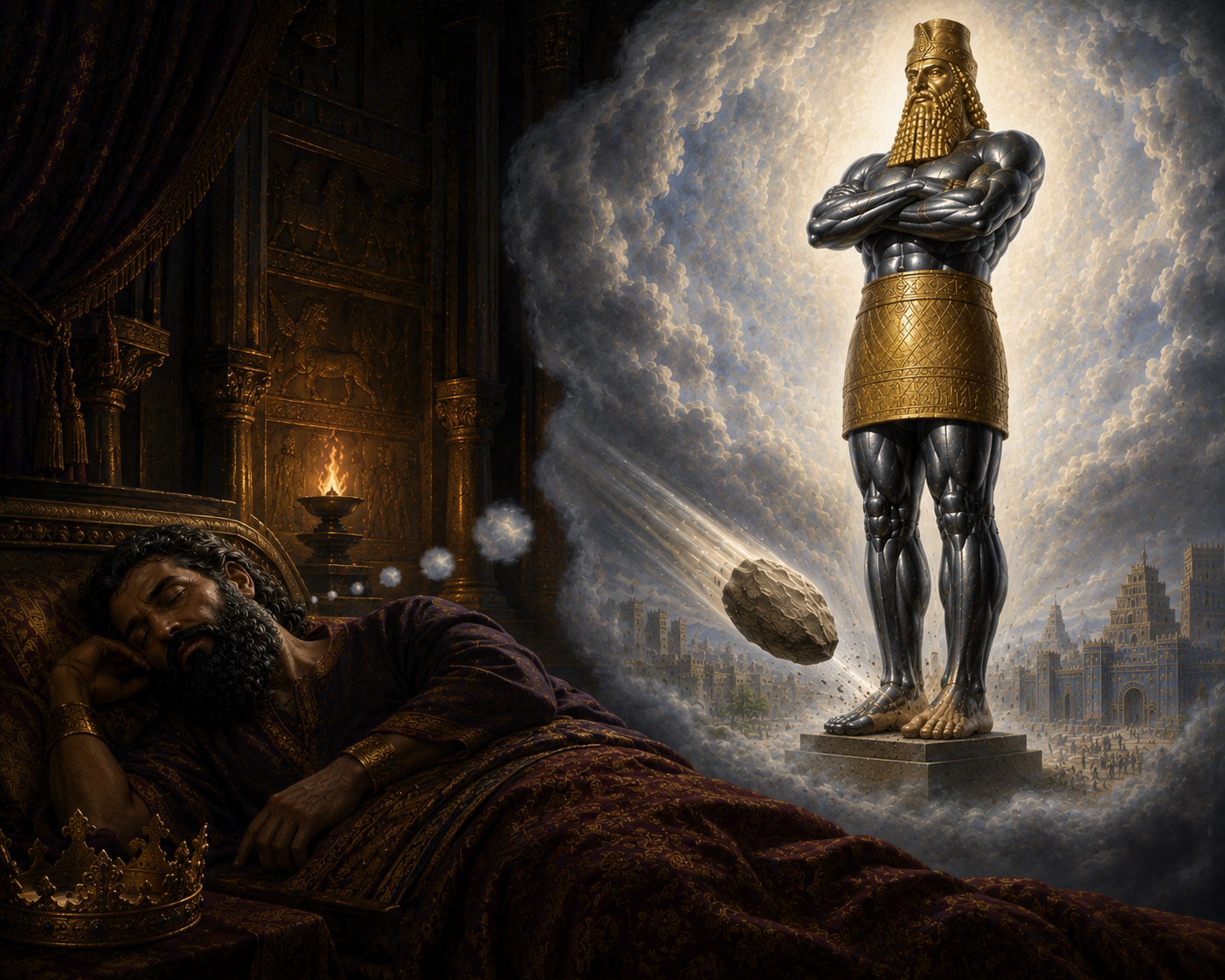
His dream contained an image and was a message to both the pagan leader and God’s people. When Jerusalem was subdued Babylon, a great change was taking place on the world stage. God would no longer rule among men through an earthly kingdom. His throne—the Ark of the Covenant—was to be removed and never returned to the people after their return. No Shekinah glory came to dwell in the second temple once it was built. The Jewish people would not remain independent, and God’s people would no longer be a military power. God’s people would be suppressed under dominant world powers until the end of time—a direct consequence of Israel’s unfaithfulness. Many had been faithful, but even their destiny in the world was negatively affected because of the unfaithful among them. Sin affects not only those who commit it; it also impacts both the good and the bad. They had “killed the prophets, and stoned them which are sent” to them, making it impossible for God to lead them as a people (Matt. 23:37). Daniel, Hananiah, Mishael, and Azariah themselves suffered for the decisions of their people. However, they are also examples of how God cares for His faithful even under worldly and pagan oppression. So, while showing the long period during which God would not have an earthly kingdom, these men testified that God was still willing to move on kings for their sake. These rulers could only go so far before God would bring them down for His people’s sake. They were never abandoned, even though they would live as strangers in many lands under many rulers. In part, this is what Daniel’s vision shows: that God knows who will put pressure on them and how God and His people can stay closely connected through these world events.

The Image

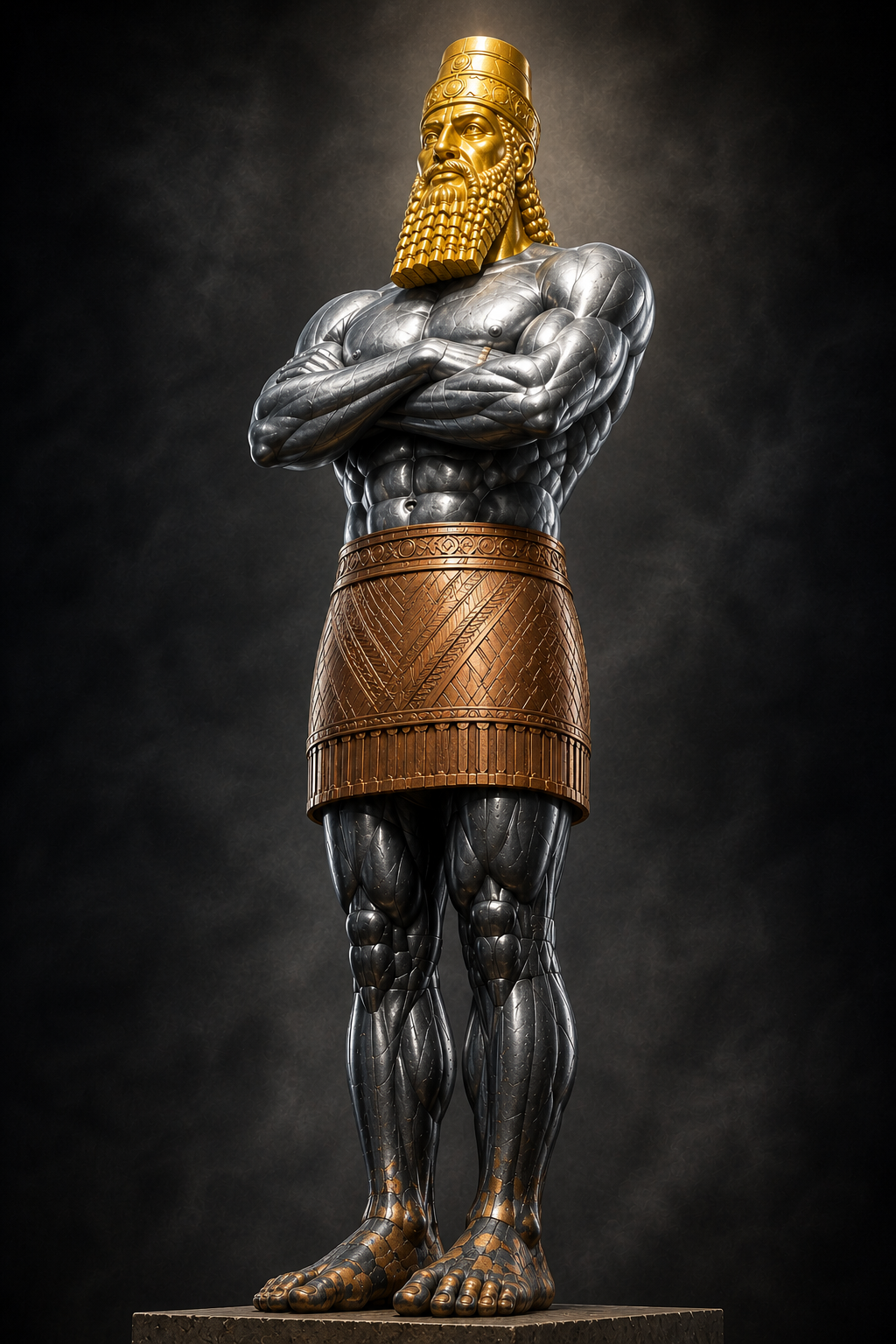
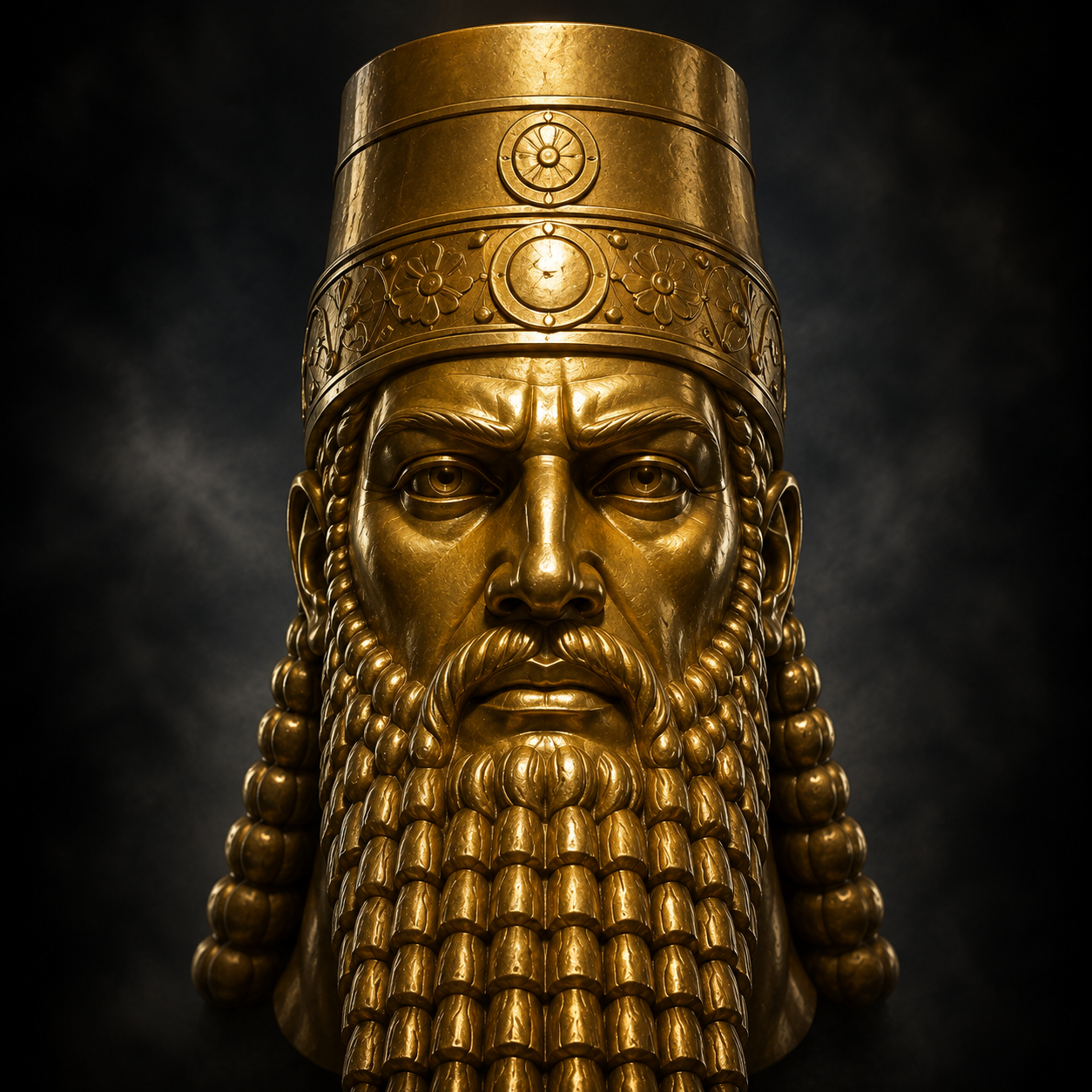
God explained the change of scene with an image of a man composed of different metals, each considered valuable in man’s eyes. In the Bible, an image made of metal that people adored and obeyed was an idol. In those days, pagans and even Israel worshiped gods through images and statues. It was forbidden by God’s law, and especially the second commandment. Showing a metallic human image to represent the different empires was perhaps God’s way of telling them that they had chosen to idolize man over God. The religion of men over the truth. Just as Eve had been deceived by the statement that “ye shall be as gods” to defy God’s law, so will men who reject God’s authority wish to rule as gods themselves. They trust their own understanding of “good and evil” over God’s word (Gen.3:5). Human religious authority that is not in union with God will always be idol worship- even witchcraft: “For rebellion is as the sin of witchcraft, and stubbornness is as iniquity and idolatry” (1 Sam.15:23)

God had criticized Israel and Judah for seeking support and alliance with the pagan nations, even calling it harlotry. Now pagan powers whom they had trusted before their very own God would rule over them.

The statue shown to Nebuchadnezzar was an idol-image of human empires. Powers playing God. Powers dictating people’s conscience and religion. But also powers who manage law and order. Powers that need to be respected and tolerated, yet not in religious matters.

The vision of the present and future is first given to the Babylonian king, him being the head of the idol. God lets him know that what he has begun others will continue, but that they do not defeat him. He rules from heaven and is over any earthly ruler (Dan.4:32). God’s kingdom will rise again, and the image Nebuchadnezzar has set up will one day fall.

Nebuchadnezzar had destroyed the temple and suppressed the people, but he or God’s people was not allowed to think he had won the greater battle. God was not defeated or suppressed. And in His own time, He would restore His kingdom.

Nebuchadnezzar was unable to interpret his dream but understood it was a divine revelation, leaving him with a heavy sense of doom. This was intended by God, so that one of His people could reveal that the vision was from God and not from Babylon’s own gods. If any of the king’s own wise men had been able to explain the dream, the interpretation would have been corrupted, and God’s people would not have received it. By placing King Nebuchadnezzar in a position where he had to hear the interpretation from a prince of Jerusalem, God made it clear which God would one day destroy the human empire.

God was humbling the king of Babylon but also comforting His people, assuring them that the oppression that had begun would one day be destroyed. However, the timeline was much longer than any of them could have guessed or imagined.

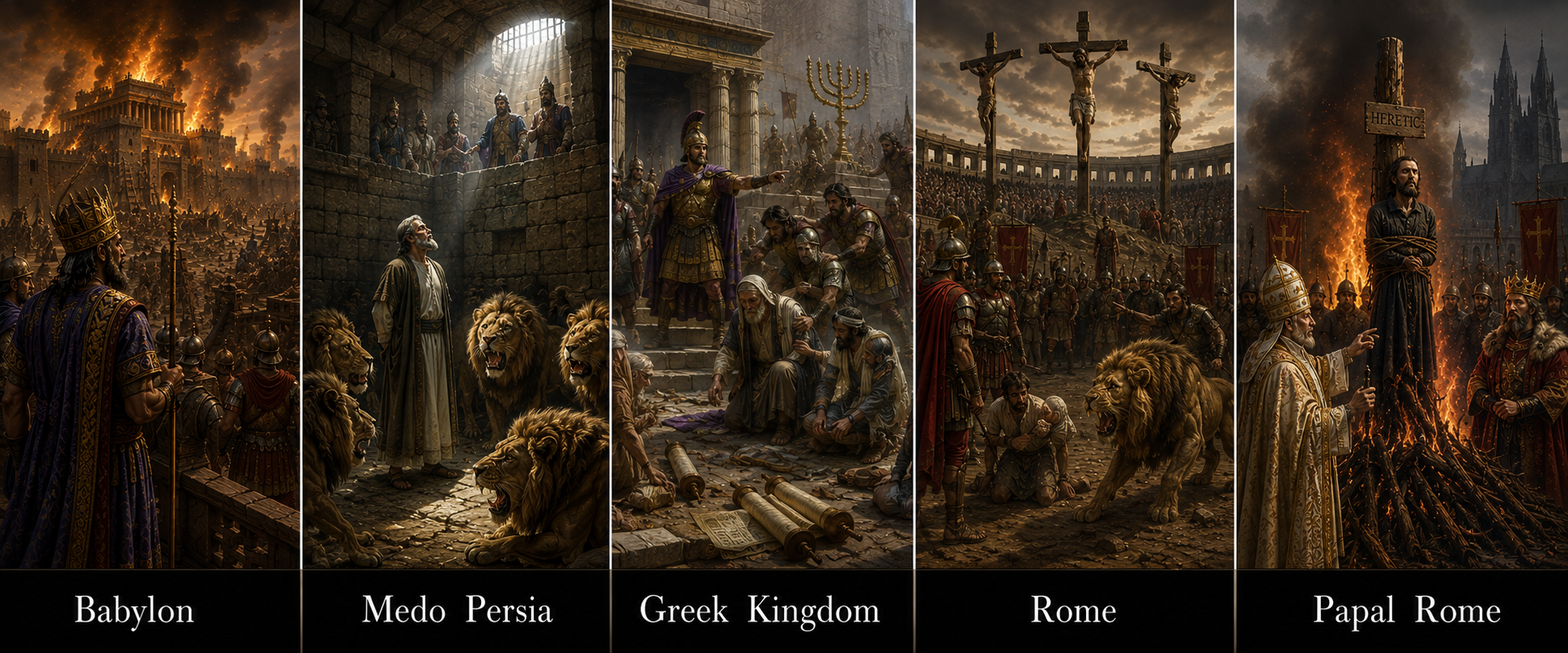
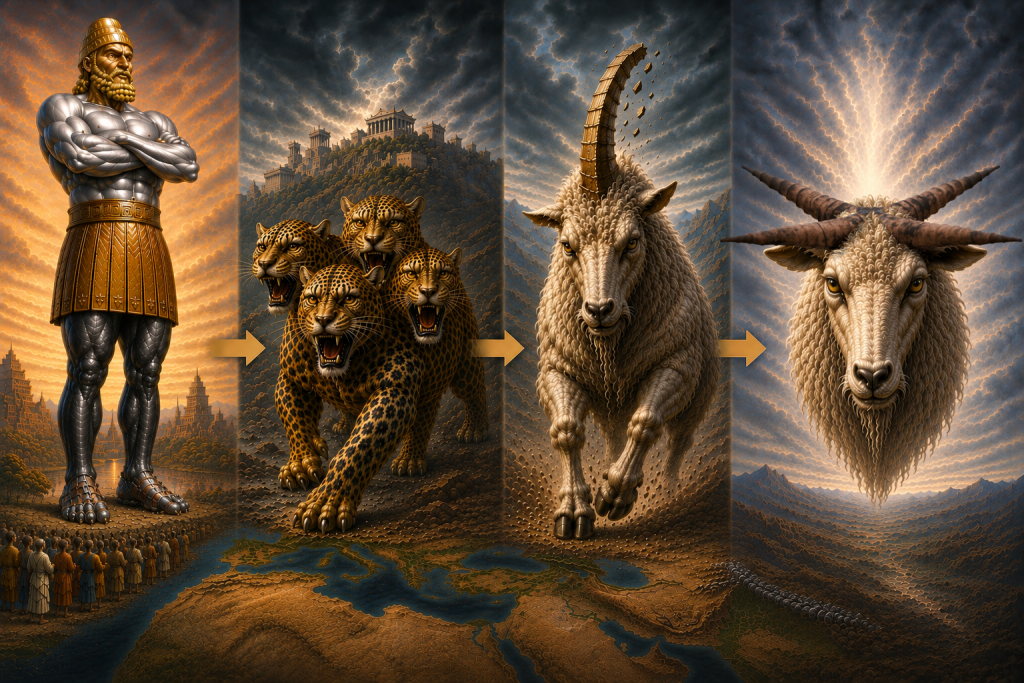
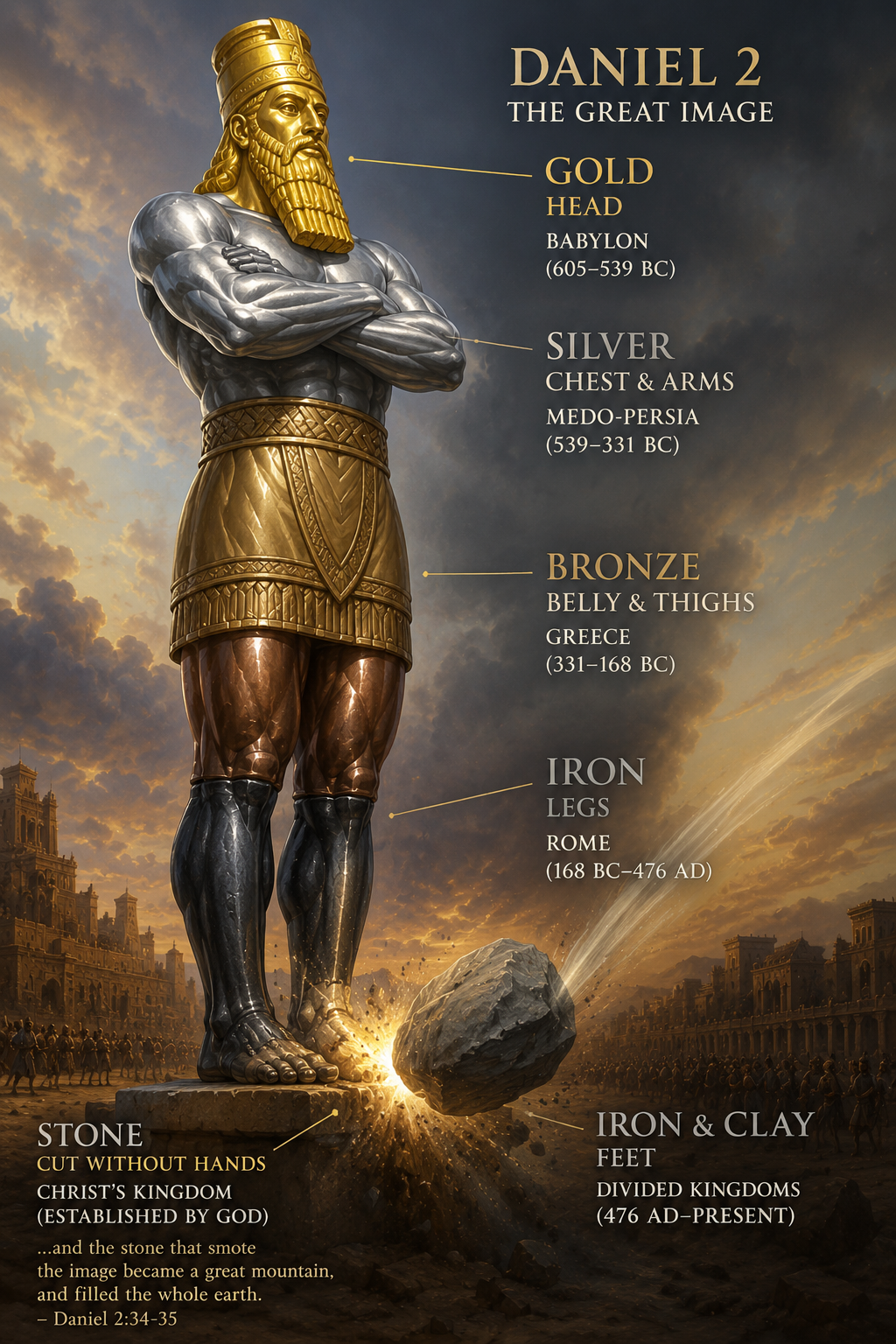
According to the interpretation given to Daniel in a vision, the head represented the Babylonian Empire.

The chest is of silver and represents the Medo-Persian Empire that would bring the Babylonian Empire down.

The bronze skirt represents the Greek Empire, which would defeat the Persian Empire.

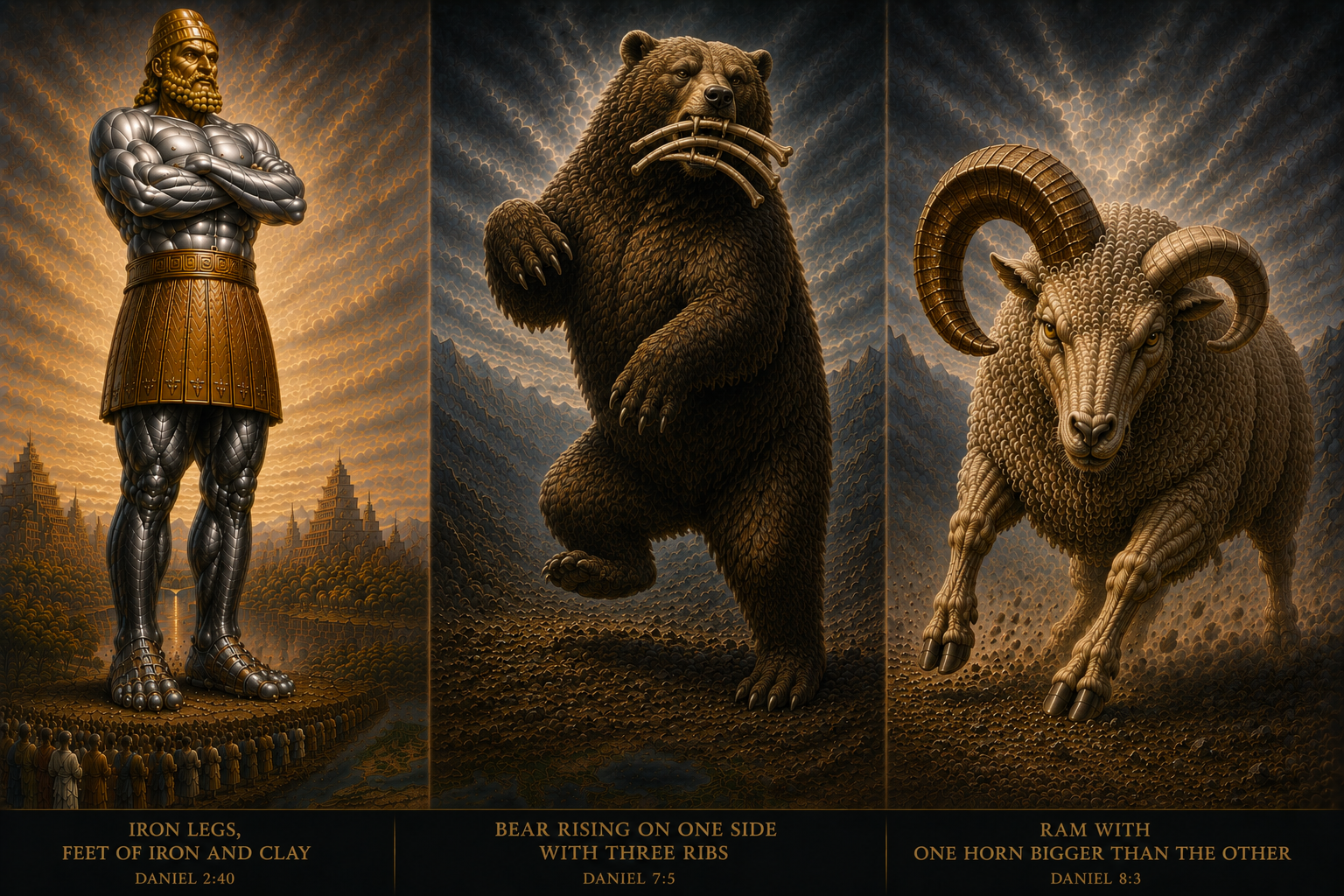
The iron legs represent the Roman Empire, which would take down the Greek Empire bit by bit until it stood as the greatest of them all.

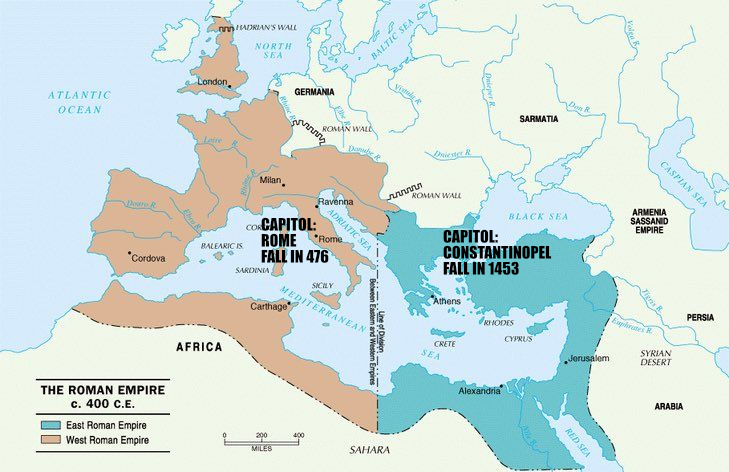
The feet, part iron and part clay, represent the Roman Empire divided. These are the European tribal kingdoms that were once a part of Rome.

And as it is explained, in the days of their rule, God will destroy them and establish his own.
This is shown when a rock, “a stone cut out without hands,” hits the feet, causing the whole statue to collapse. The head or the chest does not collapse before the feet are stricken, showing that a suppression begun by Babylon is not fully ended until that day. The statue represents a clean timeline leading up to Christ’s second coming. The stone becoming a mountain is the Kingdom of Christ.

Was terrible”

The image representing these kingdoms of men “whose brightness was excellent, stood before thee; and the form thereof was terrible” shows how man rules by inducing both people’s admiration and fear. It also depicts an image that imitates God’s glory and power. However, in comparison, God’s power also lies in His great love and mercy.  Man has little mercy to offer. God can follow up on His promises, restore, and even recreate, deserving people’s admiration and fear, while human governments act terrifyingly to ensure their own survival.

When David had sinned against God and the nation and understood God would punish him, upon choosing his punishment, “David said unto Gad, I am in a great strait: let me fall now into the hand of the LORD; for very great are his mercies: but let me not fall into the hand of man” (1.Ch.21:13)

God then sent a plague upon the land, but just as David had predicted, God cut it short in mercy.

When the plague was still heavy on the people, and David saw the destroying angel standing over the city, he pleaded with God, and God told him to build an altar in the “threshingfloor of Ornan the Jebusite” (1.Ch.21:18)
“And David built there an altar unto the LORD, and offered burnt offerings and peace offerings, and called upon the LORD; and he answered him from heaven by fire upon the altar of burnt offering.

And the LORD commanded the angel; and he put up his sword again into the sheath thereof” (1Ch 21:26-27)

This was the very place the temple of God was later constructed. When David had said it would be better to fall in God’s hands because of His mercy, it was fulfilled as his faith was. The punishment weighed heavily, but God’s mercy indeed mitigated it. The sacrifice was a symbol of Christ’s death for humanity, and how He could bring about peace between the sinner and God.

Nebuchadnezzar sees the image in his dream as “dreadful”, yet God would, in the middle of these kingdoms, send Christ to redeem His people. Had they received him, their sins would have been blotted out and the falling into “the hand of man” would be shortened by the sacrifice of God. But as God’s people continued the rebellion, the vision was certain and would not change; God’s people would remain suppressed by earthly governments until Christ’s second coming.

The rule of man playing God will, in part, show strategic mercy from time to time, but in the end, as the book of Revelation shows us, they will show no mercy at all upon God’s people in the end. Even hindering them from buying and selling, even killing them, if they do not obey the government in religious matters. And God will meet their privation of mercy towards His people with the removal of His mercy from them.  

He removeth kings”

When God had revealed the same dream Nebkadnezzar had to Daniel in a vision, he exclaimed: “Blessed be the name of God for ever and ever: for wisdom and might are his: And he changeth the times and the seasons: he removeth kings, and setteth up kings…” (Dan 2:20-21)

Although God allows man to subdue his people, He does not abandon them. God has a time limit for each ruler. By replacing the kings, God also changes the climate of these worldly empires. By giving the empires their natural enemies, the pressure is taken off God’s people when it is too great for them to bear. He would also ensure they were always able to

Babylon would not let Israel go to rebuild the city or temple. In the midst of their suppression, God allows another empire to grow strong, challenge Babylon, conquer it, and cause Israel to return to the land.

God told the Babylonian king he would be brought down that same night and made sure people understood that heaven can bring down any earthly king.

Although not granted independence and remaining under the Medo-Persian ruler, they had room to breathe. Medo-Persia allowed them to return and rebuild the temple and the walls. This gave them a feeling of independence and hope under the suppression.

Then God allowed the Greeks to bring down the Persian Empire. However, Jerusalem continued to struggle under the Greek empires around them. The Seleucid king would come and desecrate their temple and humiliate them. The conflicts between the southern and northern Greek empires exhausted God’s people.

Then God allowed Rome to bring these kingdoms down. Jerusalem was first a Roman province but later ended in war with God’s people. When Rome began heavily suppressing God’s people, God made sure Rome fell as well.

The final stage of the image suppressing God’s people was the feet, representing a divided Rome—its strength broken and mixed with clay. Although this did not end the suppression, it would at times bring temporary relief to God’s people and provide places for them to worship in peace.
“And as the toes of the feet were part of iron, and part of clay, so the kingdom shall be partly strong, and partly broken” (Dan 2:42)

With the message, God tells Daniel that the kings of the world are not all-powerful; God will interfere when necessary. He has taken away his earthly kingdom, but would continue to work from His throne in heaven to protect and help His people during their suppression and until He would free them. His people were not defenseless, and they could pray for deliverance.

The Image as a test

Nebuchadnezzar, although intimidated by his own dream and its interpretation, defied God by making a large physical image, the whole image clothed with gold. In the dream, only the head was of gold, but now, to show his kingdom as invincible and eternal, Nebuchadnezzar made a golden image into a test of loyalty to the empire and to himself.  The image, if using the Neo-Babylonian cubit, would be 30 meters high (60 cubits) and 3 meters wide (6 cubits).

“Then the princes, the governors, and captains, the judges, the treasurers, the counsellors, the sheriffs, and all the rulers of the provinces, were gathered together unto the dedication of the image that Nebuchadnezzar the king had set up; and they stood before the image that Nebuchadnezzar had set up. 
Then an herald cried aloud, To you it is commanded, O people, nations, and languages…whoso falleth not down and worshippeth shall the same hour be cast into the midst of a burning fiery furnace” (Dan.3:2-4 & 6)

Nebukadnezzar had not been told which kingdom would be next; to be sure, he called everyone to bow to an image representing Babylonian authority and to show allegiance to its continued and eternal existence. Perhaps he had hoped to single out a potential uprising. But instead, three Jewish men, his own elected leaders, were those who refused to bow down. They were “set over the affairs of the province of Babylon, Shadrach, Meshach, and Abednego” (Dan.3:12)

Nebukadnezzar immediately called for them and said: “Do not ye serve my gods, nor worship the golden image which I have set up?” (Dan.3:14) He then gives them one more chance to comply, but they refuse his offer and remain faithful to the very God that had told Nebukadnezzar his kingdom would one day fall.

The king got very angry and had them thrown into the furnace, where God delivered them, showing a powerful move unlike any other. The Son of God walked with them, and none of the men were hurt or even burnt while in the furnace. This reminds the Babylonian king of the same God who would one day rule.
The story is a mirror of the end-time conflict, in which an image is set up by “a beast,” which also demands loyalty to a governmental religious decree. At that time Jesus will come to deliver His faithful once again.

The conflict in the end times and the setting up of Nebuchadnezzar’s image mirror each other. They both demand loyalty to an earthly kingdom that defies the kingdom of God and puts the world to a test of loyalty. The image was, then and in Revelation, a combination of state power and religion. Through this image, the only way to show loyalty to the state was to also “serve the gods” of it. But also to give a religious veneration to a symbol of state power.

The measurement for Nekukandezzar was also a defiance of the God who had given him the vision. In Babylonian culture, the number 60 was the sacred number of the sky god Anu. He was considered the one from whom all the other Babylonian gods came. In good Neo-Babylonian style, likely all the Babylonian gods were represented upon the image.

The four beasts of the image

Later, Daniel sees these empires shown in the great image once more, now as individual beasts, with more detail about their identities, times, and destinies. He receives this follow-up vision during the last king of Babylon’s rule. God’s people were at that time eagerly and desperately longing for the end of their captivity. But they were not to expect complete freedom.

The Great Sea

Daniel spake and said, I saw in my vision by night, and, behold, the four winds of the heaven strove upon the great sea” (Dan 7:2)

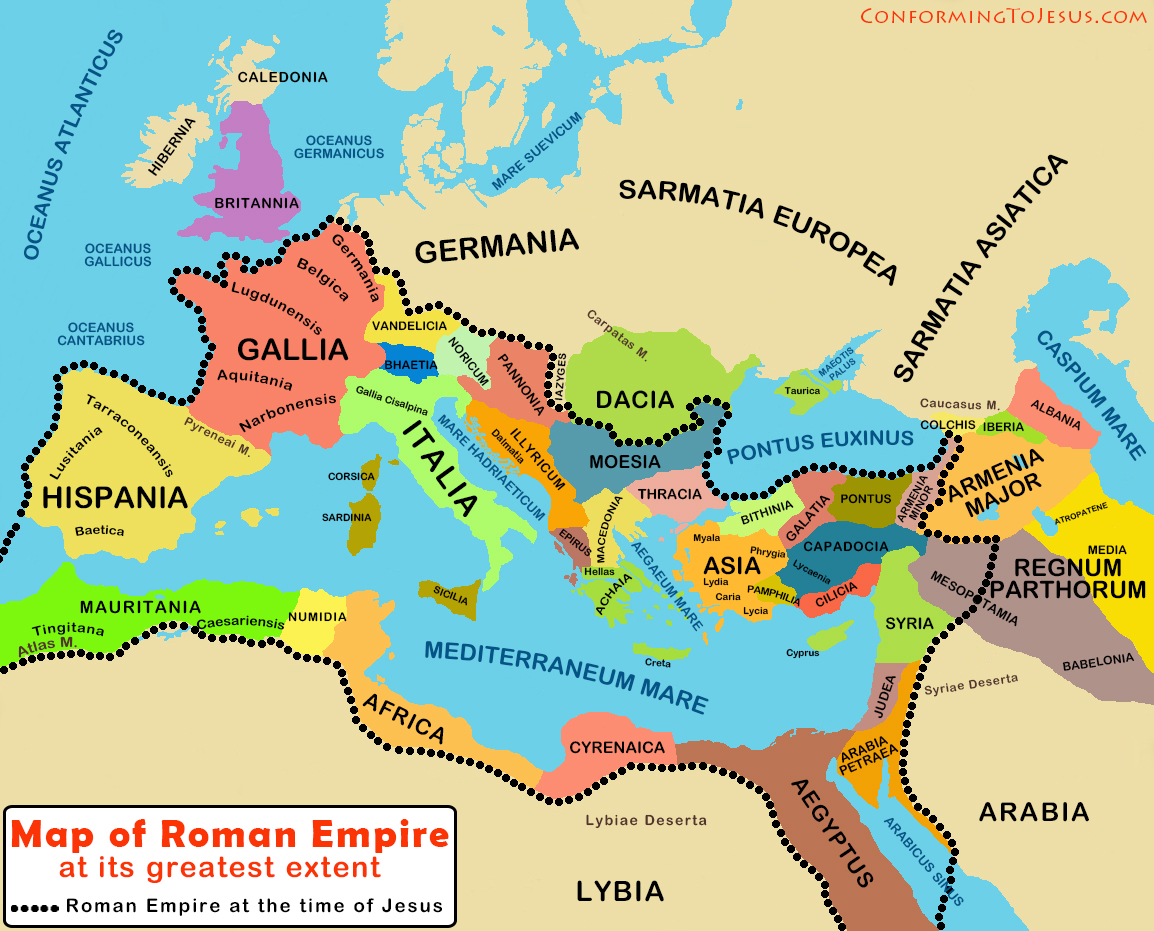
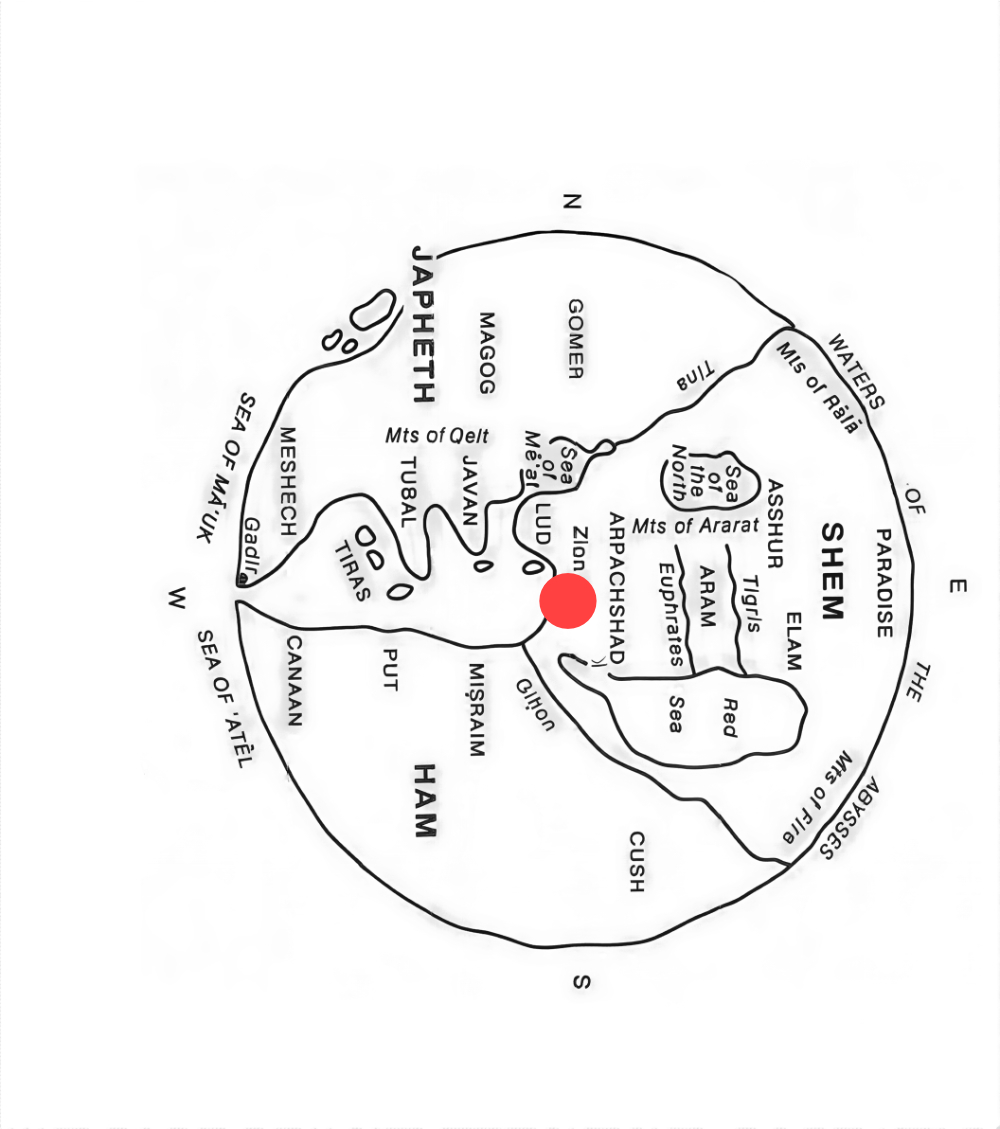
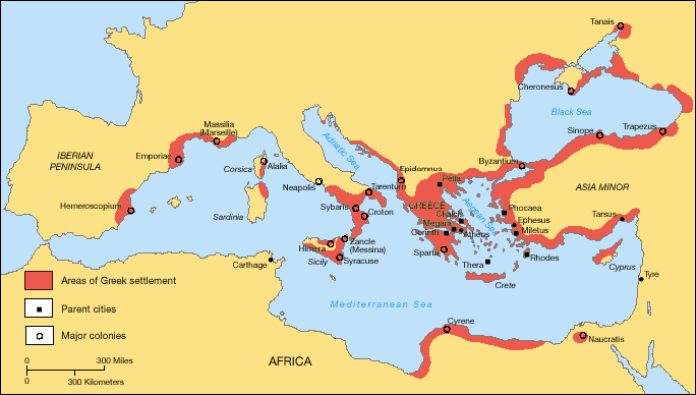
Here we see a geographic point of the coming empires to the great sea, with God’s land in the center, being the Mediterranean Sea. Although not all the empires lie by the sea, they all conquer God’s land to claim the power of this sea. The Mediterranean is not the largest ocean, but it was the most influential, as all the great early civilizations used it. It was the border sea of the three tribes of Noah. But also the east coast, the border of the land of God’s people. In Revelation, the sea is a metaphor for the center of world authority: “And he saith unto me, The waters which thou sawest, where the whore sitteth, are peoples, and multitudes, and nations, and tongues” (Rev 17:15).
Wind in the bible is a symbol for conflict and strife (Rev.7:1).

The beasts emerge from conflict over the same territories.

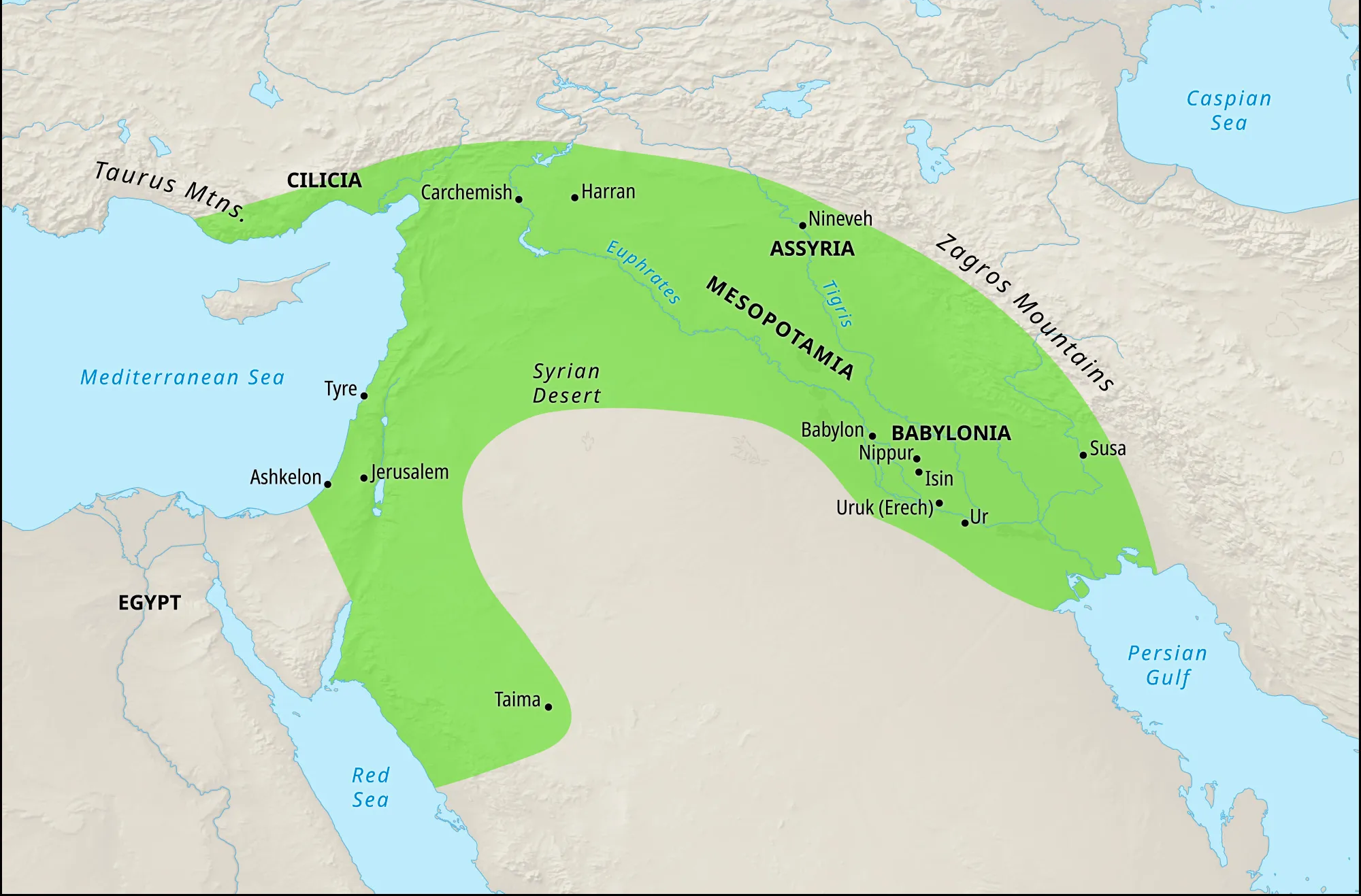
For Babylon, taking the cities of the Levant meant controlling lucrative maritime trade. Being a city between two rivers, extending their empire to the sea was important to become great. And not until they did could they be the powerful empire they became. The cities and kingdoms there were often a good source of tax and tribute. Controlling Syria and the Levant created a buffer against Egypt, Babylon’s great rival. And it provided them with security and important trade routes.

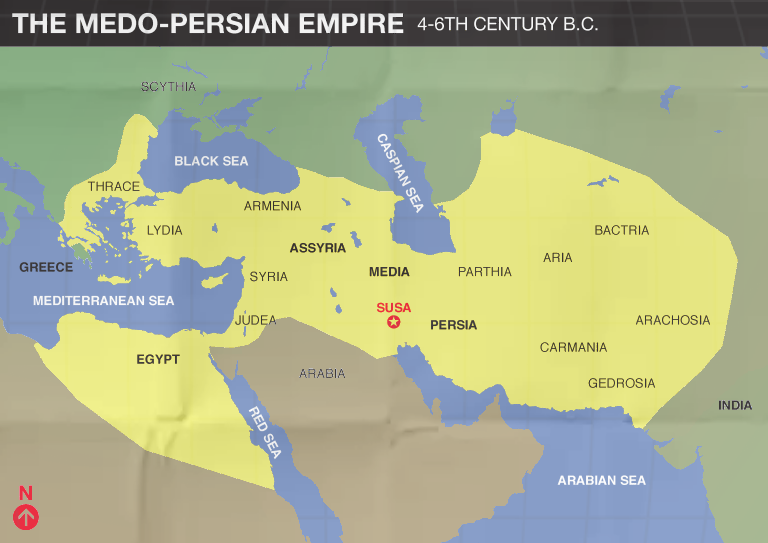
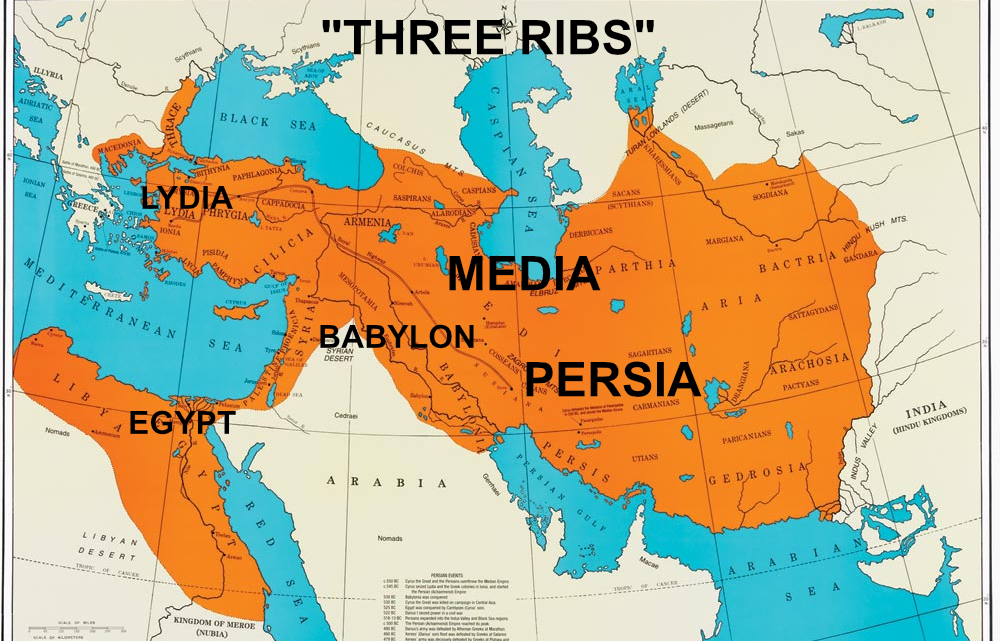
For Medo-Persia, another nation that did not initially lie at the Mediterranean, taking the territory at its coast connected Persia to the richest trade networks of the ancient world. Control of ports meant access to taxes and commerce. By controlling Phoenicia, Palestine, Egypt, and Asia Minor, they could prevent enemies from using the coast to attack the empire. The empires they then feared could challenge them were all to the west of them. Not being a naval power itself, it relied on connecting to those who were.
Holding the Mediterranean coast gave Persia bases and fleets to invade Greece under kings like Darius I and Xerxes I.

The Babylonian Empire took control of the eastern Mediterranean to control trade and secure its borders.
The Medo-Persian Empire took even more land along the Mediterranean coast than Babylon.

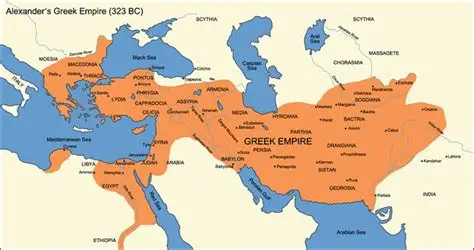
For Greece and Alexander the Great, the Mediterranean was their home. Before invading the Persian heartland, he secured the eastern Mediterranean coast, depriving the Persian navy of its bases by taking cities such as Tyre, Sidon, and Gaza. Holding the Levant also protected his route to Egypt and prevented Persian counterattacks. The Mediterranean coast became the western backbone of an empire stretching from Greece to India. A famous example is the siege of Tyre (332 BC). Alexander spent months capturing the island city because, as long as Tyre remained in Persian hands, it was a major naval base threatening his campaign. So, like Babylon and Persia, Alexander valued the Mediterranean for trade, wealth, and security.

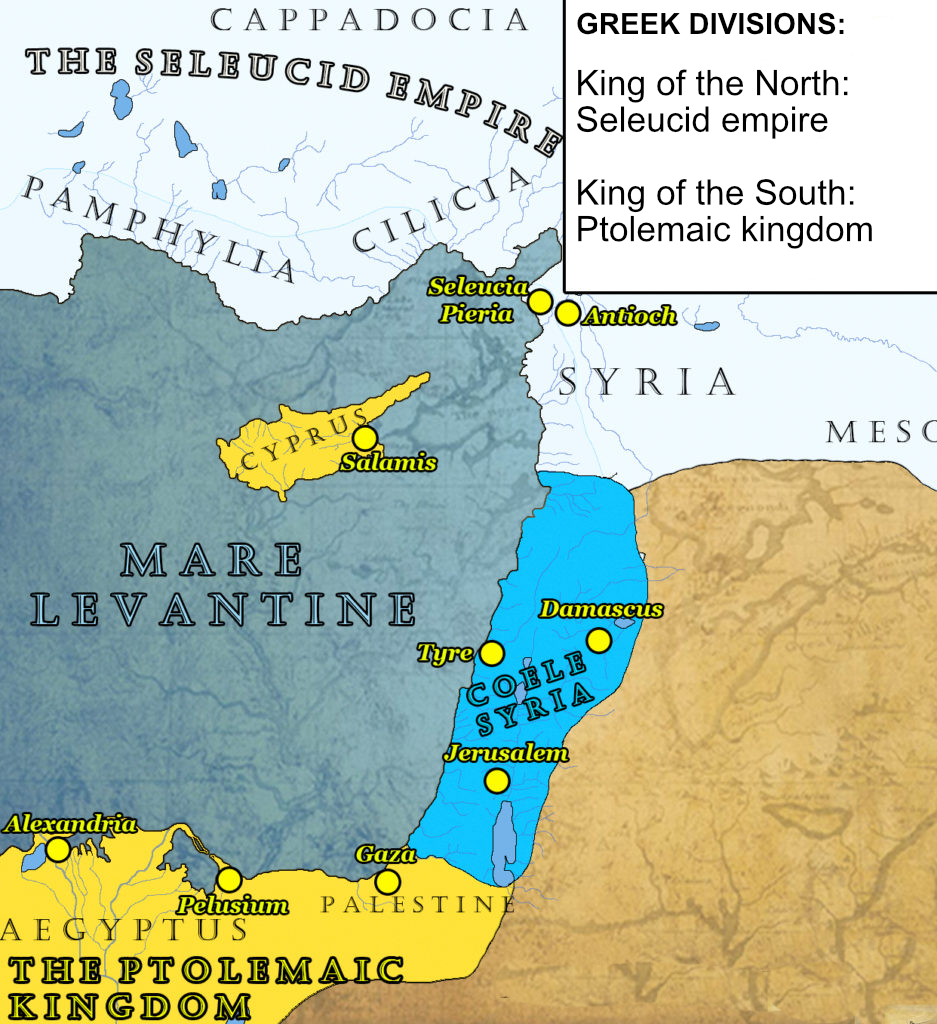
When the Greek Empire divided, the two strongest remaining empires constantly struggled for power along the coast. The southern Ptolemaic Kingdom sought to protect Egypt, dominate trade, and hold Cyprus, Phoenician ports, and, frequently, Coele-Syria, and maintained a strong navy.

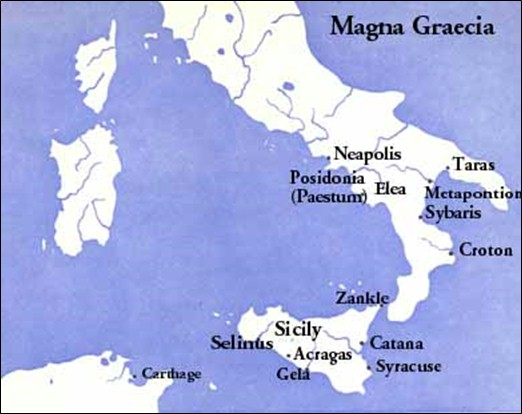
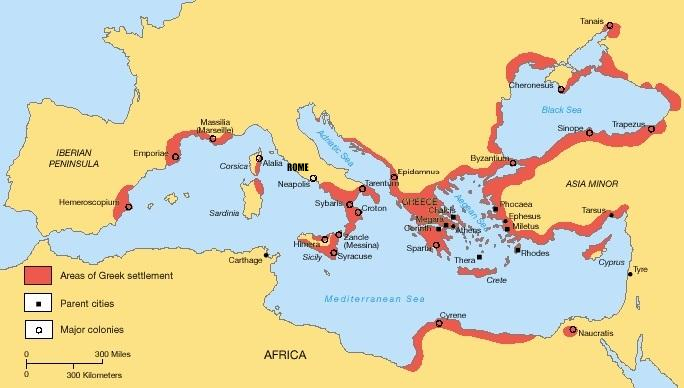
The Greek empire had even greater territories but divided them between four generals. In addition to this territory, the Greeks colonized the west Mediterranean, in what we today call Italy, Spain, France, and Ukraine.

The north-eastern Seleucid Empire secured the Mediterranean coast for trade, taxation, and access to the sea from Mesopotamia.

Their greatest rivalry was over Coele-Syria (roughly modern Israel, Lebanon, and southern Syria), because it connected Egypt to Asia, had wealthy cities and ports, controlled the main trade and military routes, and served as a buffer against invasion. This rivalry led to the Syrian Wars (six major wars, c. 274–168 BC). Or, as the Bible calls it later in Daniel chapter 11, the conflicts between the King of the South and the King of the North, leaving God’s people in the middle of this conflict.

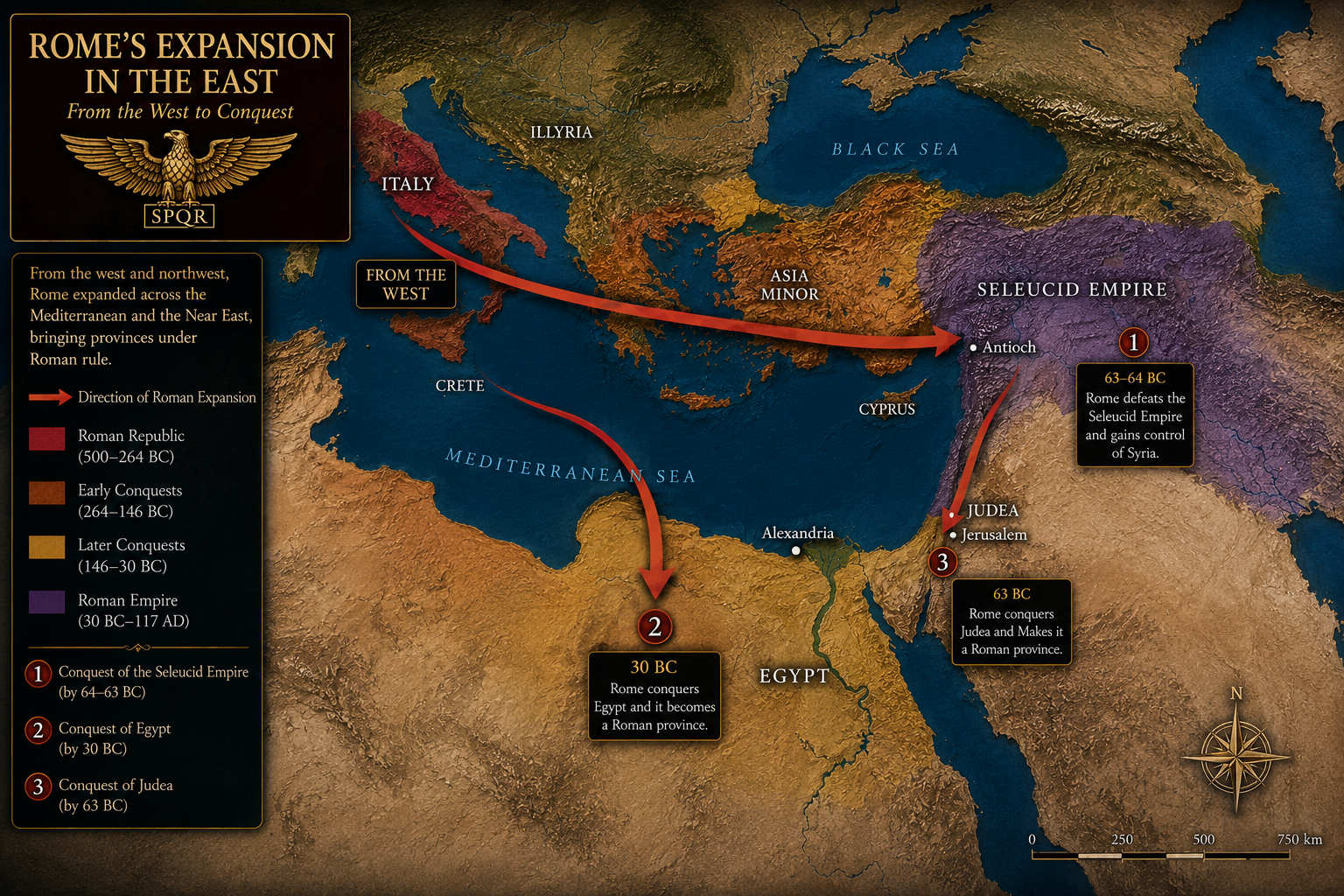
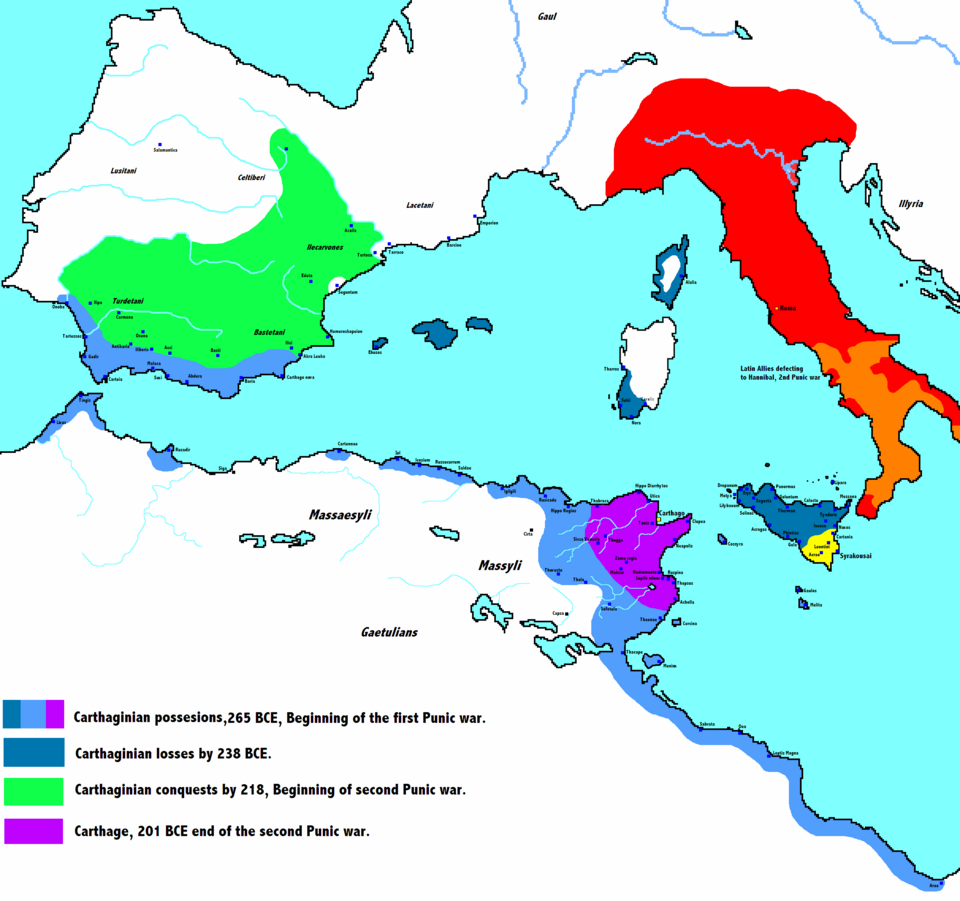
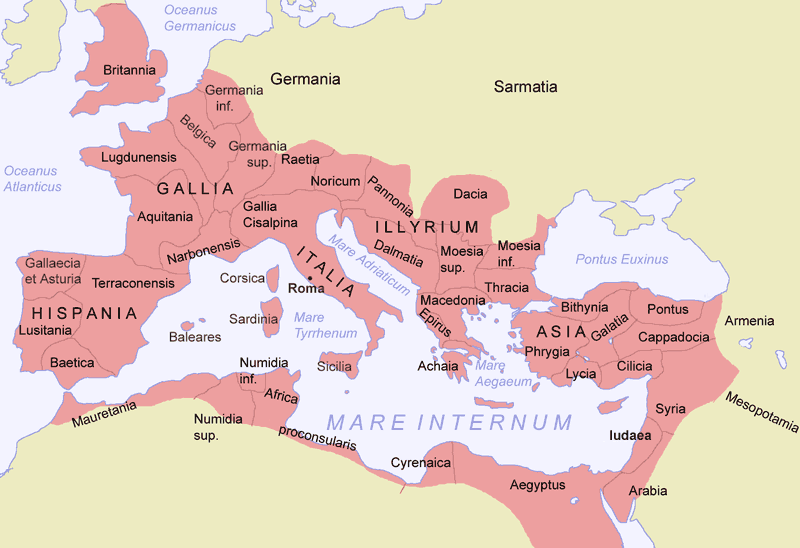
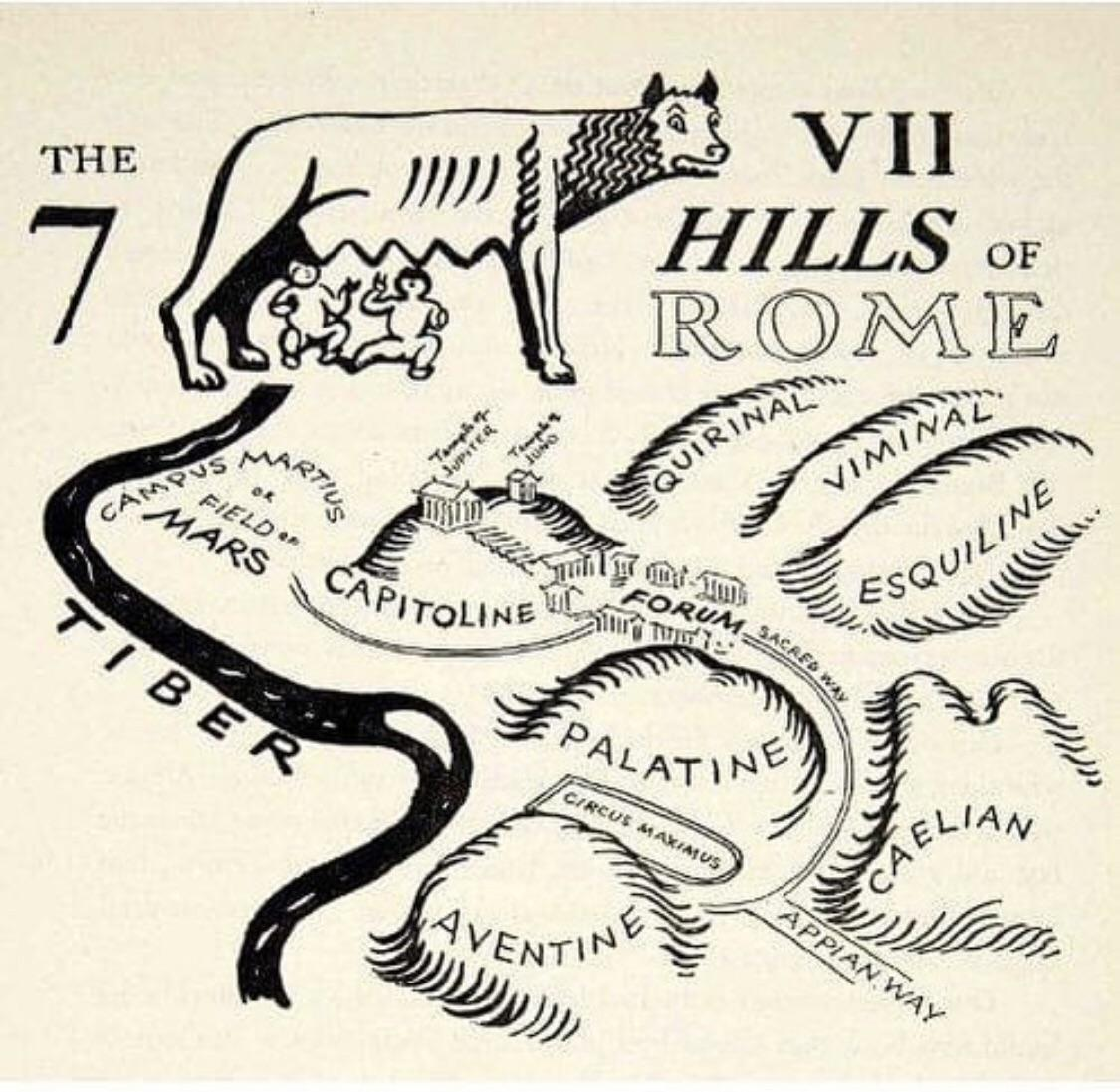
For Rome, the Mediterranean became the center of its entire empire. At first, Rome was simply one city in central Italy, but as it expanded, controlling the Mediterranean became essential for its survival and prosperity. Although Rome was small and weak at the beginning, as it began expanding its territory, the turning point came with the Punic Wars against Carthage. Rome realized that whoever controlled the Mediterranean controlled everything. By defeating Carthage and later the Hellenistic kingdoms, Rome became the dominant Mediterranean power. It expanded eastward into Asia Minor, Syria, and Egypt. The Mediterranean became the empire’s highway. Sea transport was far faster and cheaper than roads. Once Rome had brought down the Ptolemaic Kingdom in Egypt, it became the main source of grain to the Roman cities and even the capital. The Romans called the sea: Mare Nostrum — “Our Sea.”

Rome was the first to control the entire coastline of the Mediterranean Sea.
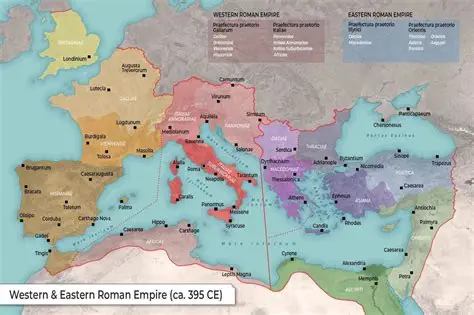
Rome was later divided between European tribes.
  • Babylon wanted access to the Mediterranean, which is why they secured Judea and Jerusalem.
  • Persia wanted to control its eastern coast, which is also why they took God’s land.
  • Alexander conquered it to destroy Persia and unite his empire, which is why he took God’s land.
  • The Ptolemies and Seleucids fought over its eastern gateway, both wanting God’s land because of its placement.
  • Rome eventually enclosed the entire Mediterranean, making it the economic, military, and administrative heart of the empire. This made it impossible for God’s land to escape its future as a Roman province.

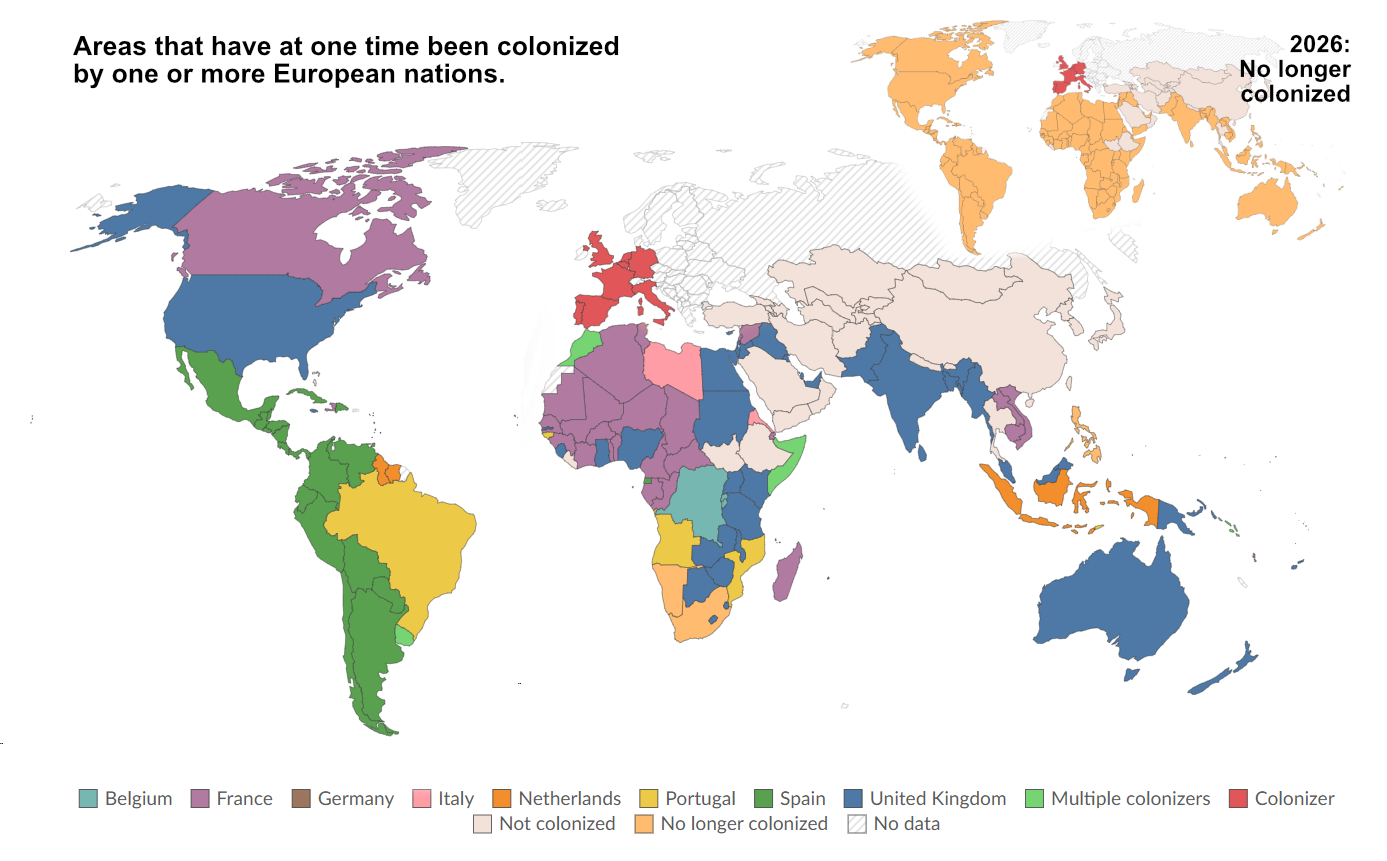
When Rome was divided, so was the power over the sea. However, the divided empire would continue to strive for the territories east of the Mediterranean in pursuit of trade superiority, access to Asia, and control over religious sites, which had also become matters of trade and power. It remained the center desired up until our own time, where the divided kingdoms still roam this very sea and whose access remains the cause of wars. When control of the eastern Mediterranean shifted to the Ottomans, it prompted Western European powers to look to the Atlantic and expand there. But the desire was constantly to bring the Ottoman Empire down and reclaim the territories. A part of history the Bible deals with, and what happens when they succeed, as we will see when we look into every detail of the prophecies.

It’s important to note that the center of the coming kingdoms in Daniel 7 is not the geographical point of Babylon in Iraq, but the sea and its relevance to God’s people and their suppressors until the very end of time.

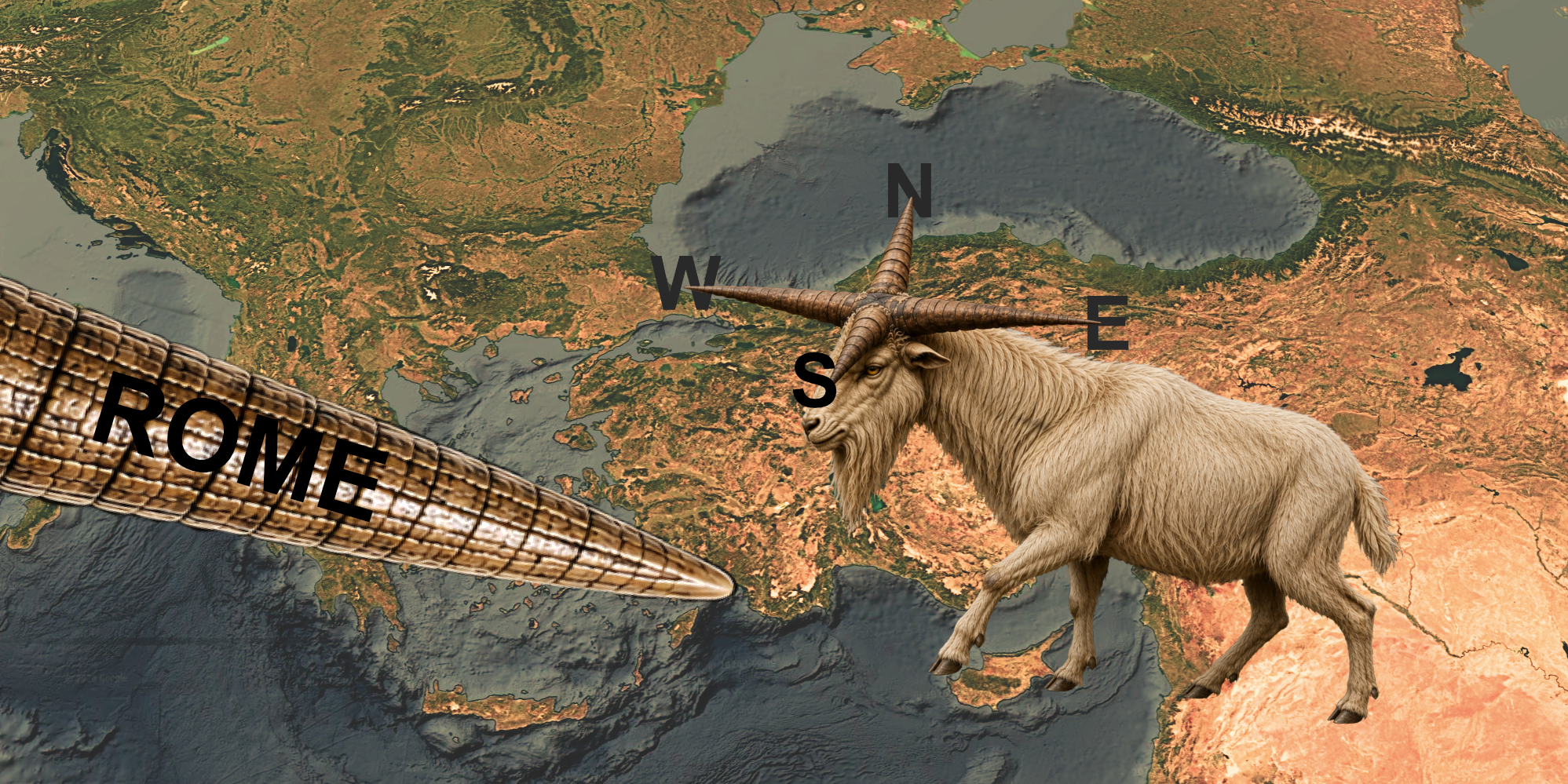
The verse says, “and, behold, the four winds of the heaven strove upon the great sea,” explaining that the strife does not come from simply one geographical point but from several: east, north, south, and west, which is consistent with what we do see. Babylon and Medo-Persia came from the east to strive for the sea; Greece came from the west; its divided kingdom came from all directions, north, west, south, and east. And Rome came from the west. The focus point is they “strove upon the great sea”. The double meaning being wars between “peoples, and multitudes, and nations, and tongues” and the geographic center of the conflict itself.

A theme the Bible brings us full circle to in the book of Revelation, where the fall of Babylon is said to be the fall of the trading network on the sea. Being that Babylon became ruins many tens of centuries before, it is, of course, speaking of the end of the feet of the image, of which Babylon was said to have been the head.

“And the kings of the earth, who have committed fornication and lived deliciously with her, shall bewail her, and lament for her, when they shall see the smoke of her burning…Standing afar off for the fear of her torment … And the merchants of the earth shall weep and mourn over her; for no man buyeth their merchandise any more … For in one hour so great riches is come to nought. And every shipmaster, and all the company in ships, and sailors, and as many as trade by sea, stood afar off …And they cast dust on their heads, and cried, weeping and wailing, saying, Alas, alas, that great city, wherein were made rich all that had ships in the sea by reason of her costliness! for in one hour is she made desolate” (Rev.18:9-18)

Giving us a hint that the source of its power is in trade, in controlling trade, and its collapse losing that power. Although in the end times “Babylon” is on all seas, it points back to the time when the place to be was around the Mediterranean.

FOUR BEASTS:

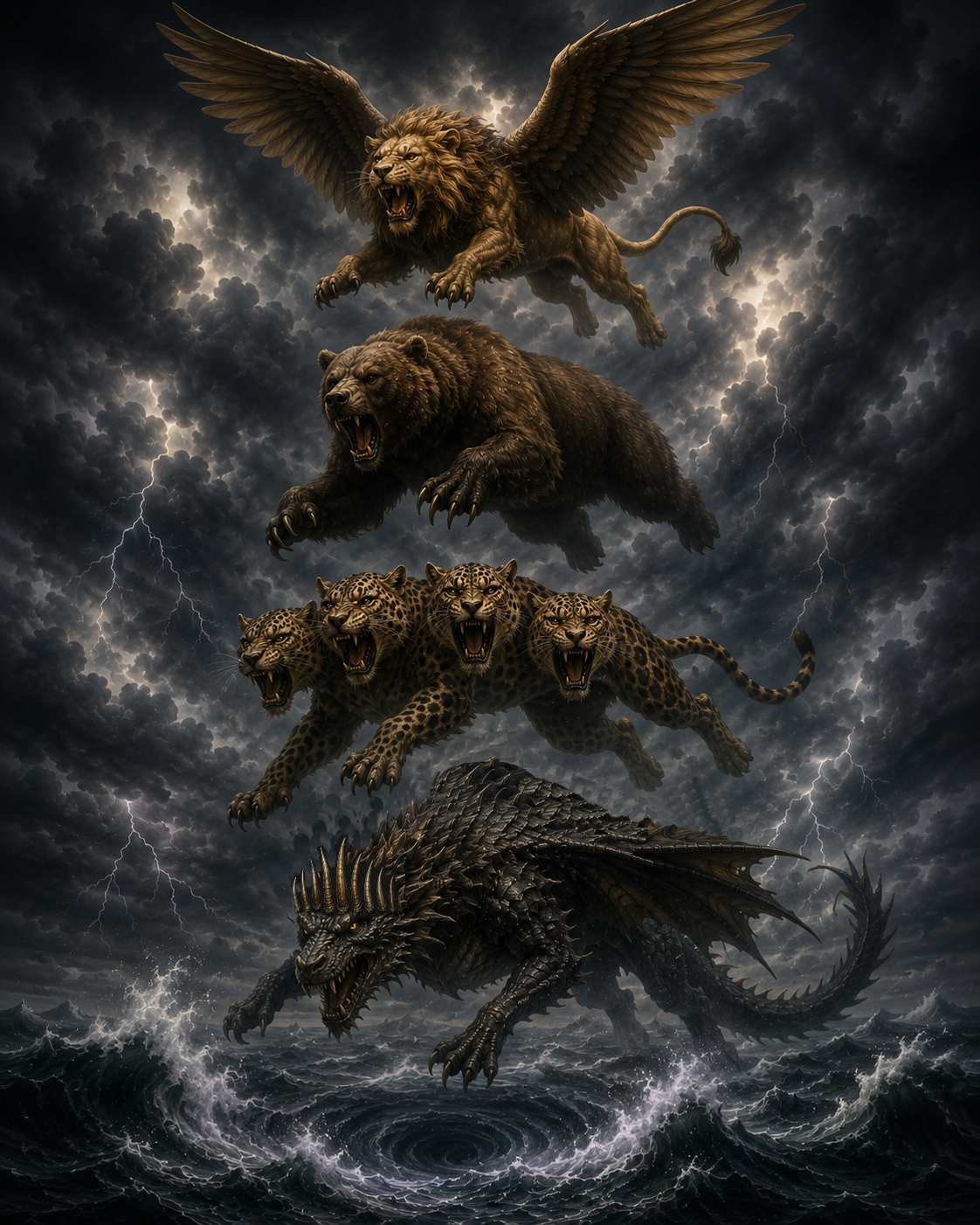
And four great beasts came up from the sea…” (Dan 7:3)

God does not give us room to misunderstand the meaning of the beasts. The angel gives us the interpretation: “These great beasts, which are four, are four kings, which shall arise out of the earth” (Dan.7:17) And: “The fourth beast shall be the fourth kingdom” (Dan.7:23) And about the end of the beast’s rule: “the saints of the most High shall take the kingdom…” (Dan.7:18) making no mistake that a beast is a metaphor for a kingdom, a territorial dominion or as we also call it today, a government.

In the first vision, the same empires are body parts of an image of a man, pointing to idol worship and to how it is manifested through their governments. In the past, the leaders all claimed to either represent a god or to be a god on earth. That is consistently what all of the empires God shows did. They make their government into an idol.
In the next vision, God reveals the kingdoms as beasts. God does not call humans animals, but he likens their governmental institution to beasts.

God may do this for several reasons. It shows how the specific human behavior through these empires is seen from heaven. Just like worshiping God makes you adopt His values, so is the case with pagan gods.

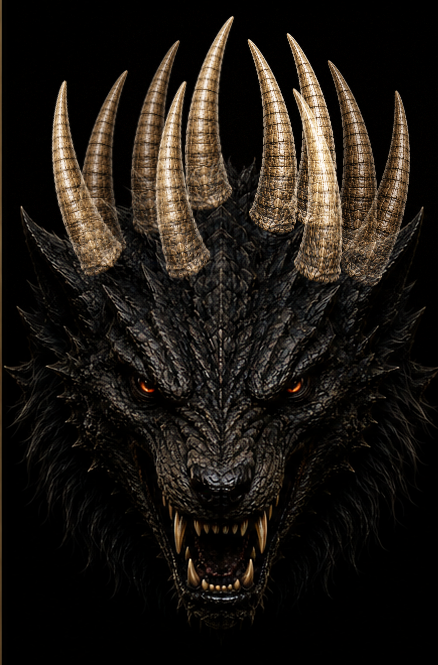
All the beasts God compares the earthly empires to are territorial and carnivorous. They are dominant in their territories; they act on impulse and instinct for their own survival – they don’t show pity or mercy if they are under threat. When a beast feels fear, it attacks; it attacks in anticipation or out of worry, without being attacked first. A carnivore is selfish in nature.

Man was created in the image of God. Still, when rejecting God’s rule and trying to be gods themselves by creating their own laws, judging by them, and demanding worship, they began to exhibit the behavior of lower creatures. Many went from being in the likeness of God in character and purpose to becoming in the likeness of a beast’s character.
Man was called to rule over the beasts, but here we are presented with beasts ruling over man (Gen 1:28; 9:2).
In the portrayal of the suppressing powers as beasts, God gives us an insight into His heart for His people and their situation. Everything He had wanted to do for and with them was ruined by their distrust and desire to resemble other nations. And so, ruled by other nations is what they ended up with instead. His desire to restore and save them all lies in Him comparing these empires with beasts.

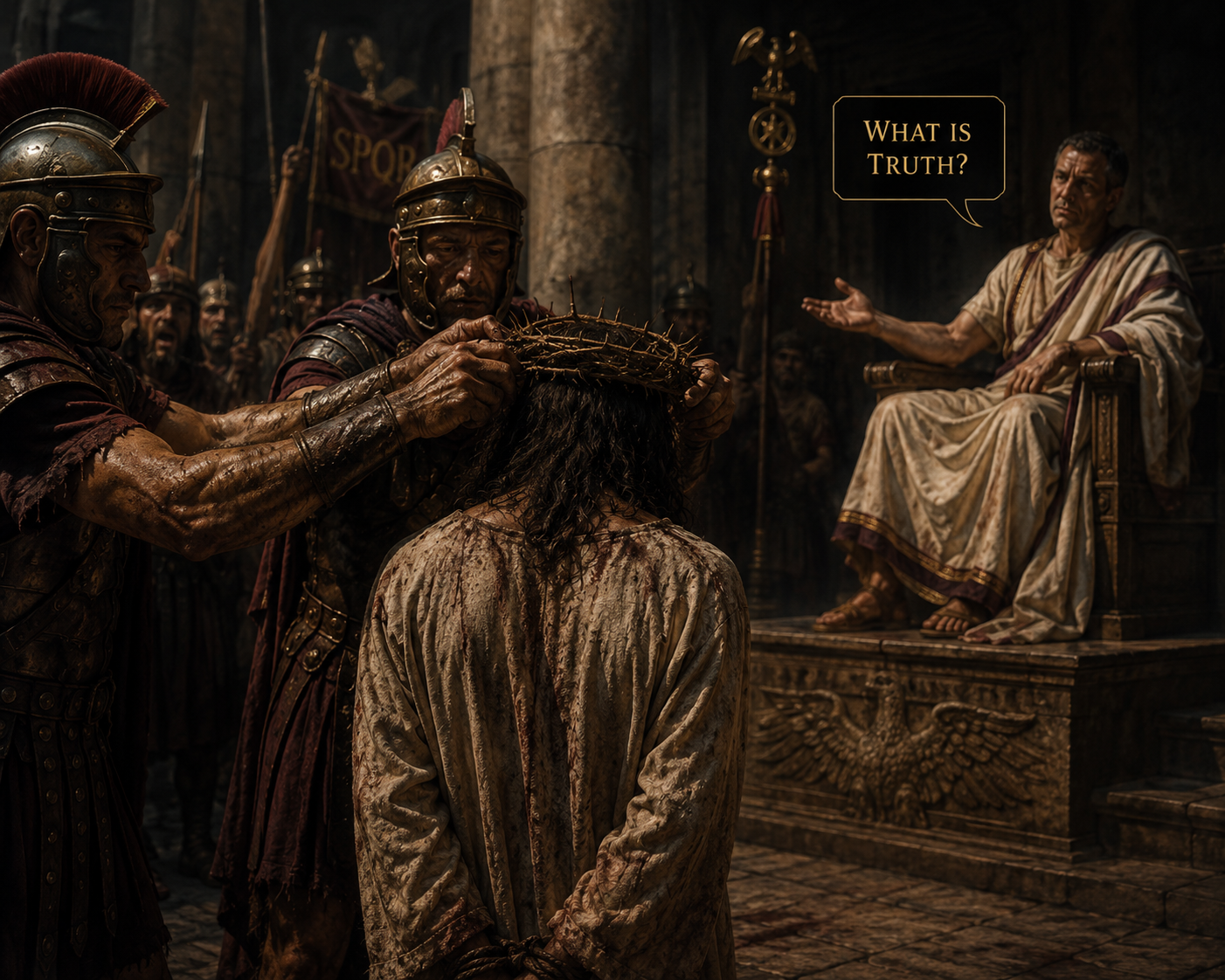
Humans do not always know their own good, and we often make decisions we think will give us good things and help us prosper, only to end up stuck in a spiral of negative fallout and suppression. In a moment of anger, jealousy, and a desire to be something great in the world, the leaders of Judah said to Pilate:
not Jesus “but Barabbas” and “We have no king but Caesar” (Mat 27:21, Mark 15:11, John 19:15). Choosing a murderer and even a pagan king over their creator. The man who had healed their illnesses and brought them dignity as human beings was rejected because they desired worldly glory. Often we cheaply sell what is of true value for materials that perish, like gold, silver, bronze, iron, and even clay. This degrades us and God’s purpose for us. Giving in to passion or ruling over our passions determines our destiny. Either we become like beasts, or we are restored to the image of God.

Territorial beasts exhibit behavior guaranteed to lead to constant strife. By rejecting God, God’s people would be suppressed by such beasts. God consistently uses beast imagery to depict governmental superpowers in the New Testament book of Revelation. This brings them to that great final conflict, with man having to choose between the name and seal of God or “the mark of the Beast” and “the image of the beast”. As the world is coming to its end, God extends His arms one last time for humanity to choose Him as their King before all the earthly kingdoms perish. But the Bible tells us even then, people, by their great desire for prosperity and the things of this world, out of fear of standing out, will close their eyes to their own danger and their own end and optimistically seek salvation through deprived leaders of a deprived government.

Who are the four beasts?

And four great beasts came up from the sea, diverse one from another” (Dan 7:3). Although the first vision given to Daniel was an image of a man and all the empires shown as body parts from head to toe, in the second vision Daniel sees them as diverse from one another. Although they all similarly represent the kingdom of man and continue Babylon’s behavior and conduct, they are not the same power, culture, or religion. They are “diverse one from another”. Even though Greece and Rome shared similar cultures and religions, they differed in what they did and who they were. The Babylonian religion, although different, shared the same foundational beliefs. The elements of nature represent or are the gods. No power of the four was the same. However, their desires for world superiority were driven by the same passions. Just as a lion, bear, and leopard are very different, they all share the same main behavioral traits.

The first three beasts are identified by name in other chapters in Daniel. Jesus identifies the final beast as Rome by referring to the book of Daniel, giving us a biblical interpretation of the identity of all four kingdoms.
The first three beasts are given equal time and amount of description, while the fourth beast is explained in much more detail. This matches the length of their rule: the fourth beast would dominate for longer than all the other three combined. Its crimes would be greater and more severe, and it would interfere with God’s people for a much longer time. The reason the divided kingdom of the fourth beast takes so long to fall is a fascinating subject we will explore in another chapter.

When Daniel received the vision of the four beasts, the Babylonian empire was in its final stage and not much of a future threat in the world scene; the two next empires, the Medo-Persian and Greek, would be more dominant in the future, but on the bigger time scale, their time too was small compared to the coming fourth.

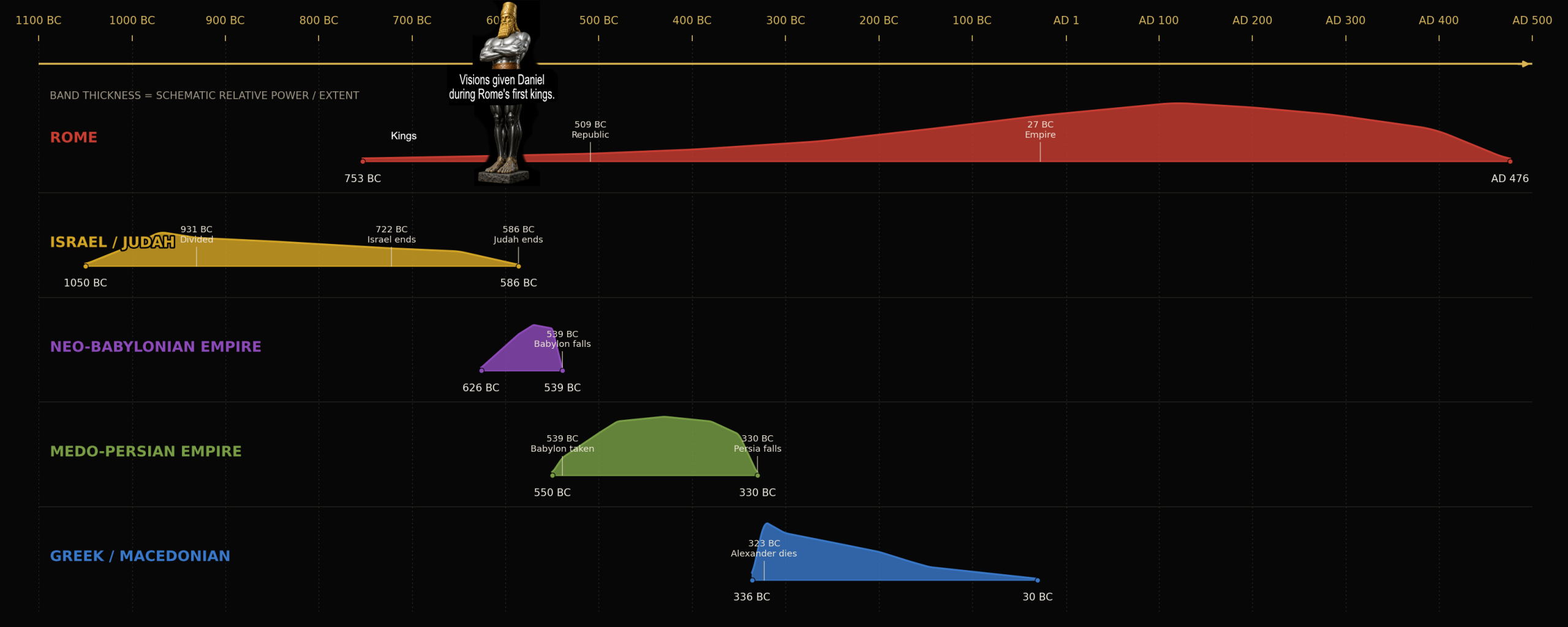
The Neo-Babylonian Empire lasted almost 90 years (626–539 BC)

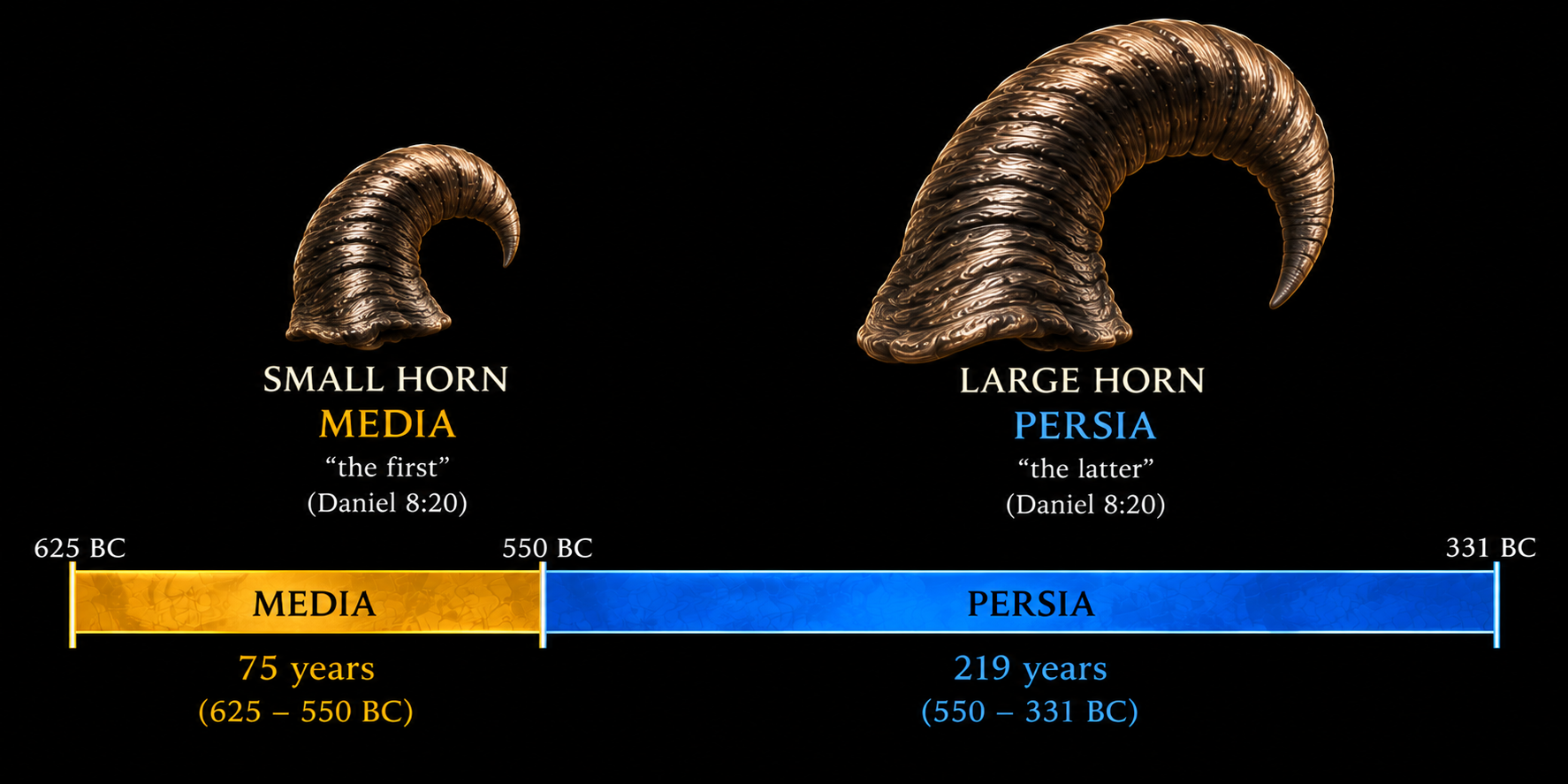
The Medo-Persian Empire lasted over two hundred years (550–330 BC)

Alexander’s united empire lasted only a little over a decade (336–323 BC), but the Greek divisions continued for even longer than the Medo-Persian ones.
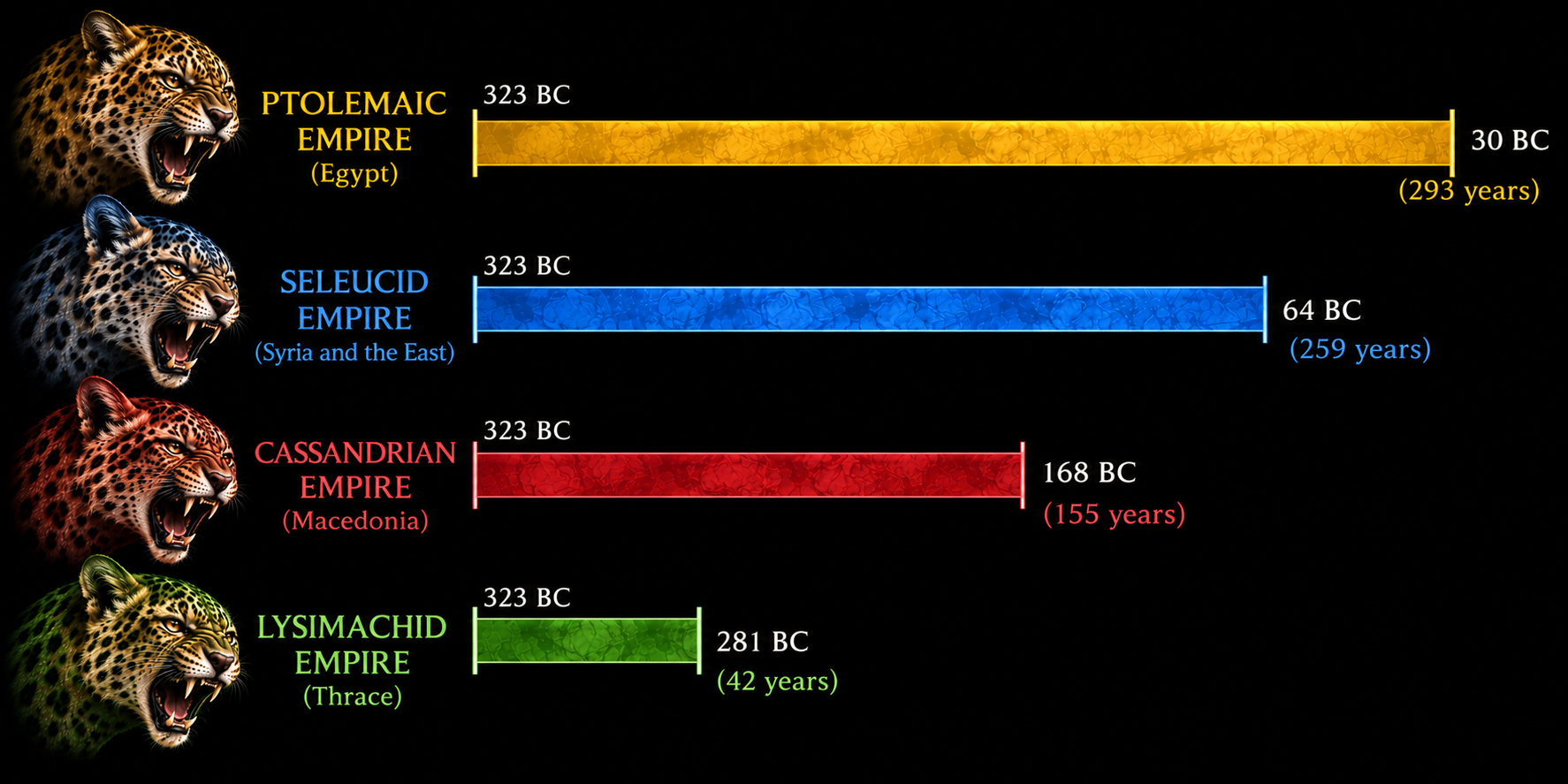
With a focus on the two strongest Greek kingdoms that lasted the longest, the Seleucid Empire lasted 249 years (312–63 BC), and the Ptolemaic Kingdom lasted 275 years (305–30 BC).

In comparison, the Roman Empire itself lasted over 500 years (27 BC – AD 476) and, if counting from when Rome began suppressing God’s people, as the Bible does, in 63 BC, even longer. Its divided remnant kingdoms (horns) are still among the greatest powers then and till today. Which then makes the Roman beast span in relevance for well over 2000 years. Making it, therefore, the main focus of the vision of the fourth beast and its horns. And mostly the only focus of Revelation, a book written during the Roman Empire’s peak. As this beast would affect more of God’s people for the longest time.

  • Neo-Babylonian Empire: 87 years
  • Medo-Persian (Achaemenid) Empire: 220 years
  • Alexander’s Empire: 13 years
  • Seleucid Empire: 249 years
  • Ptolemaic Kingdom: 275 years
  • Roman Empire (West): 503 years; From Rome took Jerusalem: 538 years.

THE LION: BABYLON

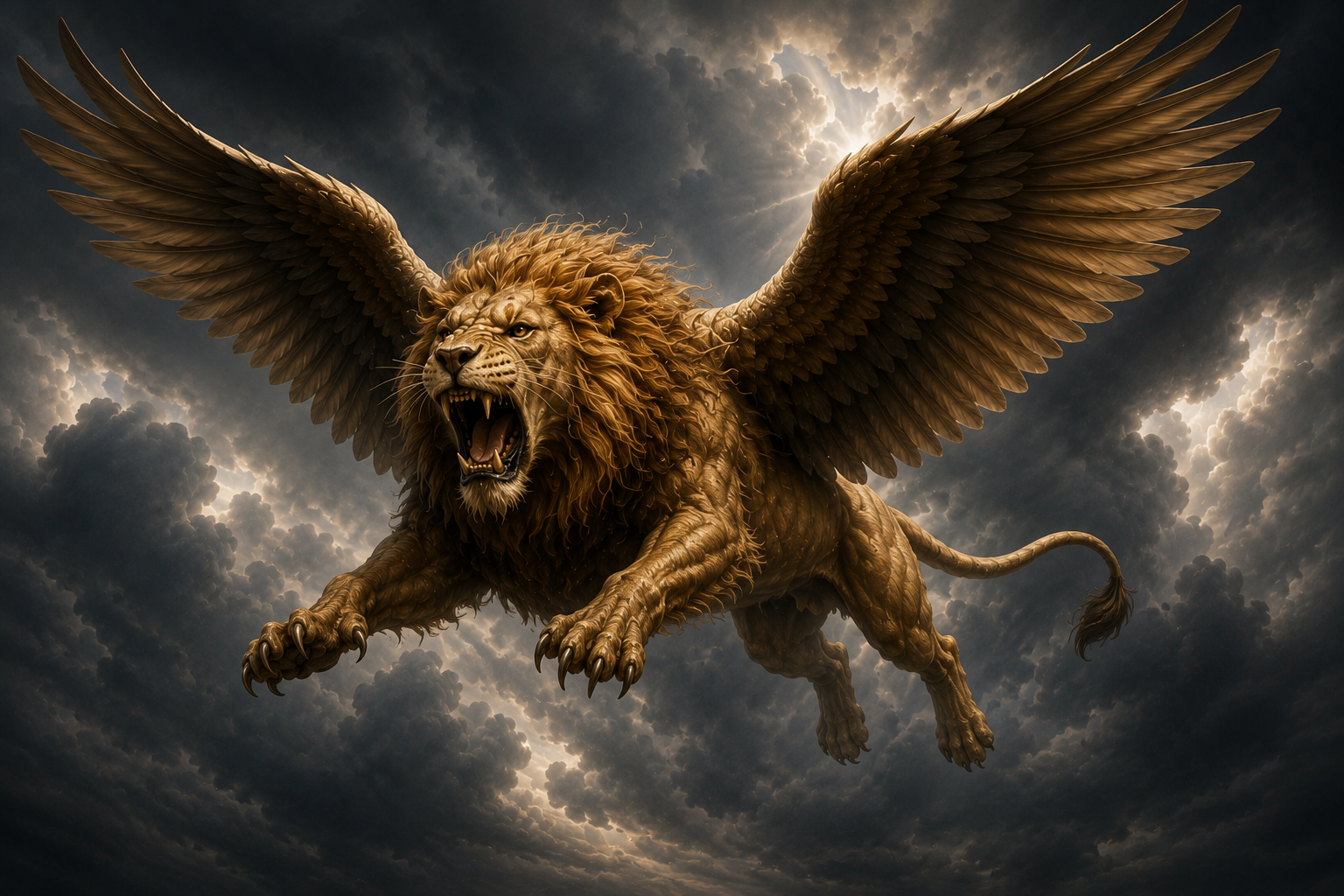
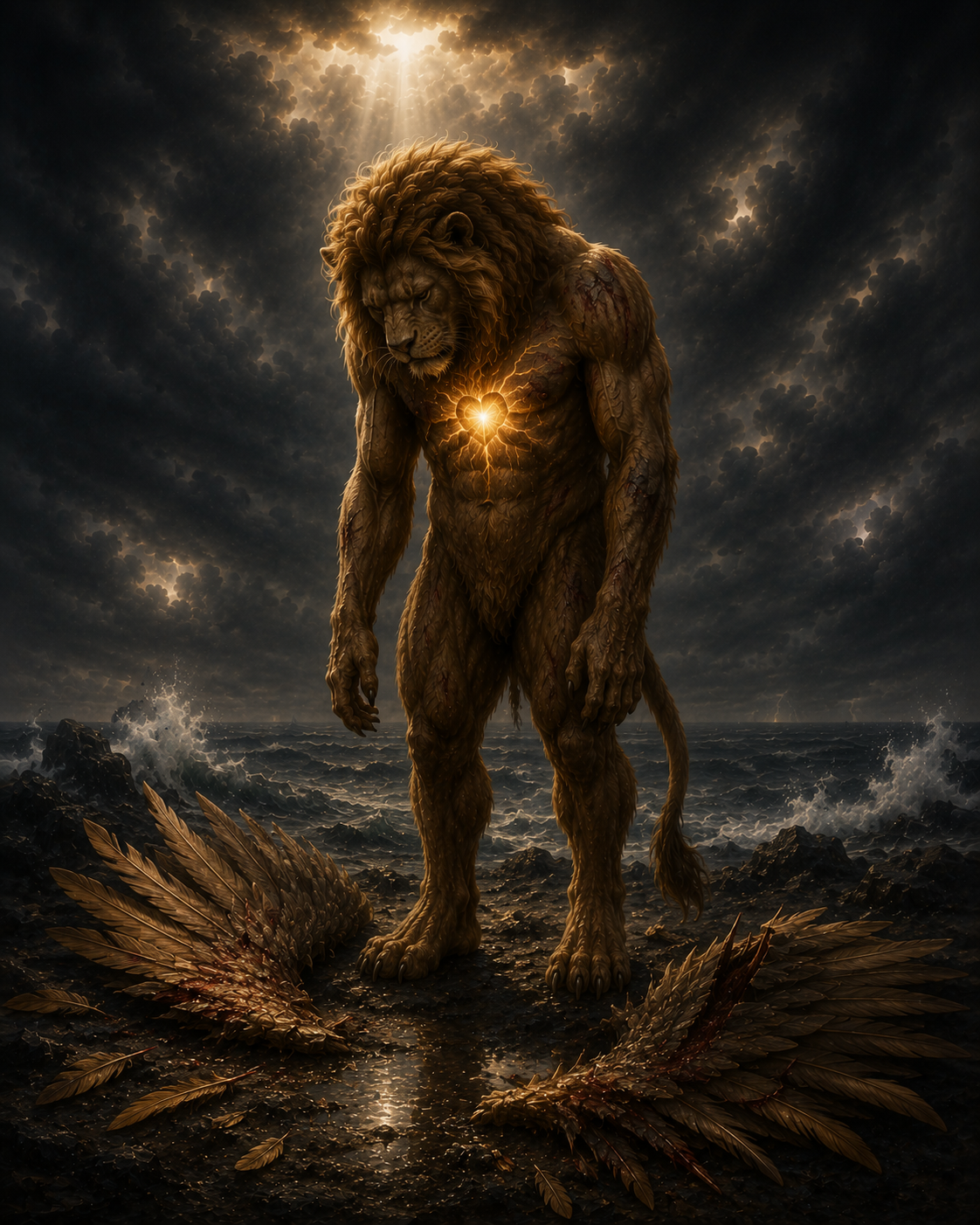
Dan 7:4  The first was like a lion, and had eagle’s wings: I beheld till the wings thereof were plucked, and it was lifted up from the earth, and made stand upon the feet as a man, and a man’s heart was given to it.

The first beast, Babylon, is the lion, the king of beasts, strong and dominant. In the vision, it has eagle’s wings, making it even a greater threat, showing superior strength and speed. The lion is a superior carnivore on the ground, but the eagle is a superior carnivore of the air. Combining the two makes a superior beast.

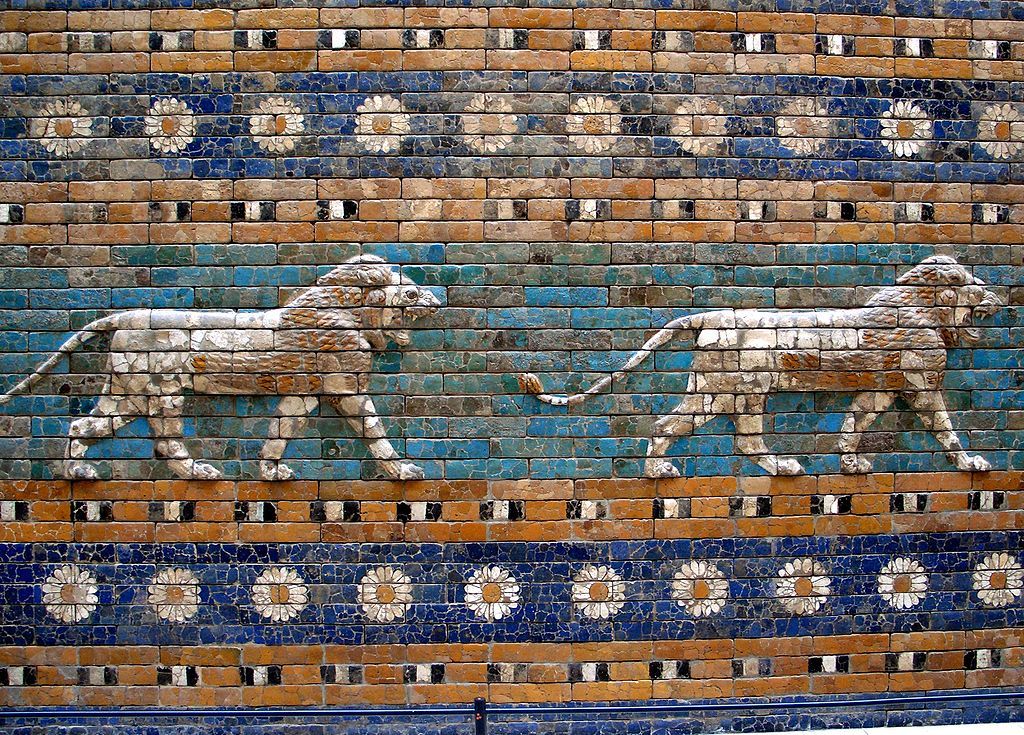
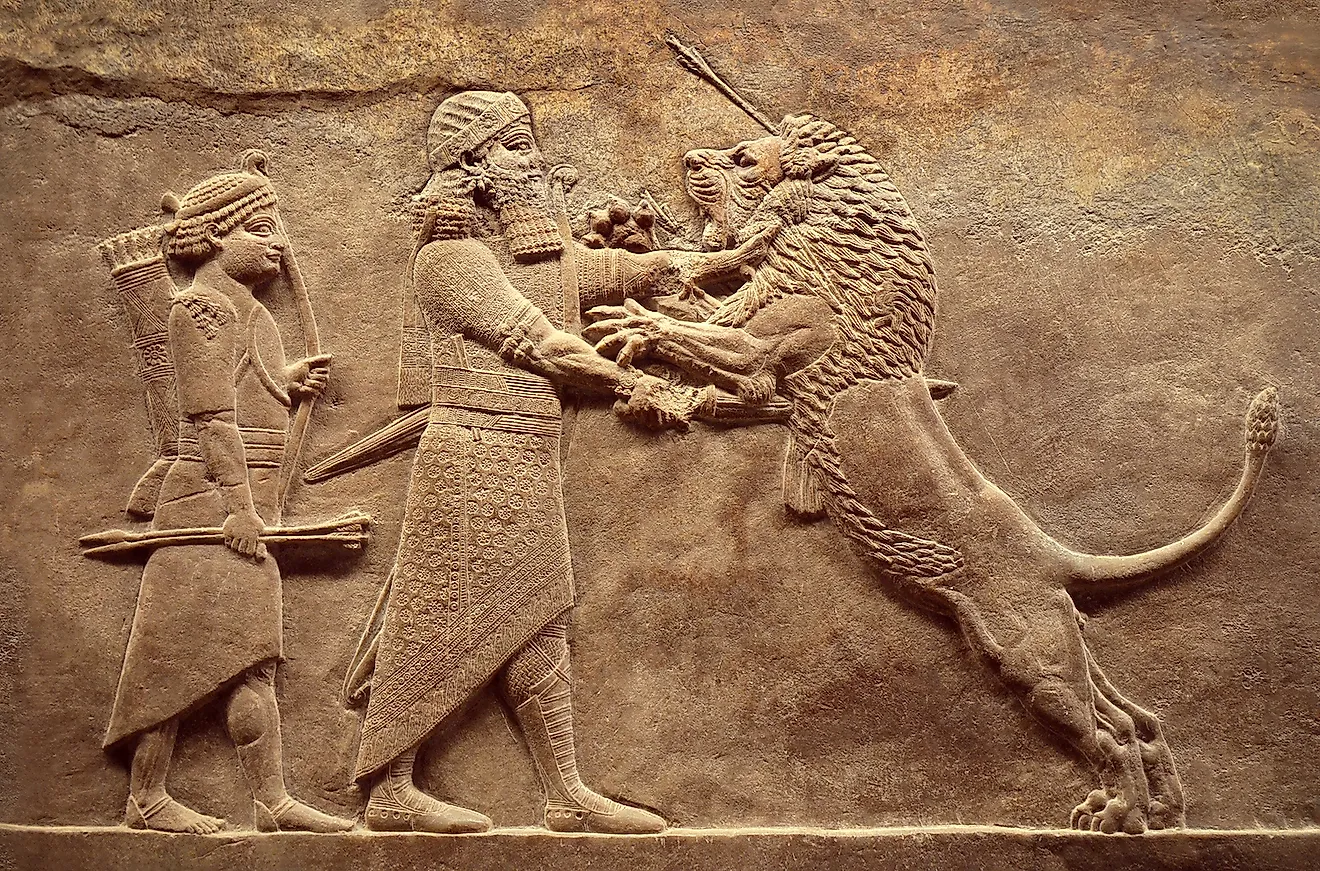
By choosing the symbol of a lion, God was not trying to keep a secret who this beast was. The lion was an adored Babylonian symbol and was depicted all along the processional street leading to the city gate. They greatly admired the animal. Babylon itself loved using winged animals as protective or divine creatures. Their divine protector, Lamassu, a continuation of the ancient Sumerian goddess, was sometimes a winged bull and other times a winged lion.

Lions decorated the entryway to Babylon. Image is from Pergamon museum.

Their main goddess, Ishtar, was associated with the lion. Ishtar’s cult was central to the Babylonians. She was worshiped as the Mistress of Heaven, protector of the city, and a goddess whose favor was sought for both fertility and military success.

In the vision given to Daniel, he sees this powerful creature change to a less frightening being. The lion ends up standing upright like a human, showing that Babylon’s decline and fall occurred in its weakest state. Anatomically, a lion becomes less stable and less powerful overall when it stands. A “man’s heart” shows a shift of the kingdom’s driving force, from an unpredictable territorial beast to a man following his heart’s pursuits.

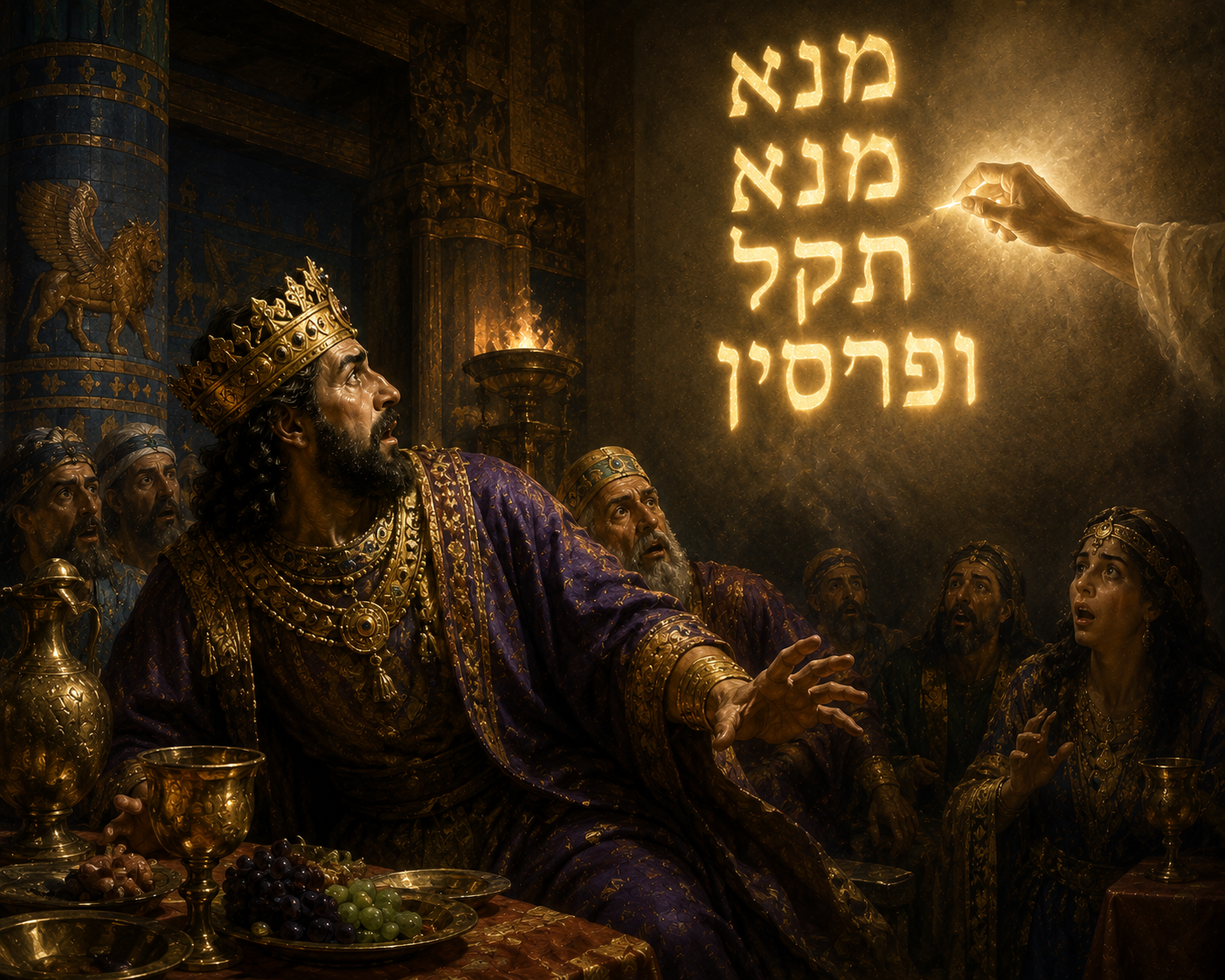
As the Bible explains the downfall of Babylon in chapter five, we see its king living in luxury, feasting and drinking while praising his wealth and the conquests of the former king, and carelessly mocking God, unaware that the Medo-Persian alliance was right outside the walls of the city, ready to bring it down. A lion would never sleep under threat. Humans fully do. And so Babylon, by God’s design, was brought down while it was at its most careless pleasure-seeking state. Their fall was not tied to being overpowered and exhausted by countless wars, as with other empires. Rather, their instability stemmed from internal conflicts over politics, festivals, and religion. Then, in one night, the city fell prey to another empire.

Babylon would later be destroyed and, by God’s prophecy, would never be an inhabited city again; the Babylon mentioned in Revelation refers to the new Babylon, the final beast and its horns. And in the days of these kingdoms Christ would return, and Christ explains the human condition at that time fairly similar to that of Babylon’s final days. “And as it was in the days of Noe, so shall it be also in the days of the Son of man. They did eat, they drank, they married wives, they were given in marriage, until the day that Noe entered into the ark, and the flood came, and destroyed them all. Luk 17:26-27)

Even God’s own fallen-away people will behave similarly unprepared for the event: “But and if that evil servant shall say in his heart, My lord delayeth his coming;

And shall begin to smite his fellowservants, and to eat and drink with the drunken;

The lord of that servant shall come in a day when he looketh not for him, and in an hour that he is not aware of…” (Mat 24:48-50)

The Babylon of the end times is described to have caused their allies to be: “waxed rich through the abundance of her delicacies” (Rev.18:3)

The night of Babylon’s fall and the fall of the last “Babylon” in Revelation are strongly connected and are images of each other.

For all the deaths Babylon was responsible for, for all the bloodshed and wars. For the destruction of God’s temple and city – God decided that Babylon had to be punished.
About Babylon He said: “I was wroth with my people… I gave them into thine hand: thou didst shew them no mercy; upon the ancient hast thou very heavily laid thy yoke.” (Isaiah 47:6)

God had used Babylon to discipline Judah, but Babylon exceeded its commission by showing no mercy.
“And I will render unto Babylon… all their evil that they have done in Zion in your sight, saith the LORD.” (Jeremiah 51:24)

The two main reasons God brought Babylon down were to punish them for their war crimes, but also because they, instead of allowing the captives of Judah and Israel to return to their land and rebuild the temple, desecrated the temple items instead. To bring His people back to the land, He had to raise a ruler that could be worked on. That ruler was Cyrus.

THE BEAR

Dan 7:5  And behold another beast, a second, like to a bear, and it raised up itself on one side, and it had three ribs in the mouth of it between the teeth of it: and they said thus unto it, Arise, devour much flesh.

A bear, with its stable feet and gait, is unlike the lion and even more fearful when it stands on its feet.

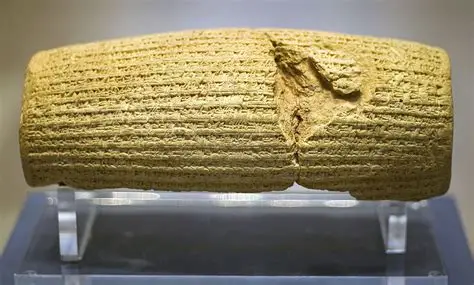
The Cyrus Cylinder is an ancient artifact containing an inscription detailing the policies of Cyrus the Great following his conquest of Babylon in 539 BCE. From this seal we learn some of his strategies. As any great leader before and after, the Medo-Persian leader Cyrus saw himself, or at least presented himself, as a helper during his conquest. Cyrus presented himself as chosen by the Babylonian god Marduk to bring relief to the Babylonian people.

After taking Babylon, Cyrus claimed that: “Marduk searched through all the lands… He took Cyrus… He ordered him to go to Babylon… The people of Babylon rejoiced at his kingship.” (Cyrus Cylinder) It is claimed that some of the religious strife that had weakened the people’s trust in their leader was the Babylonian king’s adoration of the moon god and his failure to attend the new year festivals for the god Marduk and the other gods. In the Cyrus Cylinder, the Median king criticizes Nabonidus for interfering with the worship of Marduk and presents himself as a defender of the Babylonian god. About the Babylonian king, Cyrus says: “he continually did evil against Marduk’s city.” You could say it was very clever. It was not his religion, but he presented himself as the protector of their religion all the same to win over the people. Cyrus was not out to go on a killing spree; rather, he wanted a kingdom of peace. The seal says:

The Cyrus Cylinder dates from the 6th century BC and was found in the ruins of the city of Babylon. It is now in the British Museum.

“My vast army marched into Babylon in peace; I did not permit anyone to frighten the people of Sumer and Akkad.”
The cylinder presents Cyrus as a benevolent ruler who respects the traditions of the conquered but also the one whose coming was desired:

“He made him enter his city Babylon without fighting or battle; he saved Babylon from hardship. He delivered Nabonidus, the king who did not revere him, into his hands.

[18] All the people of Babylon, all the land of Sumer and Akkad, princes and governors, bowed to him and kissed his feet. They rejoiced at his kingship and their faces shone”. (Cyrus Cylinder)
Bear in mind, these are the words of the ruler coming to conquest. This is propaganda aimed at gaining his people’s support. God, on the other side, presents this new empire as merely a continuation of the one before, just another beast on the scene. Whether people are manipulated, seduced, or violently suppressed, the main goal and nature of the beast remains the same. The Nabonidus Chronicle says: “The people of Akkad revolted, but he (Cyrus) massacred the inhabitants.” Perhaps there were more versions of the events than the one Cyrus presented.

The bear is not just a carnivore; it eats anything. Also called an omnivore, one who eats both plants and animals. Its main diet is berries, grass, nuts, and roots. But when hungry, it also takes small mammals and even deer and moose calves. You could say it has an opportunistic diet. The bear is very protective and aggressive when it has had cubs.

Not to be mistaken for a peaceful bear, it is described in the book of Daniel as one who “devour much flesh”.
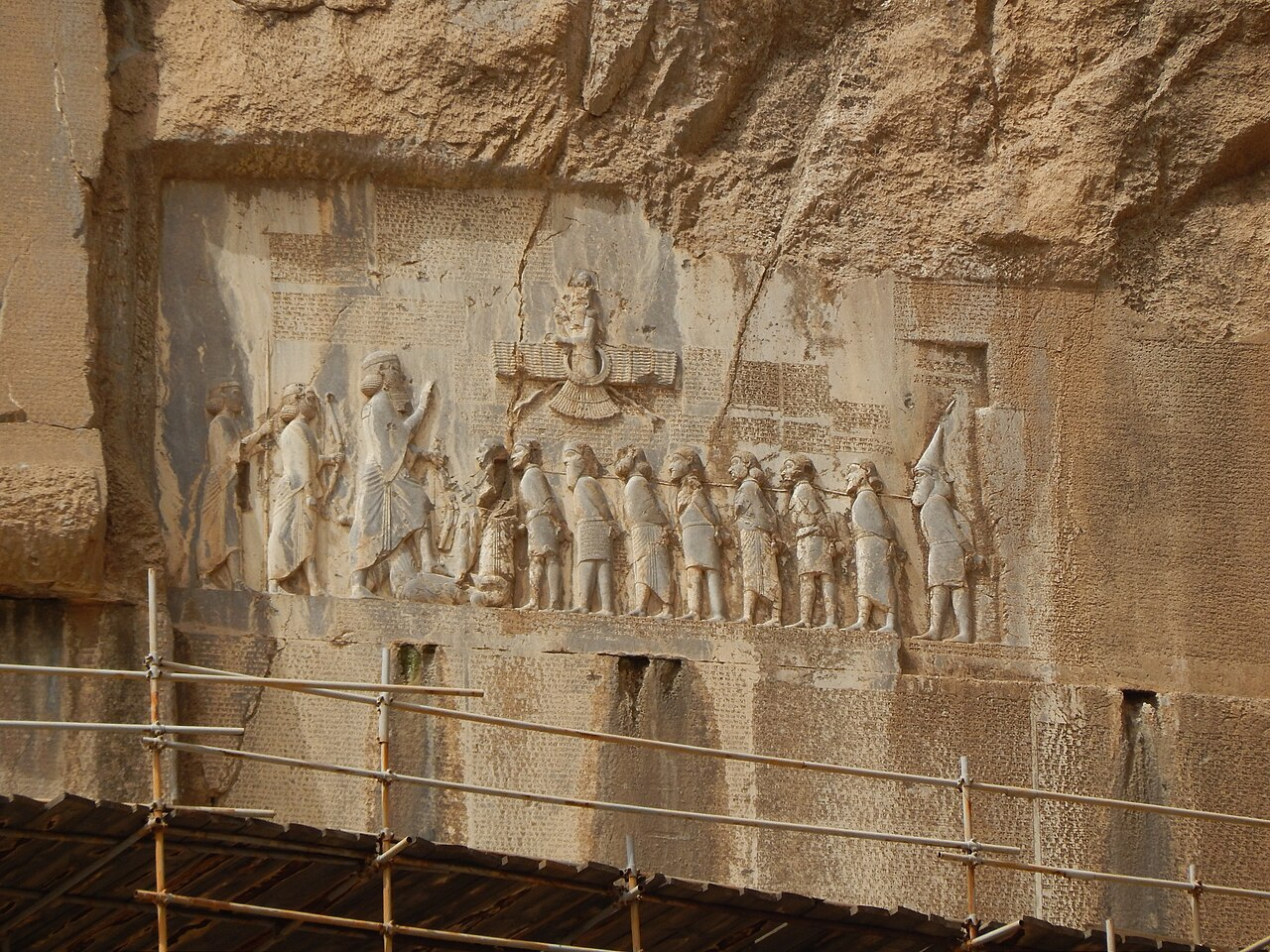
Most certainly, many of the Medo-Persian wars left a trail of blood behind them. The Behistun Inscription lists multiple rebellions. Darius says, “Many were slain.” According to the Greek historian Herodotus, Cyrus’ campaign against the Massagetae was his bloodiest war. The whole kingdom of Lydia was also destroyed by Cyrus the Great.
Claimed to be authored by Darius the Great sometime between his coronation as king of the Persian Empire in the summer of 522 BC and his death in 486 BC. The inscriptions talk about rebellions within the empire and the king’s lineage. The inscriptions were discovered in Iran.

The Bible does not detail all the workings of the Medo-Persian empire, but, as it does with all these empires, focuses on its relationship to God’s people.

This is God’s main concern and relevance. God is not giving glory to empires, their wealth, art, or science. Daniel’s prophecy warns and prepares God’s people for their main antagonists throughout time. God explains in part why he allowed their existence, but also their crimes and their final punishment. The beasts are man’s creation, but God will continuously interfere in the ways of man, for the sake of His people.

With the Median King desiring, if possible, to be accepted rather than opposed, God could use that desire to prompt the king to act in a way that the king hoped would bring him support and glory—by allowing the Jews to return to their land.

Through the prophet Isaiah, God says he will help Cyrus gain his position to use him to help His own people: “Thus saith the LORD to his anointed, to Cyrus, whose right hand I have holden, to subdue nations before him; and I will loose the loins of kings, to open before him the two leaved gates; and the gates shall not be shut;

I will go before thee, and make the crooked places straight: I will break in pieces the gates of brass, and cut in sunder the bars of iron” (Isa 45:1-2)
“That saith of Cyrus, He is my shepherd, and shall perform all my pleasure: even saying to Jerusalem, Thou shalt be built; and to the temple, Thy foundation shall be laid” (Isa 44:28)

These verses were written before even Cyrus was born, predicting his existence, but also flattering Cyrus by presenting the God of Israel as on his side.
In this way God worked on Cyrus. As God has said: “So shall my word be that goeth forth out of my mouth: it shall not return unto me void, but it shall accomplish that which I please” (Isa.55:10)

As God had said it, so it happened. Cyrus allowed the Jews to return and rebuild the Temple (Ezra 1:1–4). Although God was able to bring the people back during the king’s reign, he did not compel the king to give up the territory. Judah would remain a nation under Medo-Persian rule, with the complications that followed. Even God had to battle hard to impress the rulers. King Darius confirmed Cyrus’ decree and supported the rebuilding (Ezra 6:1-2). However, Persian officials attempted to stop the rebuilding of Jerusalem before Darius reversed the decision (Ezra 4:4-24). The people of Jerusalem had to deal with many challenges, as is written in the books of Ezra, Nehemiah, Zechariah, and Haggai. The prospect of rebuilding a city and a temple in a province of a pagan nation was discouraging to many and slowed down the process. God had to encourage them by telling them about the temple’s future glory and the coming of the Messiah. This gave them hope and purpose.

King Artaxerxes authorized Ezra to teach God’s law (Ezra 7:11-26). Another Persian king was so careless with jews that he issued a decree that would permit everyone to kill them. However, by God’s interference and deliverance, the decree was reversed. Still it showed how the Jews had many enemies in Persian provinces.

To Daniel, who was constantly praying for God to deliver his people, the angel Gabriel told him:

“But the prince of the kingdom of Persia withstood me one and twenty days: but, lo, Michael, one of the chief princes, came to help me; and I remained there with the kings of Persia” (Dan 10:13).

God was working powerfully for his people despite their suppression, and the Medo-Persian rulers would often strive against God, just as Nebuchadnezzar and the Babylonian kings did. As experienced by Daniel, Ezekiel, Esther, Ezra and Nehemiah, it’s not easy being a people under a foreign nation. The Medo-Persian kings were ambivalent, granting and withdrawing permissions. It was obvious they could no longer act as a free nation as they had desired.

“Raised itself on one side”

In Daniel’s vision, the power is depicted as a bear that rises on one side. The kingdom was composed of two nationalities, the Medes and the Persians. The Persian division of the kingdom fulfilled this; it attained the higher eminence, becoming a dominant influence in the nation.

Cyrus was Persian by his father’s line and half Median on his mother’s. He founded the Achaemenid Persian Empire. After defeating his grandfather, Astyages, around 550 BC, he united the Medes and Persians. But the ruling dynasty was Persian.

  • Persian supremacy: 550–330 BC (220 years)

And so the bear leaned on the Persian side with the Persians as the dominant power for well over 200 years, from Cyrus the Great until Alexander the Great conquered the Achaemenid Empire in 330 BC.

It had three ribs in the mouth”

The bear is described as having three ribs in his mouth. The ribs are, of course, bones of another creature that the bear has eaten. The three ribs most likely are referencing the three great provinces of Babylon, Lydia, and Egypt, which Medo-Persia especially oppressed. They were strong kingdoms in their day and the most well-known to have fallen prey to “the bear”.

God predicted and prophesied the end of the long-running Persian Empire. As ever is with the downfall of any empire, or as Jesus said: “a house divided against itself cannot stand,” has proved true throughout time. Internal conflict and bloodshed weakened the royal palace. Their armies were weakened. And in addition, they decided to provoke the Greeks by invading them, setting Greek temples on fire, and interfering in Greek politics.

Darius III was the final ruler of the Achaemenid Persian Empire. In 330 BCE, while fleeing toward Bactria, Darius was killed by his own followers, effectively bringing the Achaemenid Empire to an end.

THE LEOPARD: THE GREEK EMPIRES

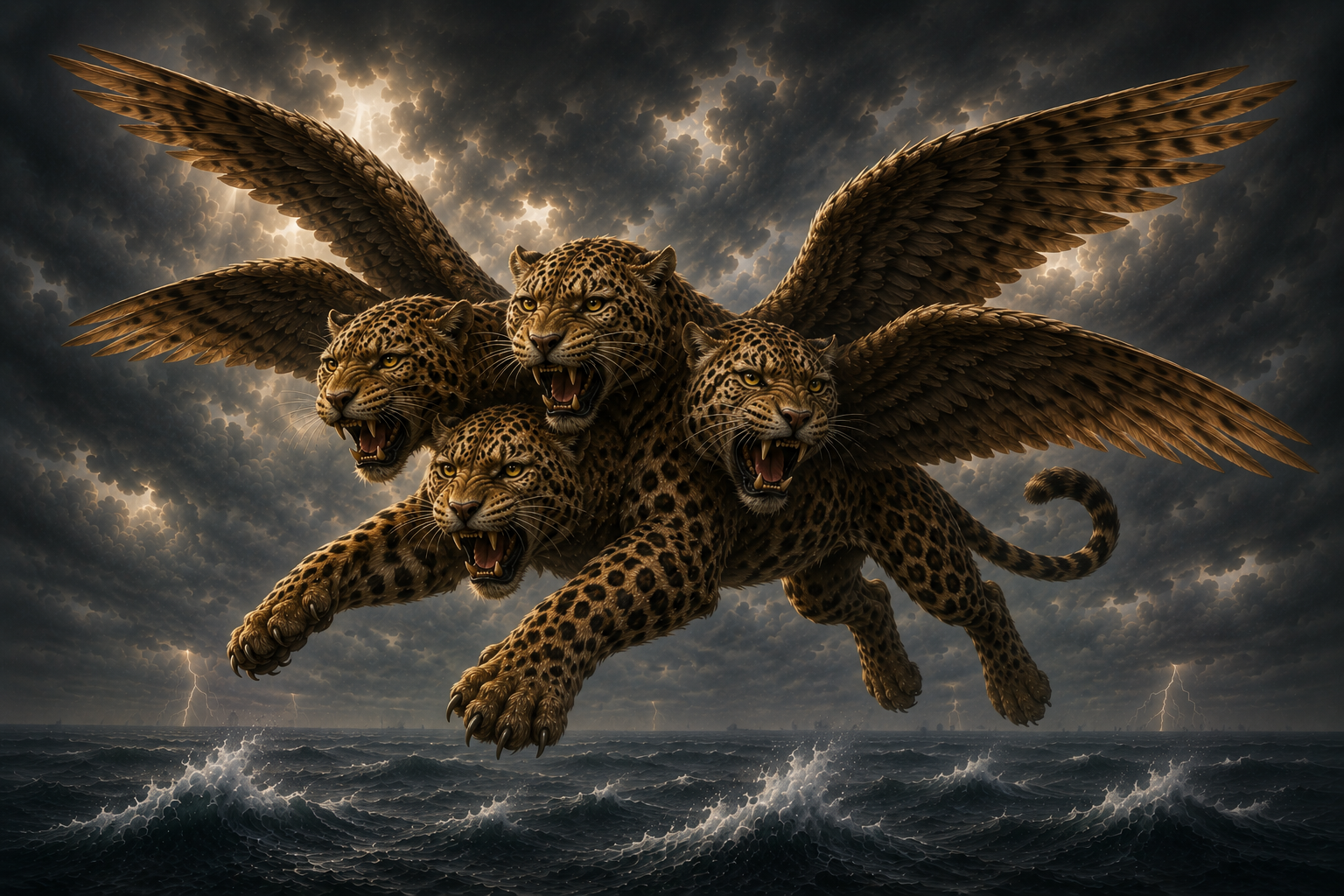
Dan 7:6  After this I beheld, and lo another, like a leopard, which had upon the back of it four wings of a fowl; the beast had also four heads; and dominion was given to it.

The next beast shown to Daniel is a leopard with four heads and four wings, illustrating the Greek empire which would defeat the Persian empire and take over much of its territories. Because the next chapter in Daniel identifies it as the Greek empire, there is no doubt who God is speaking of.

Just like the Babylonian lion, this beast has wings that signify its speed of conquest, which is very fitting for the incredibly short time it took Alexander the Great to take over the then-known world. People today are still baffled by his great accomplishments done in a short period of time. Alexander the Great died fairly young but left an impact on the whole region for hundreds of years. Even after Rome took over territories, Greek culture remained rooted in many of the societies.

Four heads

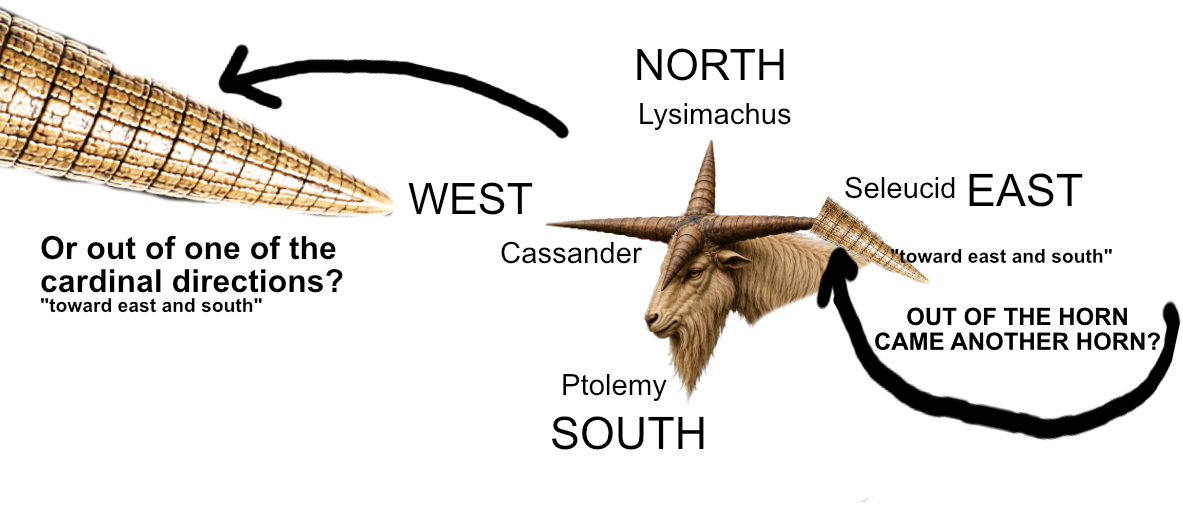
Seleucus became king of the North, and the Ptolemaic kingdom became king of the south of these Hellenistic empires. When the Bible describes kings of cardinal directions, the king of that area can change to whoever takes the territory. This changes the definition of who the King of the North is later in Daniel chapter 11 by the empires taking over the northern territory.

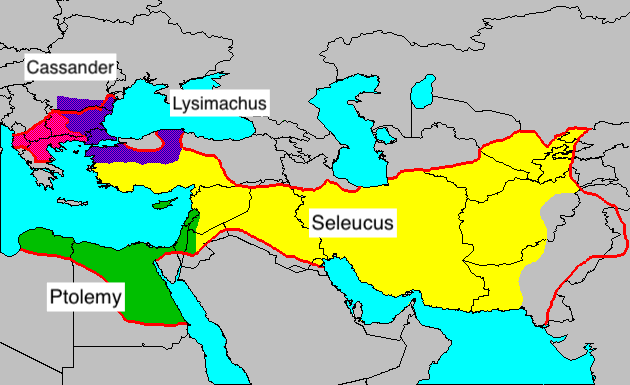
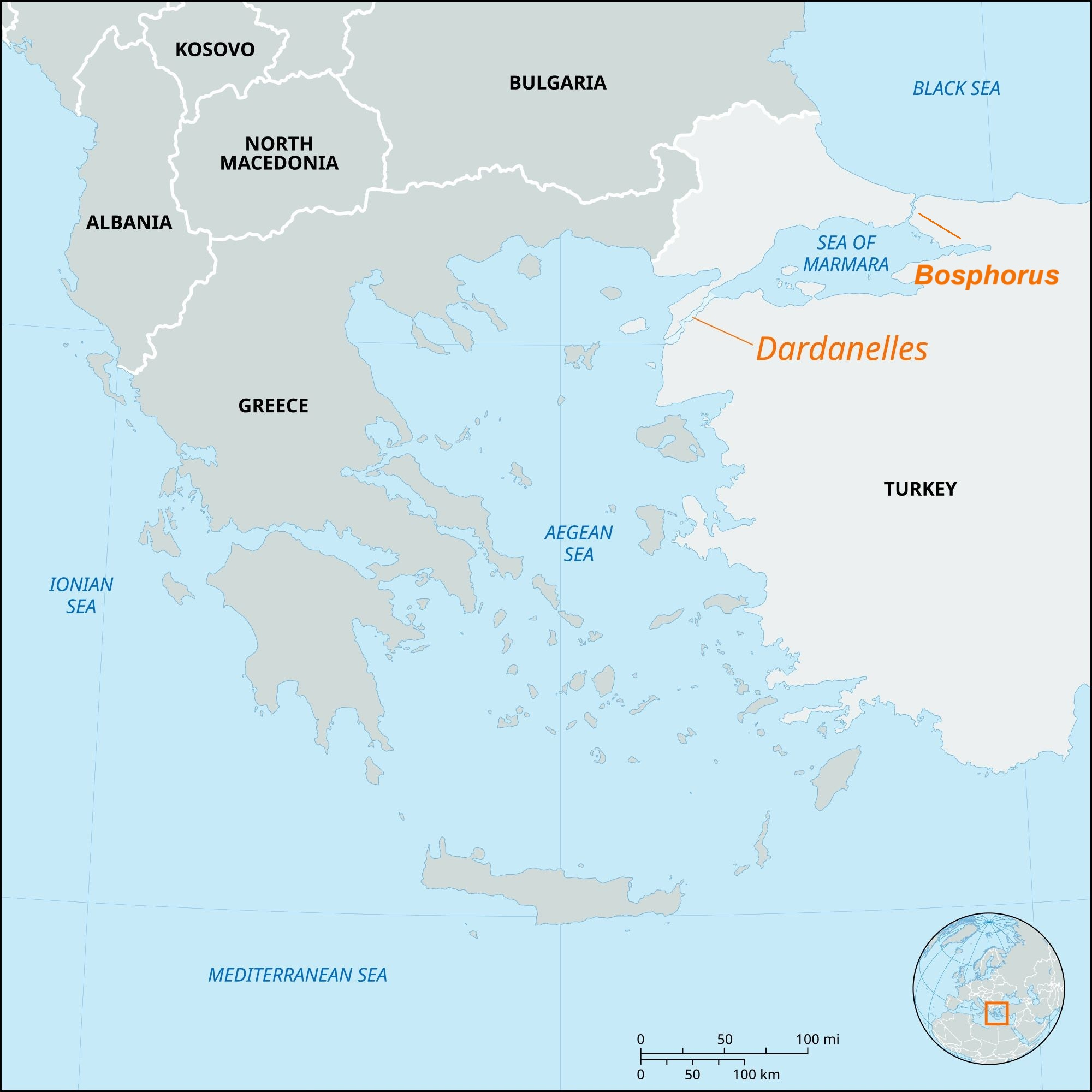
Alexander the Great made the grounds, and his conquest and empire were divided into four kingdoms, given to Alexander’s four leading generals. And so, as the Bible accurately predicted, Greece became a four-kingdom empire. General Cassander had Macedonia and Greece in the west; General Lysimachus had Thrace and the parts of Asia on the Hellespont and the Bosphorus in the north; General Ptolemy received Egypt, Lydia, Arabia, Palestine, and Coele-Syria in the south; and General Seleucus had Syria and all the rest of Alexander’s dominions in the east. By 301 BC, Alexander’s conquest, divided into four parts, was complete. As is the case with the other empires, the God of the Bible does not give praise to Greek culture or accomplishments in the arts and crafts. He does not tell his people to learn from the learned Greek men. Their mention is only in relation to God’s people. The Greeks had great kingdoms and territories, wise men, philosophers, and poets, and a sought-after and celebrated culture long before they conquered the Persian Empire. Yet, their relevance and entry onto the prophetic scene are when they take the land of God’s people.

Life under the Greek empires would prove to be, at times, good and, at other times, very bad. However, because of Daniel’s prophecies, they already knew the Persian Empire would fall, and another empire would take over; they saw the Greek Empire coming and did not fight them. But accepted their fate.

In another vision given in Daniel 11, God shows how slowly the Greek empires take to fall, how they fall, but, first, how they end up even warring against each other.

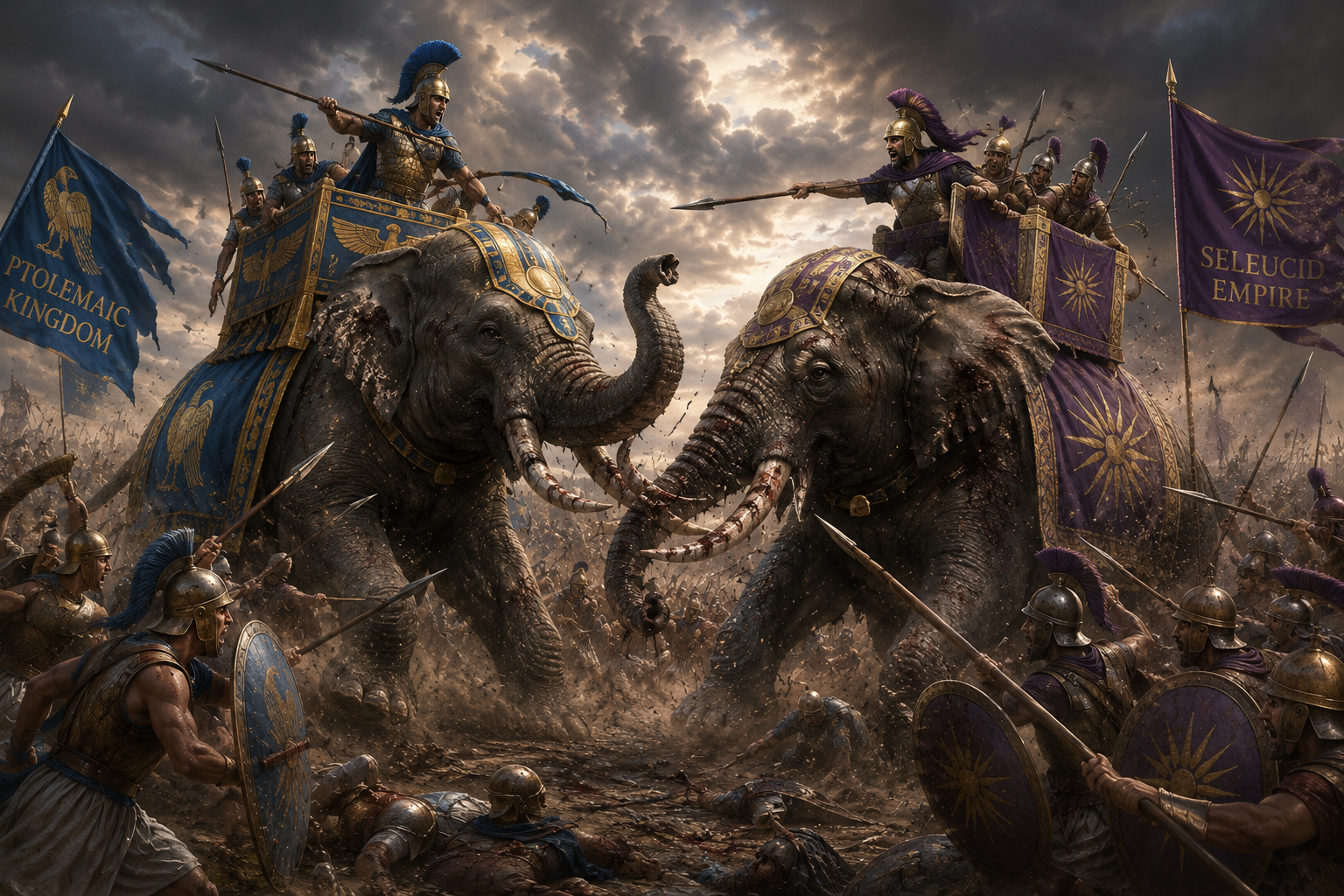
In the battle of Raphia between the Ptolemies and Seleucids, both sides used elephants. The Seleucids used Indian elephants and the Ptolemies used African elephants.

The four kingdoms became two: the Ptolemaic Empire in Egypt (King of the South) and the Seleucid Empire in Syria (King of the North). Both became a pain to Judah in their turn, mostly because of conflicts between the Greek empires.

Meanwhile, the Greek empires were weakening; another was growing strong in the west, but it would take some time before it reached the land of Judah and became relevant to them.

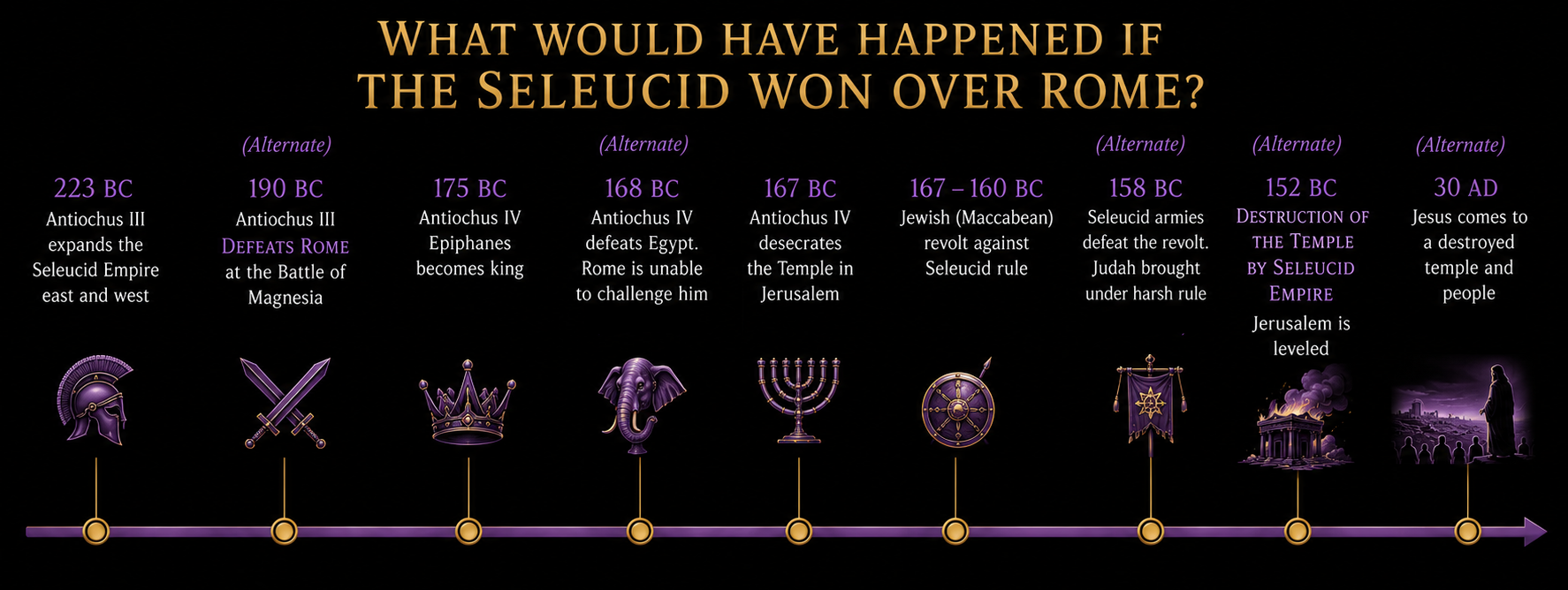
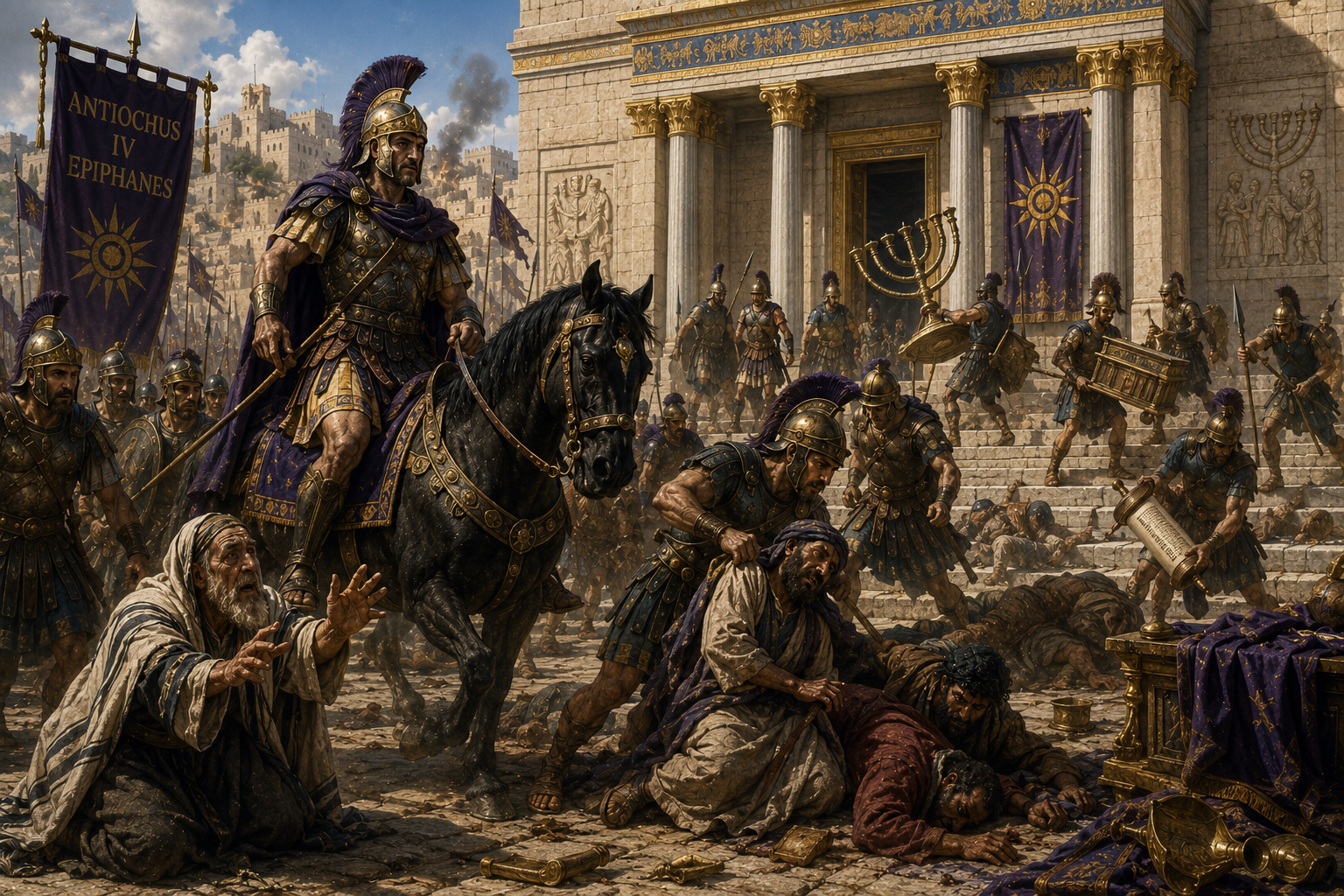
After the Seleucid king Antiochus IV Epiphanes banned Jewish practices and desecrated the Temple, the Judean people revolted in 167 BC. They even won several times against the Seleucids, but knew they could not remain strong unless they formed a powerful alliance. In 161 BC, Judas Maccabeus, the greatest warrior for the Jews, sent envoys to Rome to seek an alliance.
They traveled to Rome and addressed the Senate on behalf of Judas, saying:
“Judas, called Maccabeus, and his brothers, with the Jewish people, have sent us to you to establish an alliance and peace with you…”

Antiochus IV Epiphanes was a terror to the Jews, but his rampage lasted only a small amount of time.

The agreement with Rome is recorded in 1 Maccabees 8 and formally stated in 1 Maccabees 8:22–32. It was essentially a treaty of friendship, mutual support against enemies, and the recognition of the Jewish leadership by Rome. Rome and the Seleucid Empire had already been through several armed conflicts. The Roman-Seleucid war between 192-188 BC and the later treaty of Apamea, which forced the Seleucids to surrender territory, provide hostages, and greatly reduce their military. This was also part of why the Jews were able to win battles against them; before Rome had weakened them, they would have been too strong for Rome to handle. Rome, therefore, seemed like an answer to prayer. Rome and the Seleucids were not in an active, full-scale war in 161 BC when Judah made its treaty with Rome. Still, Rome held the upper hand politically and militarily, and the Seleucids wanted to avoid conflict with them as much as possible. And their recognition of it as a Jewish state put pressure on the Seleucids to back off.

By aligning with the Seleucid enemies, the Jews hoped to gain control. However, this alliance was in direct conflict with God’s advice. And in the past, such an act was also called harlotry by God.
“Cursed be the man that trusteth in man, and maketh flesh his arm, and whose heart departeth from the LORD.” (Jeremiah 17:5) God had criticized them and warned them in the past for seeking alliances with Egypt and Assyria rather than seeking God. (Isa.30:1-7, 31:1, Hos.5:13; 7:11; 8:9; 12:1, Jer.2:18,36, 2.Chron.16:7-9, 2.Kings 16:7-9, 18:21, Isaiah 36:6)
Thinking the Seleucids were their greatest enemy, they repeated their past mistakes and went straight into the arms of the fourth beast.

Nevertheless, after constant conflict, in 142 BC, under Simon Thassi, the Seleucids recognized Judea’s independence, marking the beginning of the Hasmonean state’s independence. The Seleucids might also have seen it as a strategy. So for a while Judah managed to take temporary control of their own land, but even then their independence was mainly an illusion, a parenthesis in the timeline.
Fleeing from the power that had desecrated their temple to the power that would destroy it proved to be merely a temporary relief. And as they ought to have been forewarned, the next beast after the Greek four-headed carnivore would be worse than all the others. And in the end, the remainder of the Seleucid kingdom and Jerusalem fell into the hands of Rome the same year.

Quick timeline of the Leopard with four heads and four wings:

  • 332–323 BC: Alexander the Great ruled Judea.
    323–301 BC: His successors fought over the region.
  • 301–200 BC: Ruled by the Ptolemies (Egypt/King of the South).
  • 200–167 BC: Ruled by the Seleucids (Syria/King of the North).
  • 167–160 BC: The Maccabean Revolt began.
  • c. 142 BC: Under Simon Thassi, Judea achieved independence from the Seleucid Empire.
  • 140–63 BC: The Hasmonean dynasty ruled an independent Jewish state (77 years).
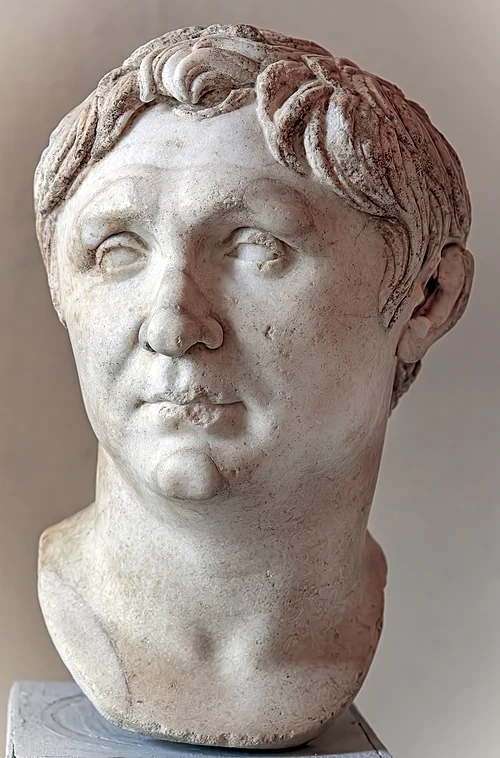
  • 63 BC: Pompey the Great conquered Jerusalem, and Judea came under Roman control.
The dangers of interpreting prophecy falsely.
 
Because Antiochus IV Epiphanes seemed like such a powerful enemy at the time, some Jewish interpreters believed the Seleucid empire was the fourth beast, rather than one of the leopard’s heads. By viewing it as the fourth beast, they thought the kingdom of God would come soon after its fall. This created a false sense of hope, which may have influenced some to reject Christ and seek help from the actual fourth beast.
The belief that Antiochus IV’s empire is the fourth beast still appears in Christian prophecy today. As a result, many Christians have joined with Papal Rome, just as the Jews once allied with Rome. They believe this is harmless, thinking the warning about the terrible beast belongs to the past, not the present.
This misunderstanding has left both Jews and Christians unprepared for what God wanted to show them. It is understandable, given how much suffering Antiochus IV caused at the time. However, he was still only one of the four heads of the Hellenistic beast and was the third head to fall.
By not understanding prophecy correctly, even the Christian church is in great danger of making the wrong alliances in our own time.
And it must also be considered that the powers the Bible warns against have eagerly played a part in Christians’ misunderstandings of prophecy.

BEASTLY ROME – PART FOUR: THE NEW BABEL

0
The city of Rome and its people were initially small and had little power compared to the Greek Empire. But slowly and steadily, Rome became stronger and stronger. Although it took a while for Rome to become the powerful capital it later became, it quickly became a refuge not just for Japhaite elsewhere, but also for escapees from other nations. The constant conflicts in the Middle East led many refugees to seek shelter in the West, which was, at the time, a more peaceful region.
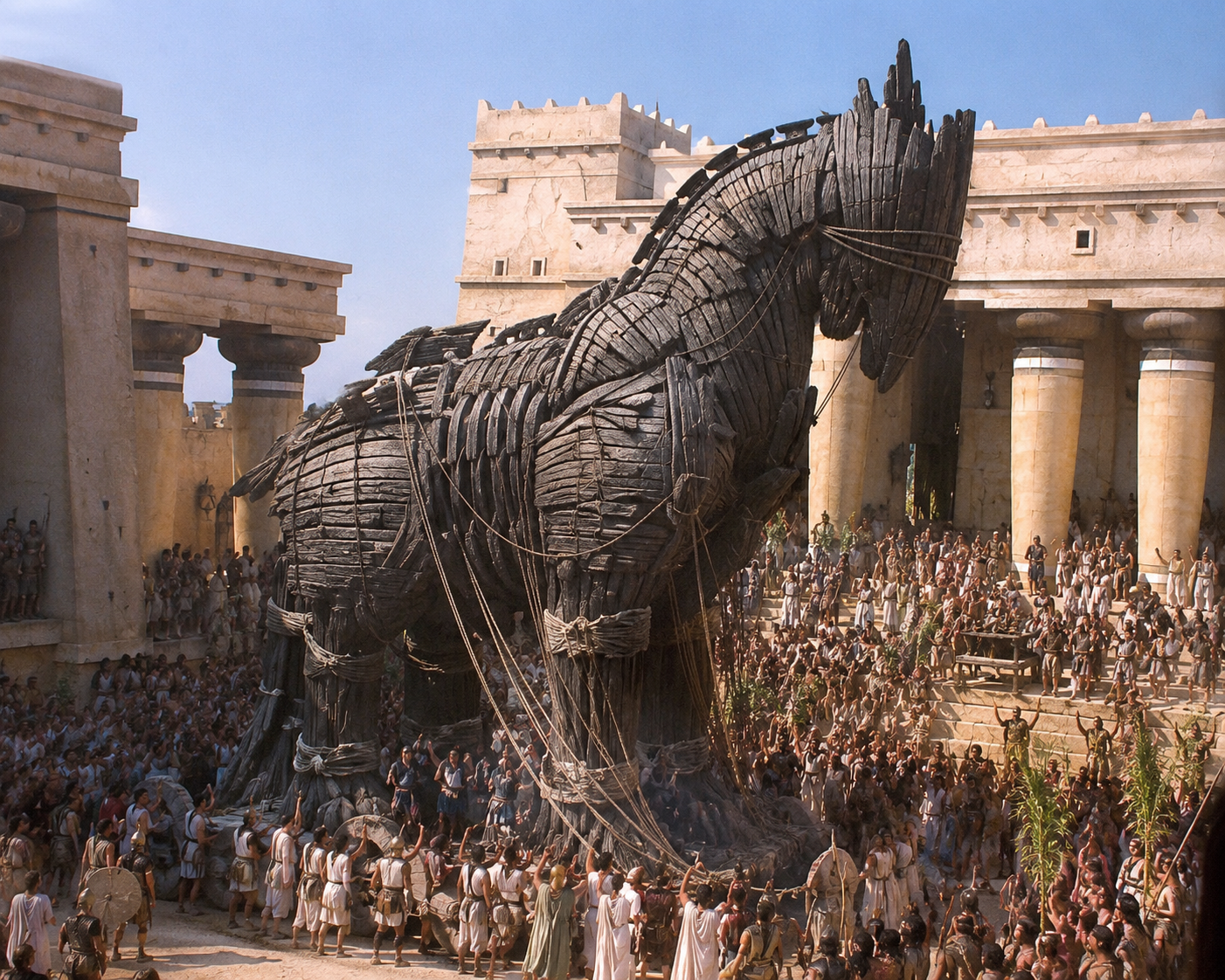
The Roman religion was just a Latin version of the Greek religion: the same gods and stories, with different names, myths, and legends. If the religion was imported with them from Troy, the culture would have been influenced by neighboring Anatolian kingdoms such as the Hittite Empire. Archaeological evidence suggests the Trojans probably worshipped Anatolian deities alongside deities later identified by the Greeks with Zeus, Apollo, and Athena. Most of the Anatolian gods had a greek/roman equivalent. The Hittites of Anatolia, the allies of Troy, did first what the Romans did later. The Hittites called it the “Thousand Gods of Hatti,” because they readily adopted local gods from the regions they ruled during their prime.
Capital of the Anatolian Hittites. The city of the thousand gods. First known attempt at a pagan ecumenical religion.
As Rome began to acquire territory, it followed the same strategy. Usually, people and nations with different gods would not accept a foreign nation with other gods coming to suppress them.
Rome’s policy toward religion was often pragmatic rather than ideological. Instead of trying to eliminate local religions, Roman leaders usually found it more useful to incorporate them into the empire. This made conquered peoples less likely to rebel.
They allowed local gods to continue being worshipped. If a city surrendered peacefully and paid taxes, Rome left its temples and priesthoods intact. They identified foreign gods with Roman ones through a practice historians call interpretatio Romana. For example, a local thunder god might be identified with the Roman Jupiter, or a war god with Mars. This helped make foreign religions seem compatible with Roman religion. They sometimes adopted foreign gods in Rome itself if they had a large enough fan base. Temples were built in Rome for deities believed to benefit the empire. Good examples of this were the goddess Cybele from Phrygia, the goddess Isis from Egypt, and the Persian-associated god Mithras.
Rome also respected ancient and prestigious religious traditions. Egyptian temples, Greek sanctuaries, and many local priesthoods were preserved because cooperation was more profitable than destruction.
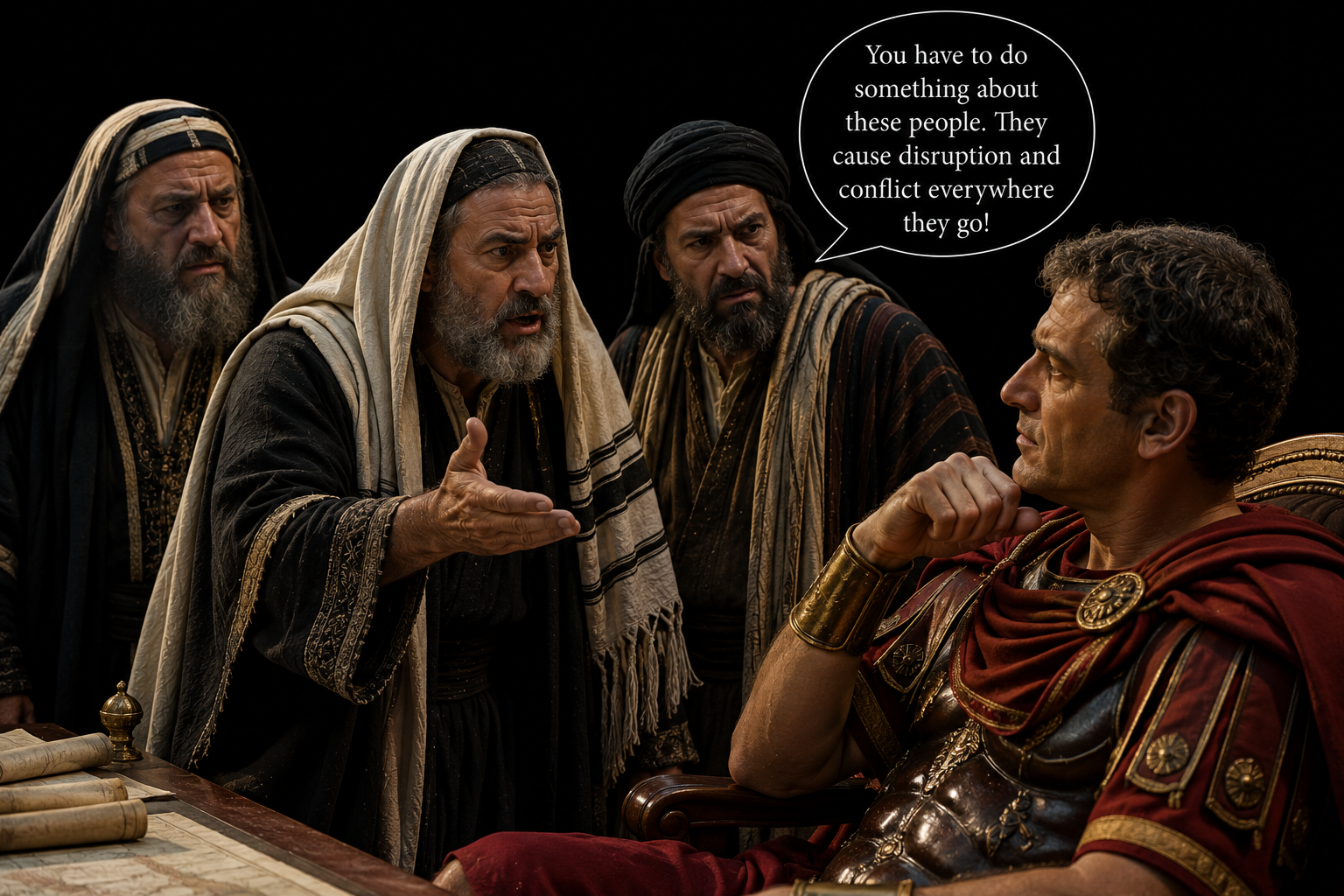
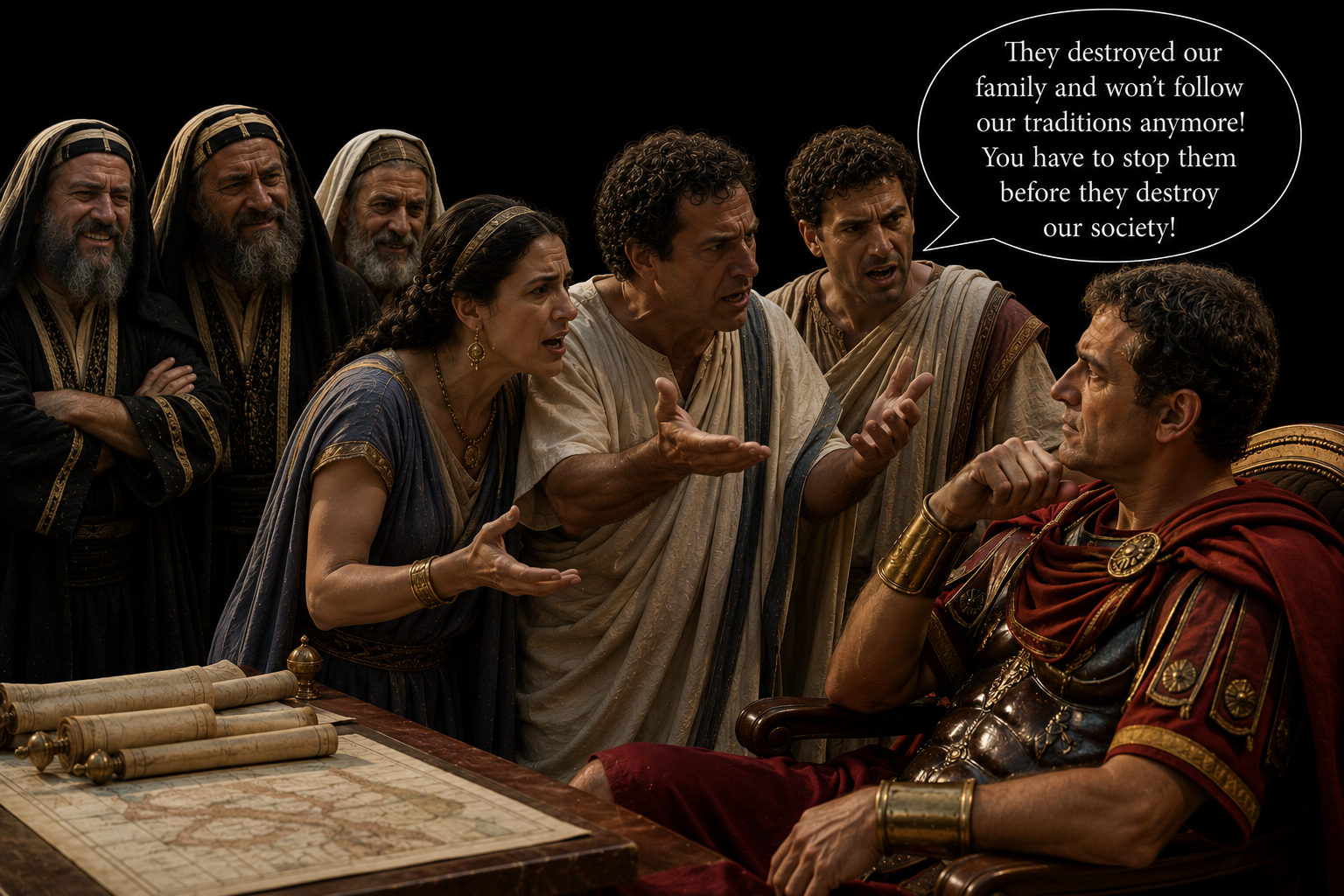
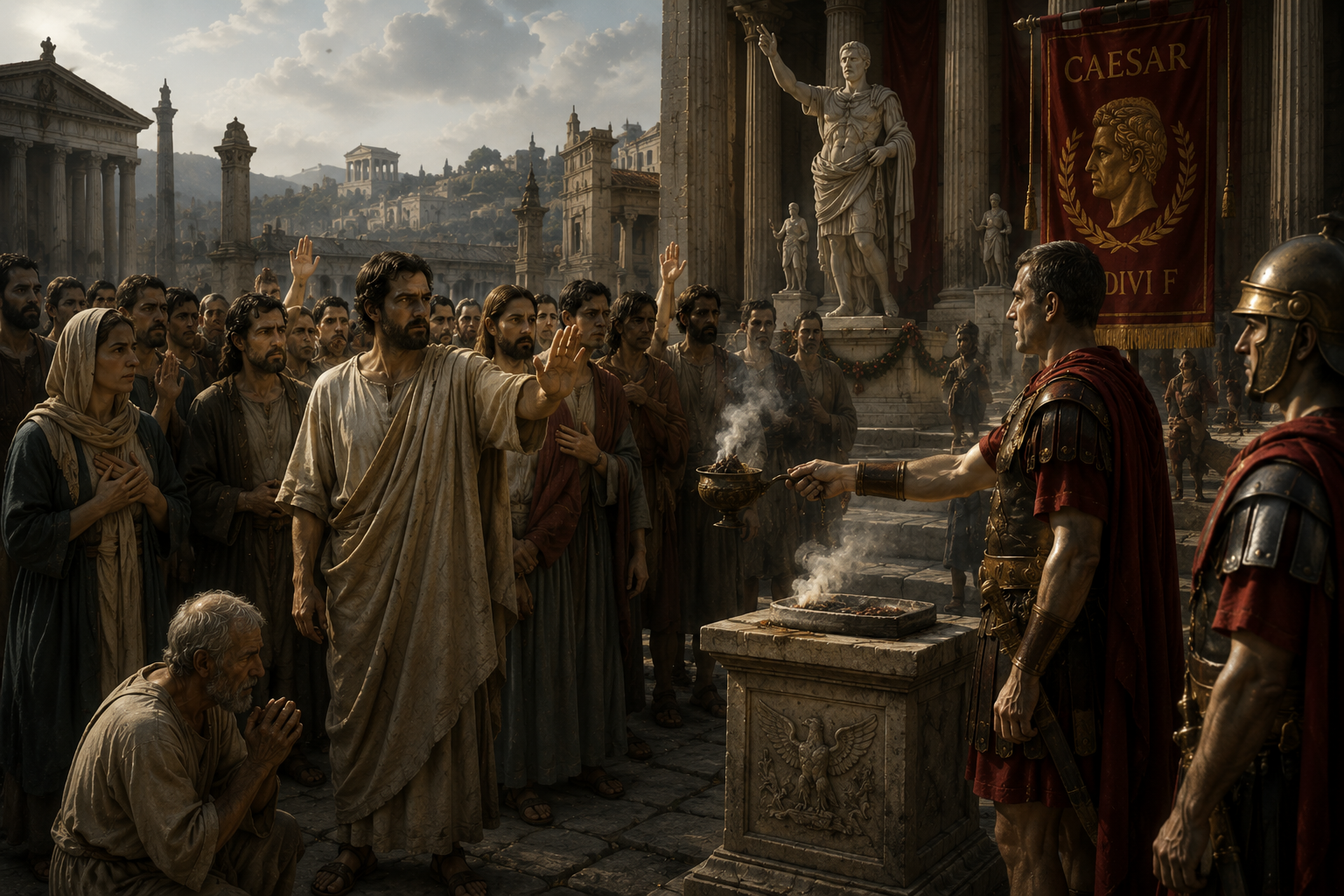
There was, however, one important expectation that came with their pagan ecumenical approach: religion should not threaten Roman authority. People were expected to show loyalty to the state with an almost religious devotion, often by making sacrifices for the emperor’s welfare. Groups that refused this or were perceived as politically disruptive could face persecution. This was in part why Roman and Jews conflicted, and later also early Christians and Rome, and was directly why many of them received the death penalty.
While Rome was the religious center at its time. Christians and Jews faithful to the Biblical God were viewed as a constant threat to the Roman idea of Utopia. Because they would not bow to the Roman Beast, the Roman government, with adoration and devotion, their religion was seen as a threat.

In the era before Christian persecutions and the Jewish revolt, Rome seemed to have considerable control over both state and religion for a while through its shrewd, ecumenical approach to other gods.
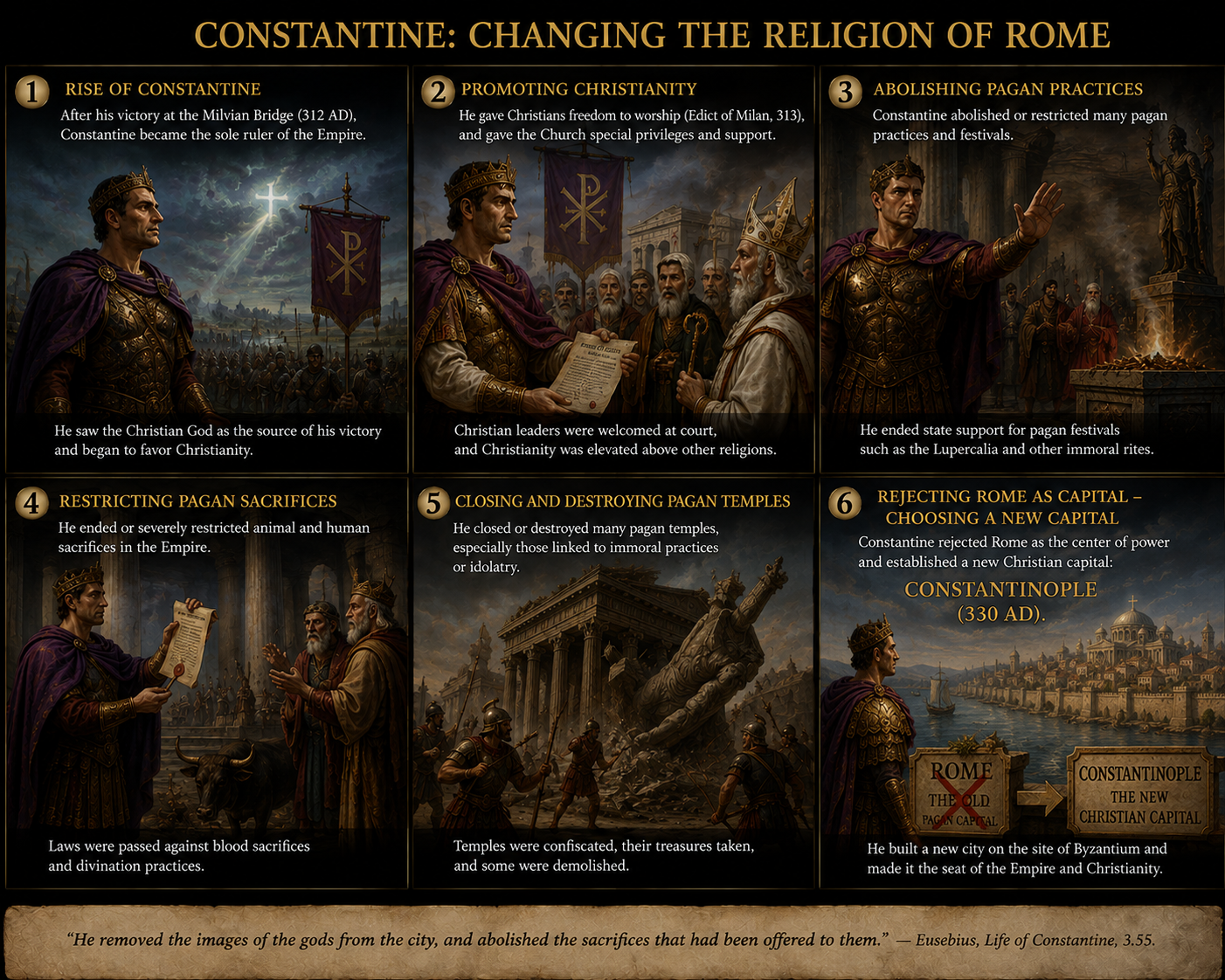
Even after Rome adopted Christianity, it continued these strategic approaches, albeit in somewhat different ways. Rather than accepting the pagan gods, they baptized them into the Christian mythology. The pagan gods became saints, whom they could still pray to and burn incense to as mediators between God and man. It was a bold compromise which made way for idol worship inside the church under the cloak of Christian mythology.

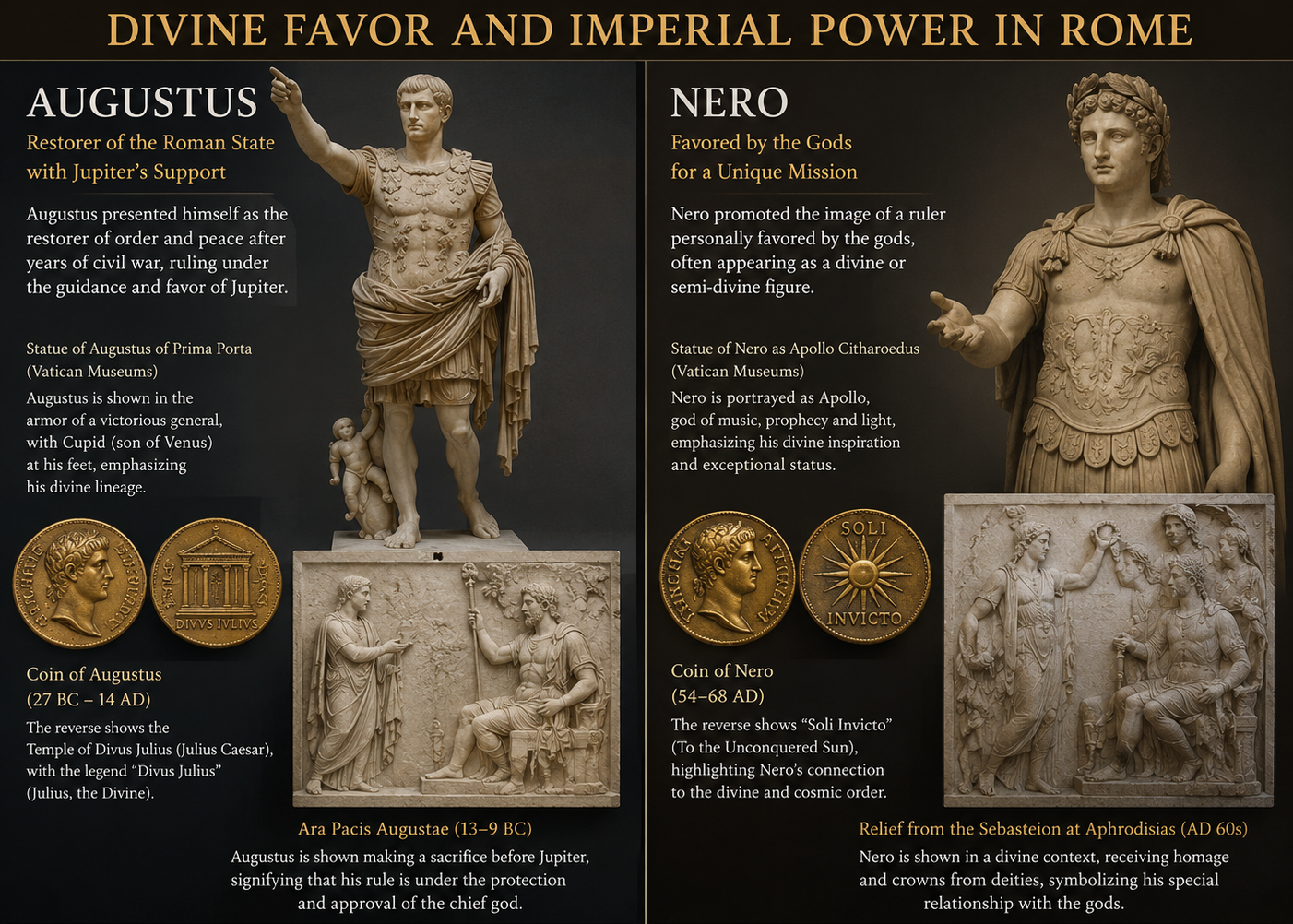
Constructed primarily under the reigns of the emperors Tiberius, Claudius, and Nero, the Sebasteion of Aphrodisias served both as a religious sanctuary honoring the imperial family and as a public statement of Aphrodisias’ loyalty to Rome.
Why Governments want to be treated as gods
Throughout time, humans who have desired power have had to contend with religious superstition and religious conviction. This has also been an everlasting conflict between the governments of this world and God’s people. People’s hearts are often divided and conflicted when a leader or government asks one thing and your religious conscience says otherwise. The conscience is not controlled by human force or persuasion, although it can be misguided. If someone’s conscience is subdued for a while, it will still, at some uncertain point, lead to some sort of rebellion. Humans have treated their conscience as a superior authority to any governmental authority and always have. It has never been tamed.
When the two conflict, it always leads to conflict and loss of power for earthly governments. This is why throughout time it was important for governmental leaders to appear one with the gods. If they managed to convince people that they represented their gods and that their words and legislation were those of their gods, they could manipulate people’s consciences to align with their objectives, allowing them to do what they wanted.
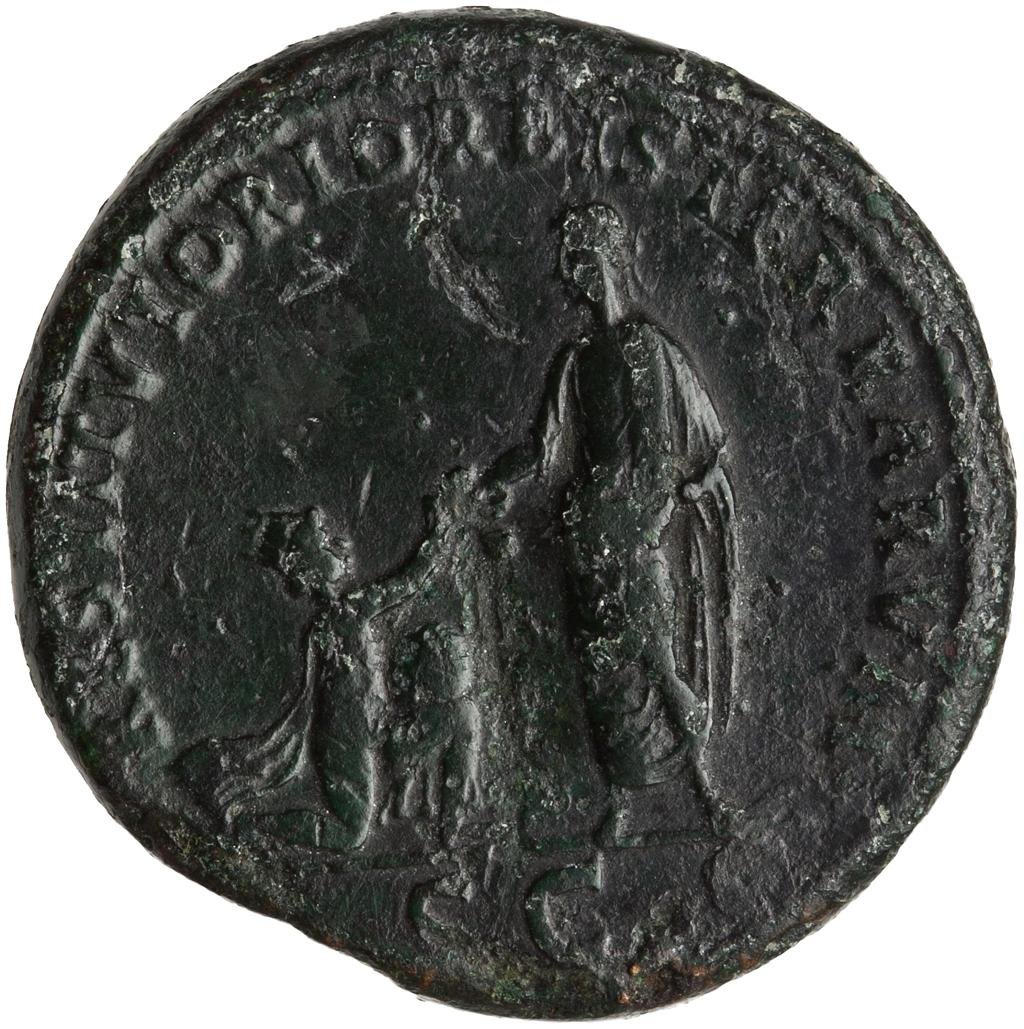
Hadrian – RESTITVTORI ORBIS TERRARVM (“Restorer of the World”)
The reverse coin shows Emperor Hadrian extending his hand to raise a kneeling woman representing the Orbis Terrarum (“the inhabited world”). She kneels before him holding a globe.
That is why Pharaoh claimed to be chosen by the gods, even to be a god on earth. That is why Nebudkadnezzar wanted everyone to worship his set-up image in Babylon. It’s why the King of Media willingly signed a document stating that all who would not pray to him as a king during a certain period would be thrown into the lions’ den. It’s why Alexander the Great claimed to be the son of the gods. The Greeks honored Alexander the Great with divine honors. After his assassination, Julius Caesar was officially deified.
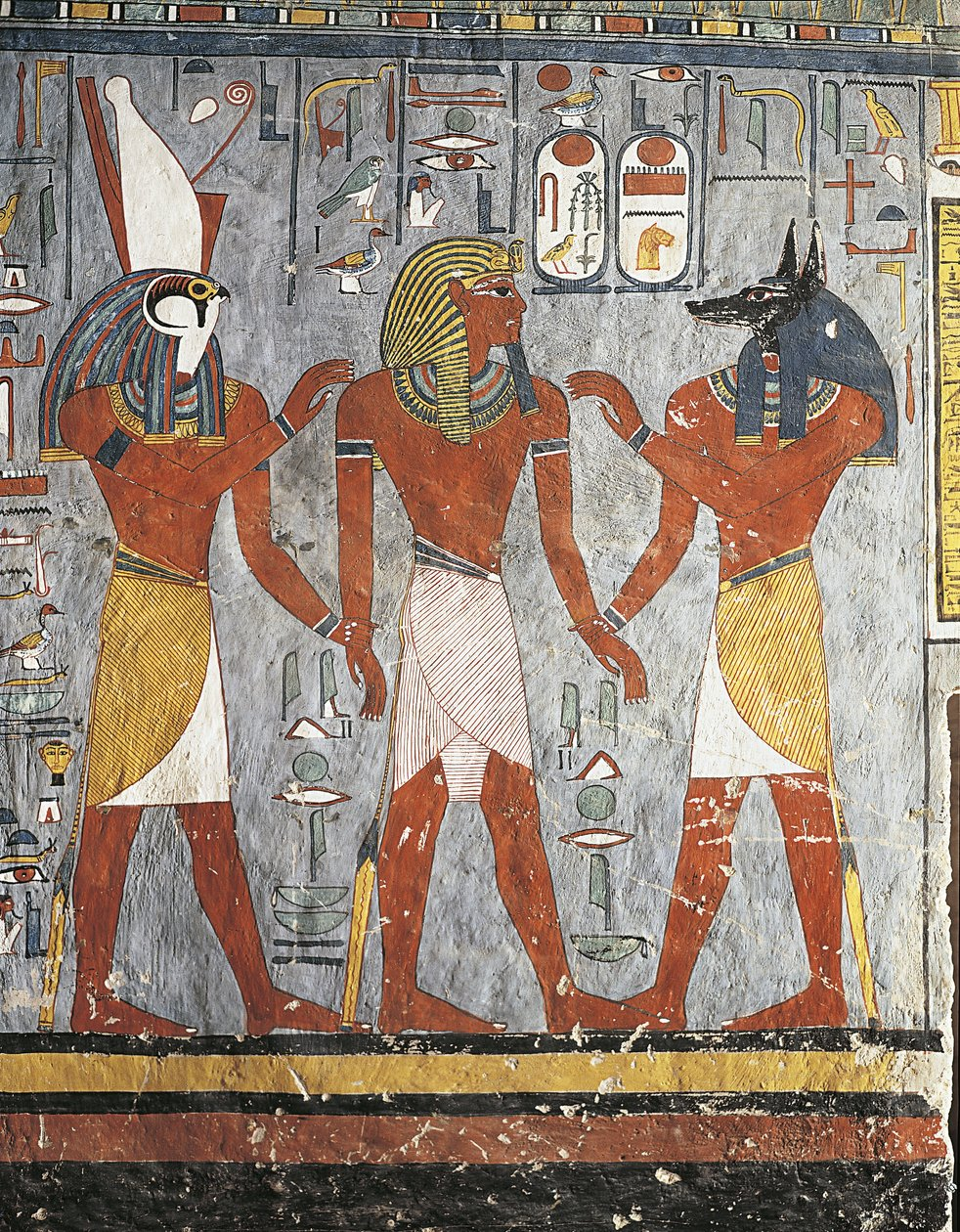
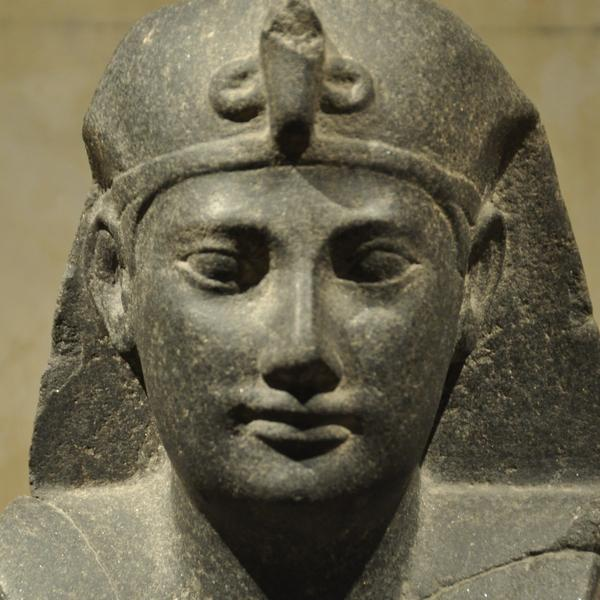
In ancient Egypt, pharaohs were considered divine intermediaries between the gods and humans, often associated with major deities like Ra, Osiris, Isis, and Horus.
The Bible has always fought these ideas through the prophets. They claim only God ought to be worshipped, and Him obeyed before any earthly government. Then government should be respected second.
Pagan nations made the state the representation of the gods, with power in human hands, claiming to be led by the gods. In that way, they could appeal to people’s conscience that if they did not do what the government wanted, the gods would fight them and they would burn or be cast into a pagan version of hell. Those who believed they could escape punishment by defying the gods—even to the point of death—would still be tortured by the gods in the afterlife. Or even their crops would fail, or the rain would not fall because the gods were so displeased with them for not accepting their earthly leader.
Even though Rome was tolerant and inclusive of various gods, it insisted on just one condition: that if the two conflicted, its own authority be acknowledged as superior to that of any deity for the sake of peace and order.
Tactfully, by making other gods their own, they avoided the controversy that arose from having to choose between their gods and the Romans.
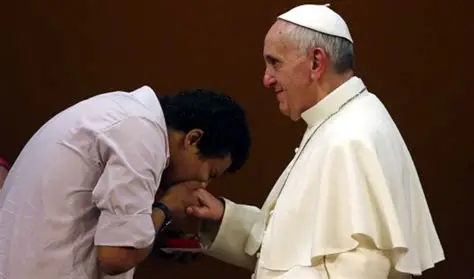
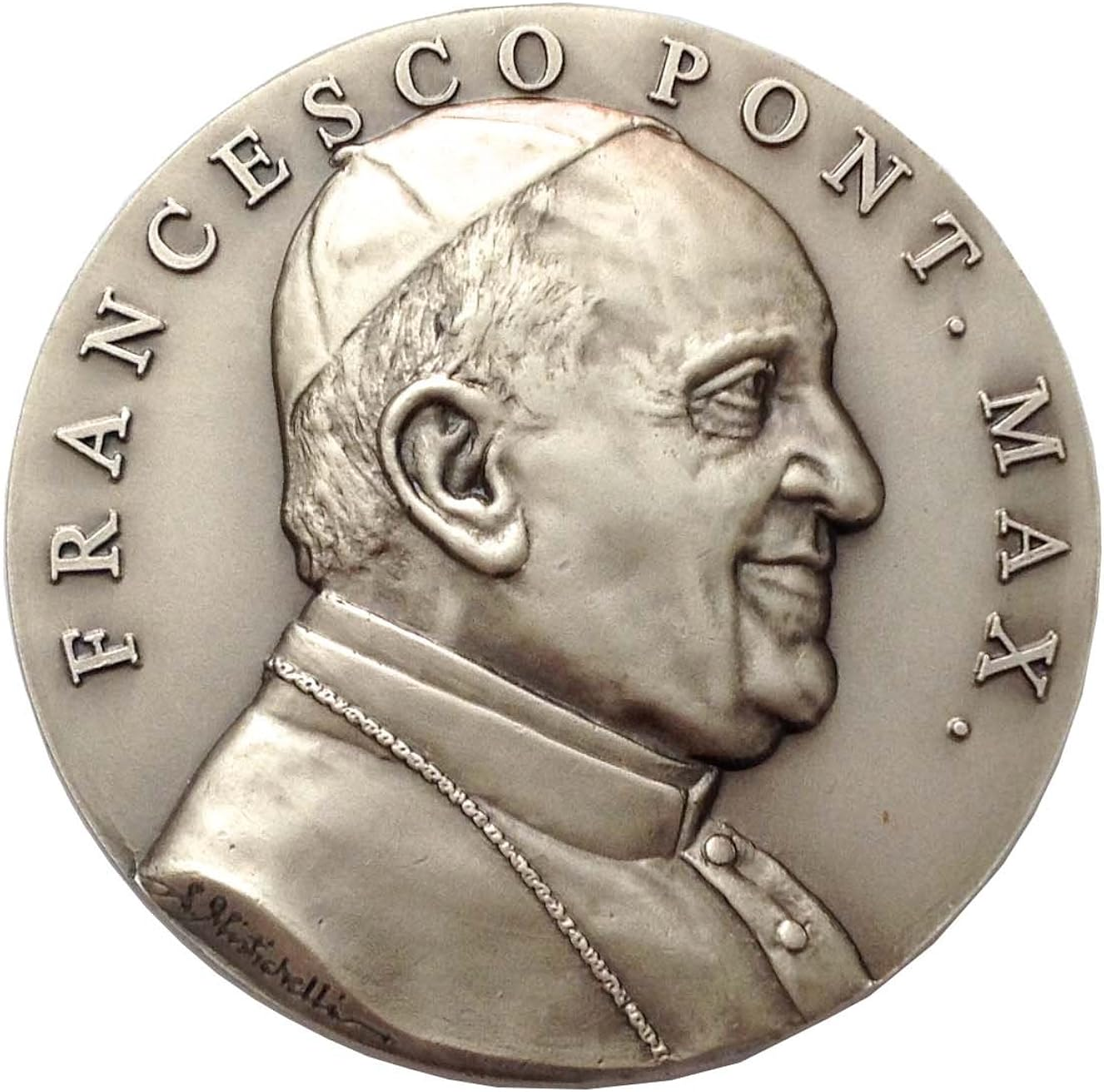
This turned religion into a demonstration of political loyalty. Offering incense or sacrifices to the emperor was less about believing he was equal to Jupiter and more about publicly acknowledging Roman rule. Refusing could be interpreted as a refusal of allegiance to the empire. So when the Christians faced this situation, they were willing to respect Roman rule, but not in a way that would lead them to break God’s law. And so they were caught in this dilemma and chose not to perform homage rituals, which caught the pagans’ attention and was seen as a disturbance of the peace. Which is what led to their persecution. Although Rome later adopted Christianity and claimed to represent Christ as His voice on earth, it did not alter its fundamental political approach to religion. To this day, the Roman Papal leaders are adored, and dead popes are even prayed to. What Christians refused when Rome was pagan, they later allowed when Rome was Christian. Although the principles of pagan authority had not changed: Making the state and God one and the same voice. But as Christians became the leading group in the Roman Empire, conversion was the only way to remain in control. Or so it seemed.
But even before Rome became Christian, Rome’s early approach to other gods, as a center of authority and worship, made it a new center of confusion, a capital of religious and superstitious ideas blended together under one government. Like Nimrod, Rome portrayed itself as a benefactor and peacemaker, chosen by the gods.
The pagan mentality and leadership style were found in all cultures, but they had their origin. People do not follow ruthless leaders; they follow leaders they believe are saving them from danger. And power-hungry people know that. 
We can see the mentality of Babel in the earliest cultures of the region Babel was once part of. Here, there are plenty of archaeological remains that give us a good idea of how to make state and god one voice.
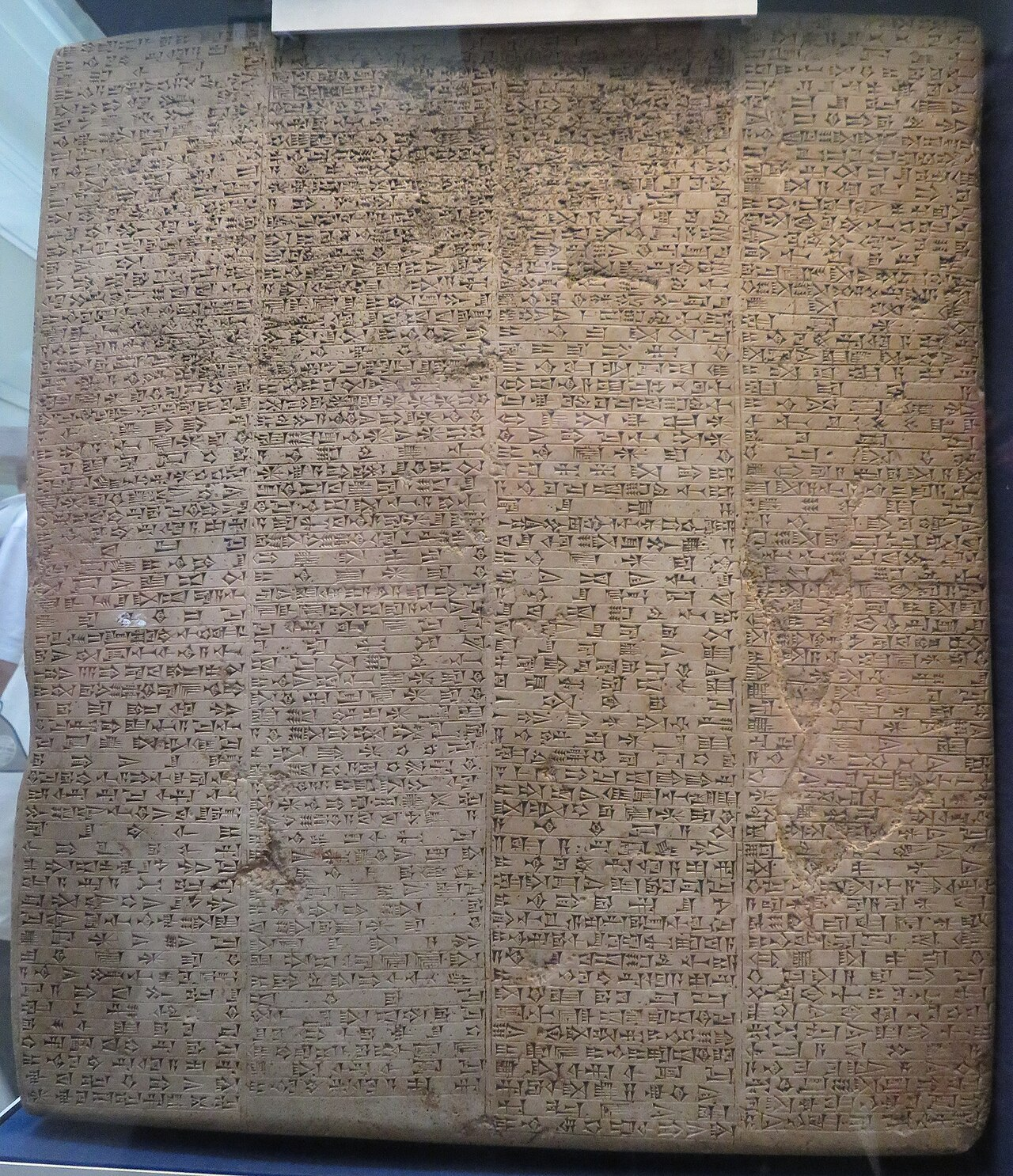
Hammurabi was the sixth Amorite king of Babylon, reigning from c. 1792 to c. 1750 BC. A relief discovered called the Code of Hammurabi shows the king receiving authority from the sun-god Shamash. In the inscription, Hammurabi presents himself as the king who brought justice, protected widows and orphans, and cared for his people. In this way, the Babylonian king is shown using a four-point method:
  1. THE LAW: If you claim your law is given to you by the gods, the people defy the gods when defying your law.
  2. THE LEADER: If your god trusts and has chosen your leader, you rebel against the god if you defy your leader.
  3. YOU NEED THEM TO THRIVE: You are dependent upon your state to provide blessings and save you from war and conflict.
  4. FEAR: This way they set people up against others. If the king or state is perceived as the manifestation of divine order, resistance represents chaos. And people will permit “enemies of the state” to be defeated.
Showing themselves as charitable was therefore a consistent strategy. How can you rebel against the hand that feeds you?
Kings such as Nebuchadnezzar II often described themselves in inscriptions as the restorers of temples, builders of cities, and providers for the gods and the people. Their role was primarily that of a pious builder appointed by the gods.
The East India House Inscription, currently on display at the British museum show Nebuchadnezzar claiming to be chosen by the gods:
“I am Nebuchadnezzar, king of Babylon, the exalted prince, the favourite of the god Marduk, the beloved of the god Nabu, the arbiter, the possessor of wisdom, who reverences their lordship, the untiring governor who is constantly anxious for the maintenance of the shrines of Babylonia and Borsippa, the wise, the pious, the son of Nabopolasser, king of Babylon; To Marduk, my lord I make supplication; Oh eternal prince, lord of all being, guide in a straight path the king whom thou lovest and whose name thou hast proclaimed as was pleasing to thee. I am the prince, the favourite, the creature of thy hand. Thou hast created me and entrusted me with dominion over all people. According to thy favour lord, which thou dost bestow on all people, cause me to love thy exalted lordship.
The Median Darius presents himself as the rightful king chosen by Ahura Mazda, the Zoroastrian supreme deity, who restored order after rebels caused chaos. In Persepolis, the reliefs depict delegates from many nations peacefully bringing tribute to the king, portraying him as the ruler who maintains harmony across the empire. In The Cyrus Cylinder, Cyrus describes himself as restoring temples, returning displaced peoples, and bringing peace to conquered lands.
Ptolemy III Euergetes, ruler of the Greek Ptolemaic kingdom, formally incorporated the title “Euergetes” (meaning “the Benefactor”) into his royal name.
Many Hellenistic cities passed honorary decrees calling kings εὐεργέτης (euergetēs, benefactor) because they funded temples, theaters, walls, grain supplies, tax relief, or other public works. 

Alexander the Great’s own propaganda emphasized that he was bringing order to Asia under his rule after defeating the Persian king. His successors likewise claimed to restore stability after wars, although they spent much of the 3rd century BC fighting one another. Not unlike the United States of our own day, they were able to sell their wars as peace work.
The Roman emperors likewise portrayed themselves as benefactors whose generosity (liberalitas) was publicized through coins, reliefs, inscriptions, and ceremonies.
Ptolemy III took the name “Benefactor”.
This is because propaganda works on people. You only need to have cards in your hands to control people. One is to make them feel dependent on you; the other is to make them afraid of what will happen without you. And so all leaders who play both these cards back and forth can, for a while, keep people in check.
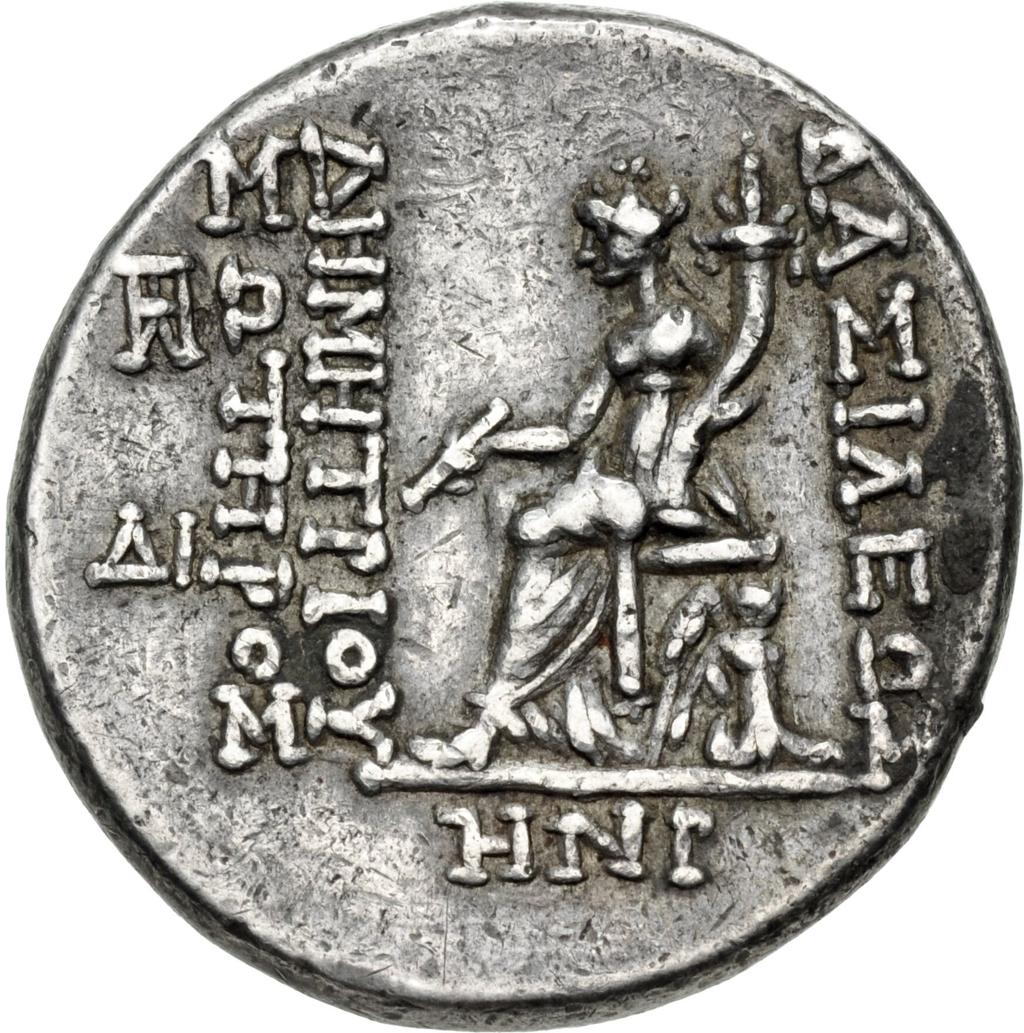
Demetrius I Soter. The museum records the reverse inscription as: ΒΑΣΙΛΕΩΣ ΔΗΜΗΤΡΙΟΥ ΣΩΤΗΡΟΣ
Which translates to: “Of King Demetrius the Savior.”
One modern example of how powerful a state becomes when they are the benefactor can be seen in socialist countries. These two tactics are the foundation and principle of socialist rule. Even democratic socialist
Both Norway and Denmark are social democracies with a strong welfare state.  In Norway, especially from the late 1800s through the 1900s, many responsibilities that had traditionally been carried out by the church gradually became the responsibility of the state or municipalities. As the modern Norwegian welfare state expanded after World War II, people increasingly looked to the state rather than the church for social support. Many historians and sociologists argue that this contributed to the decline in church involvement. Many of the world’s least religious countries—especially Norway, Sweden, Denmark, Finland, France and parts of Western Europe—also have extensive welfare states in which government provides healthcare, education, pensions and support that churches once partly supplied.
And although this appears good, it’s also made people dependent on the state, increasing state power. It has also made them feel they don’t need God.


Circus and Bread
Other pagan nations and Rome understood the psychology long before it was practiced in modern times. Rome provided several forms of public assistance to gain the devotion of its people. Hundreds of thousands of citizens in Rome received free or subsidized grain (annona). Emperors periodically distributed money to the people (congiaria). Public entertainment – Gladiatorial games, chariot races, and festivals were funded by the state or the emperor. Public works – Aqueducts, baths, roads, fountains, and sewers were built and maintained for public benefit. Under Trajan, the Alimenta program provided support for poor children in parts of Italy.
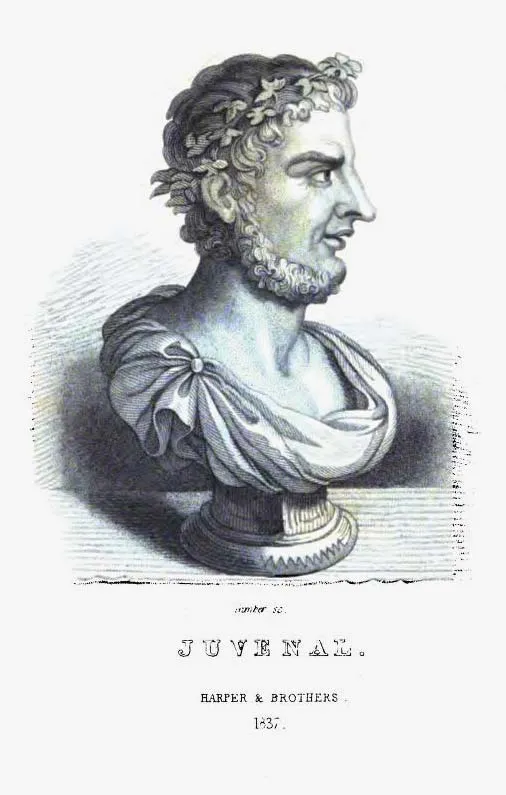
The Roman poet Juvenal, in his Satire 10, written around AD 100, said the famous line: …duas tantum res anxius optat, panem et circenses. Meaning: “… the people now care only for two things: bread and public spectacles.” Juvenal addressed how people were easily satisfied by free or subsidized grain and entertainment, and that once they had these two things, they stopped caring about political freedom, public responsibility, and good government.

In one way, it appears good and does good, but there is a hidden danger in this system of governance. And it will play a large part in the conflict right before Christ comes. 

Paul said: “For when they shall say, Peace and safety; then sudden destruction cometh upon them, as travail upon a woman with child; and they shall not escape.” (1 Thess 5:3)
About Sodom before their destruction, it was said they had: “fulness of bread, and abundance of idleness” (Eze.16:49). Idleness is a word that also means peace or rest.
About the people that died in the flood, Jesus remarked: “They did eat, they drank, they married wives, they were given in marriage, until the day that Noe entered into the ark, and the flood came, and destroyed them all” (Luk.17:27)
God is not against people eating or having food. He himself blesses man with food and “daily bread”. It was that they were satisfied with the terrible status quo as long as they had what they desired. It was their willingness to close their eyes to injustice as long as they were being fed. It describes a careless state amid societal turmoil. God is not against peace or peacemakers. Jesus said: “Blessed are the peacemakers: for they shall be called the children of God” (Mat.5:9)
Its not good for anyone’s soul or heart to be careless amidst suffering, or careless to the suffering you yourself cause.
The problem lies in the illusion of peace when there is no true lasting peace. Man can not replace God; He is not just the creator but sustainer of everything. He can do for man what no man can do. So when food and security are given instead of the true God or to replace God, it’s usually suppression, lies, and even theft behind the prosperity. Such was the case in the pre-flood era. They enjoyed their food and romance, but at the same time “wickedness of man was great in the earth, and that every imagination of the thoughts of his heart was only evil continually” and “the earth was filled with violence” (Gen. 6 5 & 11)
Such was the case in Rome. They enjoyed the benefits of its greatness and abundance, but closed their eyes to the suffering they caused, or that existed among them. Having bread does not make someone’s heart pure and good.
So it was with Egypt at its greatest peak as a nation. The most wealthy nation on earth, yet built upon the backs of slaves and suffering. They would not address it, for it would cost them their benefits.
Another good example is the USA. While claiming to be a nation under God, the land of the free and brave, and blessed, it has been the biggest exporter of immorality, violence, war, and strife in our day. In addition, exploitation of workers in other lands has greatly contributed to their prosperity.
Right before the Babylonians destroyed Jerusalem and its people, the leaders portrayed themselves as the proclaimers of peace:
“They have healed also the hurt of the daughter of my people slightly, saying, Peace, peace; when there is no peace.” (Jeremiah 6:14)
By giving people a false security, they prevented them from preparing and saving themselves from the coming doom. They seemed like peacemakers for declaring peace, but although it made them liked, it did not make the lie a truth.

God is saying we need to be good and do good, not just imagine we are good.
Both God and his enemy Satan know how easily people are manipulated if they have their immediate needs covered, and Satan uses it to his advantage to the fullest. No deceivers come to anyone’s door without gifts and promises.
A government in the best interests of people does not need to replace God or manipulate man’s conscience. Men of authority are needed to ensure equal rights and justice, but they were never needed to play gods. It is because man is afraid of losing control and hungry to be like gods that they have demanded to rule as gods. They feel if they are not admired in a highly esteemed way, someone will easily take their place. If you want someone to obey you, you have to convince them in one way or another. In the case of pagan rulers, their tactic was to unite the gods and the king into a single voice so that people would feel compelled to comply.


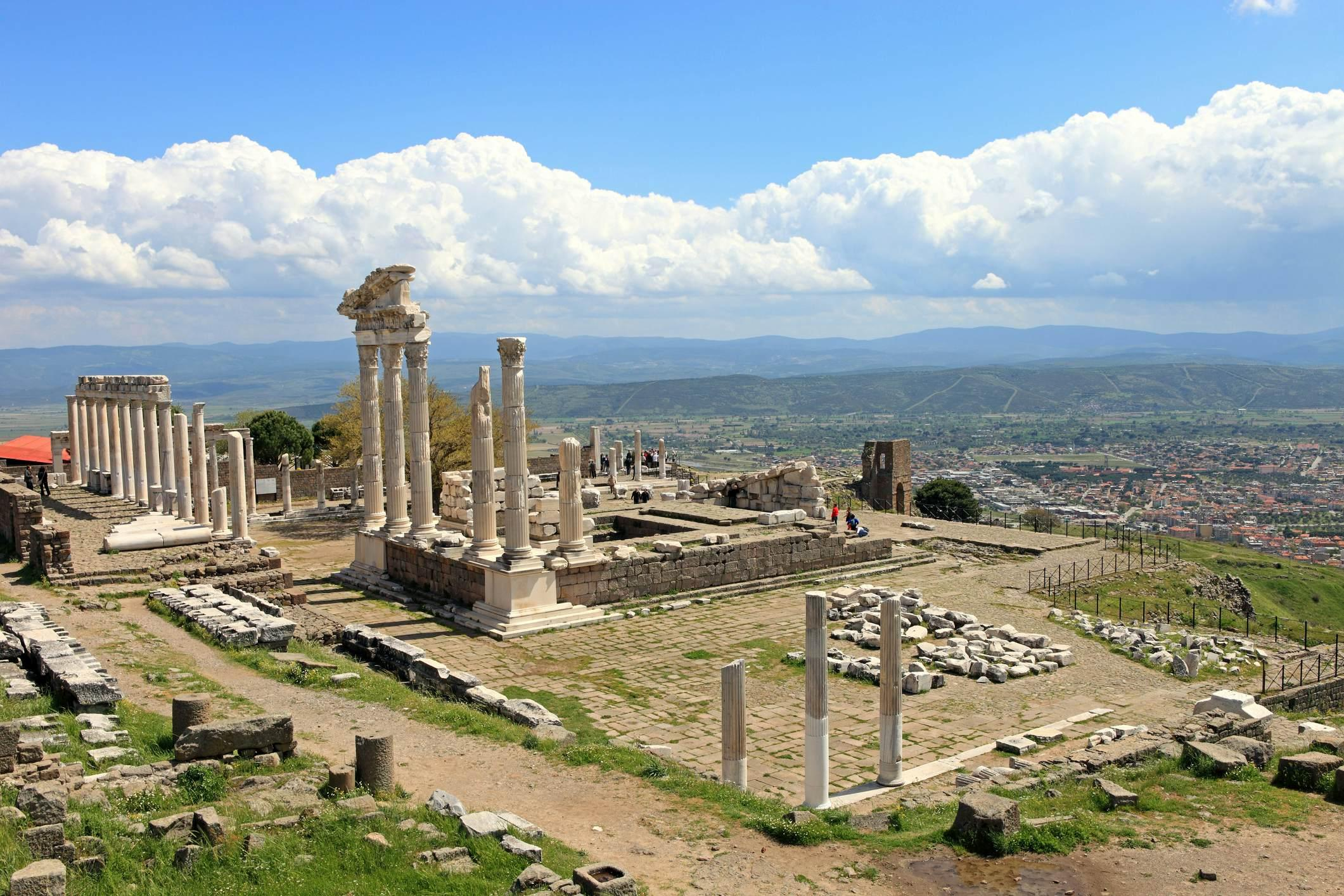
Pergamon.
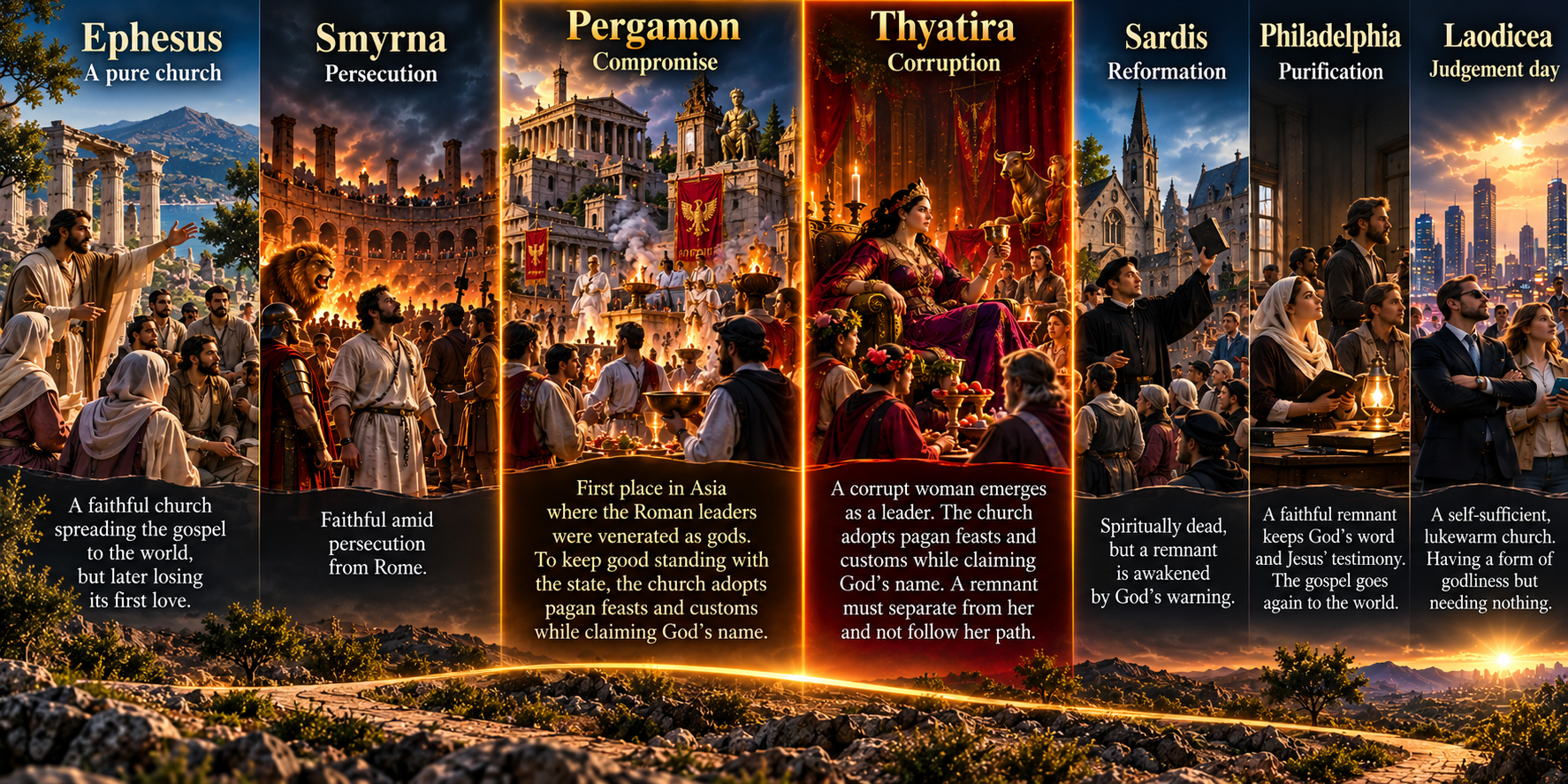
“I know thy works, and where thou dwellest, even where Satan’s seat is…” were Christ’s words to the church in Pergamon. (Rev 2:13) Before Christ’s time, and any church established there, Pergamon paid great homage to the Roman government.
It was the first city in the Roman province of Asia to receive an official provincial temple dedicated to the imperial cult.
Pergamon World Heritage Site. Augustus granted permission for the province of Asia to build a temple at Pergamon Acropolis dedicated jointly to Roma (the personification of Rome) and Augustus.
In 29 BC, Augustus authorized the province of Asia to build a temple at Pergamon dedicated to Roma (the goddess personifying Rome) and Augustus. This became the first official provincial temple of the imperial cult in Asia Minor and made Pergamon the provincial center for emperor worship. This arrangement distinguished provincial worship from the city of Rome itself, where living emperors could not ordinarily be worshipped as gods. Cities competed fiercely for the honor of building such temples because it brought prestige and imperial favor. Some historians think its prominence as the center of the imperial cult helps explain why it is described as the place “where Satan’s throne is” (Revelation 2:13), meaning this ideology is the foundation of Satan’s rule among men. Not being an earthly government himself, he has to work through an earthly government. If Satan wants to make laws for mankind, he has to do it through an earthly government or leader. The words he said to Eve which brought the earth under his domain were: “in the day ye eat thereof, then your eyes shall be opened, and ye shall be as gods, knowing good and evil” (Gen.3:5). God wanted man not just to desire to have God’s position but to elevate their own judgment of good and evil above God’s judgment.
In the message to the Pergamum church, God recognizes that they are in the middle of the conflict. Standing up, or simply refusing to take part in the adoration of the Roman leaders at their regional center, would mean death.  

Many have argued that it is claimed to be Satan’s throne in Asia because of the great altar of Zeus. But Satan does not rule through mythology; he rules through human governments. Having the Roman leaders accepted as men of the gods is how Satan gained control in the Near East and was able to put strain on the later Christian church if they did not pay such homage. The letter to the Pergamon church continues: “even in those days wherein Antipas was my faithful martyr, who was slain among you, where Satan dwelleth”
The cult that had first been centered here was the same cult that caused Christian persecution in Asia. It was for the very reason that they would not pay homage to the Roman leadership as divine that they were martyred within the Roman Empire. But it is also the same that led those who did not pay homage to the Pope, who continued to demand to be treated as the voice of god on earth, to be martyred by Christian Rome. The Greek word “Antipas” is derived from two words: “anti,” meaning opposite or instead of, and “Pas,” from pater, which is Father. Meaning someone against “Father” was martyred at Pergamon.
Many great Roman leaders were called fathers, “Pater Patriae,” meaning “Father of the Fatherland” or “Father of the Country”. Those who had these titles include Marcus Tullius Cicero (63 BC), Julius Caesar, Augustus, and many others. They also had the title of High Priest; the Roman leader was also the highest religious authority. The title Pontifex Maximus was their formal title.
While Rome was pagan, Jesus said: “And he said unto them, The kings of the Gentiles exercise lordship over them; and they that exercise authority upon them are called benefactors” (Luk 22:25).
And he instructed His followers: “But be not ye called Rabbi: for one is your Master, even Christ; and all ye are brethren.  And call no man your father upon the earth: for one is your Father, which is in heaven. Neither be ye called masters: for one is your Master, even Christ” (Mat 23:8-10).
Despite Christ’s clear warning, when Rome became Christian, it appointed a High Priest to be Master over the Christian church. And he was, and still is, called “Father” by billions of Christians and throughout time. The word “Pope” is not originally Latin but Greek. It comes from the word πάππας (pappas), meaning father. In this way, the Pope’s authority actually runs counter to Jesus’ authority. He commanded His followers not to follow in Rome’s footsteps.
And the idea of a church Pope is derived from and a continuation of the adoration of Roman leaders.
The Pope even inherited all of the Roman ‘leaders’ titles, such as Pontifex Maximus and High Priest.
This title contrasts with Christ’s claim to be the High Priest and to forbid His followers from being called “rabbi” or “master.” The Hebrew word literally means “my master” or “my teacher”. It comes from the Hebrew root “rav,” meaning “great” or “great one.” The ending is the first-person singular possessive suffix, meaning “my.” So Jesus warned against his followers calling any earthly person their great teacher or master.
The Pope’s position violates all of Christ’s laws regarding His church.
This mentality of accepting a “Pas” is also what led Christians to persecute Christians who were “Anti -Pas”.
By adding all of this information in the message to the church of Pergamon, God cleverly ties both Christian persecution to the Roman state and to Papal Rome as its continuation. No one should adore a leader in that way. Declaring the “anti-pas” as His “faithful martyr” and by it showing that His faithful followers do not follow an earthly father and master like done at Pergamon. And refusing to do so is credited by God as  “holdest fast my name”. God’s names are really titles.  His titles are Elohim, the mighty one. El Shaddai, God Almighty. These are important claims, for it shows that no man has authority over God and His law. God’s name is the seal in His law.  He is called Adonai, which means Master. Elyon, which means Most High. He is called YHWH Yireh – The Lord will provide. YHWH Shalom, The Lord is peace. Any leader placing themselves up against God is anti-God. Any peace not of God is a false peace. Any man claiming to be the provider is a false god. Showing homage to anyone claiming God’s titles is worshipping a false god.
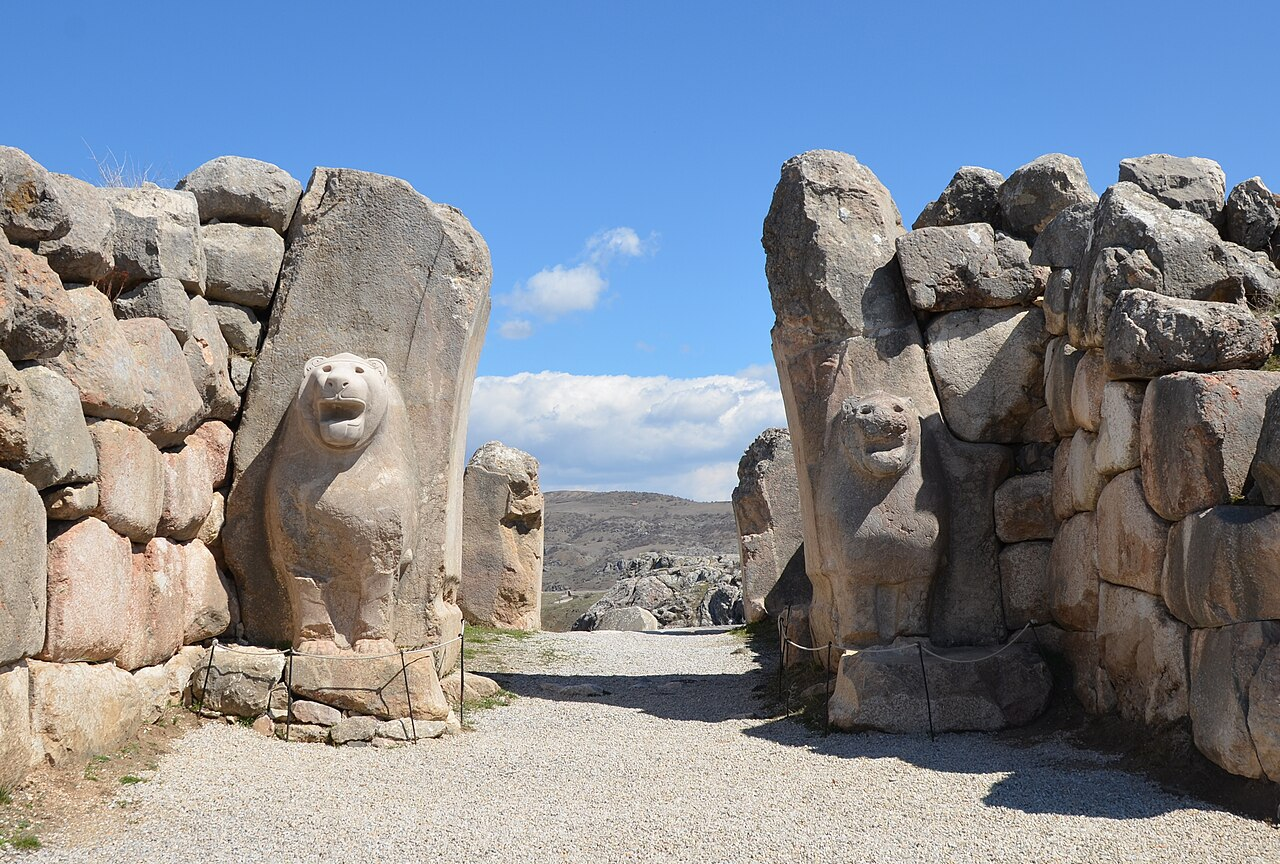
 
 
The Romans and the Chaldeans (Babylonians)
The great religion of ancient Babylon may seem to have vanished, but in reality, its doctrines and many of its practices were adopted by nearby cultures that were incorporated into Rome. But even before that, they were great teachers to the Greeks, who in turn inspired the Roman religion.
As Babylon was destroyed, the Caldeans were also scattered around. And the wise among them often gained positions in other territories. They preserved astronomical and mathematical knowledge; many surviving cuneiform tablets from the Hellenistic period were written by Babylonian temple scholars. Greek astrology, especially after Alexander the Great, was heavily influenced by Babylonian astrology. Astrology and religious mythology were often connected.  There are many similarities between Greek and Mesopotamian myths, like the flood stories, divine councils, hero journeys, and underworld traditions. They  reflect shared ancient Near Eastern traditions and cultural exchange.
No longer having a distinct land, the Chaldeans came to be known in Rome as astrologers and diviners, showing the origins of much of Rome’s inspiration in these areas.
Juvenal, an early 2nd century AD poet wrote in Satire 10: “grex Chaldaeorum” Meaning:
“the crowd (or tribe) of Chaldean astrologers.” mocking Romans who constantly seek horoscopes from “Chaldeans” The art is still popular today. The standard Latin dictionary defines Chaldaei as: “the Chaldaeans… distinguished for astronomy and astrology.”
Although they did not become a large group in Rome, their teachings were widely accepted, and many did move there as Rome became a great nation.
Just as when the USA became a great nation, immigrants flooded the land in search of opportunity, so it was with Rome in its day. Once Rome became powerful and advanced, it was the place to be. This made Rome, although ethnically and religiously Western European, also the international city of its day.
In the time of the disciples, the city was referred to as the new Babylon. The old Babylon was destroyed and ruined, but its reputation remained and was compared to Rome.
Even in the book of Peter and in the book of Revelation, Babylon is used as a code word for Rome. Several early Christian writers, such as Irenaeus (2nd century), Tertullian (2nd-3rd century), and Jerome (4th century), who translated the Bible into Latin, say Babylon refers to Rome. In addition, some Jewish texts say that Babylon destroyed the temple and Jerusalem the first time, and that Rome did so as well, destroying it the second time and therefore being a second Babylon.

Greek and Roman religion, although distinct, is of the same nature as Babylonian religion. Even of most pagan religions. It centered around the sun god, the weather gods, and the fertility goddesses. They were calendar gods, worshipped at their appointed times. They were simply the same religion expressed differently with different mythological stories. The principles remained largely the same. The governmental structure as well, where these gods and government were intertwined, and the leader was the voice of god on earth. In the Bible, God does not differentiate the religion of the pagans from each other but often just refers to them as the “other gods” of the “goy” (nations).

Rome’s connection with Babylon is also shown in the visions given to the prophet Daniel, which indicate that the empires mentioned to him continue something Babylon started. In Daniel 2, Rome and Babylon are seen as different body parts of the same body. Babylon is the head, Pagan Rome the legs, and Rome divided between the tribes, the feet Jesus will crush at his coming.
And although the state represents different groups of people suppressing God’s people, they are united in a body as their purpose and behavior are seen as blasphemers and warriors against God. They consistently not only suppress God’s people but demand from them that they regard their governmental body as a higher authority than God Himself.
And so Rome became the new Babel. The very empire God wanted to protect His people from if they had been faithful. Whose birth was the direct result of Israel’s falling away. And which birth as a Christian power was a direct result of the followers of Christ falling away.
And it is in the Roman beast’s honor that a new superpower of the ten tribes, a territory they colonize, will, in the final days of earth’s history, repeat the beast’s behavior. And demand a loyalty to the government, a sign of loyalty which, if taken, will place God’s people in violation of God’s law.
And we are talking, of course, of the second beast of Revelation 13 and the mark of the beast. Being the last beast of them all to continue the beastly behavior before Christ says enough forever. One final test will come upon God’s people. Will they bow to religious ordinances of a state, or will they choose loyalty to God as the highest religious authority and be denied the right to buy or sell? (Revelation 13:11-18) It is this final test that is right now coming upon us. And God has made it clear, by saying the mark of the beast is in homage to the Roman beast, that this is a Christian aggression, not a pagan like the former pagan beasts. It mirrors Christian Rome. The Mark of the Beast law is therefore likely to claim loyalty to Christ in its laws. To make decition og Christ behalf. To make laws on Christ’s behalf. Making the final conflict Christian brother against Christian brother. Not unlike the foundation of Rome, where one brother killed the other to create and protect a form of government and the idea of peace created on bloodshed.

As God said through the prophet Habakkuk : “Woe to him that buildeth a town with blood, and stablisheth a city by iniquity!” — Habakkuk 2:12

BEASTLY ROME: PART THREE: THE BIRTH OF ROME

0

Rome rises around the same time as the fall of Israel. In it lie the very warnings God gave them through Moses. The consequences of their infidelity would lead to suppression and scattering of the people. Rome would become the greatest suppressor of them all in more ways than one.

Genetically and historically, we can see that both the Etruscans and the early Latin people of Italy were part of Rome’s founding. But they are also closely genetically connected to the steppe people who moved westward, from whom most of Europe is now descended.

Did the rulers of Rome come from Troy?


Ancient Greek writers did not view the Roman capital as a Greek capital. And in the prophecy given to the prophet Daniel, we also do not see the Roman Beast as of the “same material” or “beast” as the Greeks, although it rose up near the territories of Greek expansion and trade. Mixing with the Greeks would be unavoidable. Although they intermingled with the Greeks, it was still not a Greek city. Surprisingly, despite the great Greek cities, Rome would become the most powerful city among the descendants of Japhet.
Some Greek historians regarded the Romans primarily as an Italian people who later mixed with newcomers. Writers such as Dionysius of Halicarnassus (1st century BC) argued that the Romans were a mixture of native Italians, Greeks, and Trojans. No matter, still the tribes of Japhet.

Most historians before the common era claim that the founders of Rome were fugitives and former citizens of ancient Troy who had wandered for some time before settling there.
The man who escaped from Troy and whose descendants established Rome was called Aeneas, the son of Aphrodite. The reason many historians reject the historical records of Greek and north-western historians, such as Snorri Sturluson, is the blending of human stories with those of the gods. However, in the ancient world, it was customary to link humans with gods, as tribal leaders and kings often claimed divine authority to legitimize their rule and consolidate power over their subjects. In fact, the Pharaohs did it, the Greek rulers did it, and later Roman rulers did it. No one questions that Alexander the Great was a real person, despite his claim to be the Son of Zeus-Ammon and a descendant of the semi-god Heracles.
So often, historical figures not confirmed by archaeology are rejected as historical figures because they blend with religious mythology. However, this was standard in those days.
Aeneas was a prince of the Trojan royal line and one of Troy’s greatest warriors. The gods repeatedly rescue him from death in battle, reflecting a destiny that extends beyond the fall of Troy and toward the future founding myths of Italy. According to Virgil’s Aeneid, Aeneas escaped the burning city, carrying his father, Anchises, and leading other Trojan survivors to the west. After years of wandering across the Mediterranean, he reached the Italian Peninsula, where he fulfilled a divine mission to establish a new homeland for his people. Aeneas was not considered the founder of Rome itself, but Roman tradition treated him as the ancestor of the line that eventually produced the twin brothers Romulus and Remus. His son, Ascanius, was said to found Alba Longa, from which Rome’s royal ancestry descended. The family of Julius Caesar and Augustus even claimed descent from Aeneas through this lineage. When later other western and northern European tribes claim to be descendants of Troy as well, some residing around the Black Sea region before heading north, this fits with the idea that they are all distant cousins. And although the legends in the rest of Europe are not as old, their connection to Rome, which has had these traditions from very early on, links the two.

The very narrow strait served as an important trading network with Bronze Age Magog. As then, who controlled the strait mattered. The narrow opening allowed taxation and military control then and now. The ancient city of Troy is said to have been at the narrowest section, making them lords of the strait in their time. The Greeks’ defeat of the Trojans pushed them out of the region. (Likely pushed Magog out of the Mediterranean).

The Position of Troy : Strait of Strife

Ancient Greek historians claim Troy lay in the Dardanelles, the narrow strait in northwestern Turkey that connects the Aegean Sea with the Sea of Marmara.

The name Dardanelles comes from Dardanus (Dardanos), the legendary ancestor of the Trojans. In antiquity, the strait was called the Hellespont by the Greeks, and an ancient town called Dardanus stood on its Asian shore. The modern name “Dardanelles” is derived from that town. It’s now called the Strait of Bosporus.
This narrow strait has been one of the world’s most strategically important waterways for trade, migration, and military campaigns since antiquity. This has caused a constant pull-and-push between the tribes of Japhet and the tribes of Shem throughout time. Even the city of Constantinople is north of this strait, which divides Europe and Asia. Being in the borderland, control shifted between the west and the east.

The strait was central to the history of the ancient Greek world and the Achaemenid Empire. According to tradition, Xerxes I built pontoon bridges across the Hellespont in 480 BCE to invade Greece, while Alexander the Great crossed it in 334 BCE as he began his campaign against Persia. Control of the waterway remained strategically important throughout the Byzantine and Ottoman Empires.

Writers such as Herodotus, Xenophon, and Strabo all describe the peoples around the Black Sea and the importance of the Hellespont as the gateway to that trade.

It was the waterway to the territory assigned to the Biblical Magog.

The strait worked as an important trading network in ancient times.
Constantine and Rome felt they were just taking back what had once been theirs. In AD 312, before the Battle of the Milvian Bridge, Constantine reported experiencing a vision associated with the Christian God. After that, he went after the strait. They came the land-way and had to battle in the strait where Troy once was situated. Here he defeated Licinius, who controlled the area. The city at the upper strait was first called New Rome, then Constantinople.
Constantine had become Christian, and securing Rome’s presence at the strait and closer to the Middle East was motivated by his newfound religion and by a desire to make the Middle East Christian-dominated. When Israel took Canaan, there was strife here and people driven out; when Constantine wanted to make Palestine Christian, he took the strait as his starting point to accomplish it, and when England was about to establish a territory in Palestine, they secured the strait. The strait and Israel are connected.

Although Troy is often described as just a city, it was actually a larger region.

Although the Romans claimed to have come from Troy or to have been chased from that region, they would not give up their claim to it. And took great pride in claiming the territories.  
Rome took control of that region in 133 BC, when the Kingdom of Pergamon was bequeathed to Rome by Attalus III. The Troad (area around Troy), including the site of Troy, then became part of the Roman province of Asia.
In the year 73 AD, Vespasian incorporated the northern strait of the Bosporus into a Roman province. Herodotus had referred to the city as Byzantion.
Emperor Constantine made this the new capital of Rome in AD 330, and the city was also called New Rome. Zosimus (early 6th century) says Constantine first went to the Troad and began laying out a city between Sigeum and ancient Ilion, but then abandoned the project after receiving a divine sign and instead chose Byzantium (New History II.30). Historical writers such as John Malalas (AD 490-570) present Roman history as beginning with the Trojans and continuing through Rome to Constantinople. Because Constantinople was the New Rome, they believed it inherited Rome’s Trojan ancestry.

This is all more relevant than meets the eye when we dive into the Bible’s prophecies and how God describes bringing Rome down step by step, as we will look at in another chapter.

The strait remains an area of conflict in our day. This is from the 1800s, when British and French troops fought alongside the Ottomans (Turks) and won. Both sides (Russia and France) claimed interests is protecting their religious status in the “holy land” as part of the reason for the conflict.

Many modern wars are, interestingly, tied to the same strait, showing how its importance has never changed. During the Russo-Turkish wars (17th- 19th centuries), it was a recurring Russian objective to gain influence through this passage, and the conflict became known as “the Straits Question” in debates. During the first Crimean War, one of the central issues was preventing Russia from dominating the Black Sea and then seizing the straits (1853–1856). Britain and France feared Russia would control the Straits and expand toward the Mediterranean and therefore helped the Ottomans. Russia lost. The Treaty of Paris (1856) limited Russian power in the Black Sea and protected Ottoman territorial integrity.
Then, from friends to enemies in the conflict in 1915-1916. The Gallipoli campaign’s objective was to capture the Dardanelles, reach Constantinople, and knock the Ottoman Empire out of the war. This time the United Kingdom and France fought against the Ottoman Empire, siding with Russia because the Ottomans had allied with Germany. This ultimately led to the end of the Ottoman Empire.
After the Ottoman Empire collapsed, modern Turkey was founded in 1923. During the Cold War, Turkey feared Soviet/Russian pressure, especially over the Turkish Straits — the Bosporus and Dardanelles.

So Turkey joined NATO with Greece in 1952, becoming an ally of Britain, France, and the USA against the Soviet bloc. This would, from then on, place the strait at the center of the Cold War between the West and Russia.

When the Ottomans sided with Germany, Western Europe helped bring about the Ottoman Empire’s fall and secured the strait. Taking the strait was necessary to protect their interests in Palestine and the Middle East. Turkey later joined an alliance with Europe through NATO, allowing it to retain the territories without further conflict. Through their alliance, they have full control over which Russian warships head towards the Mediterranean and when. There were two primary objectives in bringing down the Ottoman Empire. Take the Middle East and control the strait for security.

What it was really about was who was in power in the Mediterranean, protecting the lands there, and controlling the trade routes. To this very day, Turkey, through its alliance and dependence on NATO, puts restraints on Russian movements.  If Turkey is at war, or believes it faces an imminent threat of war, it can restrict or close the straits to warships under the convention. As an example, after Russia’s full-scale invasion of Ukraine in 2022, Turkey invoked the Montreux Convention and closed the straits to the warships of the belligerent parties.

The strait was always both controlling trade and determining who could trade. In modern times, on the eve of World War I, historians estimate that about 90% of Russia’s grain exports passed through the Dardanelles. When the Ottoman Empire closed the straits in 1914, it cut off one of Russia’s principal export routes and made it much harder for Russia to receive supplies from its Allies. In newer times, it was a political concern in the EU that Russia could deliberately use cheap grain exports to destabilize European markets, especially after Russia flooded the world market with cheap grain, driving prices down in 2023–2024

Even today, Russia exports much of its grain through Black Sea ports, so access to the Turkish Straits remains economically important. Around 90% of Russia’s seaborne grain exports in recent years have departed from southern Black Sea ports, then passed through the Bosporus and Dardanelles.

Who controls the territory is also tied to having the upper hand in conflicts in the Mediterranean. Russia, being sometimes allied with countries NATO countries wish to subdue, especially in the Israel – Arab conflicts, plays a role.
To protect the modern state of Israel before its establishment and now. It is a recurring conflict.

This is all relevant, as we will see, that the powers who wish to have control of this strait are “the horns” of the Roman “beast”. The same nations that, together with Rome, claim to come from this strait. The Roman beast seized it, then the “horns of the beast” have battled for it. And everything will make more sense as we look more closely into the prophecies in Revelation.
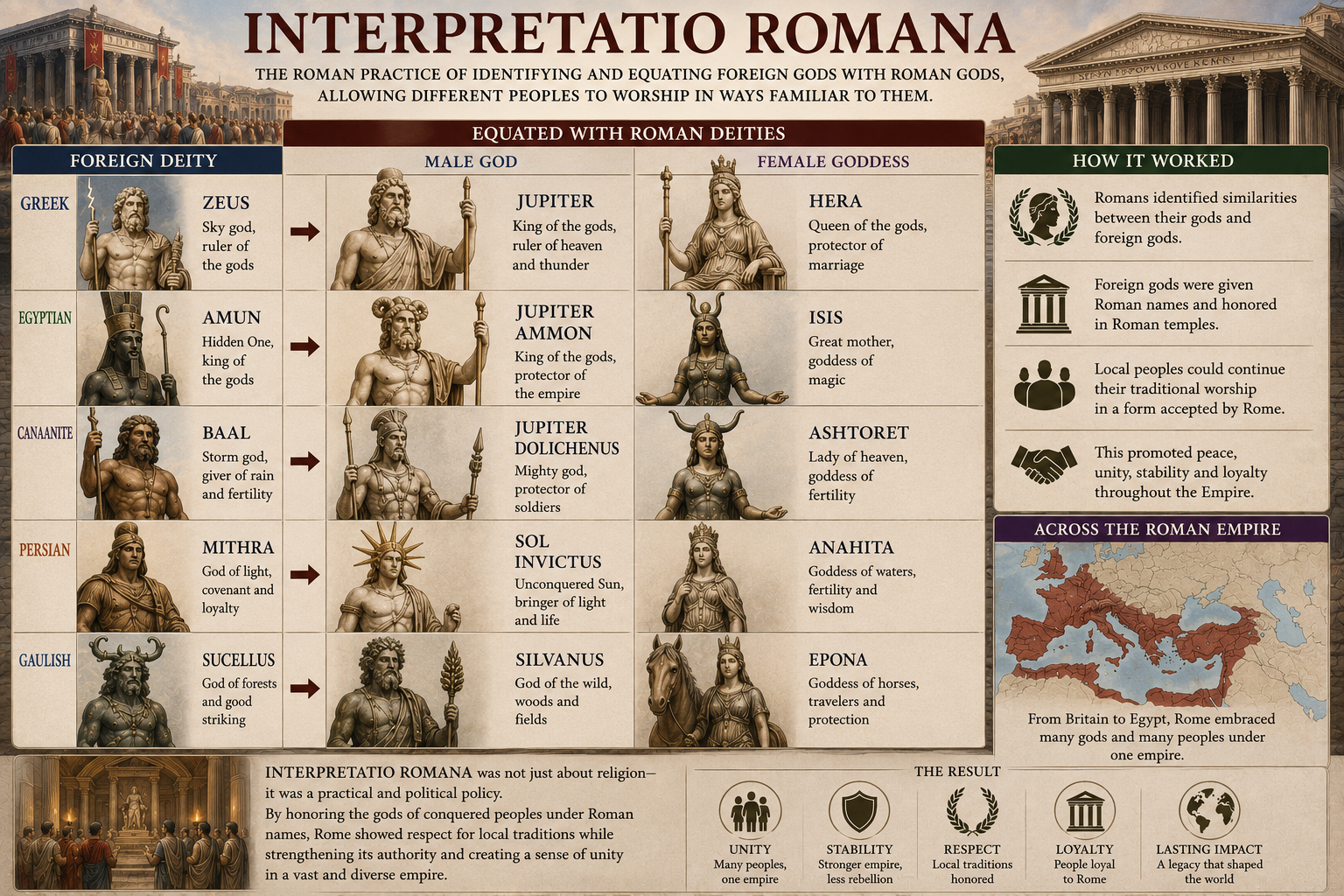
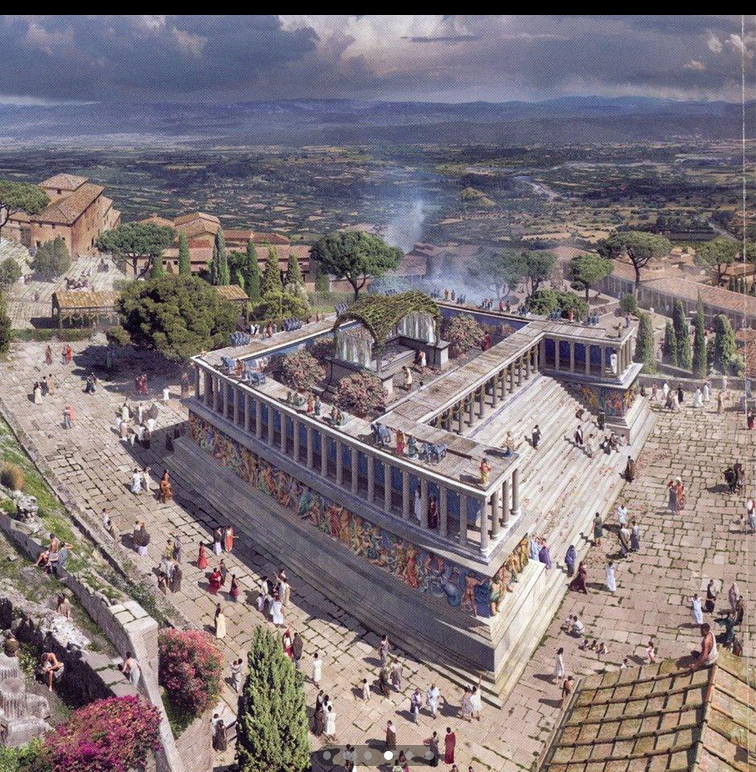
Whoever the Trojans were, and even if the story of the war in Greek poetry is said to have initially been about a stolen woman, which Hollywood keeps romanticizing, there might have been a larger conflict at play that is still ongoing to this very day.

The Trojans had placed themselves strategically at a crossroads, securing their own position while also controlling the Greeks’ access. After the fall of Troy, it is said that the inhabitants spread towards western Europe and Ukraine. And of course, the legend of the prince himself, whose descendants, according to legend, laid the foundation of the city of Rome.

The Legendary Founder: On the blood of his brother

The founder of Rome was said to be nurtured and raised by a wolf.

Rome is said to have been founded as a kingdom on April 21, 753 BC, by Romulus, a descendant of the Trojan prince. According to the traditional Roman legend, Romulus and his twin brother were said to have been orphaned and nurtured by a beast. Romulus and his brother Remus quarreled over where to found a new city and how to interpret divine omens. After Remus mocked or crossed the newly built city wall, Romulus killed him, declaring that the same fate would befall anyone who violated the walls of what became Rome. It is not certain, though, whether the story of the city’s founding is a legend or the truth.

A statue of the Roman legend. To establish the city, Romulus killed his brother. ” You are what you eat” might be a fitting term for Rome’s beginnings and its becoming a beast.

The founding date was calculated by the Roman scholar Marcus Terentius Varro in the 1st century BC, very long after the claimed beginning. The ancient writer Fabius Pictor, writing in the 3rd century BC, claimed Rome was founded in 748 BC.
Lucius Cincius Alimentus, an early Roman statesman, historian, and annalist active during the late 3rd century BCE, claimed it was founded in 729/728 BC. But Rome ultimately adopted Varro’s calculation, which was based on kings’ lists, genealogies, and chronological calculations.

Archaeologically, settlements on the hills of Rome date back to around the 8th century BC, which aligns fairly closely with the traditional date. Its then-young city also explains why the Bible never mentions Rome when listing the great trading cities of its time. Rome was fairly new and not yet a major trading hub. To be that, it had to be a city in a very populous area, which Rome for a long time wasn’t.

The Scattering and Gathering

Greek historian Eratosthenes dated the fall of Troy to the 12th or 13th century BC, which corresponds to the Judges era (1400–1350 B.C. to 1045 B.C) and roughly before the Great Bronze Age collapse. But with history written so long after, it may very well be around the same time. If Greek, Roman, and Biblical history are considered together, we should note that the founders of Rome were first dispersed from the Near East when Israel entered Canaan. God promised to drive out any enemies Israel had and give them peace. God might have done more than drive people out of Canaan.

Again, the timesetting is important because it was during this era that God was helping Israel establish itself in Canaan.
About the future Northern Israel kingdom, God said: “  

“His glory is like the firstling of his bullock, and his horns are like the horns of unicorns: with them he shall push the people together to the ends of the earth” Deuteronomy 33:17

The meaning here shows how the northern kingdoms’ presence, led by the tribes of Joseph, would push people further into their lands. “The ends of the earth” in ancient times was commonly used to refer to the cardinal directions, not because they believed the earth was flat and had an actual end.
The people of the east were pushed eastward, the people of the north pushed north and westward, the people of the south pushed southward.

Other scriptures say:

“Then will the LORD drive out all these nations from before you… There shall no man be able to stand before you.” (Deuteronomy 11:23–25)

And to Solomon: “Behold, a son shall be born to thee… I will give him rest from all his enemies round about… and his name shall be Solomon.” (1 Chronicles 22:9)

Uprooting people that were a threat to Israel would also mean future threats as well as current threats. God would ensure his people were not threatened, as long as they remained faithful. It cannot be said completely for sure that the Trojans and the Indo-European tribes in Anatolia would have been a threat to Israel, but it’s striking when they dispersed, but also when they re-enter the scene.
They scattered when Israel was faithful. And they came back when they were not.
The Strait of Bosporus was the waterway of the northern territory, and if not under control, would bring the hordes of the north towards the promised land by ships. God permitted the Greeks to have control of these areas, but others were pushed out. If the strait was for a while controlled by the tribes of Magog in the north, God would protect Israel by blocking their way to the Mediterranean by a strong Greek presence. For a long time, other tribes also controlled the land route through the Caucasus. And if the story of Troy is true, they even seized it with the help of the tribe of Dan. Pushing these tribes north of the strait, north-west in Europe where they belonged, and some to the Italian peninsula.

God helped secure Israel in the region, making it, at one time, the greatest nation of its day. AI drawing of King Solomon, who lived in peace. But his falling away would change Israel’s future.

In many ways, Rome was the superpower that was never supposed to exist as an imperium had Israel remained faithful. The Roman beast rising and the fall of God’s people are closely connected.


The 7 kings.

The first system of rule in the still-small, growing city of Rome was seven kings ruling over seven hills.

They were Romulus (753–716 BC), Numa Pompilius (715–673 BC), Tullus Hostilius (673–642 BC), Ancus Marcius (642–617 BC), Lucius Tarquinius Priscus (616–579 BC), Servius Tullius (578–535 BC), Lucius Tarquinius Superbus (535–509 BC)

Rome was founded as a city upon and in between seven hills:

  • Palatine Hill – The traditional site where Romulus founded Rome.
  • Capitoline Hill – The political and religious center, home to the Temple of Jupiter.
  • Aventine Hill – Traditionally associated with the plebeians.
  • Caelian Hill – Primarily a residential area in ancient Rome.
  • Esquiline Hill – The largest of the seven hills.
  • Viminal Hill – The smallest of the seven hills.
  • Quirinal Hill – Associated with the ancient Sabines before becoming part of Rome.

Not only was it said to have begun with seven kings ruling from the city of seven hills, but Rome would later experiment with seven forms of government: Kings, Consuls, Decemvirs, Dictators, Triumvirs, Emperors, and Popes. In addition, it did what no other empire had done before: change religion.

And we will look at all the subtle and obvious ways God reveals the Roman Beast in Prophecy when we go into the prophecies in detail. And especially the way this beast is so dangerous to God’s people.

The Jerusalem – Rome connection:

For a long time, the Bible is not focused on the descendants of Japhet or viewing them as a threat. Their enemies are rather their surrounding nations in the Near East. But as Israel falls, God again brings up the names of Japhet’s sons, beginning with Javan (Greeks). It’s clear that, at the time of Israel’s scattering, they became relevant to Israel, although not before. Knowing they were sold as slaves to these nations around the Mediterranean makes them, of course, relevant, but God also states that the children of Japhet will threaten Jerusalem in the future. To the prophet Daniel, God says that when told of the future, he should look to the west and the kingdoms coming from there. Making the final great enemies of God’s people the children of Japhet, whereas first it was the children of Ham (Egypt, Canaan, Sidon, Kush), then the children of Shem (Midianites, Arameans, Assyrians, Caldeans) before finally being the children of Japhet. In the Bible’s storytelling, we see God place His people as the center of the descendants of Noah physically, but also spiritually in spiritual warfare and how it plays out after each group attacks God’s people in different ways at different places till the end of all earthly kingdoms.
The Old Testament is largely devoted to conflicts between Israel and the tribes of Ham and Shem. It only gives forewarnings of the conflicts with the tribes of Japhet, as they did not occur in Old Testament times. This is why most of what concerns the conflict with Japhet is written in prophecy.
In the New Testament, we are taken to the time of the prophesied conflict and how it develops from then on. The book of Revelation explains how the conflict will continue to play out from John’s time to the end.

The mention of the Japhate tribes begins at the close of Israel’s era of kings. The Northern Kingdom of Israel fell in 722 BCE. Recorded in 2 Kings 17, while the southern kingdom of Judah fell with Jerusalem in 586 BCE.
But before that, Sennacherib, the King of the Neo-Assyrian Empire, in 701 BC “came up against all the fenced cities of Judah, and took them.” (2 Kings 18:13) According to Sennacherib’s own inscription (the Taylor Prism), he captured 46 fortified cities of Judah along with many smaller towns and villages.
While most of the captives taken to Babylon later were from Jerusalem, many from the Judean cities that were taken by the Assyrians were sold on the slave market. 200,150 people, according to the Assyrian stele, were taken from their homes, and Assyria often redistributed captives. Although the Assyrian inscriptions do not say what they did with them, the Bible does. They were sold to the Greeks through Tyre and Sidon.

Southern Italy was Greek colonies. Many slaves were sold to the Greeks. Northern Italy had near northern ancestry. Still to this day the genetic pool of north and south Italy is diverse.

 We also know that a Greek colony called Magna Graecia was founded in southern Italy between the 8th and 6th centuries BC. The most notable founding dates include 706 BC for Taras (Modern Taranto) and 734 BC for Cumae. This means that a lot of the Greek slaves were likely brought to these territories, which the Bible records were when the children of Judea were sold to the Greeks and by Greeks in these regions.

No doubt the timing, the genetics, and the records in the Bible show that slaves from Israel and Judah helped build Rome and many Greek and Latin settlements in the region. Over millennia, they would now number in the millions among these nations. Both tribes of Israel, slaves from Judah, immigrants, and Christian-Jewish fugitives have for a long time been intermingled with the tribes of Japhet.

All the major empires shown to Daniel- Babylon, Medo-Persia, Greece, and Rome- had slaves or captives from Judah and Israel among them. This is relevant because God focuses on empires that are connected to his people in ways that are suppressive or even deceptive. It is therefore very relevant that slaves were taken to the western European coastland.

Rome was a strategic new city as trade and population increased during the era of Greek colonization.

As Rome became a great republic and especially during the Empire, large numbers of slaves were used to build roads, aqueducts, temples, villas, mines, and public buildings.
The curse on Israel if they disconnected with God showed a potentially hard life:
“The LORD shall scatter thee among all people… And among these nations shalt thou find no ease, neither shall the sole of thy foot have rest…” (Deuteronomy 28:64–67)

Among the curses given by Moses to Israel, several might relate to Rome, while one is certain to be about Rome. However, when God gave these curses, Rome did not yet exist, which complicated how God could warn them.

Firstly, the following curse about Israel’s fate does not exclude Rome: “and shalt be removed into all the kingdoms of the earth” (Deu.28:25)

Secondly, they were told to become idol worshippers.
“The LORD shall bring thee, and thy king which thou shalt set over thee, unto a nation which neither thou nor thy fathers have known; and there shalt thou serve other gods, wood and stone” (Deut.28:36)
Although this verse fits very well what happened to King Manasseh, King Jeroboam, and the captives of Judah taken there, one part of the verse does not fit as perfectly.

“Which neither thou nor thy fathers have known.” Babylon was, according to the Bible, the Chaldeans. These people were Abraham’s homeland before going to Canaan. Their forefather. Genesis 11:28 says Abraham traveled from the “Ur of the Chaldees (Chaldeans).
Abraham said:

“The LORD God of heaven, which took me from my father’s house, and from the land of my kindred…” (Genesis 24:7). This tells us that the Chaldeans were descendants of the same people as Abraham. And Babylon was among the most well-known nations at the time. But at the time of Israel’s captivity to Babylon, it was ruled by the Chaldeans, who were also a Semitic-speaking people, though with a different language subgroup than Hebrew.

The curse in Deuteronomy 28:36 can fit the Babylonian captivity and probably speak of it; it may also apply to the Roman destruction. Their last remaining kings were taken down by Rome, as well as the people scattered, killed, or made slaves. The story repeated itself twice, and therefore this curse fits what happened with Rome as well. Herod’s son Archelaus was exiled to Vienne in Gaul by Rome. His other son Herod Antipas was also exiled to Gaul by Emperor Caligula.

Another verse that is the most likely speaking of Rome says:

“The LORD shall bring a nation against thee from far, from the end of the earth, as swift as the eagle flieth; a nation whose tongue thou shalt not understand; A nation of fierce countenance, which shall not regard the person of the old, nor shew favour to the young: And he shall eat the fruit of thy cattle, and the fruit of thy land, until thou be destroyed …And he shall besiege thee in all thy gates, until thy high and fenced walls come down” (Deu 28:49-51 & 52)

The Roman legions carried the eagle standard, called the Aquila. Each legion had one eagle standard. It was usually a gold- or silver-colored eagle mounted on a pole. The soldier who carried it was called the Aquilifer. The eagle represented the honor and identity of the legion. The Romans had a language completely unknown to Judah.

From the end of the Earth: A nation from far, from the end of the earth, points elsewhere than Babylon, which was in the center of the then-known world. Rome long existed outside the known territories of Israel, and its people extended to the western end, which was considered the end of a cardinal direction. The Roman Empire recruited soldiers from the Gauls, Britons, and many other peoples in western Europe. After 25 years of service, non-citizen troopers usually received Roman citizenship. (1)

Strange language: When Babylon took the land, God said the land would rest, enjoy its sabbath, and then be rebuilt. When Rome took the land, they destroyed it so it would not be rebuilt as a Jewish state again. God gave no promise of restoration after Rome’s destruction. The bible curse indicates a different language family from the Semitic one.

Fierce nation: “A nation of fierce countenance” also fits very well with the fourth beast Daniel saw, which is described as “dreadful and terrible”.

Eagle: Finally, the symbolic use of the eagle when describing them, knowing that the eagle was the sacred military standard of a Roman legion. It was one of the most important symbols of Roman power. Every armed legion carried the eagle standard, called the Aquila.

Roman Battle Banner.

The first connection with Rome in the Bible is that they began to rise when Israel fell. And they would exist till the very end. And God’s earthly kingdom would never be restored during the curse of their and their ten tribe’s exsistance as ruling kingdoms. Once Rome took over, the gathering of Israel would only take place at the coming of Christ’s Kingdom. And they would be gathered to a heavenly city.

Rome began to rise to prominence at the very same time as the selling of Judean and Israeli slaves on the Greek slave-market is no coincidence. Many were also Israeli refugees seeking shelter in the newly established cities. Many chose to travel as far away from their then enemies as possible.

The Bible is clear throughout, and it can not be mistaken: The origin of Rome in relation to God’s people is at least a curse, but more accurately described as “the”great curse.

The Trojan horse

According to Greek tradition, after years of failing to capture Troy, the Danaoi and Greeks pretended to sail away, leaving behind a giant wooden horse as an offering. Believing they had won the war, the Trojans brought the horse into their city, unaware that enemy soldiers were hidden inside. During the night, the soldiers emerged, opened the city gates for the returning Greek army, and Troy was destroyed.

Thus were the claimed ancestors of Rome’s leaders defeated. But as we go through the prophecy and history of Rome’s connection with God’s people, we will also see a similar approach by Rome directed at the Christian church. After first trying to destroy the followers of Christ through open persecution, imprisonment, and killings, without succeeding in bringing the church down; rather, it prospered at every attack they made. They would then create their own Trojan horse and bring it inside the church, where they would destroy it from the inside.


The story of Troy was written as a poem, but has perhaps unintentionally become a metaphor for how to conquer your fenced enemies through trickery. How to get inside the gates. Pretend to be defeated, offer a gift, be received, and then destroy. A method the Bible warns Satan would use. He would portray himself as an angel of light and his angels as workers of righteousness to gain access and destroy the church from within (2 Cor. 11:14-15). Did Satan use Rome as a Trojan horse to destroy the church of Christ?

(1). Suetonius, writing about Julius Caesar: "Encouraged by this, he added to the legions which he had received from the state others at his own cost, one actually composed of men of Transalpine Gaul and bearing a Gallic name too (for it was called Alauda), which he trained in the Roman tactics and equipped with Roman arms; and later on he gave every man of it citizenship."


PART FOUR:

Beastly Rome – Part two – THE SONS OF JAPHET

0
The areas around Rome were inhabited by the Latins and Etruscans before the city was established. However, genetics shows that they were related to the populations that later moved into the territory and helped build what would become the Roman Empire. Genetic analysis shows that much of Western Europe is descended from the same founding families. There is a biblical explanation for this.
The Bible explains that some of Japhet’s sons first moved along the coast:
“The sons of Japheth; Gomer, and Magog, and Madai, and Javan, and Tubal, and Meshech, and Tiras. 
And the sons of Gomer; Ashkenaz, and Riphath, and Togarmah.
And the sons of Javan; Elishah, and Tarshish, Kittim, and Dodanim.
By these were the isles of the Gentiles divided in their lands; every one after his tongue, after their families, in their nations.(Gen 10:2-5)
 
Another Jewish historical book found among the Dead Sea Scrolls, called the Book of Jubilees, explains in more detail how they divided the land of Japheth. Javan’s sons were to receive the first land area westward, along with its islands, which are today known as Greece and the Balkans. The Bible consistently uses the word Javan for the Greeks in the original manuscripts, and they are among the most frequently mentioned tribes of Japheth because of their close proximity to Israel and the Middle Eastern nations in Biblical times. Through them, the Western Europeans traded with the Middle East
Several of Japheth’s sons had cities named after them. His sons’ names were Elisha, Chittim, Dodanim, and Tarshish. It is well known in ancient history that the island we now call Cyprus was once called Elisha; the city now called Larnaca was then called Chittim, and Tarshish, although still not found, was frequently mentioned in the Bible as a major trading port in cooperation with Israel’s enemies. Most Bible scholars accept that the biblical Tarshish was located in the area of Gadir, Spain. Dodanim was the name for the island of Rhodes. The population grew and stretched westward.
Japhet’s sons moving along the Mediterranean coast is not only biblical but found in several ancient writings.
It’s unknown how far they spread beyond what the Bible tells us. Europeans are a mix of people from all the Japhetic tribes today (Including Shem and Ham in lower numbers). Because of displacement, conquest, and migrations within the European continent. There is no “pure” Javanite race.
The Book of Jubilees further explains that Japheth’s other sons, Tubal and Tiras, received what we now call Italy and the Tyrrhenian Islands. The name Tyrrhenian Sea, still used today, derives from the people of Tiras, called the Tyrrhenians by the Greeks (Hesiod, 8th century BCE). Meshech’s area is now known as Southern France towards Spain. Among the people living there were the Ligurians, and it is generally believed that, when the Greeks founded Massalia (Marseille), the name was taken from the local language, as it lacks a convincing Greek etymology. The name therefore was likely a Greekification of the local name. Greeks often Greekified endings in their place names and regions. But it’s worth noting that by the 8th century BCE, many tribes of Meshech were spread across the region, not just the one in southern France.
Japhet’s son Gomer moved northward, and Magog north of the black sea to the west of Gomer. The north-west coast was originally given to Japhet’s son, Medai, who, according to the script, declined and stayed in the Middle East, making way for the southern tribes to move north as well, together with Magog, who could then expand westward. Mixing especially the tribes of Tubal and Meshech with Magog, making them a blend of the people of Western and North-West Europe.
After the time of Christ, many theologians attempted to reinterpret the positions of Gomer and Magog as presented in the Book of Jubilees, often motivated by religious and political considerations. This reinterpretation gained traction during the Middle Ages and was adopted by both Catholic and Jewish scholars, reshaping traditional understandings of their roles and locations.
The placement of Japhet’s sons Gomer and Magog is of great significance because Magog, as Mesech and Tubal’s “chief prince,” is mentioned as a key aggressor against God’s people and Jerusalem.
Popular interpretations of certain prophecies have led Jews and many Christians alike to place Magog only in Russia or as Russia, whereas the book of Jubilees places Magog in mid- and northern Europe more broadly.
Naturally, as time progressed and Europe was considered the Christian capital of the world, the idea that they were Magog was opposed, despite several European nations having traditional historical records claiming descent from the tribes of Magog. For if the crusaders were descendants of Magog, it did not look good biblically that they were marching towards Jerusalem. After all, the bible was clear that Magog, Tubal, and Mesech coming against Jerusalem was against God’s will and not welcomed.
But a simple switch from the old Jewish historical writing found in the Dead Sea Scrolls to new ideas solved this problem. The Bible also made it clear that God’s design was for the territory to be inhabited by the tribe of Shem, especially the Abrahamic tribes; even if Israel was scattered from the land, a remnant of Abraham would remain. Jesus confirmed that Christians would not have a kingdom of His on earth before His coming, rejecting the idea that God was sending Christians to conquer Jerusalem (Luke 17:20-37). So even if the tribes of Magog would become Christians, they still had no permission to seize Jerusalem.
In Lebor Gabála Érenn (The Book of the Taking of Ireland), it, successive waves of settlers are described. Some historians in the past state that the Gaels and the Scythians are descendants of Magog. Partholón, Nemed, and Baath mac Magog are among the sons of Magog mentioned as stretching their borders to the western islands. Unfortunately, there are many versions found of the historical work, where names are altered. Therefore, it’s hard to use it as solid evidence of the legends. However, the version translated by R.A.Stewart Macalister says that from Magog’s grandsons three groups of people emerged:
Negua → Vandals, Saxons, Lombards
Airmen → Goths, Burgundians and others.
Isicon → Romanus, Francus, Britus, Albanus
“From Ibath are the Franks, Romans, Saxons, Britons, and Albanians.”
If these legends are derived from real history in the land, though many will argue against it because the stakes are so high, then the tribes of Magog came to the land of Mesech and Tubal, took part in establishing Rome. This does seem to harmonize with their genes coming “from the north” of Italy.
It also fits very well with Magog’s name not being mentioned in the Bible even once, since the people were scattered until the very time of Rome’s founding, in Ezekiel’s days. And here it is presented as a future threat, not a past one. Magog had lived in seclusion in the north, but its tribe would later become very dominant. It made several marches towards God’s land on many different occasions. In Revelation, they are described as leading a final war against God after a thousand years.
Yet it is also worth noting that God sometimes mentions a name with a religion. Magog also represents a religion of defiance. And the clue to understanding this religion is to see its birthplace and where it spread: the territories of Magog. For if the historical records of the north are correct, three powerful religions emerged from Magog: Papism, Protestantism, and atheism. Atheism is perhaps the most widespread ideology of our day and age, and most certainly comes with an attitude of war against God. Is the war of Magog a spiritual war, a physical war, or both? Is it the first one, then the other? Is it in the future, in the past, or present? And we will look into all of this in coming chapters.

Rome’s genetics

Rome, as it grew into more than a small kingdom, was largely founded by a mixed population of western Europeans. In part, it was also influenced by western and northern European tribes, leaving a strong mark there. It’s fair to say that Rome during the Roman Empire became the center of the tribes of Magog, Meshech, and Tubal. Among the largest paternal lineages found in western Europe are three distinct mutations that are believed to have spread from the alpine areas northward, southward, and westward.
The paternal gene from the alpine regions is closer to the one in north-west Europe and is also believed to be the main paternal gene of Northern Italy.
Among the major western branches, we see the genetic mutation markers L21 (Britain & Ireland), DF27 (Iberia), and U152 (Alpine region) as subgroups of what is also called paternal haplogroup R1b. Written long before genetics was a science, testing of West European populations shows a genetic connection between the Vandals, Saxons, Lombards, Goths, Franks, and Romans. Compared with genetic mutations elsewhere, it is clear that these European tribes share the same paternal ancestry.
As we will see, in the Bible God provides a great deal of information about a European beast with ten main tribes, three of which fight the others, yet their background remains an apparent mystery despite God naming the ancestral fathers of all the other beasts he shows Daniel. And as we continue, we will look at every detail and piece of information God gives us about Rome and the fourth Beast of the book of Daniel chapter 7.
Daniel 7: The fourth and last beast before Christ second coming. The Roman Beast has ten horns, ten tribes that continue ruling after the empires fall. This is clearly a reference to European tribes.


The tribes of Japhet’s relation with Israel

At first, people did not move far away from Babel. The descendants of Japheth first settled in what we today call western Turkey and, from there, slowly spread west and north.
Some went ahead of others but were later joined by new movements into the lands. Yet we can see their relation genetically.
It can be somewhat hard to distinguish the genetics of Japhet’s sons who moved westward, since only two of Japhet’s sons are mentioned as having actual sons. It is unclear whether the others had girls instead of sons or if only one of them had girls and not boys. There is no biblical claim that all had sons, nor is there any guarantee that all the women married only men from their own parent tribe. So genetics were mixed in the beginning, yet once they separated, those farthest away from the Middle East would become more distinct genetic races.
But the fact is that the bible does not reveal more than the sons of Javan and the sons of Gomer.
There can be several explanations for this. Often sons were named because they became strong individual tribes. Magog, Tubal, Mesech, and Tiras could have been smaller tribes at the beginning and kept their founders’ names rather than distinguishing them by their sons. This indicates they stayed together as a family for longer.
One example of tribes keeping the name of the main founding father is Kush, the son of Ham, and Misrajim, who was also a son of Ham. Although both of them had several sons, the land of Egypt remained called the land of Misrajim, and the land of Kush continued to be named after him.
While with Ham’s son Canaan, the sons’ tribes were often named instead. Like the Sidonites after his firstborn, Sidon, and the Jebusites and the Amorites, which are among the most mentioned in the Bible. Usually the land was named after the patriarch, and tribes after the patriarch’s sons. Canaan was given to West Africa, but most stayed in the Middle East, showing that not everyone went where they were supposed to at first. God patiently waited for Canaan for almost 500 years before pushing them out.
This could have been the case with other tribes who did not go where they were supposed to.

In the Bible, God consistently calls the land after the patriarch who inhabited it. Sometimes, in prophecy, because of changes in territory through war, conflict, and displacement, God uses the four cardinal directions from His land, Jerusalem. Such as Kings of the East, King of the North, and King of the South. Or a group coming from a cardinal direction upon another.
When God later mentions Japhet’s tribes, he calls them by their founder’s name even over 1700 years after the flood. This proves that God knew very well who they were and that they were largely unmixed with other nations. God uses the names Magog, Tubal, and Meshech all the way up to Ezekiel’s time. However we learn they are together in one group with Magog as the strongest in a leading position.
When speaking of Gomer, God names two of Gomer’s tribes:
“Gomer, and all his bands; the house of Togarmah of the north quarters, and all his bands” (Ezek.38:6). “Bands” means tribes, and so they are many different tribes but all children of Gomer.
He also mentions Gomer’s son Ashkenaz: “call together against her the kingdoms of Ararat, Minni, and Ashchenaz; appoint a captain against her” (Jer.51:27)
Cimmerians were called G*M*R , Gamir by the Assyrians, and are likely one of the bands of GOMER. It became a powerful tribe in the region and raided Anatolia before being defeated by other tribes. This pushed the Phrygians (possibly a tribe of Meshech). A tribe of Tabal, settled in Anatolia, was also pushed out of the region by the Assyrians. No one knows for sure what happened to the Cimmerians, as they ceased being called that after they lost and were dispersed. Many believe some of them went west into Europe.
The Bible mentions them in the 6th century as living and in cooperation with the nations in the Ararat region against Babylon. Scythians pushed the Crimmerians out of their territory in the immediate north. However, the Bible claims the bands of Gomer are still in the North during the Medo-Persian era, so many of Gomer’s tribes remained under different names. God differentiated Togarmah‘s bands and Ashkenaz, even though they are both of Gomer. This means three groups of Gomer were active and in connection with the Near East at the time. One is just called the bands of Gomer, which is likely the Cimmerians, as the Assyrians also just called them that. Another group, Togarmah, also had bands and lived north of Anatolia. And then it is Ashkenaz, who, unlike the other groups, is not said to have bands but appears to be a region or settlement close by Ararat/Urartu.
These Bible verses shows that God still distinguishes which tribes are descendants of whom, even so long after they were dispersed at Babel. Even after they called themselves by different names themselves. In the case of the sons of Gomer, they are mentioned with those of the Urartu and Caucasus regions, directly north of Israel and Assyria, and the land that leads northward to what we today call Russia. This is thereby in harmony with the Book of Jubilee, which was found among the Dead Sea Scrolls, which placed the sons of Gomer in the Caucasus and northward into Russian territory. Many nations and people however in turn tried to take Anatolia and neighboring countries. The world is mixed up, but still have a majority of its original populations.
Japhet seemingly received a smaller share in Europe/Russia than Ham did in Africa and Shem did in Asia. However, the opposite was prophesied about Japhet’s descendants. The name Japhet means “expansion,” and in addition to the name meaning itself, Noah prophesied that the children of Japhet would expand their territories:
“God shall enlarge Japheth, and he shall dwell in the tents of Shem; and Canaan shall be his servant.” In addition to expanding his own territory, Japhet was to expand into Shem’s territory as well” (Gen 9:27).
When we look at world history, we see European tribes expanding, especially into Asia and Oceania, of course, being given much more territory once they inhabited the Americas. No one has expanded their territory more than Japhet in the history of the world. This makes the tribes of Japheth start with smaller territories but end up with the largest territories, as prophesied. His territory “enlarged” to the west, and within Shem’s “tent” eastward. Making the tribes of Japhet the most powerful positioned among the three sons of Noah in our day. The empires God showed the prophet Daniel were to come after Babylon were mostly Japhetic. (The ancient Indians of the Americans have in part the same paternal mutations as Europeans – Showing that they were from the tribe of Japhet too)
 

Trading cities

In the first centuries after Babel, many nations that did not live in the Middle East or near it were nomadic at certain times of the year, often traveling there for trade and education as progress accelerated in these more populous regions. Because many tribes began spreading from Anatolia (today’s Turkey) and returning there for trade, they established flourishing city-states there.
There are several historical examples that Western European tribes had one group closer to the Middle East and another “back home” in the north or west. And groups traveling between them. A home place and a Middle Eastern post.
Because the Bible does not fully explain this, it is valid to examine the Assyrian Empire and the many texts they left behind to see whether they mention any of these tribes by name.
And they do mention the tribes of Tubal and Meshech having territories in Anatolia.
Among the Assyrian inscriptions is the King Tiglath-Pileser I (c. 1114–1076 BC) mentioning Mushki invading Anatolia with 20,000 men. The reason Mushki is believed to be descendants of Meshech is that the consonants are the same in Hebrew and Assyrian: M-Š-K vs. M-Š-K. And Mushki and the Phrygians are connected through Greek writings. And Medieval tradition ties the Phrygians with the Franks, from the same region.
Shalmaneser III (859–824 BC) is said to have campaigned against Tabal and neighboring kingdoms in central Anatolia.
King Tiglath-Pileser II (745–727 BC) receives tribute from the kings of Tabal. These show a trend among Assyrians of not believing that people in the territory they occupy have a right to it.
And Sargon II (722–705 BC) also mentions Tabal and Mushki. Records show campaigns against King Ambaris of Tabal and Mita of Mushki.
Another reason Mushki is thought to be descendants of Meshech is that the Assyrians speak of them together with Tubal, and so does God in the Bible. The Assyrian writings are very roughly contemporary with the Bible’s mentions of them.

Much of western Anatolia is associated with the Greeks, but the term Greek became broader as they increased, and many coastal groups of Japheth were later referred to as Greeks after the Greek empire became great. Having similar cultures and ways of life, close interaction, and coming from the same direction made these groups blend into one for those in the Middle East. These same groups were pushed out of Anatolia in turn, all in their own time.
Genetically, it is also hard to distinguish these tribes. Europe is consistently the same family, yet we can see clear traces of different founding fathers; however, because they have lived together for so long, they are all genetically related or “distant cousins”. So it is with language as well: most languages are Indo-European, stemming from the same root language.
 

Israel disrupts the Middle East trading network.

The famous city of Troy belonged to the Japhetic tribes. Troy was in conflict with the Greeks in their day, but that did not mean they were not all children of Japhet. The story of the city of Troy and the great conflict there is significant because several groups connected to Magog were also said to have been dispersed after the conflict. Among people that claim to have come from that conflict are the Romans (Aeneas), Franks (Francio or Priam), Britons (Brutus of Troy), Normans (Brutus), Scandinavians  (Odin brought from Troy), Danes (Odin), Germans/Holy Roman Empire (Various Trojan founders), and Venetians (Antenor, Trojan refugee). Roughly 8–12 European nations or peoples have medieval traditions claiming descent from Troy. These, however, are legendary genealogies. And although they have been believed to have found the remains of Troy at Hisarlik, it cannot be determined beyond a doubt that the city found is actually Troy. It can almost seem as if Troy were the Japhetic tribes’ second version of Babel. Many were slow to disperse, and a conflict forced them to disperse. Historically, Troy was important because it controlled trade near the entrance to the Dardanelles, a strategic route between the Aegean and the Black Sea. The story that led to the dispersal of the people of Troy centers on Helen, a Greek woman who was taken by Paris, a prince of Troy. But as we trust the Bible first of all, we learn that another great factor would rearrange the lands of the Near East and cause the Bronze Age collapse. Historians date the fall of Troy to between 1250 and 1180 BCE in the Biblical era of the Judges, which lasted between 300 and 350 years.
Satan is ever working to hide the past and history which connects people to the Bible and to God. Scholars have long fought against any legends that support creationism and the Bible’s narrative to what they want the truth to be. They have almost erased the story of Israel in the Middle East as insignificant or weak, while the opposite is true. This spiritual war makes it somewhat difficult to identify the people and places of Bible prophecy without constant conflict. But the truth is the truth nonetheless.

Several events led to the sons of Japheth dispersing from the Near East. The first great division after Babel was the Bronze Age collapse, c. 1200-1100 BC. It happened not long after Israel took Canaan around 1400 BC. The next two hundred years were marked by the uprooting of several tribes in the Near East. God had promised to secure the area for Israel, preventing great nations from forming around them or being a threat to them at its beginning. The Bronze Age collapse enabled King Solomon to become the only great king in the region and to subsequently have no enemies he could not handle. God brought about the great Bronze Age collapse to secure His people’s position in the “midst of the earth” (Gen. 48:16).

Israel disrupts the Middle East trading network.

It appears clear that the great Bronze Age collapse is tied to the conquest of Canaan. Historians, ignoring the Biblical records, say that the Bronze Age collapse was marked by the sudden decline of several major civilizations in the Eastern Mediterranean and Near East. “This era saw the destruction of cities, the collapse of trade networks, and the loss of literacy and advanced technologies. Key regions affected included Egypt, Anatolia, the Aegean, and the Balkans”. They say the causes of this collapse are still debated, but they likely include climate change, invasions, and internal strife, leading to a prolonged period known as the Dark Ages of that time.  Something disrupted the usual interaction. When there is a war or people are occupied in war, as Israel was in Canaan, it often leads to other tribes seeing an opportunity to do what they want with less fear of retaliation from other nations. World History Encyclopedia+1   Wikipedia.
Example from World History of Late Bronze age Mediterranean Trade c.1400-1200 BCE

Canaan was a major trading network and in alliance with many nations of its day. The territory was largely used as a trade network, and many upset with the Israeli invasion of the land did not wish to at first build new ties with Israel, nor did they with them. Israel’s position in the Middle East collapsed several trade networks; also, they in turn refused in the beginning to make covenants with the nations around them. They were different in religion and practices, quickly hated, and several groups affected tried to destroy them, including their closer neighbors the Moabites, Philistines, and Midianites. It was not just motivated by hate, but by the idea that Israel’s possession of the land also ruined their political and economic interests.
During the biblical era of the judges, many nations tried to recover from the upheaval caused by Israel’s invasion. From another perspective, nations God had asked to spread who had not been doing so were withdrawing from the region and establishing new connections, further scattering the nations. While Ham and Kush were pushed southward.
In this way, God managed to slow down a development that would have harmed the entire human family. Together with the Bronze Age collapse was also the Hittite collapse, a powerful mixed-group people in Anatolia, not to be confused with the Hittites in Canaan. The Hittites of Anatolia had a proto-European language.
“From the wilderness and this Lebanon even unto the great river, the river Euphrates, all the land of the Hittites, and unto the great sea toward the going down of the sun, shall be your coast.
There shall not any man be able to stand before thee all the days of thy life: as I was with Moses, so I will be with thee: I will not fail thee, nor forsake thee” (Jos 1:4-5)
However, the Bronze Age collapse also gave the Assyrians, Chaldeans, and Arameans an opportunity to expand in several areas. Shem’s influence expanded in the Middle East, though many of his descendants moved further eastward. Likewise, the tribes of Japheth began to flourish in western Anatolia and around the Aegean Sea. They are not mentioned for the longest time because they are not an immediate threat to Israel or Judah.
They don’t know the exact time for the collapse and a lot of the dates are guesswork. What they can see is a shift in culture, trade, and destroyed cities around this time.

How big was the trade collapse ?

In Deuteronomy 7:1 it says: “When the Lord your God brings you into the land which you go to possess, and has cast out many nations before you, the Hittites and the Girgashites and the Amorites and the Canaanites and the Perizzites and the Hivites and the Jebusites, seven nations greater and mightier than you…” (New King James Version)
God also says about Israel: “The Lord did not set His love on you nor choose you because you were more in number than any other people, for you were the fewest of all peoples.” (Deut.7:7)
So how big was Israel? The census recorded in Numbers 26:51 gives a very specific total:
601,730 men (aged 20 and older, capable of serving in the army). In addition, there would be women and children and those not capable of serving in the army, leaving us with a number no less than 2 million people. Now, if there were seven nations in and around Canaan that were greater than that, you would be talking about the displacement and/or end of at least 14 million people if they were the same size as Israel, and far more than 14 million if they were greater in number as God indicates. Moses also explains that they are “mightier”, showing they were not an easy prey if it were not for God’s interventions. Many were killed when Israel took the land, and others left the territory to join other nations or lands, and other smaller groups remained and intermingled with Israel. God also sent natural disasters to chase them off the land.
“And it came to pass, as they fled from before Israel, and were in the going down to Bethhoron, that the LORD cast down great stones from heaven upon them unto Azekah, and they died: they were more which died with hailstones than they whom the children of Israel slew with the sword” (Jos 10:11).
Even using animals:
“Moreover the LORD thy God will send the hornet among them, until they that are left, and hide themselves from thee, be destroyed.” Deut.7:20
Exodus 23:27 says God would throw the nations into confusion. The Book of Deuteronomy 7:22 states that God would not remove them all at once, but would do so gradually. This is consistent with the great Bronze Age collapse, which did not happen overnight but over a period between Israel’s conquest of the land and the first King of Israel. It began as a quick invasion but then led to the slow exhaustion of the nations around.

The tribe of Dan and the Greeks

As a calamity was unfolding in the Middle East, Japhet strengthened his independence in his own lands. The first Israeli tribe to interact extensively with the western territories around the Mediterranean was Dan. The Israeli tribe that left God first and strayed for the longest. Not even mentioned among the saved 144,000 in the book of Revelation, when all the other tribes of Israel are mentioned. The portion that fell to Dan had a great port at Jaffa during Israel’s time. It is also where Tel Aviv is today, the first capital of the modern state of Israel. It’s also where the prophet Jonah boarded a ship bound for Tarshish to flee God and his calling. Hence the boat going from their city to Tarshish, a Javanite city.
The Israeli tribe of Dan became a great sea people who often mingled with the children of Javan and Japhet. We know this interaction was already taking place during the era of the Judges during the Bronze Age collapse. Early on, after Israel’s invasion, the Bible records: “and why did Dan remain in ships?” (Judg.5:17). A great sigh from the prophetess Deborah, who was busy defending God’s territory and people, while implying the tribe of Dan was occupied with maritime or trading activities instead of coming to fight. They only cared for their own affairs.

The tribe of Dan mingled with the Greeks and lived as them. Some Excavations in the ancient northern city of Dan in Israel reveal a strong Greek influence and way of life, to the point that some scholars wondered whether the city was perhaps Greek. Other historical sources claim that the tribes of Dan even lived in large part among the Greeks, who were then the broad term for all the tribes of Japheth to the west and those who lived as them. They were called Danaoi, and later they were just called Greeks as the people blended into one. And they were central to the story of the Trojan War, whose dates are not accurately certain but are thought to be around the time of the Biblical judges. The coalition that attacked Troy and forced the Trojans into Europe is said to have consisted of the Danaoi, Achaeans, and Argives. So the Bible confirms Dan’s close ties in the Mediterranean at the same time as other historians mention a tribe called the same fighting alongside the Greeks. Same alliance, same time, same name.
The famous, often portrayed leaders in the Trojan conflict, Odysseus and Achilles, were actually of the tribe of the Danaoi. Although it would be a bitter pill to swallow for most Greeks and Bible critics of today, even Hollywood, the great “Greek” heroes might have actually been from the tribe of Israel. Ancient sources say that Danaus, who became King of Argos, fled from Egypt to prevent his daughters from having to marry Egyptians (Aeschylus, The Suppliants (5th century BC); Apollodorus, Bibliotheca; Pausanias, Description of Greece). Whether a group of Dan had fled before the Exodus or arrived shortly during the judges’ era and were seen as Egyptian immigrants rather than Canaanites cannot be said for sure.
The now-famous Greek heroes were members of the tribe of the Danaoi, living in Greek territories, especially Argos. It was very common to secure ports along trade routes in the ancient world. The Danaoi were said to have fled Egypt before settling among the Greeks. After the battle at Troy, they were considered Greeks.

Another great, proud legend of the Greeks is Heracles (Hercules), whose story is similar to that of the Biblical Samson. Samson came from the tribe of Dan and also lived there. The two cultures were intertwined, and it is not unnatural that an ally with superpowers would have become a great mythological hero in their mixed communities and eventually just seen as a Greek myth. Both characters had supernatural strength, both killed a lion with their bare hands, and both used improvised weapons, and both had relationships with women that brought them great suffering. Both died a tragic death. ‘Heracles’ stories, however, are full of fairy tales, although claimed to have been a real person. This was usually how ancient gods came to be. A real important figure and generations of myths added to it. The ancient Greeks would have seen someone like Samson, with super strength, as a semi-god because they would have rejected the Biblical narrative of the source and purpose of his powers.
Heracles is said to have been the first to attack Troy over a promise not kept regarding the King’s daughter. Then the next generation is said to be the great Trojan war, with the Danaoi as part of the alliance to take down the city.
Samson was a judge in Dan when Dan was in close contact with the early Greeks, and while the Danaoi had territory among the Greeks. For a seafaring people, it was important to have hold on ports along a trading route. All the great seafaring cultures of the day settled in coastal cities along their main trading routes or areas to protect those routes. Only in Dan’s case, they began populating southern Japhaite territories. In genetic research, a vast paternal haplogroup originating in the Middle East, J-M304, is found in southern Europe and is overwhelmingly common in Greek territories; its earliest entry in Europe is likely tied to the tribe of Dan.  One of their main ports was in Argos. Later Greek writers stopped using the term Danaoi, and it became a poetic or archaic name for the Greeks, erasing their true origin and merging them into a single group of ancient Greeks.
However, the Danaoi were said to have fled from Egypt, while the real Greeks came from Hellen. His father was said to have survived a flood. His descendants are the Greek tribes: Dorians, Ionians, Achaeans, and Aeolians. The land called Greece in English today is still called after Hellen, and in Greek it is still called Ellas, the land of the Hellenes. In ancient Greek literature, the name originally referred only to the small region in Thessaly, but later came to mean the entire Greek world. This is significant, as the region around Thessaly, especially to the north, is Macedon, the homeland of Alexander the Great, who united vast territories into the Greek Empire. So both descendants of the tribe of Dan and Javan make up the Greeks of today.

Only a part of Dan remained in northern Israel and was later displaced by the Assyrians.

In the Judges era. Samson was called to free Israel from their enemies close to their border, the Philistines, which the Bible explains were from Caphtor (Krete). But Samson’s quest against them is disrupted by his love for their women, which eventually strips him of his powers and brings him down.

Samson, a Biblical antihero with unusual strength, was from the tribe of Dan.

Often, the expansion of the Israelite tribes is simply called Phoenician expansion. This is because historians who do not take the Bible seriously often group time and culture together without considering that it involves different groups living in the same way. Over time, these groups became practically indistinguishable. Many historians, puzzled by the Phoenicians’ genetics, have found so much paternal DNA similar to that of ancient Israel that they have concluded Israel was never a distinct people who conquered the land, but rather the Canaanites themselves.

This is because a significant amount of Phoenician and even Philistine DNA closely resembles Jewish DNA, and some samples labeled as Phoenician are actually from pagan Israelites rather than true Phoenicians (From the tribe of Ham). Israel was originally told to spread into Lebanon, which also suggests that much of Israel displaced the ancient Canaanite genetic pool in these territories, further blurring the distinction between the groups.
What happened to the tribe of Dan with the Greeks also happened to the northern tribes with the Phoenicians. The Bible claims they intermingled religiously and culturally, and through marriages, making them, in our day, appear to modern archeologists as descendants of the same group of people at the same time and place. Even the infamous queen Jezebel was a daughter of Sidon married into the royal house of Israel, bringing Sidonian culture there. Many settlements in the Mediterranean that were called Phoenician were actually part of ancient Israel’s trading posts. Several of Judah’s kings were said to have engaged in extensive trade with distant nations.
During the reign of King Solomon, they were at the forefront of trade in the region, even using big ships. Little is found from Israel’s greatest period, which has made them appear invisible to modern researchers unable to make all the connections.

Although at the time of Judges Dan was especially connected to the Greeks, they later used the port of Tyre in today’s Lebanon (Phoenician city):
“Dan also and Javan going to and fro occupied in thy fairs” (Eze 27:19)
Tyre became a great trading port in the Middle East, used by both Israel and Dan, the Greeks, the Phoenicians, and the people of the Near East.
God judged this port because of the ungodliness that spread from there, and it was brought down first by Nebuchadnezzar II, then by the Persians, and finally by Alexander the Great. The era of Nebuchadnezzar is the second great collapse in the Near East after the Bronze Age collapse. It is written in detail in the Bible, and lists all the nations that were affected and displaced or destroyed during this time. This included the Assyrians, Israel, Edom, and more. Only this time, rather than chaos, it was suppression. The Babylonian Empire grew in power while controlling the nations and destroying the opposition.
The next pull from the tribes of Israel into the territory of Japheth was completely different and under very different circumstances than Dan’s integration with the Greeks. And the third great pull did not integrate easily at all.
 

The Collapse of the Israeli and Judean Kingdoms


As Israel became more and more corrupt, they just took over the role the Canaanites had in the region. God explains that they became an abomination in the land, as they mingled truth and error. And in many cases became worse than even the nations around them when it came to violence and sin.

God had to give up on Israel and allowed the Assyrians to conquer them. The period of Israel and Judah’s collapse strengthened both Assyria and, later, Babylon, which defeated Assyria.
The great trading ports in those days were the ports of Tyre and Sidon, which often had to pay tribute to Assyrian kings (Tiglath-Pileser III, Sargon II (722–705 BC). They had become the central trade post for ships between the descendants of Shem, Ham and Japhet.
In relation to these city ports we hear mention of Tubal and Meshech once again along with their brother Javan. About the city of Tyre God says:
“Javan, Tubal, and Meshech, they were thy merchants: they traded the persons of men and vessels of brass in thy market..” (Eze.27:13)
In the book of Joel we learn that the children of Judah were sold to the Greeks and taken to Japhet’s territory: “The children also of Judah and the children of Jerusalem have ye sold unto the Grecians (Javanites), that ye might remove them far from their border” (Joe 3:6).
This scripture indicates that the descendants of Javan brought the slaves far from the Near Eastern islands they often are associated with. Another verse explains further:
“And I will set a sign among them, and I will send those that escape of them unto the nations, to Tarshish, Pul, and Lud, that draw the bow, to Tubal, and Javan, to the isles afar off, that have not heard my fame, neither have seen my glory; and they shall declare my glory among the Gentiles” (Isa 66:19).
The rest of Israel who were not sold as slaves to the Greeks were dispersed into Babylon and the Near East, a territory today often called Kurdistan, and Iran, and Iraq, and the Caucasus regions. Many of those taken to Babylon returned to Jerusalem and rebuilt the temple.
With these biblical verses in mind, we know that many of the children of Israel and Judah became one with the children of Japheth. A trend we can see in genetics in southern Europe.
We know the Greeks expanded greatly during the time when Judah and Israel were sold into slavery.
The greatest wave of Greek colonization occurred roughly between 750 BC and 550 BC. During those two centuries, Greek settlers established colonies from:
Slaves from Judah were likely taken to all the places of the Greek expansion and made to help build these cities. The majority never returned to Israel. The Greeks also traded slaves later on with the Romans.
Many believe that the paternal haplogroup J is found among the descendants of Abraham. It’s found across most Abrahamic territories. Especially Arabia, which was largely untouched by wars and displacement, and among many ancient and modern descendants of Israel. We can see how this gene is widespread across southern Europe today, in the millions. Most have no idea of their origin and are genetically mixed with the nations they have lived in for over 2500 years. Many are today Christians.
Spain, southern France, Italy and Sicily, North Africa, the Black Sea, and parts of the eastern Mediterranean. Other cities that were expanded during the same period were Athens, Sparta, Corinth, Thebes, Argos, Miletus, and Ephesus. The likelihood of slaves existing in these cities was great.
Cities that were being built and in need of slaves were Syracuse 734 BC (in Sicily), Naxos in 734BC (in Sicily) , Cumae (In Italy) 750 BC, Taras in 706 BC (Southern Italy), Byzantium in 667 (Istanbul, Turkey), Massalia in c.600 BC (France, city of Merseille), Cyrene in c.631 BC (Libya), Naucratis in c620-570 BC (In Egypt), Olbia c.650 BC (in Ukreine), Chersonesus 5th centuary (In Crimea) and Apollonia Pontica in early 7th centuary BC (In Bulgaria). During the early Roman Empire, many of the Greek slaves were sold to the Romans as well.
The Greeks enslaved people to build cities and infrastructure, and had them work in mines and in households. And the more slaves, the more enriched a nation became, as they could have rapid growth. As the captives taken to Babylon and the nearby regions of the Near East in large part returned to the land of Israel and rebuilt, preparing for the coming of the Messiah, the sold and scattered Israel in the lands of Japhet had, in large part, blended in and adopted the languages there and become a mixed family through marriages. As the curse had said: “And the LORD shall scatter thee among all people, from the one end of the earth even unto the other…” (Deuteronomy 28:64)
“For with stammering lips and another tongue will he speak to this people,” Isaiah prophesied. (Isaiah 28:11). The verse shows how the gospel would one day be presented to these scattered in another language than Hebrew, showing that they themselves would no longer speak Hebrew and therefore need to hear it in their own new languages. Many of Israel and Judah sold into slavery to the Japhet tribes did not keep their mother tongue or their culture but adapted. They did not keep a strong biblical religion, because they did not have it when they were scattered. Israel had been paganized a long time before, already following the superstitions and ideas of the pagans. The Bible says the children of Judah followed that trend but had greater knowledge and adherence to Jewish traditions than their northern brethren.
The third pull into Western Europe for Jews was during the Roman Empire; they kept their culture in large part and are therefore, by most, the only ones considered to be Jews today. But Israel was scattered and largely blended in long before that. The Jews who, during Roman times, remained Jewish in name only represent only a small part of ancient Israel.
 
 
NEXT CHAPTER:
BEASTLY ROME: THE BIRTH OF ROME

BEASTLY ROME : DIVIDING THE WORLD – CHAPTER ONE

0

Babel

The origins of Rome can be traced back to the city of Babel, both in a physical sense and a spiritual one. After the flood, God instructed Noah’s sons and their descendants to spread out: “And God blessed Noah and his sons, and said unto them, Be fruitful, and multiply, and replenish the earth” (Gen. 9:1).
Along with the command to spread out, God granted them the following permission to fulfill His directive:
“And the fear of you and the dread of you shall be upon every beast of the earth, and upon every fowl of the air, upon all that moveth upon the earth, and upon all the fishes of the sea; into your hand are they delivered.
Every moving thing that liveth shall be meat for you; even as the green herb have I given you all things” (Gen 9:2-3)
 
We see God sending them out into the world as what evolutionists have classified as “hunters and gatherers”. One reason God permitted hunting and the use of animals for food was to prevent people from remaining together in one place due to dependence on annual farming. By allowing them to hunt and eat meat, they were free to move over greater distances and disperse more rapidly.
However, the descendants of Noah immediately felt fear at the thought of being scattered and wanted to remain together. They believed that what God asked was not in their best interests, and the uncertainty of the unknown left them feeling insecure. In direct opposition to God’s command, they said:
“let us build us a city and a tower, whose top may reach unto heaven; and let us make us a name, lest we be scattered abroad upon the face of the whole earth” (Gen.11:4)
 
The remains of an ancient, gigantic boat matching the Bible’s measurements in the mountains of Urartu were researched by Ron Wyatt; later scans of the site revealed it is a man-made structure. This finding is consistent with the Biblical story of the origin of people today. Genetic research shows all men today are descendants of a small group of people.
We know from historical geography that Noah’s ark landed in the region of Urartu, also known as the mountains of Ararat, in today’s eastern Turkey, near the Iranian border. This mountain region extends down to the large, fertile plain between the rivers Euphrates and Tigris—a plain that begins in southern Turkey and stretches to the Persian Gulf. This vast plain was called Mesopotamia by the Greeks, meaning ‘the land between the rivers,’ but it was known as the land of Shinar by the Semitic-speaking tribes.
 
The Tower of Babel was likely built in the northern section of this plain, in today’s Şanlıurfa Province. The later city of Babylon was built further south on the same plain.
Many ancient cities and ruins have been discovered in the north, including several sites that may once have been cities with towers. However, because so many early settlements have been found in this area, it is difficult to determine which one was the city of Babel, especially if the tower has collapsed and become overgrown. Because of a large dam built by Turkey, many ancient historical sites are now submerged beneath the waters of the Euphrates River.
It might seem illogical to leave a mountain region to build a tower on a plain, especially when the mountains were still nearby. Even a mountain range continued to the east all the way to the Persian Gulf. If their intention was to be elevated, why not construct the tower on the hills rather than on the flat plain?
The tower was likely intended as a safeguard as they moved down to the fertile lands by the river to begin farming. In this way, they believed they could have the best of both worlds: a tower to retreat to in case of another flood, a better climate, and the rich soil of the plain. These groups did not trust that another flood would never return—they lacked faith in God’s promises. Instead, they tried to analyze the situation with reason, seeking to understand if and how such a disaster could happen again. Their desire was to rely on their own ability to save themselves if another catastrophe occurred. Fear drove people to seek security and strong leaders; as a result, those leading the city and tower project gained significant power. Anyone who did not remain in their favor would lose access to the security and unity they promised. The builders hoped to establish the capital of the world, shaping future generations according to their own ideas and morals.
 
Many remains from the time of Babel and onward have been found in the Sanli urfra province. Many of the sites are now underwater due to dams on the Euphrates. Archaeologists are trained not to find connections with the Bible and will usually just call these ancient settlements Akkadian. Many of these elevated old structures are near the remains of an ancient city, indicating a culture in the region that built elevated fortresses and cities. The second archaeological site in this photo had its now-buried city remains researched, and many skeletons were found in a grave with damaged skulls, a sign of a massive battle.

The Babel-Flood connection

Such hierarchies were partly responsible for causing the flood in the first place. The Bible describes the conditions on earth before the flood:
“There were giants in the earth in those days; and also after that, when the sons of God came in unto the daughters of men, and they bare children to them, the same became mighty men which were of old, men of renown” (Gen 6:4).
The word ‘powerful’ here can also mean a tyrant, giant, or strong man. Rather than referring to demon-human hybrids, which many popular preachers do, the verse is likely describing how those once faithful to God fell away through intermarriage with ungodly women, causing them to abandon their principles. From these unions arose powerful tyrants and leaders.
In the Bible, ‘sons of God’ refers to those who follow God, not those who have rebelled against Him.
As a response to the men’s actions, God responded: “My spirit shall not always strive with man, for that he also is flesh: yet his days shall be an hundred and twenty years” (Gen 6:3).
This shows that the “sons of God” mentioned were humans, not angels, as God’s response is directed at men.
 
Throughout Israel’s history, their downfall often came when God’s people married pagan wives. Since women typically educated the children, they shaped the future of the nation. Whenever God’s men married pagan women, they strayed from the truth. Even in the first fall of man, Adam was not deceived by the serpent but by his love for his disobedient wife (Gen. 3:6). The problem was not women themselves, but when men allowed their desires to cloud their judgment, leadership, and sense of duty.
One example of a similar situation occurred when Israel was tempted to take Midianite wives at the border of the Promised Land, leading them to mix paganism with God’s truth. It led to the death of many. King Solomon, known as the wise king, became foolish after marrying many pagan wives: “And Solomon did evil in the sight of the LORD, and went not fully after the LORD, as did David his father.” (1 Kings 11:6) “For it came to pass, when Solomon was old, that his wives turned away his heart after other gods…” (1 Kings 11:4)
Another example is King Ahab, who married Jezebel, a pagan royal from Sidon, leading the whole land of Israel into pagan practices and the killing and persecution of God’s prophets.
And the union between the sons of men with the beautiful but idolatrous women before the flood led to similar situations. God told Noah the earth was filled with violence.
“And God looked upon the earth, and, behold, it was corrupt; for all flesh had corrupted his way upon the earth. 
And God said unto Noah, The end of all flesh is come before me; for the earth is filled with violence through them; and, behold, I will destroy them with the earth” (Gen 6:12-13).
The verse in Genesis 6 explains how all the earth ended up being filled with violence, how everyone ended up leaving God. The children of such a compromise of faith became powerful men who dictated a new way of life to others. The most dangerous combination of deception has always been and will also be the mingling of truth and error. When you have two clear sides that oppose each other, it is fairly easy to navigate and hard to be deceived. 
When lust comes before virtue and duty, it sets off a negative chain reaction that a society as a whole has to pay for.
The bible gives us very few details on what actually happened before the flood apart from three things: men were controlled by their lust for women, the world ended up a violent place, and that it was under the control of a few mighty men. Not unlike our world today. Likely there are, of course, many more aspects to what happened, yet God chose to point out these three evils as the main cause of what made everything spiral out of control.

God had no influence over them; they would not listen, and they would not stop the spree of violence. Only Noah and his family were left alive of those following Him, and He was not going to allow them to kill or destroy the last family as well. Rather, God would turn the tables and save the last remaining family.
When the descendants of Noah began forming alliances and seeking ways to control one another, led by a new group of powerful men such as Nimrod, God knew He had to act, or the situation would quickly return to what it had been before the flood. A world controlled by tyrants who mingled truth and error, leading to the great falling away and ultimately their own destruction.

About Nimrod the Bible says:
“And Cush begat Nimrod: he began to be a mighty one in the earth. He was a mighty hunter before the LORD: wherefore it is said, Even as Nimrod the mighty hunter before the LORD” (Gen 10:8-9)
If the city of Babel would succeed in their plans, God’s faithful would not stand a chance. But neither would humans be free. What looked like peace and security was only an illusion of control. What looked like saviors were the predators.

The first kings of Mesopotamia are depicted in discovered reliefs portraying them as saviors. The very same wild beasts God had said he would protect them from, they claimed they were protecting them from, taking God’s place in their hearts or as mediators of God’s protection. The leaders used superstition and desire for safety to elevate their own power. A savior is always looked upon with reverence – and with it came permission to dictate the rules of the land. By scattering the people from Babel, God took leadership from a few hands and spread it among many, making it easier for the people to have a say in their own future. One corrupt king could easily be taken down among many kings and people, but if only a few powerful individuals controlled the masses, the people would be unable to act if the leadership became despotic. And in part it was this God tried to save them from.

A beastly government
In the bible, governmental institutions that take a God-like position in people’s lives are symbolized as beasts. They take God’s place, they divert people’s adoration to themselves, and they dictate laws that violate God’s laws with the approval of the people. Nothing is as effective in controlling a group of people as to play on superstition and fear and then present yourself as the savior. At the time of Babel, everyone could see the aftereffects of the flood clearly, and using this, to them, natural disaster to create fear was the perfect way to convince them to stay together and give up freedom for peace and security.
What God was preventing at Babel, Jesus explained, ought never to be the methods of Christians. They must never become a beastly government in His name. Never to follow in the footsteps of Babel:
“Jesus called them unto him, and said, Ye know that the princes of the Gentiles exercise dominion over them, and they that are great exercise authority upon them. 
But it shall not be so among you: but whosoever will be great among you, let him be your minister; 
And whosoever will be chief among you, let him be your servant” (Mat 20:25-27)
 

God creates tribes

In Babel, the Bible says: “And the whole earth was of one language, and of one speech. And the LORD came down to see the city and the tower, which the children of men builded.
And the LORD said, Behold, the people is one, and they have all one language; and this they begin to do: and now nothing will be restrained from them, which they have imagined to do.
Go to, let us go down, and there confound their language, that they may not understand one another’s speech.
So the LORD scattered them abroad from thence upon the face of all the earth: and they left off to build the city.
Therefore is the name of it called Babel; because the LORD did there confound the language of all the earth: and from thence did the LORD scatter them abroad upon the face of all the earth” (Gen 11:1-9)
Nimrod and the strongest remained closer to the area as conflicts quickly rose after the calamity. God confusing the languages did not just cause a rift between the people, but also created a renewed bond and alliance among those who shared the same language. By it, God influenced who went where and with whom, creating strong, separate tribes.
The strongest in the conflict, men such as Nimrod, stayed in the region and built several now-known historical cities.
 
Sargon, the first great king of Akkad, bears similar traits to Nimrod and is by some thought to be the Nimrod in the Bible. His grandson, Naram-Sin, took land all the way down to southern Shinar, where the Babylonian capital would later rise.
“And the beginning of his (Nimrod’s) kingdom was Babel, and Erech, and Accad, and Calneh, in the land of Shinar.” (Gen 10:10)
It was at this time that the tribes of Japheth began moving toward their allotted territory in the west. Genetically, the descendants of Noah had already interbred, so many tribes did not consist of a single paternal lineage. Nevertheless, God grouped them into tribes based on close family ties, either through marriage or ancestry. Most of the genetics we see today come from this mixed genetic pool at Babel, except for those who stayed behind in the Urartu region.
 

Choosing a nation

Just as God had scattered the tribes at Babel, only one thing could prevent the rapid rise of another world-dominating power: a strong presence of people allied with God. The largest populations initially settled directly north, south, west, and east of Babel, and many did not move far at first.
The far-reaching influence of Babel is evident worldwide, as many ancient cultures shared similar religious concepts, especially those connected to nature and sun worship.
Before the flood, only Noah and his family remained. The rest of God’s people had either been killed or deceived. At Babel, the conditions began to look the same, and even though the people spread, they did so with the same religious ideas that had led them away from God. First, a combination of true and false worship which merged into what the bible calls idolatry. Although God had separated the tribes, he spoke of them in uniform regarding religion. For there are only two religions in the Bible, that of the “goy” or nations, which is paganism, and that of God’s people who worship the true God and follow God’s laws. Between the two groups are those who blend the two, which is called an abomination.
The confusion of Babel’s religion was so devastating that only one man—Abraham—remained completely faithful to God in the years that followed. Even Abraham’s wider family had gone astray, and if he had remained with them, his future descendants would have been affected.
Amid the nations, God wanted to establish a land that would represent Him to the world—a kingdom of priests, a light in the darkness, and a hope amid strife and death.
From the land of Shinar, God called Abraham to journey to the land promised to him, giving him the task of becoming the forerunner of such a kingdom. It was God’s plan that, from the territory Canaan had taken—land not originally given to him—God would restrain any attempts at world domination through the witness and influence of His people. This land would also serve to keep Egypt, Cush, Javan, and the kingdoms of Mesopotamia divided, preventing them from forming a single powerful empire.
The Middle East was the great meeting point for the tribes of Shem, Japheth, and Ham—a place where all the tribes interacted through trade and education. God placed His land in the center of these peoples: Shem and the kings of the east to the east, Ham to the south, and Japheth to the west, with the near north belonging to Shem and the far north to Japheth. The Middle East has always been a hub of major trading networks. When Canaan strategically positioned itself in the middle and became severely corrupt and powerful, the territory became especially important to seize.
The map in the Book of Jubilees shows that the world was divided into three parts: Shem to the east, Ham to the south, and Japheth to the west and north. Israel and Jerusalem (red dot) were to be positioned at the crossroads of the three as a light, educator in truth, and judge in the world. When they failed, powerful empires rose that deceived and misguided the world.
It was only after Israel failed in their mission that the great Middle Eastern empires arose, beginning with the Babylonian Empire, which unified the Middle East and territories beyond. Because of Babylon’s power, other nations felt compelled to follow its example—not only to secure their own dominance but also to prevent other powerful nations from subduing them. Medo-Persia followed Babylon’s lead, expanding its empire across the Middle East; the Greek Empire did the same, and then the Roman Empire established itself as the new center of the world. Eventually, Western European nations colonized vast regions worldwide through religion, diplomacy, alliances, colonization, and military campaigns.


PART 2 (COMING):

The sons of Japhet

LOST IN SINAI (2025)

0

LOST IN SINAI (2025)
This book focuses on the spiritual battle behind the two Sinai sites: the one discovered by Ron Wyatt in Saudi Arabia, and the traditional Sinai in Egypt, established in the Constantinian era. It also goes into the topic of why the Exodus-generation died in the wilderness, despite having been promised a land flowing with milk and honey. It looks into what happened at Sinai and how it is all connected to Christ. Furthermore, it explores why God would have a confrontation regarding Sinai in our time, and how it fits in with the coming of Christ.

Read the PDF here

The Second Coming, The Timelines And The Ark Discovery

0
  • Sharing the timelines as interpreted by the Early Advent Church.
  • Does the earthly Ark of the Covenant’s position in the timeline contradict or complement?

    This document will argue that we must not alter or reinterpret the time prophecies and will explain how the Ark fits into this discussion.

I will also provide a defense of the early Adventist churches’ understanding of the time prophecy, without delving into the changes that have arisen among Adventists later on.
It is recommended to have a basic understanding of the Advent movement or the Seventh-day Adventist Church, of which Ron Wyatt was a member.

Download the PDF here

The “Christian” Secret Society That Has Made Protestants Worship Pagan gods | LED Live

0

History of Christ’s church from the ascension of Christ till Christ’s second coming.

0
Click the top right list icon to see all 42 chapters.

Steps To Christ

0
Click on top right list icon for all 13 chapters.

Acts of the Apostles

0
Click top right list icon for all 58 chapters