


1. Introduction 2. The World Is A Battlefield 3. The Church: A Feast for Oppressors? 4. The Many Faces of Childhood Trauma. 5. How do victims communicate? 6. Being a victim of an offense and victimhood 7. Learned Helplessness 8. Victim-blaming 9. God’s solution to sin 10. How Satan uses the Bible to force us to submit to him 11. The Good Shepherd 12. Victimhood as a weapon 13. The Victorious Christian 14. Practical exercise towards freedom. 15. Restore your trust in God. 16. Why God allows difficulties. 17. Church Tribulations 18. Final Victory 19. Afterword
Countless studies have examined the phenomenon of “learned helplessness,” observed in both animals and humans. When subjected, over time, to obstacles they cannot escape or overcome, they reach a point where the situation seems hopeless, and they accept and succumb to it. Countless kidnapping cases show that victims who have a chance at escape often do not take it, because they are so broken down that they cannot see it as possible, even when the opportunity presents itself. Similarly, children are powerless in a grown-up world and can do little to save themselves from neglect or verbal and physical abuse. Once grown and capable of defending themselves, many still do not, because of “learned helplessness.” This carries into their adult lives, and they struggle to complete even simple tasks. They do not choose victimhood; they have been conditioned into this state. It does not mean there is no way of escape; it only means they need help to see it. Their self-confidence is broken, and they are controlled by fear and hopelessness.
Learned helplessness has been experimented with in many ways, especially among students. Even those with no specific trauma are easily manipulated into this state. In some tests, one part of the class was given impossible questions while the other received solvable ones. Simply watching the other group finish easily while they struggled was enough to trigger this phenomenon, causing them to score worse on problems they could otherwise solve. Other studies gave students very difficult assignments before easy ones, rather than the other way around. Overall, those who received the hard assignments first scored lower on the easy ones than those who started with the easier work. Learned helplessness is not something that happens only to less intelligent people; given the right manipulation, virtually anyone can be affected by it. These are just a few examples of how healthy individuals can be led to lose courage and self-esteem. Now consider someone who, throughout their entire childhood, has been repeatedly taught that they are trapped and cannot solve their own problems. It is no wonder that many will struggle in all aspects of life.
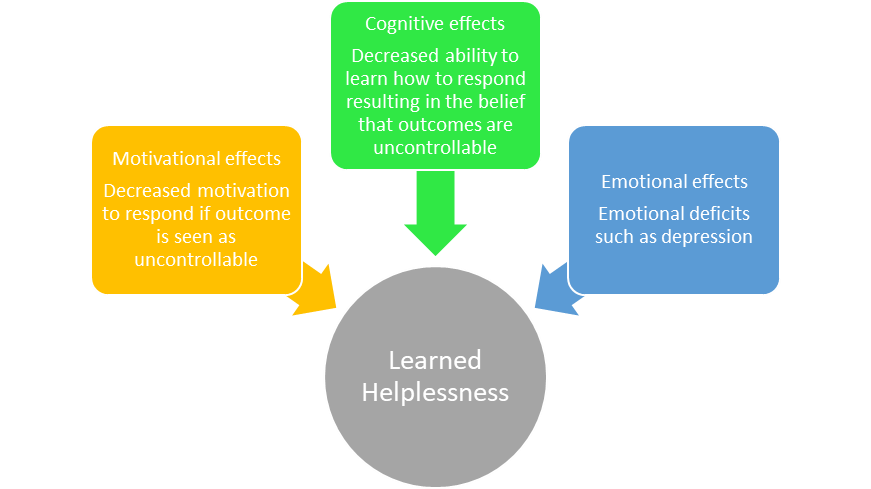
Although learned helplessness as a trauma response has always existed as a consequence of sin, it was psychologists Martin Seligman and Steven F. Maier who coined the term “learned helplessness” following several studies and experiments. Dogs repeatedly received an electric shock after hearing a tone, with no way to escape. When they were later placed in a shuttle box with two chambers separated by a low barrier, giving them a means of escape, they did not even try. Their prior experience of being unable to escape had conditioned them to stop looking for solutions, even when one existed. The dogs had lost confidence in their own ability to affect their situation. They expanded the study by dividing the dogs into three groups. The first two groups were given a sense of control through the way the experiment was structured. The third group was rendered completely helpless, receiving shocks that appeared random and beyond their control. The first two groups learned to escape; the third did not even try. This demonstrated that the dogs in the third group had developed a cognitive expectation that nothing they did could prevent the shocks. Unlike the other two groups, they were entirely overpowered by their circumstances. (Seligman ME. Learned helplessness. Annu Rev Med. 1972;23:407-12. doi:10.1146/annurev.me.23.020172.002203 )
It is the same with people. They cannot simply “snap out of it.” They need to retrain their thinking or be helped to understand their situation and find the courage to change. Above all, they need to believe that change is possible. Some require cognitive therapy.
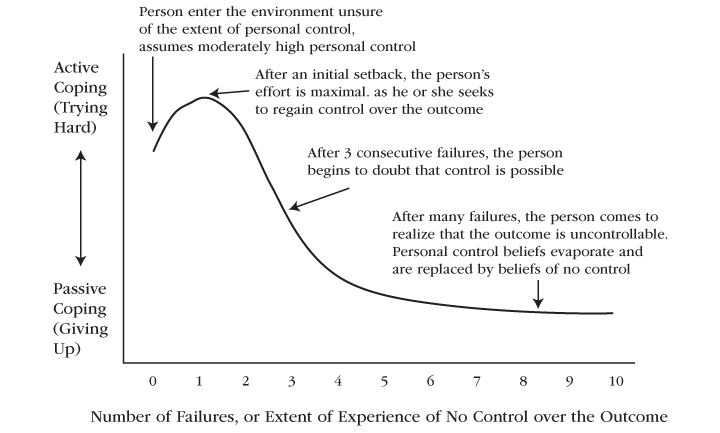
Our own intellect can work against us. After enduring a long-term abusive or toxic situation with no way of escaping, the brain begins to convince us that we must depend on others for rescue. When that help never comes, many become trapped with no self-esteem or sense of self-efficacy, unable to manage even basic obstacles, let alone their own lives.
A particularly damaging situation arises when the abuser is also the caregiver, and the victim depends on that person for basic necessities, safety, and nutrition. The very source of their survival becomes their destroyer. Such a situation can break even the strongest person and is a powerful breeding ground for “learned helplessness.”
God knows how one person’s sin can entirely ruin another’s life. Because the lines of right and wrong become so blurred, understanding the situation can take years. Often, someone in that position will continue to suffer abuse from others, and many lose their mental stability as a result. Most dissociative disorders, which are growing rapidly in society, are ways in which victims learn to escape mentally what they cannot escape physically. For others, learned helplessness sets in, and dissociation becomes their primary coping mechanism.
Humans are created to be free, and freedom is often the last thing our nature surrenders. When the body cannot escape, the mind will try to. A wide range of mental disorders can follow in the wake of trauma. Our bodies were simply not made for a world of sin.
As sin increases in the world, we will see more and more young people and adults struggling with various psychological issues, including dissociation, with low self-esteem playing a significant role. These struggles create more tension, more strife, and more pain. This compounds the physical diseases caused by long-term stress, discussed earlier.
Sin destroys mankind’s mind, heart, and soul, which is why God hates it. He has seen the full picture all along: every cause and effect, every repeated pattern. He desires to remove what is damaging His creation, to “reset” our genetics, and to restore mankind to a state free from these cycles. This is part of the purpose of heaven and the new earth. When sin is removed, suffering ends. It is also why God calls people to repent and “turn from their ways” in order to receive access. Moving from earth to heaven will not resolve any problems unless people are willing to surrender their sins. If not, suffering has simply moved to a new place. (Ezek.18; Matt.5:20; Joh.3; Isaiah 26:10)
For a long time, only physical damage was considered, because science had not yet discovered the full extent of illness that trauma causes. Now we know better.
Sin is destructive; it destroys life inside a human. It destroys our society, our children, and ourselves. The price of self-gratification and self-protection is very high.
There is no doubt that the world is full of hurting victims. Pretending otherwise does not make the damage go away; rather, it further complicates things. No one would command a newborn to get up and walk, knowing its body is not ready. Though it has a spine, two legs, and all the necessary body parts, it simply is not yet strong enough.
Demanding that someone snap out of victimhood will most likely only push them further into it. Compassion and understanding, along with helping them see that moving beyond victimhood does not erase or invalidate the fact that they were a victim, would be far more effective.
For some, getting trapped in victimhood is not a choice. Yet their recovery depends on breaking free from it. God desires us to have the freedom of choice, but those who are mentally unwell often do not know how to exercise that freedom; they fear it, and they fear having to make decisions. This is a central part of being stuck in learned helplessness.
No case is lost to God, and no case is hopeless. There is no single cure for all. Some are more deeply affected than others, and the outcome does not necessarily depend on what happened to them, but on how they were able to cope with it and what support system they had. A person who claims victimhood to control others and gain attention is in an entirely different category from someone who has been brainwashed into submission and knows no other way to communicate a need for help. No two cases are the same, and no two cases should be treated the same. Everyone’s story is unique, even when similar symptoms appear.
What is most important is to understand that God desires our freedom. He can and will help if we ask Him. No one who is truly a victim should wish to remain one. The only ones who benefit from claiming victimhood are abusers, or victims who have become abusers, who use it to manipulate those around them. For a genuine victim, the state of real victimhood leaves them vulnerable to further abuse and is therefore not a desirable place to remain.
The Example of Joseph

The biblical Joseph is a compelling example of someone who, by all accounts, should have been far more mentally broken. He had a loving upbringing but lost his mother at a young age, was regularly bullied by his brothers, was eventually attacked and nearly killed by them, and was then sold into slavery, all by the age of 17. This deeply traumatic situation continued for years, without any loving family members to help him cope. He had no closure, no justice, and he knew his brothers likely lived peacefully with their father while he continued to suffer. Yet even as a slave, stripped of his freedom, he did not give up. Instead, he made the best of every situation he found himself in, standing up for himself even when it came at a cost. When Potiphar’s wife attempted to seduce him, he could have felt compelled to comply, yet he took ownership of his own decisions and refused. He did not use his status as a slave as an excuse. Even in prison, still captive, he focused on the choices available to him and sought personal growth wherever he could find it. He did not allow his circumstances to rob him of his beliefs, his identity, or his sense of self-efficacy. In the end, he proved himself fit to lead Egypt and did so with great distinction. Though traumatized and forced into submission as a slave, he emerged from it. God placed a long-term trauma victim in a position of enormous responsibility. Although he had been a victim, he refused to remain one. He did not choose victimhood. When his brothers came to Egypt to buy grain during a famine, he did not simply grant them a fresh start on the spot, as many Christians tend to do with their abusers. Instead, he took charge of the situation to test whether they had truly changed. Rather than allowing them to dominate him again, he demonstrated that he was in control.
Joseph’s story is the antithesis of learned helplessness, a triumph over trauma. Joseph navigated his hardships by seeking emotional and spiritual support from God. As a result, he was never entirely helpless; he always sensed that someone stronger was with him. Rather than turning to dissociation to survive, he drew emotional strength from his relationship with God. He believed that God would, in time, deliver him from his situation, and that belief gave him the hope he needed to persevere. It is the loss of hope that most often gives rise to learned helplessness. By maintaining his relationship with God and continually witnessing answers to his prayers, both small and great, Joseph remained grounded. Rather than remaining a victim, he became a leader.
When naming his first son as a free man, the Bible says: “And Joseph called the name of the firstborn Manasseh: For God, said he, hath made me forget all my toil, and all my father’s house” (Gen 41:51). Joseph recognized his affliction but refused to let it define him. Despite his declaration that he had forgotten his suffering, we see that when his brothers arrived, the pain resurfaced, as it does for many trauma victims. Not out of a desire to harm them, but to protect himself and others, he proceeded with caution. When he saw that they had genuinely changed and felt remorse, he chose to forgive them and grant them another chance. However, he did not forgive them and then return to tending sheep alongside them in the fields of Canaan as though nothing had happened. Joseph remained in a position of strength and security. He was safe.
For many, forgiveness means repeatedly placing themselves back into the same harmful situation, particularly among Christians. Yet we can forgive others while still protecting ourselves. Forgiveness should not be synonymous with submission to one’s abusers. When circumstances remain unchanged, offenses tend to repeat. Forgiving someone does not remove the need to leave a destructive situation; for some, that exit is essential if they are ever to be free from further abuse and have the opportunity to heal.
The story of Joseph shows the power of faith in God to help a victim remain in control in a hopeless situation. Biblically speaking, it shows how, when all other support systems fail, having God as a support system is enough. If faith is strong, hope is strong, and we will never be completely overpowered. This is the blessing a Christian has.
“And God is faithful; he will not let you be tempted beyond what you can bear. But when you are tempted, he will also provide a way out so that you can endure it” (1 Cor. 10:13).
When King David faced some of the darkest moments of his life while fleeing from King Saul, he found shelter in God. Although his situation seemed impossible to resolve, the hope of a righteous God in charge kept him strong even in his weakest moments. David was forced to seek refuge even among his enemies, and he had little peace during that season of his life, always living under the threat of being caught. Yet because of God, David did not give up.
When Elijah felt utterly alone, God spoke to him directly at Mount Horeb. When Hananiah, Mishael, and Azariah were cast into the furnace for standing alone in their faithfulness to God among a large crowd, Christ Himself came and stood with them in the fire.
Those who take refuge in God have a genuine support system, unless their relationship with Him is a self-constructed, distorted one. For a Christian, what is meant to be part of the solution can, if corrupted, also deepen the problem. This is why some victims reject God as a source of help and abandon their faith, while others find deep healing through their relationship with Him.
A Christian is never helpless or hopeless. “For while we were still helpless, at the right time Christ died for the ungodly” (Rom. 5:6). “In my distress I called upon the Lord, and cried to my God for help; He heard my voice out of His temple, and my cry for help before Him came into His ears” (Psalm 18:6).