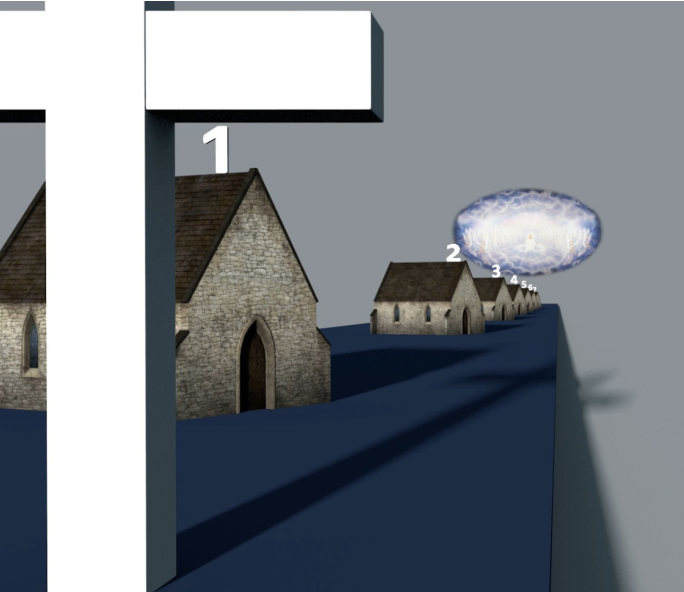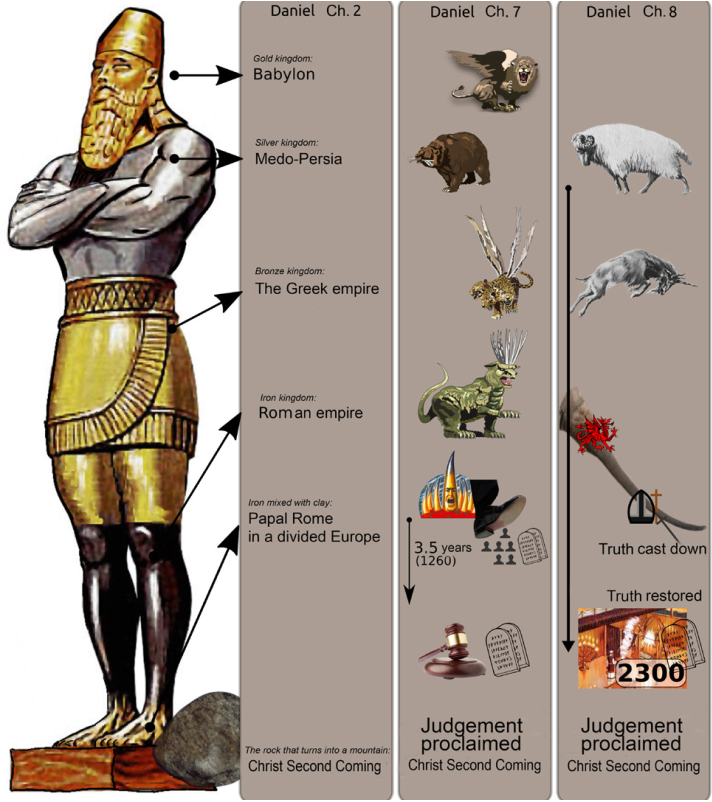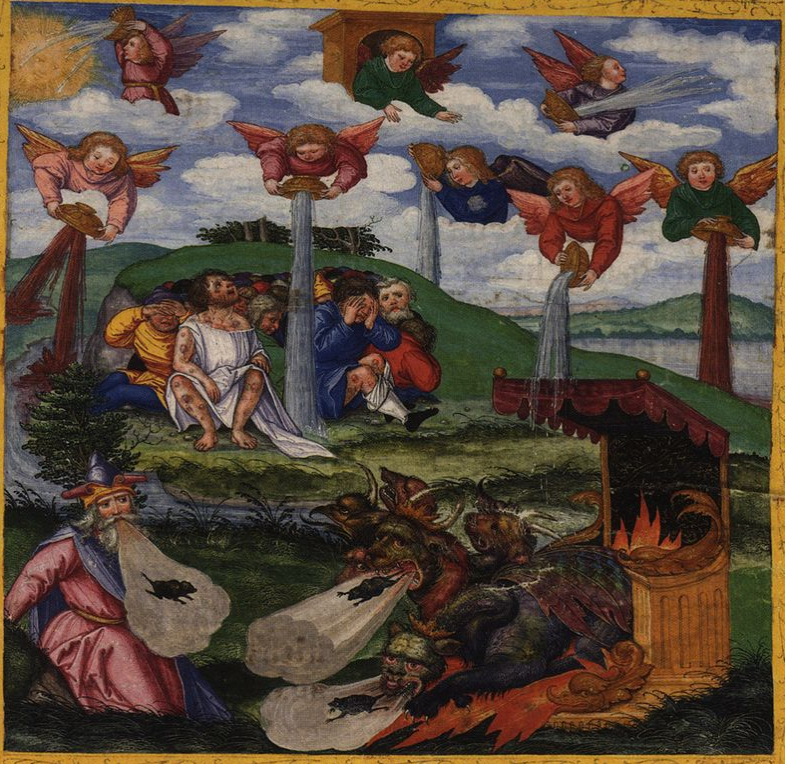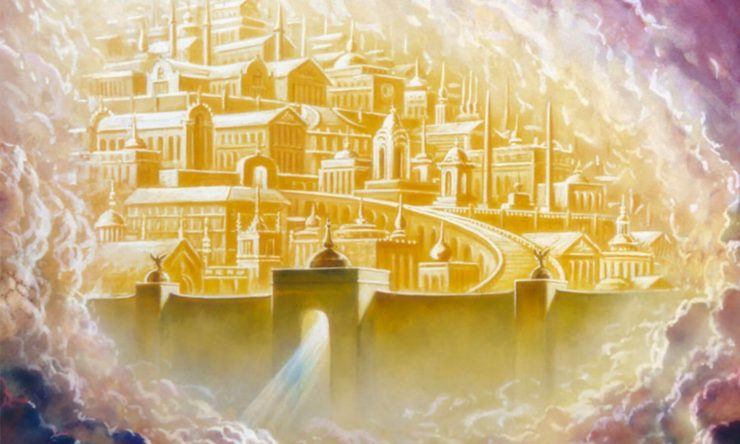
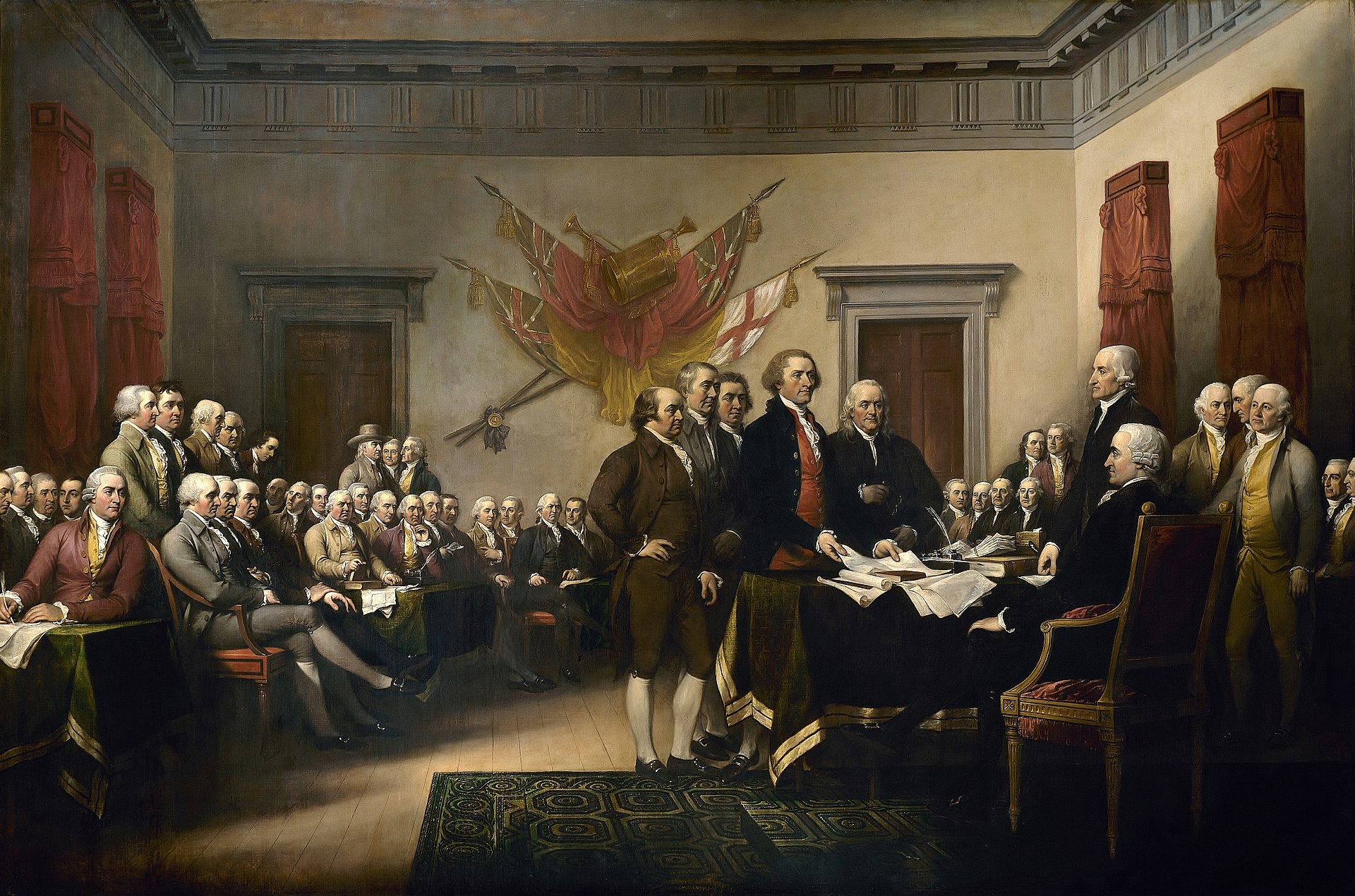

In Revelation chapter 4 and 5 we get an insight into what happens in heaven. In the book of Hebrews, we learn that Jesus is in a sanctuary, the one the earthly was a shadow of. Here we see a door opened and we see God’s throne. We learn that people who are saved from the earth have a role as elders around the throne. We know a group of people rose when Christ was risen and came with God to heaven.
“And the graves were opened, and many bodies of the saints which slept arose, And came out of the graves after his resurrection, and went into the holy city, and appeared unto many.» (Mat 27:52-53)
This might be this group of elders as they are already in heaven when John get this vision. We know from their own words that they have been redeemed from earth:
“Thou art worthy to take the book, and to open the seals thereof: for thou wast slain, and hast redeemed us to God by thy blood out of every kindred, and tongue, and people, and nation» (5:9)
We see these elders several times in Revelation and we see them agreeing with God’s judgments. This means that God has representatives from earth taking part and witnessing God’s judgment and actions. We also see in the book of Daniel and a judging scene in heaven where ten thousand upon ten thousands of angels are witnesses. (Dan.7:10) God does not need to judge man in secret, He is doing it in the open so that the witnesses can see that He is righteous and praise Him for it. God wants our praise to be tied to us knowing Him and seeing He is righteous, not out of fear. Our attention is now drawn to a sealed book. John cries because he so wants for the book to be opened, and for the church to have this insight into the future. Each seal opens a new page with a part of the future. He learns that because of Christ victory He has been given the power to open the seals. We are also told of Christ power and how He is honored in heaven.
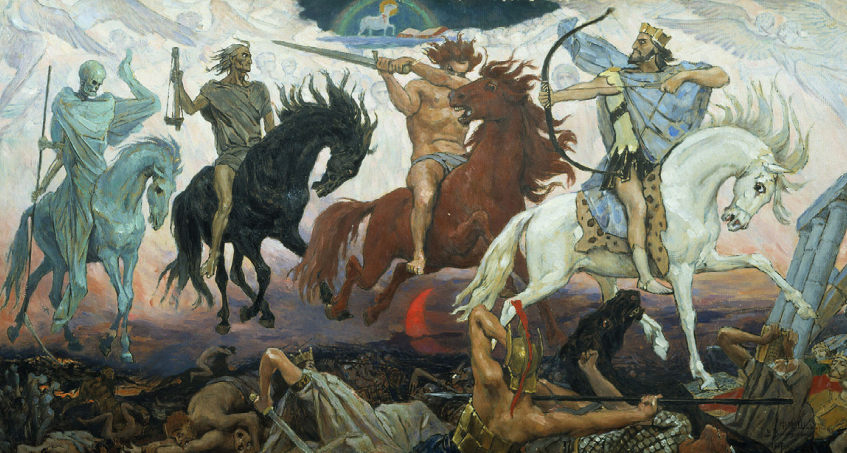
In Revelation 6-7 we get a new insight of things that would take place from the time of John and until Christ returns. This time we get new information, and more details of the different time eras. Again we are presented with the number seven just as it was seven churches, we now have seven seals. The history of the church is repeated and elaborated. The first white horse represents the first clean church that was undefiled and that brought the gospel unto the world. It represented the eagerness of the disciples and the first Christians. The next horse is red which indicated a loss of innocence. Red in the bible is a symbol of sin. Deceptions and worldliness are pressing its way into the church. The church is morally defiled, it has been infected with sin. This made it vulnerable to what was about to happen. The third horse was black. The opposite of white. The church goes into a time of moral darkness and delusion. Paganism and Christianity have been unified, the Roman Empire and Christians together have become a new religion. Superstition and philosophy, pagan rituals and practices have replaced the pure truth. It says the horseman on the black horse has a measuring weight which symbolizes authority. Christianity has mixed with worldly power spite the fact that Jesus had said his kingdom wasn’t of this world. The emperors from Constantine to Justinian make laws for the Christians, unified church, and state and even became leaders over the progress of the church. Their allies among the Christians got lucrative leading positions. The next horse is pale. It illustrates death. The church is about to die spiritually. The emperor Justinian gives the bishop in Rome authority to rule and those among God’s people who try to be faithful to the truth is
persecuted, claimed to be heretics, killed and punished in many ways. They are now hunted pray and brought to silence. This period of the Christian history is so hard for the true believers that extremely few are left and most are devoured and suppressed by this power. One example is the church in Ireland and Scotland that long persevered Gods commandments and the faith in Jesus. But even they were conquered. Those who resisted were even ‘converted’ after their death by the Catholic Church. Historical falsification, power, and brutality almost wiped out God’s faithful wherever they were. In the case of Ireland and Scotland, the Catholic Church wrote that they had been wild pagans whom they brought to the gospel, while the truth was something entirely different. The true worshipers were almost wiped out in real life and lied about in the history book written by faithful Catholics. The fifth seal is opened. The first four were horses. Not the fifth. Here we see an illustration or the aftermath of the horses. Many righteous people have been slain. They cry out to God these words: HOW LONG? They want to know how long this terrible time will continue where they will be subdued and be killed by this deceptive power who claim to be Christ followers. The cry out for God to reveal to them the time. And God answers their prayer when we see Him giving the time it will last at a later repeating prophecy. This time period of suppression is also mentioned in Daniel:
“and they shall be given into his hand until a time and times and the dividing of time.» (7:25)
And this same time period will be mentioned again several times in Revelation. From the fifth seal, we learn that it’s the suppressed among God’s people that are crying out to hear the time. The sixth seal is opened and we learn of several end time signs and for-warnings that precedes Christ coming. The deliverance is near but before there will be a lot of shaking. We are shown those who are saved, the unbroken line that has continued since the time of John and until the very end. They are not the only ones to be saved, as we also see a great multitude from all over the world. But the 144 000 is from what is called Israel, sealed and then a great multitude to large to be counted added to their number. While everyone who wants to follow God’s commandments and have the faith of Jesus will be saved, the multitude comes from different backgrounds. “After this I beheld, and, lo, a great multitude, which no man could number, of all nations, and kindreds, and people, and tongues, stood before the throne, and before the Lamb, clothed with white robes, and palms in their hands» (Rev.7:9) They do not have the complete truth and have not been part of God’s chosen light-bearers who were undefiled by the corrupted churches. Although they haven’t understood everything right they have followed the light that they had. It says about the 144 000:
“These are they which were not defiled with women; for they are virgins. These are they which follow the Lamb Whithersoever he goeth. These were redeemed from among men, being the firstfruits unto God and to the Lamb.» (Rev.14:4)
In the bible churches and even Judah and Israel was called women. Even the 144 000 are compared to a woman when they are called a virgin. If the Bible continues it’s symbolic expression it means that their doctrines are pure, that they have not allowed the harlot and her daughters to corrupt their understanding or their religious practices. They have a pure truth unfalsified. They are God’s chosen light-bearers in the end times, clean. The connection with the tribe of Israel shows us that the 144 000 are those light bearers that are a continuation from the time of Christ. They are not part of unconverted Israel, but of the line that has stayed true and listened whenever God directed them and rebuked them. We see in this scene the great multitude together with the 144 000. Everyone cheers and shouts with joy over being saved and they worship the Lord. It’s a feast in heaven. And in the seventh seal, we see silence in heaven for half an hour. Jesus has even more details to give to His people. Till now He has given them the advice on how to handle the changes that would take place in the churches and what they had to do to remain faithful (7 Churches). They have received an insight in the future and how the church would go from white to red, to black and pale unto death and how they would be persecuted by others also calling themselves Christians who were in power. They see signs of Christ coming and that God will seal His faithful. They are comforted. (7 Seals)
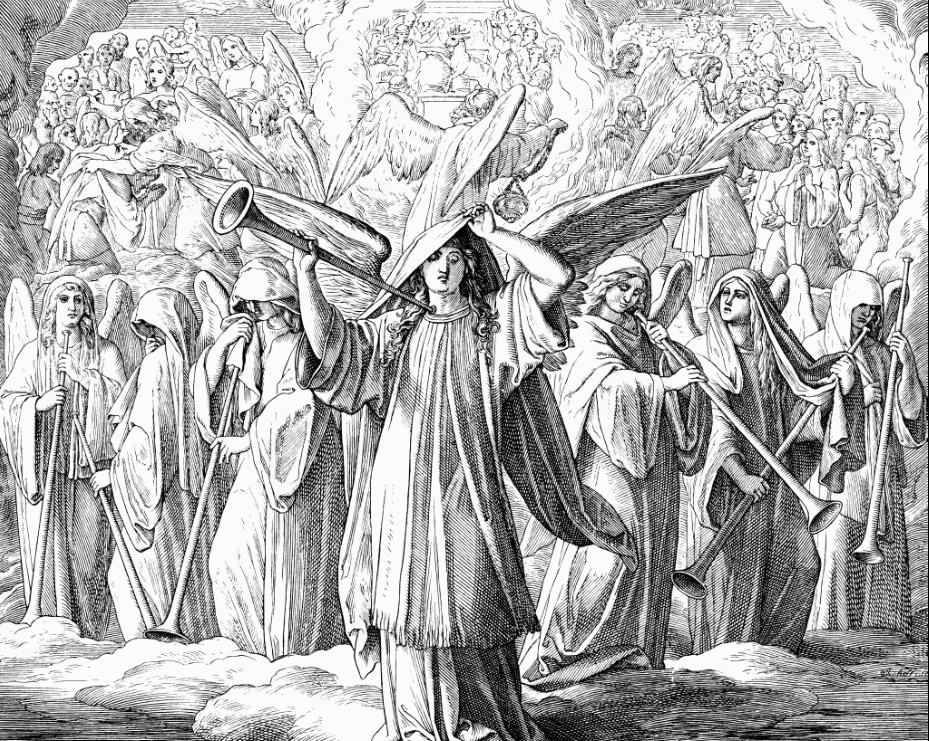
Jesus chooses to go even deeper to expose what will happen. Again, just like in the book of Daniel, Jesus goes back in time again to tell more about the time periods up until Christ second coming. Trumpets were used to gather God’s people but it was also used to forewarn war. In the scenes, we are about to see it’s clear this is war and not a feast. The bitter persecution God’s people would have to endure was to be relieved as their enemy would at times be punished and lose power. In Revelation 8 to 9 we see trumpets, a warning of judgment, directed towards the enemy of God’s true people. Just like there were seven churches and seven seals, we now get seven trumpets. So in the Bible trumpets often forewarn wars and judgments for the benefit of the people.
“If when he seeth the sword come upon the land, he blows the trumpet, and warn the people; …He heard the sound of the trumpet, and took not warning; his blood shall be upon him. But he that taketh warning shall deliver his soul. But if the watchman sees the sword come, and blow not the trumpet, and the people be not warned; if the sword comes, and take any person from among them, he is taken away in his iniquity; but his blood will I require at the watchman’s hand.» (Ezek.33:3&5-6)
You don’t blow a trumpet to warn the enemy, then the enemy will be prepared. And so the trumpets are for the benefit of God’s people. So when the trumpets sounded to forewarn armies in the Bible, if the people were faithful to God they need not fear. Those who had corrupted their worship and didn’t follow Gods law, however, were the ones in the greatest danger when the trumpets sounded. The true believers who were faithful were to live in the hope that the persecuting powers would fall bit by bit. In the beginning of chapter 8 see how the prayers of God’s people are coming up in the temple before the trumpet sounds. The altar of incense was in the sanctuary and this shows how God will take especially care of His people and receive their prayers in these times of turmoil. Although the wars aren’t directed towards them it will affect them greatly. But they were to have their hope in knowing that their prayers are accepted into the sanctuary and that the High Priest was watching over them. The first four trumpets tell us how Rome fell. Remember how God thoroughly explained how Babylon, Medo Persia, and Greece would fall bit by bit in the book of Daniel?
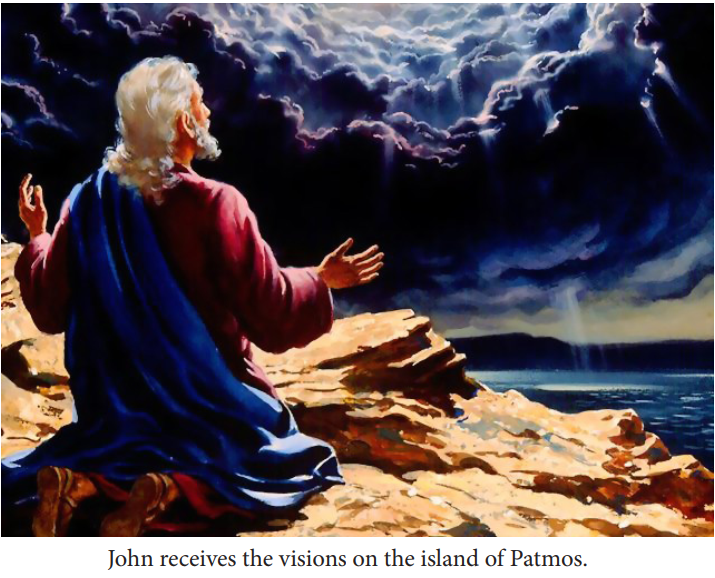
Now we get to see the last beast, that had imprisoned John on the island of Patmos, the Roman empire and its remnants, fall bit by bit. This power that not only had crucified Jesus but also many of His followers had been a burden to the true church. Now it would lose it’s power bit by bit as prophesied to Daniel. Only in Revelation do we get a more fuller explanation. Again, the visions are given symbolic so they would be understood by God’s people and not the enemy. The first part of the Roman Empire to be struck was the western empire.
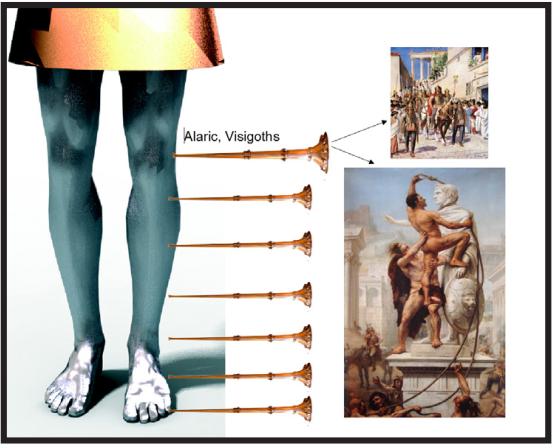
First Trumpet.
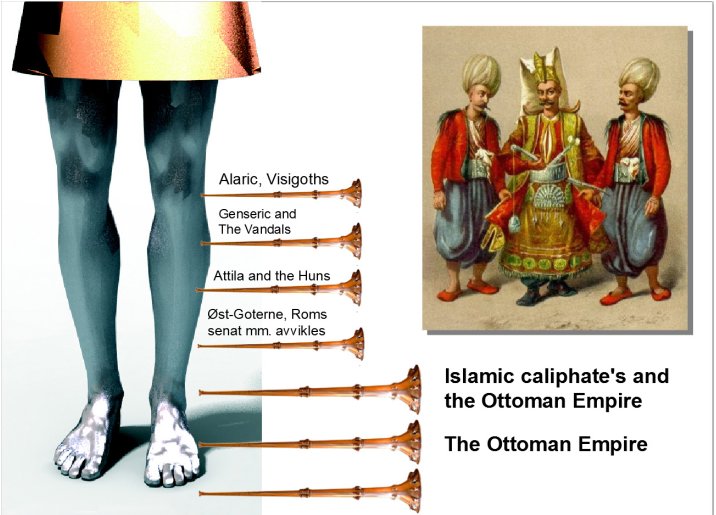
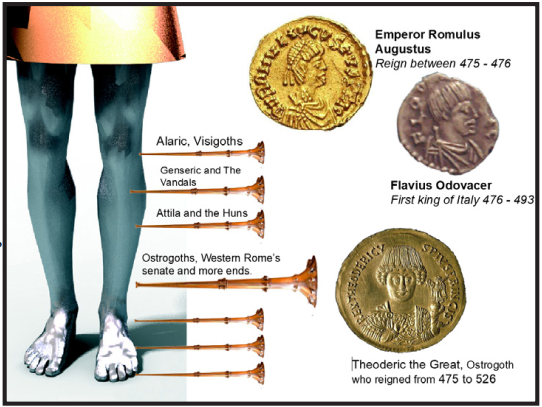
The first stroke of death was lead by Alaric and the Visigothic nation. “Thrace, Macedonia, Attica, and the Peloponnesus, but did not reach the city of Rome. On his second invasion, however, the Gothic chieftain crossed the Alps and the Apennines and appeared before the walls of the “eternal city,” which soon fell a prey to the fury of the barbarians.” The terms hail and fire mingled with blood is symbolic of their warfare. They left a bloodbath on their way. And just like no one can control hail, no one could control this army and their destruction. It’s said that the city of Rome was full of dead bodies. One third refers to one-third of the kingdom.
Constantine actually divided the Roman Empire into three parts and gave it to his three sons. Later it was divided into two parts, the western Roman empire, and the East Roman Empire.
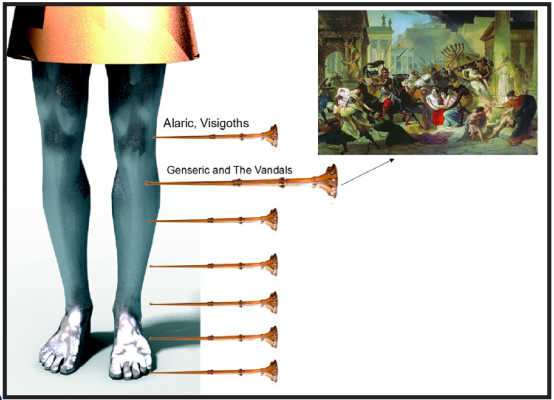
Second trumpet
The second trumpet tells of a great mountain burning with fire cast into the sea. The second deadly stroke made towards the Roman Empire was by the Vandals and it’s leader Genseric. Here two part of the kingdom is effected. Earlier in Bible prophecy, a mountain is a symbol of a kingdom. The mountain hitting the sea show us that it’s talking about a kingdom that will attack from the sea. The Vandal leader had his headquarter in Northern Africa and most of his warfare was naval. In order for Rome to cope with his attacks, they strengthen their naval with
three hundred long galleys and smaller vessels. But the vandal leader manages to sink most of their ships in a surprise attack. Rome had prepared their counter-attack for three years and they lost in one day. Some years later the Eastern Roman empire strengthens their naval and sent a great number of ships to defeat them, but they lost once again and the Vandals continued taking past Roman territories.
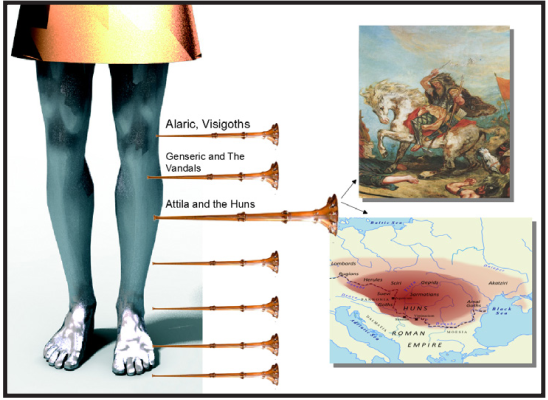
Third trumpet
In the third trumpet, we see a star falling into the rivers and fountains of water. It tells us that many of the men died in the water because it was made bitter. If we continue with the symbolism we find another army led by a strong leader. This time not a navy army but an inland army. The third deadly attack on Rom came from the Huns with the great leader Attila in front. Interestingly enough some of the major operations took place in the regions of the Alps which is the district where the rivers flow into Italy. The foundation of water. Their warfare weakened Western Rome overwhelmingly. Interestingly enough, in the Bible bitter water was given to a woman suspected of infidelity. If she drank it and her belly got swollen
it was a sign that she was guilty of the crime. (Num.5:11-31) At this time the Christians had become corrupt and infidel, and the power they were whoring with was pagan Rome.
Fourth
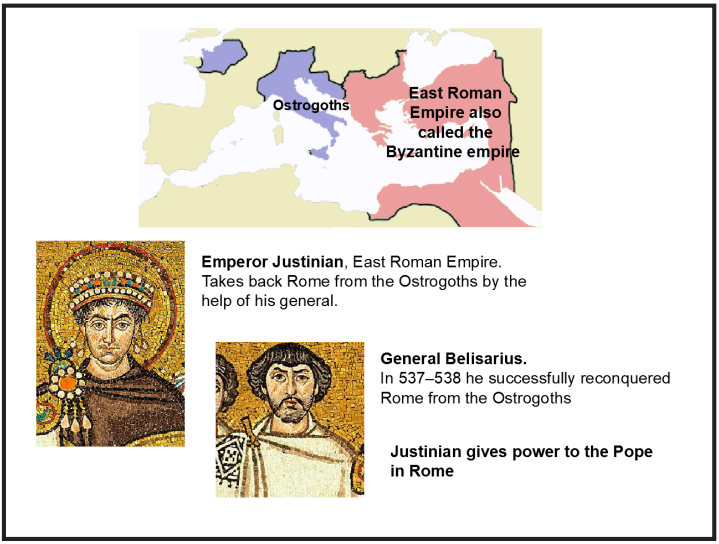
Another stroke of death for the Western Roman Empire was the Ostrogoths. Here it says the sun, moon, and stars are smitten. This is symbolic of the Roman government, the emperor, the senators, and the consuls. Western Rome fell between 476 and 566. Odoacer was made the first king of Italy but was defeated by the Ostrogoths who also took the city of Rome. The western Roman empire would never again be what it once was,
and their rule was only over small areas compared to what it had been. Although the sun, the emperor, was gone the consulship and Senate (moon and stars) lasted for a little bit longer. Ironically the end of also them was done by the emperor of the Eastern Roman empire named Justinian in 541. Justinian was also the emperor who gave the Papal power to sit in Rome and be judge over the Christian Church. As the Western Roman Empire was finished and the territory was split, the Pope continued in Rome with the emperor’s titles but with completely a different power and purpose.
Fifth trumpet
The only part that remained of the Iron Kingdom, the feet on the statue shown Daniel, was the Eastern RomanEmpiree. The next two trumpets will finish off also this part of the empire. The eastern Roman empire was known as the Byzantine kingdom and their capital had been Constantinople (Istanbul) ever since Emperor Constantine. The Byzantine kingdom was large in the Middle East. In the fifth trumpet, we learn who will bring them down. It explains that a star has fallen from heaven unto the earth and that a swarm comes out of the bottomless pit. The star represents a leader. First it was the Persian monarch that started to eat its way towards Constantinople. However, when asked to convert to the new religion Islam coming from a prophet in Mecca, he refused. While the Persian and Roman monarchs were busy fighting each other, the new Arabic movement was growing in the south. The chapter compares them to locusts, a term used previously in the bible for the Arabic people when they were about to go to war. Mohammad started this movement firstly as an objection to the partly pagan Byzantine kingdom dominating the middle east. Claiming to have a more pure teaching and a calling from God, the Arab hordes started taking over territories. “Bottomless Pit” comes from a Greek word that can mean desolate or an isolated place. It can point to the deserts of Arabia where Islam had it’s beginnings and first followers. However just as the true gospel was once called the ‘light’ we see in this verse ‘smoke’ coming out of the pit and spreading. They are also compared to scorpions, having a deadly sting. Next, we learn that they are told not to hurt those of God’s people who are sealed, meaning God allowed these people to gain this power to punish Rome and take down the East Roman Empire and corrupt Christianity, but God didn’t permit them to hurt His faithful.
God’s people were already suffering severe persecution by the pope’s men, and this strife was not to hurt them. An interesting letter was sent out in 632 by Abubekr:
“When you fight the battles of the Lord, acquit yourselves like men, without turning your backs; but let not your victory be stained with the blood of women and children. Destroy no palm-trees, nor burn any fields of corn. Cut down no fruit-Trees, nor do any mischief to cattle, only such as you kill to eat. When you make any covenant or article, stand to it, and be as good as your word. And as you go, you will find some religious persons who live retired in monasteries, and propose to themselves to serve God that way; let them alone, and neither kill them nor destroy their monasteries. And you will find another sort of people that belong to the synagogue of Satan, who have shaven crowns; be sure you cleave their skulls and give them no quarter till they either turn Mohammedans or pay tribute.”
At this time God’s people had gone to hiding and gone to live in secluded areas to escape the persecution. They were not monasteries but were regarded as such as they were isolated Christians. He then talks of the others with shaven crowns that we know were common in the Catholic monasteries among the Roman priests. They had monasteries all over the territories that the Arabs now was taking over. There were several different Islamic caliphates, each one establishing its grounds in the former Byzantine areas and becoming unbeatable. They also took Jerusalem and built their mosque there. Losing Jerusalem was forever to be a thorn in the eye of the Roman papacy and the East Roman empire.
“And the shapes of the locusts were like unto horses prepared unto battle; and on their heads were as it were crowns like gold, and their faces were as the faces of men. And they had hair as the hair of women, and their teeth were as the teeth of lions.” (Rev.9:7-8)
The description of this army matches the Arabs. They were famous for their strong horses, and they had turbans with miters. It also says they had hair like women, and the Arab men did not cut their hair and often had very long hair. In verse 5 we are told that they would torment them for five months. Five prophetic months is 150 years. Just like in the message to the churches where they were said to be under great tribulation for 10 days or years it did not mean they would only be persecuted in this time period. The 150 years here described speaks of the time period where they would do the most damage to the East Roman empire. It also tells us that these 150 years began when they had a king or a strong leader over them. The Mohammedans were divided under different leaders for many years and had no government that was extending over them all.
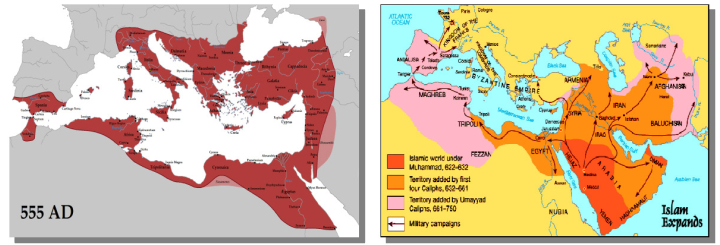
East Roman Empire at its peak in 555 A.D. Map to the right show how Islamic caliphates took piece by piece of their territories.
Othman then established the Ottoman empire and gathered all the Mohammedan tribes under one leader. But the prophecy not only talks of a common leader but of them tormenting their enemies. When they started to attack the Greek empire the west was shaking. Some count from when he first entered the territory of Nicomedia in July 1299 and it ending in 1449. The prophecy told that they would torment but not given the power to kill. Although they kept fighting their way west attacking the Greek, they didn’t manage to take Constantinople or conquer. The East Roman empire survived still. But at the end of the 150 years where they were “not given to kill but only torment” a change takes place. The restraint that had been on them, are taken away and the sixth trumpet is sounded.
Sixth trumpet
This trumpet starts with the Angels losing a restrain that has been at the river Euphrates. The River Euphrates begins in today’s Turkey and goes down into Syria and ends in Iraq. It speaks of four angels at the river that are loosened. The Ottoman empire had at this time four sultans situated at Aleppo,
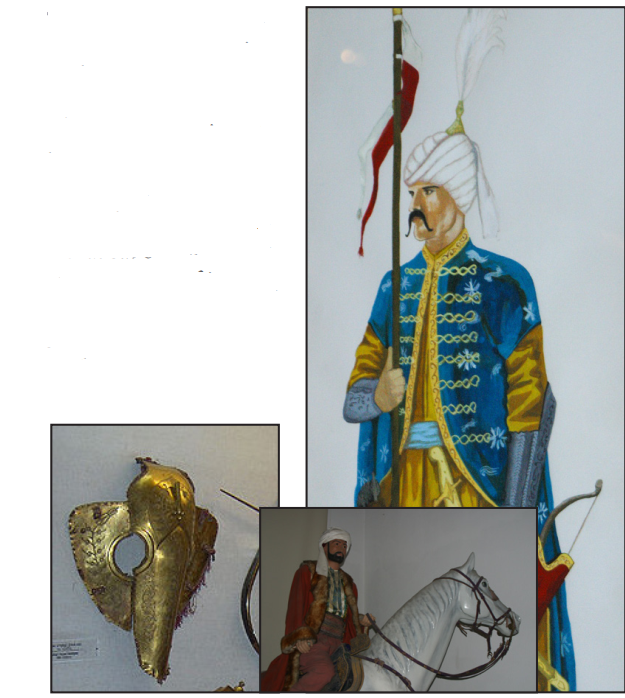
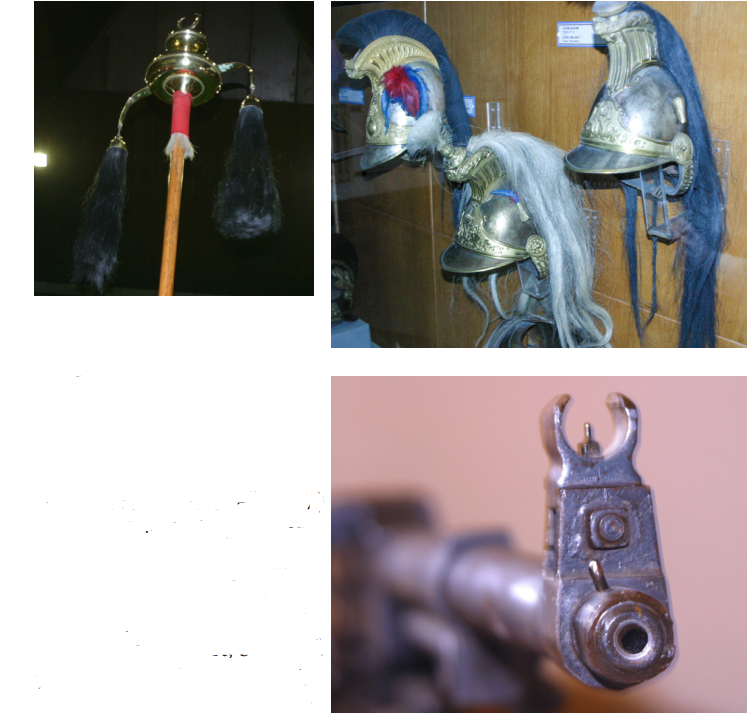
Armor for the horses head. All pictures from the Ottoman museum in Istanbul. Pictures are by the author.
Iconium, Damascus, and Bagdad. Another time prophecy is given, “an hour, and a day and a month, and a year” which translates to 391 prophetic days, if the day for a year principle is used also here. One year is 360 years, a month is 30 years, one prophetic day is one literal year and one prophetic hour is the twenty-fourth part of a literal year which is fifteen days. This gives us 391 years and 15 days. Notice last time prophecy said they would not be permitted to kill (making an end to something), now they are given that permission in the next time prophecy. From torment to kill. Now they were permitted to slay a third of the men. This is the third part of the Roman empire that had yet to fall. The last successor of the Roman emperor Constantine was removed from his throne and Constantinople captured. The East Roman Empire and the eastern city of the Caesars were now finally taken from them. We get an even better description of this army so that no mistake can be made as to their identity.
“And Thus I saw the horses in the vision, and them that sat on them, having breastplates of fire, and of jacinth, and brimstone: and the heads of the horses were as the heads of lions; and out of their mouths issued fire and smoke and brimstone.” (v. 17)
(See photo above)
Fire is red, jacinth is blue and brimstone is yellow. These were the colors the Ottoman army used. The Turkish uniform was scarlet, blue and yellow. It was the newfound invention of gunpowder that secured the Ottoman the upper hand against their enemies and helped them bring the last part of the Eastern empire to an end. They used them when conquering Constantinople as well as cannons. Such firearms were not even used in the west at this time. Riding on horses with a firearm is very well illustrated in the verse when it says that fire and smoke come out of the horses’ heads. John who was writing down what he saw had never seen anyone use a firearm before. So in the fifth trumpet, we learn that they are under constraint for 150 years but then the constraint is loosened for 391 years and 15 days. If one time-prophecy begins where the other ends, which here is natural as the constraint was lifted, the 391 years and 15 days begin at the end of July 1449 and ends in August 1840.
Women’s hair, or really horses tails on military helmets and Ottoman weapon. All from The Ottoman museum.
Notice that this doesn’t say the Ottoman empire would stop existing, only that they would lose their power completely. Many sincere Christians studied Revelation around this time and were able to predict the fall of the Ottoman empire in August 1840 based on these time prophecies, and they preached it widely a couple of years before it happened. In August 1840 a deal was made between the leader of the Ottoman and the western kingdoms. Unable to keep his strength he made a deal that his continuation was based on him subduing to the will of the western world. The Ottoman Empire no longer had the power to do anything and lived with the consequence that any rebellion would be the end of them. They no longer were a strong power who could do as they pleased, they were now in the hands of Christian powers. The Ottoman Empire was no longer independent. The Ottoman empire was permitted as a punishment to Roman Christianity. This becomes clear when we look at history but also the last verses in Chapter 8: “And the rest of the men which were not killed by these plagues yet repented not of the works of their hands, that they should not worship devils, and idols of gold, and silver, and brass, and stone, and of wood: which neither can see, nor hear, nor walk: Neither repented they of their murders, nor of their sorceries, nor of their fornication, nor of their thefts.” The Byzantine church, as well as the west Roman church, was the Christian movement that continued the practice of silver and gold icons in their churches, a religious practice from Roman times. They were killing the Christians who would not obey papal authority and they were selling what wasn’t theirs to sell. They took money from the poor “to help” their family members out purgatory, a deceptive doctrine that made the church richer. But no soul was released by money paid to the church in reality. It was a deception. They also let people buy their forgiveness from God by giving the church money. Their sorceries can easily describe how they claimed supernatural divine intervention to get people’s obedience and attention, only the powers that were at work were not of God.
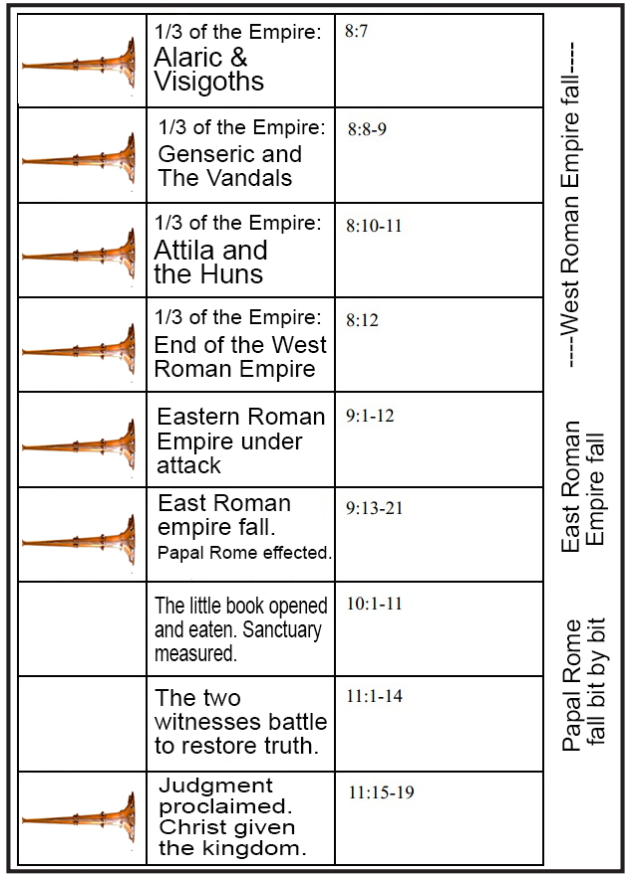
Six Trumpets – summary
The first four trumpets show how the western Roman empire is broken and looses vitally power. The two next ones show the end of the East-Roman empire and then how the Bishop in Rome struggles with the Islamic caliphate and later the Ottoman empire. The fifth and sixth trumpet show a plague of a nation to the papal influenced kingdoms. To them, they were a pest. But for Gods severally tried people the Muslims became important. The papal battle against those with a different belief became minor as Islam became the new great enemy. The Ottoman Empire also helped the reform movement get a much-needed break to outlive the persecutions and get the strength needed to break free. The Ottoman empire even offered them help so they could succeed. Even though Islam was a pest to the Roman church, it also became a hiding place for many persecuted groups who were permitted to practice their faith in peace in their areas. God used Muslims to punish the East Roman Empire and the Roman church.
Gods people got to follow along with what happened and by it know where they were in history and not fear in the same way as those who had rejected the truth. It was reformed Christians, studying the time prophecy in Revelation 9, that foresaw when the Ottoman empire would lose its independence and greatness. And they preached it before it happened.
See the next chapter to learn what happens before and during the seventh trumpet.
Before the seventh trumpet sounds God adds information about this time period. Revelation 10 and 11 give additional information of the time at the time of the Ottoman empire and until Christ second coming, about other things that concern God’s people. We are told that a book is opened. Which book is this? The only book we are previously told is still sealed is the book of Daniel. The one in Revelation chapters 4 and 5 had already been opened seal by seal. The angel prophesied to Daniel that the book he had sealed would be opened in the end times: “And he said, Go thy way, Daniel: for the words are closed up and sealed till the time of the end.» (Dan.12:9) When we now see a book open before the seven trumpet sounds and the end it is a clear reference to the book of Daniel that was sealed. But not everything in the book of Daniel was sealed, much of it was explained at the time he received it. A part of the vision was even given to His people and the nation in the city of Jerusalem. Daniel was especially told to seal one of the visions he saw regarding a time prophecy. The angel told Daniel that the vision was of a distant future, not related to his time and therefore it was preserved for the end time congregation. The prophecy told of 2300 prophetic days or years, and that he had to seal it. When the book of Daniel is opened this vision is also understood and the angel tells us that there is no time prophecy that goes past this point. We are therefore at the end of the time prophecy given Daniel. All the other time prophecies are to end before this one ends. The time prophecy of the 2300 mornings and evenings or the 2300 literal years was speaking of the sanctuary being cleansed. “And he said unto me, Unto two thousand and three hundred days; then shall the sanctuary be cleansed.» (Dan.8:14)
This is especially interesting as we have seen Christ in the sanctuary in the whole book of Revelation. We have seen several of the Sanctuary items, the candlestick and altar of incense, and in the seventh trumpet, we will see the Ark of The Covenant at the most holy. The ministering of Christ for His people is taking place in the sanctuary and that John is blessed with all this insight from the High Priest Jesus Himself. The time prophecy spoke of a cleansing of the sanctuary, and now the time has come for a special service in the sanctuary in heaven. In order to understand we have to look at the shadow service that once took place in the sanctuary on earth. The cleansing of the sanctuary took place once a year on the Day of Atonement, one of God’s appointed feasts. The meaning of the day was to cleanse the sanctuary of all the sins that had been taken in there during the year. In God’s sacrificial system the sin wasn’t removed completely when the sinner sacrificed an animal, it was removed from them personally but then transfers to the sanctuary. And this is why the sanctuary was symbolically cleansed once a year. The idea behind it is that although we are granted forgiveness through the blood of Christ, sin is still in existence. Have we really repented? Every Christian knows there are fake Christians and good Christians. Those who claim Christ’s blood but don’t really repent or convert. On the day of atonement, those who had not really repented or humbled themselves were cut off from the people. A cleansing of the heavenly sanctuary, therefore, consists of an investigation of those who have claimed Christ’s blood to themselves. Which makes perfect sense as God needs to separate the false apostles from the real before He returns. Jesus said he would separate the goats from the sheep. He also speaks of ten virgins all waiting for the groom, a metaphor for Christians waiting for Christ. Five of them are not accepted as they had not filled oil on their lamps and the lamps had gone out. (Matt.25) In the Bible oil is a symbol of The Spirit and a lamp a symbol of God’s word:
“Thy word is a lamp unto my feet, and a light unto my path.” (Psa 119:105)
Although confessing to being believers and waiting for Christ these virgins have not let the Spirit guide them and their lamp went dark when they didn’t let the God’sword direct their path.
The thought that the book opened is the book of Daniel and the vision that is especially unsealed is the time prophecy is strengthened when the next scene we are given is an angel holding a measuring rod, “And there was given me a reed like unto a rod: and the angel stood, saying, Rise, and measure the temple of God, and the altar, and them that worship therein.» (Rev.11:1) It’s of course not talking about measuring their height and with but their character. The measuring rod is God’s standard, His law, which we are measured after. (Jak 2,10-12; Pred. 12,13-14 Jes. 8,19-20; 2 Tim. 3,16-17) Note that the measuring rod is given into the hands of John, meaning we have to take part in distinguishing God’s people after God’s standard. An evaluation of the believers. He was also to measure the temple which means that the symbols in there, the law in there, was to be evaluated and used when measuring the people. We see this repeated in a later chapter when one of the last messages given to the world is that the hour of judgment has begun. So it’s clear that between the sixth trumpet and the seventh the time prophecy of Daniel has reached its end and the sanctuary was to be cleansed, an investigative judgment. We see the same pattern in God’s holy feast days. The feasts in the spring prophecized Christ’s first coming and the feast in the fall prophesied His second coming. The Day of Atonement, when the sanctuary was to be cleansed, came five days before the harvest. That day where it was to be determined who would get to stay with Israel and who had to leave. And so the judgment of God’s people are placed before Christ second coming in several prophecies. The prophecy of the cleansing of the sanctuary has an even deeper impact on God’s people. From the messages to the seven churches we learn that the fifth church had fallen away greatly and that only a few remained faithful. We were told that they needed to hold fast on what they had heard and received from God’s word. However, the sixth church has undergone such a change from the former that God has nothing He wishes to reproof them of. Something had happened to the church when Jezabel had corrupted the word and to the sixth. Truth had again conquered. In the time prophecy of the 2300 mornings and evenings, we read: “Then I heard one saint speaking, and another saint said unto that certain saint which spake, How long shall be the vision concerning the daily, and the transgression of desolation, to give both the sanctuary and the host to be trodden under foot? And he said unto me, Unto two thousand and three hundred days; then shall the sanctuary be cleansed.» (Dan 8:13-14) God’s truth as shown in the sanctuary, His law, His times, and testimony had all been disregarded and replaced with a false Christian system. For a long time, this power gets the majority of the people in darkness to the Biblical truth. This shows us that while the Sanctuary in heaven would go through its Day of Atonement the people on earth were enlightened to the truth of the Sanctuary all over again. The people who received enlightenment from the Sanctuary and the law there and the service there was the church God had no reproof to give to. The truth was not trodden underfoot, they had perfectly embraced it. So in Daniel, we learn that truth would again come into the light and in Revelation, we see how God’s people are measured by the temple standard.
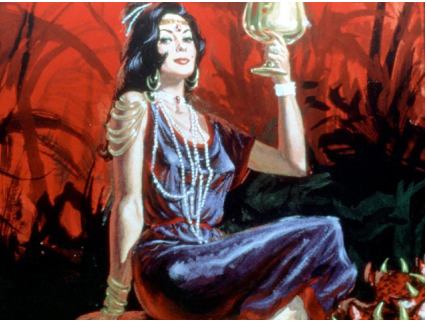
Two witnesses and a beast.
Even though we are told that the Roman empire will be divided before Christ returns there are still different powers within this division that are revealed as beasts. After showing John the measuring rod and the temple Christ reveals two witnesses.
«And I will give power unto my two witnesses, and they shall prophesy a thousand two hundred and threescore days, Clothed in sackcloth.» (Rev 11:3)
Here we receive another time prophecy of 1260 prophetic days which is 1260 years. We see God going a little bit back in time. We know that the sanctuary was to be trodden under the foot and truth be suppressed. And we are already told that the power who would do this was the same power that would physically suppress God’s people for «a time and times and the dividing of time.» (Dan.7:25) If they only got 1260 years then why does it say the sanctuary was trodden under foot for 2300 mornings and evenings? The 1260 years refer to physical suppression as well as religious. Those reforming under freedom still had a long way to go before they had rid themselves of these powers’ deceptions and religious rules. However, in the time period from the 1260 years to the end and to the end of the 2300 years, the rediscovering of God’s truth took place which ended with their enlightenment in the Sanctuary. Why did they not have this opportunity before? Because God’s two witnesses were «witnessing in sackcloth». While the Catholic Church religiously ruled in Europe they made the Bible a forbidden book for common people. Most people did not have an opportunity to study and find the truths that were there. Those sharing the Bible in this period did it in hiding. Bibles were smuggled from different secluded places where a few faithful were copying them and to especially interested. The Bible was suppressed, the truth had to be shared in hiding. And this is partly why the truth had been trodden underfoot. When the papal authority lost power the two witnesses, The Old and the New Testament, got a new enemy. Because of faithful men that had risked their lives printing it hiding and spreading it helped the Reformation away from Roman Christianity. The Protestant movement was flourishing and becoming strong. The two witnesses had done their important work in realizing people from spiritual superstitions: «And when they shall have finished their testimony, the beast that ascendeth out of the bottomless pit shall make war against them, and shall overcome them, and kill them.» (Rev 11:7) A beast rises and makes war against the Bible just as they have done this great work in sack-cloth and finally was free to preach. The word used in the Arab was a bottomless «hole». Her only the word abyss is used. The word is used in several places and doesn’t refer to one land area.
«And their dead bodies shall lie in the street of the great city, which spiritually is called Sodom and Egypt, where also our Lord was crucified. And they of the people and kindreds and tongues and nations shall see their dead bodies three days and an half, and shall not suffer their dead bodies to be put in graves. And they that dwell upon the earth shall rejoice over them, and make merry, and shall send gifts one to another; because these two prophets tormented them that dwelt on the earth. And after three days and an half the Spirit of life from God entered into them, and they stood upon their feet; and great fear fell upon them which saw them.» (Rev 11:8-11)
The Bible had first shared its witness in sackcloth, in hiding. Then when they finally could preach in the free this new power made war against them. It’s compared to Sodom and Egypt and even the city Christ was crucified. All of these are symbolic expressions. In Egypt pharaoh when confronted with God’s word said: «And Pharaoh said, Who is the LORD, that I should obey his voice to let Israel go? I know not the LORD, neither will I let Israel go.» (Exo 5:2) Pharaoh denied the existence of God or the authority of Him. In Sodom, we see the same happening. Lot was faithful to God’s standard. He represented God in the city to the people. It says Lot sat in the gate which was commonplace in those days to preach, trade and do judgments. About him it says: «And delivered just Lot, vexed with the filthy conversation of the wicked: (For that righteous man dwelling among them, in seeing and hearing, vexed his righteous soul from day to day with their unlawful deeds;) (2. Pet.2:7) Before Sodom was destroyed there was a confrontation between the citizen of the city and Lot:
«And they said, Stand back. And they said again, This one fellow came in to sojourn, and he will needs be a judge: now will we deal worse with thee, than with them. And they pressed sore upon the man, even Lot, and came near to break the door.» (Gen.19:9)
They would not be judged by God’s standards. In Jerusalem, when Christ was crucified the following word exchange took place between the Roman pontiff and the leaders of the Jewish people:
«And it was the preparation of the Passover, and about the sixth hour: and he saith unto the Jews, Behold your King! But they cried out, Away with him, away with him, crucify him. Pilate saith unto them, Shall I crucify your King? The chief priests answered We have no king but Caesar.» (Joh 19:14-15)
Here we can see that they chose a worldly king over a godly king. So all thee three examples used referred to a government that refused to be judged by God’s word. And in their attempt to rid themselves of His judgments, they give their loyalty to a worldly power and deny God. This is exactly what happened as the 1260 years were over. The French Revolution managed to take the Pope off his throne, but they also made war against God’s two witnesses, the Bible. It was the first time that a complete rejection of a divinity was made and as part of the state policy. In 1793 a decree passed in the French Assembly forbidding the Bible. As a result, the Bible was burned and banned. The book that had been in hiding was now made into a big bonfire. They attacked all religious people, both Catholic and Protestant. They wanted to rid themselves of the morals and standards in the Bible and replace them with an atheistic worldview.
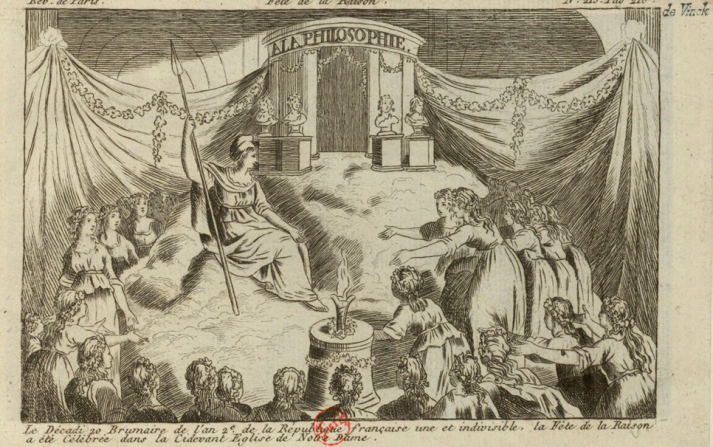
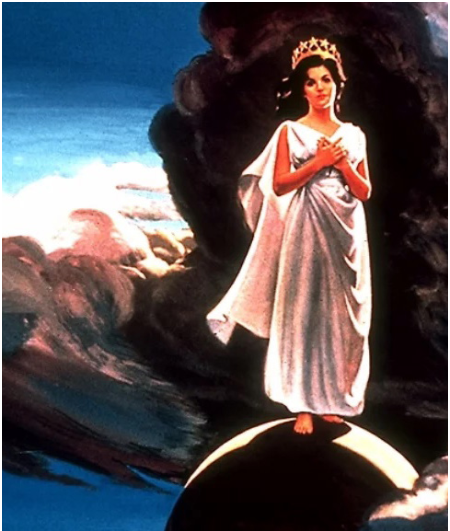
The French replaced the belief in a God with what they claimed was the belief in reason. They made a goddess that was supposed to represent this.
They made a female idol that they called ’reason’ or the ‘goddess of reason‘ that they carried down the streets. They replace God with what they claimed was the reason, but it was their reason not necessarily everyone’s reason. However, the chaos, moral decline, and blood bath that followed made the French give up on banning religion. Three years later a resolution was introduced into the Assembly to again give tolerance to the Bible. The resolution was on hold for six months before coming in force. Exactly 3,5 years as the Bible itself, the book they had burnt, prophecied. The future of the Bible is told in the next verses:
«And they heard a great voice from heaven saying unto them, Come up hither. And they ascended up to heaven in a cloud; and their enemies beheld them.» (Rev 11:12)
When the two witnesses go from being in sack-cloth, to being destroyed, ascending to heaven means they now are elevated to a position where all can behold them. This is a good description of what happened to the Bible next. The Bible is probably the most spread book in the world, still on top lists of most sold books the last 50 years. Once the Bible became «free» it was unstoppable and no book has been able to take its place.
Now the warfare against the Bible is somewhat different. Thousands of different explanations for their words are given confusing people into not reading it. Easy and light entertainment is also competing and has resulted in many claiming they don’t have the concentration to read it. The Catholic church still teaches their followers that when in competition, traditions and the Church’s authority comes before the word in the Bible. Many protestant teachers have taught their followers that much of the Bible is irrelevant and can be ignored, as it’s not part of the new covenant. Today teachers undermine the authority of the Word while they elevate their own private judgments and standards. The philosophy behind the French Revolution is still at war with the Bible. The movement nurtured atheism, inspired Marxism, communism as well as being the father of socialism that also is against God. In the end countries all over Europe and other places in the world would follow in its footsteps and through the government or state they would preach atheism as the accepted truth. They call the Bible a fantasy story that shouldn’t be taken seriously. Anyone practicing its teachings is considered fanatic. Although the Bible is allowed, the philosophy is that it’s dangerous or historically deceptive. The warfare has gone from physical to spiritual, from sword to word, from threats to ridicule. However, thiswarfare is still through governmental powers. Although available it’s disregarded as a source of truth. They say you can believe what you want as long as you do what they do. And as long as your children are taught by the state from an early age that the Bible isn’t true. The law of God explains that what you teach children when they are young is the path they will choose when they are older. The teaching of the falseness of the Bible in schools is a leading cause why western society has become less and less religious. Aristotle said: “Give me a child until he is 7 and I will show you the man.” The placing of atheism and evolution in the educational system has transformed the western world into agnostics.
Seventh trumpet
At the end of Chapter 11, we see the seventh trumpet blow. People have been investigated and the time has come for God to carry out the punishment and judgment over the people:
“And the nations were angry, and thy wrath has come, and the time of the dead, that they should be judged, and that thou shouldest give reward unto thy servants the prophets, and to the saints, and them that fear thy name, small and great; and shouldest destroy them which destroy the earth. And the temple of God was opened in heaven, and there was seen in his temple the ark of his testament: and there were lightnings, and voices, and thunderings, and an earthquake, and great hail.» (Rev.11:18-19)
By the witness’s elevation, the world has received a chance to choose God’s way. We can now see the Ark of The Covenant that once stood in the Sanctuary and in the temple. It stood in a place called the Most Holy place. Inside the Ark were the ten commandments. When we learn that nations will be judged and at the same time see the Ark of the Covenant followed by the execution of judgment we know that the law in the Ark is still what man is judged by, His measuring rod. It shows us the validity of the law until the very end. Now the Papal Church has changed these same commandments. Removed one, divided another, and changed a third. However, the law in the Ark in God’s sanctuary is not the same as the papal changed one. We are not judged by man’s alterations and versions of God’s law. We are judged by God’s law. This means that in order for us to be saved, we have to have repented the breaking of these laws which is God’s definition of sin and sought atonement for them with Christ’s blood. However, a person who does not acknowledge them as an authority cannot repent breaking them either. And where there is no repentance, there is no atonement. The papal church, the largest church in the world, is teaching its followers that the original law of God that is in God’s temple, can be broken without it being a sin. They prevent a man from repenting and their sin is therefore great. Other Protestant churches are teaching that none of these commandments are valid and are even at times encouraging their followers to break some of them in Christ’s name. But Revelation 11 and the seventh trumpet is clear what standard we are to be judged by. Jesus died to atone for our sin, the breaking of God’s laws and ordinances.
All the sixth trumpets illustrate wars coming against the Roman empire and its remains. Even the French revolution took part in taking power from the Roman Pontiff. But his religious power didn’t end. The seventh trumpet will finish off the last part of the Roman influence, the false Christian system receives its final punishment. They are measured by the law and found to be in rebellion and not in repentance. Christ Himself will deal with this last power, and then the remaining bits of the Iron Kingdom, mixed with clay, will all receive their final end. God personally destroy the last part of the Roman line as the Pope has blasphemed God in the worst way, and led millions in perdition by deception and in His name. No more deceptions, no more suppression. Christ’s kingdom is the only one to remain, and all rebels will be dealt with.
Every historical line repeated in Revelation ends up with Christ’s return. Now just like in the book of Daniel, this timeline starts all over again with even more details in the next chapters. This time all the powers are described as beasts and we will learn more about what is behind these powers’ behavior. These chapters leave the Eastern Roman Empire and instead follow the path of the Western Roman empire. This is because this is the remain of the Roman empire that would exist until Christ’s second coming, and because it was also where the greatest attack on Christ Church would take place. Usually, the beasts come out of the sea, earth, or bottomless pit. But in Revelation 12 as we start over again in the timeline, we see a dragon already present. When a beast is seen coming up it means it’s a future event, that the kingdom hasn’t already risen. The beast John here sees is the one who is in existence and has placed John on that very Island which he is now a prisoner: The Roman Empire. This was also the Iron empire that was shown to Daniel on the statue. Now we learn who is behind all of the troubles the Church is facing. In this timeline recap, God
changes the focus and we learn who is behind, why it’s happening, and the agenda of the enemy. We learn that it’s all one big ongoing conspiracy from the dragon to the beast to the second beast. They all follow the same agenda. The dragon represents the Roman empire that executed Jesus and persecuted the first Christians. The color red can refer to all the blood they spilled, however, Roman officials and soldiers often used red clothing. The dragon also represents Satan who is the one who is behind the rebellion in both heavens and towards God’s people here on earth. We see Godspure church illustrated by a pure woman and she is persecuted. She is clothed in the sun and has the moon under her feet. Now the moon has no light on its own, it only reflects the light from the sun. In the same way, the old testament ritual system was only a shadow of the true covenant. The animal sacrifices pointed to the real sacrifice. The tabernacle and priestly system were a shadow of the heavenly. The woman has the moon under her feet show us this is the remnant church that is now no longer in the shadow-system of belief but is clothed in the sun, living in the new covenant. It’s the same woman, the same lineage. It hasn’t shifted from one people to another, from one woman to another, but there is a continuation. The woman is the same both before Christ’s birth and after. But the church would be persecuted. And we now learn why and who is behind everything. The devil is mad at Christ, he has no longer access to heaven so he can spread his hatred and rebellion there. The murder of His own creator has made an angel that had any doubts now certain of his character. He has no ear who will listen to his accusations in the heavenly world. The defeat and that there now are humans who have sinned yet are receiving a new chance to be a part of the heavenly world makes him furious. He wishes no human soul freedom and salvation. If God cares so much that He is willing to send His son to die for them, the best punishment he can give God in return is to try and take away as many people as possible from Him. He needs someone to work through and now he takes control over these powers and is going to use them to try and break God’s people. The angel rejoices over not having to have the devil’s influence over the heavenly world but gives a woe to the inhabitants of the earth. Never before has God’s people been subjected to more rage than when the devil with the help of pagan Rom attacked the Christians. But he couldn’t defeat their love for Christ, and they multiplied no matter what he did. So the Devil changed tactics. Instead of openly being the Christian’s enemy he would pretend to be its defender while the attacks continued in secret. First, he had tried to prevent people to learn about salvation, but creating “a false gospel” would prove more fruitful. In that way, people would believe they were Christians when they weren’t really following Christ. In that way, people would think they were already saved, and therefore not see the need to seek salvation.
“For such are false apostles, deceitful workers, transforming themselves into the apostles of Christ. And no marvel; for Satan himself is transformed into an angel of light. Therefore it is no great thing if his ministers also are transformed as the ministers of righteousness; whose end shall be according to their works.» (2Co 11:13-15)
«…but there be some that trouble you, and would pervert the gospel of Christ. But though we, or an angel from heaven, preach any other gospel unto you than that which we have preached unto you, let him be accursed.» (Gal 1:7-8)
Revelation 13 – Beast out of the Sea
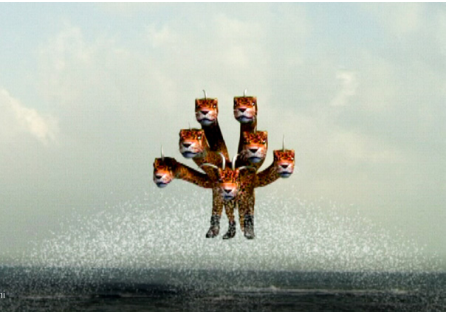
God preserves his people from the Red Dragon and the church survives the attacks. In the next chapter, we learn of a new beast that surfaces out of the sea and that the dragon now gives its power to this beast instead. But the beast resembles the last, it too has seven heads and ten horns. Three times in Revelation we are presented with a beast with seven heads and ten horns, however, the surface of its skin changes from red to leopard skin to scarlet-colored. This time, because it changes from red to leopard pattern, and that the first gives power to the next, we see a continuation yet a distinct difference.
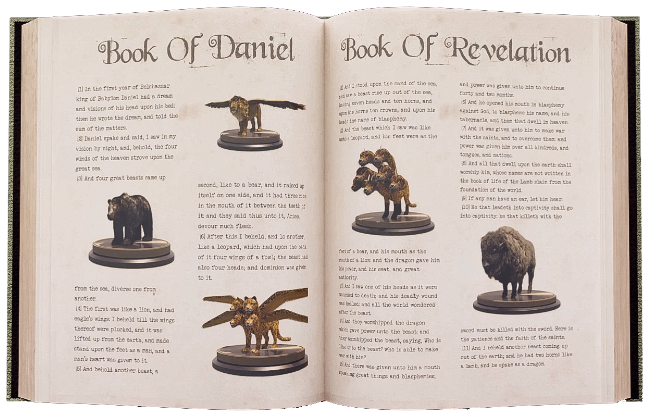
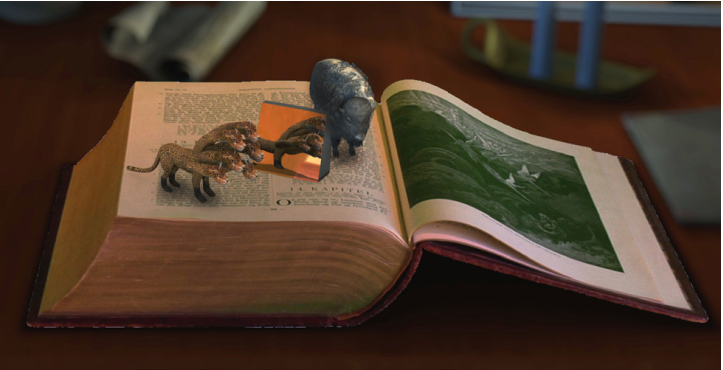
It’s described with characteristics from a lion, leopard, and a bear but with the power of the dragon. All these animals were shown to Daniel, the lion was Babylon, the bear was Medo Persia, the leopard was Greece and the last terrible beast was Rome. However, this is a new beast with elements that are taken from these former powers. The beast coming out of the sea is the same beast as the one in Revelation 12 only reborn in a different disguise with new characteristics. In chapter 12 it has the crowns on the head because at this time it is the Roman empire that the devil uses as a weapon against the Church. But this beast is risen again with a new appearance but with the same heads and horns. Only this time the crowns have been moved from the heads to the horns. This is a very important detail. The fourth terrible beast shown to Daniel had ten horns growing up from its hand signifying that the kingdom would be divided into ten parts. Now we see a seven-headed dragon with crowns going from the head to the horns. This is because the time setting of this beast’s surface is in the divided Roman empire. The crown reveals to us where we are in the timeline. In Daniel, we saw a little horn growing large coming up midst the ten horns illustrating that a power would arise among the divided Rome. This horn and this beast have all the same characteristics. In this vision we don’t see the horn grow on the head with the others, we see the horn as a beast. This is because the horns on the beast in Daniel showed a timeline. This beast doesn’t show a timeline. The crowns show us where we are in time. The beast is not one of the ten horns, it’s a separate power. The Roman emperor gave the religious high priest titles, and the other emperor titles, to the pope. Rom went from pagan Rome to Papal Rome, a seemingly Christian power. Although continuing the titles, ruling from Rome, it was a very different power. It wasn’t an empire anymore and most of its influence was dependent on cooperation with the kings and rulers in the divided land. Its power was entirely based on their ability to keep Europe Catholic. And the rulers were convinced using power and violence to maintain this goal was worth it. The moment they would turn from the religious conviction, the Bishop in Rome would only be a man with grandiose titles and spiritual followers. Roman had physical control over the empire, the pope a religious control. The persecution changed too. Instead of direct open persecution, it was now replaced with deception and manipulation. Just like the Devil tempted Christ in the wilderness appearing like an angel of light, and by quoting the Bible, the devil now used the Bible to seduce the church under the Catholic head, his own representative. Satan was to take the shepherd staff in an attempt to lead the sheep under the guise of Christ’s name. Antichrist, a deceiver controlled by the Devil himself while claiming to be anointed, while claiming to be the voice of Christ on earth. A wolf in sheep’s clothing. They claimed to be defenders and preachers of God’s word. Satan imitated Christ to bring God’s people into perdition. The Church did charity, showed themselves as humble, preached a lot of truth, but it had the sting of death inside the package. And only those who loved the truth would be able to see the deadly deception amidst all the beautiful professions and good deeds. Those who exposed his deceptive Bible references, who refused to follow the false shepherd and refused to acknowledge the ideology behind the church was systematically persecuted. The Jews didn’t have the power to execute Jesus personally, and so they used their influence to make those who did have the power to carry out the execution. This is usually how it was done around in Europe. The papal representatives put pressure on officials to carry our severe punishments on those who resisted their religious influence. This time it was harder for people to view them as martyrs as people had during the Roman empire. Because most people were confused. Who said what, who was who? Both sides called the others deceivers, heretics, and Antichrist. Who was telling the truth and who was lying? The easiest choice was to follow the mainstream and the pope as this had advantages. Believing the others would only separate them from family and friends and even their land. Didn’t they both offer the gospel, and so why not choose the gospel of those who would make life hard for them if they didn’t? The Pope claimed to have his authority from Christ Himself and so many did not dare to speak against him. They claimed to be a divine institution, what if it was true and they went against it? They were told they would burn in hell for refusing the Papal authority. No matter how corrupt the different popes were, people did not dare to go against them. Their superstition and belief that the claimed holy lineage was above truth. That the Papal commands were above even God’s commands. These difficult times of persecution and darkness had a time limit. We are told of a time prophecy of 42 months. In bible prophecy, one day is often the same as one year. That gives us 1260 years. This time prophecy matches the time given in the book of Daniel of the same power. Because the two prophecies match each other we get a confirmation of the identity of the beast and it’s ending. We are told that the power will suppress God’s people in this time period. We are told the power changes times and laws. Satan wishes to lead God’s people away from obedience to God. He has worked to get mankind to rebel against God’s reign ever since he got Eve to disobey God and eat of the fruit. The devil is in a disguise again, questioning God’s authority as lawgiver. As Christ’s representative, he claims to have permission and authority to change Gods times and laws. Slowly and surely the Christians replace obedience towards God’s word and law with the many ordinances, laws, and guidelines this vicar of Christ, his bishops and priests give. The papal power then systematically eradicated those who stood for the truth with the excuse that they were evil resisting Christ when they didn’t listen to him who sat in His place and ruled on Christ’s behalf. Those who kept God’s unfalsified laws were evil? The Bible warns:
“Woe unto them that call evil good, and good evil; that put darkness for light, and light for darkness; that put bitter for sweet, and sweet for bitter! Woe unto them that are wise in their own eyes, and prudent in their own sight!» (Isa 5:20-21)
How could it be that a people that knew why the world fell in sin in the first place would fall for the same deceptive message? The devil said to Eve she would be like God if she broke His command, God had said she would die. To opposite. Now the Papal church proclaimed that those who broke God’s command would be saved through the Church, and those who kept them would perish. When were the beginning and the end of the time era of 1260 years? In order to be a prophetic beast, the beast has to have governmental power. All the other beasts in Daniel and Revelation has governmental power. In order to know when the beast becomes a beast, we need to know when the Papal system got governmental power. We already know that they would receive the power from the former beast. Emperor Justinian, the Roman beast, made the bishop in Rome head over all churches in 533 AD. But at this time the Ostrogoths were still in Rome. They were driven out of the once Roman Capitol in 538 AD and this is when the bishop in Rome could finally sit on his throne in Rome with all the high priest titles and with governmental power to judge what was called heretics or those preaching differently within the churches. At this time the bishop in Rome had governmental power to persecute God’s people, state and church were unified. The time prophecy confirms that this time period is about persecuting God’s people and so the dates have to be connected to this behavior especially. If we count 1260 years from 538 AD we get to 1798. Towards 1798 the Reformation had done all it could to weaken the papal authority and many had already torn themselves away from Rome. It had been a hard battle and many had lost their lives. But it was in 1798 the pope received its deadly wound when atheist France demanded the pope to do what they wanted instead of the other way around. When he refused, he was captured and removed from his position. The pope went from being a threatening power to being humiliated. They no longer had the same opportunity to control people with the help of governments in the same degree as they had before. Crusades and inquisitions were gone for good. The worst periods of persecution were now finally over after many decades of suppression. Many countries in Europe rejoiced over being able to resist the papal influence both before and after this event. The pope had lost its grip in Europe and finally received its deadly wound by France. The rise of Atheism and agnosticism also made people less influenced by the threats of hell. But Revelation reveals that the papal wound would be healed. Not only would it be healed but it would again have power and strength and deceive a whole world to follow it and worship it as head of the Christian church. But without the same power, they once had, they now needed help. The devil was not about to let go of a power he had successfully used to deceive billions throughout the ages. The church still had millions of followers around the world teaching the corrupted gospel to their children and with many new joining each year, he would be best served by keeping this deception until the end. However, the devil still needed to silence and destroy those who remain faithful to God’s word. He needed a new power to work through in order to attack those who were close to the Biblical doctrines. The Protestant churches who never fully reformed back to God’s pure doctrines.
Revelation 13 – Beast out of the Earth
A large part of the tribes under the former western-Roman empire had now left Europe and could be found on the other side of the Atlantic ocean. Many had gone there to escape Papal Rome and unconverted Protestants who were persecuting them. It was a land of escape for many. Naturally, the Devil would come after them. In Revelation, we see another beast, a beast coming out of the earth. It has no crowns on its head, it has no monarch and no king. Which is very different from the countries in Europe. This part sentence tells us something about the governmental form:
“..saying to them that dwell on the earth, that they should make an image to the beast which had the wound by a sword, and did live.» (v.14)
We see the beast, the government, convincing the people to make an image. This government is dependant on the people’s votes to make a governmental change. The USA long fought for its freedom to believe and practice their religion without state interference. They got this principle in their laws and US became a place of liberty for persecuted religious groups from Europe. The US was the land of freedom and they wanted nothing to do with Rome’s influence. They knew that the mixture of state and religion could have a terrible effect on the land. The Papal beast was just that, religion and state unified. Making an image of this beast means to make something in the likeness of something. In this case, it means to give state religious authority – and to use this authority to dictate religious laws above God’s laws. Everything the US is against. Their very constitutions were built on preventing this from ever happening.
Yet here we are told that the beast manages to talk the people into making this image. The US will take a U-turn from its original ten amendments. And who will be honored by this state that once built it principles on the opposite of Rome’s, now making an image of their authority? The papal power will be the one who is honored by this change, it’s what they always wanted. The leaders in the USA long feared this would happen. They have noticed that men from Papal secret societies had infiltrated themselves all over the country. This secret society was instituted to overturn the Protestant movement in Europe and to bring everyone back under the Papal authority. Their methods were anything but Christian:
“The first triumphs of the Reformation past, Rome summoned new forces, hoping to accomplish its destruction. At this time The order of the Jesuits was created, the most cruel, unscrupulous, and powerful of all the champions of popery. …There was no crime too great for them to commit, no deception too base for them to practice, no disguise too difficult for them to assume… to be devoted to the overthrow of Protestantism, and the re-establishment of the Papal supremacy”. Michaelangelo Tamburinin, the Jesuit General also called Black Pope said: “See, my lord, from this room – from this room I govern not only Paris, but China: not only China but the whole world, without anyone knowing how ‘tis managed’.” ( Michael Angel Tamburinin, 1720, General of the Jesuits, Speaking to the Duke of Brancas.)
Both Hitler and Napoleon were in ave when they saw how efficient and powerful they were: Adolf Hitler:
“I have learned most of all from the Jesuit Order. So far, there has been nothing more imposing on earth than the hierarchical organization of the Catholic Church. A good part of that organization I have transported directly to my own party.”
Napoleon Bonaparte (1769 – 1821):
“The Jesuits are a military organization, not a religious order. Their chief is a general of an army, not the mere father abbot of a monastery. And the aim of this organization is power – power in it’s most despotic exercise – absolute power, universal power, power to control the world by the volition of a single man. Jesuitism is the most absolute of despotisms – and at the same time the greatest and most enormous of abuses.”
Marquis de LaFayette (1757-1834; French statesman and general.)
“It is my opinion that if the liberties of this country – the United States of America – are destroyed, it will be by the subtlety of the Roman Catholic Jesuit priests, for they are the most crafty, dangerous enemies to civil and religious liberty. They have instigated MOST of the wars of Europe.” (LaFayette served in the American Continental Army under the command of General George Washington during the American Revolutionary War. Quote from Romanism: A Menace to the Nation, Jeremiah J.Corwley p.140)
John Adams (1735-1826; 2nd President of the United States):
“I have long been decided in opinion that a free government and the Roman Catholic religion can never exist together in any nation or Country.” “ Liberty and Popery cannot live together. “My history of the Jesuits is not eloquently written, but it is supported by unquestionable authorities, [and] is very particular and very horrible. Their [the Jesuit Order’s] restoration [in 1814 by Pope Pius VII] is indeed a step toward darkness, cruelty, despotism, [and] death. … I do not like the appearance of the Jesuits. If ever there was a body of men who merited eternal damnation on earth and in hell, it is this Society of [Ignatius de] Loyola.”
Thomas Jefferson, President of USA:
I do not like the late Resurrection of the Jesuits. They have a General, now in Russia in correspondence with Jesuits in the U.S. who are more numerous than everybody knows. Shall we not have Swarms of them here? In as many shapes and disguises as ever … in the shape of printers, Editors, Writers, Schoolmasters, etc. If ever any congregation of men could merit, eternal Perdition on Earth and in Hell …it is this Company of Loyola.” (The Power and Secret of the Jesuits, Rene Fulop-Miller, 390)
Samuel F.B.Morse (1791 – 1872, American inventor of the telegraph, who documented foreign conspiracy):
“The Jesuits … are a secret society – a sort of Masonic order – with superadded features of revolting odiousness, and a thousand times more dangerous.”
Samuel Adams (1722-1803, American Revolutionary leader and statesman):
“I did verily believe, as I do still, that much more is to be dreaded from the growth of Popery in America than from the Stamp Act or any other Act destructive of civil rights.” (1768)
Abraham Lincoln (1809-1865; 16th President of the United States):
“I see a very dark cloud on America’s horizon, and that dark cloud is coming from Rome.” “The war [i.e., the American Civil War of 1861-1865] would never have been possible without the sinister influence of the Jesuits.” “If the American people could learn what I know of the fierce hatred of the priests of Rome against our institutions, our schools, our most sacred rights, and our so dearly bought liberties, they would drive them out as traitors.”
Abraham Lincoln said he feared Rome would try to influence the US in their thinking. Several presidents and high officials in the State expressed concern that the Pope would strengthen his agenda and philosophy there. They feared that the pope’s secret societies would be too powerful for the US to resist in the long run. In Revelation 13 we see the US give in. They will end up convincing the people to honor and follow the pope in his system. This beast will end up making an image of the beast, meaning it will have the same characteristics as the papal power once had, a mixture of corrupt Christianity and governmental power. Over the last 50 years, there has been a continuous change in American society. As TV’s came into the house where God’s name was abused and breaking of God’s law was entertainment it has changed the way people think. Although protestant America for the most part never reformed completely away from Papal-given institutions, they had a moral standard and a sense of justice. And those who did reform all the way back to God’s times and laws had the opportunity to live in peace. When TV crept its way into millions of houses and moral was fast declining. Every year the moral guidelines were pushed a little bit further. Every year the sexual moral was more liberated and the violence more brutal. All the children’s programs were filled with magic and sorcery, against God’s command. Thanks to the media all the pagan practices that had been taken out of Christian homes made their re-entry. The ancient Roman gods were back in Children’s literature. Everyone had Bibles but few were reading it. Entertainment took the place of spirituality. The more corrupt morally people got the less important it was to fight for Biblical standards. Knowledge had been decreasing. No one was sacrificing anything for truth. When the Pope stretch his hand to the protestant saying they are in agreement and should stand together, many Protestants didn’t even know what they had protested against and willingly took the outstretched hand. Meanwhile, while the Christians were awakening they had were horrid with two threats in society. The atheist leftists were fighting to take from them their Christian rights and liberties, and the Muslims they feared both physically and religiously. Christians in the US were now convinced that the enemy had to be the atheists that were forcing their way of life unto them, and Islam that they feared was trying to take over their country. The Pope standing with open arms seemed like a friend they should work with to protect Christian traditions and way of life. For the first time, Christians felt the first amendment was working against them and not for them. Because the majority of the Protestants never reformed away from the Papal times and laws, and that these same institutions are what they regard as their Christian culture, the Pope appears as an ally to their way of life. Although once appearing as the enemy of the American way of life their view is now taken a new direction. Their once enemy of religious freedom now feels like a friend and protector. It’s said that nothing binds a people to their leader like a common enemy. This has been used to manipulate the public all over the world throughout time. Protecting the Christian culture from non-Christians and Muslims is what is now inspiring them to unify in order to protect the papal institution under the thought that they are protecting Christ culture. Most don’t even consider they are in fact honoring the pope as a religious lawgiver by doing it. Ultimately this trap is deceiving them in the direction of influencing the State to unify with religion – their religion. This unification is made through getting the state to acknowledge their religious services the law of the land. In a foolish belief they are protecting their culture and defending the Bible, they are actually aiding the Pope in turning the US State into a state that forces through Papal ordained institutions to the land. Their war on Islam is the Pope’s secret war. He pretends to be their friend while he makes the US fight them for him. Those who know the scriptures, know that the Islamic war against the west was God’s punishment on Pagan and Papal Rome. While destroying Islam we are fighting against God’s punishment and strengthening the papacy. The war on Islam is not a war God’s people should partake in. Revelation 13 says they will make a mark that they will enforce, a mark that will be to the glory of the pope because it’s his ordinance or tradition that is advanced. And when they enforce this papal religious ordinance God’s people will face their final great crisis before Christ comes. The moment following God’s commandments are considered a crime towards state peace, God’s people are in for severe persecution. Everywhere in the past where Papal ordinances, were Papal times and laws, have been enforced, God’s people have at the same time been viewed as enemies of the state and persecuted. This is the horrid consequence the protestant U.S. failed to see as they had forgotten or not learned from the past. Because they no longer understand why their constitution separated the church and state in the first place.
Another reason is that they think that it’s worth sacrificing to protect the people. Like the high priest used as an excuse to crucify Christ:
“Nor consider that it is expedient for us, that one man should die for the people, and that the whole nation perishes not.” (Joh 11:50)
They feel that it’s worth sacrificing the first amendment to keep state and religion apart in order to “save the nation”. But what they don’t understand is that by doing this they are in fact letting Christ down as it’s not His ordinances that are defended but that of His enemy. Unifying the two will bring about the same result as the last time. When God’s people are suppressed and threatened, God is not honored, and the US is considered a beast. A beast, along with the Papal beast, we are told Christ will deal with personally at His second coming. Christians will again persecute Christians in the name of Christ. And the book of Revelation tells us that they will be severely punished for it. Satan has now gone from using the Roman empire, then resurrecting the Roman beast in a Christian guise to seduce and deceive people. Then that power loses authority after 1260 years and the devil attacks the free institution where God’s people have gotten the chance to worship and serve God in peace. And he then uses this beast along with the other in his final deception to either flatter, deceive, or physically force people to break God’s law and principles.
In Revelation 14 we see the 144 000 again, a specially chosen people who are cleansed. We then are told that in this time, when the beasts are working their deception, God will send three wide-spread messages to the world before Christ return. These messages are to prepare people for His coming. We are already told that 144 000 have a pure doctrine undefiled by women, a symbol of corrupt churches. Them being mentioned here can indicate that they will help bring God’s truth out to the world. The first message starts with a cry for man to turn back to worship God as the creator. At this time the atheist beast has done its works and damage, atheism rejects God as creator, and children all over the world are forced to learn this lie as a truth. Even the pope has declared evolution theory to be the truth. But in this message, God says that He should rightfully be worshiped and recognized as the creator of the world. He claims to the end time, a world of progressed science, that He is, in fact, the creator and that the Creation story is true. He says the message is to “them that dwell on the earth, and to every nation, and kindred, and tongue, and people». Everyone is deceived on this matter all over the world by false scientific conclusions made to rule out a God. If God isn’t the creator He doesn’t have ownership over the planet, He isn’t the creator of mankind and He has no right to judge. Therefore the message of honoring Him as the creator also tells that a judgment has begun. All man’s cases are in quick succession brought before the throne of God. He is judging and will carry out His judgment. The next angel proclaims that Babylon has fallen. The pagan Christianity is in Revelation compared to Jezebel, the doctrine of Bileam, a harlot, and Babylon. All these references talk about the same power in different ways – each way helps expose what happened along the way and the identity of the deceiving power. It tells us how this part of the church got corrupt, it tells us how they deceive, it tells us how God views it (as a harlot) and Babylon indicates the origin of its pagan doctrines and teachings. It was Babylon who inspired the Greek and Roman religion, and so when Christianity mixed its practices with the Roman religion it, in reality, became the ones to continue and spread the Babylonian customs and mentality to the world. They were the new advocates for Babylonian mysticism and got the world to take part by presenting it all in Christ’s name. In Babylon, the king repented and turned to God but his grandchild mocked God by taking God’s holy things while praising the gods of silver and gold. The same night a finger wrote on the wall saying Babylon had been weighed in the balances and found wanting. The judgment over Babylon had been spoken. God proclaimed Babylons spiritual fall right before it fell physically. Again in Revelation, we see the proclamation that Babylon has fallen but now it’s talking about the pagan unfaithful form of Christianity. Paganism, which had claimed a conversion but in reality had mixed holy and unholy. Babylon was to be judged because they had gotten all people to drink “the wine of her fornication”. “Then they brought the golden vessels that were taken out of the temple of the house of God which was at Jerusalem; and the king, and his princes, his wives, and his concubines, drank in them. They drank wine, and praised the gods of gold, and of silver, of brass, of iron, of wood, and of stone.» (Dan.5:3-4) And so when it says in Revelation: «For all nations have drunk of the wine of the wrath of her fornication» it means they have placed their deception in holy vessels. (Rev 18:3) They have put the name of God’s holy doctrines and gospel with their paganism. Just like the old Babylon was judged for doing this crime, so will spiritual Babylon. They have seduced a whole world with their false Christianity. The last message of the three angels warns everyone to not take the mark of the beast, or the image of the beast. It explains that those who take it will be punished by God. Those who take part in using state power to advance and persecute God’s people and God’s times and laws will be punished in return. The end has come, the end of God’s tolerance. Those who will force God’s people to stop their faithfulness to God will be punished, and if they chose to obey false Christianity they will also be punished. It warns: “If any man worships the beast and his image, and receive his mark in his forehead, or in his hand. The same shall drink of the wine of the wrath of God». (v.3-10) It says people can either take the mark on their forehead or their hand. The forehead symbolizes our decisions and the hand our actions. It’s a conscious choice or it’s forced action. Jesus now reveals who His true people are, they who are under great pressure but are resisting both the image and the mark: The saints, those who “have the commandments of God and the faith of Jesus”. (v.12) By this, we know that the mark of the beast is tied to rebellion against God’s commandments just as it has been since Eve was tempted in the garden and until this day. Satan’s agenda has this whole time been to encourage and get people to be disobedient towards God’s authority. He is still sitting in the tree telling people they don’t have to worry about consequences if they eat of the fruit. That their action will bring blessing and not judgment. The first deception will also be the last. After these three messages are given to the world we see Christ returning in the clouds as a king ready to gather His faithful to Himself. He is seen with a sickle in His hand. The harvest has come. Those who have replaced their allegiance to God with the false system of worship will be rejected and Christ will “harvest” his remnant and take them with Him. This is the last remnant, the last and final separation.
We then reach chapters 15 and 16. God has just explained how those who worship the image and take the mark will:
“drink of the wine of the wrath of God, which is poured out without mixture into the cup of his indignation» (14:10)
Now we are told what is in this cup, punishments that God will send over the beast from the sea and the beast from the earth and unto all who follow their lead. These punishments show how serious their actions against Christ and His people are considered in the eyes of the heavenly world. Just like they have accused God’s people of not following the lead of the majority and subjecting themselves to the governments of the world, God turns the tables and question why the governments of the world and it’s people refuses to follow the laws of God like the rest of the Universe. The angel says about these punishments:
«Reward her even as she rewarded you, and double unto her double according to her works: in the cup which she hath filled fill to her double. How much she hath glorified herself, and lived deliciously, so much torment and sorrow give her: for she saith in her heart, I sit a queen, and am no widow, and shall see no sorrow. Therefore shall her plagues come in one day, death, and mourning, and famine; and she shall be utterly burned with fire: for strong is the Lord God who judgeth her.» (Rev 18:6-8)
Claiming to represent Christ while furthering the devil’s agenda and trying to eliminate God’s real people is a serious crime, the worst of them all. The vision John receives of the punishment is given to show God’s people who have to go through this tribulation and how God will preserve them by fighting their and His enemies. In this way, God’s people can pay attention to the last time period in the history of this world and know, spite all that takes place, during the plagues, that God is doing it to protect them and that Jesus is on His way. When someone has pressured you so hard that you have been denied the right to buy and sell and in the end even told that you will die because of your faith, it is a relief to see the plagues described in Revelation 16 come, keeping the enemy busy. It can be compared to when God gave plagues over Egypt. Pharaoh refused to let the people go and worship God and so he placed heavy burdens on the people. But when the plagues came they were temperately hindered from continuing their actions and had to focus on surviving their plagues. This relieved God’s people from the Egyptian sword and prepared them mentally for their exit from Egypt. The beast in Revelation 13 wanted to refuse food and a living for those who are true to God. (13:17) Now God gives back what they gave and He takes these privileges from them instead. The lack of clean water and heat will make them fight for survival. It will be a great tribulation because being in want will open up for people committing terrible crimes. Before we see the different plagues in Revelation 16, chapter 15 shows us that the temple in heaven is opened and the tabernacle of the testimony there. (15:5) The testimony was the ten commandments and the Ark was called the Ark of the Testimony. (Exo.25:21; 30:6) We have just been told that God’s people who will refuse to take the mark of the beast are also they who keep the commandments of God. The plagues that are sent over the beast and its followers come from the sanctuary. It means that it is the law in the tabernacle that has judged them. Usually, the blood on the Mercy Seat over the law would protect the law-breaker and so when it doesn’t at this time, it means that they are not protected by Christ blood, by the priestly service, and this is why the law condemns them and judges them. When the mercy in the blood is removed and the Ark opened the law in there will judge those who oppose it. It will not be a good day to be the pope who has convinced billions worldwide to keep his version of the law instead of God’s. In the sanctuary service when the High Priest went into the holiest and the tabernacle of the testimony was opened, and the blood was placed over the law, God’s people were instructed to humble themselves or they would be separated from God’s people. Meaning only those who had repented and taken part in God’s instruction would be blessed by the blood on the day of judgment, the rest would be separated on that very same day.
“For whatsoever soul it is that shall not be afflicted in that same day, he shall be cut off from among his people.» (Lev 23:29)
The affliction meant they had to actually have repented for breaking God’s law. Then the blood would cover their sin. But if they refused God’s atonement they would be cut off, separated. In the same way, the door to Noah’s ark was closed seven days before the rain started. Here we see a door of mercy closing for the world and seven plagues coming over them before Christ returns. Just like the plagues in Egypt was tied to their idol worship, we can see symbolism in the plagues that come over the beast and their followers. The first is gruesome sore which the law has an interesting say in. Those who had sores like these were to be separated from the rest of the people and considered unclean. (Lev.13-15) The second plague turns the sea to become as blood and the third all the rivers and the fountains. Christ said they were to come to Him for the living water, but they had rejected His offer. They also blocked the way for others to come to the ‘living water’. It says:
“thou art righteous, O Lord, which art, and wast, and shalt be, because thou hast judged thus. For they have shed the blood of saints and prophets, and thou hast given them blood to drink; for they are worthy.» (Rev.15:5-6)
The fourth angel makes the sun sting and burns them. The corrupted Church had since its beginning mixed the old pagan sun worship with Christianity. The sun symbols were everywhere in the churches and even the creator’s sabbath was rejected for the sake of the old sun worship day. Now the sun itself turns against them. God’s promise to His faithful is the opposite:
«The LORD is thy keeper: the LORD is thy shade upon thy right hand. The sun shall not smite thee by day, nor the moon by night.» (Psa 121:5-6)
The fifth plague is darkness:
«And the fifth angel poured out his vial upon the seat of the beast; and his kingdom was full of darkness».
Again God gives what they give. Jesus came as the light of the world, yet they had turned the light into darkness. They had stepped between Christ and man, hindering the light from shining in its true light. They have given darkness to the world, and God gives them darkness in return. In the sixth plague we see how the beasts are still fighting together with the dragon and now the kings of the east are coming up against them. They gather at a place called Armageddon. They claimed to be the disciples of peace yet they are in reality those who provoke all the wars. The seventh plague is an earthquake and hail followed by Christ’s final judgment at his return. It says:
«And the beast was taken, and with him the false prophet that wrought miracles before him, with which he deceived them that had received the mark of the beast, and them that worshipped his image. These both were cast alive into a lake of fire burning with brimstone.» (Rev 19:20)
Here we see the beast cast alive into the lake of fire. We already know from the angel’s explanations to Daniel’s dreams that a beast represents a government. And so it’s a governmental beast that is destroyed. This fits with Daniel’s description of the rock hitting the statue representing the line of kingdoms that would last from Babylon and until Christ second coming. When it says the beast is cast into the fire «alive» it means that it is still in existence until the very end. The persecuting governmentalpower will continue until Christ interrupt them. Judt like pharao, the plagues have not turned them away from their desire to control God’s people and to oppose God Himself.
In chapters 17 and 18 we learn more about why the unfaithful church and all her daughters, other unfaithful churches, are judged so harshly. We see more symbols that help us identify the corrupt churches. The harlot rides the beast which explains how the corrupt church is the one that uses governmental power to get its position and to persecute God’s faithful. We learn how God will enlighten the whole world with the truth and that another message will come to God’s people who have mixed themselves with the corrupt churches and the worldly ways to hurry and separate from them so that they won’t be partakers of her plagues. (18:4) It continues to talk about how God will destroy her. We are told twice that this church is especially judged harshly because of all the blood she has spilled.
“And I saw the woman drunken with the blood of the saints, and with the blood of the martyrs of Jesus” (17:6) And: “And in her was found the blood of prophets, and of saints, and of all that were slain upon the earth.» (18:24)
It is reasonable to assume that we don’t even know half of everything this harlot is guilty of and have done in secret with the help of other governmental powers:
«the kings of the earth have committed fornication with her, and the merchants of the earth are waxed rich through the abundance of her delicacies.» (18:3)
Chapter 19-22
In chapter 19 we learn of the joy of the delivered people. The lambs wedding. Gods people are finally free in Gods’ kingdom and can finally worship God in peace. Their anguish is gone. In 19 and 20 we see God’s final settlement with Satan and his followers. And in chapter 21 we get to see that God will create a new heaven and a new earth. Everything that once was good on our planet will be re-created. It tells us of the new Jerusalem, God’s city, and unto chapter 22 where we learn of the tree of life and how man again will have access to eternal life. The Revelation ends with the angel telling John that all these words are credible and true and will happen. In the end, John receives encouragement from Gods’ people to be faithful. Jesus Himself tells John that it is He who has sent him these revelations. «I Jesus have sent mine angel to testify unto you these things in the churches. I am the root and the offspring of David, and the bright and morning star.» (Rev 22:16) God could have used the time to talk about other groups of people and all their evil. Around the world, there have been many corrupt governments and cruelty. There have been many empires and great kingdoms. But Revelation has focused on the enemy that is the greatest for God’s people, for even though the other powers can take their lives this power has the ability to take their eternal life. They claim to speak on God’s behalf while they lead men into perdition: “These things in the churches”. It is the fall of the church and the deceptions there which is God’s greatest challenge when trying to save His people. They steal souls in the name of Jesus, the greatest blasphemy of them all. The Catholic church has for many years tried to point to another enemy. Prophecy has clearly been pointing to them and people for 1700 years have preached that they are the power warned against. The Catholic Church says that the Christians now have to stand together. They have infiltrated the idea that the Antichrist really is the Muslims, other times the idea that its communism. They have also presented ideas that Antichrist is a jew and that it is an atheist. They even claimed the Protestants were the Antichrist while they were escorted to the stake to be burnt alive. Whoever has been the enemy of the Catholic church at the time have had the finger pointed in their direction. Revelation 18 tells us that the church even fools state leaders. They will gather Christianity under their control by pointing to an outer enemy. In the very end, this enemy will point to God’s true light-bearers as the antichrist. Jesus has warned us again and again that Gods enemy is someone who is pretending to be the servants of righteousness, God’s enemy pretends to be Christian. Will Gods’ people receive the warning and divorce from Babylon, her daughters and all the unclean churches that refuse to obey God’s authority? In Revelation 18 we are told that when the three angels have given their warning, a powerful angel will repeat the message one more time to give God’s people one last chance to save themselves from the deception. He says: «And I heard another voice from heaven, saying, Come out of her, my people, that ye be not partakers of her sins, and that ye receive not of her plagues. For her sins have reached unto heaven, and God hath remembered her iniquities.» (Rev 18:4-5) Although the papal system is the Antichrist the people who are deceived are not. Many godly and good people are sincerely fooled. All they have seen and heard are all the good the churches do. They have followed the light they had and they love Christ. However, God cannot save them in this corrupt system. They have to receive God’s calling and leave.
The Reveal: Who God’s people is.
So who is God’s people today? Jews that reject Christ? The Bible says no. Christians that refuse to keep the commandments of God or accept their validity? Again, the Bible says no. God’s people today have both characteristics and they are a part of the continuous line that has been ongoing since the time of Abraham, a remnant of a remnant of a remnant of a remnant. God’s people are always that remnant that chose obedience to God and to do as Abraham did, walks in faith that God knows best. «They answered and said unto him, Abraham is our father. Jesus saith unto them, If ye were Abraham’s children, ye would do the works of Abraham.» (Joh 8:39) God’s people keep the commandments of God and the faith of Jesus but God’s light-bearers the revelators of God’s prophecies have something in addition. This is important to understand because many in these times are converting back to God’s ordinances. People from all different types of churches are now receiving the commandments of God and the faith of Jesus. Many Jews are accepting Jesus as the Messiah, as natural branches, they are grafted back to the tree (Rom.11:24) and fit better in on the tree than those who were grafted from a wild tree. They understand the law with a greater depth than many others. Their knowledge of Christ’s righteousness helps them understand Christ’s message correctly, just like the first apostles. However, they have lost a large part of God’s leading the last hundreds of years and they have also missed out on the time period when God was revealing and unfolding the prophecies. They are part of God’s people, but not God’s chosen light-bearers unless they are grafted to the other light-bearers. You can have a false understanding of prophecy and still be saved because we are saved by the blood of Christ and by repenting our disobedience. But God has always had someone who has preserved God’s light in the world and they follow a lineage. So even though you can find God’s people everywhere, only a part of them is God’s chosen light-bearers. Many of those know stepping in line with those ‘keeping the commandments of God and having the faith of Jesus’ has received the gospel from people with a religious background that doesn’t belong to God’s chosen lineage of truth-bearers. They come from churches that are the harlot’s daughters and that have interpreted prophecies falsely. Because these churches haven’t been given the Spirit of truth these interpretations are the result of guesswork and adding assumptions to the word of God. Sometimes the popularity and widespread of these interpretations are thought of as evidence of their divine origin. But majority acceptance is not evidence of divine origin. Some claim the Jew’s understanding is the right one, however, they have proven to not interpret prophecy correctly. They can’t even see Jesus in their own prophecies, that is how problematic their interpretation of prophecy has been. And now these false interpretations from both the unconverted Jews and the harlot’s daughters are brought in among a congregation that keeps God’s commandments and the faith of Jesus. The origin of the doctrines is therefore of importance. So many Christians are accepting God’s commandments and are reforming back, but keep their prophetic understandings from an infidel church. This is the reason for the prophetic differences among God’s commandment-keeping people today. We know from Christ’s words that the spirit of truth was not given to either those who rejected Him, those who didn’t know Him, or those who didn’t obey God’s commandments. And so God’s truth-bearers always, in addition to “having the commandments of God and the faith of Jesus”, has a history or a lineage that has followed the experience of the seven churches in Revelation. They have received special light. God continues with a remnant of the remnant to continue carrying the light to create order, He doesn’t jump back and forth between groups of people. It’s to this line of truth-bearers we will find the true prophetic understanding. Because “Knowing this first, that no prophecy of the scripture is of any private interpretation.» (2Pe.1:20) Understanding prophecies are not tied to one’s own cleverness, it’s a revelation given by the spirit to His chosen people. God can give this wisdom to anyone who fits the criteria regardless of who they are or where they come from. However, because groups have a tendency to follow each other and to cherish past misunderstandings, and because of people’s lack of self-study, false interpretations can be found among people who have the commandments of God and the faith of Jesus. Therefore, if confused or biased, in order to make sure we understood it right or have the right understanding we need to look at God’s chosen lineage as revealed in Revelation. The last church to meet God’s condition to be blessed with prophetic understanding was the church of Philadelphia, the sixth church. It’s from this church I have gathered the prophetic reveal used in this book. It’s a people that suffered under the Papal persecution, that reformed all the way back to God’s ways and that was told they were to be spared of the tribulations that we now are about to face. The sixth church is not present when the last end-time scenario takes place, but they have left their testimony behind. Those who carry the true light on the prophecy and the end-time events is the last church in Revelation. This is a church that has many problems, in fact, God has nothing good to say about them, yet they are still His last church. They are the last light-bearers, and they have received their understanding from the cleansed and loyal church that was before them. Because of this church’s condition, many have arrogantly turned away from the light this lineage has brought to the world, thinking themselves better and therefore more blessed. But regardless, Christ Himself reveals that His last chosen church has serious problems. This is therefore not a sign that the light they have carried with them is darkness. They just haven’t been sanctified to the truth they have been handed over. Jesus said about the Pharisees: “Then spake Jesus to the multitude, and to his disciples, Saying, The scribes and the Pharisees sit in Moses’ seat: All therefore whatsoever they bid you observe, that observe and do; but do not ye after their works: for they say, and do not.» (Mat 23:1-3) At this time the Jews were the ones who had been handed over the light and no other religion at their time. And it was still a remnant of this congregation He had to continue with even though in many ways they did not practice or walk in the light. Therefore only a remnant of them continued. Such is it with the last church. Although they have been protectors of God’s word and truth only a remnant of them will be saved.
Horn – King, kingdom, power and strength (Dan.7,24; 8,5 & 21-22; Sak. 1,18-19; Rev. 17,12) Beast – State/kingdom (Dan.7,17&23) Hand – Symbol for actions, works (Ecc. 9,10, Isa. 59,6) Harvest – End of the earth (Matt.13,39) Harlot, infidel woman – Apostate church (Isa. 1,21-27; Jer. 3,1-3; 6-9; Hos.2,5;3,1) Heads – Rulers, goverments (Rev.17: 3,9,10; Dan. 7,6; 8,8 & 22) Horse – Strength and power in battle / Special messenger (Job 39,19; Psalm. 147,10; Pro.21,31; Exo.15,21; Isa.43,17; Jer.8,6; Sak.1,8-10 & 6,1-8) Image – Likeness (Exo.10,4; Gen.1,26 & 5,3) Incense – God’s peoples prayers (Psa.141,2; Rev.5,8) Israel – God’s true people (Rom.9,6-8; 2,28-29; Gal.3,29; Matt.3,9; Joh.8,39) Vessel/ jar – Person (Jer.18,1-4; 2.Cor.4,7) Jezabel – Immoral, Umoral, falling away, apostacy, idol worship among God’s people (1.King 21,25; 2.King.9,22) Keys of David – Power to open and close the Sanctuary (Rev.3,7-9; Isa.22,22) Keys – Control/authority (Isa.22,22; Matt.16,19) Lamb – Jesus/ sacrifice (John 1,29; 1.Cor.5,7; Gen.22,7-8) Lamp – God’s word (Psalm 119,105) The bride of the lamb – The New Jerusalem (Rev.19,7-9; 21,2 & 9-10) Lion – Jesus or a powerful king (Rev.5,4-9; Jer.50,43-44; Dan.7,4 & 17 &23) Grasshoppers 1 – Destruction (Joel 1,4; Deut.28:38) Grasshoppers 2 – An army from east of Israel (Dom.7,12; 6,5) Leopard – Greece (Dan 7,6) Bear – Destroying power/Medo Persia (Pro.28,15; 2.King 2,23-24; Dan.7,5) Leprosy – Sin (Luke 5,23-24) Abomination of desolation – Army of Rome (When Jesus talks about the destruction of Jerusalem. Matt.24,1-3 & verse 15) Wind – wars and strife (Jer. 25,31-33; 49,36-37, 4,11-13; Sak. 7:14; Rev.7,1) Sea – Peoples, and multitudes, and nations, and tongues. (Rev.17,15) Pure woman/ virgin – God’s faithful church (2.Cor.11,2; Efes. 5:25-27; Jer. 6:2) Fish – People (Matt.4,19) Serpent – Satan, Devil (Rev.12,9) Oil – God’s spirit (Sak.4,3 & 6) Eagles wings – Protection (Exo.19,4; Isa.40,31) Candlestick – Church (Rev.1,20) Angel – Messenger (Dan.8,16; 9,21; Luke 1,19 & 26; Heb.1,14) Babylon – Religious corruption/confusion (Gen.10,8-10; 11,6-9; Rev.18,2-3; 17,1-5) Teaching of Bileam – Follow your own interests, compromise in order to gain something etc. (Num.22,5-25) Blood – Life (Lev.17,11; Deut.12,23) Blue – Reminder of God’s law (Num.15,38-39) Bottomless Pit – Earth in a chaotic state, destroyed, dark and empty. (Gen.1,1-2; Jer.4,23-28; Isa.24,1-4 & 19; Rev.20,1-3) Clothing – Character (Isa.64,5; 59,6) Cup– measured punnishments (Psalm.11,6;Isa.51,12&22-23; Jer.25,12-17; 49,12) Day – Literal year (Ezek.,6; Num.14,34) Door – Oppertunity/probation (2.Cor.2,12; Rev.3,20; Luke 12,24-25) Dragon – Satan and/or his workers (Isa 27:1; 30:6; Psalm. 74:13,14; Rev. 12:7,9; Ezek.29:3; Jer. 51:34 Eagle – Speed, power, revenge, protection (Deut. 28:49; Hab.1:6-8; Rev. 12:1-4) Eat a book – Receiving a message (Ezek. 3:1-3; Jer. 15:16) Egypt – Symbol of atheisme or to deny God’s exsistance (Exo.5,2) Eyes – spiritual decernment (Matt. 13:10-17, 1 John. 2:11) Eye ointment – The Holy Spirit helping us to see the truth, understanding of the Word, Medecin against spiritual blindness. (Efes. 1:12-19; Psalm. 119:18; I Joh. 2: 20,27; Joh. 16:7-13 Hunger – Lack of truth (Amos 8:11) Feet – Where we are going/direction (Gen. 19:2, Psalm. 119:105) Forehead/Mind – Decitions (Rom. 7:25; Ezek. 3:8,9) Forehead and hand together – Sign of loyalty and devotion to a law (Exo.13:9, Deut.6:6-8) ) Fornication/infidelity/adultery – Illegal connection between the church and the world. (Ezek. 16:15,26; Isa. 23:17; Jak. 4:4; Rev. 14:4) Fruit– deed, actions (Gal.5,22) Goat – Greece (Dan.8,21) The Lord’s day – The Sabbath (Isa. 58:13; Matt. 12:8; Exo. 20:10) Measuring rod – Gods standard, His word or law that we are measured by. (Jak 2,10-12; Ecc. 12,13-14; Isa. 8,19-20; 2 Tim. 3,16-17) Merchants – Preachers of Babylons religions (Isa. 47,11-15; Nahum 3,16; Rev. 18:3,11,15,23) Mountains – Governments or religious-political powers (Isa. 2,2- 3; Jer. 17,3; 31,23; 51,24- 25; Ezek. 17,22-23; Dan. 2,35 & 44-45) The New Jerusalem – A holy city in Heaven (Rev. 3:12,21:2) Ram – Medo Persia (Dan.8,20) Red/scarlet – sin/curruption (Isa. 1,18;Nahum 2,3; Rev. 17,1-4) Seal – A sign or mark of acceptance (Rom.4:11; Rev.7:2, 3) Stars – Angels, messengers or leaders (Rev. 1,16&20; 12,4& 7-9; Job38,7) Sword – Gods word/destruction (Efes 6,17; Heb. 4,12 Isa. 3,25, 13:15; Acts. 12,1-2; Jer.48,2) Gods witnesses – Joh. 5,39, Sak. 4,1-14; Psalm 119,130& 105; Joh. 12:48) Vinyard – A church that bear fruit (Luke 20,9-16) White – purity (Rev.12,9& 20,2) Vine – blood/covenant/doctrines (Luke.5:37, Isa. 5:1-7)
“VERSE 1. As I in the first year of Darius the Mede, even I, stood to confirm and to strengthen him. 2. And now will I show thee the truth. Behold, there shall stand up yet three kings in Persia; and the fourth shall be far richer than they all: and by his strength through his riches he shall stir up all against the realm of Grecia.”
We now enter upon a prophecy of future events, clothed not in figures and symbols, as in the visions of chapter 2, 7, and 8, but given mostly in plain language. Many of the signal events of the world’s history, from the days of Daniel to the end of the world, are here brought to view. This prophecy, says Bishop Newton, may not improperly be said to be a comment and explanation of the vision of chapter l8; a statement showing how clearly he perceived the connection between that vision and the remainder of the book. The angel, after stating that he stood, in the first year of Darius, to confirm and strengthen him, turns his attention to the future. Three kings shall yet stand up in Persia. To stand up means to reign; three kings were to reign in Persia, referring, doubtless, to the immediate successors of Cyrus. These were, (1) Cambyses, son of Cyrus; (2) Smerdis, an imposter; (3) Darius Hystaspes. The fourth shall be far richer than they all. The fourth king from Cyrus was Xerxes, more famous for his riches than his generalship, and conspicuous in history for the magnificent campaign he organized against Grecia, and his utter failure in that enterprise. He was to stir up all against the realm of Grecia. Never before had there been such a levy of men for warlike purposes; never has there been since. His army, according to Herodotus, who lived in that age, consisted of five million two hundred and eighty-three thousand two hundred and twenty men (5,283,220). And not content with stirring up the East alone, he enlisted the Carthaginians of the West in his service, who took the field with an additional army of three hundred thousand men, raising his entire force to the almost fabulous number of over five million and a half. As Xerxes looked over that vast concourse, he is said to have wept at the thought that in a hundred years from that time not one of all those men would be left alive.
“VERSE 3. And a mighty king shall stand up, that shall rule with great dominion, and do according to his will. 4. And when he shall stand up, his kingdom shall be broken, and shall be divided toward the four winds of heaven; and not to his posterity, nor according to his dominion which he ruled: for his kingdom shall be plucked up, even for others beside those.”
The facts stated in these verses plainly point to Alexander, and the division of his empire. (See on chapter 8:8.) Xerxes was the last Persian king who invaded Grecia; and the prophecy passes over the nine successors of Xerxes in the Persian empire, and next introduces Alexander the Great. Having overthrown the Persian empire, Alexander “became absolute lord of that empire, in the utmost extent in which it was ever possessed by any of the Persian kings.” – Prideaux, Vol.I, p.477. His dominion was great, including “the greater portion of the then known habitable world;” and he did according to his will. His will led him, B.C.323, into a drunken debauch, as the result of which he died as the fool dieth; and his vainglorious and ambitious projects went into sudden, total, and everlasting eclipse. The kingdom was divided, but not for his posterity; it was plucked up for others besides those. Within a few years after his death, all his posterity had fallen victims to the jealousy and ambition of his leading generals. Not one of the race of Alexander was left to breathe upon the earth. So short is the transit from the highest pinnacle of earthly glory to the lowest depths of oblivion and death. The kingdom was rent into four divisions, and taken possession of by Alexander’s four ablest, or perhaps most ambitious and unprincipled generals, – Cassander, Lysimachus, Seleucus and Ptolemy.
“VERSE 5. And the king of the south shall be strong, and one of his princes; and he shall be strong above him, and have dominion; his dominion shall be a great dominion.”
The king of the north and the king of the south are many times referred to in the remaining portion of this chapter. It therefore becomes essential to an understanding of the prophecy clearly to identify these powers. When Alexander’s empire was divided, the different portions lay toward the four winds of heaven, west, north, east, and south; these divisions of course to be reckoned from the standpoint of Palestine, the native land of the prophet. That division of the empire lying west of Palestine would thus constitute the kingdom of the west; that lying north, the kingdom of the north; that lying east, the kingdom of the east; and that lying south the kingdom of the south. The divisions of Alexander’s kingdom with respect to Palestine were situated as follows: Cassander had Greece and the adjacent countries, which lay to the west; Lysimachus had Thrace, which then included Asia Minor, and the countries lying on the Hellespont and Bosphorus, which lay to the north of Palestine; Seleucus had Syria and Babylon, which lay principally to the east; and Ptolemy had Egypt and the neighboring countries, which lay to the south. During the wars and revolutions which for long ages succeeded, these geographical boundaries were frequently changed or obliterated; old ones were wiped out, and new ones instituted. But whatever changes might occur, these first divisions of the empire must determine the names which these portions of territory should ever afterward bear, or we have no standard by which to test the application of the prophecy: that is, whatever power at any time should occupy the territory which at first constituted the kingdom of the north, that power, so long as it occupied that territory, would be the king of the north; and whatever power should occupy that which at first constituted the kingdom of the south, that power would so long be the king of the south. We speak of only these two, because they are the only ones afterward spoken of in the prophecy, and because, in fact, almost the whole of Alexander’s empire finally resolved itself into these two divisions. Cassander was very soon conquered by Lysimachus, and his kingdom, Greece and Macedon, annexed to Thrace. And Lysimachus was in turn conquered by Seleucus, and Macedon and Thrace annexed to Syria. These facts prepare the way for an application of the text before us. The king of the south, Egypt, shall be strong. Ptolemy annexed Cyprus, Phoenicia, Caria, Cyrene, and many islands and cities to Egypt. Thus was his kingdom made strong. But another of Alexander’s princes is introduced in the expression, “one of his princes.” The Septuagint translates the verse thus: “And the king of the south shall be strong, and one of his [Alexander’s] princes shall be strong above him.” This must refer to Seleucus, who, as already stated, having annexed Macedon and Thrace to Syria, thus became possessor of three parts out of four of Alexander’s dominion, and established a more powerful kingdom than that of Egypt.
“VERSE 6. And in the end of years they shall join themselves together; for the king’s daughter of the south shall come to the king of the north to make an agreement: but she shall not retain the power of the arm; neither shall he stand, nor his arm; but she shall be given up, and they that brought her, and he that begat her, and he that strengthened her in these times.”
There were frequent wars between the kings of Egypt and Syria. Especially was this the case with Ptolemy Philadelphus, the second king of Egypt, and Antiochus Theos, third king of Syria. They at length agreed to make peace upon condition that Antiochus Theos should put away his former wife, Laodice, and her two sons, and should marry Berenice, the daughter of Ptolemy Philadelphus. Ptolemy accordingly brought his daughter to Antiochus, bestowing with her an immense dowry. “But she shall not retain the power of the arm;” that is, her interest and power with Antiochus. And so it proved; for some time shortly after, in a fit of love, Antiochus brought back his former wife, Laodice, and her children, to court again. Then says the prophecy, “Neither shall he [Antiochus] stand, nor his arm,” or seed. Laodice, being restored to favor and power, feared lest, in the fickleness of his temper, Antiochus should again disgrace her, and recall Berenice; and conceiving that nothing short of his death would be an effectual safeguard against such a contingency, she caused him to be poisoned shortly after. Neither did his seed by Berenice succeed him in the kingdom; for Laodice so managed affairs as to secure the throne for her eldest son, Seleucus Callinicus. “But she {Berenice] shall be given up.” Laodice, not content with poisoning her husband, Antiochus, caused Berenice to be murdered. “And they that brought her.” Her Egyptian women and attendants, in endeavoring to defend her, were many of them slain with her. “And he that begat her,” margin, “whom she brought forth;” that is, her son, who was murdered at the same time by order of Laodice. “And he that strengthened her in these times;” her husband Antiochus, as Jerome supposes, or those who took her part and defended her. But such wickedness could not long remain unpunished, as the prophecy further predicts, and further history proves.
“VERSE 7. But out of a branch of her roots shall one stand up in his estate, which shall come with an army, and shall enter into the fortress of the king of the north, and shall deal against them, and shall prevail: 8. And shall also carry captives into Egypt their gods, with their princes, and with their precious vessels of silver and of gold; and he shall continue more years than the king of the north. 9. So the king of the south shall come into his kingdom, and shall return into his own land.”
This branch out of the same root with Berenice was her brother, Ptolemy Euergetes. He had no sooner succeeded his father, Ptolemy Philadelphus, in the kingdom of Egypt, than, burning to avenge the death of his sister, Berenice, he raised an immense army, and invaded the territory of the king of the north, that is, of Seleucus Callinicus, who, with his mother, Laodice, reigned in Syria. And he prevailed against them, even to the conquering of Syria, Cilicia, the upper parts beyond the Euphrates, and almost all Asia. But hearing that a sedition was raised in Egypt requiring his return home, he plundered the kingdom of Seleucus, took forty thousand talents of silver and precious vessels, and two thousand five hundred images of the gods. Among these were the images which Cambyses had formerly taken from Egypt and carried into Persia. The Egyptians, being wholly given to idolatry, bestowed upon Ptolemy the title of Euergetes, or the Benefactor, as a compliment for his having thus, after many years, restored their captive gods. This, according to Bishop Newton, is Jerome’s account, extracted from ancient historians, but there are authors still extant, he says, who confirm several of the same particulars. Appian informs us that Laodice having killed Antiochus, and after him both Berenice and her child, Ptolemy, the son of Philadelphus, to revenge those murders, invaded Syria, slew Laodice, and proceeded as far as Babylon. From Polybius we learn that Ptolemy, surnamed Euergetes, being greatly incensed at the cruel treatment of his sister, Berenice, marched with an army into Syria, and took the city of Seleucia, which was kept for some years afterward by garrisons of the kings of Egypt. Thus did he enter into the fortress of the king of the north. Polyaenus affirms that Ptolemy made himself master of all the country from Mount Taurus as far as to India, without war or battle; but he ascribes it by mistake to the father instead of the son. Justin asserts that if Ptolemy had not been recalled into Egypt by a domestic sedition, he would have possessed the whole kingdom of Seleucus. The king of the south thus came into the dominion of the king of the north, and returned to his own land, as the prophet had foretold. And he also continued more years than the king of the north; for Seleucus Callinicus died in exile, of a fall from his horse; and Ptolemy Euergetes survived him for four or five years.
“VERSE 10. But his sons shall be stirred up, and shall assemble a multitude of great forces: and one shall certainly come, and overflow, and pass through: then shall he return, and be stirred up, even to his fortress.”
The first part of this verse speaks of sons, in the plural; the last part, of one, in the singular. The sons of Seleucus Callinicus were Seleucus Ceraunus and Antiochus Magnus. These both entered with zeal upon the work of vindicating and avenging the cause of their father and their country. The elder of these, Seleucus, first took the throne. He assembled a great multitude to recover his father’s dominions; but being a weak and pusillanimous prince, both in body and estate, destitute of money, and unable to keep his army in obedience, he was poisoned by two of his generals after an inglorious reign of two or three years. His more capable brother, Antiochus Magnus, was thereupon proclaimed king, who, taking charge of the army, retook Seleucia and recovered Syria, making himself master of some places by treaty, and of others by force of arms. A truce followed, wherein both sides treated for peace, yet prepared for war; after which Antiochus returned and overcame in battle Nicolas, the Egyptian general, and had thoughts of invading Egypt itself. Here is the “one” who should certainly overflow and pass through.
“VERSE 11. And the king of the south shall be moved with choler, and shall come forth and fight with him, even with the king of the north: and he shall set forth a great multitude; but the multitude shall be given into his hand.”
Ptolemy Philopater succeeded his father, Euergetes, in the kingdom of Egypt, being advanced to the crown not long after Antiochus Magnus had succeeded his brother in the government of Syria. He was a most luxurious and vicious prince, but was at length aroused at the prospect of an invasion of Egypt by Antiochus. He was indeed “moved with choler” for the losses he had sustained, and the danger which threatened him; and he came forth out of Egypt with a numerous army to check the progress of the Syrian king. The king of the north was also to set forth a great multitude. The army of Antiochus, according to Polybius amounted on this occasion to sixty-two thousand foot, six thousand horse, and one hundred and two elephants. In the battle, Antiochus was defeated, and his army, according to prophecy, was given into the hands of the king of the south. Ten thousand foot and three thousand horse were slain, and over four thousand men were taken prisoners; while of Ptolemy’s army there were slain only seven hundred horse, and about twice that number of infantry.
“VERSE 12. And when he hath taken away the multitude, his heart shall be lifted up; and he shall cast down many ten thousands; but he shall not be strengthened by it.”
Ptolemy lacked the prudence to make a good use of his victory. Had he followed up his success, he would probably have become master of the whole kingdom of Antiochus; but content with making only a few menaces and a few threats, he made peace that he might be able to give himself up to the uninterrupted and uncontrolled indulgence of his brutish passions. Thus, having conquered his enemies, he was overcome by his vices, and, forgetful of the great name which he might have established, he spent his time in feasting and lewdness. His heart was lifted up by his success, but he was far from being strengthened by it; for the inglorious use he made of it caused his own subjects to rebel against him. But the lifting up of his heart was more especially manifested in his transactions with the Jews. Coming to Jerusalem, he there offered sacrifices, and was very desirous of entering into the most holy place of the temple, contrary to the law and religion of that place; but being, though with great difficulty, restrained, he left the place burning with anger against the whole nation of the Jews, and immediately commenced against them a terrible and relentless persecution. In Alexandria, where the Jews had resided since the days of Alexander, and enjoyed the privileges of the most favored citizens, forty thousand according to Eusebius, sixty thousand according to Jerome, were slain in this persecution. The rebellion of the Egyptians, and the massacre of the Jews, certainly were not calculated to strengthen him in his kingdom, but were sufficient rather almost totally to ruin it.
“VERSE 14. And in those times there shall many stand up against the king of the south: also the robbers of thy people shall exalt themselves to establish the vision; but they shall fall.”
Antiochus was not the only one who rose up against the infant Ptolemy. Agathocles, his prime minister, having possession of the king’s person, and conducting the affairs of the kingdom in his stead, was so dissolute and proud in the exercise of his power that the provinces which before were subject to Egypt rebelled; Egypt itself was disturbed by seditions; and the Alexandrians, rising up against Agathocles, caused him, his sister, his mother, and their associates, to be put to death. At the same time, Philip, king of Macedon, entered into a league with Antiochus to divide the dominions of Ptolemy between them, each proposing to take the parts which lay nearest and most convenient to him. Here was a rising up against the king of the south sufficient to fulfil the prophecy, and the very events, beyond doubt, which the prophecy intended. A new power is now introduced, – “the robbers of thy people;” literally, says Bishop Newton, “the breakers of thy people.” Far away on the banks of the Tiber, a kingdom had been nourishing itself with ambitious projects and dark designs. Small and weak at first, it grew with marvelous rapidity in strength and vigor, reaching out cautiously here and there to try its prowess, and test the vigor of its warlike arm, till, conscious of its power, it boldly reared its head among the nations of the earth, and seized with invincible hand the helm of their affairs. Henceforth the name of Rome stands upon the historic page, destined for long ages to control the affairs of the world, and exert a mighty influence among the nations even to the end of time. Rome spoke; and Syria and Macedonia soon found a change coming over the aspect of their dream. The Romans interfered in behalf of the young king of Egypt, determined that he should be protected from the ruin devised by Antiochus and Philip. This was B.C.200, and was one of the first important interferences of the Romans in the affairs of Syria and Egypt. Rollin furnishes the following succinct account of this matter:- “Antiochus, king of Syria, and Philip, king of Macedonia, during the reign of Ptolemy Philopater, had discovered the strongest zeal for the interests of that monarch, and were ready to assist him on all occasions. Yet no sooner was he dead, leaving behind him an infant, whom the laws of humanity and justice enjoined them not to disturb in the possession of his father’s kingdom, than they immediately joined in a criminal alliance, and excited each other to shake off the lawful heir, and divide his dominions between them. Philip was to have Caria, Libya, Cyrenaica, and Egypt; and Antiochus, all the rest. With this view, the latter entered Coele-Syria and Palestine, and in less than two campaigns made an entire conquest of the two provinces, with all their cities and dependencies. Their guilt, says Polybius, would not have been quite so glaring, had they, like tyrants, endeavored to gloss over their crimes with some specious pretense; but, so far from doing this, their injustice and cruelty were so barefaced, that to them was applied what is generally said of fishes, that the larger ones, though of the same species, prey on the lesser. One would be tempted, continues the same author, at seeing the most sacred laws of society so openly violated, to accuse Providence of being indifferent and insensible to the most horrid crimes; but it fully justified its conduct by punishing those two kings according to their deserts; and made such an example of them as ought, in all succeeding ages, to deter others from following their example. For, while they were meditating to dispossess a weak and helpless infant of his kingdom by piecemeal, Providence raised up the Romans against them, who entirely subverted the kingdoms of Philip and Antiochus, and reduced their successors to almost as great calamities as those with which they intended to crush the infant king.” – Ancient History, Book 18, chap. 50. “To establish the vision.” The Romans being more prominently than any other people the subject of Daniel’s prophecy, their first interference in the affairs of these kingdoms is here referred to as being the establishment, or demonstration, of the truth of the vision which predicted the existence of such a power. “But they shall fall.” Some refer this to those mentioned in the first part of the verse, who should stand up against the king of the south; others, to the robbers of Daniel’s people, the Romans. It is true in either case. If those who combined against Ptolemy are referred to, all that need be said is that they did speedily fall; and if it applies to the Romans, the prophecy simply looked forward to the period of their overthrow.
“VERSE 15. So the king of the north shall come, and cast up a mount, and take the most fenced cities: and the arms of the south shall not withstand, neither his chosen people, neither shall there by any strength to withstand.”
The tuition of the young king of Egypt was entrusted by the Roman Senate to M. Emilius Lepidus, who appointed Aristomenes, an old and experienced minister of that court, his guardian. His first act was to provide against the threatened invasion of the two confederated kings, Philip and Antiochus. To this end he despatched Scopas, a famous general of AEtolia, then in the service of the Egyptians, into his native country to raise reinforcements for the army. Having equipped an army, he marched into Palestine and Coele-Syria (Antiochus being engaged in a war with Attalus in Lesser Asia), and reduced all Judea into subjection to the authority of Egypt. Thus affairs were brought into a posture for the fulfillment of the verse before us. For Antiochus, desisting from his war with Attalus at the dictation of the Romans, took speedy steps for the recovery of Palestine and Coele-Syria from the hands of the Egyptians. Scopas was sent to oppose him. Near the sources of the Jordan, the two armies met. Scopas was defeated, pursued to Sidon, and there closely besieged. Three of the ablest generals of Egypt, with their best forces, were sent to raise the siege, but without success. At length Scopas meeting, in the gaunt and intangible specter of famine, a foe with whom he was unable to cope, was forced to surrender on the dishonorable terms of life only; whereupon he and his ten thousand men were suffered to depart, stripped and naked. Here was the taking of the most fenced cities by the king of the north; for Sidon was, both in its situation and its defenses, one of the strongest cities of those times. Here was the failure of the arms of the south to withstand, and the failure also of the people which the king of the south had chosen; namely, Scopas and his AEtolian forces.
“VERSE 16. But he that cometh against him shall do according to his own will, and none shall stand before him: and he shall stand in the glorious land, which by his hand shall be consumed.”
Although Egypt could not stand before Antiochus, the king of the north, Antiochus could not stand before the Romans, who now came against him. No kingdoms were longer able to resist this rising power. Syria was conquered, and added to the Roman empire, when Pompey, B.C.65, deprived Antiochus Asiaticus of his possessions, and reduced Syria to a Roman province. The same power was also to stand in the Holy Land, and consume it. Rome became connected with the people of God, the Jews, by alliance, B.C.162, from which date it holds a prominent place in the prophetic calendar. It did not, however, acquire jurisdiction over Judea by actual conquest till B.C.63; and then in the following manner. On Pompey’s return from his expedition against Mithridates, king of Pontus, two competitors, Hyrcanus and Aristobulus, were struggling for the crown of Judea. Their cause came before Pompey, who soon perceived the injustice of the claims of Aristobulus, but wished to defer decision in the matter till after his long-desired expedition into Arabia, promising then to return, and settle their affairs as should seem just and proper. Aristobulus, fathoming Pompey’s real sentiments, hastened back to Judea, armed his subjects, and prepared for a vigorous defense, determined, at all hazards, to keep the crown, which he foresaw would be adjudicated to another. Pompey closely followed the fugitive. As he approached Jerusalem, Aristobulus, beginning to repent of his course, came out to meet him, and endeavored to accommodate matters by promising entire submission and large sums of money. Pompey, accepting this offer, sent Gabinius, at the head of a detachment of soldiers, to receive the money. But when that lieutenant-general arrived at Jerusalem, he found the gates shut against him, and was told from the top of the walls that the city would not stand to the agreement. Pompey, not to be deceived in this way with impunity, put Aristobulus, whom he had retained with him, in irons, and immediately marched against Jerusalem with his whole army. The partisans of Aristobulus were for defending the place; those of Hyrcanus, for opening the gates. The latter being in the majority, and prevailing, Pompey was given free entrance into the city. Whereupon the adherents of Aristobulus retired to the mountain of the temple, as fully determined to defend that place as Pompey was to reduce it. At the end of three months a breach was made in the wall sufficient for an assault and the place was carried at the point of the sword. In the terrible slaughter that ensued, twelve thousand persons were slain. It was an affecting sight, observes the historian, to see the priests, engaged at the time in divine service, with calm hand and steady purpose pursue their accustomed work, apparently unconscious of the wild tumult, though all around them their friends were given to the slaughter, and though often their own blood mingled with that of their sacrifices. Having put an end to the war, Pompey demolished the walls of Jerusalem, transferred several cities from the jurisdiction of Judea to that of Syria, and imposed tribute on the Jews. Thus for the first time was Jerusalem placed by conquest in the hands of that power which was to hold the “glorious land” in its iron grasp till it had utterly consumed it.
“VERSE 17. He shall also set his face to enter with the strength of his whole kingdom, and upright ones with him; thus shall he do: and he shall give him the daughter of women, corrupting her: but she shall not stand on his side, neither be for him.”
Bishop Newton furnishes another reading for this verse, which seems more clearly to express the sense, as follows: “He shall also set his face to enter by force the whole kingdom.” Verse 16 brought us down to the conquest of Syria and Judea by the Romans. Rome had previously conquered Macedon and Thrace. Egypt was now all that remained of the “whole kingdom” of Alexander, not brought into subjection to the Roman power, which power now set its face to enter by force into that country. Ptolemy Auletes died B.C.51. He left the crown and kingdom of Egypt to his eldest son and daughter, Ptolemy and Cleopatra. It was provided in his will that they should marry together, and reign jointly; and because they were young, they were placed under the guardianship of the Romans. The Roman people accepted the charge, and appointed Pompey as guardian of the young heirs of Egypt. A quarrel having not long after broken out between Pompey and Caesar, the famous battle of Pharsalia was fought between the two generals. Pompey, being defeated, fled into Egypt. Caesar immediately followed him thither; but before his arrival, Pompey was basely murdered by Ptolemy, whose guardian he had been appointed. Caesar therefore assumed the appointment which had been given to Pompey, as guardian of Ptolemy and Cleopatra. He found Egypt in commotion from internal disturbances, Ptolemy and Cleopatra having become hostile to each other, and she being deprived of her share in the government. Notwithstanding this, he did not hesitate to land at Alexandria with his small force, 800 horse and 3200 foot, take cognizance of the quarrel, and undertake its settlement. The troubles daily increasing, Caesar found his small force insufficient to maintain his position, and being unable to leave Egypt on account of the north wind which blew at that season, he sent into Asia, ordering all the troops he had in that quarter to come to his assistance as soon as possible. In the most haughty manner he decreed that Ptolemy and Cleopatra should disband their armies, appear before him for a settlement of their differences, and abide by his decision. Egypt being an independent kingdom, this haughty decree was considered an affront to its royal dignity, at which the Egyptians, highly incensed, flew to arms. Caesar replied that he acted by virtue of the will of their father, Auletes, who had put his children under the guardianship of the senate and people of Rome, the whole authority of which was now vested in his person as consul; and that, as guardian, he had the right to arbitrate between them. The matter was finally brought before him, and advocates appointed to plead the cause of the respective parties. Cleopatra, aware of the foible of the great Roman conqueror, judged that the beauty of her presence would be more effectual in securing judgment in her favor than any advocate she could employ. To reach his presence undetected, she had recourse to the following stratagem: Laying herself at full length in a bundle of clothes, Apollodorus, her Sicilian servant, wrapped it up in a cloth, tied it with a thong, and raising it upon his Herculean shoulders, sought the apartments of Caesar. Claiming to have a present for the Roman general, he was admitted through the gate of the citadel, entered into the presence of Caesar, and deposited the burden at his feet. When Caesar had unbound this animated bundle, lo! the beautiful Cleopatra stood before him. He was far from being displeased with the stratagem, and being of a character described in 2Pet.2:14, the first sight of so beautiful a person, says Rollin, had all the effect upon him she had desired. Caesar at length decreed that the brother and sister should occupy the throne jointly, according to the intent of the will. Pothinus, the chief minister of state, having been principally instrumental in expelling Cleopatra from the throne, feared the result of her restoration. He therefore began to excite jealousy and hostility against Caesar, by insinuating among the populace that he designed eventually to give Cleopatra the sole power. Open sedition soon followed. Achillas, at the head of 20,000 men, advanced to drive Caesar from Alexandria. Skillfully disposing his small body of men in the streets and alleys of the city, Caesar found no difficulty in repelling the attack. The Egyptians undertook to destroy his fleet. He retorted by burning theirs. Some of the burning vessels being driven near the quay, several of the buildings of the city took fire, and the famous Alexandrian library, containing nearly 400,000 volumes, was destroyed. The war growing more threatening, Caesar sent into all the neighboring countries for help. A large fleet came from Asia Minor to his assistance. Mithridates set out for Egypt with an army raised in Syria and Cilicia. Antipater the Idumean joined him with 3,000 Jews. The Jews, who held the passes into Egypt, permitted the army to pass on without interruption. Without this co-operation on their part, the whole plan must have failed. The arrival of this army decided the contest. A decisive battle was fought near the Nile, resulting in a complete victory for Caesar. Ptolemy, attempting to escape, was drowned in the river. Alexandria and all Egypt then submitted to the victor. Rome had now entered into and absorbed the whole of the original kingdom of Alexander. By the “upright ones” of the text are doubtless meant the Jews, who gave him the assistance already mentioned. With out this, he must have failed; with it, he completely subdued Egypt to his power, B.C.47. “The daughter of women, corrupting her.” The passion which Caesar had conceived for Cleopatra, by whom he had one son is assigned by the historian as the sole reason of his undertaking so dangerous a campaign as the Egyptian war. This kept him much longer in Egypt than his affairs required, he spending whole nights in feasting and carousing with the dissolute queen. “But,” said the prophet, “she shall not stand on his side, neither be for him.” Cleopatra afterward joined herself to Antony, the enemy of Augustus Caesar, and exerted her whole power against Rome.
“VERSE 18. After this shall he turn his face unto the isles, and shall take many: but a prince for his own behalf shall cause the reproach offered by him to cease; without his own reproach he shall cause it to turn upon him.”
War with Pharnaces, king of Cimmerian Bosphorus, at length drew him away from Egypt. “On his arrival where the enemy was,” says Prideaux, “he, without giving any respite either to himself or them, immediately fell on, and gained an absolute victory over them; an account whereof he wrote to a friend of his in these three words: Veni, vidi, vici; I came, I saw, I conquered.” The latter part of this verse is involved in some obscurity, and there is difference of opinion in regard to its application. Some apply it further back in Caesar’s life, and think they find a fulfilment in his quarrel with Pompey. But preceding and subsequent events clearly defined in the prophecy, compel us to look for the fulfilment of this part of the prediction between the victory over Pharnaces, and Caesar’s death at Rome, as brought to view in the following verse. A more full history of this period might bring to light events which would render the application of this passage unembarrassed.
“VERSE 19. Then he shall turn his face toward the fort of his own land: but he shall stumble and fall, and not be found.”
After this conquest, Caesar defeated the last remaining fragments of Pompey’s party, Cato and Scipio in Africa and Labienus and Varus in Spain. Returning to Rome, the “fort of his own land,” he was made perpetual dictator; and such other powers and honors were granted him as rendered him in fact absolute sovereign of the whole empire. But the prophet had said that he should stumble and fall. The language implies that his overthrow would be sudden and unexpected, like a person accidentally stumbling in his walk. And so this man, who fought and won five hundred battles, taken one thousand cities, and slain one million one hundred and ninety-two thousand men, fell, not in the din of battle and the hour of strife, but when he thought his pathway was smooth and strewn with flowers, and when danger was supposed to be far away; for, taking his seat in the senate chamber upon his throne of gold, to receive at the hands of that body the title of king, the dagger of treachery suddenly struck him to the heart. Cassius, Brutus, and other conspirators rushed upon him, and he fell, pierced with twenty-three wounds. Thus he suddenly stumbled and fell, and was not found, B.C.44.
“VERSE 20. Then shall stand up in his estate a raiser of taxes in the glory of the kingdom: but within few days he shall be destroyed, neither in anger, nor in battle.”
Augustus Caesar succeeded his uncle, Julius, by whom he had been adopted as his successor. He publicly announced his adoption by his uncle, and took his name, to which he added that of Octavianus. Combining with Mark Antony and Lepidus to avenge the death of Caesar, they formed what is called the triumvirate form of government. Having subsequently firmly established himself in the empire, the senate conferred upon him the title of Augustus, and the other members of the triumvirate being now dead, he became supreme ruler. He was emphatically a raiser of taxes. Luke, in speaking of the events that transpired at the time when Christ was born, says: “And it came to pass in those days, that there went out a decree from Caesar Augustus, that all the world should be enrolled [for taxation].” Luke2:1. That taxing which embraced all the world was an event worthy of notice; and the person who enforced it has certainly a claim to the title of “a raiser of taxes” above every other competitor. The St. Louis Globe Democrat, as quoted in Current Literature for July, 1895, says: “Augustus Caesar was not the public benefactor he is represented. He was the most exacting tax collector the Roman world had up to that time ever seen.” And he stood up “in the glory of the kingdom.” Rome reached in his days the pinnacle of its greatness and power. The “Augustan Age” is an expression everywhere used to denote the golden age of Roman history. Rome never saw a brighter hour. Peace was promoted, justice maintained, luxury curbed, discipline established, and learning encouraged. In his reign, the temple of Janus was for the third time shut since the foundation of Rome, signifying that all the world was at peace; and at this auspicious hour our Lord was born in Bethlehem of Judea. In a little less than eighteen years after the taxing brought to view, seeming but a “few days” to the distant gaze of the prophet, Augustus died, not in anger nor in battle, but peacefully in his bed, at Nola, whither he had gone to seek repose and health, A.D. 14, in the seventy-sixth year of his age.
“VERSE 21. And in his estate shall stand up a vile person, to whom they shall not give the honor of the kingdom: but he shall come in peaceably, and obtain the kingdom by flatteries.”
Tiberius Caesar next appeared after Augustus Caesar on the Roman throne. He was raised to the consulate in his twenty-eighth year. It is recorded that as Augustus was about to nominate his successor, his wife, Livia, besought him to nominate Tiberius (her son by a former husband); but the emperor said, “Your son is too vile to wear the purple of Rome;” and the nomination was given to Agrippa, a very virtuous and much-respected Roman citizen. But the prophecy had foreseen that a vile person should succeed Augustus. Agrippa died; and Augustus was again under the necessity of choosing a successor. Livia renewed her intercessions for Tiberius; and Augustus, weakened by age and sickness, was more easily flattered,, and finally consented to nominate, as his colleague and successor, that “vile” young man. But the citizens never gave him the love, respect, and “honor of the kingdom” due to an upright and faithful sovereign. How clear a fulfilment is this of the prediction that they should not give him the honor of the kingdom. But he was to come in peaceably, and obtain the kingdom by flatteries. A paragraph from the Encyclopedia Americana shows how this was fulfilled:- “During the remainder of the life of Augustus, he [Tiberius] behaved with great prudence and ability, concluding a war with the Germans in such a manner as to merit a triumph. After the defeat of Varus and his legions, he was sent to check the progress of the victorious Germans, and acted in that war with equal spirit and prudence. On the death of Augustus, he succeeded, without opposition, to the sovereignty of the empire: which, however, with his characteristic dissimulation, he affected to decline, until repeatedly solicited by the servile senate.” Dissimulation on his part, flattery on the part of the servile senate, and a possession of the kingdom without opposition – such were the circumstances attending his accession to the throne, and such were the circumstances for which the prophecy called. The person brought to view in the text is called “a vile person.” Was such the character sustained by Tiberius? Let another paragraph from the Encyclopedia answer:- “Tacitus records the events of this reign, including the suspicious death of Germanicus, the detestable administration of Sejanus, the poisoning of Drusus, with all the extraordinary mixture of tyranny with occasional wisdom and good sense which distinguished the conduct of Tiberius, until his infamous and dissolute retirement, A.D.26, to the isle of Capreae, in the bay of Naples, never to return to Rome. On the death of Livia, A.D.29, the only restraint upon his actions and those of the detestable Sejanus, was removed, and the destruction of the widow and family of Germanicus followed. At length the infamous favorite extended his views to the empire itself, and Tiberius, informed of his machinations, prepared to encounter him with his favorite weapon, dissimulation. Although fully resolved upon his destruction, he accumulated honors upon him, declared him his partner in the consulate, and, after long playing with his credulity, and that of the senate, who thought him in greater favor than ever, he artfully prepared for his arrest. Sejanus fell deservedly and unpitied; but many innocent persons shared in his destruction, in consequence of the suspicion and cruelty of Tiberius, which now exceeded all limits. The remainder of the reign of this tyrant is little more than a disgusting narrative of servility on the one hand, and of despotic ferocity on the other. That he himself endured as much misery as he inflicted, is evident from the following commencement of one of his letters to the senate: ‘What I shall write to you, conscript fathers, or what I shall not write, or why I should write at all, may the gods and goddesses plague me more than I feel daily that they are doing, if I can tell.’ ‘What mental torture,’ observes Tacitus, in reference to this passage, ‘which could extort such a confession!'” “Seneca remarks of Tiberius that he was never intoxicated but once in his life; for he continued in a state of perpetual intoxication from the time he gave himself to drinking, to the last moment of his life.” Tyranny, hypocrisy, debauchery, and uninterrupted intoxication – if these traits and practices show a man to be vile, Tiberius exhibited that character in disgusting perfection.
“VERSE 22. And with the arms of a flood shall they be overflown from before him, and shall be broken; yea, also the prince of the covenant.”
Bishop Newton presents the following reading as agreeing better with the original: “And the arms of the overflower shall be overflown from before him, and shall be broken.” The expressions signify revolution and violence; and in fulfilment we should look for the arms of Tiberius, the overflower, to be overflown, or, in other words, for him to suffer a violent death. To show how this was accomplished, we again have recourse to the Encyclopedia Americana, art. Tiberius:- “Acting the hypocrite to the last, he disguised his increasing debility as much as he was able, even affecting to join in the sports and exercises of the soldiers of his guard. At length, leaving his favorite island, the scene of the most disgusting debaucheries, he stopped at a country house near the promontory of Micenum, where, on the 16th of March, 37, he sunk into a lethargy, in which he appeared dead; and Caligula was preparing with a numerous escort to take possession of the empire, when his sudden revival threw them into consternation. At this critical instant, Macro, the pretorian prefect, caused him to be suffocated with pillows. Thus expired the emperor Tiberius, in the seventy-eighth year of his age, and twenty-third of his reign, universally execrated.” “The prince of the covenant” unquestionably refers to Jesus Christ, “the Messiah the Prince,” who was to “confirm the covenant” one week with his people. Dan.9:25-27. The prophet, having taken us down to the death of Tiberius, now mentions incidentally an event to transpire in his reign, so important that it should not be passed over; namely, the cutting off of the Prince of the covenant, or in other words, the death of our Lord Jesus Christ. According to the prophecy, this took place in the reign of Tiberius. Luke informs us (3:1-3) that in the fifteenth year of the reign of Tiberius Caesar, John the Baptist commenced his ministry. The reign of Tiberius is to be reckoned, according to Prideaux, Dr. Hales, Lardner, and others, from his elevation to the throne to reign jointly with Augustus, his step-father, in August, A.D.12. His fifteenth year would therefore be from August, A.D.26, to August, A.D.27. Christ was six months younger than John, and is supposed to have commenced his ministry six months later, both, according to the law of the priesthood, entering upon their work when they were thirty years of age. If John commenced in the spring, in the latter portion of Tiberius’s fifteenth year, it would bring the commencement of Christ’s ministry in the autumn of A.D.27; and right here the best authorities place the baptism of Christ, it being the exact point where the 483 years from B.C.457, which were to extend to the Messiah the Prince, terminated; and Christ went forth proclaiming that the time was fulfilled. From this point we go forward three years and a half to find the date of the crucifixion; for Christ attended but four Passovers, and was crucified at the last one. Three and a half years from the autumn of A.D.27 bring us to the spring of A.D.31. The death of Tiberius is placed but six years later, in A.D.37. (See on chapter 9:25-27.)
“VERSE 23. And after the league made with him he shall work deceitfully: for he shall come up, and shall become strong with a small people.”
The “him” with whom the league here spoken of is made, must be the same power which has been the subject of the prophecy from the 14th verse; and that this is the Roman power is shown beyond controversy in the fulfilment of the prophecy in three individuals, as already noticed, who successively ruled over the Roman Empire; namely, Julius, Augustus, and Tiberius Caesar. The first, on returning to the fort of his own land in triumph, stumbled and fell, and was not found. Verse 19. The second was a raiser of taxes; and he reigned in the glory of the kingdom, and died neither in anger nor in battle, but peacefully in his own bed. Verse 20. The third was a dissembler, and one of the vilest of characters. He entered upon the kingdom peaceably, but both his reign and life were ended by violence. And in his reign the Prince of the covenant, Jesus of Nazareth, was put to death upon the cross. Verses 21. 22. Christ can never be broken or put to death again; hence in no other government, and at no other time, can we find a fulfilment of these events. Some attempt to apply these verses to Antiochus, and make one of the Jewish high priests the prince of the covenant, though they are never called such. This is the same kind of reasoning which endeavors to make the reign of Antiochus a fulfilment of the little horn of Daniel 8; and it is offered for the same purpose; namely, to break the great chain of evidence by which it is shown that the Advent doctrine is the doctrine of the Bible, and that Christ is now at the door. But the evidence cannot be overthrown; the chain cannot be broken. Having taken us down through the secular events of the empire to the end of the seventy weeks, the prophet, in verse 23, takes us back to the time when the Romans became directly connected with the people of God by the Jewish league, B.C.161: from which point we are then taken down in a direct line of events to the final triumph of the church, and the setting up of God’s everlasting kingdom. The Jews, being grievously oppressed by the Syrian kings, sent an embassy to Rome, to solicit the aid of the Romans, and to join themselves in “a league of amity and confederacy with them.” 1 Mac.8; Prideaux, II, 234; Josephus’s Antiquities, book 12, chap.10, sec.6. The Romans listened to the request of the Jews, and granted them a decree, couched in these words:- “The decree of the senate concerning a league of assistance and friendship with the nation of the Jews. It shall not be lawful for any that are subject to the Romans, to make war with the nation of the Jews, nor to assist those that do so, either by sending them corn, or ships, or money; and if any attack be made upon the Jews, the Romans shall assist them as far as they are able; and again, if any attack be made upon the Romans, the Jews shall assist them. And if the Jews have a mind to add to, or to take from, this league of assistance, that shall be done with the common consent of the Romans. And whatever addition shall thus be made, it shall be of force.” “This decree,” says Josephus, “was written by Eupolemus, the son of John, and by Jason, the son of Eleazer, when Judas was high priest of the nation, and Simon, his brother, was general of the army. And this was the first league that the Romans made with the Jews, and was managed after this manner.” At this time the Romans were a small people, and began to work deceitfully, or with cunning, as the word signifies. And from this point they rose by a steady and rapid ascent to the height of power which they afterward attained.
“VERSE 24. He shall enter peacefully even upon the fattest places of the province: and he shall do that which his fathers have not done, nor his fathers’ fathers; he shall scatter among them the prey, and spoil, and riches: yea, and he shall forecast his devices against the strongholds, even for a time.”
The usual manner in which nations had, before the days of Rome, entered upon valuable provinces and rich territory, was by war and conquest. Rome was now to do what had not been done by the fathers or the fathers’ fathers; namely, receive these acquisitions through peaceful means. The custom, before unheard of, was now inaugurated, of kings’ leaving by legacy their kingdoms to the Romans. Rome came into possession of large provinces in this manner. And those who thus came under the dominion of Rome derived no small advantage therefrom. They were treated with kindness and leniency. It was like having the prey and spoil distributed among them. They were protected from their enemies, and rested in peace and safety under the aegis of the Roman power. To the latter portion of this verse, Bishop Newton gives the idea of forecasting devices from strongholds, instead of against them. This the Romans did from the strong fortress of their seven-hilled city. “Even for a time;” doubtless a prophetic time, 360 years. From what point are these years to be dated? Probably from the event brought to view in the following verse.
“VERSE 25. And he shall stir up his power and his courage against the king of the south with a great army; and the king of the south shall be stirred up to battle with a very great and mighty army; but he shall not stand: for they shall forecast devices against him.”
By verses 23 and 24 we are brought down this side of the league between the Jews and the Romans, B.C. 161, to the time when Rome had acquired universal dominion. The verse now before us brings to view a vigorous campaign against the king of the south, Egypt, and the occurrence of a notable battle between great and mighty armies. Did such events as these transpire in the history of Rome about this time? – They did. The was was the war between Egypt and Rome; and the battle was the battle of Actium. Let us take a brief view of the circumstances that led to this conflict. Mark Antony, Augustus Caesar, and Lepidus constituted the triumvirate which had sworn to avenge the death of Julius Caesar. This Antony became the brother-in-law of Augustus by marrying his sister, Octavia. Antony was sent into Egypt on government business, but fell a victim to the arts and charms of Cleopatra, Egypt’s dissolute queen. So strong was the passion he conceived for her, that he finally espoused the Egyptian interests, rejected his wife, Octavia, to please Cleopatra, bestowed province after province upon the latter to gratify her avarice, celebrated a triumph at Alexandria instead of Rome, and otherwise so affronted the Roman people that Augustus had no difficulty in leading them to engage heartily in a war against this enemy of their country. This war was ostensibly against Egypt and Cleopatra; but it was really against Antony, who now stood at the head of Egyptian affairs. And the true cause of their controversy was, says Prideaux, that neither of them could be content with only half of the Roman empire; for Lepidus having been deposed from the triumvirate, it now lay between them, and each being determined to possess the whole, they cast the die of war for its possession. Antony assembled his fleet at Samos. Five hundred ships of war, of extraordinary size and structure, having several decks one above another, with towers upon the head and stern, made an imposing and formidable array. These ships carried two hundred thousand foot, and twelve thousand horse. The kings of Libya, Cilicia, Cappadocia, Paphlagonia, Comagena, and Thrace, were there in person; and those of Pontus, Judea, Lycaonia, Galatia, and Media, had sent their troops. A more splendid and gorgeous military spectacle than this fleet of battle ships, as they spread their sails, and moved out upon the bosom of the sea, the world has rarely seen. Surpassing all in magnificence came the galley of Cleopatra, floating like a palace of gold beneath a cloud of purple sails. Its flags and streamers fluttered in the wind, and trumpets and other instruments of war made the heavens resound with notes of joy and triumph. Antony followed close after in a galley of almost equal magnificence. And the giddy queen, intoxicated with the sight of the warlike array, short-sighted and vainglorious, at the head of her infamous troop of eunuchs, foolishly threatened the Roman capital with approaching ruin. Caesar Augustus, on the other hand, displayed less pomp but more utility. He had but half as many ships as Antony, and only eighty thousand foot. But all his troops were chosen men, and on board his fleet were none but experienced seamen; whereas Antony, not finding mariners sufficient, had been obliged to man his vessels with artisans of every class, men inexperienced, and better calculated to cause trouble than to do real service in time of battle. The season being far consumed in these preparations, Caesar made his rendezvous at Brundusium, and Antony at Corcyra, till the following year. As soon as the season permitted, both armies were put in motion on both land and sea. The fleets at length entered the Ambracian Gulf in Epirus, and the land forces were drawn up on either shore in plain view. Antony’s most experienced generals advised him not to hazard a battle by sea with his inexperienced mariners, but send Cleopatra back to Egypt, and hasten at once into Thrace or Macedonia, and trust the issue to his land forces, who were composed of veteran troops. But he, illustrating the old adage,Quem Deus vultperdere, priusdementat (whom God wishes to destroy, he first makes mad), infatuated by Cleopatra, seemed only desirous of pleasing her; and she, trusting to appearances only, deemed her fleet invincible, and advised immediate action. The battle was fought Sept.2, B.C.31, at the mouth of the gulf of Ambracia, near the city of Actium. The world was the stake for which these stern warriors, Antony and Caesar, now played. The contest, long doubtful, was at length decided by the course which Cleopatra pursued; for she, frightened at the din of battle, took to flight when there was no danger, and drew after her the whole Egyptian fleet. Antony, beholding this movement, and lost to everything but his blind passion for her, precipitately followed, and yielded a victory to Caesar, which, had his Egyptian forces proved true to him, and had he proved true to his own manhood, he might have gained. This battle doubtless marks the commencement of the “time” mentioned in verse 24. And as during this “time” devices were to be forcast from the stronghold, or Rome, we should conclude that at the end of that period western supremacy would cease, or such a change take place in the empire that the city would no longer be considered the seat of government. From B.C.31, a prophetic time, or 360 years, would bring us to A.D.330. And it hence becomes a noteworthy fact that the seat of empire was removed from Rome to Constantinople by Constantine the Great in that very year. (See Encyclopedia Americana, art. Constantinople.)
Verse 26. Yea, they that feed of the portion of his meat shall destroy him, and his army shall overflow; and many shall fall down slain.
The cause of Antony’s overthrow was the desertion of his allies and friends, those that fed of the portion of his meat. First, Cleopatra, as already described, suddenly withdrew from the battle, taking sixty ships of the line with her. Secondly, the land army, disgusted with the infatuation of Antony, went over to Ceasar, who received them with open arms. Thirdly, when Antony arrived at Libya, he found that the forces which he had there left under Scarpus to guard the frontier, had declared for Caesar. Fourthly, being followed by Caesar into Egypt, he was betrayed by Cleopatra, and his forces surrendered to Caesar. Hereupon, in rage and despair, he took his own life.
“VERSE 27. And both these kings’ hearts shall be to do mischief, and they shall speak lies at one table; but it shall not prosper: for yet the end shall be at the time appointed.”
Antony and Caesar were formerly in alliance. Yet under the garb of friendship they were both aspiring and intriguing for universal dominion. Their protestations of deference to, and friendship for, each other, were the utterances of hypocrites. They spoke lies at one table. Octavia, the wife of Antony and sister of Caesar, declared to the people of Rome at the time Antony divorced her, that she had consented to marry him solely with the hope that it would prove a pledge of union between Caesar and Antony. But that counsel did not prosper. The rupture came; and in the conflict that ensued, Caesar came off entirely victorious.
“VERSE 28. Then shall he return into his land with great riches; and his heart shall be against the holy covenant; and he shall do exploits, and return to his own land.”
Two returnings from foreign conquest are here brought to view; the first, after the events narrated in verses 26, 27; and the second, after this power had had indignation against the holy covenant, and had performed exploits. The first was fulfilled in the return of Caesar after his expedition against Egypt and Antony. He returned to Rome with abundant honor and riches; for, says Prideaux (II, 556), “At this time such vast riches were brought to Rome from Egypt on the reducing of that country, and the return of Octavianus [Caesar] and his army from thence, that the value of money fell one half, and the prices of provisions and all vendible wares was doubled thereon.” Caesar celebrated his victories in a three-days’ triumph, – a triumph which Cleopatra herself would have graced, as one of the royal captives, had she not artfully caused herself to be bitten by the fatal asp. The next great enterprise of the Romans after the overthrow of Egypt, was the expedition against Judea, and the capture and destruction of Jerusalem. The holy covenant is doubtless the covenant which God has maintained with his people, under different forms, in different ages of the world, that is, with all believers in him. The Jews rejected Christ; and, according to the prophecy that all who would not hear that prophet should be cut off, they were destroyed out of their own land, and scattered to every nation under heaven. And while Jews and Christians alike suffered under the oppressive hands of the Romans, it was doubtless in the reduction of Judea especially, that the exploits mentioned in the text were exhibited. Under Vespasian the Romans invaded Judea, and took the cities of Galilee, Chorazin, Bethsaida, and Capernaum, where Christ had been rejected. They destroyed the inhabitants, and left nothing but ruin and desolation. Titus besieged Jerusalem. He drew a trench around it, according to the prediction of the Saviour. A terrible famine ensued, the equal of which the world has, perhaps at no other time witnessed. Moses had predicted that in the terrible calamities to come upon the Jews if they departed from God, even the tender and delicate woman should eat her own children in the straitness of the siege wherewith their enemies should distress them. Under the siege of Jerusalem by Titus, a literal fulfilment of this prediction occurred; and he, hearing of the inhuman deed, but forgetting that he was the one who was driving them to such direful extremities, swore the eternal extirpation of the accursed city and people. Jerusalem fell in A.D.70. As an honor to himself, the Roman commander had determined to save the temple; but the Lord had said that there should not remain one stone upon another which should not be thrown down. A Roman soldier seized a brand of fire, and, climbing upon the shoulders of his comrades, thrust it into one of the windows of the beautiful structure. It was soon in the arms of the devouring element. The frantic efforts of the Jews to extinguish the flames were seconded by Titus himself, but all in vain. Seeing that the temple must perish, Titus rushed in, and bore away the golden candlestick, the table of show-bread, and the volume of the law, wrapped in golden tissue. The candlestick was afterward deposited in Vespasian’s Temple of Peace, and copied on the triumphal arch of Titus, where its mutilated image is yet to be seen. The siege of Jerusalem lasted five months. In that siege eleven hundred thousand Jews perished, and ninety-seven thousand were taken prisoners. The city was so amazingly strong that Titus exclaimed, when viewing the ruins, “We have fought with the assistance of God;” but it was completely leveled, and the foundations of the temple were plowed up by Tarentius Rufus. The duration of the whole war was seven years, and one million four hundred and sixty-two thousand (1,462,000) persons are said to have fallen victims to its awful horrors. Thus this power performed great exploits, and again returned to his own land.
“VERSE 29. At the time appointed he shall return, and come toward the south; but it shall not be as the former, or as the latter.”
The time appointed is probably the prophetic time of verse 24, which has been previously mentioned. It closed, as already shown, in A.D.330, at which time this power was to return and come again toward the south, but not as on the former occasion, when it went to Egypt, nor as the latter, when it went to Judea. Those were expeditions which resulted in conquest and glory. This one led to demoralization and ruin. The removal of the seat of empire to Constantinople was the signal for the downfall of the empire. Rome then lost its prestige. The western division was exposed to the incursions of foreign enemies. On the death of Constantine, the Roman empire was divided into three parts, between his three sons, Constantius, Constantine II, and Constans. Constantine II and Constans quarreled, and Constans, being victor, gained the supremacy of the whole West. He was soon slain by one of his commanders, who, in turn, was shortly after defeated by the surviving emperor, and in despair ended his own days, A.D.353. The barbarians of the North now began their incursions, and extended their conquests till the imperial power of the West expired in A.D.476. This was indeed different from the two former movements brought to view in the prophecy; and to this the fatal step of removing the seat of empire from Rome to Constantinople directly led.
“VERSE 30. For the ships of Chittim shall come against him: therefore he shall be grieved, and return, and have indignation against the holy covenant: so shall he do; he shall even return, and have intelligence with them that forsake the holy covenant.”
The prophetic narrative still has reference to the power which has been the subject of the prophecy from the sixteenth verse; namely, Rome. What were the ships of Chittim that came against this power, and when was this movement made? What country or power is meant by Chittim? Dr. A. Clarke, on Isa.23:1, has this note: “From the land of Chittim it is revealed to them. The news of the destruction of Tyre by Nebuchadnezzar is said to be brought to them from Chittim, the islands and coasts of the Mediterranean; for the Tyrians, says Jerome, on verse 6, when they saw they had no other means of escape, fled in their ships, and took refuge in Carthage, and in the islands of the Ionian and AEgean Seas. So also Jochri on the same place.” Kitto gives the same locality to Chittim; namely, the coast and islands of the Mediterranean; and the mind is carried by the testimony of Jerome to a definite and celebrated city situated in that land; that is, Carthage. Was ever a naval warfare with Carthage as a base of operations, waged against the Roman empire? We have but to think of the terrible onslaught of the Vandals upon Rome under the fierce Genseric, to answer readily in the affirmative. Sallying every spring from the port of Carthage at the head of his numerous and well-disciplined naval forces, he spread consternation through all the maritime provinces of the empire. That this is the work brought to view is further evident when we consider that we are brought down in the prophecy to this very time. In verse 29, the transfer of empire to Constantinople we understood to be mentioned. Following in due course of time, as the next remarkable revolution, came the irruptions of the barbarians of the North, prominent among which was the Vandal war already mentioned. The years A.D.428-468 mark the career of Genseric. “He shall be grieved and return.” This may have reference to the desperate efforts which were made to dispossess Genseric of the sovereignty of the seas, the first by Majorian, the second by Leo, both of which proved to be utter failures; and Rome was obliged to submit to the humiliation of seeing its provinces ravaged, and its “eternal city” pillaged by the enemy. (See on Rev.8:8.) “Indignation against the covenant;” that is, the Holy Scriptures, the book of the covenant. A revolution of this nature was accomplished in Rome. The Heruli, Goths, and Vandals, who conquered Rome, embraced the Arian faith, and became enemies of the Catholic Church. It was especially for the purpose of exterminating this heresy that Justinian decreed the pope to be the head of the church and the corrector of heretics. The Bible soon came to be regarded as a dangerous book that should not be read by the common people, but all questions in dispute were to be submitted to the pope. Thus was indignity heaped upon God’s word. And the emperors of Rome, the eastern division of which still continued, had intelligence, or connived with the Church of Rome, which had forsaken the covenant, and constituted the great apostasy, for the purpose of putting down “heresy.” The man of sin was raised to his presumptuous throne by the defeat of the Arian Goths, who then held possession of Rome, in A.D.538.
“VERSE 31. And arms shall stand on his part, and they shall pollute the sanctuary of strength, and shall take away the daily sacrifice, and they shall place the abomination that maketh desolate.”
The power of the empire was committed to the carrying on of the work before mentioned. “And they shall pollute the sanctuary of strength,” or Rome. If this applies to the barbarians, it was literally fulfilled; for Rome was sacked by the Goths and Vandals, and the imperial power of the West ceased through the conquest of Rome by Odoacer. Or if it refers to those rulers of the empire who were working in behalf of the papacy against the pagan and all other opposing religions, it would signify the removal of the seat of empire from Rome to Constantinople, which contributed its measure of influence to the downfall of Rome. The passage would then be parallel to Dan.8:11 and Rev.13:2. “And they shall take away the daily sacrifice.” It was shown, on Dan.8:13, that sacrifice is a word erroneously supplied; that it should be desolation; and that the expression denotes a desolating power, of which the abomination of desolation is but the counterpart, and to which it succeeds in point of time. The “daily” desolation was paganism, the “abomination of desolation” is the papacy. But it may be asked how this can be the papacy; since Christ spoke of it in connection with the destruction of Jerusalem. And the answer is, Christ evidently referred to the ninth of Daniel, which is a prediction of the destruction of Jerusalem, and not to this verse of chapter 11, which does not refer to that event. Daniel, in the ninth chapter, speaks of desolations and abominations, plural. More than one abomination, therefore, treads down the church; that is, so far as the church is concerned, both paganism and the papacy are abominations. But as distinguished from each other, the language is restricted, and one is the “daily” desolation, and the other is pre-eminently the transgression or “abomination” of desolation. How was the daily, or paganism, taken away? As this is spoken of in connection with the placing or setting up of the abomination of desolation, or the papacy, it must denote, not merely the nominal change of the religion of the empire from paganism to Christianity, as on the conversion, so-called, of Constantine, but such an eradication of paganism from all the elements of the empire, that the way would be all open for the papal abomination to arise and assert its arrogant claims. Such a revolution as this, plainly defined, was accomplished; but not for nearly two hundred years after the death of Constantine. As we approach the year A.D.508, we behold a grand crisis ripening between Catholicism and the pagan influences still existing in the empire. Up to the time of the conversion of Clovis, king of France, A.D.496, the French and other nations of Western Rome were pagan; but subsequently to that event, the efforts to convert idolaters to Romanism were crowned with great success. The conversion of Clovis is said to have been the occasion of bestowing upon the French monarch the titles of “Most Christian Majesty” and “Eldest Son of the Church.” Between that time and A.D.508, by alliances, capitulations and conquests, the Arborici, the Roman garrisons in the West, Brittany, the Burgundians, and the Visigoths, were brought into subjection. From the time when these successes were fully accomplished; namely, 508, the papacy was triumphant so far as paganism was concerned; for though the latter doubtless retarded the progress of the Catholic faith, yet it had not the power, if it had the disposition, to suppress the faith, and hinder the encroachments of the Roman pontiff. When the prominent powers of Europe gave up their attachment to paganism, it was only to perpetuate its abominations in another form; for Christianity, as exhibited in the Catholic Church, was, and is, only paganism baptized. In England, Arthur, the first Christian king, founded the Christian worship on the ruins of the pagan. Rapin (book. 2, p. 124), who claims to be exact in the chronology of events, states that he was elected monarch of Britain in 508. The condition of the See of Rome was also peculiar at this time. In 498, Symmachus ascended the pontifical throne as a recent convert from paganism. He reigned to A.D.514. He found his way to the papal chair, says Du Pin, by striving with his competitor even unto blood. He received adulation as the successor of St. Peter, and struck the key-note of papal assumption by presuming to excommunicate the emperor Anastasius. The most servile flatterers of the pope now began to maintain that he was constituted judge in the place of God, and that he was the viceregent of the Most High. Such was the direction in which events were tending in the West. What posture did affairs at the same time assume in the East? A strong papal party now existed in all parts of the empire. The adherents of this cause in Constantinople, encouraged by the success of their brethren in the West, deemed it safe to commence open hostilities in behalf of their master at Rome. In 508 their partisan zeal culminated in a whirlwind of fanaticism and civil war, which swept in fire and blood through the streets of the eastern capital. Gibbon, under the years 508-518, speaking of the commotions in Constantinople, says:- “The statues of the emperor were broken, and his person was concealed in a suburb, till, at the end of three days, he dared to implore the mercy of his subjects. Without his diadem, and in the posture of a suppliant, Anastasius appeared on the throne of the circus. The Catholics, before his face, rehearsed their genuine Trisagion; they exulted in the offer which he proclaimed by the voice of a herald of abdicating the purple; they listened to the admonition that, since all could not reign, they should previously agree in the choice of a sovereign; and they accepted the blood of two unpopular ministers, whom their master, without hesitation, condemned to the lions. These furious but transient seditions were encouraged by the success of Vitalian, who, with an army of Huns and Bulgarians, for the most part idolaters, declared himself the champion of the Catholic faith. In this pious rebellion he depopulated Thrace,besieged Constantinople, exterminated sixty-five thousand of his fellow Christians, till he obtained the recall of the bishops, the satisfaction of the pope, and the establishment of the Council of Chalcedon, an orthodox treaty, reluctantly signed by the dying Anastasius, and more faithfully performed by the uncle of Justinian. And such was the event of the first of the religious wars which have been waged in the name, and by the disciples, of the God of Peace.” – Decline and Fall, Vol. IV, p. 526. Let it be marked that in this year, 508, paganism had so far declined, and Catholicism had so far relatively increased in strength, that the Catholic Church for the first time waged a successful war against both the civil authority of the empire and the church of the East, which had for the most part embraced the Monophysite doctrine. The extermination of 65,000 heretics was the result. Further evidence regarding the time is supplied by the prophecy of Dan.12:11, where it is stated that “from the time that the daily sacrifice shall be taken away, . . . there shall be a thousand two hundred and ninety days.” As verses 4,6,7,8,9 of this chapter speak of the “time of the end,” we may reasonably conclude the same time is meant in verse 11. Reckoning back 1290 “days,” or years, from the “time of the end,” which began A.D.1798 (see p. 290), we are brought to the year A.D.508. From these evidences we think it clear that the daily, or paganism, was taken away in A.D.508. This was preparatory to the setting up, or establishment of the papacy, which was a separate and subsequent event. Of this the prophetic narrative now leads us to speak. “And they shall place the abomination that maketh desolate.” Having shown quite fully what constituted the taking away of the daily, or paganism, we now inquire, When was the abomination that maketh desolate, or the papacy, placed, or set up? The little horn that had eyes like the eyes of man was not slow to see when the way was open for his advancement and elevation. From the year 508 his progress toward universal supremacy was without a parallel. When Justinian was about to commence the Vandal war, A.D.533, an enterprise of no small magnitude and difficulty, he wished to secure the influence of the bishop of Rome, who had then attained a position in which his opinion had great weight throughout a large portion of Christendom. Justinian therefore took it upon himself to decide the contest which had long existed between the sees of Rome and Constantinople as to which should have the precedence, by giving the preference to Rome, and declaring, in the fullest and most unequivocal terms, that the bishop of that city should be chief of the whole ecclesiastical body of the empire. A work on the Apocalypse, by Rev. George Croly, of England, published in 1827, presents a detailed account of the events by which the supremacy of the pope of Rome was secured. He gives the following as the terms in which the letter of Justinian was expressed:- “Justinian, pious, fortunate, renowned, triumphant, emperor, consul, etc., to John, the most holy archbishop of our city of Rome, and patriarch. “Rendering honor to the apostolic chair and to your holiness, as has been always, and is, our wish, and honoring your blessedness as a father, we have hastened to bring to the knowledge of your holiness all matters relating to the state of the churches; it having been at all times our great desire to preserve the unity of your apostolic chair, and the constitution of the holy churches of God, which has obtained hitherto, and still obtains. “Therefore, we have made no delay in subjecting and uniting to your holiness all the priests of the whole East. . . . We cannot suffer that anything which relates to the state of the church, however manifest and unquestionable, should be moved without the knowledge of your holiness, who is THE HEAD OF ALL THE HOLY CHURCHES; for in all things, as we have already declared, we are anxious to increase the honor and authority of your apostolic chair.” – Croly, pp.114,115. “The emperor’s letter,” continues Mr. Croly, “must have been sent before the 25th of March, 533; for in his letter of that date to Epiphanius, he speaks of its having been already dispatched, and repeats his decision that all affairs touching the church shall be referred to the pope, ‘head of all bishops, and the true and effective corrector of heretics.'” The pope, in his answer, returned the same month of the following year, 534, observes that among the virtues of Justinian, “one shines as a star, – his reverence for the apostolic chair, to which he has subjected and united all the churches, it being truly the head of all.” The “Novellae” of the Justinian code give unanswerable proof of the authenticity of the title. The preamble of the 9th states that “as the elder Rome was the founder of the laws, so was it not to be questioned that in her was the supremacy of the Pontificate.” The 131st, on the ecclesiastical titles and privileges, chapter 2, states: “We therefore decree that the most holy pope of the elder Rome is the first of all the priesthood, and that the most blessed archbishop of Constantinople, the new Rome, shall hold the second rank after the holy apostolic chair of the elder Rome.” Towards the close of the sixth century, John of Constantinople denied the Roman supremacy, and assumed for himself the title of universal bishop; whereupon Gregory the great, indignant at the usurpation, denounced John, and declared, with unconscious truth, that he who would assume the title of universal bishop was Antichrist. Phocas, in 606, suppressed the claim of the bishop of Constantinople, and vindicated that of the bishop of Rome. But Phocas was not the founder of papal supremacy. Says Croly, “That Phocas repressed the claim of the bishop of Constantinople is beyond a doubt. But the highest authorities among the civilians and annalists of Rome, spurn the idea that Phocas was the founder of the supremacy of Rome; they ascend to Justinian as the only legitimate source, and rightly date the title from the memorable year 533.” Again he says: “On reference to Baronius, the established authority among the Roman Catholic annalists, I found the whole detail of Justinian’s grants of supremacy to the pope formally given. The entire transaction was of the most authentic and regular kind, and suitable to the importance of the transfer.” – Apocalypse, p.8. Such were the circumstances attending the decree of Justinian. But the provisions of this decree could not at once be carried into effect; for Rome and Italy were held by the Ostrogoths, who were Arians in faith, and strongly opposed to the religion of Justinian and the pope. It was therefore evident that the Ostrogoths must be rooted out of Rome before the pope could exercise the power with which he had been clothed. To accomplish this object, the Italian war was commenced in 534. The management of the campaign was entrusted to Belisarius. On his approach toward Rome, several cities forsook Vitijes, their Gothic and heretical sovereign, and joined the armies of the Catholic emperor. The Goths, deciding to delay offensive operations till spring, allowed Belisarius to enter Rome without opposition. “The deputies of the pope and clergy, of the senate and people, invited the lieutenant of Justinian to accept their voluntary allegiance.” Belisarius entered Rome Dec.10, 536. But this was not an end of the struggle; for the Goths, rallying their forces, resolved to dispute his possession of the city by a regular siege. They commenced in March, 537. Belisarius feared despair and treachery on the part of the people. Several senators, and Pope Sylverius, on proof or suspicion of treason, were sent into exile. The emperor commanded the clergy to elect a new bishop. After solemnly invoking the Holy Ghost, says Gibbon, they elected the deacon Vigilius, who, by a bribe of two hundred pounds of gold, had purchased the honor. The whole nation of the Ostrogoths had been assembled for the siege of Rome; but success did not attend their efforts. Their hosts melted away in frequent and bloody combats under the city walls; and the year and nine days during which the siege lasted, witnessed almost the entire consumption of the whole nation. In the month of March, 538, dangers beginning to threaten them from other quarters, they raised the siege, burned their tents, and retired in tumult and confusion from the city, with numbers scarcely sufficient to preserve their existence as a nation or their identity as a people. Thus the Gothic horn, the last of the three, was plucked up before the little horn of Daniel 7. Nothing now stood in the way of the pope to prevent his exercising the power conferred upon him by Justinian five years before. The saints, times, and laws were now in his hands, not in purpose only, but in fact. And this must therefore be taken as the year when this abomination was placed, or set up, and as the point from which to date the predicted 1260 years of its supremacy.
“VERSE 32. And such as do wickedly against the covenant shall he corrupt by flatteries: but the people that do know their God shall be strong, and do exploits.”
Those that forsake the covenant, the Holy Scriptures, and think more of the decrees of popes and the decisions of councils than they do of the word of God, – these shall he, the pope, corrupt by flatteries; that is, lead them on in their partisan zeal for himself by the bestowment of wealth, position, and honors. At the same time a people shall exist who know their God; and these shall be strong, and do exploits. These were those who kept pure religion alive in the earth during the dark ages of papal tyranny, and performed marvelous acts of self-sacrifice and religious heroism in behalf of their faith. Prominent among these stand the Waldenses, Albigenses, Huguenots, etc.
“VERSE 33. And they that understand among the people shall instruct many; yet they shall fall by the sword, and by flame, by captivity, and by spoil, many days.”
The long period of papal persecution against those who were struggling to maintain the truth and instruct their fellow men in ways of righteousness, is here brought to view. The number of the days during which they were thus to fall is given in Dan.7:25; 12:7; Rev.12:6,14; 13:5. The period is called, “a time, times, and the dividing of time;” “a time, times and a half;” “a thousand two hundred and three-score days;” and “forty and two months.” It is the 1260 years of papal supremacy.
“VERSE 34. Now when they shall fall, they shall be holpen with a little help; but many shall cleave to them with flatteries.”
Though restrained, the spirit of persecution was not destroyed. It broke out whenever there was opportunity. Especially was this the case in England. The religious state of that kingdom was fluctuating, it being sometimes under Protestant, and sometimes papal jurisdiction, according to the religion of the ruling house. The bloody Queen Mary was a mortal enemy to the Protestant cause, and multitudes fell victims to her relentless persecutions. And this condition of affairs was to last more or less to the time of the end. The natural conclusion would be that when the time of the end should come, this power which the Church of Rome had possessed to punish heretics, which had been the cause of so much persecution, and which for a time had been restrained, would now be taken entirely away; and the conclusion would be equally evident that this taking away of the papal supremacy would mark the commencement of the period here called the “time of the end.” If this application is correct, the time of the end commenced in 1798; for there, as already noticed, the papacy was overthrown by the French, and has never since been able to wield the power it before possessed. That the oppression of the church by the papacy is what is here referred to, is evident, because that is the only one, with the possible exception of Rev.2:10, connected with a “time appointed,” or a prophetic period.
“VERSE 36. And the king shall do according to his will; and he shall exalt himself, and magnify himself above every god, and shall speak marvelous things against the God of gods, and shall prosper till the indignation be accomplished; for that that is determined shall be done.”
The king here introduced cannot denote the same power which was last noticed; namely, the papal power; for the specifications will not hold good if applied to that power. Take a declaration in the next verse: “Nor regard any god.” This has never been true of the papacy. God and Christ, though often placed in a false position, have never been professedly set aside and rejected from that system of religion. The only difficulty in applying it to a new power lies in the definite article the; for, it is urged, the expression “the king” would identify this as one last spoken of. If it could be properly translated a king, there would be no difficulty; and it is said that some of the best Biblical critics give it this rendering, Mede, Wintle, Boothroyd, and others translating the passage, “A certain king shall do according to his will,” thus clearly introducing a new power upon the stage of action. Three peculiar features must appear in the power which fulfills this prophecy: (1) It must assume the character here delineated near the commencement of the time of the end, to which we were brought down in the preceding verse; (2) it must be a wilful power; (3) it must be an atheistical power; or perhaps the two latter specifications might be united by saying that its wilfulness would be manifested in the direction of atheism. A revolution exactly answering to this description did take place in France at the time indicated in the prophecy. Voltaire had sowed the seeds which bore their legitimate and baleful fruit. That boastful infidel, in his pompous but impotent self-conceit, had said, “I am weary of hearing people repeat that twelve men established the Christian religion. I will prove that one man may suffice to overthrow it.” Associating with himself such men as Rousseau, D’Alembert, Diderot, and other, he undertook the work. They sowed to the wind, and reaped the whirlwind. Their efforts culminated in the “reign of terror” of 1793, when the Bible was discarded, and the existence of the Deity denied, as the voice of the nation. The historian thus describes this great religious change:- “It was not enough, they said, for a regenerate nation to have dethroned earthly kings, unless she stretched out the arm of defiance toward those powers which superstition had represented as reigning over boundless space.” – Scott’s Napoleon, Vol.I, p.172. Again he says:- “The constitutional bishop of Paris was brought forward to play the principal part in the most impudent and scandalous farce ever enacted in the face of a national representation . . . He was brought forward in full procession, to declare to the convention that the religion which he had taught so many years was, in every respect a piece of PRIESTCRAFT, which had no foundation either in history or sacred truth. He disowned, in solemn and explicit terms, the EXISTENCE OF THE DEITY, to whose worship he had been consecrated, and devoted himself in future to the homage of Liberty, Equality, Virtue and Morality. He then laid on the table his episcopal decoration, and received a fraternal embrace from the president of the convention. Several apostate priests followed the example of this prelate. . . . The world, for the FIRST time heard an assembly of men, born and educated in civilization, and assuming the right to govern one of the finest of the European nations, uplift their united voice to DENY the most solemn truth which man’s soul receives, and RENOUNCE UNANIMOUSLY THE BELIEF AND WORSHIP OF DEITY.” – Id., Vol. I, p. 173. A writer in Blackwood’s Magazine, November, 1870, said:- “France is the only nation in the world concerning which the authentic record survives, that as a nation she lifted her hand in open rebellion against the Author of the universe. Plenty of blasphemers, plenty of infidels, there have been, and still continue to be, in England, Germany, Spain, and elsewhere; but France stands apart in the world’s history as the single state which, by the decree of her legislative assembly, pronounced that there was no God, and of which the entire population of the capital, and a vast majority elsewhere, women as well as men, danced and sang with joy in accepting the announcement.” But there are other and still more striking specifications which were fulfilled in this power.
“VERSE 37. Neither shall he regard the God of his fathers, nor the desire of women, nor regard any god: for he shall magnify himself above all.
The Hebrew word for woman is also translated wife; and Bishop Newton observes that this passage would be more properly rendered “the desire of wives. This would seem to indicate that this government, at the same time it declared that God did not exist, would trample under foot the law which God had given to regulate the marriage institution. And we find that the historian has, unconsciously perhaps, and if so all the more significantly, coupled together the atheism and licentiousness of this government in the same order in which they are presented in the prophecy. He says:- “Intimately connected with these laws affecting religion was that which reduced the union of marriage – the most sacred engagements which human beings can form, and the permanence of which leads most strongly to the consolidation of society – to the state of a mere civil contract of a transitory character, which any two persons might engage in and cast loose at pleasure, when their taste was changed or their appetite gratified. If fiends had set themselves at work to discover a mode most effectually destroying whatever is venerable, graceful, or permanent in domestic life, and obtaining at the same time an assurance that the mischief which it was their object to create should be perpetuated from one generation to another, they could not have invented a more effectual plan than the degradation of marriage into a state of mere occasional cohabitation or licensed concubinage. Sophie Arnoult, an actress famous for the witty things she said, described the republican marriage as the sacrament of adultery. These anti-religious and anti-social regulations did not answer the purpose of the frantic and inconsiderate zealots by whom they had been urged forward.” – Scott’s Napoleon, Vol.I, p.173. “Nor regard any god.” In addition to the testimony already presented to show the utter atheism of the nation at this time, the following fearful language of madness and presumption is to be recorded:- “The fear of God is so far from being the beginning of wisdom that it is the beginning of folly. Modesty is only the invention of refined voluptuousness. The Supreme King, the God of the Jews and the Christians, is but a phantom. Jesus Christ is an impostor.” Another writer says:- “Aug.26, 1792, an open confession of atheism was made by the National Convention; and corresponding societies and atheistical clubs were everywhere fearlessly held in the French nation. Massacres and the reign of terror became the most horrid.” – Smith’s Key to Revelation, p.323. “Hebert, Chaumette, and their associates appeared at the bar, and declared that God did not exist.” – Alison, Vol.I, p.150. At this juncture all religious worship was prohibited except that of liberty and the country. The gold and silver plate of the churches was seized upon and desecrated. The churches were closed. The bells were broken and cast into cannon. The Bible was publicly burned. The sacramental vessels were paraded through the streets on an ass, in token of contempt. A week of ten days instead of seven was established, and death was declared, in conspicuous letters posted over their burial places, to be an eternal sleep. But the crowning blasphemy, if these orgies of hell admit of degrees, remained to be performed by the comedian Monvel, who, as a priest of Illuminism, said;- “God, if you exist, avenge your injured name. I bid you defiance! You remain silent. You dare not launch your thunders! Who, after this, will believe in your existence? The whole ecclesiastical establishment was destroyed.” – Scott’s Napoleon, Vol.I, p.173. Behold what man is when left to himself, and what infidelity is when the restraints of law are thrown off, and it has the power in its own hands! Can it be doubted that these scenes are what the omniscient One foresaw, and noted on the sacred page, when he pointed out a kingdom to arise which should exalt itself above every god, and disregard them all?
“VERSE 38. But in his estate shall he honor the God of forces: and a god whom his fathers knew not shall he honor with gold, and silver, and with precious stones, and pleasant things.”
We meet a seeming contradiction in this verse. How can a nation disregard every god, and yet honor the god of forces? It could not at one and the same time hold both these positions; but it might for a time disregard all gods, and then subsequently introduce another worship and regard the god of forces. Did such a change occur in France at this time? – It did. The attempt to make France a godless nation produced such anarchy that the rulers feared the power would pass entirely out of their hands, and therefore perceived that, as a political necessity, some kind of worship must be introduced; but they did not intend to introduce any movement which would increase devotion, or develop any true spiritual character among the people, but only such as would keep themselves in power, and give them control of the national forces. A few extracts from history will show this. Liberty and country were at first the objects of adoration. “Liberty, equality, virtue, and morality,” the very opposites of anything they possessed in fact or exhibited in practice, were words which they set forth as describing the deity of the nation. In 1793 the worship of the Goddess of Reason was introduced, and is thus described by the historian:- “One of the ceremonies of this insane time stands unrivaled for absurdity combined with impiety. The doors of the convention were thrown open to a band of musicians, preceded by whom, the members of the municipal body entered in solemn procession, singing a hymn in praise of liberty, and escorting, as the object of their future worship, a veiled female whom they termed the Goddess of Reason. Being brought within the bar, she was unveiled with great form, and placed on the right hand of the president, when she was generally recognized as a dancing girl of the opera, with whose charms most of the persons present were acquainted from her appearance on the stage, while the experience of individuals was further extended. To this person, as the fittest representative of that reason whom they worshiped, the National Convention of France rendered public homage. This impious and ridiculous mummery had a certain fashion; and the installation of the Goddess of Reason was renewed and imitated throughout the nation, in such places where the inhabitants desired to show themselves equal to all the heights of the Revolution.” – Scott’s Napoleon, Vol.1, Ch.17. In introducing the worship of Reason, in 1794, Chaumette said:- “‘Legislative fanaticism has lost its hold; it has given place to reason. We have left its temples; they are regenerated. To- day an immense multitude are assembled under its Gothic roofs, which, for the first time, will re-echo the voice of truth. There the French will celebrate their true worship – that of Liberty and Reason. There we will form new vows for the prosperity of the armies of the Republic; there we will abandon the worship of inanimate idols for that of Reason – this animated image, the masterpiece of creation.” “A veiled female, arrayed in blue drapery, was brought into the convention; and Chaumette, taking her by the hand, – “‘Mortals,’ said he, ‘cease to tremble before the powerless thunders of a God whom your fears have created. Henceforth acknowledge NO DIVINITY but REASON. I offer you its noblest and purest image; if you must have idols, sacrifice only to such as this. . . . Fall before the august Senate of Freedom, Vail of Reason.” “At the same time the goddess appeared, personified by a celebrated beauty, Madame Millard, of the opera, known in more than one character to most of the convention. The goddess, after being embraced by the president, was mounted on a magnificent car, and conducted, amidst an immense crowd, to the cathedral of Notre Dame, to take the place of the Deity. There she was elevated on the high altar, and received the adoration of all present. “On the 11th of November, the popular society of the museum entered the hall of the municipality, exclaiming, ‘Vive la Raison!’ and carrying on the top of a pole the half-burned remains of several books, among others the breviaries and the Old and New Testaments, which ‘expiated in a great fire,’ said the president, ‘all the fooleries which they have made the human race commit.’ “The most sacred relations of life were at the same period placed on a new footing suited to the extravagant ideas of the times. Marriage was declared a civil contract, binding only during the pleasure of the contracting parties. Mademoiselle Arnoult, a celebrated comedian, expressed the public feeling when she called ‘marriage the sacrament of adultery.'” -Id. Truly this was a strange god, whom the fathers of that generation knew not. No such deity had ever before been set up as an object of adoration. And well might it be called the god of forces; for the object of the movement was to cause the people to renew their covenant and repeat their vows for the prosperity of the armies of France. Read again a few lines from the extract already given;- “We have left its temples; they are regenerated. To-day an immense multitude is assembled under its Gothic roofs, which for the first time, will re-echo the voice of truth. There the French will celebrate their true worship, – that of Liberty and Reason. There we will form new vows for the prosperity of the armies of the Republic.”*
“VERSE 39. Thus shall he do in the most strong holds with a strange god, whom he shall acknowledge and increase with glory: and he shall cause them to rule over many, and shall divide the land for gain.”
The system of paganism which had been introduced into France, as exemplified in the worship of the idol set up in the person of the Goddess of Reason, and regulated by a heathen *During the time while the fantastic worship of reason was the national craze, the leaders of the revolution are known to history as “the atheists.” But it was soon perceived that a religion with more powerful sanctions than the one then in vogue must be instituted to hold the people. A form of worship therefore followed in which the object of adoration was the “Supreme Being.” It was equally hollow so far as any reformation of life and vital godliness were concerned, but it took hold upon the supernatural. And while the Goddess of Reason was indeed a “strange god,” the statement in regard to honoring the “God of forces,” may perhaps more appropriately be referred to this latter phase. See Thier’s “French Revolution.” ritual which had been enacted by the National Assembly for the use of the French people, continued in force till the appointment of Napoleon to the provisional consulate of France in 1799. The adherents of this strange religion occupied the fortified places, the strongholds of the nation, as expressed in this verse. But that which serves to identify the application of this prophecy to France, perhaps as clearly as any other particular, is the statement made in the last clause of the verse; namely, that they should “divide the land for gain.” Previous to the Revolution, the landed property of France was owned by a few landlords in immense estates. These estates were required by the law to remain undivided, so that no heirs or creditors could partition them. But revolution knows no law; and in the anarchy that now reigned, as noted also in the eleventh of Revelation, the titles of the nobility were abolished, and their lands disposed of in small parcels for the benefit of the public exchequer. The government was in need of funds, and these large landed estates were confiscated, and sold at auction in parcels to suit purchasers. The historian thus records this unique transaction:- “The confiscation of two thirds of the landed property of the kingdom, which arose from the decrees of the convention against the emigrants, clergy, and persons convicted at the Revolutionary Tribunals, . . . placed funds worth above L700,000,000 sterling at the disposal of the government.” – \Alison, Vol.IV, p.151. When did ever an event transpire, and in what country, fulfilling a prophecy more completely than this? As the nation began to come to itself, a more rational religion was demanded, and the heathen ritual was abolished. The historian thus describes that event:- A third and bolder measure was the discarding of the heathen ritual and re-opening the churches for Christian worship; and of this the credit was wholly Napoleon’s, who had to contend with the philosophic prejudices of almost all his colleagues. He, in his conversation with them, made no attempts to represent himself a believer in Christianity, but stood only on the necessity of providing the people with the regular means of worship wherever it is meant to have a state of tranquility. The priests who chose to take the oath of fidelity to the government were readmitted to their functions; and this wise measure was followed by the adherence of not less than 20,000 of these ministers of religion, who had hitherto languished in the prisons of France.” – Lockhart’s Life of Napoleon, Vol.I, p.154. Thus terminated the Reign of Terror and the Infidel Revolution. Out of the ruins rose Bonaparte, to guide the tumult to his own elevation, place himself at the head of the French government, and strike terror to the hearts of nations.
“VERSE 40. And at the time of the end shall the king of the south push at him: and the king of the north shall come against him like a whirlwind, with chariots, and with horsemen, and with many ships: and he shall enter into the countries, and shall overflow and pass over.”
After a long interval, the king of the south and the king of the north again appear on the stage of action. We have met with nothing to indicate that we are to look to any localities for these powers other than those which, shortly after the death of Alexander, constituted respectively the southern and northern divisions of his empire. The king of the south was at that time Egypt, and the king of the north was Syria, including Thrace and Asia Minor. Egypt is still, by common agreement, the king of the south, while the territory which at first constituted the king of the north, has been for the past four hundred years wholly included within the dominions of the sultan of Turkey. To Egypt and Turkey, then, in connection with the power last under consideration, we must look for a fulfilment of the verse before us. This application of the prophecy calls for a conflict to spring up between Egypt and France, and Turkey and France, in 1798, which year, as we have seen, marked the beginning of the time of the end; and if history testifies that such a triangular war did break out in that year, it will be conclusive proof of the correctness of the application. We inquire, therefore, Is it a fact that at the time of the end, Egypt did “push,” or make a comparatively feeble resistance, while Turkey did come like a resistless “whirlwind,” against “him,” that is, the government of France? We have already produced some evidence that the time of the end commenced in 1798; and no reader of history need be informed that in that very year a state of open hostility between France and Egypt was inaugurated. To what extent this conflict owed its origin to the dreams of glory deliriously cherished in the ambitious brain of Napoleon Bonaparte, the historian will form his own opinion; but the French, or Napoleon at least, contrived to make Egypt the aggressor. Thus, when in the invasion of that country he had secured his first foothold in Alexandria, he declared that “he had not come to ravage the country or to wrest it from the Grand Seignior, but merely to deliver it from the domination of the Mamelukes, and to revenge the outrages which they had committed against France.” – Thier’s French Revolution, Vol.IV, p.268. Again the historian says: “Besides, he [Bonaparte] had strong reasons to urge against them [the Mamelukes]; for they had never ceased to ill-treat the French.” – Id., p.273. The beginning of the year 1798 found France indulging in immense projects against the English. The Directory desired Bonaparte to undertake at once a descent upon England; but he saw that no direct operations of that kind could be judiciously undertaken before the fall, and he was unwilling to hazard his growing reputation by spending the summer in idleness. “But,” says the historian, “he saw a far-off land, where a glory was to be won which would gain a new charm in the eyes of his countrymen by the romance and mystery which hung upon the scene. Egypt, the land of the Pharoahs and the Ptolemies, would be a noble field for new triumphs.” – White’s History of France, p.469. But while still broader visions of glory opened before the eyes of Bonaparte in those Eastern historic lands, covering not Egypt only, but Syria, Persia, Hindustan, even to the Ganges itself, he had no difficulty in persuading the Directory that Egypt was the vulnerable point through which to strike at England by intercepting her Eastern trade. Hence on the pretext above mentioned, the Egyptian campaign was undertaken. The downfall of the papacy, which marked the termination of the 1260 years, and according to verse 35 showed the commencement of the time of the end, occurred on the 10th of February, 1798, when Rome fell into the hands of Berthier, the general of the French. On the 5th of March following, Bonaparte received the decree of the Directory relative to the expedition against Egypt. He left Paris May 3, and set sail from Toulon the 29th, with a large naval armament consisting of 500 sail, carrying 40,000 soldiers and 10,000 sailors. July 5, Alexandria was taken, and immediately fortified. On the 23d the decisive battle of the pyramids was fought, in which the Mamelukes contested the field with valor and desperation, but were no match for the disciplined legions of the French. Murad Bey lost all his cannon, 400 camels, and 3,000 men. The loss of the French was comparatively slight. On the 24th, Bonaparte entered Cairo, the capital of Egypt, and only waited the subsidence of the floods of the Nile to pursue Murad Bey to Upper Egypt, whither he had retired with his shattered cavalry, and so make a conquest of the whole country. Thus the king of the south was able to make a feeble resistance. At this juncture, however, the situation of Napoleon began to grow precarious. The French fleet, which was his only channel of communication with France, was destroyed by the English under Nelson at Aboukir; and on September 2 of this same year, 1798, the sultan of Turkey, under feelings of jealousy against France, artfully fostered by the English ambassadors at Constantinople, and exasperated that Egypt, so long a semi-dependency of the Ottoman empire, should be transformed into a French province, declared war against France. Thus the king of the north (Turkey) came against him (France) in the same year that the king of the south (Egypt) “pushed,” and both “at the time of the end:” which is another conclusive proof that the year 1798 is the year which begins that period; and all of which is a demonstration that this application of the prophecy is correct; for so many events meeting so accurately the specifications of the prophecy could not take place together, and not constitute a fulfilment of the prophecy. Was the coming of the king of the north, or Turkey, like a whirlwind in comparison with the pushing of Egypt? Napoleon had crushed the armies of Egypt; he assayed to do the same thing with the armies of the sultan, who were menacing an attack from the side of Asia. Feb.27, 1799, with 18,000 men, he commenced his march from Cairo to Syria. He first took the fort of El- Arish, in the desert, then Jaffa (the Joppa of the Bible), conquered the inhabitants of Naplous at Zeta, and was again victorious at Jafet. Meanwhile, a strong body of Turks had intrenched themselves at St. Jean d’Acre, while swarms of Mussulmans gathered in the mountains of Samaria, ready to swoop down upon the French when they should besiege Acre. Sir Sidney Smith at the same time appeared before St. Jean d’Acre with two English ships, reinforced the Turkish garrison of that place, and captured the apparatus for the siege, which Napoleon had sent across by sea from Alexandria. A Turkish fleet soon appeared in the offing, which, with the Russian and English vessels then co- operating with them, constituted the “many ships” of the king of the north. On the 18th of March the siege commenced. Napoleon was twice called away to save some French divisions from falling into the hands of the Mussulman hordes that filled the country. Twice also a breach was made in the wall of the city; but the assailants were met with such fury by the garrison, that they were obliged, despite their best efforts, to give over the struggle. After a continuance of sixty days, Napoleon raised the siege, sounded, for the first time in his career, the note of retreat, and on the 21st of May, 1799, commenced to retrace his steps to Egypt. “And he shall overflow and pass over.” We have found events which furnish a very striking fulfilment of the pushing of the king of the south, and the whirlwind onset of the king of the north against the French power. Thus far there is quite a general agreement in the application of the prophecy. We now reach a point where the views of the expositors begin to diverge. To whom do the words he “shall overflow and pass over,” refer? – to France or to the king of the north? The application of the remainder of this chapter depends upon the answer to this question. From this point two lines of interpretation are maintained. Some apply the words to France, and endeavor to find a fulfilment in the career of Napoleon. Others apply them to the king of the north, and accordingly point for a fulfilment to events in the history of Turkey. We speak of these two positions only, as the attempt which some make to bring in the papacy here is so evidently wide of the mark that its consideration need not detain us. If neither of these positions is free from difficulty, as we presume no one will claim that it is, absolutely, it only remains that we take that one which has the weight of evidence in its favor. And we shall find one in favor of which the evidence does so greatly preponderate, to the exclusion of all others as scarcely to leave any room for doubt in regard to the view here mentioned. Respecting the application of this portion of the prophecy to Napoleon or to France under his leadership, so far as we are acquainted with his history, we do not find events which we can urge with any degree of assurance as the fulfilment of the remaining portion of this chapter, and hence do not see how it can be thus applied. It must, then, be fulfilled by Turkey, unless it can be shown (1) that the expression “king of the north” does not apply to Turkey, or (2) that there is some other power besides either France or the king of the north which fulfilled this part of the prediction. But if Turkey, now occupying the territory which constituted the northern division of Alexander’s empire, is not the king of the north of this prophecy, then we are left without any principle to guide us in the interpretation; and we presume all will agree that there is no room for the introduction of any other power here. The French king, and the king of the north, are the only ones to whom the prediction can apply. The fulfilment must lie between them. Some considerations certainly favor the idea that there is, in the latter part of verse 40, a transfer of the burden of the prophecy from the French power to the king of the north. The king of the north is introduced just before, as coming forth like a whirlwind, with chariots, horsemen, and many ships. The collision between this power and the French we have already noticed. The king of the north, with the aid of his allies, gained the day in this contest; and the French, foiled in their efforts, were driven back into Egypt. Now it would seem to be the more natural application to refer the “overflowing and passing over” to that power which emerged in triumph from that struggle; and that power was Turkey. We will only add that one who is familiar with the Hebrew assures us that the construction of this passage is such as to make it necessary to refer the overflowing and passing over to the king of the north, these words expressing the result of that movement which is just before likened to the fury of the whirlwind.
“VERSE 41. He shall enter also into the glorious land, and many countries shall be overthrown: but these shall escape out of his hand, even Edom, and Moab, and the chief of the children of Ammon.”
The facts just stated relative to the campaign of the French against Turkey, and the repulse of the former at St. Jean d’Acre, were drawn chiefly from the Encyclopedia Americana. From the same source we gather further particulars respecting the retreat of the French into Egypt, and the additional reverses which compelled them to evacuate that country. Abandoning a campaign in which one third of the army had fallen victims to war and the plague, the French retired from St. Jean d’Acre, and after a fatiguing march of twenty-six days re-entered Cairo in Egypt. They thus abandoned all the conquests they had made in Judea; and the “glorious land,” Palestine, with all its provinces, here called “countries,” fell back again under the oppressive rule of the Turk. Edom, Moab, and Ammon, lying outside the limits of Palestine, south and east of the Dead Sea and the Jordan, were out of the line of march of the Turks from Syria to Egypt, and so escaped the ravages of that campaign. On this passage, Adam Clarke has the following note: “These and other Arabians, they [the Turks] have never been able to subdue. They still occupy the deserts, and receive a yearly pension of forty thousand crowns of gold from the Ottoman emperors to permit the caravans with the pilgrims for Mecca to have a free passage.”
“VERSE 42. He shall stretch forth his hand also upon the countries: and the land of Egypt shall not escape.”
On the retreat of the French to Egypt, a Turkish fleet landed 18,000 men at Aboukir. Napoleon immediately attacked the place, completely routing the Turks, and re-establishing his authority in Egypt. But at this point, severe reverses to the French arms in Europe called Napoleon home to look after the interests of his own country. The command of the troops in Egypt was left with General Kleber, who, after a period of untiring activity for the benefit of the army, was murdered by a Turk in Cairo, and the command was left with Abdallah Manou. With an army which could not be recruited, every loss was serious. Meanwhile, the English government, as the ally of the Turks, had resolved to wrest Egypt from the French. March 13, 1800, an English fleet disembarked a body of troops at Aboukir. The French gave battle the next day, but were forced to retire. On the 18th Aboukir surrendered. On the 28th reinforcements were brought by a Turkish fleet, and the grand vizier approached from Syria with a large army. The 19th, Rosetta surrendered to the combined forces of the English and Turks. At Ramanieh a French corps of 4,000 men was defeated by 8,000 English and 6,000 Turks. At Elmenayer 5,000 French were obliged to retreat, May 16, by the vizier, who waspressing forward to Cairo with 20,000 men. The whole French army was now shut up in Cairo and Alexandria. Cairo capitulated June 27, and Alexandria, September 2. Four weeks after, Oct.1, 1801, the preliminaries of peace were signed at London. “Egypt shall not escape” were the words of the prophecy. This language seems to imply that Egypt would be brought into subjection to some power from whose dominion it would desire to be released. As between the French and Turks, how did this question stand with the Egyptians? – They preferred French rule. In R.R. Madden’s Travels in Egypt, Nubia, Turkey, and Palestine in the years 1824 – 1827, published in London in 1829, it is stated that the French were much regretted by the Egyptians, and extolled as benefactors; that “for the short period they remained, they left traces of amelioration;” and that, if they could have established their power, Egypt would now be comparatively civilized. In view of this testimony, the language would not be appropriate if applied to the French; the Egyptians did not desire to escape out of their hands. They did desire to escape from the hands of the Turks, but could not.
“VERSE 43. But he shall have power over the treasures of gold and of silver, and over all the precious things of Egypt: and the Libyans and the Ethiopians shall be at his steps.”
In illustration of this verse we quote the following from Historic Echoes of the Voice of God, p. 49:- “History gives the following facts: When the French were driven out of Egypt, and the Turks took possession, the sultan permitted the Egyptians to reorganize their government as it was before the French invasion. He asked of the Egyptians neither soldiers, guns, nor fortifications, but left them to manage their own affairs independently, with the important exception of putting the nation under tribute to himself. In the articles of agreement between the sultan and the pasha of Egypt, it was stipulated that the Egyptians should pay annually to the Turkish government a certain amount of gold and silver, and ‘six hundred thousand measures of corn, and four hundred thousand of barley.'” “The Libyans and the Ethiopians,” “the Cushim,” says Dr. Clarke, “the unconquered Arabs,” who have sought the friendship of the Turks, and many of whom are tributary to them at the present time.
“VERSE 44. But tidings out of the east and out of the north shall trouble him: therefore he shall go forth with great fury to destroy, and utterly to make away many.”
On this verse Dr. Clarke has a note which is worthy of mention. He says: “This part of the prophecy is allowed to be yet unfulfilled.” His note was printed in 1825. In another portion of his comment, he says: “If the Turkish power be understood, as in the preceding verses, it may mean that the Persians on the east, and the Russians on the north, will at some time greatly embarrass the Ottoman government.” Between this conjecture of Dr. Clarke’s, written in 1825, and the Crimean War of 1853-1856, there is certainly a striking coincidence, inasmuch as the very powers he mentions, the Persians on the east and the Russians on the north, were the ones which instigated that conflict. Tidings from these powers troubled him (Turkey). Their attitude and movements incited the sultan to anger and revenge. Russia, being the more aggressive party, was the object of attack. Turkey declared war on her powerful northern neighbor in 1853. The world looked on in amazement to see a government which had long been called “the Sick Man of the East,” a government whose army was dispirited and demoralized, whose treasuries were empty, whose rulers were vile and imbecile, and whose subjects were rebellious and threatening secession, rush with such impetuosity into the conflict. The prophecy said that they should go forth with “great fury;” and when they thus went forth in the war aforesaid, they were described, in the profane vernacular of an American writer, as “fighting like devils.” England and France, it is true, soon came to the help of Turkey; but she went forth in the manner described, and as is reported, gained important victories before receiving the assistance of these powers.
“VERSE 45. And he shall plant the tabernacles of his palace between the seas in the glorious holy mountain; yet he shall come to his end, and none shall help him.”
We have now traced the prophecy of the 11th of Daniel down, step by step, and have thus far found events to fulfil all its predictions. It has all been wrought out into history except this last verse. The predictions of the preceding verse having been fulfilled within the memory of the generation now living, we are carried by this one past our own day into the future; for no power has yet performed the acts here described. But it is to be fulfilled; and its fulfilment must be accomplished by that power which has been continuously the subject of the prophecy from the 40th verse down to this 45th verse. If the application to which we have given the preference in passing over these verses, is correct, we must look to Turkey to make the move here indicated. And let it be noted how readily this could be done. Palestine, which contains the “glorious holy mountain,” the mountain on which Jerusalem stands, “between the seas,” the Dead Sea and the Mediterranean, is a Turkish province; and if the Turk should be obliged to retire hastily from Europe, he could easily go to any point within his own dominions to establish his temporary headquarters, here appropriately described as the tabernacles, movable dwellings, of his palace; but he could not go beyond them. The most notable point within the limit of Turkey in Asia, is Jerusalem. And mark, also, how applicable the language to that power: “He shall come to his end, and none shall help him.” This expression plainly implies that this power has previously received help. And what are the facts? – In the war against France in 1798-1801, England and Russia assisted the sultan. In the war between Turkey and Egypt in 1838-1840, England, Russia, Austria and Prussia intervened in behalf of Turkey. In the Crimean War in 1853-1856, England, France, and Sardinia supported the Turks. And in the last Russo-Turkish War, the great powers of Europe interfered to arrest the progress of Russia. And without the help received in all these instances, Turkey would probably have failed to maintain her position. And it is a notorious fact that since the fall of the Ottoman supremacy in 1840, the empire has existed only through the sufferance of the great powers of Europe. Without their pledged support, she would not be long able to maintain even a nominal existence; and when that is withdrawn, she must come to the ground. So the prophecy says the king comes to his end and none help him; and he comes to his end, as we may naturally infer, because none help him, – because the support previously rendered is withdrawn. Ever since the days of Peter the Great, Russia has cherished the idea of driving the Crescent from the soil of Europe. That famous prince, becoming sole emperor of Russia in 1688, at the age of sixteen, enjoyed a prosperous reign of thirty-seven years, to 1725, and left to his successors a celebrated “last will and testament,” imparting certain important instructions for their constant observance. The 9th article of that “will” enjoined the following policy:- “To take every possible means of gaining Constantinople and the Indies (for he who rules there will be the true sovereign of the world); excite war continually in Turkey and Persia; establish fortresses in the Black Sea; get control of the sea by degrees, and also of the Baltic, which is a double point, necessary to the realization of our project; accelerate as much as possible the decay of Persia; penetrate to the Persian Gulf; re-establish, if possible, by the way of Syria, the ancient commerce of the Levant; advance to the Indies, which are the great depot of the world. Once there, we can do without the gold of England.” The eleventh article reads: “Interest the House of Austria in the expulsion of the Turks from Europe, and quiet their dissensions at the moment of the conquest of Constantinople (having excited war among the old states of Europe), by giving to Austria a portion of the conquest, which afterward will or can be reclaimed.” The following facts in Russian history will show how persistently this line of policy has been followed:- “In 1696, Peter the Great wrested the Sea of Azov from the Turks, and kept it. Next, Catherine the Great won the Crimea. In 1812, by the peace of Bucharest, Alexander I obtained Moldavia, and the prettily-named province of Bessarabia, with its apples, peaches, and cherries. Then came the Great Nicholas, who won the right of the free navigation of the Black Sea, the Dardanelles, and the Danube, but whose inordinate greed led him into the Crimean war, by which he lost Moldavia, and the right of navigatiang the Danube, and the unrestricted navigation of the Black Sea. This was no doubt a severe repulse to Russia, but it did not extinguish the designs upon the Ottoman Power, nor did it contribute in any essential degree to the stability of the Ottoman empire. Patiently biding her time, Russia has been watching and waiting, and in 1870, when all the Western nations were watching the Franco-Prussian war, she announced to the powers that she would be no longer bound by the treaty of 1856, which restricted her use of the Black Sea; and since that time that sea has been, as it was one thousand years ago, to all intents and purposes, a mare Russicum.” – San Francisco Chronicle. Napoleon Bonaparte well understood the designs of Russia, and the importance of her contemplated movements. While a prisoner on the island of St. Helena, in conversation with his governor, Sir Hudson Lowe, he gave utterance to the following opinion:- “In the course of a few years, Russia will have Constantinople, part of Turkey, and all of Greece. This I hold to be as certain as if it had already taken place. All the cajolery and flattery that Alexander practiced upon me was to gain my consent to effect that object. I would not give it, foreseeing that the equilibrium of Europe would be destroyed. Once mistress of Constantinople, Russiagets all the commerce of the Mediterranean, becomes a naval power, and then God knows what may happen. The object of my invasion of Russia was to prevent this, by the interposition between her and Turkey of a new state, which I meant to call into existence as a barrier to her Eastern encroachments. Kossuth, also, took the same view of the political board when he said, “in Turkey will be decided the fate of the world.” The words of Bonaparte, quoted above, in reference to the destruction of “the equilibrium of Europe,” reveal the motive which has induced the great powers to tolerate so long the existence on the Continent of a nation which is alien in religion, and whose history has been marked by many inhuman atrocities. Constantinople is regarded, by general consent, as the grand strategic point of Europe; and the powers have each sagacity or jealousy enough to see, or think they see, the fact that if any one of the European powers gains permanent possession of that point, as Russia desires to do, that power will be able to dictate terms to the rest of Europe. This position no one of the powers is willing that any other power should possess; and the only apparent way to prevent it is for them all to combine, by tacit or express agreement, to keep each other out, and suffer the Turk to maintain his existence on the soil of Europe. This is preserving that “balance of power” over which they are all so sensitive. But this cannot always continue. “He shall come to his end, and none shall help him.” The following paragraph taken from the Philadelphia Public Ledger, August, 1878, sets forth an instructive and very suggestive exhibit of the recent shrinkage of Turkish territory;- “Any one who will take the trouble to look at a map of Turkey in Europe dating back about sixty years, and compare that with the new map sketched by the treaty of San Stefano as modified by the Berlin Congress, will be able to form a judgment of the march of progress that is pressing the Ottoman power out of Europe. Then, the northern boundary of Turkey extended to the Carpathian Mountains, and eastward of the River Sereth it embraced Moldavia as far north nearly as the 47th degree of north latitude. The map embraced also what is now the kingdom of Greece. It covered all of Servia and Bosnia. But by the year 1830 the northern frontier of Turkey was driven back from the Carpathians to the south bank of the Danube, the principalities of Moldavia and Wallachia being emancipated from Turkish dominion, and subject only to the payment of an annual tribute in money to the Porte. South of the Danube, the Servians had won a similar emancipation for their country. Greece also had been enabled to establish her independence. Then, as recently, the Turk was truculent and obstinate. Russia and Great Britain proposed to make Greece a tributary state, retaining the sovereignty of the Porte. This was refused, and the result was the utter destruction of the powerful Turkish fleet at Navarino, and the erection of the independent kingdom of Greece. Thus Turkey in Europe was pressed back on all sides. Now, the northern boundary, which was so recently at the Danube, has been driven south to the Balkans. Roumania and Servia have ceased even to be tributary, and have taken their place among independent states. Bosnia has gone under the protection of Austria, as Roumania did under that of Russia in 1829. ‘Rectified’ boundaries give Turkish territory to Servia, Montenegro, and Greece. Bulgaria takes the place of Roumania as a self-governing principality, having no dependence on the Porte, and paying only an annual tribute. Even south of the Balkans the power of the Turk is crippled, for Roumelia is to have ‘home rule’ under a Christian governor. And so again the frontier of Turkey in Europe is pressed back on all sides, until the territory left is but the shadow of what it was sixty years ago. To produce this result has been the policy and the battle of Russia for more than half a century; for nearly that space of time it has been the struggle of some of the other ‘powers’ to maintain the ‘integrity’ of the Turkish empire. Which policy has succeeded, and which failed, a comparison of maps at intervals of twenty-five years will show. Turkey in Europe has been shriveled up in the last half century. It is shrinking back and back toward Asia, and, though all the ‘powers’ but Russia should unite their forces to maintain the Ottoman system in Europe, there is a manifest destiny visible in the history of the last fifty years that must defeat them.” Since 1878 the tendency of all movements in the East has been in the same direction, foreboding greater pressure upon the Turkish government in the direction of its expulsion from the soil of Europe. The latest step was taken in October, l908, when Bulgaria, including Eastern Roumelia, became an independent state, and Bosnia and Herzegovina were annexed by Austria. Meanwhile, the Turkish government has experienced a sudden and surprising transformation, and has taken its place among the constitutional governments of Europe. In July, 1908, Sultan Abdul Hamid II, under pressure from the revolutionary, or “Young Turk,” party, which had won over most of the army to its support, announced that the constitution of 1876 was restored; and a meeting of the Chamber of Deputies, provided for by this constitution, was called for. A reactionary movement, instigated by the sultan, and marked by terrible massacres of Armenians in nearby Asiatic provinces followed, but was quickly suppressed by the loyal troops; the sultan was deposed and placed in confinement; and his brother, who takes the title of Mohammed V, was placed upon the throne. Under the constitutional government thus provided, Turkish citizens of all classes and religions are guaranteed individual liberty and equality before the law, and there is freedom of the press and of education. In practice, however, these constitutional guarantees have not been strictly maintained. This much desired change in Turkish governmental conditions, however, can not prevent the inevitable. The Turk must depart from Europe. Where will he then plant the tabernacles of his palace? In Jerusalem? That certainly is the most probable point. Newton on the Prophecies, p. 318, says: “Between the seas in the glorious holy mountain must denote, as we have shown, some part of the Holy Land. There the Turk shall encamp with all his powers; yet he ‘shall come to his end, and none shall help him,’ – shall help him effectually, or deliver him.” Time will soon determine this matter. And when this takes place, what follows? – events of the most momentous interest to all the inhabitants of this world, as the next chapter immediately shows.
“VERSE 1. And at that time shall Michael stand up, the great prince which standeth for the children of thy people: and there shall be a time of trouble, such as never was since there was a nation even to that same time: and at that time thy people shall be delivered, every one that shall be found written in the book.”
A definite time is introduced in this verse, not a time revealed in names or figures which specify any particular year or month or day, but a time made definite by the occurrence of a certain event with which it stands connected. “At that time.” What time? – The time to which we are brought by the closing verse of the preceding chapter, – the time when the king of the north shall plant the tabernacles of his palace in the glorious holy mountain; or, in other words, when the Turk, driven from Europe, shall hastily make Jerusalem his temporary seat of government. We noticed, in remarks upon the latter portion of the preceding chapter, some of the agencies already in operation for the accomplishment of this end, and some of the indications that the Turk will soon be obliged to make this move. And when this event takes place, he is to come to his end; and then, according to this verse, we look for the standing up of Michael, the great prince. This movement on the part of Turkey is the signal for the standing up of Michael; that is, it marks this event as next in order. And to guard against all misunderstanding, let the reader note that the position is not here taken that the next movement against the Turks will drive them from Europe, or that when they shall establish their capital at Jerusalem, Christ begins his reign without the lapse of a day or an hour of time. But here are the events, to come, as we believe, in the following order:
(1) Further pressure brought to bear in some way upon the Turk:
(2) His retirement from Europe;
(3 His final stand at Jerusalem;
(4) The standing up of Michael, or the beginning of the reign of Christ, and his coming in the clouds of heaven. And it is not reasonable to suppose that any great amount of time will elapse between these events.
Who, then, is Michael? and what is his standing up? – Michael is called, in Jude 9, the “archangel.” This means the chief angel, or the head over the angels. There is but one. Who is he? – He is the one whose voice is heard from heaven when the dead are raised. 1Thess.4:16. And whose voice is heard in connection with that event? – The voice of our Lord Jesus Christ. John 5:28. Tracing back the evidence with this fact as a basis, we reach the following conclusions: The voice of the Son of God is the voice of the archangel; the archangel, then, is the Son of God, but the archangel is Michael; hence also Michael is the Son of God. The expression of Daniel, “The great prince which standeth for the children of thy people,” is alone sufficient to identify the one here spoken of as the Saviour of men. He is the Prince of life (Acts3:15); and God hath exalted him to be a “Prince and a Saviour.” Acts 5:31. He is the great Prince. There is no one greater, save the sovereign Father. And he “standeth for the children of thy people.” He condescends to take the servants of God in this poor mortal state, and redeem them for the subjects of his future kingdom. He stands for us. His people are essential to his future purposes, an inseparable part of the purchased inheritance; and they are to be the chief agents of that joy in view of which Christ endured all the sacrifice and suffering which have marked his intervention in behalf of the fallen race. Amazing honor! Be everlasting gratitude repaid him for his condescension and mercy unto us! Be his the kingdom, power, and glory, forever and ever! We now come to the second question, What is the standing up of Michael? The key to the interpretation of this expression is furnished us in verses 2 and 3 of chapter 11: “There shall stand up yet three kings in Persia;” “A mighty king shall stand up, that shall rule with great dominion.” There can be no doubt as to the meaning of these expressions in these instances. They signify to take the kingdom, to reign. The same expression in the verse under consideration must mean the same. At that time, Michael shall stand up, shall take the kingdom, shall commence to reign. But is not Christ reigning now? – Yes, associated with his Father on the throne of universal dominion. Eph.1:20-22; Rev.3:21. But this throne, or kingdom, he gives up at the end of this dispensation (1Cor.15.24); and then he commences his reign brought to view in the text, when he stands up, or takes his own kingdom, the long-promised throne of his father David, and establishes a dominion of which there shall be no end. Luke 1:32,33. An examination of all the events that constitute, or are inseparably connected with, this change in the position of our Lord, does not come within the scope of this work. Suffice it to say that then the kingdoms of this world become the kingdom “of our Lord and of his Christ.” His priestly robes are laid aside for royal vesture. The work of mercy is done, and the probation of our race is ended. Then he that is filthy is beyond hope of recovery; and he that is holy is beyond the danger of falling. All cases are decided. And from that time on, till the terrified nations behold the majestic form of their insulted King in the clouds of heaven, the nations are broken as with a rod of iron, and dashed in pieces like a potter’s vessel, by a time of trouble such as never was, a series of judgments unparalleled in the world’s history, culminating in the revelation of the Lord Jesus Christ from heaven in flaming fire, to take vengeance on them that know not God, and obey not the gospel. 2Thess.1:7,8; Rev.11:15; 22:11,12. Thus momentous are the events introduced by the standing up of Michael. And he thus stands up, or takes the kingdom, marking the introduction of this decisive period in human history, for some length of time before he returns personally to this earth. How important, then, that we have a knowledge of his position, that we may be able to trace the progress of his work, and understand when that thrilling moment, draws near which ends his intercession in behalf of mankind, and fixes the destiny of all forever. But how are we to know this? How are we to determine what is transpiring in the far-off heaven of heavens, in the sanctuary above? – God has been so good as to place the means of knowing this in our hands. When certain great events take place on earth, he has told us what events synchronizing with them occur in heaven. By things which are seen, we thus learn of things that are unseen. As we “look through nature up to nature’s God,” so through terrestrial phenomena and events we trace great movements in the heavenly world. When the king of the north plants the tabernacles of his palace between the seas in the glorious holy mountain, a movement for which we already behold the initial steps, when Michael, our Lord, stands up, or receives from his Father the kingdom, preparatory to his return to this earth. Or it might have been expressed in words like these: Then our Lord ceases his work as our great High Priest, and the probation of the world is finished. The great prophecy of the 2300 days gives us definitely the commencement of the final division of the work in the sanctuary in heaven. The verse before us gives us data whereby we can discover approximately the time of its close. In connection with the standing up of Michael, there occurs a time of trouble such as never was. In Matt.24:21 we read of a period of tribulation such as never was before it, nor should be after it. This tribulation, fulfilled in the oppression and slaughter of the church by the papal power, is already past; while the time of trouble of Dan.12:1, is, according to the view we take, still future. How can there be two times of trouble, many years apart, each of them greater than any that had been before it, or should be after it? To avoid difficulty here, let this distinction be carefully noticed: The tribulation spoken of in Matthew is tribulation upon the church. Christ is there speaking to his disciples, and of his disciples in coming time. They were the ones involved, and for their sake the days of tribulation were to be shortened. Verse 22. Whereas, the time of trouble mentioned in Daniel is not a time of religious persecution, but of national calamity. There has been nothing like it since there was – not a church, but – a nation. This comes upon the world. This is the last trouble to come upon the world in its present state. In Matthew there is reference made to time beyond that tribulation; for after that was past, there was never to be any like it upon the people of God. But there is no reference here in Daniel to future time after the trouble here mentioned; for this closes up this world’s history. It includes the seven last plagues of Revelation 16, and culminates in the revelation of the Lord Jesus, coming upon his pathway of clouds in flaming fire, to visit destruction upon his enemies who would not have him to reign over them. But out of this tribulation every one shall be delivered who shall be found written in the book – the book of life; “for in Mount Zion . . . shall be deliverance, as the Lord hath said, and in the remnant whom the Lord shall call.” Joel2:32.
“VERSE 2. And many of them that sleep in the dust of the earth shall awake, some to everlasting life, and some to shame and everlasting contempt.”
This verse also shows how momentous a period is introduced by the standing up of Michael, or the commencement of the reign of Christ, as set forth in the first verse of this chapter; for the event here described in explicit terms is a resurrection of the dead. Is this the general resurrection which takes place at the second coming of Christ? or is there to intervene between Christ’s reception of the kingdom and his revelation to earth in all his advent glory (Luke21:27) a special resurrection answering to the description here given? One of these it must be; for every declaration of Scripture will be fulfilled.
Why may it not be the former, or the resurrection which occurs at the last trump? Answer: Because only the righteous, to the exclusion of all the wicked, have part in the resurrection. Those who sleep in Christ then come forth; but they only, for the rest of the dead live not again for a thousand years. Rev.20:5. So, then, the general resurrection of the whole race is comprised in two grand divisions, first, of the righteous exclusively, at the coming of Christ; secondly, of the wicked exclusively, a thousand years thereafter. The general resurrection is not a mixed resurrection. The righteous and the wicked do not come up promiscuously at the same time. But each of these two classes is set off by itself, and the time which elapses between their respective resurrections is plainly stated to be a thousand years. But in the resurrection brought to view in the verse before us, many of both righteous and wicked come up together. It cannot therefore be the first resurrection, which includes the righteous only, nor the second resurrection, which is as distinctly confined to the wicked. If the text read, Many of them that sleep in the dust of the earth shall awake to everlasting life, then the “many” might be interpreted as including all the righteous, and the resurrection be that of the just at the second coming of Christ. But the fact that some of the many are wicked, and rise to shame and everlasting contempt, bars the way to such an application. It may be objected that this text does not affirm the awakening of any but the righteous, according to the translation of Bush and Whiting; namely, “And many of them that sleep in the dust of the earth shall awake, these to everlasting life, and those to shame and everlasting contempt.” It will be noticed, first of all, that this translation (which is not by any means above criticism) proves nothing till the evident ellipsis is supplied. This ellipsis some therefore undertake to supply as follows: “And many of them that sleep in the dust of the earth shall awake, these [the awakened ones] to everlasting life, and those [the unawakened ones] to shame and everlasting contempt.” It will be noticed, again, that this does not supply the ellipses, but only adds a comment, which is a very different thing. To supply the ellipsis is simply to insert those words which are necessary to complete the sentence. “Many of them that sleep in the dust of the earth shall awake,” is a complete sentence. The subject and predicate are both expressed. The next member, “Some [or these] to everlasting life,” is not complete. What is wanted to complete it? Not a comment, giving some one’s opinion as to who are intended by “these,” but a verb of which these shall be the subject. What verb shall it be? This must be determined by the preceding portion of the sentence, which is complete, where the verb shall awake is used. This, then is the predicate to be supplied: “Some [or these] shall awake to everlasting life.” Applying the same rule to the next member, “Some [or those] to shame and everlasting contempt,” which is not in itself a complete sentence, we find ourselves obliged to supply the same words, and read it, “Some [or those] shall awake to shame and everlasting contempt.” Anything less than this will not complete the sense, and anything different will pervert the text; for a predicate to be supplied cannot go beyond one already expressed. The affirmation made in the text pertains only to the many who awake. Nothing is affirmed of the rest who do not then awake. And to say that the expression “to shame and everlasting contempt” applies to them, when nothing is affirmed of them, is not only to outrage the sense of the passage, but the laws of language as well. And of the many who awake, some come forth to everlasting life, and some to shame and everlasting contempt, which further proves a resurrection to consciousness for these also; for while contempt may be felt and manifested by others toward those who are guilty, shame can be felt and manifested only by the guilty parties themselves. This resurrection, therefore, as already shown, comprises some of both righteous and wicked, and cannot be the general resurrection at the last day. Is there, then, any place for a special or limited resurrection, or elsewhere any intimation of such an event, before the Lord appears? The resurrection here predicted takes place when God’s people are delivered from the great time of trouble with which the history of this world terminates; and it seems from Rev.22:11 that this deliverance is given before the Lord appears. The awful moment arrives when he that is filthy and unjust is pronounced unjust still, and he that is righteous and holy is pronounced holy still. Then the cases of all are forever decided. And when this sentence is pronounced upon the righteous, it must be deliverance to them; for then they are placed beyond all reach of danger or fear of evil. But the Lord has not at that time made his appearance; for he immediately adds, “And, behold, I come quickly.” The utterance of this solemn fiat which seals the righteous to everlasting life, and the wicked to eternal death, is supposed to be synchronous with the great voice which is heard from the throne in the temple of heaven, saying, “It is done!” Rev.16:17. And this is evidently the voice of God, so often alluded to in descriptions of the scenes connected with the last day. Joel speaks of it, and says (chapter 3:16): “The Lord also shall roar out of Zion, and utter his voice from Jerusalem; and the heavens and the earth shall shake: but the Lord will be the hope of his people, and the strength of the children of Israel.” The margin reads instead of “hope,” “place of repair, or harbor.” Then at this time, when God’s voice is heard from heaven just previous to the coming of the Son of man, God is a harbor for his people, or, which is the same thing, provides them deliverance. Here, then, at the voice of God, when the decisions of eternity are pronounced upon the race, and the last stupendous scene is just to open upon a doomed world, God gives to the astonished nations another evidence and pledge of his power, and raises from the dead a multitude who have long slept in the dust of the earth. Thus we see that there is a time and place for the resurrection of Dan.12:2. We now add that a passage in the book of Revelation makes it necessary to suppose a resurrection of this kind to take place. Rev.1:7 reads: “Behold, he cometh with clouds [this is unquestionably the second advent]; and every eye shall see him [of the nations then living on the earth], and they also which pierced him [those who took an active part in the terrible work of his crucifixion]; and all kindreds of the earth shall wail because of him.” Those who crucified the Lord, would, unless there was an exception made in their cases, remain in their graves till the end of the thousand years, and come up in the general assembly of the wicked at that time. But here it is stated that they behold the Lord at his second advent. They must therefore have a special resurrection for that purpose. And it is certainly most appropriate that some who were eminent in holiness, who labored and suffered for their hope of a coming Saviour, but died without the sight, should be raised a little before, to witness the scenes attending his glorious epiphany; as, in like manner, a goodly company came out of their graves at his resurrection to behold his risen glory (Matt.27:52,53), and to escort him in triumph to the right hand of the throne of the majesty on high (Eph.4:8, margin); and also that some, eminent in wickedness, who have done most to reproach the name of Christ and injure his cause, and especially those who secured his cruel death upon the cross, and mocked and derided him in his dying agonies, should be raised, as part of their judicial punishment, to behold his return in the clouds of heaven, a celestial victor, in, to them, unendurable majesty and splendor. One more remark upon this text before passing on. What is here said is supposed by some to furnish good evidence of the eternal conscious suffering of the wicked, because those of this character who are spoken of come forth to shame and everlasting contempt. How can they forever suffer these, unless they are forever conscious? It has already been stated that shame implies their consciousness; but it will be noticed that this is not said to be everlasting. This qualifying word is not inserted till we come to the contempt, which is an emotion felt by others toward the guilty parties, and does not render necessary the consciousness of those against whom it is directed. And so some read the passage: “Some to shame, and the everlasting contempt of their companions.” And so it will be. Shame for their wickedness and corruption will burn into their very souls, so long as they have conscious being. And when they pass away, consumed for their iniquities, their loathsome characters and their guilty deeds excite only contempt on the part of all the righteous, unmodified and unabated so long as they hold them in remembrance at all. The text therefore furnishes no proof of the eternal suffering of the wicked.
VERSE 3. And they that be wise shall shine as the brightness of the firmament; and they that turn many to righteousness as the stars forever and ever.”
The margin reads “teachers” in place of “wise.” And they that be teachers shall shine as the brightness of the firmament; that is, of course, those who teach the truth, and lead others to a knowledge of it, just previous to the time when the events recorded in the foregoing verses are to be fulfilled. And as the world estimates loss and profit, it costs something to be teachers of these things in these days. It costs reputation, ease, comfort, and often property; it involves labors, crosses, sacrifices, loss of friendship, ridicule, and, not infrequently, persecution. And the question is often asked, How can you afford it? How can you afford to keep the Sabbath, and perhaps lose a situation, reduce your income, or it may be even hazard your means of support? O blind, deluded, sordid question! O what shortsightedness, to make obedience to what God requires a matter of pecuniary consideration! How unlike is this to the noble martyrs, who loved not their lives unto the death! No; the affording is all on the other side. When God commands, we cannot afford to disobey. And if we are asked, How can you afford to keep the Sabbath, and do other duties involved in rendering obedience to the truth? we have only to ask in reply, How can you afford not to do them? And in the coming day, when those who have sought to save their lives shall lose them, and those who have been willing to hazard all for the sake of the truth and its divine Lord, shall receive the glorious reward promised in the text, and be raised up to shine as the firmament, and as the imperishable stars forever and ever, it will then be seen who have been wise, and who, on the contrary, have made the choice of blindness and folly. The wicked and worldly now look upon Christians as fools and madmen, and congratulate themselves upon their superior shrewdness in shunning what they call their folly, and avoiding their losses. We need make no response; for those who now render this decision will soon themselves reverse it, and that with terrible though unavailing earnestness. Meanwhile, it is the Christian’s privilege to revel in the consolations of this marvelous promise. A conception of its magnitude can be gathered only from the stellar worlds themselves. What are these stars, in the likeness of which the teachers of righteousness are to shine forever and ever? How much of brightness, and majesty, and length of days, is involved in this comparison? The sun of our own solar system is one of these stars. If we compare it with this globe upon which we live (our handiest standard of measurement, we find it an orb of no small magnitude and magnificence. Our earth is 8,000 miles in diameter; but the sun’s diameter is 885,680 miles. In size it is one and a half million times larger than our globe; and in the matter of its substance, it would balance three hundred and fifty-two thousand worlds like ours. What immensity is this! Yet this is far from being the largest or the brightest of the orbs which drive their shining chariots in myriads through the heavens. His proximity (he being only some ninety-five million miles from us) gives him with us a controlling presence and influence. But far away in the depths of space, so far that they appear like mere points of light, blaze other orbs of vaster size and greater glory. The nearest fixed star, Alpha Centauri, in the southern hemisphere, is found, by the accuracy and efficiency of modern instruments, to be nineteen thousand million miles away; but the pole-star system is fifteen times as remote, or two hundred and eighty-five thousand million miles; and it shines with a luster equal to that of eighty-six of our suns; others are still larger, as, for instance, Vega, which emits the light of three hundred and forty-four of our suns; Capella, four hundred and thirty; Arcturus, five hundred and sixteen; and so on, till at last we reach the great star Alcyone, in the constellation of the Pleiades, which floods the celestial spaces with a brilliancy twelve thousand times that of the ponders orb which lights and controls our solar system! Why, then, does it not appear more luminous to us? – Ah! its distance is twenty-five million diameters of the earth’s orbit; and the latter is one hundred and ninety million miles! Figures are weak to express such distances. It will be sufficient to say that its glowing light must traverse space as only light travels, – 192,000 miles a second, – for a period of more than seven hundred years, before it reaches this distant world of ours! Some of these monarchs of the skies rule singly, like our own sun. Some are double; that is, what appears to us like one star is found to consist of two stars – two suns with their retinue of planets, revolving around each other; others are triple, some are quadruple; and one, at least, is sextuple. Besides this, they show all the colors of the rainbow. Some systems are white, some blue, some red, some yellow, some green; and this means different-colored days for the planets of those systems. Castor gives his planets green days. The double pole- star gives his yellow. In some, the different suns belonging to the same system are variously colored. Says Dr. Burr, in his Ecce Coelum, p.136; “And, as if to make that Southern Cross the fairest object in all the heavens, we find in it a group of more than a hundred variously colored red, green, blue, and bluish- green suns, so closely thronged together as to appear in a powerful telescope like a superb bouquet, or piece of fancy jewelry.” And what of the age of these glorious bodies? A few years pass away, and all things earthly gather the mold of age, and the odor of decay. How much in this world has perished entirely! But the stars shine on as fresh as in the beginning. Centuries and cycles have gone by, kingdoms have arisen and slowly passed away; we go back beyond the dim and shadowy horizon of history, go back even to the earliest moment introduced by revelation, when order was evoked out of chaos, and the morning stars sang together, and the sons of God shouted for joy – even then the stars were on their stately marches, and how long before this we know not; for astronomers tell us of nebulae lying on the farthest outposts of telescopic vision, whose light in its never-ceasing flight would consume five million years in reaching this planet. So ancient are these stellar orbs. Yet their brightness is not dimmed, nor their force abated. The dew of youth still seems fresh upon them. No broken outline shows the foothold of decay; no faltering motion reveals the decrepitude of age. Of all things visible, these stand next to the Ancient of days; and their undiminished glory is a prophecy of eternity. And thus shall they who turn many to righteousness shine in a glory that shall bring joy even to the heart of the Redeemer; and thus shall their years roll on forever and ever.
“VERSE 4. But thou, O Daniel, shut up the words, and seal the book, even to the time of the end: many shall run to and fro, and knowledge shall be increased.”
The “words” and “book” here spoken of doubtless refer to the things which had been revealed to Daniel in this prophecy. These things were to be shut up and sealed until the time of the end; that is, they were not to be specially studied, or to any great extent understood, till that time. The time of the end, as has already been shown, commenced in 1798. As the book was closed up and sealed to that time, the plain inference is that at that time, or from that point, the book would be unsealed; that is, people would be better able to understand it, and would have their attention specially called to this part of the inspired word. Of what has been done on the subject of prophecy since that time, it is unnecessary to remind the reader. The prophecies, especially Daniel’s prophecy, have been under examination by all students of the word wherever civilization has spread abroad its light upon the earth. And so the remainder of the verse, being a prediction of what should take place after the time of the end commenced, says, “Many shall run to and fro, and knowledge shall be “increased.” Whether this running to and fro refers to the passing of people from place to place, and the great improvements in the facilities for transportation and travel made within the present century, or whether it means, as some understand it, a turning to and fro in the prophecies, that is, a diligent and earnest search into prophetic truth, the fulfilment is certainly and surely before our eyes. It must have its application in one of these two ways; and in both of these directions the present age is very strongly marked. So of the increase of knowledge. It must refer either to the increase of knowledge in general, the development of the arts and sciences, or an increase of knowledge in reference to those things revealed to Daniel, which were closed up and sealed to the time of the end. Here, again, apply it which way we will, the fulfilment is most marked and complete. Look at the marvelous achievements of the human mind, and the cunning works of men’s hands, rivaling the magician’s wildest dreams, which have been accomplished within the last hundred years. The Scientific American has stated that within this time more advancement has been made in all scientific attainments, and more progress in all that tends to domestic transmission of intelligence from one to another, and the means of rapid transit from place to place and even from continent to continent, than all that was done for three thousand years previous, put together. By a series of vignettes the artist has given us in the accompanying plates a birds’s eye-view of some of the most wonderful discoveries and marvelous scientific and mechanical achievements of the present age. They represent,-
1. The Suspension Bridge. – The first suspension bridge of note in this country was built across the Niagara River in 1855. The Brooklyn bridge was completed in 1883.
2. Electric Lighting. – This system of lighting was perfected and brought into use within the last twenty years of the nineteenth century. Only two electric lighting exhibits were to be seen at the Centennial Exposition in Philadelphia in 1876. At the Paris Exposition, twenty-four years later, there were two hundred such exhibits.
3. Modern Artillery. – At Sandy Hook, guarding the entrance to New York harbor, is a monster breech-loading cannon 49 feet in length, weighing 130 tons, capable of throwing a projectile, over five feet in length and weighing 2,400 pounds, a distance of twenty miles.
4. The Automobile. – Only a few years ago this machine was entirely unknown. Now automobiles are common in every section of the country, and bid fair to almost entirely supersede the horse carriage as a means of locomotion. Read, in connection with descriptions of the automobile and the railway train, the prophecy of Nahum 2:3,4.
5. The Modern Printing-press. – Presses now used in the large newspaper offices consume in an hour 280 miles of paper of newspaper width, and turn out in the same time 96,000 papers of 16 pages, folded, pasted, and counted. Contrast this with the hand printing-press of Benjamin Franklin.
6. The Telegraph. – This was first put into operation in 1844.
7. The Trolley Car. – The first practicable electric railway line was constructed and operated at the Berlin International Exposition in 1879. Interurban travel by trolley car in many places now nearly equals in speed and excels in comfort the best steam railway service. It is generally believed in fact, that electricity is about to conquer steam on all railway lines.
8. The Telephone. – The first patent on the telephone was granted to Alexander Graham Bell in 1876.
9. The Steam Railway. – The first American-built locomotive was made in Philadelphia in 1832. The use of the steam engine for locomotion has made it possible to travel around the world in about forty days.
10. Ocean Steamships. – Early in the last century the application of steam power to ships revolutionized ocean travel. Ships are now built which cross the ocean in four days, supply every luxury to be found in the finest hotels, and in size far outrank the famous Great Eastern.
11. Modern Battleships. – A single battleship of the present day could easily overcome the combined naval fleets of the world as they were at the middle of the last century.
12. The Typewriter. – The first model of the modern typewriter was put on the market in 1874.
13. The Combination Reaper and Thresher. – Compare the harvesting methods of the present day, when grain is 336 not only cut and gathered, but at the same time threshed and collected in bags ready for the market, by one machine, with the old method of hand reaping, which was in used in the days of our grandfathers.
14. The Type-setting Machine. – This machine has worked a revolution in the art of printing. The first Mergenthaler machine was made in 1884.
15. Oil Wells. – The discovery of petroleum in the last century revolutionized domestic lighting, also affording such indispensable products as benzine and gasoline.
16. The Phonograph. – The first Edison phonograph was constructed in 1877.
17. The Photographic Camera. – The first sunlight picture of a human face was made by Professor Draper of New York in 1840.
18. Wireless Telegraphy. – The first apparatus capable of transmitting wireless messages over long distances was made by Marconi in 1896. Almost every large steamship is now provided with this apparatus, and conversations can be carried on by people on the ocean hundreds of miles apart. A daily paper is published on transatlantic liners, giving each day’s news of world events, sent out by wireless telegraphy to the ship from the shores of America or of Europe.
19. Air Navigation. – The conquest of the air which has been achieved by the aeroplane, is one of the most noteworthy triumphs of any age. It is now possible to travel through the air from one city to another, hundreds of miles away, without a stop, and at a speed of over sixty miles an hour. Dirigible air ships also have been constructed which can carry a score of passengers at a time, over long distances at the speed of the average railway train.
Many other things might be spoken of, such as submarine armor for divers, submarine boats for exploring the depths of the sea, and for use in naval warfare, power spinning-machines, and anesthetics to prevent pain in surgery, etc., etc. What a galaxy of wonders to originate in a single age! How marvelous the scientific attainments of the present day, upon which all these discoveries and achievements concentrate their light! Truly, viewed from this standpoint, we have reached the age of the increase of knowledge. And to the honor of Christianity let it be noted in what lands, and by whom, all these discoveries have been made, and so much done to add to the facilities and comforts of life. It is in Christian lands, among Christian men, since the great Reformation. Not in the Dark Ages, which furnished only a travesty of Christianity; not to pagans, who in their ignorance know not God, nor to those who in Christian lands deny him, is the credit of this progress due. Indeed, it is the very spirit of equality and individual liberty inculcated in the gospel of Christ when preached in its purity, which unshackles human limbs, unfetters human minds, invites them to the highest use of their powers, and makes possible such an age of free thought and action, in which these wonders can be achieved. Of the marvelous character of the present age, Victor Hugo speaks as follows:- “In science it works all miracles; it makes saltpeter out of cotton, a horse out of steam, a laborer out of the voltaic pile, a courier out of the electric fluid, and a painter of the sun; it bathes itself in the subterranean waters, while it is warmed with the central fires; it opens upon the two infinities those two windows, – the telescope on the infinitely great, the microscope on the infinitely little, and it finds in the first abyss the stars of heaven, and in the second abyss the insects, which prove the existence of a God. It annihilates time, it annihilates distance, it annihilates suffering; it writes a letter from Paris to London, and has the answer back in ten minutes; it cuts off the leg of a man – the man sings and smiles.” – Le Petit Napoleon. But if we take the other standpoint, and refer the increase of knowledge to an increase of Biblical knowledge, we have only to look at the wonderful light which, within the past sixty years, has shone upon the Scriptures. The fulfilment of prophecy has been revealed in the light of history. The use of a better principle of interpretation has led to conclusions showing, beyond dispute, that the end of all things is near. Truly the seal has been taken from the book, and knowledge respecting what God has revealed in his word, is wonderfully increased. We think it is in this respect that the prophecy is more especially fulfilled, but only in an age like the present could the prophecy, even in this direction, be accomplished. That we are in the time of the end, when the book of this prophecy should be no longer sealed, but be open and understood, is shown by Rev.10:1,2, where a mighty angel is seen to come down from heaven with a little book in his hand open. For proof that the little book, there said to be open, is the book here closed up and sealed, and that that angel delivers his message in this generation, see on Rev.10:2.
“VERSE 5. Then I Daniel looked, and, behold, there stood other two, the one on this side of the bank of the river, and the other on that side of the bank of the river. 6. And one said to the man clothed in linen, which was upon the waters of the river, How long shall it be to the end of these wonders? 7. And I heard the man clothed in linen, which was upon the waters of the river, when he held up his right hand and his left hand unto heaven, and sware by him that liveth forever that it shall be for a time, times, and a half; and when he shall have accomplished to scatter the power of the holy people, all these things shall be finished.”
The question, “How long shall it be to the end of these wonders? undoubtedly has reference to all that has previously been mentioned including the standing up of Michael, the time of trouble, the deliverance of God’s people, and the special and antecedent resurrection of verse 2. And the answer seems to be given in two divisions: First, a specific prophetic period is marked off; and, secondly, an indefinite period follows before the conclusion of all these things is reached; just as we have it in chapter 8:13,14. When the question was asked, “How long the vision . . . to give both the sanctuary and the host to be trodden under foot?” the answer mentioned a definite period of 2300 days, and then an indefinite period of the cleansing of the sanctuary. So in the text before us, there is given the period of a time, times, and a half, or 1260 years, and then an indefinite period for the continuance of the scattering of the power of the holy people,before the consummation. The 1260 years mark the period of papal supremacy. Why is this period here introduced? – Probably because this power is the one which does more than any other in the world’s history toward scattering the power of the holy people, or oppressing the church of God. But what shall we understand by the expression, “Shall have accomplished to scatter the power of the holy people”? A literal translation of the Septuagint seems to present it in a clearer light: “When he shall have finished the scattering of the power of the holy people.” To whom does the pronoun he refer? According to the wording of the scripture, the antecedent would at first sight seem to be “Him that liveth forever,” or Jehovah; but, as an eminent expositor of the prophecies judiciously remarks, in considering the pronouns of the Bible we are to interpret them according to the facts of the case; and hence must frequently refer them to an antecedent understood, rather than to some noun which is expressed. So, here, the little horn, or man of sin, having been introduced by the particular mention of the time of his supremacy, namely, 1260 years, may be the power referred to by the pronoun he. For 1260 years he had grievously oppressed the church, or scattered its power. After his supremacy is taken away, his disposition toward the truth and its advocates still remains, and his power is still felt to a certain extent, and he continues his work of oppression just as far as he is able, till – when? – Till the last of the events brought to view in verse 1, the deliverance of God’s people, every one that is found written in the book. Being thus delivered, persecuting powers are no longer able to oppress them; their power is no longer scattered; the end of the wonders described in this great prophecy is reached; and all its predictions are accomplished. Or, we may, without particularly altering the sense, refer the pronoun he to the one mentioned in the oath of verse 7, as “Him that liveth forever;” that is, God, since he employed the agency of earthly powers in chastising and disciplining his people, and in that sense may be said himself to scatter their power. By his prophet he said concerning the kingdom of Israel, ‘I will overturn, overturn, overturn it, . . . until He come whose right it is.” Eze.21:27. And again, “Jerusalem shall be trodden down of the Gentiles, until the times of the Gentiles be fulfilled.” Luke21:24. Of like import is the prophecy of Dan.8:13: “How long the vision . . . to give both the sanctuary and the host to be trodden under foot?” Who gives them to this condition? – God. Why? – To discipline; to “purify and make white” his people. How long? – Till the sanctuary is cleansed.
“VERSE 8. And I heard, but I understood not: then said I, O my Lord, what shall be the end of these things? 9. And he said, Go thy way, Daniel: for the words are closed up and sealed till the time of the end. 10. Many shall be purified, and made white, and tried; but the wicked shall do wickedly: and none of the wicked shall understand; but the wise shall understand.”
How forcibly are we reminded, by Daniel’s solicitude to understand fully all that had been shown him, of Peter’s words where he speaks of the prophets’ inquiring and searching diligently to understand the predictions concerning the sufferings of Christ and the glory that should follow; and also of the fact that not unto themselves but unto us they did minister. How little were some of the prophets permitted to understand of what they wrote! But they did not therefore refuse to write. If God required it, they knew that in due time he would see that his people derived from their writings all the benefit that he intended. So the language here used to Daniel was the same as telling him that when the right time should come, the wise would understand the meaning of what he had written, and be profited thereby. The time of the end was the time in which the Spirit of God was to break the seal from off this book; and consequently this was the time during which the wise should understand, while the wicked, lost to all sense of the value of eternal truth, with hearts callous and hardened in sin, would grow continually more wicked and more blind. None of the wicked understand. The efforts which the wise put forth to understand, they call folly and presumption, and ask, in sneering phrase, “Where is the promise of his coming?” And should the question be raised, Of what time and what generation speaketh the prophet this? the solemn answer would be, Of the present time, and of the generation now before us. This language of the prophet is now receiving a most striking fulfilment. The phraseology of verse 10 seems at first sight to be rather peculiar: “Many shall be purified, and made white, and tried.” How, it may be asked, can they be made white and then tried (as the language would seem to imply), when it is by being tried that they are purified and made white? Answer: The language doubtless describes a process which is many times repeated in the experience of those, who, during this time, are being made ready for the coming and kingdom of the Lord. They are purified and made white to a certain degree, as compared with their former condition. Then they are again tried. Greater tests are brought to bear upon them. If they endure these, the work of purification is thus carried on to a still greater extent, – the process of being made white is made to reach a still higher stage. And having reached this state,they are tried again, resulting in their being still further purified and made white: and thus the process goes on till characters are developed which will stand the test of the great day, and a spiritual condition is reached which needs no further trial.
“VERSE 11. And from the time that the daily sacrifice shall be taken away, and the abomination that maketh desolate set up, there shall be a thousand two hundred and ninety days.”
We have here a new prophetic period introduced; namely, 1290 prophetic days, which would denote the same number of literal years. From the reading of the text, some have inferred (though the inference is not a necessary one) that this period begins with the setting up of the abomination of desolation, or the papal power, in 538, and consequently extends to 1828. But while we find nothing in the latter year to mark its termination, we do find evidence in the margin that it begins before the setting up of the papal abomination. The margin reads, “To set up the abomination,” etc. With this reading the text would stand thus: “And from the time that the daily sacrifice shall be taken away to set up [or in order to set up] the abomination that maketh desolate, there shall be a thousand two hundred and ninety days.” The daily has already been shown to be, not the daily sacrifice of the Jews, but the daily or continual abomination, that is, paganism. (See on chapter 8:13.) This had to be taken away to prepare the way for the papacy. For the historical events showing how this was accomplished in 508, see on chapter 11:31. We are not told directly to what event these 1290 days reach; but inasmuch as their commencement is marked by a work which takes place to prepare the way for the setting up of the papacy, it would be most natural to conclude that their end would be marked by the cessation of papal supremacy. Counting back, then, 1290 years from 1798, we have the year 508, where it has been shown that paganism was taken away, thirty years before the setting up of the papacy. This period is doubtless given to show the date of the taking away of the daily, and it is the only one which does this. The two periods, therefore, the 1290 and the 1260 days, terminate together in 1798, the one beginning in 538, and the other in 508, thirty years previous.
“VERSE 12. Blessed is he that waiteth, and cometh to the thousand three hundred and five and thirty days. 13. But go thou thy way till the end be; for thou shalt rest, and stand in thy lot at the end of the days.”
Still another prophetic period is here introduced denoting 1335 years. The testimony concerning this period, like that which pertains to the 1290 years, is very meager. Can we tell when this period begins and ends? The only clue we have to the solution of this question, is the fact that it is spoken of in immediate connection with the 1290 years, which commenced, as shown above, in 508. From that point there shall be, says the prophet, 1290 days. And the very next sentence reads, “Blessed is he that waiteth, and cometh to the 1335 days.” From what point? – From the same point, undoubtedly, as that from which the 1290 date; namely, 508. Unless they are to be reckoned from this point, it is impossible to locate them, and they must be excepted from the prophecy of Daniel when we apply to it the words of Christ, “Whoso readeth, let him understand.” Matt.24:15. From this point they would extend to 1843; for 1335 added to 508 make 1843. Commencing in the spring of the former year, they ended in the spring of the latter. But how can it be that they have ended, it may be asked, since at the end of these days Daniel stands in his lot, which is by some supposed to refer to his resurrection from the dead? This question is founded on a misapprehension in two respects: First, that the days at the end of which Daniel stands in his lot are the 1335 days; and, secondly, that the standing of Daniel in his lot is his resurrection, which also cannot be sustained. The only thing promised at the end of the 1335 days is a blessing unto those who wait and come to that time; that is, those who are then living. What is this blessing? Looking at the year 1843, when these years expired, what do we behold? – We see a remarkable fulfilment of prophecy in the great proclamation of the second coming of Christ. Forty-five years before this, the time of the end commenced, the book was unsealed, and light began to increase. About the year 1843, there was a grand culmination of all the light that had been shed on prophetic subjects up to that time. The proclamation went forth in power. The new and stirring doctrine of the setting up of the kingdom of God, shook the world. New life was imparted to the true disciples of Christ. The unbelieving were condemned, the churches were tested, and a spirit of revival was awakened which has had no parallel since. Was this the blessing? Listen to the Saviour’s words: “Blessed are your eyes,” said he to his disciples, “for they see; and your ears, for they hear.” Matt.13:16. And again he told his followers that prophets and kings had desired to see the things which they saw, and had not seen them. But “blessed,” said he to them, “are the eyes which see the things that ye see.” Luke10:23,24. If a new and glorious truth was a blessing in the days of Christ to those who received it, why was it not equally so in A.D.1843? It may be objected that those who engaged in this movement were disappointed in their expectations; so were the disciples of Christ at his first advent, in an equal degree. They shouted before him as he rode into Jerusalem, expecting that he would then take the kingdom; but the only throne to which he then went was the cross; and instead of being hailed as king in a royal palace, he was laid a lifeless form in oseph’s new sepulcher. Nevertheless, they were “blessed” in receiving the truths they had heard. It may be objected further that this was not a sufficient blessing to be marked by a prophetic period. Why not, since the period in which it was to occur, namely, the time of the end, is introduced by a prophetic period; since our Lord, in verse 14 of his great prophecy of Matthew 24, makes a special announcement of this movement; and since it is still further set forth in Rev.14:6,7, under the symbol of an angel flying through mid- heaven with a special announcement of the everlasting gospel to the inhabitants of the earth? Surely the Bible gives great prominence to this movement. Two more questions remain to be briefly noticed: (1) What days are referred to in verse 13? (2) What is meant by Daniel’s standing in his lot? Those who claim that the days are the 1335, are led to that application by looking back no further than to the preceding verse, where the 1335 days are mentioned; whereas, in making an application of these days so indefinitely introduced, the whole scope of the prophecy should certainly be taken in from chapter 8. Chapters 9, 10, 11, and 12 are clearly a continuation and explanation of the vision of chapter 8: hence we may say that in the vision of chapter 8, as carried out and explained, there are four prophetic periods: namely, the 2300, 1260, 1290, and 1335 days. The first is the principal and longest period; the others are but intermediate parts and subdivisions of this. Now, when the angel tells Daniel, at the conclusion of his instructions, that he shall stand in his lot at the end of the days, without specifying which period was meant, would not Daniel’s mind naturally turn to the principal and longest period, the 2300 days, rather than to any of its subdivisions? If this is so, the 2300 are the days intended. The reading of the Septuagint seems to look very plainly in this direction: “But go thy way and rest; for there are yet days and seasons to the full accomplishment [of these things]; and thou shalt stand in thy lot at the end of the days.” This certainly carries the mind back to the long period contained in the first vision, in relation to which the subsequent instructions were given. The 2300 days, as has been already shown, terminated in 1844, and brought us to the cleansing of the sanctuary. How did Daniel at that time stand in his lot? Answer: In the person of his Advocate, our Great High Priest, as he presents the cases of the righteous for acceptance to his Father. The word here translated lot does not mean a piece of real estate, a “lot” of land, but the “decisions of chance” or the “determinations of Providence.” At the end of the days, the lot, so to speak, was to be cast. In other words, a determination was to be made in reference to those who should be accounted worthy of a possession in the heavenly inheritance. And when Daniel’s case comes up for examination, he is found righteous, stands in his lot, is assigned a place in the heavenly Canaan. When Israel was about to enter into the promised land, the lot was cast, and the possession of each tribe was assigned. The tribes thus stood in their respective “lots” long before they entered upon the actual possession of the land. The time of the cleansing of the sanctuary corresponds to this period of Israel’s history. We now stand upon the borders of the heavenly Canaan, and decisions are being made, assigning to some a place in the eternal kingdom, and barring others forever therefrom. In the decision of his case, Daniel’s portion in the celestial inheritance will be made sure to him. And with him all the faithful will also stand. And when this devoted servant of God, who filled up a long life with the noblest deeds of service to his Maker, though cumbered with the weightiest cares of this life, shall enter upon his reward for well-doing, we too may enter with him into rest. We draw the study of this prophecy to a close, with the remark that it has been with no small degree of satisfaction that we have spent what time and study we have on this wonderful prophecy, and in contemplating the character of this most beloved of men and most illustrious of prophets. God is no respecter of persons; anda reproduction of Daniel’s character will secure the divine favor as signally even now. Let us emulate his virtues, that we, like him, may have the approbation of God while here, and dwell amid the creations of his infinite glory in the long hereafter.
(From U.Smith’s book Daniel and Revelation, written in the 19th centuary)
We are going to take a look at something that is of interest to many people today, and there is a lot of videos about this specific topic online. The Mark of The Beast is an end time scenario spoken of in the last book of the Bible, the Book of Revelation. It tells us
that before Christ comes back, a ‘beast’ will enforce worship of an image, and have people take a mark on their hands or foreheads, which causes all that receive it to be lost at the second coming of Christ. They will also be afflicted with the plagues that are
described in Revelation 15. In any case, there are many different theories that flourish, on what the beast, the image of the beast, and what the mark is. Which is, of course, a disadvantage, because if people don’t understand the true identity of the beast, or
understand what the mark of the beast is, they can be more easily deceived into taking it.
Some of the largest theories right now, that tries to explain the
beast, and the mark is:
1. A new world order and a microchip implant made in the US. 2. Illuminati & the entertainment industry. 3. Islam. 4. The Catholic church and their Sunday law. As of Oct.12,2014, There is potentially over 18 million people that believe this. 5. A combination of several things. 6. Another theory, that is not so popular anymore, is that the beast is communism.
The scripture in question:
Now, let’s take a look at the scriptures in question:
“And he causeth all, both small and great, rich and poor, free and bond, to receive a mark in their right hand, or in their foreheads: And that no man might buy or sell, save he that had the mark, or the name of the beast, or the number of his name.Here is wisdom. Let him that hath understanding count the number of the beast: for it is the number of a man, and his number is Six hundred threescore and six.” (Rev.13:16-18)
“And the third angel followed them, saying with a loud voice, If any man worship the beast and his image, and receive his mark in his forehead, or in his hand, The same shall drink of the wine of the wrath of God, which is poured out without mixture into the cup of his indignation; and he shall be tormented with fire and brimstone in the presence of the holy angels, and in the presence of the Lamb: And the smoke of their torment ascendeth up for ever and ever: and they have no rest day nor night, who worship the beast and his image, and whosoever receiveth the mark of his name.” (Rev.14:9-11)
It seems that this is in fact a very serious matter to God, and it is a very strong warning.
Let’s look at some more scriptures related to the mark of the beast: “And I saw as it were a sea of glass mingled with fire: and them that had gotten the victory over the beast, and over his image, and over his mark, and over the number of his name, stand on the sea of glass, having the harps of God.” (Rev.15:2)
” And the first went, and poured out his vial upon the earth; and there fell a noisome and grievous sore upon the men which had the mark of the beast, and upon them which worshiped his image.” (Rev.16:2)
” And the beast was taken, and with him the false prophet that wrought miracles before him, with which he deceived them that had received the mark of the beast, and them that worshiped his image. These both were cast alive into a lake of fire burning with brimstone.” (Rev.19:20)
“And I saw thrones, and they sat upon them, and judgment was given unto them: and I saw the souls of them that were beheaded for the witness of Jesus, and for the word of God, and which had not worshiped the beast, neither his image, neither had received his mark upon their foreheads or in their hands; and they lived and reigned with Christ a thousand years.” (Rev.20:4)
A physical micro-chip implant.
By Paul Hughes – Own work, CC BY-SA 4.0, commons.wikimedia.org
Now, let talk about one of the most popular theories, which is speaking of a microchip implant that people will be forced, by a new world order, to implant into their body in order to buy or sell. The thought is that they will have all the info on the person that
wears the implant.This sounds very similar to the biblical wording, doesn’t it?
So, first, there are some questions that are worth answering. Why would God object so much to an implant like that? Why is the implant itself so terrible in God’s eyes, that He will condemn people to hellfire for taking it? After all, it’s believed that this chip will help
people buy and sell food. Why would God object to someone feeding their family with the help of a microchip implant? Well if it’s just this, then other implants should be taken into consideration as well. Like pacemakers, or other things surgically placed into the human body in order to keep someone alive, or just to improve their lives. Like cochlear implants to hear, or a bionic eye giving vision etc. There are so many different implants today. So, if an implant is used to improve someone’s life or health, isn’t this a good thing? Is it worth sending someone into the hellfire for? Well, the mark of the beast is tied to worship, and very many people think that receiving a chip implant, is in itself an act of worship to the new world order, that has an atheistic or pagan philosophy.
Now if that is the case, we certainly have a huge problem. Because even the dollar bills, that the most vigilant Christians who believe in this theory are using on a regular basis, has the symbol of the new world order, and/or symbols tied to the Illuminati printed on them. And so, physically using this money would be just as much an act of worship, than that of using a chip-implant, working for the exact same purpose would be. Our health data and other data are all gathered in passports, bank/credit-cards etc. Basically, a chip implant, with all this information in one place, would not be more serious than all the info that is already electronically stored about us, but not implanted. We all use the money, cards, and other everyday items that are somehow linked to people who are atheistic, or even in the secret Illuminati, or freemason clubs. If we don’t think we worship the inventors or those that are in control of the bank systems right now, why would we be it by taking the implant?
So why would it be wrong to take such an electronic implant that it would make it the climax of the end time, and partly cause the second coming of Christ to judge the world?
Additional questions need to be asked. Like for instance, have the condition for salvation been changed? Are there suddenly different reasons that either condemns us or saves us in the end days, then what it has been in the last 2000 years since Christ walked the
earth? Or is it the same battle going on still? How can we find out if the Mark of the Beast is a physical mark, a symbolic one, or maybe even both?
First, we need to understand a little bit about images and expressions that the book of Revelation makes use of:
The following things are important to note when it comes to the book of Revelation:
1. It is full of references to the biblical sanctuary, and the service done in it. 2. It has a continuation of symbols that have already been used and defined in the book of Daniel. For instance, in the book of Daniel, we learn what beast, heads, and horns are representing. Which in turn helps us understand what the beasts, heads, and horns might symbolize in the book of Revelation. 3. It’s filled with similarities to stories in the Old Testament. 4. The wording in the book of Revelation, is also tied to the first book of the Bible, Genesis.
USA
By Addicted04 – Own work with Natural Earth Data, CC BY-SA 3.0, commons.wikimedia.org
It is interesting though, to notice how most theories include the USA as a major factor in the end time scenario.
There are two beasts mentioned in Revelation 13 that has something to do with the mark of the beast. They work together and the one is honoring the other. But as these two beasts become allies, we can for instance notice who in the world they are at war with, when we learn of a final confrontation between them and their enemies. This also helps to identify them:
“And the sixth angel poured out his vial upon the great river Euphrates; and the water thereof was dried up, that the way of the kings of the east might be prepared. And I saw three unclean spirits like frogs come out of the mouth of the dragon, and out of the mouth of the beast, and out of the mouth of the false prophet. For they are the spirits of devils, working miracles, which go forth unto the kings of the earth and of the whole world, to gather them to the battle of that great day of God Almighty.” ,(Rev.16:12-14)
In other books in the Bible, the kings of the east are mostly referred to as the children of Ishmael and Midian, the predecessors of the Muslims of today. The Muslims are also those that are inhabiting the areas around the Euphrates today. So let’s just assume for the moment that the Muslims are on one side and the other two powers are on the other side. Who are these other two powers?
Right now, it is the USA along with its allies in Europe, who are constantly battling in Muslim countries and territories. So, could one of the end time beasts be the USA?
Well, when looking at the different largest theories, most of them actually point to the USA as an important factor.
Those who believe in the theory of the new world order and the chip implant thinks that the USA will make the chip. Those who think the theory about the papacy and the Sunday law is correct, believe the USA will be the ones to enforce the Sunday-laws. Those thinking the Antichrist is Islam is, of course, ruling out the USA.
But if we are in the end times, it is not very to hard to see that a great battle between Islam and the West are imminent. However, in the scriptures that we just saw, if interpreted correctly, the powers in the west are the ones we are warned against.
What it is, and what it is not about:
An important part of studying the book of Revelation is actually studying the book of Genesis.
In Genesis, we see paradise lost, in Revelation we see Paradise restored. In Genesis we see the serpent condemned, and in Revelation we see the serpent bound ready for enternal death. In Genesis, we learn of the Saviour that is to come, and in Revelation, we learn of the Saviour that finally conquers His enemies.
But where does the story of the mark of the beast reflect something in Genesis?
Well, we learn the following in the Revelation:
“And he had power to give life unto the image of the beast, that the image of the beast should both speak, and cause that as many as would not worship the image of the beast should be killed.” (Rev.13:15) “And he causeth all, both small and great, rich
and poor, free and bond, to receive a mark in their right hand, or in their foreheads..” (V.16)
Here we notice that those who do not worship the beast will be murdered or attempted to be murdered. And there is a mark. We also notice in Revelation that the one who is working together with the beast is called ‘The false prophet’, meaning someone who
teaches man false worship. So the two, both those attempted to be killed, or those who are in fact killed, are among God’s people, and those who do the killing claim to also represent God. In the Revelation, we see two women, a pure persecuted one in
Revelation 12, and a harlot in Revelation 17, a corrupted church. These could be sisters of the same faith only one has fallen.
In Genesis, we find the first murder of one of God’s servants. Could it be linked to the final, collective attempt to murder God’s people in the end?
In the story of Cain and Abel, we see two brothers, from the same mother and father. Their father was Adam which in the bible is a word also used to describe Christ, Him being called the second Adam. And so, think about this: could the followers of Christ, His children, and the descendants of Adam be linked in these two stories? The two sons of Adam worshiping, and also in Revelation, two groups of Christ’ followers worshiping.
In the case of Cain and Abel, they both claim to worship God. But only one does it in the way that God told them to do it. Cain’s worship is rejected by God, even though it was claimed to be done to honor God. This angers Cain, and he ends up killing his brother over it. After killing his brother, God places a mark on the murderer.
“And the LORD set a mark upon Cain, lest any finding him should kill him.” (Gen.4:15)
Here, we can see that God protects the murderer from being killed himself, by others. This means that God Himself will deal with Cain and that no one else gets to punish him.
Now, back in the book of Revelation, we can see that God himself punishes the people who have received the mark. And Christ deals with the beast power Himself when He comes back. God’s people are not supposed to fight them themselves, using violence.
Now there are parallels, but there are some differences too. In Revelation, it is not God who gives the mark on the guilty, it is in actuality a mark they choose to take themselves.
It is interesting to note how Christ warned against this particular saying:
“These things I have spoken to you so that you may be kept from stumbling. “They will make you outcasts from the synagogue, but an hour is coming for everyone who kills you to think that he is offering service to God. “These things they will do because they have not known the Father or Me” (John. 16:2)
Now, we can ask what might provoke God more; that an atheist kills his people in the name of himself, or someone killing His children saying they are doing it on God’s behalf? The first scenario you only have to deal with the murderer. In the second scenario, God doesn’t only have to deal with the murderer, He also has to clear His
name that has been misused. And therefore the latter is even more serious than the first.
So let’s add in this story of Cain and Abel when comparing the two books:
So this might give us an additional clue to what the final conflict is really about. Why have so many intentional parallels to Genesis, and then surprisingly the last parallel I mentioned is a coincidence? I believe firmly, that there are no coincidences in the word of God.
Anyways, let us continue this thought, for the reason that whether it’s a real mark or not, a chip implant or a man-made law contradicting God’s law, it has to have deeper
meaning then just being a surgically inserted implant.
The final WAR
The book of Revelation contains the great finale between the serpent or dragon, and Christ.Notice the following scripture: “And the great dragon was cast out, that old serpent, called the Devil, and Satan, which deceiveth the whole world: he was cast out into
the earth, and his angels were cast out with him. And I heard a loud voice saying in heaven, Now is come salvation, and strength, and the kingdom of our God, and the power of his Christ: for the accuser of our brethren is cast down, which accused them before our God day and night. And they overcame him by the blood of the Lamb, and by the word of their testimony; and they loved not their lives unto the
death. Therefore rejoice, ye heavens, and ye that dwell in them. Woe to the inhabiters of the earth and of the sea! for the devil is come down unto you, having great wrath, because he knoweth that he hath but a short time.” (Rev.12:8-12)
Now, what does the dragon do to continue fighting God? It says he starts persecuting those faithful to God: “And the dragon was wroth with the woman, and went to make war with the remnant of her seed, which keep the commandments of God, and have the testimony of Jesus Christ.” (Rev.12:17). So who is he after? Well, he is
after those who keep the commandments of God, right? And they are Christians, followers of Christ? We are not talking about Jews who reject Christ, furthermore, we’re not talking about those who believe it’s OK to break God’s commandments either, right? Well, now we have identified the attacker and the attacked in the final scenes of the earth’s history. Now we know who the target group is.
So how is the dragon going to continue his attack on the mentioned group?
Reading in the next chapter, which is chapter 13, we get the answer to that question: “And I stood upon the sand of the sea, and saw a beast rise up out of the sea, having seven heads and ten horns, and upon his horns ten crowns, and upon his heads the name of blasphemy.” (v.1) ” And they worshiped the dragon which gave power unto the beast: and they worshiped the beast, saying, Who is like unto the beast? who is able to make war with him?” (v.4)
Question: who is the dragon after again? It is those who keep the commandments and the testimony of Jesus. The book of Revelation has identified the target group. Who is he using to battle them? The beast. Who follows the beast? “And all that dwell upon the earth shall worship him.” (Rev.13:8). Therefore we now know that the devil
uses the beast to continue to target the group mentioned and that the world will be on the same side as the beast in this conflict. Here we have David and Goliath. But the dragon uses another power to fight the same target group. “And I beheld another beast coming up out of the earth, and he had two horns like a lamb, and he spake
as a dragon. And he exerciseth all the power of the first beast before him, and causeth the earth and them which dwell therein to worship the first beast, whose deadly wound was healed.” (Rev.13:11-12) “And he had power to give life unto the image of the beast, that the image of the beast should both speak, and cause that as many as would not worship the image of the beast should be killed.” (Rev.13:15)
This is the power who will enforce the image of the beast upon the people. Now, if the last beast of Revelation 13 makes an image of the first beast, and they are both cooperating with the dragon, who are they targeting to kill? Who does God say they are going after? That’s right, it is they who:” keep the commandments of God, and have the testimony of Jesus Christ” (Rev.12:17)
And so the image and mark are enforced. Revelation again confirms the two groups in chapter 14. Those who worship the beast on one side and God’s saints on the other side, explained and identified yet again as: “Here is the patience of the saints: here are they that keep the commandments of God, and the faith of Jesus.” (Rev.14:12)
So now we know who is behind the beasts, it is the dragon. We know who the dragon is going after. And we know the people who do not take the mark of the beast is identified with the same characteristics as before.It is quite clear, considering the group the dragon is targeting to force to worship the beast, it’s image or mark, or the number or name of the beast, that it is all tied to something that is challenging the target group.
In the book of Daniel, we see four different beasts all representing powers that attacked or subdued God’s people. Babylon, Medo-Persia, Greece, and Rome. The Jews where God’s people. But in the book of revelation we learn that the new target group is not the Jews, but followers of Christ. Because of this, we see that the beasts still represent persecuting powers, but the target group is no longer located in Israel but scattered all over the world. Thus, if the devil is supposed to have success in harming the target group, he has to make the dominion or influence of the beasts world-wide.
When we read about the beasts in the book of Daniel we see a similar pattern with all the four beasts mentioned there. At that point, the target group is the faithful commandment keeping Jewish people. In Babylon, three Jewish men faced the death penalty for not bowing down to Nebuchadnezzar’s golden statue. This would be
breaking God’s first and second commandment, and like this they were forced to choose, either break God’s commandments and live, or keep the law and face the death penalty. This is the same situation as in Revelation 13 with the mark of the beast.
Both are worldwide, Nebuchadnezzar had every major leader bowing down to his statue: “Then the princes, the governors, and captains, the judges, the treasurers, the counselors, the sheriffs, and all the rulers of the provinces, were gathered together unto the dedication of the image that Nebuchadnezzar the king had set up; and they stood before the image that Nebuchadnezzar had set up. Then a herald cried aloud, To you, it is commanded, O people, nations, and languages, That at what time ye hear the sound of the cornet, flute, harp, sackbut, psaltery, dulcimer, and all kinds of music, ye fall down and worship the golden image that Nebuchadnezzar the king hath set up: And whoso falleth not down and worshippeth shall the same hour be cast into the midst of a burning fiery furnace.” (Dan.3:3-6)
Notice this, the word Babylon is used in both places, the worshiping of an image, it’s wide range and the death penalty. And those who are hurt by the command are God’s commandment-keeping people, and it doesn’t stop there. Who saves the three faithful men? “Did not we cast three men bound into the midst of the fire? They answered and said unto the king, True, O king. He answered and said, Lo, I see
four men lose, walking in the midst of the fire, and they have no hurt; and the form of the fourth is like the Son of God” (Dan.3:24-25). Who is the son of God? That’s right, it’s Jesus. And there you have the same two characteristics, Jesus, and the commandments.
So what happens under the rule of Media Persia? The presidents and princes targeted and wanted to get rid of Daniel. Daniel was a man of God, among the faithful. But they could not find a way to get rid of him until they realized that Daniels ‘weak’ spot was His faith. So they tricked the king to seal, with his ring, a document saying that
whosoever prayed to anyone else but the king for thirty days, should be killed. Again, who was being targeted? Anyone praying to God, obeying the first commandment of His law. Despite the consequences of breaking the Medo-Persian rule, Daniel continued
to pray to the God of Heaven and was charged and sentenced to death. However, God saved him. Like this, the state, or the beast, here makes a law to intimidate God’s commandment-keeping people into breaking God’s law, and by doing that, fall short of the characteristics of Gods people. But, of course, it fails, Daniel remained faithful.Now there are a few stories about the Greeks in the bible. But we know historically that the successor of the generals of Alexander the Great, put God’s people on a similar
test. “In the narrative of I Maccabees, after Antiochus issued his decrees forbidding Jewish religious practice, a rural Jewish priest from Modiin, Mattathias the Hasmonean, sparked the revolt against the Seleucid Empire by refusing to worship the Greek gods.” After the revolt and many battles, the Maccabees experienced
success, and entered Jerusalem and ritually cleansed the Temple, reestablishing
traditional Jewish worship. The Jewish festival of Hanukkah celebrates the rededication of the Temple following Judah Maccabee’s victory over the Seleucid. The Seleucids was the line of one of the generals of Alexander the Great, who got one-fourth of the Greek empire. One of the heads of the beast representing Greece.
So how about Rome? Well, they executed Christ himself. And after that, they went ahead to persecute Christians for not worshiping the emperor, or not taking part in pagan festivals and traditions. Now, why didn’t the first Christians want to do that?
Christians today take part in pagan feasts. Well, the first Christians refused to break Gods commandments by worshiping in front of any statues.
“Christians’ refusal to participate in public religion was as problematic to the populace as it was to the elites and contributed to the general hostility toward Christians.
Much of the pagan populace maintained a sense that bad things would happen if the established pagan gods were not respected and worshiped properly. [5][6]
Edward Gibbon wrote: “By embracing the faith of the Gospel the Christians incurred the supposed guilt of an unnatural and unpardonable offense. They dissolved the sacred ties of custom and education, violated the religious institutions of their country, and presumptuously despised whatever their fathers had believed
as true, or had reverenced as sacred.”[7] Wiki: http://en.wikipedia.org/wiki/AntiChristian_policies_in_the_Roman_Empire
We can clearly see the same behavior from all the beasts. It is the same group that is being targeted, that has the same loyalty to the commandments of God. But the last beast, the Roman empire, now targeted those who had both faith in Christ while staying faithful to the commandments. Thus, under the fourth beast, we have the identical target group as the one mentioned in Revelation.
At some point in time, Rome dissolved and divided. But the pope later continued in the emperor’s footsteps. This time, for the first time, there was a people claiming to belong to God, that started attacking the true people of God. Two sisters, or two brothers, one persecuting the other. The object of dispute: How God is worshiped. The papacy took many lives during the middle ages, many were Christians who didn’t want to follow the lead of the pope because they wanted to stay faithful to the commandments of God.
This shows us that the papacy does, in fact, have the characteristics of the biblical definition of a beast. Political, persecuting and attacking the commandment-keeping people of God.
The devil influenced Babylon, Medo-Persia, Greece, and Rome to trap the people of God. Who might the dragon want to use next in his battle? Again, we see that the book of Revelation reveals to us who the currently targeted group of the dragon is. It is the same group. We know who was persecuted, and we know who the persecutors were after the empire of Rome. It was Christians fighting Christians. An interesting fact that many don’t know about, is that when the Muslims started fighting the Catholic church, and also later continued fighting it through the Ottoman Empire, many of
those that steadfastly held on to God’s commandments, actually found refuge in the territory of the Calif, because they were not the targets of the Muslims, their target was actually the Catholic church. Also, the Catholic church was not faithful to God’s commandments. They had removed the second commandment and changed the
fourth. This means that Islam does not fit the characteristics of the beasts that were before. And because of this, it is therefore not likely at all that it is any of the beasts of Revelation 13. Because as a state, it wasn’t used to persecute those who were faithful to the commandments of God and Christ. On the other hand, they were fighting a corrupted, fallen church. Whenever Israel was attacked during Biblical times, and God allowed the attack, it was because Israel had fallen into idolatrous worship.
Therefore God used the attackers to punish the fallen congregation. This way, Islam, both in it’s beginning and under the Ottoman Empire, fighting the Catholic church, fits more with the scenario where God allows someone to punish a fallen church than
that of a prophetic “beast”.
Again, today, many Muslims have targeted both American and European soil. The US and Europe is the cradle or capital of Christianity and Protestantism. However, we know they are very corrupted. Nowhere else in the world is the breaking of God’s law
more glorified then through the media in these countries. The question that needs to be asked is: do they fit the characteristics of a nation that God would allow to be harmed by other nations? Yes, I’m afraid they do.
The great finale
Why does the devil continue to use the same strategy from the time of Babylon, and all the way until today? What we see in the book of Revelation is the great finale between the dragon and Christ. In the past, God’s people were mostly centered in an area in the middle east. Today, the group that the devil is targeting is spread out
worldwide. But when, and where did the devil start his battle with God? What was his first attack on God’s people? The first attack was on Adam and Eve, created in God’s image, these two had only two commandments. To keep the Sabbath holy, and to refrain from eating of the forbidden fruit from the tree located in the middle of the Garden of Eden. What does the devil do? He disguises himself as something harmless, a serpent. You see, in those days a serpent was actually harmless. “And God said, Let us make man in our image, after our likeness: and let them have dominion over the fish of the sea, and over the fowl of the air, and over the cattle, and over all the earth, and over every creeping thing that creepeth upon the earth.”
(Gen.1:26). The first man and woman were told that they were rulers over the animal kingdom, which of course included the serpent. Yet she came to listen to him as if he was smarter then her.”And he said unto the woman, Yea, hath God said, Ye shall not eat of every tree of the garden? And the woman said unto the serpent, We may
eat of the fruit of the trees of the garden: But of the fruit of the tree which is in the midst of the garden, God hath said, Ye shall not eat of it, neither shall ye touch it, lest ye die. And the serpent said unto the woman, Ye shall not surely die: For God doth know that in the day ye eat thereof, then your eyes shall be opened, and ye shall be as gods, knowing good and evil. And when the woman saw that the tree
was good for food, and that it was pleasant to the eyes, and a tree to be desired to make one wise, she took of the fruit thereof, and did eat, and gave also unto her husband with her; and he did eat.” (Gen.3:1-6)
So what is the first strike in the battle the devil wages? He claims to quote God, but he is not honest when he does. He is indicating to Eve that God was trying to keep all the good fruit in the garden away from her, trying to make her feel that God was being unreasonable and unfair. Eve corrects the statement of the serpent. But the
idea that God is robbing her of something good, has already been planted in her heart. Then he goes on to tell her that breaking God’s commandment will not result in punishment, but in enlightenment. And then she is convinced, she breaks God’s direct command and eats the fruit. How did the devil succeed? He was making
God’s people willing to break God’s commandment, under the false pretense that they would be prosperous by doing it. And thus, paradise is lost.
But what do we learn of the group of people in Revelation, the ones that won’t take the mark of the beast, them that keep the commandments of God?”And I saw as it were a sea of glass mingled with fire: and them that had gotten the victory over the beast, and over his image, and over his mark, and over the number of his name,
stand on the sea of glass, having the harps of God.” (Rev.15:2).They are the ones who will experience paradise being restored to its former glory. Do you see the pattern here?
The serpent is successful, then in the end; the serpent is unsuccessful. Did the serpent, or the dragon continue the same battle from the garden of Eden to this very day?
Reading the bible and history of Israel reveals the same story over and over again. When God’s people are faithful, then God saves them from their enemies. When God’s people break God’s law, then God allows them to be conquered. God calls them to turn from their ways, some do, and some don’t.
The great finale is revolving around the same topic. But this time a specific group of people will be victorious, because of the power of Christ.
The battle will reach its end at the second coming of Christ, as shown in Revelation 14, where Christ Himself will personally deal with both beasts of Revelation 13 and the dragon that is using them to further his cause.
Surely, none of the parties in this battle have given up their agenda, neither the devil nor Christ. There is only one way to hurt Christ and that is to gain victory over His people. There is only one way for the devil to gain victory over His people, and that is by causing them to sin and break God’s commandment. And this is the reason why
his agenda hasn’t changed, and will not change. The mark of the beast is clearly tied to the same battle that has been going on for the past 6000 years, and has little to do with modern technology,
So, learning from the bible what the most likely motive of the devil is, and also who his targeted group is, what he wants to accomplish, we will need to understand how the mark of the beast, or an image or the beasts, or the name or number can be used by the devil to further his cause.
Why doesn’t the devil want the world to worship the latest beast of Revelation 13? Instead the bible states: “And he exerciseth all the power of the first beast before him, and causeth the earth and them which dwell therein to worship the first beast, whose deadly wound was healed.” (Rev.13:12). Why use the first beast? We will get
to the bottom of this in just a bit.
Two opposites.
Example on seals
There isn’t just one mark in Revelation, there are actually two. Both placed are on the forehead, one is good, and you need it, the other one is bad. Both are given in what bible calls ‘the last days’. Both are given before the plagues of Revelation 15 are coming upon the earth. The good one: “And after these things, I saw four angels standing on the four corners of the earth, holding the four winds of the earth, that the wind should not blow on the earth, nor on the sea, nor on any tree. And I saw another angel ascending from the east, having the seal of the living God: and he cried with a loud voice to the four angels, to whom it was given to hurt the earth and the sea, Saying, Hurt not the earth, neither the sea, nor the trees, till we have
sealed the servants of our God in their foreheads.” (Rev.7:1-3)
Now, this is interesting. The seal is given in order to save the lives of God’s people, from the plagues that are about to come upon the earth. Winds, in the bible, are repeatedly used to describe war and strife.
However, the beast is threatening those who do not take its mark, with death. It really says, if you take the mark you will save your life. So both marks are claimed to be necessary to save your life. OK, so you’re thinking a seal is not a mark. Well, a seal is a mark. In the days when the book of Revelation was written, a seal was something
used to imprint documents and such with. Wax was dripped where the seal was going to be placed, and it was pressed down on the hot wax on paper or parchment leaving a mark with a title and a name. Sometimes also with the area of jurisdiction.
Let’s look at the explanation the Strongs concordance gives of the word used for “seal”:σφραγις – sphragissfrag-ece’
Probably strengthened from G5420; a (as fencing in or protecting from misappropriation); by implication, the stamp impressed (as a mark of privacy, or genuineness), literally or figuratively: – seal.
Other places this word is used in the new testament, is when Paul states that the sign of circumcision was a seal. Now, this was a very physical matter, to be circumcised. In the book of Revelation, seven seals are opened. A signet was what was once used as a seal in
the old days by kings. But also by common people, even Judah had one. In Exodus a signet is indeed compared to an engraving: “And the stones shall be with the names of the children of Israel, twelve, according to their names, like the engravings of a signet;
every one with his name shall they be according to the twelve tribes.” (Exo. 28:21). The signet contained their names: “And the stones were according to the names of the children of Israel, twelve, according to their names, like the engravings of a signet, every one with his name, according to the twelve tribes.” (Exo.39:14). Again a seal is an engraving: “And they made the plate of the holy crown of pure gold, and wrote upon it a writing, like to the engravings of a signet, HOLINESS TO THE LORD.” (Exo.39:30).
We even see it in the story of Daniel and the lions den. “And a stone was brought, and laid upon the mouth of the den; and the king sealed it with his own signet, and with the signet of his lords; that the purpose might not be changed concerning Daniel.”
(Dan.6:17)
The same group of people that are sealed with God’s seal in their foreheads in Revelation, are again mentioned in Revelation 14: “And I looked, and, lo, a Lamb stood on the mount Sion, and with him a hundred forty and four thousand, having his Father’s name written in their foreheads.” (Rev.14:1)
So what we see here, is that God’s name is indeed a part of His seal.
So why is this significant? Well, a seal was made to pass laws, as you, for instance, can see in the story from the time of the second beast, regarding the Medo Persian king that put his seal on the law that later was used to condemn Daniel. But we also know this from a common history. Seals were placed by the ruler on all His words and documents. For a king, it is a symbol that gives validity to a law or a verdict.The word ‘mark’, that is used in Revelation 13, charagma, is a word that has a similar meaning to how the word seal is used in the Old Testament. Notice that as we are told that the seal of God is placed on the foreheads of his people, leaving a sealed-writing showing God’s name.
The mark of the beast in Revelation is tied to the name of the beast. “And that no man might buy or sell, save he that had the mark, or the name of the beast, or the number of his name.”
So it’s quite clear that there is a strong parallel. It is people living at the same time under the same conditions. But one group has the name or the number of the beast on their forehead, and the other has the name or seal of God. This is a strong indication that it
is the behavior and the decisions of the people that decide which group they belong in.
In Rev.7:3 it says: “Hurt not the earth, neither the sea, nor the trees, till we have sealed the servants of our God in their foreheads.”
Here they are already defined as servants before they have received the seal. Again we see them characterized as someone who obeys God, just as a true servant does.
Again obedience is a key factor in this last conflict.
Well, what about the followers of the beast? Two times we are told that the second beast of revelation tries to make us worship the first beast.
Let’s look at the meaning of the word worship: “proskuneoo pros-koo-neh’-o From G4314 and probably a derivative of G2965 (meaning to kiss, like a dog licking his master s hand); to fawn or crouch to, that is, (literally or figuratively) prostrate oneself in homage (do reverence to, adore): – worship.”
Now, is there any possible way for us to kiss, like a dog licking his master’s hand, or prostate ourselves in homage to, at the same time as accepting a mark with the name of the beast, which again is tied to obeying a law that is in conflict with God’s law?
What did God say about worship? “if thine heart turn away, so that thou wilt not hear, but shalt be drawn away, and worship other gods, and serve them; I denounce unto you this day, that ye shall surely perish, and that ye shall not prolong your days upon the land, whither thou passest over Jordan to go to possess it. I call
heaven and earth to record this day against you, that I have set before you life and death, blessing, and cursing: therefore choose life, that both thou and thy seed may live: That thou mayest love the LORD thy God, and that thou mayest obey his voice, and that thou mayest cleave unto him: for he is thy life, and the length of thy days:
that thou mayest dwell in the land which the LORD sware unto thy fathers, to Abraham, to Isaac, and to Jacob, to give them. ” (Deut.30:17-20)
So, here God says other gods, in Hebrew Elohim. The word Elohim is also used to describe a magistrate or a judge in the Bible. And he says to “serve them”. Now, this is the same expression as used on those receiving the seal of God.
Worship is tied to obedience. And if you are obedient to another master than the God of Heaven, you are actually worshiping another god, or a great man or judge etc, and this is considered to be adultery. Actually, a wooden statue cannot make laws for you to keep, it doesn’t do anything you can follow. It just stands there. It’s a man who makes the laws using different names for these gods, in order to place fear in man so that they will do their bidding. This has happened so many times during the course of the history of the Earth.
In Revelation 13 we learn that what the beast represents, is a man, not a god. To serve the name of the beast is following a man. The number of the name of the beast is the number of a man. Basically, you are following and serving, or obeying a man above God.
Question: do anyone we know today have worldwide influence, are being adored by kings, leaders and princes all over, is from a corrupted church, and are representing an alternative to the law of God? If you follow him, will you at the same time break
the commandments of God? Well, it is only natural that I wanted to take a look at the catholic church, that has had a very manipulating behavior in her many many years in position in the last 1500 years, which by the way is a very long time.
Let us have a look at the Inauguration of the last pope, Francis. In the ceremony, I noticed two things given to the pope, actually to all popes. One is the pallium – a lamb’s wool shawl, and also the Ring of the Fisherman. Yes, we are talking Lord of the Rings. But let’s first look at the pallium. The theory explains its origin in connection with the figure of the Good Shepherd carrying the lamb on his shoulders.
Well, isn’t Christ the one that is the true good shepherd? Now to the Ring of the Fisherman. The ring shows a fisherman, that is supposed to be Peter, also claimed to be the pope. It is by claiming to be the successor of Peter, that the pope says he has the right to lead God’s people as the shepherd. Now the pallium has 6 crosses on it.
Which is a little weird. I don’t want to get too stuck in details but, this is made of lambs wool, believed to represent the lamb. It has crosses on it, representing what killed Christ, and it has two spears through two of the crosses. The bible says that Christ had a spear thrust into his side. And when it comes to the number of crosses,
which is 6. The number 6 is actually very frequent in the Vatican. I didn’t even look for it, but while visiting there the numbers were seen everywhere. The first thing I noticed as I was about to enter, was the crowned dragon in the ceiling at the front door. Now, what does this pallium represent? That they are ancestors of the people
that killed Christ? Who set up the cross? Well, it was the Romans. Who placed the spear in the side of Christ? A roman soldier. Who nailed Christ to the cross? Roman soldiers. Who was the lamb the symbol of? Christ. Are they honoring Christ or claiming victory over His death? Furthermore, on the fisherman’s ring that was given
to Pope Leo, you can see the title ‘Pont Max’, which was also one of the titles of the Roman emperors who persecuted and killed the followers of Christ, whose soldiers crucified Christ, and whose army destroyed the temple in Jerusalem. Come on people. If it quacks like a duck… Did you know that the triumphal arch of Titus has
pictures of the temple furniture being carried away by the Roman army, bragging about their success, having the title of both the Roman emperor on one side and the pope on the other?
Notice that in the Bible, the churches of Christ number 7 in total, not six as we can read in Revelation chapter 1 and 2. That leads us back into the sanctuary. In Revelation, we see a reference to the sanctuary, and we see seven candlesticks, and Christ standing
amidst them. Under the pope’s inauguration, he stands in the middle of 6 candlesticks. Why is the number 6 so important to the papacy?
Let’s go back to the ring. The ring of the Fisherman is actually a signet ring. And it has the name of the pope imprinted on it. Well, not his real name, but the name title he uses as a pope. So the name is tied to the job. I’ll quote something as simple as Wikipedia: “Through the centuries, the Fisherman’s Ring came to be known for its feudal symbolism. Borrowing from the traditions developed by medieval monarchs, followers showed respect to the reigning Pope, who was considered “the emperor of the world”, by kneeling at his feet and kissing the Fisherman’s Ring.”
Although not needed to sign documents or laws, the ring is still handed over to the pope because it still holds the symbolic value of a signet. Actually, when Pope Benedict retired they made two deep cuts into his ring so that it couldn’t be used as a seal.
Quote: “It’s been kissed by everyone from heads-of-state to cardinals and priests to ordinary people from every walk of life and scores of countries. The pope’s ring is also technically an official seal, exclusive only to him. So when Pope Benedict XVI
resigned, so did his ring.” (http://www.pricescope.com/blog/new-pope-new-ringcbs-news-video-creation-fishermans-ring ) See also:
“http://www.catholicnews.com/data/stories/cns/1301028.htm)
The fisherman’s ring represents the popes’ authority to make laws as the emperor of the world. You may notice it’s not common practice for leaders all over the world to participate in a ceremony where someone is handed symbols signifying that they are emperor of the world. Usually, this would cause provocation. But let’s have a look at
who showed up for this ceremony. Most of them dressed in black. 132 states and international organizations sent delegations to the inauguration. The delegations included 6 sovereign rulers, 31 heads of state, 3 princes and 11 heads of government. Even the Chief Rabbinate of Israel showed up. But back to the coalition of the beast, the false prophet and the kings of the east, clashing together at the plane of Armageddon. Guess who did not show up for the pope’s
inauguration? That’s right, the rulers of the countries around the Euphrates. That is the Iranian, Iraqi, Saudi Arabian, Afghan rulers, and basically the majority of the rulers in Islamic countries. They are and have always been a thorn in the papal eye. And they are most likely the ones mentioned coming over the Euphrates river to meet the beast, as they already have done several times in the past.
The church of England, although they once separated from the papacy, also kept the symbols tying them to the papacy, as seen in the Arms of the See of Canterbury.
Although every ring is either destroyed or marked when a pope dies so the ring cannot be abused, there are two rings in circulation.
Pope Paul VI gave his fisherman ring to the Archbishop of Canterbury, Michael Ramsey in 1966. “The ring, which Paul wore regularly, was given as a surprise to the archbishop who immediately placed it on his finger after having removed his own
ring. Since then, the ring has been passed down from one Archbishop of Canterbury to the next and has become protocol for the Archbishop to wear it whenever he visits the pope. The gesture was a profound, important move by Paul to show the
close ties of the Catholic Church with the Church of England. Interestingly, later Archbishops of Canterbury, fellow bishops, and the reigning pope still kiss this particular ring in veneration, as Pope John Paul II did on the occasion of Archbishop Rowan Williams’ visit.”
So because it’s handed down, there are always two rings. This means that in theory, the pope can also give a ring to a leader in the US if they want. However, this does not mean that they lose their power, or give it away, but that they want to unite with someone.
So, point is, the pope has a seal with his name on it that uplifts him as a lawmaker and leader in the church and the world. This is in competition with God and Christ. Because they both claim similar titles. They both claim to be high priest, the good shepherd, the lawmaker, the supreme judge, the head of the church etc. And they
both represent and advocate their own law. The pope has taken Gods
commandments and changed several things in it. One is the removal of the second commandment. But he also changed the commandment that included God’s name and jurisdiction. Basically, he changed the commandment that contained the elements you can find in a seal. God said to keep the seventh-day Sabbath. Biblically
speaking, that is from sunset Friday until sunset Saturday. In addition, He also tells us that the reason we need to keep it, is to worship Him correctly as the creator of the whole world. Now the pope claimed he could alter it from Saturday to Sunday,
because he had the authority of Peter, and was the head of the church. The authority that also is symbolized in the fisherman’s ring. When someone kneels in front of the pope, kiss his hand, or kiss the fisherman’s ring they acknowledge the pope’s right as a lawmaker. And when a man keeps his law above God’s law, they place the pope’s authority above the authority of God. No one that comes into your house and starts rearranging it, are really respecting you.
And thus you are presented with a choice. Do you follow a man, the number of a man, do you serve a man-made law that is contradicting God’s law? You know now that worship is about whom you serve, meaning whom you obey. Well, thus far no-one is forced to keep the pope’s altered version of God’s law instead of the original Ten Commandments in the western world today. We haven’t been forced
to make a decision, yet. But if the papacy is the human power the Bible mentions as the beast in Revelation 13, then who is the other beast that will force the mark of the beast upon us?
Again we are directed to the USA. Pope Francis will be the first pope to ever address the US Congress on the 24th of September 2015. The Congress are the legislators.
It has the power to enact, amend, and repeal the public policy. What has a pope to do among US lawmakers? If the beasts of Revelation really are the papacy and the US, then we need to see an enforcement of the papal law in order to see a fulfillment of the
image of the beast and the mark of the beast. It has to be enforced because it says clearly that those who will not worship or take it, will be excluded from buying and selling and even risk being killed. Now it may seem far-fetched to many. But this has happened before. People were persecuted and killed for not obeying the papal laws.
Now the mark of the beast could be a physical microchip placed on peoples forehead or hand, however, there are a few things to consider. If it is, it can’t be anything more then a physical mark symbolizing something tied to something else of bigger importance in the eternal battle. Not taking a chip or taking a chip doesn’t change someone’s character. Jesus said that it all starts in the heart, which means: not in a chip. It’s in our minds we make decisions or think clean or unclean thoughts. It is with our hearts, we follow our instincts or feelings, and it is with our right hand we physically decide to do or not do the sin or the good deed that comes from our heart.
“Do ye not perceive, that whatsoever thing from without entereth into the man, it cannot defile him; Because it entereth not into his heart, but into the belly, and goeth out into the draught, purging all meats? And he said That which cometh out of the man, that defileth the man. For from within, out of the heart of men, proceed evil thoughts, adulteries, fornications, murders, Thefts, covetousness, wickedness, deceit, lasciviousness, an evil eye, blasphemy, pride, foolishness: All these evil things come from within, and defile the man.” (Mark.7:19-23)
Many think the antichrist will come and hypnotize people into doing his will. But in the bible, it is always a matter of choice. Remember what Elijah said: “How long halt ye between two opinions? if the LORD be God, follow him: but if Baal, then follow him. And the people answered him not a word.” (1.King.18:21) Even when the law was
given at Mount Sinai they were asked to willingly follow God. The battle has always been about choosing sides or choosing to do the right thing.
And in the last conflict, we get to choose between Gods name and seal on our foreheads or the mark of the beast or its name on our forehead. But the decision comes with action. What we physically do, who we serve with our hands.
The book of revelation is full of symbols tied to the rest of the bible. Many of the things written in this book are symbolic. For instance, we are not to fear a physical woman riding a physical beast. The beast is not physical but symbolic of a political power. So if the beast isn’t physical, how can its mark be? If it’s not a physical dragon giving it power, then how can we be certain that the part of the image is? Is it a physical image? Can we decide what are illustrations or symbols on our own? Or do we have to let the bible explain the wording itself? For if the book of Daniel reveals to us that
the beasts represent political-religious powers persecuting God’s people, must not the mark of the beast, or the name of it, be connected to its symbolic meaning? Or the name of the religious-political power, or the head of it? And the mark, the mark of its authority, it’s right to make and seal its own laws over God’s?
We already know the target group is those that keep God’s law, we also know that the mark of the beast and the beast is in opposition to God’s law. Furthermore, we know it is a corrupted religious-political power. This makes it clear that the mark that is being enforced, would be an attempt to make Gods people break God’s
commandments.
Another thing points to this. If we let the bible show us a place where the forehead and hand are used symbolically, we have to go to Deuteronomy and Exodus. And, not surprisingly, it’s about the law of God. “And thou shalt bind them for a sign upon thine hand, and they shall be as frontlets between thine eyes.” (Deut.6:8) “And it shall be for a sign unto thee upon thine hand, and for a memorial between thine eyes, that the LORD’S law may be in thy mouth: for with a strong hand hath the LORD brought thee out of Egypt.” (Exo.13:9)
So if the people that aren’t taking the mark of the beast are the ones who keeps God’s commandments, then the ones who take the mark on their foreheads and their right hand are actually taking the law of a stranger, in the place where God’s law should have been.
Well then, what about the Illuminati? We see superstars and actors and musicians all making the all-seeing eye, the 666 sign and the pyramid etc. They even sing about rejecting God and advocating the devil’s philosophy of life. To many, it has become so clear that this is what the bible is warning against. But then again, what if this is an
obvious diversion from the real man of sin?
Tell me what is the greater sin? Someone who openly rejects what you stand for, or someone who goes around claiming to represent you, while presenting something entirely different than what you believe? Obviously, the last one is in a bigger conflict with you than the first.
I really think that the dragon knows he needs a counterfeit antichrist in order to finish what he started. And what better way than to have the people that receive the most attention in the world, today’s musicians and actors, openly flash symbols relating to
the bible prophecy. They are just puppets, a diversion. And while you’re looking at them, the real man of sin, the one who claims to talk on God’s behalf, is walking straight into your congress and isn’t even viewed as a threat at all. The man, who as a leader represents an institution responsible for millions of deaths over the course of
1500 years, that today is regarded as a man of peace. The same man who dresses up as a high priest has taken the authority of Christ as head-shepherd, and claim to be chosen by God to change His law.
Well then, is it complete nonsense that Sunday could be the mark of the beast? If it was enforced on the people, and those refusing to honor it, would lose the right to buy and sell it, who would be honored? God said that you honor Him as creator by keeping his Saturday Sabbath. So who is honored by Sunday? That would, of course, be the one who instituted it, which is the pope. If God says to honor his Sabbath because He is the creator, and the pope tells you to honor Sunday, because he is the lawgiver, and you choose to listen to the latter, then who are you serving? Who are you the servant of? The one whose word you hold of most value, the one whose word
you follow. Sunday can never be regarded as following God, as neither God, nor Christ ever advocated it, ordered it, or sanctified it. It is a purely human invention, that conflicts with the day that God did sanctify, and said was a symbol of His authority as the one and only true God. Now, you would think that if you going to mess with the law of a king, you wouldn’t have thought to change the single one where he says he is the supreme judge? But that is exactly what the pope did.
When the pope’s hand is kissed, his ring of authority as leader of God’s church and lawmaker. Or when he kneels before, or when leaders dress in black to pay him homage, then the papacy, a human political-religious power, is being worshiped in the place of God.
Make sure you remember that is what a beast is.
So yes, if Sunday is sanctified by man, and Gods true sabbath is forced to be a work day, then there is no conflict in scripture for this day to be the fulfillment of the prophecy of the mark of the beast mentioned in Revelation 13 and 14. All the symbols used, all
the comparisons and the expressions are tied to a similar conflict.
So what does the bible say that the United States of America is going to do?
“And he exerciseth all the power of the first beast before him, and causeth the earth and them which dwell therein to worship the first beast, whose deadly wound was healed.” (Rev.13:12)
Basically, it means, if you believe that this is the USA, that they will make the inhabitants on earth obey the papacy.
“And he had power to give life unto the image of the beast, that the image of the beast should both speak, and cause that as many as would not worship the image of the beast should be killed.” (v.15)
Again, are we talking about a literal photo or statue starting to talk? Or is it actually symbolic of the USA starting to act, and look like the papacy and what they did during the middle ages, and are they going to start persecuting the targets of the dragon, they “which keep the commandments of God, and have the testimony of
Jesus Christ.” (Rev.12:17)?
And what would be the means to do make people follow them? Obviously, those who refuse to obey their agenda must be pressured: “And he causeth all, both small and great, rich and poor, free and bond, to receive a mark in their right hand, or in their foreheads: And that no man might buy or sell, save he that had the mark, or the name of the beast, or the number of his name.” (Rev.13:15-17). So let’s continue the thought that this is symbolical. When seeing those refusing to follow the agenda and the law of the US and papacy, the US will retaliate by taking away benefits and even your chance to make a living.
But God promises, that if you manage to press through this, and still be faithful to him and his law, He will reward you greatly. And he promises to come and conquer both the papacy and the US, and all the kingdoms of the world.Revelation shows us that we will be put on a choice, and asked who we want to serve. But many think it easy, having an atheistic antichrist on one side, and all the Christians
on the other side. Unfortunately, though, the unclean woman, having Babylon written on her forehead, has made the world drunken. She has been deceptive, and she has made you think she was talking on the behalf of God, while in reality, she was working for the dragon. Many will be deceived, but everyone will have the opportunity toknow the truth and choose it.
YOUR RELIGION CAN BE AN ABUSIVE RELATIONSHIP THAT WILL EVENTUALLY CAUSE YOUR DEATH.
What is good and what is bad?
How many haven’t declared that they sometimes find people in the world kinder than those in the church? Inside the church, you can find envy, competition, strife and sometimes lack of proper politeness. I think we can all agree that there are many tares among the wheat in any church.
But how good is worldly goodness really? And is always what we conceive as bad really bad? What we will see is that the biggest problem we have are really when good and bad are mixed together.
We are so used to seeing the stereotypes of a bad person in movies and TV that we might think that this represents the reality. The bad guy finds enjoyment in torturing others, they think out schemes without any sign of remorse or empathy. Often they have something in their appearance that is nauseating. You look them in the eye and you see evil. They laugh at their victim’s pain.
With this idea of bad and evil, we are sitting ducks in reality.
Never before have so many labels been placed on people. Psychopath, psychotic, narcissist and many more. Everyone is on their own side, everyone sees it from their own perspective. For the most part, we consider ourselves always as the good guy fighting justice and the others who come in our way are always the bad guy. But is there a truth to all the labels that we today can put on everyone who suppresses us in some way? Psychologists and psychiatrists have read all the books from the different researchers and have multiple theories on what causes what.
We already know that the Bible and evolutionary science disagree, but what if the art of modern psychology and the Bible have a dispute too? What if the Bible gives a different perspective then the ones we normally use? In the Bible, men are categorized as either sinners or righteous men. Two labels. When Israel mentioned all their different kings in the Bible they categorized them in one of two ways: He «did that which was good and right in the eyes of the LORD his God» or «he wrought that which was evil in the eyes of the LORD.» We don’t see anywhere in the Bible any diagnoses, injury or trauma used as some excuse for committing a crime against what was good.
The Biblical principle is that there is no excuse for sin and that sin is a choice.
The world of psychology give labels as an excuse for behavior abnormality and indicate or even defend that the patient had no control over their mind and actions.
Dealing with someone with a labeled desire can be like dealing with a drug addict. They are viewed as helpless and sick rather it is about choice.
Yes, people who have done one sin long enough might not have the strength to break free and need help. But this doesn’t change the Biblical labeling a sinner as a sinner. Jesus said a sinner is a slave to its sin and that Jesus can free them and give them their liberty back. Often all psychiatrists have to offer is a label and pills to subdue the patient, as it doesn’t believe in a God or the world of the Bible. Some experiment in training peoples brain to think differently.
Our different ways of viewing bad acts are clearly shown in race discrimination. If a man of color commits a crime in the western world he is usually seen as an extremist, just bad or someone who has been part of a corrupting influence. If a white man does the same, researchers try to figure out what mental illness he has so they can label him and by it explain why a white man would commit such a horrible crime. The double standard of viewing a crime is visible.
Jesus said there is no excuse for any sinful act. There might be reasons for why they are committed but the reason isn’t accepted as an excuse.
The largest church in the world hasn’t been of much help either, teaching that little children are born sinners. Its doctrines leave human without responsibility for their conducts, that they are forced to continue the cycle of sin. However under no circumstance, is this the Biblical teaching.
God told them «turn ye» over and over again, His repeated message was for them to stop doing the evil they did and start doing good. «Yet the LORD testified against Israel, and against Judah, by all the prophets, and by all the seers, saying, Turn ye from your evil ways, and keep my commandments and my statutes, according to all the law which I commanded your fathers, and which I sent to you by my servants the prophets.» (2Ki.17:13)
«Say unto them, As I live, saith the Lord GOD, I have no pleasure in the death of the wicked; but that the wicked turn from his way and live: turn ye, turn ye from your evil ways; for why will ye die, O house of Israel?» (Eze_33:11)
«Be ye not as your fathers, unto whom the former prophets have cried, saying, Thus saith the LORD of hosts; Turn ye now from your evil ways, and from your evil doings: but they did not hear, nor hearken unto me, saith the LORD.» (Zec_1:4)
«In those days came John the Baptist, preaching in the wilderness of Judaea, And saying, Repent ye: for the kingdom of heaven is at hand.» (Mat 3:1-2)
«From that time Jesus began to preach, and to say, Repent: for the kingdom of heaven is at hand.» (Mat 4:17)
Now if you believe in God’s existence, you also have to admit that God would be unreasonable when asking man to turn from their ways if it wasn’t physically possible for them to follow God’s order. You don’t ask a three-month baby who hasn’t fully developed their bones and body for walking, to get up and walk. It doesn’t matter how much you threaten it or scream to it, the baby isn’t being either disobedient or defiant, it just can’t do what you ask. You are the unreasonable, not the child. The child has no choice because of it’s helpless condition. If God asks man to turn from their sins and to obey His commandments if it was impossible for humans to do it, then He would be unreasonable. If it’s not physically possible for us to meet His demand, then it isn’t a matter of choice.
And are we even responsible for our sins if it isn’t a choice? If it’s not a choice then how can we be held accountable, yet God holds us accountable for all our sins. What if we are helpless because of past and present circumstances or family relations? God tells us that even in the case of a father and a son, each holds responsibility for their own sin. It means that if the father sins, it’s not the son’s responsibility. (Ezek.18) Jesus also said that following Him would mean there would be division in a family: «The father shall be divided against the son, and the son against the father; the mother against the daughter, and the daughter against the mother; the mother in law against her daughter in law, and the daughter in law against her mother in law.» (Luk 12:53)
This means that family relations are not an excuse to not make the right decision. Neither is your upbringing in a household of sin. The larger society isn’t an excuse either as we see it was possible to remain true to God by the witness of the faithfulness of Joseph in Egypt and the Jewish young men in Babylon. There is just no excuse given in the Bible for sin.
In the modern world, a man can be acquitted of a horrid crime if they are declared mentally ill.
Anyone who has met an irresponsible person knows the consequences such a person causes by their actions. If we want someone to be responsible we have to give them their responsibility. From experience, most of us know that the person who doesn’t take personal responsibility for their wrongdoing will most likely commit them again.
Why we let repetitive sinners «off the hook».
Sin is a destructive force, sometimes it destroys families, societies, countries and even the entire world. And it does not consist of stereotypical bad people and good people. Most people who create a lot of damage around themselves do good along with the bad. It can especially be seen in Churches and even the biggest Church in the world, the Catholic Church. Why do people stay in the church after all the terrible abuse that has taken place there, after all that their corrupt leaders have done and said, after all the unchristian acts they have done throughout the ages? Because the church does a lot of good too. And in a way we accept the bad because of all the good we see, thinking it somehow excuses the bad. That the good cover the bad. Do you really want to close down a church that along with its bad actions also feed the starving, clothe the poor and nurture the sick? Won’t you feel that closing them down does more harm than good? This is how we are manipulated to accept sin among us. And the devil knows it and uses it.
Let’s look at several abusive relationship everyone has either heard of or can relate to in order to illustrate the point.
Example 1: The Narcissistic family.
A family had several members with narcissistic traits. They could never apologize to their chosen victim, they never admitted fault. They made the victim look like the villain until the victim thought she/he really was the villain. The victim’s sense of reality was constantly challenged by the gas-lighting.
The childhood was so difficult that it left the person depressed, with anxiety and low self-esteem. Her/His life consisted of second-guessing everything she/he experienced. Our victim in this example lost their life by believing lies about herself/himself and by being taught to live out the lies. She/He never got to live a life of freedom and happiness. When confronting her/his abusers they turn the tables, called it exaggerating, and they make themselves the victim of her/his accusations. She/he is looked upon as a troublemaker who is out to ruin the family. She/he suffers daily and struggle with emotional scars.
This story is a good example of how sin works. Sin destroys lives. But these family members were not the stereotypical bad people. For they didn’t just harm, they also did good things. They didn’t just curse, they also blessed. They hit with one hand and stroked gently with the other. And this is why most people are trapped in an abusive relationship. Because it’s not just bad, it’s good things that happen too. And this confuses the victim into questioning their understanding of right and wrong. Someone who is harmful to another in a relationship, whether its family, husband/wife or friends, will always bring out the good they have done in their defense.
But even though there are good things, it doesn’t change the bad things from being harmful. You can put a little bit of poison in a healthy drink, the victim will still be damaged. The healthy part doesn’t save the victim.
God is furious when His holy things and standards are mixed with evil. «Will ye steal, murder, and commit adultery, and swear falsely, and burn incense unto Baal, and walk after other gods whom ye know not; And come and stand before me in this house, which is called by my name, and say, We are delivered to do all these abominations? Is this house, which is called by my name, become a den of robbers in your eyes? Behold, even I have seen it, saith the LORD.» (Jer. 7:9-11)
He won’t have it. Songs of praise to his honor while destroying the character of the lady on the row behind you with your evil gossip? He won’t have it. He won’t accept your songs of praise while you ignore the rights of those less fortunate.
«Ah sinful nation, a people laden with iniquity, a seed of evildoers, children that are corrupters: they have forsaken the LORD, they have provoked the Holy One of Israel unto anger, they are gone away backward. …To what purpose is the multitude of your sacrifices unto me? saith the LORD When ye come to appear before me, who hath required this at your hand, to tread my courts? Bring no more vain oblations; incense is an abomination unto me; the new moons and sabbaths, the calling of assemblies, I cannot away with; it is iniquity, even the solemn meeting. And when ye spread forth your hands, I will hide mine eyes from you: yea, when ye make many prayers, I will not hear: your hands are full of blood. Wash you, make you clean; put away the evil of your doings from before mine eyes; cease to do evil; Learn to do well; seek judgment, relieve the oppressed, judge the fatherless, plead for the widow.» (Isa 1:4 & 11 & 12-13 & 14-17)
Example 2: Incest
Let’s do another example. A girl is sexually abused by her father. This is very traumatic for the girl. However, most of the time the Father is just a father, feeding, clothing, nursing their daughter. Praising her for her grades, joking with her, taking her to the cinema and other things parents may do. Sometimes the hugs are innocent while they sit on the couch. And then late at night, a night she cannot predict, her dad comes into the bedroom and make his daughter have sex with him. How much good did he do? A lot? How much bad? In terms of time, little. Maybe it was only two times that month, lasting only for a few minutes each time. How damaging can it be? It can destroy the girl’s life forever. God doesn’t measure sin in the amount of time it takes to commit the act, he doesn’t weigh it up to what good we do, He looks at the consequences and the damages. A sin cannot be atoned by good deeds. The girl grows up and her father’s actions take away from her a chance at a normal relationship and she is left with anxiety, depression, and shame.
When confronting her family it doesn’t go well for everyone. The family of the abuser who doesn’t have the bad experience has only good things to remember him by. And the girl remembers it too, she loves her perpetrator. She questions if it’s even right to take the case to trial. She worries if he will make it in jail, he cries that he will not. What does she do? Shall she suffer in silence and save the unity of the family, or shall she break free with all that follows?
Those who do us most harm are not necessarily someone who is plotting evil against us. We sympathize with the wrong-doer. It could be that the person who is manipulating are doing it unconsciously. That the one committing the act doesn’t understand the consequences of what they are doing, that it’s just learned behavior. That they don’t understand that what they do is wrong. Perhaps they have scars of their own and are just trying to cope and are hurting others in the process. The one who sins towards others sometimes do it to protect someone else, to protect themselves or they have some kind of good reason to do it.
It’s not uncommon for people to say that psychopaths are the most outgoing and charming people you will meet. But to anyone they dislike, they are a complete nightmare who destroys their lives. If the psychopath only destroys one life while doing good to 100 people, should he be confronted and punished for his actions? Most people find it easier to blame the victim and let the perpetrator go free for the sake of the 100.
Man’s solution to all of these problems is to accept sin. We accept sin in the churches, in the families, in friendship, and in workplaces. For those who have done or are doing harm is people like you and me. They cry just like us, they might even ask for forgiveness before doing it all over again, they laugh at the same jokes, they like the same TV shows. They are relatable. Some even attractive. We sympathize.
The Biblical God sympathize too, but He does not ever, not even once, excuse sin. Sin has consequences. God is a God of mercy but also a God of judgment. He doesn’t let the sinner get away if he continues damaging other human beings. He is not going to let the father in this example, go unpunished because he placed a large donation to the church that week. God is not going to ignore the daughters cry because the father works at the local homeless center.
When Paul heard of a harmful sin in the church of the Corinthians he told them to get the sin out from among them. He said they were all going to be tainted by it. They were not to excuse the man but to give him consequences for his actions.
The reason why it’s important to punish sin or to not let the sinner off the hook is that if it’s not dealt with it will worsen and spread like an airborne disease. If one person gets to have an excuse for their sin, as if they have special permission from heaven to sin because of some condition or good deed, you can be sure we will find an excuse for our favorite sin too.
Additional, if the sinner is permitted to continue harming others, if we show more mercy towards the sinner then we do the victim, we are helping the sinner in damaging the victim even more. If we are to be followers of Christ we are not to make excuses for sin. Our message to the sinner is the same Christ gave: «repent ye!». Part of Christ mission was also to set captives free. Are we doing God justice if we advise the victim to forgive and continue in a damaging relationship, or if we help them to become free? We can forgive, but we cannot allow it to continue. Is Christianity the religion of suppression, the defender of sin and sinners? In one way it is and in another way it isn’t. Christ reaches out to sinners to give them a chance to turn from their ways, not to protect them and excuse them so they can continue their crime.
A popular saying says that God loves the sinner but hates the sin. And this is true, He died to save the sinner. But He didn’t die so that the sinner could have an excuse to continue the abuse. Jesus said to the woman who was caught fornicating: «Go and sin no more». Repentance is the key here. Help the victim away from their perpetrator and let the perpetrator find his freedom from sin nowhere near their victim or other potential victims. If he is to recover it’s not at the expense of someone else. If the sinner doesn’t have to face any consequences for their actions, if the sinner is excused in some way, we are helping the sinner continuing not taking responsibility for his actions and inspire him in his future sins. «I have seen also in the prophets of Jerusalem an horrible thing: they commit adultery, and walk in lies: they strengthen also the hands of evildoers, that none doth return from his wickedness» (Jer 23:14)
The Bible tells us that God «repuke» His failing children. True Christianity deals with sin, they don’t permit it or excuse it. They take the bull by its horns. Yes, it’s hard to bring up in the church board a mans repetitive bad behavior towards others if that same man is kind to you. Yes, it will get you enemies. Yes, you will be less popular if you fight sin. But you are doing the right thing.
Paul says to obey authority for they are set there by God. (Rome 13:1-5) This doesn’t mean to obey any authority in everything. This refers to the authorities job to imprison and separate the criminals from the public. God has instituted the order that criminals have to be dealt with and victims protected from them. This means that God wants us to give the sinner consequences. This means that God cares about the victims and want to lessen the damage the sinner does. If we do the opposite we are aiding the enemy and creating a society of lawlessness.
We can forgive, but we still have to give consequences where it is necessary for the sake of both sinner and victim and for everyone who beholds the situation.
For a long time, many Christians have thought that this isn’t possible. That you cannot show mercy and punish at the same time. That these two don’t belong together. However, this isn’t the case. God both forgives and punishes in mercy. Punishment also teaches the sinner to take responsibility for their own actions, something that hopefully will benefit him and those around him. It doesn’t feel good to be punished, but it does good in the long run.
Example 3: The wife who is abused.
A woman loves her husband. He doesn’t get angry every day. He works hard for the family. He has provided the home with many good things. He plans wonderful holidays, but sometimes he hits his wife hard. It might only happen once a month. But she doesn’t know when it will happen. She is scared even when he has good days. Her behavior starts to affect their children and the people around her. Every time he has lost his temper he has cried for forgiveness not long after. Every time she forgives him. She is no longer free, she is in an abusive relationship and it will affect her health and her life in a terrible way.
She keeps weighing the good up with the bad. What happens if she leaves the abuse? Will her children side with their father, will she lose them? Will she lose her home and many of the things she loves? Will the effect be worse or better? She doesn’t know, so she stays. But she is still in an abusive and destructive relationship.
Do you have an abusive relationship with your church?
All these examples are metaphors on an apostate church. There are many different church denominations that are not obedient to God’s ways or laws. Some present different ways for you to be saved. Some do not represent the true gospel of Christ. They do, however, still have a lot to offer. They do charity, they have social clubs, youth clubs, scouts, they visit the old and they are nursing the sick. They do so much good. They put their head slightly to the side while they listen to your problems compassionately. They are everything to you. Yet that small voice inside tells you that they are in opposition to God’s ways. That small voice reminds you of the bad things they did and do. But these things seem so small compared to all the good they do. Would really God reject someone who did so much good just because they disrespected some of His teachings? The Church hasn’t done you anything bad personally?
We think He wouldn’t because we think He thinks the way we do. Jesus statements are shocking to many Christians today: «Not every one that saith unto me, Lord, Lord, shall enter into the kingdom of heaven; but he that doeth the will of my Father which is in heaven. Many will say to me in that day, Lord, Lord, have we not prophesied in thy name? and in thy name have cast out devils? and in thy name done many wonderful works? And then will I profess unto them, I never knew you: depart from me, ye that work iniquity.» (Mat.7:21-23)
If we leave the church that shares false teachings we might lose so much important to us. Friendships and family, community and respect. There so much to lose. And so we accept the churches blemishes. We except their false teachings and their wrong-doings. We bargain with them, weigh their sins up against their good deeds and think if the good deeds weigh more heavily they are still a good church. We close our eyes the best we can to everything that is bad. But in the end, like Jesus said, this church will take from us and our children eternal salvation. For no one can be saved through works. No good deed can take away our sins or the sins of the church. No self-sacrificing act can wipe away the horrid act we did to our neighbor. Even if it was just once and if you were good to all the other neighbors. Salvation isn’t about weighing good works up against the bad, this was the way of the heathen religions.
How evil is it if good works and righteous acts are what makes us legalize sin? That is just what is happening. Jesus says: «I never knew you».
Sin is of the devil no matter what wrapping it comes in. (1.John 3:8) Sin will never just appear evil, it will always be mixed with that which appear good. Sin will appear necessary sometimes, it will appear like a friend or even appear justified.
When you yourself are about to do something you know is wrong and your conscience tells you, you make excuses in your mind so that you can continue what you are doing.
If your church is disobedient to Christ and preaching a false gospel, you are not safe in its midst. Their good deeds might make you hesitate to leave, but that is why good deeds can be the greatest deception.
All the devil needs to do to win the world is to mix the lies with the truth and people will feel an obligation to take the whole package for the sake of the good, not knowing that they are going straight into the trap.
Satan can fool no one with being evil. Not just he or religious leaders know this, even political leaders and movie stars know this. That is why they are often seen doing charity work or doing some noble act. That’s how you legitimize yourself, that’s how you make it hard for people to go against you.
World goodness.
The worldly goodness seems very good. For the most part, they smile, they are polite, they help each other. Some even feel they are better at charity and caring than many Christians are. However worldly goodness is not necessarily a result of that person being good. Every human being knows that if they are good to others they get something beneficial in return. All men thrive after recognition, to fit in and for a position. These two things can only be achieved by trying to make the people around you to like you. That means doing something good towards them. Inviting them to dinner, a party, giving them a gift, helping them out when they ask you and being polite and friendly. All those things give someone a position they desire. If someone goes around and are unkind they are left without friends and other important things. People know unconsciously that if you want to have what you want out of life you have to play the game. They don’t do it consciously, but because they have been taught it. This is why people in all kinds of different cultures continue to practice the culture in their society even if they have a problem with it. If you don’t play the game you are out. If you yell at the man smoking at the bus stop he will jell back at you, knowing this will make you not yell. Even an animal or a dog knows how to adjust his behavior to get benefits and avoid punishment. This behavior isn’t necessarily Christ-like, He never said things to fit in or to get praise at the expense of truth. That is why He was hated. If He had done everything everyone expected of Him, they would have received Him and not crucified Him. To those he pleased he would seem like a kind and a generous man, they would have praised Him and given Him a seat among them. But He didn’t, and so instead they called him evil and of the devil. But in reality the act they would have conceived as good would have been bad, and Christ behavior that they felt was wrong was actually good.
The world may give an illusion of goodness were there might not be true goodness. And only in times of distress and want, you will know for sure what is good and what isn’t.
Jesus defined that true goodness only showed when the act wasn’t done with the motive of recognition.
«Take heed that ye do not your alms before men, to be seen of them: otherwise ye have no reward of your Father which is in heaven. Therefore when thou doest thine alms, do not sound a trumpet before thee, as the hypocrites do in the synagogues and in the streets, that they may have glory of men. Verily I say unto you, They have their reward. But when thou doest alms, let not thy left hand know what thy right hand doeth: That thine alms may be in secret: and thy Father which seeth in secret himself shall reward thee openly.» (Mat 6:1-4)
«Then said he also to him that bade him, When thou makest a dinner or a supper, call not thy friends, nor thy brethren, neither thy kinsmen, nor thy rich neighbours; lest they also bid thee again, and a recompence be made thee. But when thou makest a feast, call the poor, the maimed, the lame, the blind: And thou shalt be blessed; for they cannot recompense thee: for thou shalt be recompensed at the resurrection of the just.» (Luk 14:12-14)
This is Gods goodness, that is supposed to be the Christian goodness. It’s superior to worldly goodness. True goodness is selfless in the way that it doesn’t seek recognition for its acts. It doesn’t try to use its good acts to manipulate or to gain followers and friends. And it considers what is good in the long run, not just what seems good right there and then.
How to know a true church from an apostate church.
We are not saved by good works. We aren’t acquitted of our sins by weighing it with our good works. We are saved through the blood of Christ, from bloodshed. Someone had to take the punishment for our sins. They were never to be blotted out without a sentencing.
A true church will repent of its sin and try to turn back to God’s ordinances and directions.
They will not look for excuses to sin, they will not allow any excuse for sin. They will teach their members that they have to turn from their ungodly ways and back to obedience to God. They will teach them that there is no salvation through good deeds. That good deeds cannot replace obedience. “But if they had stood in my counsel, and had caused my people to hear my words, then they should have turned them from their evil way, and from the evil of their doings.” (Jer.23:22)
«Bring forth, therefore, fruits meet for repentance: And think not to say within yourselves, We have Abraham to our father: for I say unto you, that God is able of these stones to raise up children unto Abraham.» (Mat 3:8-9)
«Ye shall know them by their fruits. Do men gather grapes of thorns, or figs of thistles? Even so every good tree bringeth forth good fruit; but a corrupt tree bringeth forth evil fruit. A good tree cannot bring forth evil fruit, neither can a corrupt tree bring forth good fruit. Every tree that bringeth not forth good fruit is hewn down, and cast into the fire. Wherefore by their fruits ye shall know them. Not every one that saith unto me, Lord, Lord, shall enter into the kingdom of heaven; but he that doeth the will of my Father which is in heaven. Many will say to me in that day, Lord, Lord, have we not prophesied in thy name? and in thy name have cast out devils? and in thy name done many wonderful works? And then will I profess unto them, I never knew you: depart from me, ye that work iniquity* (*Anomia=lawlessness).» (Mat 7:16-23)
Again, it doesn’t matter how many good deeds we do in God’s name if it’s done together with lawlessness. The mixture of truth and error, good deeds with bad deeds, are what destroy the church from the inside and make you question what is right and wrong.
«Wash you, make you clean; put away the evil of your doings from before mine eyes; cease to do evil; Learn to do well; seek judgment, relieve the oppressed, judge the fatherless, plead for the widow. Come now, and let us reason together, saith the LORD: though your sins be as scarlet, they shall be as white as snow; though they be red like crimson, they shall be as wool. If ye be willing and obedient, ye shall eat the good of the land: But if ye refuse and rebel, ye shall be devoured with the sword: for the mouth of the LORD hath spoken it.» (Isa 1:16-20)
Good and bad doesn’t always reveal itself in the present
Today more than ever we see the world trying to battle instant gratification. What appears good right now might not be good in the long run.
This might be why God has allowed evil to play out and take its time. Without the testimony of time, there will always be that moment of doubt if sin really is as bad as it’s made out to be.
The consequences of sin are sometimes more far-reached and bigger than the act seemingly was separated from the consequences. That is why victims of abuse sometimes don’t act or speak up against it before they are much older. At the time the crime is committed they are still confused trying to even excuse what is being done to them. But when they are fully grown they understand and see the consequences and impact it had on their life and they are able to see it as even more horrible than ever. Many will accuse them by saying they didn’t seem to say much at the time, but this is because they do not understand that sin are only fully understood in the right light when all the after effects and consequences have been seen and they can look back at their struggle over time.
Many left-wing movements are giving the illusion that instant gratification of any personal need is good. It’s like saying ice-cream is good for you and healthy because you feel good when you eat it. But everyone knows in this case that feeling good at the moment isn’t the same as it being something that is good for you. This type of reflection should be used in all different types of “wants and needs”. What is the effect in the long run? Do your actions affect more than yourself? If you get your way, will someone else lose their way? What is the bigger picture?
Back to the example with unhealthy food. Only few will experience bad consequences as it’s eaten. But for those who eat this same bad food over time will only start to experience the consequences in the future.
Diabetes, heart disease even cancer are many of the diseases that you can get as a result of your bad habit to gratify your lust on the expense of your health. But the result doesn’t end there. It will cost to get treatment, either it will cost society or your family. Your bad habits might also affect your children after you, and they might get sick sooner than you did. Or the family will become a slave to debts. Who will care for you when you are sick, whose lives will be affected by you seemingly just doing something personal like gratifying your appetite, chain-smoking or drinking?
This is just one of many examples of how our actions that appear to cause little damage at the time, can have a huge effect on us, family and society later.
This is the case with all sin. It never stops with just us. In order to the see the effects of sin, we need to see it play out.
We cannot judge something from the present alone, we need to make decisions based on the future as well. And the only way to predict the future is to learn from the past. Because the present situation is already a consequence of the past.
The Bible teaches us that God sometimes waits with punishing the sinner. In this way, He can learn if the sinner really repents or not. If a sinner is sincerely sad about his actions he will show it by changing his acts. If someone isn’t upset about their sin and they take notice to see if they are going to be punished or not, if no punishment comes, they even more boldly continue their actions. By waiting with the punishment God can search a man’s heart to see if they are sorry for the sake of avoiding punishment or if they are sorry out of compassion and moral.
«Because the sentence against an evil deed is not executed quickly, therefore the hearts of the sons of men among them are given fully to do evil.» (Ecclesiastes 8:11)
In today’s society, people are being taught to be selfish, to do whatever makes you happy at the time you are doing it. And those who are trying to think of society as a whole and what will happen if everyone takes the path they desire, are viewed as unkind or unloving.
Today’s sinner desires freedom from consequences, however, that is impossible. And so they call the consequences by different names and they transfer the blame to those who criticize them.
The Bible has only one solution to offer us, and it has been rejected. The solution is to follow Gods laws and ordinances. God promises prosperity to those who do and that those who won’t destroy themselves slowly. What are the consequences of an atheist society? Many socialists think it would be utopia. There are many countries that have gone all the way, without bringing evidence of a good society.
The world is experimenting to its own doom. It still holds fast that as long as we have rules that make us happy right now, as long as our wants and desires are met right now, then it doesn’t matter what the long-term effect is, because we won’t be around to see it.
Our guideline.
God’s righteousness weighs present, past and future. And by this knowledge, God has given us His laws. God’s law is a reflection of what is good and righteous. Now and always. If we and our church respect God’s law and measure good and bad by it, we are on the right path. If we refused to acknowledge God’s law as the guideline to determine if something is good or bad, or if a church is good or bad, we are deceived. Social correctness changes, opinions changes, our view on life changes, but God never changes. He doesn’t use our short experience as the guideline for what is right for you. God sees the future and knows what is right. By this knowledge, He has formed the law. And by rejecting the law we reject Him as all knowing. “Thy testimonies that thou hast commanded are righteous and very faithful.» (Psa_119:138) «Thy word is true from the beginning: and every one of thy righteous judgments endureth for ever.» (Psa_119:160)
Countries and societies all over the world make rules and regulations hoping they are going to come up with a recipe for a perfect society only to have failed over and over again. If fact everything that has been tried today has been tried somewhere else or at a different time. It doesn’t work. Christians do the same, from liberals to conservative. They have their own rules and traditions they defend before they defend God’s law. God claims to have the solution, but man doesn’t believe Him.
We have been given the law as a guideline. The Hebrew word that has been translated into law is Torah which means instruction. “To the law and to the testimony: if they speak not according to this word, it is because there is no light in them.» (Isa 8:20)
Any church, no matter how good deeds, if they teach man to go against God’s laws it’s not a healthy place to be in the long run.
«Whosoever committeth sin transgresseth also the law: for sin is the transgression of the law.» (1Jn 3:4) So if a church willfully teaches and break God’s law, they are a church living in sin. Sin is of the devil and sin leads to destruction.
If we do sin we have an advocate with the father, if we repent and understand that our action is rebellion and bad influence, God is merciful and have brought us salvation through the blood of Christ.
If temporally good deeds in a church are the ticket to salvation then many atheists have that same ticket. For they do good works too. Salvation doesn’t come from our good deeds but through repenting and turning from our ways while we let Christ death pay the penalty for our sin. That is the only way to heaven, the only way to salvation. If we deny we have sinned when breaking God’s law, we do not repent and we will not receive pardon for these sins.
If you are in a church that teaches, inspires you or even pressure you to brake God’s law, you need to leave it no matter how good it seems. It’s a deceptive Godly goodness. No matter how righteous it seems, it’s not Christ righteousness. Christ was in harmony with God’s law. Christ righteousness is in harmony with God’s law.
“Here is the patience of the saints: here are they that keep the commandments of God, and the faith of Jesus.” (Rev 14:12)