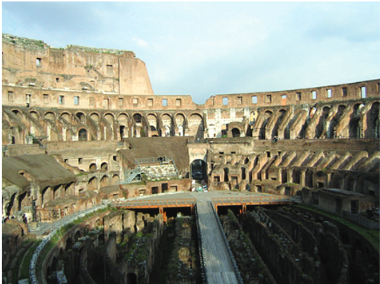
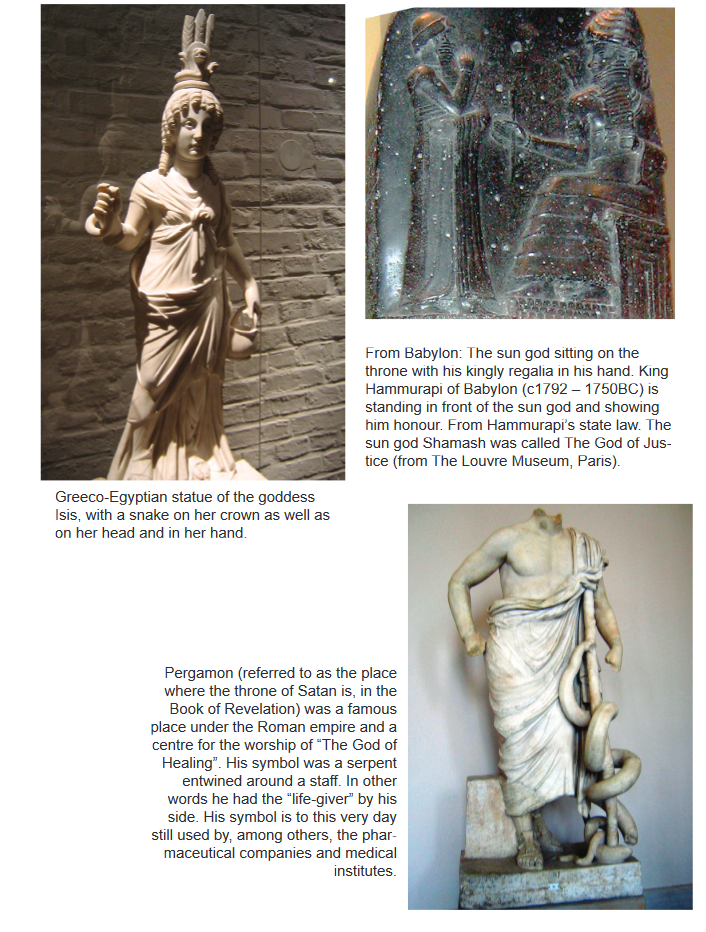
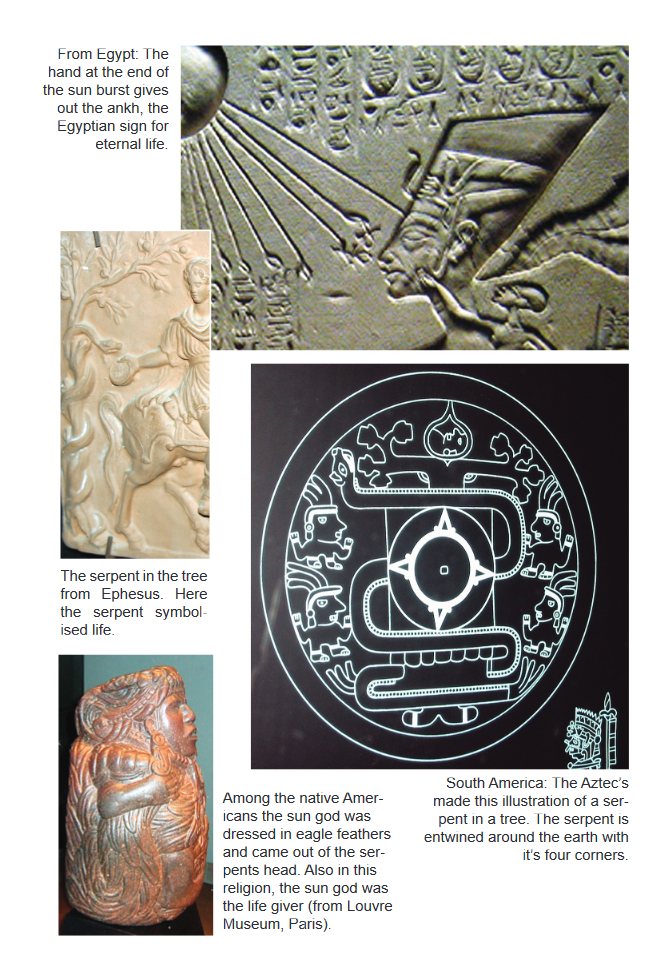
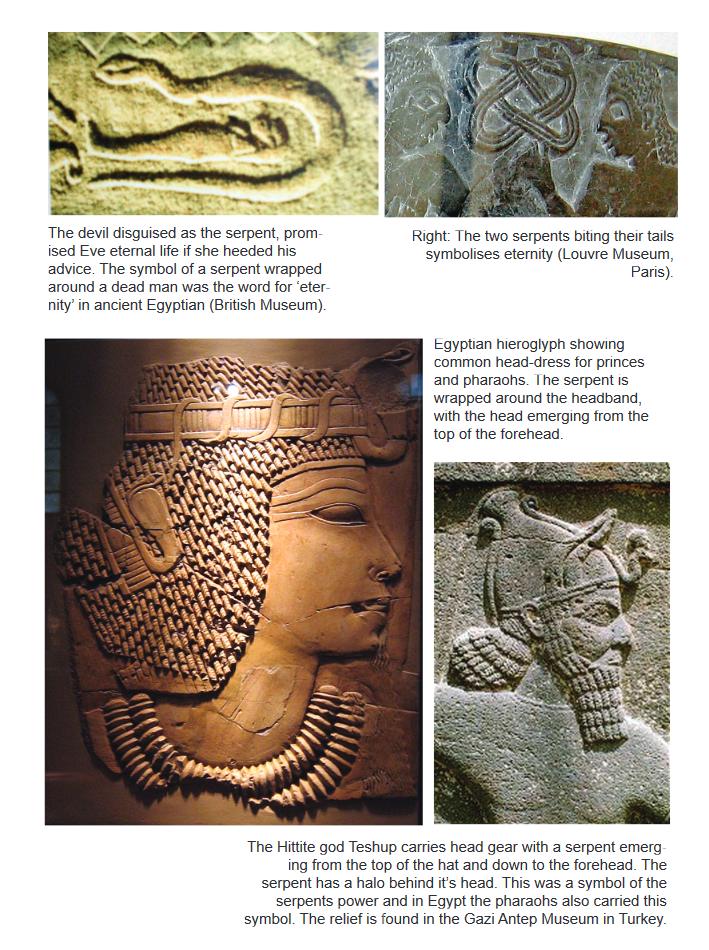
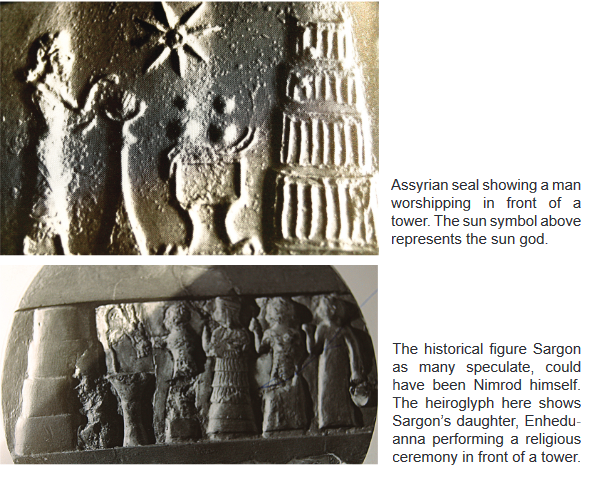
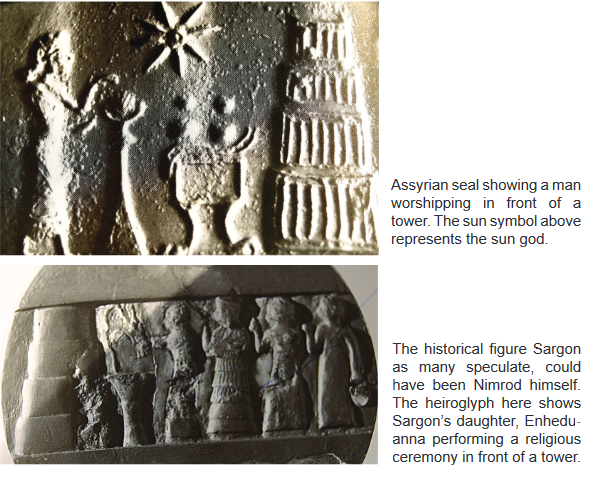
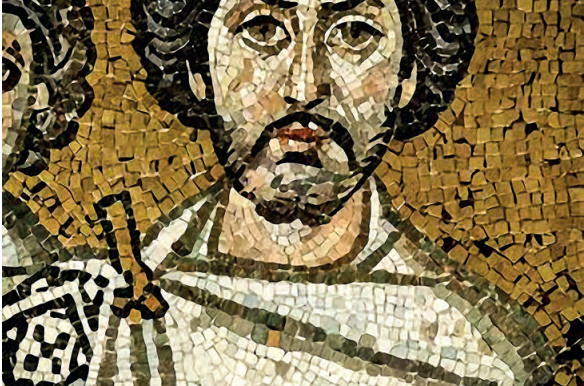
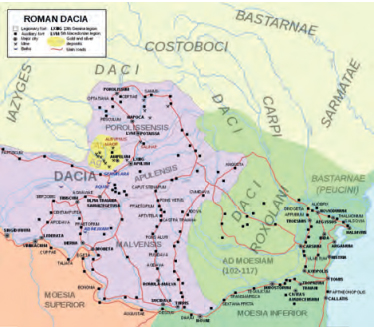
When Christians increasedin numbers, they experiencedgreatpersecution in Rome. The remains of the famous Colesseum still lie as a witness of the cru-eltiesthatoncetook place. The number ofChristian’s
who endedtheirlivesbybeingtornapartby lions, as entertainmentincolesseumsand arenas, total approximately 80 000!Thereligionthatwasmostcommon inRome at that time, was sun wor-ship. This, incidentally, was the most widespread heathen religioninthecenturiesbeforeand after Christ. We still find different gods pertaining to thisheathenreligioninvariousplacesaroundthe world. In the occult, the sunis asymbol ofLucifer or Satan. That is probably why it is no coincidence that sun worship was so widespread. In Egypt the sun god was named Ra, in Central-America we find the sun god Quetzal-coatl, the Persian sungod was Mithra, in Babylon they hadBaal andthe son Tammuz, and Apollo was the Greek sun god. These are just some of the many names the sun god had. Because of the close connection between sun worship and the luciferian religion, it is not hard to understand why God warned us about this kind of worship. Let us travel even further back in time. God warned the Israelites against sun worship
“Lest ye corrupt yourselves… And lest thou lift up thine eyes unto heaven, and when thou seest the sun, and the moon, and the stars, even all the host of heaven, shouldest be driven to worship them, and serve them”
(Deuteronomy 4:16 & 19)
Nevertheless this was exactly what the Israelites began doing notlong after. The Israelites adopted the idolatrous worship that was going on all around them, and they worshipped,
“Baal, to the sun, and to the moon, and to the planets, and to all the host of heaven.”
(2 Kings 23:5).
In spite of the warning, they still took part in sun worship. In Ezekiel 8, we read,
“He said furthermore unto me, Son of man, seest thou what they do? Even the great abominationsthatthehouse ofIsrael committeth here, that I should go far off from my sanctuary? But turn thee yet again, and thou shalt see greater abominations. And he brought me to the door of the court; and when I looked, behold ahole inthe wall. Then saidheunto me, Son of man, dig nowinthe wall: and when I had digged in the wall, behold a door. And he said unto me, Go in, and behold the wicked abominations that they do here. So I went in and saw; and behold every form of creeping things, and abominable beasts, and all the idols of the house of Israel, portrayed upon the wall round about. And there stood before them seventy men of the ancients of the house of Israel, and in the midst of them stood Jaazaniah the son of Shaphan, with every man his censer in his hand; and a thick cloud of incense went up. Then said he unto me, Son of man, hast thou seen what the ancients of the house of Israel do in the dark, every man in the chambers of his imagery? For they say, the LORD seeth us not; the LORD hath forsaken the earth. He said also unto me, Turn thee yet again, and thou shalt see greater abominations that they do. Then he brought me to the door of the gate of the LORD’s house which was toward the north; and, behold, there sat women weeping for Tammuz. Then said he unto me, Hast thou seen this, O son of man? Turn thee yet again, and thou shalt see greater abominations than these. And he brought me into the inner court of the LORD’s house, and, behold, at the door of the temple of the LORD, between the porch and the altar, were about five and twenty men, with their backs toward the temple of the LORD, and their faces toward the east; and they worshipped the sun toward the east.”
They had turned their back to the Most Holy, where the law of God was, to wor-ship the sun god, just as the law prohibited.
The origin of sun worship
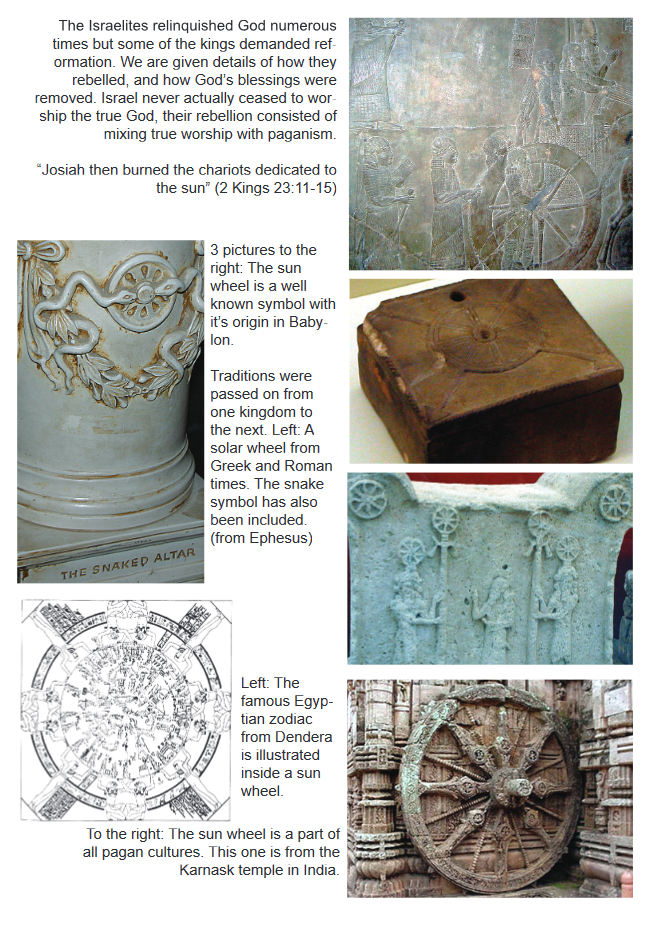
Sun worshipbeganin ancientBabylon andspreadtothefourcornersofthe world. In ancient Babylon, the sun, the moonandthestarswere worshipped. The Babylonians believed the stars were their dead heros that had ascended to heaven andbecome gods. One ofbeliefscentraltotheirreligiousceremonies was the zodiac. A part of the Babylonian belief was that the serpents power was in the sun. The sun therefore became a symbol of the serpent (or the devil). The number allocated to the sun in pagan worship was 666.
The growth of sun worship
In Genesis 11 we read how God confused the people at the Tower of Babel and introduced different languages. As man dispersed they took the sun cult with them. As the languages changed, the sun god, the queen of heaven and the gods of the zodiac all received new names according to the various languages. There-fore today we can find rituals and religions throughout the world which have strong similaritieswithsunworshipin ancient Babylon; from theindiansofsouth America to the Middle East up to Asia. Among these is the Egyptian reli-gion which has so many similarities it is practically a direct copy, and both the Greeks and the Romans copied the Egyptians. The Greeks are covered in great detail by the Greek historian Herodot. In 133B.C. Babylonian sunworshipwasdedicatedintoRome by Attalus III. There thesymboldandceremonieswerewoven intoCæcars cultandsubse-quently into Roman Catholicism. (The Great Controversy, Jim Arrabito (New Illustrated)).
Sun worship in the Christian church
How exactly did the Roman Catholic church appear on the world scene? From the time when the Christians suffered martyrdom until Rome became Christian, there were a number of changes.
“Persecution ceased, and in its stead were substituted the dangerous allurements of temporal prosperity and worldly honour. Idolaters wereledtoreceive apart of theChristian faith, while theyrejected other essential truths. They professed to accept Jesus as the Son of God and to believe in His death and resurrection, but they had no conviction of sin and felt no need of repentance or of a change of heart. With some concessions on their part they proposed that Christians should make concessions, that all might unite on the platform of belief in Christ. Now the church was in fearful peril. Prison, torture, fire, and sword were bless-ings in comparison with this. Some of the Christians stood firm, declaring that they could make no compromise. Others were in favour of yielding or modifying some features of their faith and uniting with those who had accepted a part of Christianity, urging that this might be the means of their full conversion. That was a time of deep anguish to the faithful followers of Christ. Under a cloak of pretended Christianity, Satan was insinuating himself into the church, to corrupt their faith and turn their minds from the word of truth. Most of theChristians atlastconsentedtolowertheir standard, and aunion wasformed betweenChristianity and paganism. Although theworshipersof idols professed to be converted, and united with the church, they still clung to their idolatry, only changing the objects of their worship to images of Jesus, and even of Mary and the saints. The foul leaven of idolatry, thus brought into the church, continued its baleful work. Unsound doctrines, superstitious rites, and idolatrous ceremonies were incorporated into her faith and worship. As the followers of Christ united with idolaters, the Christian religion became corrupted, and the church lost her purity and power”.
Sunday
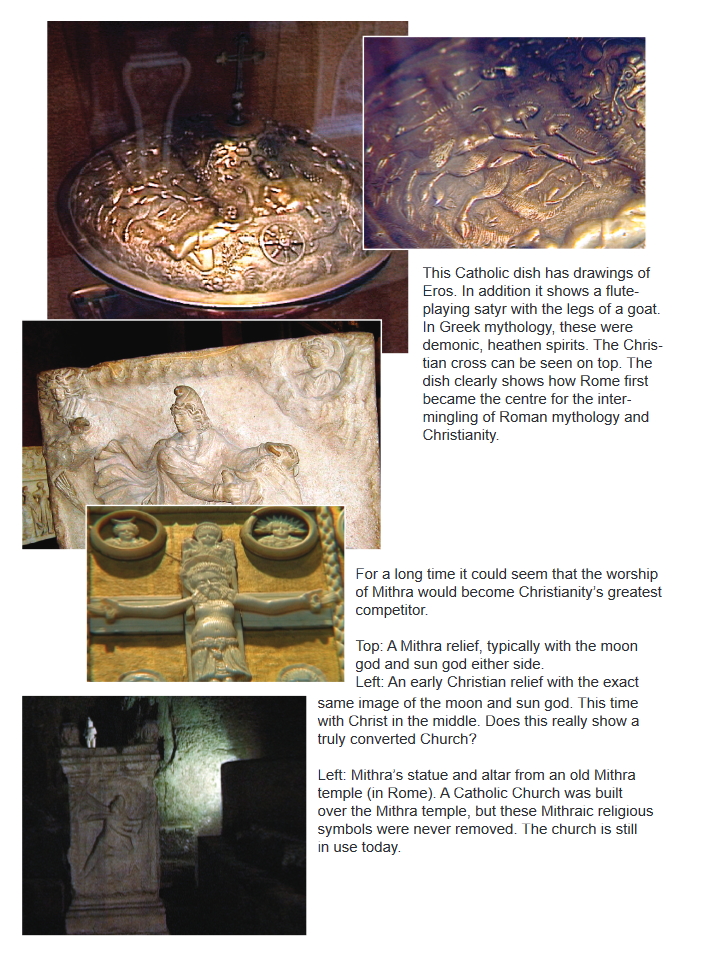
The Persian sun god Mithra was one of the most influential forms of sun worship adopted by the Romans. This happened before Christianity reached Rome. The first day of the week, Sunday, was dedicated to the sun and Mithra, so Sunday received the title, “The Lord’s Day”, and, “The Day of the Sun” (Sun day). Because of this, Sunday was acknowledged as the Sun’s day, and was of spe-cialinteresttosunwor-shippers. When Emperor Constantine realised that the gulf between Christ-ians and sun worshippers weakened the country, he converted to Christianity, but also retained
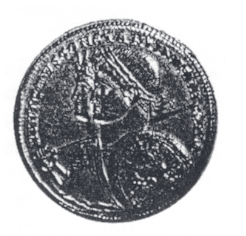
faith inhisold religion, sun worship. In that way, he couldpresenthimselfas aleader to the Christians aswell as the pagans. Constantine’s motives for converting to Christianity were of amore politicalnaturethan aconviction of faith. Old Roman coins reveal that Constantine continued to worship the sun, as the coins are decorated with symbols of sun worship along with the Emperor.
“In the early part of the fourth century the emperor Constantine issued a decree making Sunday a public festival throughout the Roman Empire. The day of the sun wasreverencedbyhispagansubjectsandwashonoured by Christians; it was the emperor’s policy to unite the conflicting interests of heathenism and Christianity. He was urged to do this by the bishops of the church, who, inspired by ambition and thirst for power, perceived that if the same day was observed by bothChristians and heathen, it wouldpromotethenominalacceptance of Christianity by pagans and thus advance the power and glory of the church. But while many God-fearing Christians were gradually led to regard Sunday as possessing a degree of sacredness, they still held the true Sabbath as the holy of the Lord and observed it in obedience to the fourth commandment. The archdeceiverhadnotcompletedhis work. He wasresolvedtogather theChristian worldunderhisbannerandtoexercisehispowerthroughhis vicegerent, the proud pontiff who claimed to be the representative of Christ. Through half-converted pagans, ambitious prelates, and world-loving church-men he accomplished his purpose. Vast councils were held from time to time, in which the dignitaries of the church were convened from all the world. In nearly every council the Sabbath which God had instituted was pressed down a little lower, while Sunday was correspondingly exalted. Thus the pagan festival came finally to be honoured as a divine institution, while the Bible Sabbath was pronounced a relic of Judaism, and its observers were declared to be accursed.”
(The Great Controversy page 53).
The first Sunday law was introduced by Emperor Constantine on the 7th day of March, 321 AD.
“On the Venerable Day of the Sun [“venerabili die Solis” – the sacred day of the Sun] let the magistrates and people residing in the cities rest, and let all workshops be closed. In the country, however, persons engaged in agriculture may freely and lawfully continue their pursuits; because it often happens that another day is not suitable for grain-sowing or for vine-planting; lest by neglecting the proper moment for such operations the bounty of heaven should be lost.
(“Codex Justinianus,” lib.3, tit.12,3; trans. In Phillip Schaff, His-tory of the Christian Church. Vol. 3 page 380.)
“This [Constantine’s Sunday decree of March, 321] is the ‘parent’ Sunday law making it a day of rest and release from labour. For from that time to the present there have been decrees about the observance of Sunday which have profoundly influenced European and American society. When the Church became a part of State under the Christian emperors, Sunday observance was enforced by civil statutes, and later when the Empire was past, the Church in the hands of the papacy enforced it by ecclesiastical and also by civil enactments.”
(Walther W. Hyde, “Paganism to Christianity in the Roman Empire,” 1946, p.261)
Remains of the struggle are found in two institutions adopted from its rival by Christianity in the fourth century, the two Mithraic sacred days, December twenty-fifth, dies natalis solis, as the birthday of Jesus, and Sunday, ‘the vener-able day of the Sun,’ as Constantine called it in his edict of 321.”
(Walter Wood-burn Hyde, Paganism to Christianity in the Roman Empire, p. 60.)
“Constantine laboured at this time untiringly to unite the worshipers of the old and thenewintoone religion. All hislawsandcontrivancesarelawfuland peaceable means melt together a purified heathenism and a moderated Christianity… Of all of his blending and melting together of Christianity and heathen-ism, none is more easy to see through than this making of his Sunday law: The Christians worshipped their Christ, the heathen their Sun-god… [so they now should be combined].”
(H.G.Heggtveit, “Illustrated Church History,” 1895, p.202, Noed.)
The Catholic church itself says,
“You may read the Bible from Genesis to rev-elation, and you will not find a single line authorizing the sanctification of Sunday. The Scriptures enforce the religious observance of Saturday, a day which we (Catholics) never sanctify.”
(James Cardinal Gibbons, The Faith of Our Fathers, p. 111, 16th ed., 1879.)
Gradually, force was used to further the agenda. Not only did they demand that Sunday should be kept holy, but everyone that kept God’s true Sabbath, should be stopped, and even persecuted.
“And the dragon was wroth with the woman, and went to make war with the remnant of her seed, which keep the command-ments of God, and have the testimony of Jesus Christ.” .
(Revelation 12:17)
At aChurch meetingheld in Bergen, Norway, 22 August 1435,
“It hadcome to the ears of the archbishop that people in different places of the kingdom had ventured thekeepingholy of Saturday. It is strictly forbidden – it is stated – in the Church-Law, for any one to keep or to adobt holy days, outside of those which the pope, archbishop, or bishops appoint” .
(The History of the Norwegian Church under Catholicism, F. Keyser, Vol. 11, page 488, Oslo, 1858)
Norway, 1435 (Catholic provincial at Bergen),
“We areinformedthatsome people in different districts of the kingdom, have adopted and observed Satur-day keeping. It isseverely forbidden – in holychurch canon – one andallto observe days excepting those which the holy Pope, archbishop, or the bishops command. Saturday-keeping mustundernocircumstancesbepermittedhere-afterfurtherthanthechurchcanon commands. Therefore, we counsel all the friends of God throughout all Norway who want to be obedient towards the holy church to let this evil of Saturday-keeping alone; and the rest we forbid under the penalty of severe church punishment to keep Saturday holy.”
(The Catholic Main Seat in Bergen, Norway, volume 7, page 397).
Norway, 1436 (Church Conference at Oslo),
“It isforbiddenunderthesame penalty to keep Saturday holy by refraining from labour”.
(History of the Norwegian Church, page 401)
“About 590, Pope Gregory, in a letter to the Roman people, denounced as the prophets of Antichrist those who maintained that work ought not to be done on the seventh day.”
(James T. Riggold in the Law of Sunday, page 267).
“Gregory, bishop by the grace of God to his well-beloved sons, the Roman citi-zens: It has come to me that certain men of perverse spirit have disseminated among you things depraved and opposed to the holy faith, so that they forbid anything to bedone onthedayof the Sabbath. What shall I call them except preachers of antichrist?”
(Epistles, book 13: epistle 1)
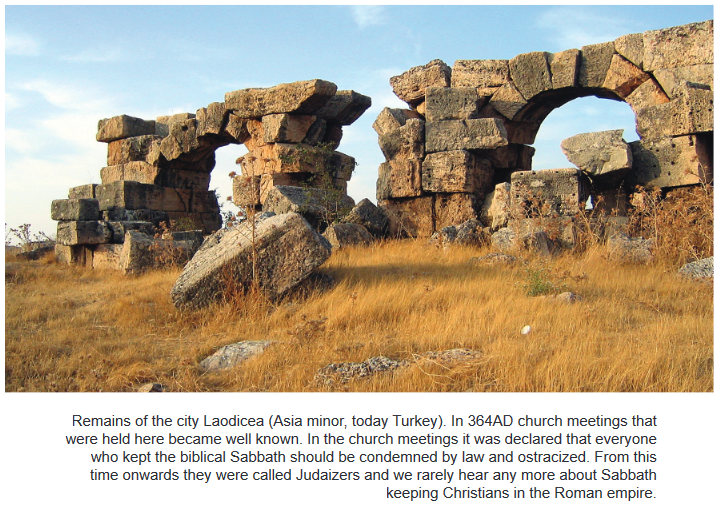
“Christians shall not Judaise and be idle on Saturday [“sabbato”], but shall work on that day; but the Lord’s day they shall especially honour, and, as being Chris-tians, shall,if possible, do noworkonthat day. If, however, they are found Judaizing, they shall be shut out [“anathema,” – excommunicated] from Christ.”
(Counsel of Laodicea, 337 AD, Canon 29, quoted in C.J. Hefeles book “A His-tory of the Councils of the Church”, vol. 2, page 316)
“The papal author, Bonacursus wrote the following against ‘Pasagini’: “Not a few, but many, know what are the errors of those who are called Pasagini… First, they teach that we should obey the Sabbath. Furthermore, to increase their terror, they condemn and reject all the church Fathers, and the whole Roman Church.”
(D’Achery, “Spicilegium,” 1, f.211-214; Muratory, “Antiq.Med.Aevi,” 5,f.152, Hahn, Volume 3 page 209; The Sabbath of Jesus Christ Through the Ages, J.F.Coltheart, Truth for Today, 1997).
“Robinson gives an account of some of the Waldenses of the Alps, who were called Sabbati, Sabbatati, Insabbatati, but more frequently Inzabbatati. ‘One says they were so named from the Hebrew word sabbath because they kept the Saturday for the Lord’s day.” .
(General History of the Baptist Denomination, Volume II, page 413)
“To destroy completely these heretics (Waldenses, France) Pope Innocent III sent Dominican inquisitors into France, and also crusaders, promising “a ple-nary remission of all sins, to those who took on them the crusade …against the Albigenses.”
“Aphonse, King of Aragon, etc., to all archbishops, bishops andtoall others.. We command you that heretics, to wit, Waldenses and Insab-bathi, should be expelled away from the face of God and from all Catholics and ordered to depart from our kingdom.”
(“Marianae , Praefatio in Lucam Tudensem,” found in “Macima Bibliotheca Veterum Patrum,” Volume 35, page 190)
“France – King Louis IX, 1329. Published the statute “Cupientes” in which he charges himself to clear southern France from heretics as the Sabbath-keepers were called.”
(The Sabbath of Jesus Christ Through the Ages, J.F.Coltheart, Truth for Today, 1997).
In France:
“Thousands of God’s people were tortured to death by the Inquisition, buried alive, burned to death, or hacked to pieces by the crusaders. While devastating the city of Biterre, the soldiers asked the Catholic leaders how they should know who were heretics; Arnold, Abbot of Cisteaux, answered: “Slay them all, for the Lord knows who are His.”
(The Sabbath of Jesus Christ Through the Ages, J.F.Coltheart, Truth for Today, 1997; “History of the Inquisi-sion,” page 96).
“The inquisitors… [declare] that the sign of a Voudois, deemed worthy of death, was that he followed Christ and sought to obey the commandments of God.”
(History of the Inquisition of the Middle Ages,” H.C. Lea, Vol.1).
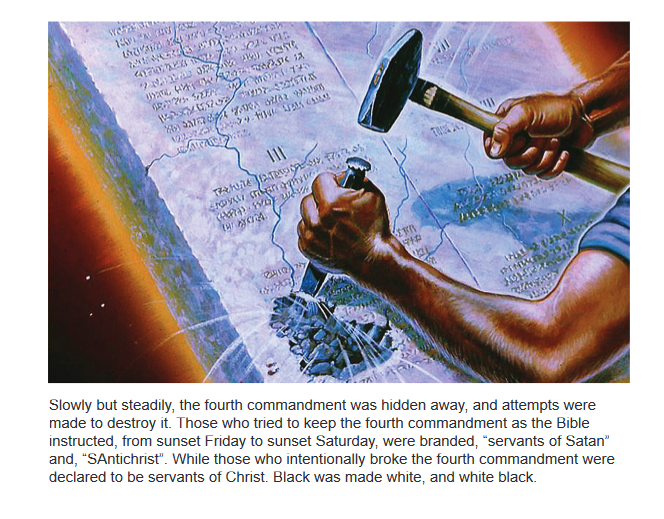
The Catholic Church hadsucceededincreatinggreat confusion. Those who kept God’s commandments were called evil, and even antichrist. On the other hand, those who broke God’s commandments to keep the Pope’s command-ments, were called true Christians, but God’s word tells us, “Woe unto them that call evil good, and good evil; that put darkness for light, and light for darkness;
that put bitter for sweet, and sweet for bitter!” (Isaiah 5:20).
“For professing faith contrary to the teachings of the Church of Rome, history records the martyrdom of more than one hundred million people. A million Waldenses and Albigenses [Swiss and French Protestants] perished during a crusade proclaimed by Pope Innocent III in 1208. Beginning from the establishment of the Jesuits in 1540 to 1580, nine hundred thousand were destroyed. One hundred and fifty thousand perished by the Inquisition in thirty years. Within the space of thirty-eight years after the edict of Charles V against the Protestants, fifty thousand persons were hanged, beheaded, or burned alive for heresy. Eighteen thousand more perished during the administration of the Duke of Alva in five and a half years.” .
(Brief Bible Readings page 16)
“And uponherforeheadwas aname written, MYSTERY, BABYLON THE GREAT, THE MOTHER OF HARLOTS AND ABOMINATIONS OF THE EARTH. And I saw the woman drunken with the blood of the saints, and with the blood of the martyrs of Jesus: and when I saw her, I wondered with great admiration.”
(Revelation 17:5-6).
“For they have shed the blood of saints and prophets, and thou hast given them blood to drink; for they are worthy.” (Revelation 16:6). “In the centuries that followed, persecution against believers in the Bible Sab-bath intensified until very few were left alive. When the Reformation began, the true Sabbath was almost unknown.”
(Editor of Harvestime Books “The Mark of the Beast”.)
The fourth commandment was given as a memorial of the true Creator of all life. Concerning theSabbath commandment, the Lord says,
“And hallow my Sabbaths; and they shall be a sign between me and you, that ye may know that I am the LORD your God.”
(Ezekiel 20:20).
During all this confusion, when the Isra-elites adopted sun worship, the Lord reminded them over and over again about this commandment. It was a sign that it was the true Creator they worshipped, He who created the earth in six days and rested the seventh, and not the sun god. Satan, who madeitappearthatthesungodwasthecreatorandgiverof life, had to remove this sign of worship. If he was to make man worship him, or the sun god as the creator, he had to remove the sign that identified the true Crea-tor. That is why Sunday, the sun’s day, was made a day of rest instead of God’s Sabbath. Thus, all those who accepted this false day of rest, also accepted a new law-giver and creator.Satanhadsucceededininfiltrating theChristian churchwithsun worship. He had succeeded in making them reject God’s commandments and replacing them with his own counterfeit. Instead of keeping the Sabbath, that was a sign between the Creator and the created, Christians now kept Sunday, signifying the power of the sun god. The sign that identified the true Creator, had been replaced with the sign of the false creator. Furthermore there were few that were seeking the true God, thinking they already worshipped Him.
The foundation of Roman Catholicism
“On the one hand, the two religions [Mithraism and Christianity] in outlying regions of the Empire, long followed different lines of dispersion. Christianity from it’s origin in the religion of Israel, spread at first among the cities on the Mediterranean, chiefly where there were colonies of Jews. On the other hand, outside Italy, Mithraism, which was propagated by soldiers and imperial officers, followed the line of the camps and centres of commerce chiefly along the great rivers of the northern frontier. Yet at Ostia and Rome and elsewhere, the two eastern religions must have been early brought face to face. In the syncretism of that age, the age of Gnosticism, rites and doctrines passed easily from one system to another. Mithra certainly absorbed much from kindred worships of Asia Minor, from Hellenic mysteries, and from Alexandrian philosophy. It is equally certain that the Church did not disdain a policy of accommodation, along with the consecration of altars of Christ in the old shrines of paganism. The Cult of local heroes was transferred to saints and martyrs. Converts found it hard to part with consecrated phrases and forms of devotion, and might address Jesus in epithets sacred to the Sun. Some Christians in the fifth century still saluted the rising sun with a prayer”
(The Society from Nero to Marcus Aure-lius, page 622, Samuel Dill, 1964, USA)
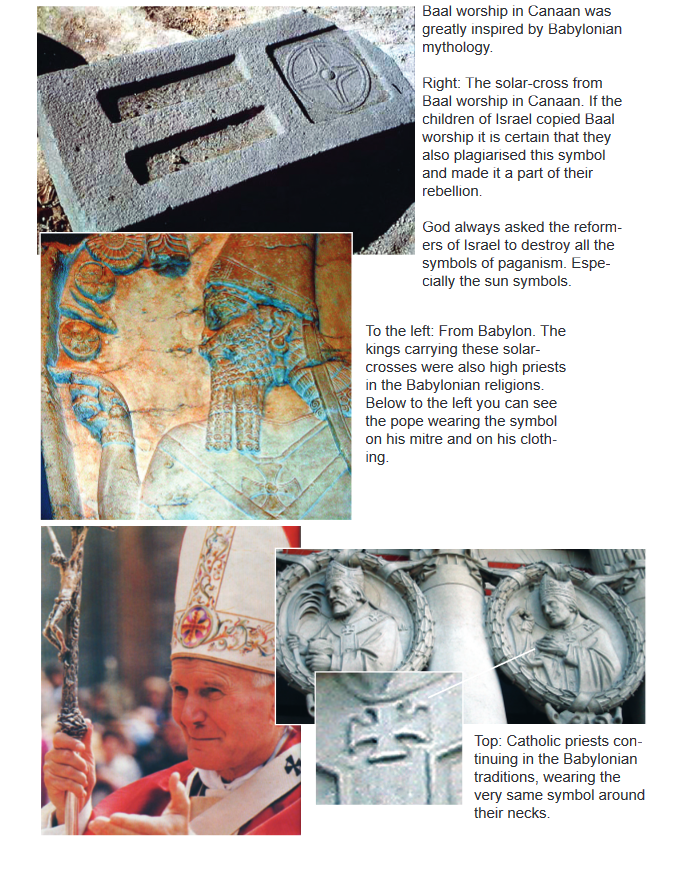
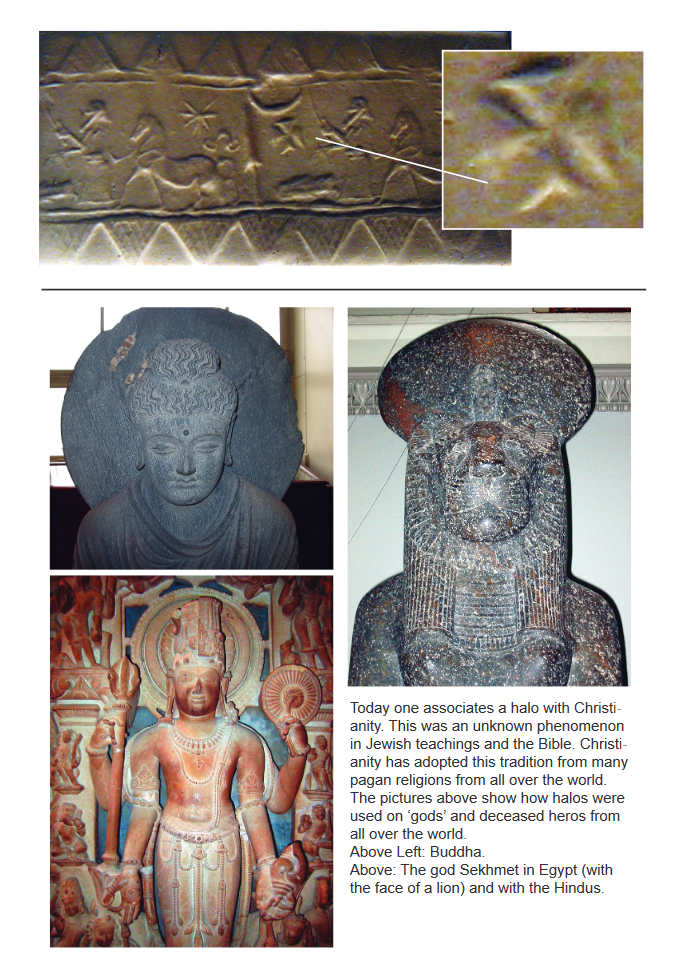
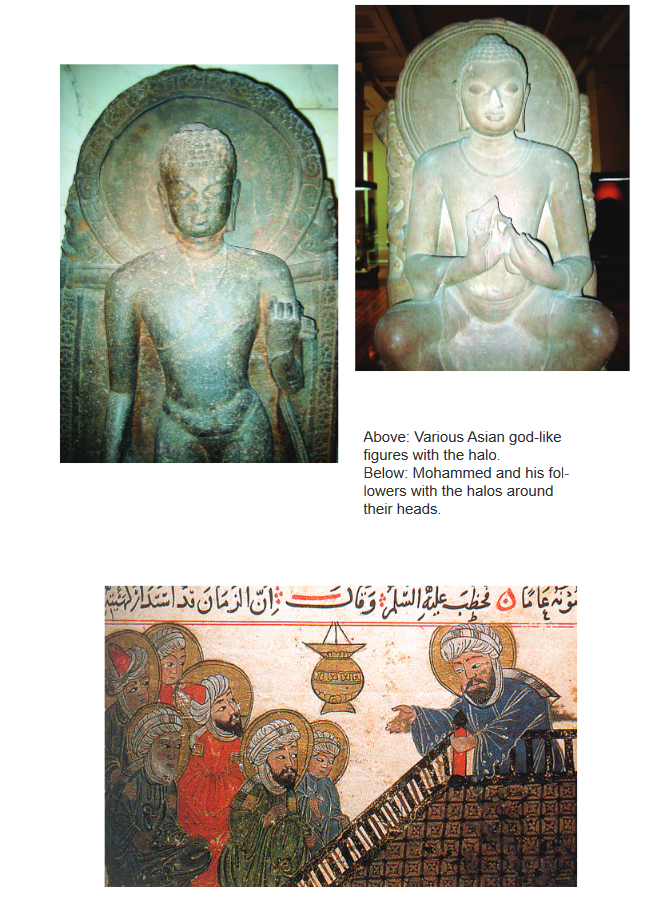
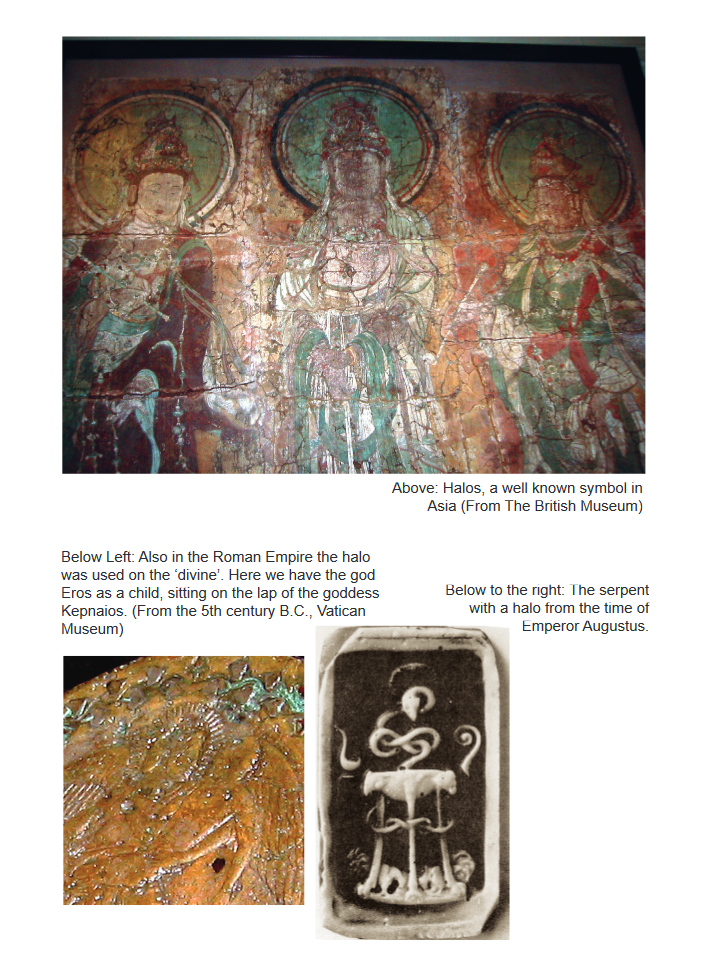
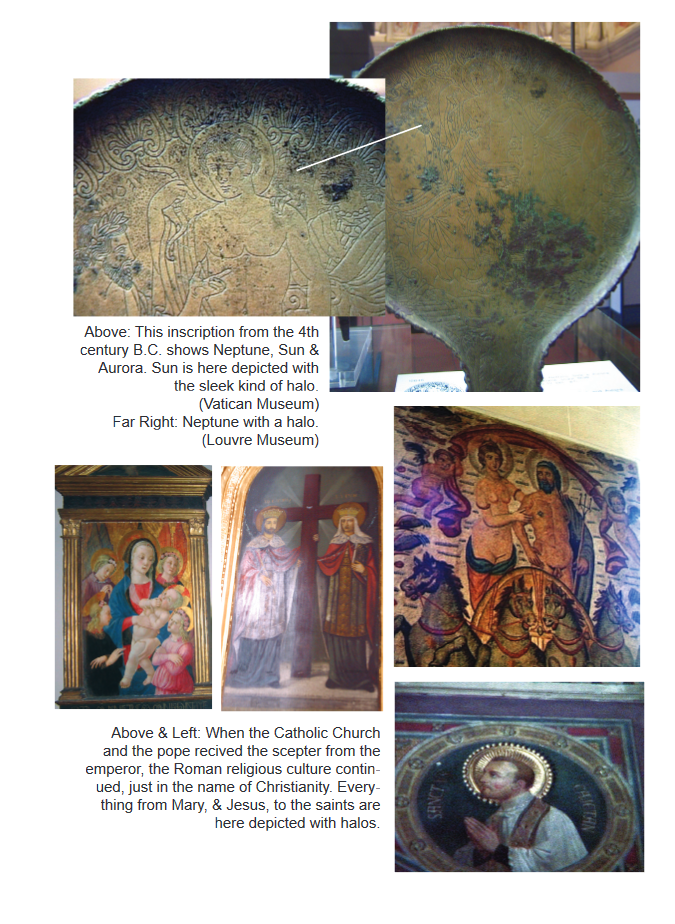
“The birthdays of Sol Invictus and of Mithra were celebrated on 25th December, close to the time of the winter solstice. In 353 or 354 CE Pope Liberius set his date as the Feast of the Nativity and a few years later he founded the Church of Santa Maria della Neva, now know as Santa Maria Maggiore, which become the centre of the Roman celebration of Christmas. The Nativity gradually absorbed or supplanted all the other solstice rites. Solar imagery came increasingly to be used toportraythe risen Christ (who wasalso called Sol Invictus), and the old solar disk that had once appeared behind the head of Asian rulers became the halo of Christian Saints. Excavation under Saint Peter’s Basilica, under-taken in hope of finding the tomb of Peter, found a very early Christian mosaic that showed Christ driving a chariot, with rays above His head. [Common way to picture Mithra and Jupiter]”.
(The Encyclopaedia of Religion, Volume 14, Mircea Eliade, USA, 1997)
“Christianity came face to face with the Babylonian paganism in various forms that hadbeenestablishedin the Roman Empire. The earlyChristians refused to have anything to do with its customs and beliefs. Much persecution resulted. Many Christians were falsely accused, thrown to the lions, burned at the stake, and inotherwaystorturedand martyred. Then greatchangesbegantobe made. The emperor ofRome professedconversion to Christianity. Imperial orders went forth throughout the empire that persecutions should cease. Bishops were given high honours. The church began to receive worldly recognition and power. But for all of this, a great price had to be paid. Many compromises were made with paganism. Instead ofthechurchbeingseparatefromthe world, it became a part of this world system. The emperor showing favour, demanded a place of leadership in the church; for in paganism, emperors were believed to be gods. From here on, wholesale mixtures of paganism into Christianity were made, especially at Rome.”
(Babylon Mystery Religion, R.E. Woodrow, 1990 Edotion, USA)
“We know that Mithraism was a state-religion in Rome at the time the Christian church was established in this area. Certain rituals from this pagan religion, like keeping Sunday andtheuseoftheroundsun-cakein the Lord’s Supper, was adoptedbythechurchatthis time. The Mithra-worship wasstronglybondedtoastrologyandincludedtheworshipofthemysticalsun god. We can, with certainty, assert that the pagan sun worship is the base for several of today’s Christian customs.” (Source unknown).
“From the forgoing, which treats merely of the more important solar festivals, it is clear that these products of paganism are as much in force at present from a symbolic point of view, as they ever were, and that Christianity countenances, and in many cases has actually adopted and practises, pagan rites whose heathen significance is merely lost sight of because attention is not called to the sources whence these rites have sprung. In short, Sun worship, symbolically speaking, lies at the very heart of the great festivals which the Christian Church celebrates today, and these relics of heathen religion, through the medium of their sacred rites, curiously enough blended with practices and beliefs utterly antagonistic to the spirit that prompted them. The reason for the survival of many of the sym-bols of Sun worship and the practice of many customs peculiar to this ancient form of idolatry, lies in the fact that the early Christian teachers found the people so wedded to their old rites and usages, that it was in vain to hope for the com-plete abandonment of these long-cherished practices. Hence a compromise was wisely effected, and the old pagan customs were deprived of the idolatry that was so obnoxious to the Christian, and transferred as meaningless symbols and empty forms to the Christian festivals.”
(Sun Lore Of All Ages, William Tyler Olcott, 1914, page 248).
Christ Himself said that He came to fulfill the law and the prophets. God’s truth had been entrusted to the Jews, and Christ’s mission was explained from these truths. When Christianity spread and became rich with influence, Christ was repositioned as the ful-fillment of the doctrine and philosophy of the pagan gods, instead of the fulfillment of the law and the prophets given to the Jews. The result was that the image of Christ was destroyed and distorted. In addition they persecuted those who believed in the Messiah who was in harmony with the Old Jewish Testament.
Sun worship under a new name
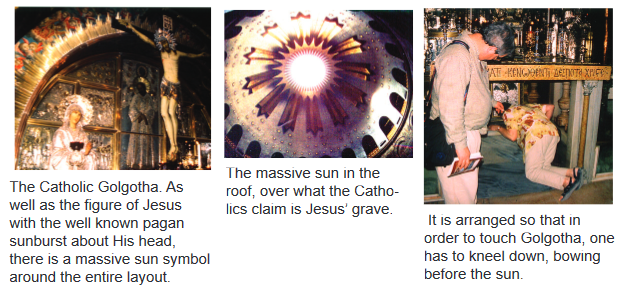
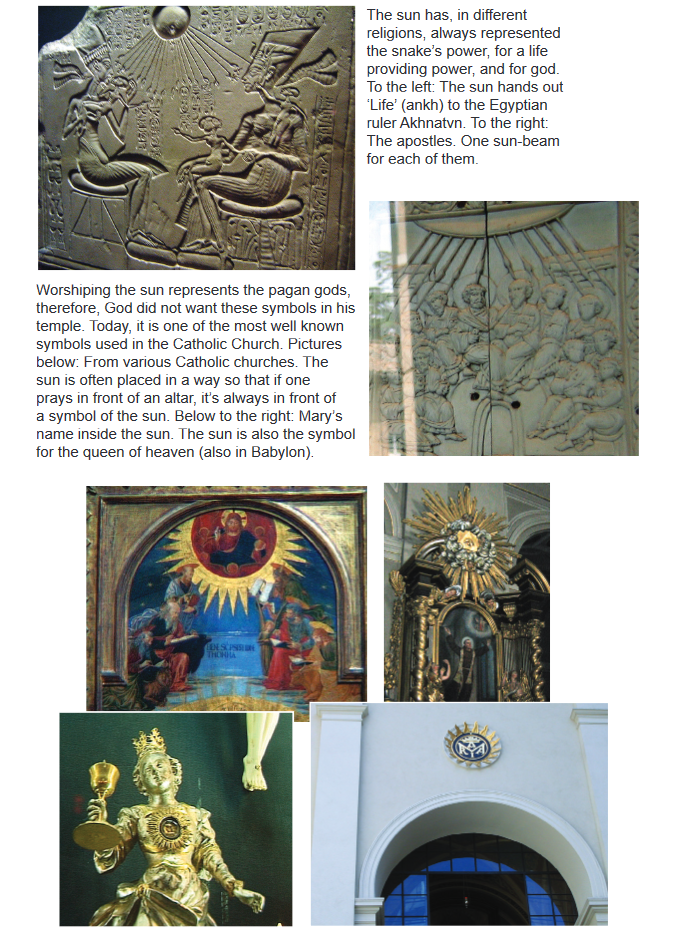
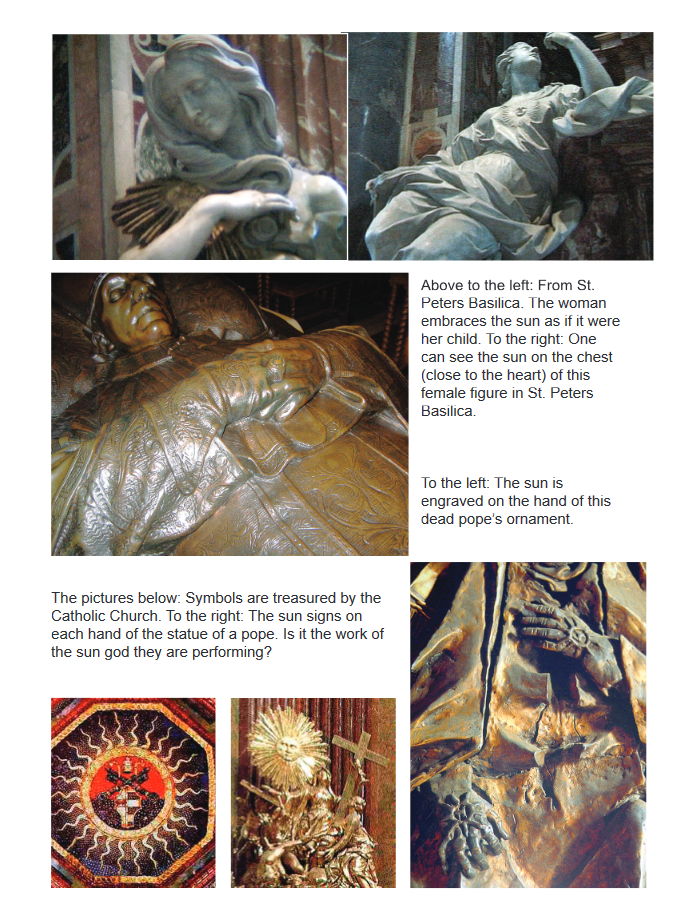
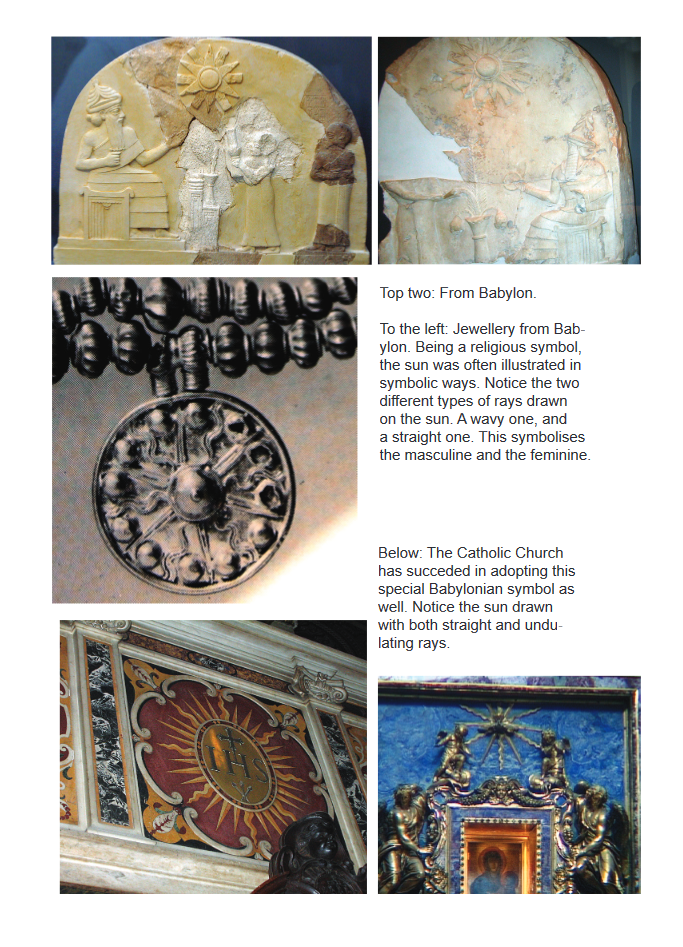
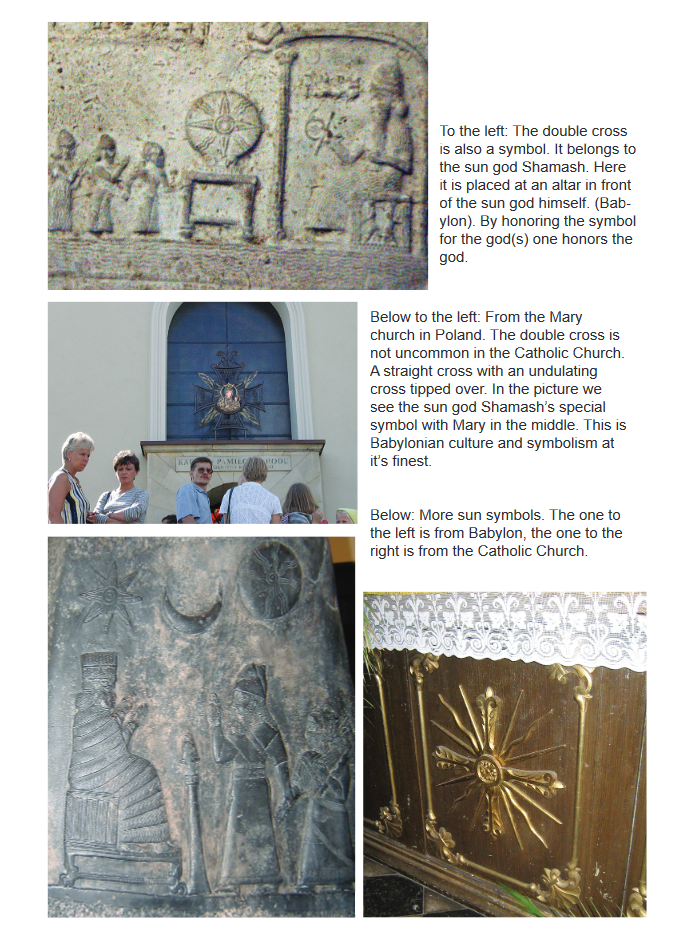
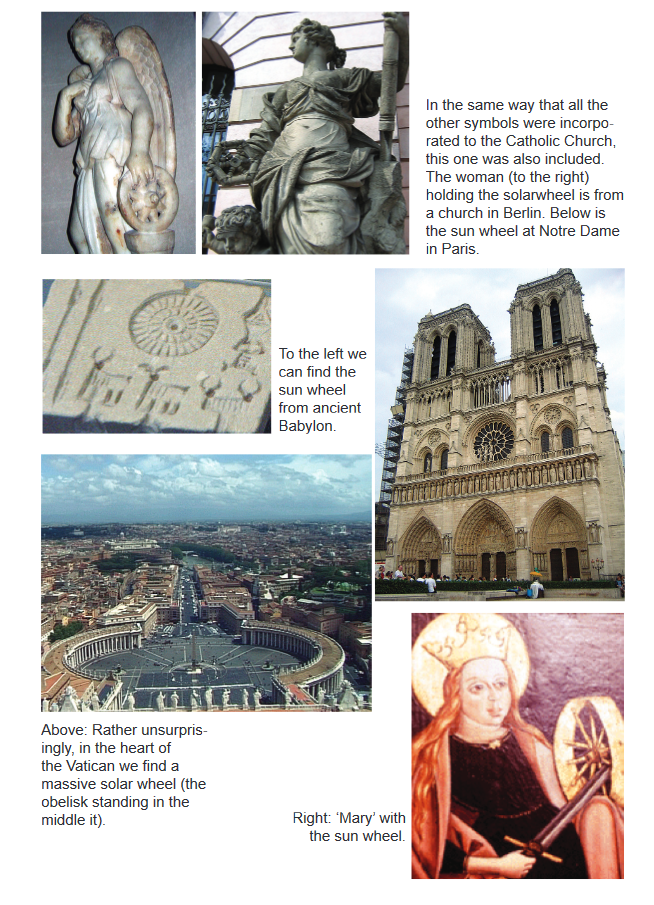
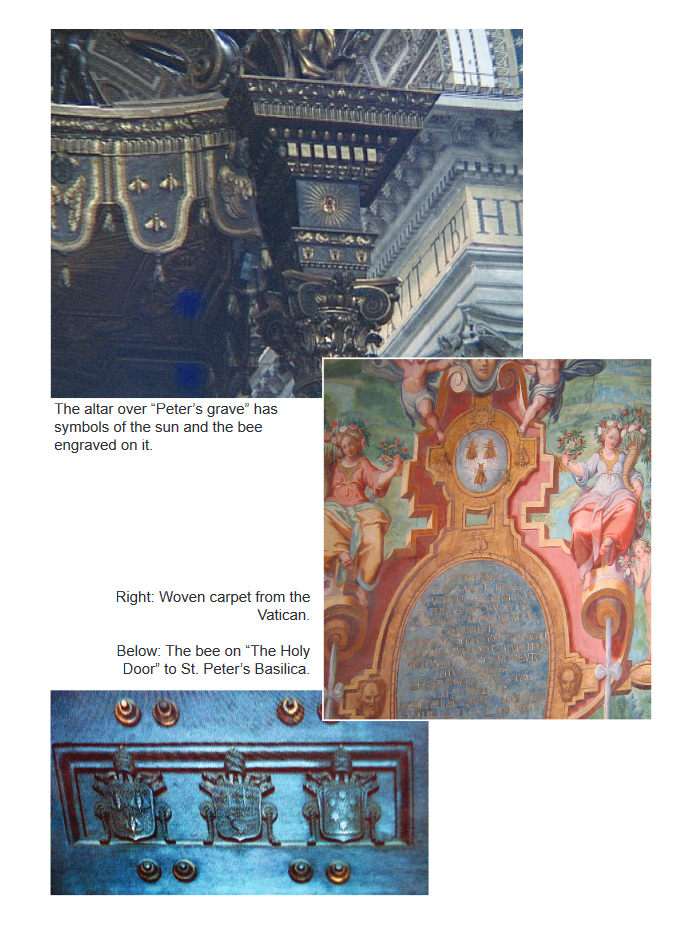
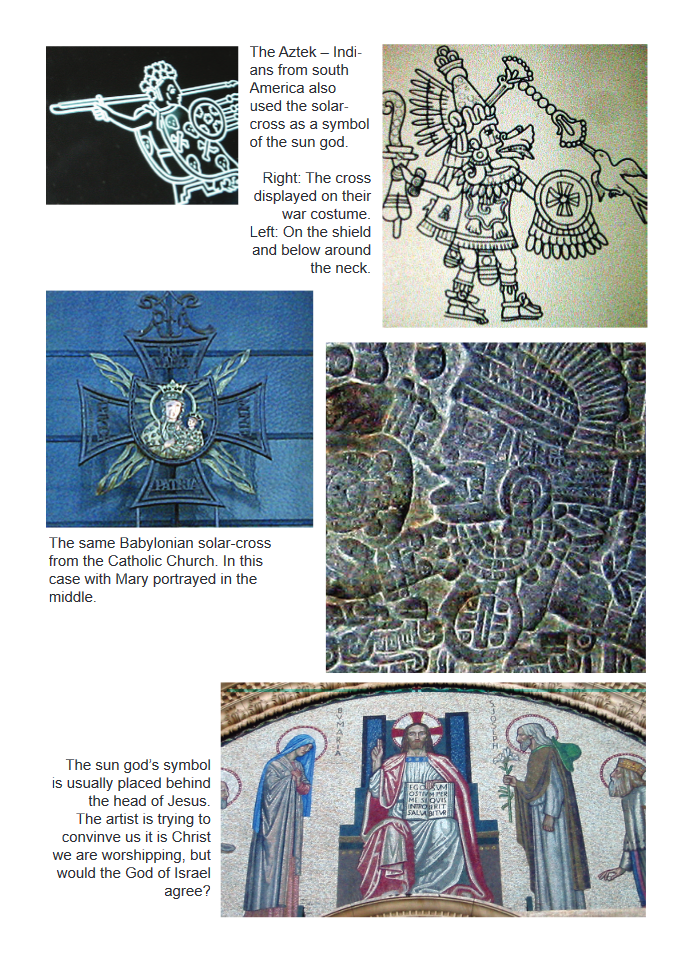
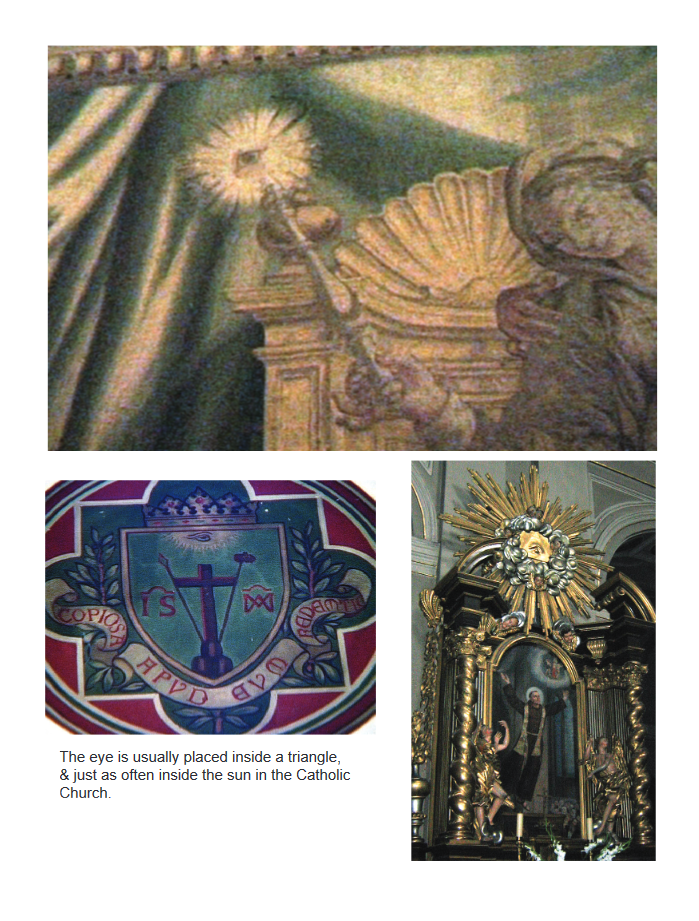
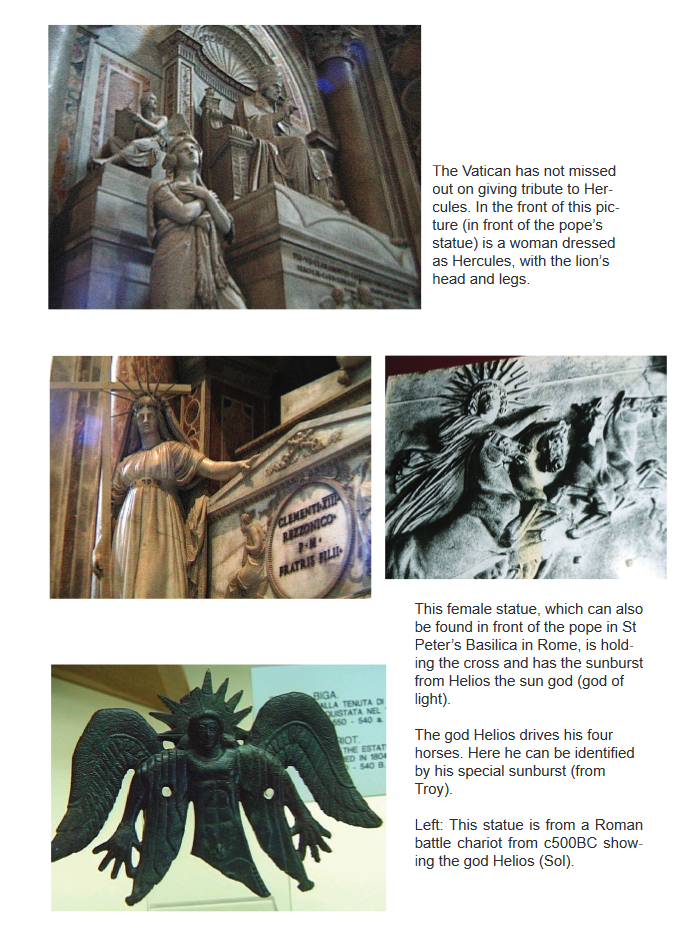
Sun worship is something that God detests according to the Bible. Sun worship in ancient Babylon was connected to astrology, and as mentioned earlier, the sun was a symbol of the serpent, the dragon, or Satan. The fact that sun worship is now practised in God’s name, shows us how far Satan is willing to go in his battle against God.Thousands of Catholic churches all over the world are decorated with symbols of the sun. One oftheworst examplesI’ve seenisin theChurch of the Holy Sepulchre in Jerusalem. This iswhere the Catholic Church claimsJesus was crucified and buried. On the spot where they claim Jesus was crucified, they have erected an idol of Jesus with a sun burst around the whole layout. All those wanting to touch the “stone” that they claim the cross was placed in, must kneel down in front of the gold statue with the sun encompassing it. It is impossible to touch the rock without bowing down to the idol. Not only is this set up a direct violation of God’s Ten Commandment law, but is also sun worship. It is not Jesus that is being honoured here. Thousands of Christians journey here year in and year out, believing that this is the place where Jesus was crucified. Thus the Catholic Church has succeeded in inviting thousands of people to kneel before an idolofthesun god, whilst believingit is Jesus. Although suchpeopleare tricked, if they had studied the Bible, they would have seen the deception and been saved from it.
___________________________________________________________________________ To read previous chapter: PONTIFEX MAXIMUS Next Chapter: Paganism in christian disguise, Part 2
Read the book Confrontation where these chapters are from HERE (PDF).
The following Scripture is well known from the story of the birth of Messiah,
“And itcametopassinthose days, that therewentout adecree from Caesar Augustus that all the world should be taxed”
(Luke 2:1).
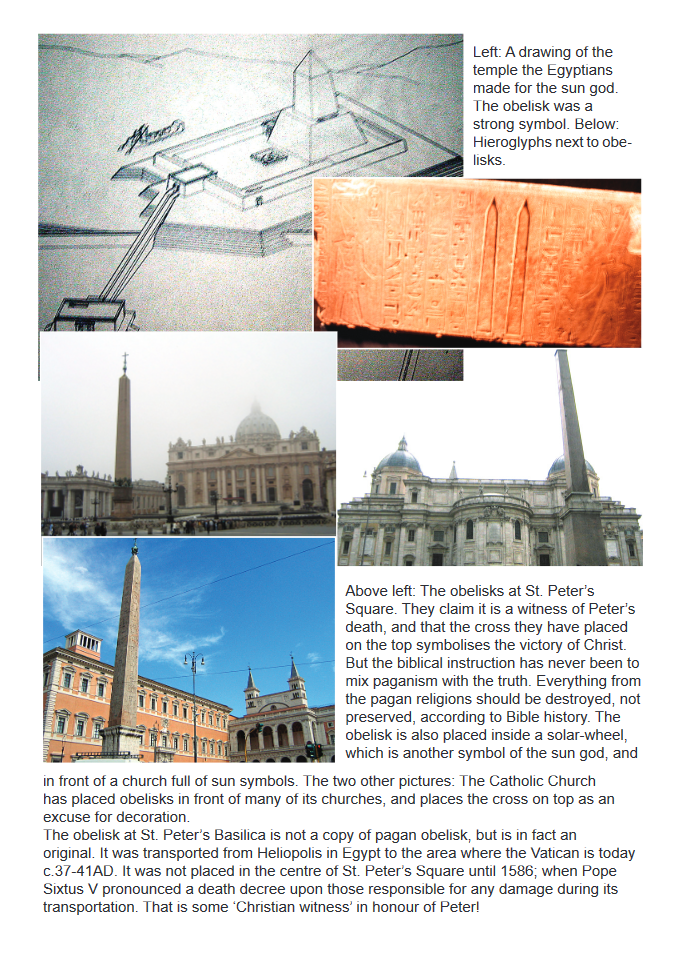
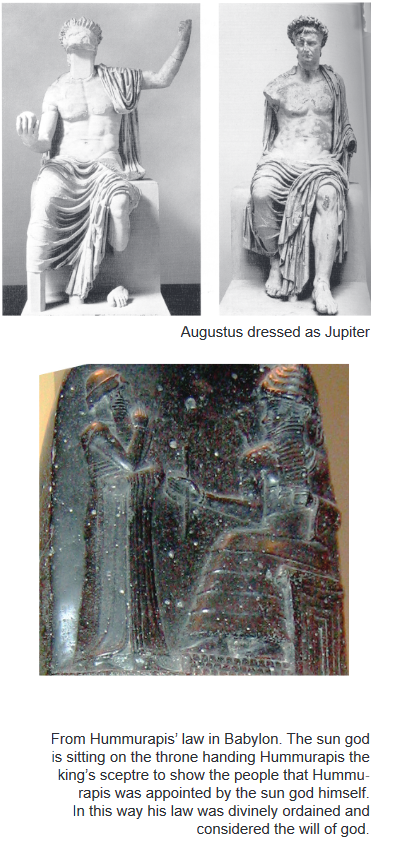
Augustus was a name that the first emperor of the Roman empire chose, and the name can mean “exalted” or “worthy of honour” (Antikkens Historie , p.197). Roman history began with kings (753 – 510BC), later becoming a republic and then a hegemonous power (510–146BC). Between 146 and 127BC it was still a republic but suffered from in-fighting. Then the reign of the emperors began in the year 27BC. Initially the Roman empire did not seem to fit the description of the fourth beast of the Book of Daniel. Babylon, Media Persia and Greece had all been powerful kingdoms that covered vast regions of the world, but the Romans struggled with civil war and other political and social maladies. For a whileit appeared as if the empire would not become the powerful kingdom it was prophesied to be, but when the emperor Augustus came to power it was the beginning of the acceleration topower for Rome. He waslookeduponas a “saviour” for the Roman empire. For years people in Rome had dreamed of a kingdom of peace, “a glorious new age”, and in the year 17BC Augustus marked the beginning of this kingdom of peace. In the year 10BC Augustus usedanobeliskforhissun dial. The openingceremonywasperformedinhonour of the sun god “Sol”. On Augustus’ birthday the shadow pointed to Ara Pacis (The Altar of Peace) and was areminder thathewasdestinedtoruleover theRoman empire(The Age of Augustus, p144 & 167). Even thoughAugustus andhisimmediatesuccessorsexperi-enced a very powerful empire, Rome did not experience peace for the remainder of its days. For “it came to pass in those days” that the Messiah was born and would in many ways shake the Roman empire, but more so after His death. While Augustus andhissuccessorswere proud of their powerful kingdom, Christ said, “My kingdomisnotofthis world” (John 18:36). Emperor Augustus reignedfor along time, which strength-enedhisnewdirec-tiveandopenedthewayforhissucces-sorstofollowinhis footsteps.
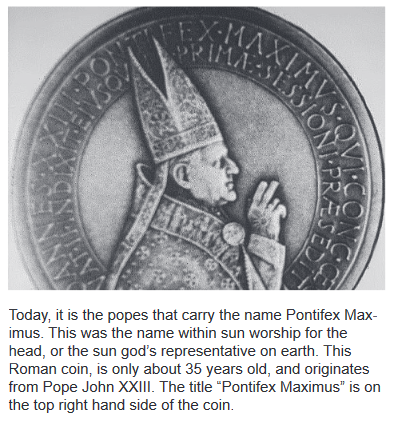
Pontifex Maximus
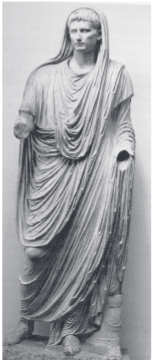
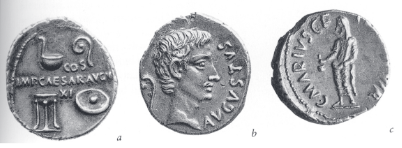
Augustus continuedmanytraditionsthat the early Roman leaders hadkeptandwhichfutureemper-ors also honour. When the kings ruled the Roman empire they functioned as high priests. Like Julius Caesar before him, emperor Augustus proclaimed himself high priest over most of thereligiouspriesthoods in Rome. Thus hebecameboth areligious leader and a head of state, and the combination strengthened the emperors power for years to come. On the 6th March, 12BC he adoptedthe title “Pontifex Maximus” which declaredhimhighpriestover theVesta nunsandvariousother
Augustus dressed as Pontifex
orders (Roman Religion, Clifford Ando, 2003, p.66). The Vesta temple lay in the heart of ancient Rome in remembrance of the place where young girls dedicated 30 years of their life to a vow of celibacy. The Bible never demands a reclusive, cloistered life, and later Christian monastic orders are inspired solely by the old pagan religious practices. This tradition was also found in Babylon where “Naditum” lived in a type of cloister that was linked to thesun godShamash’s temple. Celibacy was arequirement here too(Joan Oates, Babylon, Thames and Hudson, p.73). Roman Pontiffs led the religious practices (that were not led by special priests for particular gods), and they also enforced religious law which affected the daily life of the people. They were also responsible for the calender. Originally there were three Pontiffs who were ruled by the Pontifex Maximus.
Three coins from the era of Augustus with symbols of the priesthood Augur and Pont Max.
Augures
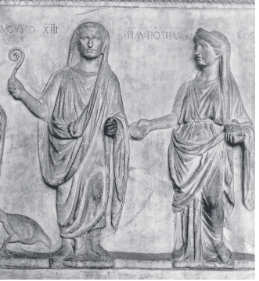
The emperor Augustus was also the leader of the exclusive priesthood of
Augustus dressed as the Augur priest with the symbol of the priesthood in his hand.
Augur. There wereonly afew ofthesepriestsandtheirtaskwastointerpret omens, “They learned the will of the gods by studying the intestines of the sacrificed animals, how the birds flew and thunderstorms. If they received a bad omen they could interrupt official proceedings as well as revoke titles and offices” (Translated from “Antikkleksikonet”, p45).
God, God’s representative and Father.
The priesthoods that Augustus appointed himself to lead existed long before he came to power. By becoming a leader to all of Rome’s priesthoods, he unified the kingdom under himself. In 2BC he was also given the title “Pater Patriae” which directly translated means, “The Father of the Land” (The Age of Augustus, p.129 & 214). He adoptedfromhisneighboring countries, the pagantra-dition to be called “the Son of God”, “the Representative of God” or “God Himself”. According to Augustus, a comet that appeared for seven nights in July of 44BC, was the sign from the late Julius Caesar (who adopted Augustus and
who died that year) that he, Julius Caesar, should be made divine (apotheose). The comet was also interpreted as the beginning of a new age of joy. The star (called “Sidus Iulium”) became the decor of coins and seals etc. as a symbol of hope. The divine Julius Caesar became a national cult, after which Augustus could declare himself “Divi Filius” or “the Son of God”. Augustus was worshipped as a god after his death and temples and altars were built in dedication to him. (The Age of Augustus, p.222 (34). He was worshipped as a god while he was alive, but mostly by the Greeks, for the simple reason that it was more acceptable to worship emperors as gods and heroes in the Greek parts of the empire, than in the Roman (Ibid p.297). A poem written about Augustus in 23BC reads;
Which translates as: Augustus is to be viewed as God on Earth because he added the kingdom, “the Britons” and “DOUR PARTHIANS”.
Even thoughAugustus wasnotworshippeddirectlyas agod inallpartsof theRoman empire, it was commonly believed thathe wasGod’s representative on earth (The Age ofAugstus p.235), just as the Babylonians and Egyptians claimed. In Babylon there were many different dynastiesand toachieve therespectofthepopulacethenew kings, regardless oftheirback-grounds, claimed tobechosenbythelocal gods. The traditionthe emperorAugustus startedwasnot new, but simplyadopted from Babylon. The first Babylonian king thatweknowofwhocalledhimselfgod, was Ur-Nammu, and hymns were sungwherehewas exalted as a god (Joan Oates, Babylon, Thames and Hudson, p49). Again in Egypt,
If theywerenotgods likePharaoh in Egypt, at leastthey claimed to be born and nursed by a goddess and appointed them their position” .
(Antikkens Historie, p9)
Late, great heroes deified
The Roman empirecontinuedtobegovernedaccordingtothepaganmodel and deified her great heros after their deaths. Elaborate tombs glorified the dead rulers of Babylon, Rome and Egypt; in the step pyramid of Saqqura, the pyramids in Giza and other famous kings tombs. In Egypt it was common to build grand tombs in the form of temples that were also places to worship the dead.
Constantine
The Christians had suffered the most horrific persecution at the hand of the various Roman emperors. The Christian claimed there was one true God and that the gods of the heathen were in fact demons, and they refused to worship other gods. Despite the conflict and persecution, the Christians experienced a time of peaceinthekingdom from 260AD until approximately 300AD. Emperor Gallienus ended the vicious tide of persecution that his predecessor Valerianus started. When the fires of persecution were again kindled against the Christians around 300AD by emperor Diocletianus, many were martyred, but the previous years ofpeaceledtoamassivegrowthintheirnumbers andChristianity spread out around the land. There were now Christians all over the kingdom and represented in all social levels. After the emperor Galerius’ edict of tolerance in 311AD the Christians experienced a change of fortune after several hundred years of violent oppresion(Antikkens Historie, p.244-255). The Roman emperorsdependedonpeople’sreligiousfaithtolegitamisetheir power. So anyreligiousdisharmonywas athreat thetheirvery power. How could the emperor be the representative of God on earth, he who decided what was sacred and what was not, if half of the kingdom did not recognise his gods? So both Julius Caesar and Augustus fabricated myths to strengthen their position (Roman Religion, Clifford Ando, 2003, p.117). Any emperor who bore the title Pontifex Maximus was high priest over all the different priesthoods thereby exploiting supreme power. As the Christian could not accept the gods of the Romans or the divinity of the emperor, nor did they accept theemperorsreligious authority, resulting inChristians becomingthe enemy of the state. When religion and state are so closely bound to one another then one cannot choose to obey the state without also serving their religion. As persucution slowed the Roman empirewassplitintotworeli-gious groups. Previously, the Roman emperors had adopted one god after the other from areas they conquered towinthetrustofthe people. This
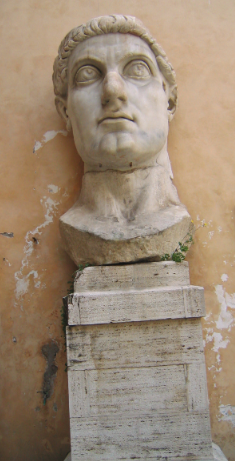
Constantine
made the Roman empire the mother church of all heathen religions in the empire. Now, if an emperor wanted to achieve a new era of greatness as areligious leader, and thereby win the support of all the people, he had to become high priest to the God of the Christians as well – either that, or ridRome of theChristians altogether. Since thelatter had been attempted in vain for so long, now that theChristians had grownto such vast numbers, it was natural to try to become the leader of the Christian religion. Constantine became the emperor who did this very thing; claiming he had converted to Christianity. Ear-lier emperors claimed that a particular god had given them victory legitimising their claim as the chosen one.
After the tyrant Peisistratos had gained victory in battle by the Temple of Athena in 546BC he honoured the goddess in Athens… The battleatsea byActium in 31BC where Augustus defeatedAntonius and Cleopatra, was outside the Temple of Apollo and the victor was convinced that this god had helped him win the battle… Emperor Aurelianus won a great victory by the city of the sun gods in Emesa in Syria in 272. Afterwards he built a great temple for Sol as ‘Lord of the Roman Empire in Rome’”
(Translated from “Antikkens Historie” p.245).
Similarly, in 312AD the emperorConstantine claimedtohave avision where the Christian God promised him victory if he fought bearing His sign. Con-stantine won the battle and so began the exaltation of the Christian God by Rome. Although Constantine was titled “The Great”, and some churches made him a saint, he was anything but a saint to his closest family.
In 310, 325 and 326 he was behind the execution of some of his closest family, including his wife, his oldest son (Crispus), his father-in-law (Maximianus, who in 307 in Trier gave Constantine the title Augustus, and gave him his daughter to marry who was executed), and his brother-in-law”
(Translated from “Kirke og Kultur”, p.107, 2-00).
Constantine built 50 streets lined with pillars in Constantinople and
a 50 metre high column was placed in the centre of the town.
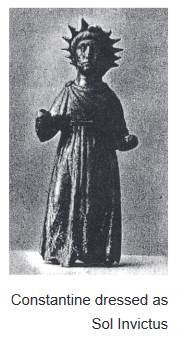
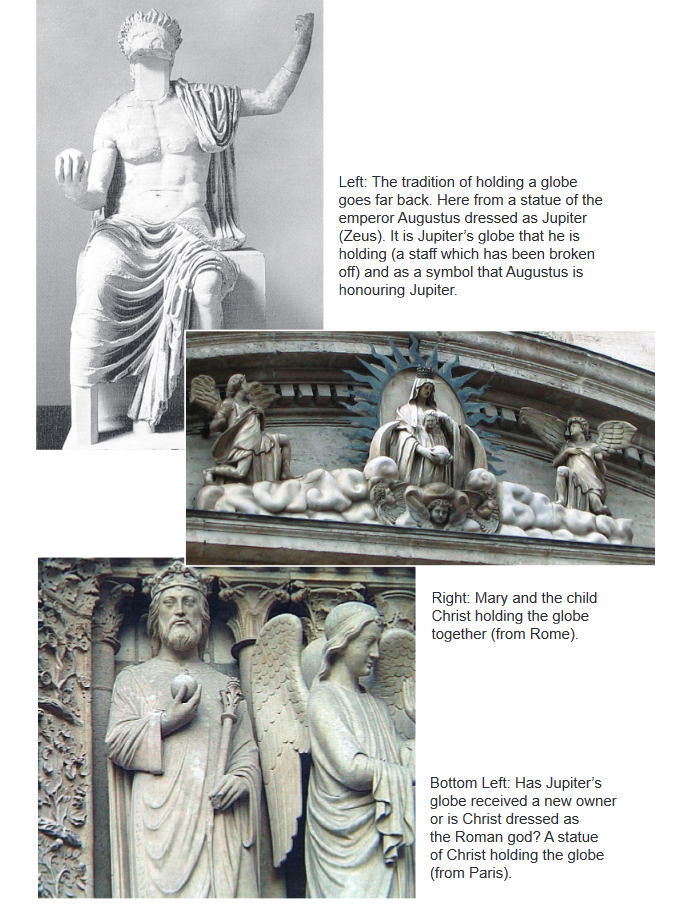
The column is partly preserved and is called “The Burnt Column”. On the top was a statue of Constantine made of light-reflecting bronze, facing east with a lance in his left hand, and in his right, a globe crowned by the goddess of victory “Victoria” – a symbol of world dominion. The head was surrounded by a crown of sunbeams. The supposedly Christian emperor dressed himself as the sun god only a few years after he led the bishops at the Council of Nicea” .
(Ibid)
When the Christians were no longer subjected to persecution, there arose disputation amongst them. Matters ofdoctrineandauthorityweregreatly contested, so Constantine decided to unite the Christians by defining their faith for them and removing some of the contested beliefs. Thus man sought to dictate truth to the Christian in the same way the emperors and thesenatehadpreviouslydonewith the Roman religion. The nature of God and the term “the Trinity” was amongthosedoctrinesthatwerediscussedanddecided upon in these church meetings. Constantine did not just influence matters of doctrine but other concepts that were to continue to this very day. In typicalemperical style, Constantine madelawsconcerningreligiousholy days and holy places, but according to the Bible this right belongs only to God. However inRomeithadalwaysbeenconsideredtheemperorsrighttodeter-mine these religious practices.
Sacred places (sacra loca) are those that have been publicly dedicated, whether in the city or in the country. It must be under-stood that a public place can only become sacred if the emperor has dedicated it or has granted the power of dedicating it.”
(Roman Religion, Clifford Ando, 2003, p.247)
Constantine’s actions as a self-proclaimed Christian were in harmony
Constantine coin where he shows hands from heaven crowing him.
with the Roman religionbutnotthebiblical religion. His motherHelena claimedtohavereceivedvisionsfrom the Christian God whichinthosedayswas themost common, heathen waytovalidateyour word. Among themost famous “holy” places were Mount Sinai (which todayisnamedafterher vision), and the Church of the Holy Sepulchre in Jerusalem’s Old City. These holy sites were legitimised through Helena’s visions, and temples and churches were built on the places she pointed out. Helena continued to appoint many new holy places which are used by the Catholic Church today. Interestingly enough, the vision of Mount Sinai in Egypt did not fit with the Bible’s description for the location at all. This makes the vision, and indeed all of her visions, highly suspicious to say the least. Constantine also claimed to have found the apostle Peter’s grave, and built a church with a monument marking the tomb.
Constantine also took the liberty of exalting Sunday, the weekly holy day that honoured the sun god Sol. By merging the Roman sun god Sol and the Chris-tian Christ intooneandthesame person, the heathenholidaysgained a new impetus in this new amalgamation of religions.
“Constantine’s lawsanc-tifyingSol’s day, the 25th Deceme-ber (Natalis Solis Invicti), seemed to indicate thatto him, Sol andChrist was one and the same deity” (Trans-lated from “.
Kirke og Kultur”, p108, 2-00)
Constantine’s intermingling of paganism and Christianity initiated a new era in Roman religion.
“At the end of the 4th century AD, a chapel with an altar was built by the pedestal under The Burnt Column, where mass was celebrated, candles were lit, incense burnt, and prayers offered to Constantine’s image atop the column… as if they were to God to protect them from accidents”
(Translated from “Kirke og Kultur”, p108, 2-00).
One mightrightlywonder how, for severalhundredsof years,
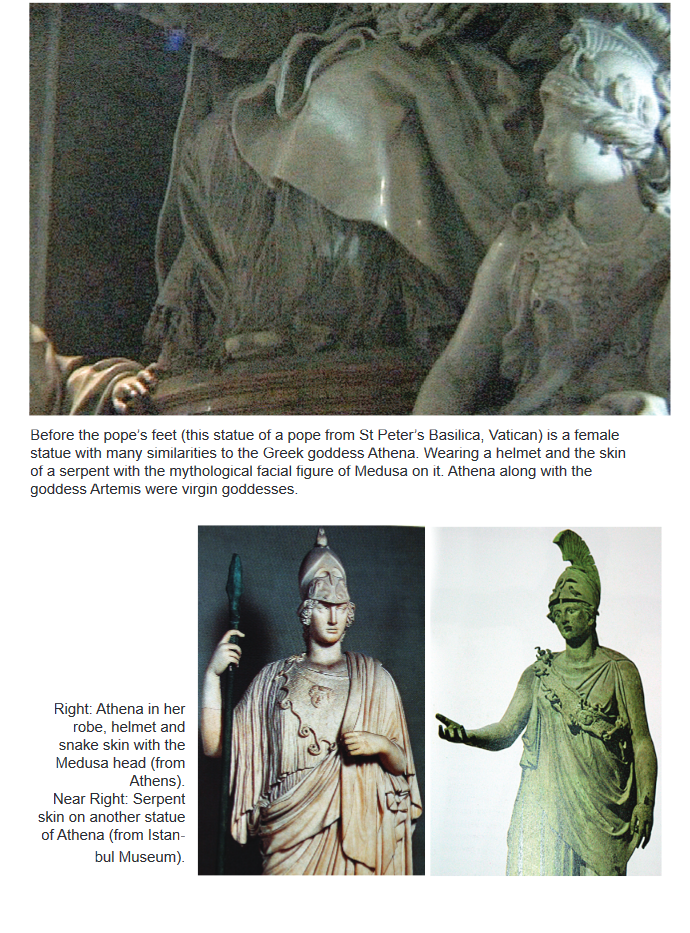
Christians suffered death rather than to pray at, or honour the altars dedi-catedtothegodsandthe emperors, but nowwillinglytookpartinthis pagan practice just because Constan-tine claimed to be converted. A falling away fromtheapostolicfaithhad begun in more ways than one. The openingceremony inConstanti-nopleutilisedtheuseofrelicsin true Roman tradition. It is also recorded that Constantine removed astatue ofthe goddess Athena from Rome and placed it under a column with a statue of him. He also gave Constantinople it’s very own goddess which was named Anthousa (Ibid p.109). A coin fromaroundthesametime showsConstantine withhis sons, and a hand from heaven reaching down and crowning Constantine. This was a traditional pagan illustration of an emperor chosen of God. The only dif-was a traditional pagan illustration of an emperor chosen of God. The only dif-was a traditional pagan illustration of an emperor chosen of God. The only difference between him and his predecessors was that he claimed it was the Chris-tian God that had crowned him and gave him power to reign in God’s stead. Constantine retained the title Pontifex Maximus, and
“not sincethedays of Nero had Rome experienced such self-glorification” .
(Ibid p.110)
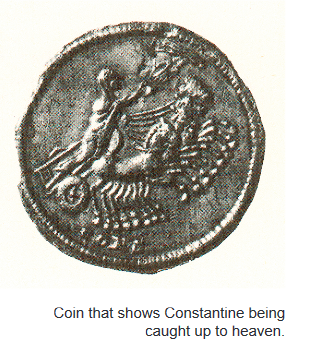
Last but not least Constantine designed a coin showing himself being caught up to heaven.
After the death of Constantine, his sons reigned and continued the new pagan/Christian amalgamation. Pagan traditions, feast days and titles all remained the same, but were simply attributed to Christ.
“In doctrinal questions, as with all others, no steadycoursewas held. They receivedcouncilfromtheir subjects; letters andappealsfrom individuals, societies, policy makers, provinces andChristian politicalrepresentativesetc. and theyfavouredthosewiththebest arguments, the most appealing rhetoric, and those that flattered them the most”
(Translated from “Antikkens Historie” p.247).
The pope takes the reigns
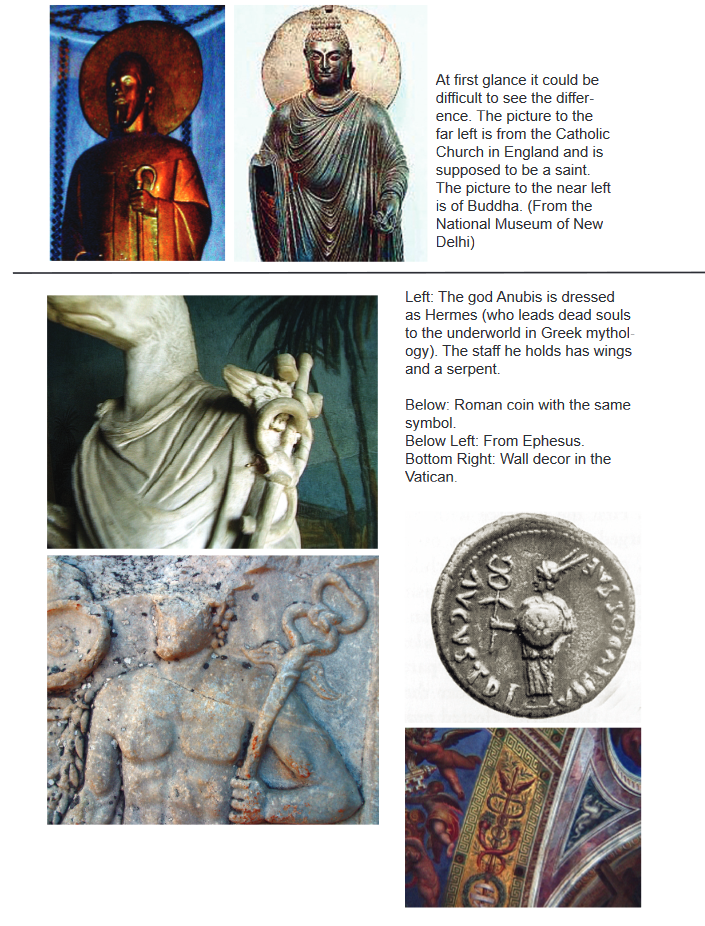
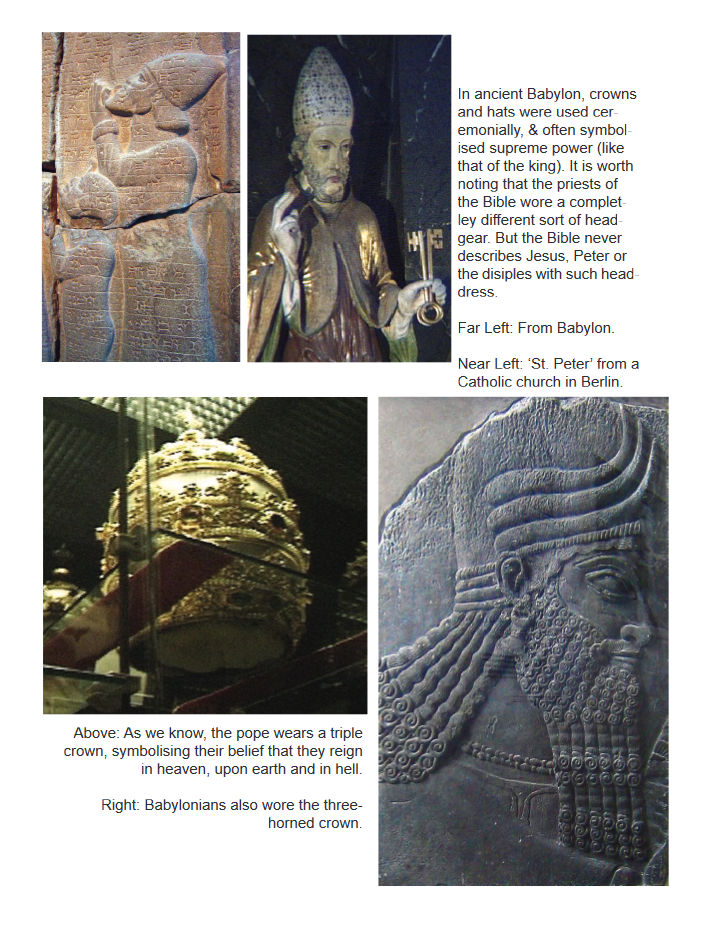
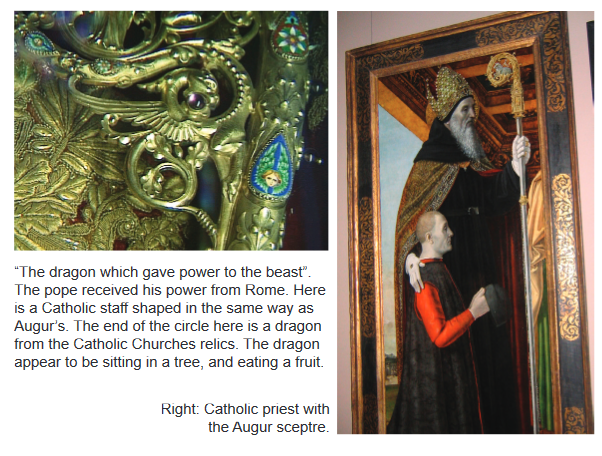
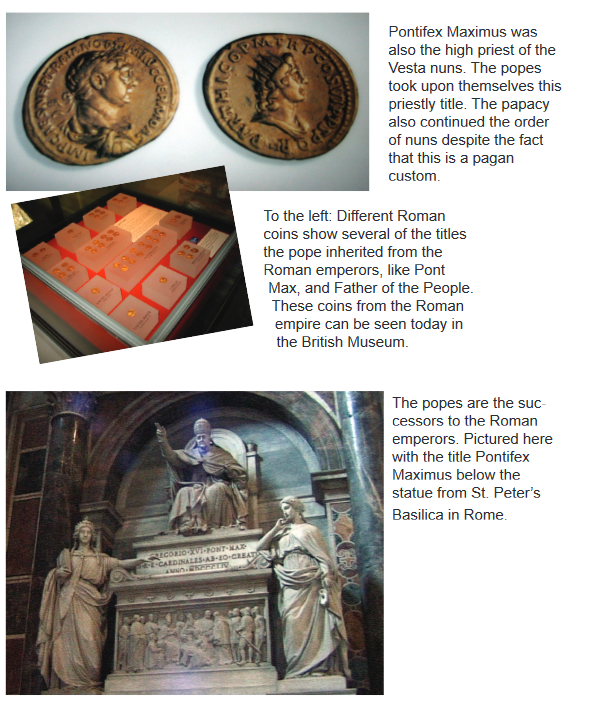
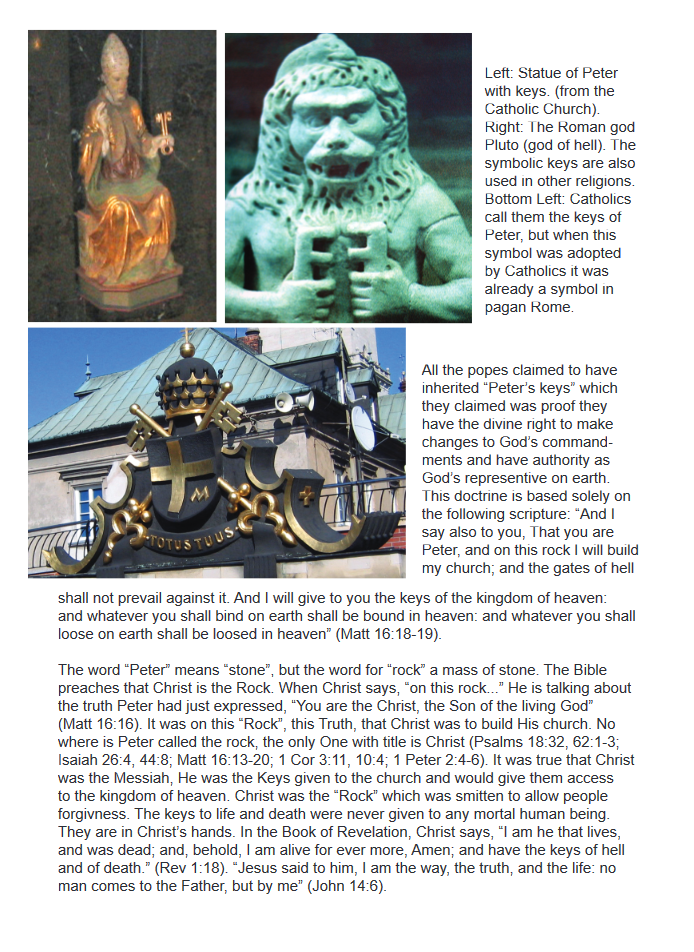
In the year395the kingdomwasdividedbetweentheeastandthe west. The grandkingdomthatemerged eastward, westward and northward, was then divided among various different Germanic tribes. In Rome a change in method of rule occurred. In the 6th century the pope, the so called “high priest” of the Christians, took the emperors seat and continued the tradition that had been continuing since the start of the Roman empire, hence, “the dragon… gave power to the beast”. The pope entitled himself with all the same heathen priestly titles, Pontifex Maximus andFather of the People, and notonlyinheritedthetitles attributed to the emperors and the symbols of their power, but he actually inher-ited the full extent of their power as well. The bishops and popes inherited the sceptre, or staff of Augur, the sign of the heathen king and high priest and the Romans understood and accepted the full implications of this. The popesdidnotinherittheirsceptre from Peter. Peter himself was never authorised to either receive worship or to rule. The historic facts tell an unambiguos story – the popes received their power when the Roman empire fell, and adopted the emperorsreligopolitcal state, titles and spirit. For over a thousand years the papacy ruled and persecuted other religious communities and individuals; among them were Jews and any Christian communities that did not adhere to Catholicism. Millions of innocent lives still scar the con-science of the Catholic Church. Christ calledHis followerstoteachall nations, kindred, tongue andpeople about God. He had encouraged them not to rule as the heathen did, and that none should seek to elevate themselves above another. Christ did not institute a kingdom inspired by paganism, nor did He prophesy that something like this would be instituted before the “New Earth”. When the Roman emperor Constantine converted to Christianity, the Christians had already started falling away, mixing pagan elements into their belief. Not long after theRoman empirebeganto fall, the kingdomwasdividedandthe emperors disappeared. Christianity became the new state religion and the high-est bishop in the Christian church was exalted to take the emperors place. The popes exploited their religious power and the support of the people, to the same degree as the Roman emperors and the Babylonian kings. They claimed they were chosen of God, to be God’s vicar, or representative. It was claimed that it was given them to decide who was holy and who was not, to dictate laws and traditions on God’s behalf. They claimed they followed in the footsteps of the apostles, and especially Peter. The Archbishop James Cardinal Gibbons, in his famous book in support of the Catholic Church wrote,
You cannot, therefor, be a true citizen of the Republic of the church so long as you spurn the legitimate supremacy of its Divinely constituted Chief. “He that is not with Me is against Me” says our Lord, “and he that gathered not with me scattereth.” How can you be with Christ if you are against His Vicar?”
(Faith of our Fathers, James Cardinal Gibbons, p.97).
Such sayings and others similar to this have had a grip on millions inside the Catholic Church, but is what they are claiming really true?If God viewed the appointing of a king in Israel as a rejection of Him as King, how does He feel about the pope? According to the Bible, Christ is the Head of the church, He who holds the key to life and death and who is the High Priest for His church (Rev 1:18, 1 Cor 1:17, 18 & Heb 3:1). The very same entitlement that the pope claims for himself. All the same arguments that the heathen powers had used, are now used by the Catholic Church to legitimise their power as God’s representative. The Pharaohs were long gone, the kings of Mesopotamia had stepped down, the Roman emperors were fallen, but their power structure continued from the fourth cen-tury AD until Napolean took the pope captive in 1798. Then in 1929 the papacy regained their political power, and their power structure remains the same to this very day. Babylon did not just claim they were chosen of God after the flood, but also that their kings lineage had continued from before the flood, right back to the very beginning. Equally, the Catholic Church today claims that Christ instituted their authority, and that the apostles (especially Peter) are part of their lineage. As the Babylonian claim was a lie, it is natural to be suspicious of the popes titles and claims to leadership, as they are directly inspired by the Roman empire and not by the intentions of God. God did not call Abraham to walk in the foot-steps of Babylon, nor did He call His disciples to walk in the footsteps of Rome. God had a different calling and a different plan and His point of view and will is clearly expressed through His communication with Israel, and Christ’s com-munication with the disciples. Another major point Christ puts forward, is that you are not chosen by God regardless of your behaviour. It has not been given to man to dictate to God. In His conversation with the Scribes this point was clearly made. They claimed the right to judge and to speak on God’s behalf because their forefathers were once chosen. Christ destroyed this argument completely,
“I know that you are Abraham’s seed; but you seek to kill me, because my word has no place in you… They answered and said to him, Abraham is our father. Christ said to them, If you were Abraham’s children, you would do the works of Abraham”
(John 8:37 & 39).
John the Baptist who prepared the way for Christ, said the same,
“And think not to say within yourselves, We have Abraham to our father: for I say to you, that God is able of these stones to raise up children to Abraham” .
(Matthew 3:9)
Lineage or inheritence or the claim of God’s approval means nothing. What matters in the biblical sense is if one does the will of God or not. It was by this principle that one could recognise God’s true workers as oppose to the false. In Babylon archaeologists found laws that had many similarities with the laws that Israel received. In the Skoyen collection, there are inscriptions which show many commandmentsidenticaltosomeof the Ten Commandments. Babylon was anything but a lawless society and they had many laws to take care of the poor and the homeless. The Hammurapis code of law states,
“That the strong may not oppress the weak, to give justice to the orphan and the widow, I have inscribed my precious words on my steele and established it in Babylon before my statue called `King of Justice`.” .
(Joan Oates, Babylon, Thames and Hudson, p.75)
The problem was not that they did not have laws, but that they did not have all of God’s laws. They themselves chose what laws they wanted to keep and threw away what they did not like. The leaders dictated the will of God to the people, when actually God has His own will. Similarly the Catholic Church has encouraged many good deeds and have kept many of the standards from the Bible, but as did Babylon, the Catholic Church added man-madelawsandfalse theories. They havemadeseveral changes; rejecting some of God’s commandments whilst adding hundreds of laws and rules that God never ordained, and are in many cases in direct opposition to God’s commandments. The Catholic Church has claimed that many of the laws God ordained, for instance the health laws, are no longer valid because God does not want to put these burdens on people. At the same time they have fab-ricated many laws themselves which are ten times the burden of God’s require-ments. The Catholic Church has theologically positioned themselves strongly against the Jews andclaimedtheyhavelosttheirposition asGod’s chosen people because they failed to recognise Christ as Messiah. Yet when they themselves have fallen away in every conceivable way, they claim that their election stands sure regardless of what they do. The traditional pagan way in which the pope continues to steer the Church is what Paul warned would happen among the apostate Christians,
“Let no man deceive you by any means: for that day shall not come, except there come a falling away first, and that man of sin be revealed, the son of perdition; Who opposes and exalts himself above all that is called God, or that is worshipped; so that he as God sits in the temple of God, showing himself that he is God” .
(2 Thess 2:3 & 4)
We know that Paul does not talk of the Roman emperors, for they were already at work when he wrote this. He was talking to the Christians, warning of a Christian falling away, and the subsequent rise of a false leader who would try to control the Church. The popes receive adoration and even worship in the same way the emperors and the kings before them. Herod also received such adoration but in this case God showed His displeasure immediately,
And on a set day Herod, arrayed in royal apparel, sat on his throne, and made an oration to them. And the people gave a shout, saying, It is the voice of a god, and not of a man. And immediately the angel of the Lord smote him, because he gave not God the glory: and he was eaten of worms, and gave up the ghost” .
(Acts 12:21-23)
When the children of Israel asked for a king, God said it was because they did not want Him to reign over them. God Himself wanted to be King for His people from His throne in heaven, and not have a royal mediator the way the heathens did. The veryrejectionofthisgodly principle, the ordinationof a “father” in the Christian church, is apostacy. Any man claiming to be the voice of God but concurrently rejecting God’s word, and mixing the pure with the impure is a perfect copy of the spirit of Babylon.
The beast that rose up from the sea previously identified is called Babylon in the Book of Revelation. What does this name really mean? Today, Babylon is a pile of ruins just as God prophesied through Jeremiah (Jer 51:37). The remains of ancient Babylon are hardly a threat to anyone today. If weare to understand why God callsthe beastBabylon severaltimes in the Book of Revelation, you first have to understand biblical terminology. In Romans 9:6-7 we can read,
“Not as though the word of God hath taken none effect. For they are not all Israel, which are of Israel: Neither, because they are the seed of Abraham, are they all children.”
What Paul explains here Christ also explained when He conversed with the Scribes and Pharisees,
I know that ye are Abraham’s seed; but ye seek to kill me, because my word hath no place in you. I speak that which I have seen with my Father: and ye do that which ye have seen with your father. They answered and said unto him, Abraham is our father. Christ saith unto them, If ye were Abraham’s children, ye would do the works of Abraham” .
(John 8: 37-39)
It is not hard to understand what Paul and Christ are trying to say here. God looks on mans works, and from this He determines what family he belongs to. So when God calls the beast coming out of the sea Babylon, it is because this power is similar to Babylon in it’s spirit, works and structure. The beasts in the book ofDaniel show usBabylon’s successorsuntiltheendof time. The last transference of Babylon’s spirit is to the Roman Empire, and then to the Little Horn which lasts until the end of time. How then does the papacy compare to Babylon? Let us first understand what the works of Babylon are.
God’s people and the falling away.
The Creator, the God of the Bible, inspires the foundation for the majority of religions today. There are many different types of Jewish communities, and several different Muslim communities, as well as hundreds of different Christian denominations. Despite the fact that they all share the God of Abraham as their God, they all disagree over what He stands for and who His spokesmen are and are not. So who is it that truly represents the Creator, and who are deceived? The dispute as to who is revealing the truth over God didn’t start with Christ or Mohammed, or by the different church denominations, nor did it start among the different Jewish communities. By tracing back to how and when it all started it is easy to discover who is representing the truth today. According to the Bible man was in close contact with a visible Lord. It is written that He came personally to converse with the first generation. There was harmony between God and man and therefore no reason to separate Himself from them. After sin entered the world and man became rebellious against God’s law, and against the law of nature, and grew evil toward one another, God sent a flood over the entire planet. Only one man and his family were saved by an ark that God commanded them to build. All mankind came from this one family. Ever since Adam and Eve had sinned, a promise for a Substitute was given to mankind. As a reminder of this, they were given the sacrificial system. So it was Noah who must have known God’s truth and been faithful and obedient to Him. The story of the world’s beginning, the flood and the Saviour to come, was therefore something Noah had taught his children and grandchildren. As God chose Noah, we can be sure that under him, the truth was pure and unadulterated at this early stage.
Noah’s Ark landed in the land RRT, which is the Urartu area in eastern Turkey, translated asArarat in most Bibles. According to theBiblethepopulationstarted here. Archaeology agrees with the Bible,
It iswellknownthatsome of the world’s oldest farming communities lie to the north of Babylonia, within the mountainousregions of Iran, Iraq, the Levant and Turkey”.
(Joan Oates, Babylon, Thames and Hudson, p.14)
Precisely intheareasouth of Urartu (or Ararat). All mankind came from Noah’s family and the early generations knew about the flood. If the Bible tells the truth, Noah’s experience should be widely acknowl-edged among communities around the world, and not just in the Middle East.
Knowledge of how the old world was destroyed in the flood with only a few people saved, is preserved in legends among various races in different parts of the world. In the Norwegian book, “De Flutsagen Ethnographisch Betrachtet” the author R. Andree mentions no less than 88 local versions of the story of the flood, from different races in different parts of the world, even the islands in the Pacific” (Alpha and Omega, vol. 1, p78).
Nimrod and his successors. According to the Bible Noah lived for 350 years after the flood. He lived to see his grandchildren, his great grandchildrenand his great, great grandchildren. One of Noah’s grandchildren was called Nimrod who “began to be a mighty one in the earth”. According to the Bible he built the first cities after the flood; Babel, Erech, Accad, Calneh, Nineveh, Rehoboth, Calah, and Resen. Some of them have been identified by archaeologists today, while others have not been found. Therefore we know that the first city of Babel was in the same area as the latter Babylon – the area of Mesopotamia. Experts agree,
Mesopotamia, with its exceptional agricultural potential but its lack ofnatural resources, was apositive stimulus. Although certainlynotthe only one, towards the growth of the world’s first cities”
Joan Oates, Babylon, Thames and Hudson, p14.
Several discoveries indicate that civilisation started in the same area as the Bible records. Archaeologists agreethattheareabetweenthetwo rivers (which the wordMesopotamia actually means) south of easternTurkey iswherewriting was first created and put into use.
“Writing was invented in Mesopotamia as a method of book-keeping. The earliest texts known are lists of livestock and agri-cultural equipment. These come from the city of Uruk (Biblical Erech), from an archaeological stratum designated by the excavators as Uruk IV (c.3100 BC)”
Joan Oates, Babylon, Thames and Hudson, p.15
Ancient Mesopotamia wasthehomeofsomeoftheworld’searliest cities, and the place where writing was invented. For these two major developments alone – urban society and literate society – it might justly be titled the ‘cradle of civilisation’, but in its literature, its religious philosophies and no less in its art it can also be placed firmly as the direct ancestor of the Western world”
(Gods, Demons and Symbols of Ancient Mesopotamia, An Illustrated Dictionary, Jeremy Black and Anthony Green, The British Museum Press, 1992, p.7).
Nimrod, Noah’s grandchild, whom the Bible says built many of these cities, is described as “the mighty hunter before the Lord”. The original Hebrew text here uses a word which literally means “in opposition to”.
“Arabic texts tell us that he claimed to have seen a golden crown in the sky and that he took it and put it on his head and then demanded to control this world in the name of the sun.”
(Babylon the Great Whore, by Torkild Terkelsen).
With Nimrod came the first great falling away from God’s truth, even though he claimed to have been chosen by the gods. When the Tower of Babel was built, “…they said, Go to, let us build us a city and a tower, whose top may reach to heaven; and let us make us a name, lest we be scattered abroad on the face of the whole earth.” (Gen 11:4). The God of the Bible claims He did not approve of this movement, and to avoid the world’s first centralisation of power, He confused their languages so that they could no longer work together and they dispersed around the world. God had not crowned Nimrod and He never chose anyone to have soul dominion upon earth. It had not been given to any man to control the world as if he was God, or God’s representative. God’s plan was of a different nature, His work was not to be left to human hands. Even so, the people of Mesopotamia and the surrounding nations, followed in the same footsteps as Nimrod, and copied his pattern of rule, by claiming that the gods had granted each king his kingship.
“Later written sources tell us that all authority derived from the gods, and all individuals whom we would classify by their functions as “religious” or “secular” officials acted alike as the servants of their divine overlord.”
(Joan Oates, Babylon, Thames and Hudson, p.25)
Mesopotamia had the first state religion as there was no separation between religion and state. This method of rule was subsequently adopted by Babylon. Religion was completely merged with the instruments of power, law, and daily life. The record of the flood and the man who survived it with his family was a famous historical document in Babylon. Several details from the biblical record of Noah’s experiencearealsomentionedonthesetabletsfoundin northern Mesopotamia. One of these tablets can be seen in the British Museum in London today. Even though archaeologists have not found Nimrod’s true name in Mesopotamia, according to the Bible he was a leader at the birth of civilisation in Mesopotamia. Early sources reveal a little about how kingship was declared,
“According to Mesopotamian tradition, embodied in the Sumerian King-List, kingship descended from heavan after the legendary flood and was then held by a number of cities, each taking its turn as the seat of royal authority and, by implication, exercising hegemony over the whole country.”
(Joan Oates, Babylon, Thames and Hudson, p.27)
In other words, Nimrod and his successors claimed that the supreme God had entrusted them to reveal His will and to reveal the truth after the flood – that they were chosen of God and represented His will. Archaeological discoveries to date, reveal that the Babylonian king Sargon had a grandchild calledNaram-Sin whowasoneofthefirstwhogave himselfhonour as if he was divine himself.
“Naram-Sin adobted a style previously the exclusive prerogativeofthe gods. On hisowninscriptionshisnameappearsprecededbythedeterminative for “divinity”, that is, the cuniform sign “god” normally written before the name of a god”. The language in texts dedicated to him is even less reserved, and in these his “servants” address him not merely as divine but literally as ‘god of Agade‘.”
(Joan Oates, Babylon, From Sargon to Hammurapi, Thames and Hudson, p.41)
Ancient illustrations of Naran-Sin, show him wearing a two horned helmet which subsequently became a symbol of lower ranking gods, for example, “God’s companion” (Ibid p41). Even though the different emperors throughout time did not always exalt themselves in the same manner, they all claimed to be God’s representative. But according to the Bible, God had not chosen these people, but choose a simple man who lived in Mesopotamia (Acts 7:2) as he had remained faithful to God’s truth despite being surrounded by apostasy. God did not chose him as His substitute or as a world ruler. The man God chose was called Abram, who was later renamed Abraham. God asked Abraham to leave the area of Mesopotamia and travel to a country God would give to him and his ancestors. The whole world adopted the Babylonian view of God and their mythological version of the fall of man and the war in heaven. So God wanted to choose a people to preserve His truth. But God would still allow the lies to spread among those who did not love the truth. Abraham was to inherit a country where his future generations could be a light in the dark. God renewed His promise of a Saviour to come from the seed of Abraham, the same promise that was given to Adam. Having faith in God’s promises, Abraham left his friends and family and jour-neyed from his home town Ur, in Mesopotamia, towards Canaan (which is now Israel). There were now two great contrasts; Abraham and the exalted kings of Mesopo-tamia, both who claimed to represent the same God; He who created the Earth and later allowed a world wide flood. Who was telling the truth? Even though the easiest choice in the time of Abraham would be to believe and follow the grand kings of Mesopotamia rather than a simple nomad, today it is commonly understood who God really chose. The Bible prophesied of Babylon, “And Babylon shall become heaps, a dwelling place for dragons, an astonish-ment, and an hissing, without an inhabitant” (Jer 51:37). The passing of time determined that the God of Noah was now with Abraham, and not with Nimrod and his successors. Therefore we can see that the God of Abraham and His holy Bible is a guide-line as to who God is with and what is His will. It is important to remember that when the languages were confused, the name of God also took on many different pronounciations. The same happened to the name of Noah and his family. The promise given to Noah of a Saviour was well known. Time after time various men claimed to be that Saviour who was to be born of a virgin. A star sign has been named after the virgin which was originally a woman with a branch in her hand. It was common then to sculpture statues of a woman with a child. The woman was worshipped as divine and usually called the “Queen of Heaven” (Jer 44:17). In addition to worshipping the Queen of Heaven the characters of good and evil angels from the war in heaven were made mytholigical and were spoken of as gods. As God had not revealed every detail of the war in heaven (which later spread to earth), speculation and myth crept in due to man’s constant desire to explain everything at all times.
Myths were also fabricated to strengthen the position and power of kings. Fanciful stories inspired a new direction in worship. Some of these myths are found in tablets fromMesopotamia andcontain amixture ofelementsfoundin the Bible, with elementsthatcontradict the Bible. For example, the Babylonian ruler Gilgamesh records how he travelled to see the man who had survived the flood, while he adds to the story that Ishtaar (the Babylonian goddess) made advances towards him, and other stories of his dangerous journey to visit the man we know as Noah (Mesopotamian Myths, the British Museum Press). One of the reasons that you can safely assert that the Babylonian myths cannot be true is that they often contradict each other.
“As might be expected from such a broad field, they display very considerable variety, and in many cases there are several different versions of a narrative, originating from different localities or in different periods, some of which directly contradict other versions.”
(Gods, Demons and Symbols of Ancient Mesopotamia, Jeremy Black and Anthony Green, The British Museum Press, 1992, p.14)
Not surprisingly, the same concept is used today. A true story is only based on the actual event. Artistic license allows ample room to add or take away finer details from the actual event. Hollywood has produced movies about a historic event, but have added themes, characters, dialogue etc. that they never claim to be historically accurate. It is simply understood by the audience that the movie is based on a true story. To create stories has always been man’s passion. We have fictitious novels and movies, and people act out stories based around history with authentic place names and historical events. Many authors thoroughly study the time period to authenticate the setting of their fiction. Details of the food they ate, the clothes they wore, how they laboured and the political climate is incorporated into the fictitious story. The more realistic the story is and the more facts used, the more praise and recognition the movie or novel gets. This happens today and has happened in times past. Not only in Mesopotamia, but the Greeks loved theatre and mythology based on their gods. The Egyptian empire and the Roman empire, in South America and in Asia, the same is found throughout the ancient world. When man was separated after the Tower of Babel, most people had an understanding of the war in heaven, the fall of man and the flood, but when writing about these events, they added to their stories according to their own traditions. This also happened after the time of Christ. For many years the Bible was known as the book which testified to the life of Christ, but today certain denominations have added to the story, based on their own understanding. Some claim that Christ went to America to minister to the native Americans after He died on the cross, others have created myths about Christ going to hell, where as well as dying for man, He also suffered in hell for us. Few have acknowledged what the Bible actually says Christ really did after His resurrection; He became our High Priest in the sanctuary in heaven.When we dig for truth amongst an array of claims and counter-claims, we need to understand that some writers have added fiction to fact. The kings of Babylon who claimed they were God’s chosen ones, continued to create myths that exalted their kingdom. They created temples, and images and statues of mythological and divine figures. They fabricated religious ceremonies and rituals. When the God of the Bible is angered at Babylon, He is also angered at the tremendous corruption that has infiltrated God’s truth. They also initiated “the way of the heathen”, which in many ways was the total opposite of what God stood for and wanted for His people. Babylon was not a lawless society. The discovery of the law of Hammurabi reveals to us the laws of Babylon. The law proclaims punishment for various social crimes. One of the first laws found by archaeologists is from Ur-Nammu, also in Mesopotamia. The forerunner to money also originated in Mesopotamia,
“silver served too as a medium of account, thus already fulfilling all the classical functions of money. Long lists of commodities valued in silver provide the earliest ‘price index’ for the staples of Mesopotamian life”
(Joan Oates, Babylon, From Sargon to Hammurapi, Thames and Hudson, p.44-45)
Babylon also had public schools, restaurants, and controlled trade. They had laws for equality between men and women, and they imposed fines for petty crimes and several other concepts that we practice today (Ibid p45).
The Centre of the Old World
Although it enjoyed rich farmland, the land between “the two rivers” or Mesopotamia, was a country with few resources. This is whyBabylon wasso dependent on trading with other countries.
Babylonia, though potentially rich in agricultural products, lacked such essential commodities as stone, timber and metal ores… For this reason trade was of crucial importance, and at an early period an extensive network of routes grew up linking Babylonia with the rest of the Near East.”
(Joan Oates, Babylon, Thames and Hudson, Introduction p.11)
Not only due to their dependence on trade, but also because their land was in the middle from where man spread eastward and westward,
“Not only did Babylon lie within that small area of Mesopotamia where its two great rivers, the Tigris and the Euphrates, approach most closely to each other, but its situation at the notheren end of the alluvial plain gave it potential control of two of the most famous roads in the ancient world… The advantages of this situation, both commercial and military, were fully appreciated and exploited by a succession of Mesopotamian dynasties and undoubtedly dictated the establishment, within 80 km of one another, of ‘the most remarkable sequence of historic capitals in the world’.”
(Ibid, p.10)
Controlling the most strategic areas in ancient times and due to their trade with other countries, Mesopotamia ended up having strong influences upon all of civilisationatthat time. It wasforthis reason, as wellasthedispersionfrom theTower of Babel, that Babylonian mythologyspreadfarandwideandwas adopted throughout the entire Middle East, and from there to European countries.
Later and almost certainly apocryphal tradition attributes to Babylon an early importance as a religious centre.”
(Joan Oates, The Old Babylonian Period, Thames and Hudson, p.60)
Perhaps the most important role of the Hurrians in the story of Babylon lies in the part they played as intermediaries in the transmission of Babylonian culture to the Hittites, to the Palestinians and Phoenicians, and indirectly, to Greece and the western world.” (Ibid, p.87)
Yet the Kassites ruled a unified Babylonia far longer than any other Mesopotamian dynasty, and the emergence of Babylon as the political and cultural centre of the ancient world took place under their aegis” (Ibid, p.101).
At its greatest extent, the influence of Mesopotamian civilisation could be felt as far away as modern Iran, Lebanon, Jordan, Israel, Egypt, Saudi Arabia and the Gulf States, Turkey, Cyprus and Greece; there were also commercial connections with the Indus Valley (Pakistan).”
(Gods, Demons and Symbols of Ancient Mesopotamia, Jeremy Black and Anthony Green, The British Museum Press, 1992 p.11).
Israel
Abraham had received God’s promises and moved from Mesopotamia, where according to the Bible, his entire family had been influenced by pagan worship. The land that God had promised him was not actually claimed until several generations later. The delay occurred because God wanted to grant the native population as much time as possible to turn back from their apostasy and their wicked way of life. Eventually though, Abraham and his sons Isaac and Jacob,lived withtheirfamiliesinthelandtheyhadbeenpromisedaswitnessestothe inhabitants. But thepeoplecontinuedtopracticetheiridolatrous worship, inspired by Mesopotamia, which included violent, sexual rituals and child sacrifices to the gods. Due to famine in the land, Abraham’s descendants moved to Egypt where they ended up as slaves under Pharaoh. God finally led them from Egypt back to Canaan (the land Abraham had been promised) because the time of probation for the inhabitants of Canaan was over. Israel conquered the country after receiving God’s moral, ceremonial and judicial laws. God chose Abraham and not the king of Babylon to preserve the truth and revealHis character. The Ten Commandments werethemorallawgiven to Israel at Mount Sinai, and were to separate God’s truth from all the pagan religions. They were asked not to have other gods; there was only one God and He was the only One they were to worship. No queen of heaven, no prayers, and no sacrificing or worshipping the dead the way the pagans did. They were only to sacrifice, pray to and worship the true God. The law was not new, God just confirmed it in writing. Abraham had kept God’s commandments and had not prayed to any other gods; only the one true God. Another commandment God asked of them was to not make any graven images of anything in heaven, on earth or in the sea. Nor were they to even worship in front of images,
“Take you therefore good heed to yourselves; for you saw no manner of similitude on the day that the LORD spoke to you in Horeb out of the middle of the fire: Lest you corrupt yourselves, and make you a graven image, the similitude of any figure, the likeness of male or female”
(Deut 4:15-16).
This was difficult for Israel to understand and adjust to, as all people from all nations worshipped their gods before statues or images of their gods. But God had asked them not to make an image of Him or of anyone else, and not to worship in front of it. But Israel went through a falling away. The Bible tells us that they adopted Babylonian gods in the same way as the surrounding nations. Even the famous king Solomon built altars for the goddess of Astarte. Israel did not reject their belief in their God, but they rejected His commandments and added pagan practices to their worship. The first time they made an idolatrous image was the golden calf at Mount Sinai. They claimed that they had made an image of the true God, but God did not want them to do this as it would lead to mythology. The God of the Bible says,
To whom will you liken me, and make me equal, and compare me, that wemaybe like? They lavishgoldoutofthe bag, and weigh silver in the balance, and hire a goldsmith; and he makes it a god: they fall down, yes, they worship. They bear him on the shoulder, they carry him, and set him in his place, and he stands; from his place shall he not remove: yes, one shall cry to him, yet can he not answer, nor save him out of his trouble. Remember this, and show yourselves men: bring it again to mind, O you transgressors” .
(Isaiah 46:5-8)
He also said to them,
“Hear you this, O house of Jacob, which are called by the name of Israel, and are come forth out of the waters of Judah, which swear by the name of the LORD, and make mention of the God of Israel, but not in truth, nor in righteousness”
(Isaiah 48:1).
Just asBabylon hadclaimedto serve the God who created Earth, fabricating their own version of truth and their own method of worship, so too did Israel when they claimed to serve God, but rejected His commandments and His will. God did not want to be worshipped falsely or be intermingled with mythological fables about a so-called queen of heaven, or any other god. It was for this purpose that God had chosen Israel, so they could represent Him correctly and so He could give them a blessed, rich and full life. Instead the idolatrous worship made them monstrous where they even sacrificed their infants, in the fire of Molech (a Babylonian god), as a pagan ritual. Because Israel flirted with the religious mentality of Babylon, God allowed their temple to be destroyed, Jerusalem to be conquered, and the people to be taken away captive to the very place they idolised – Babylon. God gave them over to their seducers because of their unfaithfulness, yet He was still hoping to reach them while they were in exile. God wanted them to understand that He could not blessthepaththeyhadtaken butHe wantedtohelpthem,and wantedto choose them again if they would only turn from their ways and seek Him. For seventy years they were in captivity in Babylon before they returned and started rebuilding the Temple and the city. Even though Israel continued some of the pagan practices, their loss of freedom aroused aninterestintheirnational identity. They rememberedtheirdaysof freedom prior to when they copied the surrounding nations. They had preserved the booksof theBible thatarenow the Old Testament,and againsoughtto follow it as their guideline. All the in-fighting and their grievances with God were recorded. All the words God had spoken to guide them and show them the truth were opened before them, and the God of the Bible was in such contrast to the gods the pagans claimed were the creators. The first four commandments revealed the God of Israel, how He did and did not want to be worshipped. These commandments would expose who was truly serving Him and who corrupted His name with lies. But thestorydoesnotend there. The Saviour, or Messiah thattheyhadbeenpromisedwasstilltocome fromAbraham’s lineage, in thedays whenIsrael wouldbesubjectto the Roman Empire. As prophesied, the Saviour wasalso to be a blessing to the gentiles, hence the gospel was to be spread to the entire world – a world already deeply rooted in generations of Babylonian paganism. Just as when Noah revealed truth to his descendants and subsequently falsehood emerged, the same would happen when Christ came to reveal truth concerning God. As the Son of God He was to represent God and portray Him to the world. However, as always, truthwasthreatenedwith lies, myths and fables. Christ warnedagainstthis andHe andHis disciplesannouncedthattherewouldbe a falling away amongst the Christians, that there would be a false gospel, that false leaders would claim authority in His name, and even among themselves men would rise up with false teaching and try and deceive them. Even though Christ had chosen the Jews for generations with the true word of God and His law, there were no guarantees that they would not contaminate the truth of the gospel. So Christ appointed the Jews to spread the gospel to the gen-tiles, and while they were to tell people of the Saviour they were also to teach the heathen who God really is and how to worship Him correctly. 2000 years havepassedand everythingChrist andthedisciplesprophesiedwouldhappenamongstthe faithful, has now happened. Today wehavemany different faiths, different teachings and we have to dig deep to find the truth. The Bible warnsusagain againstBabylon andasksthosewhowantto serve Him to “come out of her”. The Bible has already prophesied that Babylon would never beinhabited again. Indeed thereisnoonein literalBabylon today, so itmustbereferring toBabylon’s religion, mentality andfalseteachingthathassurvivedanddeceivedpeopleforthousandsof years. Now Babylon has again led the people of God (those that accepted the Messiah) into falsehood and deceit, which is why God pleaded for them to “come out of her”. At one time God called Abraham to come out from the false teaching that had spread amongst Noah’s descendants, later He called an entire people to leave, and now there is that calling to the Christians. To understandwhatthefalseteaching ofBabylon is, we needtogoback to Babylon and take a closer look at it’s religion and the nature of it’s kingdom. Then we can discover if we have mixed Babylonian teaching with the truth and thereby misrepresented God to others – as well as ourselves.
The Religion of Babylon
Although noteverydetailhasbeendiscovered regarding Babylon, and thereremainmanyanomaliesinour understanding, several thingshavebeenmade known. We also know the Greeks passed on, and even added to the myths of the Babylonian kings and gods. Much of the Babylonian religion is familiar to us today, because Babylon has had an immense influence on many religious traditions to this very day. Sur-prisingly, it isneitheratheismnorhumanismthathaveabsorbedthespirit of Babylon; it isin fact Christianity! Throughout theyearsthespirit ofBabylon has infiltrated generation after generation with its false understanding of God. Those who bore the torch of Babylon were the Greeks, and from them to the Romans, and from theRoman emperorstotheir successors, the papacy. The Roman Catholic Church carries the torch to this very day and is the world’s largest congregation.
The Rulers of the Heathen
As we already mentioned, according to the Sumerian line of kings (one of the first dynasties in Babylon), the kings were considered specially chosen by the gods to be rulers on the earth after the flood. The kings were exalted, often as divine, and at other times as the earthly representative of the gods. The people knew that sin had entered the world and there had been a flood but they were then diverted away from the God of Noah. They added their own myths and fables, exalted man and claimed it was permitted to pray to other exalted characters.The Mesopotamian kings did not just claim to be rulers over the people, but the entire world. Several of them titled themselves “king of the four quarters of the world”. Among those who adopted such titles were Naram-Sin and Hummurapi. (Joan Oates, Babylon, Thames and Hudson, p35). State and religion, priests and state representatives were merged together, where the divinely ordained king was also the high priest. This pagan structure was not only used in Mesopotamia, but in all countries that Babylon had inspired. This method of rule prevailed from the Egyptian Pharaohs to the nations of South America; in the Middle East and subsequently in the Roman empire. By calling themselves god’s representatives on earth, they could authorise laws and dictate mans religious development, and all this while dominating the people with the strong arm of the law. As with Babylon, the Roman empire was the epicenter of empirical power during its prime. The emperor was entitled “Supreme High Priest, PONTIFEX MAXIMUS, and The Spiritual Father of the People”. As the emperor and supposedly God’s chosen representative, it was he who decided what was holy or unholy, what was of God and what was not.
It must be understood that a public place can only become sacred if the emperor has dedicated it or has granted the power of dedicating it.”
(Roman Religion, Clifford Ando, 2003, p.247)
The central question before us might seem to be one of power… who was a god, and who was not? Thus stated, the question seems to lead inexorably to an old-fashioned view of Roman religion as legalistic, as granting power to mortals to dictate to their gods”
(Ibid p.8)
Religion was so inextricably linked to the emperor’s power over people and the kingdom, that in Babylon the new kings (who conquered the land) converted to the Babylonian religion in order to be seen as God’s representative and gain the loyalty of the people. Other kings in Babylon fabricated myths or took the name of former heroes, so they could be acknowledged as their successors. They became dependent upon convincing the people that they were ordained of God, as the means of retaining their throne (Joan Oates, Babylon, Thames and Hudson, p.86 & 103). Equally, the Roman empire’s political power was dependent upon her subjects religious convictions. When people became less religious, the situation became critical for the emperors.
Roman religion was in good health and held in high esteem to the extent that it was linked to politics and the political.”
(Roman Religion, Clifford Ando, 2003, p.118)
“There is certainly no question that myth was used for political ends, and that new myths were written in a political climate.”
(Ibid)
This is why it is often tempting to treat the myth as a work of art sufficient in itself, a literary or figurative work… which refers to other myths, but not to the cult in anything more than an artificial manner”
(Ibid, p.119, 120).
The Messiah whom God sent to teach the truth, made a comment regarding this heathen style of leadership. It was the Roman empire which ruled the Middle East where Christ was when He said to His disciples,
The kings of the Gentiles exercise lordship over them; and they that exercise authority on them are called benefactors. But you shall not be so: but he that is greatest among you, let him be as the younger; and he that is chief, as he that does serve. For whether is greater, he that sits at meat, or he that serves? is not he that sits at meat? but I am among you as he that serves” .
(Luke 22:25-27)
Christ did not come to win man by glamour or by force. He came to tell the truth. In contrast to the heathen version of God, Christ came to show a completely different spirit, and He clearly showed His disciples that He expected them to continue to spread the gospel in the same manner. The Book of Matthew records Christ as saying,
“You know that the princes of the Gentiles exercise dominion over them, and they that are great exercise authority on them. But it shall not be so among you: but whoever will be great among you, let him be your minister; And whoever will be chief among you, let him be your servant: Even as the Son of man came not to be ministered to, but to minister, and to give his life a ransom for many” .
(Matt 20:25-28)
Christ’s words were an indi-rect rebuke to the Roman structure, and all other nations who followed in the footsteps of Babylon.Israel also had kings as did the heathen, but it was never God’s plan for earthly kings to rule in God’s stead. It was Israel themselves who asked to have a king. To Samuel, the last judge of Israel, they said, “Behold, you are old, and your sons walk not in your ways: now make us a king to judge us like all the nations”. When Samuel heard this, he petitioned God as to what he should do, and he received this answer, “And the LORD said to Samuel, Listen to the voice of the people in all that they say to you: for they have not rejected you, but they have rejected me, that I should not reign over them. According to all the works which they have done since the day that I brought them up out of Egypt even to this day, with which they have forsaken me, and served other gods, so do they also to you. Now therefore listen to their voice: however, yet protest solemnly to them, and show them the manner of the king that shall reign over them”. Samuel then warns them against their decision to request a king like the heathen nations, “Nevertheless the people refused to obey the voice of Samuel; and they said, No; but we will have a king over us” (1 Samuel 8:5, 7-9, 19). Most of the kings of Israel led Israel into apostasy with only a few kings seeking to do God’s will. Christ prophesied of Jerusalem,
O Jerusalem, Jerusalem, you that kill the prophets, and stone them which are sent to you, how often would I have gathered your children together, even as a hen gathers her chickens under her wings, and you would not! Behold, your house is left to you desolate. For I say to you, You shall not see me from now on, till you shall say, Blessed is he that comes in the name of the Lord”
(Matt 23:37-39).
Jerusalem was indeed subsequently conquered and left in ruins in 70AD by the Roman empire, and the Jewish nation lost their royal seat for ever.
The Goths carried back these Christian captives (from Asia Minor)into Dacia, where they were settled, and where considerable numbers embraced Christianity through their instrumentality. Ulfilas was the child of one of these Christian captives, and was trained in Christian principles.
See footnote 1
THE story of the Goths enters strongly into the interpretation of the 1260-year prophetic period. When we consider the Goths and their appearance among the nations, it brings us to the name of Ulfilas.Pen can not picture how completely the face of Western Europe was changed by the Teutonic invasions sweeping from the east to the south and west. These continued for at least two centuries, ending in 508 when the Papacy completed its triumph over the newcomers. The inhabitants of Europe were driven into the background, as was also the general use of the Latin language, while strangers and foreign tongues reigned from the Danube to the Thames. The amount of territory of the old Roman
Dacia – Wikimedia.org
Empire was practically halved. Profound changes took place in what remained of that empire, now limited to the eastern end of the Mediterranean. Meanwhile, in eastern Europe there was a revival of the simpler types of Christianity. The Celtic and the Gothic peoples in the West also contributed to this new evangelical era. Great victories for Christ were won by Ulfilas (A.D. 311-383). The triumphs of this missionary were made among the nations crowded along the northern frontiers of the Roman Empire. Like Patrick of Ireland, he passed his early years in a land of captivity. Ulfilas finished his work about the time that Patrick was beginning his. There is much similarity in the beliefs and accomplishments of the two heroes. Lucian of Antioch was at the height of his career when Ulfilas was a lad. Asia Minor, the homeland of his ancestors, was, in the early years of the church, the scene of strong opposition to those allegorizing ecclesiastics who had been loaded with imperial favors by Constantine, and who were antagonistic to Lucian’s translation of the Bible and his system of teaching. Ulfilas was called to take his choice. He decided not to walk with the allegorizers. The Gothic Bible which he gave to the nations he converted follows in the main the Received Text transmitted to us by the learned Lucian.(2) Such early contacts and associations molded the belief and plans of Ulfilas. The Goths along the north shore of the Black Sea had pushed their boats to the southern harbors and had carded away captive the ancestors of Ulfilas who resided in Asia Minor. Constantine II, son and successor to Constantine, did not, as previously noted, partake of his father’s views, and he had thrown the aegis of imperial protection around the other party which was branded by the church at Rome as Arians. To these he had granted full religious liberty. What was the attitude of Ulfilas toward the disputes over the Godhead which had convulsed the Council of Nicaea? The historian W. F. Adeneysays:
There is no reason to doubt that Ulfilas was perfectly honest in the theological position he occupied. As an earnest missionary, more concerned with practical evangelistic work than with theological controversy, he may have been thankful for a simple form of Christianity that he could make intelligible to his rough fellow countrymen more easily than one which was involved in subtle Greek metaphysics.
See footnote 3
Although the Goths refused to believe as the church at Rome did, and as a consequence have been branded as Arians, Romanism actually meant little to them. In fact, it meant little to Ulfilas, their great leader.4 The Goths refused to go along with the mounting innovations being introduced into the church of the caesars, which church quickly branded any competitorArian. They were, above all, a warlike people before the coming of Ulfilas. The greatest struggle this apostle had with the Goths, as he informs us, was not so much the destruction of their idolatry as it was the banishment of their warlike temper. They, however, made great progress in replacing their passion for martial campaigns with a settled, organized government and the upbuilding of their civilization. From 250 to about 500, the Teutonic masses poured over the provinces of western Europe and formed ten new nations. Among these ten were the two branches of the Goths — the Visigoths, or western Goths, and the Ostrogoths, or eastern Goths. Other invading tribes were the Franks, the Burgundians, the Vandals, the Anglo-Saxons, the Alamanni, the Heruli, and the Suevi. These were destined to become powerful nations of western Europe. The invading hosts settled in the Roman Empire, forming such kingdoms as England, France, Germany, Switzerland, Spain, Italy, and Portugal. Three other kingdoms arose from the migrations, and if they had not been conquered, the Heruli might now be ruling over central and southern Italy, the Vandals over northern Africa, and the Ostrogoths in southern Europe. For two centuries these questions hung in the balance: Would these newnations cling to their ancient Germanic paganism? Would they become converts to Celtic Christianity? Would they fall under the dominion of the church at Rome? It is a gripping story that reveals how they were converted, some at first to Gothic, but later all to Celtic, Christianity before they were subdued by hostile nations whose armies were urged on by the Papacy. Because Ulfilas belonged to the church which had refused to accept the extreme speculations concerning the Trinity, there was a gulf between his converts and those who followed Rome. Brought up in captivity, he had not witnessed the stirring scenes of the Council of Nicaea (A.D. 325). In that famous historic assembly the church at Rome and the emperor rejected the views of Arius, and condemnation was pronounced upon those who recoiled from accepting the council’s decision. Whether the teachings of Arius were such as are usually represented to us or not, who can say? Philippus Limborch doubts that Arius himself ever held that Christ was created instead of being begotten. (5) Because of Constantine’s favor, the party of the church at Rome was dominant. After Constantine’s death, however, emperors for nearly a half century played loosely with the opponents of the Roman Church and often lifted the ban on the opposing groups. In fact, there were times when it looked as if the views of those who rejected the extreme Trinitarian speculations would become permanently dominant in the empire.Consequently when thousands of churches and church leaders of the opposition were stigmatized as Arians, it is not surprising to find Ulfilasstanding for these beliefs. Since the Goths had no written language, Ulfilas was compelled to invent an alphabet. He reduced Gothic sounds to writing. The first great piece of literature which the people of these vast nations, lying north of the empire’s frontiers, looked upon was the Bible. It became the bond of union amongst the Gothic peoples. It was the parent of Teutonic literature. It was the forerunner of a Luther, a Shakespeare, and a Goethe. But, as Massmann observes, there is no trace of what was called Arianism in the surviving remains of the Gothic translation of the New Testament.6Since his ancestors were from Asia Minor (the provinces where the apostle Peter had been especially instructed by God to plant the gospel),Ulfilas was undoubtedly influenced by the doctrines of the apostle to the Jews; and he rejected the liberal and unscriptural teachings which had flooded many western churches. He was a believer in the divine revelation of the Old Testament, as well as that of the New Testament. He impressed upon the Gothic people a simple, democratic Christianity. Like Patrick and Columba, he apparently kept the seventh day as the Sabbath. This may be seen in the following quotation concerning the great Theodoric, a subsequent king of the Goths (A.D. 454-526), taken from the historianSidonius Apollinaris. Sidonius was not only a bishop of the church in France, but was also the son-in-law of the Roman emperor. He was in France when the great invasions of the Goths took place. Therefore, he was well informed on the practices of the Goths. He writes:
It is a fact that formerly those who dwelt in the east were accustomed as a church to sanctify the Sabbath in the same manner as the Lord’s day, and to hold sacred assemblies; whereforeAsterius, bishop of Amasia in Pontus, in a homily on incompatibility called Sabbath and Sunday a beautiful span, and Gregory of Nyssa in a certain sermon calls these days brethren and therefore censures the luxury and the Sabbatarian pleasures; while on the other hand, the people of the west, contending for the Lord’s day, have neglected the celebration of the Sabbath, as being peculiar to the Jews. Whence Tertullian in his Apology: ‘We are only next to those who see in the Sabbath a day only for rest and relaxation.’ It is, therefore, possible for the Goths to have thought, as pupils of the discipline of the Greeks, that they should sanctify the Sabbath after the manner of the Greeks.
See footnote 7
Sidonius Apollinaris – Wikipedia
From a scholar and traveler describing the Muscovite Russian Church(Christians still dwelling in the region where tribes formerly had been affected by the teachings of Ulfilas) we learn that after their conversion they “ever since continued of the Greeke Communion and Religion;…reputing it unlawful to fast on Saturdaies.”(8) This same author, describing the doctrine of the Greek Orthodox Church, says:
They admit Priests’ Marriages…. That they reject the religious use of Massie, Images, or Statues, admitting yet Pictures or plaine Images in their Churches. That they solemnize Saturday (the old Sabbath) festivally, and eat therein flesh, forbidding as unlawful, to fast any Saturday in the year except Easter Eve.”
See footnote 9
The Papacy for many centuries commanded fasting on Saturday and this created a dislike among the unthinking church members for the sacredness of the day.10
CONVERSION OF THE GOTHS BY ULFILAS
It would be impossible to obtain a correct understanding of the events which drove the church into the wilderness without realizing the large part in the drama which circled about the Goths. Tribe after tribe of the Teutons — the practically unknown peoples living north of the Danube —possessed the power of making crushing blows against settled states. Masses of humanity, capable of being mobilized into destructive invading armies, hung upon the confines of the Roman Empire. The revolution wrought by their migrations and decisive victories in battle will appear as we evaluate their place in history. To the surprise of all, the Goths were won to the gospel in an astonishingly short time, not by the persuasion of Rome, but by Ulfilas. While the church at Rome was grasping after secular power, these churches were alive with missionary zeal. Onward then came those mighty armies of the invading hosts. Giant men seated on war steeds preceded the covered wagons in which were women, children, and earthly possessions. Province after province fell before their powerful battle-axes. The Roman populace either perished or fled to mountains and dens. Finally, in 409, the invaders arrived before Rome. After conquering the city which for centuries had terrified the world, they retired. But they returned after several decades for the final conquest of Italy. The Goths and the Vandals did not fight because of a bloodthirsty temperament, but because they were blocked by the Romans when driven westward by the wild masses from Scythia and Siberia. The historian Walter F. Adeney has pictured the spirit and methods of the Goths when they sacked Rome in 410:
In the first place, it was a great thing for Europe that when the Goths poured over Italy and even captured Rome they came as a Christian people, reverencing and sparing the churches, and abstaining from those barbarities that accompanied the invasion of Britain by the heathen Saxons. But, in the second place, many of these simple Gothic Christians learned to their surprise that they were heretics, and that only when their efforts toward fraternizing with their fellow Christians in the orthodox Church were angrily resented.
See footnote 11
The following words from Thomas Hodgkin show how superior were these invading hosts to the corrupt condition of the state church in north-em Africa, when the Vandals who also refused Rome’s state-prescribed doctrines seized the homeland of Tertullian and Cyprian:
August had said: ‘I came from my native town to Carthage, and everywhere around me roared the furnace of unholy love…. Houses of ill-fame swarming in each street and square, and haunted by men of the highest rank, and what should have been venerable age;chastity outside the ranks of the clergy a thing unknown and unbelieved, and by no means universal within that enclosure; the darker vices, the sins of Sodom and Gomorrah practiced, avowed,gloried in’ — such is the picture which the Gaulish presbyter draws of the capital of Africa. Into this city of sin marched the Vandal army, one might almost say, when one reads the history of their doings, the army of the Puritans. With all their cruelty and all their greed they kept themselves unspotted by the licentiousness of the splendid city. They banished the men who were earning their living by ministering to the vilest lusts. They rooted out prostitution with a wise yet not a cruel hand. In short, Carthage, under the rule of the Vandals, was a city transformed, barbarous but moral.
See footnote 12
At this point it should be clearly stated that the Goths are not being presented as constituting the Church in the Wilderness. However, they certainly were not in sympathy with the church at Rome. They were a people in which truth was struggling to come to the surface. But, on the other hand, the religious power predicted in Daniel 8:12 was to cast down the truth to the ground, and so to practice and prosper. (Daniel 8:12.)
THE 1260-YEAR PROPHECY OF THE LITTLE HORN
Thus he said, The fourth beast shall be the fourth kingdom upon earth, which shall be diverse from all kingdoms, and shall devour the whole earth, and shall tread it down, and break it in pieces. And the ten horns out of this kingdom are ten kings that shall arise: and another shall rise after them; and he shall be diverse from the first, and he shall subdue three kings. And he shall speak great wordsagainst the Most High, and shall wear out the saints of the Most High, and think to change times and laws; and they shall be given into his hand until a time and times and the dividing of time. But the judgment shall sit, and they shall take away his dominion, to consume and to destroy it unto the end.”
(Daniel 7:23-26.)
The chain of prophecy in Daniel 7 reveals by the means of animal symbols, the succession of world events from the time of the prophetic writer until the second coming of Christ. On the head of the fourth beast of Daniel’s prophecy, which beast is often interpreted to be the fourth universal monarchy, the Roman Empire, are seen ten horns. Commentators correctly conclude that these are the ten Germanic kingdoms which invaded, broke up, and took possession of the western part of the RomanEmpire, or the original territory of the fourth beast. The rise of the “little horn,” its growth in power, its plucking up of three of the ten horns, and its stout words against God, accompanied by the 1260-year persecution of the saints, must now claim attention. Clovis was the king of the Franks, one of the pagan tribes which had previously crossed the empire’s frontiers into the province of Gaul. His father before him had worked devotedly with Rome’s bishops. Clovis met and successfully overthrew the feeble resistance of the empire’s army. His next formidable enemy was the pagan Alamanni, later to be called theGermans.13 He had a long and bloody battle with them in which he successfully resisted their invasion. Previous to this, he had married Clotilda, daughter of the king of the Burgundians, and a devout Catholic.
Observing the power and influence of the Papacy, and anxious to avail himself of papal support, he professed conversion in 496, and his entire following united with him in adherence to Catholicism, three thousand of whom were baptized along with himself soon after his conversion. As he expected, the Catholics rallied around him as the only Catholic prince in the West.
See footnote 14
The Teutonic kingdoms which had occupied other Roman provinces, as well as France, were either continuing in their idolatry or were converts to Christianity as taught by Ulfilas. They are usually catalogued as Arians. After his political conversion to Christianity as championed by the church at Rome, Clovis defeated the Burgundians, which people at this time were divided between paganism and Christianity. The desire to spread his new religion and to ruin Christian kingdoms which refused the new doctrines seemed to be the aim of his warlike temper. The barbarity and cruelty of his subsequent acts proved how much his conversion was political and not a surrender to truth in the heart. There is no question but that his new profession served the purpose of establishing and enlarging his kingdom, and for this reason he renounced idolatry for the Christianity of the church at Rome.15The climax of his rise to fame and power was attained when he reached out to take the rich and beautiful lands of southern France from the kingdom of the Visigoths. Step by step, supported by Rome and by the influence of the emperor of Constantinople, Clovis drove them back until the great and decisive battle of 507-508 was waged. It was decisive because neighboring pagan kingdoms that hated him were ready to rush in against him if he lost. Rome watched with anxious heart the outcome of this decisive battle, for she well knew that her hopes of expansion in this world were vain if her only prince in the West failed. The emperor at Constantinople also followed with breathless attention the news of this war. The emperor, faced by powerful enemies on the east and north, saw little future for the type of Christianity he was championing if Clovis failed to give the Franks a permanent place under the sun by this final victory. The army of the Visigoths was routed by the Franks in the encounter of507. It was necessary for Clovis to destroy the sources of further supply. He struck while the iron was hot, and in 508 pursued the Visigoths to their southern strongholds and overcame them. Clovis was named consul by the emperor; 16 while by the church at Rome he was called the first CatholicMajesty and his successor “the Eldest Son of the Church.” The “little horn” was now in process of uprooting other horns. How great was the significance on the course of the world’s history of the culmination in 508 of the establishment of the first Catholic kingdom in the West, let witnesses testify. Says R. W. Church:
The Frank king threw his sword into the scale against the Arian cause, and became the champion and hope of the Catholic population all over Gaul. The invaders had at length arrived, who were to remain. It was decided that the Franks, and not the Goths, were to direct the future destinies of Gaul and Germany, and that the Catholic faith, and not Arianism, was the be the religion of these great realms.”
See footnote 17
Again, from Dr. David J. Hill, former United States ambassador to Germany:
Up to the time of Clovis the invading hordes of the East had moved steadily westward…. Thenceforth that tide was to be turned backward, and conquest was to proceed in the opposite direction. The Franks alone, of all the barbarian races which had invaded the empire, were not wholly absorbed by it; but kept, as it were, an open channel of communication with the great Germanic background. It was the Franks who, turning their faces eastward, not only checked further advances of the barbarians, but…were to become the defenders of Christendom.
See footnote 18
As Prof. George Adams writes:
Clovis – Wikipedia
This question Clovis settled, not long after the beginning of his career, by his conversion to Catholic Christianity…. In these three ways, therefore, the work of Clovis was of creative influence upon the future. He brought together the Roman and the German upon equal terms, each preserving the sources of his strength to form a new civilization. He founded a political power which was to unite nearly all the continent in itself, and to BRING THE PERIOD OF THE INVASIONS TO AN END.”
See footnote 19
Thus it was Clovis, king of the Franks, who in 508 put an end to the prospect that paganism might eventually be supreme.
He [Clovis] had on all occasions shown himself the heartless ruffian, the greedy conqueror, the bloodthirsty tyrant; but by his conversion he had led the way to the triumph of Catholicism; he had saved the Roman Church from the Scylla and Charybdis of heresy and paganism.”
See footnote 20
Through Clovis a new era began. We quote now from Lewis Sergeant:
But after all the changes, it was the Franks who constantly grew strong, who built up a law, a church, and an empire…. The baptism of Clovis, which implied the general conversion of the Franks to Christianity, set the crown on a century of striking successes for the western church.”
See footnote 21
SUBJUGATION OF THE GOTHS BY EMPEROR JUSTINIAN
Thirty years after the victory of 508 the Papacy was elevated to universal supremacy by Justinian. The stage was already set. The victory of Clovis over the Visigoths in 508 which broke the centuries of pagan dominion did not necessarily eradicate paganism scattered elsewhere.
Justinian I
Thirty years later(A.D. 538) dominion passed to the Papacy, a theocracy which persecuted more severely than did paganism. It is generally recognized that a union of church and state is more intolerant than a political state. Fired by the victory of Clovis, the ecclesiastical power of Rome wasstirring everywhere. In northern Africa they were disturbing the peace ofthe Christian kingdom of the Vandals, and in Spain they were rising againstthe Visigoths. Everywhere, says Milman, the ecclesiastics were increasing their power as mediators, negotiators of treaties, or as agents in the submission or revolt of cities. (22)
THE CHURCH FORCED INTO THE WILDERNESS
Justinian determined to make the rule of the Papacy universal within his dominion. In 532 he issued his famous edict which laid the foundation for the persecutions of the church which maintained the apostolic faith during the 1260 years. The distinction between the important dates of 532, 533, and 538 should now be considered. Archibald Bower says of the edict of Justinian:
By an edict which he issued to unite all men in one faith, whether Jews, Gentiles, or Christians, such as did not, in the term of three months, embrace and profess the Catholic faith, were declared infamous, and, as such, excluded from all employments both civil and miliary, rendered incapable of leaving anything by will, and their estates confiscated, whether real or personal. These were convincing arguments of the truth of the Catholic faith; but many, however, withstood them; and against such as did, the imperial edict was executed with the utmost rigor. Great numbers were driven from their habitations with their wives and children, stripped and naked. Others betook themselves to flight, carrying with them what they could conceal, for their support and maintenance; but they were plundered of the little they had, and many of them inhumanly massacred by the Catholic peasants, or the soldiery, who guarded the passes.
See footnote 23
The emperor prescribed the faith of every man, and that faith consisted of the doctrines of Rome. There was no protest from the pope. The world dominion of paganism had come to an end; but a dominion more damaging to primitive Christianity, more blighting to the intellect, had taken its place. The edict of Justinian in 532 extended over the whole empire as far as it then stretched. When, however, northern Africa and Italy were conquered, this edict followed the imperial arms. The severe and ruinous application of the decree did not cease when the three months specified init ceased. It set the pace for the 1260-year period brought to view by the prophet Daniel. By the decree of 532 Justinian reduced all true and sincere believers to the direst condition. But by the decree of 533 he exalted the Papacy to the highest earthly position possible. This exaltation, however, was in decree only, until success in war put it into effect. It, therefore, at first could apply only to his own territory. On the other hand, both decrees applied in Europe when in 538 the Ostrogoths in Italy were crushed and more power was given to the Papacy. Justinian wrote to the pope in 533: “We have made no delay in subjecting and uniting to Your Holiness all the priests of the whole East.” In the same letter he also said: “We cannot suffer that anything which relates to the state of the church, however manifest and unquestionable, should be moved, without the knowledge of Your Holiness, who are THE HEAD OFALL THE HOLY CHURCHES.”24 When the news came of the success of his general in crushing the Vandals in Africa in 534, Justinian was elated. Then, as the historian Gibbon says: “Impatient to abolish the temporal and spiritual tyranny of the Vandals, he proceeded without delay to the full establishment of the CatholicChurch.”25An opening having presented itself to declare war on the Ostrogoths, Justinian dispatched his general, Belisarius, against them. After a series of victories, the general entered Rome with his army. The Ostrogoths came150,000 strong to lay siege against Justinian’s army, but they were outgeneraled. They could make no headway against the city; while behind them, the hostility of the people depressed them. “The whole nation of the Ostrogoths had been assembled for the attack,” says Thomas Hodgkin, “and was almost consumed in the siege.” “One year and nine days after the commencement of the siege,” he further says, “an army so lately strong and triumphant, burnt their tents and recrossed the Milvian Bridge.” “With heavy hearts the barbarians must have thought, as they turned them northwards, upon the many graves of gallant men which they were leaving on that fatal plain. Some of them must have suspected the melancholy truth that they had dug one grave, deeper and wider than all, the grave of the Gothic monarchy in Italy.26Because of the events of this year, 538, the Papacy had gained a temporal foothold. It could progressively claim independent sovereignty and so was more able to carry out its program to secure supreme rule. Making the papal hierarchy supreme in Italy would ultimately create a dual sovereignty there, and establish a precedent for the same methods among other nations. The ruin of the Ostrogothic power blocked the way for a united Italy to put a king of its own on the throne. The historian Milman, commenting upon the destruction of the Ostrogoths, writes:
The conquest of Italy by the Greeks was, to a great extent at least, the work of the Catholic clergy…. The overthrow of the Gothic kingdom was to Italy an unmitigated evil…. In their overthrow began the fatal policy of the Roman See, fatal at least to Italy,…which never would permit a powerful native kingdom to unite Italy, or a very large part of it, under one dominion. Whatever it may have been to Christendom, the Papacy has been the eternal, implacable foe of Italian independence and Italian unity.
See footnote 27
It makes little difference whether the self-appointed successor of Peter rules over ten square miles or ten million square miles. If he rules, he is as verily a king as any other sovereign. Today, he is the emperor of the Vatican empire. He appoints his ambassadors, coins his money, has his own postal service. Yet why should he be made a king any more than the head of any of the Protestant churches? Such a kingship requires a union of church and state. Such a kingdom was especially condemned by Jesus. Justinian declared the pope to be “THE HEAD OF ALL THE HOLY CHURCHES.”Though the popes forgot that this title was given by fallible man, not by God, they have never forgotten to claim that power. The bitter injustice done to the Italian people by Justinian’s enthronement of the Papacy in their midst, which created a sovereignty within a sovereignty, may be seen in the character of the emperor. What kind of man was Justinian? Gibbondeclares:
The reign of Justinian was a uniform yet various scene of persecution; and he appears to have surpassed his indolent predecessors, both in the contrivance of his laws and the rigor of their execution. The insufficient term of three months was assignedfor the conversion or exile of all heretics; and if he still connived attheir precarious stay, they were deprived, under his iron yoke, notonly of the benefits of society, but of the common birthright ofmen and Christians.
Belisarius, Justinians General
The Papacy has always held that her tradition is of equal authority with the Scriptures. Having “eyes like the eyes of man,”(Daniel 7:8.) the Papacy cried out, More power, more power. She immediately turned her wrath upon the refugees in Italy who had fled out of the East from the decree of Justinian in order to find security under the tolerant rule of the Ostrogothic king Theodoric. These joined the Waldenses who were convinced that the Papacy was the“little horn” of Daniel, and the “man of sin” of Paul’s writings.29 The Church of Rome accepted the persecuting policy of Justinian, even as she had accepted the exalted title he bestowed upon her. Then to the true church were given two wings of a great eagle that she might fly from the
“great tribulation, such as was not since the beginning of the world to this time, no, nor ever shall be.”
Matthew 24:21.
The Dark Ages began. Implacable and unrelenting persecution was the resort of the church and state system. Wielding a power greater than that ever exercised by the caesars, Romanism pursued the church farther and farther into the wilderness. Nevertheless, affliction and trials caused the persecuted church to live on, shining brighter and brighter until, at the hand of God’s providence, her persecutor received a “deadly wound” when the1260 years ended. (30)
Ulfilas passed on. The church of the emperors, which he had ignored and whose teachings he refused to impart to the hordes of the north, later destroyed the sovereignty of those nations who professed his faith. Theywere conquered neither by New Testament teaching nor by missionaryeffort, but by the sword. Though independent role was taken away fromthe Goths, the Gothic people lived on. They were in subjection, but theyevinced no great love for the mysterious articles of faith taught by the lashof the whip. Deprived of martial weapons, they became an easy prey tothe rapidly advancing Franks. Nevertheless, one can follow the stirringmovements among their descendants as they listened to men mighty in theprophecies and faith of Jesus. The days dawned when others came in thespirit and power of Ulfilas. Such contributed their part when the hourcame to have the Bible once more exalted as the center of all Christian lifeand belief. (31)
FOOTNOTES/SOURCES
Smith and Wace, A Dictionary of Christian Biography, art. “Ulfilas.”
Cheetham, A History of the Christian Church, p. 423.
Adeney, The Greek and Eastern Churches, pp. 305, 306.
Bradley, The Goths, p. 59.
Limborch, The History of the Inquisition, p. 95.
Milman, The History of Christianity, vol. 3, p. 58, note.
Apollinaris, Espitolae, lib. 1, epistola 2, found in Migne, PatrologiaLatina, vol. 58, p. 448.
Purchas, His Pilgrimes, vol. 1, pp. 355, 356.
Ibid., vol. 1, p. 350.
See the author’s discussion in Chapter 15, entitled, “Early WaldensianHeroes,” p. 220, also in Chapter 16, entitled, “The Church of theWaldenses,”, p. 245.
Adeney, The Greek and Eastern Churches, p. 306.
Hodgkin, Italy and Her Invaders, vol. 1, pt. 2 pp. 931, 932.
Gibbon, Decline and Fall of the Roman Empire, ch. 38, par. 5.
Newman, A Manual of Church History, vol. 1, p. 404.
Mosheim, Institutes of Ecclesiastical History, b. 2, cent. 5, pt. 1, ch. 1,pars. 4, 5.
Ayer, A Source Book for Ancient Church History, p. 575.
Church, The Beginning of the Middle Ages, pp. 38, 39.
Hill, History of Diplomacy in the International Development of Europe, vol. 1, p. 55.
Adams, Civilization During the Middle Ages, pp. 141, 142.
The Historian’s History of the World, vol. 7, p. 477.
Sergeant, The Franks, p. 120.
Milman, History of Latin Christianity, vol. 1, b. 3, ch. 3, par. 2.
Bower, The History of the Popes, vol. 1, p. 334.
Croly, The Apocalypse of St. John, pp. 167, 168.
Gibbon, Decline and Fall of the Roman Empire, ch. 41, par. 11.
Hodgkin, Italy and Her Invaders, vol. 4, ch. 9, pp. 251, 252.
Milman, History of Latin Christianity, vol. 1, b. 3, ch. 4, par. 20.
Gibbon, Decline and Fall of the Roman Empire, ch 47, par. 24.
Daniel 7:8, 20; 2 Thessalonians 2:3. See the author’s discussion on the Waldenses in Chapters 15 and 16.
Revelation 13:3, 5. Since 1260 years added to 538 brings us to 1798, one is led to ask, What were the events clustering about 1798? In that year the pope was taken prisoner by the armies of the French Revolution, the college of cardinals was abolished, and religious liberty was proclaimed in the city of Rome. See the author’s discussion in Chapter 24, entitled, “The Remnant Church Succeeds the Church in the Wilderness.”
The Nestorian Christians are the small, but venerable, remnant of a once great and influential Christian church. They are the oldest of Christian sects; and, in their better days, were numerous through all the vast regions from Palestine to China; and they carried the gospel into China itself.
See footnote 1
IN THE stories of Vigilantius and Patrick a survey was made of the true
Nestorian service
church in central Europe and in Ireland. The story of Papas (spelled Papas by Smith and Wace, Papa by Wigram, Phapas by others) takes us eastward to a vast, densely populated region which was already the home of unnumbered Christian churches. When Papas was chosen supreme head of the Church of the East in 285, no general director of an extensive Christian organization had before been thought of as far as history shows. Papas was a contemporary of Lucian, and like him, a forerunner of Patrick and Vigilantius. From the facts related in this chapter, one can see that these latter two must have been strongly influenced in their work by the experience of Papas and the Church of the East. In the story of Papas an attempt is made to tell when and where the Church of the East was organized. As this church arose it was faced with strong counterfeit religions. The Church of the East is often called the Assyrian Church because it lies in the territory once called Assyria. This region stretches along the Tigris and Euphrates Rivers where once were the ancient realms of Assyria and Babylon. This church is many times wrongly called the Nestorian Church. And because Seleucia, its headquarters, is only about forty miles from the former city of Babylon, it has been termed the Church of Babylon, and also the Chaldean Church. Papas was chosen to be the head of the new organization when all the world was astir. The greatness of his vision meant much to the Church in the Wilderness. At the time of his election, he had been church director in the region lying around Seleucia. The creation of the new office elevated him from provincial director to the position of head over all the Church of the East. The unity abiding in that body was so strong that the directors of church provinces from Assyria to China confirmed this choice, recognizing and submitting to the supreme authority of Papas. He came to influence Syrian, or Assyrian, Christianity when a leader was needed who would not only direct the growing work in the Orient, but also show how the Church of the East should relate itself to Christianity in Europe. Papas is recognized as a learned man, versed in Persian and Syrian literature.(2)
TRANSFORMING HEATHENISM WITHOUT BEING TRANSFORMED
Only a hundred years after the death of the apostle John, the Assyrian Christians had planted their churches among the Parthians, Persians,Medes, Bactrians, Scythians, Turks, and Huns.3 One circumstance which made this possible was the conversion of thousands of listeners on the Day of Pentecost who returned with the gospel to the Parthians, Medes, Elamites, Arabians, and dwellers in Mesopotamia. (Acts 2:9-11.) The truths of Christianity broke down entrenched polygamy among the Parthians. Their church doors were opened only to those Parthians who had but one wife. The “motions of sin in the flesh” vanished in the converts who walked no longer after the flesh, but after the spirit. Among their Persian converts, they had found incest universally practiced. Fathers married their daughters, and sons took their mothers to wife. This practice was part of Zoroastrianism, the state religion.4 The anger of the state, as well as the wrath of the mobeds, the Magian priests, was brought down on anyone who spoke against it. All this was changed among the Christians. Preaching the high standards of the New Testament also elevated the industrial life of the Medes, Bactrians, Huns, and Scythians. The powers of darkness fell before the children of light! Bardesanes, writing about 180, puts it this way:
We are called Christians by the one name of the Messiah. As regards our customs our brethren abstain from everything that is contrary to their profession, e.g., Parthian Christians do not take two wives. Jewish Christians are not circumcised. Our Bactrian sisters do not practice promiscuity with strangers. Persians do not take their daughters to wife. Medes do not desert their dying relations or bury them alive. Christians in Edessa do not kill their wives or sisters who commit fornication but keep them apart and commit them to the judgment of God. Christians in Hatra do not stone thieves.
See footnote 5
Particular attention is called to the statement in the foregoing quotation, “Jewish Christians are not circumcised.” This refutes the charge that Christians who sanctified Saturday also practiced circumcision. The successes of the Assyrian Christians among the Scythians constituted a moral revolution. That vast, undefined region, lying north and east of the Black and Caspian Seas, generally known as Scythia, was a cradle of nations. Over and over again, successive waves of fierce warriors drove westward through the civilized parts of Asia. Often they settled in the territory they conquered and founded new kingdoms. One Scythian tribe in particular may be noted. It seized the territory of northwestern India, which was then ruled by the successors of Alexander the Great, and founded the Kushan dynasty (A.D. 45-225). It had in its list several notable kings, one of which, fervently devoted to Buddhism, called a famous council of Buddhist priests with the intent of promoting unity among the monks and of converting the whole world to the new religion of India. One chief object sought in this conference was to bring uniformity among the Buddhist monks on the observance of their weekly sabbath. A world convention held at Vaisali reveals how the Old Testament had impressed upon Buddha and his followers the weekly observance of a sacred day. Of this council Arthur Lloyd writes:
Was it permissible for brethren belonging to the same community to keep the sabbaths separately?… We can see how strong was the current of party feeling from the question about the sabbath. The opposing parties could evidently no longer meet together for the joint celebration of the customary observances, and the tension between the monks of the east and the west was very great.
See footnote 6
Old Nestorian church, Trichur-Kerala, India
Thus it is plainly seen how the field had been prepared for the coming of Christianity. The missionaries from Assyria did not recoil from entering the kingdoms founded by the Scythians in India and Scythia, nor did they fail to persevere in their attempts to evangelize the numerous tribes to the north. They pitched their tents alongside these wandering peoples on the plains of Tartary. There they planted thousands of Christian centers and achieved marvelous successes in missionary endeavors.(7)
SELEUCIA, HEADQUARTERS OF THE CHURCH
To understand the might of the Church of the East over which Papas was elected first supreme head, consideration should be given to the twin cities of Seleucia and Ctesiphon, the first center of this strong organization. It must be remembered that in the days of the apostles it was the Parthian Empire which lay east of Syria and Asia Minor. This empire was destined to endure for nearly five hundred years (250 B.C. to A.D. 226). It continued long enough to see the Romans come up and subjugate the weak successors of Alexander. The Romans, however, dreaded a clash with the Parthians because of their crushing cavalry. Had the Parthians put downZoroastrianism, a religion which had been strong and crafty and determined to rule the state since the days of the Persian Empire, and had the Parthians been more avaricious of power, they might have continued to be dreaded conquerors.(8) But they failed to do this. The Persians overthrew them in 226, and the new empire also set up its capital at Seleucia. WhenPapas was elected supreme leader of the church, he moved its headquarters there. Thus during the centuries that Seleucia and Ctesiphon comprised these at of government, first of the Parthians and then of the Persian Empire, New Testament believers looked to this place as their earthly spiritual center. (9) It was a region to stir the imagination. Not far from the churches along the Euphrates River the ark had rested after the Flood, and in this land the sons of Noah had laid the foundations of the Babylonian Empire. Nearby, Abraham and his fellow pilgrims had paused as they journeyed from Ur of the Chaldees to the land of Canaan. Had the apostle John in his old age visited Edessa, he would have seen one of the fairest and most progressive cities of his day. (10)
ASSYRIAN CHURCH LEADERS BEFORE PAPAS
The century and a half between the death of the apostle John and the time of Papas was full of interest for the believers in the east. Not only there, but also in the west, movements of vast import were taking place in the Christian world. Because of Parthia’s tolerant spirit, no iron monarchy held the nations of the Middle East in its viselike grip as the Roman Empire held Europe. The roads were open for the youth who bade father and mother farewell as they responded to the Macedonian call. Travelers paused at the famous cities of Edessa or Arbela as they passed on their way from the Celts of Ireland to the Celts of Turkestan or Mongolia. Neither the hoarfrosts in the tableland nor the monsoons of India could restrain the zealous evangelists of the Syrian missions. In their hands they held that fountain of inspiration, the Peshitta, the Syriac translation of the Bible. Burkitt says: “The place that is occupied among English-speaking Christians by the Authorized Version is occupied in the Syriac churches by the Peshitta.”11 That version was to have a circulation nearly as great as the Authorized Version in the West. The Christians memorized it, they recited it, they sang it. Mongolian, Manchu, Tartar, Hindu, Malay, and Filipino heard with astonishment the message as it fell from their lips. The tolerant attitude of the Parthian Empire, until its overthrow in 226, facilitated freedom of movement. No favored religion drove the state to inaugurate persecution. It is true that Zoroastrianism in its homeland of Persia proper was arrogant. Nevertheless, although it was powerful, it was not considered at this time as the imperial religion, the religiolicita, of this region. The subkingdom of Adiabene, being under the Parthian Empire, was permitted to live its own life. However, the five successive provincial directors in this realm before Papas suffered for their faith.12 Samson was put to death because of the opposition of the Zoroastrians. His successor, Isaac, was imprisoned for some time in a pit because he had sheltered a prominent man who was a convert from Magianism. At the time of Noah(A.D. 163-179), the Zoroastrians invented a new and despicable kind of persecution. Kidnapping the daughters of the Christians, they sought to win from the maidens some expression favorable to their religion of sun worship. Once that was done, they claimed these children as converts and took them into a life of captivity. A royal decree of toleration was about to be issued when the death of the Parthian monarch frustrated its publication. The last directing pastor inAdiabene spans the closing years of the Parthian Empire. Then came the vast movement to elect a head of the entire Church of the East. There must have been considerable stir when Papas was chosen.13 This united action brought together spiritual leaders from many large church provinces and thus new life and hope were brought to the believers from Syria to China. Toward the end of the second century, while the Christians of the East were busily pushing the work of evangelization from Asia Minor to Scythia, they were suddenly startled by the order from Victor I, bishop of Rome, excommunicating them. In clinging to certain practices, they followed the Scriptures; they had been adverse to the novel theories and practices which their brethren in the Roman Empire had been introducing. The subtle spiritual dangers to the true church in the West were more threatening than the physical dangers assailing the Church of the East. To understand this first usurpation whereby the ecclesiastical power at Rome alienated eastern Christians, a short explanation is necessary.
SEPARATION OF THE CHURCHES
A division between church members who sought world leadership and those who humbly followed Jesus was growing in Europe. The majority of writings of Christian authors acceptable to the West, which have come down to us from the centuries immediately following the apostles, reflect the mixture of Christianity and pagan philosophy. This is especially true of the allegorizing teachers and graduates of the church college at Alexandria.Many eminent theologians, particularly Protestant, speak against accepting the writings of the so-called apostolic fathers with too much authority. Augustus Neander says that they have “come down to us in a condition very little worthy of confidence.” (14) is John L. Mosheim testifies that they all believed the language of the Scriptures to contain two meanings, the one plain, the other hidden; that they attached more value to the hidden meaning, thus throwing obscurity over the Sacred Writings. (15)
Archdeacon Frederic W. Farrar writes: “There are but few of them whose pages are not rife with errors.” “Their acquaintance with the OldTestament is incorrect, popular, and full of mistakes.(16) While MartinLuther, who had studied deeply into the writings of those allegorizing, mystical church fathers, declared that God’s word when it is expounded by them is like straining milk through a coal sack. (17) Adam Clarke testifies that “there is not a truth in the most orthodox creed, that cannot be proved by their authority, nor a heresy that has disgraced the Romish Church, that may not challenge them as its abettors.”18In the second century the aims of the sun-worshiping emperors and those of the Alexandrian theologians ran parallel. There was an ambitious scheme on foot to blend all religions into one of which “the sun was to be the central object of adoration.”(19) Speaking of the influence of pagan philosophy on early church writers, Schaff says, “We can trace it…even inSt. Augustine, who confessed that it kindled in him an incredible fire.”(20) Approving in their hearts the conciliating attitude of the pagan emperors and the mass methods of Alexandria’s evangelism, the bishops of Rome decided to eclipse any public attraction which pagan festivals could offer. Seated in the empire’s capital, from the height of their pedestal of influence, they determined to bring together Easter, a yearly festival, and Sunday, a weekly holiday sacred to the worship of the sun, to make the greatest church festival of the year. The controversy over Easter, which was to rage for centuries, now began. God had ordained that the Passover of the Old Testament should be celebrated in the spring of the year on the fourteenth day of the first Bible month. Heathenism in the centuries before Christ had a counterfeit yearly holiday celebrating the spring equinox of the sun. It was called “Eostre” from the Scandinavian word for the goddess of spring, from which we get our word “Easter.” Since the resurrection of Christ had occurred at the time of the Old Testament Passover, a custom developed of celebrating it yearly, though neither Christ nor the New Testament provided for it.(21)This rivaled the pagan spring festival. However, the fourteenth day of the month of the Passover could fall, as now, on any day of the week. The eastern churches celebrated the resurrection of Christ annually two days after the Passover feast. They commemorated the resurrection on whatever day of the week the sixteenth day of the month fell. This was in harmony with the way the Bible regulated the Old Testament Passover feast. In addition to their yearly spring festival at Eastertime, sun worshipers also had a weekly festival holiday. As was previously pointed out, the first day of the week had widespread recognition as being sacred to the sun. The bishop of Rome, seeking to outrival pagan pomp, assaulted those churches which celebrated Easter as a movable feast. He determined to force Easter to come on the same day of the week each year, namely, Sunday.(22) By this he would create a precedent which only a devout and scholarly opposition could oppose. By this he would
Clemens
appeal to the popular prejudices of his age, be they ever so incorrect. By this he would claim to be the lord of the calendar, that instrument so indispensable to civilized nations. By this he would assert the fight to appoint church festivals and holy days. By this he would confuse and perplex other church communions, more simple and scriptural than he. Only those who have read carefully the history of the growth of papal power will ever know how powerfully the controversy concerning Easter served in the hands of the bishops of Rome. Victor I, the bishop of Rome, assembled provincial synods up and down the Mediterranean coasts to come to an agreement on the date of Easter.Clement, at the head of the school of Alexandria, brought decision in favor of Rome’s attitude by publishing a summary of traditions he had collected in favor of Sunday observance.23 Clement went further. There is no record of a writer daring to call Sunday the Lord’s day before him. This Clement did. At the same time Victor proclaimed it to all the nations around the Mediterranean. He knew that the pagans would agree to a fixed yearly spring festival and that those Christians who were becoming worldly would do the same. Therefore, he issued his decree ordering the clergy everywhere to observe Easter on the first Sunday following the first full moon after the spring equinox. A lordly command issuing from one bishop over others was something new in the world. Christian clergy, up to that time, had had their provincial synods. Generally, they had followed the decrees obtained by a majority vote in these regional gatherings. Never before Victor I, had any bishop dared to pass over the head of the provincial synods to command other clergy to obey his decrees. The shock was so astonishing and the resistance to it so pronounced that the historian Archibald Bower describes this assumption of power as “the first essay of papal usurpation.” (24) The Church of the east answered the lordly requisition, declaring with great spirit and resolution that they would by no means depart from the custom handed down to them. Then the thunders of excommunication began to roar. Victor, exasperated, broke communication with them, pronounced the clergy of the East unworthy of the name of brethren, and excluded them from all fellowship with the church at Rome.25 Here was a gulf created between the eastern and the western churches, a gulf which widened as the bishop of Rome grew in power. When Papas was elected as supreme head over the Assyrian communion, he found himself and his church anathematized, excommunicated.
ZOROASTRIANISM ATTACKS THE CHURCH
The Church of the East, excommunicated by the West, was left alone to work out its own destiny. In addition to lying under the ban of Rome, it constantly encountered the persistent opposition of Zoroastrianism, the state religion of Persia, the home of its origin. Zoroaster was the founder of Zoroastrianism, which in its later development was called Mithraism. When the attention of a traveler in Persia today is directed to the fire temples which dot the land, he is at once convinced of the former power of Zoroastrianism. Many ruins of these famous fire temples can be found on the Iranian plains. (26) The traveler may likewise visit Malabar Hill, Bombay, India, the well-known spot where the Parsees, descendants of the ancient faith of Persia, dispose of their dead. His chief interest will not be in those cement towers of silence on which the vultures perch, ready to feast upon the lifeless human bodies. He may gaze instead in rapt meditation upon the temple where the robed priest sits near the sacred flame, feeding it sandalwood. The Parsees fled to India after the rapid advance of the armies of the newly born Mohammedanism had struck down the great Persian Empire. They took with them, they claim, the sacred flame. Until their exodus, Persia had been bound together by the almost invincible religion of Mithra, sun-god of Zoroastrianism.
With its alluring philosophy, its deities connected by interesting fantasies with the movements of the stars and planets, its sacred books, its chanted music, its intriguing mysteries, its holy days, and its white-robed hierarchy, Mithraism held sway over the Parthian and Persian Empires for many centuries until its conquest by Mohammedanism in 636. It all but seized the Roman Empire in its permanent grip.
ZOROASTER’S IMITATION OF BIBLE DOCTRINES
Historians have been astonished by the remarkable similarity between the religion of the Bible and the entrancing mysteries from the Iraniantableland. While these writers are divided over the facts concerningZoroaster, we will present strong evidence to show that he, like other certain worldwide religious imposters, appears on the pages of the past as a counterfeiter of the Old Testament in general and in particular of the fertile visions granted to the prophet Daniel. The reader will be interested in the statements now offered. The learned Prideaux speaks plainly of Zoroaster’s activities, as a subordinate of the prophet Daniel who was a prime minister of both the Babylonian and Persian Empires. After discussing the different theories of superficial writers concerning this Persian religious mystic, he writes:
But the Oriental writers, who should best know, all unanimously agree, that there was but one Zerdusht or Zoroastres; and that the time in which he flourished, was while Darius Hystaspes was king of Persia…it must therefore be Daniel under whom this imposter served…. And, no doubt, his seeing that great, good, and wise man arrive at such a height and dignity in the empire, by being a true prophet of God, was that which did set this crafty wretch upon the design of being a false one…. All which plainly shows the author of this doctrine [Zoroastrianism] to have been well versed in the sacred writings of the Jewish religion out of which it manifestly appears to have been all taken; only the crafty imposter took care to dress it up in such a style and form, as would make it best agree with that old religion of the Medes and Persians, which he grafted it upon.”
See footnote 27
The above hypothesis is supported by the following statements from E.A. Gordon, an Orientalist of wide renown. In reading these testimonies we must remember that Daniel, Ezekiel, and Jeremiah were brought up together as boys and as prophets were prophesying at the same time. Thus, we can see more clearly the possible contacts of Zoroaster withDaniel.
“Note that the Persian sage, Zoroaster, is said to have conferred with Jeremiah, another prophet of the Hebrew exile.” “In the fifth century B.C. Ezekiel gives a wonderful account of the caravan traffic with Tyre in his day, which was also that of Confucius, Lao-tzi, Gautama Buddha, and Pythagoras.”
See footnote 28
In answer to those historians who advocate the hypothesis that the Persian imposter was a legendary character, The Catholic Encyclopedia says the following about Zoroaster: “It can no longer be doubted that Zoroaster was a real historical personage. The attempts of some scholars to represent him as a mythical being have failed, even though much that is related about his life is legendary, as in the case of Buddha.”29So marked is the similarity between the visions of Daniel and the dreams of Zoroaster that some Biblical commentators who lean toward modernism have suggested that Daniel copied his visions from the Persian prophet. Others have confused him with the prophet Daniel. Other writers have thought that both had a common origin, and that the truths of the OldTestament, particularly the prophecies of Daniel, either came from Zoro-astrians or were adopted from the Old Testament by Zoroaster.30The following doctrines from the prophet Daniel reappear in the teachings of Zoroaster: one supreme God, the coming of the Messiah, the existence of angels and their revelations to man,31 the resurrection of the dead, the judgment of all mankind, and Adam and Eve — the first parents. There is a collection of “sacred” volumes — writings composed by Zoroaster —which was called the Book of Abraham. The same observances about meats, clean and unclean, are found as were given to Moses. There are commands for the payment of tithe, the ordaining of one high priest overall, and references to Joseph, Moses, and Solomon in the same way as they are presented in the Old Testament. Zoroaster also hated idolatry. As the Jews had a visible Shekinah of glory, indicating the presence of Godin the temple, so Zoroaster taught his priests to behold in the sun and the sacred fire in the fire temples, the dwelling place of their supreme god. Zoroaster also instituted a priesthood similar to the Jewish priesthood. In the larger fire temples the priests watched in relays and fed the sacred flame throughout the twenty-four hours of the day. The druidesses of pagan Ireland and the vestal virgins of pagan Rome, both vowed to perpetual virginity, kept the sacred temple fires continually burning for centuries.(32) Zoroaster arranged the performance of his religion so that it was accompanied by pomp and color. The priests were arrayed in long, white robes and had tall, peaked caps upon their heads. They marched in procession on the stated days of solemn assemblies. Everything was done to make their services impressive. On these occasions libations were poured on the ground, sacred hymns were sung, and portions of the sacred writings of Zoroaster were read. For financial support they received offerings, and also possessed considerable endowments.(33) The revelations of the Old Testament had disclosed the Trinity. “In a disfigured and uncouth semblance” Zoroaster proclaimed his species of a trinity.(34) He placed at the head of his celestial hierarchy Ormazd (or Ahura-Mazda), the great wise spirit, and Ahriman, the supreme evil spirit, who was the coeval and rival god of darkness dwelling in the bottomless pit of night. With them he associated in a marked way, Mithra, the god of light, who was the sun and an embodiment of sun worship. As the sun was neither in the heavens nor on earth, but swung in an intermediate position between heaven and earth, so Mithra was the great mediator. When Mithraism had overspread the Roman Empire, Mithra was said to be the champion of sinners, the companion after death, and the guide of the soul into the heaven of heavens. Ezra, Nehemiah, and Esther had witnessed the domination of the cult of Zoroaster in the Persian Empire. The same religion captivated province after province of the Roman Empire until, through the popularizing of its sun-god, Mithra, it threatened to stifle Christianity. The devotion to Mithra was astonishingly far-reaching. A long line of Mithraea, or temples of the god, stretched from southern France along the Rhine River, extending over into the territory of the Germanic tribes. Perhaps no political divisions of the state did more to bring glory to theOriental deity than the Germanic provinces of the empire. The city of Rome itself abounds with the monuments of Mithra.35 It is an evidence of the great strength of Mithraism that pagan Rome, and later papal Rome, was seen surrendering to the religion of the Persians, its enemies. It was difficult for Christianity in its pioneer days, to face a religion which for six hundred years had been the dominant cult of the Persian and Parthian Empires. A spiritual opposition, however, more serious than persecution devolved upon the early evangelists of Christianity because many outward features and beliefs of Zoroastrianism appeared identical to those of the apostolic church. This anti-Christian religion began to tell of Mithra the mediator, of his terrestrial mission to defend the faithful, of his ascension to heaven, of the baptism he instituted, of his second coming followed by the restoration of all things and the final unending reign of the righteous. Resemblances between Christianity and Zoroastrianism were so great that when the early Christians had multiplied enough to face their opponent, each body was in a position to look upon the other as a counterfeit
THE SUN-WORSHIPING CREED OF ZOROASTER
In tying the seasonable observances of its cult to the planets and the stars, Zoroastrianism had opened a field more sure for flights of speculation than the legends of older mythologies. The worst obstacle, however, which the early church had to meet was the exalted character given to Sunday by the Persian devotees. The great defect in many of the ancient religions was that they neglected to assemble their followers one day in seven to hear expounded the laws of their founders. This Moses had commanded his people to do.(36) Zoroastrianism did not neglect this principle. It emphasized the sacredness of one day in seven. Since it was pre-eminently a religion of sun worship, what was more appropriate than to choose Sunday, the day of the sun, as the holy day? (37)
To enhance Sunday observance, the magi, or Persian wise men, taught that the five planets, all that were known in their day, with the sun and the moon, were deities. A day of the week was dedicated to each one of these seven heavenly bodies. Thus Sunday was devoted to Mithra, or the sun, the greatest of all gods of Zoroastrianism. Their baptismal service, called the “taurobolium,” was an example of theMithraistic rites so abhorrent to the followers of Jesus. The novitiate was made to lie naked on the floor of a lower chamber whose roof was latticework. In the upper chamber a bull was slain, and the blood dripped through the latticework onto the candidate below. We have already mentioned the practice of incest. Since Mithra was said to have been born in this way, the revolting practice persisted through the centuries. In addition to the Persian sacrifices, oblations were used, such as pouring oil or honey or milk onto the ground. As the followers advanced through the seven stages or degrees upward in the cult of Mithraism, many purifications and flagellations were demanded. We have noted the unparalleled rapidity and strength with which Mithraism captured the provinces of the Roman Empire. It was in the homeland of Persia, the center and source of the counterfeit, where the first missionaries of the Christian faith stormed its citadel. Thus, in the opposition of the western ecclesiastical power in Europe and in the powerful antagonist of Zoroastrianism in the East there was an almost insurmountable obstacle to be overcome by the Church of the East. It was providential that at this critical time while the church was extending its vast program toward the East, it unified its forces and found in Papas a strong leader.
THE CHURCH MEETS BUDDHA’S COUNTERFEIT
In the centuries before Christ and immediately thereafter, the civilized nations became acquainted with one another through navigation, treaties, commerce, and travel.38 Rome, Greece, Persia, and China were all interested in building and maintaining good roads, and determined to reach out for the other’s territory. By the time of Pompey, about 50 B.C., the Roman rule had been extended to the western shores of the Caspian Sea, where the boundary of China was to be found.39 From the time of Alexander’s conquest of northern India (325 B.C.) there was considerable intercourse between Egypt and India.40 The carrying into captivity of theJews — that of the two tribes of the south, beginning 606 B.C., and that of the ten tribes of the north, beginning about 800 B.C. — and their being scattered throughout all nations, were other means of intercommunication between Oriental nations in Old Testament times. The Jesuit scholar, M.L. Huc, has pointed out that the Jews proceeded in numerous caravans to Persia, India, Tibet, and even China; that this had the effect of disseminating their books, their doctrines, and their prophecies among all the inhabitants of Asia; that the Jews were scattered into all cities; and that it was not easy to find a spot of the earth which had not received them and where they had not settled. (41)
This intercourse of Oriental nations is expressed by another writer:
Throughout the Han Dynasty commercial relations existed between Rome and China, the two greatest and most powerful empires of antiquity. In the first century, Strabo saw 120 ships ina Red Sea port, ready to sail to India; and, up to the opening of the third century, maritime expeditions left Egyptian and Persian ports via the Red Sea and Indian Ocean for Canton and other south China ports.
See footnote 42
Khotan, a great city of Turkestan, far west from China proper, was founded by the Chinese emperor who built China’s Great Wall (c. 214B.C.). It was the capital of Turkestan, a country as large as France and very rich in resources. It was the central city where Chinese and Aryans met. Turkestan had highways, inns, and transportation facilities that made trade and communication possible between China and Persia and India. The following significant link in history is most interesting. Historians point out that Darius the Great, son of Hystaspes, conquered northwestern India about the time that Buddha made his famous visit to King Ajatasatru, whose dynasty reigned over wide dominions in northeastern India.43 Here was a way for Zoroaster’s teachings to mingle with those of Buddha. The part of India conquered by Persia was ruled as the twentieth satrapy, or province, and was considered the richest district in the Persian Empire. It furnished the largest bullion revenue of the empire’s Asiatic provinces. A contingent of India’s archers fought in the Persian army which marched against Greece.44 This overlapping of Persia and India made Zoroastrian-ism available for the Hindu people. The given name of Buddha was Gautama. The word Buddha means “the enlightened.” Ernest de Bunsen says, “The doctrines of Zoroaster were aswell known by Gautama as by the initiated Hindus, though they hid this knowledge more or less from the people.”45 Bunsen further says, “TheBuddhistic reform was based on Zoroastrian doctrines.”46 Pythagoras of Greece followed Zoroaster. Since Confucianism in China in its close resemblance to Buddhism apparently followed Old Testament teachings and was similar to Pythagorean philosophy, agreements in these three religions can be founded.47 Their differences are chiefly in the difference of emphasis. Buddha of India placed his emphasis on the world to come; Confucius of China on a religion of home and state; and Pythagoras of Greece on the mind and soul. The first was pantheistic, the second was nationalistic, and the third was spiritistic. In this manner these religious leaders influenced nations and caught them in their bewitching, false applications of divine revelations. Until the time of Buddha, about 400 B.C., India had been in the grip of Brahmanism, loaded with the caste system and given over to idolatry. The new religion of Buddha swept successfully into this subcontinent. Buddhism changed idolatry from the worship of millions of gods to the worship of Buddha himself.48 Its teaching is permeated with doctrines and ceremonies counterfeiting the revealed religion of the Old Testament. In Buddhism one can find visions, miracles, a priesthood, a carnal ten commandments, processions, temples, images, and feast days.49 The greatBuddha festival of the fifteenth day of the seventh month should be noted as being the precise day of the Biblical Feast of Tabernacles.50 In this, Buddha probably followed Zoroaster.51 Later striking evidences will be given of how Buddhism subsequently saved itself from world rejection by counterfeiting the history and doctrines of Christ.52The relation of Buddha to the seventh-day Sabbath is expressed by Arthur Lloyd in these words:
To us it will seem easy to conjecture the quarter from which he got his idea of a weekly Sabbath, and the fact that the Order of Monks kept their Sabbath days for many centuries after the nirvana will make it easier for us to recognize and admit the doctrine held by a large section of northern Buddhists that Buddha also taught, personally and during his earthly life, the salvation worked out for many by another Buddha, who is boundless in life, light, and compassion, and whom Japan knows as Amitabha.
See footnote 53
THE CHURCH OF THE EAST COMBATS HINDUISM
Hinduism, which had already attempted to meet the challenge of the OldTestament teachings and the Buddhist reform, bestirred itself again to oppose the Church of the East. In the days of the prophet Daniel the full light of God’s truth broke upon the people of the Ganges. They were engaged in the sensual worship of their idols. Immorality and degeneracy had seized upon them with terrible force. They were destined to perish in their own corruption should salvation not reach them from some other quarter. The Jews of the ten tribes, more than a century before Daniel, had been taken into captivity. In the providence of God they had been scattered into many lands; yet they were still God’s chosen people. Fired by the wonderful new revelations vouchsafed to the prophet Daniel, they preached with a ringing challenge to the animistic gods of India. Hebrew literature poured across the Himalayas telling of God the Father, the HolySpirit, and a third Person of whom the Psalmist declared: “The Lord said unto my Lord, Sit Thou at My right hand.”(Psalm 110:1.) The Jews settled in India.54 One Orientalist finds convincing evidence that the Afghans were descended from the lost tribes. In the country of the Afghans among the innumerable descendants of the Jewish captivesBuddha’s race ruled. There stirring events of Buddha’s ministry took place.(55)The Brahmans hastened to develop a new philosophy of the deity. Historians show that at this time (c. 500 B.C.) the Hindu priests changed their teachings and adopted the adorable conception of a loving heavenly Father.(56) A new literature sprang up, and innumerable tractates were written to place Brahma (the creator), Vishnu (the preserver), and Siva (the destroyer), the Hindu trinity, on a par with Jehovah. These more abstract and less materialistic concepts of religion were the beliefs of the Brahmans and the educated classes, but they left the masses to their coarse idolatry. The Brahmans aimed to control the idolatry of the ignorant populace by using powerful doctrines of fear and favor. Nothing had aroused the Jews in captivity to such a pitch of enthusiasm as the visions of Daniel disclosing the coming of their Messiah. The Hebrew prophet made it clear that this Anointed One was to be a suffering mediator, a substitute in His death for sinners.(Daniel 9:24; 7:27.) While the Brahmans did not grasp this phase of the Messiah’s mission any more than did the Pharisees, they were aroused to the significant appeal which a divine mediator would have upon the masses. Therefore, they invented new teachings without acknowledging the source of their inspiration. They began to teach a Hindu trinity, a rival to the Old Testament Godhead. An illustration of this can be seen outside of Bombay, in the rock-cave temple on the island of Elephanta, visited annually by thousands of pilgrims and travelers.(57) Besides giving to their votaries the three-heads-on-one-body type of trinity, the priests employed the heathen doctrines of pantheism, nirvana, and transmigration. In pantheism they taught that the Godhead was the sum total of the universe. Material things, as one saw them, did not exist. Every visible object was an illusion, all things were but fleeting manifestations of divinity. They were without essential reality. Only one thing was real — Brahma, the Absolute, the Infinite, the Indescribable, the All. The doctrine of transmigration struck terror to the hearts of the people of India. It contemplated a never-ending succession of funerals and subsequent rebirths into lower animal or plant forms of life. Existence in this present life for the Hindu masses meant at the best only one misery after another. Death, however, held no release for them. Instead of bringing relief to life’s sufferings, the soul must descend to earth again to become a snake, a dog, or a filthy swine. If any hope existed in a chance to choose the lesser of two evils in the world to come, they must obey the priests in this life. Hence, the power of the Brahmans. The third doctrine, nirvana, was the belief in the utter absorption of existence at death. It meant the annihilation of the man, the self, by complete union with Brahma. It contemplated the melting away of all conscious entities into the passionless peace and rippleless thought of deity. The most blessed existence was the utter dissolution of all existence. The trinity would gather up into itself for endless years all the untold personalities of the universe. Heaven was not a place, it was a state of mind. It was heresy to the Hindu to say that eternity would be filled with holy, happy beings such as the Old Testament described. According to Hinduism, thrones, principalities, angels, demons, and mediators would all perish. They were all fantasies of the spirit; they did not really exist.
THE NEW REVOLUTION IN HINDUISM
Such was India five hundred years after Darnel when the Church of theEast entered that unhappy land. Of all the difficult situations Christianity ever faced in the Orient, the one in India was without rival. Fearless in the strength of the Holy Spirit, apostolic fervor at once challenged hidebound heathenism. Now unified under the organization completed by Papas, the church went forth to conquer for Christ. God gave wonderful success. With the sickle of truth the witnesses for Jesus gleaned golden grain for the heavenly garner. Year after year, decade after decade, Christianity revealed itself as a conquering force in India. Then an amazing revolution occurred. The Brahmans awoke with a start. They realized that new truths were wrenching their power from them. They doubtless reasoned thus, “Why sit we here as fools? Have we not seen the church at Rome in the west build up a successful rival to the NewTestament church? Let us outrun both Rome and the simpler bodies of Christianity. Let us fabricate such a dazzling scheme of imitation that all other religions, even our own former teaching, will be completely eclipsed.” Then about 600 they invented the Krishna legend, and in support of it they falsified their chronology. The power of the gospel to challenge error is revealed in the stirring among the Hindu leaders. The pagan priests were aware that it meant the end of their power unless they fabricated new weapons. Success depended upon their ability to imitate. They must make the same powerful appeals to the human emotions which for the first time had been brought to the world through Jesus Christ. They must revamp their religious duties and copy or counterfeit the services of the true church. To build a defense against the gospel, they were obliged to do three things. First, they must invent a god of their own who entered a human body. This could compete with the story of the birth of Jesus in the flesh, which was winning hearts everywhere. Secondly, they must give this counterfeitMessiah a name similar to Christ, with similar events of His life and parallel teachings. Thirdly, they must arrange their chronology with Hindu astronomy to throw the date of this fabricated incarnation centuries previous to the birth of Jesus in order to make Christianity appear to have been copied from Hinduism. New literature was provided to give success to the venture. The deity they chose to incarnate was Krishna, a name much like that ofChrist. Books written by pagans, previous to the coming of Christianity, had told of the descents of the gods among men. These, however, had been simply the manifestation of some part of some attribute of the divinity. The new doctrine of incarnation which now sprang up produced a complete round of literature and theology concerning the wondrous birth of Vishnu, the supreme deity, who came in human flesh under the name“Krishna.”58 “He descended in all the fullness of the godhead, so much so that Vishnu is sometimes confounded with Brahma, the latter becoming incarnate in Krishna as ‘the very supreme Brahma.’”59 Many epics were written to glorify the exploits of this god who had descended to share thejoys and sorrows of humanity. In the hearts of millions, Krishna has cometo occupy the place of Vishnu himself. Even as Christians direct their prayers to Christ instead of God, so Hindus may direct their prayers to Krishna rather than to Vishnu, the supreme deity. Great credit is due to John Bentley who, in 1825, detected this fraud of the Brahmans after it had been accepted for twelve hundred years. The similarity between the names of Christ and Krishna had long been noticed. Writers had listed the many agreements between the events of Christ’sbirth and life and those of Krishna.60 When later translations of Hindu literature were published, thinkers were puzzled over the many startling similarities between the teachings of the two religions. The priests of India who claimed that the incarnation of Krishna was six hundred years beforeChrist, loved to boast that the New Testament was built out of the Hindu epics. Bentley solved the mystery. He obtained from the Brahmans the horoscope of Krishna, who, they said, was born at midnight of March 25, and also the positions of the sun, the moon, and the five planets among the heavenly constellations. This keen Englishman, skilled in the mathematics of astronomy, proved conclusively that the earliest date which could be claimed for the birth of Krishna was August 7, A.D. 600.61 Subsequent writers on Hinduism have felt Bentley’s findings worthy of consideration. The following interesting details concerning Krishna are given byM’Clintock and Strong:
Krishnaism, with all its imperfections, may be accounted as a necessary and extreme revolt of the human heart against the unsatisfying vagaries of the godless philosophy into which Brahmanism and Buddhism had alike degenerated. The speculations of the six schools of philosophy, as enumerated by native writers, served only to bewilder the mind until the word maya, “illusion,” was evolved as the exponent of all that belongs to the life to come. Man’s nature asks for light upon the perplexed questions of mortal existence, but at the same time demands that which is of more moment, an anchorage for the soul in the near and tangible….On the other hand, the Puranas disclose with regard to Krishna a human life, when considered from the most favorable standpoint, discreditable to the name and nature of man. It is a tissue ofpuerilities and licentiousness. The miraculous deeds of Krishnawere rarely for an object commensurate with the idea of a divineinterposition. His associations as a cowherd (gopala) with thegopis [females] — in which capacity he is most popular as anobject of adoration — are no better than the amours of classicmythology.”
Se footnote 62
At the time the Brahmans invented the Krishna story there was no opposing power in India strong enough to prevent them from creating the fraud. The Dark Ages were settling down on Europe. In the west there was neither enough interest nor ability to unmask the deception. It is a great tribute to the splendid missionary activity displayed by the Church of the East that Hinduism, fearful of losing its power, was driven to create a counterfeit of Christ and His gospel. It proves that the evangelical church over which Papas had been elected in 285 had become a force to be reckoned with by 600. Speaking of Cosmas, the celebrated Nestorian traveler and preacher, a well-known Oriental writer, using the word “monk” in its original meaning of pastor, indicates the vast extent of the Church of the East in 538:
Here we will again pause a moment to consider the description given by Cosmas (who before he became a monk was an Alexandrian merchant and navigated the Mediterranean, Red Sea, Persian Gulf, and also visited India and Ceylon) of the vast extent of AN ORIENTAL CHRISTIANITY at the very date, A.D. 535, of the arrival of the Mahayana in Japan. He declares that churches with a complete liturgy were then to be found in Ceylon, Malabar, Socotra, and N. W. India (apparently identical with the St. ThomasChristians) ministered to by bishops and priests sent from the Patriarch of Seleucia; also in Bactria and amongst the Huns; in Mesopotamia, Scythia, etc.”
See footnote 63
In the story of Papas we have seen the forces with which the Church of the East contended. Yet against all these powerful enemies the church under the organization begun in the days of Papas was triumphant. Each one of these counterfeit religions was obliged to adopt drastic measures to combat the inroads made by this church, a guardian of apostolic Christianity. God greatly blessed the Church of the East and preserved it for centuries until it had accomplished its mission.
Footnote /Sources
1. Perkins, A Residence of Eight Years in Persia, p. 1. 2 Bar Hebraeus, Chronicon Ecclesiasticum, vol. 3, p. 27. 3Recognitions of Clement, book 9, and Tertullian, An Answer to the Jews, ch. 7, found in Ante-Nicene Fathers, vols. 8, 3. 4 Prideaux, The Old and New Testament Connected, vol. 1, p. 203. 5 Stewart, Nestorian Missionary Enterprise, p. 78. 6 Lloyd, The Creed of Half Japan, p. 23. 7 See the author’s discussion in Chapters 17 to 23. 8 Rawlinson, The Seven Great Monarchies of the Ancient Eastern World,vol. 3, (“The Sixth Monarchy”), pp. 207-211. 9 While the writer was at Bagdad, he visited what remained of Seleucia and Ctesiphon. These ruins are only a few miles from Bagdad. 10 Wigram and Wigram, The Cradle of Mankind, p. 17. 11 Burkitt, Early Eastern Christianity, p. 41. 12 Wigram, Introduction to the History of the Assyrian Church, pp. 27-34. 13 Bar Hebraeus, Chronicum Ecclesiasticum, vol. 3, p. 27. 14 Neander, General History of the Christian Religion and Church, vol. 1,p. 657. 15 Mosheim, Institutes of Ecclesiastical History, b. 1, cent. 3, pt. 2, ch. 3,par. 5. 16 Farrar, History of Interpretation, pp. 162, 165. 17 Luther, Table Talk, p. 228. 18 Clarke, Commentary, on Proverbs 8. 19 Milman, The History of Christianity, vol. 2, pp. 175, 176. 20 Schaff, History of the Christian Church, 2d Period, vol. 2, par. 173. 21 Killen, The Old Catholic Church, p. 275. 22 Bower, The History of the Popes, vol. 1, p. 18; also, Hefele, History ofthe Christian Councils, vol. 1, pp. 300-313.433 23 Shotwell and Loomis, The See of Peter, p. 276. 24 Bower, The History of the Popes, vol. 1, p. 18. 25 Mosheim, Institutes of Ecclesiastical History, b. 1, cent. 2, pt. 2, ch. 4,par 11. 26 Jackson, Persia, Past and Present, pp. 135, 153, 253, 281, 336, 366.When the writer visited Malabar Hill, he was told that each white-robed priest serves six hours, thus dividing the twenty-four-hourwatch among four priests. 27 Prideaux, The Old and New Testament Connected, vol. 1, pp. 194-197. 28 Gordon, “World Healers,” pp. 41, 450. 29 The Catholic Encyclopedia, art. “Avesta.” 30 Hopkins, History of Religions, pp. 408, 409. 31 Rawlinson, The Seven Great Monarchies of the Ancient Eastern World,vol. 3, p. 586. 32 Killen, Ecclesiastical History of Ireland, vol. 1, p. 29. 33 Rawlinson, The Seven Great Monarchies of the Ancient Eastern World,vol. 3, p. 588. 34 Edgar, The Variations of Popery, p. 296. 35 Cumont, The Mysteries of Mithra, pp. 79-81. 36 Josephus, Antiquities of the Jews, b. 1, ch. 1, par. 1. 37 Cumont, The Mysteries of Mithra, pp. 167, 191; also Tertullian, Apology, ch. 16, found in Ante-Nicene Fathers, vol. 3. 38 Howells, The Soul of India, pp. 534, 535. 39 Huc, Christianity in China, Tartary, and Thibet, vol. 1, p. 9. 40 Howells, The Soul of India, p 535. 41 Huc, Christianity in China, Tartary, and Thibet, vol. 1, pp. 2, 3. 42 Gordon, “World Healers,” p. 40. 43 Smith, Early History of India, pp. 34, 40. 44 Smith, Early History of India, pp. 39, 40. 45 Bunsen, The Angel-Messiah of Buddhists, Essenes and Christians, p. 10. 46 Ibid., p. 80.434 47 See the author’s discussion in Chapter 21, entitled, “Adam and theChurch in China.” On agreement between Pythagorism andConfucianism see The Encyclopedia Brittanica, 9th ed., art.“Confucius.” 48 Gordon, “World Healers,” pp. 10, 31, 66, 138, 151, 165. 49 Beal, Buddhists’ Records of the Western World, vol. 1, pp. i-l(Introduction) 50 Reichelt, Truth and Tradition in Chinese Buddhism, p. 97. 51 Fluegel, The Zend-Avesta and Eastern Religions, p. 101. 52 See the author’s discussion in Chapter 23, entitled, “The Church in Japan and the Philippines.” 53 Lloyd, The Creed of Half Japan, p. 16.* Psalm 110:1. 54 Edersheim, The Life and Times of Jesus the Messiah, vol. 1, pp. 12-14; also Gordon, “World Healers,” p. 229. 55 The writer visited the synagogue in Cochin, India, whose leaders believe that their ancestors started eastward from Palestine long before Christ. 56 Hunter, The Indian Empire, pp. 99, 113; also Smith, The Oxford History of India, pp. 56, 57.* Daniel 9:24-26; 7:27. 57 The writer made a special trip to the island of Elephanta, and ascended the hill amid many votaries on their way to worship Hinduism’s triune god. He took photographs of the immense stone representing theheathen trinity, or three heads on one body, three persons in onesubstance. 58 M’Clintock and Strong, Cyclopedia, art. “Avatar.” 59 Ibid., art. “Krishna.” 60 Milman, The History of Christianity, vol. 1, p. 94, note. 61 Bentley, Historical View of Hindu Astronomy, p. 111. 62 See M’Clintock and Strong, Cyclopedia, art. “Krishna”; also Kaye, AGuide to the Old Observatories, pp. 68, 69. 63 Gordon, “World Healers,” p. 77.
Columba possessed a superior education. He was familiar with Latin and Greek, secular and ecclesiastical history, the principles of jurisprudence, the law of nations, the science of medicine, and the laws of the mind He was the greatest Irishman of the Celtic race in mental powers; and he founded in Iona, the most learned school in the British Islands, and probably in Western Europe for a long period.
See footnote 1
WHILE the long night of the Dark Ages covered Europe and
Layer 1St. Columba’s Church garden, Donegal – Kay Atherton
darkness covered the people, the lamp of truth was shining brightly in Scotland and Ireland. Here arose the commanding figure of Columba. Here, the virile churches, one in faith, but covering two separate islands, proclaimed the truth. Ireland on the western, and Scotland on the northwestern, brink ofthe known world, stood like a wall to resist the advancing menace ofreligious tyranny. Scotland in particular, like the Waldenses in northernItaly, found in her rugged mountains strong fortresses to assist her. Columba, an Irishman, was born in Donegal in 521, and both of his parents were of royal stock. He founded a memorable college on the small island ofIona which was a lighthouse of truth in Europe for centuries. That the Celtic, not the Latin, race populated the British Isles was a determining factor, for the Christian churches in which Patrick had been reared received their doctrine, not from Rome, but from their brethren of the same faith in Asia Minor. Here was the link which connected the faith of Patrick and Columba with primitive Christianity. (2) The farthest lands touching the Atlantic saw the rise of a vigorous apostolic Christianity not connected with the Church of Rome, but independent of it. The Scottish resistance to the growing European hierarchy had its originsin the work of Columba. About the time he left the schools established by Patrick in Ireland to go to Scotland, the reactionary Council of Constantinople (A.D. 553) was being held. At that council, the churches of the Roman Empire surrendered their freedom to the Papacy. Offended at the unscriptural innovations of medieval European compromises, four large communities in the East — the Armenian, the Coptic, the Jacobite, and the Church of the East (often falsely called the Nestorian Church) —separated from the western hierarchy.(3) The news of these revolutionaryhappenings had come to the ears of the Celtic believers throughout theBritish Isles. Scotland and Ireland in the west, with the same spirit ofindependence which was manifested by these eastern communions towardimperial Christianity, girded themselves to meet the crisis. In dedicating his life to the spread of Bible religion, Columba, who was of royal descent, is said to have renounced his chance to the Irish throne.(4) He was a descendant of Niall of the Nine Hostages, an Irish king so mighty that it is said of him that he held hostages for the nine kingdoms he had subdued.(5) Columba was also related to the renowned family of Riada who conquered for themselves a principality in northeastern Scotia (the ancient name for Ireland). The new state was Dalriada, from Dal, meaning “inheritance,” or the kingdom of the Riadians. This relationship stoodColumba well in hand when he decided to make his headquarters in Iona, because a half a century before this, members of the Dalradian clan had crossed over from Ireland and had secured for themselves a goodly portion of west central Caledonia (the former name for Scotland), and called this new kingdom also Dalriada.6 This act brought the Scots from Ireland, orScotia. As, in the course of time, the Scots of the second kingdom ofDalriada were to conquer the large kingdom in Caledonia of the Picts to thenorth and west of them and then the kingdom of the Britons, orStrathclyde, to the immediate south of them, naturally the name Scotlandcame to ancient Caledonia.7 For several centuries the two Dalriadakingdoms, one in Ireland and one in Scotland, existed contemporaneously. Thus this clan through Columba not only gave the spiritual leadership to Scotland, but later through their warriors also gained the political overlordship of it. In the providence of God, Columba appeared at this moment to mold thesesignificant revolutions. Iona, the burial ground of kings and nobles, a sacredseat of the heathen Druidic learning and religion, became the center of theCuldee Church and the college of Columba. Here this great apostle
THE EDUCATION OF COLUMBA
At his birth Columba, it is said, was given two names — Crimthann, “wolf,” and Colum, “dove.”(8) However, in his later days of supreme devotion to Christ and to Bible truth, he was usually known by the second, Colum. In his early youth, the fame of Ireland’s colleges, the outgrowth of Patrick’s early organization and labors, was known far and wide. Columba, it is usually related, was first taught by Finnian of Moville. After this he removed to Leinster where he placed himself under the instruction of the bard, Gemman.(9) Probably, the most outstanding of all Columba’s teachers was the renowned Finnian of Clonard, widely known for his learning. He was popular, and he placed the Bible at the foundation of all studies. According to Archbishop Ussher, his institute had an enrollment of three thousand pupils and was likened to a university.(10) Many who came there to receive their education gave themselves to the ministry of the gospel.(11) It was atClonard that Columba became especially skillful in the art of copying and illuminating manuscripts. There he remained several years until the urgency of his spirit to help humanity, to raise up churches, and to plant mission stations sent him upon extensive labors.
Clonard – Andreas F. Borchert CC-BY
LABORING IN IRELAND
Columba was only twenty-five years of age when he built the church atDerry, in northern Ireland, where later he planted a school. This place is now the well-known Londonderry. The youthful zeal and accomplishments of this missionary greatly impressed the historian Bede who makes special mention of Derry.(12) During the seven years following the establishment of Derry, Columba founded many churches
Londonderry
and Biblical institutes. He is credited with bringing into existence during this period more than three hundred churches. Aboutone-third of these were the so-called “monasteries,” or church schools. Happy in his activity for God, he was constantly traveling. The sick andinfirm blessed his name, while the poor always felt that in him they had a friend. Tall of stature, he had a powerful voice which could be heard at agreat distance. No journey was too great, no labor too arduous for him toundertake while serving the needs of the people. In Ireland, where thechieftains were constantly waging war against one another, Columbacommanded respect enough to travel in safety. He was devoted to thestudy of the Scriptures. His biographer mentions that he spent much timein writing, that is, in transcribing portions of the Bible. He is credited withhaving copied three hundred New Testaments with his own hands. He wasthe author, not only of Latin hymns, but also of poems in his native Irishtongue. A careful examination of his writings shows that in many places heuses the Itala version of the Bible. Of him Adamnan says: “He could notpass the space even of a single hour without applying himself either toprayer, or reading, or writing, or else to some manual labor. (13)
LABORING IN IRELAND
Columba was only twenty-five years of age when he built the church atDerry, in northern Ireland, where later he planted a school. This place is now the well-known Londonderry. The youthful zeal and accomplishments of this missionary greatly impressed the historian Bede who makes special mention of Derry. (12) During the seven years following the establishment of Derry, Columba founded many churches and Biblical institutes. He is credited with bringing into existence during this period more than three hundred churches. About one-third of these were the so-called “monasteries,” or church schools. Happy in his activity for God, he was constantly traveling. The sick and infirm blessed his name, while the poor always felt that in him they had a friend. Tall of stature, he had a powerful voice which could be heard at a great distance. No journey was too great, no labor too arduous for him to undertake while serving the needs of the people. In Ireland, where the chieftains were constantly waging war against one another, Columbacommanded respect enough to travel in safety. He was devoted to the study of the Scriptures. His biographer mentions that he spent much time in writing, that is, in transcribing portions of the Bible. He is credited with having copied three hundred New Testaments with his own hands. He was the author, not only of Latin hymns, but also of poems in his native Irish tongue. A careful examination of his writings shows that in many places he uses the Itala version of the Bible. Of him Adamnan says: “He could not pass the space even of a single hour without applying himself either to prayer, or reading, or writing, or else to some manual labor. (13)
JOURNEYS INTO SCOTLAND
There are probably three reasons why Columba chose Scotland as his mission field. In the first place, a large part of the island, especially the country of the Picts, was still pagan. Columba longed for a mission field and a life of service. Secondly, about fifty years previous to this his own countrymen, the Dalradians, had won a kingdom in the west central portion of what is now called Scotland. Here was a door open in a dark land. Thirdly, Columba saw that he could there establish a center which would be mighty in its influence not only in Scotland, but also in England, Wales, and Ireland. After he sailed from his beloved Derry, with about two hundred of his companions, he was tempted to locate on a near-by island, when he discovered that from its highlands he could discern the coasts of Ireland. He then gave the word to sail on. He finally chose the small island of Iona, whose native name was Hy, having the large island of Mull lying between it and the mainland.14 Here he and his company disembarked in 563. In all probability, the lord of the island of Mull, being a relative of his, granted to him ownership of Iona. His followers held the island for six hundred forty-one years, until they were driven out of it in 1204 by the Benedictine monks.(15)
Pioneering in all its aspects was the story of Iona. Dwellings had to be built; crops had to be planted. In the settlement of Iona and of other centers founded by Columba and his disciples, apparently, no effort was made for pomp and ostentation. These simple missionaries allowed no entanglements either in politics or worldly affairs to hinder them from obeying the heavenly vision. Although Columba was needed to direct and oversee the establishment of these new ventures for Christ, he found time, nevertheless, to convert many persons on the large neighboring island of Mull. He founded a Christian school and training institute which later at-rained the highest reputation for the pursuit of Biblical study and science.(16) His work made this center so venerated that its abbots had the control of the bordering tribes and churches, and even their pastors (then called bishops), acknowledged the authority of these abbots. He built up in Iona a glorious center of evangelization which has made the island famous for all time. Here are buried not only kings of Scotland, but also kings of Ireland, France, Denmark, and Norway. Even to this day thousands of visitors come annually to this hallowed soil.(17)
THE MISSION CENTER AT IONA
The spirit of God wrought mightily in Columba, and in humility he chose to dwell in a rude shelter of pioneer construction. The humble abode of his energetic and learned co-workers at Iona proves that in their hearts they had brought into subjection the restless spirit of the age. Even a generation later when one of the renowned apostles of Iona erected another mission station in northwestern England, it is related that, “he built a church after the manner of the Scots, not of stone, but of hewn oak, and covered it with reeds.”(18) Unlike the ambassadors of imperial Christianity, who loved the associations of capitals and courts, these missionaries chose the wilderness if it might be their happy lot to serve God. Much ground was required to support the Iona mission. Many acres of land, orchards, and meadows were maintained by the students and faculty who combined manual labor with study. A considerable portion of the day was spent in gathering and winnowing the grain, feeding the lambs and the calves, working in the gardens, in the bakehouse, and in mechanical pursuits. These duties were alternated with classes of instruction by learned teachers and also by spending hours in prayer and in singing psalms. The care with which these theological students were trained to be the guardians of learning as well as the teachers of the gospel may be gathered from the fact that frequently eighteen years of study were required of them before they were ordained.19 In other words, Iona was not a monastery, but a great mission institute. It can be likened to the schools of the prophets of the Old Testament, or to the wonderful training centers of the Church of the East.
DOCTRINES OF THE CHURCH IN SCOTLAND
The fact that Ireland lay outside the bounds of the Roman Empire kept it from the saint worship, image worship, and relic worship which flooded the state church at that time. And at Iona there is no record of the theological students’ digging for relics, or sending to Rome for relics which were reputed to have belonged to some martyred Christian. There were no processions in which relics were displayed, no burning of incense or candles before a tomb. In fact, at the time when the apostle to the Picts had erected his spiritual lighthouse in Scottish Dalriada, England had yet been untouched by papal monasteries of the continental type. Happily, Columba had more than a generation in which to work before the influence of rulers on the Continent brought another type of Christianity to the shores of England. He built his church on the Bible and the Bible only. He could look to the authentic copy of the Confession of Patrick, his great predecessor, who in this short document had used twenty-five quotations from the Holy Scriptures.20 Columba taught his followers never to receive as religious truth any doctrine not sustained by proofs drawn from the Sacred Writings. Bede expressly declares that Columba sailed away from Ireland to Scotland for the definite purpose of converting heathen to the word of God.21 It is said of Baithen, the successor of Columba at Iona, that he had no equal this side of the Alps in his knowledge of the Sacred Scriptures and in his understanding of science.22The Columban system of institutions was a confederation of spiritual centers held together by invisible bonds of grace and truth, each locality looking to the brotherhood as the final source of authority. It had no pope, and it had no descending steps of clergy like archbishop, bishop, priest, and deacon. The headman of each locality was generally the abbot of the mission institute.23 These centers of spiritual life and training grew into well-organized institutions splendidly adapted to the spreading of Bible truths. For many centuries Iona was recognized as the leading center, whose chief officer besides being called an abbot, was also known as the coarb, or spiritual successor, of Columba.24 While there was a term resembling the word “bishop” sometimes used to designate the clergy, it did not mean a bishop in the twentieth-century acceptation of the term.25 The word“Culdee,” meaning “man of God,” was later used to designate the Columban church. Maclauchlan states that, generally speaking, most of the features which can be shown to have characterized the Scottish Church, even at the later period, were such that no Protestant could censure them.26 Success attended these consecrated men as they pioneered in the conversion of the northern and western parts of Scotland, and Christianized the center of Scotland and the eastern portion of England by Iona’s colonies. The remains of places of worship, which still stand in the north and are found to extend to the farthest distance of the Hebrides, testify to the all-pervading influence of the Culdee Church. (27)
There was a continual stream of missionaries from the churches of Ireland and Scotland flowing toward the continental church, of which we have ample evidence in the numerous Gaelic MSS. belonging to these churches found in continental monasteries.”
See footnote 28
BIBLE MANUSCRIPTS AND BIBLE STUDIES
If it be true that Columba with his own hand copied three hundred NewTestaments, as well as portions of the Old Testament, what must have been the output of Iona when all the workers assigned to the making of manuscripts produced their contribution? It must not be forgotten that Columba, while supervising the institutions in Scotland, never relinquished the care of the many training centers he had established in Ireland during the first forty years of his life. It is small wonder that the Irish and Scottish Churches covered the British Isles and the continent of Europe with their thousands of missionary centers in a short period. Lucy Menzies, in her life of Columba, gives the following excellent presentation of the copying done by the Scottish Church:
In this as in everything connected with the spread of Christianity in Scotland, we have to look to Ireland for the history and development of the art. Letters were known in Ireland before St.Patrick’s day; he used to instruct his disciples in the art of writing. The characters and designs used by these early scribes were probably of Byzantine origin and would come to Ireland from Ravenna through Gaul. The Irish adapted them to their own idea of beauty, but though early Irish manuscripts have features peculiar to Ireland, similar interlacings are found in early Italian churches, especially in those of Ravenna. These interlacings symbolized life and immortality, having neither beginning nor end. Designs of interlaced ribbon work, plaited rushes, bands, cords, and knots are common to the earliest art of various peoples, and when the first missionaries came to Ireland bringing copies of the Gospels, they naturally brought this art with them. The object of the writing was, of course, to multiply copies of the Scriptures…. There must have been at Iona a separate room or hut where the writing materials were kept, a library where those engaged in transcribing theScriptures might work, where the polaires containing the finished copies hung on the walls and where the valuable manuscripts were kept.”
See footnote 29
The youth in the Culdee schools clung to the fundamental Christian doctrines, such as the divinity of Christ, baptism, the atonement, inspiration of the Scriptures, and the prophecies connected with the last days. They did not accept the doctrines of infallibility, celibacy, transubstantiation, the confessional, the mass, relic worship, image adoration, and the primacy of Peter. As Killen says:
The monastery was, in fact, a college where all the branches of learning then known were diligently cultivated; where astronomy was studied; where Greek as well as Latin literature entered into the curriculum; where the sons of kings and nobles received tuition; and where pious and promising youths were training up for the sacred office…. But theology was the subject with which the attention of the teachers of the monastery was chiefly occupied; the Bible was their daily textbook; their pupils were required to commit much of it to memory.
See footnote 30
The last hours of Columba are recorded as follows:
“Having continued his labors in Scotland thirty-four years, he clearly and openly foretold his death, and on Saturday, the ninth ofJune, said to his disciple Diermit: “This day is called the Sabbath, that is, the day of rest, and such will it truly be to me; for it will put an end to my labors.”
See footnote 3
THE CENTURY AFTER COLUMBA’S DEATH
It is written of Saul in the divine word that “them went with him a band of men, whose hearts God had touched.” In like manner some members of the noble galaxy surrounding Columba were so filled with the flame of livingfire that they subdued unconquerable warriors of that northern land forChrist. Standing first among these contemporaries of Columba
was Baithen. Unwilling always to be sheltered under the wing of Iona, theparent institution, he obtained leave to sail westward to the island of Tireewhere he built a subordinate training center. Then, after having spread theinfluence of Iona over northwestern Scotland, he returned to the originalcenter to become its head after Columba died. Although privileged tooccupy the abbot’s seat for only four years prior to his death, he obtainedwidespread fame for remarkable learning and courageous labors. It would be thrilling to read how Kenneth, Ciaran, Colmonnel, Donnan,Molaise, and others pushed their way southward into the promontories ofKintyre; to the Western Isles, or Hebrides; to the beautiful counties ofFife, Forfarshire, Aberdeen, which look out toward the waters of Norway;and above all, to northern Scotland, especially the counties of Caithness,Sutherland, and Ross. Here the members of the Celtic Church convertedthe heathen and built churches; they founded institutions copied after themodel of Iona; they distributed Bibles, taught the people to read, and firedtheir converts with their own missionary zeal. If Iona was the center of the northern Picts, so Abemethy became the same to the southern Picts. They pushed farther south into the Anglo-Saxon kingdom of Northumbria. As early as the middle of the seventh century, or about one hundred years after the founding of Iona, several large and influential mission schools had sprung up in the British Isles.32 Probably next to Iona in fame is Lindisfarne on the northeastern coast of England. This spiritual center is prominently connected with Aidan whose work is considered in Chapter12.
BATTLING AGAINST THE NORTH MEN AND THE PAPACY
The four hundred years following the establishment of Iona are noted for three events in England and Scotland. First, there was intense rivalry and warfare between the seven kingdoms of England, known as the Heptarchy, and the three kingdoms of Scotland. Second, all three countries-England, Ireland, and Scotland, harassed, invaded, and in the case of England and Ireland, conquered by the Northmen, especially the Danes. Third, and probably the most far-reaching event, was the intense struggle waged between the Papacy and the Celtic Church. In Scotland the kingdoms of the Picts and the Britons were finally absorbed by the ever-increasing Scots. If England suffered such serious consequences at the hands of the Normans, and Ireland at the hands of the Danes, it can readily be seen how difficult must have been the struggle of the Celtic Church to hold its own against the power of the Papacy when backed by the all-powerful states of the Continent.Within the one hundred twenty-five years after the death of Columba, the Picts had been swayed enough by the mighty influence of Rome to adopt the Roman Easter. Nevertheless, the change in Easter did not represent a complete surrender to the Papacy. About the same time Nechtan, the Pietish king, expelled the Columban clergy. When, however, the conqueringKenneth MacAlpine, king of the Scots, in 846, united under the one crown the Scots and the Picts, he brought the Columban clergy back in honor. He was the king who removed the seat of the government from Iona to Forteviot, the ancient capital of the Pictish kingdom. In his day the Danes were furiously assaulting the coasts, making inroads among the WesternIsles, while they practically seized supreme power in both Ireland and England. Fierce warriors as they were, they soon learned that they were no match for the Scots. Scotland must have been a wealthy country at this time because, in those northern latitudes, it attracted the century-long invasion of the Northmen. It is interesting to add that in the midst of these commotions Andrew became the patron saint of Scotland, while the thistle was chosen for its national emblem. The latter was selected because of a historic incident: When the Danes were about to make a surprise attack, a warrior planting his foot on the thistle uttered a cry of pain loud enough to be heard by the fighting Scots.Although the Danes frequently burned and pillaged Iona, the veneration for it was so great and the pilgrimages made to it so many that it could not long remain in a devastated condition. It was a learned and righteous clergy which directed the Culdee Church, and they were so beloved by the people that this communion was deeply rooted in the affections of all. It must be kept in mind that through the two centuries that the Northmen fought to plant themselves in Scotland, the Danes were still heathen. It is repeatedly recorded how devout kings, warriors, and people would seize the remains of Columba and carry them to a place of safety, sometimes in Ireland, and sometimes further east in Scotland. For some time the bishop of Armagh in Ireland stood forth as the successor of both Columba and Patrick, the two offices often being united in the same person. Through these years as one kingdom sought to conquer another, the warring powers would naturally call for allies. Here was the chance of the Papacy. As the centuries passed, the Celtic Church and the civil rulers who were pro-Celtic would look across to the Continent, but they could discern no great nation which had not made an alliance with Rome.The dates, 1058 and 1066, stand for startling changes. There were only eight years between the time when Malcolm III became king of Scotland, and the year that William the Norman conquered England. By the time Malcolm III had reached the throne, the aggressive Scots had succeeded in absorbing Strathclyde, the northwest kingdom of the Britons. Vigorously they had extended their territory southward to the River Tweed. As the Northmen were still in possession of the Western Isles, they had driven a wedge between Ireland and Scotland. Since it was the Papacy that abetted the Norman invasion of England by William, the church of Columba in Scotland found herself alone without any strong political backing in Ireland, England, or on the Continent.Moreover, Malcolm III, or Malcolm Canmore (that is, “large head”), had been educated in England in company with the Roman Catholic king, Edward the Confessor. When he came to the throne of Scotland he was the least imbued with the Celtic atmosphere and Celtic ideas of any of his predecessors. Yet as late as 1058, the Scottish Church remained largely as it had been modeled by its early teachers. But the crowning of Malcolm brought these believers in early Christianity into a fierce struggle. Malcolm III took Margaret as his second wife, a girl who had been determined to enter a nunnery. She was a member of one of the former royal houses of England. In exile in Hungary, she and her brothers. were brought up in a strong Catholic atmosphere. Malcolm III was passionately devoted to her because she had renounced her plan to become a nun to marry him.However, in return she took charge of religious affairs and, instructed by some of the ablest men of the papal church from England and the Continent, set in motion the force which for three centuries placed the church of Columba in the shadows.
QUEEN MARGARET AND THE SCOTTISH CHURCH
Margaret found the Scottish Church a church of the people; she determined to make it the church of the monarch. The passion of her life might be summed up in one word — Rome. As Dr. Barnett writes: “Hungary was a strongly Roman Catholic country…. Here we touch the first vital source from which Queen Margaret drew her passionate attachment to the Roman Church.”(33) And again he writes, “Zeal for the church literally consumed her.”(34) What her purposes were in marrying Malcolm III, king of Scotland, this same writer states further, “Margaret very soon after her marriage is setting about a movement to Romanize and Anglicize the ancient Celtic Church in Scotland.”35 Still another quotation from the same author helps to clarify the vast and determined purpose of this queen:
“It will be readily understood, therefore, that this saintly queen who had been brought up among the comparative magnificence of monastic religion, first in Hungary, and then in England where buildings like Westminster Abbey were being conceived, would beanxious to bring the church in the land of her adoption into line with all-powerful Rome.”
See footnote 36
The contest which now opened was a strife between the throne and the people. In herself the queen possessed the weapon of a keen intellect, a strong memory, a readiness in subtle expression, and a polemic training in the defense of papal doctrines. She also brought to the battle a group of monastic scholars who could both prompt and protect her in her attacks on the Celtic Church. When Margaret landed on the shores of Fife with her retinue, the people witnessed the largest vessels ever seen on Caledonianshores. The inhabitants of these rural glades beheld the beauty of the Saxon princess. However, they placed a greater value upon the grace of God than upon the queen’s rubies and diamonds. Both the Scriptures and the life and deeds of Columba had taught them the love of the spiritual. To destroy the glory of Columba was impossible. Margaret might as well attempt to degrade the apostle Paul. In five hundred years the love of Scotland for Columba had not dulled. A more feasible avenue to success would be to legislate against the religious customs of the Celtic Church. Margaret never hesitated to unite church and state. Like Constantine, she joined together that which Christ had put asunder. Beginning with a Sunday law, she proceeded to the demolition of the Celtic Church. How little does the public suspect that religious legislation to enforce Easter and Sunday has often been the method of choking the life out of a liberty-loving church. This procedure was used by Margaret. The queen called an ecclesiastical congress, and for three days she sat in the chair. She argued, cajoled, commanded, and within a soft glove manipulated an iron hand. The blunt, impatient, warlike king stood by her side with his hand on the hilt of the sword. Did not the emperor Constantine support the episcopal chair at the great Council of Nicaea, in 325, when a pompous church became the spouse of the Roman Empire? Did not King Oswy preside in northern England at the Council of Whitby (A.D. 664), when a terrible blow was struck at the Celtic Church amid the Anglo-Saxons? And so Malcolm’s fervent love for his consort led him to place the full power of the state behind the queen.
PROBLEMS OF THE COUNCIL
Though details are lacking, it is not difficult to picture the leaders of Columba’s church in Scotland as, for three days, they were obliged to listen to the proceedings of Margaret’s council. There were points of difference as is recorded in her Life, written by her priestly confessor, Turgot.(37) The first two points were relative to the age long controversy about Easter. It was all a matter of religious opinion, with which the government had no right to concern itself. As to the third point, on the celebration of the mass, some authorities think this was an indignant threat, because the Culdees conducted the services of the Lord’s Supper not in Latin, as Rome did, but in the native language. The question of Sabbath and Sunday was particularly contested. As shown previously in quotations from Drs. Flick and Barnett, (38) the traditional practice of the Celtic Church was to observe Saturday instead of Sunday as the day of rest. This position is supported by a host of authors. The Roman Catholic historian, Bellesheim, gives the claim of the queen and describes the practice of the Scots as follows:
The queen further protested against the prevailing abuse of Sunday desecration. “Let us,” she said, “venerate the Lord’s day, inasmuch as upon it our Savior rose from the dead: let us do not servile work on that day.”…The Scots in this matter had no doubt kept up the traditional practice of the ancient monastic Church of Ireland, which observed Saturday rather than Sunday as a day of rest.”
See footnote 39
Andrew Lang writing upon the general practice of the Celtic Church says: “They worked on Sunday, but kept Saturday in a sabbatical manner.”40Another author states:
It seems to have been customary in the Celtic churches of early times, in Ireland as well as Scotland, to keep Saturday the Jewish Sabbath, as a day of rest from labor. They obeyed the fourth commandment literally upon the seventh day of the week.”
See footnote 41
The historian Skene in commenting upon the work of Queen Margaret also reveals the prominence of the Sabbath question as follows:
Her next point was that they did not duly reverence the Lord’sday, but in this latter instance they seemed to have followed a custom of which we find traces in the early monastic Church of Ireland, by which they held Saturday to be the Sabbath on which they rested from all their labors, and on Sunday on the Lord’s day, they celebrated the resurrection.”
See footnote 42
As pointed out in the story of Patrick, the opposition to the TenCommandments failed to recognize that the culminating reason for the death of Christ upon the cross was that while becoming man’s substitute He was to uphold the moral law. The papal church denies that it was as man’s substitute and surety that Christ died on the cross.43 Columba, however, did recognize this truth. A verse from the poem by him addressed to his Redeemer reads as follows:
As Thou didst suffer on the cross
To save a guilty race
Show me Thy power, with Thy love
And glory grant, with grace
See footnote 44
Nothing so quickly leads to persecution as Sunday laws. In a land like Scotland there could be the Anglo-Saxon sect observing Sunday, the Celtic Church consecrating Saturday from the days of the apostles, Moslemsobserving Friday, and unbelievers celebrating no day. A law which would single out any one certain day of the week and exalt it to sacredness would be sectarian legislation. Soon the favored sect would indulge in feelings of superiority and point the finger of scorn at those conscientiously observing another day. Bitterness would set in speedily, followed by persecution.In this way the Culdees were ordered to conform or to depart. When KingDavid, the son of Margaret, had confiscated their Loch Leven lands, he ordered them to conform to the rites of the Sunday-keeping monks, on whom he had conferred the dispossessed property, or to be expelled.45Needless to day, they were expelled. This was in the year 1130.
SCOTLAND SUBSEQUENT TO THE PAPAL PENETRATION
The unscrupulousness of the victors in destroying or in misrepresenting the records of the past has placed a false face over the true story of the Celtic Church. (46) The gulf between that church and the Papacy was great even as late as 1120. A severe difference arose between King Alexander, another son of Margaret, and Eadmer, a newly appointed head to the bishopric of Saint Andrews. When he asked counsel of two Canterbury monks, they made a remarkable statement, “For they say that Eadmercannot accommodate himself to the usages of the Scottish Church without dishonoring his character and hazarding his salvation.”47 Although Rome admits that as late as 1120 the usages of the Culdees were so far from those of Rome that a bishop would endanger his eternal salvation to follow them, yet at the same time she did to Scotland’s hero as she had done to Patrick — enrolled Columba as a Roman Saint.
It is a remarkable fact that those very regions in which the Iro-Scottish mission work was most successful during the sixth and seventh centuries were precisely the regions in which the evangelical sects of the later times flourished most.
See footnote 48
The transformations in character and practices wrought by Columba and his successors elevated the condition of women, brought loving attention to the children, produced Bible-loving believers, brought proper relations between church and state, and breathed an enduring missionary life into a vigorous western people. In Scotland the seeds were sown plentifully and deep. There was a rich evangelical subsoil. This enrichment endured long, although the growth was later covered by a layer of papal practices and traditions. When the Reformation came to this realm, it was to a large extent a reversal of the royal establishment of popery in Scotland. The Papacy had been unable to wholly exterminate the faith and simpler system of the ancient Culdees, especially in those districts which were the earliest abodes and latest retreats of primitive Christianity. As there were reformers in nearly every country in Europe before the Reformation, it could not be far wrong to conclude that they also continued to exist in that country which was the last to register its public protest against the usurpation of the Church of Rome.“No religion ever has been destroyed by persecution if the people confessing it were not destroyed.” The ancient faith of Columba was handed down from father to son enshrouded in lasting love and affection. The sufferings which the Scots underwent at the hand of the usurping religion also deepened their faith even as expression deepens impression. Encroachments of the Romanists were firmly resisted. As appears later, individuals of the Waldensian communion as well as followers of Wycliffe were found in Scotland during the days of papal supremacy there. The final and permanent uprising against religious tyranny came when theReformation secured this land as one of her greatest allies. It is not an injustice to history to say that Scotland twice saved the world for theReformation. At length the Church in the Wilderness triumphed, due in no small degree to the impetus given it by the wonderful organization and godly life of Columba.
FOOTNOTES / SOURCES:
1. Cathcart, The Ancient British and Irish Churches, p. 185. 2 Moore, The Culdee Church, pp. 23-29. 3 Innes, Church and State, pp. 52, 53. 4 Menzies, Saint Columba of Iona, p. 1. 5 Jamieson, Historical Account of the Ancient Culdees of Iona, p. 21. 6 Menzies, Saint Columba of Iona, Introduction, pp. 31, 1. 7 Maclauchlan, Early Scottish Church, pp. 10, 135, 136. 8 Dowden, The Celtic Church in Scotland, p. 86. 9 Adamnan, Life of St. Columba, Summary, p. 15. 10 Stokes, Ireland and the Celtic Church, p. 101. 11 Cathcart, The Ancient British and Irish Churches, p. 183 12 Bede, Ecclesiastical History of England, b. 3, ch. 4. 13 Adamnan, Life of St. Columba, Summary, p. li. 14 Bede, Ecclesiastical History of England, b. 3, chs. 3, 4. 15 Menzies, Saint Columba of Iona, Appendix, p. 215. 16 Neander, General History of the Christian Religion and Church, vol. 3,p. 10. 17 On my visit to Iona, I was moved not so much by the sight of the broken remnants of papal edifices which marked the later domination of Rome, nor by the tombs of kings and nobles, but by the holy ground where Columba and his successors prayed and sacrificed to save a heathen world. 18 Bede, Ecclesiastical History of England, b. 3, ch. 25. 19 Moore, The Culdee Church, p. 48. 20 DeVinne, History of the Irish Primitive Church, p. 47. 21 Bede, Ecclesiastical History of England, b. 3, ch. 4. 22 Fitzpatrick, Ireland and the Making of Britain, p. 21.431 23 Killen, The Old Catholic Church, p. 294. 24 Maclauchlan, Early Scottish Church, p. 428. 25 Jamieson, Historical Account of the Ancient Culdees of Iona, p. 36. 26 Maclauchlan, Early Scottish Church, p. 327. 27 Maclauchlan, Early Scottish Church, p. 336. 28 Ibid., p. 380. 29 Menzies, Saint Columba of Iona, pp. 68, 70. 30 Killen, The Old Catholic Church, p. 292. 31 Butler, Lives of the Saints, vol. 6, p. 139. 32 Maclauchlan, Early Scottish Church, p. 226. 33 Barnett, Margaret of Scotland: Queen and Saint, p. 7. 34 Ibid., p. 87. 35 Barnett, Margaret of Scotland: Queen and Saint, p. 41. 36 Ibid., p. 87. 37 Barnett, Margaret of Scotland: Queen and Saint, p. 89. 38 See Chapter 7, entitled, “Patrick, Organizer of the Church in the Wilderness in Ireland.” 39 Bellesheim, History of the Catholic Church of Scotland, vol. 1, pp. 249,250. 40 Lang, A History of Scotland, vol. 1, p. 96. 41 Moffat, The Church in Scotland, p. 140. 42 Skene, Celtic Scotland, vol. 2, p. 349. 43 See note 53 of Chapter 7, of this book. 44 Smith, The Life of Columba, p. 142. 45 Maclauchlan, Early Scottish Church, pp. 400-403. 46 Ibid., p. 390. 47 Ibid., p. 395.48 Newman, A Manual of Church History, vol. 1, p. 414.
From all that can be learned of him (Patrick), there never was a nobler Christian missionary…. He went to Ireland from love to Christ, and love to the souls of men…. Strange that a people who owned Rome nothing in connection with their conversion to Christ, and who long struggled against her pretensions, should be now ranked among her most devoted adherents”
(See footnote 1
THE heroic figure of Patrick, taken captive as a boy into slavery,
St.Patrick – Wikimedia Commons
stands out as a creator of civilization. He was not only an architect of European society and the father of Irish Christianity, but he raised up a standard against spiritual wolves entering the fold in sheep’s clothing. So much legend and fiction has been written about him that one is almost led to believe that there were two individuals — the real Patrick and the fictitious Patrick. The statement may come as a surprise to many, yet it is a factthat the actual Patrick belonged to the Church in the Wilderness. He should not be placed where certain historians seem determined to assign him. The facts presented in the following pages will no doubt be a revelation to many who, misled by wrong representations, have not realized of what church Patrick was a child and an apostle. As will be shown later, he was of that early church which was brought to Ireland from Syria.2 He was in no way connected with the type of Christianity which developed in Italy and which was ever at war with the church organized by Patrick. Patrick belongs to the Celtic race, of which the Britons of England, as wellas the Scotch and Irish, are a part. The vivacity of the Celtic temperament is equaled by noble courage under danger and by a deep love for learning. The Celts, like the Germans, possess a profound religious fervor which makes them devoted to the faith of their choice. This race once extended all the way from Scythia to Ireland. 3 The Celts are descended from Gomer, the grandson of Noah, from whom they obtained through the centuries the name of the Cimmerians. In fact, the Welsh today call themselves Cymry. Three countries, Britain, Ireland, and France, are claimed by different writers to be the fatherland of Patrick. The weight of evidence plainly indicates that his birthplace was in that kingdom of Strathclyde, inhabited and controlled by the ancient Britons, which lay immediately northwest of England.4 Rome had divided the island into five provinces, and, in addition, recognized the Strathclyde kingdom. It was then customary to speak of these divisions as “the Britains.” To ten of the superior cities of these Britains, the Roman senate had extended the fight of citizenship.5 As his parents resided in one of these ten cities, Patrick in all probability, like Paul, was born a Roman citizen. He was born about A.D. 360.6 Fortunately, two of Patrick’s writings, his Confession and the Letter against Coroticus, a near-by British king, survive and may be found readily. In the Letter Patrick tells how he surrendered his high privileges tobecome a slave for Christ. Of his faith and his dedication to God, he says:
I was a free man according to the flesh. I was born of a father who was a decurion. For I sold my nobility for the good of others, and Ido not blush or grieve about it. Finally, I am a servant in Christ delivered to a foreign nation on account of the unspeakable glory of an everlasting life which is in Christ Jesus our Lord.”
Of the two writings, namely, the Confession, and the Letter, Sir William Betham writes:
In them will be found no arrogant presumption, no spiritual pride,no pretension to superior sanctity, no maledictions of magi, or rivers, because his followers were drowned in them, no veneration for, or adoration of, relics, no consecrated staffs, or donations of his teeth for relics, which occur so frequently in the lives and also in the collections of Tirechan, referring to Palladius, not to Patrick.”
See footnote 7
At the age of sixteen, Patrick was carried captive to Ireland by freebooters who evidently had sailed up the Clyde River or landed on the near-bycoast. Of this he writes in this Confession:
I, Patrick, a sinner, the rudest and least of all the faithful, and most contemptible to great numbers, had Calpurnius for my father, a deacon, son of the late Potitus, the presbyter, who dwelt in the village of Banavan, Tiberniae, for he had a small farm at hand with the place where I was captured. I was then almost sixteen years of age. I did not know the true God; and was taken to Ireland in captivity with many thousand men in accordance with our deserts, because we walked at a distance from God and did not observe His commandments.”
It can be noticed in this statement that the grandfather of Patrick was a presbyter, which indicated that he held an office in the church equal to that of bishop in the papal meaning of the term. This is one of the many proofs that celibacy was not an obligation among the early British clergy. Patrick’s father was a deacon in the church, a town counselor, a farmer, and a husband. To the glory of God, it came to pass that, during his seven years of slavery in Ireland, Patrick acquired the Irish form of the Celtic language. This was of great value, because the fierce fighting disposition of the pagan Irish, at that time was a barrier to the Romans’ or Britons’attempting missionary work across the channel on a large scale. However, many of those previously carried off into captivity must have been Christians who engaged themselves so earnestly in converting their captors that considerable Christianity was found in Ireland when, after his escape, Patrick dared to return to evangelize the island. It will be further noted in the quotation above that he was taken into“captivity with many thousand men.” The seagoing craft used in those days along the coasts of Ireland, called “coracles,” were small vessels made by covering a wicker frame with hide or leather. The problem involved in transporting many thousands of captives by means of such small boats indicates that the raid must have been made on a near-by coast, which is further testimony that his fatherland was “the Britains.”Patrick, like his Master of Galilee, was to learn obedience through suffering. A great task awaited him. The apostolic church had won a comparatively easy victory in her struggle with a pagan world for three centuries. But an almost impossible task awaited her when a compromising Christianity, enforcing its doctrines at the point of the sword, had become the state religion of the Roman Empire. It was an hour when a new line of leaders was needed. As the struggle of free churches to live their lives without the domination of a state clergy began, God was training Patrick. While considering the early life of this Christian leader, it is most interesting to note what was happening in contemporary history.Vigilantius8 was doing his work in southern France and in northern Italy, or among the Latin peoples. Shortly before Patrick’s time the empire at Constantinople had been under the rule of Constantine II, who recoiled from accepting the extreme views on the Godhead, which had won the vote under his father, Constantine the Great, in the first Council of Nicaea. As will be related later, similar opposition to those extreme views prevailed all over Europe. Patrick’s belief was that of the opposition. Dr. Stokeswrites: “The British churches of the fourth century took the keenest interest in church controversies. They opposed Arianism, but hesitated, like many others, about the use of the word ‘homoousion.’”9 (This word means “identity of substance.”) Thus Celtic Christianity in the years of Patrick refused to accept this test term and the conclusions to which the radical speculations were leading.It is remarkable that in the time of Patrick, as later testimony fromAlphonse Mingana will point out, there were large groups of Christians stretching all the way from the Euphrates to northwestern India. Furthermore, in 411, when Patrick was at the height of his work, the recognized head over the Church of the East at Seleucia, Persia, consecrated a metropolitan administrator for China who must have had many provincial directors under him. This indicates many Christian churches in China in that age. Ambrose reported in 396 that Musaeus, an Abyssinian church leader, had “traveled almost everywhere in the country of the Seres.” Seres was the name for the Chinese.10 Truly, the age in which Patrick labored saw stirring scenes throughout the world. Both Isaac, supreme director, and Theodore of Mopsuestia, author and theologian, were powerful leaders in the great Church of the East during the period of Patrick’s ministry. The influence of the writings of Theodore in molding Oriental Christianity for centuries and his signal work in refuting the doctrines of Mithraism in the East, while Patrick was winning his victories in the West, is of importance. 11
CHRISTIANITY IN IRELAND BEFORE PATRICK
Celtic Christianity embraced more than Irish and British Christianity. There was a Gallic (French) Celtic Christianity and a Galatian Celtic Christianity, as well as a British Celtic Christianity. So great were the migrations of peoples in ancient times that not only the Greeks, but also the Assyrians settled in large numbers in the land now called France. Thus for almost a thousand years after Christ there was in southern France a strong Greek and Oriental population. As late as 600, there were people in France who spoke the language of Assyria.12Surely no one could claim that that branch of Celtic Christianity in AsiaMinor, whose churches arose as the result of the labors of the apostle Paul, received their gospel from the bishop of Rome. On the other hand, itis evident that Gaul received her knowledge of the gospel from missionaries who traveled from Asia Minor. It was the Celtic, or Galatiantype of the New Testament church which evangelized Great Britain.13Thus Thomas Yeates writes:
A large number of this Keltic community (Lyons, A.D. 177) —colonists from Asia Minor — who escaped, migrated to Ireland(Erin) and laid the foundations of the pre-Patrick church.”
See footnote 1
The Roman Catholic Church throughout the centuries was able to secure a large following in France; but until after the French Revolution she never succeeded in eliminating the spirit of independence in the French hierarchy.This is due largely to the background of the Celtic race. As H. J. Warner writes:
Such an independence France had constantly shown, and it may be traced not only to the racial antipathy between Gaul and Pelagian, but to the fact that western Gaul had never lost touch with its eastern kin.”
See footnote 15
PATRICK’S WORK IN IRELAND
Columba
Two centuries elapsed after Patrick’s death before any writer attempted to connect Patrick’s work with a papal commission. No pope ever mentioned him, neither is there anything in the ecclesiastical records of Rome concerning him. Nevertheless, by examining the two writings which he left, historical statements are found which locate quite definitely the period in which he labored. When Patrick speaks of the island from which he was carried captive, he calls it “the Britains.” This was the title given the island by the Romans many years before they left it. After the Goths sacked the city of Rome in410, the imperial legions were recalled from England in order to protect territory nearer home. Upon their departure, savage invaders from the north and from the Continent, sweeping in upon the island, devastated it and erased its diversified features, so that it could no longer be called “the Britains.” Following the withdrawal of the Roman legions in 410, the title“the Britains” ceased to be used. Therefore from this evidence it would seem logical to reach the conclusion that Patrick wrote his letters and documents before that date. This date agrees with the time when Columba, the renowned graduate ofPatrick’s school who brought Christianity to Scotland, began his ministry. Columba graduated when the schools founded by Patrick had grown to sizable proportions. The time which elapsed between the founding of the schools by Patrick and their growth in the days of Columba would indicate that Patrick began his ministry in Ireland about 390. What Patrick did between the time of his escape from slavery in Ireland and his return as a missionary to that land is not known. Every effort has been made by pro papal writers to place him in this interval, at Rome. On one such fictitious visit it is said that Patrick with the help of an angel performed the questionable feat of stealing many relics from the pope among which was supposed to have been the bloodstained towel of our Savior and some hair from the Virgin Mary. One writer exclaims: “O wondrous deed! O rare theft of a vast treasure of holy things, committed without sacrilege, the plunder of the most holy place in the world!”16The words of Patrick himself reveal his unrest of soul after his escape from slavery until he submitted to the call of God to proclaim the news of salvation to the Irish. He had continually heard voices from the woods of Hibernia, begging him, as did the man in the night vision of Paul, “Comeover…and help us.” Neither the tears of his parents nor the reasonings of his friends could restrain him. He determined, whatever the cost, to turn his back upon the allurements of home and friends and to give his life for the Emerald Isle
HIS AUTHORITY — THE BIBLE
Patrick preached the Bible. He appealed to it as the sole authority for founding the Irish Church. He gave credit to no other worldly authority; here cited no creed. Several official creeds of the church at Rome had by that time been ratified and commanded, but Patrick mentions none. In his Confession he makes a brief statement of his beliefs, but he does not refer to any church council or creed as authority. The training centers he founded, which later grew into colleges and large universities, were all Bible schools. Famous students of these schools — Columba, who brought Scotland to Christ, Aidan, who won pagan England to the gospel, and Columbanus with his successors, who brought Christianity to Germany,France, Switzerland, and Italy — took the Bible as their only authority,and founded renowned Bible training centers for the Christian believers. One authority, describing the handwritten Bibles produced at these schools, says, “In delicacy of handling and minute but faultless execution, the whole range of paleography offers nothing comparable to these early Irish manuscripts.”17In the closing words of his Letter, Patrick writes: “I testify before God and His angels that it shall be so as He has intimated to my ignorance. These are not my words, but (the words) of God, and of the apostles and prophets, which I have written in Latin, who have never lied.”Patrick, like his example, Jesus, put the words of Scripture above the teachings of men. He differed from the Papacy, which puts church tradition above the Bible. In his writings he nowhere appeals to the church at Rome for the authorization of his mission. Whenever he speaks in defense of his mission, he refers to God alone, and declares that he received his call direct from heaven. Sir William Betham states that the more recent Latin version of Jerome was not publicly read in Patrick’s day. Evidently the earlier Latin version of the Bible, known as the Itala, was publicly used. It is interesting to note that it was approximately nine hundred years before Jerome’s Vulgate could make headway in the West against the Itala.18
Wicklow
Wherever this Christian leader sowed, he also reaped. Ireland was set on fire for God by the fervor of Patrick’s missionary spirit. Leaving England again with a few companions, according to the record in the Book of Armagh, he landed at Wicklow Head on the southeastern coast of Ireland. Legendary and fabulous is The Tripartite Life of Patrick. It cannot be credited, yet doubt less it was built around certain facts of his life. At least from these records can be traced his steps for a quarter of a century through the isle. Patrick believed that Christianity should be founded with the home and the family as its strength. Too often the Christian organizations of that age were centered in celibacy. This was not true of the Irish Church and its Celtic daughters in Great Britain, Scotland, and on the Continent. The Celtic Church, as organized and developed under Patrick, permitted its clergy to marry.19The absence of celibacy in the Celtic Church gives added proof to the fact that the believers had no connection with the church at Rome. Thus Dr. J.H. Todd writes: “He [Patrick] says nothing of Rome, or of having been commissioned by Pope Celestine. He attributed his Irish apostleship altogether to an inward call, which he regarded as a divine command.”20One of the strongest proofs that Patrick did not belong to papalChristianity is found in the historical fact that for centuries Rome made every effort to destroy the church Patrick had founded. Jules Michelet writes of Boniface, who was the pope’s apostle to the Germans about two hundred years after Patrick: “His chief hatred is to the Scots [the name equally given to the Scotch and Irish], and he especially condemns their allowing priests to marry.”21 Patrick sought two goals in his effort to make truth triumphant. First, he sought the conversion of those among whom he had been a slave, and, secondly, he longed to capture Tara, the central capital of Ireland, forChrist. Therefore he proceeded immediately to County Antrim in the northwest, where he had endured slavery. While he failed to win his former slave master, he was successful in converting the master’s household. This threw open a door to further missionary labors not only to this region but also across the adjacent waters into near-by Scotland.
History loves to linger upon the legend of Patrick’s attack on Tara, the central capital. The Irish, like other branches of the Celtic race, had local chieftains who were practically independent. They also had, by their own election, an overlord, who might be referred to as a king and who could summon all the people when needed for the defense of the nation. For many years Tara had been the renowned capital of Ireland to which were called the Irish chieftains to conduct the general affairs of the realm. These conventions were given over not only to business, but also to festivals emblazoned with bright scenes and stirring events. As Thomas Moore wrote:
The harp that once through Tara’s halls The soul of music shed, Now hangs as mute on Tara’s walls,As if that soul were fled. —So sleeps the pride of former days, So glory’s thrill is o’er; And hearts, that once beat high for praise, Now feel that pulse no more.
See footnote 22
It was at the time of one of these assemblies, so the story goes, that Patrick personally appeared to proclaim the message of Christ. The event is so surrounded by legends, many of them too fabulous to be considered, that many details cannot be presented as facts. His success did not come up to his expectations, however; but by faithful efforts he placed the banner of Christianity in the political center of the national life. He did not enter the capital because he felt that God’s work needed the help of the state. Patrick rejected the union of church and state. More than one hundred years had passed since the first world council at Nicaea had united the church with the empire. Patrick rejected this model. He followed the lesson taught in John’s Gospel when Christ refused to be made a king. Jesus said, “My kingdom is not of this world.”(John 18:36.) Not only the Irish apostle but his famous successors, Columba in Scotland, and Columbanus on the Continent, ignored the supremacy of the papal pontiff.They never would have agreed to making the pope a king. Although theRoman Empire after the fourth century had favored that supremacy, there was still great discontent throughout Europe against this encroachment of civil power into the church. While Patrick was laboring in Ireland, the bishop of north Africa in 418had excommunicated Apiarius, a clergyman, for grave offenses.
Columba memorial at iona
The offender appealed to the pope, who acquitted him over the heads of his superiors. The bishops retaliated by assembling in council and passing a protest forbidding an appeal of lower clergy against their bishops to an authority beyond the sea. The pope replied with resolutions which he claimed had been passed by the Council of Nicaea. Their illegality was exposed by the African prelates.23 Yet it must not be thought, as some writers antagonistic to the Celtic Church claim, that Patrick and his successors lacked church organization.Dr. Benedict Fitzpatrick, a Catholic scholar, resents any such position. He adduces satisfactory proof to show that the Irish founders of Celtic Christianity created a splendid organization.24
THE FICTITIOUS PATRICK
Many miracles have been ascribed to Patrick by the traditional stories which grew up. Two or three will suffice to show the difference between the miraculous hero of the fanatical fiction and the real Patrick. The Celtic Patrick reached Ireland in an ordinary way. The fictitious Patrick, in order to provide passage for a leper when there was no place on the boat, threw his portable stone altar into the sea. The stone did not go to the bottom, nor was it outdistanced by the boat, but it floated around the boat with the leper on it until it reached Ireland.25 In order to connect this great man with the papal see, it was related: “Sleep came over the inhabitants of Rome, so that Patrick brought away as much as he wanted of the relics. After ward those relics were taken to Armagh by the counsel of God and the counsel of the men of Ireland. What was brought then was three hundred and threescore and five relics, together with the relics of Paul and Peter and Lawrence and Stephen, and many others. And a sheet was there with Christ’s blood [thereon] and with the hair of Mary the Virgin.26 But Dr. Killen refutes this story by declaring:
He (Patrick) never mentions either Rome or the pope or hints tha the was in any way connected with the ecclesiastical capital of Italy. He recognizes no other authority but that of the word ofGod. .. When Palladius arrived in the country, it was not to be expected that he would receive a very hearty welcome from the Irish apostle. If he was sent by [Pope] Celestine to the native Christians to be their primate or archbishop, no wonder that stout-hearted Patrick refused to bow his neck to any such yoke of bondage.”
See footnote 27
About two hundred years after Patrick, papal authors began to tell of a certain Palladius, who was sent in 430 by this same Pope Celestine as a bishop to the Irish. They all admit, however, that he stayed only a short time in Ireland and was compelled to withdraw because of the disrespect which was shown him. One more of the many legendary miracles which sprang from the credulity and tradition of Rome is here repeated. “He went to Rome to have[ecclesiastical] orders given him; and Caelestinus, abbot of Rome, he it is that read orders over him, Gemanus and Amatho, king of the Romans, being present with them. .. And when the orders were a reading out, the three choirs mutually responded, namely the choir of the household of heaven, and the choir of the Romans, and the choir of the children from the wood of Fochlad. This is what all sang: ‘All we Irish beseech thee, holy Patrick, to come and walk among us and to free us.’”28 It is doubtful whether the choirs in heaven would accept this representation that they were Irish.
WAR ON THE CELTIC CHURCH
The growing coldness between the Celtic and the Roman Churches as noted in the foregoing paragraphs did not originate in a hostile attitude of mind in the Celtic clergy. It arose because they considered that the Papacy was moving farther and farther away from the apostolic system of theNew Testament. No pope ever passed on to the leading bishops of the church the news of the great transformation from heathenism to Christianity wrought by Patrick. This they certainly would have done, as was done in other cases, had he been an agent of the Roman pontiff. One is struck by the absence of any reference to Patrick in theEcclesiastical History of England written by that fervent follower of the Vatican, the Englishman Bede, who lived about two hundred years after the death of the apostle to Ireland. That history remains today the well from which many draw who would write on Anglo-Saxon England. Bede had access to the archives of Rome. He was well acquainted with the renowned Celtic missionaries who were the products of the schools of Patrick. He also emphasizes the profound differences between the Celtic and Roman Churches which brought about bitter controversies between kings and bishops. Though a great collector of facts, Bede makes
Iona
no reference whatever to Patrick. The reason apparently is that, when this historian wrote, the Papacy had not yet made up its mind to claim Patrick. When the pope had sent Augustine with his forty monks to convert the heathen Anglo-Saxons, Augustine, with the help of Bertha, the Catholic wife of King Ethelbert of Kent, immediately began war on the Celtic Church of Wales. He demanded submission of the Christian society ofnearly three thousand members at Bangor in north Wales.29 Augustineaddressed the president of this society in these words: “Acknowledge theauthority of Rome.” He promptly received the answer that the pope wasnot entitled to be called the “Father of fathers” and the only submissionthat they would render to him, would be that which they owed to everyChristian. Augustine threatened them with the sword, and, as will be noted later, twelve hundred of these British Christians were slaughtered by a pagan army.30As further evidence of the gulf between the Roman and the Celtic Church, another episode occurred in England in 664 when the Papacy by state force inflicted a severe wound at the well-known Synod of Whitby in northern England. The king of that region had married a Roman Catholicprincess, who, with the help of her priestly confessor, laid the trap for thepastors who were graduates from Patrick’s schools. The king, weariedwith the strife between the two communions, became a tool to the plan. That conference with its unjust decisions drove the leaders of the CelticChurch out of northern England.31 About fifty years after this, or in 715, the growing influence of the Roman Catholic Church backed by the papal monarchs of Europe, brought about an attack upon Scotland’s center of Celtic Christianity at Iona. Founded by Columba and celebrated in songand story, this was attacked, and the clergy of the Irish Church wereexpelled from the place.
THE CHARACTER OF PATRICK
Patrick, while manifesting all the graces of an apostolic character, also possessed the sterner virtues. Like Moses, he was one of the humblest of men. He revealed that steadfastness of purpose required to accomplish a great task. His splendid ability to organize and execute his Christian enterprises revealed his successful ability to lead. He was frank and honest. He drew men to him, and he was surrounded by a band of men whose hearts God had touched. Such a leader was needed to revive the flickering flames of New Testament faith in the West, to raise up old foundations, and to lay the groundwork for a mighty Christian future. To guide new converts, Patrick ordained overseers or bishops in charge of the local churches. Wherever he went, new churches sprang up, and to strengthen them he also founded schools. These two organizations were so closely united that some writers have mistakenly called them monasteries. The scholarly and missionary groups created by Patrick were very different from those ascetic and celibate centers which the Papacy strove to multiply.32 According to Sir William Betham, monastic life was considered disgraceful by the Scots and the Goths during the first four centuries of the Christian Era.33Among the most famous training colleges which Patrick established were Bangor, Clonmacnoise, Clonard, and Armagh. In Armagh, the most renowned center of Ireland, are located today the palaces of both the Church of England primate and the Roman Catholic primate. Two magnificent cathedrals are there which command attention between them.34One is the cathedral for relics of the Church of Rome, the other for the Church of England. Armagh grew from a small school to a college, then to a university. It is said to have had as many as seven thousand students in attendance at one time. As Ireland became famous for its training centers it acquired the name “Land of saints and scholars.”35 In these schools
Queen Margareth of Scotland
the Scriptures were diligently read, and ancient books were eagerly collected and studied. There are historians who see clearly that the Benedictine order of monks was built upon the foundations so wonderfully laid by the Irish system of education. C. W. Bispham raises the question as to why the Benedictine Rule, a gift of one of the sons of the Papacy, was favored by her, and furthermore, she was jealous of the Celtic Church and crowded out the Bangor Rule.36 Benedict, the founder of the order, despised learning and took no care for it in his order, and his schools never took it up until they were forced to do so about 900, after Charles the Great had set the pace.37 The marvelous educational system of the Celtic Church, revised and better organized by Patrick, spread successfully over Europe until the Benedictine system, favored by the Papacy and reinforced by the state, robbed the Celtic Church of its renown and sought to destroy all the records of its educational system. 38
THE BELIEFS AND TEACHINGS OF PATRICK
In the years preceding the birth of Patrick, new and strange doctrines flooded Europe like the billows of the ocean. Gospel truths, stimulating the minds of men, had opened up so many areas of influence that counterfeiting doctrines had been brought in by designing clergy who strove for the crown while shunning the cross. Patrick was obliged to take his stand against these teachings. The Council of Nicaea, convened in 325 by Emperor Constantine, started the religious controversy which has never ceased. Assembling under the sanction of a united church and state, that famous gathering commanded the submission of believers to new doctrines. During the youth of Patrick and for half a century preceding, forty-five church councils and synods had assembled in various parts of Europe. Of these Samuel Edgar says:
The boasted unity of Romanism was gloriously displayed, by the diversified councils and confessions of the fourth century. Popery, on that as on every other occasion, eclipsed Protestantism in the manufacture of creeds. Forty-five councils, says Jortin, were held in the fourth century. Of these, thirteen were against Arianism, fifteen for that heresy, and seventeen for Semi-Arianism. The roads were crowded with bishops thronging to synods, and the traveling expenses, which were defrayed by the emperor, exhausted the public funds. These exhibitions became the sneer of the heathen, who were amused to behold men, who, from infancy, had been educated in Christianity, and appointed to instruct others in that religion, hastening, in this manner, to distant places and conventions for the purpose of ascertaining their belief.”
See footnote 39
The burning question of the decades succeeding the Council of Nicaea was how to state the relations of the Three Persons of the Godhead: Father, Son, and Holy Ghost. The council had decided, and the Papacy had appropriated the decision as its own. The personalities of the Trinity were not confounded, and the substance was not divided. The Roman clergy claimed that Christianity had found in the Greek word homoousios (in English, “consubstantiality”) an appropriate term to express this relationship. 40 Then the papal party proceeded to call those who would not subscribe to this teaching, Arians, while they took to themselves the title of Trinitarians. An erroneous charge was circulated that all who were called Arians believed that Christ was a created being.41 This stirred up the indignation of those who were not guilty of the charge. Patrick was a spectator to many of these conflicting assemblies. It will be interesting, in order to grasp properly his situation, to examine for a moment this word, this term, which has split many a church and has caused many a sincere Christian to be burned at the stake. In English the word is “consubstantial,” connoting that more than one person in habit the same substance without division or separation. The original term in Greek is homoousios, from homos, meaning “identical,” and ousia, the word for“being.”However, a great trouble arose, since there are two terms in Greek of historical fame. The first, homos, meaning “identical,” and the second,homoios, meaning “similar” or “like unto,” had both of them a stormy history. The spelling of these words is much alike. The difference in meaning, when applied to the Godhead, is bewildering to simplehearted believers. Nevertheless, those who would think in terms of homoiousian, or “similar,” instead of homoousian, or “identical,” were promptly labeled as heretics and Arians by the clergy. Yet when the emperor, Constantine, in full assembly of the Council of Nicaea, asked Hosius, the presiding bishop, what the difference was between the two terms, Hosius replied that they were both alike. At this all but a few bishops broke out into laughter and teased the chairman with heresy.42
As volumes have been written in centuries past upon this problem, it would be out of place to discuss it here. It had, however, such profound effect upon other doctrines relating to the plan of salvation and upon outward acts of worship that a gulf was created between the Papacy and the institutions of the church which Patrick had founded in Ireland. While Patrick was anything but an Arian, nevertheless he declined to concur in the idea of “sameness” found in that compelling word “consub-stantial” or homoousian. Usually when violent controversy rages, there are three parties. In this instance there were the two extremes, one of which was led by the Papacy, the second by the Arians, and the third party was the middle-of-the-road believers whose viewpoint was the same as Patrick’s.43 As Dr. J. H. Todd says of homoousian, the test word of the papal hierarchy, when commenting on Patrick’s beliefs, “This confession of faith is certainly not homoousian.”44Another fact verifying this opposition of the British churches to the extreme speculations of theCouncil of Nicaea respecting the Trinity is the story of the Council of Rimini in 359, held approximately at the time of Patrick’s birth. This, it seems, was the last church council to be attended by Celtic delegates from the British Church before the withdrawal of Rome’s legions in 410, and it was followed by the overrunning of England by the pagan Anglo-Saxons. This Council of Rimini passed decrees denouncing and rejecting the conclusions of Nicaea respecting the Trinity. The pope of Rome had recently signed similar decrees in the Council of Sirmium. No one will blame the evangelicals for recoiling from the papal view of the Trinity, when history shows that their views were strong enough to cause two popes to sign decrees contrary to the policy of the Papacy respecting Nicaea. One of the reasons, no doubt, why the Papacy for many years did not mention Patrick’s name or his success was the position of the Irish Church respecting the decrees of Nicaea. Centuries were to pass before the Papacy discovered that his merits were too firmly established to be overlooked. It labored to gather Patrick into its fold by inventing all kinds of history and fables to make him a papal hero. It surrounded with a halo of glory a certain Palladius, apparently sent by Rome to Ireland in the midst of Patrick’s success. He also has been called Patrick.45
Patrick beheld Jesus as his substitute on the cross. He took his stand for the Ten Commandments. He says in his Confession: “I was taken to Ireland in captivity with many thousand men, in accordance with our deserts because we walked at a distance from God, and did not observe His commandments.” Those who recoiled from the extreme speculations and conclusions of the so-called Trinitarians believed Deuteronomy 29:29: “The secret things belong unto the Lord our God: but those things which are revealed belong unto us and to our children forever.”The binding obligation of the Decalogue was a burning issue in Patrick’sage. In theory, all the parties in disagreement upon the Trinity recognized the Ten Commandments as the moral law of God, perfect eternal, and unchangeable. It could easily be seen that in the judgment, the Lord could not have one standard for angels and another for men. There was not one law for the Jews and a different one for the Gentiles. The rebellion of Satan in heaven had initiated the great revolt against the eternal moral law. All the disputants over the Trinity recognized that when God made man in His image it was the equivalent of writing the Ten Commandments in his heart by creating man with a flawless moral nature. All parties went a step further. They confessed and denied not that in all the universe there was found no one, neither angel, cherubim, seraphim, man, nor any other creature, except Christ, whose death could atone for the broken law. Then the schism came. Those who rejected the intense, exacting definition of three Divine Persons in one body, as laid down by the Council of Nicaea, believed that Calvary had made Christ a divine sacrifice, the sinner’s substitute. The Papacy repudiated the teaching that Jesus died as man’s substitute upon the cross. Consequently it ignored the exalted place given the Decalogue by the crucifixion of Christ. Those who saw the eternal necessity of magnifying the law, and making it honorable, main-tamed that death claimed the Son of God, but had left untouched the Father and HolySpirit. This was the teaching of Patrick and his successor. Thus, the Celtic Church upheld the sacredness of the Ten Commandments. They accepted the prophecy of Isaiah that Christ came to magnify the law and make it honorable. They preached, as Jeremiah and Paul did, that the purpose of the new covenant was to write God’s law in the heart. God could be just and justify the sinner who had fled to Christ. No wonder that the Celtic, the Gothic, the Waldensian, the Armenian Churches, and the great Church of the East, as well as other bodies, differed profoundly from the Papacy in its metaphysical conceptions of the Trinity and consequently in the importance of the Ten Commandments. Not overlooking the adoption of images by the Roman Catholic Church —contrary to the second commandment — and other violations of the moral law which the other bodies refused to condone, one of the principal causes of separation was the observance of the Sabbath. As will be presented in other chapters, the Gothic, Waldensian, Armenian, and Syrian Churches, and the Church of the East, as well as the church organization which Patrick founded, largely sanctified Saturday, the seventh day of the week, as the sacred twenty-four-hour period on which God rested after creation. Many also had sacred assemblies on Sunday, even as many churches today have prayer meeting on Wednesday. Treating of the Celtic Church, the historian A. C. Flick writes, “The Celts used a Latin Bible unlike the Vulgate, and kept Saturday as a day of rest, with special religious services on Sunday.”46T. Ratcliffe Barnett, in his book on the fervent
Christ Church Cathedral, Dublin
Catholic queen of Scotland, who in 1060 was first to attempt the ruin of Columba’s brethren, writes,“ In this matter the Scots had perhaps kept up the traditional usage of the ancient Irish Church which observed Saturday instead of Sunday as the day of rest.”47 Also it may be stated that Columba, who converted Scotland to Christianity, taught his followers that they should practice such works of piety and chastity as they could learn from the prophetical, evangelical, and apostolic writings.48 This reveals how Patrick and his colleges made the Bible the origin and center of all education.
ENEMIES OF THE CELTIC CHURCH IN IRELAND
An obscurity fails upon the history of the Celtic Church in Ireland, beginning before the coming of the Danes in the ninth century and continuing for two centuries and a half during their supremacy in the Emerald Isle. It continued to deepen until King Henry II waged war against that church in 1171 in response to a papal bull. The reason for this confusion of history is that when Henry II mined both the political and the ecclesiastical independence of Ireland he also destroyed the valuable records which would clarify what the inner spiritual life and evangelical setup of the Celtic Church was in the days of Patrick. Even this, however, did not have force enough to blur or obscure the glorious outburst of evangelical revival and learning which followed the work of Patrick. Why did the Danes invade England and Ireland? The answer is found in the terrible wars prompted by the Papacy and waged by Charlemagne, whose campaigns did vast damage to the Danes on the Continent. Every student knows of that Christmas Day, 800, when the pope, in the great cathedral at Rome, placed upon the head of Charlemagne the crown to indicate that he was emperor of the newly created Holy Roman Empire. With battle-axin hand, Charlemagne
continuously waged war to bring the Scandinavians into the church. This embittered the Danes. As they fled before him, they swore that they would take vengeance by mining Christian churches wherever possible, and by slaying the clergy. This is the reason for the fanatical invasion by these Scandinavian warriors of both England and Ireland.49 Ravaging expeditions grew into organized dominations under famousDanish leaders. Turgesius
landed with his fleet of war vessels on the coast of Ireland about the year 832. He sailed inland so that he dominated the east, west, and north of the country. His fleets sacked its centers of learning and mined the churches. How did the Danes succeed in overthrowing the Celtic Church? It was by first enduring, and then embracing the Papacy. It must not be thought that these invaders, because they were pagans, were also ignorant and illiterate. This is far from the truth. They excelled in many lines of learning and culture. As the years passed and bitterness toward Christianity decreased on the part of the Danes, many became nominal Christians. Being in constant conflict with centers of the Celtic Church, hostility to it was inbred in the invaders. On the other hand, the semipagan Christianity of the Danes was more powerfully impressed by the magnificent cathedrals, the colorful hierarchy, and the alluring rites and ceremonies of the Papacy. It is only natural, therefore, that they should seek ordination for their clergy at the hands of Latin bishops. As the theme proceeds, the force of the following quotation from Dr. George T. Stokes will be seen: “The Danes formed one principal channel through which the papal see renewed and accomplished its designs upon the independence of the Irish Church in the course of the eleventh and twelfth centuries.”50 When the Danish bishops of Waterford were consecrated by the see of Canterbury, they ignored the Irish Church and the successors of Patrick, so that from that time on there were two churches in Ireland.51Turgesius was the first to recognize the military advantages and the desirable contour of the land on which the city of Dublin now stands. With him began the founding of the city which expanded into the kingdom of Dublin. Later on, a bishopric was established in this new capital, modeled after the papal ideal. When the day came that the Irish wished to expel their foreign conquerors, they were unable to extricate themselves from the net of papal religion which the invaders had begun to weave. This leads to the story of Brian Boru.
BRIAN BORU OVERTHROWS THE DANISH SUPREMACY
The guerilla fights, waged for decades between the native Irish and their foreign overlords, took on the form of a national warfare when Brian Boru emerged as one of Hibernia’s greatest heroes. First, he fought valiantly along with his brother Mahon, king of Munster, and after his brother’s death, alone as successor to the kingdom. Step by step he subdued one after another of the Danish kingdoms. The two great battles which climaxed his career were those of Glen Mama and Clontarf, both near Dublin. In the first he made himself master of all Ireland, up to the gates of Dublin. In the second, Dublin was brought under the rule of a native Irishking, though he, his son, and his grandson lost their lives in the conflict. It must not be thought that with the victories of Brian, the Danes were entirely expelled from Irish soil. They continued for some years with varying fortunes, now weak, now strong, but never again in the ascendancy. The power of the Danes grew weaker and weaker, but the Papacy, whose entrance among the Irish the Danes had facilitated, grew stronger and stronger. The great victory of Brian, 1014, in the battle of Clontarf, was only some fifty years before the time when William the Conqueror, under the guidance of the pope, led his Normans to the conquest of England. The Latin clergy in Ireland, seeking the ruin of the Celtic Church, gained a formidable ally in the papal Norman kings of England. It was an easy task, upon the death of a Celtic Church leader in Ireland, to substitute a Roman bishop from time to time as his successor. Finally, a traitor to the Celtic Church was found in Celsus, the Celtic archbishop of Armagh, who contrived to make Malachy, a youth instructed in the continental school of Bernard of Clairvaux deeply permeated by papal teaching, his successor. This Malachy “Finally reduced Ireland beneath the supremacy of Rome and introduced Roman discipline.” Therefore when, a little later, Henry II, under authorization of the Papacy, brought Ireland under English rule, the subjection of the Celtic Church was complete.
THE RUIN OF PATRICK’S CHURCH
Showing that the introduction of the Papacy into England under the monk Augustine was religious and that full power was not secured by Rome until William the Conqueror (A.D. 1066), Blackstone says:
This naturally introduced some few of the papal corruptions in point of faith and doctrines; but we read of no civil authority claimed by the pope in these kingdoms until the era of the Norman conquests, when the then reigning pontiff having favored DukeWilliam in his projected invasion by blessing his host and consecrating his banners, he took that opportunity also of establishing his spiritual encroachments, and was even permitted so to do by the policy of the conqueror, in order more effectually to humble the Saxon clergy and aggrandize his Norman prelates; prelates who, being bred abroad in the doctrine and practice of slavery, had contracted a reverence and regard for it, and took a pleasure in riveting the chains of a freeborn people.”
See footnote 52
The bull of Pope Adrian IV issued to King Henry II of England, 1156, authorized him to invade Ireland. A part of the bull reads thus: “Your highness’s desire of esteeming the glory of your name on earth, and obtaining the record of eternal happiness in heaven, is laudable and beneficial; inasmuch as your intent is, as a Catholic prince, to enlarge the limits of the church, to decree the truth of the Christian faith to untaught and rode nations, and to eradicate vice from the field of the Lord.”
Several things are clear from this bull. First, in specifying Ireland as an
Pope Adrian IV
untaught and rode nation, it is evident that papal doctrines, rites, and clergy had not been dominant there. Second, in urging the king “to enlarge the limits of the church,” the pope confesses that Ireland and its Christian inhabitants had not been under the dominant supremacy of the Papacy. Third, in praising Henry’s intent to decree the Christian faith of the Irish nation, Pope Adrian admits that papal missionaries had not carried theRomish faith to
King Henry II of England
Ireland before this. In laying upon Henry II the command that he should annex the crown of Ireland upon condition that he secure a penny from every home in Ireland as the pope’s revenue,53 it is clear that the Papacy was not the ancient religion of Ireland and that no Roman ties had bound that land to it before the middle of the twelfth century.W. C. Taylor, in his History of Ireland, speaking of the synod of Irish princes and prelates which Henry II summoned to Cashel, says, “The bull of Pope Adrian, and its confirmation by [Pope] Alexander, were read in the assembly; the sovereignty of Ireland granted to Henry by acclamation;and several regulations made for increasing the power and privileges of the clergy, and assimilating the discipline of the Irish Church to that which theRomish see had established in Western Europe.”54From that time to the Reformation, the Celtic Church in Ireland was in the wilderness experience along with all the other evangelical believers in Europe. Throughout the dreadful years of the Dark Ages many individuals, in churches or groups of churches, straggled to re-establish and to maintain the original purity of the apostolic teachings. No doubt under the fury of the dominion exercised by combined religious and political power, the greater number surrendered wholly or in part. Even as, during the 1260years, the Church in the Wilderness in Mohanunedan and far-off heathen lands lapsed into barbarian rites and ceremonies, so the Celtic Church in Ireland succumbed more or less to papal practices. Nevertheless, the glorious substratum endured, and when God in His mercy shed upon the world the spiritual splendor of the Reformation, many of these oppressed Christians revived and substituted the supremacy of the Bible for the domination of the hierarchy.
FOOTNOTES/SOURCES: 1.Maclauchlan, Early Scottish Church, pp. 97, 98. 2 Neander, General History of the Christian Religion and Church, vol. 1,sec. 1, pp. 85, 86; Moore, The Culdee Church, pp. 15-20. 3 Ridgeway, The Early Age of Greece, vol. 1, p. 369. 4 Neander, General History of the Christian Religion and Church, vol. 2,pp. 146-149. 5 Gibbon, Decline and Fall of the Roman Empire, chapter 31. 6 Smith and Wace, A Dictionary of Christian Biography, art. “Patricius.” 7 Betham, Irish Antiquarian Researches, vol. 1, p. 270.428 8 See Chapter 6, entitled, “Vigilantius, Leader of the Waldenses.” 9 Stokes, Ireland and the Celtic Church, pp. 11, 12. 10 Gordon, “World Healers,” pp. 48, 49. 11 Bidez and Cumont, Les Mages Hellenises, vol. 1, p. 55. For an amplification of this subject see the writer’s discussion in Chapter 18. 12 Stokes, Ireland and the Celtic Church, p. 173. 13 Moore, The Culdee Church, p. 2114 Yeates, East Indian Church History, p. 226 (included in Asian Christology and the Mahayana, by E. A. Gordon). 15 Warner, The Albigensian Heresy, vol. 1, p. 20. 16 Stokes, Ireland and the Celtic Church, p. 93. 17 Tymms, The Art of Illuminating as Practiced in Europe From Earliest Times, p. 15. 18 Jacobus, Roman Catholic and Protestant Bibles Compared, p. 4. 19 Neander, General History of the Christian Religion and Church, vol. 3,p. 53. 20 Todd, St. Patrick, Apostle to Ireland, p. 377. 21 Michelet, History of France, vol. 1, p. 74; vol. 1, p. 184, ed. 1844. 22 Moore, Irish Melodies, p. 6. 23 Foakes-Jackson, The History of the Christian Church, p. 527. 24 Fitzpatrick, Ireland and the Making of Britain, p. 231. 25 Stokes, Chronicles and Memorials of Great Britain and Ireland, vol. 89, pt. 2, pp. 447-449. 26 Stokes, Chronicles and Memorials of Great Britain and Ireland, vol. 89, pt. 1, p. 239. 27 Killen, Ecclesiastical History of Ireland, vol. 1, pp. 12-15. 28 Stokes, Chronicles and Memorials of Great Britain and Ireland, vol. 89, pt. 1, pp. 31, 33. 29 d’Aubigne, History of the Reformation, vol. 5, pp. 41, 42. 30 See the author’s discussion in Chapter 11, entitled, “Dinooth and the Church in Wales.”429 31 See the author’s discussion in Chapter 12, entitled, “Aidan and the Church in England.” 32 M’Clintock and Strong, Cyclopedia, arts. “Columba” and“Columbanus.” 33 Bethain, Irish Antiquarian Researches, vol. 1, p. 268. 34 The writer when visiting Armagh noted the sites traditionally connected with the life of Patrick. 35 Killen, The Old Catholic Church, p. 290. 36 Bispham, Columban — Saint, Monk, Missionary, pp. 45, 46; Smith and Wace, A Dictionary of Christian Biography, art. “Columbanus.” 37 Stillingfleet, The Antiquities of the British Churches, vol. 1, p. 304.39. 38 Fitzpatrick, Ireland and the Making of Britain, pp. 47, 185. 39 Edgar, The Variations of Popery, p. 309. 40 The Catholic Encyclopedia, art. “Arianism.” 41 It is doubtful if many believed Christ to be a created being. Generally, those evangelical bodies who opposed the Papacy and who were branded as Arians confessed both the divinity of Christ and that Hewas begotten, not created, by the Father. They recoiled from other extreme deductions and speculations concerning the Godhead. 42 Robinson, Ecclesiastical Researches, p. 183. 43 Stokes, Ireland and the Celtic Church, p. 12. 44 Todd, St. Patrick, Apostle to Ireland, p. 390. 45 Newell, St. Patrick, His Life and Teaching, p. 33, note 1. 46 Flick, The Rise of the Medieval Church, p. 237. 47 Barnett, Margaret of Scotland: Queen and Saint, p. 97. 48 Bede, Ecclesiastical History of England, b. 3, ch. 4. 49 Stokes, Ireland and the Celtic Church, p. 252. 50 Stokes, Celtic Church in Ireland, p. 277. 51 Ibid., pages 308-314. 52 Blackstone, Commentaries on the Laws of England, b. 4, ch. 8, p. 105. 53 O’Kelly, Macariae Excidium or The Destruction of Cyprus, p. 242.430 54 Taylor, History of Ireland, vol. 1, pp. 59, 60.
Learn what people had to go through just to be able to keep God’s original ten commandments and original Sabbath. ___________________________________________________________________
THE SEVENTH DAY
Part 1 of a series of 11. Eleven part video series on the seventh day Sabbath of the Bible. Hosted by award winning actor Hal Holbrook. These series are produced by LLT Productions.
When Christianity in Rome got authority it was expected that Christians subdued to it. Later history falsification has been made and the claim that the Catholic Church was the first apostolic church who spread the gospel to the world. The series below shows how Christ followers had to battle to keep the truth clean and to bring the gospel to the world amidst persecution from Rome.
This is the story of the persecuted church that prevailed and how God has always had His faithful people among religious corruption.
All episodes will come in sequence. If you want to choose an episode please click on the small play-button to the right of the play-button. __________________________________________________________ NB: This video series is not made by thirdangelsmessage.com , we are just helping spread the message by making it accessible here. If you wish to show support for the makers of it visit their youtube page through the youtube video.
” The paganism which so soon began to avenge itself by creeping into the doctrines and practices of the early church has never been altogether eradicated, and has always been ready to become the nucleus of heresy or corruption when faith declined or ardor cooled” (See footnote 1).
THE earliest leader of prominence among the noble Waldenses in
Vigilantius
northern Italy and southern France is Vigilantius (A.D. 364-408). By some he has been accounted the first supreme director of the church of the Waldenses.(2) In his time the protests against the introduction of pagan practices into primitive Christianity swelled into a revolution. Then it was that the throngs who desired to maintain the faith once delivered to the saints in northern Italy and southwestern France were welded into an organized system. Desiring truth based on the Bible only, those who refused to follow the superstitious novelties being brought into the church were greatly influenced by the clear-cut scriptural teachings of Vigilantius. Undoubtedly Patrick of Ireland, who was at that same time enlarging the Irish Church, was stirred by the reforms taking place in south central Europe. Vigilantius was born in southern France near the Pyrenees Mountains.3His father was the proprietor of a relay post, a “mansio,” one of those many traveling stations throughout the Roman Empire. The early home of the reformer was a relay center where change of horses could be secured for travelers who, perchance, were merchants, ambassadors, illustrious personages, bishops, ordinary tourists, or imperial couriers. The business offered to the growing youth abundant opportunity to obtain information on all topics from those who tarried at his father’s mountain abode. As Vigilantius ranged through the solitudes tending the flocks, pursing the chase, or guiding travelers through the mountain defiles, he increased in stature and wisdom. Sometime while in contact with Christian travelers he accepted Christ as his Savior. Nearby were the estates of the famous historian Sulpicius Severus. This renowned writer was the idol of the learned class. In his mansion he was at some time host for practically all the distinguished men of his day. He invited Vigilantius to enter his employ, first probably in ordinary service, but later as the collector of rents and the manager of his estates. While Vigilantius was employed in the services of this historian, a great change came over Sulpicius Severus. He was carded off his feet by the wave of asceticism and monasticism which was sweeping westward. Vigilantius early learned to love his employer. He admired greatly the brilliant intellect of this man who could feed the hungry, clothe the poor, and visit the sick, while engaged in many literary labors.
THE STRUGGLE AGAINST MONASTICISM
Now, not far to the north dwelt Martin, bishop of Tours. Near the banks of the Loire River this prelate had founded the first monastery in France. The extreme austerities of asceticism to which he had subjected himself, coupled with the flaming reports of his so-called miracles, enabled him to set loose in the West the passion for monastic life. Sulpicius Severus, accompanied by Vigilantius, his Celtic financier, set out to visit Martin. That conference produced a profound change in the life of both Sulpicius and Vigilantius, but in opposite directions. The fanaticism of Martin, bishop of Tours, drew Sulpicius and his brilliant talents into the monastic life.
Marmoutier
“Such were the scenes related to Vigilantius by Sulpicius, if not actually witnessed by him; and he could not remain blind to the fact that his patron was neither happier nor better for his visit to the bishop of Tours. After his return home, the image of Martin haunted the sensitive historian: he was pursued by the recollection of the ascetic prelate sleeping on the cold earth, with nothing but ashes strewed beneath him, and covered with sackcloth only; refusing a softer bed, or warmer clothing, even in severe illness;declaring that a Christian ought to die on ashes; feeding on the most unwholesome food, and denying himself every indulgence; praying in the most irksome posture, forcing sleep from his eyes, and exposing himself to the extremes of heat and cold, hunger and thirst. The imagination of Sulpicius dwelt on what he had seen and heard at Marmoutier, until he believed that heaven would be closed upon him, unless he should practice the same austerities.”
See footnote
St. Martin av Tours
The love of the marvelous, the habit of dwelling upon tales of wonders and of practicing ascetic austerities, had seized the employer of Vigilantius. On the other hand, Vigilantius saw in the system a form of religion without the simplicity of the gospel of Christ.
“Thus Vigilantius saw on one side vainglorious exaltation, spiritual pride, and pretension to miraculous power; and on the other side, a false humility and prostration of the understanding, both growing out of the same mistaken system of asceticism: a system which undermined the doctrine of Christ’s full and sufficient sacrifice, and assigned an undue value to the inflictions and performances of men like Martin of Tours: and which he probably foresaw would in theend elevate them in the minds of weak brethren, to mediatorial thrones, and render them little less than objects of divine worship.Consequently we must attribute to impressions first received in the household of Sulpicius, the efforts, which Vigilantiusafterwards made, to expose the errors of asceticism, and to check the progress of hagiolatry.”
See footnote 5
The gulf between Vigilantius and Sulpicius which was formed by their visit to Martin was widened when Sulpicius employed him as the messenger to Paulinus of Nola, Italy. This excellent man had also gone to a retreat where he could give his time
“to those beguiling practices, which after wards became the characteristics of the Latin Church; and proved so fatal in the end to the simplicity of the gospel…. Religious observances, transferred from pagan altars to Christian shrines, were dignified with the name of honors due to the memory of a departed saint: and as the heroes of old were invoked by the ancestors of Paulinus, so did he himself substitute the name of Felix for that of Hercules or Quirinus, and implore the aid of a dead martyr, when no other name in prayer ought to have been upon his lips, than that of the one Mediator between God and man.”
See footnote 6
Furthermore we are told that Pope Gelasius, in the fifth century, introduced into the West the Purification festival, coupled with a Procession of Lights, to supplement the heathen feast Lupercalia.7
What must have been the effect upon our simple mountaineer when he beheld in Italy gorgeous shrines erected to commemorate a hermit? Through divine grace Vigilantius escaped the infatuation which descends almost irresistibly upon those who yield themselves to practices designed to supplant the simplicity of the gospel. The age of the apostles faded away into the age of the church fathers. Learning and argument were used to prove the verities of the gospel rather than the words “which the Holy Ghost teacheth.”(1 Corinthians 2:13.)This was especially true of Europe and Africa.
REVOLT AGAINST ASCETICISM AND MONASTICISM
As if the ransom of the Redeemer was not sufficient without their own sufferings, those who practiced asceticism imposed appalling torments upon themselves. They undermined the doctrine of Christ’s full and sufficient atonement for sin. Processions were formed, relics displayed, and incense burned before the tomb of some exalted ascetic. Monasticism followed on the heels of asceticism. Justin Martyr (A.D. 150) was prominent among the early apostates because of his perverted teachings.8 He was followed by his pupil Tatian, who in turn taught Clement (A.D. 190), a founder of the ecclesiastical school at Alexandria. Clement declared he would hand down the gospel mixed with heathen philosophy. But it remained for Origen, Clement’s pupil, who mutilated himself, to start the glorification of celibacy. Monasticism is not a product of Christianity. It was imported from non-Christian religions. Christianity saw it first introduced from Egypt, evidently coming from Buddhism. There were two classes of monks. The first, the anchorites, sought to live alone in the gloomiest and wildest spots in the wilderness. The second class, monks, evading the solitary life, gathered into communities called monasteries. Refusing obedience to any spiritual superior except the supreme head of the church, they placed at the command of the Papacy a vast mobile army of men not responsible to any congregation. Let it be remembered that the Bible training schools of Celtic and Syrian Christianity were not monasteries of this kind, although there are writers who would have it so. The inmates of the monasteries had a different program from the Bible training schools, whose pupils were there, not for life, but for a period of training, as the youth of today leaves home for four years in college. The monks at certain times had pageantries, prostrations, and genuflexions. All these externals were symptoms of a growing ecclesiastical system, and they helped prepare the way for the union of the papal church with the state. Nevertheless, these and other departures from New Testament Christianity stirred deeply in all lands those who were to become leaders against the new perversions and who would demand a return “to the law and to the testimony.”(Isaiah 8:20.)
THE FORERUNNERS OF VIGILANTIUS
The splendid city of Milan, in northern Italy, was the connecting link between Celtic Christianity in the West and Syrian Christianity in the East.9 The missionaries from the early churches in Judea and Syriasecurely stamped upon the region around Milan the simple and apostolic religion. Milan was the rendezvous of numerous councils of clergy from the East, so that the early liturgies of Antioch, Milan, and Gaul were practically identical.10 It is impossible to find a time throughout the centuries when there was not opposition in northern Italy to the Roman hierarchy, sometimes great, sometimes small, but always evangelical. Dr.Allix states this fact thus:
“To this purpose it will be of use to set forth as well the constitution of the church, as the manner in which the diocese of Milan did continue independent until the midst of the eleventh century, at which time the Waldenses were obliged more openly to testify their aversion for the Church of Rome as an anti-Christian church. It will be easy enough for me to perform what I have proposed by myself, in following the history of the church. Before the Council of Nicaea, we find the diocese of Italy very distinct from that of Rome.”
See footnote 11
Dr. Faber presents, in the following words, one way in which this gulf between the churches of the Milan district and Rome originated:
” Now this district, on the eastern side of the Cottian Alps, is the precise country of the Vallenses [Waldenses]. Hither their ancestors retired, during the persecutions of the second and third and fourth centuries: here, providentially secluded from the world, they retained the precise doctrines and practices of the primitive church endeared to them by suffering and exile; while the wealthy inhabitants of cities and fertile plains, corrupted by a now opulent and gorgeous and powerful clergy, were daily sinking deeper and deeper into that apostasy which has been so graphically foretold by the great apostle.”
See footnote 12
OPPONENTS OF PAGAN PRACTICES
First among those who protested against heathen practices in the church was Helvidius I (c. A.D. 250-420 [sic]). It is interesting to note that three of the outstanding opponents of the papal innovations in Latin Christianity were from northern Italy. These were Helvidius, Jovinian, and Vigilantius. As for Helvidius, all that was written by him and for him has been destroyed. Though he lived a century and a half after Justin Martyr and more than a century after Tertullian, Cyprian, Origen, and Clement, their writings have been preserved, while his were destroyed. Helvidius belonged to the church which strove to hand down the doctrines of the Bible in the pure form. He is famous for his exposure of Jerome for using corrupted Greek manuscripts in bringing out the Vulgate, the Latin Bible of the Papacy. If the thunders of Jerome had not been turned against Helvidius, we would know less concerning him.
“Helvidius, a so-called heresiarch of the fourth century, a layman who opposed the growing superstitions of the church… He was a pupil ofAuxentius, bishop of Milan, and the precursor of Jovinian.”
See footnote 13
Duchesne points out that Auxentius, for twenty years at the head of the diocese of Milan, was from Asia Minor and impressed on those regions the Syrian leadership in Christianity. Daring in his scholarship, Helvidius accused Jerome, as Jerome himself admits, of using corrupt Greek manuscripts. (14)
“That part of the ecclesiastical system of the fourth century, which was peculiarly ascetic and rigid, found an impersonation in Jerome, who exhibited its worst and most repulsive traits in the whole tenor of his life and conversation. Sourness, bitterness, envy,intolerance, and dissatisfaction with every manifestation of sanctity which did not come up to his own standard, had become habitual to him, and were betrayed in almost everything that he wrote, said, or did. Censoriousness, and the spirit of invective,were amongst his most strongly marked failings, and the very best men of the age did not escape his censure.” (15)
The second renowned reformer in north Italy and forerunner of
Jovinianus
Vigilantiuswas Jovinian (A.D. 330-390). He was so superior in scholarship that the united attempts of such learned advocates of the Papacy as Jerome, Augustine, and Ambrose failed to overthrow his scriptural and historical arguments.16 Of him Albert H. Newman says:
“That the protest of Jovinianus awakened great interest and received influential support is evident from the excited polemics of Jerome, and from the public proceedings that were instituted against him in Rome and Milan…. The persistence of the influence of Jovinianus is seen in the movement led by Vigilantius. It is not unlikely that followers of Jovinianus took refuge in the Alpine valleys, and there kept alive the evangelical teaching that was to reappear with vigor in the twelfth century.”
See footnote 17
Beuzart relates how a learned French historian speaks of the relentless persecution carried on as late as 1215 by monks against so-called heretics named Jovinianists, Patarines, and Albigenses.18Jovinian drew the wrath of Jerome because he taught that the lives of married people, all other things being equal, are fully as acceptable in the sight of God as those who are not married; that eating with thanksgiving is as commendable with God as abstemiousness; and that all who are faithful to their baptismal vows will be equally rewarded at the day of judgment. Because of this, Jerome said that Jovinian had “the hissing of the old serpent,” “nauseating trash,” and “the devil’s poisonous concoction.”19 Vigilantius was convinced that the new system of austerities, processions, and sacraments did not result in making men preeminently happy and holy. Vigilantins witnessed too many of the ecclesiastical riots of the day.
“When Damasus was elected pope, A.D. 366, the dissentionsin Rome were so violent that the gates of the basilica, where his rival was consecrated, were broken open, the roof was torn off, the building was set on fire, and one hundred and thirty-seven persons were killed.”
See footnote 20
Similar ecclesiastical riots were seen at this time in Palestine. Jerome, in one of his epistles, declares that their private quarrels were as furious as were those of the barbarians.
WHAT CAUSED THE RUPTURE BETWEEN VIGILANTIUS AND ROME?
When Vigilantius returned to Sulpicius, his employer, he stood at
Paulinus av Nola
the parting of the ways. On the one hand there was Martin, bishop of Tours, rushing from cave to cell in the excitement of supposed miracles; there was Sulpicius, turning from sound scholarship to fables and visions; and the gentle Paulinus of Nola was groveling before the image of a favorite saint— the victim of delusions. On the other hand, there was Helvidiuschallenging the corrupt manuscripts in the hands of Jerome, the bishop of Rome, and their followers; there was the great leader Jovinian defending gospel simplicity and a married clergy. The event which decided Vigilantius was his visit to Jerome. By this time the Goths, Celts, and Franks had forgotten their days of invasion and their religious differences, and were being united by the invisible bonds of community life. They prized their Latin Bible (not the Latin Bible of Jerome), generally called the Itala,
“because it was read publicly in all the churches of Italy, France, Spain, Africa, and Germany, where Latin was understood; and Vetus, on account of its being more ancient than any of the rest.”
See footnote 21
To supplant this noble version, Jerome, at the request of the pope and with money furnished by him, brought out anew Latin Bible. He was looked up to by the imperial church as the oracle of his age. Vigilantius having inherited his father’s wealth and desiring to consult Jerome, determined to visit him in his cell at Bethlehem. He went by way of Italy, paying a second visit to Panlinus. While he was there, processions to the tomb of the saint were made, accompanied by the swinging of incense and carrying of lighted tapers; but Vigilantius said nothing. The gentle manners of Sulpicius and Panlinus coupled with their meek devotion softened their delusions. When, however, he encountered the fierce polemics of Jerome, the eyes of the Gallic reformer were opened.
“Vigilantius, A.D. 396, was the bearer of a letter from Paulinus to Jerome, and this was the introduction which made him personally acquainted with the most extraordinary man of that age. Jerome was the terror of his contemporaries; the man above all others,who, in a mistaken attempt to do his duty to God, failed most signally in his duty towards men, unmindful of the apostle’swords, “If a man say, I love God, and hateth his brother, he is a liar,” etc. The mortification of the flesh had tended to puff up his spirit, and of all the polemical writers of the fourth century, he was the most bitter and severe.”
See footnote 22
The first meeting of Vigilantius with Jerome at Bethlehem is described in this language:
” A narrow bypath leading off from the street, at the spot where the tomb of King Archelaus formerly stood, conducted the traveler to the cell of Jerome; here he found the ascetic clad in a vestment so coarse and sordid, that its very vileness bore the stamp of spiritualpride, and seemed to say, “Stand off, my wearer is holier than thou.” The face of the monk was pale and haggard. He had been slowly recovering from a severe illness, and was wasted to a shadow. Frequent tears had plowed his cheeks with deep furrows; his eyes were sunk in their sockets; all the bones of his face were sharp and projecting. Long fasting, habitual mortification, and the chagrin which perpetual disputation occasions, had given an air of gloominess to his countenance, which accorded but ill with his boast, that his cell to him was like an arbor in the Garden of Eden.”
See footnote 23
Vigilantius was at first warmly received by Jerome. The scenes at Bethlehem were the same as he had witnessed on the estates of his friends who had been drawn into the tide of asceticism. The sourness of temper and the fierce invectives of the editor of the Vulgate began to raise doubt in the mind of Vigilantius, however, as to the value of the whole system. TheGallic presbyter was especially incensed at Jerome’s criticism of Panlinus; but it was when Jerome turned fiercely upon Rufinus, his former friend, that the break between Vigilantius and Jerome took place. Vigilantius left Bethlehem to visit Rufinus at Jerusalem. There was nothing in the life and atmosphere of that ancient city to encourage the visitor from southern France. He learned enough from his interview with Rufinus to recoil from Jerome’s leadership and to discover the first protest arising in his heart against the new system of asceticism and monasticism. Here turned from Jerusalem to Bethlehem fully determined to protest against the unchristian vagaries of the monk whom few dared to oppose. As a result of this encounter, Vigilantius resolved to quit for good the contentious successors of the Alexandrian school, because of their loose theology and because they associated with the swarms of Egyptian monks. He determined to raise his voice in defense of the gospel’s primitive simplicity. Another incident occurred to strengthen his resolution. He revisited Nola, Italy, returning by way of Egypt. One can imagine his indignation when he learned that Jerome was not satisfied with all the humiliations and sufferings Paulinus had undergone to conform to a sceticism, but had written a taunting demand that his friend surrender all his wealth immediately. Then Vigilantius decided to break the silence. How and where and against what, we learn from Jerome’s reply to Reparius, a priest of southernFrance, to whom, about A.D. 404, Jerome wrote the following concerning Vigilantius:
“I have myself before now seen the monster, and have done my best to bind the maniac with texts of Scripture, as Hippocrates binds his patients with chains; but “he went away, he departed, he escaped, he broke out,” and taking refuge between the Adriatic and the Alps of King Cotius, declaimed in his turn against me.”
See footnote 24
In the Cottian Alps, in that region lying between the Alps and the Adriatic Sea, Vigilantius first began public efforts to stop the pagan ceremonies that were being baptized into the church. Why did he choose that region? Because there he found himself among people who adhered to the teachings of the Scriptures. They had removed to those valleys to escape the armies of Rome. “Hewas perhaps aware that he would find in the Cottian Alps a race of people, who were opposed to those notions of celibacy and vows of continence, which formed the favorite dogma ofJerome, and were at the bottom of all his ascetic austerities.”25 How fruitful were the endeavors of Vigilantius, may be seen in the following, taken from another letter of Jerome to Reparius: “Shameful to relate, there are bishops who are said to be associated with him in his wickedness — if at least they are to be called bishops — who ordain no deacons but such as have been previously married.” 26 It is not known whether the bishops who were agreeing with Vigilantius in his crusade against the semipagan Christianity of his day were on the Italian or the French side of the Alps. It mattered little as far as Jerome was concerned, since the preaching of Vigilantius on both sides of these mountains produced the thundering denunciations of Jerome, the great champion of the state church, that were heard all the way across the Mediterranean from Bethlehem. Thus the new mission of Vigilantius had created a cleavage between those who elected to walk in the apostolic way and those who gave church “development” as their reason for adding pagan ceremonies to the glamour of state gorgeousness.
THE NEW ORGANIZATION OF FREE CHURCHES
The Alpine churches of France and Italy were not swept into the new hysteria. They welcomed Vigilantius with open arms, and his preaching was powerful. “He makes his raid upon the churches of Gaul,” cried out Jerome. Those in the south of France who desired the new teaching sappealed to Jerome to defend the innovations against the attacks ofVigilantius. Jerome’s reply, addressed to Reparius, reveals what doctrines and practices the Gallic reformer was denouncing — church celibacy, worship of relics, lighted tapers, all-night vigils, and prayers to the dead.Again and again Jerome begged to have sent to him the book whichVigilantius wrote. The historian Milner has exclaimed, “For a single page of Jovinian or Vigilantius I would gladly give up the whole invectives ofJerome.”27 The new leader of the churches which had not united with the state spent his fortune in collecting manuscripts, circulating the Scriptures, and employing amanuenses to write pamphlets, tracts, and books. Jerome demanded that he be delivered over to the state for banishment or death; and as historians and the decrees of popes point out, the state church, when seeking the life of opponents, turned them over to the secular tribunal for punishment.28 This was done in order to disguise their crime.29“The wretch’s tongue should be cut out, or he should be put undertreatment for insanity,” wrote Jerome. Thus the ecclesiastical leaders, supported by state police power, were abandoning the persuasion of love for the brutal argument of force.In spite of all this, those in the regions under consideration, were determined to follow the Bible only. They were growing in strength, and were coming closer together. Under the impetus of the campaigns of Vigilantius, a new organization was being created, destined to persist through the coming centuries. Vigilantius had prepared himself for this throughout the years by giving days and nights to study and research. It is a regrettable fact that none of his writings have been preserved. How demoralizing the influence of the monastic hysteria was may be seen in the transformation wrought in Augustine (A.D. 354-430). This renowned writer of the church (probably of all Catholic Fathers, the most adored by the Papacy) was forced by the popular pressure into the views of Jerome, and was in correspondence with him. His complete surrender to the policy of persecution is given at length by Limborch.30 Augustine, from his episcopal throne in north Africa, gave to the Papacy a deadly weapon; he invented the monstrous doctrine of “Compel them to come in.” Thus he laid the foundation for the Inquisition. Intoxicated with Greek philosophy, he cried out that its spirit filled his soul with incredible fire.31 He had wandered nine long years in Manichaeism, which taught the union of church and state and exalted the observance of the first day of the week. 32 Augustine found many reasons why the doctrines and practices of the church should be enforced by the sword.33 The doctrine “Compel them to come in,” sent millions to death for no greater crime than refusing to believe in the forms of ecclesiastical worship enforced by the state. Such was the atmosphere of the age in which Vigilantius ministered.In his day another controversy existed which was to rock the Christian world. Milan, center of northern Italy, as well as all the Eastern churches,was sanctifying the seventh-day Sabbath, while Rome was requiring its followers to fast on that day in an effort to discredit it. Interesting pictures of the conflict are given by an eminent scholar and writer, Dr. PeterHeylyn.34 Ambrose, the celebrated bishop of Milan, and Augustine, the more celebrated bishop of Africa, both contemporaries of Vigilantins, described the interesting situation. Ambrose said that when he was in Milan he observed Saturday, but when in Rome he fasted on Saturday and observed Sunday. This gave rise to the proverb, “When you are in Rome, do as Rome does.” Augustine deplored the fact that in two neighboring churches in Africa, one observed the seventh-day Sabbath, another fasted on it.35Vigilantius has been called “the Forerunner of the Reformation,” “one of the earliest of our Protestant forefathers.”36 Although the practices against which he inveighed continued for hundreds of years, yet the influence of his preaching and leadership among the Waldenses.37 burned its way across the centuries until it united with the heroic reforms of Luther. As the Papacy promoted persecutions from time to time against the Waldenses, it proclaimed the “heresy” of these regions as being the same brand as that of Vigilantius. Two centuries later medieval writers leveled their attacks against Claude, bishop of Milan, and against his followers on the basis that he was infected with the “poison” of Vigilantius.38 From the days of the Gallic reformer on, multiplied churches of northern Italy and southern France bore an entirely different color from that which rested upon legal ecclesiasticism. Thus, Vigilantius, in southern Europe, like his contemporary, Patrick, of Ireland, can be counted as being one of the early bright stars of the Church in the Wilderness.
FOOTNOTES/SOURCES:
1. Muir, The Arrested Reformation, p. 13. 2 Faber, The Ancient Vallenses and Albigenses, pp. 275-279. 3 Jerome, Against Vigilantius, found in Nicene and Post-Nicene Fathers, 2dSeries, vol. 6, p. 418. Jerome here states that Vigilantins was born in Convenae, southern Gaul. This city bore also the name Lyons, whose pronunciation is like the English word Leo. Obviously, therefore, he would be called Vigilantius the Leonist. The Waldenses are often also called Leonists. It has been concluded, therefore, that the appellation“Leonists” is derived from Vigilantius. 4 Gilly, Vigilantius and His Times, pp. 161, 162. 5 Ibid., pp. 163, 164. 6 Ibid., pp. 169, 170. 7 Gordon, “World Healers, p. 469, note 3. 8 Schaff, History of the Christian Church, vol. 2, 2d Period, par. 173, pp.719-723. 9 Gordon, “World Healers,” pp. 237, 238. 10 Ibid. pp. 210, 211. 11 Allix, The Ancient Churches of Piedmont, p. 109. 12 Faber, The Ancient Vallenses and Albigenses, pp. 293, 294.426 13 M’Clintock and Strong, Cyclopedia, art. “Helvidius.” The statement that Helvidius was the pupil of Auxentius opens up wide considerations, when we remember that Ambrose was the successor ofAuxentius in the bishopric of Milan. Ambrose sanctified the seventh day as the Sabbath (as he himself says). Ambrose had great influence in Spain, which was also observing the Saturday Sabbath, as we show later. It was Ambrose who recorded with rejoicing the supervising trip of the illustrious leader of Abyssinia, Bishop Musaen (and Abyssiniaobserved the Sabbath for seventeen hundred years) who toured the churches of India and China. Since Helvidius and Vigilantius were practically contemporaneous and preachers of the same message, it is safe to conclude that Auxentius, Ambrose, Helvidius, and Vigilantiuswere Sabbath keepers. These facts link together Spain, northern Italy, Abyssinia, India, central Asia, and China in Sabbath keeping. All the foregoing events occurred close to A. D. 400. It is interesting to note that Pope Innocent I, within fifteen years after this date, passed a law which required fasting on Saturday in order to brand its sacredness with austerity instead of joy. 14 Jerome, Against Helvidius, found in Nicene and Post-Nicene Fathers, 2dSeries, vol. 6, p. 338. 15 Gilly, Vigilantius and His Times, p. 246. 16 M’Clintock and Strong, Cyclopedia, art. “Jovinian.” 17 Newman, A Manual of Church History, vol. l, p. 376. 18 Beuzart, Les Heresies, p. 470. 19 Jerome, Against Jovinian, found in Nicene and Post-Nicene Fathers, 2dSeries, vol. 6, p. 348. 20 Gilly, Vigilantius and His Times, p. 99. 21 Gilly, Vigilantius and His Times, p. 116. 22 Ibid., p. 231. When the writer visited the reputed cell of Jerome at Bethlehem it was thronged with monks who were devoting their livesto tending that shrine. 23 Gilly, Vigilantius and His Times, pp. 236, 237. 24 Jerome, Select Works and Letters, Letter 109, found in Nicene and Post-Nicene Fathers, 2d Series, vol. 6, p. 213.427 25 Gilly, Vigilantius and His Times, p. 323. 26 Jerome, Against Vigilantius, Introduction, found in Nicene and Post-Nicene Fathers, 2d Series, vol. 6, p. 417. 27 Milner, History of the Church of Christ, vol. 1, p. 456, ed. 1835. 28 Mansi, Sacrorum Conciliorum Nova et Amplissima Collectio, vol. 23, p.73. 29 Tillemont, le Nain de, Memoires, vol. 10, p. 326. 30 Limborch, The History of the Inquisition, vol. 1, ch. 6, pp. 30-33. 31 Schaff, History of the Christian Church, 2d Period, vol. 2, par. 173, pp.724, 725. 32 Milman, The History of Christianity, vol. 2, pp. 270-275. 33 Ruffini, Religious Liberty, pp. 26, 27. 34 Heylyn who, in 1612, wrote The History of the Sabbath to expose thePuritans’ false claims for Sunday. 35 Heylyn, The History of the Sabbath, in Historical and MiscellaneousTracts, p. 416. 36 Gilly, Vigilantius and His Times, p. 12. 37 Faber, The Ancient Vallenses and Albigenses, pp. 275-279. 38Maxima Bibliotheca Veterum Patrum, vol. 14, pp. 201-216.
” Lucian was really a learned man; his work on the text of the OldTestament, which he corrected from the original Hebrew, soon became famous; he was a Hebrew scholar, and his version was adopted by the greater number of the churches of Syria and AsiaMinor. He occupied himself also with the New Testament. His exegesis differs widely from that of Origen. In Antioch allegorical interpretation was not in fashion” (See footnote 1).
CONSIDERATION having been given to the importance of Syria in
Origen
conserving the original bases of the true church, attention is now directed to Lucian (c.A.D. 250-312). Born among the hills of Syria, this devout scholar was destined to exercise a dominating influence on the thought of men through the ages. He was gifted with an unusual spirit of discernment, which theHoly Spirit used in enlarging and strengthening the foundations laid by the apostles. For many years destructive teachings more deadly to early Christianity than the poison of serpents had been gaining ground. Lucian was called upon to face these, and although he did not succeed in completely removing them, nevertheless he did build for all a safe retreat. Lucian might be likened to the founders of the American republic. As authors of the American Declaration of Independence and that part of the Constitution known as the Bill of Rights, they gave the nation written documents upon which to build the state. So Lucian, in an hour when documentary confusion was threatening chaos, defended, preserved, and passed on to other generations the true text of the Holy Scriptures. He also left a masterpiece of theology to evangelical believers. He stimulated and vivified correct church organization and method of evangelization. Although his opponents have seen to it that not much history about him has been preserved, yet they cannot rob him of his great works.41Lucian was born at Antioch, a center of Greek life and culture. In his day, Rome ruled supreme. There was no more powerful metropolis than Antioch. On the outskirts lay the glamorous grove of Daphne, celebrated above all other groves. In it the pleasure seeker could find many delights, ranging from the most luxurious and sensuous to the highest performances of classical art. Often, in his youth, Lucian looked upon these scenes of worldly folly; but his pious heart turned away from them in complete devotion to his Lord. He could wander eastward a few miles to those beautiful villages and cities, the remains of which have been described in a previous chapter. At that time they were the flourishing home of a learned, devoted Christianity, clinging closely to the early simplicity of the gospel, and refusing to adopt the unscriptural teachings and customs of heathenism which were gaining ground in some professed Christian bodies. The early years of Lucian were years of great contrast. He quickly discerned that there were two movements taking shape in Christendom, one loose in doctrine and affiliating itself with heathenism, the other based on the deep foundations of the Christian faith.
HIS BOYHOOD AND YOUTH
In early boyhood an event occurred which opened his eyes to the frailty of empires. The Persians, led by the fanaticism of Mithraism, had made themselves masters of the Near Eastern world, bringing into existence an empire which would be the dreaded antagonist of Rome for five centuries. When Lucian was about ten years of age,
Shapur I
Shapur (Sapro) I, the Persian monarch, waged successful warfare to the west, capturing the city of Antioch and taking captive the Roman emperor.2 Naturally he carried back from the region many captives, among them Syrian Christians who would labor to evangelize Persia. Antioch on the border line between Rome andPersia, the coveted prize of both empires, offered a commanding positionfrom which the work of Lucian could exercise its influence east and westthrough the coming centuries.Soon the government of the Roman world passed into the hands of an energetic soldier, the emperor Aurelian, who set about vigorously to repair the damage to the imperial system done by weak predecessors. At this time a certain Paul, born in Samosata, was bishop of Antioch and had brought down upon himself the wrath of the Roman and Alexandrian 42 churches because of his teachings. Paul was accused of believing a doctrineconcerning the divinity of Christ which in the eyes of the bishops of Romeand Alexandria was considered heresy. Now for the first time Lucian heardthe thunders of that struggle concerning the Sonship of our Lord whichwould go on until and after the first and most famous general council of thechurch was held at Nicaea in 325.How difficult and dangerous the situation of Lucian was may quickly beseen. The churches of Rome and Alexandria had entered into an alliance.Alexandria had, for more than two centuries before Christ, been the realcapital of the Jews who were compromising with paganism. The church atAlexandria was in this atmosphere. The city of Rome had been for sevenhundred years, and was still to be for some time, the world capital ofpaganism. This environment greatly influenced the church at Rome. Luciangrew up in the churches of Judea. Here was the divine pattern for furtherbelievers. Lucian founded a college at Antioch which strove to counteract the dangerous ecclesiastical alliance between Rome and Alexandria. How bitter the situation became and how it finally split the West and East will be clarified by the following four facts: First, the original founders of the ecclesiastical college at Alexandria strove to exalt tradition. Justin Martyr, as early as 150, had stood for this.3 Hewas the spiritual father of Tatian, who in turn was, in all probability, ateacher of Clement. Second, Clement, most famous of the Alexandrian college faculty and a teacher of Origen, boasted that he would not teach Christianity unless it were mixed with pagan philosophy.4 Third, Victor I, bishop of Rome, entered into a compact with Clement, about 190, to carry on research around the Mediterranean basin to secure support to help make Sunday the prominent day of worship in the church.5 Sunday was already a day exalted among the heathen, being a day on which they worshiped the sun; yet Rome and Alexandria well knew that most of the churches throughout the world sanctified Saturday as the Sabbath of the fourth commandment.6 Fourth, when Victor I, in lordly tones, pronouncedexcommunication on all the churches of the East who would not with himmake Easter always come on Sunday, Alexandria supported this firstexhibition of spiritual tyranny by the bishop of Rome. Lucian opposedAlexandria’s policies and for this has been bitterly hated and his name keptin the background In the church struggle over Paul of Samosam, Lucian held aloof from bothparties. When it appeared as if neither side would win, appeal was made tothe pagan emperor Aurelian. The party led by the bishops of Rome andAlexandria could well bow its head with shame that the aid of a heathenemperor was invoked to settle a controversy over the divine Son of God.Most astonishing to relate, the emperor declined to judge the case and commanded (A.D. 270) that it should be submitted to the judgment of the bishops of Italy and Rome.7 In referring this issue to the bishop of the capital city and his associates, it was assumed that they were responsible for the whole Christian church. This came as a recognition from the paganstate to Pope Felix. It could easily be used to support the assumedprimacy of Peter.What must have stirred the mind of Lucian, however, who at this time wasabout twenty-five years of age, were the philosophical speculationsoffered to sustain the theological viewpoint held by the bishop of Romeconcerning the Godhead. Concerning the Christians after the Council of Nicaea, where the influence of Rome was dominant, the historian EdwardGibbon wrote, “They were more solicitous to explore the nature, than topractice the laws, of their founder.”8As no record has been found that Lucian was a participant in thiscontroversy, subsequent historians recognize their inability to accuse himof factionalism or instability. One must read the thorough defense of thisholy man by George Bishop Bull to know the errors Lucian opposed andthe excellent doctrines he taught.9 There is no record of any charge ofheresy, officially or ecclesiastically, lodged against him by hiscontemporaries.In his early youth, Lucian was called to resist the rise and spread of twoperverted types of Christianity: Manichaeism and Gnosticism.
INSIDIOUS TEACHINGS MET BY LUCIAN
Manichaeism dethroned the first chapter of Genesis by rejecting creation and a miracle-working God, by demanding celibacy of its leaders, and by worshiping the sun as the supreme dwelling place of Deity.10 Imbued with the ancient Persian hatred of the Old Testament, it ridiculed the Sabbath of the fourth commandment and exalted Sunday.11 This fanatical darkness,44 with its own fabricated scriptures, came down upon Syria like a fog. Lucian weakened its attacks by his irresistible defense of the Scriptures and their teachings. He was next aroused to meet in the primitive church an invasion of subtle hero worship. Gnosticism was eating its way into those sections of the church which were compromising with paganism. The wrath of the papal party was brought down upon him because he refused to participate in a questionable movement to exalt on fraudulent grounds the primacy of the bishop of Rome. For more than a century previously there had appeared considerable deceptive literature giving an exalted place to Peter. In these crafty stories the impetuous apostle was brought to Rome, and with him was brought Simon the magician, whom he had rebuked. Supernatural powers were attributed to Simon. Peter, in these dishonest fables, was reputed to follow Simon, rapidly confuting his heresies and his superhuman feats, and finally destroying this pretended follower of the faith by a mighty miracle. These fabulous exploits of Peter were emblazoned abroad.
“The apocryphal accounts…of Peter’s deeds at Rome leaped at once beyond all bounds of sober credibility. They may have concealed a modicum of fact beneath the fiction, but the fiction so far exceeded and distorted the fact that it is hopeless now to try to disentangle one from the other….None the less this literature cannot be overlooked by one who aims to comprehend the growth of papal prestige. Conceptions founded upon it and incidents borrowed from it were in time accepted by most of the influential writers of Roman Christendom, even by those who like Eusebius or Jerome fully realized that the literature as a whole was a web of falsehood. In particular, the figure of Simon Magus, once installed at Rome, could never be entirely exorcised, nor could Peter be deprived of the renown of being the first mighty victor over heresy as embodied in Simon’s person. In fact, it is difficult to name one of the Fathers after the third century who does not sometime allude to that famous story. Ambrose, Jerome, Augustine and others…could none of them rid themselves altogether of the impression it made upon them.
See footnote 12
Lucian never accepted such doubtful tales. He protested against those who were championing fraudulent claims; but as they became more determined in countenancing these false stories, and so helped to make the bishop of Rome “the vicar of the Son of God,” the more hostile they grew toward Lucian.
LUCIAN’S GIFT OF THE GENUINE NEW TESTAMENT
The Protestant denominations conserving the upon that manuscript of the GreekNew Testament sometimes called the Textus Receptus, or Received Text. It is that Greek New Testament from which the writings of the apostles inGreek have been translated into English, German, Dutch, and other languages. During the Dark Ages, the Received Text was practically unknown outside the Greek Church. It was restored to Christendom by the labors of that great scholar, Erasmus. It is altogether too little known that the real editor of the received text was Lucian. None of Lucian’senemies fails to credit him with this work. Neither Lucian nor Erasmus, but rather the apostles, wrote the Greek New Testament. However, Lucian’s day was an age of apostasy when a flood of depravations was systematically attempting to devastate both the Bible manuscripts and Bible theology. Origen, of the Alexandrian college, made his editions and commentaries of the Bible a secure retreat for all errors, and deformed them with philosophical speculations introducing casuistry and lying.(13) Lucian’sunrivaled success in verifying, safeguarding, and transmitting those divine writings left a heritage for which all generations should be thankful. Mutilations of the Sacred Scriptures abounded.(14) There were at least eighty heretical sects all striving for supremacy.(15) Each took unwarranted license in removing or adding pages to Bible manuscripts.16Consider how masterly must have been Lucian’s collection of the evidences which identified and protected the writings left to the church by the apostles. From that day to this the Received Text and the New Testaments translated from it are far in the lead of any other Bibles in use.
REJECTION OF THE SPURIOUS OLD TESTAMENT BOOKS
Not only did Lucian certify the genuine New Testament, but he spent years of arduous labor upon the Old Testament.17 As the Greek language46was the prevalent tongue in which leading works were published throughout the civilized world, he translated the Hebrew Scriptures into Greek. He did this work so well that even Jerome, his bitter opponent, admitted that his Greek translation of the Old Testament held sway in the capital city of Constantinople and in most of the Near East.18Jerome also entered the same field and translated the Hebrew Bible, not only into Greek, but into Latin. When the two translations of the Hebrew Bible appeared, there was a marked difference between the edition of Lucian and that of Jerome. To Jerome’s Latin edition were added the seven spurious books called the Apocrypha, which the Protestant world has continuously rejected. The responsibility cannot all be laid upon Jerome, for he did not believe in these seven spurious books. Augustine, whose fame as a father of the papal church outshines Jerome’s, favored them.19Since, however, Jerome had been employed by the bishop of Rome to publish this translation and had received abundant money
Textus Receptus
from his employer for its accomplishment, the pope took the liberty of adding the seven spurious books in question to the Latin edition of Jerome’s Old Testament. Later the Papacy pronounced it to be the authoritative Bible of the Roman Catholic Church. Thus, in many ways Lucian became a blessing to those churches which in later years designated the Church of Rome “a newcomer,” and felt themselves compelled to disagree with it, while they persevered in apostolic usages.
EXPOSURE OF THE ALLEGORIZING THEOLOGIANS
Clement (c. A.D. 194) and Origen (c. A.D. 230) of the metaphysical school of Alexandria, in the days immediately preceding Lucian, welded into an alluring and baffling system the method of allegorizing the Bible. in completely the supremacy of the bishop of Rome and declared that there conserving the salvation outside the church. Clement played to the applause of the populace by advocating the affinity of Christianity with paganism and of sun worship with the Sun of Righteousness. John Mosheim testifies to this as follows:
“He [Clement] himself expressly tells us in his Stromata, that he would not hand down Christian truth pure and unmixed, but“associated with, or rather veiled by, and shrouded under the precepts of philosophy”… the philosophy of the Greeks.”
See footnote 20
While Clement, with Pantaenus, mixed Christianity with paganism at Alexandria, Lucian founded at Antioch a school of Syrian theology. The profound difference between his teaching and that of the north Africanallegorizing theologians, Dr. Williston Walker thus describes:
“With Antioch of this period is to be associated the foundation of a school of theology by Lucian, of whom little is known of biographical detail, save that he was a presbyter, held aloof from the party in Antioch which opposed and overcame Paul of Samosata, taught there from c. 275 to 303, and died a martyr’s death in 312…. Like Origen, he busied himself with textual and exegetical labors on the Scriptures, but had little liking for the allegorizing methods of the great Alexandrian. A simpler, more grammatical and historical method of treatment both of text and doctrine characterized his teaching.”
See footnote 21
It was a critical hour in the history of the church in the days following the efforts of Clement, Origen, and Tertullian — the mystical teachers of north Africa — to substitute new foundations for Christianity. In that time God raised up a tireless champion of truth, Lucian. Speculation within the church was tearing to pieces the faith once delivered to the saints. The very foundation of the gospel itself was at stake. Because of the immense contributions made by Syrian Christianity in the following centuries, later generations are indebted to Lucian. At this time the words of the psalmist were appropriate:
“If the foundations be destroyed, what can the righteous do?”
(Psalm 11:3.)
It was at this time, according to a historian acceptable to the Roman Church, who lived in the same century with Lucian, that the martyr drew up a confession of faith.
DENOUNCING TRADITION ABOVE THE BIBLE
The apostle Paul had prophesied that after his departing men would arise from the ministry, speaking perverse things and entering like grievous wolves among the flock. (Acts 20:29, 30.) Paul said it would come; Lucianin his day could say truly that it had come. Within a hundred years after the death of Paul there can be found in the writings of authors who now stand high in the Roman Catholic Church the exaltation of tradition to the level, if not above the level, of the Holy Scriptures. Tertullian (A.D. 150-235), who lived in the same century as did Lucian, after explaining the oblations for the dead, the sign of the cross upon the forehead, and the dipping of candidates in the water three times for baptism, writes:
“If, for these and other such rules, you insist upon having positive Scripture injunction, you will find none. Tradition will be held forth to you as the originator of them, custom as the strengthener, and faith as their observer.
See footnote 23
The Church in the Wilderness believed the Bible to be supreme. Its members believed that the Holy Spirit and the word agreed, and they remembered that Jesus met each test Satan put against Him in the hour of temptation with the words, “It is written.” To hold the Holy Scriptures as an infallible guide to salvation excludes the admission of any other authority upon as high a level. To exalt tradition and place it on the level with the Bible throws the door open to admit all kinds of writings as bearing the seal of divine authority. Moreover, it places an impossible burden upon believers to verify a wide range of literature. The Protestant and the Catholic worlds both teach that the Holy Scriptures are of God. There is a difference, however, for the Protestants admit the Bible and the Bible only, while the Papacy places the church traditions on an equality with the Scriptures. The Council of Trent, 1545, whose decisions are supreme authority on doctrine in the Roman CatholicChurch, speaks as follows on written and unwritten tradition:
The sacred and holy, oecumenical and general Synod of Trent,…following the examples of the orthodox fathers, receive sand venerates with equal affection of piety, and reverence, all the books both of the Old and of the New Testament, — seeing that one God is the author of both, and also the said traditions, as well those appertaining to faith as to morals, as having been dictated,either by Christ’s own word of mouth, or by the Holy Ghost, and preserved by a continuous succession in the Catholic Church.
See footnote 24
That this principle still prevails in the Roman Catholic Church is shown by the words of the celebrated Cardinal Gibbons of Baltimore, who was long the leading exponent of his church in the United States. Thus he writes:
A rule of faith, or a competent guide to heaven, must be able to instruct in all the truths necessary for salvation. Now the Scriptures alone do not contain all the truths which a Christian is bound to believe, nor do they explicitly enjoin all the duties which he is obliged to practice. Not to mention other examples, is notevery Christian obliged to sanctify Sunday, and to abstain on thatday from unnecessary servile work? Is not the observance of thislaw among the most prominent of our sacred duties? But you may read the Bible from Genesis to Revelation, and you will not find a single line authorizing the sanctification of
Church meeting in Trent
Sunday. The Scriptures enforce the religious observance of Saturday, a day which we never sanctify.
See footnote 25
Lucian was obliged to take his stand against the tide of error that was rising in his day. He was diametrically opposed to the school of theology at Alexandria, whose teachings exalted tradition. Tertullian took the same stand as did other early north African authors directly or indirectly favored by the Papacy. 26 Lucian encountered the contradictory teachings concerning the binding obligations of the Ten Commandments. The same inconsistency is manifest in papal doctrine today, for The Catholic Encyclopedia says:
“The Church, on the other hand, after changing the day of rest from the Jewish Sabbath, or seventh day of the week, to the first, made the Third Commandment refer to Sunday as the day to be kept holy as the Lord’sDay. The Council of Trent
(Sess. 6, can. 14)
condemns those who deny that the Ten Commandments are binding on Christians.” 27 This directly contradicts the teachings of Thomas Aquinas regarding the fourth commandment.28 And it is to be remembered that the Roman Church ranks him first as an expositor of papal doctrine.
STANDING AGAINST “NO-LAW” THEORY
If any one part of the Ten Commandments is ceremonial, as Thomas Aquinas teaches, then the claim that they all are perfect, immutable, and eternal in their binding power upon all men falls to the ground. The celebrated Reformer, Calvin, indignantly refuted the analysis of Thomas Aquinas.29 The charge made by Thomas Aquinas that the Sabbath commandment was ceremonial is not sustained by changing Saturday to Sunday, for, if definitely naming one particular day of the week is ceremonial, Sunday would be as ceremonial as is Saturday. Nor would the choice of any other succession of days, as one day in ten, or one day in twenty, escape this condemnation. Since the New Testament teaches that the ceremonial law was nailed to the cross, this attempt to make the fourth commandment partly ceremonial, placing it as a plaything in the hands of the church, clearly taught the abolition of the moral law. Herein can be seen how diametrically the above quotation from The Catholic Encyclopedia disagrees with Thomas Aquinas. The first says that the Decalogue is moral; the second claims it to be partially ceremonial. Cardinal Newman praised Alexandria, the seat of Gnosticism, which powerful movement rejected the Old Testament and with it the Ten Commandments. Lucian took his stand against such advocates of the “no-law” theory and taught the binding obligation of the Ten Commandments. Therefore he was called a “Judaizer” by John Henry Cardinal Newman.30 Excessive in his denunciations against Lucian, and master of the use of English, Newman, in founding the Oxford Movement, attempted to de-Protestantize the Western world. All must admit the great debating
Cardinal John H. Newman
ability of the Oxford professor who left the Church of England to enter the Roman Catholic priesthood. He set out to defend the Alexandrian theologians.31 He sought diligently to find another way to circumvent the truth. Newman and the Oxford Movement as antagonists labored to brand the Authorized Version of the Bible as dishonest in doctrine.32 In order to secure a reason for writing his book entitled The Arians of the Fourth Century, which volume is practically atheism wearing a gospel mask, he was compelled to recognize the outstanding leadership of Lucian. So he said, “Now let us advance to the history of this Lucian, a man of learning, and at length a martyr.” He neglected, however, to state that for centuriesLucian’s orthodoxy has been defended by such great scholars as CaesarCardinal Baronius, George Bishop Bull, and Henry Melville Gwatkin. So Newman resurrected against Lucian the old shibboleth of Judaizing. When a modernist is pressed for a weapon to attack defenders of the TenCommandments, he brings out again the old bogey of Judaizing. What are the historical facts? Newman recognized that the Jews “became an influential political body in the neighborhood of their ancient home, especially in the Syrian provinces which were at that time the chief residence of the court.33However, Newman failed to add the facts admitted by The CatholicEncyclopedia, that “for a long time Jews must have formed the vast majority of members in the infant Church.”34 Since the majority of believers in the East were for a long time Jewish converts, it can easily be seen that the custom was general in the eastern church of observing Saturday as the Sabbath.35 It could hardly have been otherwise. The nobleChristianity of converted Jews was second to none. Centuries of training under the prophets had endowed Jewish believers in Christ with ability to comprehend and to propagate the truths of the Scriptures. They felt, as the heathen world did not, the force of such terms as God, sin, righteousness, and atonement.Lucian, though he was a Gentile, is belittled by Cardinal Newman as a Judaizer. Why? Those who sanctified Saturday by abstaining from labor were stigmatized as Judaizers. why should Lucian observe Saturday as sacred? It was the general custom. The church historian Socrates writes a century after Lucian: “For although almost all churches throughout the world celebrate the sacred mysteries on the Sabbath of every week, yet the Christians of Alexandria and at Rome, on account of some ancient tradition, have ceased to do this.”36 Here we note the union between the church at Rome and at Alexandria, and their common antagonism to the seventh-day Sabbath.Sozomen, a contemporary of this Socrates, and also a church historian, writes likewise, “The people of Constantinople, and almost everywhere, assemble together on the Sabbath, as well as on the first day of the week, which custom is never observed at Rome or at Alexandria.”37At the Synod of Laodicea (c. A.D. 365) the Roman Catholics passed a decree that “Christians must not Judaize by resting on the Sabbath, but must work on that day…. But if any shall be found to be Judaizers, let them be anathema from Christ.”38 Thus this church law not only forbade its followers to sanctify Saturday, but also stigmatized as Judaizers those who did. A long list of early church writers could be given to show that for centuries the Christian churches generally observed Saturday for the Sabbath and rested from labor on that day. Many churches also celebrated the day ofChrist’s resurrection by having a religious meeting on Sunday, but they did not recognize that day as the holy day of the fourth commandment.39The churches throughout the world were almost universally patterned after the church of Jerusalem in belief and practice. “It is true that the Antiochene liturgy describes Jerusalem ‘as the mother of all churches.”40 Paul wrote,
“Ye, brethren, became followers of the churches of God which in Judea are in Christ Jesus.”
(1 Thessalonians 2:14.)
The apostle Paul, therefore, is the author of the Judean pattern. How long did this pattern continue? The quotation given above from The CatholicEncyclopedia, article, “Calendar,” reveals that vast numbers, not a scattered few, of Christians were converts from the Jews, so that the Judean type of Christianity was almost universal, and it so continued for along time.Syria, the land of Lucian, possessed the Judean type of Christianity.“They [the books DeLacy O’Leary was describing] certainly do prove the continued and vigorous existence of a Judaistic Christianity within the province of Syria.” Judean Christianity prevailed so widely that it reached far into Africa, Thomas Aquina seven into Abyssinia. The church in Abyssinia was a great missionary church. Neither must we forget that the Abyssinian Church [which is distinctively of Judaic-Christian type] became popular in the fourth century. In the last half of that century St. Ambrose of Milan stated officially that the Abyssinian bishop, Museus, had “traveled almost everywhere in the country of the Seres” [China].42 For more than seventeen centuries the Abyssinian Church continued to sanctify Saturday as the holy day of the fourth commandment.As early as the second century, Judean Christianity in Syria produced scholars famous in Bible manuscripts. “The work of Malchion is generally regarded as commencing the ‘Early School’ of Antioch. .. The actual leader53in the critical work was Lucian who came from Edessa and was Malchion’spupil The result was an Antiochene revised Greek text of both Testaments.”43 Lucian and his school, like Origen, worked in the field of textual criticism, but he used different manuscripts from those used by Origen. Erasmus rejected the manuscripts of Origen, as did Lucian.44 Lucian prevailed over Origen, especially in the East. “The Bibles produced by the Syrian scribes presented the Syrian text of the school of Antioch, and this text became the form which displaced all others in the Eastern churches and is, indeed, the Textus Receptus (Received Text) from which our Authorized Version is translated.”45Before his death Lucian was acknowledged throughout all Christendom as orthodox from the standpoint of the Bible, and a fundamentalist. It remained for Cardinal Newman to resurrect the calumny of Judaizingagainst him fifteen hundred years later.A brief summary of the theological conditions which prevailed in the days of Lucian, and a review of his work and influence, is now presented.
1 THEOLOGY
The school at Antioch, founded by Lucian, developed a system of theology, so real that though all the power of the Papacy was thrown against it, it finally prevailed. The Papacy also developed a great system of theology which was challenged both by the Church in the Wilderness and by the Reformation
2 QUALITY NOT QUANTITY
The Antioch system of theology which we have been studying was prominent; it extended from England to China and from Turkestan to Ethiopia.Papal theology was also prominent. It is not necessary to indicate the dominating course it has had throughout the earth. Yet numbers do not constitute the final proof of truth. As an example, more millions of people in the world follow Buddha than follow any other religion.
3 THE GENUINE BIBLE
Lucian and his school gathered and edited a definite and complete Bible. It was a collection of the books from Genesis to Revelation. Well-known writers like Jerome, Erasmus, and Luther, and, in the nineteenth century,John William Burgon and Fenton John Anthony Hort, whether friends or opponents, agree that Lucian was the editor who passed on to the world the Received Text — the New Testament text which was adopted at the birth of all the great churches of the Reformation. Not a single church born of the Reformation, such as Lutheran, Calvinistic, Anglican, Baptist, Presbyterian, Methodist, Congregational, or Adventist, adopted any other Bible than that whose New Testament text came down from Lucian. The Papacy passed on to the world an indefinite and incomplete Bible.While it recognized to a certain extent the books from Genesis to Revelation, it added to them seven other books not considered canonical by the authorities quoted above. In the Latin Vulgate of the Papacy it adopted a New Testament text with passages radically different from the same in the Received Text. It also made the decrees of the councils and the bulls of the popes equal to the books of the Bible. In other words, with theRoman Catholic Church, the Scriptures are still in the making. The Papacy55exalts the church above the Bible. Cardinal Gibbons says, “The Scriptures alone do not contain all the truths which a Christian is bound to believe.”46
4 MANUSCRIPTS TRUE AND FALSE
The text which Lucian gave to the world was to all intents pure andcorrect.47 Even his opponents declare that there are no Greek NewTestaments older than Lucian’s, and that with it agree the great mass ofGreek manuscripts.48The Roman Catholic text of the regular books from Genesis to Revelation and the seven apocryphal books based upon the manuscripts of Origen —later edited by Jerome — abounded in errors. Thousands of these errors have been noted and presented to the world by eminent Catholic and non-Catholic writers. Catholics admit that Jerome was a polemic theologian and that he allowed his prejudices to warp his translation.49
5 RELATION TO THE LAW OF GOD
The theology of Antioch stood for the binding obligation of the TenCommandments.The theology of the Papacy claims authority to change the TenCommandments.
6 CHRIST OUR SUBSTITUTE AND SURETY
The theology of Antioch teaches salvation for sinful man through the substitutionary death of Christ on the cross.56The Papacy does not now teach and never has taught salvation for sinful man through the substitutionary death of Christ on the cross. The Catholic Encyclopedia states, “‘Vicarious satisfaction,’ a term now in vogue, is not found expressly in the church formularies, and is not an adequate expression of Christ’s mediation.”50
7 THE SABBATH
The majority of the churches of Syria and of the East continued to observe Saturday, the Sabbath of the fourth commandment from the days of theapostles and throughout the centuries. Hence the attempt to stigmatize them as Judaizers. The Papacy has always endeavored to substitute the observance of Sunday for the sanctification of Saturday, the Sabbath of the fourth commandment. Pope Gregory I, in 603, declared that when antichrist should come, he would keep Saturday as the Sabbath.51
8 NO UNION OF CHURCH AND STATE
The church organization developed by the apostles and continued largely by Syrian theology was simple and evangelical. Fundamentally, it rejected the union of church and state. The church organization developed by the Papacy is hierarchal. Throughout its history it has believed in the union of church and state.Lucian died before Constantine had consummated the union of the church with the state. Lucian’s teaching, however, lived on to plague imperial Christianity. The heritage he left behind became embosomed in the Church in the Wilderness. As late as the fifteenth century the Catholic clergy displayed a bitter hatred to Greek learning.52 The knowledge of Greek, however, remained in the bosom of the Church in the Wilderness whether57in Syria, northern Italy, among the Celts, or in Oriental lands. And wherever the true faith was held, the New Testament, verified and transmitted by Lucian, was venerated and followed. Conditions continued thus until the dawn of the Reformation under Luther. The Papacy waxed more powerful and more autocratic. The churches remaining true to New Testament Christianity became more and more sure of their ground, following the leadership of Lucian. Finally, when the great Reformation began, almost the first thing they did was to reach out, seize, and place at the foundation of the Reformed Church theGreek New Testament of Lucian. On the other hand, the first four decisions of the Council of Trent — the first Catholic world council after the powerful beginnings of the Reformation — condemned Lucian’s text and insisted on Jerome’s Vulgate. It is true that the Reformation leaders did not part with all the teaching of the Papacy subsequently deemed byProtestant bodies as unscriptural, namely: the union of church and state, ceremonialism, hierarchal organization, etc. Protestantism should have gone forward in its reforms until it had returned to the purity of the Church in the Wilderness. Lucian by his life and by his opposition to Alexandrian errors showed tha the would never accept any doctrines of the Trinity which destroyed the moral obligation of the Ten Commandments; that he refused any teaching which exalted the inspiration of the church above the inspiration of the Bible, and that he did not countenance any authority which divided theDecalogue into moral and ceremonial, is proved by his writings. Lucian is one of those world characters who needs no sculptor to erect a monument to his fame. The transmission of the Received Text with its unparalleled effects down through the centuries is monument enough. Another monument is the influence of Lucian in the great Church of the East, as reproduced in its evangelical thought and life. In its history will be seen the hand of God, building a sure foundation for the divine troths that shall live in the long wilderness period of the church
Footnotes/Sources
Duchesne, Early History of the Christian Church, vol. 1, p. 362.
2 Rawlinson, The Seven Great Monarchies of the Ancient Eastern Worldvol.3, ch. 4, p. 283.
3 Schaff, History of the Christian Church, vol. 2, p. 720.
4 Mosheim, Commentaries, cent. 2, vol. 1, p. 341.
5 See the author’s discussion in Chapter 9.
6 See later on this same chapter.
7 Ayer, A Source Book for Ancient Church History, p. 227.
8 Gibbon, Decline and Fall of the Roman Empire, ch. 47, par. 1.
9 Bull, Defence of the Nicene Faith, vol. 1, pp. 344-351.423
10 M’Clintock and Strong, Cyclopedia; also The New InternationalEncyclopedia, art. “Manichaeism”
11 Milman, The History of Christianity, vol. 2, p. 270. See also M’Clintockand Strong, Cyclopedia, and The New International Encyclopedia, art.“Manichaeism”
12 Shotwell and Loomis, The See of Peter, p. 122.
13 Mosheim, Institutes of Ecclesiastical History, b. 1, cent. 3, pt. 2, ch. 3,pars. 5-10.
14 Gilly, Vigilantius and His Times, p. 116.
15 Fisher, History of Christian Doctrines, p. 19.
16 Eusebius, Ecclesiastical History, b. 5, ch. 28, found in Nicene and Post-Nicene Fathers.
The Catholic Encyclopedia, art. “Lucian.”
Nolan, The Integrity of the Greek Vulgate, p. 72.
Killen, The Old Catholic Church, p. 153; Jacobus, Roman Catholic andProtestant Bibles Compared, p. 4.
Mosheim, Commentaries, cent. 2, vol. 1, p. 341.
Walker, A History of the Christian Church, p. 106.
Sozomen, Ecclesiastical History, b. 3, ch. 5, found in Nicene and Post-Nicene Fathers.
Tertullian, The Chaplet or De Corona, chapter 4.
Buckley, Canons and Decrees of the Council of Trent, pp. 17, 18.
Gibbons, The Faith of Our Fathers, pp. 111, 112, 63d ed.; p. 86, 76th ed.
Schaff, History of the Christian Church, vol. 2, Second Period, par. 196,pp. 822-824.
The Catholic Encyclopedia, art. “Commandments of God.”
Cox, The Literature of the Sabbath Question, vol. 1, pp. 370, 371.
Ibid. vol. 1, pp. 128, 129.
Newman, The Arians of the Fourth Century, pp. 10, 11, 14, 27.
Cadman, The Three Religious Leaders of Oxford, pp. 479, 481.
Jacobus, Roman Catholic and Protestant Bibles Compared, p. 280.424
Newman, The Arians of the Fourth Century, pp. 7-11.
The Catholic Encyclopedia, art. “Calendar.”
Cox, The Literature of the Sabbath Question, vol. 1, p. 334.
Socrates, Ecclesiastical History, b. 5, ch. 22, found in Nicene and Post-Nicene Fathers.
Sozomen, Ecclesiastical History, b. 7, ch. 19, found in Nicene and Post-Nicene Fathers.
Council of Laodicea, Canon 29, Scribner’s Nicene and Post-NiceneFathers, 2d Series, vol. 14, p. 148.
See Augustine, Ambrose, Chrysostom, Gregory of Nyssa, Asterius,Gregory of Caesarea, Origen, Cassian, etc.
O’Leary, The Syriac Church and Fathers, p. 27.
O’Leary, The Syriac Church and Fathers, p. 28.
Ambrose, De Moribus, Brachmanorium Opera Omnia, found in Migne,Patrologia Latina, vol. 17, pp. 1131, 1132.
O’Leary, The Syriac Church and Fathers, p. 44.
Nolan, The Integrity of the Greek Vulgate, pp. 413-416.
O’Leary, The Syriac Church and Fathers, p. 49
Gibbons, The Faith of our Fathers, p. 111, 63d ed.; p. 86, 76th ed.
Nolan, The Integrity of the Greek Vulgate, pp. 125, 126.
On the Revisers and the Greek Text, pp. 11, 12.
Jacobus, Roman Catholic and Protestant Bibles Compared, p. 42.
The Catholic Encyclopedia, art. “Mediator.” J. E. Canavan, in the mystery of the Incarnation, p. 19, says: “The common Catholic theory is that Christ redeemed us, not by standing in our place, not by substituting Himself for us, but by offering to God a work which pleased Him far more than sin displeased Him.” See also M’Clintockand Strong, Cyclopedia, art. “Christology.”
Epistles of Gregory I, b. 13, epistle 1, found in Nicene and Post-Nicene fathers.
Fitzpatrick, Ireland and the Foundations of Europe, p. 161; Draper, History of the Intellectual Development of Europe, p. 469.
“The ancestry of the Reformers is to be found in the godly men and women who, even in the darkest days, by their simple evangelical piety, kept the fire on the altar from going out altogether” . (See footnote 1)
IN THE early ages of the Christian Era the flourishing cities of Syria were the first to occupy a commanding position in the development of the doctrines and missions of the true church. It is an impressive fact thatmany of these silent and deserted cities still remain in a remarkable state ofpreservation. For many centuries after the Jewish Christians migratednorth when they were driven out of Jerusalem, they continued to augmentthe membership of this already virile Christian region whose chief city wasAntioch.2 Syria is a district, little known, but full of significance respectingthe history of the true church. Because of the hatred for the Jews who had rebelled against Rome andwere duly suppressed, the emperor forbade them, in 135, to enter the cityof Jerusalem. This, of course, excluded Christians of Jewish descent. Thisact also contributed to the building up of new Syrian centers ofChristianity. Today one finds the splendid remains of the villas, churches,inscriptions, and public buildings in Syria which were established in theearly Christian centuries.3 Here church organizations and missionenterprises took permanent shape under the hands of the apostles andtheir immediate successors. From this new base, streams of light went outto the ends of the earth. However, before describing that which research can find in many of these cities, attention is directed to the historical and archaeological background of this early Syrian civilization which formed the earliest base for missionary work, both in the West and in the East.31
HISTORICAL AND ARCHAEOLOGICAL BACKGROUND
Jerusalem’s fall produced its greatest moral effect upon the millions of Jews who did not reside in Palestine. Stunned by this event, they listened to the gospel, and untold numbers turned to Christ. These did a great working establishing the church in all parts of the world.4 As they had not been under the fanatical legalism of the Jerusalem rabbis, thousands of them were open to the convincing fulfillments of prophecy preached by the leaders of the church. The victories of the Roman armies aroused the Christian Jews in Palestine to obey the command of Jesus to flee from Judea when the fall of Jerusalem was imminent. The first region to receive beneficial influence from this transfer of population was that portion of Palestine lying to the east of the Jordan, referred to in the Bible as Decapolis,5 a word meaning“ten cities.” Upon these cities the Roman Empire had bestowed special citizen rights and had lavished huge sums of money to beautify andem bellish them. It was Rome’s purpose to exalt alluring Grecian culture and philosophy in the hope of leading the
Silent cities of Syria can be found in a cluster north of Idlib, close to the Turkish border.
Jews into pagan art andthought.6In the days of the apostles this trans-Jordan region was a fertile land, enriching its inhabitants by varied and abundant harvests. The ChristianJews fled here to escape the terrors of the Roman war (A.D. 66). The bookof Acts would lead one to believe that there were many thousands of themby this time. (Acts 21:20.) Possibly from seventy to ninety thousandChristian Jews fled from Palestine eastward. Many Gentile Christians alsoescaped. According to Eusebius these refugees fled to the city of Pella.(7) The same historian again mentions Pella in connection with the widespread rebellion of the Jews in 135, after which the emperor Hadrian plowedJerusalem under, changed its name to Aelia, and forbade the GentileChristians there to have a leader of Jewish descent.(8) Pella, at this time, was one of the famous ten cities. Arriving in such a region of culture, wealth, and liberality of thought, the fleeing Jewish Christians, stirred by having recently seen the fulfillment of one of Christ’s major prophecies, could hardly have failed to exercise an irresistible influence upon their new neighbors. The exiles who settled here multiplied in numbers throughout the following years. Their converts and their descendants formed large and learnedChristian communities. The land of these pagan ten cities, or Decapolis, suddenly found itself producing a strong effect upon Christianity. Another remarkable migration then began from Decapolis to the regionabout Antioch. Decades had passed since Paul and Barnabas had raised upchurches in that part of Syria which lay directly north of Decapolis. Therenumerous converts to Christ existed among the Gentiles and Jews. Themajority of the new believers, however, in the northern Syrian region werefrom among the sons of Israel. This latter community beckoned to thedwellers in Decapolis. Consequently, descendants of those who originally fled from Jerusalem left Pella and its regions to enrich and multiply Christian centers to the north as far as the Euphrates River.(9) Syria had early attracted the attention of the cultured as a region in which to erect the magnificent in architecture. It was the richest and mostprosperous province of the Roman Empire.10 It was also famed for cultureand learning. In this section are found the grandest temples erected by theRoman emperors for the worship of the sun-god. In the midst of this landstood Antioch, the capital city. Later, when the emperor Justinian wanted, about 530, to build in Constantinople the finest church in the world, he searched diligently throughout Greek and Latin civilizations to secure agiftedbuilder, but was obliged at last to turn to Syria. Here he found the skill he sought.
“The school of Antioch at that time surpassed almost every other in scientific and literary repute, and its methods dominated all theEast. Justinian, in the middle of the sixth century, wished tore build the cathedral of Constantinople, and from the school of Antioch he drew both his architects, Anthemius of Tralles and Isidore of Miletus.”
See footnote 11
Concerning the unrivaled skill and scholarship of Syria, one historian says:
“Now the primary characteristic of Byzantine architecture is its development of the method of roofing with domes. The most perfect specimen of this work is the great church of St. Sophia at Constantinople, which it was the pride of Justinian to have built.33 Two earlier churches had been burnt — Constantine’s church inA.D. 404, at the time of Chrysostom, and its successor in A.D. 532. Strictly speaking, Justinian’s St. Sophia — still standing and now used as a mosque — is not typical Byzantine architecture. It is quite unique. Nothing of the kind had preceded it; it was never successfully imitated. Its famous architect, Anthemius, has the proud distinction of having produced a work without peer or parallel in all the ages of building. “St. Sophia,” sayM. Bayer, “has the double advantage of marking the advent of a new style and reaching at the same time such proportions as have never been surpassed in the East.”
See footnote 12
In tracing the Celtic Church in Ireland, scholars are much impressed with the influence which these new styles, introduced by the Syrian architects, had on Western
Hagia Sophia, Istanbul – Wikimedia Commons
architecture. The connection of this style with the West iswell established. The new principles of Syrian architecture were adoptedin Ireland.
From Constantinople Byzantine architecture rapidly passed westwards. Greek art was dead. Roman art was dead. In the sixth century, the only living, powerful, vivifying art was the art and the architecture of Byzantium. I have now to show you two things:first, how Byzantine art and architecture passed over to Gaul; and then, how from Gaul it passed to Ireland. In the first place, as to the transition of Byzantine architecture from Constantinople to Gaul, the time and place of transit are easily determined.
See footnote 13
The splendor of the civilization built up in Syria can still be seen. The glory that remains is described in Howard Crosby Butler’s article, “A Land of Deserted Cities”:
“Few people appreciate the fact that today, at the dawn of the twentieth century, there are still parts of the old Roman Empire where no traveler of modern times has been; that there are ancient towns which no tourist has seen, temples and towers that no lover of classic architecture has yet delighted in, inscriptions in ancient Greek that no savant has as yet deciphered, whole regions, in fact, full of antiquities for which no Baedeker has been written, and which are not shown upon the latest maps.
Let the reader for a moment imagine himself withdrawn from the luxuriant landscapes of forest-capped hills and fresh green pastures with which he is familiar, and set down in this wasted land of barren gray hills, beneath a cloudless sky, and let him see before him in the distance a towering mass of broken walls and shattered colonnades, the mighty remnants of a city long deserted by civilized men, silent, sepulchral, with gates wide open and every house within untenanted even by wild beasts. Let him recall that this now lonely city was in existence before the days of Constantine the Great, while Rome was still mistress of the world and the Antonine emperors still sat upon the throne, that its magnificent churches were erected while our ancestors were bowing to Woden and Thor, that its spacious villas and its less pretentious, though still luxurious abodes, were built while the Anglo-Saxon was content with a hut of branches and skins, and then let him reflect that this once wealthy and thriving town has stood uninhabited for thirteen centuries, that no hand has been raised to add a single stone or to brace a tottering wall in all that time, and he will grasp something of the antiquity and something of the desolation of these dead cities.(14) These silent cities of Syria differ in many respects from the ruins and remains of the archaeological past found elsewhere in the world. The monuments are not the work of some foreign invader, but are indigenous the work of the inhabitants themselves. Furthermore, the stones were skillfully fitted together without cement or mortar. The construction and arrangements for sanitation were of the highest order and betoken an advanced degree of civilization. Some authors state that the arrangements for health and sanitation would be superior to those found in many places in the Western world today, even in Europe and America.
“Tangible remains of their civilization indicate that the people who inhabited the greater number of these smaller towns in northern and southern Syria composed a large, well-to-do middle class. They seem to have had no superiors living near them, for there is only one residence of special magnificence in northern Syria, and one in the south, and these may have been the houses of the local governors.
See footnote 15
The apostles foresaw that the future success of the gospel would see many indifferent members coming into the fold. Paul declared that even in his day false brethren had entered in unawares. In their stand for the pure doctrines of Christianity, the churches of Syria were horrified at the license which many so-called Christian teachers took with the Scriptures, and they rebelled against the doctrines of Gnosticism which arose in the corrupted Christianity of the church in Alexandria.“The school of Antioch led a revolt against the Alexandrian exegesis of Holy Scripture, and founded a more critical method.”16 Lucian, the famous evangelical leader and scholar, was obliged to contend against both Gnosticism and Manichaeism, but more especially against the former, which was the older of the two movements. As opposition to the allegorizing tendency of the age centered in the theology of the school of Lucian, it later found a home in the Church of the East.(17) Emphasis should be placed upon the fact that the Syrian type of theology had great influence, endured until the Reformation, and kept its apostolic stamp. The inscriptions found on many of the buildings indicate that Syrian Christianity compassed a goodly portion of the territory in which the silent cities are found today.
“It is perhaps interesting to note that the inscriptions from this region (treated by Wm. Kelley Prentice), covering more than three centuries, show, in their phraseology, a primitive Christianity in that they are dedicated to “God and His Christ,” sometimes with mention of the Holy Spirit or the Trinity, but without invocation of the saints or even of the Virgin Mary. In this region, as in the Hauran, there are almost no Mohammedan remains, the prosperity of both regions having evidently ended with the Mohammedan conquest.”
See footnote 18
EL-BARA AND OTHER CITIES
El-Bara, one of the silent cities on the road between Aleppo and Lattaquia, near Antioch, still contains villas, churches, funeral pyramids, and other edifices giving evidence of the past culture and education. Monograms cutin stone disclose the builder’s faith in Christ as the Alpha and Omega.19 At Djebel Barisha may be seen many inscriptions and monuments of the second century after Christ. Some prominent inscriptions on these buildings are in Greek, some in Latin, some in Syrian. A few of them as recorded by an American
Al-Bara, Syria – Wikimedia Commons
archaeological expedition, read as follows:
If God be for us, who can be against us?
Our Lord Jesus Christ, the Son, the Word of God, dwells here; let no evil enter.
The Lord shall preserve thy going out and thy coming in.
Upon this rock I will build My church, and the gates of hell shall not prevail against it.
See footnote 20
Baouda contains the ruins of a large market town. To reach it, the visitor passes over an old Roman road built evidently before the days of Christ. Baouda betrays the marks of having been a strictly commercial, financial,and transportation center. The stone edifices provided for the store below with a dwelling apartment above for the proprietor. A short distance from Baouda is Babiska. Here are two churches, large and small public baths,with spacious inns near them. The buildings show great care and architectural ability in their construction. The fragment of another large building, probably a temple, dates from 225. (21)
Bauda, Syria – Wikimedia Commons
WHY SILENT AND DESERTED CITIES
To understand why these cities are silent and deserted, one must notice the policy of Imperial Christianity during the centuries prior to the time when the scourge of Mohammedanism fell on the Roman Empire in Asia. Immediately after the Council of Nicaea, 325, the inroads of the northern Goths became serious and demanded the attention of the Roman emperors. The victories of these invaders cut off much of the empire in the West and reduced it in Europe to only about one third of its original territory. In order to survive, it was necessary to closely unify that which remained. In addition, imperial Christianity made the punishment of heresy a serious part of its program. Then terrible persecution fell on those who rejected the Church of Rome. This started a movement among the believers in Syria, long a part of the Roman Empire, which caused them to flee into those Eastern regions already alienated in spirit by imperial exactions. The scourge of heresy hunting had fallen upon the Eastern provinces. Entire Christian populations migrated from the areas of the silent cities and from that part of Assyria near the headwaters of the Euphrates and Tigris Rivers which was included in the Roman Empire. When the emperor Justinian in 532 began his policy of subjecting everything to imperial Christianity, the devout, learned, and industrious portions of the population had already left these parts to find a refuge within the boundaries of the restored Persian Empire.22Imperial Christianity, on the other hand, was wholly unprepared for the Mohammedan hordes which appeared unexpectedly out of Arabia about one hundred years after Justinian. Mohammedanism issued from Arabia following 622 with the suddenness and force of a tornado. When Islam had finished its onslaught against Asia Minor and the eastern provinces, it had wrenched away the Roman Empire’s possessions in Asia, north Africa,and Spain. In the first onrush of this new fanatical religion, Palestine was captured. Then followed the overthrow of the Roman emperor and his army on a battlefield in Syria. Followers of Mohammed pursued their work of slaughter, devastation, loot, and deportation. The Christian population that remained in the land of Syria evidently worked its way farther east, leaving behind them their cities, silent and deserted.Further historical recitals involving the Church of the East reveal that those first six and a half centuries of Syrian Christianity were marvelous in establishing the New Testament church, not only in the East, but also in the West. The mingling of the large Gentile and Jewish gospel communities in this region, coupled with the splendid spiritual background of training which the Jews under the Old testament had in things divine, richly endowed this fruitful soil for the spread of Christianity. Finally, the persecutions carried on by the imperial church, followed by the devastation of the Mohammedans, left the area depopulated and robbed of the gospel church of Syria. The protecting hand of God was over His truth, and the churches far to the west in Europe, and also to the east in Asia, were strong enough to carry forward the light
A CHURCH EVANGELICAL, NOT PAPAL
The fact that the East was full of Jews, and that the preponderance of converts in the early gospel communities was for a long time from among them, would indicate that the character of the beliefs and observances held by the Church of the East were modeled after the churches of Judea, not after Rome. Early believers for a long time called themselves Nazarenes, a title found in the words of Luke, who reported that the accusers of the apostle Paul said,
“For we have found this man a pestilent fellow, and a mover of sedition among all the Jews throughout the world, and a ting-leader of the sect of the Nazarenes.”
(Acts 24:5.)
They also called themselves Beni-Israel, or Sons of Israel. They usually spoke of our Lord as the Messiah, and therefore were called Messiahans. Many of their rites and ceremonies were performed in such a way as to reveal their connection with the Jews of earlier times. The majority of writings preserved by the Church of Rome supports the contentions of that ecclesiastical system. Light is thrown on the actual beliefs of the early Christians by studying the fundamental instructions concerning the organization of individual churches as given by the apostle Paul. The great apostle to the Gentiles made it distinctly clear that the churches which he founded in his missionary labors were modeled after the Christian churches in Judea. Thus he says,
“For ye, brethren, became followers of the churches of God which in Judea are in Christ Jesus: for ye also have suffered like things of your own countrymen, even as they have of the Jews.”
(1 Thessalonians 2:14.)
Paul did not pattern the plan of the local church after the heathen temple or after the Gentile models he might have found in his travels. The pattern given him was of God. What was that pattern? It was the first Christian church at Jerusalem and its duplicates in Judea. It would be difficult to imagine that the apostle Paul, laboring in regions all the way from Babylon to the western borders of Asia Minor, would organize the churches upon any other model. His congregations also were but repetitions of the original Christian communions in the province of Judea, particularly of the churches in Jerusalem. For some time, groups of Christian believers continued to meet in the synagogues on the Sabbath day with the Jews.(24) This fact indicates that the apostolic church, in its primitive organization, did not cast away everything connected with the synagogue. A
Bangor-on-Dee. Unarmed students at the Walsh mission school was massacred here in the year 613.
confirming indication of this is found in the decision of the Apostolic council recorded in the book of Acts, where the assembled delegates voted that they would not pass any ordinances other than the four which they had already sanctioned, because,
“Moses of old time hath in every city them that preach him, being read in the synagogues every Sabbath day.”
(Acts 15:21.)
The Gnostic theology of Alexandria which was followed by the Church of Rome, was hostile to anything Jewish, even Jewish Christianity. Therefore it is safe to conclude from these historic developments that primitive Syrian Christianity was not organized after the pattern of the Church of Rome, but followed an evangelical Judean and Biblical type of church organization. The thoughtful student cannot but be impressed with the heroic exploits achieved by the missionary churches, offsprings of the Syrian parent communion church, throughout vast domains. Here one finds the spiritual leadership of Lucian of Antioch, of Vigilantius, reputed to be the first supreme head of the Waldenses, and indirectly of Patrick, organizer of Celtic Christianity in Ireland. These leaders are presented fully in succeeding chapters
Footnotes /Source
1. Muir, The Arrested Reformation, p. 49.420 2 O’Leary, The Syriac Church and Fathers, p. 29. 3 After having long contemplated a visit to these silent cities of Syria, the author several years ago was happily able to personally study their magnificent sites. After visiting the district on the other side of the Jordan River and in the area about Damascus, the party came toBeyrouth in Syria. Here the author secured the assistance of Dr.William Lesovsky, a linguist scholar in Arabic, English, French, andGerman. Arrangements were made to contact the leading American andSyrian scholars of Beyrouth. Since Syria was then a French mandate, contact was first made with the French Director of Antiquities. Hewas well informed concerning these silent cities, and from him it waslearned that there were about one hundred of them, which wouldrequire much study to investigate thoroughly. We arranged to examinethose most representatively Christian and most important from thestandpoint of architecture and sanitation. The director advised that westart with El-Bara, and, although he gave us good highway directions, we suffered the usual transportation difficulties experienced bytravelers with native automobile drivers. When we reached Oroum-El-Djoz, the sun was setting; and, as it was the month of February, theweather was cold in the Syrian mountains. Here we found the signboard pointing out across the country to El-Bara, but our problemwas how to reach it. As it was late, we spent the night with a native, now a Protestant teacher of English, returning about eight o’clock thefollowing morning to the sign pointing into the forest toward El-Bara.After driving through mudholes, out of which we were obliged to push the car, and over rocky roads, we emerged at last into a valley. Uponthe hill to our right we could see the Mohammedan mud village, and inthe valley lay the remains of the ancient city of El-Bara. We wereanxious to inspect the ruins immediately, but prudence advised us tosee the moukdhar first. As we visited with this chief official of thevillage a crowd gathered. Finally, we received permission to inspect the ruins of El-Bara. 4 Foakes-Jackson, The History of the Christian Church, p. 33. 5 Matthew 4:25; Mark 5:20; 7:31; Burgon and Miller, The Traditional Text of the Holy Gospels, p. 123, and note 1.421 6 Schurer, A History of the Jewish People in the Time of Christ, 2 div. vol.1, pp. 29-56. Although he had read much regarding Decapolis, thewriter was surprised on visiting these places to behold the grandeurand the magnificence of the remains which still stand. Even now the traveler who goes eastward from the Jordan River is deeply impressed by the magnificent scenery of the area. 7 Eusebius, Ecclesiastical History, b. 3, ch. 5, p. 138, found in Nicene and Post-Nicene Fathers. 8 Ibid., b. 4, ch. 6; b. 5, ch. 12. 9 O’Leary, The Syriac Church and Fathers, pp. 28, 29. 10 Ibid., p. 34. 11 Stokes, Ireland and the Celtic Church, p. 242. 12 Adeney, The Greek and Eastern Churches, p. 181. 13. Stokes, Ireland and the Celtic Church, p. 243. 14. Century Magazine, vol. 66, N. S. 44, pp. 217, 220. 15 Butler, Early Churches in Syria, pt. 1, p. 10. 16 Hastings, Encyclopedia of Religion and Ethics, art. “AlexandrianTheology.” 17. In speaking of Syrian theology, we are following the lead of the majority of the church historians in using the term to designate that communion which we call the Church of the East. We constantly use the termChurch of the East to designate that great communion which, forcenturies, extended from the Euphrates River to Persia, India, centralAsia, and the Orient. Many writers call it the Nestorian Church, whichis incorrect and is a misnomer. It is often called the Assyrian Church.To use the term Church of the East to apply to the Greek OrthodoxChurch is confusing. 18. The Nation, vol. 95, p. 260.422 19. The author spent some time at El-Bara taking many photographs. Fromhere the party visited Dalozza, where we saw a large ruin of what issaid to have been the most beautiful private house in Syria. It seems tohave been a commodious villa planned for the use of a singlehousehold. Here it was possible to visualize the suburban villas ofthose first Christian Syrians with their beautiful landscapes and theirmagnificent views. 20 Prentice, Publication of an American Archeological Expedition to Syria,part 3. The last inscription is on a church building in Syria. 21 The author visited and inspected nine of these deserted cities. At El-Bara he found himself in a dangerous situation. For more than an hourhe was in the midst of an intertribal war. The fact that these silent cities lie far from the main lines of travel and in the midst of an excitable Mohammedan population undoubtedly accounts for the fact that for centuries they have been practically unvisited and unknown. 22 See the author’s discussion in Chapter 10, “How the Church Was Driven into the Wilderness.” 23.The Catholic Encyclopedia, art. “Calendar.” 24.The Catholic Encyclopedia, art. “Calendar.”