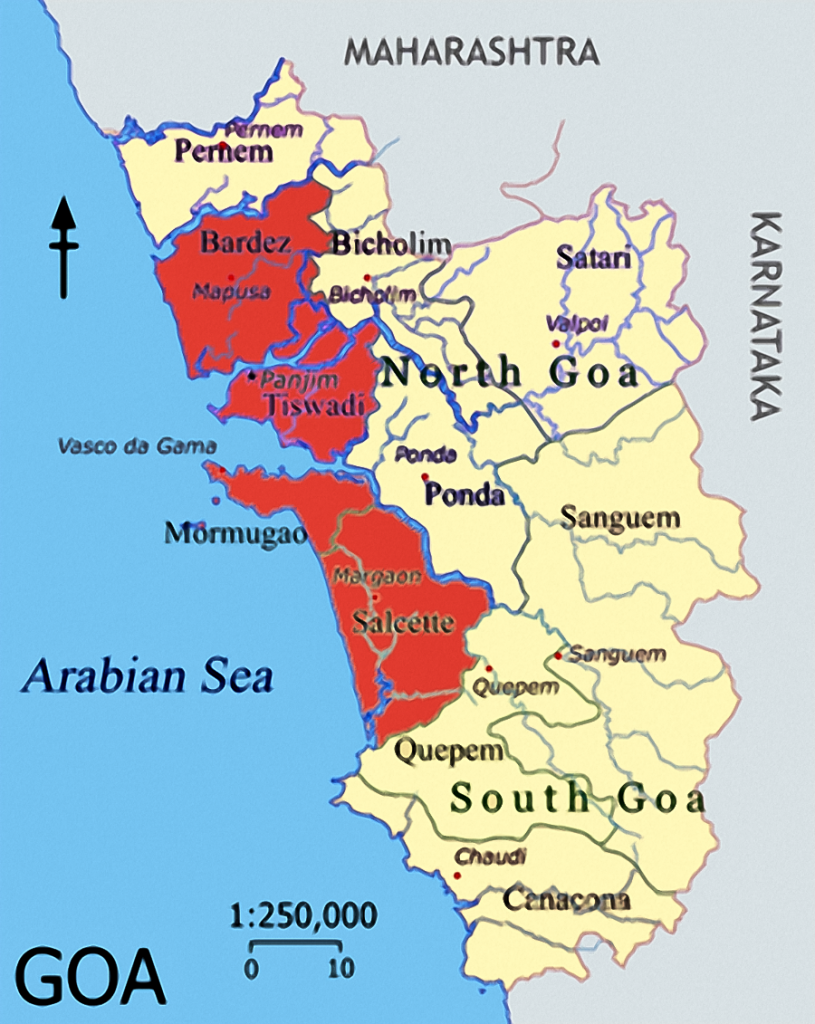
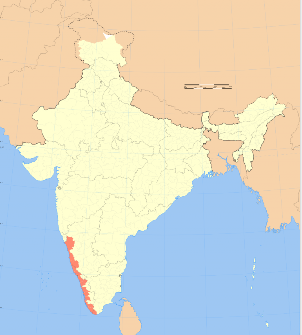
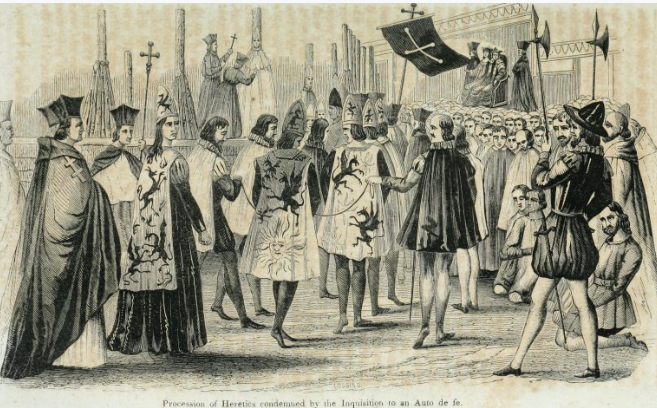
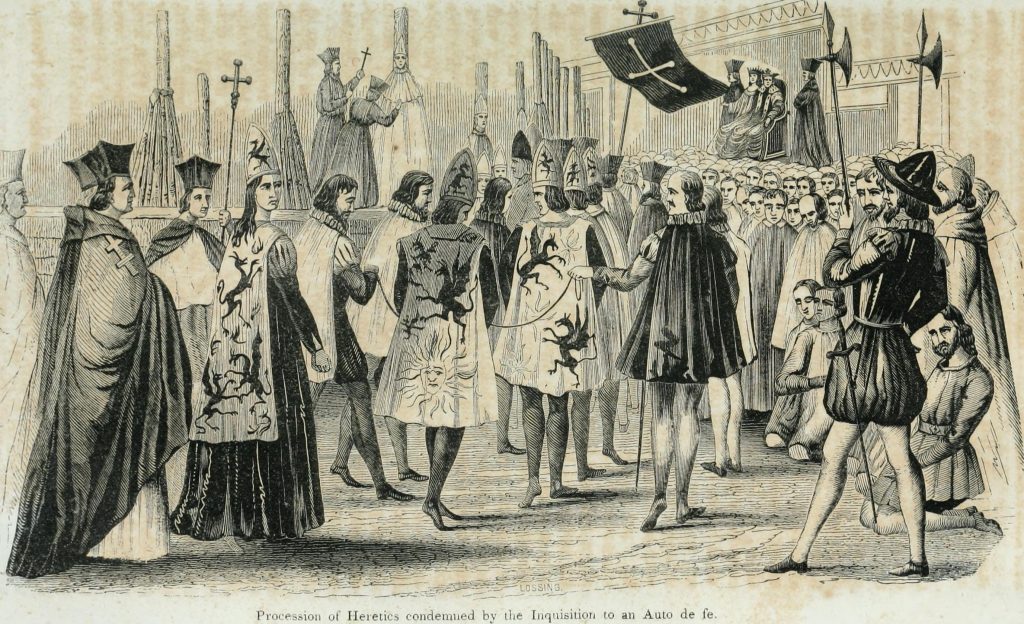
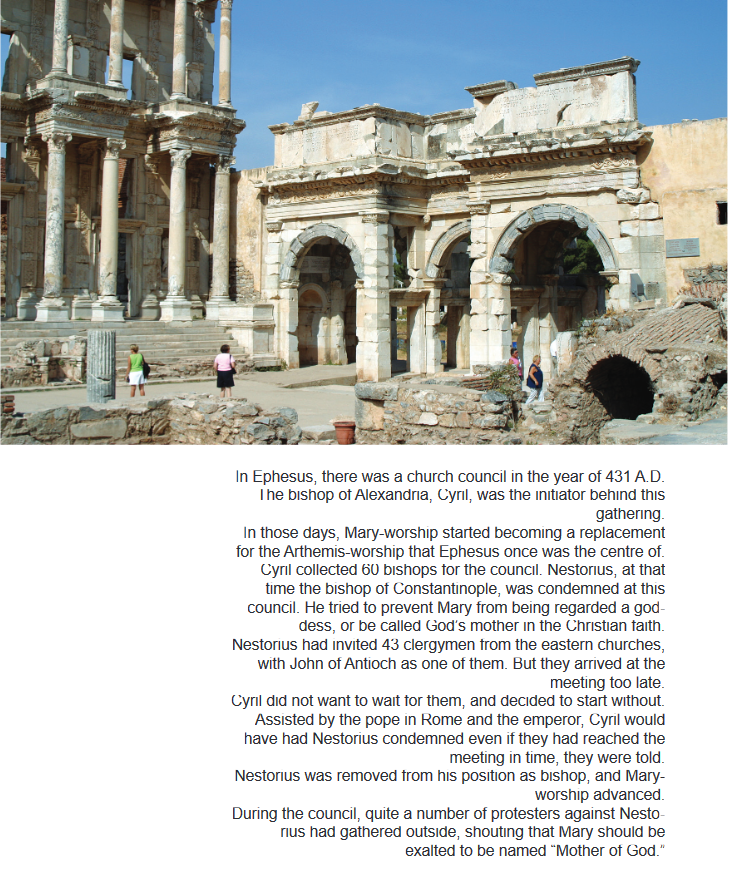
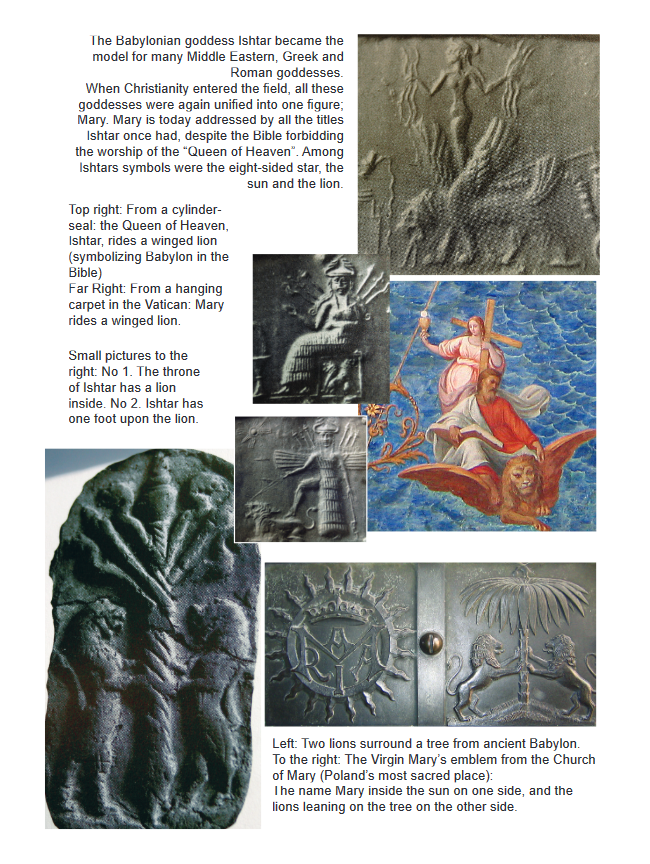
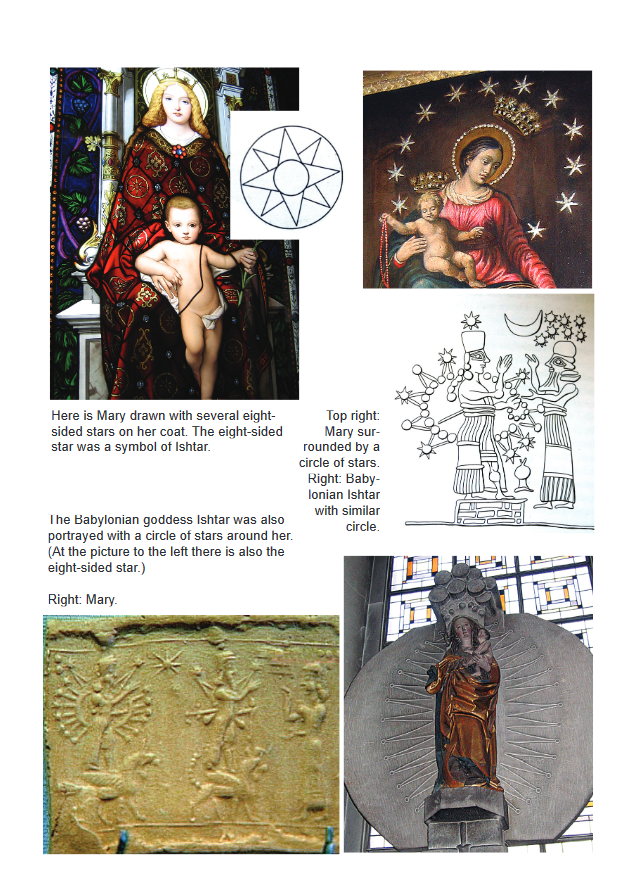
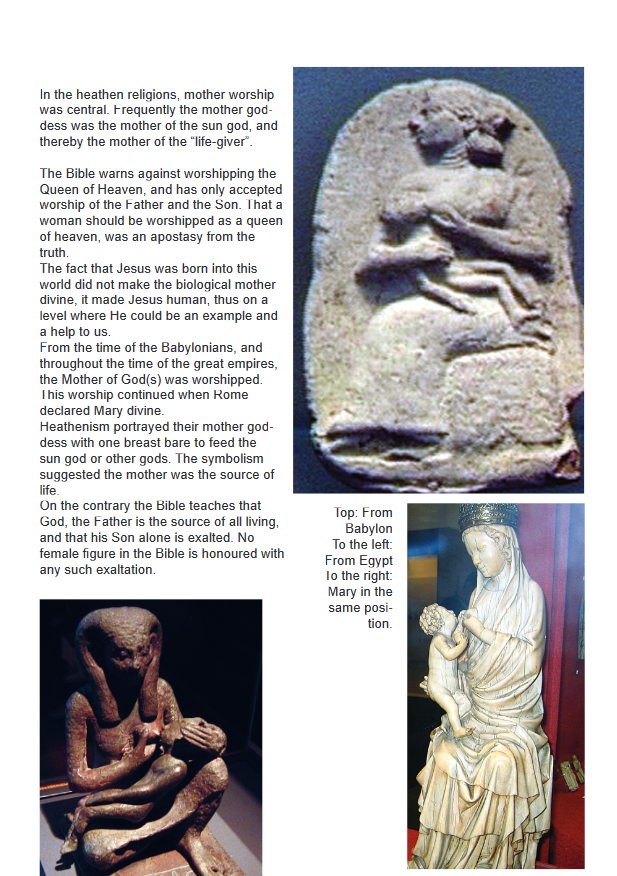
With all its intolerance and its terrors, the Inquisition was set up atGoa (India) in the sixteenth century; and when it was resolved to subjugate the Syrian Church to papal jurisdiction, this relentless institution was used to overawe it, and to prevent the arrival of bishops from Babylon. The subjugation was consummated by the Synod of Diamper in 1599, and for nearly two generations Rome’styranny endured, until the splendid rebellion of the Assyrian Church at Coonen Cross.
See footnote 1
IN INDIA, the land of color and romance, the gospel was proclaimed as
early as it had been in Italy. Christ had told His disciples that they should be witnesses for Him unto the uttermost parts of the earth,(Acts 1:8.) and the apostles were ready to go anywhere. With a faith great enough to remove mountains, they did not hesitate to evangelize any tribe or nation regardless of how terrifying the situation to be encountered. An early ecclesiastical writer states that when the world was portioned off for evangelization, Thomas was assigned to Parthia.(2) There
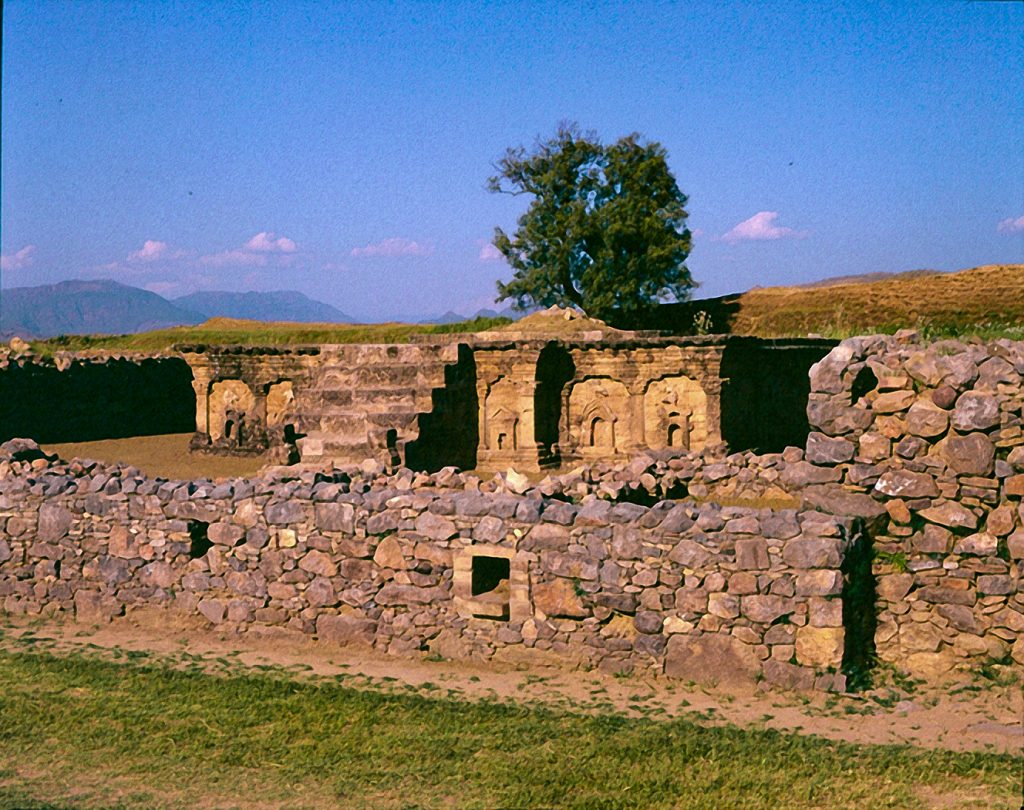
Taxila, where Tomas started his work
is evidence enough that Thomas worked in Parthia. Libraries are full of literature telling of his founding churches in India. (3) The accounts that tell how Thomas raised up and established Christianity in India form an interesting link in the lives of the apostles. The Master chose young men as His disciples, who were able to carry on the work for many years after His crucifixion in A.D. 30-31. Paul was beheaded about thirty-five years later. Thomas was killed, some authorities state, in 72 on the west coast of India by the lance of a Brahman. (4) Evidence shows that the apostle John, living to the ripe old age of one hundred (according to Jerome), must have heard all about the spiritual victories in India before he wrote his Gospel and the book of Revelation.
THOMAS AND THE GOSPEL IN INDIA
The question of whether Thomas ever labored in India or not has been discussed by many authors, and immense research has been done in the hope of arriving at an irrefutable conclusion. It is well known that if the Church in the Wilderness ever suffered in any country, it certainly suffered in India. All are desirous of knowing who was the founder of that church. A. Mingana writes:
It is the constant tradition of the Eastern Church that the apostle Thomas evangelized India, and there is no historian, no poet, no breviary, no liturgy, and no writer of any kind who, having the opportunity of speaking of Thomas, does not associate his name with India.
See footnote
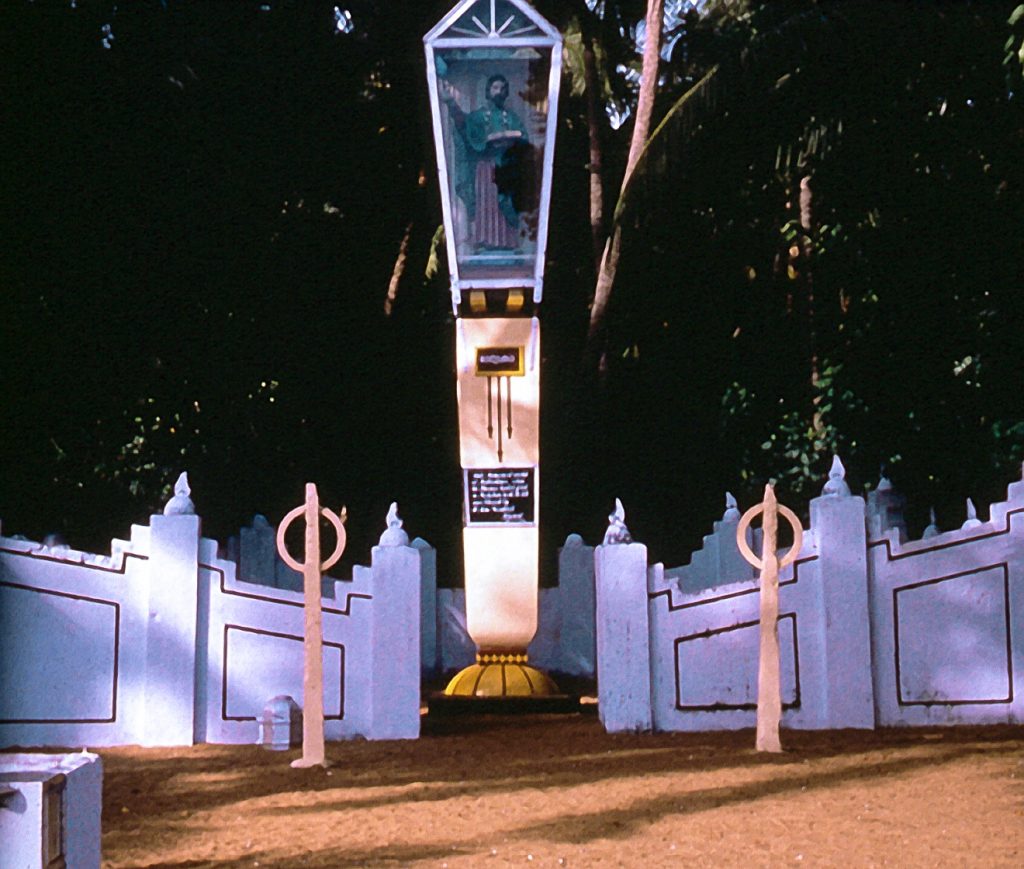
Cranganore, India
J. M. Neale testifies:
There is a constant tradition of the church, that the gospel was first preached in India by the apostle St. Thomas. Having evangelizedArabia the Happy, and the Island of Zocotra, he arrived atCranganor, a town situated a little to the north of Cochin, and where the most powerful among the princes who ruled in Malabarthen resided. Having here wrought many miracles, and established a church, he journeyed southward to the city of Coulan. Here his labors were attended with equal success, and after traversing the peninsula he arrived at Meliapour, a town close to the more celebrated city of Madras. Sailing from this port he preached Christianity in China, and returning again to Meliapour, extended the knowledge of the faith so widely as to excite the envy and hatred of the Brahmins. Two of them watching an opportunity, stirred up the people against him; they fell on him and stoned him. One of the Brahmins remarking some signs of life in the holy apostle, pierced him with a lance, and thus completed his martyrdom.
See footnote 6
M. L’Abbe Huc, the brilliant Jesuit traveler and writer, says:
The circumstance of St. Thomas having preached at all in India has been frequently called in question by writers deserving of attention; but we find it supported by so much evidence, that it seems difficult for an unprejudiced mind to refuse credit to a fact guaranteed by such excellent historical authorities. All the Greek, Latin, and Syriac monuments proclaim that St. Thomas was the apostle of the Indies, who carried the torch of faith into the remote regions where he suffered martyrdom. Some writers have affirmed that he prosecuted his apostolical labors as far even as China; and the mission and the martyrdom of Saint Thomas in the Indies have been alluded to in all the martyrologies, and in the ancient liturgies, which form the most pure and authentic source of Christian tradition.
See footnote 7
W. F. Adeney, citing the origins of the Armenian, the Abyssinian, and the Georgian Churches, says:
The Syrian Church in India, which claims St. Thomas as its founder — all of them independent churches in regions outside theRoman Empire — will claim our attention later on; because as they have remained in independent existence on to our own day we shall want to know something about the course of their history right down the centuries.
See footnote 8
The testimony of J. D. D’Orsey is this:
Amidst the clouds which cover the traditions of the Christians of St. Thomas, the following account seems to possess the greatest amount of probability, and the nearest approach to truth. After having established Christianity in Arabia Felix, and in the island of Dioscorides (now called Socotra), the holy apostle landed at Cranganor, at that time the residence of the most powerful king on the Malabar Coast. We know, from the historians of the Christian people, from Josephus and from the Sacred Books themselves, in the account of the miracle of Pentecost that before the birth of Jesus Christ, there went forth from Judea a great number of its inhabitants, and that they were scattered throughout Egypt, Greece, and several countries of Asia. St. Thomas learnt that one ofthese little colonies had settled in a country adjacent to Cranganor. Love for his nation inflamed his zeal; and faithful to the command of Jesus Christ who had enjoined His apostles to proclaim the faith to the Jews, before turning to the Gentiles, he repaired to the country which his compatriots had chosen for their asylum; he preached to them the gospel, converted them, and changed their synagogue into a Christian church. This was the cradle of Christianity in India.
See footnote 9
ENTRANCE OF CHRISTIANITY INTO INDIA
In the days of Thomas the apostle, one authority states,
“One hundred twenty great ships sailed for India from Egypt every year.”
See footnote 10
As witnesses to the vast trade carded on between Rome and those eastern countries before and after Christ, large quantities of Roman coins have been found in south India lands. Theodor Mommsen evaluated the Roman coinage sent annually to India as being worth five hundred thousand pounds sterling.(11) There is, therefore, nothing to render improbable the pioneer evangelization of Parthia and India by the apostle Thomas.
“Their sound went into all the earth, and their words unto the ends of the world,” the apostle Paul could say in his day of those who had spread the gospel. (Romans 10:18.)
Consider how many nations were represented at Jerusalem on the eventful Day of Pentecost, and the character of their representatives. “Devout men, out of every nation under heaven,” is the record. Who were they?
“Parthians and Medes, and Elamites, and the dwellers in Mesopotamia,… Cretes and Arabians.” (Acts 2:5, 9-11.)
The story of Pentecost spread as if on the wings of the wind when these visitors enthusiastically returned to their homes and hearths. Tradition claims that Thomas reached India soon after Pentecost.(12) Another situation which favored the rapid expansion of the gospel to the East was the dispersion of the Jews throughout Asia. The progeny of Abraham covered the East; there was hardly a land or city where they had not gone. These descendants celebrated their holy days in a way which recalled their Jewish associations. (13) The beginnings of Christianity in Edessa (modem Urfa in Asia Minor), the first intellectual center for the spread of Christianity to the East, was among the Jews. (14) In fact, the Jews for a long time formed the major portion of the infant church.(15) Another medium for the diffusion of the gospel to the Orient was the Aramaic language. The Hebrew, Syriac, and Aramaic — the latter, Christ’s native speech — were cognate languages. History tells that Josephus, the famous Jewish author in the days of the apostles, wrote his Wars of theJews first in Aramaic and later in Greek because of the large Aramaic reading constituency in the East. The Aramaic had widely penetrated the Parthian Empire, including Seleucia-Ctesiphon, the brilliant twin-city capital of that empire.(16)
CHRISTIANITY’S EARLY GROWTH IN INDIA
Naturally, the Church of the East looking back to Thomas as its founder, placed no value on the claim that Peter was the “rock” upon which Christ would build His church and that He would give the “keys” to Peter only. The difference between the Church of India in dating its origins from the apostle Thomas and the Church of Rome in dating its origins from the apostle Peter, is a difference of doctrines and practices. This contrast appears in the account given by the historian Gibbon of the first meeting between the Jesuits when they arrived on the coast of India, and the St.Thomas Christians. He writes:
When the Portuguese first opened the navigation of India, the Christians of St. Thomas had been seated for ages on the coast of Malabar…. The title of Mother of God was offensive to their ear; and they measured with scrupulous avarice the honors of the Virgin Mary, whom the superstition of the Latins had almost exalted to the rank of a goddess. When her image was first presented to the disciples of St. Thomas they indignantly exclaimed, “We are Christians, not idolaters!”
See footnote 17
How much the world owes to the brave stand made by Christianity in India, man will never know until the judgment. For the first six hundred years the churches of southern India grappled successfully with dominant Buddhism; then for the succeeding one thousand years they contended with a degraded and wily Hinduism. But the real struggle began in the seventeenth century when the Jesuits, supported by the guns of Portugal, entered their parishes. It was not the missionaries from Rome, therefore, who first entered India. The type of New Testament faith first planted on the Malabar Coast nineteen hundred years ago is still there and is similar to that of the rest of the Protestant world. For sixteen hundred years the St. Thomas Christians refused to put the church above the Bible. They found their starting point in the Sacred Scriptures, rather than in the catchphrase that the church was “instinct with heavenly life.” They refused to accept the teaching that the clergy only and not the laity were capable of interpreting the Bible. Accordingly, they clung to the Sacred Writings as the only channel through which the saving and transforming influence of the Holy Spirit could work. They refused to choose salvation through the sacraments rather than through the Scriptures. “The words that I speak unto you, they are spirit, and they are life,” said Jesus, (John 6:63.) and they cherished His admonition.
“Any attempt,” Mingana writes, “to speak of early Christianity in India as different from the East Syrian Church, is, in our judgment, bound to fail. Christianity in India constituted an integral part of the church that began to develop vigorously towards the end of the first century in the Tigris valley.”
See footnote 18
About this time three great revolutions of significance took place — one in the bosom of Christianity, one in the Parthian Empire, and the third in theRoman Empire. The first revolution occurred when the Church of the East definitely broke with the West by electing Papas of Seleucia as its independent supreme head (A.D. 285), thus recognizing the importance of a regular autonomous organization of its own. Why did this new catholicos ten years after his election make India into one of the grand ecclesiastical divisions of the world field and ordain David of Basra, famous for his learning, as the first supervising director of the new division?19 The answer is not far to seek. The Persians, led on by fanatical Zoroastrianism, organized themselves with new strength, attacked, and overthrew the Parthians. Here was a new situation for the believers. As the victorious Persian Empire was intolerantly Zoroastrian, or Mithraistic, it was necessary for the Church of the East to meet the changed situation by a new setup of its own. This it did by electing Papas as catholicos. The third revolution was the compromise of Christianity with paganism. The emperor, Constantine, saw it to his advantage to straddle the issue. The last pagan persecution of New Testament believers was raging furiously when Constantine assumed the imperial purple and decreed the termination of religious hostilities. His Sunday law of 321 was a bait thrown to compromising Christians and an appeasement for those Romans who glorified the day exalted by the sun-worshiping Zoroastrians. But Constantine did not stop there. Persecution began anew. This time it was not against all Christians, but against those churches who were determined to defend the faith once delivered to the saints. They fled. The hatred of the Romans by the Persians meant hatred of the new RomanChristianity and sympathy for the gospel believers. Therefore, refugees, some of the best church members in Europe, followed in the steps of their brethren who were persecuted by pagan Rome one hundred years previous, and joined the Church of the East. Following this growth of the Assyrian Church, a new migration of believers, composed of skilled mechanics, merchants, artisans, and clergy, left for India in 345. It is amazing to learn how quickly blindness settled over the hierarchy of the West after the Council of Nicaea. The Dark Ages, destined to overshadow papal lands for a thousand years, drew on. In the East there was a light. The Church in the Wilderness was the ark which carried the Sacred Writings over from the apostolic age to the dawn of modem liberty. Claudius Buchanan in his researches in 1812 found among the St. Thomas Christians of the Malabar Coast a copy of the Bible which he believes has been among them from the days before the Council of Nicaea. Thus he wrote:
“In every church, and in many of the private houses, here are manuscripts in the Syriac language: and I have been successful in procuring some old and valuable copies of the Scriptures and other books, written indifferent ages and in different characters.”
See footnote 20
He wrote of another city in Travancore,
“In this place I have found a good many valuable manuscripts.”
See footnote 21
CHRISTIANITY IN INDIA DURING THE DARK AGES
Upon report from India on the condition of the Malabar Christians, the catholicos sent Thomas, a merchant, with clergymen, deacons, artisans, and skilled workmen (a company of three thousand persons) to settle among the brethren in Travancore (c. A.D. 345). The king of Malabar received them kindly and gave them social and commercial privileges of great value. Some believe that these privileges granted by King Perumalranked these Christians and their disciples among the nobility. For more than one hundred years fresh bands of believers kept arriving from Persia. The reign of Shapur II, who was ruling Persia after the adoption of Christianity in the Roman Empire by Constantine, lasted for more than sixty years. When Persia was at peace, primitive believers coming from the West were well treated; but in war it was different. The two empires being in conflict following the death of Constantine, it was natural that the Zoroastrians would be suspicious of all Christians and claim that they were spies in the pay of the Roman Empire. How India would be likely to become a haven of refuge to the persecuted is thus easily understood. That the existence of Christians in India appealed to the imagination of believers in Europe may be seen from the many references to the fact found in the writings of the second, third, and fourth centuries. The evangelical and simple spirit shown by the high reverence of these Christians for the Holy Scriptures characterized them as neither papal nor Jewish. Mingana writes: “The fifth century opens with an Indian Christianity which was in such a state of development that she is able to send her priests to be educated in the best schools of the East Syrian Church and to assist the doctors of that Church in their revision of the ancient Syriac translations of the Pauline Epistles.”(22) Thus the opening of the year A.D. 500 discloses communities of Assyrian Christians throughout India. Faithful in their evangelical missionary life, they assembled for worship on the Sabbath day.(23) When priests from Rome entered India a thousand years later, papal hatred stigmatized the persecuted church as Judaizers. These St. Thomas Christians watched carefully over the spiritual training of their children, having no higher purpose in life for them than to be ministers or missionaries. Their schools were on a level with the best in the world and were far above those in many lands. The speedy and commodious passage by sea direct from Egypt to southern India, as well as from the Persian Gulf to the same destination, kept them in touch with thought and scholarship elsewhere. They did not ignorantly arrive at the doctrines they held, but founded their faith first on the fact of its transmission direct from the apostles, and, secondly, on prayer and devout study.
“This union of the Church of India with that of Mesopotamia and Persia is rendered more evident by another scholar of the school of Edessa, Mana, bishop of Riwardashir, who wrote in Persian (i.e., Pahlavi) religious discourses, canticles, and hymns, and translated from Greek into Syriac the works of Diodorus and Theodore of Mopsuestia and sent them all to India.”
See footnote 24
The Assyrian Christians were not only scholars, translators, and clergymen, but they were also travelers. Cosmas, who resided near Babylon, widely read for his explorations in the first half of the sixth century, sailed the Indian Seas so frequently that he has been called Indicopluestes (India traveler). Cosmas was personally in touch with the patriarch of the Assyrian Church. In his famous passages revealing how far-flung was the Church of the East, of which he was a member, he says that there was an infinite number of churches with their clergy and a vast number of Christian people among the Bactrians, Huns, Persians, Greeks, Elamites, and the rest of the Indians.(25) In relating his explorations in Ceylon, Cosmas tells that the island has a church of Persian Christians settled there with a presbyter appointed from Persia and a deacon well furnished with all necessary articles for public worship. Commenting on these facts, Mingana writes:
“The above quotations from Cosmas prove not only the existence of numerous Christian communities among many central Asian people, in India, and in the surrounding districts, but also the subordination of all of them to the Nestorian patriarchate of Seleucia and Ctesiphon.”
See footnote 26
What Cosmas wrote about the island of Socotra in the Indian Ocean, lying directly in the path of sea travel from Egypt to southern India, is significant. He said that all the inhabitants were Assyrian Christians. Wha this successor in travels, the famous Italian voyager Marco Polo, who belonged to the papal church, wrote concerning Socotra in 1295 — long enough after Cosmas to see the headquarters of the church removed from Seleucia to Bagdad — is also revealing:
Their religion is Christianity, and they are duly baptized, and are under the government, as well temporal as spiritual, of an archbishop, who is not in subjection to the pope of Rome, but to a partriarch who resides in the city of Baghdad, by whom he is appointed. Or sometimes he is elected by the people themselves, and their choice is confirmed.
See footnote 27
Of the same place Nicolo de Conti, another renowned traveler, wrote about 1440:
“This island produces Socotrine aloes, is six hundred miles in circumference, and is for the most part inhabited by Nestorian Christians.”
See footnote 28
About the year 774 reinforcements arrived from the West. This event evidently raised the standing of the Malabar Christians in the eyes of the reigning king. He issued one of those copperplate charters, so familiar in the history of India, to Iravi Corttan, evidently the head of the Christian community. This recognized him as a sovereign merchant of the kingdom of Kerala, and evidently promoted the Christians considerably above the level of their pagan surroundings.(29) About fifty years after the contingent of 774 had arrived, in the providence of God more reinforcements came. They evidently were an overflow of the Christians in Persia who by this time had grown to be a large proportion of the population there. They declined to settle down selfishly in the midst of their homeland affluence. A contingent of outstanding men with their families left for Travancore. Though Mohammedanism by this time had become all-powerful in Iran, it had not yet made a dent on the greater part of India. Led by the prayer of faith, two prominent leaders in the Church of the East conducted this Christian colony to the kingdom of Kerala.(30) The date of these new arrivals was 822. They were received with honors, and a future status of power and privileges was accorded them in a charter of five copperplates.31 Into a kingdom of India, then, still sufficiently strong to repel foreign invaders, came the new Christian recruits. The
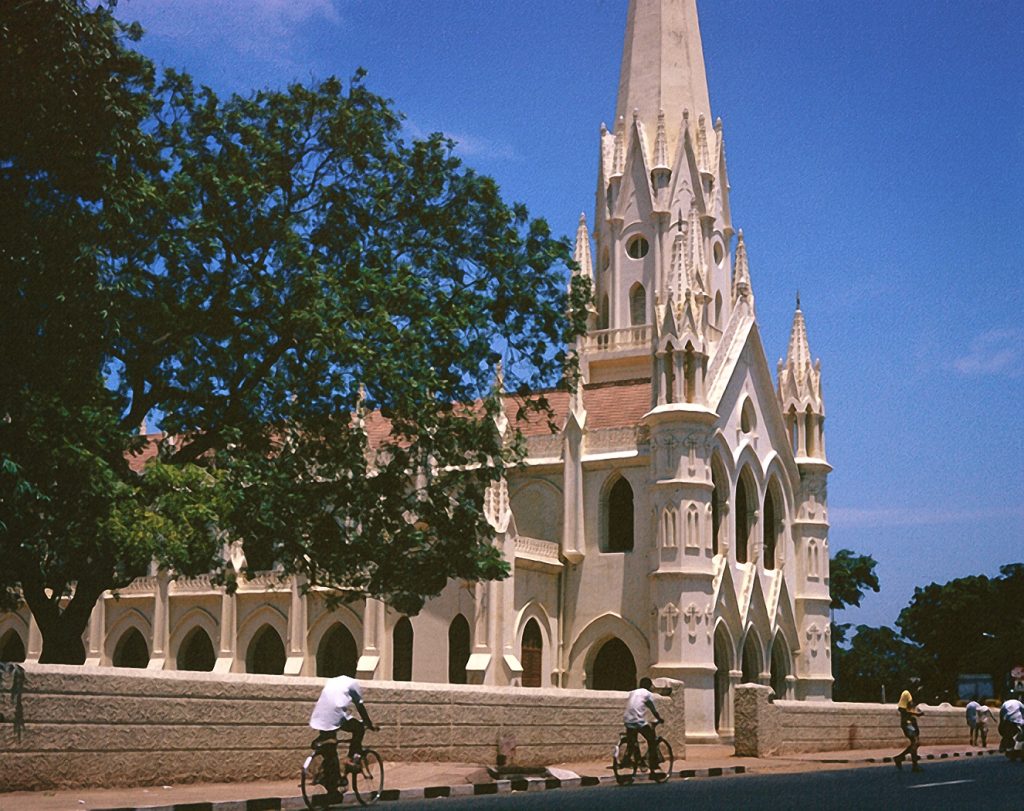
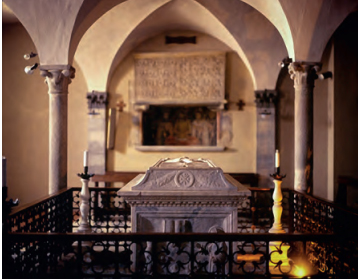
Church built over the tomb of Thomas
privileges granted them at the time on the copperplates politically raised the native church to a position of independence in their pagan surroundings; socially placed them next to the Brahmans; and spiritually gave them
Coast of Malabar, India
freedom in religious life. All this reveals the strength of the church on the Malabar Coast in the ninth century. Concerning their status seven centuries later, William W. Hunter writes: “The Portuguese found them firmly organized under their spiritual leaders, bishops, archdeacons, and priests, who acted as their representatives in dealing with the Indian princes. For long they had Christian kings, and at a later period chiefs, of their own.”(32) Spreading all over the land, they possessed an organization simple and workable as well as strong. Every community that was under a supreme spiritual director endeavored to maintain a college of advanced grades. From these institutions of learning graduates went to the scholarly theological seminaries in Assyria. The Portuguese arrived in 1500. The Jesuits soon followed. Care was taken to burn all the records of these “heretical” communities; otherwise, more details of the date and place could be given.(33) Nevertheless, enough has come down from the secular and church historians to give a real picture of their activities. There are also the observations made by the European and Moslem travelers.(34) Marco Polo related that there were six great kings and kingdoms in the heart of India, three of which were Christian, the other three being Mohammedan. “The greatest of all the six,” he said, “is a Christian.”(35) The Church in the Wilderness in India continued to grow throughout the thirteenth, fourteenth, and fifteenth centuries. After that it entered into its fatal struggle with the Jesuits. Mingana presents the important testimony of Marignolli, who in his Recollections of Eastern Travel, speaks of Indian Christians as being the masters of the steelyards and the proprietors of the spices of south India.(36) Nicolo de Conti, another traveler in India in the same century, tells us that the Nestorians “were scattered over all India in like manner as are the Jews among us.”(37) As indicative of the carefulness of the life they lived, Conti further reports that though they are spread all over India, they are the only exceptions in the matter of polygamy. Here counts that he met a man from north India who told him that there was a kingdom twenty days’ journey distant from Cathay (north China) where the king and all the inhabitants were Nestorians, and that he had come to India to find out about these same Christians. Conti observes that the churches of the Christians in this kingdom which he had described were larger and more powerful than those in India.(38) Louis of Varthema has written a most interesting book on his itinerary in southern Asia in the fifteenth century. He tells of the St. Thomas Christians which he met on the Malabar Coast in 1505, and also describes the reputed tomb of St. Thomas, a short distance from Madras on the Coromandel Coast.(39) He recounts a curious story of the merchants of the St. Thomas Christians whom he met in Bengal, as follows:
They said that they were from a city called Sarnau (in Siam) and had brought for sale silken stuffs, and aloes wood, and benzoin, and musk. Which Christians said that in their country there were many lords also Christians, but they are subject to the great khan(of) Cathai (China). As to the dress of these Christians, they were clothed in a kebec (jerkin) made with folds, and the sleeves were quilted with cotton. And on their heads they wore a cap a palm and a half long, made of red cloth. These same men are as white as we are, and confess they are Christians…. We departed thence with the said Christians, and went towards a city which is called Pego(in Burma), distant from Banghella (Bengal) about a thousand miles. On which voyage we passed a gulf (of Martaban) towards the south, and so arrived at the city of Pego.
See footnote 40
Varthema was of the papal faith, and he recognized that the religion of the region of Pego was different. He says that the king “has with him more than a thousand Christians of the country which has been above mentioned to you, that is, Nestorians from Sarnau.”41 He and his traveling companions struck a bargain with the Christians that they should act as guides while they visited the islands of Sumatra, Java, Borneo, and Maluko. It is characteristic of this outstanding missionary church that its members were not content with having planted the seeds of their faith in Persia, India, and China, but that they also extended their work down the Malacca Strait over into Sumatra, Java, Borneo, and the Spice Islands. It is written that the catholicos, Elijah V, in 1503 ordained three metropolitans and sent one to India, one to China, and one to Java. These churches held fast through the years to the simple faith which no doubt came down to them from the apostle Thomas. Having won great victories over heathenism, they were now to sustain their greatest trial as the Jesuits began arriving in the sixteenth century.
_________________________________________
FOOTNOTES / SOURCES
1 Rae, The Syrian Church in India, pp. 196, 197.2 Eusebius, Ecclesiastical History, b. 3, ch. 1, found in Nicene and Post-Nicene Fathers, 2d Series, vol. 1. 3. When the writer visited Miramon in the kingdom of Travancore in southern India, where the largest camp meeting in the world is annually held, the St. Thomas Christians enthusiastically pointed out the place where the apostle Thomas had built a church. “See,” said they, “that farm over there? That farm is located on the spot where he secured hisfirst converts.” 4. Neale, A History of the Holy Eastern Church, vol. 1, General Introduction, p. 145. 5. Mingana, “Early Spread of Christianity,” Bulletin of John Ryland’sLibrary, vol. 10, pp. 447, 448. 6. Neale, A History of the Holy Eastern Church, vol. 1, General Introduction, p. 145. 7. Huc, Christianity in China, Tartary, and Thibet, vol. 1, pp. 17, 18. 8. Adeney, The Greek and Eastern Churches, p. 297. 9. D’Orsey, Portuguese Discoveries, Dependencies, and Missions in Asia and Africa, pp. 63, 64. 10. Mingana, “Early Spread of Christianity,” Bulletin of John Ryland’sLibrary, vol. 10, p. 90. 11. Ibid., vol. 10, p. 94 12. The Catholic Encyclopedia, art. “Thomas.” 13. Couling, The Luminous Religion, pp. 7-10. 14. Burkitt, Early Eastern Christianity, p. 34. 15. The Catholic Encyclopedia, art. “Calendar.” 16. Rae, The Syrian Church in India, pp 70-72. 17. Gibbon, Decline and Fall of the Roman Empire, ch. 47, par. 31. 18. Mingana, “Early Spread of Christianity,” Bulletin of John Ryland’sLibrary, vol. 10, p. 440. 19. Keay, A History of the Syrian Church in India, p. 17. 20. Buchanan, Christian Researches in Asia, pp. 126, 127. 21. Ibid., p. 140 22. Mingana, “Early Spread of Christianity,” Bulletin of John Ryland’sLibrary, vol. 10, p. 459 23. Mingana proves that as early as A.D. 225 there existed large bishoprics or conferences of the Church of the East stretching from Palestine to, and surrounding, India. In 370 Abyssinian Christianity (a Sabbath-keeping church) was so popular that its famous director, Musaeus, traveled extensively in the East promoting the church in Arabia, Persia, India, and China. In 410 Isaac, supreme director of the Church of the East, held a world council, — stimulated, some think, by the trip of Musaeus, — attended by eastern delegates from forty grand metropolitan divisions. In 411 he appointed a metropolitan director forChina. These churches were sanctifying the seventh day, as can be seen by the famous testimonies of Socrates and Sozomen, RomanCatholic historians (c. A.D. 450), that all the churches throughout the world sanctified Saturday except Rome and Alexandria, which two alone exalted Sunday. A century later (c. A.D. 540) Cosmas, the celebrated world traveler, a member of the great Church of the East, testified to the multiplied number of churches of his faith he had seen in India and central Asia and to those he had learned about in Scythia and China. We wrote in previous pages of the Sabbath-keeping Irish, Scottish, Welsh, and English Churches in the British Isles during these same centuries and down to 1200. We dwelt upon the Paulicians,Petrobrusians, Passagians, Waldenses, Insabbatati, as greatSabbathkeeping bodies of Europe down to 1250. We wrote of the sabbatarians in Bohemia, Transylvania, England, and Holland between1250 and 1600, as authenticated by Cox, Jones, Allix, and William of Neuburg. We have mentioned the innumerable Sabbath-keeping churches among the Greeks, Abyssinians, Armenians, Maronites, Jacobites, Scythians, and the great Church of the East (also from A.D.1250 to 1600) with supporting evidence from competent authorities.The doctrines of all these Sabbath-keeping bodies throughout the centuries were comparatively pure, and the lives of their members were simple and holy. They were free from the unscriptural ceremonies which arose from the following of tradition. They received the Old Testament, and the whole Bible was their authority. 24. Mingana, “Early Spread of Christianity,” Bulletin of John Ryland’sLibrary, vol. 10, p. 460 25. Mingana, “Early Spread of Christianity,” Bulletin of John Ryland’sLibrary, vol. 10, p. 462. 26. Ibid., vol. 10, p. 462. 27. Komroff, The Travels of Marco Polo, p. 311. 28. Major, India in the Fifteenth Century, Travels of Nicolo Conti, p. 20. 29. Rae, The Syrian Church in India, p. 155. 30. Adeney, The Greek and Eastern Churches, pp. 520, 521. 31. Two of these plates were shown to the author by Mar Thomas (the word “Mar” is their title for clergy of official rank), supreme head of the St. Thomas Christians, in his church headquarters at Tiruvalla, Travancore. The other three plates, now in possession of the leader of the Jacobites at Kottayam, could not be seen as he was absent from the church at the time of my visit. 32. Hunter, The Indian Empire, p. 240. 33. Neale, A History of the Holy Eastern Church, vol. 1, General Introduction, p. 148. 34. Smith, The Oxford History of India, p. 300. 35. Yule, The Book of Ser Marco Polo, vol. 2, p. 427. 36. Mingana, “Early Spread of Christianity,” Bulletin of John Ryland’sLibrary, vol. 10, p. 487. 37. Major, India in the Fifteenth Century, Travels of Nicolo Conti, p. 7. 38. Ibid., p. 33. 39. Temple, The Itinerary of Ludovico di Varthema of Bologna From 1502to 1508, pp. 59, 60. 40. Ibid., pp. 79, 80. 41. Ibid., Preliminary Discourse, p. lxix.
It was not from Nestorius, but from Thomas, Bartholomew, Thaddeus, and others that this people first received the knowledge of a Savior, as will be seen in the sequel.(1) They were a strong, and prosperous people before the Mohammedans overran Asia, living on the plains of Assyria, sustaining schools and colleges, whose students carried to China, and throughout India, probably, the first message telling that the Messiah had come.(2)
TIMOTHY is an outstanding leader of the Church of the East in connection with its great expansion throughout Asia. He belongs to the period when the Mohammedans dominated not only Persia, but also the Near East after having over thrown the Zoroastrian dominion. He is a representative of that line of patriarchs who guided the church through centuries of Moslem power. From the time of Timothy, and even from a short while before, the Church of the East took its place in gospel and prophetic history when it was driven into the wilderness. This is not because the Arabian rulers persecuted Christians but rather because of the attitude of the papal church in the West. When the Moslem power struck low the Mithraickings of Persia, Mohammedanism was not yet strong enough to completely oppose other religions. In many general ways Mohammed himself felt kindly toward Christianity, especially toward the more simple believers in Jesus, such as the Assyrian Christians.3 When the victorious Moslem general conquered Zoroastrian Persia, the Church of the East was in the hands of a wise and able head, who secured in the following way a charter of privileges for Christians. Ishoyabh (sometimes called Jesus-Jabus), as catholicos, succeeded in obtaining a pledge granting protection and freedom of worship on condition that the Christians paid certain tribute. Of this Sir E. A. WallisBudge says:
The patriarch Isho-yahbh II, who sat from 628-44, seeing that the downfall of the Persian Empire was imminent came to terms with Muhammad, or Abu Bakr…. The patriarch stipulated that the Christians should be protected from the attacks of their foes; that the Arabs should not make them go to war with them; that they should not compel them to change their manners and laws; that they should help them to repair their old churches; that the tax on the poor should not exceed four zuze; that the tax on the merchants and wealthy men should be ten zuze per man; that a Christian woman servant should not be compelled to change her faith, nor to neglect fasting and prayer.
See footnote 4
These immunities extended by abu-Bekr were not only confirmed by Omar, his successor, but even the taxes were remitted. It remained for the renowned warrior Caleb to confirm and extend the high rights and privileges which were allowed to the church. The Arabs, like the Persians, were very partial to the Assyrian Christians because they found it necessary in the early days of their power to lean upon the splendid schools which this church had developed. Medicine made great progress in the hands of the Church of the East.5 The Arabian court and its extended administrations employed its members as secretaries and imperial representatives. Justinian’s grievous laws against the leaders in Asia Minor and Persia afflicted the Church of the East. He destroyed any possibility of reconciliation with the Assyrian Church when he issued the imperial condemnation of the three church leaders usually called the Three Chapters. By this decree he bitterly alienated the millions of believers in Asia without winning the malcontents. Never again would there be any general movement among the Asiatic Christians toward the religion of Rome. The year of this decree is 553.
CATHOLICOS MOVES TO NEW CAPITAL OF MOSLEM EMPIRE
The Mohammedaris used the conquered Persian Empire as a steppingstone to further and more rapid conquests. They looked with greedy eyes upon the rich and cultured kingdoms of central Asia. It is difficult for travelers of today who behold the sandy expanses of Palestine to visualize the once mighty kingdoms of Israel and Judah that occupied those wastes. With whirling advances into these gardens of Eden, the intrepid warriors ofMohammed secured decisive victories; then returned to display to astonished eyes the dazzling riches of Transoxiana. Extension of the dominion brought weakness of control. The rapid and unexpected victories of Islam’s western armies stretching along the southern Mediterranean to the Atlantic Ocean and extending northeast to Turkestan broke the unity of the empire. Strife for pre-eminence came in between different branches of Mohammed’s progeny. Instead of one, there arose three caliphates. The name Ommiads was given to the dynasty of the prophet’s family which seized the power reaching from the Mediterranean Sea to the borders of China. The birth of this new caliphate was the signal for the creation of anew capital. An excellent site on the Tigris River was chosen, and the city of Bagdad, which still stands today, arose in all its splendor. In 762 with their usual foresight the leaders of the Church of the East removed the central administration of their widely extending work to the new capital at Bagdad. They had received recognition from the caliph as amelet, the term usually given to subject religions under Oriental monarchs. Abraham Yohannan writes that an Arabian history of India records for the year 1000 that the bulk of population in Syria, Iraq, and Khurasan wasChristian.(6) He further states that Assyrian Christians held high offices under the caliphs. The historian Arminius Vambery notes that by 1000 theChurch of the East had made greater progress in central Asia than Mohammedan historians are willing to allow.(7)
THE CATHOLICATE OF TIMOTHY
Timothy I (A.D. 780-824) was elected as catholicos at a time when Charlemagne was wielding his heavy sword to advance the interests of the Papacy in Europe. His election took place twelve years before the founding of Kyoto, the most famous of Japan’s ancient cities. It was during the early years of his catholicate that Japan sent Kobo Daishi, of whom more shall be said later, to visit China and bring about are conciliation in Japan between Buddhism and the old indigenous religion of the mikado’s realm, called Shintoism. In the days of Timothy a wave of inquiry was sweeping over the minds of men in eastern and northeastern Asia. Literature and learning were in the hands of the Church of the East. Practically all the subjects offered in similar institutions today were taught in their colleges.8 Some of the lines of instruction given were science, philosophy, materia medica, medicine, astronomy, law, Bible, theology, geometry, music, arithmetic, dialectics, grammar, rhetoric, Greek literature, and the Greek, Syrian, Chaldean, and Egyptian languages. Claudius Buchanan writes:
They have preserved the manuscripts of the Holy Scripturesincorrupt, during a long series of ages, and have now committed them into our own hands. By their long and energetic defense of pure doctrine against and-Christian error, they are entitled to the gratitude and thanks of the rest of the Christian world.
See footnote 9
Timothy grasped the situation with a master’s hand. This unwearied worker was ever busy receiving reports from distant lands, at the same time stimulating training centers to graduate more and still more missionaries. He watched over the purity of the doctrine. He was continually consecrating devoted young men that had the spirit of sacrifice, missionaries who would bring mercy into cruel hearts, who would instill culture into repulsive peoples, and who would gather the galloping tribes of the desert around them to study the messages of the Sacred Word. Timothy must have been thrilled by the news from China, even though delayed because of the immense distances, that in the day of the preceding catholicos a stone monument had been erected with imperial co-operation in Changan, the capital of the nation, to the triumphs of Christianity amid the yellow race. Moreover, China was then the greatest empire in the world, and its imperial center was the most thrilling city on the globe.10There is a record of a letter that Timothy wrote, exulting in the news of the conversion of a king of the Turks. He states that these people have turned from idolatry, have become Christians, and have asked that a metropolitan be consecrated and sent to guide their nation in the new faith. Their demand for a metropolitan would indicate the
existence of many leaders of provincial clergy among the Turks. The request, Timothy declares, has already been granted.(11) Or, as the letter recites,
“In these days the Holy Spirit has anointed a metropolitan for the Turks, and we are preparing to consecrate another one for the Tibetans.”
See footnote 12
The making of this provision for Tibet portrays the success achieved by the Church of the East in that tableland nation. In other letters to a certain Rabban Sergius, the patriarch not only records the fact that he was preparing to consecrate a metropolitan for the inhabitants of Tibet, but also that in his time many missionaries “crossed the sea and went to the Indians and the Chinese with only a rod and as crip.” In one of these epistles he apprises his correspondents of the death of the metropolitan of China.(13) Thus while Charlemagne by the strokes of his battle-ax was destroying the beautiful centers of Celtic Christianity in northwestern Europe, and while agents from Rome were laboring to resist the onward march of Scottish and Irish Christianity into England, the Church of the Wilderness in the East was consecrating metropolitans to superintend spiritual leaders in Tibet, China, India, and among the nations of the Turks. Thomas of Marga, writing concerning the indefatigable labors of Timothy, tells of the appointment of eighty missionaries sent to convert the heathen of the Far East:
These were the bishops who preached the teaching of Christ in those countries of the Dailamites and Gilanians, and the rest of the savage peoples beyond them, and planted in them the light of the truth of the gospel of our Lord…. They evangelized them and they baptized them, worked miracles and showed prodigies, and the news of their exploits reached the farthest points of the East. You may learn all these clearly from the letter which some merchants and secretaries of the kings, who had penetrated as far as there for the sake of commerce and of affairs of state, wrote to [thepatriarch] Mar Timothy.
See footnote 14
In another place the same historian relates that about this time Shubbalisho was ordained by Timothy to evangelize the primitive peoples inhabiting the country beyond central Asia. The patriarch declared that the one newly ordained for this task was fitted for it because he was versed not only in Syriac, but also in Arabic and Persian. In this letter it is to be noted that the Church of the East not only brought heathen into their faith, but also overcame a difficult task in converting heretics like the Marcionites and Manichaeans. Thus he continues:
He taught and baptized many towns and numerous villages, and brought them to the teaching of the divine life. He built churches, and set up in them priests and deacons, and singled out some brethren who were missionaries with him to teach them psalms and canticles of the Spirit. And he himself went deep inland to the farthest end of the East, in the work of the great evangelization that he was doing among pagans, Marcionites, Manichaeans, and other kinds of beliefs and abominations, and he sowed the sublime light of the teaching of the gospel, the source of life and peace.
See footnote 15
By these facts, which have been well authenticated, one can get a glimpse of the tremendous activity going on in the bosom of the Assyrian Church. This work was to go on for many centuries after Timothy. Timothymaybetaken as a type of the intelligent, devoted, and industrious leaders who, for decade after decade throughout Asia, turned many to righteousness. In the midst of these labors India was not forgotten. It has already been noted how Timothy sent many
missionaries to India at the same time he was sending them to China. The patriarch Ishoyabh, who consummated the contract with the Moslem caliph for the protection of his people more than one hundred years previous to Timothy, censured for misconduct the metropolitan of southeastern Persia, who was located near the borders of northwestern India. His written rebuke bemoaned the disastrous effect of this leader’s irregularities, because he says that, “Episcopal succession had been interrupted in India,” and that “divine teaching by means of rightful bishops” had been withheld from India. In other words, the rebuke implies that throughout the whole of the Hindu peninsula, clergy, provincial directors, organized churches, and companies of Christian communities could be found. Of Timothy himself it is recorded that while writing to the monks of MarMaron regarding the disputed words, “who was crucified for us,” adds:
“In all the countries of the sunrise, that is to say, — among the Indians, the Chinese, the Tibetans, the Turks, and in all the provinces under the jurisdiction of this patriarchal see, there is no addition of the words ‘crucified for us’”
See footnote 16
CONQUESTS OF THE MONGOLS
Mingana quotes a letter purporting to have been written by Philoxenus. He was a famous writer attached to the smaller Eastern church (Monophysite).(17) The document is in two parts. The second part, which is evidently the work of a later
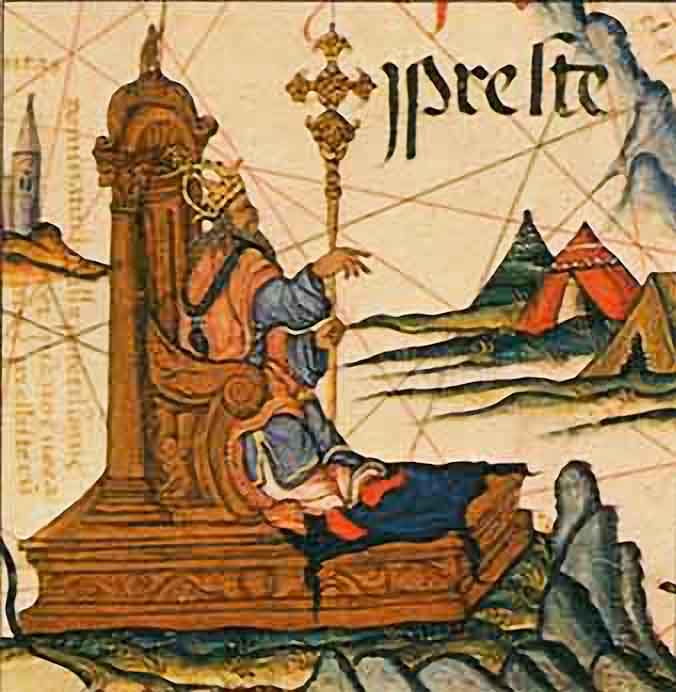
Prester John – Wikimedia commons
writer, outlines the introduction of Christianity among the Turks. The scope and analysis of its treatment dealing with the nations of farther Asia, as well as the freshness of its descriptions, sheds unusual light on a region that is little known. It presents the Turks as dwelling in tents and having no towns, villages, or houses. Well organized, they live as the children of Israel did during their forty years of wandering in the wilderness. These Turks had their premises well kept, while the people themselves were clean and neat in their habits. They accepted both the Old and New Testaments in Syriac, although evidence indicates that they had the Scriptures also in their own script. When the divine writings were used in public services, they were translated by officiating pastors into the vernacular in order that the people might understand what was read. It is a most illuminating statement concerning these Turks to read that they were ruled over by four great and powerful kings who
evidently lived at quite a distance from each other. The letter applied the name Tartar to all the divisions, and designated their country as Sericon. This is the name (as Mingana points out) which was given to China in the days of Christ. Each of these kings ruled over four hundred thousand families who accepted and obeyed the teachings and gospel of Christ. If each family was composed of an average of five persons, it would mean that the four kingdoms had a population of about eight million, and they all were Christians. From the twenty-seven grand divisions of the church administration covering the Orient, communications were sent in not only concerning new religious developments, but also about events of international importance. Thus in the year 1009, Abdisho, metropolitan of Merv, the church director in the powerful province of Khurasan, northeast Persia, wrote to the patriarch John informing him that two hundred thousand Turks and Mongolians had embraced Christianity. He pointed out that the conversion occurred because the king of the Keraits, which people spread over the region around Lake Baikal, Siberia, had been found wandering in a high mountain where he had been overtaken by a violent snowstorm. In his hopelessness he considered himself lost, and dreamed or thought he saw a giant appear to him in vision, saying, “If you will accept Christ, I will lead you to safety.” Having promised to become a Christian and having returned safely to his kingdom, he sought out Christian merchants who were traveling among his tribes, and learned from them the way of salvation. Mention should be made here of the name of Prester John, stories of whom stirred medieval Europe. Reports came through to the West of a powerful Christian king who, in the depths of Scythia, ruled over a mighty people. He is known variously by the names, Prester John, Presbyter John, and Priest John. Some think he was a king of the Keraits, and others believe that, in addition to being a great king himself, he was also son-in-law to the king of the powerful Karakitai. The picture of these nations with their dreaded kings, all, or nearly all, of whom had been brought to Christ, confirms the opinion expressed by Mingana that the Church of the East “was by far the greatest missionary church the Christian cause has produced.”(18) In following its evangelical conquests, one ranges through Turkestan, Siberia, Mongolia, Manchuria, and Tibet. One is introduced to stretches of territory more vast than would be possible to visualize in any other quarter of the globe. One becomes interested in, and familiarized with, peoples and portions of the earth’s nations which previously had no claim upon man’s attention. Truly, the Church in the Wilderness was a wonderful missionary church.
CONQUESTS OF GENGHIS KHAN
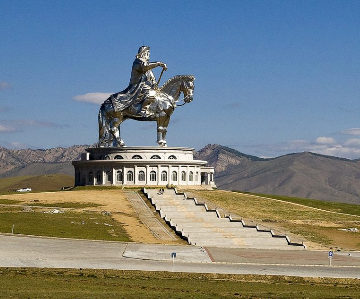
Twelve centuries of ever-widening spiritual conquests were not accomplished any too soon by the Church of the East. The fierce energy of the countless tribes of Mongolia and Siberia, stirred by the new ideas heard from the lips of missionaries, was beginning to display itself as a world menace. These hordes needed only a leader possessing the caliber of a Julius Caesar to go forth on conquests never halting until Germany, France, and England trembled before the next blow. In the beginning of the thirteenth century, that leader appeared. His name was Genghis, a chief of the Mongols. After his first victories over surrounding tribes in Siberia, he took the title of khan, or king. How Genghis Khan conquered all Asia, how he and his son, Ogotai, devastated eastern Europe, and how the pope started up in alarm at the report of this news and sought to utilize the influence of the Church of the East to save the Catholic nations in theWest is a story of great significance. The name Mongol, for two centuries after Genghis Khan, was the terror of central Asia. Yet the origin of the tribe is in obscurity. Numerically it was not the largest of the Tartary kingdoms. Genghis came of a warlike father and mother, but was left fatherless when he was only thirteen years of age. His mother resolutely assumed the reins of the kingdom, and regained supremacy over half of the revolting chiefs. Later, Genghis brought all the rebels back into
Genghis Khan
subjection and began successful conquest of the near-by kingdoms of the Keraits, Merkits, Uigurs, and Naimans. The immense victories won by Genghis in China were the results as much of strategy as of prowess. He possessed skillful ability in coordinating massive bodies of troops spread over wide areas, aiming at separate points of conquest. He was tolerant of religion. He treated Christianity, Buddhism, Mohammedanism, and other faiths with impartiality; some authorities say he killed them all alike if they were in the way of his conquests or were in the cities doomed to destruction. Abul Faraj writes of him that he “commanded the scribes of the Uigurs and they taught the children of the Tatars their books.”(19) He was a lawgiver of high order, creating for the people over whom he ruled, a code of regulations which later conquerors were glad to adopt. Fortified by his victories in Siberia, Mongolia, and China, he turned his attention to new successes in western Asia and eastern Europe. Of the ruin wrought by Genghis Khan, Arminius Vambery writes:
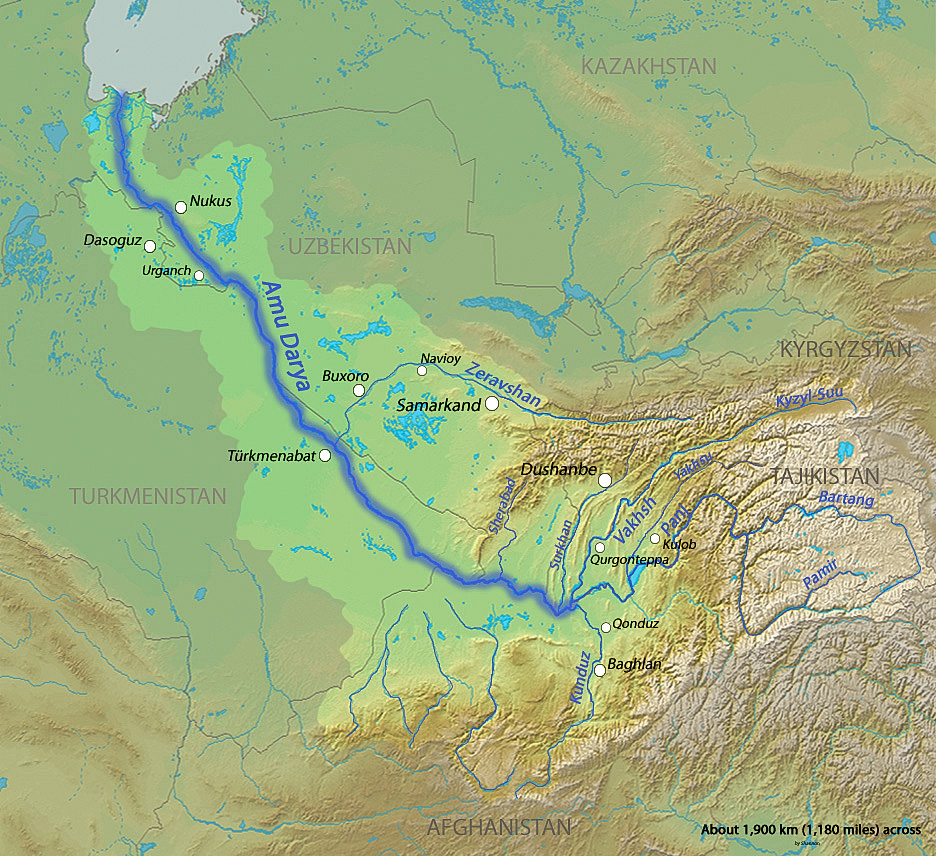
Though already seventy years old, Djenghiz once more took field against Tanghut, which had rebelled against him; but he died during this campaign in the year 624 (1226), leaving behind him traces throughout all Asia of the fire and sword with which his love of war had devastated a whole continent; but nowhere so deeply marked as in Transoxania, where the civilization of centuries had been destroyed, and the people plunged into a depth of barbarism in which the remembrance of their former greatness and their whole future were alike engulfed. No part of all Asia suffered so severely from the incursions of the Mongolian hordes as the countries bordering on the Oxus and the Yaxartes….No wonder, then, that within five short years, the great high roads of central Asia, by which the products of China and India were conveyed to western Asia and to Europe, were deserted; that the oases, well known for their fertility, lay barren and neglected; or,finally, that the trade in arms and jewelry, in silks and enamels, so celebrated throughout Islam, decayed forever. The towns were in ruins, the peasants either murdered or compulsorily enrolled in the Mongolian army, and the artisans sent off by thousands to the farthest East to adorn and beautify the home of the conqueror….Bokhara and Samarkand never regained their former mental activity, and their intellectual labors were henceforth entirely devoted to casuistry, mysticism, and false religion.
See footnote 20
At the time Russia was conquered it consisted of many small independent states constantly at war with one another and nominally under the common suzerainty of a grand prince or czar. (21) All the cities ravaged by the armies of Genghis were so completely obliterated from the sight of man that the Mongol chieftain could say, as he said many times to his fallen foe, that he was “the scourge of God.” Thus, while his armies were subduing the northern Chinese empire in the east and other armies of the Mongols were conquering the northwestern part of India, Genghis Khan was also laying waste a part of Russia and attacking on the upper Volga. Death overtook him while in this warfare.
He was not a persecutor of Christianity. It is stated that one of his wives, a Kerait by birth and a near relative of Prester John, was a Christian.(22) He bequeathed his vast empire, reaching from China all the way to Hungary and Poland, to his three sons. One of the three, Ogotai, was chosen as the king of kings to succeed his father.
KUYUK SPARES EUROPE
It was the terrible wars waged by Ogotai which brought home to the nations of Europe the threat of subjection to the Mongols. Batu, the intrepid and invincible general of Ogotai, suddenly appeared on the eastern flanks of Poland and Hungary. Hungary had been relied upon to check the Mongols, but unexpectedly it offered comparatively feeble resistance; and for a number of years the forces of the Tartars passed and repassed over her lands, pillaging, ravaging, and devastating. Only the Holy RomanEmpire now lay between the conquerors on the east and France and England on the west. Ogotai died in the year 1241. The princes were recalled from war to elect anew khan. While they were coming together, the queen mother labored earnestly for the election of her favorite, son, Kuyuk, and her work resulted in his election. Kuyuk was a true Christian, and in his days the prestige of the numerous Christians in his dominions was very high.23Mingana relates that his camp was full of church leaders, clergy, and scholars, and that a Christian by the name of Kaddak was his grand vizier. Under Kuyuk the massacres and devastations which had characterized the rule of Genghis and Ogotai seem to have come to an immediate end. It is a question if Europe was not spared further Mongolian wrath because a Christian, such as Kuyuk, was elected to supreme command. After the death of Kuyuk in 1251 the succession passed to Mangu. Tule, a brother of Ogotai, was a mighty general. Of Sarkuty Bagi, the wife of Tule, Mingana shows that she was another Christian queen, a true believer and the wisest of all.24 She was the mother of three sons who in turn became vested with imperial dignity, and all of them were professed Christians or possessed of Christian wives. Their names were Mangu, Hulagu, and Kublai. The thrilling stow of their contributions to the Church of the East belongs to the history of China in a later chapter. When the sword of destruction hung over Germany, Italy, France, and England through the menacing attitude of Ogotai’s skillful generals, the pope decided to send an envoy to the relentless Batu, leader of the Tartar armies. Friar John of Plano Carpini was chosen for this task. He journeyed to the banks of the Dnieper where the Tartar legions were encamped, encountering many difficulties on the way. Receiving scant attention, he was hurried on to the Volga, the headquarters of Batu. But Batu was unwilling to handle the proposition, and the wiry friar had to proceed by forced marches to the central camp farther east. He arrived after the death of Ogotai and before the election of the new emperor. Some years after the journey of Friar John, King Louis IX of France commissioned Friar William of Rubruck to proceed to the central camp of the Mongolians, hoping that he might convert the emperor to the Roman faith. Friar William reports many items about the Assyrian Christians.(25) What interests one most is what Friar William of Rubruck said of the Assyrian Christians (called by him, Nestorians) whom he encountered in his visits to those realms. He found them in nearly all the countries which he traversed; he met with them in the country of Karakhata, where he noticed that the Turkish people, called Mayman, had as king a Nestorian.(26) The Nestorians, he said, were in those parts inhabited by the Turkomans. They conducted their services in the latter’s language and wrote books in their alphabet; in all their towns was found a mixture of Nestorians.(27) He relates that in fifteen cities of Cathay there were Nestorians possessing an episcopal see. The grand secretary of the emperor Mangu, Bulgai by name, was a Nestorian, whose advice was nearly always followed and who was the imperial interpreter.(28)
THE DOCTRINES OF THE CHRISTIAN MONGOLS
The long and predominating favor with which the Mongol rulers treated the Church of the East indicates that the doctrines of the Christian Mongols were those of the Assyrian Church. This will appear to be more the case when the later histories of this remarkable people are considered. The beginning of their power, however, is connected with a significant fact from which conclusions can be drawn respecting the type of Christianity that they fell in with during the first years of their dominion. Again we consider that celebrated personage, Prester John. The name Prester John is connected with a great revolution which took place in Asiatic Tartary about 1000. Many writers of sincerity who are worthy of credit relate that a king of the Keraits had been converted to Christ. He had taken the name of John, and he with thousands of his people was baptized by the Church of the East. His empire grew; each successive ruler was also called John. After about two centuries, Genghis Khan conquered the last king. Since the victorious Mongol chieftain married the daughter of the slain priest-king, the doctrine of the Church of the East rose to great influence among the Mongols.29 Mosheim says that Europe was deeply stirred at the report concerning the wealth, strength, and happiness of this Christian realm. The king of Portugal sent an embassy to Abyssinia because he concluded that the doctrines of Prester John were those of the Abyssinians.30 The legation discovered many things among the Abyssinians that were analogous to those reported of Prester John.
THE CHURCH OF THE EAST IN ITS WIDE EXTENT OF MISSIONS
The organization of the Oriental believers is equally as interesting as the stirring events in the midst of which they labored. From the days of Timothy the believers in all Asia had been divided by the church into fromtwenty-six to thirty grand divisions. Over each of these there was the metropolitan or presiding officer. From time to time, possibly annually, these clergy assembled under their sub-province president to report the condition of the faithful in their parishes and to consider with one another the problems with which they were similarly confronted. Then occasionally there would be a large convention under the chairmanship of the metropolitan with delegates from the different provinces. When the distances were too great to communicate easily with the catholicos, the head at Bagdad, then the metropolitan was expected to hand in a report at least once every six years. An account has already been given of the purity of doctrine and practice of the Church of the East, which is often wrongly styled Nestorian after Nestorius. M’Clintock and Strong regards them as the Protestants of Eastern Christianity.
“The Christians of Saint Thomas, in East India, are a branch of the Nestorians. They are named after the apostle Thomas, who is supposed to have preached the gospel in that country.”
See footnote 31
They were entirely separated from the church at Rome. Edward Gibbon shows that the St. Thomas Christians as well as the Syrian Christians were not connected with Rome in any way. He says that when the Portuguese in their first discoveries of India presented the image of the Virgin Mary to the St. Thomas Christians in the sixteenth century, they said, “We areChristians, not idolaters.”(32) Here is a list of the doctrines of that branch of the Assyrian Christians in India which is called the St. Thomas Christians. Those believers —
1. Condemned the pope’s supremacy,
2. Affirmed that the Roman Church had departed from the faith,
3. Denied transubstantiation,
4. Condemned the worship of images,
5. Made no use of oils,
6. Denied purgatory,
7. Would not admit of spiritual affinity,
8. Knew nothing of auricular confessions,
9. Never heard of extreme unction,
10. Permitted the clergy to marry,
11. Denied that matrimony and consecration were sacraments,
12. Celebrated with leavened bread and consecrated with prayer. (33)
The remarkable fact is that in the face of titanic difficulties the Church of the East was able to maintain through ages such wonderful unity of belief and soundness of Biblical living. “In the first place,” says Etheridge, speaking of one branch of the Church of the East, “the Nestorian church has always cherished a remarkable veneration for the Holy Scriptures. Their Rule of Faith has been, and is, the written word of God.”(34) Widespread and enduring was the observance of the seventh-day Sabbath among the believers of the Church of the East and the St. Thomas Christians of India who never were connected with Rome. It also was maintained among these bodies which broke off from Rome after the Council of Chalcedon; namely, the Abyssinians, the Jacobites, the Maronites, and the Armenians. The numbers sanctifying the Sabbath varied in these bodies; some endured longer than others. Noted church historians, writing of the Nestorians in Kurdistan, say,
“The Nestorian fasts are very numerous, meat being forbidden on 152 days. They eat no pork, and keep both the Sabbath and Sunday. They believe in neither auricular confession nor purgatory, and permit their priests to marry.”
See footnote 35
Sabbath-keeping among the Abyssinians is especially worthy of notice. Of them the historian Gibbon fittingly remarks,
“Encompassed on all sides by the enemies of their religion, the Ethiopians slept near a thousand years, forgetful of the world, by whom they were forgotten.”
See footnote 36
When in the sixteenth century Europe again came into contact with the Abyssinians, the seventh day was found to be their weekly rest day; Sunday was only an assembly day. Sorely pressed by Mohammedanism, they made the same mistake which was made by the St. Thomas Christians of India in that they appealed for help in 1534 to the Portuguese, the greatest naval power of Europe in that day. The following argument was presented to Portugal by the Abyssinian ambassador when asked why Ethiopia sanctified the seventh day:
On the Sabbath day, because God, after he had finished the Creation of the World, rested thereon: Which Day, as God would have it called the Holy of Holies, so the not celebrating thereof with great honor and devotion, seems to be plainly contrary to God’s Will and Precept, who will suffer Heaven and Earth to pass away sooner than his Word; and that especially, since Christ came not to dissolve the Law, but to fulfill it. It is not therefore in imitation of the Jews, but in obedience to Christ and his holy Apostles, that we observe that Day…. We do observe the Lord’s day after the manner of all other Christians, in memory of Christ’s Resurrection.
See footnote 37
When the Portuguese made a gesture of sending help to the Abyssinians, a number of Jesuits were included in the mission, and they immediately began to win the Abyssinian Church to Roman Catholicism. In 1604 they influenced the king to submit to the Papacy. One of their first efforts was to have a proclamation issued by the king prohibiting all his subjects dominion penalties to observe the seventh day any longer.(38) Civil war followed. The Jesuits were expelled and their laws were rescinded. With respect to the Jacobites, there is the statement of that well-known and learned Samuel Purchas, who, having visited them in the beginning of the seventeenth century, writes:
“They keep Saturday holy, nor esteem Saturday Fast lawful but on Easter Even. They have Soleme Service on Saturdays.”
See footnote 39
Another authority, Josephus Abudacnus, writing in the eighteenth century in his history of the Jacobites, stated that they assembled every Sabbath in their temples, to which statement the later editor, J. Nicholai, adds the following footnote:
Our author states that the Jacobites assembled on the Sabbath day, before the Dommical day, in the temple, and kept that day, as do also the Abyssinians as we have seen from the confession of their faith by the Ethiopia king Claudius…. From this it appears that the Jacobites have kept the Sabbath as well as the Dommical day, and still continue to keep it.
See footnote 40
Alexander Ross writes that the Maronites likewise observed the Sabbath as well as Sunday.(41) Thus, we see how these four Eastern communions, three of which never walked with the Papacy, continued to honor the Sabbath. As one looks upon the approximately five centuries of Mohammedan rule in Asia, three things are worthy of notice. In the first place, the comparatively tolerant attitude of the rulers is comforting. This is not to say that at times dominion there were not periods of persecution and fierce opposition. However, one does not witness a persistent, determined purpose to root out Christians by cruel, bloody wantonness. The supreme motive of the Moslem conqueror was the lust of power rather than a fanatical passion to kill and to ruin other faiths. The leaders of Islam were so continuously occupied by war among themselves that they had neither time nor desire to frame within their own ranks an organization of the clergy tied firmly to absolute obedience, as was seen in the papal hierarchy. Dynasties rose and fell, but the Church of the East grew and extended its missions over all the lands of Asia. Secondly, one is surprised by the splendidly balanced organization which energized the Church of the East. Rejecting the polygamy of the Moslems, it was not distracted by domestic broils. This same church refused to emphasize an unmarried life for its clergy, the rule which prevailed in Buddhism and in Western Romanism. As marriage was designed of God not only to increase love, but to purify love, the Church of the East was safeguarded against such degradation of standards as was seen in the Buddhist priests and nuns. Their thoughts ever turned toward their Sabbath home, dearer to them than any palace halls. In other words, they obeyed the four divine policies laid down in the first chapter of Genesis: Namely, the worship of the Creator, Sabbath observance, family life, and proper diet and temperance. Lastly, the members of the Church of the East were not only a church of evangelical activities, but also a people of sound doctrines. It is difficult to say which is the more dangerous — sound doctrines without evangelism, or evangelism without sound doctrine. The first leads to coldness in religion; the second produces vaudeville in preaching. Both these extremes were avoided by the Church of the East. It was able to give a reason for the faith, and at the same time, it displayed a life of missionary zeal and sacrifice which has seldom been surpassed.
_______________________________________
Footnotes/Sources:
1 Grant, The Nestorians, or the Lost Tribes, p. 72. 2 Wishard, Twenty Years in Persia, p. 18. 3 Saeki, The Nestorian Monument in China, pp. 50, 51. 4 Budge, The Monks of Kublai Khan, Emperor of China, pp. 30, 31. 5 Schaff, History of the Christian Church, vol. 3, pp. 731, 732, note 2. 6 Yohannan, The Death of a Nation, p. 102. 7 Vambery, History of Bokhara, p. 32; also p. 89, note 2. 8 Neander, General History of the Christian Religion and Church, vol. 2, p.183, note; Saeki, The Nestorian Monument in China, pp. 116-118; Schaff, History of the Christian Church, vol. 3, pp. 732, 732, note; Draper, History of the Intellectual Development of Europe, pp. 290,291. 9 Buchanan, Christian Researches in Asia, pp. 146, 147. 10 Among all the memorials which still remain to revive the glorious centuries of the Church of the East, this stone, which it was the privilege of the writer to study and to photograph, attracts the greatest attention. 11 Mingana, “Early Spread of Christianity,” Bulletin of John Ryland’sLibrary, vol. 9, p. 306. 12 Ibid., vol. 9, p. 306. 13 Ibid., vol. 9, p. 306. 14 Ibid., vol. 9, p. 307. 15 Mingana, “Early Spread of Christianity,” Bulletin of John Ryland’sLibrary, vol. 9, pp. 307, 308. 16 Mingana, “Early Spread of Christianity,” Bulletin of John Ryland’sLibrary, vol. 10, p. 466. 17 O’Leary, The Syriac Church and Fathers, p. 113. 18 Mingana, “Early Spread of Christianity,” Bulletin of John Ryland’sLibrary, vol. 10, p. 113. 19 Abul Faraj, Chronography, vol. 1, p. 354. 20 Vambery, History of Bokhara, pp. 137, 138. 21 Pott, A Sketch of Chinese History, p. 81. 22 Huc, Christianity in China, Tartary, and Thibet, vol. 1, p. 129. 23 Mingana, “Early Spread of Christianity,” Bulletin of John Ryland’sLibrary, vol. 9, p. 312. 24 Abul Faraj, Chronography, vol. 1, p. 398. 25 Mingana, “Early Spread of Christianity,” Bulletin of John Ryland’sLibrary, vol. 9, p. 315. 26 Rockhill, The Journey of William of Rubruck, pp. 109, 110. 27 Ibid., pp. 141, 142. 28 Ibid., p. 168. 29 See Neander, General History of the Christian Religion and Church, vol.4, pp. 46-50. 30 Mosheim, Institutes of Ecclesiastical History, b. 3, cent. 12, pt. 1, ch. 1,par. 7, note 12. 31 M’Clintock and Strong, Cyclopedia, art. “Nestorians.” 32 Gibbon, Decline and Fall of the Roman Empire, ch. 47, par. 31. 33 D’Orsey, Portuguese Discoveries, Dependencies, and Missions in Asiaand Africa, pp. 232, 233. 34 Etheridge, The Syrian Churches, p. 89. 35 Schaff-Herzog, The New Encyclopedia of Religious Knowledge, art.“Nestorians”; also, Realencyclopaedie fur Protestantische Theologieund Kirche, art. “Nestorianer.” 36 Gibbon, Decline and Fall of the Roman Empire, ch. 47, par. 38. 37 Geddes, The Church History of Ethiopia, pp. 87, 88. 38 Ibid., pp. 311, 312. 39 Purchas, His Pilgrimes, vol. 8, p. 73. 40 Abudacnus, Historia Jacobitarum, pp. 118, 119. 41 Ross, Religions of the World, p. 493.
In the sixth century, according to the report of a Nestorian traveler, Christianity was successfully preached to the Bactrians, the Huns, the Persians, the Indians, the Persarmenians, the Medes, and the Elamites: the barbaric churches, from the Gulf of Persia to the Caspian Sea, were almost infinite… The zeal of the Nestorians overleaped the limit which had confined the ambition and curiosity both of the Greeks and Persians. The missionaries of Balch and Samarcand pursued without fear the footsteps of the roving Tartar…. In their progress by sea and land the Nestorians entered China by the port of Canton.
See footnote 1
PROMINENT among the dauntless leaders who spread the faith from
Mar Abba I The Great – Wikimedia commons
the Tigris eastward is Aba (c. A.D. 500-575). He is identified with that great church which has been called the Waldenses of the East. For centuries the followers of Jesus in Asia generally were called Messiahans, or Messiah people. Many renowned Messiahans who withstood the fierce opposition of the Persian state religion, or Mithraism, carded primitive Christianity to India, central Asia, China, and Japan. Outstanding among them was Aba. If the victory of Christianity over Mithraism in the Roman Empire was a European triumph, the victory of the Church in the Wilderness over this counterfeit in Persia was still more outstanding. Mithraism was proud not only of her sway in Persia, but also of having adapted Zoroastrianism to the western world; thus having paved the way for this form of sun-worship to become a universal religion in the Roman world. (2) The two centuries and a half which spanned the time between Papas (A.D.285), the first catholicos, or supreme head over the Church of the East, to Catholicos Aba (A.D. 538), were alternating years of peace and persecution. One must recall that the supreme head of the Church of the East was called “catholicos” and his incumbency, a “catholicate.” A former chapter related how in this same year the Papacy was securely seated in the city of Rome. During the intervening decades there were many bright luminaries over the Assyrian Church to guide the faithful. Some of these sealed their witnessing with their blood. Persia at war with Rome naturally spelled persecution. The
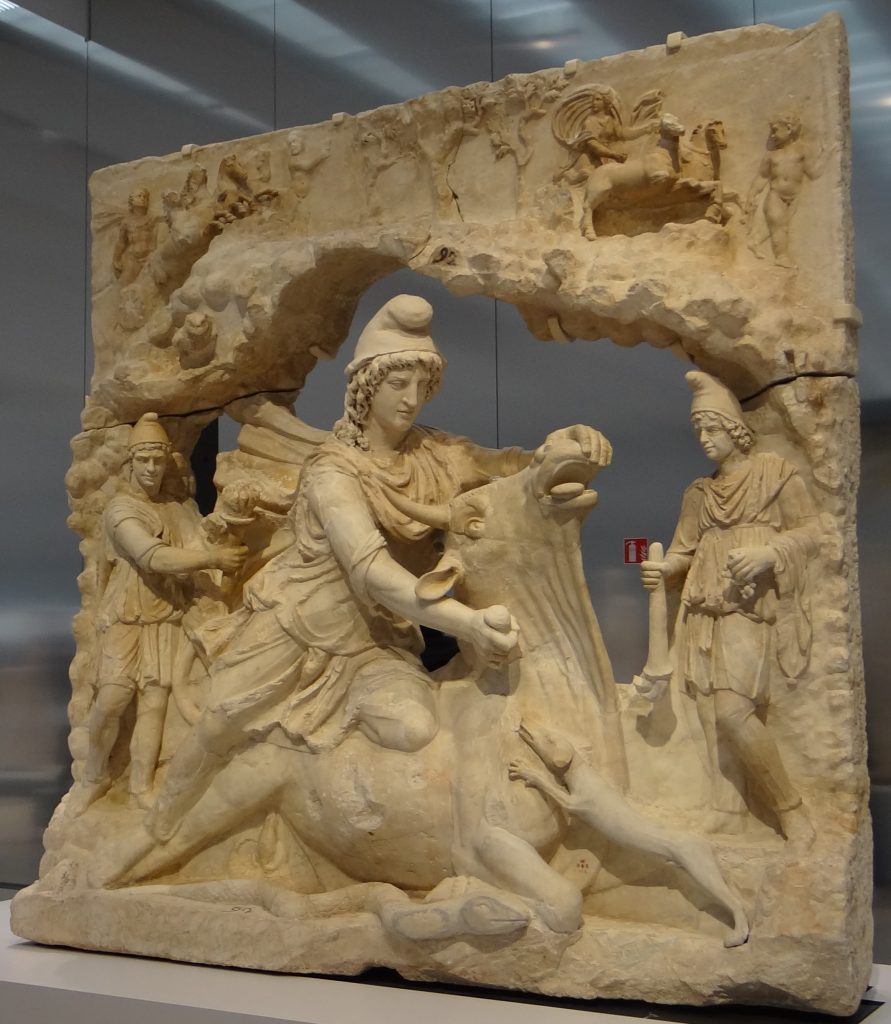
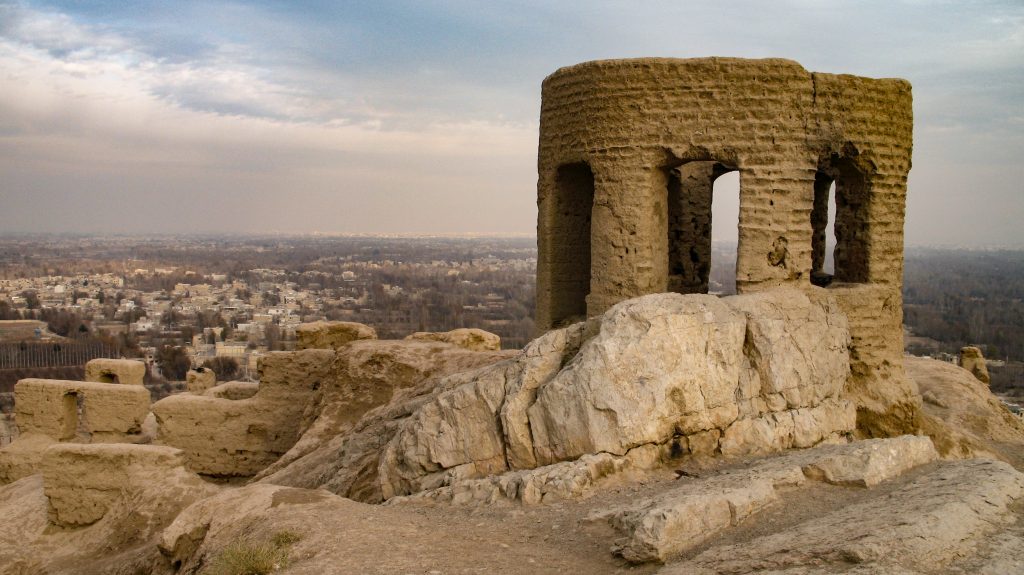
The god Mithra
Persian commanders in chief did not distinguish between the papal Christianity of the Roman Empire and the Church of the Messiah. All Christians were alike to them whether the believers were of Persia or of Rome. The Iranian lords feared collusion between Persianevangelicals and Rome, and also suspected the existence of spies. Moreover, Mithraism sought to secure any occasion to attack the simple but ever-expanding Church in the Wilderness. The sun was sacred to Mithraism Persecutions fell upon the believers who lived and worked in the presence of the sun worshipers, and the Christians dared not say that the sun was not a living being. Mithraists imitated Bibleceremonies.(3) The Church of Rome which, according to some
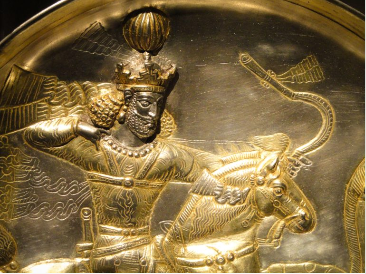
Shapur II – Wikimedia commons
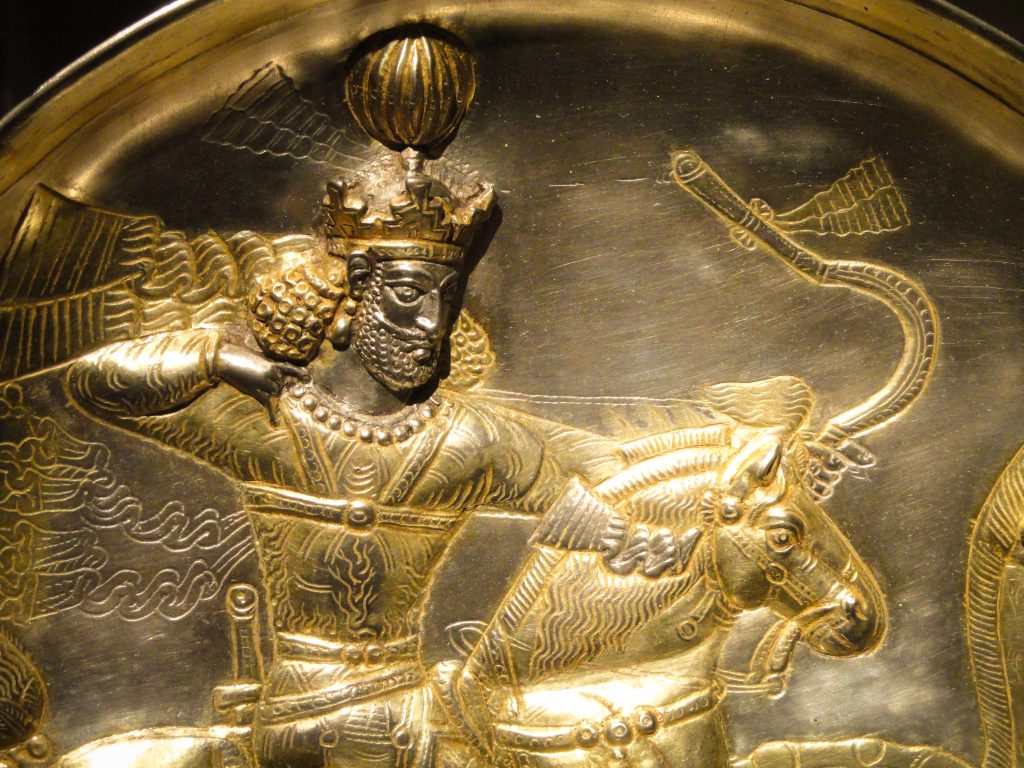
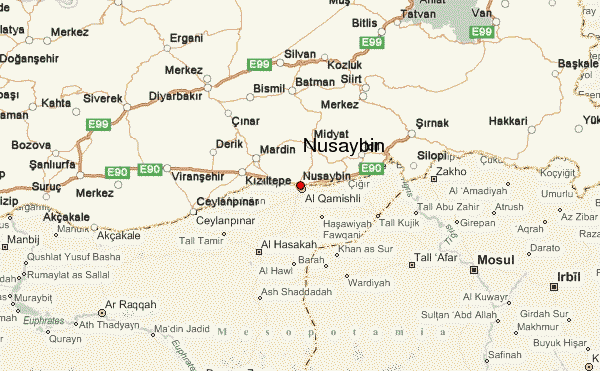
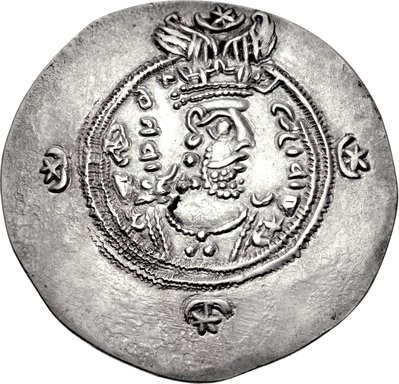
authorities, had imbibed much of the lure and philosophy of Mithraism, was very nearto it in spirit.(4) The Christians in Persia refused the sublimated idolatry of the Iranians and suffered because they did so. The first persecution of magnitude after the union of all districts of the Church of the East under Papas was launched by the Persian king, Shapur II. It began during the catholicate of Shimun (Simeon) and continued through forty years (A.D. 335-375). King Shapur was ambitious to recover all the territories ruled over by King Xerxes of the early Persian Empire. He launched his attack as soon as he deemed the time favorable. But church members refused to serve in the army, and the exasperation of the king knew no bounds. He was enraged not only at the defeat of his campaign, but also because the courageous defenders in the great fortress of Nisibis had with stood his attacks and had been kept alive by James, the resident bishop appointed by the church at Rome. On his return to Seleucia, the capital, the king determined to exact retribution from the Persian Christians. The mobeds, the priests of Magianism, were at hand to arouse the wrath of the king. The first firman of persecution laid a double tax upon the Messiahans to defray the expenses of the war. Shimun, the catholicos, was ordered to collect it. He refused on the grounds of religious scruples and because of the poverty of his people. Though Shimun was a personal friend of the king, nothing now was to stand in the way of teaching the Christians a lesson. The destruction of church buildings throughout the empire was commanded, and the catholicos was arrested. He was offered freedom for himself and his people if he would adore the sun but once. Upon his refusal, he, with five associates over districts and one hundred other clergy, was put to death. Forty years of trial by fire now descended upon the children of God. Provincial governors had the power to condemn or acquit. In the case of a kind and just governor, the church fared well; but such was not usually the situation. The popular complaints sufficient to keep alive
Nisibis near the Syrian border
resentment against the Christians would run something like this:
“They despise our sun-god. Did not Zoroaster, the sainted founder of our divine beliefs, institute Sunday one thousand years ago in honor of the sun and supplant the Sabbath of the Old Testament which the Jews in our land then sanctified? Yet these Christians have divine services on Saturday. They desecrate the sacred earth by burying their dead in it and pollute the water by their ablutions. They refuse to go to war for the shah-in-shah; and they preach that snakes, scorpions, and creeping things were created by a good God.”
The intention of Shapur II to deal effectively with the followers of theNew Testament did not stop with the death of Shimun. The next catholicos, elected as his successor, followed him to a martyr’s grave. And when another head of the church was chosen and was also put to death, the office remained vacant for twenty years. Naturally the main objects of the attack were the clergy, but the bitterest feelings were displayed against converts from Magianism. While it was true that the Church in the East did not have monasteries in the sense of the celibate life which had spread over Egypt and Europe, nevertheless there were those who believed that they could work more effectively by remaining single. Those who have lived for many generations in nations of liberty and light can little appreciate the desperate opposition which the heralds of the cross met indifferent lands throughout the early centuries. In the East, Christianity encountered Buddhism, a religion carried on largely by monks and nuns. To cope with such powerful antagonists as Buddhism and Zoroastrianism, there were those who naturally felt that they could do it more effectively by not marrying. Advocacy of an unmarried clergy never had the ascendancy in the Church of the East. Such houses of celibate life would not have been able to endure in Persia. The persecution was bitter enough against the eastern theological training centers, and it was furious against unmarried clergy. The Mithraic faith was strong in advocating marriage and the presenting of children to the state who could serve in the army and be of other service. After the death of Shapur II there was a lull for a time in the sufferings ofthe church. Finally, the believers gathered up strength to elect another head. Then the catholicos and leading clergy took advantage of the time of peace to reorganize the church. There was now a greater demand for stronger organization, for persecution had fired the zeal of the believers. Many of the oppressed had fled eastward to other lands, there to found new churches. It was not long, however, until in the subsequent reigns of Yazdegerd I, Bahram V, and Yazdegerd II, waves of death and destruction swept over the Persian believers. These were not as long as under Shapur II, but they were much more severe. The facts concerning the outbreak of persecution under Yazdegerd I, the first of these kings, are given byDeLacy O’Leary. The Persian bishop of Susa, who was given to impetuosity, destroyed one of the fire temples of the Zoroastrians. Complaint
Coin with the image of Yazdegerd III
being made to the king, the bishop was ordered to restore the building and to make good all damage that had been done. When the bishop refused, Yazdegerd I threatened to destroy every church in his dominion. Such orders were issued and were carried out eagerly by the Zoroastrians inflamed with jealousy against the believers. Before long the destruction of the churches developed into ageneral persecution. Yazdegerd I died in 420, and his son, Bahram Vincreased the afflictions of the
church.(5) Clergy and laity alike were subjected to the most horrible tortures.
Mar Barsumas
Their feet were bored with sharp irons, and some experienced what is called the“nine deaths,” where bit by bit their bodies were cut to pieces. It was quite common under the different monarchs to confiscate the wealth of the well to do and to pillage their homes. Had there been no state Christianity in the Roman Empire, probably in Persia there would not have been persecutions of Christianity. Zeno, the Roman emperor, closed the Assyrian church college at Edessa because it did not agree with the theological views then prevailing in the state religion.A powerful leader in the Church of the East moved the school to Nisibis, a strong fortress city in which the college developed into one of the intellectual centers of the world. The phenomenal work and influence of the new college at Nisibis, opened by Barsumas, reached to Oxford, Cambridge, and Paris. Thus W. A.Wigram writes:
When we remember how much of the culture of medieval Europe was to come to her through the Saracens, and that the ‘Nestorians’ were the teachers of the Saracens, one is set asking whether Oxford, Cambridge, and Paris do not owe an unsuspected debt to Bar-soma, though the road from Nisibis to those centers may run through Bagdad and Salamanca.6
See footnote 6
Persia later became tolerant of Christianity; liberty was increased
there while it was vanishing in Europe. If Mohammedanism had not conquered Persia, the Christians would probably have gained complete religious liberty.
PERSIAN CHRISTIANS ESCAPE THEOLOGY OF ROME
The Christianity of Persia existed not only as a challenge to Mithraism, but it also differed widely from the ruling church in the Roman Empire. The forty years of persecution by Shapur II made impossible any contact between the believers in the two dominions. The revolutionary events which centered in the Council of Nicaea and in the angry controversies which followed that gathering were unknown to the churches beyond the Euphrates. They had no part in the fierce disputes concerning the Godhead. They had grown in strength and had performed miracles inspreading the gospel eastward before the contest arose over Nestorius. Nestorianism, according to Samuel Edgar, is a dispute about words.(7) It is a misnomer to call the Church of the East, Nestorian. Even to this day communions so labeled resent the name.(8) The Church of the East in India also was free from the controversies of imperial Christianity. This fact reveals the separation between the Church of India and the Western hierarchy. To note some points of difference between the Church of the East and the Papacy, it may be observed that the first rejected the use of images, and interposed no mediator like the Virgin Mary between God and man. The Church of the East also dispensed with candles, incense, relics, and many other usages of imperial Christianity. They had a different Bible than that of Rome; for their Bible they used the Peshitta, evidently the work of the school of Lucian.9 Assyrian Christians (the name often given to the Church of the East) rejected the supremacy of the bishop of Rome. At this timeSeleucia, the church headquarters, was full of Jews,10 and many Christians throughout the East were of Jewish blood. Of the Persian Christians, W. F. Adeney writes:
They have no doctrine of transubstantiation, no purgatory; they do not sanction Mariolatry or image worship; nor will they even allow icons to be exhibited in their churches. Men and women take the communion in both kinds. All five orders of clergy below the bishops are permitted to marry.
See footnote 11
MISSIONARY EXPANSION FROM PAPAS TO ABA
“In the early Christian centuries there was a system of roads and posts between the cities of central Asian plains as lately shown by the recovery of documents in some of the unearthed cities), and there was no pass unknown to the Chinese pilgrims — not only the direct routes but all the ways which linked up the Buddhist centers.”
See footnote 12
“When the Persian King, Kawad (A.D. 498), because of rebellions in his kingdom, twice took refuge with the Huns and Turks, he found Christians there who helped him to reconquer his land.”
See footnote 13
When he had regained his throne, he killed some Mithraists, incarcerated others, but was benevolent toward the Christians because a company of them rendered service to him on his way to the king of the Turks. (14) About this same time the Assyrian Christians were credited with having taught the Turks the art of writing in their own language. In commenting upon their expansion eastward, Wigram indicates their influence over Tibet:
“The seventh century was the period of missions to China; and the strangely Christian-like ceremonial of modem lamas was quite possibly borrowed from Assyrian sources.”
See footnote 15
The scholar, Alexander von Humboldt, reveals how thorough were the education and organization in the Church of the East before Aba. He also shows how this same church taught arts and sciences to the Arabs:
It was ordained in the wonderful decrees by which the course of events is regulated, that the Christian sects of Nestorians, which exercised a very marked influence on the geographical diffusion of knowledge, should prove of use to the Arabs even before they advanced to the erudite and contentious city of Alexandria, and that, protected by the armed followers of the creed of Islam, these Nestorian doctrines of Christianity were enabled to penetrate far into Eastern Asia. The Arabs were first made acquainted with Greek literature through the Syrians, a kindred Semitic race, who had themselves acquired a knowledge of it only about a hundred and fifty years earlier through the heretical Nestorians. Physicians, who had been educated in the scholastic establishments of the Greeks, and the celebrated school of medicine founded by the Nestorian Christians at Edessa in Mesopotamia, were settled at Mecca as early as Mohammed’s time, and there lived on a footing of friendly intercourse with the Prophet and Abu-Bekr.
See footnote 16
In 549 the White Huns, inhabiting the regions of Bactria, and the Huns on both the north and south banks of the Oxus River, sent a request to Persia to Catholicos Aba that he would ordain for them a director. The Persian king was astonished to see these representatives of the thousands of Christians in that distant land coming to him; and being amazed at the power of Jesus, he concurred. The spiritual director was ordained, and here turned with the mission.(17) A. Mingana gives a list of twenty-one towns and provinces west of the Oxus River which had spiritual leaders ordained to role the churches in them and mentions especially those leaders of the fifth and sixth centuries. He also maintains that the majority of the two powerful divisions of the eastern Turks, the Uigurs and the Keraits, were Christians, and that the gospel of Christ had penetrated into the mighty confederacy of Naimans comprised of nine powerful clans.(18) These missionaries had also converted a fourth conglomeration of tribes of Turkish stock with an infusion of Mongolian blood, called the Merkits.19All these vigorous peoples lived far away to the northeast in Asia. As to supplementary records of this expansion, Mrs. E. A. Gordon says: “Dr.Aurel Stein recently discovered in the loess in Chinese Turkestan, thousands of rolls of precious MSS.”(20) Claudius Buchanan, who has left a thrilling account of his own experiences and life in India about 1812, declares that he saw in that land a Syrian version of the Bible which according to popular belief would date probably as far back as 325, the year
River Amu-Darja – Wikimedia commons
of the Council of Nicaea.21 There is no doubt that the fierce forty-year persecution of King Shapur II of Persia hurried many Christians away into India. One supreme head of the church wrote that the book of Romans was translated into Syrian (c. A.D. 425) with the help of pastor Daniel from India.(22) The Syrians in the fifth century in India as elsewhere were well trained not only in church services, but also in learning, and India was under the catholicos of Seleucia. Marco Polo, the famous Venetian traveler, speaks of the large island of Socotra in the Arabian Sea near the Gulf of Aden, possessing many baptized Christians who had nothing to do with the pope at Rome, but were subject to the catholicos at Bagdad. Some writers find a connection between that island’s Christianity and the Abyssinian Church.(23) Of this widespread missionary endeavor, P. Y. Saeki writes:
“The famous Bar Somas, bishop of Nisibis from 435 to 489 A.D., did much to spread Nestorian teaching in the East —in central Asia, and then in China.”
See footnote 24
Mingana reveals the civilizing influences of these missions:
“We need not dwell here on the well-known fact that the Syriac characters as used by the Nestorians gave rise to many central Asian and Far Eastern alphabets such as the Mongolian, the Manchu, and the Soghdian.”
See footnote 25
These facts reveal that the missionaries of the church in Asia were the makers of alphabets as well as the creators of a Far Eastern literature. In fact, there still exists a voluminous Syrian Church literature which, with research, yields thrilling facts of the past. All directors of ecclesiastical districts were expected to report to headquarters annually. Those from distant Oriental lands were required to report to the catholicos not less than once in six years. It must have been an astonishing sight to the Persian king to see the representatives from so many different countries arriving at Seleucia upon official missions. There are in the writings of Cosmas, the traveled geographer of about 530, some thrilling descriptions of Assyrian churches in lands eastward from Persia. Cosmas was of the same church and of the same land as were Papas and Aba. He lived at the same time as Aba and was a personal friend of the catholicos. His explorations being in many Asian lands, he has been called “Indicopluestes,” or India traveler, because of his voyages in the Indian Seas early in the sixth century. He believed that the earth was shaped like Moses’ Tabernacle, and he engaged in research far and wide in studying his thesis. His book, entitled Topographia Christiana (Christian Topography), contains an omnibus collection of remarkable facts, many of which are of real value. From it can be learned how widely extended were the worshipers in the Church of the East.
In the sixth century, according to the report of a Nestorian traveler, Christianity was successfully preached to the Bactrians, the Huns, the Persians, the Indians, the Persarmenians, the Medes, and the Elamites. The barbaric churches, from the Gulf of Persia to theCaspian Sea, were almost infinite; and their recent faith was conspicuous in the number and sanctity of their monks and martyrs. The pepper coast of Malabar and the isles of the ocean, Socotra and Ceylon, were peopled with an increasing multitude of Christians; and the bishops and clergy of those sequestered regions derived their ordination from the catholicos of Babylon.
See footnote 26
ABA COMES TO THE CATHOLICATE
Aba came to the catholicate after years of confusion caused by the quarrel sand laxness due to rival claimants for the position. He was a convert from Zoroastrianism. While still a worshiper of the sun, his learning and ability had advanced him until he was a teacher of the Magi. After his conversion he studied for a while in the celebrated college of the Assyrian Church at Nisibis. Later he took a voyage farther west to observe the state of Christianity in Syria and at Constantinople. Upon his return he was called to be a teacher in the Christian college at Nisibis. For further incidents of his life the following excerpts from the splendid work of W. A. Wigram are given:
The work of organization and reform had not been accomplished too soon; for not many weeks can have elapsed after the patriarch’s return from his tour when his persecution at the hands of the Magi began — a trial that was to continue until his death. (27) Naturally it was not long before an “apostate” so conspicuous as the patriarch was attacked; he being accused to the king by the mobed mobedan in person, and charged with despising the national “din,” and with proselytizing…The patriarch was arrested, and tumultuously accused as an apostate and a proselytizer, both of which charges he fully admitted, and was threatened with death.28Aba was given no opportunity of defending himself, but was declared guilty and worthy of death. On this he appealed to the king, who had by this time (for the proceedings took time) returned from the war to Seleucia.Chosroes heard the case, the mobeds demanding the death of the enemy of ‘the religion,’ and called on the patriarch for his answer.‘I am a Christian,’ he said; ‘I preach my own faith, and I want every man to join it; but of his own free will, and not of compulsion. I use force on no man; but I warn those who are Christians to keep the laws of their religion.’ ‘And if you would but hear him, sire, you would join us, and we would welcome you,’ cried a voice from the crowd. It was one Abrudaq, a Christian in the king’s service, and the words, of course, infuriated the mobeds, who demanded the death of the blasphemer.(29) Still a false accuser was found and produced in court — where he broke down utterly and ignominiously, confessing himself that all his accusations were false. Such an end to such a charge against aman who had done Aba’s reforming work is as high a testimony tothe character of that work as could well be given.(30) Shortly afterwards Chosroes met Aba in the street (the patriarch was apparently allowed a measure of personal liberty), and to the horror and rage of the Magi returned his salute with marked friendliness, and summoned him to an audience. Here he told him frankly that, as a renegade, he was legally liable to death…. “But you shall go free and continue to act as catholicos if you will stop receiving converts, admit those married by Magian law to communion, and allow your people to eat Magian sacrifices.” Obviously the mobeds had been influencing the king; but the royal offer sheds an instructive light on the rapid growth of the Church, and on the position of the patriarch as recognized head of his melet. To the terms, however, Aba could only return his steadfast nonpossumus, and the king, annoyed at the attitude, ordered him toprison under the care of the Magi. This was equivalent to asentence of death, though it was probably not so intended; for when he was in prison it would be easy to dispatch him by the hand of some underling, and represent that an act of possibly mistimed zeal towards a notorious apostate ought not to be judged severely.31Amid the passionate grief of all Christians he departed, and reached the appointed province; but the local rad, Dardin (a man selected for his notoriously hard character), soon showed such respect and regard for the patriarch that he was removed thence, and sent to‘Sirsh,’ the very center and stronghold of Magianism…. Here his confinement was purposely made very severe at first, in the undisguised hope that his death would be caused by it; and the hard winters of the high Persian plateau must have been a further trial to one bred in the land of Radan, which is practically the Babylonian plain. Later, however (perhaps in response to a hint from the court), he was allowed to live in a house of his own, where he furnished a room as a church, and his friends were allowed to visit him. Here for seven years he continued in a captivity which may without irreverence be compared to that of St. Paul; and acted as patriarch from his prison in the Magian stronghold. He consecrated bishops, reconciled penitents, governedby interviews and correspondence. Men came in numbers to see him, and ‘the mountains of Azerbaijan were worn by the feet of saints’ who came either on Church business, or on what tended to become a pilgrimage to a living saint.(32) Finally his persecutors, disappointed no doubt at the failure of their double plan, to deprive him of his power or to compass his death, determined to be done with him forever. An assassin washired, one Peter of Gurgan, an apostate Christian priest; and a plotformed for the murder of Aba, who, it was to be explained, hadbeen cut down in attempting to make his escape. The plot failed, and was discovered, and the wretched instrument fled. Aba, however, recognized that the attempt would be repeated, perhaps with better fortune, and took a bold resolution. He left his place of exile with one or two companions, but went, not to any place of concealment, but straight to Seleucia and the king, before whose astonished gaze he presented himself. The Magians, were of course, delighted, thinking that their enemy was at last delivered into their hands. The patriarch was, of course, arrested; and the amazed Chosroes asked what he expected, after thus flying in the face of the royal command. Fearlessly Mar Aba replied that he was the king’s servant, ready to die if that was his will; but though willing to be executed at the king’s order, he was not willing to be murdered contrary to his order. Let the king of kings do justice! No appeal so goes home to an oriental as a cry ‘to the justice of theking.’…Now he heard the stream of accusations that the Magians pouredout, and then addressed the patriarch. ‘You stand charged with apostasy, with proselytizing, with forcing your melet to abstain from marriages that the state accepts, with acting as patriarch in exile against the king’s order, and with breaking prison — and you admit the offenses. All the offenses against the state I pardon freely; as a renegade from Magianism, however, you must answer that charge before the mobeds. Now, as you have come of your own accord to the king’s justice, go freely to your house, and come to answer the accusation when called upon.’ The decision shows atonce the strength and weakness of the king: he could pardon offenses against himself, and he could respect a noble character; buthe dared not defy the Magian hierarchy….Still fear of the mobeds prevailed with the king, and he allowed them to arrest the patriarch and convey him to prison secretly, for fear of riot; though it must be owned that he gave strict orders that he was on no account to be killed. For months Aba remained in prison and in chains; though, as is usual in Oriental prisons, his friends were allowed to visit him (probably by grace of the great power Bakhshish), and he was allowed even to consecrate bishops while in confinement. Still a captive, he was obliged to accompany the king on the whole of his ‘summer progress;’ though at every halting place Christians crowded to see him and receive his blessing, and to petition the king for his release. Even mobeds respected him, and promised to intercede for his pardon if he would but promise to make no more converts. Finally, soon after the royal return to Seleucia, his patientconstancy was victorious. Chosroes sent for him, and released him, absolutely and unconditionally. It is true that when the king left the city, soon after, the mobeds pounced on their prey, and the patriarch found himself in prison once more; but though Chosroes might hesitate long, he was not the tool the mobeds imagined him to be, and this open contempt of the royal decree roused him.A sharply worded order for the instant release of the prisoner came back, and Mar Aba, worn in body and broken in health, but yet victorious, came out once more, and finally, from his prison. Nine years of persecution and danger had been his portion, but he had endured to the end, and he was saved.(33)
See footnotes 27-33
Zoroaster – Wikimedia commons
Shortly after this Aba passed away. He is presented as a type of those patriarchs who ruled the Church of the East during the eventful days when the religion of Mithra dominated the throne of Persia. Aba was called to his heavy task in an hour when the cause needed the hand of a strong leader.
FROM ABA TO THE MOSLEM CONQUEST
The individual history of the successors of Aba in the two centuries which elapsed between his catholicate and the overthrow of the Zoroastrian government by the Mohammedans are full of interest. The people who followed the Bible lived on. The hills of Persia and the valleys of the Tigris and Euphrates re-echoed their songs of praise. They reaped their harvests and paid their tithes.(34) Not burdened with the super fluity of observances which obtained with the hierarchy of the West, they concentrated their attention on the words of Holy Writ. They repaired to their churches on the Sabbath day for the worship of God.(35) In their foreign missionary societies the youth of the faith offered themselves as ready to go to Turkestan, Scythia, Mongolia, Tibet, Manchuria, China, or wherever God would call. These people with their simplicity of faith and worship and deep reverence for the Scriptures; with their opposition to images, icons, the confessional, purgatory, and the adoration of the host, were the Protestants of Asia.(36) Reformers before the Reformation, they sent gifts and messages of truth and light to the submerged believers of Europe, who during the Dark Ages were praying and dying for the triumph of Bible Christianity. Concerning their missions to central Asia, India, China, andJapan during the supremacy of the Moslems, the recitation of theseeventful hours is reserved for following chapters. Jacob, the organizer of another eastern church protesting against theinnovations of Rome, was called to be the leader of the Jacobites the sameyear that Aba was made catholicos of the Assyrian Christians.37The Jacobites constitute a large sector of the dissenting Eastern millionswho recoiled from Rome’s speculative analysis of the divine nature. Because of the doctrines passed on by the Council of Chalcedon (A.D.451), the Ethiopian Church, the Coptic Church of Egypt, the JacobiteChurch of Syria, and the Church of Armenia broke off all connection withRome. It is remarkable how these bodies through the centuries were keptfree of the accumulating beliefs and practices of Rome which later wererejected by the Reformation. It is true that in spite of the comparativepurity of the apostolic faith which they maintained during the supremacyof the Papacy, they gave way at times to some papal or heathen practice. Sir E. A. Wallace Budge, in commenting on the controversy over the two natures of Christ, writes:
“It is very difficult to find out exactly what Nestorius thought and said about them, because we have only the statement of his enemies to judge by.”
See footnote 38
The interference of the state in religion had put things on a tension among the Jacobites. Great masses of believers were bitter over the situation into which state-dictated religion had forced them. They were ready for a leader when Jacob Baradaiappeared, and he imparted to them an enthusiastic organization which has persisted to this day. The cause of the Jacobites, and even that of dissenters in other lands, was made strong by the hands of Jacob Baradai. Edward Gibbon, showing the preference of the Eastern Church for Turkish rule rather than papal rule even under dire conditions, wrote:
“After a period of thirteen hundred and sixty years…the hostile communions still maintain the faith and discipline of their founders. In the most abject state of ignorance, poverty, and servitude, the Nestorians and Monophysites [another name for the Jacobites] reject the spiritual supremacy of Rome, and cherish the toleration of their Turkish masters.”
See footnote 39
While it would be incorrect to say that the Jacobites and the Church of the east agreed in doctrines, organization, and practices, nevertheless their differences fundamentally were not great. The Church of the East, growing up in an entirely Oriental environment, never was under Rome. The Monophysites, in all their branches — Abyssinians, Copts of Egypt, Jacobites, and Armenians — though citizens of the empire until their break with Rome, early refused to go along with the religion of the Caesars. The believers located in the valleys of the Tigris and Euphrates escaped many of the beliefs and practices which the Papacy later adopted. (40) When, from about 650, both bodies passed more or less under Mohammedan rulers, their afflictions were less severe than those experienced by evangelicals in the Gothic ten kingdoms of western Europe when brought under papal rule. Assyrian Christians and Jacobites suffered comparatively little at thehands of the Moslems, but later much more so at the hands of the Jesuits. These later afflictions had a tendency to draw them together. As an illustration, witness the Assyrian Christians of India, when the devastating persecutions of the Jesuits had laid them low, accepting the leadership of a Monophysite bishop who happened at the moment to arrive on the Malabar Coast. There have been already noticed in detail many fundamental differences between these two bodies on the one hand and the church of the empire on the other. In the further history of the expansion of the Assyrian Church during the Moslem rule in Persia, authorities will be cited as evidence that the Sabbath of the fourth commandment was observed by both Monophysitism and the Church of the East in their separate areas in near and far Asia.
RISE AND CONQUESTS OF THE MOHAMMEDANS
Like the smoke out of the bottomless pit,(Revelation 9:1-3.) darkening thesun and the air, the new religion of Mohammed suddenly issued fromArabia. Like a whirlwind from the desert, it swept furiously over rivers and plains until all of western Asia, northern Africa, and the southern extremities of Europe had been conquered. Three factors contributed to thesudden and amazing conquests of the Arabians. The first
Mekka, where Muhammeds was born – Wikimedia commons
was the new national awakening among the Arabs. The second was the exhaustion of the Roman and Persian Empires caused by four centuries of constant warfare between themselves plus the gigantic invasions of the Goths which had overrun the western provinces of Rome. The third was Mohammed himself. In the days of Aba and his successors new movements were stirring the Arabians. They were throwing off their old idolatry and longing for amonotheistic religion like the Jews and other powerful neighbors. They had a strong urge toward national unity. Several forays accompanied by success had convinced them of the weakness of both the Roman and Persian Empires. All they needed was a leader, and that leader was Mohammed. Of course, it took some time for this obscure camel driver to convince his fellow countrymen of his pretended revelation from heaven that there is but one God and Mohammed is His prophet. Born about A.D. 570 at Mecca, he rose from an ordinary laborer until he married a wealthy widow in whose employ he was. With deepening religious fervor he began to see visions and to dream dreams, but for some time his success was limited to converting his immediate relatives and servants. His growing progress excited the hostility of Mecca. So when, about the year 622, he fled with his most trusted companion to the city of Medina, where he was received as a prophet, this flight, the Hegira, was chosen as the first year of the Mohammedan era. The new prophet and his belligerent disciples began by attacking rich caravans. Strengthened by the riches and arms of their plunder, they began the subjugation of Arabia, which was accomplished by the time of the death of Mohammed. Under the impetuosity of his immediate successors, abu-Bekr, Omar, and Othman, it was not long before Syria, Egypt, and Persia were subdued. When the Arabian empire was fully established, it built up Bagdad, its magnificent new capital. The Church of the East, still recognizing the importance of having its headquarters at the center of the secular government, removed its spiritual capital from Seleucia to Bagdad, where it remained for approximately the next five hundred years. Nevertheless, great conquests for God were accomplished by the Church of the East while Mohammedanism reigned in all lands stretching toward the Pacific. This will be the theme in succeeding chapters.
Gibbon, Decline and Fall of the Roman Empire, ch. 47, par. 30.
Foakes-Jackson, The History of the Christian Church, p. 184.
Foakes-Jackson, The History of the Christian Church, pp. 184, 185.
Newman, A Manual of Church History, vol. 1, p. 296.
O’Leary, The Syriac Church and Fathers, pp. 83, 84.
Wigram, Introduction to the History of the Assyrian Church, p. 167.
Edgar, The Variations of Popery, p. 62.
Before the writer visited the bishop of the cathedral in Trichur, India, he had been informed that it was a Nestorian church. When, however, he sat at the table with the bishop, this official declared that not only he but all the directors belonging to his denomination rejected the nameNestorian.
O’Leary, The Syriac Church and Fathers, p. 46.
Milman, The History of Christianity, vol. 2, pp. 248, 249.
Adeney, The Greek and Eastern Churches, pp. 496, 497.
Gordon, “World Healers,” pp. 231, 232.
Mingana, “Early Spread of Christianity,” Bulletin of John Ryland’sLibrary, vol. 9, p. 302.
Ibid., vol. 9, p. 303.
Wigram, Introduction to the History of the Assyrian Church, p. 227.
Humboldt, Cosmos: A Sketch of a Physical Description of the Universe, vol. 2, p. 208.
Mingana, “Early Spread of Christianity,” Bulletin of John Ryland’sLibrary, vol. 9, pp. 304, 305.
Mingana, “Early Spread of Christianity,” Bulletin of John Ryland’sLibrary, vol. 9, p. 316.
Ibid., vol. 9, p. 317.
Gordon, “World Healers,” p. 146.
Buchanan, Christian Researches in Asia, pp. 141, 142.
Mingana, “Early Spread of Christianity,” Bulletin of John Ryland’sLibrary, vol. 10, p. 459.
Yule, The Book of Ser Marco Polo, vol. 2, pp. 407-409, with notes.
Saeki, The Nestorian Monument in China, p. 105.
Mingana, “Early Spread of Christianity,” Bulletin of John Ryland’s Library, vol. 9, p. 341.
Gibbon, Decline and Fall of the Roman Empire, ch. 47, par. 30.
Wigram, Introduction to the History of the Assyrian Church, p. 199.
Ibid., p. 200.
Ibid., p. 201.
Ibid., p. 202.
Wigram, Introduction to the History of the Assyrian Church, pp. 202,203.
Ibid., pp. 203, 204.
Wigram, Introduction to the History of the Assyrian Church, pp. 204-207.
Yule, The Book of Ser Marco Polo, vol. 2, p. 409, note 2; also Gordon, “World Healers,” p. 466.
Realencyclopedie fur Protestantische Theologie und Kirche, art.“Nestorianer”; also, Bower, The History of the Popes, vol. 2, p. 258, note 2.
Couling, The Luminous Religion, p. 44.
When the writer was in Beyrouth, Syria, he visited the Jacobite bishop. A series of questions were asked the church leader regarding his people and their history. The last remark of the bishop was that his church had anath-ematized Nestorius. He admitted that the Papacy had anathematized the Jacobites.
Budge, The Monks of Kublai Khan, Emperor of China, p. 37.
Gibbon, The Decline and Fall of the Roman Empire, ch. 47, par. 28.
The Vaudois (Waldenses) are in fact descended from those refugees from Italy, who, after St. Paul had there preached the gospel, abandoned their beautiful country and fled like the woman mentioned in the Apocalypse, to these wild mountains, where they have to this day handed down the gospel from father to son in the same purity and simplicity as it was preached by St. Paul.
See footnote 1
THE preceding chapter brought the story of the Waldenses up to the workof
Bobbio, Pellice
Peter Waldo. He gave a new impetus to this church, and forged a new weapon for evangelicals who refused to walk with Rome, in that he provided popular editions of the word of God in the vernacular. As is always the case when the Bible is circulated among the laity, the believers became imbued with the spirit of evangelism. Thus Peter Waldo can be credited with contributing to the increase in numbers and influence of the Waldenses throughout the world. However, it was not long before he felt the wrath of the Papacy. When persecuted, he withdrew to the north of France. Pursued, he fled to Bohemia. When the anger of persecution turned from him to his converts, great numbers then hastened to the Waldensian valleys in Italy. The passing of Waldo into east central Europe and the migration of large numbers of his followers into surrounding mountainous terrain were in the providence of God. The seeds of truth sown in previous centuries were beginning to grow into a large harvest. In the twelfth century there was a longing throughout Europe to return to that type of religion which Jesus pointed out when He said, “All ye are brethren.” Churches with pomp and ceremonies, which had put so great a gulf between priest and people and which had graded the clergy into ascending ranks with titles of honor, were growing in disfavor. Enforcement of doctrines by law had brought rebellion. The Scriptures were now more largely circulated. Bible principles were contrasted with hierarchical canons. Multitudes, becoming aware of a more excellent Christianity shorn of ecclesiastical accretions, drew together to form large bodies. They had been called such names as Albigenses, Cathari, and Passagians. But the former multiplicity of names bestowed upon them began to disappear as they took the general name of Waldenses.(2) On the other hand, the priests who had allied themselves with kings, generals, and world officials were determined to hold what temporal power they had acquired and to possess the seat of absolute authority. Their aggressions were so plainly visible and their harsh, domineering spirit so keenly resented that the masses could no longer link heresy with vice. The attempt to dub people as criminals for freedom of belief, brought growing resentment. Therefore, the name Waldenses was found more on the people’s lips, a title that was to be synonymous in Europe with the Christianity set forth by Christ and the apostles in the New Testament. How dreadfully the Waldenses suffered under persecution is a well-known story in all histories. Their steadfastness and their victory was nothing short of miraculous. Much of the liberty, enlightenment, and advance of civilization today can be attributed to the faithfulness of the Church in the Wilderness, and especially to the courageous Waldenses because of their valiant and triumphant efforts to maintain the principles of democracy.
THEIR RECORDS DESTROYED
Persecution was not the only way of waging war against the evangelicals. Their records were systematically destroyed. In the empires of
Massacre of Vaudois of Merindol
antiquity anew conqueror often followed up his purging of the preceding dynasty by the destruction of all writings telling of its past, even to the extent of chiseling annals from stone monuments. In like manner the noble and voluminous literature of the Waldenses, whether of the Italian, French, or Spanish branches, was almost completely obliterated by the rage of the Papacy.(3) Only fragments remain. For the rest, one must use the tirades written to vilify them, the accounts of papal inquisitors, the reports of investigators to their prelates, and the decrees and sentences pronounced by emperors, papal councils, and the Inquisition against them to aid in reconstructing their history.
LEARNING OF THE WALDENSES
The Waldensian pastors and teachers were well trained. To refute the
Waldensian Collage for pastors (Barbes).
reproach sometimes cast on them, the following quotations are given. Alexis Muston writes: Gilles says, ‘This Vaudois people have had pastors of great learning…versed in the languages of the Holy Scriptures…and very laborious…especially in transcribing to the utmost of their ability, the books of Holy Scripture, for the use of their disciples.”(4) S. V. Bompiani states:
Unfortunately many of these books were lost during the persecutions of the seventeenth century, and only those books and ancient documents sent to the libraries of Cambridge and Geneva by Pastor Leger were preserved. The papists took care after every persecution to destroy as much of the Waldensian literature as possible. Many of the barbes were learned men and well versed in the languages and science of the Scriptures. A knowledge of the Bible was the distinctive feature of the ancient, and is now of the modem Vaudois… .Deprived for centuries of a visible church, and forced to worship in caves and dens, this intimate knowledge of God’s word was their only light. Their school was in the almost inaccessible solitude of a deep mountain gorge called Pra del Tor, and their studies were severe and long-continued, embracing the Latin, Romaunt, and Italian languages.
See footnote 5
Alexis Muston also writes:
Superstition, obscuring the moral and religious perceptions, cast sits shadows equally over all the regions of human intelligence; as, on the other hand, also, the light of the gospel…elevates, augments, and purifies all the powers of the mind. Of this, the Vaudois themselves are a proof, for they had taken their place,…at the head of modern literature, having been the first to write in the vulgar tongue. That which they then used was the Romance language, for all the early remains of which we are indebted to the Vaudois. It was from this language that the French and Italian were formed. The religious poems of the Vaudois still continue to be the most perfect compositions belonging to that period; and they are also those in which the rays of the gospel shine with the greatest brightness.
See footnote 6
The idea engendered and fostered by Rome that the Waldenses were few in number, without much organization or learning, and dependent upon Rome for their Bible and culture is dispelled by abundant trustworthy and scholarly testimony. Much proof can be produced to show that in some places the nobility were members of the Waldensian churches; that among them were the greatest scholars and theologians of the age; that among them were leaders in language, literature, music, and oratory. Their missionary endeavors were widespread. How powerful their influence was upon the Reformation is well expressed in the following quotation:
Seemingly they took no share in the great struggle which was going on around them in all parts of Europe, but, in reality they were exercising a powerful influence upon the world. Their missionaries were everywhere, proclaiming the simple truths of Christianity, and stirring the hearts of men to their very depths. In Hungary, inBohemia, in France, in England, in Scotland, as well as in Italy, they were working with tremendous, though silent power. Lollard, who paved the way for Wycliffe in England, was a missionary from these Valleys…. In Germany and Bohemia the Vaudoisteachings heralded, if they did not hasten, the Reformation, andHuss and Jerome, Luther and Calvin did little more than carry on the work begun by the Vaudois missionaries.
See footnote 7
The extent to which the doctrines of the Waldenses or Albigenses had been accepted by the nobility may be seen by the following quotation from Philip Mornay:
Many great and noble men joined unto them as namely, RaymundEarle of Toulouse and of S. Giles, the king’s cousin, Raymund Roger Vicount of Besiers and of Carcasonne, Peter Roger Lord ofCabaret, Raymund, Earl of Foix, near kinsman to the king of Arragon, Gasto Prince of Beam, the Earle of Bigorre, the Lady of the Vaur, the Earl of Carman, Raymund de Termes, Americ de Montreuil, William de Menerbe, and infinite others, both Lords and Gentlemen, men truly of that rank that no man of sound judgment will think, they would have exposed to manifest danger their life fortunes and honor for the defense of vices and errors so execrable as they were charged with all. (8) After early schooling it was not uncommon for the Waldensian youth to proceed to the seminaries in the great cities of Lombardy or to theUniversity of Paris.(9)
See footnote 8 & 9
The Waldenses was hunted down by the Roman Church.
A PEOPLE OF THE BIBLE
It is indeed gratifying that this branch of the Church in the Wilderness was a Bible people. No subsequent Protestant church reverenced the HolyScriptures more than did they. Their obedience to the book of God was at once the cause of their incomparable success, as it was also the offense which they gave to their enemies. Through the long night of the Dark Ages these people were a sanctuary for the Holy Scriptures. They were the ark in Europe which safely carried the Bible across the stormy waters of medieval persecution. Since the Waldenses existed from the early Christian centuries, it would naturally be expected that their first Bible in their own tongue would be in Latin. Diligent research has proved that this is so. They early possessed that beautiful Latin version of the Bible called the Itala, which was translated from Greek manuscripts.(10) This is proved by comparing the Itala version with the liturgy, or fixed form of divine service, used in the diocese of Milan for centuries, which contains many texts of Scripture from this Itala.(11) H. J. Warner says:
“The version current among the Western heretics can be shown to be based upon the Greek and not upon the Vulgate.”
See footnote 12
When the fall of the Roman Empire came because of the inrush of the Teutonic peoples, the Romaunt, that beautiful speech which for centuries bridged the transition from Latin to modem Italian, had become the mother tongue of the Waldenses. They multiplied copies of the Holy Scriptures in that language for the people.13 In those days the Bible was, of course, copied by hand. (14)
The Bible formed the basis of the congregational worship, and the children were taught to commit large portions of it to memory.(15) Societies of young people were formed with a view of committing the Bible to memory. Each member of these pious associations was entrusted with the duty of carefully preserving in his recollections a certain number of chapters; and when the assembly gathered round their minister, these young people could together recite all the chapters of the Book assigned by the pastor.(16) It thus can be seen how naturally their pastors, called “barbes,” were a learned class.(17) They were not only proficient in the knowledge of the Bible in Latin and in the vernacular, but they were also well schooled in the original Hebrew and Greek, and they taught the youth to be missionaries in the languages which then were being used by other European peoples. Thus through these people has been handed down to the present generation the Bible of the primitive church, which found a permanent influence in the translation of the Authorized Version.
PERSECUTIONS OF THE WALDENSES
There were persecutions before the thirteenth century against those considered as Waldenses, who perhaps went under other names. For hundreds of years, wars of extermination were waged in order to destroy every vestige of the writings of these different bodies. No artifice,
The Waldenses was attacked in the caves they worshiped God.
no exertion, no expense, was spared by their enemies to efface all the records of the ancient Waldenses from the face of the earth. There was no village of the Vaudois valleys but had its martyrs. The Waldenses were burned; they were cast into damp and horrid dungeons; they were smothered in crowds in mountain caverns, mothers and babes and old men and women together; they were sent out into exile in a winter night, unclothed and unfed, to climb the snowy mountains; they were hurled over the rocks; their houses and lands were taken from them; their children were stolen to be indoctrinated with the religion that they abhorred. Rapacious individuals were sent among them to strip them of their property, to persecute, and to exterminate them.
“Thousands of heretics, old men, women, and children, were hung, quartered, broken upon the wheel, or burned alive, and their property confiscated for the benefit of the king and Holy See.”
See footnote 18
So many books have been written relating these circumstances and picturing these heart-rending scenes that further enumeration is unnecessary. It is sufficient to say that the Waldenses remained true to the truth. When the Reformation dawned, under Luther, Zwingle, Calvin, and others, they were ready to receive a delegation from the new movement of Reformers who came to inquire of their beliefs. There were enough of them left in 1550, according to W. S. Gilly, so that eight hundred thousand soul sin the Alpine provinces continued to refuse to accept the beliefs and practices of the Papacy.(19)
TRUTH PLANTED IN MANY LANDS
Urged on by the power of truth triumphant, the Waldenses went forth to Europe. How widespread was the work of this noble people may be seen in the words of Samuel Edgar: The Waldenses, as they were ancient, were also numerous. Vignier, from other historians, gives a high idea of their populousness. The Waldenses, says this author, multiplied wonderfully in France, as well as in other countries of Christendom. They had many patrons in Germany, France, Italy, and especially in Lombardy, notwithstanding the papal exertions for their extirpation. This sect, says Nangis, were infinite in number; appeared, says Rainerus, in nearly every country; multiplied, says Sanderus, through all lands; infected, says Caesarius, a thousand cities; and spread their contagion, says Ciaconius, through almost the whole Latin world. Scarcely any region, says Gretzer, remained free and untainted from this pestilence. The Waldensians, says Popliner, spread, not only through France, but also through nearly all
One of the caves the Waldenses hid.
the European coasts, and appear in Gaul, Spain, England, Scotland,Italy, Germany, Bohemia, Saxony, Poland, and Lithuania. Matthew Paris represents this people as spread through Bulgaria,Croatia, Dalmatia, Spain, and Germany. Their number, according to Benedict, was prodigious in France, England, Piedmont, Sicily, Calabria, Poland, Bohemia, Saxony, Pomerania, Germany, Livonia, Sarmatia, Constantinople, Philadelphia, and Bulgaria.(20) Some have claimed that the Albigenses were different from the Waldenses. However, the truth is that they did not differ in belief. They are called Albigenses only because of Albi, the French city which was their headquarters. But the decrees of the popes have condemned them as Waldenses; papal
“legates made war against them as professing the beliefs of the Waldenses; the monks Inquisitors, have formed their Proces and Indictments as against the Waldenses: the people have persecuted them as being such…. Many historiographers call them Waldenses.”
See footnote 21
How the Waldenses or Albigenses made converts among Bulgarians the following quotation from Philip Mornay will show: Matthew Paris saith further, That they spread themselves so far as into Bulgaria, Croatia, and Dalmatia, and there took such root, that they drew unto them many bishops: and thither came one Bartholomew from Carcassone in the country of Narbon in France, unto whom they all flocked…and he created bishops, and ordained churches. (22)
PROTESTANTISM A GLORIOUS FRUIT OF WALDENSIANISM
In 1517, the dawn of the Protestant Reformation came to Europe. Protestantism was not so much a separation from the Church of Rome as it was a revival of apostolic doctrines so long held by the Waldenses. Protestantism was a spiritual expansion of the Church in the Wilderness. Of the remaining evangelical churches which had come down from the days of the apostles, the Waldenses were the purest and the most prominent. James D. McCabe writes concerning the delegates of early Reformers sent to a synodal assembly of the Waldenses:
Thus the time passed on until the Reformation dawned upon the world. The Vaudois were well pleased at this general awakening of the human mind. They entered into correspondence with the Reformers in various parts of Europe, and sent several of their Barbas to them to instruct them. The Reformers on their part, admitted the antiquity of the Vaudois rites and the purity of their faith, and treated the mountain church with the greatest respect. On the twelfth of September, 1532, a Synodal Assembly was held at Angrogna. It was attended by a number of deputies from the Reformed Churches in France and Switzerland. Among them was William Farel of France…. He manifested the greatest interest in the manuscript copies of the Bible which the Vaudois had preserved from the earliest times, and at his instance, the entire Bible was translated into French, and sent as a free gift from the Vaudois to the French Church.
See footnote 23
The simplicity and purity of their lives was the result of the simplicity and purity of their doctrines. They followed the command of the apostle John that no man should add to, nor take from, the word of God. This attitude was a great defense against error, and constituted the divine rule for success in missionary enterprises. Even their enemies admitted that their beliefs were like those of the early Christians. An enumeration of these beliefs sounds like the preachings of Vigilantius in the fourth century and of Claude in the eighth. Antoine Monastier shows in the following words some of the errors that they rejected:
The ancient Vaudois constantly rejected doctrines that were based on authority and human tradition; they repelled, with holy indignation and horror, images, crosses, and relics, as objects of veneration or worship; the adoration and intercession of the blessed Virgin Mary and the saints; they consequently rejected the feasts consecrated to these same saints, the prayers addressed to them, the incense and tapers that were burned in their honor; they likewise rejected the mass, auricular confession, purgatory, extreme unction, and prayers for the dead, holy water, Lent, abstinence from meat at certain times and on certain days, imposed fasts and penances, processions, pilgrimages, the celibacy of the clergy, monkery, etc., etc. Their declaration on these points is as explicit as it is strong.
See footnote 24
Reinerius Saccho, their enemy, was obliged to admit that they were a commandment-keeping people:
Concerning their manners, he [Reinerius] writes, they were modest, simple, meddling little with bargains or contracts…. That the first rules and instructions which for rudiments they gave unto their children was the Decalogue of the law, the Ten Commandments.(25)
See footnote 25
It was to be expected that persecutions, isolation, and desperate circumstances would tear away many of the people from some of their beliefs; and that at times there would be a certain amount of conformity to papal practices. Furthermore, when the Reformation, manifesting extreme liberalism in many things, swept over Europe, it had a great influence upon the ancient churches which had long suffered for many of the doctrines to which the Reformers turned. These ancient churches possessed in many points identical beliefs with those announced by the Reformation. Unfortunately, in their joy over the Reformation they conformed to certain shortcomings of the Reformers. The Reformation was a mighty influence for good as far as it went; but it is widely recognized that it did not go far enough.26 Others than the pioneer Reformers were obliged to labor for the further restoration of primitive Christian beliefs and practices in the churches that were sincerely following the Master’s precepts.
DID THE EARLY WALDENSES KEEP THE SABBATH?
Before taking up the specific cases of the observance of the Sabbath by the ancient Waldenses, it would be profitable to glance at the status of Sunday observance at the end of what is usually reckoned to be the first period of church history, terminating in the Council of Nicaea (A.D. 325). Constantine, who was the first Christian ruler of the Roman Empire at the time when the church and the state were coming together in perfect union, issued his now-famous Sunday law (A.D. 321). A comment upon this by a leading Roman Catholic journal states the case clearly:
The emperor Constantine after his conversion to Christianity, made the observance of Sunday a civil duty, and the law which commanded it is found in the Roman code. ‘Let all judges and people of the town rest, and the trades of various kinds be suspended on the venerable day of the sun. Those who live in the country may, however, freely and without fault apply to agriculture, because it often happens that this day is the most favorable for sowing wheat and planting the vine, lest an opportunity offered by divine liberality be lost with the favorable moment.’ Now we can scarcely conceive that Constantine would have excepted agricultural labor, if the church had from time immemorial strictly forbidden among Christians that kind of work which it prohibited at a later period…. Hence it has been the unanimous doctrine of divines, from time immemorial, that cessation from servile work is not only a point of discipline liable to change but it can be dispensed with by ecclesiastical authority whenever a reasonable cause presents itself.
See footnote 27
There is ample evidence to show that the above quotation does not reveal any incidental condition or anything unusual in the observance of Sunday in the fourth century. This was not only the custom of the state church in general, but it can be proved that the same church claimed that she had power enough to institute Sunday in the beginning, and also to say how much work should or should not be done on that day. As evidence, another quotation from the same journal is given:
To place the subject in a clearer light, we may state that, according to many learned writers it was not strictly commanded to abstain from work on Sunday during the first ages of the church. This day was undoubtedly viewed by Christians as a day of joy, of triumph, and of gratitude to God; and they convened in the church to offer their homage to the Almighty; but there is no evidence to show that cessation from work was considered obligatory; probably because there might have been some danger of Judaism in this cessation from work, and perhaps also because practice, in the time of persecution, would have greatly exposed the professors of Christianity. It was deemed sufficient to substitute public prayer for the Jewish Sabbath, particularly as the latter was observed by many of the faithful.
See footnote 28
Thus it can be seen that Sunday in the early Christian centuries was not a holy day of divine appointment, but was, rather, appointed by man, and physical labor was carried on. From the quotations of church historians which follow, it will be seen that in the churches of the East as well as in all the churches of the West, except Rome, the Sabbath was publicly observed by those who were courageous enough to withstand the rising tide of those endeavoring to appease a sun-worshiping heathen world which gave special prominence to Sunday. In contrast to the questionable beginnings of Sunday, consider the seventh-day Sabbath at the same time. The following two quotations have been given before, but are worthy of repetition. Socrates, a church historian of the fourth century, wrote thus:
“For although almost all the churches throughout the world celebrate the sacred mysteries on the Sabbath of every week, yet the Christians of Alexandria and at Rome, on account of some ancient tradition, have ceased to do this.”
See footnote 29
Another quotation from the church historian, Sozomen, who was a contemporary of Socrates, declares:
“The people of Constantinople, and almost everywhere, assemble together on the Sabbath, as well as on the first day of the week, which custom is never observed at Rome or at Alexandria.”
See footnote 30
The substance of these two quotations reveals that the Christianity of the Greek Church was a Sabbath keeping Christianity; and that the Christianity of the West, with the exception of the city of Rome and possibly Alexandria, was also a Sabbath keeping Christianity. However, there is more specific information regarding the observance of the Sabbath before 325 when one considers the history of Spain. Spain had the good fortune to escape for centuries any marked influence of the church at Rome. Its church history is divided into two periods: first, that which covered the time up to 325; and secondly, the period between 325and 1200. For the study of the first four centuries it is more than fortunate that the eighty-one church resolutions or canons passed by the council held at Elvira, Spain (c. A.D. 305), still exist. The records of the Council of Elvira reveal three things: first, up until the time of that council, the Church of Spain had adopted no creed, and certainly not the
Waldensian logo
creed later adopted at Nicaea;31 secondly, punishment of faulty members by the church did not go farther than dismissal, for there was no appeal to civil law; thirdly, up to the time of the Council of Elvira, movements toward a union of the church and the state had made no progress, but it was evident that attempts were being made along this line. When it is a matter of inquiry as to what was the attitude of Christians in Spain on Sabbath observance, the evidence is clear. Canon 26 of the Council of Elvira reveals that the Church of Spain at that time kept Saturday, the seventh day.
“As to fasting every Sabbath: Resolved, that the error be corrected of fasting every Sabbath.”
See footnote 32
This resolution of the council is in direct opposition to the policy the church at Rome had inaugurated, that of commanding Sabbath as a fast day in order to humiliate it and make it repugnant to the people.33 What connection is there between these facts and the early Waldensians? It is this: that while for centuries Christianity in Spain was one, yet when the encroachments by Rome on these primitive Christians in Spain began, the people of the Pyrenees separated themselves from the errors that crept in upon them. Robert Robinson writes that the people living in the valleys indifferent countries became known as the “valley dwellers,” or Vallenses. Infact, this author states his belief that the inhabitants of the Pyrenees werethe true original Waldenses.(34) The original word is the Latin, vallis. From itcame “valleys” in English, Valdesi in Italian, Vaudois in French, andValdenses in Spanish.(35) Resolution (26) of the Council of Elvira having revealed that the early church of Spain kept the Sabbath, and history having proved that the Waldenses of north Spain existed at that time, these connections prove the keeping of the seventh-day Sabbath by the early Waldenses in Spain. It is a point of further interest to note that in northeastern Spain near the city of Barcelona is a city called Sabadell, in a district originally inhabited, in all probability, by a people called both “Valdenses” and Sabbatati.”(36) Could not this name, Sabadell, have originated from the expression, “dell of the Sabbathkeepers”? It is also shown that the name Sabbatati comes fromthe fact of their keeping the Sabbath. There are still in the vicinity of Sabadell archaeological remains of these ancient peoples.(37) Many centuries later when the Papacy rose to dominion in Spain, and persecution fell upon these dwellers in the valley, they often would go over to northern Italy where they were welcomed and given a home among the Waldenses of the Alps.(38)
THE WALDENSES, A BIBLE PEOPLE
The stronger the church at Rome grew, the greater was the emphasis placed upon Sunday. On the other hand, the churches which continued in apostolic Christianity clung as long as possible to the day which JesusChrist and the apostles sanctified. The Waldenses were so thoroughly a Bible people that they kept the seventh-day Sabbath as the sacred rest day for centuries. Two centuries after Pope Gregory I (A.D. 602) had issued the bull against the community of Sabbathkeepers in the city of Rome, a church council which disclosed the extent of Sabbathkeeping in that peninsula was held at Friaul, northern Italy (c. A.D. 791). Friaul was one of the three large duchies into which the Lombard kingdom had been originally organized. This council, in its command to all Christians to observe the Lord’s Day, testified to the wide observance of Saturday as follows: “Further when speaking of that Sabbath which the Jews observe, the last day of the week, which also all peasants observe.”(39) About one hundred years later (A.D. 865-867), when the sharp contest between the Church of Rome and the Greek Church over the newly converted Bulgarians and their observance of the Sabbath came to the front, the question again entered into the controversy, as can be seen in the reply of Pope Nicolas I to the one hundred six questions propounded to him by the Bulgarian king. (40) Peter Allix, speaking of an author who was discussing the doctrines of the Waldenses, writes:
“He lays it down also as one of their opinions; that the Law of Moses is to be kept according to the letter, and that the keeping of the Sabbath, circumcision, and other legal observances, ought to take place.”
See footnote 41
However, the accusation that they practiced circumcision has been repeatedly proved to be false. Writing of the Passagians, who are taken to be a branch of the Waldenses, David Benedict says:
The account of their practicing circumcision is undoubtedly a slanderous story forged by their enemies, and probably arose in this way. Because they observed the seventh day, they were called, by way of derision, Jews, as the Sabbatarians are frequently at this day; and if they were Jews, it followed of course, that they either did or ought to circumcise their followers. This was probably the reasoning of their enemies; but that they actually practiced the bloody rite, is altogether improbable.
See footnote 42
Adam Blair says:
Among the documents we have by the same peoples, an explanation of the Ten Commandments, dated by Boyer 1120. It contains a compend of Christian morality. Supreme love to God is enforced, and recourse to the influence of the planets and to sorcerers, is condemned. The evil of worshiping God by image sand idols is pointed out. A solemn oath to confirm anything doubtful is admitted, but profane swearing is forbidden. Observation of the Sabbath, by ceasing from worldly labors and from sin, by good works, and by promoting the edification of the soul through prayer and hearing the word, is enjoined.
See footnote 43
In spite of the fury of the oppressors, the protecting hand of Christ was on His commandment-keeping people. They grew in numbers. But it was not until the twelfth century that the bishop of Rome became terrified over the growth of the Waldenses. The so-called heretics in southern France were in reality the western portion of the Waldenses, and were usually referred to as Albigenses because of the great numbers in the large city of Albi. The province in which Albi attracted attention was in alliance with the king of France, though not incorporated legally into that realm. The Papacy was allied with the French kings. A synod of “heretics” was held in 1167 in the district of Toulouse at which were present Cathari from Lombardy and Italy, as well as from France. Nicetas, the Paulician leader or bishop at Constantinople, attended by request and presided.(44) Yet the Paulicians, as Adeney indicates, disregarded Sunday and sanctified Saturday.(45) In order to meet the new economic conditions in which the Roman Church found itself and to combat the threat of heresy, two orders of monks were formed — the Franciscans and the Dominicans. As one author writes:
“It has been affirmed that the orders of the Franciscans and Dominicans were instituted to silence the Waldenses.”
See footnote 46
As to the persecutions suffered by the Waldenses for Sabbath keeping, the following is found in the decree of Alphonso, published about 1194:
Alphonse, king of Aragon etc., to all archbishops, bishops, and to all others:… We command you in imitation of our ancestors and in obedience to the ordinances of the church, that heretics, to wit, Waldenses, Insabbathi and those who call themselves the poor of Lyons and all other heretics should be expelled away from the face of God and from all Catholics and ordered to depart from our kingdom.
See footnote 47
The use of the term “Insabbathi” in the previous quotation, designating those who should be expelled from Spain, leads to a consideration of Spanish Sabbathkeepers in medieval times. That the Insabbatati wereWaldenses is proved by the statement of Bernard Gui, famous program builder of the Inquisition, that “Ensavates [Insabbatati] was the name given to the Vaudois.”(48) Abundance of evidence can be produced to show that these Sabbath-keepers were interchangeably called Waldenses andInsabbatati.49There are two items of interest which throw light upon the term “insabbathi” used in the decree of King Alphonso (A.D. 1195) as given above. The first item is that there was a Gothic Spanish liturgy.50 It was very different from that of Rome, and was not abolished until 1088.51 The following quotation from Michael Geddes will help to show the interrelationship of the facts: “The papal supremacy was a thing not known in the ancient Gothic Catholic Church: So that the popish doctrines of transubstantiation, and of purgatory, and of praying to angels and saints, and of adoring images, and of auricular confessions, etc. were as little known in her; may, I conceive, easily be proved from her records, which are extant.”52 Then the author goes on to say in the same paragraph that the faith in the ancient Spanish Gothic Church was the same as that of the ancient British Church. The reader needs only to refer to former chapters in this book to be able to rehearse the evidences there given that the ancient British or Celtic Church sanctified the seventh day as the Sabbath of the fourth commandment. This constitutes another link in the chain of evidence that the term Insabbatati refers to the keeping of the seventh day as the Sabbath.The second item of interest is worthy of special note. The decree of King Alphonso of Aragon was given in the year 1194. This indicates how late in the middle ages the Waldenses were keeping the Sabbath in Spain. That papal authors in Germany, Italy, and France about the same time as the above decree were putting forth their writings against the Sabbatati, orInsabbatati, discloses how many and widespread were these people. There is an abundance of reference to “heretics” under the name of Sabbatati, orInsabbatati, in the records of the Inquisition. Explanations of their belief, however, are scarce because, as Robert Robinson writes:
“It was a maxim with the catholics to avoid the mention of heresy in their synods, lest it should create a desire in any to know what it was. They forbad preachers to quote even their good arguments lest the people should entertain a favorable opinion of the authors.”
See footnote 53
These terms Sabbati, Sabbata, Insabbatati refer to keeping the seventh day as the Sabbath. The historian Goldast says of those who were calledInsabbatati,
“They were called Insabbatti, not because they were circumcised, but because they kept the Sabbath according to Jewish law.”
See footnote 54
Shortly after the decree of King Alphonso against the Insabbatati there flourished a fervent papal writer in Spain who has subsequently obtained considerable notoriety. This was Lucas of the city of Tuy, generally known as Lucas Tudensis. His writings make it clear how strong and how numerous were the Insabbatati in Spain about 1260. Lucas died about seventy-five years before the appearance of Wycliffe, “Morning Star of the Reformation.” A splendid summary of his writings is given as follows:
Those, who will take the trouble to read this work, and observe how fondly Lucas dwells upon the presumed opinions of Isidore, the Spanish saint, how he laments that Spanish enthusiasm should be cooled, and should not burst out in arms against the enemies of the Catholic faith — how he declaims against heretical conventicles— the public disputations of heretics — their profanation of the parish churches — the arrival of Arnald in Spain and the transactions at Leon, — will perceive that the mind of Lucas was occupied by the consideration of Spanish and not of Albigensian,or foreign nonconformity.
See footnote 55
The following testimony concerning the Sabbath was given by a Waldensian prisoner before the Inquisition (probably in Freiburg ,Germany): Barbara Von Thies testified… That on the last Saint Michael’s day concerning confession as it is administered by the priests she has nothing to do with it. As to that which has to do with the Virgin Mary, on that she has nothing to answer. Concerning Sunday and feast days she says:
‘The Lord God commanded us to rest on the seventh day and with that I let it be; with God’s help and His grace, we all would stand by and die in the faith, for it is the right faith and the right way in Christ.”
See footnote 56
The blessing of Christ upon these, His persecuted children, was so great that they entered into many lands. Mosheim declares that, prior to the age of Luther, there lay concealed in almost every country of Europe-especially in Bohemia, Moravia, Switzerland, and Germany — many persons in whose minds were deeply rooted the principles of the Waldenses, the Wycliffites, and the Hussites.(57) The Sabbath of the fourth commandment was observed among these peoples in obedience to the moral law. How high was the standing of Sabbatarians among lords and princes may be seen from the
following quotation of Lamy:
All the counselors and great lords of the court, who were already fallen in with the doctrines of Wittenburg, of Augsburg, Geneva,and Zurich, as Petrowitz, Jasper Cornis, Christopher Famigall, John Gerendi, head of the Sabbatarians, a people who did not keep Sunday, but Saturday, and whose disciples took the names of Genoldists. All these, and others, declared for the opinions ofBlandrat.(58)
There is an abundance of testimony to show the harmonious chain of
A memorial over the massacre of the Albigenses (Waldenses)
doctrine extending from the days of the apostles down to the Reformation and later, including the beliefs held by the believers of northern Italy, the Albigenses, the Wycliffites, and the Hussites. Andre Favyn, a well-known Roman Catholic historian, who wrote in French, traces the teachings of Luther back through Vigilantius to Jovinianus, claiming that Vigilantius gave his doctrines to “the Albigenses, who otherwise were called theWaldenses,” and that they in turn passed them on to the Wycliffites and the followers of Huss and Jerome in Bohemia.(59) Inspired by the Redeemer, the Waldenses were always going forth in missionary labors. Because of this, they were in some places at certaintimes called Passaginians. Thus Gilly writes (in Waldensian Researches, page 61, note 2):
“Passagii and Passagini, or the inhabitants of the passes,from the Latin word passagium, is one of the names given by ancientauthors to the Waldenses.”
A large proportion of the Waldenses, whether called by that name or by other names, believed the observance of the fourth commandment to be obligatory upon the human race. Because of this they were designated by the significant title of Insabbati, or Insabbatati. Farmers or townsmen going on Saturday about their work were so impressed by the sight of groups of Christians assembling for worship on that day that they called themInsabbatati. The term “Sabbath” was almost never applied to Sunday. Speaking of Constantine’s Sunday law of 321, Robert Cox writes:
“No evidence has been adduced, that before the enactment of this law there was Sabbatical observance of the Lord’s Day in any part of Christendom.”
See footnote 60
That the Waldenses would be committed to Saturday as the Sabbath can be seen in these words:
“They hold that none of the ordinances of the church that have been introduced since Christ’s ascension ought to be observed, being of no worth; the feasts, fasts, orders, blessings, offices of the church and the like, they utterly reject.”
See footnote 61
This is said of them in Bohemia. Erasmus testifies that even as late as about 1500 these Bohemians not only kept the seventh day scrupulously, but also were called Sabbatarians.(62) Thus, from historical statements, from unquestioned historical evidence that under various names and designations the Waldenses kept theSabbath, as well as from their being called Sabbatati, Insabbatati, and other forms of this name, it is plain that one of the fundamental teachings and practices of the larger part of the Waldenses was that of observing the seventh day as the sacred day of the fourth commandment.
THE WALDENSES AND THE REFORMATION
Although the reformed churches transformed the face of Europe, they failed to reject certain Latin practices which arose later to plague them. Pastor Robinson, in his farewell address to the Pilgrims departing from the shores of Holland to seek a new world, said that it was impossible for churches (referring to the Reformers) which had lately come out of such thick anti-Christian darkness to have received all the light. Perhaps, if the churches of the Piedmont, in their joy and boundless feelings of fraternity toward the new army of Protestants, had been able to continue to hold to their ancient purity, the question concerning the modern Waldenses’ tallying with the accounts of their primitive and medieval brethren would not now be raised. The answer is found in the events of 1630.
The descendants of the Waldenses who lived shut up in the valleys of Piedmont, were led by their proximity to the French and Genevans to embrace their doctrines and worship. Yet they retained not a few of their ancient rules of discipline, so late as the year 1630. But in this year the greatest part of the Waldenses were swept off by pestilence; and their new teachers, whom they obtained from France, regulated all their affairs according to the pattern of the French Reformed Church.
See footnote 63
Although the Waldenses were one in essential doctrines with the churches of the Reformation, they did not lose their separate organization. There formed churches grew in power to such an extent that in countries like Germany and England, they were free from Rome’s persecutions. This, however, was not the case of the Waldenses, still under the rule of Italy. After a synod when a delegation of Reformers met with them, they vowed to witness publicly more boldly than ever before. January 21, 1561, the day after delegates from their churches had sworn eternal friendship upon the snowy summits of the Alps, a decree from their enemies was published ordering all Waldenses to attend mass. After warlike attempts to drag them to the galleys, the stake, the prison, and the gallows, they developed such resistance and endurance that the duke of Savoy, influenced by his Protestant wife, granted them amnesty. The persecution which raged from 1655 to 1689 was most terrible. It all but extinguished this evangelical people, Horrible massacres, incredible acts of perfidy, burning of villages, children tom from their mothers to be dashed against the rocks, hosts of fugitives driven across the borders —such revolting acts as these followed one another. Half of the Waldenses were driven into exile for three and a half years. Concerning the persecutions of this period, one authority states:
“In 1655 the persecution raged again, and if all the Protestant powers of Europe had not interposed a complete annihilation of the Waldenses would have been the result.”
See footnote 64
In 1689, their pastor and hero, Henri Arnaud, led nine hundred of their warriors from Switzerland to the border town of Balsille. All winter they resisted an army of ten thousand. When all seemed lost the duke of Savoy joined the Protestant prince of Holland, and they were permitted to return in peace to their valleys. This great exploit is called the “Glorious Return.” By the time the 1260-year period had run out, this faithful branch of the Church in the Wilderness had secured religious toleration. The persecution of the Waldenses led John Milton to write his famous sonnet, “On the Late Massacre in Piedmont.”
Avenge, O Lord, Thy slaughtered saints, whose bones Lie scattered on the Alpine mountains cold, Ev’n them who kept Thy truth so pure of old When all our fathers worshiped stocks and stones.
Forget not: in Thy book record their groans Who were Thy sheep and in their ancient fold Slain by the bloody Piedmontese that rolled Mother with infant down the rocks. Their moans
The vales redoubled to the hills, and they To heaven. Their martyred blood and ashes sow O’er all the Italian fields where still doth sway
The triple tyrant: that from these may grow A hundredfold, who having learned Thy way, Early may fly the Babylonian woe.
A WORLD-WIDE AWAKENING TO BIBLE PROPHECIES
In this area a lot of Waldenses was killed becouse of their beliefs.
Protestantism was largely an abundant fruitage of the Church in the Wilderness. Protestantism rejected the development theory, an important and essential doctrine of Romanism. Through this theory the Papacy claims innate power to go on developing the teachings of the apostles. Through it Rome went on in its development of doctrine until it brought forth teachings contrary to the Bible. Cardinal Gibbons writes, “The Scriptures alone do not contain all the truths which a Christian is bound to believe.”(65) Protestantism was a return to the Bible. It emphasized a more and more conscientious and enlightened application of scriptural truths. Protestantism grew mightily, and as it went on in expanding Bible study, its churches awoke in the eighteenth century to the urgent necessity of heeding the warnings wrapped up in Bible prophecies. Intensive study was applied to the great prophetic time periods. Thus John Wesley cried out in 1756 concerning the two-horned beast of Revelation 13:
“He has not yet come, though he cannot be far off; for he is to appear at the end of the forty-two months of the first beast.”
See footnote 66
The 1260-year period of prophecy had become the concern of all. This led to a closer study of the seventy weeks of Daniel 9 in which the date of Christ’s crucifixion was a determining factor. The time was near for the church to come up out of the wilderness. This led to prayerful and learned consideration of the longer 2300-day period of Daniel 8. Bible societies sprang into existence; missionary associations were formed. Missionariesdeparted into all lands to announce that “the time of the end” had come. The centuries of faithfulness seen in the history of the Church in the Wilderness were succeeded by the period of the Remnant Church who would “keep the commandments of God, and the faith of Jesus.”(Revelation 14:2.)
FOOTNOTES/ SOURCES:
1.Arnaud, The Glorious Recovery by the Vaudois, Preface by the author, p.xiv. 2 Benedict, A General History of the Baptist Denomination, vol. 1, p. 112. 3. Gilly, Waldensian Researches, p. 39; Jones, The History of the Christian Church, vol. 2, p. 6; Robinson, Ecclesiastical Researches, p. 178. 4. Muston, The Israel of the Alps, vol. 2, p. 448. 5. Bompiani, A Short History of the Italian Waldenses, pp. 56, 57. 6. Muston, The Israel of the Alps, vol. 1, p. 36. 7. McCabe, Cross and Crown, p. 32; also Perrin, History of the Ancient Christians, pp. 47, 48. 8. Mornay, The Mysterie of Iniquitie, p. 354. 9. Wylie, The History of Protestantism, vol. 1, pp. 29, 30. 10. Nolan, The Integrity of the Greek Vulgate, pp. 88, 89. 11. Allix, The Ancient Churches of Piedmont, p. 37. 12. Warner, The Albigensian Heresy, vol. 1, p. 12. 13. Henderson, The Vaudois, pp. 248,249. 14. In a famous library in Dublin, Ireland, the writer saw one of the four extant copies of this Waldensian Bible. 15. Bompiani, A Short History of the Italian Waldenses, pp. 2, 3. 16. Muston, The Israel of the Alps, vol. 1, p. 52. 17. Ibid., vol. 2, p. 448. 18. Thompson, The Papacy and the Civil Power, p. 416. 19. Gilly, Waldensian Researches, p. 76. 20. Edgar, The Variations of Popery, pp. 51, 52. 21. Perrin, Luther’s Forerunners, pt. 2, pp. 1, 2. 22. Mornay, The Mysterie of Iniquitie, p. 392. 23. McCabe, Cross and Crown, p. 37. 24. Monastier, A History of the Vaudois Church, pp. 83, 84. 25. Mornay, The every persecution of Iniquitie, p. 449. 26. Muir, The Arrested Reformation, p. 3. 27. The United States Catholic Magazine, Index to vol. 4, 1845, pp. 233,234. 28. The United States Catholic Magazine, Index to vol. 4, 1845, p. 233 29. Socrates, Ecclesiastical History, b. 5, ch. 22, found in Nicene and Post-Nicene Fathers, 2d Series, vol. 2. 30. Sozomen, Ecclesiastical History, b. 7, ch. 19, found in Nicene and Post-Nicene Fathers, 2d Series, vol. 2. 31. Robinson, Ecclesiastical Researches, p. 180. It should be noted that some church historians place the date of the Council of Elvira at A.D.324; among these is Michael Geddes, an eminent authority on Spanish church history. 32. “Errorum placuitcorrigi, ut omni Sabbati die super positionescelebremus.” — Mansi, Sacrorum Conciliorum Nova et AmplissimaCollectio, vol. 2, p. 10. 33. See the author’s discussion in Chapter 20, entitled, “The Great Struggle in India,” pp. 311-314. 34. Robinson, Ecclesiastical Researches, p. 299. 35. Ibid., p. 302. 36 Ibid., p. 310. 37. The writer had the privilege of visiting Sabadell many years ago and assisting in the baptism of Christian converts. 38. Robinson, Ecclesiastical Researches, pp. 319-321. 39. Mansi, Sacrorum Conciliorum Nova et Amplissima Collectio, vol. 13, p.852. 40. Responsa Nicolai Papae I ad Consulta Bulgarorum, Responsum 10, found in Mansi, Sacrorum Conciliorum Nova et Amplissima Collectio,vol. 15, p. 406. 41. Allix, The Ancient Churches of Piedmont, p 154. 42. Benedict, A General History of the Baptist Denomination, vol. 2, p. 414. 43. Blair, History of the Waldenses, vol. 1, p. 220. 44. Warner, The Albigensian Heresy, vol. 1, p. 15. 45. Adeney, The Greek and Eastern Churches, p. 218. 46. Gilly, Waldensian Researches, p 98, note 2. 47. Marianae, Praefatio in Lucam Tudensem, found in Maxima BibliothecaVeterum Patrum, vol. 25, p. 190. 48. Gui, Manuel d’ Inquisiteur, vol. 2, p. 158. 49. Du Cange, Glossarium Mediae et Enfimae Latinitatis, art. “Sabatati.” 50. Geddes, Miscellaneous Tracts, vol. 2, p. 26. 51. Whishaw, Arabic Spain, pp. 19, 20; also Mosheim, Institutes of Ecclesiastical History, b. 3, cent. 11, pt. 2, ch. 4, par. 1. 52. Geddes, Miscellaneous Tracts, vol. 2, p. 71. 53. Robinson, Ecclesiastical Researches, pp. 271,272. 54. Quoted by Dr. Jacob Gretzer, Opera Omnia, vol. 12, pt. 2, p. 11. 55. 55. Gilly, Waldensian Researches, pp. 102, 103. 56. Der Blutige Schau-Platz, Oder Martyrer Spiegel der Taufs Gesinnten, b.2, pp. 30,31. 57. Mosheim, Institutes of Ecclesiastical History, b. 4, cent. 16, sec. 3, pt. 2,ch. 3, par. 2. 58. Lamy, The History of Socianism, p. 60. 59. Favyn, Histoire de Navarre, pp. 713-715. 60. Cox, The Literature of the Sabbath Question, vol. 1, p. 257. 61. See Lewis, A Critical History of Sabbath and Sunday, pp. 211,212. 62. Cox, The Literature of the Sabbath Question, vol. 2, pp. 201,202. 63. Mosheim, Institutes of Ecclesiastical History, b. 4, cent. 16, sec. 3, pt. 2, ch. 2, par. 25. 64. M’Clintock and Strong, Cyclopedia, art. “Waldenses.” 65. Gibbons, The Faith of Our Fathers, p. 111, 63d ed.; p. 86, 76th ed. 66. Notes on Revelation 14.
We are going to take a look at something that is of interest for many people today, and there is a lot of videos about this specific topic online. The Mark of The Beast is an end time scenario spoken of in the last book of the Bible, the Book of Revelation. It tells us that before Christ comes back, a ‘beast’ will enforce worship of an image, and have people take a mark on their hands or foreheads, which causes all that receive it to be lost at the second coming of Christ. They will also be afflicted with the plagues that are described in Revelation 15. In any case, there are many different theories that flourish, on what the beast, the image of the beast, and what the mark is. Which is, of course, a disadvantage, becouse if people don’t understand the true identity of the beast, or understand what the mark of the beast is, they can be more easily deceived into taking it. Some of the largest theories right now, that tries to explain the beast, and the mark is:
1. A new world order and a microchip implant made in the US.
2.Illuminati & the entertainment industry.
3.Islam.
4.The Catholic church and its Sunday law. As of Oct.12,2014, There are potentially over 18 million people that believe this.
5.A combination of several things.
6. Another theory, that are not so popular anymore, is that the beast is communism.
The scripure in question: Now, lets take a look at the scriptures in question:
“And he causeth all, both small and great, rich and poor, free and bond, to receive a mark in their right hand, or in their foreheads: And that no man might buy or sell, save he that had the mark, or the name of the beast, or the number of his name. Here is wisdom. Let him that hath understanding count the number of the beast: for it is the number of a man; and his number is Six hundred threescore and six.” (Rev.13:16-18)
“And the third angel followed them, saying with a loud voice, If any man worship the beast and his image, and receive his mark in his forehead, or in his hand, The same shall drink of the wine of the wrath of God, which is poured out without mixture into the cup of his indignation; and he shall be tormented with fire and brimstone in the presence of the holy angels, and in the presence of the Lamb: And the smoke of their torment ascendeth up for ever and ever: and they have no rest day nor night, who worship the beast and his image, and whosoever receiveth the mark of his name.” (Rev.14:9-11)
It seems that this is in fact a very serious matter to God, and it is a very strong warning. Let’s look at some more scriptures related to the mark of the beast:
“And I saw as it were a sea of glass mingled with fire: and them that had gotten the victory over the beast, and over his image, and over his mark, and over the number of his name, stand on the sea of glass, having the harps of God.” (Rev.15:2)
“And the first went, and poured out his vial upon the earth; and there fell a noisome and grievous sore upon the men which had the mark of the beast, and upon them which worshiped his image.” (Rev.16:2)
“And the beast was taken, and with him the false prophet that wrought miracles before him, with which he deceived them that had received the mark of the beast, and them that worshiped his image. These both were cast alive into a lake of fire burning with brimstone.” (Rev.19:20)
“And I saw thrones, and they sat upon them, and judgment was given unto them: and I saw the souls of them that were beheaded for the witness of Jesus, and for the word of God, and which had not worshiped the beast, neither his image, neither had received his mark upon their foreheads, or in their hands; and they lived and reigned with Christ a thousand years.” (Rev.20:4)
A physical micro-chip implant:
Now, let talk about one of the most popular theories, which is speaking of a microchip implant that people will be forced, by a new world order, to implant into their body in order to buy or sell. The thought is that they will have all the info on the person that wears the implant. This sounds very similar to the biblical wording, doesn’t it? So, first, there are some questions that are worth answering. Why would God object so much to an implant like that? Why is the implant itself so terrible in God’s eyes, that He will condemn people to hellfire for taking it? After all it’s believed that this chip will help people buy and sell food. Why would God object to someone feeding their family by the help of a microchip implant? Well if it’s just this, then other implants should be taken into consideration as well. Like pacemakers, or other things surgically placed into the human body in order to keep someone alive, or just to improve their lives. Like cochlear implants to hear, or a bionic eye giving vision etc. There are so many different implants today. So, if an implant is used to improve someone’s life or health, isn’t this a good thing? Is it worth sending someone into the hellfire for? Well, the mark of the beast is tied to worship, and very many people think that receiving a chip implant, is in itself an act of worship to the new world order, that has an atheistic or pagan philosophy. Now if that is the case, we certainly have a huge problem. Because even the dollar bills, that the most vigilant Christians who believe in this theory are using on a regular basis, has the symbol of the new world order, and/or symbols tied to the Illuminati printed on them. And so, physically using this money would be just as much an act of worship, than that of using a chip-implant, working for the exact same purpose would be. Our health data and other data are all gathered in passports, bank/credit-cards etc. Basically, a chip implant, with all this information in one place, would not be more serious than all the info that is already electronically stored about us, but not implanted. We all use money, cards, and other everyday items that are somehow linked to people who are atheistic, or even in the secret Illuminati, or freemason clubs. If we don’t think we worship the inventors or those that are in control of the bank systems right now, why would we by taking the implant? So why would it be wrong to take such an electronical implant that it would make it the climax of the end time, and partly cause the second coming of Christ to judge the world? Additional questions need to be asked. Like for instance, have the condition for salvation been changed? Are there suddenly different reasons that either condemns us, or saves us in the end days, then what it has been in the last 2000 years since Christ walked the earth? Or is it the same battle going on still? How can we find out if the Mark of the Beast is a physical mark, a symbolic one, or maybe even both? First we need to understand a little bit about images and expressions that the book of Revelation makes use of: The following things are important to note when it comes to the book of Revelation:
It is full of references to the biblical sanctuary, and the service being done in it.
It has a continuation of symbols that have already been used and defined in the book of Daniel. For instance, in the book of Daniel we learn what beast, heads and horns are representing. Which in turn helps us understand what the beasts, heads and horns might symbolize in the book of Revelation.
It’s filled with similarities to stories in the Old Testament.
The wording in the book of Revelation, is also tied to the first book of the Bible, Genesis.
USA
It is interesting though, to notice how most theories include USA as a major factor in the end time scenario. There are two beasts mentioned in Revelation 13 that has something to do with the mark of the beast. They work together and the one is honoring the other. But as these two beasts becomes allies, we can for instance notice who in the world they are at war with, when we learn of a final confrontation between them and their enemies. This also help to identify them:
“And the sixth angel poured out his vial upon the great river Euphrates; and the water thereof was dried up, that the way of the kings of the east might be prepared. And I saw three unclean spirits like frogs come out of the mouth of the dragon, and out of the mouth of the beast, and out of the mouth of the false prophet. For they are the spirits of devils, working miracles, which go forth unto the kings of the earth and of the whole world, to gather them to the battle of that great day of God Almighty.” (Rev.16:12-14)
In other books in the bible, the kings of the east are mostly referred to as the children of Ishmael and Midian, the predecessors of the Muslims of today. The Muslims are also those that are inhabiting the areas around the Euphrates today. So let’s just assume for the moment that the Muslims are on one side and the other two powers are on the other side. Who are these other two powers? Right now, it is the USA along with it’s allies in Europe, who are constantly battling in Muslim countries and territories. So, could one of the end time beasts be the USA? Well, when looking at the different largest theories, most of them actually point to the USA being an important factor. Those who believe in the theory about the new world order and the chip implant,thinks that USA will make the chip. Those who think the theory about the papacy and the Sunday law is correct, believe USA will be the ones to enforce the Sunday-laws. Those thinking the antichrist is Islam, is of course ruling out USA. But if we are in the end times, it is not very to hard to see that a great battle between Islam and the West is imminent. However, in the scriptures that we just saw, if interpreted correctly, the powers in the west are the ones we are warned against
What it is, and what it is not about:
An important part of studying the book of Revelation is actually studying the book of Genesis. In Genesis we see paradise lost, in Revelation we see Paradise restored. In Genesis we see the serpent condemned, and in Revelation we see the serpent bound ready for eternal death. In Genesis we learn of the Saviour that is to come, and in Revelation we learn of the Saviour that finally conquers His enemies.
But where does the story of the mark of the beast reflect something in Genesis? Well we learn the following in the Revelation:
“And he had power to give life unto the image of the beast, that the image of the beast should both speak, and cause that as many as would not worship the image of the beast should be killed.” (Rev.13:15)
“And he causeth all, both small and great, rich and poor, free and bond, to receive a mark in their right hand, or in their foreheads..” (V.16)
Here we notice that those who do not worship the beast, will be murdered or attempted to be murdered. And there is a mark. We also notice in Revelation that the one who is working together with the beast is called ‘The false prophet’, meaning someone who teaches man false worship. So the two, both those attempted to be killed, or those who are in fact killed, are among God’s people, and those who do the killing claim to also represent God. In the Revelation we see two women, a pure persecuted one in Revelation 12, and a harlot in Revelation 17, a corrupted church. These could be sisters of the same faith only one has fallen. In Genesis we find the first murder of one of God’s servants. Could it be linked to the final, collective attempt to murder God’s people in the end? In the story of Cain and Abel we see two brothers, from the same mother and father. Their father was Adam which in the bible is a word also used on Christ, Him being called the second Adam. And so, think about this: could the followers of Christ, His children, and the descendants of Adam be linked in these two stories? The two sons of Adam worshiping, and also in Revelation, two groups of Christ’ followers worshiping. In the case of Cain and Abel, they both claim to worship God. But only one do it in the way that God told them to do it. Cain’s worship is rejected by God, even though it was claimed to be done to honor God. This angers Cain, and he ends up killing his brother over it. After killing his brother, God places a mark on the murderer.
“And the LORD set a mark upon Cain, lest any finding him should kill him.” (Gen.4:15)
Here, we can see that God protects the murderer from being killed himself, by others. This means that God Himself will deal with Cain and that no one else gets to punish him. Now, back in the book of Revelation we can see that God himself punishes the people who has received the mark. And Christ deals with the beast power Himself when He comes back. God’s people are not supposed to fight them themselves, using violence. Now there are parallels, but there are some differences too. In Revelation it is not God who gives the mark on the guilty, it is in actuality a mark they choose to take themselves. It is interesting to note how Christ warned against this particular saying:” “These things I have spoken to you so that you may be kept from stumbling. “They will make you outcasts from the synagogue, but an hour is coming for everyone who kills you to think that he is offering service to God. “These things they will do because they have not known the Father or Me” (John. 16:2)Now, we can ask what might provoke God more; that an atheist kills his people in the name of himself, or someone killing His children saying they are doing it on God’s behalf? The first scenario you only have to deal with the murderer. In the second scenario, God doesn’t only have to deal with the murderer, He also has to clear His name that has been misused. And therefore the latter is even more serious then the first. So let’s add in this story of Cain and Abel when comparing the two books:
So this might give us an additional clue to what the final conflict is really about. Why have so many intentional parallells to Genesis, and then surprisingly the last parallel I mentioned is a coincidance? I believe firmly, that there are no coincidances in the word of God. Anyways, let us continue this thought, for the reason that whether it’s a real mark or not, a chip implant, or a man made law contridicting God’s law, it has to have deeper meaning then just being a surgically inserted implant.
The final WAR
The book of Revelation contains the great finale between the serpent, or dragon, and Christ. Notice the following scripture:
“And the great dragon was cast out, that old serpent, called the Devil, and Satan, which deceiveth the whole world: he was cast out into the earth, and his angels were cast out with him. And I heard a loud voice saying in heaven, Now is come salvation, and strength, and the kingdom of our God, and the power of his Christ: for the accuser of our brethren is cast down, which accused them before our God day and night. And they overcame him by the blood of the Lamb, and by the word of their testimony; and they loved not their lives unto the death. Therefore rejoice, ye heavens, and ye that dwell in them. Woe to the inhabiters of the earth and of the sea! for the devil is come down unto you, having great wrath, because he knoweth that he hath but a short time.” (Rev.12:8-12)
Now, what does the dragon do to continue fighting God? It says he starts persecuting those faithful to God:
“And the dragon was wroth with the woman, and went to make war with the remnant of her seed, which keep the commandments of God, and have the testimony of Jesus Christ.” (Rev.12:17).
So who is he after? Well, he is after those who keep the commandments of God, right? And they are Christians, followers of Christ? We are not talking about Jews who reject Christ, furthermore we’re not talking about those who believe it’s OK to break God’s commandments either, right? Well, now we have identified the attacker and the attacked in the final scenes of the earth’s history. Now we know who the target group is.So how is the dragon going to continue his attack on the aforementioned group? Reading in the next chapter, which is chapter 13, we get the answer to that question: “And I stood upon the sand of the sea, and saw a beast rise up out of the sea, having seven heads and ten horns, and upon his horns ten crowns, and upon his heads the name of blasphemy.” (v.1) ” And they worshiped the dragon which gave power unto the beast: and they worshiped the beast, saying, Who is like unto the beast? who is able to make war with him?” (v.4)Question: who is the dragon after again? It is those who keep the commandments and the testimony of Jesus. The book of Revelation has identified the target group. Who is he using to battle them? The beast. Who follows the beast? “And all that dwell upon the earth shall worship him.” (Rev.13:8). Therefore we now know that the devil uses the beast to continue to target the group mentioned, and that the world will be on the same side as the beast in this conflict. Here we have David and Goliath. But the dragon uses another power to fight the same target group.
“And I beheld another beast coming up out of the earth; and he had two horns like a lamb, and he spake as a dragon. And he exerciseth all the power of the first beast before him, and causeth the earth and them which dwell therein to worship the first beast, whose deadly wound was healed.” (Rev.13:11-12)
“And he had power to give life unto the image of the beast, that the image of the beast should both speak, and cause that as many as would not worship the image of the beast should be killed.” (Rev.13:15)
This is the power who will enforce the image of the beast upon the people. Now, if the last beast of Revelation 13 makes an image of the first beast, and they are both cooperating with the dragon, who are they targeting to kill? Who does God say they are going after? That’s right, it is they who: “keep the commandments of God, and have the testimony of Jesus Christ” (Rev.12:17) And so the image and mark is enforced. Revelation again confirms the two groups in chapter 14. Those who worship the beast on one side and God’s saints on the other side, explained and identified yet again as:
“Here is the patience of the saints: here are they that keep the commandments of God, and the faith of Jesus.” (Rev.14:12)
So now we know who is behind the beasts, it is the dragon. We know who the dragon is going after. And we know the people who does not take the mark of the beast is identified with the same characteristics as before. It is quite clear, considering the group the dragon is targeting to force to worship the beast, it’s image or mark, or the number or name of the beast, that it is all tied to something that is challenging the target group.In the book of Daniel we see four different beasts all representing powers that attacked or subdued God’s people. Babylon, Medo-Persia, Greece and Rome. The Jews were God’s people. But in the book of revelation we learn that the new target group is not the Jews, but followers of Christ. Because of this, we see that the beasts still represent persecuting powers, but the target group is no longer located in Israel but scattered all over the world. Thus, if the devil are supposed to have success in harming the target group, he has to make the dominion or influence of the beasts world-wide. When we read about the beasts in the book of Daniel we see a similar pattern with all the four beasts mentioned there. At that point the target group are the faithful commandment keeping Jewish people. In Babylon three Jewish men faced death penalty for not bowing down to Nebuchadnezzar’s golden statue. This would be breaking God’s first and second commandment, and in this way they were forced to choose, either break God’s commandments and live, or keep the law and face the death penalty. This is the same situation as in Revelation 13 with the mark of the beast. Both is world wide, Nebuchadnezzar had every major leader bowing down to his statue:
“Then the princes, the governors, and captains, the judges, the treasurers, the counselors, the sheriffs, and all the rulers of the provinces, were gathered together unto the dedication of the image that Nebuchadnezzar the king had set up;and they stood before the image that Nebuchadnezzar had set up. Then an herald cried aloud, To you it is commanded, O people, nations, and languages, That at what time ye hear the sound of the cornet, flute, harp, sack but, psaltery, dulcimer, and all kinds of music, ye fall down and worship the golden image that Nebuchadnezzar the king hath set up: And whoso falleth not down and worshippeth shall the same hour be cast into the midst of a burning fiery furnace.” (Dan.3:3-6)
Notice this, the word Babylon is used in both places, the worshiping of an image, it’s wide range, and the death penalty. And those who are hurt by the command are God’s commandment keeping people, and it doesn’t stop there. Who saves the three faithful men?
“Did not we cast three men bound into the midst of the fire? They answered and said unto the king, True, O king. He answered and said, Lo, I see four men loose, walking in the midst of the fire, and they have no hurt; and the form of the fourth is like the Son of God” (Dan.3:24-25).
Who is the son of God? That’s right, it’s Jesus. And there you have the same two characteristics, Jesus and the commandments. So what happens under the rule of Media Persia? The presidents and princes targeted and wanted to get rid of Daniel. Daniel was a man of God, among the faithful. But they could not find a way to get rid of him until they realized that Daniels ‘weak’ spot was His faith. So they tricked the king to seal, with his ring, a document saying that whosoever prayed to anyone else but the king for thirty days, should be killed. Again, who was being targeted? Anyone praying to God, obeying the first commandment of His law. Despite the consequences of breaking Medo-Persian rule, Daniel continued to pray to the God of Heaven, and was charged and sentenced to death. However, God saved him. Like this, the state, or the beast, here makes a law to intimidate God’s commandment-keeping people into breaking God’s law, and by doing that, fall short of the characteristics of Gods people. But, of course, it fails, Daniel remained faithful. Now there are a few stories about the Greeks in the Bible. But we know historically that the successor of the generals of Alexander the Great, put God’s people on a similar test.
“In the narrative of I Maccabees, after Antiochus issued his decrees forbidding Jewish religious practice, a rural Jewish priest from Modiin, Mattathias the Hasmonean, sparked the revolt against the Seleucid Empire by refusing to worship the Greek gods.”
After the revolt, and many battles, the Maccabees experienced success, and entered Jerusalem and ritually cleansed the Temple, reestablishing traditional Jewish worship. The Jewish festival of Hanukkah celebrates the re-dedication of the Temple following Judah Maccabee’s victory over the Seleucid. The Seleucids was the line of one of the generals of Alexander the Great, who got one-fourth of the Greek empire. One of the heads of the beast representing Greece. So how about Rome? Well, they executed Christ himself. Jesus said He had kept God’s law, John said He was the word made flesh and He was, of course, Jesus Himself. And after that, they went ahead to persecute Christians for not worshiping the emperor, or not taking part in pagan festivals and traditions. Now why didn’t the first Christians want to do that? Christians today take part in pagan-inspired feasts? Well, the first Christians refused to break Gods commandments by worshiping in front of any statues. “Christians’ refusal to participate in public religion was as problematic to the populace as it was to the elites, and contributed to the general hostility toward Christians. Much of the pagan populace maintained a sense that bad things would happen if the established pagan gods were not respected and worshiped properly. [5][6] Edward Gibbon wrote: “By embracing the faith of the Gospel the Christians incurred the supposed guilt of an unnatural and unpardonable offense. They dissolved the sacred ties of custom and education, violated the religious institutions of their country, and presumptuously despised whatever their fathers had believed as true, or had reverenced as sacred.”[7] (Wiki: http://en.wikipedia.org/wiki/Anti-Christian_policies_in_the_Roman_Empire) We can clearly see the same behavior from all the beasts. It is the same group that is being targeted, that has the same loyalty to the commandments of God. But the last beast, the Roman empire, now targeted those who had both faith in Christ, in addition to staying faithful to the commandments. Thus, under the fourth beast we have the identical target group as the one mentioned in Revelation. At some point in time, Rome dissolved and divided. But the pope later continued in the emperors footsteps. This time, for the first time, there was a people claiming to belong to God, that started attacking the true people of God. Two sisters, or two brothers, one persecuting the other. Object of dispute: How God is worshiped. The papacy took many lives during the middle ages, many of them were Christians who didn’t want to follow the lead of the pope, because they wanted to stay faithful to the commandments of God that the pope claimed he had changed. This shows us that the papacy does in fact have the characteristics of the biblical definition of a beast. Political, persecuting and attacking the commandment keeping people of God. The devil influenced Babylon, Medo-Persia, Greece and Rome to trap the people of God. Who might the dragon want to use next in his battle? Again, we see that the book of Revelation reveals to us who the currently targeted group of the dragon is. It is the same group. We know who was persecuted, and we know who the persecutors were after the empire of Rome. It was Christians fighting Christians. An interesting fact that many don’t know about, is that when the Muslims started fighting the catholic church, and also later continued fighting it through the Ottoman empire, many of those that steadfastly held on to God’s commandments, actually found refuge in the territory of the Calif, because they were not the targets of the Muslims, their target was actually the Catholic dominance. Also, the Catholic church was not faithful to God’s commandments. They had removed the second commandment and changed the fourth. This means that Islam does not fit the characteristics of the beasts that were before. By targeting those who did not keep God’s law rather those who did, Islam in its early history did not fit the description of the beast. And because of this, it is therefore not likely at all that Islam is any of the beasts of Revelation 13. Because as a state, it wasn’t used to persecute those who were faithful to the commandments of God, and Christ. On the other hand, they were fighting a corrupted fallen church. Whenever Israel was attacked during Biblical times, and God allowed the attack, it was because Israel had fallen into idolatrous worship. Therefore God used the attackers to punish the fallen congregation. This way, Islam, both in it’s beginning and under the ottoman empire, fighting the Catholic church, fits more with the scenario where God allows someone to punish a fallen church than that of a prophetic “beast”. Again, today, many Muslims have attacked on both American and European soil. The US and Europe is the cradle or capitol of Christianity and protestantism. However, we know they are very corrupted. Nowhere else in the world is the breaking of God’s law more glorified then through the media in these countries. The question that needs to be asked is: do they (Europe/USA) fit the characteristics of a nation that God would allow to be harmed by other nations? Yes, I’m afraid they do.
The great finale
Why does the devil continue to use the same strategy from the time of Babylon, and all the way until today? What we see in the book of Revelation is the great finale between the dragon and Christ. In the past, God’s people where mostly centered in an area in the middle east. Today, the group that the devil is targeting is spread out world wide. But when, and where did the devil start his battle with God? What was his first attack on God’s people? The first attack was on Adam and Eve, created in God’s image, these two had only two commandments. To keep the Sabbath holy, and to refrain from eating of the forbidden fruit from the tree located in the middle of the Garden of Eden. What does the devil do? He disguises himself as something harmless, a serpent. You see, in those days a serpent was actually harmless.
“And God said, Let us make man in our image, after our likeness: and let them have dominion over the fish of the sea, and over the fowl of the air, and over the cattle, and over all the earth, and over every creeping thing that creepeth upon the earth.” (Gen.1:26).
The first man and woman were told that they were rulers over the animal kingdom, which of course included the serpent. Yet she came to listen to him as if he was smarter then her.
“And he said unto the woman, Yea, hath God said, Ye shall not eat of every tree of the garden? And the woman said unto the serpent, We may eat of the fruit of the trees of the garden: But of the fruit of the tree which is in the midst of the garden, God hath said, Ye shall not eat of it, neither shall ye touch it, lest ye die. And the serpent said unto the woman, Ye shall not surely die: For God doth know that in the day ye eat thereof, then your eyes shall be opened, and ye shall be as gods, knowing good and evil. And when the woman saw that the tree was good for food, and that it was pleasant to the eyes, and a tree to be desired to make one wise, she took of the fruit thereof, and did eat, and gave also unto her husband with her; and he did eat.” (Gen.3:1-6)
So what is the first strike in the battle the devil wages? He claims to quote God, but he is not honest when he does. He is indicating to Eve that God was trying to keep all the good fruit in the garden away from her, trying to make her feel that God was being unreasonable and unfair. Eve corrects the statement of the serpent. But the idea that God is robbing her of something good, has already been planted in her heart. Then he goes on to tell her that breaking God’s commandment will not result in punishment, but in enlightenment and freedom. And then she is convinced, she breaks God’s direct command, and eats from the fruit. How did the devil succeed? He was making God’s people willing to break God’s commandment, under the false pretense that they would be prosperous by doing it. And thus, paradise is lost. But what do we learn of the group of people in Revelation, the ones that won’t take the mark of the beast, them that keep the commandments of God?
“And I saw as it were asea of glass mingled with fire: and them that had gotten the victory over the beast, and over his image, and over his mark, and over the number of his name, stand on the sea of glass, having the harps of God.” (Rev.15:2).
They are the ones who will experience paradise being restored to it’s former glory. Do you see the pattern here? Serpent is successful, then in the end; serpent is unsuccessful. Did the serpent, or the dragon continue the same battle from the garden of Eden to this very day? Reading the bible and history of Israel reveals the same story over and over again. When God’s people are faithful, then God saves them from their enemies. When God’s people break God’s law, then God allows them to be conquered. God calls them to turn from their ways, some do, and some don’t. The great finale is revolving around the same topic. But this time a specific group of people will be victorious, because of the power of Christ. The battle will reach it’s end at the second coming of Christ, as shown in Revelation 14, where Christ Himself will personally deal with both beasts of Revelation 13, and the dragon that is using them to further his cause. Surely, none of the parties in this battle have given up their agenda, neither the devil nor Christ. There is only one way to hurt Christ and that is to gain victory over His people. There is only one way for the devil to gain victory over His people, and that is by causing them to sin and break God’s commandment. And this is the reason why his agenda hasn’t changed, and will not change. The mark of the beast is clearly tied to the same battle that has been going on for the past 6000 years, and has little to do with modern technology, So, learning from the bible what is most likely the motive of the devil, and also who his targeted group is, what he wants to accomplish, we will need to understand how the mark of the beast, or an image or the beasts, or the name or number can be used by the devil to further his cause. Why doesn’t the devil want the world to worship the latest beast of Revelation 13 but instead the first? The bible states:
“And he exerciseth all the power of the first beast before him, and causeth the earth and them which dwell therein to worship the first beast, whose deadly wound was healed.” (Rev.13:12).
Why use the first beast? We will get to the bottom of this in just a bit.
Two opposites.
There isn’t just one mark in Revelation, there are actually two. Both are placed on the forehead, one is good, and you need it, the other one is bad. Both are given in what the Bible calls ‘the last days’. Both are given before the plagues of Revelation 15-16 are coming upon the earth. The good one:
“And after these things I saw four angels standing on the four corners of the earth, holding the four winds of the earth, that the wind should not blow on the earth, nor on the sea, nor on any tree. And I saw another angel ascending from the east, having the seal of the living God: and he cried with a loud voice to the four angels, to whom it was given to hurt the earth and the sea, Saying, Hurt not the earth, neither the sea, nor the trees, till we have sealed the servants of our God in their foreheads.” (Rev.7:1-3)
Now this is interesting. The seal is given in order to save the lives of God’s people, from the plagues that are about to come upon the earth. Winds, in the bible, are repeatedly used to describe war and strife. However, the beast is threatening those who do not take it’s mark, with death. It really says, if you take the mark you will save your life. So both marks are claimed to be necessary to save your life. OK, so you’re thinking a seal is not a mark. Well, a seal is a mark. In the days when the book of Revelation was written, a seal was something used to imprint documents and such with. Wax was dripped where the seal was going to be placed, and it was pressed down on the hot wax on paper or parchment leaving a mark with a title and a name. Sometimes also with the area of jurisdiction. Let’s look at the explanation the Strongs concordance gives of the word used for “seal”: σφραγις – sphragissfrag–ece‘ Probably strengthened from G5420; a (as fencing in or protecting from misappropriation); by implication the stamp impressed (as a mark of privacy, or genuineness), literally or figuratively: – seal. Other places this word is used in the new testament, is when Paul states that the sign of circumcision was a seal. Now this was a very physical matter, to be circumcised. It was a permanent mark. In the book of Revelation, seven seals are opened. A signet was what was once used as a seal in the old days by kings. But also by common people, even Judah had one. In Exodus a signet is indeed compared to an engraving:
“And the stones shall be with the names of the children of Israel, twelve, according to their names, like the engravings of a signet; every one with his name shall they be according to the twelve tribes.” (Exo. 28:21).
The signet contained their names:
“And the stones were according to the names of the children of Israel, twelve, according to their names, like the engravings of a signet, every one with his name, according to the twelve tribes.” (Exo.39:14).
Again a seal is an engraving:
“And they made the plate of the holy crown of pure gold, and wrote upon it a writing, like to the engravings of a signet, HOLINESS TO THE LORD.” (Exo.39:30).
We even see it in the story of Daniel and the lions den.
“And a stone was brought, and laid upon the mouth of the den; and the king sealed it with his own signet, and with the signet of his lords; that the purpose might not be changed concerning Daniel.” (Dan.6:17)
The same group of people that is sealed with God’s seal in their foreheads in Revelation, are again mentioned in Revelation 14:
“And I looked, and, lo, a Lamb stood on the mount Sion, and with him an hundred forty and four thousand, having his Father’s name written in their foreheads.” (Rev.14:1)
So what we see here, is that God’s name is indeed a part of His seal. So why is this significant? Well, a seal was made to pass laws, as you, for instance, can see in the story from the time of the second beast, regarding the Medo Persian king that put his seal on the law that later was used to condemn Daniel. But we also know this from common history. Seals were placed by the ruler on all His words and documents. For a king it is a symbol that gives validity to a law or a verdict. The word ‘mark’, that is used in Revelation 13, charagma, is a word that has a similar meaning to how the word seal is used in the Old Testament. Notice that as we are told that the seal of God is placed on the foreheads of his people, leaving a sealed-writing showing God’s name. The mark of the beast in Revelation, is tied to the name of the beast. “And that no man might buy or sell, save he that had the mark, or the name of the beast, or the number of his name.” So it’s quite clear that there is a strong parallel. It is people living at the same time under the same conditions. But one group has the name or the number of the beast on their forehead, and the other has the name or seal of God. This is a strong indication that it is the behavior and the decisions of the people that decides which group they belong in. In Rev.7:3 it says:
“Hurt not the earth, neither the sea, nor the trees, till we have sealed the servants of our God in their foreheads.”
Here they are already defined as servants before they have received the seal. Again we see them characterized as someone who obeys God, just as a true servant does. Again obedience is a key factor in this last conflict. Well, what about the followers of the beast? Two times we are told that the second beast of revelation tries to make us worship the first beast. Let’s look at the meaning of the word worship: “proskuneoo pros-koo–neh‘-o From G4314 and probably a derivative of G2965 (meaning to kiss, like a dog licking his master s hand); to fawn or crouch to, that is, (literally or figuratively) prostrate oneself in homage (do reverence to, adore): – worship.” Now, is there any possible way for us to kiss, like a dog licking his master s hand, or prostate ourselves in homage to, at the same time as accepting a mark with the name of the beast, which again is tied to obeying a law that is in conflict to God’s law? What did God say about worship?
“if thine heart turn away, so that thou wilt not hear, but shalt be drawn away, and worship other gods, and serve them; I denounce unto you this day, that ye shall surely perish, and that ye shall not prolong your days upon the land, whither thou passest over Jordan to go to possess it. I call heaven and earth to record this day against you, that I have set before you life and death, blessing and cursing: therefore choose life, that both thou and thy seed may live: That thou mayest love the LORD thy God, and that thou mayest obey his voice, and that thou mayest cleave unto him: for he is thy life, and the length of thy days: that thou mayest dwell in the land which the LORD sware unto thy fathers, to Abraham, to Isaac, and to Jacob, to give them. ” (Deut.30:17-20)
So, here God says other gods, in Hebrew eloheem. The word Eloheem is also used to describe a magistrate or a judge in the bible. And he says to “serve them”. Now this is the same expression as used on those receiving the seal of God. Worship is tied to obedience. And if you are obedient to another master than the God of Heaven, you are actually worshiping another god, or great man or judge etc, and this is considered to be adultery. Actually, a wooden statue cannot make laws for you to keep, it doesn’t do anything you can follow. It just stands there. It’s man who makes the laws using different names for these gods, in order to place fear in man so that they will do their bidding. This has happened so many times during the course of the history of the Earth. In Revelation 13 we learn that what the beast represents, is man, not a god. To serve the name of the beast is following a man. The number of the name of the beast is the number of a man. Basically, you are following and serving, or obeying a man above God. Question: do anyone we know today have worldwide influence, are being adored by kings, leaders and princes all over, is from a corrupted church, and are representing an alternative to the law of God? If you follow him, will you at the same time break the commandments of God? Well, it is only natural that I wanted to take a look at the Catholic church, that has had a very manipulating behavior in her many many years in position in the last 1500 years, which by the way is a very long time. Let us have a look at the Inauguration of the last pope, Francis. In the ceremony I noticed two things given to the pope, actually to all popes. One is the pallium – a lamb’s wool shawl, and also the Ring of the Fisherman. Yes, we are talking Lord of the Rings. But let’s first look at the pallium. The theory explains its origin in connection with the figure of the Good Shepherd carrying the lamb on his shoulders. Well, isn’t Christ the one that is the true good shepherd? Now to the Ring of the Fisherman. The ring shows a fisherman, that is supposed to be Peter, also claimed to be the pope. It is by claiming to be the successor of Peter, that the pope says he has the right to lead God’s people as the shepherd. Now the pallium has 6 crosses on it. Which is a little weird. I don’t want to get to stuck in details but, this is made of lambs wool, believed to represent the lamb. It has crosses on it, representing what killed Christ, and it has two spears through two of the crosses. The bible says that Christ had a spear thrust into his side. And when it comes to the number of crosses, which is 6, the number 6 is actually very frequent in the Vatican. I didn’t even look for it, but while visiting there the numbers were seen everywhere. The first thing I noticed as I was about to enter St.Peters church in the Vatican was the crowned dragon in the ceiling at the front door. Now, what does this pallium represent? That they are ancestors of the people that killed Christ? Who set up the cross? Well, it was the Romans. Who placed the spear in the side of Christ? A roman soldier. Who nailed Christ to the cross? Roman soldiers. Who was the lamb the symbol of? Christ. Are they honoring Christ or claiming victory over His death? Furthermore, on the fisherman’s ring that was given to Pope Leo, you can see the title ‘Pont Max’, which was also one of the titles of the Roman emperors who persecuted and killed the followers of Christ, who’s soldiers crucified Christ, and whose army destroyed the temple in Jerusalem. Come on people: If it quacks like a duck and so on. Did you know that the triumphal arch of Titus has pictures of the temple furniture being carried away by the Roman army, bragging about their success, having the title of both the Roman emperor on one side and the pope on the other? Notice that in the Bible, the churches of Christ has number 7 in total, not six, as we can read in Revelation chapter 1 and 2. That leads us back into the sanctuary. In Revelation, we see a reference to the sanctuary, and we see seven candlesticks, and Christ standing amidst them. Under the pope’s inauguration, he stands in the middle of 6 candlesticks. Why is the number 6 so important to the papacy? Let’s go back to the ring. The ring of the Fisherman is actually a signet ring. And it has the name of the pope imprinted on it. Well not his real name, but the name title he uses as a pope. So the name is tied to the job. I’ll quote something as simple as Wikipedia: “Through the centuries, the Fisherman’s Ring came to be known for its feudal symbolism. Borrowing from the traditions developed by medieval monarchs, followers showed respect to the reigning Pope, who was considered “the emperor of the world”, by kneeling at his feet and kissing the Fisherman’s Ring.” Although not needed to sign documents or laws, the ring is still handed over to the pope because it still holds the symbolic value of a signet. Actually, when Pope Benedict retired they made two deep cuts into his ring so that it couldn’t be used as a seal. Quote: “It’s been kissed by everyone from heads-of-state to cardinals and priests to ordinary people from every walk of life and scores of countries. The pope’s ring is also technically an official seal, exclusive only to him. So when Pope Benedict XVI resigned, so did his ring.” (http://www.pricescope.com/blog/new-pope-new-ring-cbs-news-video-creation-fishermans-ring ) See also: “(http://www.catholicnews.com/data/stories/cns/1301028.htm) The fisherman’s ring represents the popes’ authority to make laws as the emperor of the world. You may notice it’s not common practice for leaders all over the world to participate in a ceremony where someone is handed symbols signifying that they are emperor of the world. Usually, this would cause provocation. But let’s have a look at who showed up for this ceremony. Most of them dressed in black to show submission. 132 states and international organizations sent delegations to the inauguration. The delegations included 6 sovereign rulers, 31 heads of state, 3 princes and 11 heads of government. Even the Chief Rabbinate of Israel showed up. But let’s go back to the coalition of the beast, the false prophet and the kings of the east clashing together at Armageddon. Guess who did not show up for the pope’s inauguration? That’s right, the rulers of the countries around the Euphrates. That is the Iranian, Iraqi, Saudi Arabian, Afghan rulers, and basically the majority of the rulers in Islamic countries. They are and have always been a thorn in the Papal eye. And they are most likely the ones mentioned coming over the Euphrates river to meet the beast, as they already have done several times in the past. The church of England, although they once separated from the papacy, also kept the symbols tying them to the papacy, as seen in the Arms of the See of Canterbury. Although every ring is either destroyed or marked when a pope dies so the ring cannot be abused, there are two rings in circulation. Pope Paul VI gave his fisherman ring to the Archbishop of Canterbury, Michael Ramsey in 1966. “The ring, which Paul wore regularly, was given as a surprise to the archbishop who immediately placed it on his finger after having removed his own ring. Since then, the ring has been passed down from one Archbishop of Canterburyto the next and has become protocol for the Archbishop to wear it whenever he visits the pope. The gesture was a profound, important move by Paul to show the close ties of the Catholic Church with the Church of England. Interestingly, later Archbishops of Canterbury, fellow bishops, and the reigning pope still kiss this particular ring in veneration, as Pope John Paul II did on the occasion of Archbishop Rowan Williams’ visit.” So because it’s handed down, there are always two rings. This means that in theory, the pope can also give a ring to a leader in the US if they want. However, this does not mean that they lose their power, or give it away, but that they want to unite with someone. So, point is, the pope has a seal with his name on it that uplifts him as a lawmaker and leader in the church and the world. This is in competition with God and Christ. The Catholic Church claims that its lawmaking is above God’s. That means if they make a law (which they have) that conflicts with God’s law (which they do) you are to follow them above God (which their followers do). This attitude is exactly like the other beasts. They also compete with Christ while claiming to represent Him. They both claim similar titles. They both claim to be high priest, the good shepherd, the lawmaker, the supreme judge, the head of the church etc. And they both represent and advocate their own law. The pope has taken Gods commandments and changed several things in it. One is the removal of the second commandment. But he also changed the commandment that included God’s name and jurisdiction. Basically, he changed the commandment that contained the elements you can find in a seal. God said to keep the seventh-day Sabbath. Biblically speaking, that is from sunset Friday till sunset Saturday. In addition, He also tells us that the reason we need to keep it is to worship Him correctly as the creator of the whole world. Now the pope claimed he could alter it from Saturday to Sunday, because he had the authority of Peter, and was the head of the church. The authority that also is symbolized in the fisherman’s ring. When someone kneels in front of the pope, kiss his hand, or kiss the fisherman’s ring they acknowledge the pope’s right as a lawmaker. And when mankeep his law above God’s law, they place the pope’s authority above the authority of God. Man over God. He made a new organization with worship that contradicts the Bible and Christ teachings. A religion based on the mixture of old pagan rites with Christianity while the true biblical was to be built on the foundation of the Old Testament as well as the New. In this way the Papacy became the “Cain” claiming to worship God, offering “their sacrifices” to God, but it’s a “sacrifice” of their own making, a sacrifice of disobedience and rebellion. And like Cain, they too persecuted and have killed those who wanted to follow the Bible and the Bible only, those who have the worship God approves of. No one that comes into your house and starts rearranging it, are really respecting you. And thus you are presented with a choice. Do you follow man, the number of man, do you serve a man-made law that is contradicting God’s law? You know now that worship is about whom you serve, meaning whom you obey. Well, thus far no-one is forced to keep the pope’s altered version of God’s law instead of the original Ten Commandments in the western world today. We haven’t been forced to make a decision yet. But most laws do work in favor of those who reject God’s law. But if the papacy is the human power the bible mentions as the beast in Revelation 13, then who is the other beast that will force the mark of the beast upon us? Again we are directed to the USA. Pope Francis will be the first pope to ever address the US congress on the 24th of September this very year. The congress are the legislators. It has the power to enact, amend, and repeal public policy. What has a pope to do among US lawmakers? If the beasts of Revelation really are the papacy and the US, then we need to see an enforcement of papal law in order to see a fulfillment of the image of the beast and the mark of the beast. It has to be enforced, because it says clearly that those who will not worship or take it, will be excluded from buying and selling and even risk being killed. Now it may seem far fetched to many. But this has happened before. People were persecuted and killed for not obeying the papal laws in the past. Millions of people were killed during the Middle Ages. One of the persecuting forces on behalf of Papal legislations was called the Inquisition. The mark of the beast could be a physical microchip placed on peoples forehead or hand, however there are a few things to consider. If it is, it can’t be anything more then a physical mark symbolizing something tied to something else of bigger importance in the eternal battle. Not taking a chip or taking a chip doesn’t change someones character. Jesus said that it all starts in the heart, which means: not in a chip. It’s with our minds we make decisions, or think clean or unclean thoughts. It is with our hearts we follow our instincts or feelings, and it is with our right hand we physically decide to do or not do the sin or the good deed that comes from our heart. “Do ye not perceive, that whatsoever thing from without entereth into the man, it cannot defile him; Because it entereth not into his heart, but into the belly, and goeth out into the draught, purging all meats? And he said, That which cometh out of the man, that defileth the man. For from within, out of the heart of men, proceed evil thoughts, adulteries, fornications, murders, Thefts, covetousness, wickedness, deceit, lasciviousness, an evil eye, blasphemy, pride, foolishness: All these evil things come from within, and defile the man.” (Mark.7:19-23) Many think the antichrist will come and hypnotize people into doing his will. But in the bible it is always a matter of choice. Remember what Elijah said:
“How long halt ye between two opinions? if the LORD be God, follow him: but if Baal, then follow him.And the people answered him not a word.” (1.King.18:21)
Even when the law was given at mount Sinai they we’re asked to willingly follow God. The battle has always been about choosing sides, or choosing to do the right thing. And in the last conflict we get to choose between Gods name and seal on our foreheads, or the mark of beast or it’s name on our forehead. But the decision comes with action. What we physically do, who we serve with our hands. The book of revelation is full of symbols tied to the rest of the bible. Many of the things written in this book are symbolic. For instance, we are not to fear a physical woman riding a physical beast. The beast is not physical but symbolic of a political power. So if the beast isn’t physical, how can it’s mark be? If it’s not a physical dragon giving it power, then how can we be certain that the part of the image is? Is it a physical image? Can we decide what are illustrations or symbols on our own? Or do we have to let the bible explain the wording itself? For if the book of Daniel reveals to us that the beasts represent political-religious powers persecuting God’s people, must not the mark of the beast, or the name of it, be connected to its symbolic meaning? Or the name of the religious-political power, or the head of it? And the mark, the mark of its authority, it’s right to make and seal its own laws over God’s? We already know the target group is those that keep God’s law, we also know that the mark of the beast and the beast is in opposition to God’s law. Furthermore, we know it is a corrupted religious-political power. This makes it clear that the mark that is being enforced is an attempt to make Gods people break or abandon God’s commandments. Another thing points to this. If we let the bible show us a place where the forehead and hand is used symbolically, we have to go to Deuteronomy and Exodus. And, not surprisingly, it’s about the law of God.
“And thou shalt bind them for a sign upon thine hand, and they shall be as frontlets between thine eyes.” (Deut.6:8)
“And it shall be for a sign unto thee upon thine hand, and for a memorial between thine eyes, that the LORD’S law may be in thy mouth: for with a strong hand hath the LORD brought thee out of Egypt.” (Exo.13:9)
So if the people that aren’t taking the mark of the beast are the ones who keep God’s commandments, then the ones who take the mark on their foreheads and their right hand are actually taking the law of a stranger, in the place where God’s law should have been. Well then, what about the Illuminati? We see superstars and actors and musicians all making the all-seeing eye, the 666 sign and the pyramid etc. They even sing about rejecting God and advocating the devil’s philosophy of life. To many, it has become so clear that this is what the bible is warning against. But then again, what if this is an obvious diversion from the real man of sin? Tell me what is the greater sin? Someone who openly rejects what you stand for, or someone who goes around claiming to represent you, while presenting something entirely different than what you believe? Obviously, the last one is in a bigger conflict with you than the first. The first one is at least honest. The devil disguises himself as he did in the Garden, for he is targeting those who belong to God. And they won’t follow him unless he can trick them. That is why Revelation 13:14 says it’s a deception, an attempt to trick you: “And deceiveth them that dwell on the earth by the means of those miracles which he had power to do in the sight of the beast” Why do miracles as part of the deception? To make you think they have God’s blessings and that God is working through them. I really think that the dragon knows he needs a counterfeit antichrist in order to finish what he started. And what better way than to have the people that receive the most attention in the world, today’s musicians and actors, openly flash symbols relating to the bible prophecy? They are just puppets, a diversion. And while you’re looking at them, the real man of sin, the one who claims to talk on God’s behalf, is walking straight into your congress, and isn’t even viewed as a threat at all. The man, who as a leader represents an institution responsible for millions of deaths over the coarse of 1500 years, that today is regarded as a man of peace. The same man who dresses up as a high priest, has taken the authority of Christ as head-shepherd, and claim to be chosen by God to change His law. Well then, is it complete nonsense that Sunday could be the mark of the beast? If it was enforced on the people, and those refusing to honor it, would lose the right to buy and sell, who would be honored? God said that you honor Him as creator by keeping his Saturday Sabbath. So who is honored by Sunday? That would, of course, be the one who instituted it, which is the pope. If God says to honor his Sabbath because He is the creator, and the pope tells you to honor Sunday, because he is lawgiver, and you choose to listen to the latter, then who are you serving? Who are you the servant of? The one whose word you hold of most value, the one whose word you follow. Sunday can never be regarded as following God, as neither God, nor Christ, ever advocated it, ordered it, or sanctified it. It is a purely human invention, that conflicts with the day that God did sanctify, and said was a symbol of His authority as the one and only true God. Now, you would think that if your going to mess with the law of a king, you wouldn’t have thought to change the single one where he says he is the supreme judge? But that is exactly what the pope did. When the pope’s hand is kissed, his ring of authority as the leader of God’s church and lawmaker; Or when kneeling is done before him, or when leaders dress in black to pay him homage, then the papacy, a human political-religious power, is being worshiped in the place of God. Make sure you remember that is what a beast is. So yes, if Sunday is sanctified by man, and Gods true sabbath is forced to be a work day or a national community work day, then there is no conflict in scripture for this day to be the fulfillment of the prophecy of the mark of the beast mentioned in Revelation 13 and 14. All the symbols used, all the comparisons, and the expressions are tied to a similar conflict. So what does the bible say that the United States of America is going to do? “And he exerciseth all the power of the first beast before him, and causeth the earth and them which dwell therein to worship the first beast, whose deadly wound was healed.” (Rev.13:12) Basically, it means, if you believe that this is speaking of the USA, that they will make the inhabitants on earth obey the papacy’s religious laws over the Biblical.
“And he had power to give life unto the image of the beast, that the image of the beast should both speak, and cause that as many as would not worship the image of the beast should be killed.” (v.15)
Again, are we talking about a literal photo or statue starting to talk? Or is it actually symbolic of the USA starting to act, and look like the papacy and what they did during the middle ages, and are they going to start persecuting the target group of the dragon, they “which keep the commandments of God, and have the testimony of Jesus Christ.” (Rev.12:17)? And what would be the means to make people follow them? Obviously those who refuse to obey their agenda must be pressured:
“And he causeth all, both small and great, rich and poor, free and bond, to receive a mark in their right hand, or in their foreheads: And that no man might buy or sell, save he that had the mark, or the name of the beast, or the number of his name.” (Rev.13:15-17).
So let’s continue the thought that this is symbolical. When seeing those refusing to follow the agenda and the law of the US and papacy, the US will retaliate by taking away benefits and even your chance to make a living. But God promises, that if you manage to press through this, and still be faithful to him and his law, He will reward you greatly. And he promises to come and conquer both the papacy and the US, and all the kingdoms of the world. Revelation shows us that we will be put on a choice, and asked who we want to serve. But many think it easy, having an atheistic antichrist on one side, and all the Christians on the other side. Unfortunately though, the unclean woman, having Babylon written on her forehead, have made the world drunken. She has been deceptive, and she has made you think she was talking on the behalf of God, while in reality she was working for the dragon. Many will be deceived, but everyone will have the opportunity to know the truth and choose it.
In the book of Revelation verses 12 through 18, we are given some of the greatest deceptions and persecution coming upon God’s people. In addition, we learn of the punishment that God will send upon his enemies. But we also learn how these great powers precede each other, and some even work at the same time. The book of Revelation was to be a «revelation» to Christ churches:
«I Jesus have sent mine angel to testify unto you these things in the churches. I am the root and the offspring of David, and the bright and morning star.»
Revelation 22,16
It is Jesus Himself who speaks toJohn and he also receive the following instructions:
«And he saith unto me, Seal not the sayings of the prophecy of this book: for the time is at hand.»
Revelation 22,10
So according to Jesus, the book of Revelation was never meant not to be understood instead the symbols used in this book were to help His churches from the time of John and until Christ second coming so that they could see, understand and avoid being deceived by the tactics of the enemy. However, in time, and especially in our days, the many interpretations given of this book have lead people to the conclusion that it is either possible only to understand parts of it, or that it is in fact sealed, contrary to Christ’ own words. Only one person wins on this confusion, and that is the enemy, «the old dragon», who is the one behind the deceptions and persecutions spoken of in the book of Revelation. As long as people are confused enough to not heed Christ’ blessing for those who read the book, and believe it is impossible to understand anyway, are by this actually giving «the old dragon» a huge advantage. This is the work of the great Babylon. Babylon is a word that literally means «confusion» and no one can deny the confusion in the Christian and the religious world today. In fact, this confusion is used as an argument to disbelieve by many atheists. And used by many Christians to disregard the Bible as a source of truth. We are going to expose Babylon and join the angel in chapter 18 declaring; “it has fallen”
Who can interpret the book of Revelation correctly?
Me, you, someone else? Does the Bible give us a clue? The answer is everyone and nobody at the same time. Peter writes
«Knowing this first, that no prophecy of the scripture is of any private interpretation. For the prophecy came not in old time by the will of man: but holy men of God spake as they were moved by the Holy Ghost.»
2.Peter 1,20-21
And thus no man, no matter how clever and no matter how many academical degrees he has received, and no matter how imaginative, can interpret the book of Revelation correctly. Unless the holy spirit is opening the meaning in the scriptures for him. This is also why anyone can understand the book if given the understanding by the holy spirit. But since it contains information all the way from John’s time and until the end, it is also necessary to have some basic knowledge of history.However, the spirit of truth is only granted a certain people. Jesus said the world could not have the spirit of truth because they knew Him not.
«If ye love me, keep my commandments. And I will pray the Father, and he shall give you another Comforter, that he may abide with you for ever; Even the Spirit of truth; whom the world cannot receive, because it seeth him not, neither knoweth him: but ye know him; for he dwelleth with you, and shall be in you.» (John. 14:15-17).
The disciples understood what Christ was saying because they later declared:
«And we are his witnesses of these things, and so is also the Holy Ghost, whom God hath given to them that obey him.» (Acts.5:32)
But Paul explains the terrible temptations ahead of God’s church, and how many will be deceived to err:
«Even him, whose coming is after the working of Satan with all power and signs and lying wonders, And with all deceivableness of unrighteousness in them that perish; because they received not the love of the truth, that they might be saved. And for this cause God shall send them strong delusion, that they should believe a lie: That they all might be damned who believed not the truth, but had pleasure in unrighteousness.» (2.Thess. 2:9-12) .
The deceiving power is called «the mystery of iniquity» and the word iniquity is from the Greek word ανομια which mean ‘violation of law’. Obviously since this is about obedience to God, His law is the one spoken of as the one that is violated. Eve was told not to eat of the forbidden tree in the garden of Eden. Satan offered her the deception of a blessing if she broke this law, he also claimed that God would not punish her. He is doing the exact same work today. Every deception that results in disobeying God, comes with the hope of a reward in the flesh, or a blessing. However, Satan is a liar and what-ever short duration of satisfaction given, at the end of the line is misery and death. Paul described in the letter to the Thessalonians that many will chose to believe the lie because of the apparent immediate reward they are tempted with. One example is Judas. After realizing his reward would not give him the desired effect, having sold Jesus for thirty pieces of silver. He threw the blood-mon-ey back to his deceivers. However, it was too late. In the same manner, many in God’s church has and will «sell the truth» and their loyalty to Christ for the sweet temptation that is found in the lie. And just like Jesus let Judas do what he desired, we see from Paul’s letter that God will let those who do this be deceived, simply because they loved not the truth. What rewards may motivate people to do this? Recognition, position, work, money and so on. Many pastors, priests, and ministers today, if they follow what God shows them to be truth, would be very much at risk to lose their jobs, their income, and respect from the community. And so, they compromise. I’ve seen many compromising with what they know is right, just to avoid getting into a conflict with people, even family. But Jesus declared that following the truth, and Him, will cause conflict with family and even His own people. The book of Revelation is ex-plained, by Christ, to be given to His churches, and also that they are to understand them. However not those in the congregations that have chosen to separate themselves from God’s law. The book of Revelation is full of symbols gathered from the Torah and the prophets in the old testament. Therefore those who have accepted God’s law and His prophets will understand the symbolic expression found in Revelation. And that also goes for those which have been ignorant of God’s law, but still is open to God’s leading. The prophet Malachi warned us:
«For the priest’s lips should keep knowledge, and they should seek the law at his mouth: for he is the messenger of the LORD of hosts.» (Mal.2:7)
Because God always has a church representing Him, we have to find someone who matches the criteria for a messenger and that has «the spirit of truth», and take a look at how they explain prophecy, and then give it the biblical test. In this way, we know who has the right understanding, but also how we can be blessed by the spirit of truth ourselves. You don’t need another mediator except for Christ if He and His spirit dwell in you. Now. I’m not going to present my own theory of interpretation. I will present one that was by a reformation-movement who honored God’s law and had the love of Christ. And who also thoroughly investigated if they carried false teachings from the other churches. And that’s the criteria we have to look for. And I found that the interpretation of prophecy they give, seems to be correct, and I’ll share it with you. Now, remember I will now move away from the more popular ways of interpreting scripture. For the reason that you can’t measure truth by the number of people that preach it, but rather the quality of what is preached. Also, an opinion does not become true because it is repeated many times but depends on if it can stand the biblical test. And remember that according to the bible, not only the doctrine but also the teacher has to stand the test. So bear with me and see if this makes sense. There are also people and powers that have nothing to gain from this interpretation, and it’s only natural that it will have its enemies.So let’s find out who Babylon really is, and if we’re taking part in its sins. And if are you one of God’s people and you love the Lord, there is, according to Revelation 18, a good chance you might still be one of those deceived. Reason being, Revelation 18 says that God’s people are mixing their teachings with Babylonian doctrines, and have to be warned and separate from them before judgment comes.
Understanding Revelation chapter 12 to 17 takes us to the prophet Daniel:
In the second chapter of the book of Daniel, we have seen a statue that represents the kingdoms that would follow the Babylonian em-pire. The vision is short, scarce on details but still contains the ‘time-frame’ within where all the other prophetic descriptions are to be placed. The statue shows the time from Nebuchadnezzar’s Babylon, until Christ second coming. The kingdoms that follow each other, and also their impact on God’s people, is explained in more detail in the visions that come after. These powers are a challenge for God’s people, that is the reason why God told them beforehand what would happen, and also how they could recognize the most deceiving of them all, which also has the longest influential time span, and who would also exist until Christ’ second coming.In Daniel 5 these kingdoms are described as beasts, powers that in different forms would subdue or conquer God’s land or people. A beast is, therefore, in the biblical Understanding Revelation chapter 12 to 17 takes us to the prophet Daniel:context, always connected to God’s people in a persecuting or deceiv-ing way. So when the beastsin Revelation rise, we can know that they either; 1. Represent a threat to God’s truth. 2. Subdues God’s people 3. Are powers excising in the time frame of the statue in Daniel 2. Babylon destroyed the temple in Jerusalem and scattered God’s people in those days, and by this, they suppressed God’s people. Jerusalem was now under their jurisdiction. The Babylonians, on the other hand, were conquered by Me-do-Persia, who allowed the peopleof God to rebuild the temple and city. However not under their own rule, but under Persian rule. At one time the total extinction of the Jews was declared in the provinces, but God intervened through queen Esther and saved them. Although they were still attacked, they were now allowed to defend themselves by the king’s decree. This shows the prejudice the Jews suffered under the Medo-Persian rule:
«But the other Jews that were in the king’s provinces gathered themselves together, and stood for their lives, and had rest from their enemies, and slew of their foes seventy and five thousand, but they laid not their hands on the prey» (Es.9:16).
In this turn of events, where the people of Medo-Persia were given to freely kill the Jews all over the empire, instead ended up getting killed themselves. This was a time of deliverance for the Israelites, but Jerusalem and the people didn’t receive their inde-pendence and were still under pagan rule. Greece, with Alexander the Great in the front, ended the Persian rule and also placed Jerusalem and God’s people under his rule. The Jewish people, who at that time had studied the prophecies of Daniel, greeted Alexander the Great and told him they had expected him. And this is just how God’s prophecies work. People understand what is coming, and are therefore prepared when the prophecies are being fulfilled. And that’s the attention God is giving us by the warnings in the book of Revelation, to prepare us. However, the myriads of false interpretations that have been spread by the enemy of God, has left a multitude of Christians unprepared. Let’s get back to Daniel: In the book of Daniel chapter 5 & 8, we learn how Alexander’s kingdom was to be divided into four king-doms. History tells us that Alexan-der’s four generals did receive one part each. Cassander received the west part of the empire, Lysimachus the north part, Seleucus the east, and Ptolemy the south. However, in later strife, the west-part and north-part was merged togeth-er with the east-portion of Alexan-der’s previous kingdom, under the line of Seleucus. Ptolemy’s descen-dants kept the south. And thus, as explained further in the Bible in chapter 11, there remained thesouthern and the northern king-dom of the Greek empire, both who would be associated with Jeru-salem and God’s people. In chapter 5 the Greek empire is portrayed as a beast with four heads, showing how the kingdom was divided, just like it happened in history. There-fore, two of these heads, north, and south, existed until the fourth and final beast rose from the sea. In Daniel 8 the Greek empire is further explained, but this time as a Goat with four horns going into each of the four directions of the wind:
«and for it came up fournotable ones toward the four winds of heaven.» (Dan.8:8)
From one of these winds appears a horn growing great
«toward the south, and toward the east, and to-ward the pleasant land.» (Dan.8:9).
Rome came slowly towards the remains of the great empire of Alexander the Great. In the time before Christ, Rome made a covenant with Judea that they would help each other. But some of those leaders had not studied scriptures as they should have. Unlike those who were greeting Alexander the Great, they seemed unaware that they now were dealing with the next great power described in Daniel, as they were busy surviving the north and south kingdoms that remained after Alexander. We have seen it before, Hezekiah foolishly showing representatives from Babylon all the treasures He had in Jerusalem. Or King Josiah who decided to help Egypt fight off the Babylonians. Or the many times God’s people went to Egypt for help, just in order to fight off some other threat.But they should have known that they were making a deal with the fourth beast, that Daniel explained to be
«dreadful and terrible, and strong exceedingly; and it had great iron teeth:it devoured and brake in pieces, and stamped the residue with the feet of it» (Dan.7:7).
If they had understood this, they would have known that this power would one day take Jerusalem by force. This was the kingdom that was to be divided. The beast is described with ten horns and then another horn coming up amongst them. In the ‘frame-vision’ with the great statue, Rome was the iron kingdom that was later divided into the statue’s legs and feet, that consisted of iron mingled with clay. And thus, at their time, we learn from the vision that was explained to Daniel, that the second coming of Christ would occur. This is the time we are at now. Now notice the time when Daniel receives these visions. When he sees the four beasts in chapter 5, it is the first year of the reign of «Belshazzar king of Babylon». When he sees Medo-Persia and Greece again, as a ram and a goat, there is no description of Babylon any longer. This vision was given in Belshazzar’s third year, which was not long before Babylon fell. God left Babylon out of the next vision, as seen also at the beginning of chapter 11 where the changes taking place are explained even further. Daniel then receives the interpretation from the angel during the middle period of the Medo-Persian rule. The first thing he learns is:
«And now will I shew thee the truth. Behold, there shall stand up yet three kings in Persia, and the fourth shall be far richer than they all: and by his strength through his riches he shall stir up all against the realm of Grecia.» (Dan.11:2)
All of these powers were relevant to God’s people because of the sup-pression and also the religious influence. Rome entered into a peace-ful covenant with Juda. However, this turned out be just as awful as Daniel had described it. Rome later took Jerusalemby force and restored that which the generals of Alexander the Great hadn’t been able to.South and North, that had been fighting for so long, were now all part of the Roman rule, including even more territory than Alexander the Great once had.The death of Cleopatra was a milestone in the development, as Augustus now reigned in Egypt the southern kingdom, Babylon the eastern kingdom, Asia minor the northern kingdom, and Rome the western kingdom.The beast was not only larger but also more intense the persecutions than the former.In Chapter 8 in the book of Daniel, the ram symbolizing Medo-Persia is described as «great», the goat symbolizing Greece is described as «very great», and the next power, Rome, is described as «waxed ex-ceeding great». This way we know for certain that the kingdom that was predicted to come after the division of Greece, was even larger than that of Alexander the Great, leaving Rome as the only option. Rome’s on and off-going battle with the Jews is common known history. Many were killed. And even Jesus was sentenced to death by this power,
«and shall be broken; yea, also the prince of the covenant» (Dan.11:22).
But Rome didn’t stop with the crucifixion of Christ, they also burnt down the temple in Jerusalem and destroyed the city and the people within it. Then they continued to kill and persecute the followers Christ wherever they could. This power was like none of the others, just like Daniel ex-plained. Its sins anddamages towards God’s people were far greater than the nations before. And then we find the apostle John at the island of Patmos, where the same power Daniel had seen would persecute God’s people, had sentenced him to captivity on this island, after first having tried to kill him. But God would not allow his servant to be killed, for Hehad chosen him to record the book of Revelation, uncovering even more of the challenges that were in store for God’s people. Howev-er, this time God’s people had fled Judea and were now spread all over the Roman empire and beyond. Jesus is the one that gives himthese revelations (Rev.1,1). And in chapter 12 we receive a rough explanation of what is to come. Remember now, that in the time frame we are now at the legs and feet of the statue. And thus, what is being revealed to John, is con-nected to the fourth beast and its division.We see a woman described as being clothed in the sun with the moon under her feet. The moon gets it’s light from the sun, in the same way, the light contained in the old covenant, represented by the moon, was derived from the light in the new covenant, represented by the sun. The moon shown under her feet shows that this part is past, and the woman being clothed in the sun marks a new era for the church of God. A woman in the Bible is often seen as symbolizing God’s church. In the old testament, God’s people are compared to a woman when they were faithful, and then a harlot when they were unfaithful to Him. Here, in Revelation, she is seen giving birth to a child that would later be taken to heaven, which is clearly to be understood as the birth of Christ and His ascension. However the enemy Daniel had spoken of, as the fourth beast, is here described as a dragon. In Daniel, we were never told what the beast was, but have a look at what it says in Revelation:
«And there appeared another wonder in heaven; and behold a great red dragon, having seven heads and ten horns, and seven crowns upon his heads. And his tail drew the third part of the stars of heaven, and did cast them to the earth: and the dragon stood before the woman which was ready to be delivered, for to devour her child as soon as it was born. And she brought forth a man child, who was to rule all nations with a rod of iron: and her child was caught up unto God, and to his throne.» (Rev.12:4-5)
Rome assisted Herod in killing the babies in Bethlehem and ended up taking part in the crucifixion of Christ Jesus. Then we learn that the dragon continued to persecute Christ’ followers. Something John, who was writing this in captivity, had already felt on his body. But a change was coming. And then, even more, persecution. We learn of a time prophecy:
«And the woman fled into the wilderness, where she hath a place prepared of God, that they should feed her there a thousand two hundred and threescore days.»
The 1260 years mentioned, would be explained further to John, but was also mentioned to Danielwho was speaking of the same time period when he was looking at the fourth beast. Because both the two are speaking of the same time pe-riod, the feet, there is overlapping information in the two testimonies. Daniel saw the beast, the Roman empire, that it would be divided into ten kingdoms, the ten horns. Then a little horn would start grow-ing, and later cause three of the other horns to be plucked out. This one horn grows out after Rome has been divided, but still out of Rome. And is said to persecute God’s people for 1260 years (times, a time and dividing of time *). By this, we know that Romewould have some sort of continu-ance in the little horn, and by this horn cause great persecution upon God’s people. Although Daniel is limited in his description of this power, because of the fact that he is covering the entire time span from Babylon, all the way to theend of time. Including also Me-do-Persia and Greece, which was relevant for all those people living in the era after he wrote it. The book of Revelation, on the other hand, starts after the time of all these kingdoms have passed, and concentrate more on the current and future ‘beasts’. However we have already learned from the book of Daniel, that the second com-ing of Christ would happen while Rome was divided, and while the little horn was talking blasphemous words. Thus, everything in Revela-tion is tied to the time of Rome and the divided kingdom. However, just like God showed Daniel more spe-cifically what would happen when one power overthrew another, and also how Rome came to its power,Revelation contains even more de-tail on the time that was to come.But notice that John does not see the dragon in chapter 12 coming out of the sea. Reason being that it is already a power that exists. Consequently, he doesn’t see it emerging. On the other hand, he does witness the birth of the other beasts, as they ascend out of the waterand the earth. So John’s first beast is already in the world, and from the description, it is clear that it is the Roman empire, and then he sees it getting reborn. Now the reborn kingdom is also a deceiving and persecuting power. Before the ‘rebirth’, Rome would first under-go a specific change. Constantine represented the first of several emperors, and also the first step of turning Rome from pagan to Christian. This happened over 200 years after John died and the book of Revelation was written. While Rome was turning ‘Christian’, the persecution of Christians was temporarily stopped. This was a great temptation for God’s people. When the pagans they once feared came to meet them halfway, would they not seem intolerant if they didn’t make peace with them? Many left Christ with their hearts, but not in their profession, just in order to obtain peace and prosperity in the now pagan-Christian kingdom. In addition, many let go of their obedience to God in the process. This would, as Paul said, lead the way for «the man of sin»:
«Let no man deceive you by any means: for that day shall not come, except there come a falling away first, and that man of sin be revealed, the son of perdition» (2.Tess.2:3).
God’s persecuted church had become united with the Roman kingdom in more ways than one, and when Rome was attacked they stuck with Rome. Church leaders were elected and many determined they should be the voice of truth, even though they had rejected the spirit of truth, and their obedience to God for the sake of money, position and other benefits. And thus the Catholic church, as we know it today, was born. And not by the will of the apostles. As we are about to see, this papal institution was to last all the way up to our very own days, which makes it very enduring and significant. It’s the iron that endures. The Roman power had fallen and gotten divided.However, the constant battle between the east Roman and the west Roman districts left the two to go their separate ways. But the Roman emperor Justinian did something special.He gave his religious high priest-ly power, that emperors in Rome had for a long time, and he gave it to the bishop of Rome, the pope. The edict of the emperor Justinian, dated A.D.533, made the bishop of Rome the head of all the churches. Not only that, but the pope was given the power to expose and punish heretics. Meaning that those who didn’t agree with the pope’s definition of truth, and the pope’s right to dictate how the Bible was to be interpreted correctly, was branded as heretics. However, the pope didn’t have the ‘key’ that Christ had given, the spirit of truth. Rather, he had gotten his consent and his power from the «terrible beast».«The Heruli, Goths, and Vandals, who conquered Rome, embraced the Arian faith, and became enemies of the Catholic Church. It was especially for the purpose of exterminating this heresy that Justinian decreed the pope to be the head of the church, and the corrector of heretics. The Bible soon came to be regarded as a dangerous book that should not be read by the common people, but all questions in dispute were to be submitted to the pope.» (Daniel and Revelation, U.Smith) The edict that Justinian made concerning the pope being the high priest of all Christians, couldn’t move into effect, ‘from Rome’, until the Arian Ostrogoths, the last of the three horns, was plucked up. They were driven out of Rome in A.D.538, and then the pope could finally take his seat in Rome as «Father» and «high priest», titles that once only belonged to the emperor. And so the little horn grew strong and great, out of the head of the Forth beast. Receiving a religious leader, who was allowed to dictate and punish those who had different beliefs, God’s people were once again persecuted.The power to punish heretics from Rome was to last for a very long time. Interestingly enough the bible tells us exactly how long.John is shown a woman riding the beast in Revelation 17. He sits, persecuted by pagan Rome, on Patmos, while receiving the vision, and he says: «And I saw the woman drunken with the blood of the saints, and with the blood of the martyrs of Jesus: and when I saw her, I wondered with great admiration. And the angel said unto me, Wherefore didst thou marvel? I will tell thee the mystery of the woman, and of the beast that carrieth her, which hath the seven heads and ten horns.» The word that here is translated «admiration», should most likely be ‘wonder’, from the Greek word θαυμα. He probably had no admiration for someone who was drunken with the blood of his fellow believers. And this is how the woman is described:
«So he carried me away in the spirit into the wilderness: and I saw a woman sit upon a scarlet coloured beast, full of names of blasphemy, having seven heads and ten horns. And the woman was arrayed in purple and scarlet colour, and decked with gold and precious stones and pearls, having a golden cup in her hand full of abominations and filthiness of her fornication: And upon her forehead was a name written, MYSTERY, BABYLON THE GREAT, THE MOTHER OF HARLOTS AND ABOMINATIONS OF THE EARTH. And I saw the woman drunken with the blood of the saints, and with the blood of the martyrs of Jesus: and when I saw her, I wondered with great admiration.» (Rev.17:3-6)
At the time John saw this it seemed, perhaps, even unlikely that Rome would undergo a change into Christendom. But here, suddenly, is seen the woman that was to represent a church, now not only being a harlot, even a mother of harlots, a leader, and doing to Gods people that which the pagan Rome was already doing, and had been doing to the disciples of Christ for some time. Would the fall of the church be that great? Yes, it would.And he marveled at the vision. And learned that the beast ‘was, and isn’t and will be’: «The beast that thou sawest was, and is not; and shall ascend out of the bottomless pit, and go into perdition: and they that dwell on the earth shall wonder, whose names were not written in the book of life from the foundation of the world, when they behold the beast that was, and is not, and yet is.» (Rev. 17:8)Rome was persecuting God’s people severely, but would for a time stop when it was transforming from a pagan nation to a Christian one. However when the pope could take his seat in Rome, as the judge of heresy, the beast would rise again – «and yet is».However, the shocking turn of events was that it went from a pagan persecuting power to a seemingly Christian persecuting power. This was the blasphemous horn Daniel saw coming out of the fourth beast, and this was the continuance of Roman persecution that was prophesied in Revelation chapter 12. It would also be permitted to succeed in its terrible acts for 1260 years.When the Arian Ostrogoths was driven out of Rome in A.D 538, the pope had already been given, from emperor Justinian, his right as the high priest of all the Chris-tian churches of the world, whether they wanted him as a leader or not. But it wasn’t until now that he could accomplish this, from Rome. And so, from this point in time, we can add 1260 years, that ends up in 1798. A year where events happened, as we will see, that finally weakened the pope’s power in Europe as it had been. We learn from Revelation 17 that the ten horns will despise the woman they had allowed to ride the beast for so long, and reject her. Although most of the kings and queens of Europe had cooperated with the pope, they now had risen against her one by one, adopting their own state churches or alternatives. And as this continued, many places it was now Catholics against Protestants.Many governments that before had manipulated by using the church, now had a contempt for the Catholic institution.The 10th of February 1798, Rome fell into the hands of Berthier, a general of the French army, and the pope was taken captive and died in exile. Napoleon had later invited the pope to his coronation in 1804, but placed the crown upon his own head, and crowning also, his wife, to clearly show that he was not under the pope.A long period, where the pope had used governments to persecute God’s people was over, and although the papacy continued, they had lost the persecuting power they once had. Even this was foretold in the Bible:
«And I saw one of his heads as it was wounded to death, and his deadly wound was healed: and all the world wondered after the beast.» (Rev.13:3).
However, the 1260 years it was allowed to physically persecute God’s people, was over. Now they had to persecute and manipulate while hiding in the shadows. The Jesuit order has been used to do this, and also other secret organizations. As Daniel has been told:
«And he shall speak great words against the most High, and shall wear out the saints of the most High, and think to change times and laws: and they shall be given into his hand until a time and times and the dividing of time.» (Daniel 7:25).
God permitted his people to be subdued, just like in the story of Job where the devil was permitted to harm him for a time. Satan was hoping to make Job curse God, but instead Job remained faithful. Because of the moral fall, the true church was allowed to be under the rod of the false Christian leader. But many that were faithful, suffered like Job did. However, God would not permit it to be like this forever.
«Papists deny that the church has ever persecuted anyone; it has been the secular power; the church has only passed decision upon the question of heresy, and then turned the offenders over to the civil power, to be dealt with according to the pleasure of the secular court. The impious hypocrisy of this claim is transparent enough to make it an absolute insult to common sense. In those days of persecution, what was the secular power? – Simply a tool in the hand of the church, and under its control, to do its bloody bidding. And when the church delivered its prisoners to the executioners to be destroyed, with fiendish mockery it made use of the following formula: “And we do leave thee to the secular arm, and to the power of the secular court, but at the same time do most earnestly beseech that court so to moderate its sentence as not to touch thy blood, nor to put thy life in any sort of danger.” And then, as intended, the unfortunate victims of popish hate were immediately executed. (Geddes’s Tracts on Popery; View of the Court of Inquisition in Portugal, p.446; Limborch, Vol. II, p.289. Quote in it’s entire from Daniel and Revelation by U.Smith)
This is how it was done in Babylon, Medo-Persia, Greece, and Rome. The persecutors of the true church used the governments to punish those who would not yield to their religious authority.Europe was free of the pope’s perse-cutions, and many rejoiced in their new found freedom. But as we are about to see, the churches that went out of Rome were found to have some family resemblance, and one part of this group would even make an image of the beast
Revelation 13
In Revelation 13 we are again reminded about papal Rome. Here the beast, unlike the one in Revelation 12 that is about to take the newborn babe, has the same heads and horns. However, the crowns are no longer upon the heads, but on the horns. Then we learn of this beast, in the following explanation, that it is in the stage or time when Rome is already divided, and it has been reborn as a persecuting power.
To make sure that we understand which power is meant, we are again introduced to the same explanations as those that were revealed to Daniel, about the single horn, or kingdom, growing up amongst divided Rome. It is said that the dragon, that was first mentioned, and that we have identified with Rome, would «give power unto the beast:
«and they worshipped the beast, saying, Who is like unto the beast? who is able to make war with him?» (Rev.13:4).
As we already mentioned, it was the Roman emperor that gave the pope the position to persecute and judge «heretics» as head of all churches. Again we receive the same information in Revelation 13, of this power: «And there was given unto him a mouth speaking great things and blasphemies; and power was given unto him to con-tinue forty and two months.» (v.5). 42 months in prophecy, is inter-preted as being the same as 1260 years, as one prophetical day stands for one year. The biblical month was always 30 days, and 30 days times 42 months is 1260 prophetic days, which then interpreted as years. When the children of Israel had sinned, God said:
«After the number of the days in which ye searched the land, even forty days, each day for a year, shall ye bear your iniquities, even forty years, and ye shall know my breach of promise.» (Num.14:34)
Although we learn in chapter 13 that one of the beast’s heads would receive a deadly wound, and that it would be healed, we can also see Revelation 13that God says: «And all that dwell upon the earth shall worship him, whose names are not written in the book of life of the Lamb slain from the foundation of the world.» (v.8)Now how can the time period that this beast was to persecute and succeed over God’s people be over, and still receive such attention and growth? We know today that the members of the Catholic church, that is loyal to the pope, counts millions worldwide, and itis still the biggest Christian domination in the world. This is a deceitful power, it falsifies history, and it has also spread all over the world, which makes it an important power in earth’s history, and especially for God’s true church. For the reason that when falsehood gets more attention than truth, then indeed the false is a contender for the truth, and then also for the true head of the church, Jesus Christ. Jesus Christ and the pope bears similar titles, but they represent two distinctly different laws. Moreover, this false church also claim their head is Christ, and this obviously makes it a serious issue for God, and it is, therefore, explained very thoroughly in the book of Revelation. But now the battle is not so much with the physical sword as the spiritual. The spiritual warfare is still very much ongoing, although the pope doesn’t have the type of power it had during the 1260 year period. The ten horns that represent divided Rome, although many had sworn to their own state church and protestant churches flourished, they still continued to obey the ten commandments that were modified by the papacy. And thus in some way are still loyal to the pope, rather than loyal to God. In the bible, worship of God is synonymous with obedience to His law. (See 1.Sam.15:22, Isaiah 1, Gen.4:1-5, Deut.11:28, John.14:15 & 21 etc.). The word worship in the bible means to ‘to depress’, ‘bow’, humbly beseech’ etc. It’s apparent that we cannot worship God, and at the same time oppose His government. Thus, those worshipping the beast, are those that are obedient to the law of the beast. It does not necessarily mean that someone needs to bow down before it physically. Paul says this in words that very easy to understand:
«Know ye not, that to whom ye yield yourselves servants to obey, his servants ye are to whom ye obey; whether of sin unto death, or of obedience unto righteousness?» (Rom. 6:6).
If we knowingly put the law and word of the beast before the word of God, then by the definition of the Bible, we worship the beast. The end of the 1260 years that papal Rome was to suppress the people of God, was 1798. And after teaching us about this, we learn of a new power that is to arise around this time. Satan does not give up, and will always have a power he will use to try to break theGod’s elect. When he saw the pope losing influence and power, he found himself a new puppet, that would be his last tool in the battle against Christ and His followers. The last new beast «exerciseth all the power of the first beast», and the rise of this beast is pinned around the time when the continue of the other beast was weak-ened.
Beast out of the earth
«And I beheld another beast coming up out of the earth; and he had two horns like a lamb, and he spake as a dragon. And he exerciseth all the power of the first beast before him, and causeth the earth and them which dwell therein to worship the first beast, whose deadly wound was healed. And he doeth great wonders, so that he maketh fire come down from heaven on the earth in the sight of men, And deceiveth them that dwell on the earth by the means of those miracles which he had power to do in the sight of the beast;saying to them that dwell on the earth, that they should make an image to the beast, which had the wound by a sword, and did live. And he had power to give life unto the image of the beast, that the im-age of the beast should both speak, and cause that as many as would not worship the image of the beast should be killed. And he causeth all, both small and great, rich and poor, free and bond, to receive a mark in their right hand, or in their foreheads: And that no man might buy or sell, save he that had the mark, or the name of the beast, or the number of his name.» (Rev.12-17)
To identify it, it is important to note at what point in time this beast surface. Remember the statue that Daniel saw in the vision, that the second coming of Christ would be whilst Rome was divided, but a part of it was also still in existence. This last new beast, by honoring the former, shows that the first beast is keeping its influence alive until the very end.Although Europe continued in it’s divided state, a large amount of the ten tribes had fled to a new land, west of Europe. This started long before 1798. However small powers are not mentioned as beasts in either the book of Daniel or Reve-lation. This is, therefore, a large power. We learn that it will coexist with the pope, and will not take over or conquer Rome, rather it will be their friend. Nor will it unite Europe, but it will grow up «out of the earth» (Rev.13:11) The papacy was described to rise Beast out of the earth up from among the strife of the all the continually conflicting areas, to: «rise up out of the sea» (v.1), and «The waters which thou sawest, where the whore sitteth, are peoples, and multitudes, and nations, and tongues.» (Rev.17:15). This means that this beast was reborn in a new form, but in the same place as the one that was before it. It’s worth noticing that the crowns of the dragon moves to the horns of a new version of the old beast. At the end of the 1260 year period, we see a new power emerge from the earth, without any crowns on, neither on the head nor on the horns.This beast is described to have two horns like a lamb, but speaking like a dragon. A beast represents a power, and the horns of the lamb reveal that it is a ‘newborn’, and we know it didn’t come out of the strife of the ‘old world’, and we can conclude that it surfaces in a new place. In the time around 1798, a new country would slowly grow from a smaller nation to a superpower and also be without a king or sole ruler (without crowns). Instead, as shown in the next verses, it has to get the people to make the laws, which shows us that it has a form of democracy. There is no other power matching this description at this time, except for the United States of America. Most of the inhabitants are descen-dants of the ten kingdoms from the statue in Daniel, but starting a new system in a new country.Europe and USA are ethnic brothers, one rising up in war and constant strife, the other in a more peaceful new area.But was the USA randomly picked? Were there special characteristics that applied to the USA from 1798? The following quote was written for over a hundred years ago: «The half-century has extinguished three kingdoms, one grand duchy, eight duchies, four principalities, one electorate, and four republics. Three new kingdoms have arisen, and one kingdom has been transformed into an empire. There are now forty-one states in Europe against fifty-nine which existed in 1817. Not less remarkable is the territorial extension of the superior states of the world. Russia has annexed 567,364 square miles; the United States, 1,968,009; France, 4,620; Prussia, 29,781; Sardinia, expanding into Italy, has increased by 83,041; the Indian empire has been augmented by 431,616. The principal states that have lost territory are Turkey, Mexico, Austria, Denmark, and the Netherlands.”In their bearing upon the prophecy before us, these statements are worthy of the particular attention of the reader. During the half century named, twenty-one governments disappeared altogether, and only three new ones arose. Five lost in territory instead of gaining. Only five besides the United States added to their domain, and the one which did the most in this direction added only a little over half a million of square miles; while the United States added nearly two million square miles. Thus the American government added over fourteen hundred thousand square miles of territory during the fifty years named, more than any other single nation, and over eight hundred thousand more than were added, during that time, by all the other nations of the earth put together. Can anyone doubt what nation was emphatically “coming up” during the period covered by these statistics? Certainly, it must be admitted that the United States is the only power that meets the specifications of the prophecy on this point of chronology.» (Daniel and Revelation p.289) Notice again that it says: «saying to them that dwell on the earth, that they should make an image to the beast, which had the wound by a sword, and did live». The power that comes out «of the earth», is here speaking to the ones «that dwell on the earth». In ancient times the ruler did not need the people to push through a law, but notice that here the inhabitants are advised by the power; «that they should make an image to the beast».It is, therefore, logical to conclude that there is some sort of democratic process. That the power will manipulate them, is written in the same verses. However, the people will join in and partake and will be deceived. Just like the beast that came out of the sea was papal power connected with civil power. Then this new persecuting beast must represent Christian America connected to civil power in a persecuting form. Just like all the former beasts, and also the one that was right before, the one that it is an image of. By doing this they will accomplish to make «an image of the beast». But this beast is also going to make people worship the first beast. Therefore, the obedience in question is related to the law of the original beast, being the papacy, and not a new one created by them. For man worship, and are a servant of who they obey, whether they acknowl-edge it or not.So what is going on here? Well, simply put, it’s history repeating it-self. The USA was long regarded as the place where state and religion were kept separate. Even though the majority once were protestants, they sought to give their fellow man the right not be persecuted by a civil power for the sake of their beliefs. This was the attitude that had existed, and put into practice quite violently during the 1260 years of the papacy. When the church could make the civil power uphold their religious laws. This way of doing things was rejected by US law.However time is about to, or perhaps already has, changed. Remember, a beast in the bible is always persecuting God’s people, chances are pretty high that the USA will also do this. Like the Jews that understood the prophecies and waited for and told Alexander the Great that they knew he was coming. So we can know that the USA will attempt to use civil force towards God’s people.We notice in the verses describing the beast from the earth, that they still have kept, and brought with them many of the doctrines of their «mother», the harlot. Those are also the doctrines they will enforce, and by doing that, pay homage to their mother, the first beast that came up from the sea. If you make use of the same laws and also use persecution like the «mother», it is clear that the mother is the one that is honored.
When is Jesus coming?
So the question is, when is Jesus coming? According to Daniel, He was to come and gather His faithful while Rome was still in it’s divided state, and while the little horn was still speaking, but after the prophetic time period of persecuting God’s people. Because thebeast/little horn were still to be ac-tive when Christ returns. Note that the beast that came out of the earth operates at the same time as the papacy:
«And he exerciseth all the power of the first beast before him, and causeth the earth and them which dwell therein toworship the first beast, whose deadly wound was healed.» (v.12).
He exercises the power of the first beast «before him», and cooperates with him during his existence. When Christ comes it speaks of this deceiving power that will be working to make the mark of the beast, while the other power is still there. However in this verse the name used is different, identifying the two-horned beast that came out of the earth even more clearly:
«And the beast was taken, and with him the false prophet that wrought miracles before him, with which he deceived them that had received the mark of the beast, and them that worshipped his image. These both were cast alive into a lake of fire burning with brimstone.» (Rev.19:20).
This confirms what Daniel saw, that the beast/little horn would exist until the second coming of our Lord Christ. But the scripture also shows that the beast from the earth that partakes in the sins, will also coexist with the first beast, and these two will be dealt with at the same time. It is called «the false prophet», showing that it is a false Christian power, which is why it is so deceptive to God’s people. It appears to speak on behalf of the God they worship, but this is, in fact, a lie. Even so, they shall win the entire world over to the law made by the first beast, the papacy. At least for a short time. It will be a world-wide deception, which means there will be a world-wide Christian movement with a false prophetic message. For those among God’s true followers that seeks unity, this unity that this When is Jesus coming? false movement offers will be very deceptive and convincing. It will appear as though they uplift «Christ», and say that all is done in His name, to His glory. But the bible is clear that it’s worship is not leading people to the real salvation. The false prophet is a wolf in sheep’s clothing, thus making it a challenge for the «real sheep» to expose it. However, Jesus has actually exposed it beforehand in His Revelation to His churches. Here, the beast is described to have a lambs horns, something innocent and related to Christ. But it speaks like a dragon, which reveals that it is just another one of the old dragon’s tools to deceive and persecute the people of God. And in the end, it will be exposed by the help of its fruits.
Babylon the Great
After the Reformation began, and people started opposing the papacy, a new-found respect for the word of God started to grow. But many groups ended their reformation with a strong leader and didn’t continue to gain more understanding by the way of the scriptures. Some other groups continued their growth. Yet others of those who continued, divided into new fractions. The congregations split up again and again, and whenever there was a disagreement, the opposing side went out and formed another congregation, with a slightly different theology. This is still an ongoing process, up until this very day. The explosion of different congregations with different understandings of the scriptures is massive. The pagans argue and disagree with each other, the different Jewish congregations disagree with each other, Muslims fight Muslims and Christians keep disagreeing among themselves. The word Babylon actually means con-fusion, and today everyone that has gone astray from the true gospel is in the middle of this confusion. Even those that have the truth, is somewhat unsure if they really have it. In addition, we have the atheistic society throwing its influence upon the world. But even the atheistic inspired powers, both before and now suppress each other with different beliefs and adds to the former sins ofthe pagans, Jews, Christians, and Muslims. TV series and movies are openly thrashing God and present the doctrines of the self-claimed ‘enlightened’, and of the “goddess of reason” that was worshipped during the French revolution. Their professed enlightenmentis a glorification of what God forbids, adultery, murder, and blas-phemy. The horrible thing is that most Christian’s eyes are glued to the screen, taking part with their hearts and minds, slowly adopting the kind of morality that is being presented while thinking they are still Christians.The ones that deny God have Babylon the Greatproven to be just as persecuting as the religious counterpart, as seen in communism and socialistic coun-tries.But the harlot, the Catholic church, riding the beast had something written on her forehead; «Babylon the great». Because under her rule, she managed to confuse the truth a great deal, just like Daniel prophe-sied. But we learn that the majority of the Protestant churches that left her, the mother, ends up walking in her footsteps after all. But this time, as we see in Revelation 13, the beast that comes out of the earth is the one who will exercise the power the first beast had.The Protestant community refused to reform all the way back to what Christ intended it to. Many still continued to keep the altered law of the pope. And although many did it in ignorance, we will see that they too are in Babylon. And if they are to be saved they must leave.
How to become a harlot.
So how did the Catholic church get the stamp of «Babylon» upon her head and become a harlot? In the time when John wrote the book of Revelation, dictated to him by Christ Himself, the church was innocent and pure. But it’s connection with the world and the way it mixed with its ways, turned it from the straight path, into the path of deception. The conclusion was that the largest body of the church be-came corrupted, just like a ‘harlot’. They turned worldly, without zeal for the sake of Christ and His truth. They exchanged the pure truth for paganism and got a very confusing mix of the two. By winning the admiration and acceptance of the world, they ended up becom-ing worldly themselves, all done in the name of Christ. In the end, they started, like Cain did Abel, to persecute and even kill those that would not partake in their ways of exercising their religion. Those who remained faithful was an annoying reminder to them that they were corrupted, and instead of changing themselves they sought to get rid of those that lead a more pure life. They became like Cain that at-tacked Abel. This mentality is also what caused the scribes, Pharisees and Sadducee’s to persecute Jesus. He was the constant reminder to them of their corrupt ways, their love for money and the world while still claiming to be humble, and so they wanted him out of their faces. They felt that He threatened their power and posi-tion. And instead of searching their own motives, they wanted to rid themselves of the One who exposed them. And this is the way it has always been since Satan first re-belled in Heaven. When he couldn’t achieve his goal by flattery, lies, and deception, he went forviolence. This also goes for those doing his bidding. He is offering men ‘the world’, a good life, and great achievements, but only if they obey him. However, the gift he of-fers has a very short lifespan. If his gifts are rejected, and the offer does not convince the victim, he will try to lie or deceive to make people walk into his traps. Or he might try to project his evil char-acter onto God. If nothing helps he tries to kill those who will not yield, and will use the people that received him «as an angel of light» to carry out his evil plot. (2.Cor.11:14)
Who is Babylon, and the message that God has for them:
In the very end, before the return of Christ, while the papal and the protestant beast (USA) are deceiving the nations by the hand of their fallen churches and their media-machine, there is to be given a special message.Before this, there is sent three an-gels, bearing three important mes-sages to the world. But in the very end, another angel is said to:
«come down from heaven, having great power; and the earth was lightened with his glory.» (Rev.18:1).
The message he gives is not to be mistaken:
«And he cried mightily with a strong voice, saying, Babylon the great is fallen, is fallen, and is become the habitation of devils, and the hold of every foul spirit, and a cage of every unclean and hateful bird.» (18,2).
The corruption of the churches, and now also the daughters of the harlot, the Protestants, have become «the habitation of devils and the hold of every foul spirit», instead of being a dwelling place for the spirit of God. These are very serious words! And what else is seen? God’s people have started to partake in the sins of Babylon, and they need to evacuate immediately:
«Come out of her, my people, that ye be not partakers of her sins, and that ye receive not of her plagues.» (Rev.18:4).
Here we can see the request for the last separation that needs to be made before Christ is coming in the clouds.Christian churches have become like the rest of the world with its amusements and evils, and no longer bear any likeness to Christ whom they profess to love and serve. Many of the churches have become a dwelling place for evil spirits and immorality. You probably know very well how the people, living only 100 years ago would react if they had seen what is happening today. The moral degradation of the human race has increased rapidly.Almost every TV-show contains ei-ther rejection of God as creator or rejection of His existence, or people Who is Babylon, and the message that God has for them: are being encouraged to break one or all of God’s commandments. It glorifies violence, murder, lies, and adultery. The church has slowly been changed by its association with this world and adopted the opinions, the sadistic humor and the evil moral that we find there. The more hours that are spent in company with those who oppose God, either by TV, Computer or by living with them, the more we will be changed into their likeness. It is no longer a question if we will be changed, but when.Everyone is preaching peace, but there is no longer any peace. Anxiety, as predicted, is one of the largest plagues upon men in our days, without that stopping anyone’s plans.Protestant churches are filled with spiritualism of the negative sort, and the members are too blind to see what is going on. The cartoons that are served the children on TV are filled with demonic symbols, evil spirits and spiritualism, and even more those directed at the youth. They all teach rebellion. But their association with evil spirits in the congregations, and in the world, is not the only moral fall of these churches. The world and the churches alike have become like the people of Sodom hating the moral voices that are heard among them. They said to Lot who tried to hinder their evil ways:
«And they said again, This one fellow came into sojourn, and he will needs be a judge: now will we deal worse with thee, than with them.» (Gen.19:9).
Isn’t this the accusation that is given to those who cry out for reform? That they try to judge them, and that the ones: «making themselves a judge» are at fault? However, they are just voices who are trying to save them, not judge them. But it is not seen or under-stood this way, because they are blinded by their lusts to break free from God’s moral laws, although not from the name of Christ and His reward. And because they are reluctant to give up their faith in salvation by Christ, whilst doing or condoning abominations, they have committed yet another great sin. The third commandment states:
«Thou shalt not take the name of the LORD thy God in vain; for the LORD will not hold him guiltless that taketh his name in vain.» (Exo. 20:7).
They are using God’s name as a front to promote their ways. And their glorification of sin is blasphemous. What else did Sodom do? Remember Babylon is about to be destroyed like Sodom was, and therefore is worth noticing the resemblance between them. Also in both cases, an angel is asked to call out the people from Babylon, and angels also came to take Lot out right before the destruction of the city.
«For Jerusalem is ruined, and Judah is fallen: because their tongue and their doings are against the LORD, to provoke the eyes of his glory. The shew of their countenance doth witness against them; and they declare their sin as Sodom, they hide it not. Woe unto their soul! for they have rewarded evil unto themselves.» (Isa. 3:8-9).
«I have seen also in the prophets of Jerusalem a horrible thing: they commit adultery, and walk in lies: they strengthen also the hands of evildoers, that none doth return from his wickedness: they are all of them unto me as Sodom and the inhabitants thereof as Gomorrah.» (Jer. 23:14)
Even more:
«Behold, this was the iniquity of thy sister Sodom, pride, the fullness of bread, and abundance of idleness was in her and in her daughters, neither did she strengthen the hand of the poor and needy. And they were haughty, and committed abomination before me: therefore I took them away as I saw good.» (Ezek.16:49-50).
If God then allowed Jerusalem to be destroyed for it’s resemblance to Sod-om, then what about the branches that were grafted on the stem of the tree, the Christian churches? Shall they be let off any easier?
«Boast not against the branches. But if thou boast, thou bearest not the root, but the root thee. Thou wilt say then, The branches were broken off, that I might be graffed in. Well; because of unbelief they were broken off, and thou standest by faith. Be not high minded, but fear: For if God spared not the natural branches, take heed lest he also spare not thee.» (Rome.11:18)
For what did the Catholic church do, that the Protestant churches haven’t now already done? The protestants too persecuted those who had a different understanding of the scriptures, and in some ways they still do. They have become one with the world, just as the first church became corrupted by mingling with the pagan world back then. They too have strived for money and positions, their eyes filled with covetousness and violence. Children are «sacrificed» daily on the altar of Mammon which is money. Babylon and her daughters have fallen, morally, in every way. According to Revelation 18, Babylon the Great will be destroyed at the second coming of Christ. The two head leaders in deceiving people, the papal beast, and the USA as the false prophet, will be among the first to be cast in the lake of fire. And all those who partake in the sins and fornications of Babylon will also partake in her destruction. Remember their punishment are specially recorded in Revelation for the explicit reason that they, unlike the rest of the world, have done these things in the name of God. And their influence has been worldwide. Time is ticking. For anyone that knows the state they are in or the state of the world they live in, the time to leave these corrupted churches is right now. We know that the great mass of churches have already fallen, fallen and are no longer are a dwelling place forGod’s spirit, but for false spirits and false prophets. The world as well is in the same condition.
The last event to take place.
The second coming of Christ is knocking at the door, only one prophecy is left to be fulfilled. And that is that the USA and the people living there will make an image of the beast, meaning they will ask the government to unite and take sides with their religious standpoint. And then the mark of the beast will be enforced open the people.
«And he causeth all, both small and great, rich and poor, free and bond, to receive a mark in their right hand, or in their foreheads: And that no man might buy or sell, save he that had the mark, or the name of the beast, or the number of his name.» (Rev.13:16-17).
Now, notice that when this power is making their religious persecution, it is not said as it was of the papal beast during its reign of 1260 years: «And it was given unto him to make war with the saints, and to overcome them». It is not written that this power is given to overcome them. The USA will deny people the right to buy or sell without obedience to their system, trying to rob God’s people of the very right to eat and drink and to exist. It also says, as it has always has been when a false church asks the civil power to do their bidding:
«and cause that as many as would not worship the im-age of the beast should be killed.» (Rev.13:15)
Something new has happened since the last time there were persecutions. And this time, God will, after a small period of end-time persecution, turn the tables. Instead of his faithful being slaughtered, as they were before, He declares at the end of the existence of the papal power:
«He that leadeth into captivity shall go into captivity: he that killeth with the sword must be killed with the sword. Here is the patience and the faith of the saints.» (Rev.13:10)
We see this illustrated in none other than the kingdoms of pre-vious beast’s, the first in Babylon. When Nebuchadnezzar sets up an image that he then proclaims that all must worship, or else die. Three The last event to take place.men from Judea, by conscience and loyalty to God, say that they cannot do that. They are, as always, with persecutions, rattled on by others:
«Wherefore at that time certain Chaldeans came near and accused the Jews.» (Dan.3:8).
Read the following verses too, where it is clear that they rattle on these three faithful servants of God, and goes to the government to have the death penalty carried out on them. Thus they are taken to the furnace to be killed. They were even put into the oven, asnear death as anyone can come. Yet they were surely saved. But those following the orders of the govern-ment, which was to put these men to death, were killed themselves by the flames they were throwing them into.The same thing happened with Daniel under the Medo-Persian rule. It was the leaders of the peo-ple that wanted to rid themselves of Daniel. Daniel had a higher rank than themselves, and he was a bet-ter man than they were. Because of this, they fooled the kinginto passing a law, that no one could worship any other than the king for 30 days, lest they are thrown into the lion’s den. The king was flattered and put the seal on the law. Then, they lay in wait outside Daniels home, to catch him in the act of praying to the God of his fathers. And, not surprisingly, Daniel did still stay faithful to his God and went to pray to Him. The other leaders went back to the king, the civil power, and told him he had to throw Daniel to the lions for breaking his law. Unwillingly, he did throw him in the lion’s den. Again, as close to death as anyone can possibly come. But yet, he too was saved. The lions didn’t hurt Daniel at all, and he was retrieved back from out of the den after the night was over. Instead, those who had accused Daniel was thrown into the lion’s den themselves, with all their families, and they were all killed by the lions before they were at the bottom of the den. The same death they wanted Daniel to have, they received for themselves.Also in the time of Queen Esther. All those who had received a com-mand to kill the Jews after their own pleasure, and went to follow this decree, where the ones who ended up dead.This is what will happen at the very end. The USA will deny the people of go God the right to trade for even food. Therefore God will send a plague upon the earth, that will cause them to loose their trade:
«Standing afar off for the fear of her torment, saying, Alas, alas, that great city Babylon, that mighty city! for in one hour is thy judgment come. And the merchants of the earth shall weep and mourn over her; for no man buyeth their me-chandise any more» (Rev.18:10-11)
When the death decree is given, and the persecution has already started, God says:
«For her sins have reached unto heaven, and God hath remembered her in-iquities. Reward her even as she rewarded you, and double unto her double according to her works: in the cupwhich she hath filled fill to her double.» (Rev.18:5-6)
God’s people have been through many stages, as shown to John through the whole book of Reve-lation. However, there will not be another time like the 1260 years, where they overcame the people of God and suppressed the truth. Only those who «leave Babylon»will be spared.The same thing happened at the foot of Mount Sinai. They had just heard and been reacquainted with the law of God, yet while Moses was away for 40 days and nights, they made themselves a golden calf from all the spoils they had gotten in Egypt.
«They have turned aside quickly out of the way which I commanded them: they have made them a molten calf, and have worshipped it, and have sacrificed thereunto, and said, These be thy gods, O Israel, which have brought thee up out of the land of Egypt.» (Exo.32:8)
In the same way, God will enlighten the whole world, and Babylon, with His law and truth.And at this point, they will all realize that they have indeed ‘fallen’. But startled at first, they who love not the truth will again go back to their former way of worship, just as Israel did at Sinai. They chose a golden calf because it was what they were accustomed to, and it was a part of the trend in the world, in Egypt, whom they had mingled with. However, many of the fallen people of today will quickly turn back to the type of worldly wor-ship they were accustomed to, after being enlightened. They will turn to the idols of this world. Then God commands that the mass of people be divided into two groups.
«Then Moses stood in the gate of the camp, and said, Who is on the LORD’S side? let him come unto me. And all the sons of Levi gathered themselves together unto him. And he said unto them, Thus saith the LORD God of Israel, Put every man his sword by his side, and go in and out from gate to gate throughout the camp, and slay every man his brother, and every man his companion, and every man his neighbor. And the children of Levi did according to the word of Moses: and there fell of the people that day about three thousand men.» (Exo.32:26-28)
Although the people of God will not carry out the punishment for Him, they will be asked to ‘come out of Babylon’, that is, the corrupt churches, for God Himself will punish the other group by the hands of His angels. The work of executing judgment in the end is not left in the hands of man, but in the hands of His angels. (Rev.14:14-20) Then God says the in the following two verses, what is the patience of the saints at this time of trouble at the very end: 1. “Here is the patience of the saints: here are they that keep the commandments of God, and the faith of Jesus.” (Rev.14:12) And if they keep this they have this promise: 2. “He that leadeth into captivity shall go into captivity: he that killeth with the sword must be killed with the sword. Here is the patience and the faith of the saints”.
When His people are at the brink of death, as close as Daniel with the lions, and also with his three friends that were thrown in the oven, God will turn the tables by sending plagues, and also by the second coming of Christ. He comes, not to a planet where all his faithful servants have been slaugh-tered for no good reason, just to please the heart of the persecutors. But comes to triumphantly gather His faithful people from the claws of the enemy. He comes to deliver His people, just like he once delivered Israel out from Egypt, a moment all His faithful servants have longed for since they first suffered martyrdom, without being rescued from their tribulation. The special situation of the last days is that there is no ignorance. As the angel mentioned in Revelation 18 is said to «having great power; and the earth was lightened with his glory.» (Rev.18:1). And yet when the world has shown it’s true face, they still choose to do what they had planned and con-tinue their rebellion and their persecutions. They have been given a choice and they have chosen rebellion. Seeing that this is so, there is no reason for God to allow any more evil. He will deliver His people and they will be alive, waiting for Him, ready to receive Him. And their pursuers will suffer the fate they intended to fall upon them. Here is the patience of the saints, here is the hope that will make them endure, for those who are alive when these events occur. Then we go back to what was revealed to Ron by the angels guarding the earthly throne of God, the Ark of the Covenant. This discovery will be shown to the world when the Sunday laws are being enforced. There is no doubt that this will have an impact on the world, if only for a short time. The last call for man to repent and turn from their idols, and choose the only God who deserve our worship, our Creator and Father, and His Son – Jesus Christ. It is rightfully their planet. They will stop the misery, and give it to the meek, the poor in spirit, they that mourn, they which hunger and thirst after righteousness, they who are merciful, the pure of heart, the peacemakers, and they which are persecuted for the sake of righteousness. (Matt.5:1-11)
Choose today which side you want to be on, who you will obey. And walk over, and stand by His side. This is the time.
Whenever, therefore, in the following sketches, the terms Berengarians, Petrobrusians, Henricians, Arnoldists, Waldenses, Albigenses, Leonists, or the poor men of Lyons, Lollards, Cathari,etc, occur, it must be understood that they intend a people, who agreed in certain leading principles, how ever they might differ in some smaller matters, and that all of them were by the Catholicscomprehended under the general name of Waldenses.
See footnote 1
TO NORTHWESTERN Italy, southeastern France, and northern Spain onemust look for that spiritual fortress which for centuries was invincible tothe fierce onslaughts of the medieval hierarchy. There the giant Alps hadbeen piled high as a mighty wall between France and Italy. In the
Waldense homes
peaceful valleys and dales of the Alps lived the noble and heroic Waldenses. The charm of those verdant fields was rendered more charming by the presence of a people who were ever loyal to the gospel. The Waldenses, while covering many lands with their Bible teachings, did not spread into all the countries in which are found other branches of the Church in the Wilderness. They may not have counted their members by the millions as did other churches during the Dark Ages. Their first mention is due to the fact that they remained the largest of any Christian group in the struggle to preserve the Bible and primitive Christianity. When the Reformation came, they were still protesting against ecclesiastical tyranny. Among them truth triumphed. It is not difficult to discern in the lines of influence emanating from the Waldenses a force which aided the spiritual upheavals led by MartinLuther and John Calvin. The ensign of the gospel was passed from their battle-scarred hands to those of the Reformers, and was carried with victorious acclaim to the Teutonic nations of northern Europe and on to the young republic in North America. To the Waldenses was given the task of passing the light on to the Protestants of modem times and of penetrating the darkness of the world with the glory of true Bible doctrine. Through the Dark Ages the Waldensian heroes kept the faith which they had received from their fathers, even from the days of the apostles. Of them Sir James Mackintosh writes:
With the dawn of history, we discover some simple Christians in the valleys of the Alps, where they still exist under the ancient name of Vaudois, who by the light of the New Testament saw the extraordinary contrast between the purity of primitive times and the vices of the gorgeous and imperial hierarchy which surrounded them.”
See footnote 2
Shut up in mountain valleys, they held fast to the doctrines and practices of
Piedmonte
the primitive church while the inhabitants of the plains of Italy were daily casting aside the truth.3 When one gazes upon their magnificent mountain bulwarks, he cannot but admit that here God had provided forHis people safe and secure retreats as foretold by John in the Apocalypse. After Emperor Constantine had declared (A.D. 325) which of the Christian churches he recognized, and had decreed that the Roman world must conform to his decision, there came a straggle between the Christians who refused to compromise the teachings of the New Testament and those who were ready to accept the traditions of men. Mosheim declares:
The ancient Britons and Scots could not be moved, for a long time,either by the threats or the promises of the papal legates, to subject themselves to the Roman decrees and laws; as is abundantly testified by Beda. The Gauls and the Spaniards, as no one can deny, attributed only so much authority to the pontiff, as they supposed would be for their own advantage. Nor in Italy itself, could he make the bishop of Ravenna and others bow obsequiously to his will. And of private individuals, there were many who expressed openly their detestation of his vices and his greediness of power. Nor are those destitute of arguments who assert, that the Waldenses, even in this age [seventh century], had fixed their residence in the valleys of Piedmont, and inveighed freely against Roman domination.”
See footnote 4
Robert Oliveton, a native of the Waldensian valleys, who translated the Vaudois Bible into French in 1535 wrote thus of the Scriptures in the Preface:
It is Thee alone [the French Reformation Church] to whom I present this precious Treasure…in the name of a certain poor People thy Friends and Brethren in Jesus Christ, who ever since they were blessed and enriched there with by the Apostles and Ambassadors of Christ, have still enjoyed and possessed the same.
See footnote 5
WALDENSES DATE BACK TO THE APOSTLES
The connection between the Waldenses, the Albigenses, and other believers in the New Testament and the primitive Christians of Western Europe is explained by Voltaire thus:
Auricular confession was not received so late as the eighth and ninth centuries in the countries beyond the Loire, in Languedoc and the Alps — Alcuin complains of this in his letters. The inhabitants of those countries appear to have always had an inclination to abide by the customs of the primitive church, and to reject the tenets and customs which the church in its more flourishing state judged convenient to adopt. Those who were called Manichaeans, and those who were afterward named Albigenses, Vaudois, Lollards, and who appeared so often under different names, were remnants of the first Gaulish Christians, who were attached to several ancient customs, which the Church of Rome thought proper to alter afterward.”
See footnote 6
For nearly two hundred years following the death of the apostles, the process of separation went on between these two classes of church members until the open rupture came. In the year 325 the first world council of the church was held at Nicaea, and at that time Sylvester was given great recognition as bishop of Rome. It is from the time of this Roman bishop that the Waldenses date their exclusion of the papal party from their communion. As the church historian Neander says:
But it was not without some foundation of truth that the Waldenses of this period asserted the high antiquity of their sect,and maintained that from the time of the secularization of the church — that is, as they believed, from the time of Constantine’s gift to the Roman bishop Silvester [A.D. 314 — 336] — such an opposition as finally broke forth in them, had been existing all along.”
See footnote 7
These Christians of the Alps and Pyrenees have been called Waldenses from the Italian word for “valleys,” and where they spread over into France, they have been called Vaudois, a French word meaning “inhabitants of the valleys” in a certain province. Many writers constantly call them Vaudois. The enemies of this branch of the Church in the Wilderness have endeavored to confuse their history by tracing to a wrong source the origin of the name, Waldenses. They seek to connect its beginnings with Peter Waldo, an opulent merchant of Lyons, France, who came into notice about
A waldenses collage, Italy
1175. The story of this remarkable man commands a worthy niche in the temple of events. However, there is nothing in the original or the earliest documents of the Waldenses — their histories, poems, and confessions of faith — which can be traced to him or which make any mention of him. Waldo, being converted in middle life to truths similar to those held by the Vaudois, distributed his fortune to the poor and labored extensively to spread evangelical teachings. He and his followers soon met with cruel opposition. Finally, in desperation they fled for refuge to those Waldenses who had crossed the Alps and had formed a considerable body in eastern France. The great antiquity of the Waldensian vernacular preserved through the centuries witnesses to their line of descent independent of Rome, and to the purity of their original Latin. Alexis Muston says:
The patois of the Vaudois valleys has a radical structure far more regular than the Piedmontese idiom. The origin of this patois was anterior to the growth of Italian and French — antecedent even to the Romance language, whose earliest documents exhibit still more analogy with the present language of the Vaudois mountaineers, than with that of the troubadours of the thirteenth and fourteenth centuries. The existence of this patois is of itself a proof of the high antiquity of these mountaineers, and of their constant preservation from foreign intermixture and changes. Their popularidiom is a precious monument.”
See footnote 8
Turning back the pages of history six hundred years before Peter Waldo, there is even a more famous name connected with the Waldenses. This leader was Vigilantius (or, Vigilantius Leo). He could be looked upon as a Spaniard, since the people of his regions were one in practically all points with those of northern Spain. Vigilantius took his stand against the new relapses into paganism. From these apostatizing tendencies the Christians of northern Italy, northern Spain, and southern France held aloof. The story of Vigilantius and how he came to identify himself with this region is told in another chapter.9 From connections with him, this people were for centuries called Leonists, as well as Waldenses and Vaudois. Reinerius Saccho, an officer of the Inquisition (c. A.D. 1250), wrote atreatise against the Waldenses which explains their early origin. He had formerly been a pastor among them, but had apostatized and afterward had become a papal persecutor. He must have known as much about them as any enemy could. After declaring on his own personal testimony that all the ancient heretical sects, of which there were more than seventy, had been destroyed except four — the Arians, Manichaeans, Runearians, and Leonists — he wrote, “Among all these sects, which still are or have been, there is not any more pernicious to the church than that of the Leonists.”
He gave three reasons why they were dangerous to the Papacy:First, because it is of longer duration; for some say that it hathendured from the time of Pope Sylvester; others from the time ofthe apostles; second, because it is more general. For there isscarcely any country wherein this sect is not. Third, because whenall other sects beget horror in the hearers by the outrageousness oftheir blasphemies against God, this of the Leonists hath a greatappearance of piety: because they live justly before men andbelieve all things rightly concerning God and all the articles which are contained in the creed; only they blaspheme the Church ofRome and the clergy.10
See footnote 10
Thus Saccho showed that the Leonists, or Waldenses, were older than theArians; yes, even older than the Manichaeans.
THEIR TERRITORY WAS NOT ROMAN
A distinction has long been recognized between the northern Italian peninsula and the central part, so that for more than one thousand years the bishoprics in northern Italy were called Italic, while those in central Italy were named Roman. Or, as Frederick Nolan says, in speaking of a nearly Latin Bible in this territory: “The author perceived, without any labor of inquiry, that it [Italic Bible] derived its name from that diocese which has been termed the Italic, as contradistringuished from the Roman.”11 The city of Milan in the northern part of the Italian peninsula has always been one of the most famous cities of history. At times it has been a rival to Rome. Several Roman emperors, abandoning the city on the banks ofthe Tiber, fixed their capital here. It was a famous meeting place for the East and the West. One author states that the religious influence of Milanwas regarded with respect, and that its authority was especially felt in Gaul and in Spain.12 It was the chief center of the Celts who lived on the Italian side of the Alps.13 Before it could come under the dominant influence of the Roman bishop, the Gothic armies had completed their conquest of Italy as well as France. These newcomers, who had been converted to Christ more than one hundred years previously, held fast to the usages and customs of the primitive church and did no harm to Milan.14 Since the Goths granted religious freedom to their subjects, Milan profited by it. When from all parts of Europe newly chosen bishops came to Rome to be consecrated, none appeared from the Italic dioceses of Milan and Turin. They did not join in the procession. In fact, for many years after 553 there was a widespread schism in northern Italy and adjacent lands between Rome and the bishops of nine provinces under the leadership of the bishop of Milan who renounced fellowship with Rome to become autonomous. They had been alienated by the famous decree of the “Three Chapters,” passed in 553 by the Council of Constantinople, condemning three great leaders of the Church of the East.15 The people of this region knew the straight truth. They did not believe in the infallibility of the pope and did not consider that being out of communion with him was to be out of fellowship with the church.16 They held that their own ordination was as efficacious as the pretended apostolic succession of the bishop of Rome.While the Papacy was bringing much of Europe under her control,
the two dioceses of Milan and Turin continued independent. It was unbearable to the Papacy that, in the very land in which was her throne, there should be a Mordecai in the gate. Two powerful forces nullified all her efforts to annex the Milan territory. First, the presence of the Lombard kings, unconquered until about 800, assured religious tolerance there. Moreover, the Lombards, like the Goths before them, rejected so many innovations brought in by Rome that they never admitted the papal bishops of Italy to a seat in their legislative councils.17 Therefore, they were promptly called Arians, the name given by Rome to her opponents.
EARLY WALDENSIAN HEROES
Because of the desperate attempt of papal writers to date the rise of the Waldenses from Peter Waldo, all Waldensian heroes before the time of the crusades which largely destroyed the Albigenses, will be called “early.” This term refers to those evangelical leaders that kept continental Europe true to primitive Christianity between the days of the apostles and the Albigensian crusades. Such believers did not separate from the Papacy, for they had never belonged to it. In fact, many times they called the Roman Catholic Church “the newcomer.” To relate the godly exploits of the early Alpine heroes from the days of Vigilantius to Waldo is to answer the thesis of the papists that the Waldenses did not begin until about 1160. The most noted papalantagonist of the Waldenses who has endeavored to brand them as originating at that date is Bishop Jacques Benigne Bossuet. Bossuet, the brilliant French papist, is reckoned by some to be one of the seven greatest orators of history. With almost undetectable shrewdness he analyzed every item of history which he thought might give the Waldenses an early origin, and then drew his false conclusions. Of him Mosheim says:
“This writer certainly did not go to the sources, and being influenced by party zeal, he was willing to make mistakes.”
See footnote 18
A casual reader, or one partly informed, could easily be misled by Bossuet. Full acquaintance with the records, however, exposes this bishop to the charge of a scandalous misuse of information. To those who lay too much stress upon Peter Waldo as being the founder of the Waldenses, it can be said that there were many by the name of Waldo. Particular attention has been called by a papal author to a Peter Waldo, an opponent of the Papacy, who arose in the seventh century.19 Certain papal writers have grouped all religious bodies in Europe hostile to Rome since the year 1000 or earlier, under the title of Waldenses.20 Their reason for doing this can be seen when one contemplates the record of the growth of the churches refusing to go along with Rome’s innovations. Consider to what extent the Waldenses were leaders in this policy. The teachings and organizing ability of Vigilantius gave leadership to the evangelical descendants of the apostles in northern Italy, southern France, and northern Spain.21 In those days evangelical churches were unable to effect visible unity in these sections of Europe. As those who preserved primitive Christianity multiplied on the continent and as they contacted the Celts of the British Isles and the Church of the East, they discovered that they were one in their essential beliefs. Then they realized more fully the fulfillment of our Savior’s prediction that His church would be of all nations. Though great efforts were made to fix various names on these different evangelical groups, even their enemies, at times, were obliged to recognize that they were “men of the valleys,” or
A Waldense church
Waldenses. The masses of the heathen naturally became a mission field for the efforts of the two rival communions — Rome and the Church in the Wilderness. Outwardly, the Papacy seemed dominant because of her apparent victories by law, by the sword, and by political alliances. The evangelical churches, however, increased in power. The eighth century opens with strong leadership appearing in both of these communions. The successors of Columbanus, as well as the powerful evangelists of northern Italy and of the Celts, were making irresistible appeals to the masses. The Council of Frankfort (A.D. 794) attended by bishops from France, Germany, and Lombardy attests the independence shown by national clergy to the will of Rome. In the presence of papal legates they rejected the second Council of Nicaea (A.D.787) which had decreed for the worship of images.22 In the Orient, in this same century, the independent Church of the East had just erected in the capital of China that famous monument, still standing, which tells of the wide conquests won by consecrated missionaries in central and farther Asia. 23
CLAUDE OF TURIN
One cannot be rightly acquainted with the ninth century withoutrecognizing a famous apostle of that time — Claude, the light of northernItaly. Although a Spaniard by birth, his eminent talents and
Waldenses chapel
learning attracted the attention of the reigning Western emperor. Claude was first called by this prince to his capital in northern Europe, and was afterward promoted by him to be bishop of Turin, Italy, an influential city nestled in the midst of the Waldensian regions. When he arrived at his new post, he found the state church in a deplorable condition. Vice, superstition, simony, image worship, and other demoralizing practices were rampant. There is an almost unanimous testimony of historians on this point. The Papacy was slipping back into paganism. Claude at once undertook the almost impossible task of stemming the tide. He found that even the evangelical churches had been obliged to struggle hard against the prevailing influences. Claude boldly hurled defiance at the Papacy and called the people back to New Testament faith and practice.Evidently Claude, while maintaining that Christ was divine by nature, did not accept the extreme speculations concerning the Godhead voted by the first Council of Nicaea. This was true of most of the evangelical bodies which differed from the Church of Rome.24 Nothing in the writings of the famous reformer has ever been brought forth to inculpate him of any heresy, although a well-known antagonist accused him after his death of heresy.25 On the contrary, his Biblical commentaries and his other works plainly reveal him to be a New Testament Christian. In one of his epistles Claude vehemently denies that he had been raising up some new sect, and points to Jesus who was also denounced as a sectarian and a demoniac. He claims that he found all the churches of Turin stuffed full of vile and accursed images, and he at once began to destroy what was being worshiped.26 From another opponent to this reformer can be learned the interesting fact that Claude’s diocese was divided into two parts: on the one hand, those who followed the superstitions of the time and who were bitterly opposed to him; on the other hand, those who agreed with him in doctrine and practice. These evidently were the Vallenses of the Cottian Alps. This opponent, Dungal by name, exalted by modem papal writers as a brilliant churchman, constantly accused Claude of perpetuating the heresies of Vigilantins. The fact that such opponents never ceased to hurl the accusation against Claude and his Vallenses that they believed and taught the same doctrine as Vigilantins, the eminent reformer who lived four hundred years earlier, proves the continuous chain of truth among the inhabitants of northern Italy during the lapse of those four centuries.27 Claude cried out thus against image worship: “If a man ought not to worship the works of God, much less should he worship and reverence the works of men. Whoever expects salvation which comes only from God, to come from pictures, must be classed with those mentioned in Romans 1, who serve the creature more than the Creator.” Against the worshiping of the cross he taught:
“God has commanded us to bear the cross; not to pray to it. Those are willing to pray to it, are unwilling to bear it, either in the spiritual or in the literal sense. To worship God in this manner, is in fact to depart from Him.”
When accused of not holding to the authority of the pope, he wrote:
“He is not to be called the Apostolical,…who sits in the apostle’s chair; but he who performs the duties of an apostle. For of those who hold that place, yet do not fulfill its duties, the Lord says, ‘They sit in Moses’ seat.’”
See footnote 28
Claude wanted to know why they should adore the cross and not also worship many other things — as mangers, fishing boats, trees, thorns, and lances — with which Jesus came in contact. He also defended himself against those who reviled him because he denounced pilgrimages.
THE RISE OF A NEW CONTROVERSY
Thus the gulf was widening between those congregations descended from the apostles and those attached to the Papacy. About this time (A.D. 831) a book was written which widened the breach.29 It dealt in a revolutionary manner with the subject of the bread and wine of the Lord’s Supper. Perhaps this bold venture was made because the writer knew himself to be supported in his novel doctrine by the Papacy. The bishop of Rome had just succeeded with the help of Charlemagne in organizing the Holy Roman Empire, and thus he had gained powerful influence. The author, therefore, supported by the theocracy, boldly put into print a doctrine which had been considered for some time. There had already appeared advocates of the papal thesis that the priest had power to change the bread and wine into the actual body and blood of Jesus Christ, but now this startling theory was presented to the public. Simple scriptural believers concluded that this teaching belittled the sacrifice of Christ on the cross. Christians who were under apostolic influence took the stand that salvation was obtained by the one and only death of the Redeemer. If this new doctrine prevailed, they saw it would logically follow that the Decalogue, which the Redeemer had died on the cross to uphold, would occupy an inferior status. From that time on, strong evangelical leaders never ceased to oppose these innovations. This revolutionary book on transubstantiation was written about six years before the death of the noble Claude in 839. There is no record that this reformer was acquainted enough with this latest lapse into paganism to assail it. Whenever from the midst of the Church in the Wilderness a new standard-bearer appeared, the Papacy promptly stigmatized him and his followers as “a new sect.” This produced a twofold result. First, it made these people appear as never having existed before, whereas they really belonged among the many Bible followers who from the days of the early church existed in Europe and Asia. Secondly, it apparently detached the evangelical bodies from one another, whereas they were one in essential doctrines. The different groups taken together constituted the Church in the Wilderness. It is as if one wrote of the Washingtonians, the Jeffersonites, the Lincolnites, and the Americans; or, as if one would describe the Matthewites, the Thomasites, the Peterites, the Paulites, and the Christians. The grouping was not of their own originating; instead, it was a device of their antagonist. As Philippus Limborch writes:
“And because they dwelt in different cities, and had their particular instructors, the papists, to render them the more odious, have represented them as different sects, and ascribed to them different opinions, though others affirm they all held the same opinions, and were entirely of the same sect.
See footnote 30
About this time John Scot, a famous Irish scholar, was called to the court of Charles the Bald, grandson of Charlemagne. He is usually called Joannes Scotus Erigena. In those days, the word “Scotus” definitely designated an Irishman. “Erigena” is the Greek equivalent of Scotus. This man, the head of the royal school at Paris, was the author of many celebrated works, and ranks as a leading scholar of his time. He was shocked at the awful import of the treatise advocating that the bread and wine of the Lord’s Supper is changed into the actual body of Christ by the ritual of the mass. He took up his pen and produced a book which successfully met the new enemy of evangelism and profoundly stirred believers in primitive Christianity. Two centuries later a papal council condemned this work because the participants recognized the powerful influence it long had possessed over the people.
GLARING PAPAL FORGERIES
This century also witnessed certain other new and disastrous claims issuing from the ranks of the Papacy. The Dark Ages were already beginning to overshadow the masses of Europe. Religious thought was poisoned by the work of one who compiled and issued a series of falsified documents.31 The collection, usually called the Pseudo-Isidorian Decretals, purported to produce early authentic records verifying the claims of the popes to spiritual and temporal world power. These documents were employed with powerful effect throughout the subsequent eight centuries (A.D. 800-1520) to mislead both rulers and the ruled. Although about seven hundred years later their perfidy was exposed, the tyranny and dominion obtained by the Papacy through them was not surrendered. In a dull and declining age, such fabricated decrees, clothed with an authoritative antiquity, were used against the Church in the Wilderness. If it had not been for its innate virility, born of the Spirit of God, the apostolic religion would surely have gone down before the baneful influence of such falsifications. Rome itself centuries later was compelled to drop this forgery.
ELEVENTH-CENTURY WALDENSIAN HEROES
In discussing the churches of south central Europe which preserved primitive Christianity, the greatest credit is usually given to those peoples who lived along both sides of the Alps and in the Pyrenees. In these deep, beautiful, secluded valleys they were often called by names which indicated their location. Thus Ebrard of Bethune, a papal author (c. A.D.1200) in attempting to explain the name “Vallenses,” wrote, “They are some who are called Vallenses, because they dwell in the Valley of Tears.”32 Pilchdorffius, a writer recognized by Rome, wrote this about 1250: “The Waldenses…are those who claim to have thus existed from the time of Pope Sylvester.”33 Since Sylvester was bishop of Rome in the early part of the fourth century, here is another witness to the claim that the men of the valleys existed as early as 325. Cardinal Peter Damian, one of the able builders of the papal edifice, in his campaign (A.D. 1059) against these primitive Christians in northern Italy, called them Subalpini.34 The word in common parlance to designate these borderers of the Alps was “Vallenses,” from which in time the V was changed into W, one of the l’s into d, and they have since the twelfth century generally been called Waldenses. Primitive Christianity, enlarging its influences, became such a threat to the papal hierarchy that many synods and councils were summoned to combat it. Evangelical dissent from the growing paganism of the Papacy was so strong that even Rome’s champions were forced to call it “inveterate.”35 The Papacy decided to challenge this new power with ruthless measures. At one synod or council after another, either the evangelicals were brought to trial or actions were passed against them. An example of the injustice enacted in such courts took place in the case of the Canons of Orleans, France, in 1017. The so-called heresy must have affected numerous provinces, because the judges claimed that it was brought into Gaul from Italy through a missionary “by whom many in many parts were corrupted.” Papal authorities were horrified to learn that Stephen, formerly chaplain of the queen; Heribert, who had been one of the realm’s ambassadors; and Lisoye— all famous for learning and holiness — were members of the hated church. As prisoners, indicted for heresy, they were arraigned before the prelates. Four conflicting accounts come down to us of the Council of Orleans.36 Papal writers, such as Bossuet, take out of these accounts the material that they wish, thinking thus to justify their unfounded charge of Manichaeism against the evangelicals. Writers studying these reports cannot refrain from noticing that the charge was not proved, and that the facts were garbled ina ridiculous manner.37 Three things happened in connection with the Council of Orleans which revealed the spirit of the papal judges who condemned thirteen primitive Christians to be burned at the stake. First, Queen Constantia was stationed at the door, and as the condemned martyrs filed out, she thrust a stick into the eye of Stephen, who formerly had been her private chaplain, and had evidently rebuked her for her loose conduct. For this act, her praises have been voluminously sung by the ultramontanes. Secondly, it is known that one of the Frankish nobility, in order to secure evidence, pretended to join the primitive Christians as a member of their church. By means of this double dealing, he obtained catch phrases which could be falsely turned at the trial against the accused. Thirdly, after these martyrs were burned at the stake, it was discovered that a certain nobleman had been a member of the hated church for three years and had died before the trial. In anger, his body was dug up and publicly dishonored. The faith of those condemned at this court of injustice may be understood from the words that they addressed to the judges at the close of eight hours of grilling. They said:
You may narrate these doctrines to others, who are wise in worldly wisdom, and who believe the figments of carnal men written upon animal parchment. But to us who have the law written in the inner man by the Holy Ghost, and who know nothing else save what w ehave learned from God the Creator of all things, you vainly propound matters which are superfluous and altogether alien from sound divinity. Put therefore an end to words: and do with us what you list. We clearly behold our King reigning in heavenly places, who with His own right hand, is raising us to an immortal triumph;and He is raising us to the fullness of joy celestial.38
See footnote 38
Can this be the testimony of profligates or erratic religionists? Eight years later (A.D. 1025) at Arras in northern France another farcical trial was held. The defendants were accused of Manichaeism, the usual false accusation of the Papacy against evangelicals. If the trial resulted in anything, it revealed that these devoted missionaries were guilty of no such demeanors.39 It made clear that the doctrine unacceptable to that unjust court came from northern Italy. The martyrs were not called Waldenses in the report. Their beliefs, however, were those of the martyrs of Orleans and were similar to the teachings of the Waldenses. From the testimony obtained in these trials of the primitive Christians, we are enabled to conclude that their churches were numerous, with some scholars and eminent persons. The renowned city of Toulouse in southern France is an example of how certain communities held fast to the doctrines of the apostles from the early days of Christianity until they aroused the fury of an exterminating crusade. Toulouse is blamed not only as the breeding place of so-called heresy, but is also said to have successfully housed rejecters of Rome throughout the centuries, first in the days of Gothic Christianity, and later in tunes of the Albigenses and Waldenses.40 None of these dissenters can be called “reformed,” because they never diverged far enough from the early church either in beliefs or practices to necessitate a movement of reform. As to the remote antiquity of the hated evangelicals in the city and kingdom of Toulouse, there is a remarkable statement from the chaplain who accompanied the bloody crusade of 1208-1218, which destroyed the beautiful Albigensian civilization. “This Toulouse,” he said, “the completely wretched, has, it is asserted, from its very foundation, rarely or never been free from the miasma or detestable pestilence of condemned heresy, handing down, and successively diffusing throughout generations from father to son, its poison of superstitious infidelity.”41
BERENGARIUS
The cruel use of fraud and force against the inoffensive and persecuted followers of Jesus Christ only confirmed them in the conviction that their cause was of God. The common people sympathized with the oppressed Bible believers and prayed for deliverers. Noble and scholarly leaders arose to oppose the oppressors. However, they were cut down before they were permitted to go far enough in their sacrificing efforts to turn the tide of persecution and intolerance. Among those whose protest went home with force was Berengarius of France, who comes in to claim special attention.His followers were called the Berengarians or earlier Waldenses.42 More church councils were probably held against Berengarius than against anyone else. The papists hated him alive and dead. He was the second prominent witness in whose mouth the truth was established. Joannes Scotus Erigena, a world figure two hundred years previous, had been the first. There is a tradition to the effect that Scotus came from one of the schools established by Columba. Both had truly analyzed the doctrine of transubstantiation. To Berengarius it was not simply an error of the church; it was the height of seducing delusions. Other errors were tradition, allegorizing, abolition of the Decalogue, disregard of the sabbath, and obscuration of the one and sufficient sacrifice of Jesus Christ. Apostasy had strengthened since the days of Vigilantius and Claude, and Berengarius was obliged to oppose all that they had denounced and more. He was therefore branded as the “purveyor of many heresies.” He gathered disciples around him and committed to many groups of trained young men the task of spreading the light everywhere. Thousands in whose hearts lingered the love of primitive Christianity received his disciples gladly. Matthew of Westminster (A.D. 1087) complains that the Berengariaus and Waldenses had corrupted all of France, England, and Italy.43 This was a full century before Peter Waldo. Many authorities acknowledge that the resistance of the Berengarians to the Papacy was the same as the resistance shown by the Waldenses. Others, as Ussher and Benedict, see in Berengarius a leader of the Waldenses. Archbishop Lanfranc was counselor and ecclesiastical peer to William of Normandy when he set out to conquer England. After William had added the English kingdom to his French possessions, he offered Lanfranc the primacy of the newly conquered lands. Lanfranc was anxious to overthrow Berengarius, whom he considered an enemy in doctrine. He set out to destroy him by the use of his pen, because Berengarius was too prominent and too greatly beloved to be burned at the stake, although in the fifty years previous many believers in the doctrines issuing from northern Italy had expired in flames. Repeatedly condemned by many councils, Berengarius was driven into exile. Though nominally a Roman Catholic prelate, he had doctrinally gone over to the Waldenses. From Lanfranc it is learned that the Berengarians called the Church of Rome “The Congregation of the Wicked and the Seat of Satan,” which also the Waldenses did. The Papacy promptly branded the thousands who rejoiced in his bright and shining light as Berengarians. Actually they were a part of the increasing numbers who had refused to follow Rome in departing fromthe teachings of the apostles.
SEPARATION BETWEEN GREEK AND LATIN CHURCHES
In the midst of its attempt to overthrow the spiritual leadership of Berengarius and its military victory in the conquest of England, the Papacy reached its final break with the Greek Church. During these eventful years the Roman pontiff possessed three ecclesiastical field marshals of outstanding shrewdness. They were Lanfranc, Damian, and Humbert. The Papacy had used Lanfranc against Berengarius. Cardinal Humbert was sent to Constantinople (A.D. 1054) to demand that the Greek Church recognize completely the world leadership of the pontiff in the Vatican. Cardinal Damian was sent into northern Italy (A.D. 1059), the region of the Waldenses, to bring into subjection the diocese of Milan which had ever remained independent of the Roman see. Since the scholarly rejection which this haughty priest met at Constantinople took place before the mission to Milan, it greatly strengthened the Waldenses in their resistance. Both the Greek and the Latin churches had lost much of the spiritual power maintained by the Waldenses. Dean Stanley reveals how much deeper the Latin apostasy was than the Greek as late as the twelfth century:
“At certain periods of their course, there can be no doubt that the civilization of the Eastern Church was far higher than that of the Western.”
See footnote 44
Rome’s discontent at the lagging Eastern Church was first manifest when the king of Bulgaria and his nation were converted to Christianity by Greek missionaries in 864. The pope noted that these missionaries had followed the example of Eastern evangelism by translating the Bible not from the Latin Vulgate, but from the original Greek. They also had given the Bulgarians a liturgy, or order of church services, which was not pliable to the unscriptural Roman liturgy. The Papacy was as determined to achieve spiritual supremacy over Bulgaria as over Lombardy and England. Again the Sabbath question became prominent. The churches of the East from the earliest days had sanctified Saturday as the Sabbath, and wherever Sunday had crept in, religious services were observed on both days.45 Bulgaria in the early season of its evangelization had been taught that no work should be performed on the Sabbath.46 Long before this time, migrations from the Paulician church had reached Bulgaria. ThesePaulicians observed the Seventh-day Sabbath of the fourth commandment. Consequently, they were a strong reinforcement to the Greek attitude on this question. Pope Nicholas I, in the ninth century, sent the ruling prince of Bulgaria along document elucidating political, territorial, and ecclesiastical questions, and saying in it that one is to cease from work on Sunday, but not on the Sabbath. The head of the Greek Church, offended at the interference of the Papacy, declared the pope excommunicated. The Greek patriarch also sent a circulatory letter to some leading bishops of the East, censuring the Roman Catholic Church for several erroneous doctrines, especially emphasizing its rebellion against past church councils in compelling its members to fast on the seventh-day Sabbath. This fast was commanded in order that they might unfavorably compare the austerity of the seventh day with the pleasures of the first day. The letter rebuked the Papacy for seeking to impose this yoke on the Bulgarians. A complete break between the churches, however, did not occur at this time. The heat of the controversy continued, only to break out anew later. Events conspired to drive the Greek and Latin branches of the church more and more apart. Two hundred years later (A.D. 1054) the controversy again arose. The Greek patriarch, Michael Cerulanius, and a learned Greek monk, both attacked the Roman Catholic Church on a number of points, including fasting on the Sabbath. Now the haughty Cardinal Humbert comes into the picture. While Lanfranc was assailing Berengarius, and Cardinal Damian was preparing to gather Waldensian territory into the fold, the pope sent three legates to Constantinople with countercharges. Amongst others, the following charge was made by the pope against the Greek Church: “Because you observe the sabbath with the Jews and the Lord’s Day with us, you seem to imitate with such observances the sect of Nazarenes who in this manner accept Christianity in order that they be not obliged to leaveJudaism.”47 Enraged at his failure to bring the Greek Church under subjection, Humbert declared it excommunicated. He found that the leading bishops of the East sided with the Greek patriarch. The gulf between these two communions was final. The following quotation from John Mason Neale will reveal the difference in attitude toward the Sabbath between the Greek and the Latin Church: “The observance of Saturday is, as everyone knows, the subject of a bitter dispute between the Greeks and the Latins.”48
THE REVOLUTION IN NORTHERN ITALY
The pope immediately turned his attention to the Waldenses. Having shaken himself loose from the Greek Church, he had now become the titular spiritual head of Europe. He resolved to tolerate the independence of the diocese of Milan no longer. He saw, as a new enemy, the rising tide throughout the Continent of evangelical churches whose nerve center was northern Italy. He resented their claim to be the only true church directly descended from the apostles, and he detested their preaching that the Papacy was the mystical Babylon predicted by the Apocalypse. It never occurred to the pope that, instead of crushing the northern Italian diocese, he might create a small but well-organized minority with dangerous possibilities. He relied for support upon the infiltration into that diocese of those who sided with Rome. These latter were determined to eliminate the opponents of Vatican policies. Therefore, the shrewd Cardinal Damian was sent to Milan in 1059 to work with the malcontents and to bring into subjection that diocese. Clergy and people alike were greatly stirred. They demanded to know by what authority one diocese could invade the rights and prerogatives of another.49 They were deeply incensed when Damian assembled a synod of the clergy of Milan and seated himself above their archbishop, Guido. Using deceptive documents, he cajoled, threatened, and promised. He followed the Jesuit motto, “Where we cannot convince, we will confuse.” He proposed among other things that they adopt several doctrinal articles rejected by the Greeks, including celibacy of the priesthood. The result was that as soon as his legation left the city, the loyal clergy and the nobility called a council which asserted the right of the clergy to marry. Ontheother hand, the papal party had succeeded so far in their efforts that they had induced the prefect of the city to use public threats against the Milanese. With the city torn by strife and contest, those in favor of a married clergy concluded that the only thing for them to do was to retire for their devotions to a separate place called Patara, whereupon they were reproachfully called Patarines.50
“They have given this nickname of Patarines to the Waldenses, because the Waldenses were those Subalpini in Peter Damian, who at the same time maintained the same doctrines in the Archbishopric of Turin.”
See footnote 51
The maneuvering of the cardinal not only destroyed the agelong independence of the Milan diocese, but it also transformed the Patarinesinto a permanent organization of opposition. Thus, he produced a revolution. By Lanfranc’s opposition, the Papacy had publicized the preachings of Berengarius; through Humbert’s hostility, it had left on the pages of history a mighty opponent in the Greek Church; through the work of Damian, it had transformed Milanese dissent into the organized Patarines. Thus the imperious work of these three papal legates not only alienated the public, but also caused large additions to Christian congregations clinging to primitive Christianity. Three new names were now given to the men of the valleys; namely, Berengarians, Subalpini, and Patarines.
GREGORY VII, THE IMPERIOUS INNOVATOR
While the incompatibilities between tradition and the Bible, and between apostolic and medieval Christianity, were growing in intensity, PopeGregory VII (A.D. 1073-1085) assumed the tiara. When chosen as supreme pontiff, he began immediately to subject the Roman Catholic clergy more completely to the bishop of Rome. He changed the simpler liturgies, or services of worship, existing since primitive days to suit later corruptions; he rigidly enforced celibacy upon the priesthood; and he brought the princes of Europe under his iron heel.52 He is the pope who made the western emperor, Henry IV, stand barefooted and bareheaded in the outer court of the castle at Canossa for three days in winter imploring the forgiveness and support of the offended pontiff. Gregory’s harsh and cruel measures to make the married clergy put away their wives finally fastened celibacy upon the Roman Catholic Church. It produced such an opposite effect upon the evangelical groups that it hastened the coming of the Reformation. That primitive Christianity was growing strong enough to worry the pontiff of Rome may be seen in the decree of Urban II, the pope who attempted to carry on the reforms of Gregory VII. This Vatican ruler issued a bull in 1096 (nearly a century before Peter Waldo) against one of the Waldensian valleys on the French side of the Alps for being infested with “heresy.”53 In the following one hundred years, three other names were bestowed upon the people known as the Waldenses; namely, Petrobrusians, Henricians, and Amoldists. But these were more than mere names. Behind each appellation stood the record of a powerful leader in evangelism. As each new apostle arose, Rome at first was content to treat him and his followers as a “new sect,” for by so doing she aimed to cover up the fact that the renewed evangelical wave sweeping over Europe was another manifestation of the Church in the Wilderness. Later, however, when primitive Christianity made devastating inroads upon her flock, she began to persecute, and the Inquisition, the stake, and the torture chamber followed. Three important events occurred in the eleventh century which formed a background for the reactions which produced famous spiritual leaders among the primitive Christians. The first event was the conquest of England. The second consisted in the power of Archbishop Lanfranc as spiritual overlord of England whereby he instituted the policy designed to crash the Celtic Church in Scotland and Ireland. The third, the Crusades which followed the conquest of England, made Europe overnight into one vast armed confederacy, with Rome at the head of the armies moving out of Europe into Asia to rescue Palestine from the Mohammedans Pope Urban II, author of the bull denouncing the “heresy” of the men of the valleys, summoned all kings, princes, bishops, and abbots to seize the sword and start for Palestine in 1096. The hour was propitious, for he had filled the Continent with tradition instead of Bible teachings. Then too, the masses were brooding over a wrong interpretation of the Apocalypse. A millennium having passed since the writing of the book, the hour was at hand, they thought, for the chaining of Satan, for the descent of the Holy City, and for the final judgment. When pilgrims, returning from Jerusalem and the scenes of our Savior’s journeyings, told the pitiful stories of Moslem cruelties upon Christians, more fuel was added to the fire. The Vatican sent its agents up and down the land to inflame them and to crash the Mohammedans and magnify the leadership of the Roman Catholic Church. In less than a century and a half there was the crashing defeat of four Crusades. In the midst of these, Rome aroused the mob and rabble under bloodthirsty swashbucklers to destroy the beautiful civilization of the Albigenses in southern France. The eyes of Europe opened. They became satiated in seeing lands rent with civil feuds and drenched in fraternal blood. Reform movements grew. Justice depended less upon the caprice of one man. Nationalism grew. Commerce expanded. The claims of the Roman pontiff grew weaker and weaker, and the teachings of the Church in the Wilderness grew stronger and stronger.
PETER DE BRUYS
The Crusades had a different effect upon the masses than the Papacy had anticipated. The Cross was not victorious over the Crescent. The downtrodden and defeated armies, returning from the East, exposed the folly of papal policies. They demonstrated to the people that the teachings of Christ should be lived in a different way. They realized that Christian victories in this life are not gained by the sword. This drove many to a re-examination of the Holy Scriptures, and they turned to the Waldenses, Albigenses, and Paulicians — different names for the same primitive Christians — who had always circulated translations of the Bible in their native language and who had adopted a simple church service. Men of profound devotion and great learning were stirred by the needs of the masses. The twelfth century saw the emergence of three outstanding evangelical heroes. First among these in point of time was Peter de Bruys. He was born in the Waldensian valley on the French side of the Alps which Urban II had declared to be infested with “heresy.” This youth’s blood ran warm with evangelical fervor. The decrees proclaiming that no church council could be assembled without the consent of the pope had aroused the indignation of southern France. Peter de Bruys began his work about 1104. One must read the writings of an abbott, a contemporary and an enemy, to secure much of what can be learned concerning this evangelical preacher.54 For twenty years Peter de Bruys stirred southern France. There was a deep spiritual movement among the masses. He brought them back to the Bible and to apostolic Christianity. His message had the power to transform characters. He especially emphasized a day of worship that was recognized at that time among the Celtic churches of the British Isles, among the Paulicians, and in the great Church of the East; namely, that seventh day of the fourth commandment, the weekly sacred day of Jehovah. Five centuries later, during heated debates on the Sabbath, a learned bishop of the Church of England referred to Sabbath-keeping of the Petrobrusians.55 For centuries evangelical bodies, especially the Waldenses, were called Insabbati or Ensavates, that is, Insabbatati, because of Sabbath-keeping.56 “Many took this position,” says Ussher.57 The learned Jesuit, Jacob Gretzer, about 1600, recognized that the Waldenses, the Albigenses, and the Insabbatati were different names for the same people.58 The thesis that they were called Insabbatati because of their footwear is indignantly rejected by the learned Robert Robinson.59 To show how widespread this term, Insabbatati, was applied to the Waldenses, the following oath is quoted which the monks directing the Inquisition would extract from prisoners suspected of holding different religious views from those of the Church of Rome:
The oath by which a person suspected of heresy was to clear himself was this, to be taken in public. “I, Sancho, swear, by Almighty God and by these holy gospels of God, which I hold in my hand, before you lord Garcia archbishop, and before others your assistants, that I am not, nor ever have been, an InzabbatateWaldense, or poor person of Lyons, or an heretic of any sect of heresy condemned by the church; nor do I believe, nor have I ever believed, their errors, nor will I believe them in any future time of my life: moreover I profess and protest that I do believe, and that Iwill always hereafter believe, the catholic faith, which the holy apostolical church of Rome publicly holds, teaches and preaches, and you my lord archbishop, and other prelates of the catholic church publicly hold, preach and teach.
See footnote 60
The worst criticism against the work of Peter de Brays was the branding of it as a revival of Manichaeism. This has been repeatedly proved to be false. Nevertheless, many modem historians whose thinking has been distorted by papal documents, repeat the charge. A century or more beforePeter de Brays, Manichaeism had ceased to be a force in the world. All churches detested its wild teachings and its idolatrous practices. To make this accusation against innocent followers of primitive Christianity was to say all manner of evil against the Petrobrusians. Peter de Bruys was hounded and harassed by his enemies, and he was finally apprehended and burned at the stake about 1124. The name, Petrobrusians, was added by papists to the other names already given the evangelical bodies.
HENRY OF LAUSANNE
Another great hero of this age is Henry of Lausanne. While the Papacy was wasting the manpower of Europe in the Crusades, Henry of Lausanne, generally accepted as a disciple of Peter de Bruys, was changing the characters of men. Henry was no visionary crusader; he wielded the sword of the Spirit, not the sword of steel. As in the case of Peter de Bruys, much that is known of his teachings is found in a treatise written against him by an abbot.61 To let it be seen how little information the adversary of Henry possessed in order to write his treatise, it is only necessary to quote his own words:
At the immolation of Peter de Bruis at St. Giles, through which the zeal of the faithful in burning him was repaid, and that impious man has passed from temporal to eternal fire, Henry, the heir of wickedness with I know not what others, had not so much ammended as altered his Satanic teaching; so that he lately published in a volume, said to have been dictated by him, not merely five but many articles. Against which the spirit is stirred again, to oppose Satanic words with holy speeches. But because I am not yet fully confident that he so believes and preaches, I will postpone my reply to such a time when I am fully confident concerning the things reported concerning him.
See footnote 62
This writer confesses that his knowledge comes from hearsay. He discourses generously about the doctrines of the followers of Peter de Bruys and of Henry, and at the same time admits that his information is inadequate. This book of Henry, mentioned by Peter of Cluny, could hardly have failed to influence both Arnold of Brescia and Peter Waldo, two reformers who followed after him. As Henry traveled, labored, prayed, and preached to raise the masses to triumphant truth, he was assailed by the most commanding figure in the papal world. Bernard, abbot of Clairvaux, was the only man with force enough to whip superstitious Europe into the frenzy of a second crusade. The first crusade had flickered out so disastrously that the Papacy was compelled to subpoena the services of Bernard. The word of this champion was powerful enough to decide even the choice of popes. A number of his poetical compositions, having had the good fortune to be set to charming music, have been placed by his admirers in Protestant hymnbooks. He entertained and directed the Irish bishop who did more than any other man to betray the Celtic Church in Ireland. He trained the Irish monks who returned home to overthrow the followers of Patrick. He is called “the oracle of those times.” It was this Bernard who poured forth his biting invectives against Henry. Though he could determine the choice of popes, though he could throw crusading armies of Europe into Asia, though he could help to direct the Normanizing and the Romanizing of the Celtic Church in the British Isles, he could not cower the indefatigable Henry. Bernard summoned the count of St. Giles to stop Henry by imprisonment and death. He said:
How great are the evils which I have heard and known that the heretic Henry has done and is daily doing in the churches of God! A ravening wolf in sheep’s clothing is busy in your land, but by our Lord’s direction I know him by his fruits. The churches are without congregations, congregations without priests, priests without their due reverence, and, worst of all, Christians without Christ. Churches are regarded as synagogues, the sanctuary of Godis said to have no sanctity, the sacraments are not thought to be sacred, feast days are deprived of their wonted solemnities…. This man, who says and does things contrary to God is not from God. Yet, O sad to say, he is listened to by many, and he has a following which believes in him…. The voice of one heretic has put to silence all the prophets and apostles.
See footnote 63
Bernard was a relentless persecutor of Peter de Bruys, Henry of Lausanne, and Arnold of Brescia. Besides assailing them in particular writings, he took occasion to launch forth his diatribes against the whole evangelical movement of his day. A letter from a neighboring clergyman in Germany, namely, Evervinus, bishop of Cologne, asked Bernard to explain why these so-called heretics went to the stake rejoicing in God. When Bernard wrote an answer to this question, he called these heretics Apostolicals, giving as his reason for so naming them that no one could trace them back to the name of any particular founder. He admitted that the Arians had Arius fora founder; that the Manichaeans had Mani (or Manes); and the Sabellians had Sabellius; the Eunomians had Eunomius; and the Nestorians had Nestorius.64 He recognized that all the foregoing bodies bore the name of their leaders, but he could find no such founder under whom he might tabulate the hated churches he was fighting, unless, as he concluded, they were the offspring of demons. The fact that Bernard declared the name of these Christians to be Apostolicals and that they called themselves after no human founder, singles them out as descendants of the early primitive church.The unity of these believers in essential doctrines and the fact that they were the forerunners of Luther and Calvin has been recognized by eminent authorities. Thus, Francois Mezeray indicates that there were two sorts of“heretics”: the one ignorant and loose, somewhat of the nature of the Manichees; the other, more learned and less disorderly, maintaining much the same doctrines as the Calvinists, and called Henricians and Waldenses.65 Allowance must be made for the papal attitude of this writer. He did not clearly bring out the fact that the followers of Peter de Bruys and Henry were probably confounded with the Manichaeans by the bishop and clergy. There is also the remarkable statement by Gilbert Genebrard who states definitely that the spiritual fathers of the Calvinists were the Petrobrusians, the Henricians, and the Albigenses.66 The numerous disciples raised up by Peter de Bruys and Henry of Lausanne occasioned the calling of ecclesiastical councils to combat the rising tide of evangelism. In 1119 Pope Calixtus assembled a council at Toulouse, France, in which “the sentence of excommunication wast hundered out against a sect of heretics in those parts, condemning the eucharist, the baptism of infants, the priesthood, all ecclesiastical orders, and lawful marriages.”67 By lawful marriages the papists referred to the opposition of the evangelicals to calling marriage a sacrament, and requiring it to be performed only by a priest. When Pope Innocent II held a council at Pisa, Italy, in 1134, “the doctrines taught by a hermit named Henry, were declared heresies and condemned with their author and all who taught or held them.”68 This same pope convened a general council in Rome five years later to which all the princes of the West were summoned, and it was a large council.
“By the twenty-third canon of the present council the opinions of Arnold of Brescia were declared repugnant to the doctrine received by the Catholic Church, and condemned as such.”
See footnote 69
Naturally, such a council would not be held unless it was to deal with large propositions. As all of these councils were held many years before Peter Waldo appeared on the scene, the reader can see that evangelism had grown to be a mighty force before Waldo’s time.
ARNOLD OF BRESCIA
To Arnold of Brescia belongs the glory of openly denouncing the overgrown empire of ecclesiastical tyranny. In his soul were the spirit of both the evangelist and the general. Arnold was from Brescia, a city with an independent spirit like Milan and Turin. From there comes the beautiful Brixianus manuscript, exemplar of the beloved Itala, the first translation of the New Testament from Greek into Latin, three centuries before Jerome’sVulgate. Born amid such traditions, Arnold needed only to sit at the feet of the renowned Abelard to receive the full flame of freedom which was already glowing within him. From his studies under Abelard he returned to Brescia where his voice was with power. His words were heard in Switzerland, southern Italy, Germany, and France. In this latter land, the sensitive ears of Bernard detected an ominous note in his teachings. Arnold was far ahead of his age. In fact, he did what the reformers failed to do. He attacked the union of church and state. Arnold’s idealism an deloquence aroused the people to a high pitch of enthusiasm. Papal bishops and clergy combined against him. A church synod — ever a potentialenemy of progress — was called, and in 1139 Arnold was condemned to silence and to expulsion from Brescia. He fled to Zurich, Switzerland, and again took the field against the wealth, luxury, and the temporal power of the clergy. He called for a democratic type of ministry, and he mightily stirred those regions. Even the papal legate, a future pope, came over to his side. Bernard of Clairvaux promptly reduced that prospective pope into submission. The bishop of Constance came out for Arnold, but Bernard frightened him out of any further participation in Arnoldism. The lordly Cistercian monk demanded that all of Arnold’s books and writings be burned. This was done. But in spite of this bitter opposition, Arnold labored on. The soil was good, and the reformer scattered the seeds far and wide. Who knows but that the future strength of Switzerland in her stand for freedom and religious liberty was due in some measure to the sowing of Arnold. The papists could not forgive his opposition to certain doctrines. He preached against transubstantiation, infant baptism, and prayers for the dead.70 Because of this, Bernard of Clairvaux continually pressed for the execution of Arnold. Meanwhile events were taking place in Rome. That city had come out for civil government. The pope fled, but as he went out, Arnold came in. The people welcomed him in a frenzy of enthusiasm. Here is where Arnold compromised his truly evangelical lead by sanctioning, if not directing, the masses in using force. Here is where a flaw affected his vision. Possessing unopposed leadership, however, he divorced religion from the civil government in the city. He restored the Roman senate. The old glories of Italy returned. His opposition to tradition, to unacceptable ceremonies,and to unscriptural doctrines encouraged the believers in the New Testament. Primitive Christians lifted up their heads, and their followers multiplied everywhere. Papal writers promptly declared that a new sect had been founded, whom they called the Arnoldists. Then the pope and the emperor leagued against Arnold. He soon learned that they who take the sword shall perish by the sword. The fickle crowd deserted him and his political friends took to cover. After the pope at the head of an army had driven Arnold out of Rome, he was taken by the armed forces of the emperor. His body was burned and his ashes were thrown into the Tiber River. Thus perished a fearless leader who, single-handed, dared to denounce the unholy union of church and state. He had no visible support upon which to rely except the vigorous assent of the human mind to the greatness of his message. His effect upon future generations was far-reaching.
“The Waldenses look up to Arnold as to one of the spiritual founders of their churches; and his religious and political opinions probably fostered the spirit of republican independence which throughout Switzerland and the whole Alpine district was awaiting its time.”
See footnote 71
That the provinces of southern France were crowded with the followers of Peter de Bruys and Henry long before Waldo or his followers began to labor there is seen in the letter written about 1150 by the archbishop of Narbonne to King Louis VII: “My Lord the King, we are extremely pressed with many calamities, amongst which there is one that most of all affects us, which is, that the Catholic faith is extremely shaken in our diocese, and St. Peter’s boat is so violently tossed by the waves, that it is in great danger of sinking.”72Still further testimony is given by Pope Leo, as is recorded in The Annals of Roger de Hoveden in the year 1178 as follows:
Wherefore, inasmuch as in Gascony the Albigeois, and other placesinhabited by the heretics whom some style “Catam,” others“Publicani” and others “Paterini,” and others call by other names,their damnable perverseness has waxed so strong that they practicetheir wickedness no longer, in secret as elsewhere, but publiclyexpose their errors, and draw the simple and weak to be their accomplices, we do decree them and their protectors and harborersto be excommunicated.73
See footnote 73
THE NOBLA LECON
If no spiritual movement among men is great unless it has produced a glorious literature, then the message of the Waldenses can be called great. Among other products remaining from the writings of this martyred and wonderful people mention should be made of the Nobla Leton (NobleLesson) written in the Romaunt tongue, the common language of the south of Europe from the eighth to the fourteenth century. Its opening words claim that the date of the composition was 1100. On it the people to whom the treatise belongs is definitely called the Vaudois, and this is nearly a century before Peter Waldo. Much study has been made to determine whether the statement regarding 1100 is from the author or authors of the NoblaLeton, or is from another hand. There has also been considerable thought given to the commencement of the 1100 years. The NoblaLeton begins, “Hear, oh brothers, a Noble Lesson.” Then there appears before the reader a sublime presentation of the origin and the story of the plan of redemption. The Nobla Leton stands for the eternal moral obligation of the Ten Commandments, and in that light it presents the great expiation on the cross. One is led along step by step in considering what manner of love the Father has bestowed upon man in such divine provisions for his ransom from the fall. Its soft and glowing terms stir the soul. No one can read the chapter by Peter Allix in which he analyzes and presents the message of the Nobla Let on without feeling that a great contribution has been made to the world’s literature.
PETER WALDO
Mention is now made of that famous individual, Peter Waldo. Some authorities claim that the name Waldo was derived from the Waldensesbecause of his prominent work among them. Whether this is true or not, we do know that from his time on the name Waldenses was more generally used to indicate those large reforming bodies which had previously been called “men of the valleys,” or Vallenses, Albigenses, Insabbatati, Berengarians, Subalpini, Patarines, Petrobrusians, Henricians, Arnoldists,and other names.Peter Waldo of Lyons, France, began his work somewhere between 1160 and 1170. He was a wealthy merchant who gave away all his goods and began to preach the genuine doctrines of the New Testament. He claimed the Papacy to be the “man of sin,” and the beast of the Apocalypse. He devoted much time to translating and distributing the Bible.
Heritics lead to their execution during the inquisition.
FOOTNOTES/SOURCES
1. Benedict, A General History of the Baptist Denomination, vol. 1, pp. 112,113. 2. Mackintosh, History of England, vol. 1, p. 321, found in Lardner’s Cabinet Encyclopedia. 3 Bompiani, A Short History of the Italian Waldenses, p. 9. 4 Mosheim, Institutes of Ecclesiastical History, b. 2, cent. 7, pt. 2, ch. 2, par. 2. 5 Morland, The Church of the Piedmont, pp. 16, 17. 6 Voltaire, Additions to Ancient and Modern History, vol. 29, pp. 227, 242. 7 Neander, General History of the Christian Religion and Church, 5thPeriod, sec. 4, p. 605. 8 Muston, The Israel of the Alps, vol. 2, p. 406. 9 See the author’s discussion in Chapter 6, entitled, “Vigilantius, Leader ofthe Waldenses.” 10 Saccho, Contra Waldenses, found in Maxima Bibliotheca VeterumPatrum, vol. 25, p. 264. 11 Nolan, The Integrity of the Greek Vulgate, Preface, p. 17 12 Gordon, “World Healers,” pp. 237, 238. 13The Catholic Encyclopedia, art. “Milan.” 14 See the author’s discussion in Chapter 10, entitled, “How the Churchwas Driven into the Wilderness.” 15 Ayer, A Source Book for Ancient Church History, pp. 596, 597. 16 Allix, The Ancient Churches of Piedmont, p. 33. 17 Gibbon, Decline and Fall of the Roman Empire, ch. 45, par. 18. 18 Mosheim, Institutes of Ecclesiastical History, b. 3, cent. 9, pt. 2, ch. 5,par. 4, note 5. 19 Pilchdorffius, Contra Pauperes de Lugduno, found in Maxima Bibliotheca Veterum Patrum, vol. 25, p. 300; also, Robinson, Ecclesiastical Researches, p. 303. 20 Bossuet, Variations of the Protestant Churches, vol. 2, p. 67. “The factis, in Gretser’s time, the general name of the Vaudois was given to allsects separate from Rome ever since the eleventh or twelfth centurydown to Luther’s days.” See also Robinson, Ecclesiastical Researches,p. 56.
21. See the author’s discussion in Chapter 6, entitled, “Vigilantius, Leaderof the Waldenses.” 22 Mezeray, Abrege Chronologique de L’Histoire de France, vol. 1, p.244; also Mosheim, Institutes of Ecclesiastical History, b. 3, cent. 8, pt.2, ch. 3, par. 14; also note 29. 23 See the author’s discussion in Chapter 21, entitled, “Adam and theChurch in China.” 24 Robinson, Ecclesiastical Researches, pp. 99, 106, 440, 441, 445, 446; Adeney, The Greek and Eastern Churches, p. 218. 25 This accuser was Jonas, bishop of Orleans. 26 Claude, Epistle to Abbot Theodimir, found in Maxima BibliothecaVeterum Patrum, vol. 14, p. 197. 27 Dungali Responsa, found in Maxima Bibliotheca Veterum Patrum, vol.14, pp. 201-216. 28 Mosheim, Institutes of Ecclesiastical History, b. 3, cent. 9, pt. 2, ch. 3,par. 17, note 24. 29 This book was De Corpore et Sanguine Domini (On the Body and Bloodof Christ), by Paschasius Radbertus. 30 Limborch, The History of the Inquisition, vol. 1, p. 42. 31 Usually attributed to Isidore Mercator, a fictitious person formerly erroneously identified with Isidore of Seville, Spain. 32 Bethuensis, Liber Antihaeresis, found in Maxima Bibliotheca VeterumPatrum, vol. 24, p. 1572. 33 Pilchdorffius, Contra Haerisin Waldensium Tractatus, ch. 1, found inMaxima Bibliotheca Veterurn Patrum, vol. 25, p. 278. 34 Damian, Opuscula, Opusculum 18, found in Migne, Patrologia Latina,vol. 145, p. 416. 35 Such as Bishop Otto (d’Achery, Spicilegium, vol. 1, pp. 434, 435, 1723ed.) of Vercelli of northern Italy, who in 945 complained of Separatists in his own province; also Bishop Rudolphus (Spicilegium, vol. 2, p.702) of Trom, Belgium, about 1125, who called the Dissenters“inveterate.” “Inveterata haeresi de corpore et sanguine Deo. “
36. (a) Adolphus Glaber; (b) John of Fleury; (c) The Acts of the Council;(d) An History of Aquitaine. 37 Says George S. Faber: “Through a space of eight hours the examination was prolonged. And the same men, we are assured, in the course of the same scrutiny, confessed: that They believed in one God, that They believed in two Gods, and yet that They believed in no God; that They asserted one God in heaven to be the Creator of all things, that They asserted the material world and the spiritual world to have been severally created by two Gods, and yet that They asserted the entire world both material and spiritual to have never been created at all but to have existed without any Creator from all eternity: that They totally denied a future state of rewards and punishments, and yet that Their assured confidence in an everlasting state of future glory and joy celestial was such as to make them face without shrinking the most terrible of all deaths!” — The Ancient Vallenses and Albigenses, page146. 38 d’Achery, Spicilegium, vol. 1, pp. 604-606. 39 Ibid., vol. 1, pp. 607,608. 40 The Catholic Encyclopedia, art. “Toulouse.” 41 De Vaux Cemay, Historia Albigensium, ch. 1, found in Migne,Patrologia Latina, vol. 213, pp. 545, 546. 42 Benedict, A General History of the Baptist Denomination, vol. 1, pp.112, 121. 43 Matthew of Westminster, The Flowers of History, vol. 2, p. 15. 44 Quoted in Gordon, “World Healers,” p. 470. 45 Bower, The History of the Popes, vol. 2, p. 258; also, note 2, 1845 ed. 46.Responsa Nicolai Papae I ad Consulta Bulgarorum, Responsum 10, found in Mansi, Sacrorum Conciliorum Nova et Amplissima Collectio,vol. 15, p. 406; also to be found in Hefele, Conciliengeschicte, vol. 4,sec. 478. 47. Migne, Patrologia Latina, vol. 145, p. 506; also, Hergenroether, Photius,vol. 3, p. 746. The Nazarenes were a Christian denomination. 48.Neale, A History of the Holy Eastern Church, General Introduction, vol.1, p. 731. 49 Damian, Opuscula, Opusculum 5, found in Migne, Patrologia Latina, vol. 145, p. 90. 50 M’Clintock and Strong, Cyclopedia, art. “Patarenes.” 51 Allix, The Ancient Churches of Piedmont, pp. 121, 122. 52 “Nearly the whole form of the Latin church therefore, was changed by this pontiff; and the most valuable rights of councils, of bishops, and of religious societies, were subverted, and transferred over to the Roman pontiff. The evil however was not equally grievous in all the countries of Europe; for in several of them, through the influence of different causes, some shadow of pristine liberty and customs was preserved. As Hildebrand introduced a new code of ecclesiastical law, he would have introduced also a new code of civil law, if he could have accomplished fully his designs. For he wished to reduce all kingdoms into fiefs of St. Peter, i.e., of the Roman pontiffs; and to subject all causes of kings and princes, and the interests of the whole world, to the arbitrament of an assembly of bishops, who should meet annually at Rome.” —-Mosheim, Institutes of Ecclesiastical History, b. 3, cent.11, pt. 2, ch. 2, par. 10. 53 Muston, The Israel of the Alps, vol. 1, pp. 3, 14, note 1. 54 See Peter of Cluny, Tractatus Contra Petrobrussianos, found in Migne, Patrologia Latina, vol. 189, pp. 720-850. 55 White, Bishop of Eli, A Treatise on the Sabbath Day, p. 8, found inFisher, Tracts on the Sabbath. 56 Gui, Manuel d’ Inquisiteur, vol. 1, p. 37. Pope Innocent III was the inspiring force in legalizing the Inquisition; Dominic became its founder; Francis dragged the unoffending evangelicals to its prisons; but Bernard Gui drew up the processes of condemning and of afflicting the victims. 57 “Dicti sunt et Insabbatati: non ‘quod nullumfestumcolerent’ utopinatus est Johannes Massonus, nec quod in Sabbato ColendoJudaizarent, ut multi putabant,” wrote Ussher, GravissimaeQuaestionis de Christianarum Ecclesiarum Successlone, ch. 8, par. 4. 58. Gretzer, Praeloquia in Triadem Scriptorum Contra Valdensium Sectam, found in Maxima Bibliotheca Vetcrum Patrum, vol. 24, pp. 1521,1522. 59 Robinson, Ecclesiastical Researches, p. 304. 60 Ibid., pp. 322, 323. 61 Peter of Cluny, Tractatus Contra Petrobrussianos, found in Migne, Patrologia Latina, vol. 189, pp. 720-850. 62 Ibid., vol. 189, p. 723. 63 Bernard of Clairvaux, Epistle 241 (A.D. 1147) to Hildefonsus, Count of St. Eloy, found in Eales, The Works of St. Bernard, vol. 2, pp. 707,708. 64 Bernard of Clairvaux, Sermon 66, on the Canticles, found in Eales, TheWorks of St. Bernard, vol. 4, pp. 388,400 — 403. 65 Mezeray, Abrege Chronologique de L’Histoire de France, vol. 2, pp.654-657. 66 Genebrard, Sacred Chronology. See Allix, Remarks Upon theEcclesiastical History of the Ancient Church of the Albigenses, p. 172. 67 Bower, The History of the Popes, vol. 2, p. 456. 68 Ibid., vol. 2, p. 468 69 Ibid., vol. 2, pp. 470, 471. 70 Bower, The History of the Popes, vol. 2, p. 471. 71 Milman, History of Latin Christianity, vol. 3, p. 281. 72 Allix, Remarks Upon the Ecclesiastical History of the Ancient Church of the Albigenses, p. 117. 73 The Annals of Roger de Hoveden, translated from the Latin by Riley, vol. 1, p. 502.
The real work of the early Irish missionaries in converting the pagans of Britain and central Europe, and sowing the seeds of culture there, has been overlooked when not willfully misrepresented Thus, while the real work of the conversion of the pagan Germans was the work of Irishmen, Winfried or, as he is better known, St. Boniface, a man of great political ability, reaped the field they had sown, and is called the apostle of Germany, though it is very doubtful if he ever preached to the heathen.1
See footnote 1
THE sun of Columbanus had shone brilliantly upon the cold hearts of Europe. He and his followers brought light to the lands overspread with darkness since the advent of the Franks.2 Three revolutions immediately succeeded one another, which tell the story of Europe after his death during the medieval period of the Church in the Wilderness. These were:first, the development of civilization on the Continent through the efforts of the Celtic Church leaders who succeeded Columbanus and through the early Waldensian heroes; secondly, the organized opposition of the Papacy to this work; and lastly, the disastrous centuries which followed the crowning of Charlemagne by the pope as the founder of the Carolingian line of kings and the first emperor of the Holy Roman Empire. The Celtic missionaries who came from Ireland in the seventh and eighth centuries found Europe
St. Gallus
in ignorance and disorganization. Their training centers raised the intellectual level of the territories in which they labored. By evangelizing and manifesting the spirit of sacrifice, they lifted the courage and hope of the populace toward truth triumphant. They impressed upon the people the love of reverence for sacred and noble themes. The dignity of labor was not neglected. Farms arose in territories which once looked slovenly. They were stocked with cattle and other necessary domestic animals. Bright flowers bloomed where formerly was a desert. Again the eyes looked upon the fields of waving grain, and the smile of prosperity beamed upon the land. What became of the manifold centers of civilization in Europe planted by Columbanus and his followers? Clarence W. Bispham says:
“Columbanintroduced into Gaul such a durable monument of the religious spirit of Ireland, that during his life no less than one thousand abbots recognized the laws of a single superior.”
See footnote 3
Columbanus arrived on the Continent less than a half a century after the beginning of the 1260-year period, which began in 538. The Merovingian kings, descendants of Clovis, were the founders of the Frankish realm. The story is well known of how the enfeebled progeny of Clovis, known as the “Do-Nothing Kings,” introduced into the adminstration the Major Domus (the mayor of the palace), a sort of prime minister. These became powerful, and in time displaced the weakling king to found the Carolingian dynasty, so named from Charles the Great (Charlemagne). The predecessors of Charlemagne gained power with the assistance of the clergy from Rome, and then harassed the successors of Columbanus.(4) Attention is called to the companions of Columbanus, who appear to have lea Ireland with him and who like himself became the founders not merely of training centers, but of schools, towns, and cities. These men were diligent in evangelism and in the study of literature.
Early Irish manuscripts still extant in Continental libraries testify both to the culture and to the widespread missionary activity of these Irish monks. What writings have come down to us in OldIrish are exclusively religious. These Irish monks also surpass the rest of western Europe at this time in illuminating manuscripts; that is, in decorating them with colored initials, border designs, and illustrations.
See footnote 5
Mention has already been made of Gallus, also called St. Gall. Benedict Fitzpatrick gives attention to Eurcinus, who after creating a miniatureChristendom on the shores of the Lake of Bienne, Switzerland, founded the town of St. Ursanne; Sigsbert who, taking leave of Columbanus at the foot of the Alps which separate Italy from Switzerland, crossed the perilous glaciers and high in the region of perpetual snow established the valuable community of Dissentis; and Dicuil, brother apparently of St.
St. Gallus church, Switzerland
Gall, who laid out the foundations of the town and mission center of Lure.6 These and many other training centers of Celtic culture endured through the centuries of crisis. They continued from their eminences to educate the rude population of Europe and to produce new generations of scholars and teachers. The Holy Scriptures must have been greatly multiplied when one considers the vast stretch of territory in which were located the foci of the Celtic Church on the Continent. Some of these seminaries were thronged with students. Reckoning only one copy of the Bible to every three or four students, and that would be little enough, there must have been a widespread dissemination of the Old and New Testaments throughout the countries we now call France, Belgium, Germany, Switzerland, Austria, and Italy. Momentous political changes, brought about by the Papacy’sentering into alliance with the rulers of these different sections to advance her church, pushed the Scotch-Irish establishments into the background. There are writers who have tried to indict the Celtic Church on the false ground that it was poorly organized and without central control. The probabilities and the facts of the case both are against this conclusion. The Irish colonizers studied and obeyed the Bible admonition, “Let all things be done decently and in order.”(1 Corinthians 14:40.) It is true that they were not driven under the lash of a church united with the state nor forced to obey under threat of the sword. Rather, they were kept together by the invincible bonds of truth, blessed by the inspiration of the Holy Spirit. They sought to avoid the hierarchical gradation, and so they employed other names than those used by Rome. On the other hand, the Church of the East, all the way from Assyria to China, which was the counterpart of the Celtic Church in the West, recognized as supreme pastor, the catholicos sitting at Seleucia in southern Mesopotamia, the headquarters of that church.7 Surely this was organization. After the conquest of Persia by the Moslems, the organization continued; but the patriarchal seat was removed to Bagdad, and five hundred years later to Mosul (near Ninevah) on the Tigris River in northwestern Mesopotamia.8
PAPAL HOSTILITY TO THE CELTIC CHURCH ON THE CONTINENT
One power, however, viewed with fear and alarm the scope of the work being built up by the Celtic Church. Pope Zachary in a letter to his chief agent in this section of Europe recognized that the pastors of this church were more numerous than those of his own church.9 Neander quotes Epistle 45 from Pope Gregory III to the bishops of Germany, admonishing them to be steadfast in the doctrines and practices of the Roman CatholicChurch, and to beware of the doctrines of the Britons and of false and heretical priests, coming among them.10 This same historian quotes from other epistles of the same pope addressed to bishops and dukes, informing them that one of the reasons he had sent Boniface among them was to win back those who had become the victims of “heresy through diabolical craft.” This leads to the consideration of Boniface (originally Winfried), so often presented to us as the apostle and founder of Christianity in Germany. The quotation at the beginning of this chapter notes, what any fair-minded reader of history would find, that Columbanus and his successors should be given the credit for the founding of Christianity in the countries in which the credit is usually given to Boniface. Unless one pays particular notice, it will escape his attention that Boniface was an Englishman brought up in scornful hatred of the Celtic Church. Wilfrid, another Englishman, must not be confounded with Winfried. The first led the bitter opposition to Celtic Christianity in England; the second, under the name of Boniface, did the same in Germany.As to the objectives of Boniface, Dr. A. Ebrard writes:
His life’s goal and his life’s work was the subjection of the Christian churches of Austrasia as of Neustria to the papal decrees of canon law, especially the enslavement and destruction of that Christian denomination, which refused to recognized the primacy of the Roman seat but held firmly to its own constitutions and to its own ordinances.”
See footnote 11
Benedict Fitzpatrick, a Roman Catholic scholar of wide research, pictures how greatly Boniface was aroused against the Irish missionaries because of their teachings.12 The papal agent brought them before councils and secured their condemnation as if they were heretics. The pope greatly feared that Boniface himself might fall under the superb influence of the missionaries whose work he was delegated to destroy. Therefore, he bound Boniface, at the beginning of his labors, to the Papacy by a solemn oath. At the supposed tomb of the apostle Peter at Rome, he took this oath:
I promise thee, the first of the Apostles, and thy representativePope Gregory, and his successors, that, with God’s help, I will abide in the unity of the Catholic faith, that I will in no manner agree with anything contrary to the unity of the Catholic church, but will in every way maintain my faith pure and my co-operation constantly for thee, and for the benefit of thy church, on which was bestowed, by God, the power to bind and to loose, and forthy representative aforesaid, and his successors. And whenever I find that the conduct of the presiding officers of churches contradicts the ancient decrees and ordinances of the fathers, I will have no fellowship or connection with them, but, on the contrary, if I can hinder them, I will hinder them; and if not, report them faithfully to the pope.
See footnote 13
Neander goes on to say that although the missionaries whom Boniface had sworn to oppose were his superiors in learning and in soul winning, his oath to the pope meant that German Christianity was to be incorporated into the old system of the Roman hierarchy, creating a reaction against free Christian development by suppressing the British and Irish missionaries.14 This shocking oath not only required Boniface to hinder all who did not agree with the Papacy; but also bound him to stifle his own convictions and concur in all things with Rome. It is the first oath of its kind; but it has since been demanded of every Roman Catholic bishop. Of it the historian Archibald Bower writes:
When Boniface had taken this oath (and it is the first instance that occurs in history, of an oath of obedience, or, as we may call it, of allegiance, taken to the pope), he laid it, written with his own hand, on the pretended body of St. Peter, saying, This is the oath, which I have taken, and which I promise to keep. And indeed how strictly he kept it, what pains he took to establish, not in Germany only, but in France, the sovereign power of his lord the pope, and bring all other bishops to the abject state of dependence and slavery, to which he himself had so meanly submitted, will appear in the sequel.”
See footnote 15
Heinrich Zimmer writes that when the Anglo-Saxon Boniface (Winfried)appeared in the kingdom of France as papal legate in 723 to Romanize the churches already there, not one of the German tribes, i.e., Franks, Thuringians, Alamanni, or the Bavarians, could be considered pagan. What the Irish missionaries and their foreign pupils had implanted, quite independently of Rome, for more than a century, Boniface organized and established under Roman authority, partly by the force of arms.16From this we learn that when Boniface started out on the subjection andRomanizing of the Columban missions, the Bavarian provinces practically belonged to the Columban church system.17 When Boniface arrived there, he at once condemned Ehrenwolf, who was an outstanding Columbanclergyman.18 After Charles Martel had won his victory over the Moslems in the well-known Battle of Tours (A.D. 732), the duke of Thuringia who had previously been pressed to drive out from his territory the Scotch-Irish clergy, did not dare disregard this command from the victorious Charles. So in 733-34 the Celtic clergy were exiled.19 However, the lack of pastors was so great that Boniface, terrified as he recognized the danger that whole stretches of land would swing back into heathenism, obtained a permit to reinstate a certain number of the Columban clergy.20 In 743 Boniface threw two Scotch-Irish clergymen into prison on the grounds that they forbade any church to consecrate apostles or saints for veneration; that they declared pilgrimages to Rome useless; and that they rejected canonical law as well as the writings of Jerome, Augustine, and Gregory.21 However, there was such an uproar among the people that even the mayor of the palace, Pepin, thought it wise to set both of the men free.
CHARLES MARTEL
Like Boniface, Charles Martel has been overrated. There are writers who
Charles Martel
recognize that his victory over the Mohammedans has been overplayed. Walter F. Adeney tells us that all that Charles Martel did was to check a Moorish raid in the west that had nearly spent its force — a raid that could never have resulted in the permanent subjection of Europe.22 Many do not know how weak this Moslem invasion was which Martel blocked, because of the great extent to which history has been written to glorify papal heroes. Alban Butler reveals the further influence of the oath of Boniface in its relation to Charles Martel.
“Pope Gregory gave him [Boniface] a book of select canons of the church, to serve him for a rule in his conduct, and by letters, recommended him to Charles Martel.”
See footnote 23
Charles Martel continued after his overrated victory to build up the Papacy. Italy was still under the Eastern Roman emperor at Constantinople. The day of the Holy Roman Empire in the West was about to dawn. John Dowling presents an accurate picture of conditions at that time as he writes:
In the year 740, in consequence of the pope refusing to deliver up two rebellious dukes, the subjects of Luitprand, king of the Lombards, that warlike monarch invaded and laid waste the territories of Rome. In their distress, their fear of the resentment of the emperor forbidding them to apply to him for the assistance they urgently needed, they resolved to apply to the celebrated Charles Martel….It is certain that he turned a deaf ear to these pathetic appeals of the pope; till the latter, despairing of gaining his help by appealing to his piety or superstition, attacked him in a more vulnerable part, by appealing to his ambition. This Gregory did by proposing to Charles, that he and the Romans would renounce all allegiance to the emperor, as an avowed heretic, and acknowledging him for their protector, confer upon him the consular dignity of Rome, upon condition that he should protect the pope, the church, and theRoman people against the Lombards; and, if necessity should arise, against the vengeance of their ancient master, the emperor. These proposals were more suited to the warlike and ambitious disposition of Martel, and he immediately dispatched his ambassadors to Rome to take the pope under his protection, intending, doubtless, at an early period, to consummate the agreement.
See footnote 24
In the meantime Charles Martel died and was succeeded by his son Pepin. The new Major Domus conceived the design of dethroning his feeble monarch, the descendant of Clovis. He resolved to obtain the spiritual recognition of the people for his project by arguing that since he possessed the power without the title, he had a right to obtain the title. Pope Zachary, who at that time had strained relations with the imperial ruler at Constantinople on the one hand, and was exposed to the warlike Lombards in northern Italy on the other, was obliged, he felt, to secure the favor and protection of the powerful Pepin and his Franks. An agreement was consummated. The feeble king was deposed. Pepin was crowned and knighted shortly after this by Boniface, who acted as the pope’s legate.This conspiracy is an example of how the Papacy built itself up by alliances with the kings of the earth. The Papacy had aided Pepin to become a king. It was now the turn of Pepin to aid the Papacy. The king of the Lombards had laid siege to the city of Ravenna and threatened to march on Rome unless his rightful authority was recognized. The pope immediately appealed for deliverance to the emperor at Constantinople, who was nominally the sovereign of Rome. When, however, he was unable to secure that succor, the pope considered that the power of the eastern emperor in Italy was at an end; and he appeared in person before King Pepin of France to request deliverance. After a short delay Pepin and the pope at the head of a victorious army recrossed the Alps and defeated the Lombards. The king then fulfilled a promise made to the pontiff by delivering up to him all the cities, castles, and territories formerly belonging to the emperor in the West to be held and possessed forever by the pope and his successors. (25)
CHARLEMAGNE AND THE HOLY ROMAN EMPIRE
The colorful scene of Christmas Day at Rome (A.D. 800) when the pope placed an imperial crown on the head of Charlemagne, Pepin’s son, and named him the head of the whole Roman Empire, signified a vast European revolution. It meant the removal of the emperor at Constantinople from further power in European affairs. It meant the passing of many princes, dukes, and duchies, and the subduing of Aquitaine, Alamannia, Saxony, and Bavaria, because Charlemagne was now too strong with the sword to permit rivals in power. It meant the union of church and state; the union of the Papacy with the empire for more than a thousand years. It meant that Charlemagne as a crushing warrior would wield his mighty battle-ax to spread throughout Europe the rule of the papal church. Henry HartMilman writes:
The Saxon wars of Charlemagne, which added almost the whole of Germany to his dominions, were avowedly religious wars. IfBoniface was the Christian, Charlemagne was the Mohammedan, apostle of the gospel. The declared object of his invasions, according to his biographer, was the extinction of heathenism; subjection to the Christian faith or extermination.26Throughout the war Charlemagne endeavored to subdue the tribes as he went on by the terror of his arms; and terrible indeed were those arms! On one occasion at Verdun-on-the-Aller, he massacred four thousand brave warriors who had surrendered, in cold blood.”
See footnote 27
Such actions of Charlemagne were eloquently praised by leading papists as the pious acts of an orthodox member of the church. Among the barbarians who were supposed to be newly converted, the church instilled its superstitions and its hatred of heretics and unbelievers. The polygamy of Charlemagne was more like an Oriental sultan. The notorious licentiousness of his court was unchecked, and indeed unreproved by the religion of which he was at least the temporal head. The spiritual sovereign of this same religion had placed on his brow the crown of the Holy Roman Empire. The Mohammedans, in their fury against idols and images, claimed that God had raised them up to destroy idolatry; but the Papacy allowed its leaders to erect images in the churches. It is a well-known fact that it was because of the fierceness with which Charlemagne drove the inhabitants of Europe into the papal faith that the Danes left their native home in great masses and sailed away, swearing that they would destroy Christians and Christian churches wherever they couldfind them. They soon afterward conquered England and Ireland, having invaded these countries with great forces. They wreaked their vengeance on Christianity in both these kingdoms. Two centuries passed by before Ireland, under the famous Brian Boru,28 overthrew the Danish kingdom andre-established an Irish role. And so far as England is concerned, it was not until the Norman conquest that the present line of kings displaced the Danes and gained the throne of Great Britain. From the date of the founding of the Holy Roman Empire we can hardly say that the leadership of the Church in the Wilderness in Europe was limited to the spiritual successors of Columbanus. Events occurred which brought forth the strength of all evangelical bodies. Visible unity of evangelical faith throughout the different persecuting kingdoms of the empire was impossible. But leaders arose in different sections of the Continent, and the groups of the Church in the Wilderness were united inessential doctrines though visibly separated. The decree of Pope Gregory IX (A.D. 1236), mentioning these different bodies by the names they had acquired, recognized the unity of their evangelical teachings. It reads thus: “We excommunicate and anathematize all the heretics, the Puritans, Patefines, the poor of Lyons, Pasagines, Josephines, Amoldists, Speronists, and all others of whatever name: their faces might differ, but their tails are entangled in one knot.”29 By the expression, “their tails are entangled in one knot,” the Papacy recognized how deep was the unity among the evangelical bodies. Earlier (A.D. 1183)Pope Lucius had published a bull against heresies and heretics to be found in different states of Europe and who bore different names, declaring, “all Cathad, Paterini, and those who called themselves the humble or poor men of Lyons, and Passagini…to lie under a perpetual anathema.”30 The Dark Ages, as many authorities state, settled deep upon the masses of the Continent. John Dowling says:
The period upon which we are now to enter, comprising the ninth and tenth centuries, with the greater part of the eleventh, is the darkest in the annals of Christianity. It was a long night of almost universal darkness, ignorance, and superstition, with scarcely a ray of light to illuminate the gloom. This period has been appropriately designated by various historians as the “dark ages,” the “iron age,” the “leaden age,” and the “midnight of the world.” …During these centuries, it was rare for a layman of whatever rank to know how to sign his name.
See footnote 31
Also, J. L. Mosheim writes: “It is universally admitted, that the ignorance of this century was extreme, and that learning was entirely neglected….The Latin nations never saw an age more dark and cheerless.”32 Ignorance and poverty left the people an easy prey to superstition. The number and order of monks and nuns, the religious soldiers of the Vatican, greatly increased. The Papacy on several occasions had sworn emperors, princes, and local rulers to hunt out those who refused to follow the imperial church and to condemn them as heretics. The masses had been so cowed by the political sword and by superstitious terrors that as time went on, if even the emperor refused to bend to the demands of the Papacy, the church declared his subjects absolved from their oath of allegiance to him. So the pope’s power vastly increased. Peoples of simple evangelical faith who truly loved the Scriptures and were willing to die for them were to undergo imprisonment, confiscation of property, and slaughter.
THE ALBIGENSES AND THE PAULICIANS
About the time of the establishment of the Holy Roman Empire, if not
Albigenserne lived in the South of France.
considerably before, a large body of evangelical Christians entered Europe from Asia Minor. These were the Paulicians, for centuries misrepresented and falsely accused but lately exonerated. It was because of their earnest desire to live according to the Epistles of Paul that they were called Paulicians. They soon spread over Europe, and although no chronicle records their dispersion, the fact is attested to by the appearance of their teachings in many countries of the West. They joined themselves to migrating groups, and as J. A. Wylie says,
“From this time a new life is seen to animate the efforts of the Waldenses of Piedmont, the Albigenses of southern France, and of others who, in other parts of Europe, revolted by the growing superstitions, had begun to retrace their steps towards the primeval fountains of truth.”
See footnote 33
The noble work which had been done formerly by Vigilantius in northern Italy was to be augmented by the coming of the Paulicians, and the NewTestament doctrines which had been impressed upon Western Europe by Columbanus, and the liberty-loving Christianity that characterized the Visigothic Christians, were to be re-emphasized. Historians maintain that although the Paulicians have been the most wantonly libeled of all gospel sects, it has been clearly proved that they represent the survival of a more primitive type of Christianity. Nevertheless, men who should have known better have endeavored to brand them as Manichaeans. W. F. Adeneywrites of them:
Mariolatry and the intercession of saints are rejected; image worship, the use of crosses, relics, incense, candles, and resorting to sacred springs are all repudiated as idolatrous practices. The idea of purgatory is rejected. The holy year begins with the feast ofJohn the Baptist. January sixth is observed as the festival of baptism and spiritual rebirth of Jesus. Zatic, or Easter, is kept on the fourteenth Nisan. We meet with no special Sunday observances, and possibly the Saturday Sabbath was maintained. There is no feast of Christmas or of the Annunciation. When we come to consider the question of doctrine, we note that the word“Trinity” never appears on the book.
See footnote 34
Edward Gibbon, who writes a whole chapter on the Paulicians, has vindicated them of the charge of Manichaeism.35 Likewise, the scholar,George Faber, in his volume dedicated to the vindication of the Albigenses and Waldenses, in writing of Constantine, the founder of the Paulicians,says: “It is true, indeed, that Constantine, deeply imbued with the discourses of Christ and with the writings of Paul, openly rejected the books of the ancient Manichaeans.” Faber further speaks of the purity of their Scriptures, “Now this single circumstance alone, independently of all other evidence, is amply sufficient to demonstrate the impossibility of their pretended Manichaeism.”36Thus, the greatly increased supremacy of the Papacy faced the growing triumph of pure Bible truth in the hearts of evangelical bodies. A struggle began which would never cease until the Reformation had broken the power of darkness. Though much research has been given to the relation of the Paulicians and Albigenses to each other, only this much is clear — their beliefs and history are similar, if not identical. The Albigenses were numerous in southern France where they gained myriads of converts. Here they maintained an independence of the Papacy, and rejected transubstantiation.37 The Papacy became alarmed over the growth in dissent, and acted. First, there were persecutions on a minor scale. In 1198 Rome dispatched legates to the south of France, and a large number of Albigenses were committed to the flames. When these measures failed to secure the desired results, Raymond, the reigning count of Toulouse, was ordered to engage in a war of extermination against his unoffending subjects. Raymond hesitated. Later events increased the bitterness, and the pope proclaimed a crusade against southern France. Ample forgiveness of sins committed through a lifetime was promised to all who would join. Without entering into detailconcerning the numerous adventurers, soldiers, and aspiring fighters who composed the invading army, we may say that hideous massacres and widespread slaughter upon these numerous, simple-hearted believers in the New Testament ensued. The assembled host of the invaders were encamped around the fortified city of Beziers in July, 1209. When the citizens of the beleaguered place,the majority of whom were good Catholics, refused to surrender, the crusaders demanded of the pope’s legate how they should distinguish the Catholics from the heretics. He replied, “Kill them all; God will know His own.”38 A terrible massacre followed. For several years the revolting slaughter went on from city to city until a cry of horror arose, not only in Roman Catholic nations, but throughout Europe. The moral prestige of the Papacy suffered.
THE FRANCISCANS AND DOMINICANS
There is another bit of history connected with this exterminating crusade that will come as a surprise to many. In the track of these hysterical religionists who had slaughtering weapons in their hands, followed the Franciscan and Dominican monks inflaming the fanatics with their mystic fury.39 It was largely in order to exterminate the widespread dissent throughout the Continent, and particularly in southern France, against the unacceptable doctrines of Rome that these two orders of monks came into existence. The Franciscans were formally approved in 1223 by the pope; the Dominicans shortly before. About the year 1200, Pope Innocent III established the Inquisition. Bishops and their vicars being, in the opinion of the pope, neither fit nor sufficiently diligent for the extirpation of heretics,
Beziers
two new orders, those of St. Dominic and St. Francis were duly instituted.40 It is astonishing to read the vast amount of literature put forth lately by modem authors glorifying St. Francis, the founder of the Franciscans, for what they call his holy, gentle life and powerful preaching. He has been surrounded with a halo of so-called miracles and experiences as well as being made participant in events which never happened. The real facts of the case indicate that his only claim to a place on the pages of history is that he brought the unoffending believers in the New Testament to prison, to the stake, and to exile for no other crime than refusing to believe the doctrines of the Papacy. However, there is more to be said about the active work of the Dominicans in connection with the Inquisition than the Franciscans. Also there are good authorities who, writing without any reference whatever to the heresy-hunting policy of the Franciscans and Dominicans, claim that their mystic teachings and beliefs were similar to Manichaeism and other pantheistic Oriental teachings. 41
THE POWER OF THE REFORMATION
Swiftly the years rolled by. The fundamental teachings of the Church in the Wilderness, which according to Revelation 12 was the successor of the apostolic church, gained an increasing number of adherents throughoutGreat Britain and on the Continent. About the time efforts were made to turn the homeland of the Albigenses into an Aceldama, the Papacy, through the successors of William the Conqueror, sent armies marching into Ireland to complete the subjection of early Celtic Christianity .Nevertheless new and vigorous spiritual leaders were arising who, though of different names and organizations, took up the banner of truth as it was struck from the hands of the Celts and the Albigenses. Wycliffe, “theMorning Star of the Reformation,” during the fourteenth century filled all England with his opposition to Rome and with his championship of the Bible. In Bohemia he was followed by Huss and Jerome, both of whom were burned at the stake. Before the epochal Reformation led by Luther had broken forth in Germany, the Papacy had slaughtered the Waldenses of northern Italy as it had previously persecuted the Albigenses. John Calvin, the successful leader against the Papacy in France and Scotland, is recognized as a direct descendant of the Waldenses.42 The Lollards, as the followers of Wycliffe are often called, were indoctrinated by the Albigenses and the Waldenses.43 In previous chapters we have noted the rage of Rome against those who continued to believe that Saturday, the seventh day of the week, was the Sabbath of the fourth commandment. It is recalled that the historian A. C. Flick and other authorities claim that the Celtic Church observed Saturday as their sacred day of rest, and that reputable scholarship has asserted that the Welsh sanctified it as such until the twelfth century. The same day was observed by the Petrobrusians and Henricians, and Adeney, with others, attributes to the Paulicians the observance of Saturday. There arereliable historians who say that the Waldenses and the Albigensesfundamentally were Sabbathkeepers. The Reformation came, and within a third of a century from its inception powerful nations of Europe had been wrenched away from the Papacy. Would one now be tempted to say that this was the time that the church came up out of the wilderness? Hardly. The Reformation forms part of the history covered by the Church in the Wilderness. It falls inside the 1260-year period. The twelfth chapter of Revelation, however, does not present the Reformation church as the successor of the Church in the Wilderness. The Remnant Church, or the last church, is to proclaim the soon-coming of Jesus Christ and the keeping of “the commandments of God, and the faith of Jesus.” Revelation 14:12. The Remnant Church is the true and final successor to the Church in the Wilderness.
THE END OF THE HOLY ROMAN EMPIRE
What the Reformation did in restoring the Bible to western lands, the armies of the French Revolution were to do in releasing the nations of the Continent from the grip of the old regime. The human race was to have one more chance in perfect freedom and with unprecedented advantages in learning and science to demonstrate to the universe whether it would believe and live according to the revealed will of God in the light of fulfilling prophecy. The United States of America was the first nation to write complete religious liberty into its Constitution. The British Empire and some other governments manifest a tolerance which in practice amounts to religious liberty, but they still maintain a state church and do not, as a legal right, grant full liberty of conscience to their citizens. The effect of the American Revolution was electrifying on France. The common people arose and broke the tyrannical rule of the nobles and the clergy; and, copying the American Bill of Rights, not only proclaimed religious liberty to France, but also to all peoples wherever the armies of the French Revolution went. The crowning act occurred in May, 1798,when the armies of France entered Rome, took the pope prisoner, dispersed the college of cardinals, and proclaimed religious liberty upon Capitoline Hill, the most famous of Rome’s seven mountains. One is justified in saying that the 1260-year prophecy terminates at this point in history. The crushing of the old regime continued. That military genius, Napoleon, placed himself at the head of France’s revolutionary armies and disposed of what was left of the order established by the illegitimate union between Charlemagne and the pope throughout the Continent. The Holy Roman Empire is usually said by historians to have breathed its last by the fatal strokes of Napoleon in 1804. It is true Napoleon made a concordat for France with the pope in 1801, but in it the victorious general refused to accord the Papacy its old standing under the former kings; he would recognize no more than that the Catholic faith was the religion of the majority of Frenchmen. Though Napoleon accorded other recognitions to the Papacy, they were nothing more than the usual gains sought through diplomacy. To whom shall be ascribed praise for having liberated the oppressed Western world from this awful tyranny? — not to the sword of any great conqueror, but to the Church in the Wilderness, which suffered and bled and died throughout centuries for freedom, truth, and the Holy Scriptures. The examples of these martyrs put into the hearts of the people the spirit to resist tyranny until liberty became the law of the land. Thus the spirit and power of Columbanus and his successors, mingled with the spirit of freedom, dwelt in the descendants of the Celts, the Goths, and the Lombards, and arose to a crescendo in the hearts of kings who determined to do the will of God. The story of Europe is not complete, however, without knowing how richly the Waldenses contributed to dispelling the Stygian shades of the Dark Ages and to restoring Biblical Christianity; and there is much to be told of the Church in the Wilderness in the Near East, in India, in central Asia and China.
FOOTNOTES AND SOURCES:
1. The Historians’ History of the World, vol. 21, p. 342. 2 Smith and Wace, A Dictionary of Christian Biography, art.“Columbanus.” 3 Bispham, Columban — Saint, Monk, Missionary, p. 44. 4 Newman, A Manual of Church History, vol. 1, pp. 411,413. 5 Thorndike, History of Medieval Europe, pp. 165, 166. 6 Fitzpatrick, Ireland and the Foundations of Europe, pp. 69, 70. 7 Rae, The Syrian Church in India, pp. 35-38. 8 Purchas, His Pilgrimes, vol. 1, p. 359. 9 Monastier, A History of the Vaudois Church, pp. 11, 12. 10 Neander, General History of the Christian Religion and Church, vol. 3,p. 49, note 1. 11 Ebrard, Bonifatius, der Zerstorer des Columbanischen Kitchentums aufdemFestlande, p. 213. 12 Fitzpatrick, Ireland and the Foundations of Europe, pp. 18, 162-164. 13 Neander, General History of the Christian Religion and Church, vol. 3,p. 48. 14 Ibid., vol. 3, p. 49. 15 Bower, The History of the Popes, vol. 2, pp. 23, 24. 16 Zimmer, The Irish Element in Medieval Culture, p. 35. 17 Ebrard, Bonifatius, der Zerstorer des Columbanischen Kirchentums aufdemFestlande, p. 127. 18 Ibid., pp. 127, 128 19 Ibid., pp. 130. 20 Ibid., pp. 130-133. 21 Ibid., pp. 197, 199. 22 Adeney, The Greek and Eastern Churches, pp. 188, 189. 23 Butler, Lives of the Saints, vol. 6, p. 77. 24 Dowling, The History of Romanism, pp. 166, 167. 25 Ibid., pp. 168, 169. 26 Milman, History of Latin Christianity, vol. 2, pp. 215, 216. 27 Ibid., vol. 2, p. 220. 28 See the author’s discussion in Chapter 7, entitled, “Patrick, Organizer ofthe Church in the Wilderness in Ireland.” 29 Mansi, Sacrorum Conciliorum Nova et Amplissima Collectio, vol. 23, p.73. 30 Gilly, Waldensian Researches, pp. 95, 96. 31 Dowling, The History of Romanism, p. 181. 32 Mosheim, Institutes of Ecclesiastical History, b. 3, cent. 10, pt. 2, ch. 1,pars. 1, 4. 33 Wylie, The History of Protestantism, vol. 1, p. 34. 34 Adeney, The Greek and Eastern Churches, p. 218. 35 Gibbon, Decline and Fall of the Roman Empire, ch. 54, pars. 2, 7. 36 Faber, The Ancient Vallenses and Albigenses, pp. 37, 56. 37 Ibid., p. 65. 38 Green, A Handbook of Church History, p. 508. 39 Mosheim, Institutes of Ecclesiastical History, b. 3, cent. 13, p. 2, ch. 2,par. 26. 40 Jones, The History of the Christian Church, vol. 2, p. 93. 41 Neander, General History of the Christian Religion and Church, vol. 4,pp. 275, 276. 42 Leger, Historie Generale des Eglises Vaudoises, bk. 1, p. 167. 43 McCabe, Cross and Crown, p. 32.
Columbanus proved to be the great avant-courier of the rebirth of civilization in Europe. During the five hundred years that followed there was hardly a generation that did not see the vineyards crowded with Irish laborers, that did not hear the voice of some authoritative personality of the Gael ringing in the ears of princes and peoples.
See footnote 1
AS THE tide of Celtic missionary work rolled on, it brought forth a leader who did more for the reconversion of Europe than anyone who followed him. Columbanus (some write his name Columban) was the apostle to Europe submerged by the influence of Clovis and the northern pagans. Patrick took the ancient pagan civilization of Ireland and forged it into a crusading Christianity; Columba through his college at Iona lifted Scotland from darkness to a leadership of light; but Columbanus was to impress the teachings of Christ on France, Germany, Switzerland, and Italy. The Holy Spirit bestowed upon Columbanus many spiritual gifts as he surrendered his heart to the Savior. With his training came an inescapable burden to carry the gospel which he learned to the Continent in its then chaotic condition. The environment into which Columbanus (A.D. 543-615) was born was the finest there was anywhere in the West. The overflowing of the Teutonic invasions which had torn down the structure of Roman civilizations in Europe had left Ireland and Scotland untouched. There the best in Celtic, Roman, and Christian culture had been preserved, organized, and nurtured by Patrick, Columba, and a generation of enthusiastic scholars. Columbanus breathed this atmosphere, and by masterly self-discipline was, like Moses in the court of Pharaoh or Paul in the seminaries of the Pharisees, “learned in all the wisdom” (Acts 7:22.) of his day. He was tall, sinewy, and handsome. “His fine figure and his splendid color,” says his biographer Jonas, “aroused against him the lust of lascivious maidens.”2
Columbanus spent several years in study in the halls of learning at Bangor. Here he devotedly studied the Scriptures. The music of sacred song charmed his soul, and he perfected his gift of writing poetry. From Bangor he could look across the waters of the Irish Channel to England which was still in the grip of the pagan Anglo-Saxons. Northward he could behold the marvelous transformations wrought in Scotland by Columba. Farther to the east lay France in wretched moral condition. The apostolic spirit burned within Columbanus as he heard the stories of the miserable state of Gaul, and he decided to go forth to evangelize France in the missionary spirit of Celtic Christianity.
MISSIONARY ENDEAVORS IN FRANCE
The arrival of Columbanus in Gaul brought the dawn of a new day for Europe. In the many centers of civilization which he and his followers created, he implanted the spirit of Christianity in the hearts of the people.3The power of the gospel continued for centuries in spite of papal supremacy.4 In fact, the Church of Rome, in order to save its prestige, was compelled to assail the Columban order and Rule, and to favor the Benedictine. The best in European civilization still owes its rebuilding to Columbanus, his companions, and his followers; other European evangelicals co-operated.5For years before the coming of Columbanus there had been savage, fratricidal warfare among the descendants of Clovis. As for the populace, they had a form of religion but no conception of true piety; and with no solid guiding principles, they were like the heathen. Immorality and degradation abounded. Columbanus and his associates reckoned not on political might, but on the power of the love of God in their hearts to convince the population. They relied upon the Holy Spirit in noble lives to cause the masses to hunger and thirst after righteousness. The learning of Columbanus had won him high favor with the reigning descendants of Clovis. King Guntram hailed his arrival with joy. Clarence W. Bispham says: “Here are Irish missionaries in new surroundings. Before this they were in strife with the heathen. Now they begin to battle against a corrupt and debased Christianity.”6 Or, as Jonas, the biographer of Columbanus who learned from his associates the facts of his life, wrote:
“The creed alone remained. But the remedy of repentance and the love of mortifying the lusts of the flesh were to be found only in a few.”
See footnote 7
So King Guntram besought him to settle in his realm, saying:
“If you wish to take the cross of Christ and follow Him, seek the quiet of a retreat. Only be careful, for the increase of your own reward and our spiritual good, to remain in our kingdom and not to go to neighboring peoples.”
The missionaries accepted the offer of an old, half-mined fort at Anagrates (the present Anegray), which dated from Roman days, as the site for their first mission.
THE FIRST THREE CENTERS IN FRANCE
The beginnings at Anagrates in the wilderness of the Vosges were difficult. While the buildings were being erected and before the first fruits of the ground could appear, the Irish missionaries knew what suffering meant.Food at times was so scarce that they lived on berries, on the bark of trees, and on whatever they could find on the ground. On one occasion KingGuntram, hearing of their distress, commanded food to be brought to them. Yet they stood faithfully at their post of duty. All they asked was an opportunity for manual labor and the solitude in which to study the Scriptures. These tall, powerful men dressed in their long, coarse gowns, their books slung over their shoulders in leather satchels, and carrying staves in their hands, must have made a deep impression on the native population. Of their exemplary life and saving example, Jonas again writes:
Modesty and sobriety, gentleness and mildness shone forth in them all. The evils of sloth and of unruly tempers were expelled. Pride and haughtiness were expiated by severe punishments. Scorn and envy were driven out by faithful diligence. So great was the strength of their patience, love, and mildness that no one could doubt that the God of mercy dwelt among them.
See footnote 8
At times Columbanus would retire apart and live for days by himself. He had no companion but the Bible which he no doubt had transcribed by his own hand at Bangor. He trusted God for food and for care against the
First Celtic mission school in Anagrates in France.
elements. He was looked upon as a prince over the wild beasts. From these retreats he came forth like the prophets of old, strengthened and refreshed for his labors. Wide-spreading influence quickly came to the new mission. The youth of the land, many of whom were from noble families, flocked to the young training center. It was not now necessary to travel abroad to attend the colleges of the Emerald Isle. Here was a faculty of thirteen Irish teachers in their own land, bringing the sanctity, the learning, and the manual skill of their famous Celtic seminaries. A hundred years earlier Clovis had made apolitical union with the Papacy in order to gain the support of the eastern emperor; but this had turned out to be a detriment, not a stimulant. And no wonder, for in the days of Columbanus the pope of Rome was Gregory I, called Gregory the Great, well known as an enemy of classical learning.9Many authorities upbraid this pontiff because he drove the mathematicians out of Rome, proscribed Greek, and denounced learning.10 Anagrates soon became too small. The number of candidates for admission into the new settlement increased greatly. The influence of Columbanus became widespread. The sincerity and consecration of the Irish camp was so superior to anything of that nature on the Continent that it was like introducing a new religion. The inhabitants of storm-swept Europe turned their eyes to the place whence came inspiring reports, and doors of opportunity were opened to the evangelists. This determined Columbanus to open another center for the spread of the gospel. He met with the hearty co-operation of King Guntram. The ruler ofBurgundy gladly granted them a site at Luxeuil, situated at the foot of the Vosges mountains, where the forests of the mountains had invaded the plain. Here were the ruins of old Roman villas, overgrown by the tangled underbrush. The wilderness abounded in bears, wolves, foxes, and other wild life. But under the sturdy blows of these missionaries of the Church in the Wilderness all this changed. The forest was felled and the land was cleared. The plowshares broke up the fallow ground, and soon fields of waving grain were seen. As accommodations were provided, the noble youth of the land flocked to Columbanus as postulants in the new brotherhood. Luxeuil was destined to become the mother of numerous centers of civilization in Europe.11 As these missionaries worked, they would reply to questions: “We be Irish, dwelling at the very ends of the earth. We be men, who receive naught but the doctrine of the apostles and evangelists.” Again there were rapid growth and crowded conditions at Luxeuil as there had been at Anagrates. Columbanus founded a third training center at Fontaines, so named by him because of the warm medicinal springs issuing from the ground. Located within a radius of about twenty miles, these three settlements formed the evangelical center of the work of the Church of the Wilderness in France. Everywhere the people rallied around them. Fresh ideas of truth triumphant spread as if on the wings of the wind. There developed other leaders who trained recruits who would repeat their exploits. Also from Ireland came a continual stream of trained leaders and teachers to augment the first evangelists.12 Thus the word of God grew mightily. Soon, however, danger of a deadly nature raised its head to threaten the growth of the church.
THE STRUGGLE WITH THE BISHOPS OF ROME
In Scotland and England the Irish missionaries were grappling with stark
Statue of Colubanus in Luxeuil, France
heathenism. On the Continent they were facing a more difficult situation. The gulf between the Celtic Church and the Church of Rome was greater than that between Irish Christianity and paganism. In fact, this gulf was far greater than that between Protestantism and Romanism in the days of Luther. Paganism did not have access to the culture and truth which the Papacy claimed. It was not supported, as was the Papacy, by the military machine of the Roman Empire of the East, created by Belisarius, the greatest fighting genius of the age. The union of a Christian church with the state is always more dangerous to liberty than the union of paganism with the state. The opposition of the bishops of Rome to the work of Columbanus, therefore, meant a straggle between liberty and despotism. The condition of the Papacy in this region has thus been described by a modem historian:
The church among the Franks and Germans was in a wretched condition. Many of the church lands were in the hands of laymen. There was little or no discipline, and no control exercised over the clergy. Each priest did what was right in his own eyes. There were, at this time, many vagabond priests and monks wandering about over the country, obtaining a precarious living by imposing upon the people.
See notefication 13
Concerning the church in the era of Justinian, the same historians of the
Mission school in Luxeuil, France
medieval period declare: “The Christianity of that day was utterly degraded, and the Christians differed very little from the other peoples about them. Mohammedanism was in part a revolt against this degradation.”14The priests were jealous of the influence and growth of the Celtic missions. Back of it all, however, lay their resentment at the rebuke given by Columbanus to their questionable lives. Therefore, they summoned the Irish leader in 602 to answer before a synod of Gaulish bishops. He refused to appear, but for his defense he sent an epistle begging them to refrain from interfering. The Roman Catholic historian John Healy, writes thus of the affair:
Remonstrance was useless; they adhered tenaciously to their country’s usages. Nothing could convince them that what St.Patrick and the saints of Ireland had handed down to them couldby any possibility be wrong. They only wanted to be let alone. They did not desire to impose their usages on others. Why should others impose their usages on them? They had a right to be allowed to live in peace in their wilderness, for they injured no man, and they prayed for all. Thus it was that Columbanus reasoned, or rather remonstrated with a synod of French bishops that objected to his practices. His letters to them and to Pope Gregory the Greaton the subject of this paschal question are still extant, but he cannot be justified in some of the expressions which he uses. He tells the bishops in effect in one place that they would be better employed in enforcing canonical discipline amongst their own clergy, than in discussing the paschal question with him and his monks. Yet here and there he speaks not only with force and freedom, but also with true humility and genuine eloquence. He implores the prelates in the most solemn language to let him and his brethren live in peace and charity in the heart of their silent woods, beside the bones of their seventeen brothers who were dead.
See footnote 15
Here is an incident by which one may contrast the spirit of the two churches. One needs only to compare the letter of Columbanus with the haughty treatment of Dinooth of Celtic Wales by Augustine. On this point Clarence W. Bispham writes:
Columban’s answer is in splendid contrast to Augustine’s unfortunate utterance, through which he has been prophetically responsible for certain deeds of blood. In conclusion, we must recognize that the Bangor Rule of Life, though most severe, produced a meekness of character in the fiery Keltic nature that is amazing, and is in wonderful contrast to the more moderateBenedictine Rule which produced the arrogance of St. Augustine.
See footnote 16
COLUMBANUS AND QUEEN BRUNHILDA
If there ever was another Jezebel, it was Brunhilda, wife of King Sigebert of Austrasia, brother of Guntram and persecutor of Columbanus. After murdering her husband in 575, she charmed the son of his brother, Chilperic, king of Neustria. Through infatuation the lad married her. Later she led her grandson, Theuderich II, king of Burgundy, into profligate life. Theuderich had great respect for Columbanus, and for some years protected and defended him even while the Irish missionary was remonstrating with him and his dissolute grandmother for their evil ways. For fear that Theuderich would espouse a queen who would displace her, Brunhilda plotted to keep him in a life of vice. When the Celtic apostle rebuked her for the iniquitous life of the court, she turned on him in fury; and from that time began continued persecution of the evangelical colleges founded by Columbanus. About ten years previous to this, Augustine, the monk sent to convert England, had brought a letter of Introduction to Brunhilda from the pope.17 Of Brunhilda’s affiliations with the religious enemies of the Celtic Church, historians write:
“Brunhilda seems to have been, according to the ideas of her time, areligious woman. She built churches, monasteries, and hospitals, and was a friend of some of the leading churchmen of her day.”
See footnote 18
Since the queen-dowager and the Roman Catholic bishops were hostile to Columbanus, she urged them to attack the Celtic faith and to abolish his system of education.
COLUMBANUS IN EXILE
By this time the fame of Columbanus had greatly increased in all the cities and provinces of France and Germany, so much so that he was highly venerated and celebrated. Even the soldiers of the king on various occasions either hesitated to execute the royal order for his banishment, or executed it so loosely that Columbanus could escape back to Luxeuil. Because he feared vengeance on his associates, the old scholar decided to depart. He first made his way with certain companions to the Loire River, which it seems he followed, intending to set sail from the port of Nantes for Ireland. The story of his movements reads not like a departure in exile, but like a march of conquest. He did not sail from Nantes, however, but went to Soissons, the capital of Clotaire II, king of Neustria. There his position was similar to prime minister, if not one of royal power. Clotaire consulted him on all important questions of state and followed his advice, but Columbanus had a yet greater work to do. He hoped to plant new centers in Germany, Switzerland, and Italy. As Columbanus had been honored by Clotaire II, king of Neustria, which country later expanded and became France, so was he royally treated byTheodebert, king of that Austrasia, which country later would take in portions of the territory that is now Germany. While on his way toTheodebert, he stopped at Meaux, where he was entertained by a prominent citizen, a friend of Theodebert. His godly life influenced the daughter of his host to dedicate her life to the Columbanian missions. These beginnings of Celtic Christianity were multiplied when the learned associates of Columbanus declined to proceed further east into the wilderness, and began immediately to found new settlements starting with Metz as the center. King Theodebert was happy over the arrival of Columbanus at his court. He besought him to remain in his kingdom permanently and to carry on his work. The scholar, however, wished to do more for Europe which was in a state of barbarism.19 As Benedict Fitzpatrick says,
“The Irish were the first missionaries in Germany, and Germany had in the main been made a Christian land by them when Boniface, who has been called the Apostle of Germany, first arrived there.”20
See footnote 20
It might be well at this point to protest against crediting the Benedictine monks with the work that was done by the Irish missionaries. Fitzpatrick says,
“The general belief that the Benedictines, who were the only ‘rivals’ of the Irish monks in the period under review, were learned men is totally erroneous. No branch of the Benedictines making learned studies their aim existed till the establishment of the Maurists in the seventeenth century.”
See footnote 21
For several years Columbanus labored in Germany and Switzerland, leaving a string of missions to carry on the work he had started. However, a pagan conspiracy against him forced him to again remove to other lands. Leaving the center of Bregenz, in what is now Austria, in charge of one of his historical associates, Gallus (generally known as St. Gall),22 Columbanus, although past seventy years of age, made his way over the towering Alps to the court of Agilulf, king of the Lombards. In this region the primitive Christian teachings of Jovinianus of the fourth century, and of Claude of the ninth century, were still persisting.23 Here Columbanus was joyfully received. Now, we might say, the Celts and the Waldenses were joining hands in spreading the gospel. The Lombards and the descendants of the Goths had followed the simpler and more Biblical Christianity of the Church of the East and never had walked in the ways of the Papacy.24 The
Agiluf, king of the Lombards, Italy
mighty Lombard king was glad to have this powerful spiritual leader from Ireland in his realm. In the medieval centuries these valleys were extremely populous. Refusing to stay at the court, however, Columbanus besought the king fora place wherein to plant a new center. Agilulf was reminded of the locality of Bobbio where there was a mined church. The Lombards at this time, because they were not affiliated with the Papacy, were branded as Arians. As the Papacy, supported by the armed forces of the Eastern RomanEmpire, had assumed a threatening attitude toward both Celtic Christianity and to those communions it chose to call Arians, there was naturally the fellowship of misery between Columbanus and King Agilulf. John Healy
Bobbio in Italy
writes that Bobbio “was near the Trebbia, almost at the very spot where Hannibal first felt the rigors of that fierce winter in the snows of the Apennines.”25 One is astonished at the marvelous work in clearing the forests, in arranging the buildings, in tilling the lands and producing the crops, performed anew at Bobbio. Columbanus seems to have had unusual ability in directing farm operations, in acting as physician for his associates, and in using the hides of bears to make sandals. He was specially skilled in domesticating wild animals. While he excelled indirecting such labors as building highways, digging wells, constructing churches and training schools, he did not neglect learning. One scholar writes,
“The Irish foundations of Germany and north Italy became the chief book-producing center on the Continent.”
See footnotes 26
When later scholars began their search for Irish written manuscripts, St. Gall and Bobbio were found to be valuable storehouses. Of Bobbio it is written:
“Here the nucleus of what was to be the most celebrated library in Italy was formed by the manuscripts which Columban had brought from Ireland and the treatises of which he himself was the author.” “The fame of Bobbio reached the shores of Ireland, and the memory of Columban was dear to the hearts of his countrymen.” “Atenth-century catalogue, published by Muratori, shows that at that period every branch of knowledge, divine and human, was represented in this library.”
See footnote 27
Bobbio became such an evangelical training center that later theRoman Catholic Church followed the same procedure with Columbanus as she did with Patrick and Columba; she finally claimed him as one of her own.
DEATH OF COLUMBANUS
Columbanus did not live much more than a year after he had finished his work at Bobbio. Though there was widespread grief at his impending death, there were no regrets in his own heart. He could look back on his more than thirty years of arduous labors and recognize that he had made an indelible impress upon the Franks, Germans, Suevi, Swabians, Swiss, and Lombards. He willingly laid down the work for which God had appointed him. He finished his work in 615, being at that time some seventy-two years of age. His body was buried beneath the altar of the church, and to this day his remains are kept in the crypt of the church at Bobbio. About twenty-five extant manuscripts are purported to be his writings.
REASONS FOR THE OPPOSITION OF THE PAPAL BISHOPS
There are certain writers who seek to minimize the differences between the Celtic Church and the Roman Catholic Church. Probably this is wishful thinking on their part, because they like to believe that the divine messages of the Celtic Church have passed into the rival communion, never tore appear. This viewpoint is contrary not only to the thorough examination made by a host of authorities, but also to conclusions reached by a simple
The tomb of Columbanus in Bobbio
consideration of the differences of life and doctrine of the two systems. George T. Stokes, speaking of the final willingness of the Celtic leaders to go along on the question of Easter, says: But though the Celtic Church by the beginning of the eighth century had thus consented to the universal practice of the church both east and west alike, this consent involved no submission upon other matters to the supremacy of Rome. Nay, rather, we shall see hereafter that down to the twelfth century the Celtic Church differed from Rome on very important questions, which indeed formed a pretext for the conquest of this country by the Normans.28 What were these important questions upon which the Celtic Church for centuries differed from the Roman? It was on such vital questions as the supreme authority of the Scriptures, the supremacy of the pope, the celibacy of the clergy, auricular confession, transubstantiation, the Trinity, and the binding claims of the moral law. Many other differences might be mentioned. Considering the unrelenting hostility of the Papacy to the Celtic Church, it is clear that one or the other of the two communions must either die or surrender. The absence of learning in the papal church and its abundant presence in the Celtic Church in the days after the fall of imperial Rome, is proved in the following words of Benedict Fitzpatrick:
“In the lands, formerly included in the Western Roman Empire, where Latin was the medium of Christianity and education, there hardly existed a school in the full meaning of the term, save such as had already been established, directly or indirectly, by Irish hands.”
See footnote 29
This Roman Catholic author further says:
“Pope Eugenius II for the first time in history issued in A.D. 826 bulls enjoining throughout Gaul and the rest of Christendom schools of the kind that had then been in existence in Ireland for centuries.”
See footnote 30
Columbanus and Dinooth of Wales had expressed Christian courtesy to the Catholic leaders, but they had refused to be brought into subjection.(31) They sought, without any surrender of their own historic past which reached back to the apostles, to cultivate a fraternal atmosphere as far as possible. As was noted in the controversy between Roman Catholic Queen Margaret of Scotland and the successors of the great Columba, one serious difference between the Celtic Church and the Roman Catholic Church was the observance of Saturday as the sacred day of rest. Pope Gregory I, who in the days of Columbanus opposed classical learning, was so incensed because many Christians in the city of Rome observed Saturday as theSabbath that in 602 he issued a bull declaring that when antichrist should come, he would keep Saturday for the Sabbath. This act is a matter of common record.(32) Was the severe opposition of many popes to the wonderful work of the Irish missions in Europe due in large measure to the fact that it was the practice of the Celtic Church to observe Saturday as the day of rest and worship? Denouncing the Celtic Church on the Continent as heretical in many aspects, particularly because of the seventh-day Sabbath
Itala Bible
observance, Rome charged it with Judaizing. Thus, Epistle 45 of Pope Gregory III to the bishops of German Bavaria exhorts them to cling to
Rome’s doctrines and beware of Britons coming among them with false and heretical priests.33 Those missionaries who labored without papal authority were denounced by Boniface, the pope’s legate, as seducers of the people, idolaters, and (because they were married) adulterers. In all of this theRoman Catholic Church took good care that only vague and indefinite accounts of all the points at issue remain to the present day. As to the charge that certain churches were Judaizing, the minutes of the synod at Liftinae (the modem Estinnes), Belgium, 743, give more particular information. Dr. Karl J. von Hefele writes:
“The third allocution of this council warns against the observance of the sabbath, referring to the decree of the Council of Laodicea.”
See footnote 34
As early as the council of Laodicea, held about the close of the fourth century, it was decreed that all who would rest from their labors on Saturday were Judaizers, and should be excommunicated.
LUXEUIL, ST. GAUL, AND BOBBIO
Among the multiplied centers which were created by Columbanus and his associates, it has been observed that Luxeuil was the leading center in France, St. Gaul the leading center in Germany and Switzerland, while Bobbio held the position for Italy. There were, however, a multitude of other centers. Of Luxeuil, Benedict Fitzpatrick writes:
“Luxeuil proved to be the greatest and most influential of the monasteries and schools established by Columbanus. It became the recognized spiritual capital of all the countries under Frankish government…. In the seventh century Luxeuil was the most celebrated school in Christendom outside of Ireland.”
See footnote 35
Of St. Gaul and Bobbio, he writes:
“St. Gaul itself became known as ‘the intellectual center of the German world,’ as Bobbio, founded by Columbanus, was long ‘the light of northern Italy.’
See footnote 36
Any attempt to evaluate the work of Columbanus must be feeble indeed. It is not within the power of man to give adequate praise to that which God hath wrought in making His truth triumphant. This pioneer built his spiritual foundations upon the ruins of the Roman Empire. His missionary centers became the nursery of civilization, the campus and pulpit of evangelism. The noble character of this man, his multiplied talents, his high executive ability, and above all his entire surrender to God make him a type of the amazing work done by the Celtic Church.
Footnote/Sources
1.Fitzpatrick, Ireland and the Foundations of Europe, p. 15. 2 Jonas, Vita Columbani, found in Migne, Patrologia Latina, vol. 87, p.1015. 3 Bispham, Columban — Saint, Monk, Missionary, p. 44. 4 Newman, A Manual of Church History, vol. 1, p. 414. 5 Smith and Wace, A Dictionary of Christian Biography, art.“Columbanus.” 6 Bispham, Columban — Saint, Monk, Missionary, p. 19. 7 Jonas, Vita Columbani, found in Migne, Patrologia Latina, vol. 87, pp.1017, 1018. 8 Ibid., vol. 87, p. 1018. 9 M’Clintock and Strong, Cyclopedia, art. “Gregory.” 10 Draper, History of the Intellectual Development of Europe, p. 264. 11 Smith and Wace, A Dictionary of Christian Biography, art.“Columbanus.” 12 Fitzpatrick, Ireland and the Making of Britain, pp. 7-14. 13 Thatcher and Schwill, Europe in the Middle Ages, p. 242. 14 Ibid., p. 338. 15 Healy, Insula Sanctorum et Doctorum, pp. 374, 375. 16 Bispham, Columban — Saint, Monk, Missionary, p. 57. 17 Fitzpatrick, Ireland and the Making of Britain, p. 196. 18 Thatcher and Schwill, Europe in the Middle Ages, p. 93. 19 Fitzpatrick, Ireland and the Making of Britain, p. 12. 20 Ibid., p. 10. 21 Fitzpatrick, Ireland and the Making of Britain, p. 47. 22 The writer took particular pains to visit the celebrated library at St.Gall, named in honor of Gallus, in order to inspect the Irish manuscripts still remaining there. The life and literary labors of St. Gallare worthy of the study of any student. 23 Beuzart, Les Heresies, pp. 6, 470. See the author’s discussion in Chapters 6 and 15, entitled, “Vigilantius, Leader of the Waldenses,”and “Early Waldensian Heroes,” respectively. 24 Robinson, Ecclesiastical Researches, pp. 157, 158, 164, 165, 167. 26. 25 Healy, Insula Sanctorum et Doctorum, p. 377. 26 Fitzpatrick, Ireland and the Foundations of Europe, p. 24. 27.The Catholic Encyclopedia, art., “Bobbio.” 28 Stokes, Celtic Church in Ireland, p. 165. 29 Fitzpatrick, Ireland and the Making of Britain, p. 5. 30 Ibid., p. 80. 31 Edgar, The Variations of Popery, pp. 181, 182. 32.Epistles, of Pope Gregory I, coil. 13, ep. 1, found in Nicene and Post-Nicene Fathers, 2d Series, vol. 13. 33 Neander, General History of the Christian Religion and Church, vol. 3,p. 49, note. 34 Hefele, Concilliengeschicte, vol. 3, p. 512, sec. 362. 35 Fitzpatrick, Ireland and the Foundations of Europe, p. 68. 36 Fitzpatrick, Ireland and the Making of Britain, p. 21.
Not Augustine at Canterbury, but devoted Irish Gaels in every valley of the Heptarchy — Aidan, Finan, Colman, Maeldubh, Diuma and the others — first carried the evangel of Christian culture to the savage English tribes.
See Footnote 1
PATRICK in Ireland, Columba in Scotland, and Dinooth in Wales were apostles to a people using the Celtic tongue. Aidan, on the other hand, a disciple of Columba’s Celtic school, was called to be an apostle to a different race — the pagan Anglo-Saxons of England. During its six-hundred-year Anglo-Saxon period, the conversion of England stood as a monument to the missionary, zeal of Aidan. The pagans in conquering Britain by the sword had all but destroyed the primitive British Church. Nearly two hundred years later this same evangelical church not connected with Rome, through Aidan and his successors, subdued practically two thirds of their heathen conquerors by the power of the gospel.(2) The seven kingdoms, the Heptarchy, into which England was divided inAidan’s days, were as jealous of one another as are the Balkan States today. Mercia in the center was the largest. The next largest, occupying the northeast portion of the realm, was Northumbria, where Aidan began his great work. South of Northumbria along the coast were (in succession) East Anglia; Essex, the kingdom of the East Saxons; Kent; and Sussex, the kingdom of the South Saxons. To the southwest of these lay the seventh member of the Heptarchy, Wessex, the kingdom of the West Saxons.
THE CHARACTER AND EDUCATION OF AIDAN
To the west and north of these seven pagan Anglo-Saxon kingdoms lay the Celtic Christian lands of Wales, Ireland, and Scotland; and to the southeast across the English Channel was the kingdom of the Franks which was ruled over by papal sovereigns. Aidan came from Iona, which had grown into a well-equipped university.3Scholars of renown filled its chairs of instruction. This fact so impressed Dr. Samuel Johnson, the interesting figure in English literature, that he wrote: “We were now treading that illustrious island, which was once the luminary of the Caledonian regions, whence savage clans and roving barbarians derived the benefits of knowledge, and the blessings of religion.”4 Many travelers of the high seas occupied the guesthouse at Iona during the student life of Aidan, so that he devoured eagerly the knowledge imparted by the navigators from Iceland in the north, from the Holy Landin the south, and from other distant parts of the world.5 He must also have known considerable about the seven kingdoms of pagan England, since many Angles came into Caledonia, either as fugitives or as captives taken by the warring Scots. Two events occurred which singled out the call of Aidan as one of an unusual nature. The assembly of Iona selected one of their students to go in answer to the request from King Oswald of Northumbria for an evangelist. Though distinguished for the austerity of his life and for his learning, the one selected quickly returned home, complaining, like the ten spies of old, of the fierce people and the great obstacles to overcome. He lacked the faith to serve, however much he loved to shine. Another student in the assembly,
Oswald of Northumbria – Wikimedia commons
who advocated love, gentleness, and patience in winning the Anglo-Saxons, was chosen. This was the youthful Aidan. The second unusual factor in the case was the remarkable career of Oswald, ruler of the land to which Aidan was called. In early youthOswald knew of the national hatred of his pagan people for the Britons which led to the slaughter of the twelve hundred students.6 He had also witnessed the conversion of his pagan father to the superficial Christianity advocated by Paulinus, a priest sent from Kent. Later the priest fled when, at the death of Oswald’s father, the Northumbrians lapsed into idolatry. Oswald himself was compelled to flee his own land and find an asylum atIona. Then the love of his countrymen for his family revived, and Oswald was summoned to the throne. Paulinus, the Roman bishop, was still alive and near at hand, but Oswald wanted his people in Northumbria to walk in the ways of Columba, so he passed this priest by and sent to Iona for a leader.
ROME’S MISSION TO THE KINGDOM OF KENT
Northumbria was not the only Anglo-Saxon kingdom which, after it had lapsed from Romanism into idolatry, was won to Christ by the Celtic Church. In fact, the history of the whole 1260-year period reveals that it was the Church in the Wilderness in papal lands that helped, by virtue of its competition, to keep Roman Catholicism alive. When it was removed or destroyed in certain areas, the standards of Christianity began quickly tofall. Such was the case in Essex, Mercia, East Anglia, and Kent. To understand this and to follow the great work of Aidan and his successors, consideration should be given to the labors of Augustine and his forty monks who came from Rome to Canterbury in 597. The following instruction from Pope Gregory to Augustine after the latter through the efforts of Bertha, the Catholic wife of the pagan king, Ethelbert, had secured for him and his monks a footing in Kent, is worthy of notice:
At first it was Gregory’s intention, which he intimated, indeed, toKing Ethelbert, to have all the temples of idolatry destroyed; but on maturer reflection, he altered his mind, and dispatched a letter after the abbot Mellitus, in which he declared, that the idol temples, if well built, ought not to be destroyed but, sprinkled with holy water and sanctified by holy relics, should be converted into temples of the living God; so that the people might be more easily induced to assemble in their accustomed places. Moreover, the festivals in honor of the idols, of which the rode people had been deprived, should be replaced by others, either on the anniversaries of the consecration of churches, or on days devoted to the memory of the saints whose relics were deposited in them. On such days, the people should be taught to erect arbors around the churches, in which to celebrate their festive meals, and thus beholden to thank the giver of all good for these temporal gifts. Being thus allowed to indulge in some sensual enjoyments, they could be the more easily led to those which are inward and spiritual.
See footnote 7
As to the methods Augustine employed, the following is from thehistorian Albert Henry Newman:
By making a parade of ascetical life, by pretended miracles, and by promises of earthly advantages, they succeeded in converting Ethelbert, king of the Saxons, who with about ten thousand followers received baptism in a river at the hands of the missionaries. A firm alliance having been formed between the king and the Roman See, the missionaries addressed themselves to the far more difficult task of subjecting the British Christians to Rome. When all other means proved unavailing, they persuaded the Saxon king to make an expedition against them. Three thousand of the British Christians were slaughtered on one occasion. For centuries the Christians of the old British type, in Wales, Scotland, and Ireland, as well as in various parts of Germany, resisted with all their might the encroachment of Rome, and it is probable that Christianity of this type was never wholly exterminated.
See footnote 8
AIDAN’S MISSIONARY LABORS
In direct contrast to the method employed by Augustine in Kent stands the manner in which Aidan labored for Northumbria. John Lingard, a defender of the Papacy, writes:
As soon as he had received the episcopal ordination, he repaired to the court of Oswald. His arrival was a subject of general exultation; and the king condescended to explain in Saxon the instructions which the missionary delivered in his native tongue. But the success of Aidan was owing no less to his virtues than to his preaching. The severe austerity of his life, his profound contempt of riches, and his unwearied application to the duties of his profession, won the esteem, while his arguments convinced the understanding of his hearers. Each day the number of proselytesincreased; and, within a few years, the church of Northumbria wasfixed on a solid and permanent foundation.
See footnote 9
The character of Aidan was well balanced. In religious fervor he was second to none of the great church leaders. His industry was amazing. He was never idle. In him was that flame of living fire which blazed forth so gloriously in many of the young missionaries sent from the schools of Patrick and Columba. Of him Bede says:
It was the highest commendation of his doctrine, with all men, that he taught no otherwise than he and his followers had lived; for he neither sought nor loved anything of this world, but delighted in distributing immediately among the poor whatever was given him by the kings or rich men of the world. He was wont to traverse both town and country on foot, never on horseback, unless compelled by some urgent necessity; and wherever in his way he saw any, either rich or poor, he invited them, if infidels, to embrace the mystery of the faith; or if they were believers, to strengthen them in the faith, and to stir them up by words and actions to alms and good works.
See footnote 10
The good work spread to the other Anglo-Saxon kingdoms. What thrilling encouragement this evangelical movement among these pagan neighbors must have given to those of like faith who in Persia and the Far East were laboring for the conversion of the heathen! One medieval historian breaks forth in admiration as he attempts to tell what God had done for King Oswald. He enumerates all the nations — the Britons, the Scots, the Picts, and the English — and the provinces of Britain that were brought underOswald’s dominion.11 Aidan was a man of prayer. He withdrew into his closet and shut the door. On bended knees he poured forth his fervent supplications to God. He had a clear perception of truth and duty, and he exercised a saving, transforming influence upon all who were about him. He exhibited great tenderness in his labors for the sinner and in his effort to relieve the poor and afflicted. “He is said to have been deeply concerned for the welfare of the poor and to have devoted much attention to ransoming slaves.”12 Bede, while expressing plainly his disapproval of Aidan’s refusal to accept papal doctrines, takes great pleasure in saying that this missionary was careful to omit none of the things which he found in the apostolic and prophetic writings, but that to the utmost of his power he endeavored to perform them all.13 Aidan was also a founder of church schools and training colleges. At the beginning of his ministry, King Oswald assigned to him the island of Lindisfarne. This was situated on the eastern coast of Northumbria near to the capital of the kingdom, but sufficiently off the main thoroughfare to give the proper surroundings to an educational center. Taking Iona as a model, Aidan did for England through this mother college what Columba had done for Scotland. The fields were used to give work to support the students, as well as to furnish the food for faculty and pupils. It was the purpose of the Celtic Church to plant many centers rather than to concentrate numbers and wealth in some ecclesiastical capital. Aidan and his followers limited the buildings to the necessities of the school. Of the location of Lindisfarne and its influence in creating similar institutions, John Lingard says that in all his toil, Aidan kept his eyes fixed on his patron, Columba.14 From Aidan’s first institution, similar training centers were established in the kingdoms of Bernicia, Deira, Mercia, andEast Anglia. Aidan’s work was a triumph for truth. First, paganism was swept away and replaced by religion founded on New Testament doctrines.Only thirty years was spanned by Aidan and his immediate successors, Finan and Colman. In apportioning these years, Bede gives seventeen to Aidan, ten to Finan, and three to Colman.15 And yet in that brief period the Celtic Church grew and prospered so that John Meissner says, “The original Celtic Christianity had thus a very powerful hold on the country at the time when the first Roman emissary landed in Kent.”16 Edward Hulme writes that “Aidan was the apostle of England.”17
CELTIC CHURCH TRAINING CENTERS
The chief instrument of Aidan’s success was the training school. In naming these evangelical colleges, many writers call them “monasteries,” using the term in its ancient sense. W. M. Hetherington presents as additional proof that the East was the homeland of early British Christianity, that the terms“monk” and “monastery” as used by the ecclesiastical writers of that age did not mean segregated congregations of unmarried men as writers generally now use the expressions. These words meant, rather, that the pupils of the British theological seminaries were married men and were frequently succeeded in their offices and duties by their own sons. This author further claims that wherever the Culdees or Celtic Christians founded new settlements, the presiding officer of the board of directors was chosen by election, not appointed by some foreign superior. “He was,in fact, nothing more than ‘the first among equals.’”18 Archbishop James Ussher writes that
“our monasteries in ancient times were the seminaries of the ministry: being as it were, so many colleges of learned divines, whereunto the people did usually resort for instruction, and from whence the church was wont continually to be supplied with able ministers.”
See footnote 19
Furthermore, the learned Joseph Bingham takes considerable pains to prove by past authorities that “monk” and“monastery” originally had different meanings from those usually given to the words now.20 Soon after the establishment of Lindisfarne, Aidan founded Melrose on the Tweed River as a second training field. Although for centuries since then the shadows have daily crept across the vacant fields where once stood this Columban college, yet splendid memorials still remain to show its noble contribution to civilization. 21
WHITBY AS A TRAINING CENTER
Another such institute, probably the most famous of all Columbanspiritual headquarters in England, was Whitby in the kingdom of Northumbria. Two celebrated names — Hilda and Caedmon — are connected with this history-making center. Whitby is remembered particularly because of the celebrated abbess Hilda. She was of royal descent, and from the age of thirteen was well known for her piety andconsecration to the Christian faith. When pagamsm again arose in Northumbria after the superficial work done by Augustine, Hilda left the country and went to the south, probably to East Anglia. Then came the great news that King Oswald was on the throne of her native land. Having distinguished herself by a noble work in two training centers, she returned to Northumbria and undertook either to build or to arrange a Bible seminary at Whitby. Bede relates that Aidan and other religious men knew her and honored her work. Because of her innate wisdom and inclination to the service of God, they frequently visited with her and diligently instructed her in the doctrines. Even kings and princes asked and received her advice.22 She put the seminary at Whitby under efficient and scholarly discipline. This establishment was very large, having two separate divisions, one for each sex. This latter arrangement was unusual. She obliged all those who were under her direction to attend much to the reading of the Bible and to learn how to teach scriptural truths. There is ample evidence that this was the type of training center established throughout the world by the Church in the Wilderness. A specialty was made of studying and copying the Holy Scriptures. Farming and other trades were taught. To the girls instruction was given suitable to their later life. Whitby became the nursery of eminent men, graduating five who became provincial directors, and giving to the world Caedmon, the first of English religious poets. Dugdale says that Hilda “was a professed enemy to the extension of the papal jurisdiction in this country, and opposed with all her might the tonsure of priests and the celebration ofEaster according to the Roman ritual.”23 In the crisis precipitated in the national convocation, when the contending papal and the British delegates met at Whitby in 664, Hilda was found on the side of the successor of Aidan. Many other training centers besides Whitby were established by the Scots in Great Britain and Ireland.
CAEDMON
The grace of the Lord made use of a simple custom in one of these training centers to bring forth a leader. It seems that at certain entertainments a harp would be passed around from one individual to another and each was expected to compose an impromptu poem and play the harp in accompaniment. Caedmon, being a simple cowherd, felt so deeply his inferiority that one night when the harp was passed to him he refused to make an attempt, and retired to the stable where he had charge of the cattle. It seemed that a man appeared to him in his sleep and greeted him, saying, “Sing, Caedmon, some song to me.” He answered that he could not, and it was because of this that he had left the feast. The visitor answered him, “However, you will sing to me.” “What shall I sing?” asked the humble youth. “The beginning of created things,” commanded the voice Immediately he began to sing and compose to the praise of God. When this was reported, Hilda, always seeking for gifts among her students, requested him to relate the dream and repeat the words he had heard. Bede says, “They all concluded, that heavenly grace had been conferred upon him by our Lord.”The students of the abbey delighted themselves in exercising the gift they had discovered in Caedmon. They gave him passages from the HolyScriptures which, when translated into English, he immediately converted into harmonious verse and sweetly repeated to his masters. Bede writes:
He sang the creation of the world, the origin of man, and all the history of Genesis: and made many verses on the departure of the children of Israel out of Egypt, and their entering into the Land of Promise, with many other histories from Holy Writ; the incarnation, passion, resurrection of our Lord, and His ascension into heaven; the coming of the Holy Ghost, and the preaching of the apostles; also the terror of future judgment, the horror of the pains of hell, and the delights of heaven; besides many more about the Divine benefits and judgments, by which He endeavored to turn away all men from the love of vice, and to excite in them the love of, and application to, good actions.
See footnote 24
The sermons wrought into verse by Caedmon captured the hearts of England. Caedmon loved sacred subjects. Composed in the people’s language, these elevating themes could be sung by all circles. For the first time the common people enjoyed the wonderful words of life in hymns they could understand. In those days when there was no printing press, Caedmon, through singing, gave the message that Aidan and his disciples set forth by preaching.
FINAN
At Aidan’s death Finan was chosen in his place. He carried forward the work ably begun by his predecessor. When Finan evangelized the kingdom of Mercia, it held a dominant position in the Heptarchy, for it was located in the center of England and was inhabited by a brave, warlike people. Through the influence of the war likeruler, Penda, the kingdom was given to idolatry. Now, Penda’sson, Peada, — a most exemplary young man, open-minded and resourceful, — was in love with Elfleda, the daughter of King Oswy of Northumbria, who was brother of Oswald. When he sought the hand of the girl in marriage, the father refused on the basis that he was not a Christian; but he requested Peada to receive instructions in the teachings of Christ and to work for the conversion of the southern part of Mercia over which his father had set him as ruler. When he learned of the gospel and was taught concerning the resurrection and the future immortal life, he rejoiced in his new-found light and informed Elfleda’s father that it was his great desire to become a Christian whether he secured the girl or not. ThereuponFinan was sent to Peada with a large retinue of earls, soldiers, and servants. After Finan had baptized the young prince, he left behind to further instruct him and his people, four pastors of the Celtic Church — Cedd, Adda, Betti, and Diuma. The last-named minister was of Scottish blood while the others were English. When these pastors arrived in the province of the prince, they preached the word of God, which was gladly received by many of the nobility as well as by the common people. Many renounced their idolatry and were baptized.
THE EAST SAXONS
From the kingdom of Mercia we turn to Essex. A study of the religion of the East Saxons reveals again the superficial work of papal missionaries. Following his first success in Kent, Augustine ordained Mellitus as bishop to Sabert, king of the East Saxons. Many were baptized, and it looked as if Mellitus had done a good work. Upon the death of Sabert, however, his three pagan sons immediately made an open profession of idolatry which previously they had renounced. They granted liberty to the people to serve idols. And when they saw the Roman bishop celebrating mass and giving the wafer to the people, they argued with the priest. Finally, they forced the bishop and his followers to depart from the kingdom of Kent. All three agreed it would be best for them to leave England, so they withdrew into
St. Augustin
France.UnderFinan the Christian faith was again established among the East Saxons, and this time the Celtic Church brought the message. The Essex king, Sigebert, and his friends were baptized. After his baptism, the king called Celtic missionaries to his kingdom. Thus the Celtic Church was the instrument in God’s hand of making Christianity prevail over idolatry in the kingdom of Essex. Finan recognized how God was working with the church missionaries in Essex. Following the example of Columba and Aidan before him, he established a theological training center at Tillbery. It has been shown how the three kingdoms of Northumbria, Mercia, and Essex were brought back from their idolatry to the faith of the Celtic Church through the consecrated labors of the Scots. Speaking of the magnificent work done by the Celtic Church in these kingdoms, the historian Rapin de Thoyras writes:
Austin [Augustine] has had the honor of converting the English, when in the main the progress he made was not very considerable.‘Tis true he preached to the Saxons of Kent, as Mellitus did to those of Essex, and that with good success….Augustine in the height of his success, for which he is so greatly honored, established but two bishops only, Justus at Rochester (in his own Kent), and Mellitus at London, though the pope had expressly ordered him to settle bishops wherever there should be occasion…. This is clear evidence, that the progress ascribed to him was not so considerable as Gregory imagines…. It is therefore surprisingly strange that the conversion of the English should be ascribed to Augustine, rather than to Aidan, to Finan, to Colman, to Cedd, to Diuma, and the other Scotch monks, who undoubtedly labored much more abundantly than he. But here lies the case.These last had not their orders from Rome, and therefore must not be allowed any share in the glory of the work.
See footnote 25
The historian Henry Soames writes upon the same theme:
Only two counties, therefore, north of the Thames… were ever under Roman superintendence during their transition from paganism to Christianity, and these two were largely indebted to domestic [Scottish] zeal for their conversion. Every other county, from London to Edinburgh, has the full gratification of pointing to the ancient church of Britain as its nursing mother in Christ’s holy faith.
See footnote 26
THE CHURCH IN KENT, WESSEX, EAST ANGLIA, AND SUSSEX
What now should be said of the four other kingdoms — Kent, East Anglia, Sussex, and Wessex? Kent, being the kingdom in the southeastern part of the island and farthest away from the missionary advance of the Scots, had early been entered by Augustine. The Christianity which prevailed in this province, therefore, was of the papal type. Wessex, kingdom of the West Saxons, was farthest away from either the Scottish or the papal advance; therefore it long resisted any profession of Christianity. As to the country of the East Angles, here again it was the influence of Scottish missionaries which reclaimed it to Christianity when, after the departure of the Roman monks, it had fallen into idolatry. A few years after this lapse into paganism a Scottish pastor labored so diligently among them that great numbers of the apostates were led to renounce their error sand return to the faith.27 As for Sussex, kingdom of the South Saxons, it was greatly indebted to the Celtic Church for the knowledge of Christ. Their king had been baptized in the province of the Mercians by the evangelical Scots. Even in the Roman Catholic province of the West Saxons it was the labors of Scottish missionaries which efficiently helped the Anglo-Saxons there to depart from their paganism and embrace the gospel.
“It is no exaggeration to say that, with the exception of Kent and Sussex, the whole English race received the foundation of their faith from Celtic missionaries, and even in Sussex it is known that Irish missionaries were at work before the arrival of Wilfrid.”28 As the celebrated Count de Montalembert, French Catholic scholar wrote, “Northumbrian Christianity spread over the southern kingdoms.”
See footnote 26
COLMAN
At the death of Finan, Colman was chosen as his successor to lead the Celtic Church. Bede says that he was sent from Scotland.30 Colman came to preach the word of God to the English nation.31 The Scots sent him to Lindisfarne, therefore his consecration and his field of labor were identical with those of Aidan and Finan — the kingdom of Northumbria. Since, however, at that time Oswy, king of Northumbria, was a leader among other kingdoms of England, Colman would naturally be a leader of leaders.He possessed the meekness of Christ. Step by step British Christianity successfully met entrenched paganism and decadent Romanism and advanced into province after province. Suddenly the wind changed; the
Colman
intrigues of the Roman Catholic queen ofOswy succeeded. When Colman had been in office only three years, the actions of the queen precipitated the Council of Whitby. Three things were against Colman: first, the short time in which he had been in office; secondly, the fact that his antagonist, Wilfrid, had been drilled in the ways of the Papacy; and lastly, the intrigue of the Roman Catholic queen. The main question in dispute was the same as that between Augustine andDinooth, the same which had led Victor I, the Roman bishop, to excommunicate the clergy of the East — the date of the observance ofEaster. In other lands the sword was used against those who refused to accept the practices of Rome.32 Eanfled, the Roman Catholic queen ofOswy, was determined to bend the king to the practices of Rome. The queen’s chaplain, Wilfrid, was one of the most determined opponents of the Celtic Church. He had been sent to Rome where for four years he had looked upon the gorgeous rites and temples of the Papacy. During this time he had been drilled in the arguments and traditions designed to spreadRome’s authority, and he returned to Northumbria with the purpose of forcing the Celtic Church to come into line with papal practices.33 Public debate is exactly what Wilfrid sought, in order that a decision might be proclaimed in favor of the Papacy. The weakness of the king assured this victory in advance. Oswy decreed that both parties should meet in open forum. The place chosen was Whitby. Oswy presided over the council. Colman, his Scottish clerks, the abbess Hilda and her followers, and Bishop Cedd were on the side of the Scots. The king, his son, Prince Alchfrid, the queen, and two able Roman priests besides Wilfrid were on the side of Rome.34 None can read the report of the discussion as handed down by the papal historian Bede without realizing how skillfully Colman answered the arguments in the case. However, Wilfrid artfully brought the debate around to the supremacy of Peter. It is informing to know that, although this question was in nowise the real point at issue, the Roman divines heaped derision on the great Columba as Wilfrid shouted:
As for you and your companions, you certainly sin, in having heard the decrees of the apostolic see and of the universal church, you refuse to follow them; for though your fathers were holy, do you think their small number, in a corner of the remotest island, is to be preferred before the universal church of Christ? And if that Columba of yours was a holy man and powerful in miracles, yet,could he be preferred before the most blessed prince of the apostles, to whom our Lord said, ‘Thou art Peter, and upon this rock I will build My church, and the gates of hell shall not prevail against it; and to thee I will give the keys of the kingdom of heaven?”
See footnote 35
Immediately the king broke in: “Is it true, Colman, that these words were spoken to Peter by our Lord?” When Colman replied in the affirmative, endeavoring at the same time to show the fallacy and weakness of using the incident of the keys as a basis for church supremacy, his remarks were considered beside the point. The king led the audience to increasingindecision, until they finally renounced their former custom and decided to conform to the pretended superiority of the papal Easter.36It is not difficult to see why King Oswy surrendered to the pressure of the queen and her chaplain. Through alliance with the kings of Europe, Rome was laying broad and deep the foundations of her theocracy. The new line of kings, descendants of Charlemagne, was rising to dominance on the Continent and carrying the Papacy along with them. The decrees of the general councils of the Papacy were supreme. Kings of even greater resolution than Oswy would have weakened before the pressure.
THE FOUR CENTURIES FOLLOWING WHITBY
Some have asked why Colman and his accompanying workers immediately left for the island of Iona. How could he have done otherwise? If he had rallied his forces to fight the king and the foreign priests, such a plan might have torn down the church organization which had been so ably built up by Aidan and Finan. He remembered that when the first fierce persecutions fell upon the infant church in Jerusalem the apostles left the city, so that the assaulting opposition was turned aside from the church.Thus, we can see the wisdom of Colman in departing immediately with his co-workers.
“During the four dark centuries that followed the Council of Whitby, the northward extension of the Roman Church was checked by racial warfare and pagan invasions which built up additional barriers between the north and the south.”
See footnote 37
In the providence of God, Colman’s departure could not have been better timed. The Papacy was not permitted a widespread enjoyment of her questionable victory at the Council of Whitby, as many historians have stated. Before Wilfrid and his successors could accomplish the destruction of the Celtic Church, the design for which he had been trained at Rome, the Danes swept down upon England bringing with them a new flood of paganism. However, when the leaders of the British Church had departed, the representatives of Romanism immediately seized the spiritual overlordship of the realm. The year following Whitby, Pope Vitalian wrote a letter toKing Oswy concerning the appointment of an archbishop for Canterbury, in which he said, “By the protecting hand of God you have been converted to the true and apostolic faith.” Pope Vitalian told the king that he would root out the enemy tares.38 He further promised to send the relics of the apostles Peter and Paul along with the letter. Not long afterward, the king’s son, Alchfrid, discovered and banished the Scottish sect.39 This injustice was inflicted by King Alchfrid upon the Scottish believers with the approbation of his father, Oswy, because the Scots refused to conform to a church which sanctioned relic worship. Although the Papacy had secured the ascendancy in England, God did not permit the truth to die. The seed sown by Aidan, Finan, and Colman, though dormant, was not lifeless. The faith represented by the Celtic leaders remained powerful in Scotland, Ireland, Wales, and the southwestern part of England. Followers of the truth persisted down through the centuries, so that when Wycliffe began his marvelous revival centuries later, his followers are thought by some to have been those who had maintained from generation to generation the doctrines of Aidan. During the four hundred years from Whitby to the Norman conquest the Papacy in England proper was never able to overcome totally the paganism of the Danes or the inspiring courage of Celtic believers. Therefore, the Church of Rome saw that if it was to win, a new plan of battle must be devised. Time and circumstances placed in its hands a leader destined to bring about a change in the British Isles. This champion was William of Normandy.
THE PAPACY AND WILLIAM THE CONQUEROR
The Papacy favored the conquest of England by William of Normandy.40There were three reasons for this. The Danes in conquering Anglo-Saxon England (c. A.D. 820) were imbued with such a pagan background that Rome could never expect a strong ascendancy through them even though in later years they had leanings toward that faith. This might even have meant a victory for the ancient Celtic Church which had
The Battle at Hastings – painting by Francois Debon
already shown itself spiritually able to win both Anglo-Saxons and Danes. Therefore, the Papacy welcomed the hour when a strong Norman leader in France had an apparent claim to the throne of England. In the second place, somethinghad to be done to break the power of the Celtic Church, particularly inScotland and Ireland. Finally, it was necessary to have a new race uponwhich to build. The Normans, whose fatherland was France, were livingunder the leadership of the people whom the pope had entitled “the eldestdaughter of the church.” They had enthusiasm for the political combinationof colorful superstition, a tyrannical caste system, and regal pomp. If theNormans could lay an iron hand upon Saxon and Danish England, thewhole of the British Isles might be brought fully under the papal flag. When William of Normandy landed in England in 1066 with his warriors, the Danish king, Harold, had just been called to fight in the north a terrific battle with a rebellious rival. Obliged to move south by forced marches tomeet the Norman invaders, his wearied army drew up on the heights ofHastings. But it could not withstand the invaders, and the battle was wonby the Normans. The victory at Hastings brought new leadership for the Roman Church inEngland. A powerful reorganization of English life, customs, andinstitutions followed. Nevertheless, three hundred years passed before the combined powers of continental Roman Catholicism and Norman prowess could bring Ireland and Scotland under the dominance of the Papacy. Wales was not subdued. Even then the spiritual conquest was one of might and not of right. Swayed by fear and awed by authority, the people accepted the customs of the Normans and made a superficial profession of accepting the papal doctrines. The deeper convictions of truth and liberty which prevailed in the days of the Celtic Church were smothered under the weight of the invaders. The great work of Aidan was apparently buried in utter darkness. Yet, centuries later when the Reformation challenged the supremacy of Rome, the seed sown by Aidan, Finan, and Colman sprang forth to newness of life. The Church of the Wilderness bestirred herself, and a new day dawned not only for England, but for the world.
FOOTNOTES / SOURCES
Fitzpatrick, Ireland and the Foundations of Europe, p. 14.
Soames, The Anglo-Saxon Church, pp. 57, 58.
Lloyd, “Historical Account of Church Government,” quoted inStillingfleet, The Antiquities of the British Churches, vol. 2, pp. 157,158.
Boswell, The Life of Samuel Johnson, vol. 3, p. 147, note.
Fitzpatrick, Ireland and the Foundations of Europe, pp. 26, 154
See the author’s discussion in Chapter 6, entitled, “Dinooth and the Church in Wales.”
Neander, General History of the Christian Religion and Church, vol. 3, p.15.
Newman, A Manual of Church History, vol. 1, p. 411.
Lingard, The Antiquities of the Anglo-Saxon Church, vol. 1, pp. 27, 28.
Bede, Ecclesiastical History of England, b. 3, ch. 5.
Ibid., b. 3, ch. 6.
Latourette, The Thousand Years of Uncertainty, p. 57.
Bede, Ecclesiastical History of England, b. 3, ch. 17.
Lingard, The Antiquities of the Anglo-Saxon Church, vol. 1, p. 155.
Bede, Ecclesiastical History of England, b. 3, ch. 26.
Meissner, The Celtic Church in England, p. 4.
Hulme, A History of the British People, p. 33.
Hetherington, History of the Church of Scotland, vol. 1, pp. 11, 12.
Ussher, The Whole Works, vol. 4, p. 297.
Bingham, The Antiquities of the Christian Church, b. 7, ch. 2, sec. 6.
Bede, Ecclesiastical History of England, b. 4, ch. 27.
Ibid., b. 4, ch. 23.
Quoted in M’Clintock and Strong, Cyclopedia, art. “Hilda.”
Bede, Ecclesiastical History of England, b. 4, ch. 24.
Thoyras, History of England, vol. 1, p. 69.
Soames, The Anglo-Saxon Church, pp. 58, 59.
Bede, Ecclesiastical History of England, b. 3, ch. 19.
Meissner, The Celtic Church in England, p. 4.
Montalembert, Monks of the West, vol. 4, p. 88.
Bede, Ecclesiastical History of England, b. 3, ch. 25.
The abbot of the most distinguished British monastery, at Bangor, Neynoch1 by name, whose opinion in ecclesiastical affairs had the most weight with his countrymen, when urged by Augustin to submit in all things to the ordinances of the Roman Church, gave him the following remarkable answer:1 “We are all ready to listen to the church of God, to the pope at Rome, and to every pious Christian, that so we may show to each, according to his station, perfect love, and uphold him by word and deed. We know not, that any other obedience can be required of us towards him whom you call the pope or the father of fathers.”
Se footnote 1 & 2
THE heroic figure of Dinooth (c. A.D. 530-610) sheds glory upon the history
Bangor
of Christianity in Wales. He stamped his personality upon the life of the Welsh nation, and he gave direction to the first desperate encounter between an able leader of the Celtic Church and the agents of the Papacy.He became director of Celtic Christianity in England and Wales about the time the 1260-year period was beginning in 538. He led the Celtic Church in its critical encounter with Augustine, the founder of the papal church in England. The Welsh still consider the sixth century as the most brilliant period of their history.3 Columba was finishing his work in Scotland when Dinooth was at the height of his career. Since these two were leaders of the same faith during victorious years of Celtic Church advance in the British Isles, Dinooth learned from Columba, and followed his program of evangelization. Add to the names of these pioneers that of Aidan, a famous leader of Celtic Christianity in England in the generation following Dinooth, and one can see the unity, as well as the abundant evangelism, that this church displayed. To obtain a close-up view of the environment in which Dinooth carried on his great work, it is necessary to examine the history of the British Isles as they experienced three inundating waves of penetration. Wales was the first of the nations of Great Britain to feel
Wales
weapons of aggression directed against the Celtic Church after the arrival of the Papacy. Welsh believers exemplified the bravery of others who laid down their lives for their faith. The Celtic people were renowned for their courage, and they almost exhausted the conquering forces of the Roman Empire when army after army melted away before the native tribes of the Welsh mountains.4The Welsh, a part of the great Celtic branch of the human family,5 were originally pagan in their religion. Some practiced polytheism, while others followed druidism. The schools of the druids are famous in history for their scholarship and literary training.
THE ARRIVAL OF CHRISTIANITY
Christianity early entered the British Isles. Even in the days of the apostles the message may have reached them, for Mosheim writes,
“Whether any apostle, or any companion of an apostle, ever visited Britain, cannot be determined; yet the balance of probability rather inclines toward the affirmative.”
See footnote 6
Origen about A.D. 225 spoke concerning Britain as follows: “When did Britain previous to the coming of the Christ agree to the worship of one God? When the Moors? when the whole world? Now, however, through the church all men call upon the God of Israel.”7During the four hundred years that Britain was under the Roman Empire, the followers of the gospel there knew nothing of the ecclesiastical domination and pompous ritual of Rome. The truth was practiced in apostolic simplicity. The British were first evangelized, not by Rome, but by their brethren in Asia Minor who had continued in primitive Christianity.8 Columbanus, who was of the same faith as Dinooth, declared that his church had received nought but the doctrines of the Lord and the apostles.9 Therefore, as shall later be seen in his conflict with papal leaders, we must conclude that early British Christianity was apostolic and not papal.
The invasions of the Goths and the sack of Rome brought a crisis to the Celtic Church in England and Wales. The defense policy of the empire was forced to a radical change. The order was given at once for the imperial legions to abandon Britain, as they were needed on the Continent nearer home. The frontier of the empire contracted, leaving the British to their fate. At once the fierce Picts from Scotland and the Saxons from Scandinavia swept down upon the island. And, when about 449 the surge of invasion of the Anglo-Saxons began, the hatred of the foreigners against the Britons spent its fury on the British Church. Ultimately, paganism was dominant from the English Channel to the border of Scotland — Wales alone being able to stand its ground. Step by step the Anglo-Saxons conquered and settled England. It took them almost two hundred years to do what the Romans did in a few years. Never was there more noble, sacrificing, and persistent resistance to despoilers. The overrunning of Italy and Spain was a migrating movement, but England was won only inch by inch and foot by foot. The defenders were farmers and herdsmen as well as fighters, but the pagan invaders took their lands. Christian churches were demolished or replaced by heathen temples. During these conflicts in England, however, Celtic Christianity was expanding and growing stronger in Ireland, Scotland, and Wales. While the pagan Anglo-Saxons were pressing the Celtic Church back to Wales, a revolution had taken place in France which would ultimately affect Christianity throughout Great Britain. The pagan Franks, coveting the rich lands in southern France possessed by the Christian Visigoths, underwent a political conversion to Rome, strongly supported by the bishop of Rome and the Roman emperor. The Franks conquered the Visigoths in 508. This made their new faith dominant in France, and foreshadowed a similar advance into England. Before the revolution in Gaul was fully consummated, the conquering Anglo-Saxons in England had coalesced into a number of strong confederacies. Finally, there emerged a number of kingdoms, usually under the number of seven, spoken of as the Heptarchy. Of these, the kingdom of Kent was the first to engage attention because of its early strong lead and of its relationship with the church at Rome. The king of Kent at this time (A.D. 560-616) was Ethelbert, who had married Bertha, the daughter of the Roman Catholic king of the Franks. Immediately a powerful advantage was given to the Papacy, since this zealous princess had the support not only of the strong nations of Gaul and Italy, but also of the Eastern Empire, whose emperor was in alliance with the Papacy. Bertha consented to this marriage only on condition that she should be accompanied to England by her chaplain.
AUGUSTINE IN GREAT BRITAIN
When Augustine and his monks landed on the island (A.D. 597), political conditions favored his coming. The Papacy had sought for more
St. Augustin – Wikimedia commons
than two hundred years to pierce the apostolic Christianity which prevailed throughout Great Britain. By misrepresentation and by the sword it had persecuted the evangelical dissenters in northern Italy. It also hated the similar organization in Great Britain. Now, at last, it had found an ally. The previous stubborn resistance of the Celtic Britons to the Germanic Anglo-Saxon invaders had permeated the latter with rage toward their victims. The religious hatred embosomed in the Papacy was now joined to the racial hatred of the Anglo-Saxons. On landing, Augustine went to Canterbury, the metropolis of Kent. He and his companions drew near, “furnished with divine, not with magic virtue, bearing a silver cross for their banner, and the image of our Lord andSavior painted on a board; and singing the litany.”10 It was a severe affliction upon the Christianity introduced among the Anglo-Saxons to make them believe that the ineffable Eternal could be represented by an image on a board, and to teach them license with God’s commandment against images while proclaiming obedience to Christ, for had not the prophet declared of God: “To whom then will ye liken Me?” (Isaiah40:25.)These newcomers were given permission to teach openly, to repair and tore open the churches which the pagan Anglo-Saxons had destroyed. How political and therefore how superficial Augustine’s wholesale baptism often thousand Kentish subjects was, became apparent when shortly after the death of the king the kingdom lapsed into paganism,11 Due probably to the influence of Augustine, a revision of the old laws had been made in which an ordinary penalty was prescribed for offenses against ordinary citizens, a ninefold penalty for an offense against the king, but an elevenfold penalty for an offense against the bishop and a twelvefold penalty for an offense against a church building. Then followed more strategic marriages. Probably the greatest line of success achieved by Augustine was the marriage of the Roman Catholic princess Aethelberg, daughter of Ethelbert, to the pagan king, Edwin, ruler of Northumbria, and later the marriage of the Roman Catholic princessEanfled, granddaughter of King Ethelbert to the Northumbrian king, Oswy,grandson of Edwin, who had embraced the British faith under the influence of his saintly father, King Oswald, a student of Columba’s celebrated training school at Iona. These three, Bertha, Aethelberg, and Eanfled, represented Rome’s policy of marrying Catholic princesses to the ruler of the country whose faith was to be overthrown. Of these three, Eanfled had the most influence, as is related later, when she turned away the heart of her husband, King Oswy of Northumbria, from following the Celtic Church after he, for ten years as king, had walked in the footsteps of his noble father.
KING ARTHUR AND EARLY WELSH HEROES
One name around which romance has built a voluminous literature is that of King Arthur, the Welsh hero. This George Washington of his country must have fought many fierce battles to throw back the Anglo-Saxons.Evidently Arthur was the sword of the Lord in defense of the British Church. He is credited with building or repairing many churches, as well as with successful battling. The historian Gibbon says:
But every British name is effaced by the illustrious name of ARTHUR, the hereditary prince of the Silures, in South Wales, and the elective king or general of the nation. According to the most rational account, he defeated, in twelve successive battles, the Angles of the north and the Saxons of the west; but the declining age of the hero was embittered by popular ingratitude and domestic misfortunes.
See footnote 12
The splendid growth of the Celtic Church during the period which elapsed between the time of King Arthur and the landing of Augustine, brought serious misgivings to the papal church. Dr. A. Ebrard says of Pope Gregory I:
“A Rome-free British Irish church and mission in the British Islands already existed. He invested Augustine with jurisdiction over allthe bishops of the British Church.”
See footnote 13
The fact that Pope Gregory commissioned Augustine to be archbishop over British bishops as well as over the Roman Catholics proves that the pontiff planned the extinction of the Celtic Church. Augustine influenced King Ethelbert of Kent to summon the Celtic teachers from the nearest provinces of the Britons to Augustine’s Oak, a place probably located on the banks of the Severn. The summons was sent to the famous Celtic training school at Bangor in Wales. Bede relates that the large enrollment of ministerial students at this college necessitated its being separated into seven divisions with a dean over each. None of the different parts contained less than three hundred men, all of whom lived by the labor of their hands.14Dinooth, as president of his college, would, according to the organization of the Celtic Church in that period, be supreme director also of the churches in Wales. If Dinooth would attend the proposed conference, Augustine would have opportunity to encounter a learned representative of early British Christianity. To Augustine’s Oak, therefore, came delegations of the doctors or teachers from Bangor, Wales, which college might be looked upon as the ecclesiastical center of the Britons.15 The Roman Catholics began by accusing the Celtic pastors of doing many things against the unity of the
church. Augustine requested them to abandon their method of keeping Easter, to preserve Catholic unity, and to undertake in common the preaching of the gospel to the pagans. A long disputation followed. It was clearly evident to those pastors, whose church had an origin independent of the Papacy and had never had any connection with Rome, that the unity demanded of them meant the loss of their identity. They refused to be swayed by the exhortations and rebukes of Augustine and his companions. They gave answer that it was their preference to follow their own Christian practices. The Britons promptly declared, “that they could not part from their ancient customs without the consent and leave of their people.”16 Therefore a second conference was arranged.
SECOND CONFERENCE ON CHURCH DOCTRINES
To this second meeting came seven bishops, as Bede calls them, and many learned men of the Britons. Before these delegates left for this conference they visited one of their ancient men noted for his sanctity and wisdom to ask his advice. He counseled them to let Augustine and his party arrive at the place of meeting first. If, when the Britons arrived, Augustine arose and received them with the meekness and humility of Christ, they were tolook upon him as heaven’s messenger. If, however, he displayed haughtiness and arrogance, it was a sign that they were to refuse to fellowship with him or accept his authority. When they did arrive at the place of meeting, Augustine was already there and, retaining his seat, did not deign to rise. Whereupon, the Britons charged him with pride, answering all his arguments. Augustine commanded them to keep Easter according to the Church of Rome, to give up their evangelical unity, and to become Romanists. The Britons fully and determinedly rejected Augustine’s claims to the superior authority of his church and the supremacy of the pope who sent him. They declared that“they would do none of these things, nor receive him as their archbishop.”17 Consequently, Augustine predicted their ruin, saying that“if you will not join with us in unity, you shall from your enemies suffer the vengeance of death.”18James Ussher writes of this interview: “The Welsh Chroniclers further relate that Dinooth the abbot of Bangor produced divers arguments at that time to show that they owed him no subjection.” From the same authority we further learn that the Welsh made answer to Rome’s monks that they adhered to what their holy fathers held before them, who were the friends of God and the followers of the apostles, and therefore they ought not to substitute for them any new dogmatists.19Soon after this contest between Dinooth and Augustine the Welsh clergy lived to see the terrible slaughter of their young ministerial candidates in the war waged upon the Britons and the British Church in Wales. Aethelfrith, king of Northumbria, raised a great army to war against them. As he prepared to attack, he noticed a special company of about twelve hundred young men engaged in prayer. These were from the famous training college of Bangor, Wales. Though these young men were opposed to bearing arms, they were wont to pray for the soldiers of their own nation who were fighting for national existence. Upon learning who these twelve hundred were, Aethelfrith shouted that their prayers showed on what side they stood, even if they did not bear arms, and that he would slay them first. By his wicked command practically all of them were exterminated. So great was the slaughter that the papal historian Bedethinks he sees in this a fulfillment of Augustine’s malediction. Ussher has recorded some of the poems of the leading Welsh bard, Taliessin, poet laureate we may say, who wrote:
Woe unto him who doth not keep From Romish wolves his holy sheep.
All must admire the spirit of the Welsh church leaders. Their lot was hard enough with the fierce Anglo-Saxon armies constantly harassing them. Added to that were the demands of the papal emissaries and of the organization backed by the king of France and the Roman emperor. The gulf between the two types of believers was deep and wide. This same Pope Gregory who sent Augustine to Britain had issued a bull declaring that the decrees of the first four general councils of the church were of equal inspiration with the gospels. This was an unacceptable man-made enlargement of the Scriptures. The Celtic Church rejected it and clung to the Bible and the Bible only. In the second place the Welsh would not accept what Augustine did in Kent. On the advice of Gregory, he proceeded to sanctify, not abolish, the idolatrous festivals he found there. It was the practice of the apostles and their immediate successors wherever possible to abolish pagan sacrifices which, they declared, were sacrificed to devils.20 Images of no kind were permitted in the churches of primitive Christianity during the first three hundred years. Then, the pressure to accept the supremacy of a foreign Italian bishop as ordained of God to be a universal head of the church by virtue of apostolic succession, was offensive to the Welsh Church which had received its faith in direct descent from the apostles. A fourth point was the new conception of the office of the bishop. The Celtic Church retained the original understanding of the New Testament that a bishop was a pastor over a church, a presbyter, and not a spiritual overlord who held his authority from a superior in the Roman Catholic hierarchy. A fifth reason for the difference between the Welsh Church and the Papacy was the increasing demand by Rome for celibacy of the clergy. TheChurch in the Wilderness always maintained the original God-given freedom of its officers to marry. At times when dangers, exposure, and travel were the lot of the missionaries, they often chose the single life. These cases were the exception and certainly were never made the sinequanon of entrance into the ministry. The Papacy, even in the days of its greatest power, was never able to force celibacy onto the Welsh clergy, though she made many attempts to accomplish it.21 Then came the controversy over the Sabbath. The historian A. C. Flick says that the Celtic Church observed the seventh day as the Sabbath.22The believers resented the effort to stigmatize them as Judaizers because they conscientiously believed the seventh day of the fourth commandment to be still binding. Moreover, this same Pope Gregory had issued an official pronouncement
Bede writes about Augustin of Canterbury
against a section of the city of Rome itself because the Christian believers there rested and worshiped on the Sabbath.23 When the facts reveal that at this time, the seventh century, there were still more Christian churches throughout the world sanctifying the seventh day, the day which God sanctified in the fourth commandment of the Decalogue rather than Sunday, we can fully understand the apostolic churches that refused to worship on another day.
There is much evidence that the Sabbath prevailed in Wales universally until A.D. 1115, when the first Roman bishop was seated at St. David’s. The old Welsh Sabbath keeping churches did not even then altogether bow the knee to Rome, but fled to their hiding places where the ordinances of the gospel to this day have been administered in their primitive mode without being adulterated by the corrupt Church of Rome”
See footnote 24
The Welsh and the papists led by Augustine disagreed. The Welsh Church continued independent. Nothing would ever now satisfy Rome but the obliteration of the Celtic Church. The change came when William the
Walesian Church
Conqueror landed in England with his Norman warriors and overthrew the Anglo-Saxon power. Here is a truly interesting parallel. When the Franks, still pagans, crossed the Rhine, to overthrow Gaul, the Papacy cooperated with the new pagan tribes, relying upon her great alliance with the Eastern emperor to so influence the invaders that, in ruining Gaul, they would also ruin the Celtic Church. And such came to pass as we present later in studying the widespread work in Europe of the Celtic missionaries from Ireland and Scotland. Likewise,William the Conqueror had the full assurance and the help of the pope, and the understanding that he would have this continued support, on condition that the Celtic Church must go.25It is sad to follow step by step the policy pursued to displace the Celtic
Church in Wales. One is thrilled by the spirit of independence and fidelity to apostolic truths which was shown by its members in the following centuries. Dinooth is a type of the splendid leadership given the native church. Had the entire conflict come immediately after William the Conqueror landed, instead of the prolonged wearing away, undoubtedly the early Celtic Church would still be there. Little by little, however, by intrigue, by flatteries, by threats, supported at every turn by England’s armed power and seconded by the strong papal influences in Italy and France, the papal clergy succeeded after seven centuries in obtaining the mastery.
STEPS IN SUBJECTION
In analyzing the different steps in securing this subjection, we might present them as follows: First, some of the Celtic clergy were persuaded to seek ordination from the papal primate of England, the archbishop of Canterbury. Secondly, the bishop of England assumed the power to nominate the clergy of Wales. Thirdly, England, by right of conquest succeeding certain wars, claimed definite pieces of territory within the Welsh realm in which she would build a Catholic monastery and set over the community a Catholic bishop. Fourthly, whenever a Norman bishop was placed in Wales, he astutely followed the policy of claiming the lands belonging to any near-by landed noble who owed unpaid revenues. Fifthly, continued efforts were made by the papal clergy in England to drive awedge between the Celtic clergy in Wales and the Welsh princes. Sixthly, as this went on, they had persuaded the Welsh princes that it was to their advantage to divorce their interests from those of the native church. Seventhly, when a sufficient number of papal clergy had gained a footholdin Wales, they began to hold regional synods or conventions. Eighthly, another step in advance was made when the native clergy submitted to a tour of visitation by a Catholic bishop. A new turn of affairs came with the victories of King Edward I. This aggressive warrior who overthrew Sir William Wallace of Scotland as well as Prince Llewellyn of Wales, asserted his claim to be the head of theWelsh Church, and also to be the sovereign lord over Wales. By statutory legislation he decreed that English law should be the code of procedure wherever the crown had visited the states in Wales. In other territories he was willing that the old Celtic ecclesiastical measures should prevail in the church while English civil law ruled in secular matters. Thus from 1272 until King Henry VIII, Wales was no longer under Welsh law both civilly and religiously, but was under three different codes. Under Henry VIII all this was swept aside. This monarch, who had brought into existence the Church of England, ordered that the civil and religious laws of England should be supreme throughout Wales. This had an immense effect in tearing down Welsh customs and in overthrowing the influence of the Celtic Church. It placed the Welsh clergy in the difficult position of either surrendering their convictions and practices of centuries, or being found in rebellion against the supreme law of the land. This situation has continued from then until now. It had the tendency to embitter a people who had never been too fond of their neighboring Anglo-Saxon kingdom. These changes were forced upon them and were never heartily accepted, so that when the Methodist revival in the eighteenth century swept Wales, it found a nation always resentful of ritualism, ready to return to evangelism. The Celtic Church of Wales, not the papal, is the connecting link in that land between apostolic Christianity and latter-day Protestantism.
Although centuries have passed, the old religious characteristics of the people still remain. Ecclesiasticism which was forced upon them is no deeper than a thin veneer. The deadly struggle between these Celtic andRoman churches may be summed up in the words of J. W. Willis Bund:
The issue was at once shifted from a fight between Christianity and paganism to a fight, a deadly fight, between the Latin and the Celtic Churches. In the north of England the Latin Church was victorious. She forced the Celtic missionaries to retire to Scotland or Ireland, and nominally brought England under the rule of Rome. But in Wales the result was different. Here the Latin Church was repulsed, if not defeated; here Celtic Christianity long maintained its position with its peculiar ideas and exceptional beliefs.”
See footnote 26
FOOTNOTES / SOURCES:
1. Variously spelled Dinooth, Dinodh, and Dinuth. 2 Neander, General History of the Christian Religion and Church, vol. 3, p.17.3 Killen, The Old Catholic Church, p. 272. 4 Green, A Short History of the English People, vol. 1, pp. 28-30. 5 Fitzpatrick, Ireland and the Making of Britain, p. 160. 6 Mosheim, Institutes of Ecclesiastical History, b. 1, cent. 2, pt. 1, ch. 1,par. 4, note 8. 7 Origen, In Ezechielem, Homilia 4, found in Migne, Patrologia Graeca,vol. 13, p. 698. 8 Yeates, East Indian Church History, p. 226 and note 1. 9 Fitzpatrick, Ireland and the Foundations of Europe, pp. 58, 59. 10 Bede, Ecclesiastical History of England, b. 1, ch. 25. 11 Fitzpatrick, Ireland and the Making of Britain, p. 9.437 12 Gibbon, Decline and Fall of the Roman Empire, ch. 38, par. 38. 13 Ebrard, Bonifatius, der Zerstorer des Columbanischen Kitchentums aufdemFestlande, p. 16. 14 Bede, Ecclesiastical History of England, b. 2, ch. 2. 15 The writer, while traveling in Wales, saw ancient church buildings stillstanding in the neighborhood of Bangor. 16 Bede, Ecclesiastical History of England, b. 2, ch. 2. 17 Ibid., b. 2, ch. 2. 18 Killen, The Old Catholic Church, p. 276. 19 Ussher, Discourse on the Religion Anciently Professed by the Irish andBritish, p. 106; also Lane, Illustrated Notes on English Church History,vol. 1, pp. 54, 55. 20 Bower, The History of the Popes, vol. 1, pp. 416, 417. 21 Bund, The Celtic Church of Wales, p. 297. 22 Flick, The Rise of the Medieval Church, p. 237. 23.Epistles of Pope Gregory I, coll. 13, ep. 1, found in Nicene and Post-Nicene Fathers, 2d Series, vol. 13. 24 Lewis, Seventh Day Baptists in Europe and America, vol. 1, p. 29. 25 Stokes, Celtic Church in Ireland, p. 165. 26 Bund, The Celtic Church of Wales, p. 5
Today, it isChrist’s birththatiscelebrated on December 25th, established by the Roman Catholic Church. But was Jesus really born on the 25th of December, or doesthispublicholidayalsobelongtothesun god? In Babylon, the god Tammuz was worshipped in the form of a child,
“Born on December 25th, he representedtherebirthofthe sun. As thepagan god-child, he was called “Baal-berith,” or lord of the fir-tree. The word “yule” is a Babylonian word for infant. The paganAnglo-Saxons called December 25th, Yule day. Both theEgyptians andPersians celebratedthebirthdayoftheirgod on December 25th. Other names applied to the sun-god as a child are: Mithra, Horus, Isvara, Deoius, Jupiter, Plutus, Ninus, Osiris, Dionysus, Bacchus, Iacchus, Adonis, Attis, etc. All mythology involving child worship is a reflection of ancient Babylonian customs”.
(The Great Controversy, Ellen White, from the new illustrated section by Jim Arrabito, Laymen For Religious Liberty, 1990, Florida, USA).
“There is no logical reason to giving the name, “Yule-day” (Christmas) to a holiday commemorating Jesus’ birthday, as this word is the Chaldean or Babylonian word for “infant” or “little child”. It is referring to Tammuz, the incarnation of the sun god, who was born on the winter solstice. The 25th of December was Tammuz’s birthday. We call this day, “Yule-day” (Christmas day) after inheriting it from the Anglo-Saxons. Several centuries before Jesus was born, this day was celebrated as the birth of the sun god accross the entire world, in Babylon (Tammuz), Persia (Mithra), Egypt (Horus), Greece (Dionysus), Scandinavia (Balder) etc. In sun worship, (which in the Roman Empire wasdeclaredthe state religion around the year 270), the 25th of December was celebrated as the birthday of the sun with grand celebrations and games. The first Christians kept away from this pagan feast day. It was not until the middle of the fourth century, that the day was first celebrated in Rome as the birthday of Jesus. (Just as with the adoption of pagan idol worship into the Christian church, these holidays maintained their practice and meaning, but merely underwent a name change). Two great festivals were of particular importance within sun worship. That was the summer and winter solstice, both times of the year when the sun is farthest from the equator. The midsummer festival, that was celebrated on the 24th of June (the longest day of the year), was kept to honour the sun on the day which it had “it’s full maturity”. The dead were honoured, and by sunset they built large fires. Apart from “walking through fire” over red hot ashes, every contestant was forgiven for their sins committed against the highest deity. After the midsum-merfestival the days grew gradually shorter, and the sun was looked upon as dying. But by the winter solstice this changed, and the 25th of December was therefore reckoned to be the birthday of the sun, and the day the sun god was reborn. Henceforth the sun began to grow again. Sun worshippers thought they could help the sun in this process. They lit lights and fires so that the sun could regain light… Christmas celebrations have nothing to do with Christianity, but are a tradition deeply rooted in heathenism. It is not the birthday of Jesus that is celebrated, but Tammuz, the pagan, false messiah. This idolatroustradition has sneaked its way into Christianity, under the label of “tradition” today. But this trademark is not good enough in God’s eyes. Human commands and tradi-tions can never make up for disregarding or replacing the commandments God has given. God said through the prophet Isaiah, “This people honoureth me with their lips, but their heart is far from me. Howbeit in vain do they worship me, teaching for doctrines the commandments of men.” (Mark 7:6-7)”
(Obadiah, (Norwegin magazine) no. 6, August 2000).
“Just likeallsungodsatthat timeMithra alsohadhisbirthdayon the 25th of December. The 25th of December wasthedayofthe oldRoman festival for the sun’s birth. The Arabic Sabaenerne celebrated the moon god’s birthday on the 24th of December. In thechurch in Rome, the 25th of December was celebrated from the year 274 as, “Deis Natalis Solis Invicti”, the unconquered sun’s birthday. Around the year 336 the Christian church decided to confirm the 25th of December as Jesus’ birthday… The Christmas tree was common in both heathen Rome and Egypt. In Egypt it was a palm tree, and in Rome it was a fir tree. The sun god’s mother was said to have been transformed into a tree when she was going to give birth to her child. The son was therefore counted as the root sprout. The Scandinavian god Odin was thought to have given special gifts around Christmas time to those who went to his holy fir tree.”
(The Power of Music, Tore Sognefest, 2000).
To eat god
“The communion, or mass of the Catholic Church does not accurately represent the biblical ceremony which the Protestants call, “The Lord’s Supper”. A series of pagan elements from primitive idolatry have been adopted into the Catholic celebration,so thatthemostbeautifulceremonyhasbeentransformedinto a grotesque and idolatrous ceremony. The Catholic Church builds much of its cen-tral philosophy concerning the mass, on the thought that Christ’s death on the cross was an offering to appease God. This is a terrible deception. It was in the pagan religions that man attempted to appease their gods with sacrifices. The New Testament tells us that Christ’s sacrifice was a gift to man from God… When Jesus told the disciples, “this is my body and this is my blood”, we are to interpret His statement in line with the rest of the Bible. The Catholic Church does not do this, making these clearly symbolic words rigid, applying them liter-ally. The Catholic Church claims that the wine and the bread, by some mystical process of transubstanciation, is transformed into Christ’s actual and literal flesh and blood. The explanation the Church gives is that this transformation is liter-ally and completely real and that the bread even contains Christ’s bones, nerves, spirit and soul… By their mass, the Catholic Church addsinsult toChrist’s deathonthe cross. The symbolism that Jesus offered is transformed into an idolatrous ceremony in harmony with the Ancient Babylonian religion. But some may sincerely enquire, Doesn’t Jesus say, “This is my flesh”? But when a Scripture text is taken out of context, and the interpretation has no natural relation to the text, then the princi-ples for true Bible exegesis are broken. Imagine what would happen if religious communities interpreted all of Christ’s expressions as the Catholic Church has done with the bread and wine; “I am the door: by me if any man enter in, he shall be saved, and shall go in and out, and find pasture.” (John 10:9). “I am the vine, ye are the branches…” (John 15:5) “I am the true vine, and my Father is the husbandman” (John 15:1), ”…that Rock was Christ.” (1 Corinthians 10: 4). Is Jesus a door? A tree? A rock? Of course not, the symbolism is clear.
During the mass, when theCatholic priestblessesthebreadand wine, he says in Latin the words, “HOC EST CORPUS MEUS”. What happens in that moment, according to the Papacy, is thetransformationofbreadandwineto the literal flesh and blood of Christ. It is easy to understand how the magic words, “HOCUS POCUS” originate from this phrase. Furthermore, the Catholic Church teaches that participation in the mass is necessary for one’s deliverance. The churchalsohas acommandment concerningone’sdutytowardattending mass on Sundays and holidays. This is totally non-biblical. Salvation does not come through participation in a ritual, whether it be The Lord’s Supper or even baptism. Salvation is a gift received by grace by the belief that Jesus died for us. In the Scriptures the Lord’s supper is carried out as an act of rememberance, and the believers’ baptism, in response to a good conscience toward God (1 Peter 3:21). The historian Durant tells us how this service is one of the ceremonies that came from those ancient, primitive religions. In thehighlyacclaimed book, “The Encyclopaedia of Religion and Ethics”, Hastings writes extensively in the arti-cle, “Eating God”. In this article, and several other sources, we find confirma-tion that transubstanciation has a background deeply rooted in paganism.The Catholic Encyclopaedia openly admits that the Eucharist finds it’s origins in the Babylonian “god-meal” practised in Baal worship. From this religion, the tradition of the “god-meal” was spread around the world. In Egypt, a round cake was consecrated (made holy) by a priest, thus being transformed into the body of Osiris. In Mexico and Central America, among thosetribesthathadnever heard of Christ, there were ceremonies where the eating of their god was prac-ticed. Several historians have shown how the custom of eating the “god-meal” in those primitive tribes had a cannibalistic frame. The pagan priests ate parts of all the sacrifices.But why does the Catholic Church use a circular wafer? Simply because of the same need to transform the bread and wine into literal “god-flesh”, in order to co-ordinate their rituals with the Babylonian, pagan customs. The circular wafer is a perfect copy of the circular sun-cake which was supposedly transformed into Baal’s flesh in the Babylonian religion. The sun god Baal demanded a cir-cular cake, symbolic of the sun. The Catholic mass is nothing more than this Babylonian, idolatrous ceremony revived. The sacrifice is not Christ’s sacrifice, and the god that is worshipped is not the God of heaven.Around the year 1200, a festival for the glory of Christ’s flesh (Corpus Christi) was established. This mass of honour was composed by Thomas Aquinas, and as a part of the celebration, the round host (sun-wafer) was carried in procession through the city. This is a detailed copy of the procession in Ancient Babylon, where the sun-cake was carried through the streets. People fell down to worship the “literal christ”, the sun-cake. It was Baal they worshipped in those days, and it is still the same idol that is worshipped in this pagan custom today, under the guise of Christianity.It is paganism at its most blasphemous to assert that Christ is sacrificed again, every time there is a mass. The Lord’s Supper is not a revival of Christ’s sacri-fice. On the cross Jesus said, “It is finished.” (John 19:30). In the Old Testament the sacrifice had to be repeated on a daily basis because these animal sacrifices were imperfect sacrifices. In Hebrews we read, “Nor yet that he should offer himself often” (Hebrews 9:25). “So Christ was once offered to bear the sins of many” (Hebrews 9: 28). “By the which will we are sanctified through the offering of the body of Jesus Christ once for all.” (Hebrews 10:10). (“While We Wait”, (Norwegian magazine) no. 2, 1992).
The use of statues in worship
It was so important to God to warn us against this form of worship, that He made it the second longest law in the Ten Commandments.
“Thou shalt not make unto thee any graven image, or any likeness of any thing that is in heaven above, or that isintheearth beneath, or thatisinthewaterunderthe earth. Thou shalt not bow down thyself to them, nor serve them: for I the LORD thy God am a jealous God, visiting the iniquity of the fathers upon the children unto the third and fourth generation of them that hate me; And shewing mercy unto thousands of them that love me, and keep my commandments.”
(Exodus 20:4-6).
Jesus regards this practice as so serious that He refers to those who break this commandment as them that “hate” Him. No wonder Satan, who so hates Jesus, has completely removed this commandment from his “version” of so-called “Christianity”. The Roman Catholic Church has totally removed this commandment from their version of the law. They accumulate large incomes from the sales of statues and images of Mary and Jesus, and Catholics pray before these statues daily. No wonder God calls this power “Babylon the great”. The Bible is clear that one of Babylon’s worst sins was the use of statues in their worship. God warned them about this over and over again. In Isaiah 21:9 we read, “Babylon is fallen, is fallen; and all the graven images of her gods he hath broken unto the ground.”The sooncomingfall of “last day” Babylon isdescribed as,
“Alas, alas that great city Babylon, that mighty city! For in one hour is thy judgment come. And the merchants of the earth shall weep and mourn over her; for no man buyeth their merchandise any more: The merchandise of gold, and silver, and precious stones, and of pearls, and fine linen, and purple, and silk, and scarlet, and all thyine wood, and all manner vessels of ivory, and all manner vessels of most precious wood, and of brass, and iron, and marble.”
(Revelation 18:10-12).
The warning sounds,
“Come out of her, my people, that ye be not partakers of her sins, and thatyereceivenotofher plagues. For hersinshavereachedunto heaven, and God hath remembered her iniquities.”
(Revelation 18:4, 5)
Worship of the Virgin Mary
No statue or picture should be used as a link between God and His true worshippers, and He has not given away the honour He requested exclusively for
Himself, to some other “queen of heaven”.The apostasy thatIsrael oncewandered into, continues todayin theChristian church. Like in Babylon, Mary andthesaintshavebeenexaltedtoreceive prayers from the people. Candles are lit before their graves, people bend their knees before their icons, and prayers are offered up to them, so they can present the people’s causes before God.But these traditions do not originate from the Bible; they originate from Baby-lon. In Babylon they might have a supreme god, but they also added a pantheon of “holy people” or saintsthatpeoplecouldpray to, and whowereregarded protectors of the people.Among such traditions was “goddess-worship”; the worship of the woman with stars around her head, her being Ishtar or Inana. Worshipping her was apostasy, and this was the reason God called Abraham (and his kinsmen who participated in this worship) to leave Mesopotamia. Because of this, God wanted to bless Abraham and chose him to present a contrast to this forgery. The Catholic glorification of the Virgin Mary has no support in Scripture. The Bible only glorifies God and His Son Jesus Christ. Jesus Himself gave glory only to God. No ascension is described regarding Mary. When the new heaven and the new earth are described in the Revelation, the Son is mentioned, but no “Queen of Heaven” and no Mary. When the Bible talks about Jesus as media-tor and high priest in the heavenly sanctuary, Mary is never mentioned, nor is a single word mentioned about her in prophecy. The ideaofmakingthemother ofJesus queenandmediatorinheavenisas much of a myth as the worship of Ishtar in Babylon. Like her, Mary is depicted with a crown upon her head, and stars around it. Faithful worshippers bow their knees before her, pray to her, light candles for her, in fact everything that was included in ancient pagan worship is still practiced today. As it was in Israel, this mixture of truth and error is sure apostasy. As it was in Israel, they do not reject God’s name, or service, but add to it their own myths and traditions.Those who create their own mythological faith aside from the worship of God cannot meet the standard of the first four of the commandments in the Decalogue, which separate true worship from false. Thus the Catholic Church was compelled to alter two of the first four commandments.If you walk into any Christian bookstore today, you very rarely find the original 10 commandments even on a postcard, while the commandments that have been changed, will most likely cover the bookshelves. The late pope expressed a blessing forthosewhopraybefore aparticular pictureof the Virgin Mary. He claimstohavebeenparticularlyblessedbyprayingbeforeit,and openly declares that it was Mary herself that saved his life.
“To place in the heart of the heavenly Mother my thanks for having saved me from danger. I saw in everything that was happening (I never tire of repeating it) a special motherly protection of our Lady”
(John Paul II, Portugal: Message of Fatima (Bosten: St.Paul’s Editions, 1983) pp.49-50)
Furthermore the late pope has stated,
“We have recourse to your protection, holy Mother of God… Embrace, with the love of the Mother, and Handmaid, this human worldof ours, which weentrust andconsecrateto you… In entrustingto you O Mother, the world, all individualsand peoples, we alsoentrusttoyoutheconsecration itself, for theworld’s sake, placing itinyourmotherly heart. Oh, Immaculate Heart! Help us to conquer the menace of evil… Accept, O Mother of Christ, this cry… Let there be revealed, once more, in the history of the world your infinite power of merciful Love”
(Pope John Paul II, Lòsserva-tore Romano, May 24, 1982, pp.5,12)
From the second Vatican Council,
“For, as St. Irenaeus says, she “being obedient, became the cause of salvation for herself and for the whole human race”. Hence not a few of the early Fathers gladly assert with him in their teaching: “the knot of Eve’s disobedience was united by Mary’s obedience: what the virgin Eve bound through her disbelief Mary loosened by her faith.” Comparing Mary with Eve, they call her “Mother of the living,” and frequently claim: “death through Eve, life through Mary”.”
(Second Vatican Council, Dogmatic Constitution on the Chuch, no.56).
The adoration of Mary is not only rebellion against God’s commandments but against Christ Himself, as Mary is honoured in place of Christ and is credited for the workHe did, and stilldoestothis day. The apostlesnever mentioned Mary as being without sin, as divine, or as specially honoured. The worship of a “Queen of Heaven” is only found in the Bible as apostasy against God. The apostles make it utterly clear that there is no other Saviour than Christ and that no one else is exalted except the Father and His Son. The exaltation of Mary is literally a mythological concept fabricated in harmony with pagan philosophy, totally alien to the God of Abraham, Isaac, Jacob and even the apostle Peter. The fact that Mary, a very ordinary (albeit faithful) human being, gave birth to Christ, the Son of God, did not suddenly make her divine, it simply made Jesus human. Jesus musthavebeenawareofthisdeceptionthatwouldcreepintothefaith of the true Christians, and made Mary’s less than elevated position quite clear,
“Jesus saith unto her, Woman, what have I to do with thee? Mine hour is not yet come”
(John 2:4)
and,
“There came his brethren and his mother, and, standing without, sent unto him, calling him. And the multitude sat about him, and they said unto him, Behold, thy mother and thy brethren without seek for thee. And he answered them, saying, who is my mother, or my brethren? And he looked round about on them which sat about him, and said, behold my mother and my brethren! For whosoever shall do the will of God, the same is my brother, and my sister, and mother.”
(Mark 3:31-35)
In modern times there have been many appearances of Mary around the globe. Many claimthatsherevealsherselftotheminpersontotellthemofthingsaboutto happen. Furthermore one hears of statues of Mary that cry tears of blood, and other signs and wonders, but let us not forget
“him, whose coming is after the working of Satan with all power and signs and lying wonders.” (2 Thess 2:9)
Despite the worship of Mary being carried out in the name of Christianity, these revelations are not actually from Mary, but from the one that is behind all spiritualistic apparitions, namely Satan himself. The morepeoplewhostop praying to God in the name of Jesus, and start sending their prayers to Mary to ask forgiveness, the morepeoplewillbe lost. Thousands ofpeoplehavealready fallen for this idolatry simply because it is covered in a Christian-like guise. The deceit is grand, but we have been warned,
“And no marvel, for Satan himself is transformed into an angel of light.” and, “But though we, or an angel from heaven, preach any other gospel unto you than that which we have preached unto you, let him be accursed.” (2 Cor 11:14 & Gal 1:8)
Saints and gods
In ancient Babylon, the people thought the stars were their dead patriarchs, and this false belief was the basis for the worship of the celestial bodies. The wor-ship of gods ruling over various aspects of one’s life is not new in theological concept. In Egypt they also had this form of religion. The people prayed to the god that was responsible for whatever aspect of life was pertinent at the time. Worshipers could change which of the various gods to pray to. When we study the heroic Babylonian gods and the Egyptian gods of various themes, we find an exact likeness to the Catholic ordained, worship of the saints. They have main-tained the exact same practise, but simply changed the names of the heroic gods to so-called Christian saints. To carry out a pagan practice abominable to God, but simply change its name, renders it no less of an abomination to God. It still revolves around worshipping dead people. No place in the entire Bible is there anything that encourages prayer to the dead, nor indeed prayer to anyone but God.“In addition to Mary worship, Catholics also pray to a number of saints. Accord-ing to Catholic belief, they are ordinary people that have excelled due to a spe-cial holiness or because of special deeds done for the church. After their death, and after an official investigation, they were declared, “saints” and thus it was declared that they had been taken to heaven. This doctrine is easily traced back to the Babylonian religion. The Catholic Church believes and practices spirit-ism through prayers to the dead, whether it is Mary or the saints. The Catholic Encyclopaedia explains that Catholic doctrine regarding prayers to the dead has it’srootsinthecongregationofthe apostles, but thisallegationprovestobe untrue. If we go back to the mother-system for all false religions again, Ancient Babylon, we find that people during that time worshipped and honoured many gods. The Babylonians had asystem withnoless than 5000 gods andgod-desses! They alsobelievedthatthesegodshadoncebeenreligiouspatriarchs that had once excelled here on earth, but that they were now “rewarded” with a higher spiritual existence. Every month, indeed, nearly every day of the year was under the protection of one of these lesser gods. The belief in several gods, spread aroundthe world (in muchthesameway as “mother and child” wor-ship) when people emigrated from Babylon. Even the earlier Buddhists in China worshipped severallesser gods. They hadgodsfor sailors, gods of war, gods for the various different communities, indeed, gods for a whole variety of dif-for the various different communities, indeed, gods for a whole variety of dif-for the various different communities, indeed, gods for a whole variety of different aspects of life. The Syrians believed that some of these gods had a limited jurisdiction and could not exercise their power outside a particular geographic region. 1 Kings 20:23 is an example of that. When the Romans conquered the world, the belief in the Babylonian spirit world and order was still very much in place. Bright was the goddess of the poets, Juno Regina was the goddess of feminism and marriage. Minerva was the goddess of wisdom and music. Venus was the goddess of sex and love. Vesta protected all the bakers of bread. Ceres was thegoddessofcornand wheat. Hercules wasthegodofjoyand wine. Mercury gaveabilitiestospeakersandthosewho debated. (It wasnocoinci-dence that the people in Lystra thought the eloquent Paul was the god Mercury see Acts 14:11, 12.) This is just a small selection. There was actually a god or goddess for everything and everyone. For money, houses, gardens, food, dolls, health and illness etc. etc. When Christianity became a popular state-religion in Rome, former “pagans” came tothechurchbythe thousand. With themthey brought a myriad of different gods. The church, who was now more of a politi-cal power than a spiritual power, found it easy to accommodate all these lesser gods in the Roman Church. They were well accepted, but were gradually allo-cated new names; “saints”. The fact that ancient pagan idolatry from Babylon lives on in Catholic saint-worship can in no way be denied. The Papacy them-selves admit this in several books, writings and in their conference resolutions. Here is alist ofsomeof the Catholic Church’s saints, or rather, Babylonian, pagan idols.
The Roman Catholic Church also has a saint for sterile women (St. Anthony), beer drinkers (St. Nicholas), children (St. Dominic), lovers (St. Raphael), vir-gins (St. Andrew), the poor (St. Lawrence) and so on and so forth. Furthermore, the Papacy has produced saints for about every disease that exists. The church recommends that sick people pray to these saints to better their chances of heal-ing. It is historically documented and confirmed by the Catholic Church, that saint-worship of the Catholic Church is a direct inheritance from the pagan Babylonian religion, where gods or goddesses protect certain days, occupations or human needs.” (The Great Apostasy; Saint Worship. “While We Wait”, (Nor-wegian magazine) no. 2, 1992).In the Catholic Encyclopaedia on pages 130-131 in the article, “Legends” we read, “These legends (saints) repeat the ideas that we find in pre-Christian sto-ries. The legends are not Christian, only made Christian. On several occasions the legends regarding our saints, are built on the same pre-Christian myths. It was simple to transfer the stories that antiquity connected to their heroes, to our Christian martyrs. This explains the great likeness between gods and saints.”
Saints – Spiritism and the state of the dead
The Bible tells us about a man who decided to petition a dead prophet for help. This story is a serious warning to us even in our time. We find the event recorded in 1 Samuel.
“Now Samuel was dead, and allIsrael hadlamented him, and buried him in Ramah, even in his own city. And Saul had put away those that had familiar spirits, and the wizards, out of the land… And when Saul saw the host of the Philistines, he was afraid, and his heart greatly trembled. And when Saul enquired of the LORD, the LORD answered him not, neither by dreams, nor by Urim, nor by prophets. Then saidSaul untohis servants, Seek me a woman that hath a familiar spirit, that I may go to her, and enquire of her. And his servants said to him, Behold, there is a woman that hath a familiar spirit at Endor. And Saul disguised himself, and put on other raiment, and he went, and two men with him, and they came to the woman by night: and he said, I pray thee, divine unto me by the familiar spirit, and bring me him up, whom I shall name unto thee. And the woman said unto him, Behold, thou knowest what Saul hath done, how he hath cut off those that have familiar spirits, and the wizards, out of the land: wherefore then layest thou a snare for my life, to cause me to die? And Saul sware to her by the LORD, saying, As the LORD liveth, there shall no punishment happen to thee for this thing. Then said the woman, Whom shall I bring up unto thee? And he said, Bring me up Samuel. And when the woman saw Samuel, she cried with a loud voice: and the woman spake to Saul, saying, Why hast thou deceived me? for thou art Saul. And the king said unto her, Be not afraid: for what sawest thou? And the woman said unto Saul, I saw gods ascending out of the earth. And he said unto her, What form is he of? And she said, An old man cometh up; and he is covered with a mantle. And Saul perceived that it was Samuel, and he stooped with his face to the ground, and bowed himself. And Samuel said to Saul, Why hast thou disquieted me, to bring me up? And Saul answered, I am sore distressed; for the Philistines make war against me, and God is departed from me, and answereth me no more, neither by prophets, nor by dreams: therefore I have called thee, that thou mayest make known unto me what I shall do. Then said Samuel, Wherefore then dost thou ask of me, seeing the LORD is departed from thee, and is become thine enemy? And the LORD hath done to him, as he spake by me: for the LORD hath rent the kingdom out of thine hand, and given it to thy neighbour, even to David: Because thou obeyedst not the voice of the LORD, nor executedst his fierce wrath upon Amalek, therefore hath the LORD done this thing unto thee this day. Moreover the LORD will also deliver Israel with thee into the hand of the Philistines: and to morrow shalt thou and thy sons be with me: the LORD also shall deliver the host of Israel into the hand of the Philistines. Then Saul fell straightway all along on the earth, and was sore afraid, because of the words of Samuel: and there was no strength in him; for he had eaten no bread all the day, nor all the night. And the woman came unto Saul, and saw that he was sore troubled, and said unto him, Behold, thine handmaid hath obeyed thy voice, and I have put my life in my hand, and have hearkened unto thy words which thou spakest unto me.” .
(1 Samuel 28:3-21)
“The Scripture account of Saul’s visit to the woman of Endor has been a source of perplexity to many students of the Bible. There are some who take the posi-tion that Samuel was actually present at the interview with Saul, but the Bible itself furnishes sufficient ground for a contrary conclusion. If, as claimed by some, Samuel was in heaven, he must have been summoned thence, either by the power of God or by that of Satan. None can believe for a moment that Satan had power to call the holy prophet of God from heaven to honour the incantations of an abandoned woman. Nor can we conclude that God summoned him to the witch’s cave; for the Lord had already refused to communicate with Saul, by dreams, by Urim, or by prophets. 1 Samuel 28:6. These were God’s own appointed mediums of communication, and He did not pass them by to deliver the message through the agent of Satan. The message itself is sufficient evidence of its origin. Its object was not to lead Saul to repentance, but to urge him on to ruin; and this is not the work of God, but of Satan. Furthermore, the act of Saul in consulting a sorceress is cited in Scripture as one reason why he was rejected by God and abandoned to destruc-tion: “Saul died for his transgression which he committed against the Lord, even against the word of the Lord, which he kept not, and also for asking counsel of one that had a familiar spirit, to inquire of it; and inquired not of the Lord: therefore He slew him, and turned the kingdom unto David the son of Jesse.” (1 Chronicles 10:13, 14). Here it is distinctly stated that Saul inquired of the famil-iar spirit, not of the Lord. He did not communicate with Samuel, the prophet of God; but through the sorceress he held intercourse with Satan. Satan could not present the real Samuel, but he did present a counterfeit, that served his purpose of deception…This same belief in communion with the dead formed the cornerstone of hea-then idolatry. The gods of the heathen were believed to be the deified spirits of departed heroes. Thus thereligionoftheheathenwas aworship ofthe dead. This is evident from the Scriptures. In the account of the sin of Israel at Beth-peor, it is stated: “Israel abode in Shittim, and thepeoplebegantocommitwhoredomwiththedaughters of Moab. And theycalledthepeopleuntothe sacrifices of their gods: and the people did eat, and bowed down to their gods. And Israel joined himself unto Baalpeor.” Numbers 25:1-3. The psalmist tells us to what kind of gods these sacrifices were offered. Speaking of the same apos-tasy of the Israelites, he says, “They joined themselves also unto Baalpeor, and ate the sacrifices of the dead” (Psalm 106:28); that is, sacrifices that had been offered to the dead. The deification of the dead has held a prominent place in nearly every system of heathenism, as has also the supposed communion with the dead. The gods were believed tocommunicatetheirwillto men, and also, when consulted, to give them counsel. Of this character were the famous oracles of Greece and Rome. The belief in communion with the dead is still held, even in professedly Chris-tian lands. Under the name of spiritualism the practice of communicating with beings claiming to be the spirits of the departed has become widespread. It is calculatedtotakeholdofthesympathiesofthosewhohavelaidtheirloved ones in the grave. Spiritual beings sometimes appear to persons in the form of their deceased friends, and relate incidents connected with their lives and per-form acts that they performed while living. In this way they lead men to believe that their dead friends are angels, hovering over them and communicating with them. Those who thus assume to be the spirits of the departed are regarded with a certain idolatry, and with many their word has greater weight than the word of God. There are many, however, who regardspiritualismas amere imposture. The manifestationsbywhichitsupportsitsclaimsto asupernatural characterare attributed to fraud on the part of the medium. But while it is true that the results of trickery have often been palmed off as genuine manifestations, there have also been marked evidences of supernatural power. And many who reject spiritualism as the result of human skill or cunning will, when confronted with manifestations which they cannot account for upon this ground, be led to acknowledge its claims. Modern spiritualism and the forms of ancient witchcraft and idol worship—all having communion with the dead as their vital principle—are founded upon that first lie by which Satan beguiled Eve in Eden: “Ye shall not surely die: for God doth know that in the day ye eat thereof. . . ye shall be as gods.” Genesis 3:4, 5. Alike based upon falsehood and perpetuating the same, they are alike from the father of lies. The Hebrews were expressly forbidden to engage in any manner in pretended communion with the dead. God closed this door effectually when He said: “The dead know not anything. . . Neither have they any more a portion forever in anything that is done under the sun.” Ecclesiastes 9:5, 6. “His breath goeth forth, he returneth to his earth; in that very day his thoughts perish.” Psalm 146:4. And the Lord declared to Israel: “The soul that turneth after such as have familiar spirits, and after wizards, to go a whoring after them, I will even set My face against that soul, and will cut him off from among his people.” Leviticus 20:6. The “familiar spirits” were not the spirits of the dead, but evil angels, the mes-sengers of Satan. Ancient idolatry, which, as we have seen, comprises both wor-ship of the dead and pretended communion with them, is declared by the Bible to have been demon worship. The apostle Paul, in warning his brethren against page 420participating, in any manner, in the idolatry of their heathen neighbors, says, “The things which the Gentiles sacrifice, they sacrifice to devils, and not to God, and I would not that ye should have fellowship with devils.” 1 Corinthians 10:20. The psalmist, speaking of Israel, says that “they sacrificed their sons and their daughters unto devils,” and in the next verse he explains that they sacri-ficed them “unto the idols of Canaan.” Psalm 106:37, 38. In their supposed wor-ship of dead men they were in reality worshiping demons. Modern spiritualism, resting upon the same foundation, is but a revival in a new form of the witchcraft and demon worship that God condemned and prohibited of old. It is foretold in the Scriptures, which declare that “in the latter times some shall depart from the faith, giving heed to seducing spirits, and doctrines of devils.” 1 Timothy 4:1. Paul, in his second letter to the Thessalonians, points to the special working of Satan in spiritualism as an event to take place imme-diately before the second advent of Christ. Speaking of Christ’s second coming, he declares that it is “after the working of Satan with all power and signs and lying wonders.” 2 Thessalonians 2:9.” (Patriarchs and Prophets, Ellen G. White, page 683-686).There is one common feature with the Catholic worship of Mary and of the saints; they are all dead. Any form of prayer to the dead is idolatry, and is flirting with the occult, “…a charmer or a consulter with familiar spirits, or a wizard, or a necromancer. For all that do these things are an abomination unto the LORD” (Deuteronomy 18:11-12).
“Come out of her My people”!
Jesus said that those doing the works of Abraham were the children of Abraham, and so it is easy to understand why He calls the Catholic Church Babylon. For indeed, they do the works of Babylon do they not?
“No man can serve two masters: for either he will hate the one, and love the other; or else he will hold to the one, and despise the other. Ye cannot serve God and mammon.”
(Matthew 6:24).
Therefore God gives the following calling to all those sincere souls caught up in all false religions,
“Come out of her, my people, that ye be not partakers of her sins, and that ye receive not of her plagues.”.
(Revelation 18:4)
Hell.
The word hell is often used by Catholics, Protestants and Pentecostals to scare their congregations. When we open our Bibles we do find the word “hell” and therefore it is easy to assume that this concept of “hell” is biblically correct, but the common interpretation of this word is from Babylon, and not from the truth that Abraham’s children were given. The Bible teaches that
“the deadknownotany thing”, and “they shall be as ashes under their feet” (Ecclesiastes 9:5, Malachi 4:3) .
There is a penalty for sin which is death. The Bible compares the death of the ungodly with the death of Sodom and Gomorrah (Jude 1:7). These cities were burnt by fire and brimstone from heaven. Today only the ash and the brimstone remain, but nothing is burning now. The fire has stopped. Eternal life was to be given to the faithful, but those that would not follow Christ would be sentanced to death, meaning they would not receive “eternal life” in hell, but that they would become as if they never had been. When we find the word “hell” among the words of Christ, it is worth noting that He spoke within the Jewish mindset and not the pagan. For He said,
“all things must be fulfilled, which were written in the law of Moses, and in the prophets, and in the psalms, concerning me” .
(Luke 24:44)
Christ came to confirm that what they had been taught through the law and the prophets was correct. The word Christ used which is translated to “hell”, is “gehenna”, which is an area outside Jerusalem’s city wall where they burnt garbage. Sometimes the fire burnt for days until there was nothing left to burn. The use of the word is often misunderstood today. A fire that cannot be extinguished until everything is burnt up, is incorrectly interpreted as a fire that will never stop burning. To be able to burn man for eternity, God has to recreate the man that is burning over and over again, or to make him inconsumable, but this is not in harmony with the word of God.The word “forever” is usedin the Bible, but theHebrew expressionthatitistranslatedfromdoesnotnecessarily mean ‘a never endingperiodof time’. It can also mean ‘a limited period of time’. It depends in what context the word is used. In the story of the prophet Jonah who was swallowed by a great fish, it says that “her bars was about me for ever” (Jonah 2:6), but Jonah was only there 3 days and 3 nights. The last argument used to maintain the pagan interpretation of hell in the Christian faith, is that the apostles have used the Greek word, “hades”. Hades was the Greek word for the kingdom of death, where there was said to be fire and misery. After an ancient copy of the gospel of Matthew was discovered, it has been speculatedthatthegospelsand the New Testament writingswere originally written in Hebrew. The most important thing is not what word was used in the Greek, but what Christ and His apostles really believed. They were Jews not Greeks. They had a Jewish understanding of death, and not Greek. The Old Testament is clear that the loss of eternal life is final, the decision is eternal andthatthedeadwillbeburnt up. The doctrineofhellasweknowit amongChristians todayis amyth thatoriginates in Babylon. A myth that the Greeks and the Romans subsequently adopted into their own beliefs. Even though myths often changed or developed, the Babylonians believed in a under-world that was populated by demons. (Gods, Demons and Symbols of Ancient Mesopotamia, Jeremy Black and Anthony Green, The British Museum Press, 1992, p.63). They believedthatthedemonswereplacedtherebythegodsto punish the sinners. The Bible on the other hand says the Devil is in opposition to God, and not someone who works with Him. Of the Babylonian teaching it is written,
“The underworld is always described as in complete darkness, dusty and unpleasant. All the dead, without exception, wander there, thirsting for water and having only dust to eat… Apart from these spirits of the dead (gidim), the underworld is also the home of the dead gods, of some demons (who are described as the ‘offspring of arali’ and who issue from theunderworldtobringtribulationto mankind…”
(Ibid. p.108).
In the Sumerian poem “Gilgamesh, Enkidu and the Underworld” a conversation is described;
“between Gilgames and the ghost of his dead servant Enkidu which makes it clear that while life in the underworld is most unattractive, it can be made slightly more tolerable if surviving relatives make regular offerings to the dead of food and drink, so that it is desirable to leave as many descendants as possible. Those who have no children have a hard time indeed after death, while those who do not even receive proper burial are worst off: the person who died in a fire or whose body lies in the desert does not even have a gidim in the under-world.” .
(Ibid. p.181)
This Babylonian myth must have created a lot of sorrow among the poorer families and those who were dying and did not have a family. In the same way this Babylonian myth was passed down and made to fit with Christian doctrine by the Catholic Church. The doctrine of purgatory has created problems for millions of poor people and for those without families during the Middle Ages. It supposedthatthefamiliesofthedeceasedcouldreducetheirtimeinpurgatorybytheirowngood deeds, and bypayingindulgencesto the Church, but iftheydidnot haveCatholic family members,
“Roman Catholic theologians are not in agreement as to the nature of the suffering in purgatory. Some teach that the pain of purgatory is chiefly a sense of loss in being separated from God. Others, following Thomas Aquinas, teach that souls in purgatory suffer intense and excruciating physical pain from fire” .
(The Gospel According to Rome, James G. McCarthy, Harvest House Publishers, Eugene, Oregon, 1995)
“Another wayinwhichthelivingcanhelpthedeadisbyacquiringspecial credits, called indulgences, that cancel out temporal punishment [1032, 1479]. Roman Catholicism teachesthatthechurchhasthepowertodispense indulgences from a vast reservoir of merit called the treasury of the Church [1476, 1477]” .
(Ibid p.94)
It was a tough time for those who did not get enough attention after their death or for those who did not receive a proper burial in the time of Babylon and in the Catholic Church during the Dark Ages. Christ knew of these pagan doctrines that flourished when He walked the earth. His attitude was of a different charac-ter, because He knew those things claimed by the heathen were not true. There was noreasontoworryforthe dead. He said, “Let thedeadburythe dead” (Luke 9:60). God hid the burial place of Moses from the children of Israel in a time when they had been guilty of worshiping Baal and Peor (worshiping the dead). Therefore the tomb ofMoses washiddenfromthemsotheywouldnotthink that, even though Moses had been a godly man, they could pray to him or make his grave a place of worship. In Babylon there was a belief which had influenced everyone except the Jews. The Babylonian hell was an underworld with god’s or demons ruling in it. A teaching which today has become Christian.
“The notion of an underworld peopled by terrifying demonic beings, which foreshadowed the medieval hell, seems to have been a theological invention of the first millennium B.C.” .
(Gods, Demons and Symbols of ancient Mesopotamia, An Illustrated Dictionary by Jeremy Black and Anthony Green, The British Museum Press, 1992, p.28)
“Be ye not unequally yoked together with unbe-lievers: for what fellowship hath righteousness with unrighteousness? and what communion hath light with darkness?” (2 Corinthians 6:14)
“And I heard another voice from heaven, saying, Come out of her, my people, that you be not partakers of her sins, and that you receive not of her plagues.” (Rev 18:4)
The following traditions are not from the Bible but have been added to Christian teachings by, among others, the Catholic Church:Canon Law, Bullarium, Encyclical, Canon, Breviary, Litany, Sacerdotale, Rubric, Collect, Offertory, Introit, Ritual, Prebend, Supererogation, Absolution, Confessional, Indult, Limbo, Transubstantiation, Mass (6 forskjellige), Req-uiem Mass, Low Mass, High Mass, Nuptial Mass, Votive Mass, Mass Bell, Sprinkling, Infant Baptism, God Mother, Pater Noster, Decree, Dogma, Missal, Liturgy, Litany of the Saints, Catechism, Sacramentary, Preface, Gradual, Anti-phon, Stipend, Novena, Treasury of Merit, Dispensation, Pennance, Purgatory, Indulgence, Communion under one kind, Instrumental Music, Pouring, Ave Maria, Te Deum, Lent, Christmas, Good Friday, Easter Duties, Corporal, Sac-rementals, Extreme Unction, Candles, Incense, Crucifix, Agnus Dei, Scapulars, Ashes, Relics, Blessing Cars, Blessing Cemeteries, Blessing Distilleries, Bless-ing weapons, Epiphany, Mortal sin, Latria, Diptychs, Praying for the Dead, Sta-tions of the Cross, Infallibility of the Pope, Celibacy, Easter, All Saints Day, Fish on Friday, Canonical Hours, Sacraments, Confirmation, Holy Eucharist, Holy Water, Rosary, Sign of the Cross, Way of the Cross, Miraculous Medals, Palm Leaves, Shrines, Cosecrated Cemeteries, Canonising, Canonised Saints, Original Sin, Venial Sin, Dulia, Praying to Mary, Saints, Images, Immaculate Conception, Sunday sabbath, “Catholic Church” Organisational structure within the church which is not Scriptural.Hierarchy, Clergy, Pope, Pontiff, Pontifex Maximus, Vicar of God and Christ, Vicegerant of God, Cardinal, Archbishop, Metropolitan, Bishop, Prelate, Prelate Nullius, Abbot, Abbot Nullius, Abbis, Vicar, Vicar General, Superior, Mother Superior, Nuncio, Chancellor, Prefects Apostolic, Legate, Dean, Canon, Apos-tolic Camera, Cameralengo, Cleric, Clerk, Licentiate, Laity, Laic, Ordinary, Regular, Rector, Interstice, sacred Penitentiary, Orders, Holy Orders, Mendi-cant Orders, Cura, Curator, Archdeacons, Subdeacon, Archpriests, Confessor, Lector, Ostiary, Doorkeeper, Porter, Monk, Nun, Fiar, Prior, Religious, Quasi-religious, Euharistic Christ, Acolyte, Catechumen, Sodality. Monarchical Bishops, Pontificate, Curia, Congregation of Holy Office (Inquisi-tion), Constetutions of the Chatolic Church, Congregation of the Discipline of the Sacrements, Congregation of the Council, Congregation of the Affairs of Religious, Congregation of the Propoganda, Congregation of the Index, Congre-gation of rites, Cermonial Congregation, Congregation of Extraordinary Ecclesiastical Affairs, Congregation of Studies, Sacred Penitentiary, Sacred Roman Rota, Apostolic Segnatura, Apostolic Chancery, Apostolic Datary, Apostolic Camera, Papal Secretary of State, College of Cardinals, Secretary of Brief to Princes, Secretary of Latin Letters, Councils, Synods, Nuncios, Diocese, Parish, Dominicans, Franciscans, Jesuits, Carmelites, Hospitallers, Templars etc.
Some quotations from the Catholic Church:
“Akin to these divine laws is the purely ecclesiastical law or law of the Church. Christ sent forth His Church clothed with His own and His Father’s authority… To enable her to carry out this divine plan she makes laws, laws purely ecclesiastical, but lawsthathavethesamebindingforceasthedivinelaws themselves… For Catholics, therefore, as far as obligations are concerned there is no practical difference between God’s law and the law of the Church”
(Explanation of Catholic Morals, John H. Stapleton, Benziger Bros., New York, Cincinnati, Chicago, 1904, p.26)
“In other spiritual books the truths of the Bible are presented more fully, and in a more modern and familiar style, so that we can hardly wonder that they are, as a rule preferred; and that though Catholic families generally have a Bible, it is more venerated than read”
(Plain Facts, Geo. M. Searle, Paulist Press, N.Y., 1915, p.154).
Regarding the Reformation, it is written
“The Reformation produced indeed an exaggerated individualism, which by declaring every man equally competent to find out doctrine of the Saviour from his own private reading of the Scriptures, has led millions to the utter denial of Christ.”
(The Question Box, p. 131, Bertrand L. Conway, The Columbus press, N.Y., 1913).
To an extent Bertrand is correct. A study of the Bible has led many Christians out of the Catholic Church and away from the type of Messiah represented by them. The Catholic Christ and the Christ of the Bible are very different in teaching and character. The more you learn of Christ in Scripture, the easier it is to distance yourself from the Catholic Jesus. Many of the Christian traditions are inspired by Scripture, but many of the fabri-cated traditions do away with God’s commandments or are placed in their stead. Just as the sacredness of Sunday has replaced God’s holy Sabbath. Other traditions like the veneration of Mary, saints and graven images, have made void the law of God, and these are traditions that are practiced despite the fact that the Bible clearly forbids them.