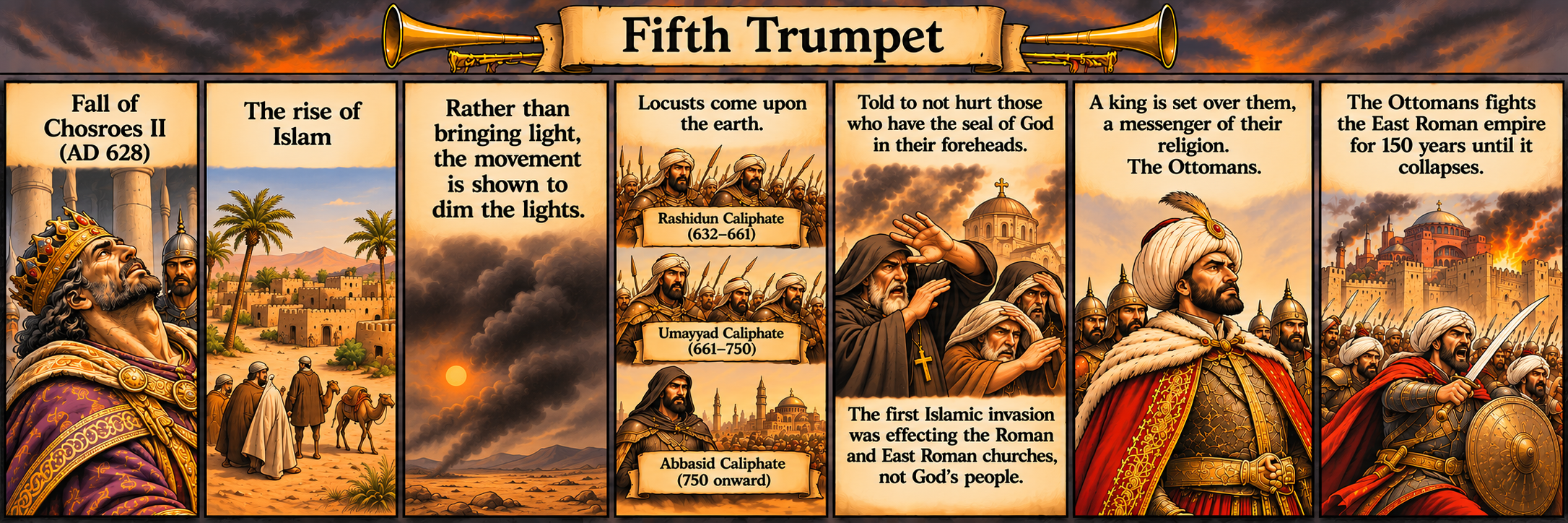
A false religion became the scourge of an apostate church.
Fifth Trumpet: Attack from the East.
The next war targets the Eastern Roman imperial monarchy, whose capital was Constantinople. It is also an affliction and a plague upon apostate Christianity, affecting both the Eastern and Western Roman churches. The Book of Revelation offers a longer, more detailed explanation, with time prophecies to help identify this power more accurately. This description is likely longer because a new group is entering the scene. By contrast, Daniel 7 explains Western Rome’s struggle with the Germanic tribes: the little horn fights off three of the beast’s horns to make way for itself, depicting an internal conflict among the ten horns of the Roman beast in Western Europe. Although Attila the Hun was not one of the horns, he expanded his power by seizing territory and recruiting Germanic peoples into the conflict.
This time, however, in the fifth trumpet, we see an outsider from Western Europe: a new leader with a new group of followers. This people would not only end Eastern Roman dominance in the Middle East but also plague the followers of Papal Rome until the very last days, when Christ returns. The Bible describes these newcomers in three stages: the fifth trumpet, the sixth trumpet, and the sixth plague.
“And the fifth angel sounded, and I saw a star fall from heaven unto the earth: and to him was given the key of the bottomless pit.
And he opened the bottomless pit; and there arose a smoke out of the pit, as the smoke of a great furnace; and the sun and the air were darkened by reason of the smoke of the pit.
And there came out of the smoke locusts upon the earth: and unto them was given power, as the scorpions of the earth have power” (Rev 9:1-3).
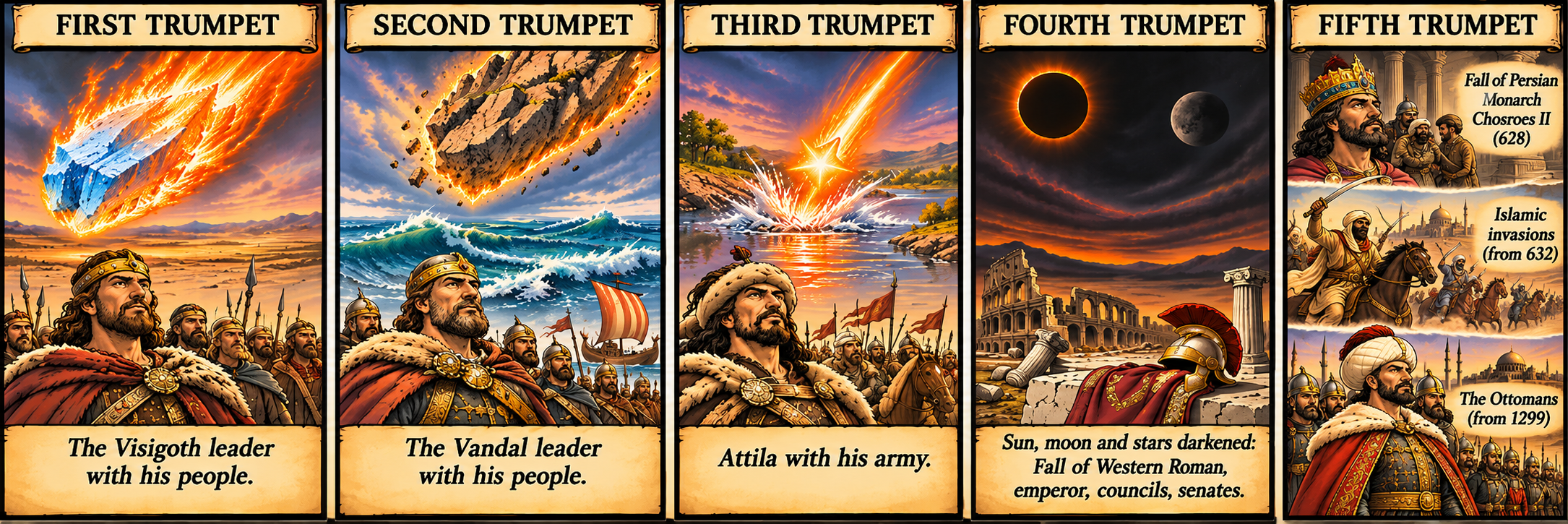
The Visigoth leader was represented by “hail and fire” cast upon the earth. The Vandal leader was represented by a burning mountain cast into the ocean, and Attila and the Huns by “a great star from heaven, burning” on the rivers and fountains of waters. This time, we see another star-leader fall. Rather than the fall itself causing an immediate reaction, however, his fall is the key that opens the bottomless pit, releasing smoke and locusts that behave like scorpions.
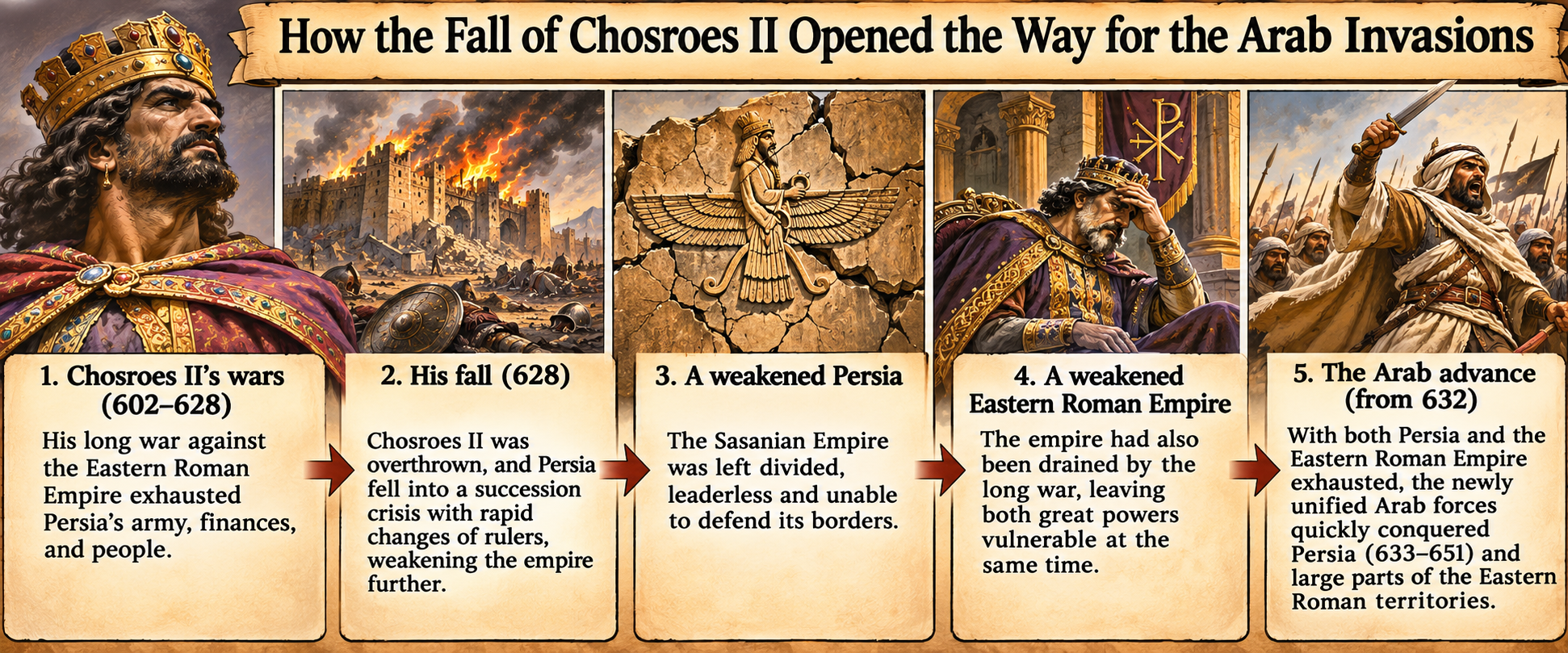
The Eastern Roman Empire and the Persian monarch Chosroes II had long exhausted each other in repeated battles. The weakening and even fall of the Persian monarch would make way for a new era, with new people gaining strength and taking control of the region. The fifth trumpet describes a chain effect that introduces a new religion and its armies.
The great ambition of the Roman papal church and Eastern Rome was to control the Eastern Mediterranean and the Middle East. One exercised religious authority, as it did in Europe; the other exercised direct civil authority. The areas under their supervision included Syria, Palestine, Judea, Egypt, and parts of Mesopotamia and Anatolia. To them, having Jerusalem especially was a sign of God’s approval of their Christianity and was used to manipulate. Christ had said He would not have an earthly kingdom before He comes, and using Jerusalem and the land of the Bible to argue that God chose them was about to be an empty argument. The people coming over them would keep Jerusalem longer than they had or would have, without the church acknowledging that victory meant God favored this new group. The rise of this people humiliated their self-perception as God’s favored because of their superiority over other believers.
A “star” had fallen to the ground, and this would cause them to lose control of these desired areas, remain a thorn in their side, and keep them in check until Christ returned. The star here is both a warrior and a religious leader, and largely a consequence of the Eastern Roman Empire’s own religious and political behavior.
The Arab world was largely Christian, although some practiced polytheism, and often clashed with Eastern Roman dominance in the region. In the 3rd century, Queen Zenobia of Palmyra challenged Roman authority and conquered Egypt and parts of the eastern provinces. Rome defeated her in AD 272. In the 4th century, an Arab queen named Mavia led a major rebellion against the Eastern Roman Empire around AD 378, forcing the empire to negotiate peace. Differences in cultural and religious understanding kept growing, and the desire for more authority over their own lands increased. In the 5th and 6th centuries, many Arab Christians followed Miaphysite Christianity, while Constantinople supported Chalcedonian doctrine. This created religious divisions. In the 6th century, the Christian Ghassanid Arabs allied with Byzantium, while the Lakhmid Arabs allied with Persia. They fought repeated wars along the Roman-Persian frontier. Tiberius II had the Ghassanid leader al-Mundhir arrested in 581 or 582. Byzantine relations with some Arab allies deteriorated.
By Muhammad’s birth around AD 570, the Romans and various Arab tribes already had centuries of warfare, alliances, religious disagreements, and political tensions behind them. The desire to break free was already there, and to even reform what many arabs consider apostate Christian practices and beliefs. But the reform would escalate and change the Middle East forever, even further than the people at the beginning could have imagined. Slowly lessening Christ’s role, and elevating another teacher til one became more important than the other.
Locusts from the pit.
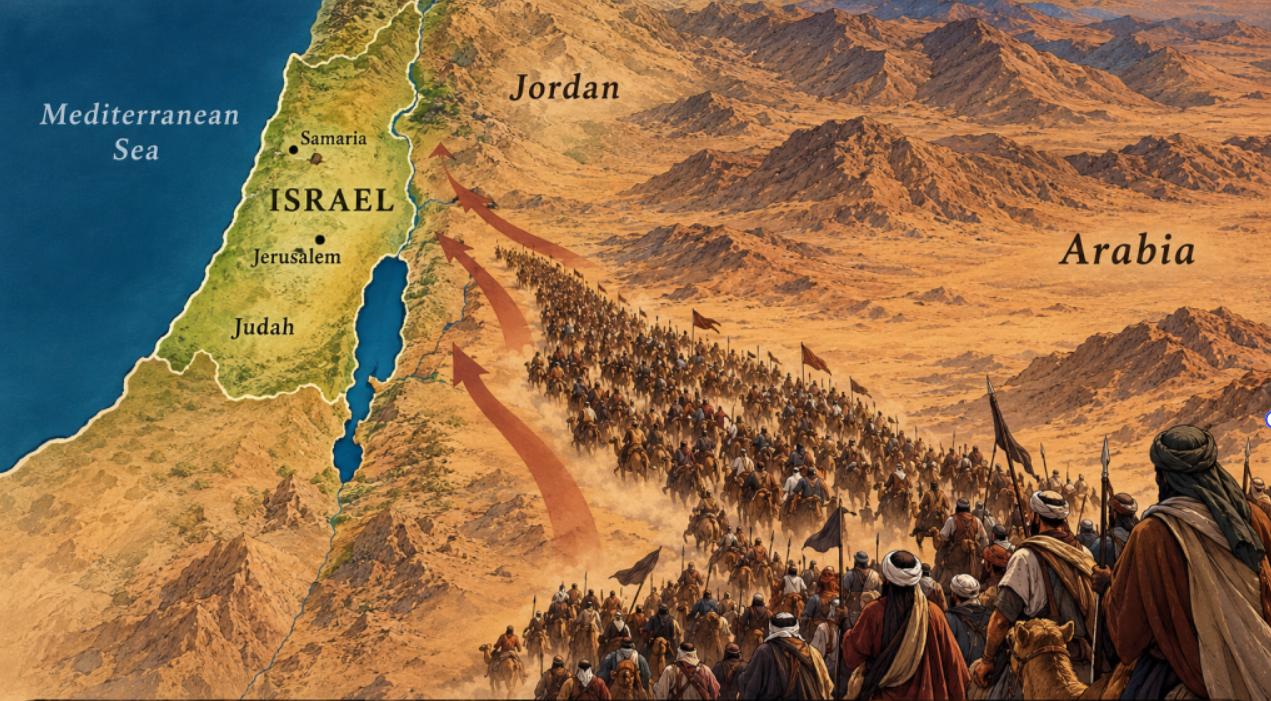
“A bottomless pit” contrasts with the beast that comes out of the waters, a symbol of “peoples and nations.” Here, we are presented with a dry area, not the metropolis of clashing peoples seen in the visions of Daniel and Revelation and described as beasts. The star does not fall to a city, to the ocean, but to a deserted area, and from there the army spreads and conquers.
This clearly points to a new region, from which a great force will emerge, wholly unpredictable and surprising. A new region and a new religion will become the greatest nemesis of Papal Rome and Eastern Rome.
Muhammad, an Arab, is said to have received visions and begun preaching these revelations in 610 AD. In 622, he is said to have moved from Hijra to Medina, marking the beginning of the Islamic calendar and the establishment of his political community. He is said to have conquered Mecca in 630 AD and was soon recognized as a great authority in Arabia.
Two years after his death, the Arab hordes began their conquests.
In the Bible, locusts are a symbol of plagues upon both the pagan Egyptians who mistreated God’s people and a plague on God’s people when they were unfaithful to God.
“If I shut up heaven that there be no rain, or if I command the locusts to devour the land, or if I send pestilence among my people; If my people, which are called by my name, shall humble themselves, and pray, and seek my face, and turn from their wicked ways; then will I hear from heaven, and will forgive their sin, and will heal their land” (2Ch 7:13-14).
In the Bible, the people of Arabia were also likened to grasshoppers. “And the Midianites and the Amalekites and all the children of the east lay along in the valley like grasshoppers for multitude; and their camels were without number, as the sand by the sea side for multitude” (Jdg 7:12). The land of the Midianites was in what we today call Northern Saudi Arabia, where Muhammedism rose. By using this description, Revelation points back to the Old Testament, revealing which group of people and which area is mentioned in the fifth trumpet.
Grasshoppers are usually solitary and scattered, but certain species enter a swarming phase, gathering in enormous groups and migrating as a plague.
“The locusts have no king, yet go they forth all of them by bands” (Pro 30:27)
Through this symbolic language, God accurately explains the rise of Muhammedism and the conquest of the Middle East. Just as locusts come suddenly and overwhelmingly, so did the followers of Muhammad. Beginning only two years after his death, Muslim armies conquered Syria, Palestine, and Egypt from Eastern Rome between 634 and 642.
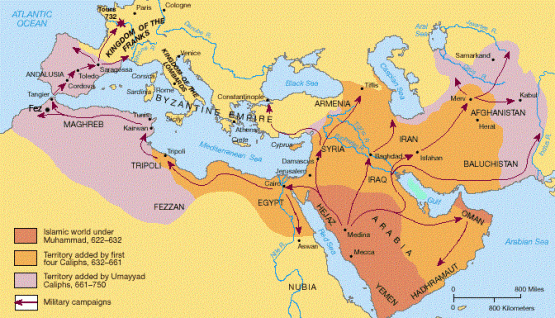
Just as Western Rome lost territory before losing its capital, so did Eastern Rome. It first lost its most desired territory: Jerusalem. Papal Rome was also powerless against this force, whose followers did not accept its religious authority and could not be converted because it considered itself a reform movement. Because Papal Rome was not an empire with a large army, it depended largely on obedience, diplomacy, and alliances with leaders to gain control. Here, all those tactics proved futile. Just as one cannot predict or stop a swarm of locusts from devouring a field, neither Papal Rome nor Eastern Rome could stop the Islamic invasion. As the fifth-trumpet prophecy explains, one leader, one “star,” brought it all about and unleashed Arab resistance.
From 647 to 709, they rapidly expanded across North Africa. Their conquests did not stop with Jerusalem and the territories of the Roman church. In 711, Muslims invaded Spain, a deeply Catholic territory. In 732, their advance into Frankish territory was checked at Tours/Poitiers, causing mayhem and creating fear and anguish in both Eastern Roman territories and Western Europe.
However, when they tried to take the heavily fortified city of Constantinople in 717–718, they failed. But just as the Pope persuaded armed men and European leaders to fight for his causes by converting them, so did the Arabs.
The new religion would spread and recruit an even stronger force: the Turks. Because the prophecy points to the origin and to “the star” who unleashed these new invaders, we can see that the fifth trumpet speaks not only of an ethnicity but also of a new religion and its army.
Hurt not the Green
In the fifth prophecy, an angel restrains this movement:
“And it was commanded them that they should not hurt the grass of the earth, neither any green thing, neither any tree; but only those men which have not the seal of God in their foreheads” (Rev 9:4).
Here, we see God intervening against this rising power to protect His faithful by keeping them from becoming Islam’s target. Although Eastern Rome and Papal Rome would be the targets, God would prevent the invaders from harming His people. In this context, God had promised His faithful protection from the plague. But not all Christians have the seal of God on their foreheads. God distinguishes a marked group of Christians who are exempt. This makes it important to understand what God’s seal is. Deuteronomy warned that plagues would come upon His people if they did not respect His law.
Revelation speaks of God’s people being sealed: “Seal the servants of our God in their foreheads.” Another verse describes what that seal looks like: “his Father’s name written in their foreheads” (Rev. 7:3; Rev. 14:1). God’s name can only be placed on the foreheads of those who keep His law. As David said in Psalm 119:55:
“I have remembered thy name, O LORD, in the night, and have kept thy law.”
Exodus 34:5–7 is especially interesting. God “proclaimed the name of the LORD” and then declared His character: merciful, gracious, longsuffering, and just. His name therefore represents His character, and His law expresses His righteous standard.
“If thou wilt not observe to do all the words of this law that are written in this book, that thou mayest fear this glorious and fearful name, THE LORD THY GOD…” (Deuteronomy 28:58)
The whole Bible tells us the same thing: God’s name is not associated with those who do not respect His authority. The verses show us that God would spare His people during the Islamic invasion. Interestingly, this is what happened. Christians who were faithful to the law were respected and treated differently, while Roman Christians with their idols were considered infidels, competitors, and targets. Those faithful to God’s law did not seek political power and were therefore not a threat. Many practices considered abominations by the new religion were not practiced by those who kept God’s law.
Abu-bekr in AD 632, once established his authority instructed his army:”When you fight the battles of the Lord, acquit yourselves like men, without turning your backs; but let not your victory be stained with the blood of women and children. Destroy no palm-trees, nor burn any fields of corn. Cut down no fruit-trees, nor do any mischief to cattle, only such as you kill to eat. When you make any covenant, or article, stand to it, and be as good as your word. As you go on, you will find some religious persons who live retired in monasteries, and propose to themselves to serve God that way; let them alone, and neither kill them nor destroy their monasteries: and you will find another sort of people that belong to the synagogue of Satan, who have shaven crowns; be sure you cleave their skulls, and give them no quarter till they either turn Mahometans or pay ‘tribute.’ ” [12]
Torment, not kill
The fifth trumpet tells us they were given power to harm others like scorpions. But they would not defeat the Eastern Roman monarch or take over southern Europe; their power was limited.
“And to them it was given that they should not kill them, but that they should be tormented five months: and their torment was as the torment of a scorpion, when he striketh a man” (Rev 9:5).
“Not kill” means they were not able to bring down Eastern Rome completely. They could only plague it, while both the Roman church and the Roman imperial monarchy would survive. Here we are given a time prophecy of five months. The Bible gives us the formula that one day equals one year, and the biblical calendar has 30 days in each month, giving us 150 years. At first glance, it may seem that the prophecy does not specify when this period begins. However, the time prophecy is repeated at the end of the passage.
The impact of the Muslim invasion and the rapid spread of the religion on the Roman church is described as follows:
“And in those days shall men seek death, and shall not find it; and shall desire to die, and death shall flee from them” (Rev 9:6).
Many had to live with uncertainty and repeated attacks, which exhausted them.
The next verses give us a description of the “locusts”:
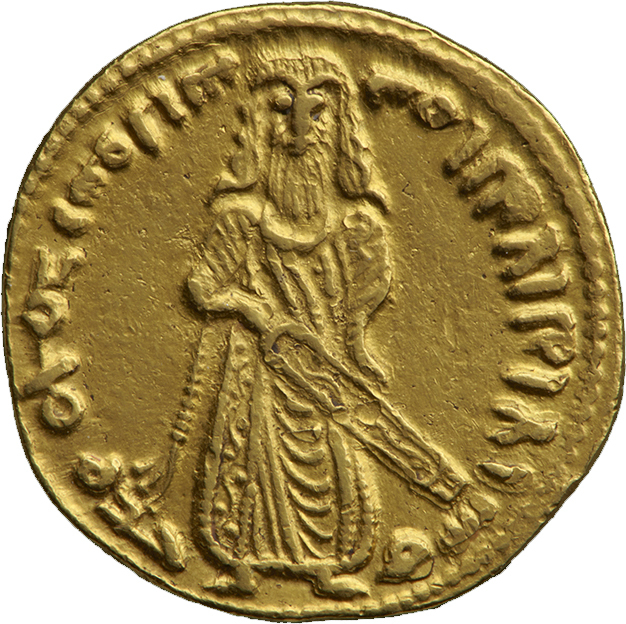
“And the shapes of the locusts were like unto horses prepared unto battle; and on their heads were as it were crowns like gold, and their faces were as the faces of men.
And they had hair as the hair of women, and their teeth were as the teeth of lions.
And they had breastplates, as it were breastplates of iron; and the sound of their wings was as the sound of chariots of many horses running to battle” (Rev 9:7-9).
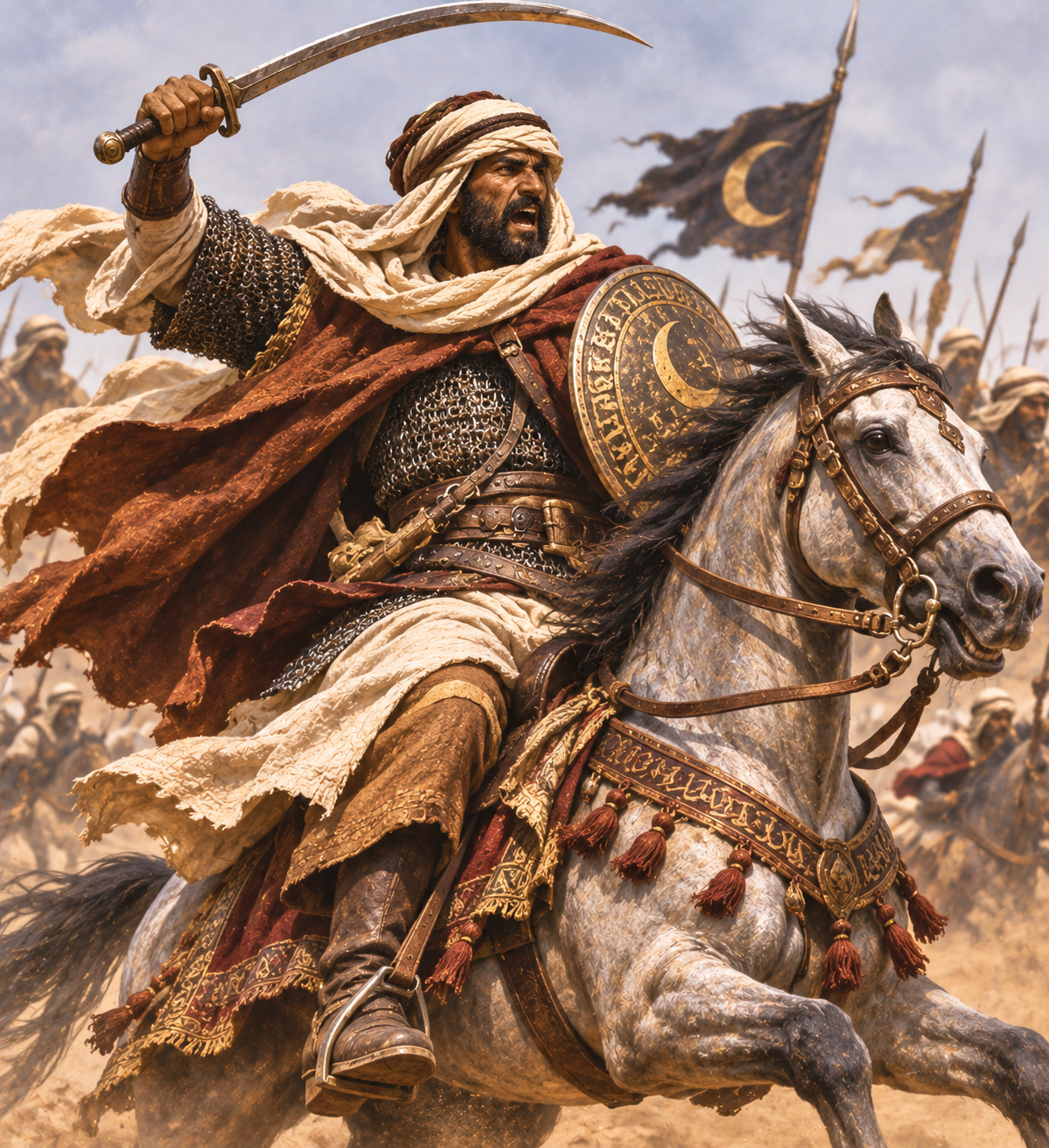
The Muslim invaders were long remembered for their horsemanship and fine horses. Their turbans sometimes included ornaments and miters, and they often wore their hair long, distinguishing them from European and East Roman customs.
Five-month prophecy (150 years)
“And they had tails like unto scorpions, and there were stings in their tails: and their power was to hurt men five months” (Rev 9:10).
Here the time prophecy is repeated. As is often the case with biblical time prophecies, it provides an event to anchor the prophecy. The following verse explains:
“And they had a king over them, which is the angel of the bottomless pit, whose name in the Hebrew tongue is Abaddon, but in the Greek tongue hath his name Apollyon” (Rev 9:11).
The name Apollyon means “destroyer,” because his arrival would destroy the remains of imperial Rome, but also because of his ruthlessness. It is a plague resulting from the Roman church’s actions, its infidelity and harlotry. God allowed it to happen to bring down the power of the Roman head and its Eastern ally. It’s important to understand that the trumpets are God’s warning of wars to come as a result of rejecting His lead; He is not the initiator. The parallel is in Israel’s history, even with the Arabs then called Midianites, Ishmaelites, and Amalekites. God removed His protection because of His people’s infidelity, but at the same time told them the way out; it was up to them to take it. The same with Babylon, God told them He could not protect the city if they continued their behavior. The king of Jerusalem provoked the Babylonian king, and only if he listened to God’s prophet could he save his life and the city. He chose not to, and he was taken captive, and the city was destroyed.
The verse says, “they had a king over them,” which is the key to fitting the time prophecy. Although the invasion, movement, and spread of the ideology began in the seventh century with the first Arab invasions, these events took place after Muhammad’s death. He was not their king during the 150 years mentioned here. These are two different groups who would advocate Islam: one brings about the movement and its spread; the other becomes its ruler and king during a “five-month” period. In the Bible, a king is sometimes also a symbol of a kingdom.
In addition, we know these 150 years (five prophetic months) are tied to a particular period when they especially tormented or harmed the Roman monarchs. We therefore need to consider two clues: they have a king over them, and they particularly plague a group of people. The theme of the trumpets is attacks on Rome, and so that is relevant in understanding the time prophecy. The placement of the time prophecy also indicates a closing period for the fifth trumpet, as the sixth continues what the fifth started. Several caliphates spread Islam and conquered territories.
- Rashidun Caliphate (632–661) — controlled Arabia and rapidly conquered Syria, Palestine, Egypt, Iraq, and Persia. They took Jerusalem in 637/638 AD.
- Umayyad Caliphate (661–750) — one caliph ruled an enormous empire from Spain/North Africa through the Middle East into Central Asia.
- Abbasid Caliphate (750 onward) — initially controlled most of the central Islamic world, though it progressively fragmented.
“Caliph” means “successor,” and each caliph claimed to be Muhammad’s successor as leader of the Muslim community. Any of them might therefore be a good candidate. All of them plagued the Roman areas. However, Appollyon is described not as coming out with the locusts, but as a messenger of the same religion, and as a kingdom set over them, especially during the last 5 prophetic months. So the locusts had a kingdom come upon them, but also a messenger from “the pit”.
During the conquests and spread of Islam, missionaries reached the Turks, and several Turkish rulers converted, leading major Turkic powers to become Muslim. This was especially true under the Abbasid Caliphate, where Turkish soldiers became increasingly important. In 1055, the Seljuk Turks entered Baghdad and became the dominant military power there. Then, from the 1070s, the Turks expanded into Syria and Palestine. In AD 1250, the Mamluk military elite were predominantly of Turkic origin and took power in Egypt. Between AD 1516-1517, the Ottoman Turks conquered Syria, Palestine, Egypt, and the Hejaz, establishing control over much of the Arab Middle East.
The fifth trumpet says the Roman Empire would be tormented for five months but not killed, while the sixth trumpet says death would come to them. The great Islamic power that could first torment and then kill the Eastern Roman Empire was the Turks. They were the ones the Eastern Roman Empire could not defeat, despite trying with all its might. Once the Turks took control, they maintained it in the region in different ways for over a thousand years, even fighting off repeated attacks from the west and the Crusaders.
The Turks pressed on into Anatolia. founded the Ottoman dynasty, named after it’s first great leader Osman I, in 1299. Its early center was around Söğüt and Bilecik, southeast of Constantinople.
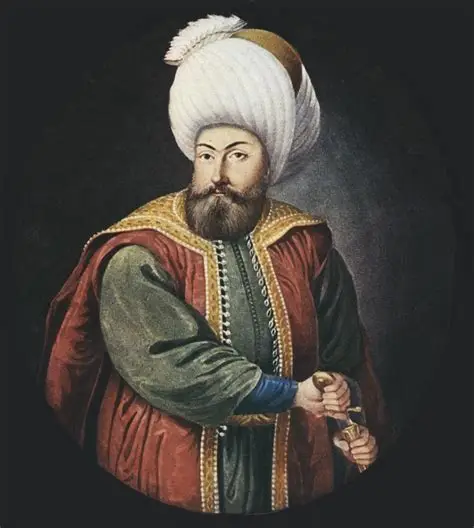
From this small frontier territory, the Ottomans expanded westward into Byzantine lands. The Turks’ conversion and invasion caused great distress and fear in the Eastern Roman Empire.
When the verse speaks of the angel of the bottomless pit, note that the word “angel” also means “messenger” in the Bible. A messenger can be good or bad. His message is destruction. The Bible gives his name as the word “destroyer” in both Hebrew and Greek: Abaddon and Apollyon. These names signify whom he would destroy. He would take what the Jews desired and what the Eastern Roman Empire desired. The Eastern Roman Empire became predominantly Greek-speaking, although Latin remained important. By the seventh century, Greek had become dominant in government and society, even though its people still called themselves Rhomaioi (Romans). The verse therefore cleverly indicates whom they will torment most:
“And they had a king over them, which is the angel of the bottomless pit, whose name in the Hebrew tongue is Abaddon, but in the Greek tongue hath his name Apollyon” (Rev 9:11).
Jews and Christians both competed for control of Jerusalem. In 614 AD, Persian forces captured the city with help from Jewish forces. For a short time, the Jews held authority there and hoped to restore the temple. But the Persians turned against them and handed control to the Christians. Since losing the temple area to Rome and coming under Eastern Roman control, the Jews had viewed the Christians as their great foe. With the arrival of Muslim groups, they faced a third competitor, one stronger than their other enemy. Jerusalem, especially the Temple Mount, has been in Islamic hands for most of the time since their arrival. Many Jews in Muslim lands were forced to convert to Islam and found themselves living under a new regime and religion they had not anticipated. Apollyon means “destroyer,” first of all in relation to Jewish and Eastern Roman interests. But to God, this power would also be a destroyer of truth, as its religion would compete and grow and hinder the spread of the gospel. But if we consider a leader who would eventually bring the Eastern Roman Empire to its “death,” we must consider the time prophecy in relation to the establishment of Ottoman power. The Ottomans directed their strength against the Eastern Roman emperor, taking nearby territories and even forcing him to pay tribute. From the rise of Ottoman forces conquering Eastern Roman territory to the fall of Constantinople, exactly 150 years passed as prophesied.
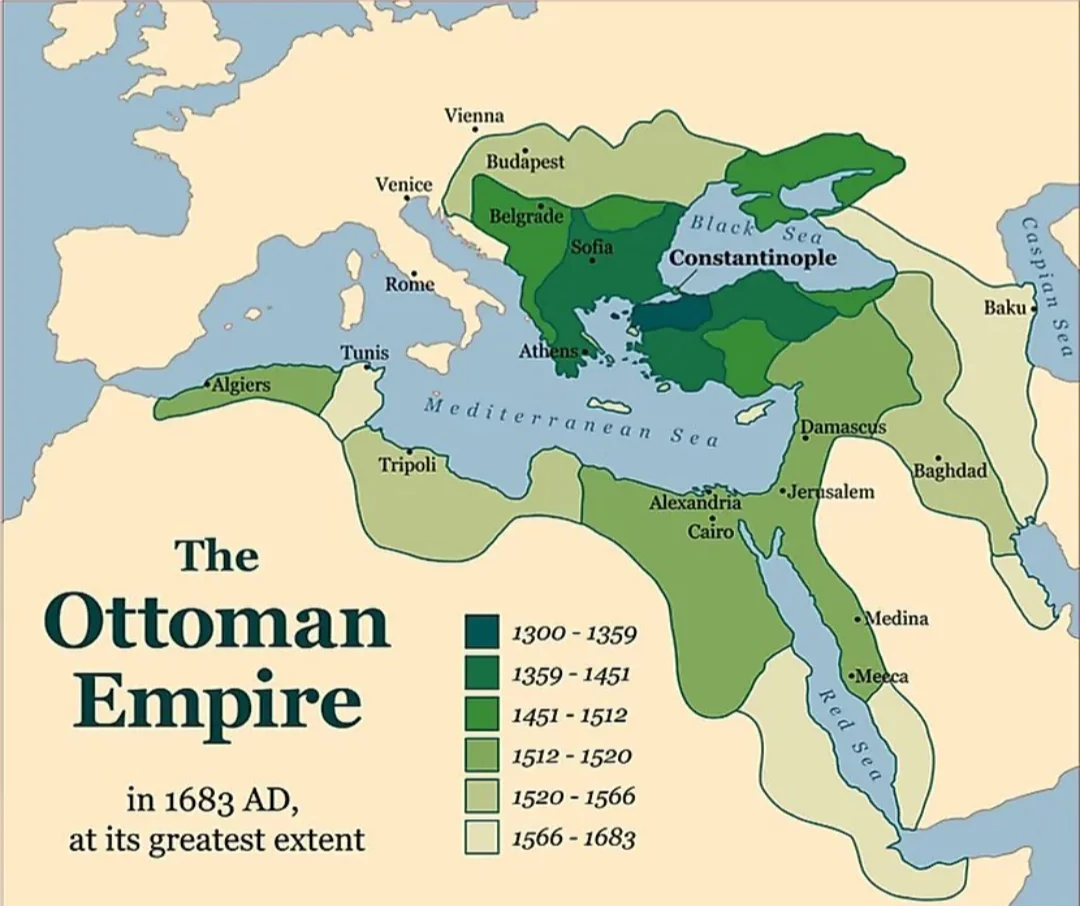
The fifth trumpet focuses on how the fall of the Persian monarch made way for the rise of a new dominant force in the Near East. This was a new religion centered on one leader, whose followers would rapidly seize large territories and spread its ideology worldwide. It describes how they plagued the followers of the Roman pontiff and the Eastern Roman Empire. It ends by focusing on one particular leader among them who would conquer the last Byzantine strongholds.
In other words, the fifth trumpet tells of the rise of Muhammedism, its spread and conquests, its effect on the remnant of Rome, and the final 150-year battle between them. The era of the fifth trumpet spans 843 years, from the beginning of Muhammad’s preaching to the final fall of the Eastern Roman Empire.
The Islamic invasion and expansion are called a woe upon the earth. The passage further warns God’s servants that the woes will come in three phases. They are to expect trouble on earth because of them.
“One woe is past; and, behold, there come two woes more hereafter” (Rev 9:12).