
The Seven-headed dragon
In the book of Revelation, Rome is described as a beast with seven heads and ten horns. Daniel saw many empires rise and fall, but John, while on the island of Patmos, only needed to learn about the last beast and its horns. This final beast would remain important until Christ’s second coming. Since John was living during the Roman Empire, the fall and division of Rome was the main event to watch for until Christ returned.
God chose this timeline on purpose. He could have shown the future using many empires, but that would have made things confusing and the book much longer. Instead, God wanted His people to focus on the timeline of the last beast and its divisions. This way, they would know when Christ would return to “destroy the feet of the image” and “the little horn” of the Roman beast.
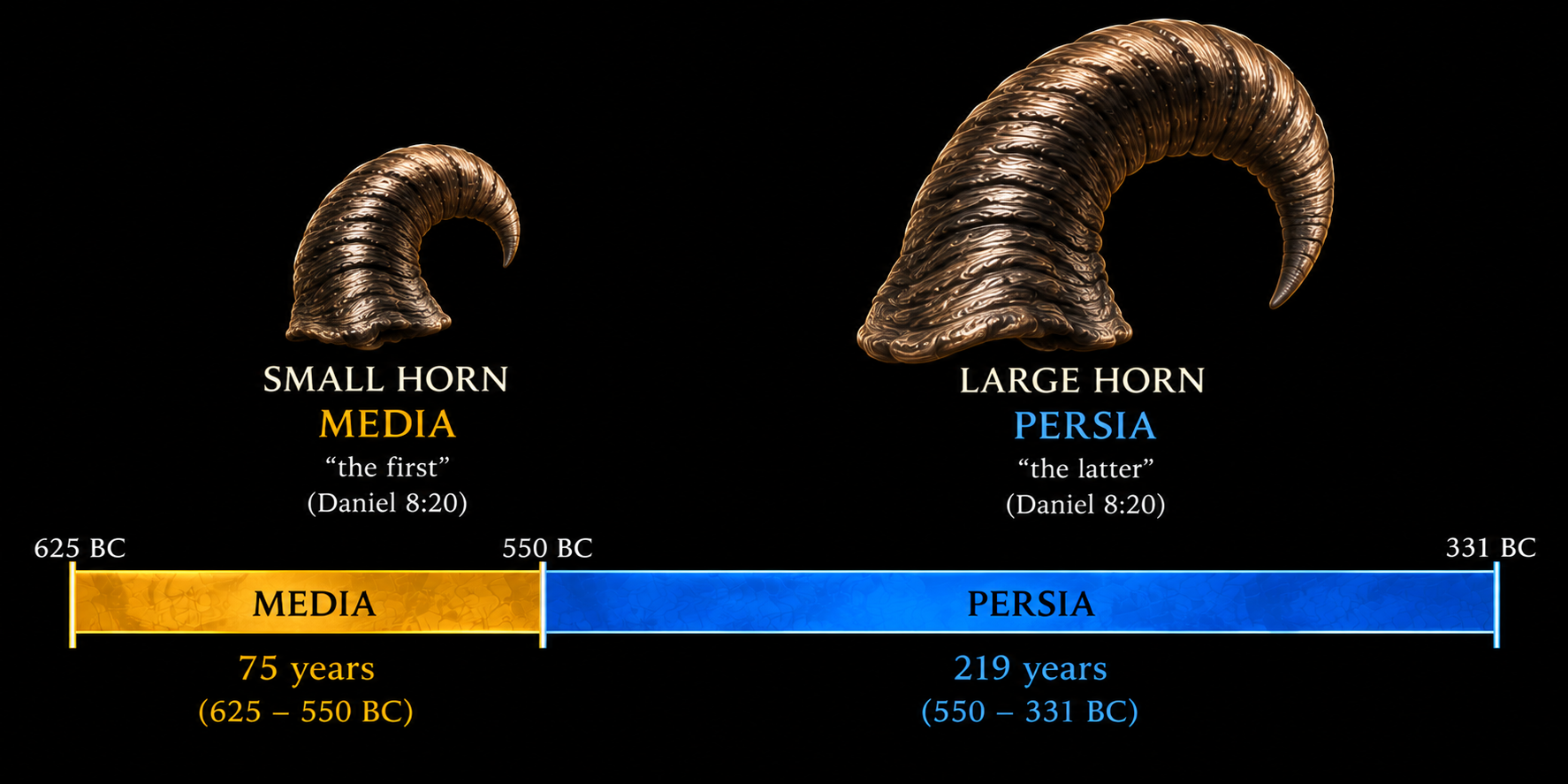
In Daniel, God used different symbols to represent the same kingdoms. Medo-Persia was shown first as a chest of silver, then as a bear with ribs in its mouth standing on one side, and finally as a ram with two horns—one of which grew up later and became larger. These symbols show important shifts in power. The bear standing on one side suggests either Media or Persia would become the stronger power, but it isn’t clear which. In the next symbol, the two-horned ram, Persia is shown to be the stronger. The Bible says, “one was higher than the other, and the higher came up last” (Dan. 8:3): Media was dominant first, but Persia took over and stayed in control until Greece defeated the Persian king. God made the visions similar so we would know it was the same power. The bear leaning and the ram’s uneven horns connect the two, while the detail of which horn comes last adds more information. For Greece, the kingdom splits into four heads on the beast and four horns on the goat, again showing it’s the same power. This vision adds details about how Greece defeated Persia and that one strong leader—Alexander the Great—made Greece powerful before dying and leaving the empire to be split into four. Earlier visions seemed to suggest that four kings would rule together from the start, but the later visions clarify and correct that assumption. In both additional visions about Medo-Persia and Greece, the added symbols also provide a sequence, or timeline, of events. The symbols themselves therefore also carry a timeline. Making it possible to know the major stages. With the four heads of Greece, knowing when the next beast would arrive meant following the fall of each Greek head until you knew exactly who the next beast was. So the heads can be used as a timeline. The same applies to Rome and its division.
Recognizing how God changes the appearance of prophetic symbols to add new details and insights guides us in interpreting the visions about Rome and the book of Revelation. Daniel serves as a key to unlocking Revelation, illustrating the method God uses to reveal the future. God often repeats and expands on information, directing our attention to the main issues and underlying reasons for each power’s role. Each repetition draws from previous visions, connecting prophecies to show they speak about the same power. He adds meat to the bone – so to speak.
This process is similar to how humans are made up of different layers—skeleton, organs, muscles, and skin—but a person’s true character is found in the heart. We only understand someone’s heart by observing their actions and words; the outside reveals what is inside. In the same way, God’s purpose is to reveal the sin at the heart of the beast and issue a warning against being deceived by it or even repeating it. To understand this sin, we must learn the beast’s identity and history. So God explains the heart of the beast, its nature, and its history, as well as its past and future. This takes a lot of repetition and symbolism. When Christ was to explain his own mission, even identity, he called himself both a door and bread, His coming as both that of a thief as well as in the open for everyone to see. In the Bible’s symbolic language, we find the thread that binds them together and learn from the differences presented through shifts in symbolic language. Christ can come as a thief in the night as well as in glory with His angels for all to see. One addresses the condition of the heart when Christ comes and how we perceive it; the other addresses how He actually appears at His coming. One warns, the other encourages, about the same event. They are not two different events even though the symbolic language is so different. God has a thread that ties them together and helps us see the same event from two different angles.
By studying the patterns in Daniel and other prophecies, we can better understand why Revelation describes three beasts with seven heads and ten horns. The beasts change in appearance, but they all share the same key traits. At first, the crowns are on the heads of the seven-headed beast. Later, in the next beast, the crowns move to the horns, and the beast looks different. This shift shows that the kingdom is divided, and so is the power.
Rome went through many changes, so the Bible explains these by showing similarities that prove it’s still the same power, while also highlighting the different stages it went through. These changes also serve as a timeline leading up to Christ’s second coming.
Revelation gives a more detailed timeline of events tied to the iron kingdoms and their divisions—the same beast with ten horns from Daniel 7. Revelation presents the same timeline repeatedly, using different symbols and perspectives. In these visions, God focuses on the downfall of the iron kingdom and its horns, just as He revealed to Daniel. He explains not only why He targets this power, but also the steps He will take to bring about its end.
In Daniel, the image in chapter 2, the beasts in chapter 7, the beasts in chapter 8, and even chapters 11 and 12 mostly focus on the same events and timeline. The central theme is the fall of Rome and how Western and Central Europe continued its legacy, even acting as its foot soldiers.
Revelation’s main theme is the end of Rome and the ongoing relationship between Rome and God’s people. We see this story from the viewpoint of God’s people, from God’s viewpoint, and we learn more about the different stages of the iron kingdom and the horn that grows from it in Daniel 7—the one that will face God’s special judgments.
The three seven-headed beasts
In Revelation 12, there is a red dragon with seven heads and ten horns, and the crowns are on the heads. In Revelation 13, the dragon changes and now looks like a mix of the beasts from Daniel 7. At this point, the crowns have moved from the heads to the ten horns. Revelation 13 describes the beast as having received its power from the beast in Revelation 12.
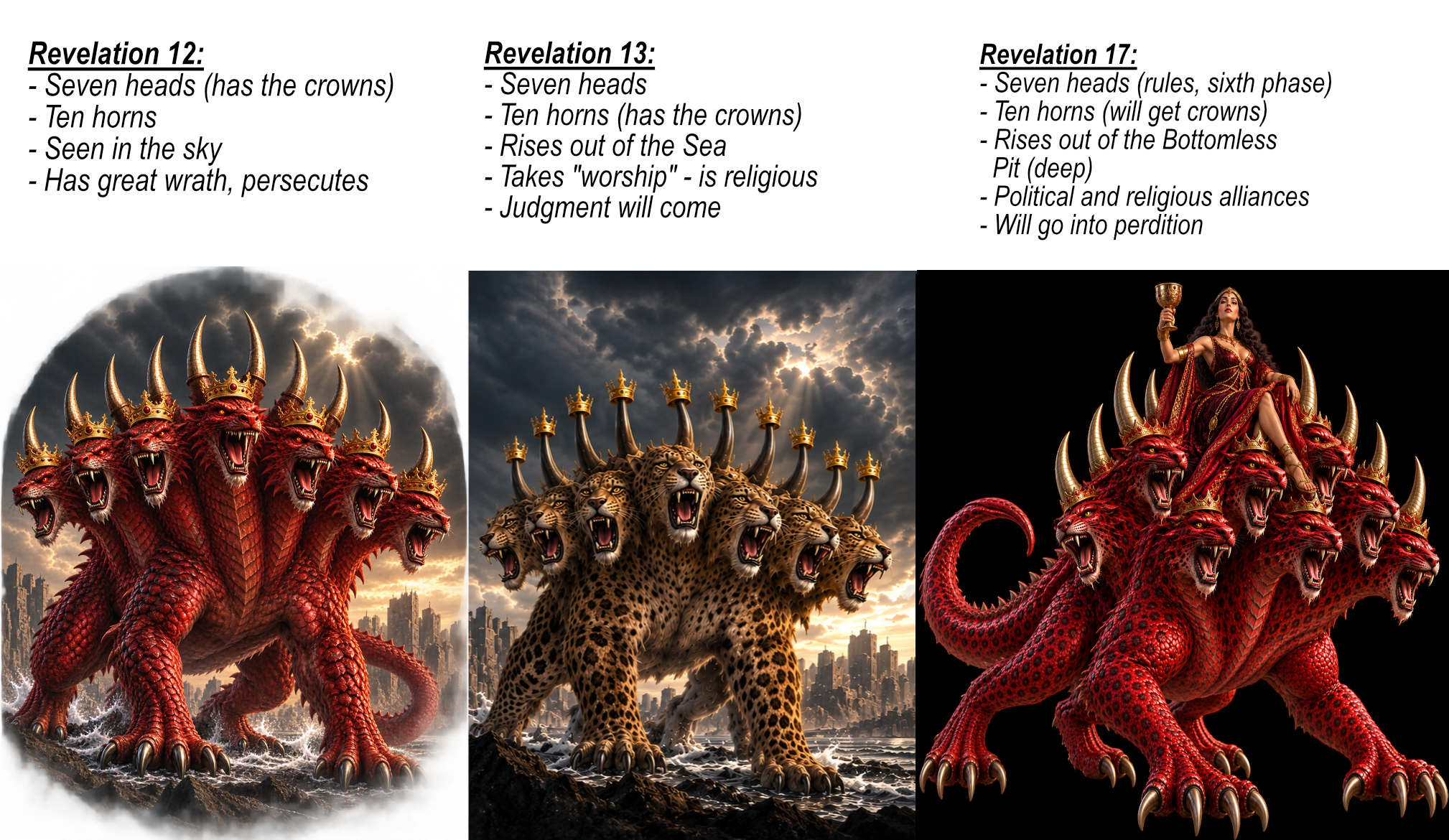
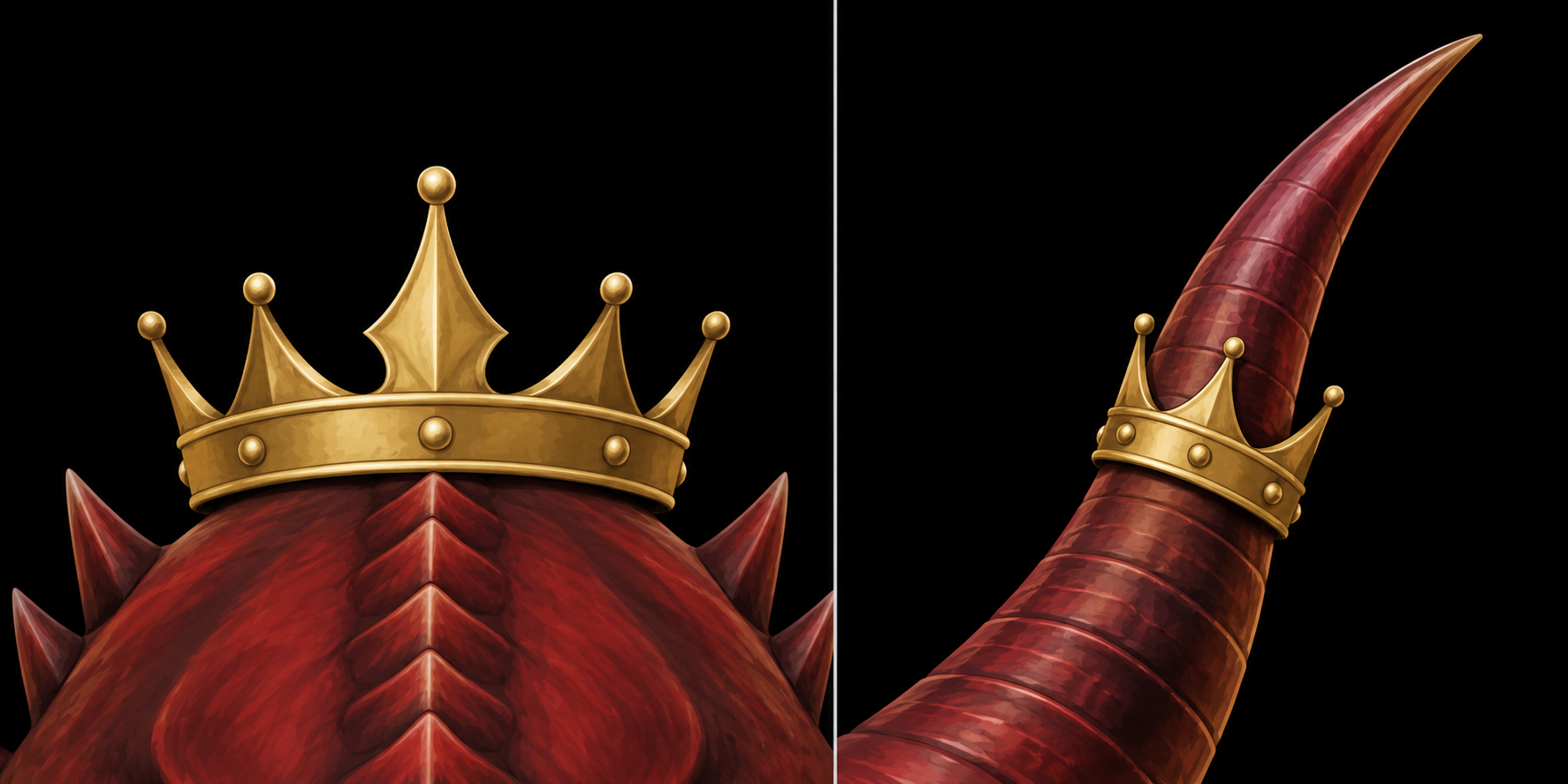
God explains that the beast has changed. If the crowns are not on the heads but on the horns, it means the power has been divided between the ten kingdoms. After Rome’s fall, a new form of Rome emerges, taking on a different set of characteristics. The crowns moving from the head to the horns explain the shift in Roman leadership; we can see the first dragon with crowns on the head as Imperial Rome and the second as Papal Rome, which ruled while the former Roman western territories were divided. The crown is on the tribes; they rule. But a beast in Rome still rules as well. By using crowns and swapping their places, God shows which time period we are in.
In Revelation 13, the beast has a mouth like a lion, feet like a bear, and leopard skin like a leopard. It rules at the same time as the ten kingdoms.
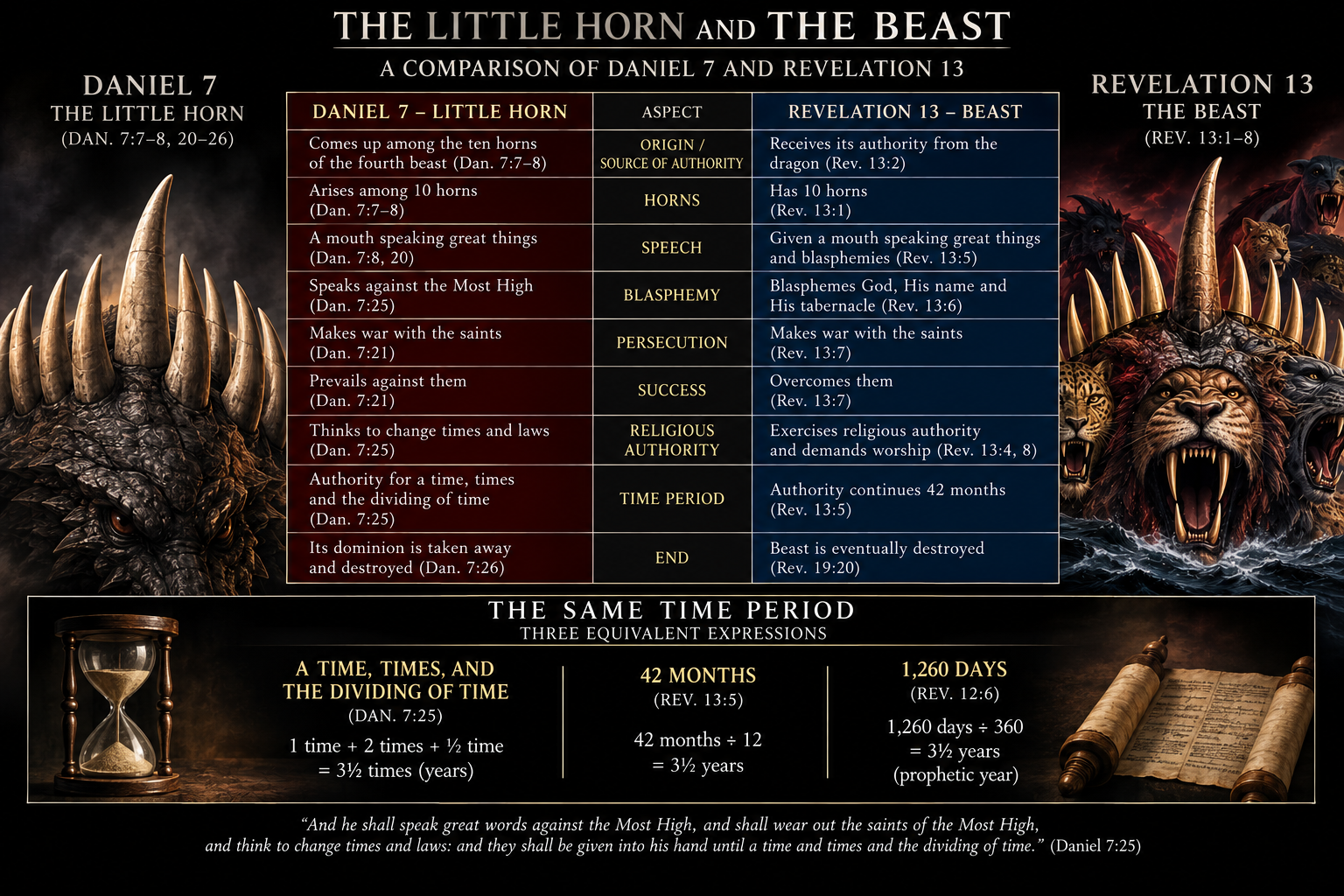
In Daniel 7, a horn grows from the Roman beast and becomes powerful, even pushing out several kings. It rules among the ten horns.
In Revelation, this horn does not appear among the ten. Instead, we are told that the beast itself now represents that horn. God uses the same prophecies for this beast as he did for the horn in Daniel 7.
In Revelation 17, we see a seven-headed beast once more, now with a color similar to red. A recap devoted to exposing the sins of the harlot in particular and how the power went from the woman to the beast.
The seven-headed beasts that represent Rome and Western Europe are first shown as a “wonder in heaven.” After they change, they “rise up out of the sea,” and they are also seen to “ascend out of the bottomless pit.” At all times, the ten horns are on the beast and therefore a part of the prophecy and the changes. This means the beast itself represents both Western-Central Europe and Rome.
Medo-Persia was more than its capital; it was also a territory and a people. The same with Greece. They were a people and a territory with a capital. But they also had seized territories from other kingdoms. Their empire ended when they were reduced to their own territories, but the people lived on there. We should understand it similarly to Rome: Western and Central Europe are related peoples. It’s a Latin-Gallic beast with Germanic horns. Both the horns and the beast belong and have their homeland in Western and Central Europe. A mystery we do not need to unfold completely, but just accept in faith that God knows what He is talking about. He also placed Media and Persia as one beast even though they are from two tribes.
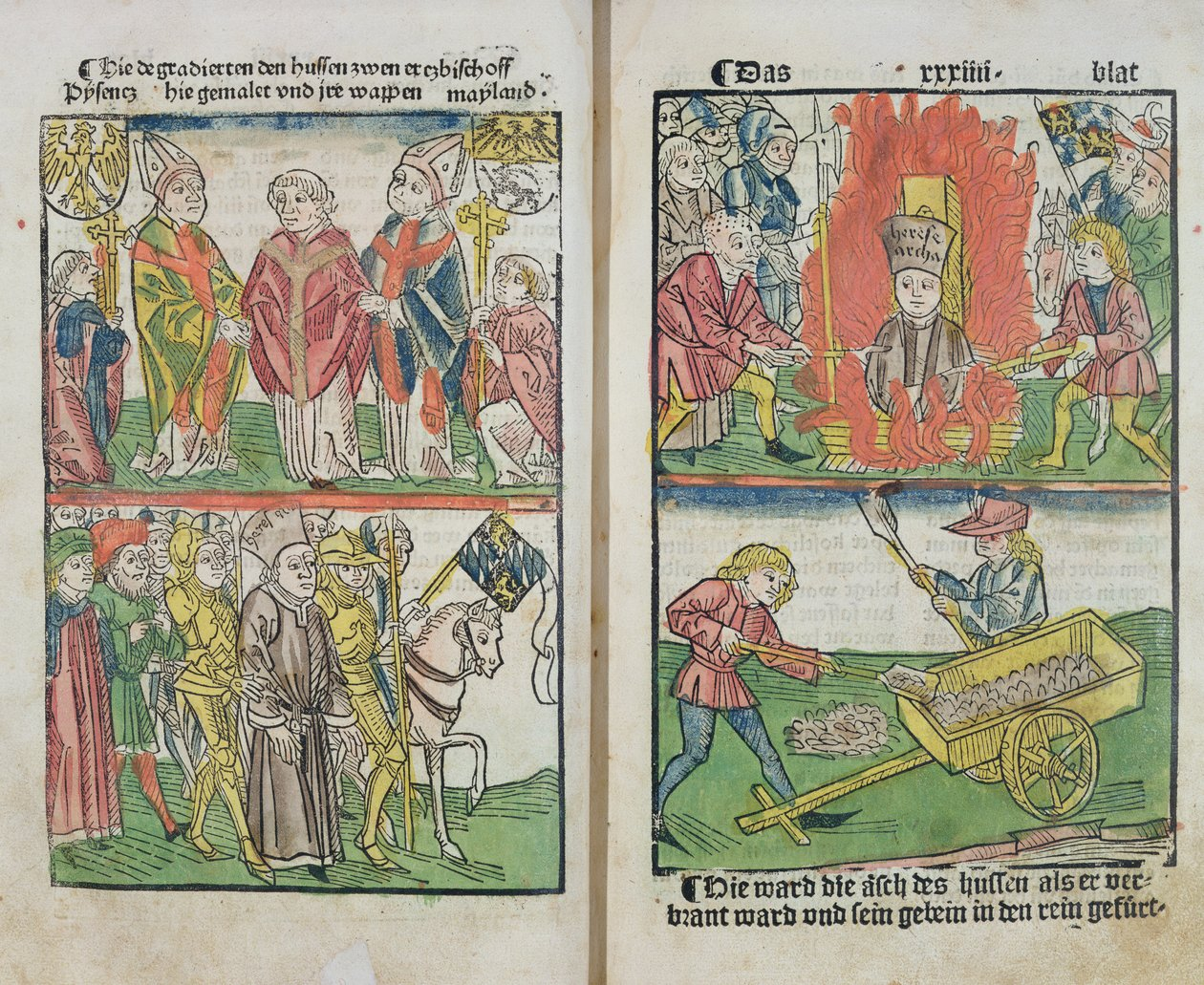
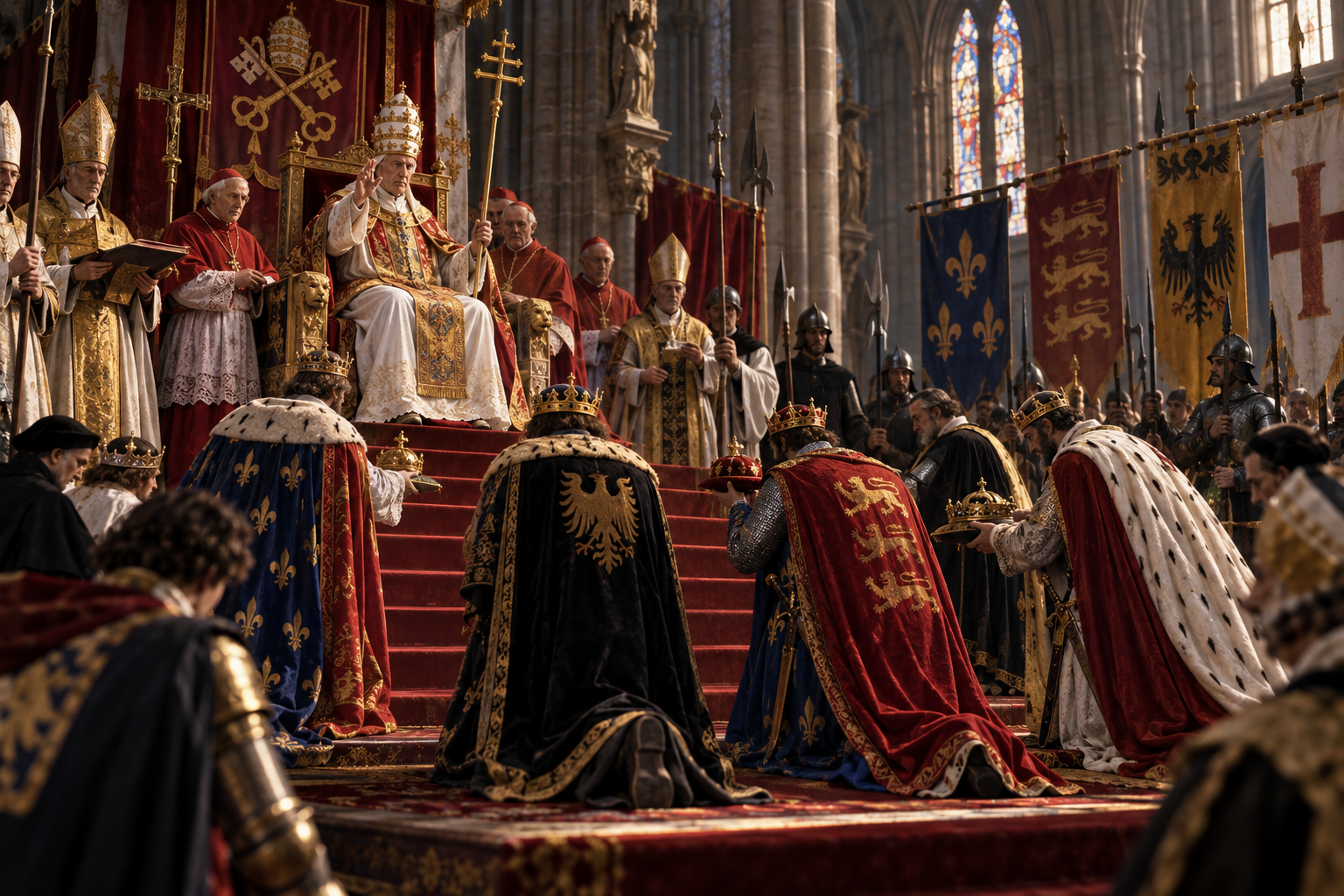
But this puts us in a position to understand that whatever Rome wants, the horns follow up on. A horn is what an animal uses to defend itself and fight others. In the Bible, horns represent strength and power. While God targets the beast, He also identifies those who support its cause, whether they realize it or not. History confirms this: many European kings and queens did what Rome asked. They were the crusaders; they led the Inquisition; they launched armadas; they made war against their own for Rome’s sake. They killed their own citizens for refuting the religious ideology of the Pope in Rome. And even after Europe split in two between Catholicism and Protestantism, Protestants still defended and upheld papal ordinances above Christ. Like a child rebelling against their parent, but still continuing in their path. However, Western and Central Europe later split into three main directions—Protestantism, Catholicism, and pagan-agnosticism. The Bible addresses these divisions, but all three continued to be influenced by papal traditions and culture.
The seven-headed dragon in Revelation 12
God has already explained that beasts are metaphors for governmental powers.
In Revelation 12, John does not see the dragon emerging from the water for an important reason: Rome was already at the height of its power during John’s time. If the vision had shown the dragon coming out of the water, it would have suggested that Rome had not yet risen, which was not true. Rome’s power was already present—evident in its persecution of Jesus and the apostles. Instead, the vision shows that, because of Satan’s open conflict with God, Satan chose to use this existing power to fight Christ.
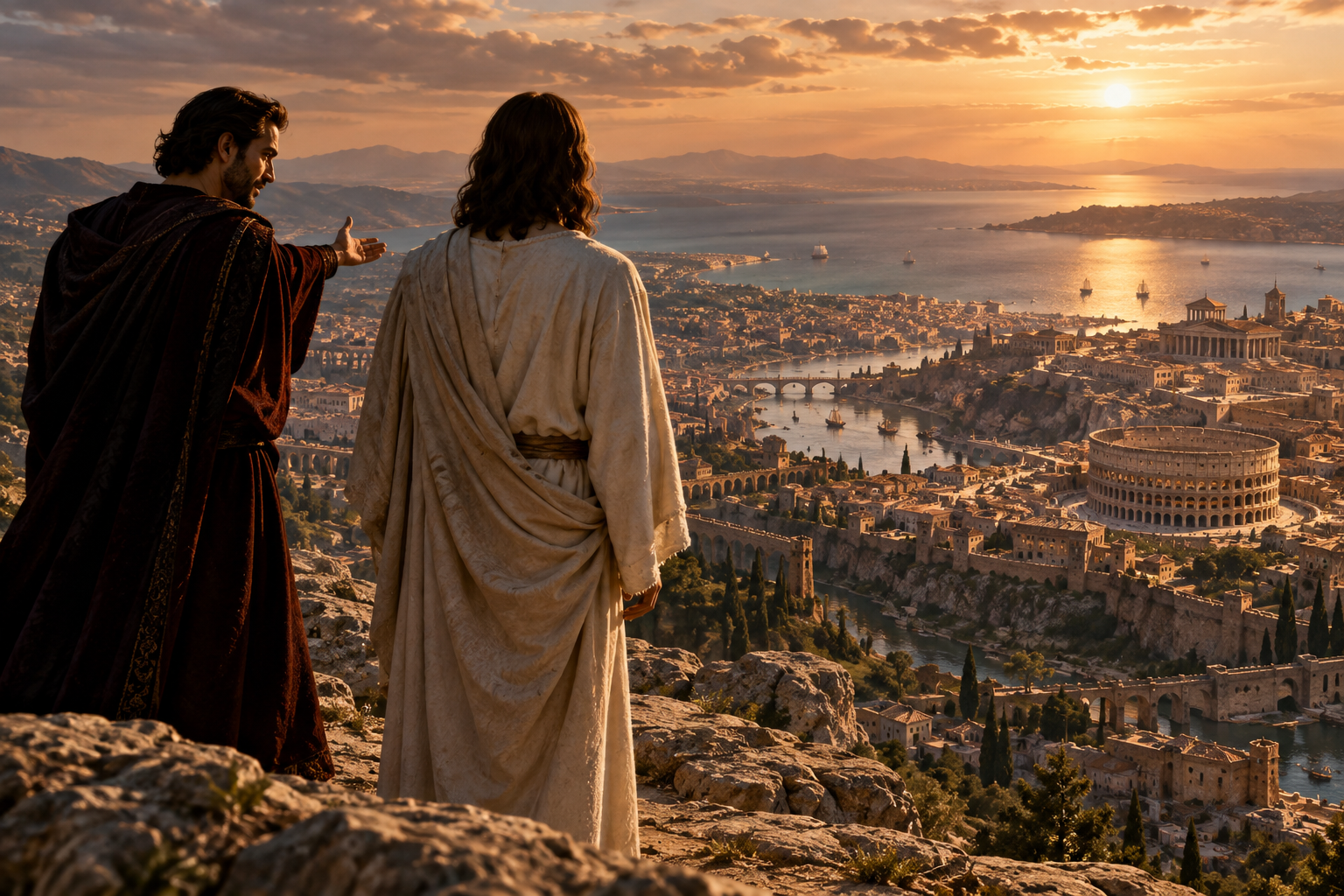
Satan claimed control over earthly kingdoms when he tempted Jesus, offering them if Jesus would bow to him.
“Again, the devil taketh him up into an exceeding high mountain, and sheweth him all the kingdoms of the world, and the glory of them;
And saith unto him, All these things will I give thee, if thou wilt fall down and worship me” (Matt.4:8-9)
Rome held power over many client kingdoms, including Judah. Satan claimed authority over all pagan kingdoms throughout the world and, through Rome, even ruled over God’s chosen land. No nation escaped his deceptive influence, but Rome served as his greatest instrument. It was the kingdom over kingdoms. In the Garden of Eden, Satan disguised himself as a beast of the field (Gen. 3:1) to deceive Eve into disobeying God. Likewise, earthly governments that follow Satan’s will are called “beasts”—they act as his disguise and voice.
Rome’s pagan state religion was something God had previously warned about in the law, saying it actually connected people to demons (see Deuteronomy 32:16–17, Psalm 106:35–38, 1 Corinthians 10:19–20, Revelation 9:20). Through this pagan religion, Satan could achieve his dream of being treated and worshipped as a god; likewise, the angels who followed him would also be regarded as gods. For Satan, being a god was not about being adored; it was about being the lawmaker—the one who ruled and controlled events. He was power-hungry, and you cannot have power unless you can create the rules others must follow. This is the position Satan desired above all: to have no god over him and to be a god to others. But to control mankind, he needed a human government to work through. Satan cannot enforce his rules on humanity without attaching himself to an earthly governmental authority.
Satan bragged about controlling Rome when tempting Jesus in the wilderness. But Jesus would not give up truth and principle to obtain a throne in Rome—a temptation that many who claimed to follow Jesus would not overcome in the future. Instead, later on, they made it seem as if Jesus had abandoned the pure truth in exchange for this throne, which completely obscured Christ’s true victory over Satan in the wilderness. No doubt, Satan turned his failure into what appeared to be a success.
The seven-headed dragon in Revelation 12 is both Rome and Satan at the same time: the earthly government that does his bidding and over which he rules. But Satan is also the ruler over the seven heads of it. He controls each head.
The seven-headed beast in Revelation 13
Unlike the dragon, which has already appeared, the seven-headed beast in Revelation 13 rises out of the water—symbolizing its emergence or birth. This reveals to John that the new power did not yet exist in his time. The beast has the same seven heads and ten horns, but now the crowns are on the horns instead of the heads. Rome, in its history, can be seen as two beasts at once because Imperial and Papal Rome coexisted for long periods. Eventually, the Pope became Rome’s sole ruler; where emperors and kings once ruled, the Pope was seated. Papal Rome functioned both as a religious and a civil government.
The Bible focuses on the most important aspects but also briefly addresses Rome’s complexity. In Daniel 2, Rome appears as the iron legs of a man, then as iron mixed with clay in the feet. In the next vision, the beast has ten horns, and another horn rises among them. God identifies this horn as His enemy and explains its role. Daniel 8 describes this horn as an extension of Rome, completing the destructive work begun by Pagan Rome. Throughout Daniel (chapters 2, 7, 8, 9, 11, and 12), the focus remains on God’s defeat of this enemy. Revelation continues this theme, explaining Rome and God’s judgments on it.
The seven-headed beast rising out of the water after the seven-headed dragon is both a contemporary beast and a successor to the high priest and head of Rome. In pagan Rome, the emperor was the high priest of the pagan religion. As Rome became more Christian in expression, the roles were initially split between the head of the Roman church and the emperor, before the Popes became sole leaders in Rome and once again became what the pagan leader had been in both roles.
Papal Rome gradually took over leadership in Rome. The first “throne” given to the Pope by imperial Rome was headship over religious affairs. By Justinian’s era, Nicene Christianity became the empire’s official religion, and the Church was legally integrated into the Roman state. Bishops received legal authority and public duties, with state protection and privileges. The pope was appointed as Judge in church matters—doctrine, clergy, discipline, and heresy. Thus, Rome and the papacy became united, forming a state church (the church often symbolized as a woman, and the state as a beast). In biblical terms, a congregation seeking authority through government is called a harlot—a woman riding a beast. The Ostrogoths controlled Rome for a time, but Emperor Justinian, ruling from Constantinople, drove them out. This allowed the Pope to assume his throne in Rome, enacting the emperor’s authority to judge heretics. At this moment, the Papacy was unified with the Roman beast, becoming a governmental religious institution—receiving “his power, and his seat, and great authority” from the seven-headed dragon. Nevertheless, it was not entirely independent.
The pope was not the political sovereign of Rome; technically, Rome remained under the Eastern Roman/Byzantine emperor and had to rely on it for its power for some time.
The book of Revelation explains its rise to power like this:
“And I stood upon the sand of the sea, and saw a beast rise up out of the sea, having seven heads and ten horns, and upon his horns ten crowns, and upon his heads the name of blasphemy.
And the beast which I saw was like unto a leopard, and his feet were as the feet of a bear, and his mouth as the mouth of a lion: and the dragon gave him his power, and his seat, and great authority” (Rev 13:1-2).
The emperors of Rome no longer had their seat in Rome, and they gave the Papal church its authority and power over Christians. Bear in mind this is what the vision given to Daniel focuses on: “and they shall be given into his hand until a time and times and the dividing of time” (Dan.7:25). This is why we know the time prophecy “a time and times and the dividing of time” begins ticking when they were made the judge of heretics and head of religious affairs, not when they get full political control over Rome.
Because both the emperor and the pope ruled as suppressing authorities over Rome—one as high priest of religious affairs, the other as emperor—they are depicted as both an existing dragon and a resurfacing beast coming out of the water. Both have seven heads; since the Papacy, though initially a separate beast, became the continuation of Rome’s leadership after the emperor lost control. This makes the Papacy both a separate beast and one of Rome’s heads.
How they got independent
To see the progress historically, we need to look at how the beast became a successor of Rome’s many governments.
As Byzantine (Eastern Roman Empire) control weakened, popes administered estates, supplied Rome, negotiated with invading armies, and organized defenses, increasingly acting as Rome’s civic leaders. However, the Eastern Empire maintained nominal control through the Exarchate of Ravenna. Seeking independence, the Pope turned to the Franks after the Lombards defeated the Exarchate. King Pepin the Short defeated the Lombards and transferred their territory to the Pope, rather than returning it to the Eastern Empire. The Donation of Pepin in AD 756 marked the beginning of 1,114 years of Papal independence, usually seen as the foundation of the Papal States. Having adopted the titles and territory of former Roman leaders, the papacy became a direct continuation of the Roman heads.
Thus, we see two different beasts with seven heads and ten horns—yet they are both a continuation of each other and, for a time, coexisted, with one receiving authority from the other. Without Rome’s transformation into a state-supported church, the Papacy would never have gained such power or influence; the Roman emperor paved the way and gave the Pope his seat. Although civil power and independence increased later, once the Pope became the sole ruler in Rome, the Eastern Roman emperor had no more control over Western Europe. This shift led to religious tensions that lasted until the Great Schism in AD 1054, when the Eastern (Orthodox) and Western (Catholic) churches finally split.
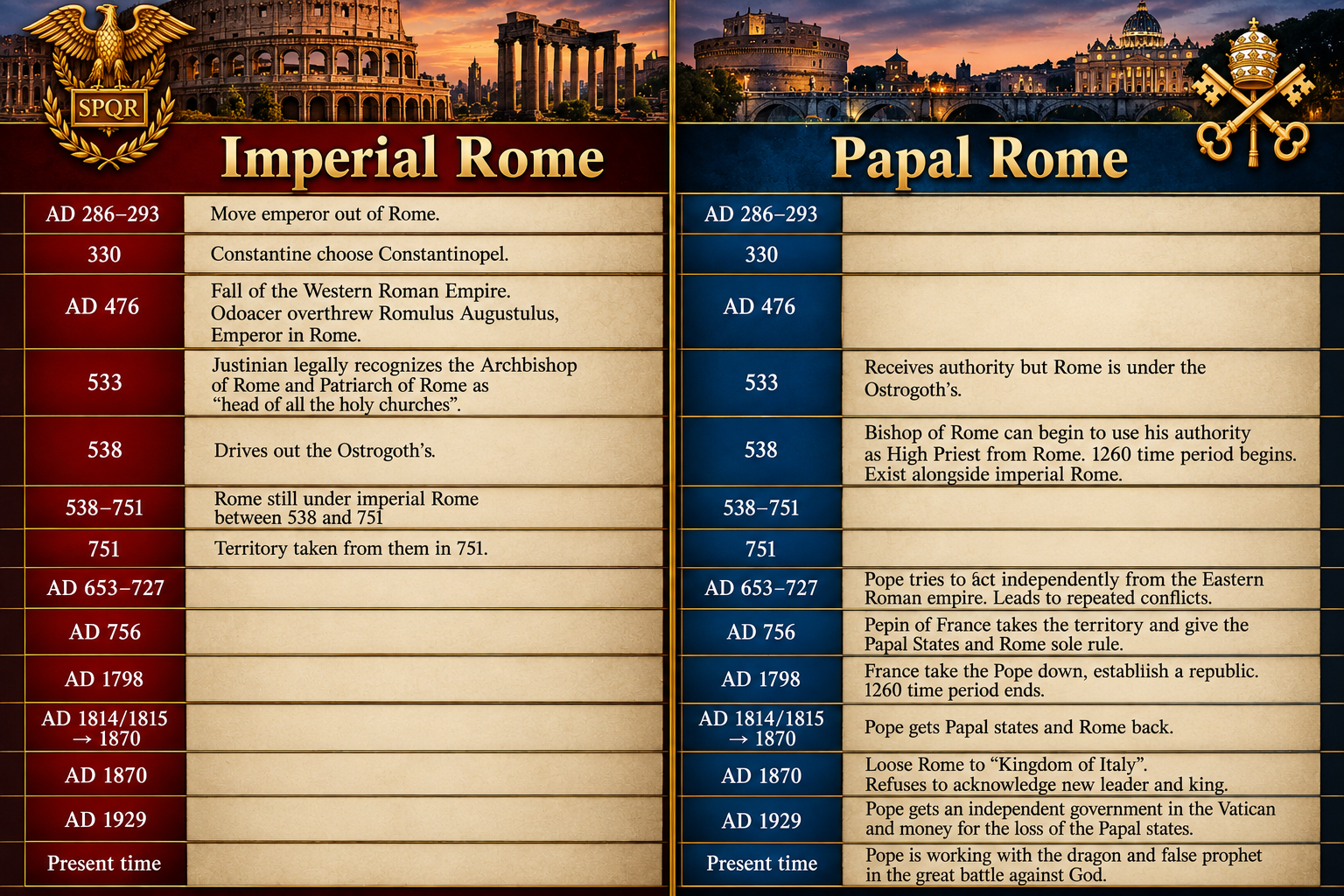
Revelation does not put Papal Rome on the scene in 756, but in 538, as it took its place in Rome as judge over the Christians. Bear in mind, in the Bible the Hebrew word for judge, Elohim, is also the word for god. Meaning, if we spoke in Hebrew, we would say he placed himself as an Elohim in the church. He made himself a god over Christ’s church, His temple.
The time prophecy never claims the Pope had all civil power when it began, only that he had great power to subdue God’s people, given by Rome, and that he would be seated in the city the emperors once reigned from.
The Bible focuses on God’s people, whom the Roman emperor gave control over long before papal independence as a governmental power: “and the dragon gave him his power, and his seat, and great authority” speaks of its authority over the church.
This is exactly what the Roman emperor did; he gave the Papal institution the role of high priest in Rome, a task that had previously belonged to the emperors. The Pope was given the role of head of the church, with the civil rights to punish heretics. And heretics, by their definition, were those who refused to call the Pope father, who were against his authority in religious affairs, and who continued to follow Biblical times and laws. And so we know the start date of the time prophecy is related to the Pope as judge over the church: “and they [God’s people] shall be given into his hand until a time and times and the dividing of time” (Dan.7:25)
God illustrates both the division of roles in Rome and their later reunification by showing both the dragon and the beast with seven heads and ten horns, only altering their appearance. This vision tells us that papal power continues Rome, but is also a new authority established by Rome, rather than a natural successor. The Papal church was a new institution. Because this new power existed alongside the old system, God had to show them as different beasts and as successive beasts at the same time.
In Daniel, each beast symbolized a government’s character and behavior. The lion, king of animals and sky (with eagle’s wings), represented Babylon’s majesty, wealth, and swiftness in battle and conquest.
When Rome is illustrated as the red dragon, it shows its pagan phase and its bloodshed. But as the new seven-headed beast, now a Papal, apparently Christian institution, it’s more accurate to change its appearance in the symbolic language.
The King of Babylon, the lion, praised the God of Israel, but also destroyed the temple, its people, and tried to kill the innocent among them. The treasures of God had been placed in his treasure. His relationship with God was confusing and all over the place. The new Roman beast had a lion’s mouth. When Nebuchadnezzar’s empire was compared to a lion, he made bold self-praising comments while also occasionally praising the God of the Bible. The Babylonian lion did both. It also praised wealth, Mammon, while holding God’s holy temple vessels. A lion itself kills its prey quickly with its mouth. So the beast in Revelation 13 has the mouth of a lion. And like lions, territorial and allowing no competition, neither did the Popes. The Papal church was efficient at both killing its opposition and convincing its followers to show it undivided obedience.
The bear’s feet are very stable, which lets it stand longer than other animals. While a lion would easily be forced down onto all fours, the bear can remain standing longer. The leopard in Daniel 7 symbolizes Alexander the Great, with its speed in conquest. With the new Rome appearing like a leopard, it shows its power would be far-reaching and its speed to its great position as a religious leader. Here we see a fast, stable, and admirable-looking creature representing what Papal Rome became—carrying the best strengths of Babylon, Medo-Persia, and Greece and but also continuing their bloodthirst and delusions, and their suppression of God’s people.
With its seven heads and ten horns, it inherited both authority and history from Pagan Rome. Making the Papal beast a continuation of all the beasts before it. The spirit of Babylon was in her. She was in the feet of the symbolic image of a man, with Babylon as the head.
Satan shifts tactics and powers.
Revelation 12 and 13 also show a shift in Satan’s tactics to defeat God’s people. It begins with the “seven-headed dragon” trying to kill the baby a pure woman gives birth to, Jesus. The woman represents God’s faithful congregation. When the child “was caught up unto God, and to his throne”, Satan is said to follow and go after “the woman”. The meaning is clear to most Christians: once Christ was on earth, all of Satan’s fury was directed at him to kill him. Once Christ ascended to heaven, this same fury was directed at those who were faithful to Christ: “Therefore rejoice, ye heavens, and ye that dwell in them. Woe to the inhabiters of the earth and of the sea! for the devil is come down unto you, having great wrath, because he knoweth that he hath but a short time” (Rev 12:12). It reveals that he directs his anger to the woman and follows after her as she flees.
Revelation 12 shows how Satan tries to defeat Christ followers by “casting his mouth water as a flood after the woman that he might cause her to be carried away of the flood” (Rev.12:15), mimicking the words of Gabriel to Daniel: “ and the people of the prince that shall come shall destroy the city and the sanctuary; and the end thereof shall be with a flood.”
Again binding the two prophecies together.
Water in the Bible often symbolizes people. (Rev. 17:15) Sending out a flood means Satan had the numbers on his side, and coming out of his mouth shows that he uses false doctrines and teachings to overcome the “woman,” which represents the faithful church. She is outnumbered and attempted to be deceived into infidelity. But rather than surrender, she flees. But only a remnant of her, we learn, remains faithful to God. This means the majority is overcome by deception or destroyed. The remnant becomes Satan’s new and last target:
“And the dragon was wroth with the woman, and went to make war with the remnant of her seed, which keep the commandments of God, and have the testimony of Jesus Christ” (Rev.12:17). They are his target, but Rome is his instrument.
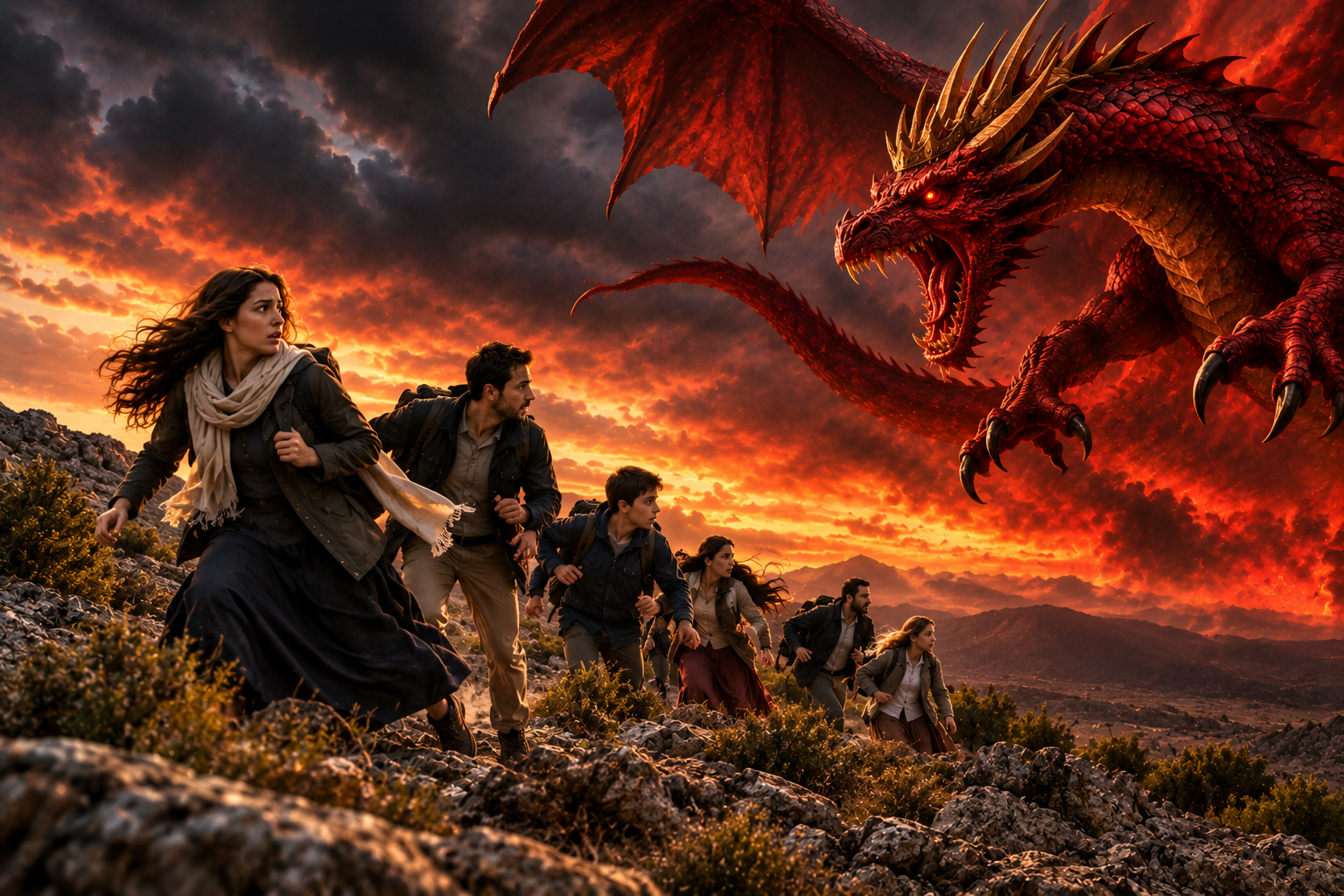
We see the devil change his tactic from trying to kill to trying to deceive. Rome is handing over authority to a new power to do the devil’s bidding. Revelation 13 doesn’t just say Rome gave power to the Papal beast; it says Satan himself created the beast: “the dragon gave him his power.” Because a beast is always a governmental power, and to be a government, you need “power”; giving power means creating it. Satan gave it the breath of life to accomplish his purpose to impersonate Christ to Christ followers.
When Christians were persecuted in the beginning, their numbers only grew; they became purer and more morally steadfast. So Satan knew he had to go in amongst them to split them up and corrupt them in that way.
A flood of false teaching, a false gospel, and a false Christ is used to lure and deceive those who “keep the commandments of God, and have the testimony of Jesus Christ”. As Satan employs this new religious-governmental institution, it’s shown how the beast achieves great success, whereas in the past he failed with the pagan Roman government. Satan becomes head of a Christian universal church. This success, the time prophecy reveals, will especially last for 1260 years. Satan, through the Papal throne, would become the christians Elohim, judge, leader, and Jesus. For the Jesus presented through Roman imagery is not really Jesus. Throughout Bible history, we see that demons are worshipped through graven images, not God. God has never and will never receive worship through imagery. Because the use of imagery in worship is a direct violation of God’s law, and worship is done by disobeying God, it is defined as witchcraft: “For rebellion is as the sin of witchcraft” (1Sa.15:23). By introducing worship before imagery in the church, Satan was accomplishing the withdrawal of God’s spirit, and he could receive the prayers and answer them instead (Rom.8:7-9; John 14:15-17, Acts 5:32). The power of the church was always truth, Spirit and God working for them. To prevent God from interfering in his newly designed church, Satan was dependent on making sure the prayers made in the church were not heard and answered by his competition. The bible is clear on what causes God to turn away from worship and prayers directed at Him:
Holding on to sin (Psalm 66:18, Isaiah 59:1–2), refusing to keep God’s law Proverbs 28:9, bloodshed (Isaiah 1:15–16), refuse to reform when God calls upon them (Proverbs 1:24–29), praying or adoring others then God (Jeremiah 11:10–14), hypocrecy and abusive (Isaiah 1:11–17), have sinful motives (James 4:3), unforgiving of trespass made against it (Mark 11:25–26) and praying against God’s will (1 John 5:14). Satan created a church that would consistantly do all these violations to make sure he could rule it in peace. The prayers to saints, Mary, the refusal to keep God’s law and changing it, the bloodshed and cruelty performed by the church were all designed to keep God out of it so Satan himself could answer the prayers and dictate its progress. Through signs and wonders, people were convinced their prayers were heard and that they were still in God’s good favor and doing God’s will. As a result, they would refute the Spirit’s call to leave the institution, allowing signs to overrule truth. Satan’s despicable plan worked.
Bear in mind that it does not mean God would not hear the prayers of souls seeking him outside the church system.
Although Satan becomes a Christian leader through a religious institution, he would get tired of it and long to be worshipped directly.
Satan’s greatest dream is to be acknowledged as himself, to be worshipped and supported as himself, but as humans have free will and are still moved by God’s spirit, he has been forced to use manipulation and deception to get his way. Humans have always disliked double morals. Accusing God of being what he is doing would never gain the greater following for Satan. He has trapped himself in his own disguise.
One of the heads of the beast of Revelation 13 is said to receive a “wound to death,” but he rises once more and “all that dwell upon the earth shall worship him” (Rev.13:8). This wound is to the seventh and final head, which would have killed the beast if it had not healed. Satan would have to reinvent his deceptions to keep it alive, which is why we have an eighth head, which is of the seven, as revealed in Revelation 17.
As we continue reading Revelation, when the seven-headed beast is wounded and loses power in its death struggle, another beast rises and uses its power to help him. And we learn that this is the time period when Jesus comes back.
By giving us all these details, God helps His people pay attention to the sequence of events to calculate the era Christ returns so they can be prepared and “that day should [not] overtake you as a thief.” (1 Th 5:4)
At the same time, God comforts His people through these revelations. He shows them that His church is not the one that sits as a queen with governmental power. Signs and wonders that seem to fool the world are not signs that He is the one behind them. That success does not always equal His blessings. God has a remnant; the beast has the rest of the world. Truth is not found with the majority. And the church that is great because of governmental alliances and power is not His church.
But the persecuted church, the one persecuted by the other church, is God’s real church. The church that keeps God’s laws and practices Christ’s culture and expression of God’s law. God comforts them and makes sure they know that those who keep his commandments and believe in Jesus are the real church. They have God’s Spirit, truth, and spiritual gifts. And that the Jewish people who reject Jesus are likewise not His people. A state of Israel created by fornicating with governments, wars won by alliances with kings and queens, with their money and weapons, is not a success from God. It’s a win through fornication. They have followed the governmental church and copied its sins and strategy, which in turn followed the footsteps of Israel’s harlotry.
The majority of Christians have followed the wrong church not because the bible is hard to understand, but because they wanted power, authority, stability, and “peace and security” over truth. They made themselves believe the lie to leave a comfortable life with the hope of acceptance by Christ at the same time.
Revelation 17
Revelation 17 retells the events with new focus points and an ending. The angel about to carry out judgment upon Papal Rome and its allies tells John: “Come hither; I will shew unto thee the judgment of the great whore that sitteth upon many waters” (Rev.17:1)
In Revelation, God explains why judgment must come, her sins, and how she gained power. Revelation 12 and 13 don’t deal with this; they say the Papal beast got its power from Pagan Rome and then explain them separately.
In Revelation 17, we go both back in time and forward in time with a focus on the harlot church’s connection with governmental power and how it is the cause of not just confusion but the “ABOMINATIONS OF THE EARTH”. That is quite the accusation. We learn that the harlot has “daughters” who follow in her footsteps.
In Revelation chapters 2 and 3, Christ reveals what would happen in the churches throughout the 2000 years they await Christ second coming. He tells about a pure church working to spread the gospel to the world but, after some time, losing its first love. He then describes the persecution the faithful experienced from Rome; he explains how they began listening to people like Balaam and the Nicolaitans, who represented the mingling of truth and error, and tells them to repent. Balaam deceived Israel to celebrate pagan feasts to compromise with their pagan women. This tells us that the church will begin to celebrate pagan feasts and do pagan customs while at the same time claiming God’s name.
Satan is said to have a throne in the church called “Pergamon.” This city was the first place in Asia where they began venerating the Roman leaders as godlike figures. This means that to hold good standing with the state, this church would have to venerate the Roman leaders as Fathers and gods.
Then it talks about the next phase where the church will divide: one group is rejected by God completely, and another hears God’s warning, and He tries to save them. In the church of Thyatira, a corrupt woman emerges as a leader, and another remnant must separate from her. And not follow her path.
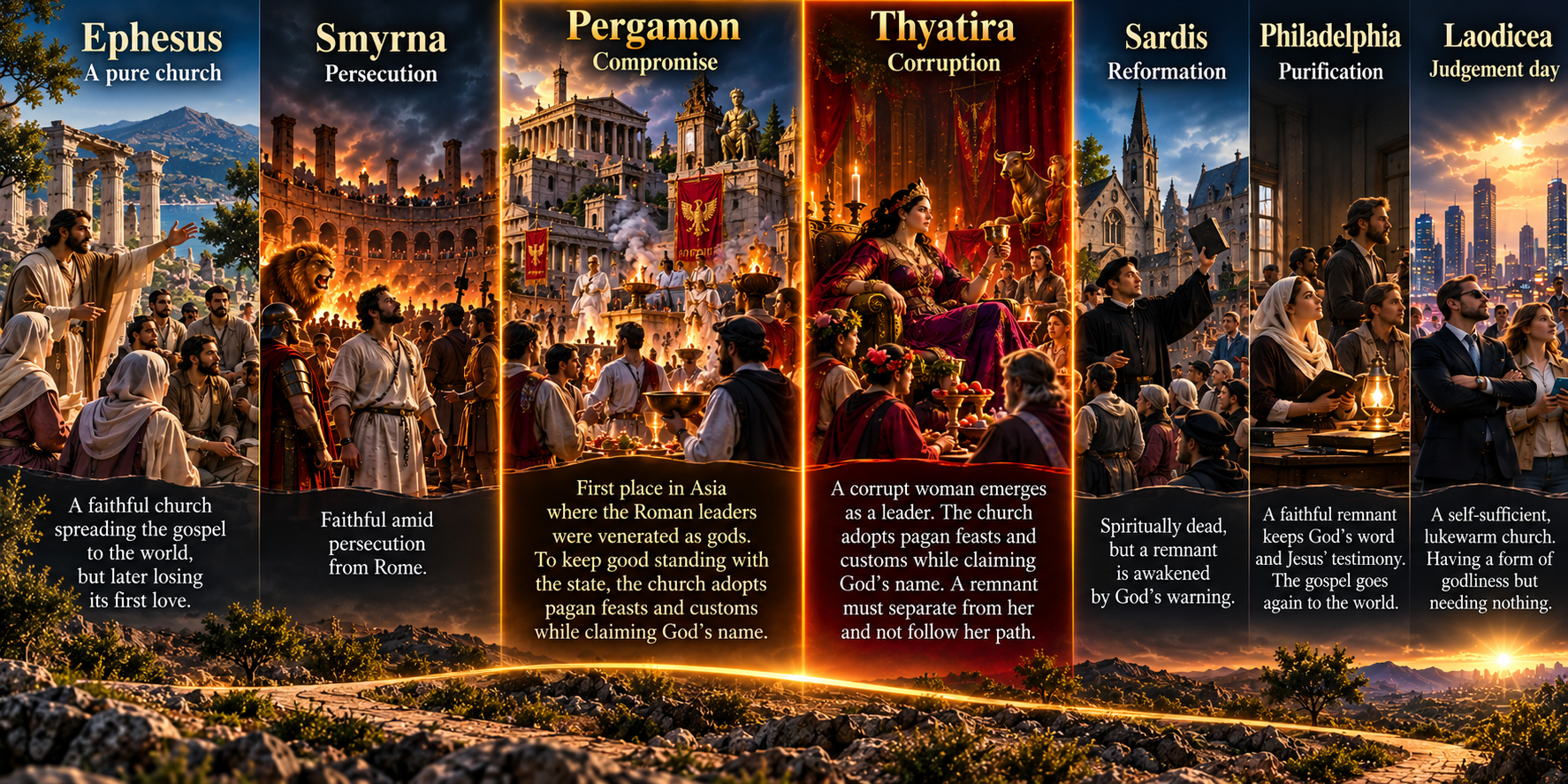
This explains why in Revelation 12 we first see the people of God as a pure woman, then her being persecuted. But suddenly we also have a harlot in the mix in Revelation 17. One is the remnant of the pure church; the other is the one who went astray and made alliances with pagan philosophy and governments. We learn the split began in the church called “Pergamum,” where the church was tested on whether they would carry the cost of not venerating political-religious leaders, culminating in the church phase called “Thyatira.” God leaves one group and continues with the one willing to repent. One woman is to “ride the beast” and another “to flee” the beast.
God compares the group that does not repent with the followers of Jezebel: “And I gave her space to repent of her fornication; and she repented not.
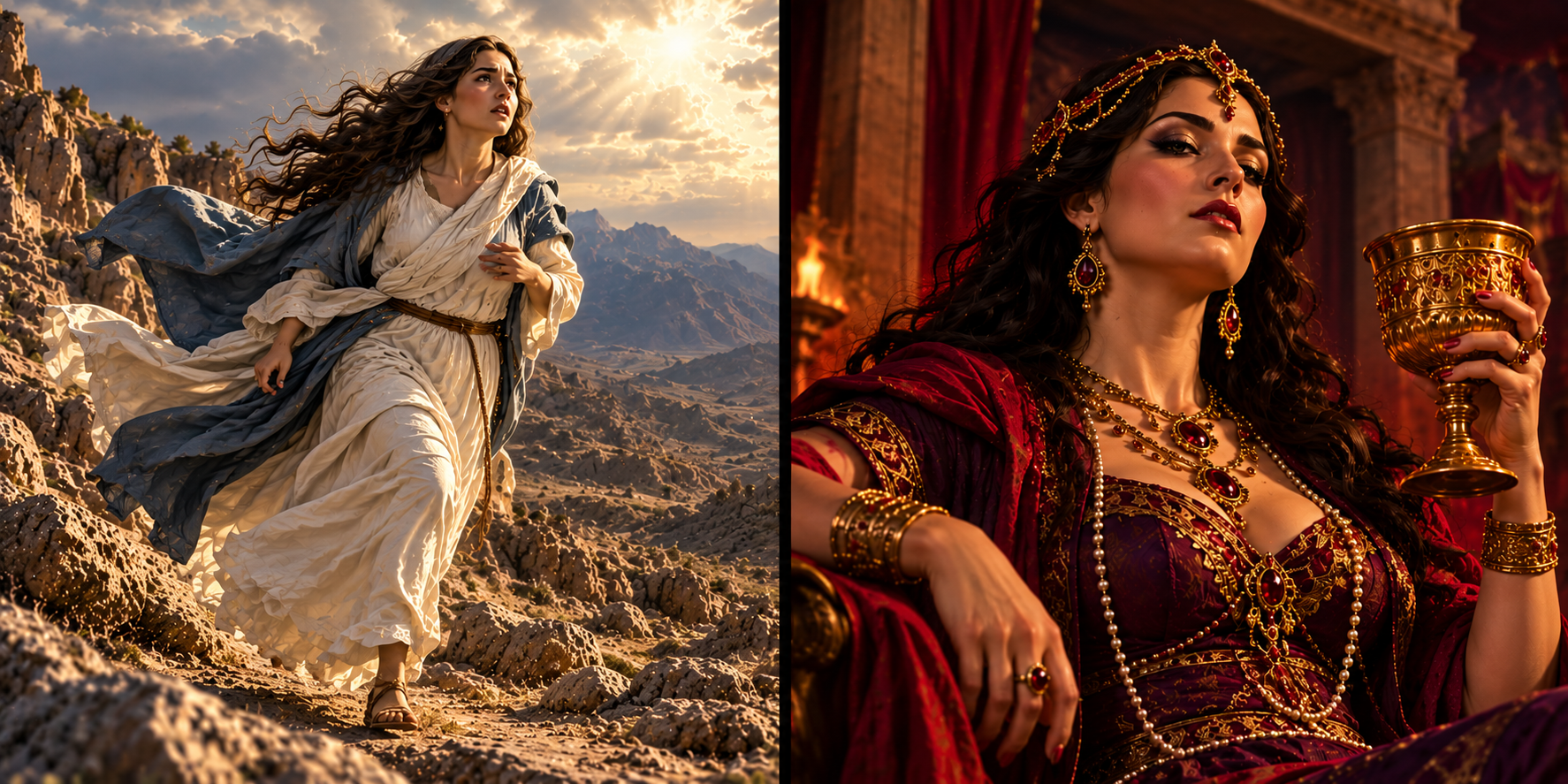
Behold, I will cast her into a bed, and them that commit adultery with her into great tribulation” (Rev 2:21-22)
Jezebel was a heathen queen who married an Israelite king and ruled over God’s people. She was said to lure both the leader of Israel as well as the people into pagan practices. She also got God’s true prophets killed. This perfectly hints at when church leadership sought a governmental alliance and unified with Rome. The “wedding” of church and state. This would result in the persecution and death of God’s true prophets and faithful. The harlot in Revelation 17 is said to have daughters; likewise Jezabels daughter, the child of this union, tried to conquer Judah, behaving just like her mother.
This also explains why God rejects the church at this stage. When they began persecuting and killing Christ followers, the Jews’ time was up. Jerusalem’s time was up, because the truth-sayers among them were driven out. The same with the church following “Jezebel,” which is Papal Rome; they began persecuting those among them telling the truth. God can not work in such a place and withdraws. All the while, the same church claims to be God’s church and acts on God’s behalf.
This is the church John sees riding a beast. She sought power, and she was willing to betray God to get it. Not being a beast herself to begin with, she rode the Roman beast. This was the phase where she used the government to accomplish her goal, win over her competition, and teach the world the false gospel. That the law is separated from the cross, that disobedience is worship, and that salvation can be bought or earned.
Before becoming a beast, she began judging God’s people true to God’s times and law as heretics. She is described: “With whom the kings of the earth have committed fornication, and the inhabitants of the earth have been made drunk with the wine of her fornication.” (Rev.17:2) And as the church’s power grew, she would one day sit “on many waters”, and be the religious authority all the way to Africa, the Middle East, Asia, and America. This church has murder on her conscience: “And I saw the woman drunken with the blood of the saints, and with the blood of the martyrs of Jesus” (Rev 17:6)
Often the church would incite governments to wars, other times to target single preachers. This amounted to millions of deaths over 1500 years, especially during their 1260 prime.
Why the beast has Seven Heads.
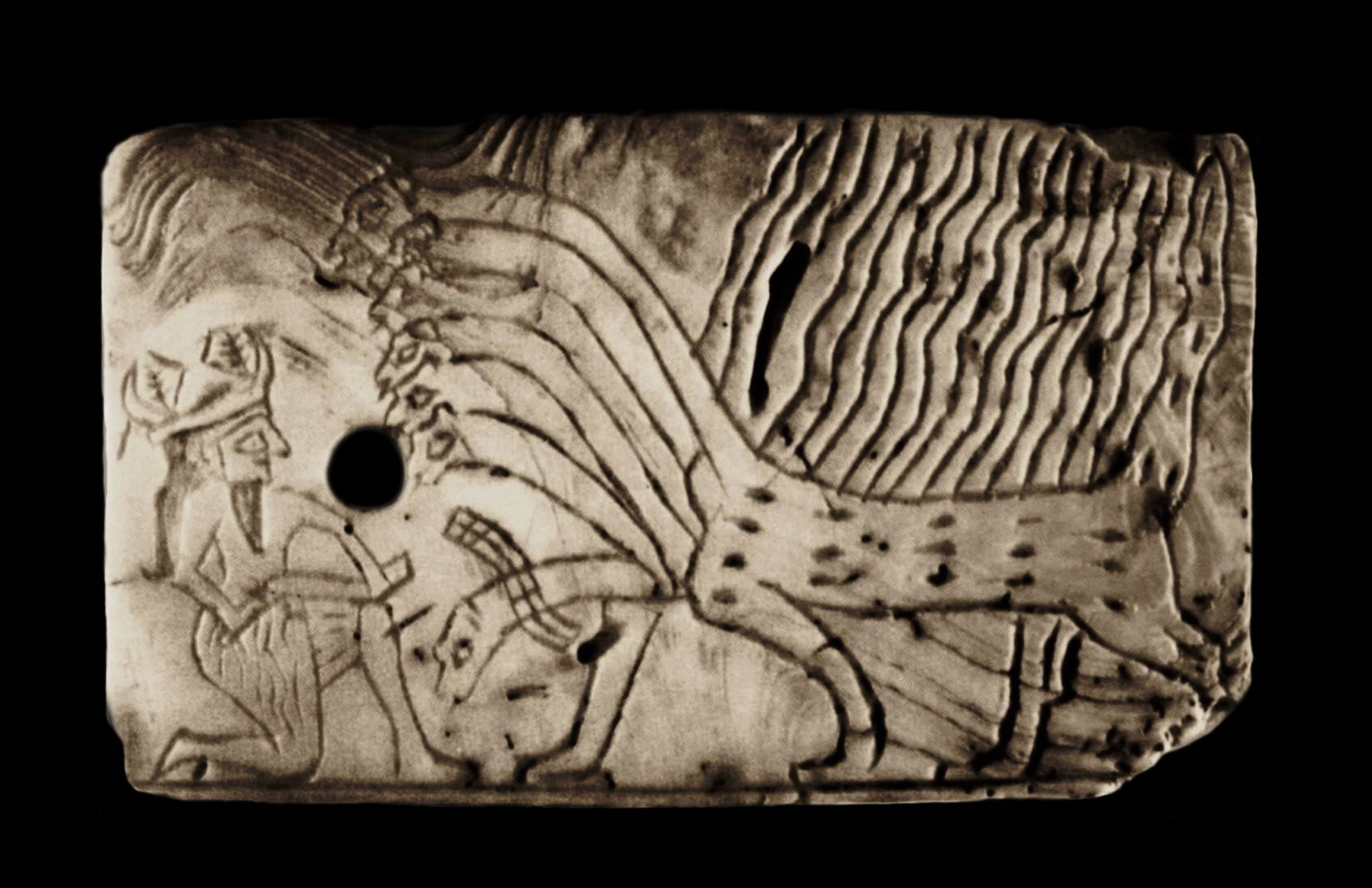
We are then told the explanation behind the Roman beast’s seven heads: “And here is the mind which hath wisdom. The seven heads are seven mountains, on which the woman sitteth.
And there are seven kings: five are fallen, and one is, and the other is not yet come; and when he cometh, he must continue a short space” (Rev 17:9-10).
In Daniel, both heads and horns symbolize kingdoms or divisions of a kingdom. In the case of the Roman beast in Daniel, the horns that come up take over the rule, as ten kingdoms existing at the same time.
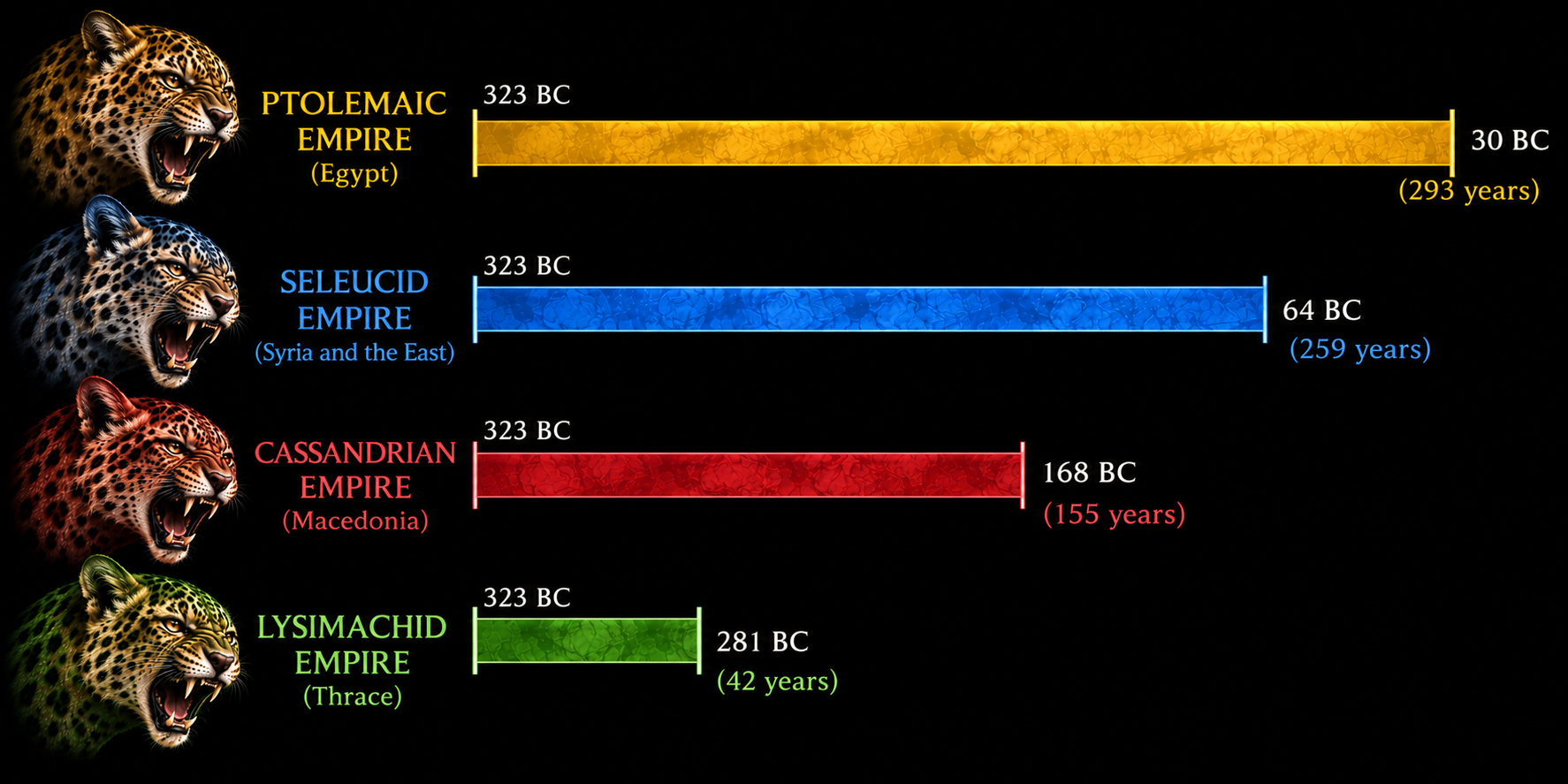
But here God is telling us that, while Western Rome will still be divided into ten horns, we see Rome itself with seven heads in succession. The four heads of the Greek beast existed at the same time; some took over another’s territory and thereby succeeded one another, and some lasted longer than others. The Greek heads all got their empire at the same time, but they did not end at the same time. For the Hellenistic empire to end, each head had to fall. All four heads had to be slain to slay the beast.
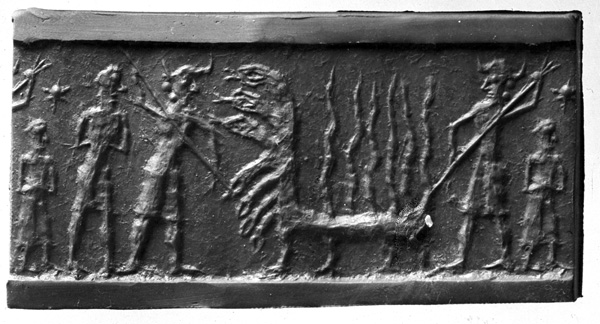
Rome took general Cassander’s territory in 168 BC. The second head, Lysimachus, lost his kingdom in 281 BC, and then the third head, the Seleucids, continued until they were defeated in 64/63 BC.
Finally, the last of the four remaining heads was Ptolemy, whose territory Rome annexed in 30 BC.
Instead of explaining all of this, God shows us four heads, four divisions. When all four are gone, the beast is slain.
As for the heads on the Roman beast, the Bible makes it clear they come one after another. They generally do not rule at the same time, and the horn represents the divisions that exist at the same time.
So we do not need to wonder whether we should count the heads of the Roman beast as divisions or as successive rulers. The Bible already tells us the answer.
The seven-headed monster comes from ancient myths and legends. The seven heads show how difficult it is to destroy the beast. When one head is destroyed, the beast continues to live through the remaining heads, so all seven must be destroyed to kill the beast. God uses this symbol to show that it will take several stages to bring the beast down. Seven different government forms must fall before the beast is finally destroyed. The seven trumpets, seven vials, and seven plagues all represent the process of destroying this beast that refuses to die. The Bible says that one of the heads is wounded to death, but it survives and continues. We know which head this is because John was told he was living during the sixth head, with the seventh still to come. So the seventh head is wounded. This means the last head almost dies, and only a “short time” remains for this head to keep the beast alive.
The reason Christ himself is the one who destroys the beast in the end is that it has been used by Satan, the current ruler of this world, for his own purpose. Rome and Satan’s throne must be defeated together as long as they are connected. This is why we see Christ capture both Satan and the beast at the same time, destroying the beast (Satan’s tool), and casting the beast into eternal fire. This means this government will never rise or exist again (see Rev. 19 & 20). It rose out of the water, but it will never rise out of the fire. Satan will no longer be able to deceive or persecute anyone through this power again.
Christ gives Satan a strong fight by weakening his power in stages and helping His people endure the era of the Iron kingdom and its “iron/clay” feet.
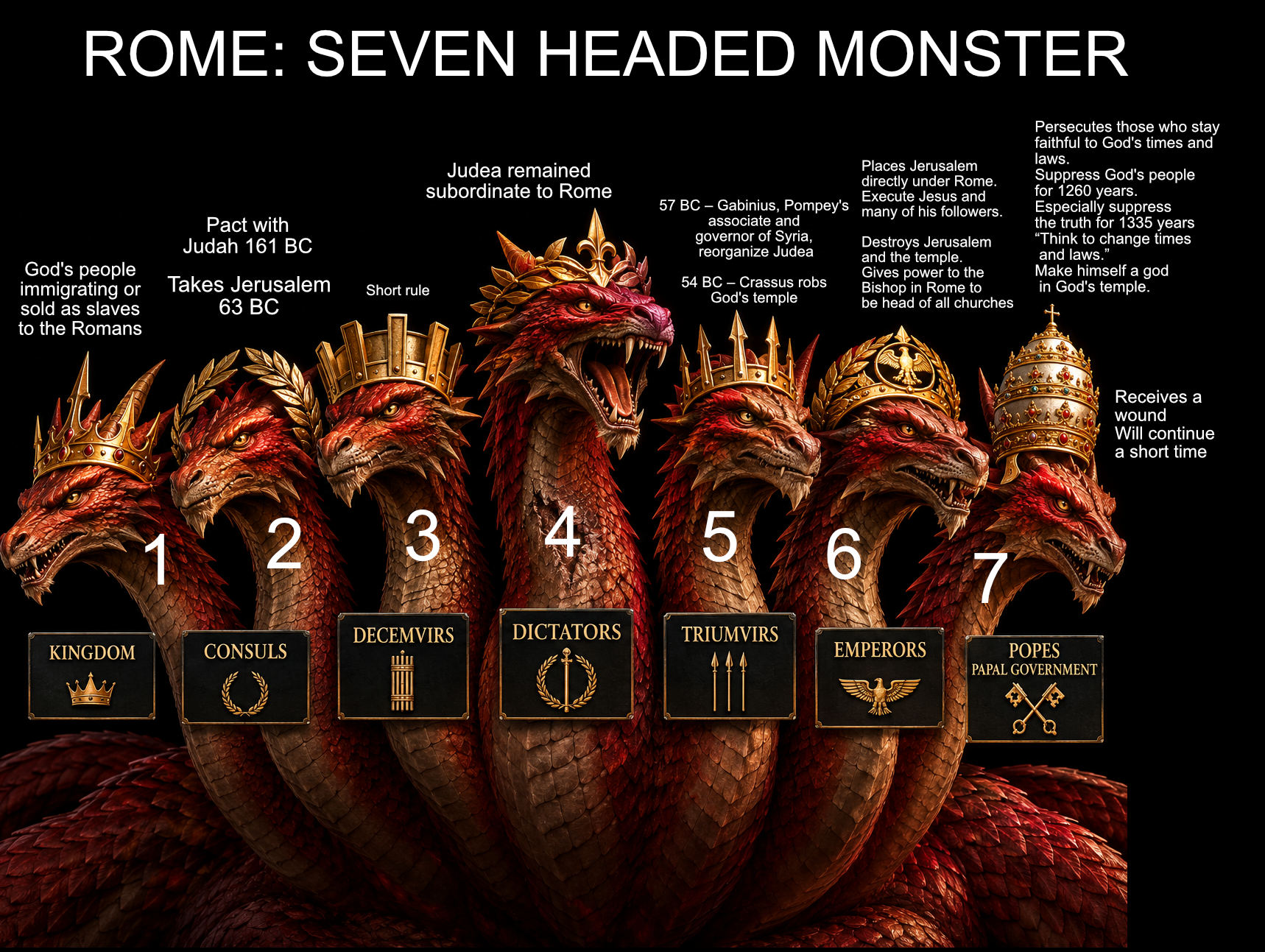
The book of Daniel describes the fall of Babylon, Medo-Persia, and even Greece. The book of Revelation is about the fall of Rome, the struggle of the true church, and the rise of Christ’s kingdom. God’s people struggle and receive help during this intense conflict. Jesus Himself warned that any kingdom claiming to be His before His coming was false and should not be followed.
The angel explains to John that five of the heads have already fallen. One exists while he is on Patmos, and another will come. There is also an eighth head, but the beast does not have eight heads, so the “eighth head” is the beast itself.
“And here is the mind which hath wisdom. The seven heads are seven mountains, on which the woman sitteth.
And there are seven kings: five are fallen, and one is, and the other is not yet come; and when he cometh, he must continue a short space.
And the beast that was, and is not, even he is the eighth, and is of the seven, and goeth into perdition” (Rev 17:9-11)
The head controls the movements, plans, morals, and ideology; it is the “control center.” The beast’s heads represent the government. Five had already passed by John’s time, and one existed then. We can see that Rome’s government went through seven main phases that gave the beast its strength and longevity. John lived in the Roman imperial phase. But Rome was not always an empire. Its head was not always an emperor, and an emperor did not always subdue God’s people. Rome changed its form of government several times. Unlike Babylon, Medo-Persia, and Greece, which were all monarchies, Rome created new forms of government and was a forerunner for others.
Rome began with seven kings; these kings were the foundation of Rome itself. But when Rome’s monarchy fell, it did not perish; instead, it adopted a new government that only increased Rome’s power on the world stage. Its second phase was the Consuls; then the third governmental head was the Decemvirs. Again, each head made Rome great. The fourth type of government was Dictators. Julius Caesar served as a dictator for a period of time, but dictatorship also occurred briefly during other transition periods. The fifth governmental head was the Triumvirate, which lasted briefly but made way for the sixth system and its leader: the Emperors. Imperial leadership took different forms, but it remained an emperor-led system, though at times divided among more than one emperor.
The seventh was the Papal government, which was a new form of government. Most historians only mention four main periods: Kingdom, Republic, Imperial, and Papal, and they leave out the shorter phases. However, these shorter phases are important to the story of Rome’s longevity and to it being “diverse from all the beasts that were before it” (Daniel 7:7). Rome did not just change its religion; it also changed its form of government, unlike the empires before it. It was a beast with many skins and many heads. Its beginning was with seven kings, and its longevity came from having seven different types of government. If Rome had not changed its style of government when it did, it would have collapsed much earlier. Each government leader helped ensure its survival in different ways.
God’s people dealt with several of the Roman heads. Rome’s relationship with God’s people began when they were slaves or fugitives among the Romans early on. During the period of the Consuls, they made a pact with Rome to strengthen themselves against the Seleucids. When Rome subdued Jerusalem in 63 BC, the Republic was already near its end. Later, during the imperial period, Rome took Jerusalem under direct rule, and during this period Christ was crucified. That was the sixth head. Imperial Rome also put John in prison on the island of Patmos, where he undoubtedly cried for his people and for Rome’s power to end, just as Daniel cried for his people, as we see in Daniel 9. John would have wanted this event just as much, but he is told that although five of Rome’s heads are gone, one exists, and another will come. This next one will reign the longest. At the very end, another form of government, which is one of the previous seven, would rule. And that is exactly what happened.
By giving us the seven heads, we learn that changes in governmental style do not change the fact that we are talking about the same beast; all are part of the beast, which includes the Papacy as one of the heads. For example, if North Korea became a democracy, it would still be North Korea. This might be the point of the seven heads: God acknowledges the big changes over time in governmental style and how leaders come to power, even differences in religion, but it’s still the same beast. By showing seven heads, God lets us know we cannot rule out the Papal government as part of this beast just because it’s different. The papal head receives the deadly wound, but it is healed. This means that although Papal power almost perished, it would rise again (Rev. 13:3).
When speaking of Papal Rome, the angel notes: “and the other [head] is not yet come; and when he cometh, he must continue a short space.” This has confused many into thinking it cannot mean the papacy, as it continued for more than a short space, being the longest-sitting Roman monarchical system.
But this refers only to what is said about one of the heads of the beast being wounded. The Papacy lost its governmental period for a time, and it looked like the Papal Rome period was over for good. Europe had gone through the Reformation, which was spreading; atheists and agnostics were taking over more and more, and once France took down the Pope and took from him the Papal States, including Rome, it looked like there was no way for him to come back and be anything noteworthy again. He had lost his position among the ten heads. Yet instead, this “seventh head,” although wounded to death, did not die. Instead, “he must continue a short space” (Rev. 17:10). Revelation 13 tells us the time period for the seventh head is 1260 years, and after receiving a wound, he rises and continues again. However, God promises that this time will be “a short space”.