


Two Princes shall come: One will be cut off, one will come to destroy
The prophet Daniel witnessed the transition from Babylon to Medo-Persia and learned that the Greek empire would rise next. At that time, Greece was already a significant power, so its future dominance was not unexpected. The Jewish people had interacted with Greeks for generations. Rome, however, was still an unknown and distant power. Yet, many prophecies focused on Rome, describing it as a coming prince.
Daniel 9 explains Christ’s first coming, the situation with His people, and why Jerusalem is ultimately destroyed. Daniel was crying over Babylon’s destruction of Jerusalem and worrying about whether they would be accepted again by God and able to rebuild the city and the temple. In answer to this prayer, God sends the angel Gabriel to explain the role of his people and Jerusalem going forward. He is told that Jerusalem would be rebuilt after a command would come “to restore and to build Jerusalem” (Dan. 9:25). This did not mean it would remain standing; the angel explains that “Messiah the Prince” would come, and even the year He would come. The angel explains that, after being rebuilt, Jerusalem would have a prolonged time to seek redemption: a full 70 prophetic weeks, which is 490 years, since one day equals one year in the prophetic timeline.
Daniel 9:24: “Seventy weeks are determined upon thy people and upon thy holy city, to finish the transgression, and to make an end of sins, and to make reconciliation for iniquity, and to bring in everlasting righteousness, and to seal up the vision and prophecy, and to anoint the Most Holy.”
The angel explains that after the word comes to restore the city, 69 prophetic weeks will pass, and then the Messiah will make Himself known.
Daniel 9:25: “Know therefore and understand, that from the going forth of the commandment to restore and to build Jerusalem unto the Messiah the Prince shall be seven weeks, and threescore and two weeks…”
This prophecy tells us that the Messiah would come exactly 483 years after the command to restore Jerusalem. The decree from Artaxerxes to Ezra in 457 BC, when combined with the 483 years, brings us to 27 AD—the year Christ was baptized and began His ministry. According to the angel, this marked the start of the final week of seven years. In the middle of this period, the Messiah would be “cut off,” which occurred in 31 AD, the true date of Christ’s crucifixion.
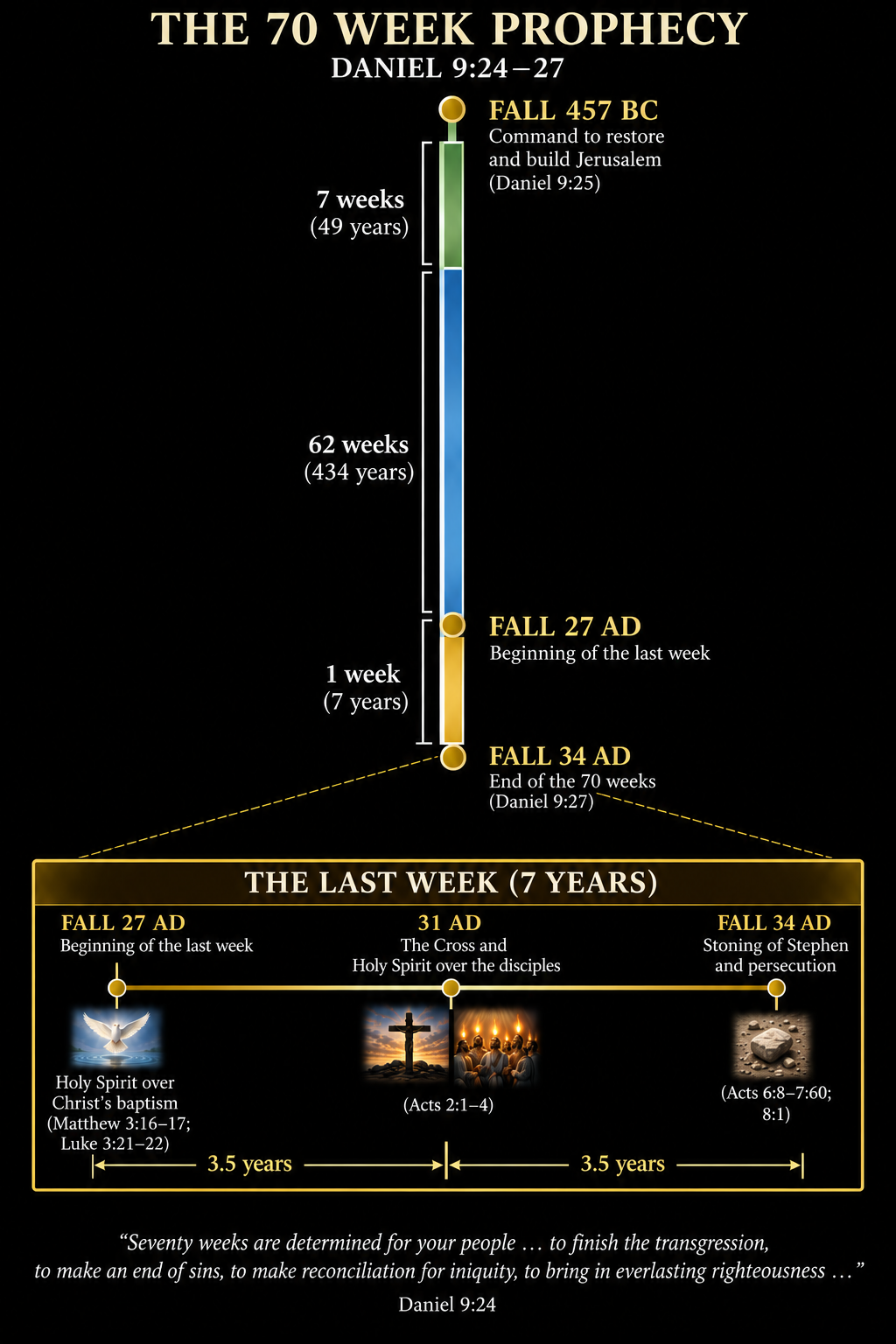
Daniel 9:27: “And he shall confirm the covenant with many for one week: and in the midst of the week he shall cause the sacrifice and the oblation to cease”
The midpoint of the seven years—3.5 years—marks the length of Christ’s public ministry, from His baptism to His crucifixion. This left another 3.5 years for Jerusalem and its people to “finish the transgression” before the end of the 70 weeks. In other words, God gave Jerusalem an additional 3.5 years after Christ’s death. During this time, the apostles received the Holy Spirit and began preaching and healing throughout Jerusalem, teaching its people. Like Christ, the apostles had 3.5 years to preach before they too faced rejection. After persistent resistance, the conflict reached its peak with the stoning of Stephen, a servant in the first Christian assembly. This event triggered a great persecution against Christ’s followers, forcing many to flee Jerusalem: “And Saul was consenting unto his death. And at that time there was a great persecution against the church which was at Jerusalem; and they were all scattered abroad throughout the regions of Judaea and Samaria, except the apostles.” (Acts 8:1) It’s important to note that this event sealed the fate of Jerusalem and its people, marking the end of the period given to them to “finish their transgressions.” Jesus was willing to forgive them because they did not fully grasp the seriousness of their crime at first. However, even when they did come to understand, they still refused to listen or repent. The 70 weeks are directly connected to the fall feasts, counted from the fall of 457 BC: Christ was baptized in the fall, Stephen was stoned in the fall, and the 70 weeks concluded in the fall. While God’s calendar normally begins in the spring, in the month of Abib (or Nisan), this prophetic timeline is measured from fall to fall because the seventh month is the designated month of decision in God’s law. On the Great Day of Atonement in that seventh month, the people were either judged for failing to repent and reform, or they celebrated with rejoicing and the announcement of the year of Jubilee. It was a day of mercy and forgiveness—or of rejection.
The fate of the people depended on the condition of their hearts. This was a time when God wanted captives freed, lands returned, and great rejoicing. Because the end of the 70 weeks represented either redemption or judgment, it was set in the seventh month. Instead of restoration, the people faced rejection. The 70-week prophecy is drawn from a longer timeline of 2,300 mornings and evenings, which also concludes on the Day of Atonement. This division marks a split in the church: some receive blessing, others judgment. The end of the 2,300-day period points to a judgment for Christ’s followers, while the first 70 weeks were for the Jewish people. Christians who refused to repent and accept God’s righteousness as revealed in His law were rejected at the end of those 2,300 days. Because the prophecy is centered on the feasts of the seventh month, God gave it in terms of mornings, evenings, and weeks, connecting it to the Sanctuary. In the sanctuary, daily sacrifices concluded on the Day of Atonement, when everyone’s standing was judged and the “sanctuary was cleansed.” Similarly, the 70 prophetic weeks make up exactly 10 jubilee cycles of 49 years each (7 x 7). Both prophecies focus on the seventh month, symbolizing a day of judgment and deliverance. While the 70 weeks applied to the earthly temple and its people, the 2,300 years relate to the heavenly sanctuary, which includes both.
Daniel 8:14: “unto two thousand and three hundred days; then shall the sanctuary be cleansed”.
Daniel 9:24: “Seventy weeks are determined [châthak: cut off] upon thy people and upon thy holy city”.
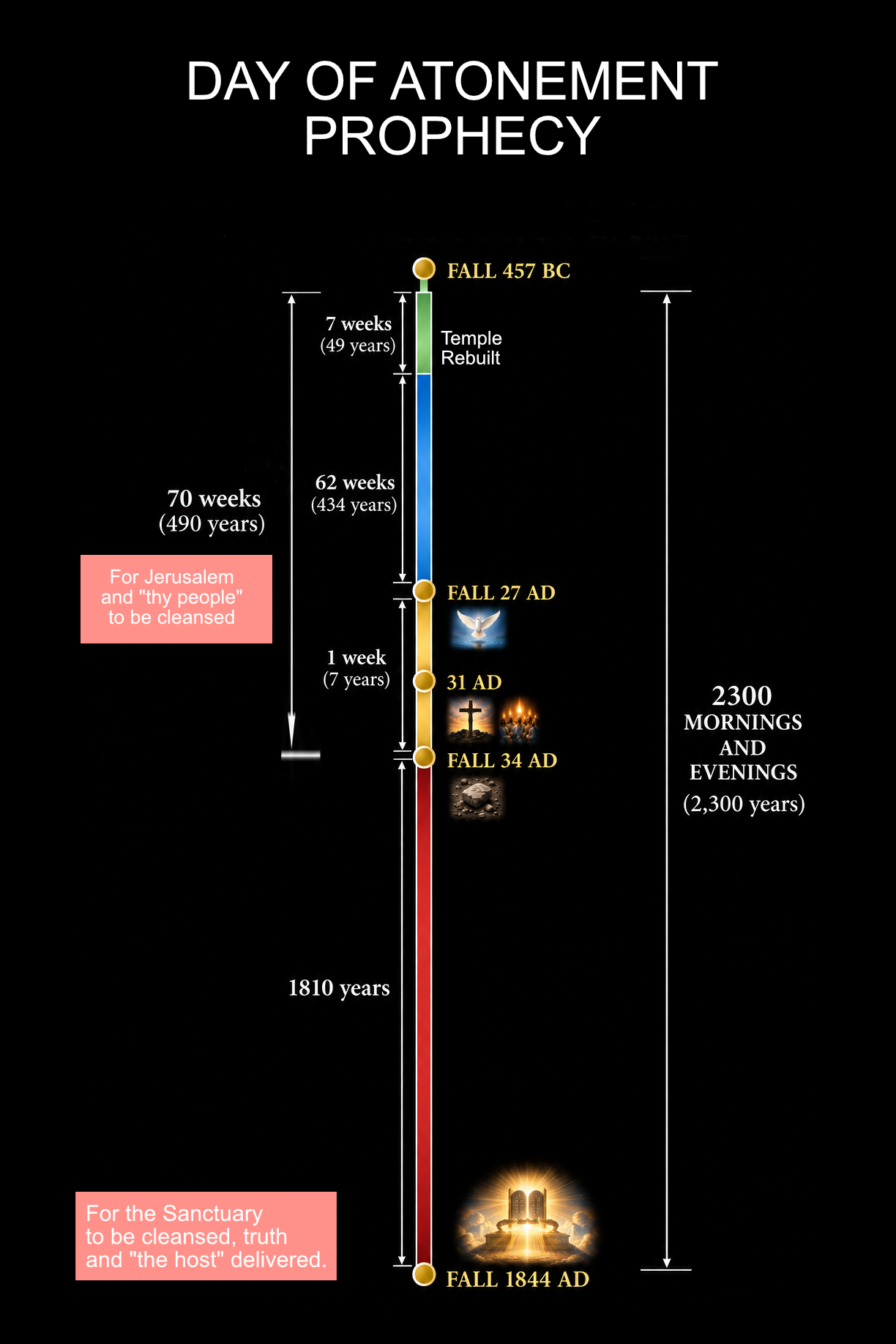
By silencing the voice of truth in the temple and Jerusalem, and forbidding it to be spoken, the people brought about God’s rejection of Jerusalem. The city was no longer the city of truth, nor were its people priests of the Most High. Jerusalem was not “holy” anymore, and they were no longer a “holy nation.” They had been given 70 prophetic weeks to “anoint the most holy,” dedicate themselves to the New Covenant, and receive pardon, but they refused. As a result, they were judged in the seventh month and rejected, missing out on their jubilee of mercy and restoration. Stephen spoke about this in his address to the people of Jerusalem and as he was being stoned.
What would have happened if they had received Christ? The temple would have remained standing as a historical testimony and a memorial of the Old and New Covenants. It would have served as a witness instead of a place of ritual, becoming a place of learning. God could have ruled from an earthly temple, not only a heavenly one. Jerusalem would have been the city of truth, where people would learn God’s law, His ways, and His salvation. The Bible always presents two timelines: one fulfilled if the people are faithful (blessing) and one if they are unfaithful (curse). Jerusalem could have been God’s center forever:
“And many people [nations] shall go and say, Come ye, and let us go up to the mountain of the LORD, to the house of the God of Jacob; and he will teach us of his ways, and we will walk in his paths: for out of Zion shall go forth the law, and the word of the LORD from Jerusalem” (Isa.2:3)
And: “How beautiful upon the mountains are the feet of him that bringeth good tidings, that publisheth peace; that bringeth good tidings of good, that publisheth salvation; that saith unto Zion, Thy God reigneth!” (Isa 52:7)
But if unfaithful, they would be driven away:
“The LORD shall cause thee to be smitten before thine enemies: thou shalt go out one way against them, and flee seven ways before them: and shalt be removed into all the kingdoms of the earth” Deu 28:25 .
…And thou shalt become an astonishment, a proverb, and a byword, among all nations whither the LORD shall lead thee. Deu 28:37
And: “The LORD shall bring a nation against thee from far …And he shall besiege thee in all thy gates, until thy high and fenced walls come down” (Deut.28:49&52)
As history shows us, and as Christ concluded, Jerusalem ceased to be the center of worship and was destroyed.
As prophesied, they rejected their Messiah despite God telling them even the year He would come almost 500 years before. Even though wise men of the east announced His birth, shepherds in the fields, and prophets in Jerusalem, they were still unprepared because they would not believe.
Through the temple priest and his miracle son, they had been forewarned of His coming, and John, as an adult, told them Christ was about to make Himself known. God gave them every chance to prepare, and they still rejected Christ.
Much of this rejection stemmed from the influence of popular first-century rabbis and the emergence of a new form of Judaism that diverged from the classical faith Christ taught. Jesus rejected the oral law, later recorded as the Talmud, and its interpretation of God and His commandments. The Jewish people were already moving in a different direction, towards a version of Judaism very different from what Abraham and Moses practiced. They lost their mission and calling as they focused on rituals and politics rather than true heart transformation. Jesus tried to rescue them from these teachings and from the superstitious misunderstandings of God and His law that dominated the new doctrines. Although they claimed to honor God’s law, they ridiculed Jesus—the Law made flesh—accusing Him of being Beelzebub. Jerusalem was headed for disaster regardless; Christ’s coming marked a crossroads. They could have chosen to follow Christ and understand the law and prophets through Him, or continue on their path toward a form of Judaism from which they could not recover. Sadly, they chose the latter.
Another reason Jerusalem and its people were given only 490 years to turn from their sins is that Christ’s coming introduced a new covenant and a new way of relating to God. The old system would no longer function as it had before. From that point on, their standing with God depended entirely on whether they followed Christ. If not, they would come to the end of their election and calling. There was no way to make reconciliation with God outside Christ. He was the New Priest.
The angel explained, “And he shall confirm the covenant with many for one week: and in the midst of the week he shall cause the sacrifice and the oblation to cease, and for the overspreading of abominations he shall make it desolate” (Dan 9:27). Jesus was the true King of Israel and Judah, and when He was rejected, they were left without a King, atonement, or priest. Naturally, this meant losing their status as God’s people and as “a kingdom of priests, and an holy nation” (Exo. 19:6). They could not be a holy nation after rejecting the only One who could sanctify and make them holy.
Rome in Daniel 9
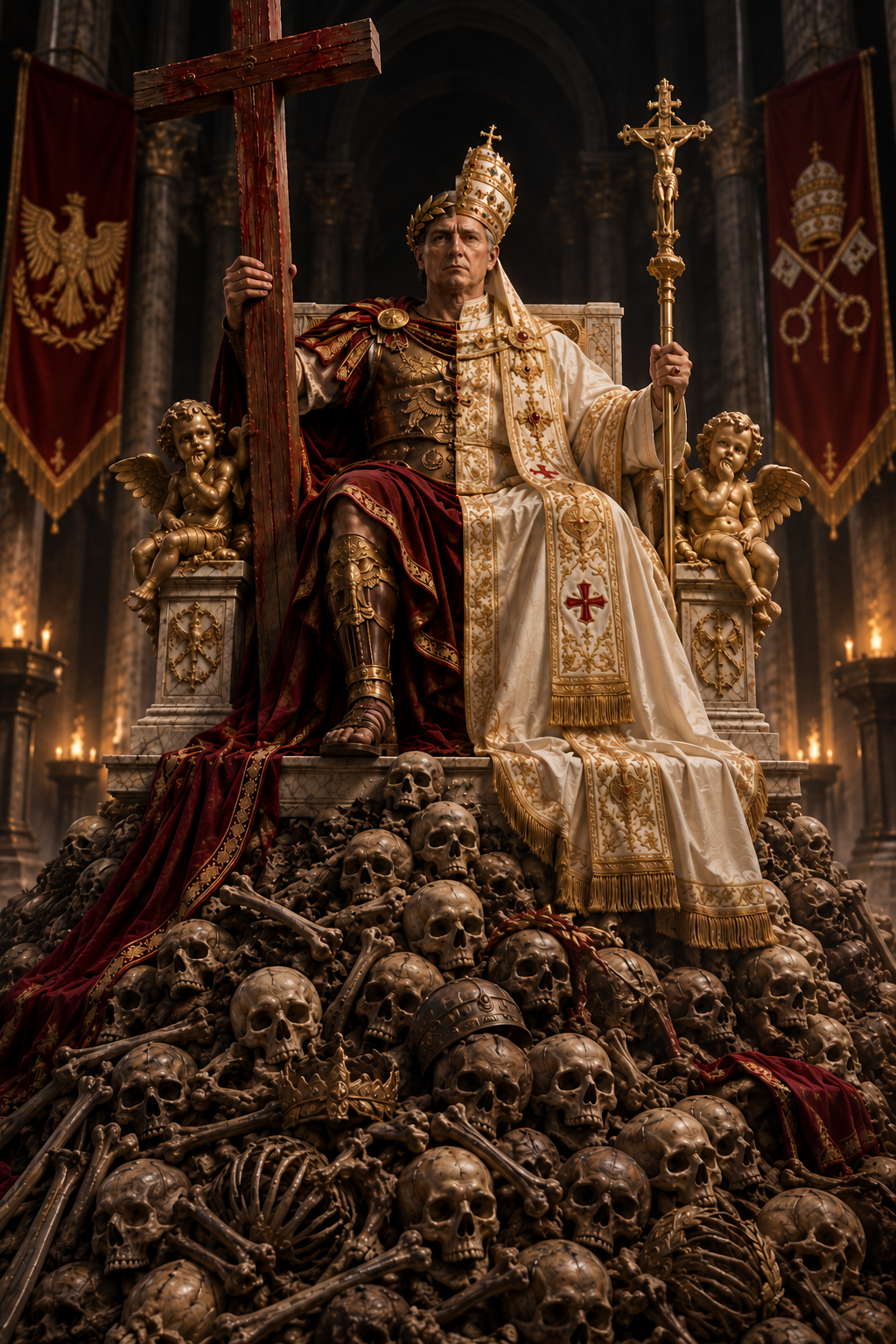
The people of the prince that shall come—Rome—are the prophesied power mentioned in Daniel 2, 7, and 8. This power destroys the city; the “flood” refers to Rome’s ongoing, relentless destruction of all things belonging to God, a process that lasts until the end of time. The phrase “the people of the prince that shall come shall destroy the city and the sanctuary” is generally understood to mean Jerusalem and the temple. However, the word used for “temple” here is just “qôdesh.” In Daniel 5:2, the temple in Jerusalem is called “the temple [hêykal] which was in Jerusalem.” In Daniel’s prayer earlier in chapter 9, he uses “miqdâsh,” meaning a dedicated, holy house. The temple was sometimes called הֵיכָל (hekal) or בַּיִת (bayit, “house”) with “qôdesh” attached, but rarely “qôdesh” alone. The language in Daniel’s prophecy comes from the angel Gabriel, who explains that sacrifice and oblation cease when the Messiah is “cut off.” Jesus said of the temple, “Behold, your house is left unto you desolate” (Matt. 23:38). He then departed from Jerusalem via the Mount of Olives, just as He had left the first temple before the Babylonians destroyed it, symbolizing its abandonment once more.
Was the angel Gabriel saying that the temple in Jerusalem remained holy after Christ was rejected—even though every sacrifice performed there was now an act of rejecting Christ’s salvation? In Daniel, the destruction of the temple in Jerusalem is encompassed by the term “city.” The “sanctuary” here likely does not refer to the Jewish temple, but to what is truly holy to God, which Daniel 8 describes as being “trodden under foot.”
According to the testimony of Ron Wyatt, the holy sanctuary items were beneath the site of Christ’s crucifixion, and His blood ratified the new covenant there. This means Rome literally trampled on holy things and the holy covenant when they besieged Jerusalem. Later, they further profaned the covenant by establishing the Papacy. When Christ ratified the new covenant, a new holy place and a new holy covenant came into existence. Daniel 9 shows that Rome would not only destroy Jerusalem, but also attack what is holy in the New Covenant. Rome would trample on God’s sanctuary and holy covenant both literally and spiritually.
About this power, God said: “he shall also stand up against the Prince of princes; but he shall be broken without hand” (Dan.8:25). The same wording is used on Christ’s second coming: “Thou sawest till that a stone was cut out without hands, which smote the image upon his feet that were of iron and clay, and brake them to pieces” (Dan 2:34), saying Christ Himself will take this power no human has been able to stop the influence of. Likewise in Daniel 7, we see the little horn dealt with when Christ comes. All of this is important and identifies the power that destroyed Jerusalem as Rome, and that a leader in Rome will continue to provoke God and exhaust His people till Christ returns. It helps us see that Gabriel is speaking of the same power over and over. And consistently points to Rome.
The setting of the verse gives us more details:
Daniel 9:26 “And after threescore and two weeks shall Messiah be cut off, but not for himself: and the people of the prince that shall come shall destroy the city and the sanctuary [qôdesh]; and the end thereof shall be with a flood, and unto the end of the war desolation’s are determined”.
Re-examining this text, we therefore see identified the power which destroys the city as the same that in Daniel 8 is said to step on God’s truth and suppress God’s people, and in Daniel 7 to try to change times and laws and blaspheme: “to give both the sanctuary [qôdesh] and the host to be trodden under foot”. The “sanctuary” [qôdesh] would not be cleansed until after 2300 mornings and evenings, ruling out the Jewish temple as what Gabriel is speaking of.
In Daniel 9, the angel Gabriel refers back to the earlier vision Daniel received in chapter 8 and identifies who it is speaking of and when these prophecies begin to be fulfilled. By doing so, the Angel Gabriel identifies Rome by placing the events mentioned in Daniel 8 after Christ’s first coming and after Jerusalem is destroyed. This excludes the popular idea that Daniel 8 spoke of the Seleucid Empire and Antiochus Epiphanes. The angel Gabriel then continues to explain that it “shall be with a flood, and unto the end of the war desolation are determined”. Again saying it will have influence till the end of time.
Therefore, the book of Daniel itself, through its time prophecies, identifies the beast and its horn, the horn in Daniel 8, and the associated crimes. This evidence is so clear that some, seeking to divert attention from Papal Rome, have proposed moving the last seven years of the prophecy to the end times as a future Antichrist, thus removing the focus from Rome. However, when we compare the visions that share the same timeline, such interpretations are exposed as unfounded.
Just as shown in Daniel’s vision, the Roman beast would have a horn that continued its attack against God and waged war against His people until the end. However, its period of trampling the “holy” would eventually be interrupted. The book of Revelation also describes these events and provides further details.
In summary, Daniel 9 teaches that after the Messiah, the “prince of princes”, “the prince of the covenant” is cut off, another “prince that shall come” comes to destroy.
Why it happened is evident at Christ’s crucifixion, when Pilate, the Roman governor, asked the Jews, “Shall I crucify your King?” and the chief priests replied, “We have no king but Caesar” (John 19:15). It was poetic justice: they chose the murderer Barabbas over Jesus, and when asked to choose their king, they pledged loyalty to Caesar. Later, when they rebelled, Rome sent soldiers who killed many inhabitants and expelled them from the city, just as Christ and His followers had been cast out. Rome even placed its supreme god where the temple once stood. Thus, as a result of the Messiah being “cut off,” a “prince shall come and destroy the city”—and also something holy. They chose the one who would destroy them instead of the One who would have saved them—the prince of destruction over the Prince of Peace. One prince is prophesied to be killed; the other is prophesied to both destroy and prosper.
The Bible provides a complete picture of the future when its passages and prophecies are understood together.
Daniel was especially curious about the meaning of the 2,300 mornings and evenings prophecy, but he was instructed to seal the vision rather than receive an explanation. We will therefore set this prophecy aside for now and address it later in our study.